EP0628792A1 - Signalerfassung eines fluidischen Oszillators - Google Patents
Signalerfassung eines fluidischen Oszillators Download PDFInfo
- Publication number
- EP0628792A1 EP0628792A1 EP94201612A EP94201612A EP0628792A1 EP 0628792 A1 EP0628792 A1 EP 0628792A1 EP 94201612 A EP94201612 A EP 94201612A EP 94201612 A EP94201612 A EP 94201612A EP 0628792 A1 EP0628792 A1 EP 0628792A1
- Authority
- EP
- European Patent Office
- Prior art keywords
- signal
- amplifier
- threshold
- threshold device
- fluid
- Prior art date
- Legal status (The legal status is an assumption and is not a legal conclusion. Google has not performed a legal analysis and makes no representation as to the accuracy of the status listed.)
- Granted
Links
Images

Classifications
-
- G—PHYSICS
- G01—MEASURING; TESTING
- G01F—MEASURING VOLUME, VOLUME FLOW, MASS FLOW OR LIQUID LEVEL; METERING BY VOLUME
- G01F1/00—Measuring the volume flow or mass flow of fluid or fluent solid material wherein the fluid passes through a meter in a continuous flow
- G01F1/05—Measuring the volume flow or mass flow of fluid or fluent solid material wherein the fluid passes through a meter in a continuous flow by using mechanical effects
- G01F1/20—Measuring the volume flow or mass flow of fluid or fluent solid material wherein the fluid passes through a meter in a continuous flow by using mechanical effects by detection of dynamic effects of the flow
- G01F1/32—Measuring the volume flow or mass flow of fluid or fluent solid material wherein the fluid passes through a meter in a continuous flow by using mechanical effects by detection of dynamic effects of the flow using swirl flowmeters
- G01F1/325—Means for detecting quantities used as proxy variables for swirl
- G01F1/3287—Means for detecting quantities used as proxy variables for swirl circuits therefor
Definitions
- the present invention relates to a system for measuring the frequency of oscillation of a fluid inside a fluid oscillator comprising means for detecting the oscillations of the fluid providing a signal representative of these oscillations.
- the invention also relates to a flow meter comprising a fluidic oscillator and such a system.
- the most common flowmeters for a fluid include moving mechanical elements, such as turbine or membrane flowmeters.
- moving mechanical elements such as turbine or membrane flowmeters.
- fluidic oscillators which do not have moving parts but which measure the vibrations of a fluid inside an oscillation chamber.
- These oscillators can be of small size and very simple architecture. Their reliability is therefore very good.
- they deliver a frequency signal, the frequency of which is proportional to the speed of the fluid entering the oscillation chamber. This signal can be easily converted to a digital signal. This feature is particularly advantageous for reading meters from a distance.
- Vortex oscillators use an obstacle placed in a pipe to generate vortices in a fluid flowing in the pipe. For an obstacle of given geometry, the frequency of detachment of the vortices is proportional to the speed of flow of the fluid.
- An oscillator of this kind is described in US Pat. No. 4,085,615.
- Coanda effect oscillators use the tendency of a fluid jet to follow the contours of a wall when the jet discharges near this wall, even if the contour of this wall moves away from the jet discharge axis.
- a fluidic oscillator of this type is described in US Pat. No.
- Detection means such as for example a pair of pressure sensors or thermal sensors located at different locations in the oscillation chamber, detect the oscillations of the fluid in the chamber.
- the detection means deliver an alternating signal having a frequency proportional to the speed of the fluid which enters the oscillation chamber.
- the average amplitude of this AC signal should remain constant.
- asymmetries in the system for example due to the location of the sensors, mean that the average signal amplitude can change, sometimes very significantly, with changes in the frequency of the signal. This problem arises in particular with vortex oscillators and flow meters used in the field of industrial metering, for example in an industrial gas meter, where the quantities and the speed of the fluid are greater than those used in the field of metering. domestic or commercial.
- the object of the present invention is to provide a simple system which consumes little current and which is capable of delivering a digital signal representative of the frequency of oscillation of the fluid even in the presence of significant variations in the signal and which in particular makes it possible to process also both low amplitude and high amplitude signals.
- the subject of the present invention is a system for measuring the frequency of oscillation of a fluid inside a fluid oscillator comprising means for detecting the oscillations of the fluid providing a signal representative of these oscillations, the detection means having a peak detector comprising a threshold device receiving a first signal corresponding to the signal representative of the oscillations, the threshold device being in a conductive state when the voltage applied to it exceeds a threshold value, the device then delivering a second signal having a voltage drop compared to the first signal, means for receiving and storing the second signal, and comparison means comparing the value of the second stored signal with the value of the first signal and delivering an output signal characteristic of the relative values of the first and second signals, characterized in that the peak detector further comprises an amplifier which receives and amplifies the signal delivered by the detection means and which supplies the first signal to the device to be threshold, the gain of the amplifier being controlled by the second signal received from the threshold device.
- the threshold device and the means for memorizing function as a buffer memory. As the amplitude of the first signal increases, the value of the signal stored in the memory will remain behind the first signal by the value of the voltage drop of the threshold device and the comparison means deliver a first output showing that the amplitude of the first signal is greater than the amplitude of the stored signal. When a peak is reached and the signal amplitude decreases, the difference between the stored signal value and the signal amplitude itself will drop below the threshold of the threshold device and the latter will no longer be in a state passerby.
- the value of the stored signal is then fixed, and when the signal decreases below the level of the stored signal value, the comparison means will deliver a different output signal, showing that the amplitude of the stored signal is now greater than 1 amplitude of the first signal and a peak has occurred.
- the gain of the amplifier is controlled by the second signal received from the threshold device means that when the amplitude of the first signal delivered by the detection means is equal to or lower than the threshold level of said threshold device, the latter is not in a conductive state, the second signal therefore has a zero value and, therefore, said first signal will be amplified by the natural gain of the amplifier.
- the amplifier of the first signal increases and is greater than the threshold level of the threshold device, this signal will not need to be amplified because said threshold device is in a conductive state and delivers a second signal whose the amplitude increases with that of the first signal. In such a case, the gain of the amplifier is equal to unity.
- the combination of the elements of the invention provides a peak detector with a rapid response which follows the amplitude of the signal from the detection means during its variations, which delivers an output when a peak is reached despite large modulations of the signal d oscillation and which allows to adapt to low amplitude signals.
- a gain limiter arrangement the gain of which depends on the amplitude of the signal delivered by the detection means, which means that this arrangement only amplifies the low amplitude signals. by consuming little energy by comparison with the circuit described in US Pat. No. 3,982,434 which amplifies all the signals by consuming more energy.
- the threshold device, the comparison means, the means for memorizing and the amplifier can be easily produced by inexpensive components in a circuit which consumes little current.
- the threshold device is in conductive state when the voltage applied to it exceeds a negative threshold or a positive threshold, that is to say, that the device is in a conductive state in a direction as in the other.
- the detector also functions to deliver an output signal for positive peaks and negative peaks.
- the threshold device comprises two diodes mounted head to tail.
- the means for memorizing can also include a capacitor.
- the amplifier is a differential amplifier, one of the two inputs of the amplifier receiving the signal delivered by the detection means and the other input receiving a signal dependent on the second memorized signal and on the output of the amplifier, the output of the amplifier providing the first signal and being connected to the device at threshold.
- a unit gain impedance adapter is disposed between the amplifier and the means for memorizing the second signal, which in a way makes it possible to isolate said memorizing means from the amplifier and to restore the amplitude of the second signal to said amplifier. .
- the impedance adapter is for example a follower circuit.
- the comparison means can also include an amplifier which receives the first and second signals at two of its inputs to compare them. All of these components are inexpensive and work together with very low current consumption.
- a system for measuring the frequency of oscillation of the fluid inside a fluidic oscillator comprises detection means 1, an amplifier 2, a peak detector 3, and a counter 4.
- the detection means are conventional and include two thermistors 5, 6, and a DC source and two resistors 7, 8.
- the thermistors 5, 6 are placed with a heat source and detect changes in temperature due to the oscillations of the fluid from the fluidic oscillator.
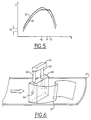
- a vortex oscillator is shown in use with the system of Figure 1 and includes an obstacle 60 placed in a pipe 61.
- the direction of flow of the fluid in the pipe 61 is indicated by the arrow.
- the flow of the fluid against the obstacle 60 generates the vortices 62 in the fluid which form alternately on each of the sides of the obstacle, thus creating a phenomenon of periodic oscillations.
- a differential pressure is established between the two sides and oscillates with a frequency proportional to the speed of flow of the fluid.
- a channel 63 connects orifices 64 formed on each side of the obstacle and a part of the fluid flows in the channel from one orifice to the other, the direction of flow of the fluid depending on the differential pressure.
- the vortex oscillator is provided with a detector 65 comprising the thermistors and the heat source of the detection means of the system of FIG. 1.
- the thermistors and the heat source are placed in the channel 63, the heat source being stake in position between the thermistors.
- one thermistor will be downstream and the other will be upstream of the heat source. When the flow direction changes the situation is reversed.
- the peak detector 3 delivers a digital signal corresponding to the number of peaks detected at the input of a counter 4 which provides an output corresponding to the frequency of the oscillations and to the speed of the fluid. It would be within the reach of a skilled person to build a flow meter using this output.
- a peak detector according to an embodiment of the invention comprises an amplifier 10 with a resistor 11 and a capacitor 12, a threshold device 13 comprising two diodes 20, 21 mounted head to tail, a capacitor 14 playing the role of a memory, a differential amplifier 15 and resistors 16, 17.
- Each diode 20 or 21 can be the junction of a TEC.
- the amplifier 10, the resistor 11 and the capacitor 12 isolate the signal at the input of the capacitor 14. In other embodiments they can be omitted.
- Each diode is characterized by a threshold and displays a voltage drop when it is in a conducting or passing state. When the amplitude of the signal at point 18 increases above the threshold of the diode 20 the diode will be in a conducting state and the value of the voltage signal at point 18 minus the voltage drop of the diode will be stored in the capacitor 14 .
- the differential amplifier 15 compares the value of the voltage at point 18 with the value of the voltage of the capacitor 14 and provides a high signal while the voltage at point 18 is higher than the voltage of the capacitor 14.
- FIG. 5 shows the variation of the voltage of the first signal at point 18 by curve 50 and the variation of the voltage of the capacitor by curve 51.
- the voltage of capacitor 51 is equal to the voltage of signal 50 minus the value Vd corresponding to the voltage drop of the diode 20 and the amplifier 15 provides a high signal.
- the voltage of the capacitor 51 is fixed.
- the signal voltage 50 drops below the voltage stored in the capacitor 51 and the output of the amplifier 15 provides a low signal.
- time t2 the difference between the signal voltage and the voltage stored in the capacitor is greater than the threshold value of the diode 21 and the capacitor voltage still follows the voltage of the first signal.
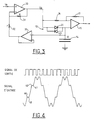
- Figure 4 shows the output signal of the circuit of Figure 2 by comparison with an example of an input signal.
- the input signal can be considered as a sinusoidal signal of high frequency but of a low amplitude superimposed on a noise of large amplitude which produces large variations in amplitude of the signal.
- the change in the direction of the input signal at each positive peak 40 or at each negative peak 41 is marked by a change in the direction of the output signal.
- the output signal can be used immediately by the counter 4 to deliver a digital value corresponding to the oscillation frequency and the speed of the fluid entering the oscillation chamber.
- FIG. 3 represents a peak detector according to a second embodiment of the invention.
- the elements having the same function as the elements in Figure 2 are indicated by the same reference numbers.
- This embodiment is, in particular, suitable for the detection of signals of amplitude equal to or lower than the threshold level of the threshold device 13 and also includes an amplifier 30, having associated resistances 31, 32 which determine the proper gain of the amplifier 30, and an amplifier 33 of gain equal to one which delivers an output corresponding to the value of the voltage of the capacitor 14 and which isolates the amplifier 30 from the capacitor 14.
- the circuit 33 is actually a follower circuit which has infinite input impedance and very low output impedance. Thus, the capacitor C does not discharge and it is therefore not necessary to use a capacitor having a large capacitance value. For a signal Ve of very low amplitude at the input, the output of the amplifier 30 will be below the threshold Vd of the diodes 20, 21 which will remain in a non-conducting state.
- the voltage of the capacitor 14 will remain zero and the amplifier will operate with a gain determined by the proportion of the values of the resistors 31, 32.
- the output of amplifier 30 will pass the threshold of diode 20 and the value of the voltage of capacitor 14 will also increase.
- the output voltage of amplifier 33 will follow the voltage of capacitor 14 and the gain of amplifier 30 will gradually decrease as the difference between Ve and the output of amplifier 33 decreases.
- the gain of the amplifier becomes equal to one and the amplifier 30 then behaves like a follower.
- intermediate values of the signal Ve will be amplified and the threshold device and the means for memorizing will detect the peaks of these signals.
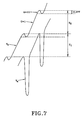
- Va the voltage of the output of the amplifier 30
- Vd the voltage drop
- Vc the voltage of the capacitor 14.
- the example in FIG. 7 illustrates the operation of the measurement system and represents an input signal Ve received by the amplifier 30 of the type of that represented in FIG. 4 as well as the first signal Va delivered by said amplifier 30 to the device at threshold 13.
- the zones Z1 and Z2 are the zones where the voltage Vc follows the voltage Va and where the gain of the amplifier 30 is equal to unity.
- the gain limiter assembly for small amplitude inversions on the input signal, for example, of the order of 0.07V, the gain limiter assembly, the gain of which depends on the amplitude of the input signal, makes it possible to deliver to the device at threshold a signal Va whose frequency is easily detectable.
- the peak-to-peak amplitude of the signal Va is somewhat compressed compared to what would happen in the case of a linear amplification and the assembly described here is therefore suitable for use on low voltage batteries (for example example 3V) thus considerably reducing energy consumption.
Landscapes
- Physics & Mathematics (AREA)
- Fluid Mechanics (AREA)
- General Physics & Mathematics (AREA)
- Measuring Volume Flow (AREA)
- Measurement Of Levels Of Liquids Or Fluent Solid Materials (AREA)
Applications Claiming Priority (2)
| Application Number | Priority Date | Filing Date | Title |
|---|---|---|---|
| FR9307042 | 1993-06-11 | ||
| FR9307042A FR2706608B1 (fr) | 1993-06-11 | 1993-06-11 | Système de mesure de signaux d'un oscillateur fluidique. |
Publications (2)
| Publication Number | Publication Date |
|---|---|
| EP0628792A1 true EP0628792A1 (de) | 1994-12-14 |
| EP0628792B1 EP0628792B1 (de) | 1998-05-13 |
Family
ID=9448024
Family Applications (1)
| Application Number | Title | Priority Date | Filing Date |
|---|---|---|---|
| EP94201612A Expired - Lifetime EP0628792B1 (de) | 1993-06-11 | 1994-06-07 | Signalerfassung eines fluidischen Oszillators |
Country Status (5)
| Country | Link |
|---|---|
| US (1) | US5574228A (de) |
| EP (1) | EP0628792B1 (de) |
| CA (1) | CA2125085A1 (de) |
| DE (1) | DE69410166T2 (de) |
| FR (1) | FR2706608B1 (de) |
Families Citing this family (2)
| Publication number | Priority date | Publication date | Assignee | Title |
|---|---|---|---|---|
| US6023969A (en) * | 1997-09-17 | 2000-02-15 | Feller; Murray F. | Flow modulated mass flow sensor |
| NO20003461L (no) * | 2000-07-05 | 2002-01-07 | Njord As | V¶skemåler |
Citations (3)
| Publication number | Priority date | Publication date | Assignee | Title |
|---|---|---|---|---|
| DE2610336A1 (de) * | 1975-03-14 | 1976-09-16 | Eastech | Anordnung und verfahren zur verarbeitung eines zusammengesetzten eingangssignals |
| FR2449870A1 (fr) * | 1979-02-26 | 1980-09-19 | Nissan Motor | Appareil de mesure d'ecoulement du type a tourbillons de karman |
| US4966040A (en) * | 1988-04-19 | 1990-10-30 | Mitsubishi Denki Kabushiki Kaisha | Karman vortex flowmeter with signal waveform shaper circuit |
Family Cites Families (2)
| Publication number | Priority date | Publication date | Assignee | Title |
|---|---|---|---|---|
| US4175256A (en) * | 1976-07-30 | 1979-11-20 | Motorola, Inc. | Dynamic threshold tone detector |
| FR2543304B1 (fr) * | 1983-03-22 | 1985-07-12 | Soletanche | Procede et dispositif pour obtenir la valeur de crete d'un signal et application a un procede et un dispositif pour determiner la durete d'un sol |
-
1993
- 1993-06-11 FR FR9307042A patent/FR2706608B1/fr not_active Expired - Fee Related
-
1994
- 1994-06-03 CA CA002125085A patent/CA2125085A1/fr not_active Abandoned
- 1994-06-07 DE DE69410166T patent/DE69410166T2/de not_active Expired - Fee Related
- 1994-06-07 EP EP94201612A patent/EP0628792B1/de not_active Expired - Lifetime
- 1994-06-10 US US08/259,749 patent/US5574228A/en not_active Expired - Fee Related
Patent Citations (3)
| Publication number | Priority date | Publication date | Assignee | Title |
|---|---|---|---|---|
| DE2610336A1 (de) * | 1975-03-14 | 1976-09-16 | Eastech | Anordnung und verfahren zur verarbeitung eines zusammengesetzten eingangssignals |
| FR2449870A1 (fr) * | 1979-02-26 | 1980-09-19 | Nissan Motor | Appareil de mesure d'ecoulement du type a tourbillons de karman |
| US4966040A (en) * | 1988-04-19 | 1990-10-30 | Mitsubishi Denki Kabushiki Kaisha | Karman vortex flowmeter with signal waveform shaper circuit |
Also Published As
| Publication number | Publication date |
|---|---|
| EP0628792B1 (de) | 1998-05-13 |
| US5574228A (en) | 1996-11-12 |
| FR2706608A1 (fr) | 1994-12-23 |
| CA2125085A1 (fr) | 1994-12-12 |
| DE69410166T2 (de) | 1998-12-24 |
| FR2706608B1 (fr) | 1995-08-18 |
| DE69410166D1 (de) | 1998-06-18 |
Similar Documents
| Publication | Publication Date | Title |
|---|---|---|
| US5000579A (en) | Frost and dew sensor | |
| EP0496661B1 (de) | Verfahren und Vorrichtung zur Geschwindigkeitsmessung einer instationären Strömung | |
| FR2602587A1 (fr) | Dispositif pour mesurer sans contact le debit volumique ou massique d'un milieu en mouvement | |
| FR2679028A1 (fr) | Oscillateur fluidique et debitmetre comportant un tel oscillateur. | |
| CH647596A5 (fr) | Procede pour determiner le volume de liquide contenu dans un recipient ferme et dispositif pour la mise en oeuvre de ce procede. | |
| FR2463936A1 (fr) | Dispositif de transmission, ou transmetteur, pour debitmetres a vortex ou a tourbillons | |
| EP2265907A1 (de) | Nichtstationärer echtzeit-durchflussmesser | |
| EP1716393B1 (de) | Messgerät für unstetige strömungen | |
| FR2462711A1 (fr) | Procede de mesure de vitesse d'ecoulement d'un fluide par determination de la duree de transit d'un marqueur, et debitmetre fonde sur ce procede | |
| EP1242792A1 (de) | Verfahren und vorrichtung zur fehlererkennung für einen ultraschalldurchflussmesser | |
| EP0628792B1 (de) | Signalerfassung eines fluidischen Oszillators | |
| US4005603A (en) | Apparatus for measuring fluid flow | |
| FR2721360A1 (fr) | Oscillateur fluidique et procédé de mesure d'une quantité volumique de fluide s'écoulant dans un tel oscillateur fluidique. | |
| FR2729466A1 (fr) | Dispositif de mesure du debit d'un fluide dans un canal pour fluides | |
| EP0752093A1 (de) | Wirbelströmungsmessermit einem profilierten messrohr | |
| FR2558954A1 (fr) | Calorimetre | |
| US3995482A (en) | Vortex swirl flowmeter sensor circuit | |
| FR2785675A1 (fr) | Soufflante comprenant un dispositif pour la determination du debit massique ou volumique du fluide vehicule | |
| EP1248944B1 (de) | Verfahren zur messung der oszillationsfrequenz eines flüssigkeitsstrahls in einem fluidischen oszillator | |
| JP2002168663A (ja) | 流量計測装置及び、漏洩検出装置 | |
| JP3344846B2 (ja) | フルイディック式ガスメータ | |
| EP1586871B1 (de) | Verfahren und Vorrichtung zur Messung einer Flüssigkeitsströmung | |
| JP2002062179A (ja) | ガスメータ | |
| EP1210608B1 (de) | Durchflussmesser für gasströmung | |
| FR2724226A1 (fr) | Dispositif de mesure de debit d'un fluide en ecoulement |
Legal Events
| Date | Code | Title | Description |
|---|---|---|---|
| PUAI | Public reference made under article 153(3) epc to a published international application that has entered the european phase |
Free format text: ORIGINAL CODE: 0009012 |
|
| AK | Designated contracting states |
Kind code of ref document: A1 Designated state(s): BE DE FR GB IT NL |
|
| 17P | Request for examination filed |
Effective date: 19950415 |
|
| GRAG | Despatch of communication of intention to grant |
Free format text: ORIGINAL CODE: EPIDOS AGRA |
|
| 17Q | First examination report despatched |
Effective date: 19970630 |
|
| GRAG | Despatch of communication of intention to grant |
Free format text: ORIGINAL CODE: EPIDOS AGRA |
|
| GRAH | Despatch of communication of intention to grant a patent |
Free format text: ORIGINAL CODE: EPIDOS IGRA |
|
| GRAH | Despatch of communication of intention to grant a patent |
Free format text: ORIGINAL CODE: EPIDOS IGRA |
|
| GRAA | (expected) grant |
Free format text: ORIGINAL CODE: 0009210 |
|
| AK | Designated contracting states |
Kind code of ref document: B1 Designated state(s): BE DE FR GB IT NL |
|
| REF | Corresponds to: |
Ref document number: 69410166 Country of ref document: DE Date of ref document: 19980618 |
|
| ITF | It: translation for a ep patent filed | ||
| GBT | Gb: translation of ep patent filed (gb section 77(6)(a)/1977) |
Effective date: 19980722 |
|
| PLBE | No opposition filed within time limit |
Free format text: ORIGINAL CODE: 0009261 |
|
| STAA | Information on the status of an ep patent application or granted ep patent |
Free format text: STATUS: NO OPPOSITION FILED WITHIN TIME LIMIT |
|
| 26N | No opposition filed | ||
| PGFP | Annual fee paid to national office [announced via postgrant information from national office to epo] |
Ref country code: FR Payment date: 20010528 Year of fee payment: 8 |
|
| REG | Reference to a national code |
Ref country code: GB Ref legal event code: IF02 |
|
| REG | Reference to a national code |
Ref country code: FR Ref legal event code: GC |
|
| PG25 | Lapsed in a contracting state [announced via postgrant information from national office to epo] |
Ref country code: FR Free format text: LAPSE BECAUSE OF NON-PAYMENT OF DUE FEES Effective date: 20030228 |
|
| REG | Reference to a national code |
Ref country code: FR Ref legal event code: ST |
|
| PGFP | Annual fee paid to national office [announced via postgrant information from national office to epo] |
Ref country code: GB Payment date: 20040602 Year of fee payment: 11 |
|
| PGFP | Annual fee paid to national office [announced via postgrant information from national office to epo] |
Ref country code: NL Payment date: 20040603 Year of fee payment: 11 |
|
| PGFP | Annual fee paid to national office [announced via postgrant information from national office to epo] |
Ref country code: DE Payment date: 20040617 Year of fee payment: 11 |
|
| REG | Reference to a national code |
Ref country code: FR Ref legal event code: DG |
|
| PGFP | Annual fee paid to national office [announced via postgrant information from national office to epo] |
Ref country code: BE Payment date: 20040813 Year of fee payment: 11 |
|
| PG25 | Lapsed in a contracting state [announced via postgrant information from national office to epo] |
Ref country code: IT Free format text: LAPSE BECAUSE OF NON-PAYMENT OF DUE FEES;WARNING: LAPSES OF ITALIAN PATENTS WITH EFFECTIVE DATE BEFORE 2007 MAY HAVE OCCURRED AT ANY TIME BEFORE 2007. THE CORRECT EFFECTIVE DATE MAY BE DIFFERENT FROM THE ONE RECORDED. Effective date: 20050607 Ref country code: GB Free format text: LAPSE BECAUSE OF NON-PAYMENT OF DUE FEES Effective date: 20050607 |
|
| PG25 | Lapsed in a contracting state [announced via postgrant information from national office to epo] |
Ref country code: BE Free format text: LAPSE BECAUSE OF NON-PAYMENT OF DUE FEES Effective date: 20050630 |
|
| PG25 | Lapsed in a contracting state [announced via postgrant information from national office to epo] |
Ref country code: NL Free format text: LAPSE BECAUSE OF NON-PAYMENT OF DUE FEES Effective date: 20060101 |
|
| PG25 | Lapsed in a contracting state [announced via postgrant information from national office to epo] |
Ref country code: DE Free format text: LAPSE BECAUSE OF NON-PAYMENT OF DUE FEES Effective date: 20060103 |
|
| GBPC | Gb: european patent ceased through non-payment of renewal fee |
Effective date: 20050607 |
|
| NLV4 | Nl: lapsed or anulled due to non-payment of the annual fee |
Effective date: 20060101 |
|
| BERE | Be: lapsed |
Owner name: *SCHLUMBERGER INDUSTRIES Effective date: 20050630 |