EP0629089A2 - Dispositif pour la transmission ou l'enregistrement d'images de télévision numérique, et dispositif pour la récéption de ces images - Google Patents
Dispositif pour la transmission ou l'enregistrement d'images de télévision numérique, et dispositif pour la récéption de ces images Download PDFInfo
- Publication number
- EP0629089A2 EP0629089A2 EP94201562A EP94201562A EP0629089A2 EP 0629089 A2 EP0629089 A2 EP 0629089A2 EP 94201562 A EP94201562 A EP 94201562A EP 94201562 A EP94201562 A EP 94201562A EP 0629089 A2 EP0629089 A2 EP 0629089A2
- Authority
- EP
- European Patent Office
- Prior art keywords
- data
- block
- channel block
- length
- channel
- Prior art date
- Legal status (The legal status is an assumption and is not a legal conclusion. Google has not performed a legal analysis and makes no representation as to the accuracy of the status listed.)
- Granted
Links
- 230000015654 memory Effects 0.000 description 84
- 230000005540 biological transmission Effects 0.000 description 16
- 238000000034 method Methods 0.000 description 9
- 230000001419 dependent effect Effects 0.000 description 5
- 238000013139 quantization Methods 0.000 description 4
- 238000010586 diagram Methods 0.000 description 3
- 238000005070 sampling Methods 0.000 description 3
- GOWMBYUZXIZENX-CAUSLRQDSA-N 1-[(2r,3s,4s,5r)-3,4-dihydroxy-5-(hydroxymethyl)oxolan-2-yl]-4-(hexadecylamino)pyrimidin-2-one Chemical compound O=C1N=C(NCCCCCCCCCCCCCCCC)C=CN1[C@H]1[C@@H](O)[C@H](O)[C@@H](CO)O1 GOWMBYUZXIZENX-CAUSLRQDSA-N 0.000 description 2
- 238000001514 detection method Methods 0.000 description 2
- 235000005156 Brassica carinata Nutrition 0.000 description 1
- 244000257790 Brassica carinata Species 0.000 description 1
- 230000004308 accommodation Effects 0.000 description 1
- 230000006835 compression Effects 0.000 description 1
- 238000007906 compression Methods 0.000 description 1
- 230000006798 recombination Effects 0.000 description 1
- 238000005215 recombination Methods 0.000 description 1
Images



Classifications
-
- H—ELECTRICITY
- H04—ELECTRIC COMMUNICATION TECHNIQUE
- H04N—PICTORIAL COMMUNICATION, e.g. TELEVISION
- H04N19/00—Methods or arrangements for coding, decoding, compressing or decompressing digital video signals
- H04N19/85—Methods or arrangements for coding, decoding, compressing or decompressing digital video signals using pre-processing or post-processing specially adapted for video compression
- H04N19/89—Methods or arrangements for coding, decoding, compressing or decompressing digital video signals using pre-processing or post-processing specially adapted for video compression involving methods or arrangements for detection of transmission errors at the decoder
-
- H—ELECTRICITY
- H04—ELECTRIC COMMUNICATION TECHNIQUE
- H04N—PICTORIAL COMMUNICATION, e.g. TELEVISION
- H04N7/00—Television systems
- H04N7/24—Systems for the transmission of television signals using pulse code modulation
- H04N7/52—Systems for transmission of a pulse code modulated video signal with one or more other pulse code modulated signals, e.g. an audio signal or a synchronizing signal
- H04N7/54—Systems for transmission of a pulse code modulated video signal with one or more other pulse code modulated signals, e.g. an audio signal or a synchronizing signal the signals being synchronous
-
- H—ELECTRICITY
- H04—ELECTRIC COMMUNICATION TECHNIQUE
- H04N—PICTORIAL COMMUNICATION, e.g. TELEVISION
- H04N9/00—Details of colour television systems
- H04N9/79—Processing of colour television signals in connection with recording
- H04N9/80—Transformation of the television signal for recording, e.g. modulation, frequency changing; Inverse transformation for playback
- H04N9/804—Transformation of the television signal for recording, e.g. modulation, frequency changing; Inverse transformation for playback involving pulse code modulation of the colour picture signal components
- H04N9/8042—Transformation of the television signal for recording, e.g. modulation, frequency changing; Inverse transformation for playback involving pulse code modulation of the colour picture signal components involving data reduction
- H04N9/8047—Transformation of the television signal for recording, e.g. modulation, frequency changing; Inverse transformation for playback involving pulse code modulation of the colour picture signal components involving data reduction using transform coding
-
- H—ELECTRICITY
- H04—ELECTRIC COMMUNICATION TECHNIQUE
- H04N—PICTORIAL COMMUNICATION, e.g. TELEVISION
- H04N5/00—Details of television systems
- H04N5/76—Television signal recording
- H04N5/78—Television signal recording using magnetic recording
- H04N5/782—Television signal recording using magnetic recording on tape
- H04N5/783—Adaptations for reproducing at a rate different from the recording rate
Definitions
- the invention relates to a device for transmitting or storing digital television pictures and to a device for receiving digital television pictures.
- the invention also relates to a storage medium on which digital pictures are stored.
- picture transform of two-dimensional blocks of, for example 8*8 pixels is generally used.
- this transform for example Discrete Cosine Transform (DCT)
- DCT Discrete Cosine Transform
- a block of coefficients is obtained whose number equals the number of pixels in each block.
- One of these coefficients, the DC coefficient represents the average brightness or colour of the block.
- the other coefficients are AC coefficients. Each of them represents the extent to which a given picture detail is present.
- the known device accommodates as many as possible code words of each data block in a corresponding channel block. As far as the space in the channel block is not adequate, the surplus of data is accommodated in other channel blocks. If there is space left, the channel block will comprise the surplus data of other data blocks as well.
- the boundary between data of the corresponding data block and surplus data of other data blocks is constituted by the previously mentioned EOB code.
- the receiver comprises two decoders.
- a first decoder receives the channel blocks and is adapted to recognize the presence of the EOB code therein. By means of this decoder the received data stream is split up into data of corresponding data blocks and surplus data.
- a second decoder receives the data blocks and ensures their complete decoding. If the size of a channel block is exceeded during decoding of a data block, the data block will be completed with the split-off surplus data until the EOB code is recognized.
- a further embodiment of the device is adapted to refrain from transmitting the start address in the absence of surplus data in a channel block and to accommodate a status code for the absence at a further predetermined position of the channel block.
- the transmission of the status code requires extra space (in principle, one bit per channel block), but practical experiments have proved that this is amply offset by the frequently occurring redundance of the (multibit) start address. If a channel block does not comprise any surplus data, the space which would be occupied by the start address is utilized for the transmission of code words.
- the start address is preferably expressed in an integral number of fixed word lengths of, for example eight bits. Then, the start address does not only occupy fewer bits, but it also simplifies the required circuitry for splitting up the data stream into corresponding data and surplus data. A possible space between data of the corresponding data block and surplus data is filled up with a dummy bit series. The start of a variable-length code word which is longer than said space may be used for this purpose, no separate definition of the dummy bit series will then be required.
- a further embodiment of the device is characterized in that the formatting means are further adapted to accommodate selected code words of at least two data blocks in corresponding successive parts of a channel block.
- this leads to a reduction of overhead information (sync words, identification words, protection bits) because now a channel block is formed per group of at least two data blocks.
- each channel block comprises at least selected code words of the corresponding data blocks, for example the code words of each data block which are representative of the DC coefficient and the most significant AC coefficients. If a group of data blocks does not completely fit in the channel block and consequently a part of the code words is accommodated in the form of surplus data in another channel block, this surplus data will always relate to the less significant AC coefficients.
- each channel block comprises surplus data, even if the group of data blocks were to fit completely in a channel block.
- the start address of the surplus data is not transmitted separately but is formed by the end of the last block section in a channel block.
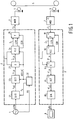
- Fig. 4 shows an embodiment of a formatting circuit shown in Fig. 1.
- Figs. 5, 6 and 7 show some diagrams to explain the operation of the formatting circuit shown in Fig. 4.
- Fig. 8 shows an embodiment of a deformatting circuit shown in Fig. 1.
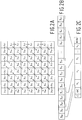
- the coefficient y 0,0 represents the DC coefficient and is a measure of the average luminance Y or chrominance U, V of the sub-picture.
- the other coefficients y i,k with i,k ⁇ 0 are the AC coefficients.
- the coefficients are read consecutively, with the DC coefficient y 0,0 in the lead.
- the sequence is shown by means of arrows in Fig. 2A and is determined by a control circuit 26 which generates address words AD(i,k) for this purpose and applies them to the transformer 22.
- the series of coefficients thus obtained is applied to a quantizing circuit 23.
- This circuit subjects the coefficients y i,k to a quantizing operation so that a quantized coefficient ⁇ i,k is obtained for each coefficient y i,k .
- the quantization is dependent on the position of the coefficient in the coefficient block.
- the quantizing circuit 23 not only receives the coefficients but also the associated address words AD(i,k). Since many AC coefficients have a small value, many quantized coefficients ⁇ i,k will have the value of zero. In this connection it is common practice to refer to these coefficients as zero coefficients and non-zero coefficients.
- the series of quantized coefficients ⁇ i,k is shown in Fig. 2B.
- C has a larger value.
- the quantized coefficients ⁇ i,k are subsequently applied to a variable-length coding (VLC) circuit 24 which subjects each coefficient block of 64 quantized coefficients ⁇ i,k to variable-length coding and converts them into a series of code words of variable length. Moreover, the VLC coding circuit supplies the length LEN for each code word.
- VLC variable-length coding
- a possible embodiment of the VLC coding circuit 24 is described in European Patent Application EP 0 260 748. In this embodiment an unambiguous code word is generated for each non-zero coefficient, together with the directly succeeding or preceding zero coefficients.
- the VLC coding circuit also receives the classification code C from the quantizing circuit 23, in order that this code is also transmitted as a code word to the decoding station.
- each coefficient block is terminated by means of an End-Of-Block (EOB) code.
- EOB code is supplied as soon as the VLC coding circuit of the control circuit 26 has received the last address word AD(7,7). It is to be noted that it is advantageous not to subject the DC coefficient to a variable-length coding but to a fixed length coding.
- the classification code C also has a fixed length.
- the code words of a coefficient block constitute a data block.
- the VLC coding circuit 24 supplies the code words bit-serially so that a bit stream ⁇ j is obtained.
- the bit stream corresponding to a data block is shown in Fig. 2C.
- the data block successively comprises: the classification code C having a fixed length of, for example 2 bits, the DC coefficient having a fixed length of, for example 9 bits, a variable number of variable-length code words V1, V2, ... V n and the EOB code having a fixed length of, for example 5 bits.
- the afore-mentioned operations are used for the luminance signal Y as well as for the chrominance signals U and V. If the sample frequency of the chrominance signal in the horizontal and vertical directions amounts to half the sample frequency of the luminance signal, one chrominance block U and one chrominance block V is obtained for every four luminance blocks Y. In this respect it is common practice to speak of a macro block. Such a macro block is shown symbolically in Fig. 3.
- the code words of a group of data blocks and their respective length LEN are subsequently applied to a formatting circuit 25 which forms the channel bit stream z j .
- the formatting circuit will hereinafter be described in greater detail.
- the first control circuit 256 is adapted to distribute the code words of the group of data blocks stored in the buffer 251 among the memories 253 and 254. It will hereinafter be assumed that a group of twelve data blocks is processed each time. These twelve data blocks are referred to as DB1 ... DB12 and correspond to a double macro block comprising two contiguous macro blocks (see Fig. 3).
- the MID memory has a layout as shown in Fig. 5A. It is 128 bytes long and comprises a first byte STA for storing status information, a section FL having a length of 24 bytes for storing fixed-length code words, a section LAC for storing variable-length code words which represent low-frequency AC coefficients and a remaining section HAC for storing other variable-length code words.
- the size of the LAC section is determined by the control circuit 256 for each double macro block. More particularly, the LAC section for each data block DB i comprises a memory section having a length L i which is dependent on the classification code C of a data block DB i . As already previously stated, C may assume the values 0 ...
- a length L is fixed for each value of C.
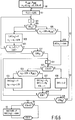
- a step 60 the operation of processing a double macro block is initialized.
- the control circuit reads the classification code C of the twelve data blocks from memory buffer 251 and sums the corresponding lengths L i .
- the sum thus obtained constitutes the length N LAC of the LAC section of the MID memory.
- the control circuit fixes the remaining length N HAC of the HAC section.
- the circuit initializes two memory addresses n L and n H which represent a bit position within the LAC and HAC sections, respectively, of the MID memory. Both addresses have the initial value 0.
- the logic value 0 is assigned to one of the bits in the status byte STA (see Fig. 5A). The significance of this status bit will be described in greater detail.
- the successive code words (sec Fig. 2C) of a data block DB i are transferred from buffer memory 251 to one of the memories MID or OVF.
- the control circuit stores the first two code words (the fixed length classification code C and DC coefficient) at fixed, predetermined positions of the FL section of the MID memory.
- a number of variable-length code words of data block DB i is subsequently stored in the LAC section of the MID memory. This is realised as follows.
- a code word V is read (step 621) and in a step 622 it is stored in the LAC section from bit position n L . Subsequently, the bit position n L is raised by the length LEN of the stored code word.
- the code word is stored in this section from bit position n H in a step 634. Subsequently, the bit position n H is raised by the length LEN of the stored code word. In a step 635 it is ascertained whether the stored code word is an EOB code. If this is not the case, the subsequent code word is read (step 631). If this is the case and if not all data blocks have been processed (step 636), the control circuit returns to the step 61 so as to process the subsequent data block.
- Steps 627 and 636 in Fig. 6 will now be described. In these steps it is ascertained whether the EOB code of the last data block DB12 has been processed. In that case the distribution of code words among the two memories MID and OVF is terminated.
- the control circuit now checks in a step 64 whether the status bit STA has maintained the logic value 0.
- the twelve data blocks are then completely stored in the MID memory and storage of surplus data in the OVF memory has not taken place.
- the start address of the still remaining space in the MID memory is computed on the basis of bit position n H in a step 65. This start address, rounded off upwards to an integral number of bytes, is stored in the last memory location of the MID memory in the form of a pointer P.
- the remaining space between the last code word and the rounded-off start address is filled with dummy bits.
- Fig. 5B shows a first example of the distribution of code words of a double macro block in the MID memory.
- the classification codes C and the DC coefficients of the twelve data blocks are at fixed positions of the FL section.
- the first memory section of the LAC section (with length L1) accommodates the variable-length code words V1, V2 and V3 of DB1, in which V3 has exceeded the length L1.
- the second memory section appears to have accommodated all code words of DB2, including its EOB code. Consequently, the first code word V1 of the third data block DB3 can already start in the second memory section.
- V1 ... V4 of the last data block DB12 are stored in the LAC section.
- the code word V5 would have caused exceeding of this section.
- the LAC section is completed with dummy bits.
- the HAC section is filled with the other code words, staring at V4 ... VN and EOB of DB1.
- the twelve data blocks appear to have such a total length that not all code words fit in the MID memory. This is indicated by the status bit STA which has the logic value 1.
- the surplus data is stored in the OVF memory, contiguous to surplus data of previous double macro blocks.
- Fig. 5C shows a second example of the distribution of code words of a double macro block in the MID memory.
- the status bit therefore has the value 0 and a pointer P points at the start address of the still empty space in the HAC section of the memory. It has been attempted to indicate by way of a shaded area that the space between the last code word and the byte limit determined by P is filled with dummy bits.
- a step 71 the control circuit reads the status bit STA into the MID memory.
- a step 72 it is ascertained whether the status bit has the logic value 1. If this is the case, the MID memory is completely filled with data of the double macro block.
- a step 73 all 128 bytes of MID memory are applied to the output via the multiplex switch. If the status bit has the logic value 0, the circuit writes the value P into the MID memory in a step 74. Subsequently the circuit successively applies to the output in a step 75: the first P bytes from the MID memory, 127-P bytes from the OVF memory and one byte of the value of P itself.
- each channel block in any case comprises the code words which are representative of a given extent of picture detail of the two corresponding macro blocks.
- the pointer P only occupies transmission space if this is really necessary. In the absence of surplus data in the channel block, the relevant byte is available for transmission of code words.
- the received channel bit stream z' j successively traverses a deformatting circuit 81, a variable-length decoding circuit 82, an inverse quantizing circuit 83, an inverse DCT circuit 84 and a D/A converter 85.
- the deformatting circuit 81 will be described in greater detail. The other circuits are generally known and will not be further described.
- the deformatting circuit 81 which is shown diagrammatically in Fig. 8 has the same structure as the formatting circuit 25 (see Fig. 4).
- the circuit comprises a channel block buffer 811, a distributor switch 812, a first memory 813, a second memory 814 and a multiplex switch 815.
- the two memories 813 and 814 will hereinafter be referred to again as MID memory and OVF memory, respectively.
- a first control circuit 816 is coupled to channel block buffer 811, controls the distributor switch 812 and supplies a write address for the MID memory.
- a second control circuit 817 supplies a read address for the MID memory and controls the multiplex switch 815. It is also coupled to the variable-length decoder 82 (see also Fig. 1).
- the first control circuit 816 is adapted to distribute the data in each channel block among the memories MID and OVF. This distributing operation will be explained with reference to a flow chart shown in Fig. 9.
- a step 91 the status bit STA is read and in a step 92 it is ascertained whether the status bit has the logic value 1. If this is the case, the complete channel block is stored in the MID memory via the distributor switch in a step 93. If the status bit has the logic value 0, the circuit reads the value P in a step 94. Subsequently, the circuit writes P bytes into the MID memory and writes the other data into the OVF memory. After this distributing operation the MID memory comprises code words of a corresponding double macro block.
- the way in which these code words are stored is in full conformity with Fig. 5B or 5C.
- the MID memory thus has an FL section of 24 bytes, a LAC section comprising twelve memory sections of length L1 and a remaining HAC section.
- the data in OVF memory is surplus data of other macro blocks.
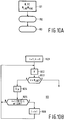
- the successive code words V are read from the LAC section in a process 102.
- This process is further shown in Fig. 10B.
- a data block counter i and a bit position counter n are initialized.
- each code word is read and applied to the variable-length decoder (step 1022).
- a step 1023 it is ascertained whether the end of the LAC section is reached. As yet, this is not the case.
- the code word V which has been read represents one or more AC coefficients.
- these coefficients ⁇ i,k are decoded by the variable-length decoder and stored in a corresponding coefficient block.
- the circuit ascertains in a step 1025 whether the limit ⁇ L i of the current LAC memory section has been exceeded or whether the decoded code word was an EOB code. If this is the case, the data block counter i is raised by 1 (step 1026) so as to indicate that the subsequent code words originate from a subsequent data block DB i . Subsequently, the next code word is read. The process 102 is left as soon as it has been determined in step 1023 that all code words are written into the LAC section. This is the case when the bit position counter n exceeds the length N LAC during reading of a code word before the code word is decoded by the variable-length decoder.
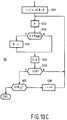
- a process 103 in which the other code words are read from the HAC section.
- This process is further shown in Fig. 10C.
- the data block counter i and the bit position counter n are reinitialized.
- the bit position counter now points at the position in the HAC section of the MID memory.
- the logic value 0 is assigned to a routing bit R. This routing bit controls the position of multiplex switch 815 (see Fig. 8).
- a code word is read from the selected memory. As yet, this will be the MID memory.
- a step 1033 it is ascertained whether the limit of the HAC section is reached. If this is not the case, the HAC section supplies a complete code word V. If this is the case, it is a code word which is no longer completely accommodated in the MID memory.
- the routing bit then obtains the value 1 so that the multiplex switch is put into its other position. The rest of the code word as well as any subsequent code word is then read from the OVF memory.
- the code word V which has thus been read is decoded in a step 1035 by the variable-length decoder and stored as coefficient ⁇ i,k in the corresponding coefficient block.
- a step 1036 it is ascertained whether the decoded code word is an EOB code.
- step 1038 the data block counter i is first raised by 1 (step 1038). In this way all code words of a double macro block are decoded until the last EOB code (step 1037) is found.
- the length of the channel blocks and the number of channel blocks per television picture will have to be in conformity with the quantity of data.
- the status byte of each channel block also comprises a indication indicating the channel block type.
- channel blocks need not necessarily start at equidistant bit positions. For the sake of robustness of the channel bit stream it is sufficient when the bit positions at which each channel block starts have been predetermined and are known at the receiver end.
- bit positions at which each channel block starts have been predetermined and are known at the receiver end.
- different formats for recorders for consumer and professional use can be standardized. The same applies to the transmission and recording of standard TV signals and HDTV signals.
Landscapes
- Engineering & Computer Science (AREA)
- Multimedia (AREA)
- Signal Processing (AREA)
- Compression, Expansion, Code Conversion, And Decoders (AREA)
- Compression Or Coding Systems Of Tv Signals (AREA)
Priority Applications (1)
| Application Number | Priority Date | Filing Date | Title |
|---|---|---|---|
| EP19940201562 EP0629089B1 (fr) | 1993-06-07 | 1994-06-01 | Dispositif pour la transmission ou l'enregistrement d'images de télévision numérique, et dispositif pour la récéption de ces images |
Applications Claiming Priority (3)
| Application Number | Priority Date | Filing Date | Title |
|---|---|---|---|
| EP93201613 | 1993-06-07 | ||
| EP93201613 | 1993-06-07 | ||
| EP19940201562 EP0629089B1 (fr) | 1993-06-07 | 1994-06-01 | Dispositif pour la transmission ou l'enregistrement d'images de télévision numérique, et dispositif pour la récéption de ces images |
Publications (3)
| Publication Number | Publication Date |
|---|---|
| EP0629089A2 true EP0629089A2 (fr) | 1994-12-14 |
| EP0629089A3 EP0629089A3 (fr) | 1995-04-12 |
| EP0629089B1 EP0629089B1 (fr) | 2000-03-15 |
Family
ID=26133839
Family Applications (1)
| Application Number | Title | Priority Date | Filing Date |
|---|---|---|---|
| EP19940201562 Expired - Lifetime EP0629089B1 (fr) | 1993-06-07 | 1994-06-01 | Dispositif pour la transmission ou l'enregistrement d'images de télévision numérique, et dispositif pour la récéption de ces images |
Country Status (1)
| Country | Link |
|---|---|
| EP (1) | EP0629089B1 (fr) |
Cited By (2)
| Publication number | Priority date | Publication date | Assignee | Title |
|---|---|---|---|---|
| EP0637174A3 (fr) * | 1993-07-30 | 1996-01-24 | Victor Company Of Japan | Méthode et appareil pour la transmission de données numériques. |
| EP0831661A3 (fr) * | 1996-09-20 | 2000-06-14 | Samsung Electronics Co., Ltd. | Appareil pour le décodage de données codées à longueur variable |
Family Cites Families (4)
| Publication number | Priority date | Publication date | Assignee | Title |
|---|---|---|---|---|
| EP0554300B1 (fr) * | 1990-10-24 | 1996-06-12 | Deutsche Thomson-Brandt Gmbh | Procede, codeur et decodeur de transmission et/ou d'enregistrement de donnees |
| EP0512623B1 (fr) * | 1991-05-10 | 1999-09-29 | Koninklijke Philips Electronics N.V. | Système de télévision pour la transmission de signaux d'images en format numérique |
| JP3134424B2 (ja) * | 1991-10-31 | 2001-02-13 | ソニー株式会社 | 可変長符号化方法及び装置 |
| DE4218695A1 (de) * | 1992-06-09 | 1993-12-16 | Thomson Brandt Gmbh | Verfahren, Coder und Decoder zur Datenübertragung und/oder -speicherung |
-
1994
- 1994-06-01 EP EP19940201562 patent/EP0629089B1/fr not_active Expired - Lifetime
Cited By (3)
| Publication number | Priority date | Publication date | Assignee | Title |
|---|---|---|---|---|
| EP0637174A3 (fr) * | 1993-07-30 | 1996-01-24 | Victor Company Of Japan | Méthode et appareil pour la transmission de données numériques. |
| US5537619A (en) * | 1993-07-30 | 1996-07-16 | Victor Company Of Japan, Ltd. | Digital data transmission method and apparatus for transmitting digital data at a high efficiency |
| EP0831661A3 (fr) * | 1996-09-20 | 2000-06-14 | Samsung Electronics Co., Ltd. | Appareil pour le décodage de données codées à longueur variable |
Also Published As
| Publication number | Publication date |
|---|---|
| EP0629089B1 (fr) | 2000-03-15 |
| EP0629089A3 (fr) | 1995-04-12 |
Similar Documents
| Publication | Publication Date | Title |
|---|---|---|
| JP3037407B2 (ja) | デジタル信号処理システム | |
| KR0128435B1 (ko) | 비디오 변환계수의 벡터 코딩방법 및 그 장치 | |
| EP0613303B1 (fr) | Appareil et méthode de compression de signal d'image | |
| EP0627153B1 (fr) | Recepteurs de television a haute definition presentant une resolution plus faible | |
| EP0557948B1 (fr) | Appareil de codage prédictif intertrame avec compensation de mouvement | |
| US5434623A (en) | Method and apparatus for image data compression using combined luminance/chrominance coding | |
| EP0765090B1 (fr) | Appareil et procédé de codage et enregistrement/reproduction d'image | |
| US5570132A (en) | Device for transmitting or storing digital television pictures, and device for receiving said pictures | |
| US5585931A (en) | Video signal recording data overflow allocation apparatus and method | |
| EP0443676A1 (fr) | Système de transmission pour images de télévision numérisées | |
| US5444490A (en) | Television system for transmitting pictures in a digital form | |
| US5410308A (en) | System for processing a digital signal including auxiliary data to facilitate data reconstitution at a decoder | |
| US6078690A (en) | Image data conversion device and method having function of inserting delimiter code into position in image data where a predetermined amount of data is reached | |
| EP0602817B1 (fr) | Dispositif de traitement d'un signal vidéo numérique | |
| US6574368B1 (en) | Image processing method, image processing apparatus and data storage media | |
| JP3285220B2 (ja) | デジタル形式で画像信号を伝送するテレビジョンシステム | |
| EP0541029B1 (fr) | Procédé et appareil pour le codage d'un signal vidéo numérique | |
| US5448368A (en) | Arrangement for recording or reproducing data reduced video information | |
| EP0629089A2 (fr) | Dispositif pour la transmission ou l'enregistrement d'images de télévision numérique, et dispositif pour la récéption de ces images | |
| EP0512623B1 (fr) | Système de télévision pour la transmission de signaux d'images en format numérique | |
| JP3357468B2 (ja) | 画像圧縮システムおよび画像再生システム | |
| EP0578308B1 (fr) | Système de télévision pour la transmission d'images sous forme numérique | |
| US6614934B1 (en) | Method and apparatus for concatenating bits of odd-length words | |
| JPH05234261A (ja) | ディジタルvtrの記録方式およびその装置 | |
| EP0624991B1 (fr) | Arrangement pour l'enregistrement et la reproduction d'informations vidéo comprimées |
Legal Events
| Date | Code | Title | Description |
|---|---|---|---|
| PUAI | Public reference made under article 153(3) epc to a published international application that has entered the european phase |
Free format text: ORIGINAL CODE: 0009012 |
|
| AK | Designated contracting states |
Kind code of ref document: A2 Designated state(s): AT DE FR GB IT |
|
| PUAL | Search report despatched |
Free format text: ORIGINAL CODE: 0009013 |
|
| AK | Designated contracting states |
Kind code of ref document: A3 Designated state(s): AT DE FR GB IT |
|
| 17P | Request for examination filed |
Effective date: 19951012 |
|
| 17Q | First examination report despatched |
Effective date: 19970828 |
|
| GRAG | Despatch of communication of intention to grant |
Free format text: ORIGINAL CODE: EPIDOS AGRA |
|
| GRAG | Despatch of communication of intention to grant |
Free format text: ORIGINAL CODE: EPIDOS AGRA |
|
| RIC1 | Information provided on ipc code assigned before grant |
Free format text: 6H 04N 7/24 A, 6H 04N 5/92 B |
|
| GRAG | Despatch of communication of intention to grant |
Free format text: ORIGINAL CODE: EPIDOS AGRA |
|
| GRAH | Despatch of communication of intention to grant a patent |
Free format text: ORIGINAL CODE: EPIDOS IGRA |
|
| GRAH | Despatch of communication of intention to grant a patent |
Free format text: ORIGINAL CODE: EPIDOS IGRA |
|
| GRAA | (expected) grant |
Free format text: ORIGINAL CODE: 0009210 |
|
| AK | Designated contracting states |
Kind code of ref document: B1 Designated state(s): AT DE FR GB IT |
|
| PG25 | Lapsed in a contracting state [announced via postgrant information from national office to epo] |
Ref country code: IT Free format text: LAPSE BECAUSE OF FAILURE TO SUBMIT A TRANSLATION OF THE DESCRIPTION OR TO PAY THE FEE WITHIN THE PRE;WARNING: LAPSES OF ITALIAN PATENTS WITH EFFECTIVE DATE BEFORE 2007 MAY HAVE OCCURRED AT ANY TIME BEFORE 2007. THE CORRECT EFFECTIVE DATE MAY BE DIFFERENT FROM THE ONE RECORDED.SCRIBED TIME-LIMIT Effective date: 20000315 Ref country code: AT Free format text: LAPSE BECAUSE OF FAILURE TO SUBMIT A TRANSLATION OF THE DESCRIPTION OR TO PAY THE FEE WITHIN THE PRESCRIBED TIME-LIMIT Effective date: 20000315 |
|
| REF | Corresponds to: |
Ref document number: 190793 Country of ref document: AT Date of ref document: 20000415 Kind code of ref document: T |
|
| REF | Corresponds to: |
Ref document number: 69423389 Country of ref document: DE Date of ref document: 20000420 |
|
| ET | Fr: translation filed | ||
| PLBE | No opposition filed within time limit |
Free format text: ORIGINAL CODE: 0009261 |
|
| STAA | Information on the status of an ep patent application or granted ep patent |
Free format text: STATUS: NO OPPOSITION FILED WITHIN TIME LIMIT |
|
| 26N | No opposition filed | ||
| PGFP | Annual fee paid to national office [announced via postgrant information from national office to epo] |
Ref country code: FR Payment date: 20010625 Year of fee payment: 8 |
|
| PGFP | Annual fee paid to national office [announced via postgrant information from national office to epo] |
Ref country code: GB Payment date: 20010629 Year of fee payment: 8 |
|
| PGFP | Annual fee paid to national office [announced via postgrant information from national office to epo] |
Ref country code: DE Payment date: 20010821 Year of fee payment: 8 |
|
| REG | Reference to a national code |
Ref country code: GB Ref legal event code: IF02 |
|
| PG25 | Lapsed in a contracting state [announced via postgrant information from national office to epo] |
Ref country code: GB Free format text: LAPSE BECAUSE OF NON-PAYMENT OF DUE FEES Effective date: 20020601 |
|
| PG25 | Lapsed in a contracting state [announced via postgrant information from national office to epo] |
Ref country code: DE Free format text: LAPSE BECAUSE OF NON-PAYMENT OF DUE FEES Effective date: 20030101 |
|
| GBPC | Gb: european patent ceased through non-payment of renewal fee |
Effective date: 20020601 |
|
| PG25 | Lapsed in a contracting state [announced via postgrant information from national office to epo] |
Ref country code: FR Free format text: LAPSE BECAUSE OF NON-PAYMENT OF DUE FEES Effective date: 20030228 |
|
| REG | Reference to a national code |
Ref country code: FR Ref legal event code: ST |