EP0629151B1 - Elastische gegenstände mit verbesserter entspannungsleistung - Google Patents
Elastische gegenstände mit verbesserter entspannungsleistung Download PDFInfo
- Publication number
- EP0629151B1 EP0629151B1 EP93906022A EP93906022A EP0629151B1 EP 0629151 B1 EP0629151 B1 EP 0629151B1 EP 93906022 A EP93906022 A EP 93906022A EP 93906022 A EP93906022 A EP 93906022A EP 0629151 B1 EP0629151 B1 EP 0629151B1
- Authority
- EP
- European Patent Office
- Prior art keywords
- elastic film
- film
- range
- copolymer
- elastic
- Prior art date
- Legal status (The legal status is an assumption and is not a legal conclusion. Google has not performed a legal analysis and makes no representation as to the accuracy of the status listed.)
- Expired - Lifetime
Links
- 238000009826 distribution Methods 0.000 claims abstract description 51
- 239000000203 mixture Substances 0.000 claims abstract description 48
- 229920001577 copolymer Polymers 0.000 claims abstract description 45
- VGGSQFUCUMXWEO-UHFFFAOYSA-N Ethene Chemical compound C=C VGGSQFUCUMXWEO-UHFFFAOYSA-N 0.000 claims abstract description 35
- 239000005977 Ethylene Substances 0.000 claims abstract description 35
- 239000004711 α-olefin Substances 0.000 claims abstract description 20
- -1 C20 polyene Chemical class 0.000 claims abstract description 18
- 239000000155 melt Substances 0.000 claims abstract description 10
- 150000001993 dienes Chemical class 0.000 claims description 14
- 238000001125 extrusion Methods 0.000 claims description 11
- 239000012968 metallocene catalyst Substances 0.000 claims description 10
- VXNZUUAINFGPBY-UHFFFAOYSA-N 1-Butene Chemical compound CCC=C VXNZUUAINFGPBY-UHFFFAOYSA-N 0.000 claims description 8
- LIKMAJRDDDTEIG-UHFFFAOYSA-N 1-hexene Chemical compound CCCCC=C LIKMAJRDDDTEIG-UHFFFAOYSA-N 0.000 claims description 7
- 239000000178 monomer Substances 0.000 claims description 7
- PRBHEGAFLDMLAL-GQCTYLIASA-N (4e)-hexa-1,4-diene Chemical compound C\C=C\CC=C PRBHEGAFLDMLAL-GQCTYLIASA-N 0.000 claims description 6
- WTQBISBWKRKLIJ-UHFFFAOYSA-N 5-methylidenebicyclo[2.2.1]hept-2-ene Chemical compound C1C2C(=C)CC1C=C2 WTQBISBWKRKLIJ-UHFFFAOYSA-N 0.000 claims description 5
- 229920000098 polyolefin Polymers 0.000 claims description 5
- CRSBERNSMYQZNG-UHFFFAOYSA-N 1-dodecene Chemical compound CCCCCCCCCCC=C CRSBERNSMYQZNG-UHFFFAOYSA-N 0.000 claims description 4
- KWKAKUADMBZCLK-UHFFFAOYSA-N 1-octene Chemical compound CCCCCCC=C KWKAKUADMBZCLK-UHFFFAOYSA-N 0.000 claims description 4
- FUDNBFMOXDUIIE-UHFFFAOYSA-N 3,7-dimethylocta-1,6-diene Chemical compound C=CC(C)CCC=C(C)C FUDNBFMOXDUIIE-UHFFFAOYSA-N 0.000 claims description 4
- KAKZBPTYRLMSJV-UHFFFAOYSA-N Butadiene Chemical compound C=CC=C KAKZBPTYRLMSJV-UHFFFAOYSA-N 0.000 claims description 4
- YWAKXRMUMFPDSH-UHFFFAOYSA-N pentene Chemical compound CCCC=C YWAKXRMUMFPDSH-UHFFFAOYSA-N 0.000 claims description 4
- 150000004291 polyenes Chemical class 0.000 claims description 4
- ZSWFCLXCOIISFI-UHFFFAOYSA-N cyclopentadiene Chemical compound C1C=CC=C1 ZSWFCLXCOIISFI-UHFFFAOYSA-N 0.000 claims description 3
- QQONPFPTGQHPMA-UHFFFAOYSA-N propylene Natural products CC=C QQONPFPTGQHPMA-UHFFFAOYSA-N 0.000 claims description 3
- 125000004805 propylene group Chemical group [H]C([H])([H])C([H])([*:1])C([H])([H])[*:2] 0.000 claims description 3
- KEMUGHMYINTXKW-NQOXHWNZSA-N (1z,5z)-cyclododeca-1,5-diene Chemical compound C1CCC\C=C/CC\C=C/CC1 KEMUGHMYINTXKW-NQOXHWNZSA-N 0.000 claims description 2
- RJUCIROUEDJQIB-GQCTYLIASA-N (6e)-octa-1,6-diene Chemical compound C\C=C\CCCC=C RJUCIROUEDJQIB-GQCTYLIASA-N 0.000 claims description 2
- VYXHVRARDIDEHS-UHFFFAOYSA-N 1,5-cyclooctadiene Chemical compound C1CC=CCCC=C1 VYXHVRARDIDEHS-UHFFFAOYSA-N 0.000 claims description 2
- 239000004912 1,5-cyclooctadiene Substances 0.000 claims description 2
- PPWUTZVGSFPZOC-UHFFFAOYSA-N 1-methyl-2,3,3a,4-tetrahydro-1h-indene Chemical compound C1C=CC=C2C(C)CCC21 PPWUTZVGSFPZOC-UHFFFAOYSA-N 0.000 claims description 2
- UFERIGCCDYCZLN-UHFFFAOYSA-N 3a,4,7,7a-tetrahydro-1h-indene Chemical compound C1C=CCC2CC=CC21 UFERIGCCDYCZLN-UHFFFAOYSA-N 0.000 claims description 2
- IZLXZVWFPZWXMZ-UHFFFAOYSA-N 5-cyclohexylidenebicyclo[2.2.1]hept-2-ene Chemical compound C1=CC2CC1CC2=C1CCCCC1 IZLXZVWFPZWXMZ-UHFFFAOYSA-N 0.000 claims description 2
- BDEXHIMNEUYKBS-UHFFFAOYSA-N 5-cyclopent-2-en-1-ylbicyclo[2.2.1]hept-2-ene Chemical compound C1=CCCC1C1C(C=C2)CC2C1 BDEXHIMNEUYKBS-UHFFFAOYSA-N 0.000 claims description 2
- INYHZQLKOKTDAI-UHFFFAOYSA-N 5-ethenylbicyclo[2.2.1]hept-2-ene Chemical compound C1C2C(C=C)CC1C=C2 INYHZQLKOKTDAI-UHFFFAOYSA-N 0.000 claims description 2
- VSQLAQKFRFTMNS-UHFFFAOYSA-N 5-methylhexa-1,4-diene Chemical compound CC(C)=CCC=C VSQLAQKFRFTMNS-UHFFFAOYSA-N 0.000 claims description 2
- CJQNJRMLJAAXOS-UHFFFAOYSA-N 5-prop-1-enylbicyclo[2.2.1]hept-2-ene Chemical compound C1C2C(C=CC)CC1C=C2 CJQNJRMLJAAXOS-UHFFFAOYSA-N 0.000 claims description 2
- UGJBFMMPNVKBPX-UHFFFAOYSA-N 5-propan-2-ylidenebicyclo[2.2.1]hept-2-ene Chemical compound C1C2C(=C(C)C)CC1C=C2 UGJBFMMPNVKBPX-UHFFFAOYSA-N 0.000 claims description 2
- 229940069096 dodecene Drugs 0.000 claims description 2
- TVMXDCGIABBOFY-UHFFFAOYSA-N n-Octanol Natural products CCCCCCCC TVMXDCGIABBOFY-UHFFFAOYSA-N 0.000 claims description 2
- JFNLZVQOOSMTJK-KNVOCYPGSA-N norbornene Chemical compound C1[C@@H]2CC[C@H]1C=C2 JFNLZVQOOSMTJK-KNVOCYPGSA-N 0.000 claims description 2
- YXRZFCBXBJIBAP-UHFFFAOYSA-N 2,6-dimethylocta-1,7-diene Chemical compound C=CC(C)CCCC(C)=C YXRZFCBXBJIBAP-UHFFFAOYSA-N 0.000 claims 1
- 238000000034 method Methods 0.000 abstract description 42
- 238000000137 annealing Methods 0.000 abstract description 27
- 239000002243 precursor Substances 0.000 abstract description 18
- 230000008569 process Effects 0.000 abstract description 18
- 238000002844 melting Methods 0.000 abstract description 10
- 230000008018 melting Effects 0.000 abstract description 10
- 229920001971 elastomer Polymers 0.000 abstract description 8
- 239000000806 elastomer Substances 0.000 abstract description 7
- 229920000642 polymer Polymers 0.000 description 42
- 229920000034 Plastomer Polymers 0.000 description 25
- 239000003054 catalyst Substances 0.000 description 15
- 238000006116 polymerization reaction Methods 0.000 description 15
- 238000004519 manufacturing process Methods 0.000 description 13
- 239000013013 elastic material Substances 0.000 description 11
- 125000004432 carbon atom Chemical group C* 0.000 description 10
- 239000000463 material Substances 0.000 description 10
- YXFVVABEGXRONW-UHFFFAOYSA-N Toluene Chemical compound CC1=CC=CC=C1 YXFVVABEGXRONW-UHFFFAOYSA-N 0.000 description 9
- 238000010828 elution Methods 0.000 description 9
- 239000000047 product Substances 0.000 description 9
- 229920001866 very low density polyethylene Polymers 0.000 description 7
- IJGRMHOSHXDMSA-UHFFFAOYSA-N Atomic nitrogen Chemical compound N#N IJGRMHOSHXDMSA-UHFFFAOYSA-N 0.000 description 6
- 239000004708 Very-low-density polyethylene Substances 0.000 description 6
- 238000006243 chemical reaction Methods 0.000 description 6
- 239000007795 chemical reaction product Substances 0.000 description 6
- 150000001875 compounds Chemical class 0.000 description 6
- 229920002635 polyurethane Polymers 0.000 description 6
- 239000004814 polyurethane Substances 0.000 description 6
- 229920002943 EPDM rubber Polymers 0.000 description 5
- 239000004698 Polyethylene Substances 0.000 description 5
- 238000001816 cooling Methods 0.000 description 5
- 229920000092 linear low density polyethylene Polymers 0.000 description 5
- 229920000573 polyethylene Polymers 0.000 description 5
- 238000002360 preparation method Methods 0.000 description 5
- 238000012360 testing method Methods 0.000 description 5
- 229910052723 transition metal Inorganic materials 0.000 description 5
- 150000003624 transition metals Chemical class 0.000 description 5
- 230000001351 cycling effect Effects 0.000 description 4
- QWTDNUCVQCZILF-UHFFFAOYSA-N isopentane Chemical compound CCC(C)C QWTDNUCVQCZILF-UHFFFAOYSA-N 0.000 description 4
- 239000004707 linear low-density polyethylene Substances 0.000 description 4
- 239000008188 pellet Substances 0.000 description 4
- 230000000704 physical effect Effects 0.000 description 4
- 239000002904 solvent Substances 0.000 description 4
- XLYOFNOQVPJJNP-UHFFFAOYSA-N water Substances O XLYOFNOQVPJJNP-UHFFFAOYSA-N 0.000 description 4
- 239000004721 Polyphenylene oxide Substances 0.000 description 3
- 230000008901 benefit Effects 0.000 description 3
- 230000015572 biosynthetic process Effects 0.000 description 3
- 230000001186 cumulative effect Effects 0.000 description 3
- 230000005484 gravity Effects 0.000 description 3
- 229910052757 nitrogen Inorganic materials 0.000 description 3
- 229920000570 polyether Polymers 0.000 description 3
- 239000002002 slurry Substances 0.000 description 3
- 229920001897 terpolymer Polymers 0.000 description 3
- 238000012956 testing procedure Methods 0.000 description 3
- 238000004804 winding Methods 0.000 description 3
- OJOWICOBYCXEKR-APPZFPTMSA-N (1S,4R)-5-ethylidenebicyclo[2.2.1]hept-2-ene Chemical compound CC=C1C[C@@H]2C[C@@H]1C=C2 OJOWICOBYCXEKR-APPZFPTMSA-N 0.000 description 2
- 238000001644 13C nuclear magnetic resonance spectroscopy Methods 0.000 description 2
- 229920000089 Cyclic olefin copolymer Polymers 0.000 description 2
- 229920000181 Ethylene propylene rubber Polymers 0.000 description 2
- 244000043261 Hevea brasiliensis Species 0.000 description 2
- CYTYCFOTNPOANT-UHFFFAOYSA-N Perchloroethylene Chemical group ClC(Cl)=C(Cl)Cl CYTYCFOTNPOANT-UHFFFAOYSA-N 0.000 description 2
- 239000004743 Polypropylene Substances 0.000 description 2
- 238000002835 absorbance Methods 0.000 description 2
- 239000012190 activator Substances 0.000 description 2
- 239000000654 additive Substances 0.000 description 2
- 150000001336 alkenes Chemical class 0.000 description 2
- 238000005266 casting Methods 0.000 description 2
- 230000008859 change Effects 0.000 description 2
- 238000012512 characterization method Methods 0.000 description 2
- 125000000058 cyclopentadienyl group Chemical group C1(=CC=CC1)* 0.000 description 2
- 239000003085 diluting agent Substances 0.000 description 2
- AFABGHUZZDYHJO-UHFFFAOYSA-N dimethyl butane Natural products CCCC(C)C AFABGHUZZDYHJO-UHFFFAOYSA-N 0.000 description 2
- 238000004090 dissolution Methods 0.000 description 2
- 238000005194 fractionation Methods 0.000 description 2
- 238000012685 gas phase polymerization Methods 0.000 description 2
- 238000010438 heat treatment Methods 0.000 description 2
- 239000011159 matrix material Substances 0.000 description 2
- 238000005259 measurement Methods 0.000 description 2
- 229920003052 natural elastomer Polymers 0.000 description 2
- 229920001194 natural rubber Polymers 0.000 description 2
- 239000003921 oil Substances 0.000 description 2
- JRZJOMJEPLMPRA-UHFFFAOYSA-N olefin Natural products CCCCCCCC=C JRZJOMJEPLMPRA-UHFFFAOYSA-N 0.000 description 2
- 229920003023 plastic Polymers 0.000 description 2
- 239000004033 plastic Substances 0.000 description 2
- BASFCYQUMIYNBI-UHFFFAOYSA-N platinum Chemical compound [Pt] BASFCYQUMIYNBI-UHFFFAOYSA-N 0.000 description 2
- 229920001155 polypropylene Polymers 0.000 description 2
- 229950011008 tetrachloroethylene Drugs 0.000 description 2
- HECLRDQVFMWTQS-RGOKHQFPSA-N 1755-01-7 Chemical compound C1[C@H]2[C@@H]3CC=C[C@@H]3[C@@H]1C=C2 HECLRDQVFMWTQS-RGOKHQFPSA-N 0.000 description 1
- IONBATYVVYDHNH-UHFFFAOYSA-N 2,6-dimethylocta-1,7-diene 3,7-dimethylocta-1,6-diene Chemical compound CC(CCCC(C)=C)C=C.CC(CCC=C(C)C)C=C IONBATYVVYDHNH-UHFFFAOYSA-N 0.000 description 1
- AQZWEFBJYQSQEH-UHFFFAOYSA-N 2-methyloxaluminane Chemical compound C[Al]1CCCCO1 AQZWEFBJYQSQEH-UHFFFAOYSA-N 0.000 description 1
- RSPAIISXQHXRKX-UHFFFAOYSA-L 5-butylcyclopenta-1,3-diene;zirconium(4+);dichloride Chemical compound Cl[Zr+2]Cl.CCCCC1=CC=C[CH-]1.CCCCC1=CC=C[CH-]1 RSPAIISXQHXRKX-UHFFFAOYSA-L 0.000 description 1
- ZOXJGFHDIHLPTG-UHFFFAOYSA-N Boron Chemical compound [B] ZOXJGFHDIHLPTG-UHFFFAOYSA-N 0.000 description 1
- 239000004215 Carbon black (E152) Substances 0.000 description 1
- JOYRKODLDBILNP-UHFFFAOYSA-N Ethyl urethane Chemical compound CCOC(N)=O JOYRKODLDBILNP-UHFFFAOYSA-N 0.000 description 1
- 239000004677 Nylon Substances 0.000 description 1
- 239000004793 Polystyrene Substances 0.000 description 1
- RTAQQCXQSZGOHL-UHFFFAOYSA-N Titanium Chemical compound [Ti] RTAQQCXQSZGOHL-UHFFFAOYSA-N 0.000 description 1
- QCWXUUIWCKQGHC-UHFFFAOYSA-N Zirconium Chemical compound [Zr] QCWXUUIWCKQGHC-UHFFFAOYSA-N 0.000 description 1
- 230000000996 additive effect Effects 0.000 description 1
- 125000002723 alicyclic group Chemical group 0.000 description 1
- 125000003342 alkenyl group Chemical group 0.000 description 1
- 125000001118 alkylidene group Chemical group 0.000 description 1
- 210000003423 ankle Anatomy 0.000 description 1
- 238000013459 approach Methods 0.000 description 1
- QVGXLLKOCUKJST-UHFFFAOYSA-N atomic oxygen Chemical compound [O] QVGXLLKOCUKJST-UHFFFAOYSA-N 0.000 description 1
- 230000004888 barrier function Effects 0.000 description 1
- 239000011324 bead Substances 0.000 description 1
- 229910052796 boron Inorganic materials 0.000 description 1
- 238000003490 calendering Methods 0.000 description 1
- 230000003197 catalytic effect Effects 0.000 description 1
- 150000001768 cations Chemical class 0.000 description 1
- 230000001143 conditioned effect Effects 0.000 description 1
- 239000000356 contaminant Substances 0.000 description 1
- 125000000392 cycloalkenyl group Chemical group 0.000 description 1
- 230000007423 decrease Effects 0.000 description 1
- 238000001739 density measurement Methods 0.000 description 1
- 230000001419 dependent effect Effects 0.000 description 1
- 230000001627 detrimental effect Effects 0.000 description 1
- 230000000694 effects Effects 0.000 description 1
- 239000013536 elastomeric material Substances 0.000 description 1
- HQQADJVZYDDRJT-UHFFFAOYSA-N ethene;prop-1-ene Chemical group C=C.CC=C HQQADJVZYDDRJT-UHFFFAOYSA-N 0.000 description 1
- 229920001038 ethylene copolymer Polymers 0.000 description 1
- 125000000816 ethylene group Chemical group [H]C([H])([*:1])C([H])([H])[*:2] 0.000 description 1
- 238000011156 evaluation Methods 0.000 description 1
- 239000012850 fabricated material Substances 0.000 description 1
- 230000002349 favourable effect Effects 0.000 description 1
- 235000003891 ferrous sulphate Nutrition 0.000 description 1
- 239000011790 ferrous sulphate Substances 0.000 description 1
- 238000010528 free radical solution polymerization reaction Methods 0.000 description 1
- 229910052735 hafnium Inorganic materials 0.000 description 1
- VBJZVLUMGGDVMO-UHFFFAOYSA-N hafnium atom Chemical compound [Hf] VBJZVLUMGGDVMO-UHFFFAOYSA-N 0.000 description 1
- 229910052736 halogen Inorganic materials 0.000 description 1
- 150000002367 halogens Chemical class 0.000 description 1
- 210000003128 head Anatomy 0.000 description 1
- 125000005842 heteroatom Chemical group 0.000 description 1
- 210000001624 hip Anatomy 0.000 description 1
- 229930195733 hydrocarbon Natural products 0.000 description 1
- 150000002430 hydrocarbons Chemical class 0.000 description 1
- 125000001183 hydrocarbyl group Chemical group 0.000 description 1
- 239000001257 hydrogen Substances 0.000 description 1
- 229910052739 hydrogen Inorganic materials 0.000 description 1
- 238000010348 incorporation Methods 0.000 description 1
- 150000008040 ionic compounds Chemical class 0.000 description 1
- 150000002500 ions Chemical class 0.000 description 1
- BAUYGSIQEAFULO-UHFFFAOYSA-L iron(2+) sulfate (anhydrous) Chemical compound [Fe+2].[O-]S([O-])(=O)=O BAUYGSIQEAFULO-UHFFFAOYSA-L 0.000 description 1
- 229910000359 iron(II) sulfate Inorganic materials 0.000 description 1
- 229920001684 low density polyethylene Polymers 0.000 description 1
- 239000004702 low-density polyethylene Substances 0.000 description 1
- 239000010687 lubricating oil Substances 0.000 description 1
- 238000002156 mixing Methods 0.000 description 1
- 210000003739 neck Anatomy 0.000 description 1
- 230000007935 neutral effect Effects 0.000 description 1
- 150000002848 norbornenes Chemical class 0.000 description 1
- 229920001778 nylon Polymers 0.000 description 1
- 230000003287 optical effect Effects 0.000 description 1
- 230000003647 oxidation Effects 0.000 description 1
- 238000007254 oxidation reaction Methods 0.000 description 1
- 239000001301 oxygen Substances 0.000 description 1
- 229910052760 oxygen Inorganic materials 0.000 description 1
- 239000002985 plastic film Substances 0.000 description 1
- 229920006255 plastic film Polymers 0.000 description 1
- 229910052697 platinum Inorganic materials 0.000 description 1
- 229920001200 poly(ethylene-vinyl acetate) Polymers 0.000 description 1
- 229920000139 polyethylene terephthalate Polymers 0.000 description 1
- 239000005020 polyethylene terephthalate Substances 0.000 description 1
- 239000002685 polymerization catalyst Substances 0.000 description 1
- 230000000379 polymerizing effect Effects 0.000 description 1
- 229920002223 polystyrene Polymers 0.000 description 1
- 239000005373 porous glass Substances 0.000 description 1
- 238000012545 processing Methods 0.000 description 1
- 238000011027 product recovery Methods 0.000 description 1
- 238000005086 pumping Methods 0.000 description 1
- 238000010926 purge Methods 0.000 description 1
- 238000010791 quenching Methods 0.000 description 1
- 230000000171 quenching effect Effects 0.000 description 1
- 239000000376 reactant Substances 0.000 description 1
- 229920005989 resin Polymers 0.000 description 1
- 239000011347 resin Substances 0.000 description 1
- 230000004044 response Effects 0.000 description 1
- 230000000630 rising effect Effects 0.000 description 1
- 239000005060 rubber Substances 0.000 description 1
- 238000007573 shrinkage measurement Methods 0.000 description 1
- 238000001542 size-exclusion chromatography Methods 0.000 description 1
- 239000003381 stabilizer Substances 0.000 description 1
- 239000000758 substrate Substances 0.000 description 1
- 229920003051 synthetic elastomer Polymers 0.000 description 1
- 238000009864 tensile test Methods 0.000 description 1
- 229910052719 titanium Inorganic materials 0.000 description 1
- 239000010936 titanium Substances 0.000 description 1
- IMFACGCPASFAPR-UHFFFAOYSA-N tributylamine Chemical compound CCCCN(CCCC)CCCC IMFACGCPASFAPR-UHFFFAOYSA-N 0.000 description 1
- VOITXYVAKOUIBA-UHFFFAOYSA-N triethylaluminium Chemical compound CC[Al](CC)CC VOITXYVAKOUIBA-UHFFFAOYSA-N 0.000 description 1
- 238000013022 venting Methods 0.000 description 1
- 210000000707 wrist Anatomy 0.000 description 1
- 229910052726 zirconium Inorganic materials 0.000 description 1
Images




Classifications
-
- C—CHEMISTRY; METALLURGY
- C08—ORGANIC MACROMOLECULAR COMPOUNDS; THEIR PREPARATION OR CHEMICAL WORKING-UP; COMPOSITIONS BASED THEREON
- C08J—WORKING-UP; GENERAL PROCESSES OF COMPOUNDING; AFTER-TREATMENT NOT COVERED BY SUBCLASSES C08B, C08C, C08F, C08G or C08H
- C08J5/00—Manufacture of articles or shaped materials containing macromolecular substances
- C08J5/18—Manufacture of films or sheets
-
- C—CHEMISTRY; METALLURGY
- C08—ORGANIC MACROMOLECULAR COMPOUNDS; THEIR PREPARATION OR CHEMICAL WORKING-UP; COMPOSITIONS BASED THEREON
- C08F—MACROMOLECULAR COMPOUNDS OBTAINED BY REACTIONS ONLY INVOLVING CARBON-TO-CARBON UNSATURATED BONDS
- C08F210/00—Copolymers of unsaturated aliphatic hydrocarbons having only one carbon-to-carbon double bond
- C08F210/16—Copolymers of ethene with alpha-alkenes, e.g. EP rubbers
- C08F210/18—Copolymers of ethene with alpha-alkenes, e.g. EP rubbers with non-conjugated dienes, e.g. EPT rubbers
-
- C—CHEMISTRY; METALLURGY
- C08—ORGANIC MACROMOLECULAR COMPOUNDS; THEIR PREPARATION OR CHEMICAL WORKING-UP; COMPOSITIONS BASED THEREON
- C08F—MACROMOLECULAR COMPOUNDS OBTAINED BY REACTIONS ONLY INVOLVING CARBON-TO-CARBON UNSATURATED BONDS
- C08F210/00—Copolymers of unsaturated aliphatic hydrocarbons having only one carbon-to-carbon double bond
- C08F210/16—Copolymers of ethene with alpha-alkenes, e.g. EP rubbers
-
- C—CHEMISTRY; METALLURGY
- C08—ORGANIC MACROMOLECULAR COMPOUNDS; THEIR PREPARATION OR CHEMICAL WORKING-UP; COMPOSITIONS BASED THEREON
- C08J—WORKING-UP; GENERAL PROCESSES OF COMPOUNDING; AFTER-TREATMENT NOT COVERED BY SUBCLASSES C08B, C08C, C08F, C08G or C08H
- C08J2323/00—Characterised by the use of homopolymers or copolymers of unsaturated aliphatic hydrocarbons having only one carbon-to-carbon double bond; Derivatives of such polymers
- C08J2323/02—Characterised by the use of homopolymers or copolymers of unsaturated aliphatic hydrocarbons having only one carbon-to-carbon double bond; Derivatives of such polymers not modified by chemical after treatment
- C08J2323/16—Ethene-propene or ethene-propene-diene copolymers
-
- Y—GENERAL TAGGING OF NEW TECHNOLOGICAL DEVELOPMENTS; GENERAL TAGGING OF CROSS-SECTIONAL TECHNOLOGIES SPANNING OVER SEVERAL SECTIONS OF THE IPC; TECHNICAL SUBJECTS COVERED BY FORMER USPC CROSS-REFERENCE ART COLLECTIONS [XRACs] AND DIGESTS
- Y10—TECHNICAL SUBJECTS COVERED BY FORMER USPC
- Y10S—TECHNICAL SUBJECTS COVERED BY FORMER USPC CROSS-REFERENCE ART COLLECTIONS [XRACs] AND DIGESTS
- Y10S526/00—Synthetic resins or natural rubbers -- part of the class 520 series
- Y10S526/943—Polymerization with metallocene catalysts
Definitions
- the present invention relates to elastic articles and a method for their production. More particularly this invention relates to ethylene-based plastomer articles having improved unload power and a process for their production. Even more particularly this invention relates to a plastomer precursor which, by a post polymerization process of orienting and annealing, is made into an article having improved unload power.
- Elastomeric polymers are utilized in a wide variety of applications for which non-elastic polymers are totally unsuited.
- articles of clothing such elastomeric polymers are utilized as neck, wrist, waist, ankle and head bands.
- the elastic polymer band must have enough "unload power” to hold it in place.
- the elastic polymer band When the garment is not worn, it is generally desirable that the elastic polymer band have a low "residual set" so that the elastic polymer band of the garment returns essentially to its original shape.
- the elastic polymer band must also demonstrate a high degree of repeatability as the garment is worn over a long period of time. In terms of garment applications, these constraints dictate which of those elastomeric polymer compositions now known can be fabricated into article forms which can be placed into applications in garments.
- Unload power is an important elastic tensile property in elastics applications, particularly for garment applications.
- the unload power of an elastomeric article provides an indication of the retractive force which holds the elastomeric article which is part of the diaper leg of the garment against the infant's body.
- the unload power is lower than the load power (the force required to extend the strip). This difference shows up as a hysteresis (i.e. the force to extend is different than the force to hold in place) and is larger for synthetic elastomers than in the case of a natural rubber.
- Residual set refers to the change between the length of an elastomeric material before and after its extension to a certain length for a certain time for a certain number of cycles. Residual set may be for example, the percent change in length of a film after extension of the film to 200 percent of its initial length through 5 cycles. Each cycle would consist of extending the film to 200 percent of its initial length, holding the film extended for a time period, releasing the extending force, and allowing the film to return for a time period.
- Typical elastic materials utilized for clothing applications include polyurethanes, ethylene-propylene rubbers (EP or EPR), including ethylene-propylene-diene terpolymers (EPDM), and natural rubbers.
- EP or EPR ethylene-propylene rubbers
- EPDM ethylene-propylene-diene terpolymers
- Polyurethanes have the desired unload power, residual set and repeatability for use in most garment applications.
- polyurethanes have a relatively high specific gravity, which results in a lower yield of polyurethane articles hence a higher cost as compared to comparable lower specific gravity polymers.
- polyurethanes as an element thereof are overengineered for the desired use of that garment and thus overly expensive.
- conventional EPs and EPDMs have very poor intrinsic physical properties and for such applications generally must be blended with a plastic material such as low density polyethylene, linear low density polyethylene or ethylene vinyl acetate copolymers. Ideally, for suitability in such garment applications an EP and/or EPDM which does not need such blending has been desired.
- the present invention relates to elastic materials having improved unload powers, wherein the elastic materials comprise ethylene based elastomers and plastomers made from metallocene catalysts.
- Such elastic materials having improved unload powers are produced by subjecting a precursor elastic film to orienting and annealing.
- a process for producing an elastic film of improved unload power which comprises providing a precursor film that is oriented and annealed.
- the film comprises a copolymer of ethylene polymerized with at least one comonomer selected from the group consisting of C 3 to C 20 alpha-olefins and C 3 to C 20 polyenes utilizing a metallocene catalyst, wherein the copolymer has a density in the range of 0.855 g/cm 3 to less than 0.900 g/cm 3 , a melt index in the range of 0.2 to 1000, with a Composition Distribution Breadth Index (CDBI) at least 45 percent and a molecular weight distribution in the range of 1.5 to 30.
- CDBI Composition Distribution Breadth Index
- the orientation of the film is to a draw ratio in the range of 2:1 to 20:1.
- the annealing is conducted at a temperature between the film softening point and melting point.
- the combination of orientation and annealing provides the opportunity for novel property profiles. Significant variation in the property profile can be achieved by controlling the amount of orientation and annealing adopted during the fabrication.
- the copolymer has preferred density range from 0.88 to 0.900 g/cm 3 .
- FIG. 1 is a schematic of the present invention showing the precursor film being made by the slit film extrusion process (also referred to as ribbon yarn extrusion process), wherein the melted polymer is extruded through a die to form the precursor film. Also shown are the orienting and annealing apparatus for making an elastic film having improved unload power.
- the slit film extrusion process also referred to as ribbon yarn extrusion process
- FIG. 2 is a schematic of the present invention showing the precursor film being made by the blown film process, therein the melted polymer is blown into a tube and air cooled to form the precursor film. Also shown are the orienting and annealing apparatus for making an elastic film having improved unload power.
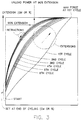
- FIG. 3 illustrates the hysterisis testing procedure used for determining the unload power and residual set.
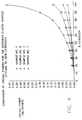
- FIG. 4 plots the unload power at various extensions up to 100 percent for elastic sample Nos. 1, 2, 5 and 7.
- FIG. 5 is a graph of the solubility distribution and composition distribution of a copolymer (X) having a narrow solubility distribution composition distribution and composition distribution and copolymer (Y) having a broad solubility distribution composition distribution and composition distribution.
- FIG. 6 is a graph illustrating the correlation between dissolution temperature and composition used to convert the temperature scale to a composition scale.
- FIG. 7 is a graph illustrating the method for calculating CDBI.
- the present invention provides a fabrication method for increasing the unload power of an elastic material.
- elastic materials are considered those materials which rapidly return to approximately their initial dimensions and shape after substantial deformation by a weak stress and release of the stress.
- elastic materials are considered those which when stretched to twice their original length (2X) at room temperature (18 to 29°C) and held at 2X for one minute, will retract to less than 1.5X within one minute after the deforming force is released.
- the present invention relates to elastic film having improved unload power produced by orienting and annealing a precursor elastic film.
- the precursor film is first formed by any suitable method. Once formed, the precursor film is then subjected to a combination of orienting and annealing to improve its unload power.
- the precursor elastic film which is to be further processed to improve its unload power according to the method of the present invention may be produced by any suitable method. Methods of making film are discussed by J. H. Briston and L.L. Katan in Plastic Films , (2nd ed. 1983). Commonly known methods of producing film which may be utilized in the present invention include casting (extrusion and solvent), calendering and extrusion methods, such as blow extrusion or slit die extrusion.
- the present invention is suitable for improving the unload power of thin elastic articles.
- Such thin elastic articles are commonly known as ribbon, tape, film and strip.
- the difference between these particular terms is generally dimensional.
- tape is generally thought of as being narrower than film.
- the terms “ribbon”, “tape”, “film” and “strip” are generally interchangeable, with the present invention suitable for application to thin elastic articles and not dimensionally limited.
- non-elastic films such as polypropylene, polystyrene, nylon and polyethylene terephthalate to improve clarity, impact strength and, particularly in the case of polypropylene, its barrier properties is well known in the art.
- non-elastic films such as polypropylene, polystyrene, nylon and polyethylene terephthalate to improve clarity, impact strength and, particularly in the case of polypropylene, its barrier properties is well known in the art.
- the methods utilized on non-elastic film are generally suitable for use with in the present process for orienting elastic film.
- the orienting and annealing of the film may be carried out monoaxially in the machine direction or the transverse direction or in both directions (biaxially) either simultaneously or sequentially using conventional equipment and processes following cooling of the precursor film.
- Blown films are preferentially stretched in machine direction or in both directions whereas cast films are preferably stretched in the machine direction.
- the precursor film is passed around two rollers driven at different surface speeds and finally to a take up roller.
- the second driven roller which is closest to the take up roll is driven faster than the first driven roller.
- Conventional "godet" stands as are well known in the art may also be utilized.
- Film orientation may also be carried out in a tentering device with or without machine direction orientation to impart transverse direction orientation in the film.
- the film is gripped by the edges for processing through the tentering device.
- the precursor film is monoaxially oriented in the machine direction.
- the morphology of the plastomer derived tapes can be viewed as a matrix of amorphous material interspersed with crystallites.
- amorphous material interspersed with crystallites.
- the film For orienting it is generally necessary that the film be heated to between its softening point and its melting point. This heating is necessary to allow extension or orientation to be induced into the film. Since the temperature is between the film softening point and melting point, the smaller imperfect crystallites will melt, whereas larger more perfect crystallites of the plastomer will remain.
- the molecules in the amorphous matrix become oriented or extended depending on the draw ratio and other material and fabrication parameters.
- the temperature is still between the film softening point and melting point.
- the annealing step is necessary to anneal or perfect the crystallites that survived the orienting step and to relax out stresses. This annealing aids in maintaining the orientation or extension induced in the orienting step.
- the annealing temperature is preferably less than the orienting temperature.
- the film from the annealing step is then spooled in a winding unit.
- a commercially available orientation line includes the Killion ribbon yarn line (model serial number 3874).
- FIG. 1 shows a schematic of a slit film extrusion process.
- the elastic pellets are fed into hopper 10 of extruder 12 .
- extruder 12 the elastic pellets are heated to above their melting point and extruded through die 15 into film 3 .
- Film 3 is subsequently cooled by quenching in water bath 19 .
- Slitter 22 is an optional station that slits film 3 into two or more narrower tape sections 5 .
- Orientation and annealing takes place utilizing first godet stand 25 , second godet stand 28 , third godet stand 30 , orienting oven 26 and annealing oven 29 .
- Tape 5 is subsequently wound into spools in winding unit 33 .
- the material is generally heated to a temperature above the softening point but less that its melting point.
- FIG. 2 shows a schematic of a blown film extrusion process.
- the elastic pellets are fed into hopper 10 of extruder 12 .
- the elastic pellets are heated to above their melting point and extruded through die 15 into tube shaped film 3 .
- Film 3 is subsequently air cooled in blown-film tower 18 .
- Slitter 22 is an optional station that slits film 3 into two or more narrower tape sections 5 . Orientation and annealing takes place utilizing first godet stand 25 , second godet stand 28 , third godet stand 30 , orienting oven 26 and annealing oven 29 .
- Tape 5 is subsequently wound into spools in winding unit 33 .
- the draw ratio to which the film is oriented may be any ratio that will improve the unload power of the film to desired levels.
- V 1 , V 2 and V 3 represent the film travel speed at various points as indicated.
- the draw ratio is the ratio of V 2 to V 1 .
- the draw ratio of the drawn film could be at least 2:1, preferably at least 4:1 and most preferably at least 6:1.
- the upper limit on the draw ratio is generally limited by the properties of the elastic material utilized and the desired end properties of the drawn film. Generally, the draw ratio will not exceed 20:1, preferably the draw ratio will not exceed 10:1 and most preferably the draw ratio will not exceed 6:1.
- V 3 is such that the film orientation can be maintained during the annealing step. This means that V 3 is generally at or near V 2 .
- the type of copolymer utilized will depend upon economics and the properties desired in the final end product.
- the copolymer utilized in the present invention refers to a class of ethylene based polymers having a density of less than 0.900 g/cm 3 (down to 0.855 g/cm 3 ) at a molecular weight, M w greater than 20,000 (200 MI and lower).
- the preferred ethylene based polymers are plastomers. Plastomers for the purposes of this patent application have an ethylene crystallinity between plastics linear low density and very low density polyethylenes) and ethylene/alpha-olefin elastomers and generally have a density of less than 0.900 g/cm 3 down to 0.88 g/cm 3 .
- the copolymer utilized in the present invention is selected from the group of polymers consisting of ethylene polymerized with at least one comonomer selected from the group consisting of C 3 to C 20 alpha-olefins and C 3 to C 20 polyenes.
- Plastomer utilized in the present invention are selected from the group of polymers consisting of ethylene polymerized with at least one comonomer selected from the group consisting of C 3 to C 20 alpha-olefins.
- the types of monomers selected in the plastomer utilized in the present invention will depend upon economics and the desired end use of the resultant fabricated material.
- the polyene utilized in the present invention generally has in the range of 3 to 20 carbon atoms, preferably, the polyene has in the range of 4 to 15 carbon atoms.
- the polyene is preferably a diene, that generally has in the range of 3 to 20 carbon atoms.
- the diene utilized in the present invention is a straight chain, branched chain or cyclic hydrocarbon diene preferably having from 4 to 20 carbon atoms, and more preferably from 4 to 15 carbon atoms, and most preferably in the range of 6 to 15 carbon atoms.
- the diene is a non-conjugated diene.
- Suitable dienes are straight chain acyclic dienes such as: 1,3-butadiene, 1,4-hexadiene and 1,6-octadiene; branched chain acyclic dienes such as: 5-methyl-1,4-hexadiene, 3,7-dimethyl-1,6-octadiene 3,7-dimethyl-1,7-octadiene and mixed isomers of dihydro myrcene and dihydroocimene; single ring alicyclic dienes such as: 1,3-cyclopentadiene, 1,4-cylcohexadiene, 1,5-cyclooctadiene and 1,5-cyclododecadiene; and multi-ring alicyclic fused and bridged ring dienes such as: tetrahydroindene, methyl tetrahydroindene, dicylcopentadiene, bicyclo-(2,2,1)-hepta-2-5-diene; alkeny
- Particularly preferred dienes are 1,4-hexadiene, 5-ethylidene-2-norbornene, 5-vinyllidene-2-norbornene, 5-methylene-2-norbornene and dicyclopentadiene.
- the especially preferred dienes are 5-ethylidene-2-norbornene and 1,4-hexadiene.
- the alpha-olefins suitable for use in the present invention contain in the range of 3 to 20 carbon atoms, more preferably, of 3 to 16 carbon atoms and, most preferably 3 to 8 carbon atoms.
- Preferred examples of such alpha-olefins are propylene, 1-butene, 1-pentene, 1-hexene, 1-octene and 1-dodecene.
- the copolymers utilized in the material of the present invention are either ethylene/alpha-olefin copolymers or ethylene/alpha-olefin/diene terpolymers.
- suitable copolymers are those such as ethylene/butene-1, ethylene/hexene-1, ethylene/octene-1, and ethylene/propylene copolymers.
- terpolymers include ethylene/propylene/1,4-hexadiene and ethylene/butene-1/1,4-hexadiene.
- copolymers suitable in the present invention with desired monomer levels can be prepared by polymerization of the suitable monomers in the presence of supported or unsupported catalyst systems.
- the catalyst system utilized is a metallocene catalyst system.
- the precise monomer content of the copolymers utilized in the present invention will depend upon economics and the desired applications of the resultant materials.
- the copolymers utilized in the present invention will generally comprise in the range of 65 mole percent to 93 mole percent ethylene (based on the total moles of monomer), preferably, 73 mole percent to 88 mole percent ethylene.
- the copolymers utilized in the present invention for example can have an ethylene crystallinity less that 35 percent.
- the ethylene crystallinity is less than 20 percent.
- the copolymers utilized in the present invention have a density in the range of 0.855 g/cm 3 to less than 0.900 g/cm 3 .
- the elastomers have a density of 0.860 to 0.89 g/cm 3 , and more preferably 0.865 g/cm 3 to 0.88 g/cm 3 . Densities were measured using standard accepted procedures, except that they were additionally conditioned by holding them for 48 hours at ambient temperature (23° C), prior to density measurement.
- the melt index (MI) of the copolymers utilized in the present invention is such that the copolymer can be extruded into the desired end product.
- the MI must be such that the copolymer will have sufficient drawability as desired.
- the melt index is in the range of 0.2 dg/min to 1000 dg/min, preferably the MI is not more than 100, more preferably the MI is in the range of 0.5 dg/min to 50 dg/min, and most preferably in the range of 1 dg/min to 5 dg/min.
- MI as measured herein was determined according to ASTM 10-1238 (190/2.16). High load MI was determined according to ASTM D-1238 (190/21.6).
- the copolymers utilized in the present invention have a molecular weight distribution such that the polymer will have the desired drawability and be processable into the desired end product.
- the ratio of M w /M n is generally in the range of 1.5 to 30, preferably 1.8 to 10, more preferably 2.0 to 4.
- composition distribution breadth index (CDBI) of the copolymers utilized in the present invention is generally 45 percent or higher.
- the CDBI is 60 percent or higher, and more preferably, 70 percent or higher.
- the CDBI is defined as the weight percent of the copolymer molecules having a comonomer content within 50 percent (i.e. ⁇ 50%) of the median total molar comonomer content.
- the CDBI of linear polyethylene, which does not contain a comonomer, is defined to be 100%.
- CDBI is determined via the technique of T emperature R ising E lution F ractionation (TREF). CDBI determination clearly distinguishes, for example, the plastomers utilized in this invention (narrow composition distribution as assessed by CDBI values of 45% or higher) from products traditionally utilized in prior art (broad composition distribution as assessed by CDBI values generally less than 45%).
- Composition distribution (CD), composition distribution breadth index (CDBI) were determined by techniques known in the art, such as temperature rising elution fractionation as described, for example, in U.S. Patent 5,008,204, or in Wild et al., J. Polymer Sci. Poly. Phys. Ed. , volume 20, page 441 (1982).
- Solubility Distribution is measured using a column of length 164 cm and 1.8 cm inner diameter is packed with non-porous glass beads 548 to 841 ⁇ m (20-30 mesh) and immersed in a temperature programmable oil bath. The bath is stirred very vigorously to minimize temperature gradients within the bath, and the bath temperature is measured using a platinum resistance thermometer. About 1.6 g of polymer is placed in a sample preparation chamber and repeatedly evacuated and filled with nitrogen to remove oxygen from the system. A metered volume of tetrachlorethylene solvent is then pumped into the sample preparation chamber, where it is stirred and heated under 3.04 bar (3 atmospheres) pressure at 140°C to obtain a polymer solution of about 1 percent concentration. A metered volume of this solution, 100 ml is then pumped into the packed column thermostated at a high temperature, 120°C.
- the polymer solution in the column is subsequently crystallized by cooling the column to 0°C at a cooling rate of ⁇ 20°C/min.
- the column temperature is then maintained at this temperature for 25 min. at 0°C.
- the elution stage is then begun by pumping pure solvent, preheated to the temperature of the oil bath, through the column at a flow rate of 27 ml/min.
- Effluent from the column passes through a heated line to an IR detector which is used to measure the absorbance of the effluent stream.
- the absorbance of the polymer carbon-hydrogen stretching bands at about 2960 cm -1 serves as a continuous measure of the relative weight percent concentration of polymer in the effluent.
- SDBI Solubility Distribution Breadth Index
- Solubility distributions of two ethylene interpolymers are shown in FIG. 5.
- Sample X has a narrow solubility distribution and elutes over a narrow temperature range compared to Sample Y, which has a broad solubility distribution.
- a solubility distribution breadth index (SDBI) is used as a measure of the breadth of the solubility distribution curve.
- w (T) be the weight fraction of polymer eluting (dissolving) at temperature T.
- SDBI is thus analogous to the standard deviation of the solubility distribution curve, but it involves the fourth power rather than the second power to T - T ave ).
- the narrow solubility distribution Sample X and the broad solubility distribution Sample Y in Figure 5 have SDBI values equal to 14.6°C and 29.4°C, respectively.
- the preferred values of SDBI are less than 23°C and more preferred less than 20°C and even more preferred less than 16°C.
- composition distribution (CD) of a crystalline interpolymer is determined as follows.
- the composition and number average molecular weight, M n of fractions collected in various narrow temperature intervals for several poly(ethylene-co-butene)'s was determined by C13 NMR and size exclusion chromatography, respectively.
- Figure 6 is a plot of mole percent comonomer vs. elution temperature for fractions having M n > 15,000. The curve drawn through the data points is used to correlate composition with elution temperature for temperatures greater than 0°C. The correlation between elution temperature and composition becomes less accurate as the M n of a fraction decreases below 15,000. Such errors can be eliminated by direct measurement of the composition of effluent fractions by C13 NMR.
- the elution temperature-composition calibration for high molecular weight fractions given in Figure 6 may be corrected based on the M n of effluent fractions and an experimentally established correlation between M n and elution temperature that applies for M n ⁇ 15,000. However, it is assumed that such low molecular weight molecules are present to a negligible extent and that any errors caused are negligible.
- a correlation curve such as the one in FIG. 6 is applicable to any essentially random poly(ethylene-co- ⁇ -olefin) provided, however, that the ⁇ -olefin is not propylene.
- the temperature scale of a solubility distribution plot can thus be transformed to a composition scale, yielding a weight fraction of polymer versus composition curve.
- Sample X contains molecules spanning a narrow composition range
- Sample Y contains molecules spanning a wide composition range.
- Sample X has a narrow composition distribution
- Sample Y has a broad composition distribution.
- CDBI A quantitative measure of the breadth of the composition distribution is provided by the CDBI.
- CDBI is defined to be the percent of polymer whose composition is within 50% of the median comonomer composition. It is calculated from the composition distribution curve and the normalized cumulative integral of the composition distribution curve, as illustrated in Figure 7.
- the median composition, C med corresponds to the composition at the point where the cumulative integral equals 0.5.
- the difference between the values of the cumulative integral at compositions 0.5 C med and 1.5 C med (71 - 29, or 42%, in this example) is the CDBI of the copolymer. CDBI values fall between zero and one, with large values indicating narrow CD and low values indicating broad CD.
- the narrow and broad CD copolymers have CDBI's equal to 95.5% and 42%, respectively. It is difficult to measure the CD and CDBI of copolymers having very low comonomer content with high accuracy so the CDBI of polyethylenes with densities greater than 0.94 g/cm 3 is defined to be equal to 100%.
- copolymers have modest levels of ethylene crystallinity (around 20%) which give rise to orientability and strength in the fabricated elastic articles. Control of the molecular weight allows control of orientation and elasticity. Finally, copolymers are hydrocarbon-based and so chemically quite inert.
- the copolymers useful in the present invention may be produced by any suitable method that will yield a polymer having the required properties, that when fabricated into an elastic article by the method of the present invention, will have suitable residual set and unload power properties.
- An illustrative non-limiting example of a particularly suitable method of making the copolymer useful in the present invention utilizes a class of highly active olefin catalysts described earlier as transition metal metallocenes, which are well known especially in the preparation of polyethylene and copolyethylene-alpha-olefins.
- transition metallocenes which are well known especially in the preparation of polyethylene and copolyethylene-alpha-olefins.
- Composition distribution refers to the distribution of comonomer between copolymer molecules. This feature relates directly to polymer crystallizability, optical properties, toughness and many other important use characteristics. Molecular weight distribution plays a significant role in melt processability as well as the level and balance of physical properties achievable. Also important is the molecular weight (MW) of the polymer, which determines the level of melt viscosity and the ultimately desired physical properties of the polymer. The type and amount of comonomer also affects the physical properties and crystallizability of the copolymer.
- copolymers utilized in the present invention may be made by any suitable process which allows for the proper control of the above mentioned structural features (MW, MWD, CD, comonomer type and amount) to yield the desired polymer with the desired elastics properties.
- One suitable method is through the use of a class of highly active olefin catalysts known as transition metal metallocenes.
- Metallocenes are well known especially in the preparation of polyethylene and copolyethylene-alpha-olefins. These catalysts, particularly those based on group IV transition metals, zirconium, titanium and hafnium, show extremely high activity in ethylene polymerization.
- the metallocene catalysts are also highly flexible in that, by manipulation of catalyst composition and reaction conditions, they can be made to provide polyolefins with controllable molecular weights from as low as about 200 (useful in applications such as lube oil additives) to about 1 million or higher, as for example in ultra high molecular weight linear polyethylene. At the same time, the molecular weight distribution of the polymers can be controlled from extremely narrow (as in a polydispersity, M w /M n , of about 2), to broad (as in a polydispersity of 8 or above).
- Metallocene catalysts for the purposes of this application are herein defined to contain one or more cyclopentadienyl or other pi-bonded moiety. Cyclopentadienylide catalyst systems using a metallocene complex in conjunction with an alumoxane or reaction product thereof are suitable for preparing the polymer utilized in the invention.
- Various forms of the catalyst system of the metallocene type may be used for polymerization to prepare the polymer components of the present invention including those of the homogenous or the heterogeneous, supported catalyst type wherein the catalyst and alumoxane cocatalyst are together supported or reacted together onto an inert support for polymerization by gas-phase, high pressure, slurry, or solution polymerization.
- the use of metallocene catalysts for the polymerization of ethylene is described in US-A-4,937,299 and EP-A-0 129 368 published July 26, 1989, US-A-4,808,561, US-A-4,814,310, and US-A-4,937-299.
- ethylene/alpha-olefin copolymers and ethylene/alpha-olefin/diene terpolymers are taught in US-A-4,871,705.
- the alumoxane may be prepared with water for example in the form of a hydrated ferrous sulfate.
- Other cocatalysts may be used with metallocenes, such as trialkylaluminum compounds; or ionizing ionic activators or compounds such as, tri (n-butyl) ammonium tetra(pentaflurophenyl) boron, which ionize the neutral metallocene compound.
- Such ionizing compounds may contain an active proton, or some other cation associated with (but not coordinated or only loosely coordinated to) the remaining ion of the ionizing ionic compound.
- Such compounds are described in EP-A-0 277 003 and EP-A-0 277 004 both published August 3, 1988.
- the metallocene catalyst component can be monocyclopentadienyl heteroatom containing compound, which is activated, for example, by either an alumoxane or an ionic activator to form an active polymerization catalyst system to produce polymers useful in this present invention as is shown for example by WO92/00333 published January 9, 1992, US-A-5,055,438, EP-A-0 420 436 and WO91/ 04257.
- the catalyst systems described above may be optionally prepolymerized or used in conjunction with an additive component to enhance catalytic productivity.
- the polymers of the present invention can be produced in accordance with any suitable polymerization process, including a slurry polymerization, gas phase polymerization and high pressure polymerization process.
- the copolymers useful in the present invention can be produced in accordance with any suitable polymerization process, including a slurry polymerization, gas phase polymerization, and high pressure polymerization process.
- copolymer of the present invention may be fabricated into any form that is suitable for the use to which it will serve.
- the catalyst system for polymerizing this ethylene copolymer comprised bis(n-butylcyclopentadienyl)zirconium dichloride as catalyst and a 10wt% methylalumoxane in toluene solution as cocatalyst.
- the polymerization was conducted in a batch mode using a diluent phase polymerization process.
- a 227 liter (150 gallons) pilot plant reactor was used to carry out the polymerization.
- the reactor vessel Prior to charging the reactants the reactor vessel was rinsed with triethyl aluminum and purged with nitrogen. Isopentane diluent was then fed to the reactor via a mol-sieve bed to remove moisture.
- the required weights of hexene-1 comonomer and cocatalyst solution (10 wt% MAO in toluene) were charged.
- the reactor contents were heated to reaction temperature. At thermal equilibrium, ethylene was slowly fed to the reactor until the pressure set point was reached.
- Reaction was initiated by controlled addition of catalyst (3 x 10 mg charges). This was followed by addition, as needed, to build and sustain a controllable reaction. Reaction rate was monitored by noting reactor temperature and heat removal rates from the water heat exchanger. The reaction was killed after 27.18 kg(60lbs) of ethylene had been fed to the reactor. Product recovery began by slowly venting the reactor to 0.34 bar (5 psi.), followed by adding water and, with a nitrogen purge to flare, heating the mixture to 73.9°C(165°F) to flash remove the isopentane and unreacted comonomer. The product was recovered from the reactor, compounded with Irganox®-1076 stabilizer and melt extruded to screen out contaminants and pelletize the material.
- the product was analyzed to have a Melt Index of 2.8, density of 0.88 g/cm 3 and a Melt Index Ratio (I 21.6 /I 2.16 ) of 23. It will be recognized by persons skilled in the art that products with different Melt Indices and Densities to the above product can be obtained by adjusting the process conditions. Additionally, the composition of the product can be altered, depending on the choice of alpha-olefin comonomer.
- Numbers 1 and 2 are the same plastomer sample made according to example 1 above. Number 1 was fabricated to a draw ratio of 5:1 according to the method of the present invention, whereas Number 2 was produced in a traditional cast film operation and was not subject to the combination of orientation and annealing as was Number 1. Numbers 3, 4 and 6 have appreciable levels of ethylene crystallinity and do not show good elastic response and extensibility by the fabrication of this method. Numbers 5, 6 and 7 are commercially available materials. Number 5 was obtained in 0.05 mm (2 mil) strip form, whereas Number 7 was obtained in 0.05 mm (2 mil) film form.
- Elastic sample No. 1 and non-elastic sample Nos. 3, 4 and 6 were fabricated into oriented tapes or ribbons, using a Killion ribbon yarn line (Model Serial No. 3874).
- This apparatus can be represented by the schematic of FIG. 1 except that a slitter was not utilized.
- Table 2 provides a dimensional characterization of the fabricated strip samples used in the evaluation.
- the hysteresis testing procedure used is shown in FIG. 3.
- the method is based on a procedure described by DuPont in its brochure on its polyether urethane elastic product, T-722A.
- the testing was conducted on an Instron Model No. 1122. 30.48 cm (12 in) lengths of the sample film strip to be tested were held by the Instron jaws and extended 100% using a cross-head speed of 500 mm/min. Following the extension, the cross head was retracted, also at 500 mm/min, back to the original position. This cycling was conducted six times.
- the force versus extension curves were plotted (chart speed also 500 mm/min) as is shown in FIG. 3.
- FIG. 4 plots the unload power at various extensions up to 100 percent for elastic sample Nos. 1, 2, 5 and 7. Sample Nos. 3, 4 and 6 were too crystalline (non-elastic) and did not have sufficient extensibility to survive the repeated cycling to 100 percent. As seen in FIG. 4, the unload power is very dependent on the particular fabrication approach. The same polymer (plastomer of Example 1) can be made to show different unload power values, depending on fabrication technique. The fabrication process of this invention which includes the combination of orientation and annealing, provided a much higher value of unload power than was obtained using a traditional extrusion casting fabrication technique.
- Table 4 shows a summary of the hysteresis testing on cycling to 100% extension. The set after 5 cycles appears comparable for the 4 samples, ranging from 15 to 20 percent, per the testing procedure followed.
- Table 3 shows shrinkage measurements at elevated temperatures (i.e. shrinkage of original lengths) on the 4 samples that survived cycling to 100 percent extension.
- the fabrication process of this invention provides high shrinkage at lower temperatures, which is an advantage in certain elastic applications (compare values for plastomer ribbon versus plastomer cast film strip).
- Table 5 quantifies the force at break values and the ultimate elongation values during tensile testing of the tape/film on an Instron Model 1122 with cross head speed of 500 mm/min.
- VLDPE 1.MI,0.90D,60 MIRatio;C2/C6 Oriented tape (5:1 draw ratio) produced on 19 mm (3/4 inch) Killion ribbon yarn line 4.
- LLDPE 0.7MI,0.922D,35 MIRatio;C2/C6) Oriented tape (5:1 draw ratio) produced on 19 mm (3/4 inch) Killion ribbon yarn line 5.
- VLDPE X-142 (0.9MI,0.90D,27 MIRatio;C2/C6) Oriented tape (5:1 draw ratio) produced on 19 mm (3/4 inch) Killion ribbon yarn line (Polymer from Mitsubishi Petrochemical Co., Japan 7.
- Exxtraflex 120 Exxtraflex 120 film (Exxon Film Products, Lake Zurich, Illinois) TABLE 2 SAMPLES CHARACTERIZATION SAMPLE ID dtex (DENIER (G/9000M)) MEAN VALUE * STRIP WIDTH STRIP THICKNESS 1.
- Plastomer ribbon 3354 (3723) 0.4 cm (.1575 in) 0.114 mm (4.49 mil) 2.
Landscapes
- Chemical & Material Sciences (AREA)
- Engineering & Computer Science (AREA)
- Manufacturing & Machinery (AREA)
- Health & Medical Sciences (AREA)
- Chemical Kinetics & Catalysis (AREA)
- Medicinal Chemistry (AREA)
- Polymers & Plastics (AREA)
- Organic Chemistry (AREA)
- Materials Engineering (AREA)
- Addition Polymer Or Copolymer, Post-Treatments, Or Chemical Modifications (AREA)
- Manufacture Of Macromolecular Shaped Articles (AREA)
Claims (14)
- Elastische Folie, die auf ein Reckverhältnis im Bereich von 2:1 bis 20:1 orientiert worden ist, wobei die Folie ein Copolymer von Ethylen umfaßt, das mit mindestens einem Comonomer ausgewählt aus der Gruppe bestehend aus C3- bis C20-α-Olefinen und C3- bis C20-Polyenen unter Verwendung eines Metallocenkatalysators polymerisiert worden ist, wobei das Copolymer eine Dichte im Bereich von 0,855 g/cm3 bis weniger als 0,900 g/cm3, einen Schmelzindex im Bereich von 0,2 bis 1000, einen Breitenindex der Zusammensetzungsverteilung von 45 % oder höher und eine Molekulargewichtsverteilung im Bereich von 1,5 bis 30 hat.
- Elastische Folie nach Anspruch 1, bei der das Copolymer eine Dichte von 0,88 bis weniger als 0,900 g/cm3 hat.
- Elastische Folie nach einem der vorhergehenden Ansprüche, bei der das Copolymer einen Schmelzindex von nicht mehr als 100 hat.
- Elastische Folie nach einem der vorhergehenden Ansprüche, bei der die elastische Folie durch Breitschlitzextrusion hergestellt ist.
- Elastische Folie nach einem der vorhergehenden Ansprüche, bei der die elastische Folie durch Blasfolienextrusion hergestellt ist.
- Elastische Folie nach einem der vorhergehenden Ansprüche, bei der das α-Olefin ausgewählt ist aus der Gruppe bestehend aus Propylen, 1-Buten, 1-Penten, 1-Hexen, 1-Octen und 1-Dodecen.
- Elastische Folie nach einem der vorhergehenden Ansprüche, bei der das Copolymer eine Dichte im Bereich von 0,860 g/cm3 bis 0,890 g/cm3, einen Schmelzindex von 0,5 bis 50, eine Molekulargewichtsverteilung von 1,8 bis 10 und einen Breitenindex der Zusammensetzungsverteilung von mindestens 60 % hat.
- Elastische Folie nach einem der vorhergehenden Ansprüche, bei der das Polyen ein Dien ausgewählt aus der Gruppe bestehend aus geradkettigen Dienen, verzweigtkettigen Dienen und cyclischen Kohlenwasserstoffdienen ist.
- Elastische Folie nach einem der vorhergehenden Ansprüche, bei der das Dien ausgewählt ist aus der Gruppe bestehend aus 1,3-Butadien, 1,4-Hexadien, 1,6-Octadien, 5-Methyl-1,4-hexadien, 3,7-Dimethyl-1,6-octadien, 3,7-Dimethyl-1,7-octadien, gemischten Isomeren von Dihydromyrcen und Dihydroocimen, 1,3-Cyclopentadien, 1,4-Cyclohexadien, 1,5-Cyclooctadien und 1,5-Cyclododecadien, Tetrahydroinden, Methyltetrahydroinden, Dicyclopentadien, Bicyclo[2.2.1]hepta-2,5-dien, 5-Methylen-2-norbornen (MNB), 5-Propenyl-2-norbornen, 5-Isopropyliden-2-norbornen, 5-(4-Cyclopentenyl)-2-norbornen, 5-Cyclohexyliden-2-norbornen, 5-Vinyl-2-norbornen und Norbornen.
- Elastische Folie nach einem der vorhergehenden Ansprüche, bei der das Copolymer Ethylen im Bereich von 65 Mol.% bis 93 Mol.% umfaßt, bezogen auf die gesamten Mol an Monomer.
- Elastische Folie nach einem der vorhergehenden Ansprüche, bei der das Copolymer Ethylen im Bereich von 73 Mol.% bis 88 Mol.% umfaßt, bezogen auf die gesamten Mol an Monomer.
- Elastische Folie nach einem der vorhergehenden Ansprüche, bei der das Copolymer eine Ethylenkristallinität von weniger als 20 % hat.
- Elastische Folie nach einem der vorhergehenden Ansprüche, bei der die elastische Folie an Polyolefine gebunden oder gesiegelt ist.
- Produkt, das mit der elastischen Folie nach einem der vorhergehenden Ansprüche hergestellt ist.
Applications Claiming Priority (3)
| Application Number | Priority Date | Filing Date | Title |
|---|---|---|---|
| US07/837,769 US5241031A (en) | 1992-02-19 | 1992-02-19 | Elastic articles having improved unload power and a process for their production |
| US837769 | 1992-02-19 | ||
| PCT/US1993/001413 WO1993016863A1 (en) | 1992-02-19 | 1993-02-17 | Elastic articles having improved unload power and a process for their production |
Publications (2)
| Publication Number | Publication Date |
|---|---|
| EP0629151A1 EP0629151A1 (de) | 1994-12-21 |
| EP0629151B1 true EP0629151B1 (de) | 1996-12-18 |
Family
ID=25275362
Family Applications (1)
| Application Number | Title | Priority Date | Filing Date |
|---|---|---|---|
| EP93906022A Expired - Lifetime EP0629151B1 (de) | 1992-02-19 | 1993-02-17 | Elastische gegenstände mit verbesserter entspannungsleistung |
Country Status (6)
| Country | Link |
|---|---|
| US (1) | US5241031A (de) |
| EP (1) | EP0629151B1 (de) |
| JP (1) | JPH07503913A (de) |
| CA (1) | CA2130192C (de) |
| DE (1) | DE69306765T2 (de) |
| WO (1) | WO1993016863A1 (de) |
Cited By (4)
| Publication number | Priority date | Publication date | Assignee | Title |
|---|---|---|---|---|
| US5931823A (en) | 1997-03-31 | 1999-08-03 | Kimberly-Clark Worldwide, Inc. | High permeability liner with improved intake and distribution |
| US6706228B2 (en) | 1998-10-16 | 2004-03-16 | Exxonmobil Chemical Company | Process for producing polyolefin microporous breathable film |
| US6843949B2 (en) | 1996-07-31 | 2005-01-18 | Tredegar Film Products Corporation | Process for adjusting WVTR and other properties of a polyolefin film |
| US6953510B1 (en) | 1998-10-16 | 2005-10-11 | Tredegar Film Products Corporation | Method of making microporous breathable film |
Families Citing this family (141)
| Publication number | Priority date | Publication date | Assignee | Title |
|---|---|---|---|---|
| US5582923A (en) | 1991-10-15 | 1996-12-10 | The Dow Chemical Company | Extrusion compositions having high drawdown and substantially reduced neck-in |
| US5395471A (en) | 1991-10-15 | 1995-03-07 | The Dow Chemical Company | High drawdown extrusion process with greater resistance to draw resonance |
| US5674342A (en) | 1991-10-15 | 1997-10-07 | The Dow Chemical Company | High drawdown extrusion composition and process |
| US5783638A (en) | 1991-10-15 | 1998-07-21 | The Dow Chemical Company | Elastic substantially linear ethylene polymers |
| US5451450A (en) * | 1992-02-19 | 1995-09-19 | Exxon Chemical Patents Inc. | Elastic articles and a process for their production |
| US6143854A (en) * | 1993-08-06 | 2000-11-07 | Exxon Chemical Patents, Inc. | Polymerization catalysts, their production and use |
| US6203750B1 (en) | 1992-06-05 | 2001-03-20 | Cryovac, Inc | Method for making a heat-shrinkable film containing a layer of crystalline polyamides |
| ATE291059T1 (de) | 1992-11-13 | 2005-04-15 | Cryovac Inc | Wärmeschrumpfbare, durch single-site-katalyse hergestellte copolymere enthaltende folien. |
| US5604043A (en) * | 1993-09-20 | 1997-02-18 | W.R. Grace & Co.-Conn. | Heat shrinkable films containing single site catalyzed copolymers having long chain branching |
| CA2085813C (en) * | 1992-12-18 | 2001-06-12 | Bankim B. Desai | Formulation of high abuse, high shrink barrier bags for meat packaging |
| US5472775A (en) * | 1993-08-17 | 1995-12-05 | The Dow Chemical Company | Elastic materials and articles therefrom |
| US5723507A (en) * | 1996-03-11 | 1998-03-03 | The Dow Chemical Company | Foamed gaskets made from homogeneous olefin polymers |
| US5538790A (en) † | 1993-12-17 | 1996-07-23 | Exxon Chemical Patents Inc. | Cling film |
| US5491019A (en) * | 1994-03-28 | 1996-02-13 | W. R. Grace & Co.-Conn. | Oxygen-permeable multilayer film |
| US6060136A (en) * | 1995-10-13 | 2000-05-09 | Cryovac, Inc. | High modulus oxygen-permeable multilayer film |
| US5468440B1 (en) * | 1994-05-06 | 1997-04-08 | Exxon Chemical Patents Inc | Process of making oriented film or structure |
| US5622780A (en) * | 1994-05-11 | 1997-04-22 | W. R. Grace & Co.-Conn. | Microwaveable multilayer films with metal-like appearance |
| US5658625A (en) * | 1994-05-25 | 1997-08-19 | W.R. Grace & Co.-Conn. | Film containing alpha-olefin/vinyl aromatic copolymer |
| US6682825B1 (en) * | 1994-06-06 | 2004-01-27 | Cryovac, Inc. | Films having enhanced sealing characteristics and packages containing same |
| NZ289619A (en) | 1994-06-28 | 1998-12-23 | Grace W R & Co | Bag with patches, the patches having overhang regions which are adhered together |
| NZ272446A (en) * | 1994-06-30 | 1998-06-26 | Grace W R & Co | Meat package; comprises a product support member, an oxygen-permeable film over the support member and an oxygen-impermeable film over and in close proximity to the oxygen-permeable film |
| CA2199411C (en) * | 1994-09-07 | 2006-11-14 | Shih-Yaw Lai | Plastic linear low density polyethylene |
| AU3587495A (en) * | 1994-09-14 | 1996-03-29 | Exxon Chemical Patents Inc. | Polymerization process |
| US5712353A (en) * | 1994-10-31 | 1998-01-27 | Exxon Chemical Patents Inc. | Gas phase polymerization process |
| US5763543A (en) * | 1994-09-14 | 1998-06-09 | Exxon Chemical Patents Inc. | Olefin polymerization process with little or no scavenger present |
| US5837335A (en) * | 1994-10-04 | 1998-11-17 | Cryovac, Inc. | High shrink multilayer film which maintains optics upon shrinking |
| US5834077A (en) * | 1994-10-04 | 1998-11-10 | W. R. Grace & Co.-Conn. | High shrink multilayer film which maintains optics upon shrinking |
| DE69523859T2 (de) * | 1994-10-19 | 2002-05-29 | Cryovac, Inc. | Heissschrumpfbare Mehrschichtfolien |
| US5792534A (en) | 1994-10-21 | 1998-08-11 | The Dow Chemical Company | Polyolefin film exhibiting heat resistivity, low hexane extractives and controlled modulus |
| US6287613B1 (en) | 1994-12-12 | 2001-09-11 | Cryovac Inc | Patch bag comprising homogeneous ethylene/alpha-olefin copolymer |
| CA2170961C (en) * | 1995-03-22 | 2005-08-09 | Walter B. Mueller | Multilayer films for packaging and administering medical solutions |
| US5695840A (en) * | 1995-03-22 | 1997-12-09 | W. R. Grace & Co.-Conn. | Films for medical solution pouches |
| US6884480B2 (en) | 1995-05-19 | 2005-04-26 | Cryovac, Inc. | Film containing alpha-olefin/vinyl aromatic copolymer |
| EP0744285B1 (de) * | 1995-05-24 | 1999-12-15 | Cryovac, Inc. | Mehrschichtiger Verpackungsfilm mit Saurstoffbarriere |
| MY114719A (en) | 1995-06-29 | 2002-12-31 | Mitsui Chemicals Inc | Olefin thermoplastic elastomer compositions |
| US5925454A (en) * | 1995-07-11 | 1999-07-20 | W.R. Grace & Co.-Conn. | Film having modified surface characteristics through use of combination of spherical and lamellar particulates |
| US5866214A (en) * | 1995-07-28 | 1999-02-02 | W. R. Grace & Co.-Conn. | Film backseamed casings therefrom, and packaged product using same |
| US6159608A (en) | 1995-09-28 | 2000-12-12 | Saint-Gobain Performance Plastics Corporation | Thermoplastic interlayer film |
| US5792560A (en) * | 1995-09-28 | 1998-08-11 | Norton Performance Plastics Corporation | Thermoplastic interlayer film |
| ATE197140T1 (de) * | 1995-12-28 | 2000-11-15 | Cryovac Inc | Beutel mit durchlaufender schutzauflage |
| US5858515A (en) * | 1995-12-29 | 1999-01-12 | Kimberly-Clark Worldwide, Inc. | Pattern-unbonded nonwoven web and process for making the same |
| DE19714751B4 (de) * | 1996-04-12 | 2004-02-12 | Vacuflex Gmbh | Kunststoff-Wellschlauch |
| US5932307A (en) * | 1996-05-03 | 1999-08-03 | Baxter International Inc. | Oriented medical tubing |
| US20030094736A1 (en) * | 1996-05-03 | 2003-05-22 | Chuan Qin | Method of surface modifying a medical tubing |
| US6187400B1 (en) | 1996-05-03 | 2001-02-13 | Baxter International Inc. | Medical tubing and pump performance enhancement by ionizing radiation during sterilization |
| US6328716B1 (en) | 1996-05-03 | 2001-12-11 | Baxter International Inc. | Method of using medical tubings in fluid administration sets |
| US6506333B1 (en) | 1996-05-03 | 2003-01-14 | Baxter International Inc. | Method of surface modifying a medical tubing |
| US6129876A (en) * | 1996-05-03 | 2000-10-10 | Baxter International Inc. | Heat setting of medical tubings |
| US5954702A (en) * | 1996-05-03 | 1999-09-21 | Baxter International Inc. | Interface geometry for adhesive bonds |
| US5741452A (en) * | 1996-05-03 | 1998-04-21 | Baxter International Inc. | Orienting extrusion processes for medical tubing applications |
| US6036676A (en) * | 1996-05-03 | 2000-03-14 | Baxter International Inc. | Surface modified polymeric material formulation |
| US6576305B2 (en) | 1996-06-07 | 2003-06-10 | Saint-Gobain Vetrotex America, Inc. | Package having a multilayer film disposed around a layered coil of filament strands |
| US6045924A (en) * | 1996-06-19 | 2000-04-04 | Cryovac, Inc. | Film from a vinylidene chloride copolymer containing blend |
| US5843502A (en) * | 1996-06-26 | 1998-12-01 | Cryovac, Inc. | Package having cooked food product packaged in film having food adhesion layer containing high vicat softening point olefin/acrylic acid copolymer |
| NZ333941A (en) | 1996-08-16 | 2000-11-24 | Cryovac Inc | Multilayered film comprising a polyamide sealant, a polyamide core layer, and an oxygen barrier layer |
| US5846620A (en) * | 1997-02-06 | 1998-12-08 | W. R. Grace & Co.-Conn. | High strength flexible film package |
| US6333061B1 (en) | 1996-11-22 | 2001-12-25 | Cryovac, Inc. | Packaging article |
| AU7872198A (en) * | 1996-12-20 | 1998-07-17 | Kimberly-Clark Worldwide, Inc. | Limited use products with elastic breathable film prepared by phase separation of an elastic base resin |
| US6667082B2 (en) * | 1997-01-21 | 2003-12-23 | Cryovac, Inc. | Additive transfer film suitable for cook-in end use |
| US6296886B1 (en) | 1997-03-17 | 2001-10-02 | Cryovac, Inc. | Method of film crease elimination and patch bag without crease within lay-flat bag side |
| CA2284920C (en) | 1997-04-04 | 2007-11-06 | Cryovac Incorporated | Patch bag having seal through patches |
| US6302027B1 (en) | 1997-06-30 | 2001-10-16 | Cryovac, Inc. | Packaged explosive product and packaging process therefor |
| US6282869B1 (en) | 1997-07-21 | 2001-09-04 | Cryovac, Inc. | Method of cutting and sealing film |
| US6909028B1 (en) | 1997-09-15 | 2005-06-21 | Kimberly-Clark Worldwide, Inc. | Stable breathable elastic garments |
| US6045900A (en) | 1997-09-15 | 2000-04-04 | Kimberly-Clark Worldwide, Inc. | Breathable filled film laminate |
| US6096668A (en) * | 1997-09-15 | 2000-08-01 | Kimberly-Clark Worldwide, Inc. | Elastic film laminates |
| US6238767B1 (en) | 1997-09-15 | 2001-05-29 | Kimberly-Clark Worldwide, Inc. | Laminate having improved barrier properties |
| US6270819B1 (en) | 1997-09-23 | 2001-08-07 | Cryovac, Inc. | Patch bag having curved seal and curved patch |
| US6790468B1 (en) | 1997-09-30 | 2004-09-14 | Cryovac, Inc. | Patch bag and process of making same |
| US6610392B1 (en) | 1998-03-04 | 2003-08-26 | Cryovac, Inc. | Heat-shrinkable multilayer packaging film comprising inner layer comprising a polyester |
| CA2321033C (en) | 1998-03-04 | 2008-12-30 | Cryovac, Inc. | Stack-sealable, heat-shrinkable multilayer packaging film |
| US6663905B1 (en) | 1998-03-16 | 2003-12-16 | Cryovac, Inc. | Patch bag having wrap-around patch |
| US6270910B1 (en) * | 1998-04-03 | 2001-08-07 | 3M Innovative Properties Company | Anisotropic film |
| AU762118B2 (en) | 1998-06-22 | 2003-06-19 | Cryovac, Inc. | Packaged food product including an added liquid and process for making same |
| US6355287B2 (en) | 1998-06-22 | 2002-03-12 | Cryovac, Inc. | Packaged food product having added liquid |
| US6562443B1 (en) | 1998-07-22 | 2003-05-13 | Cryovac, Inc. | Cook-in package with tight appearance |
| US6579584B1 (en) | 1998-12-10 | 2003-06-17 | Cryovac, Inc. | High strength flexible film package utilizing thin film |
| US6680265B1 (en) | 1999-02-22 | 2004-01-20 | Kimberly-Clark Worldwide, Inc. | Laminates of elastomeric and non-elastomeric polyolefin blend materials |
| US6397425B1 (en) | 1999-08-31 | 2002-06-04 | Gillette Canada Company | Polypropylene brush body |
| US6372162B1 (en) | 1999-08-31 | 2002-04-16 | The Gillette Company | Injection molding of oral brush bodies |
| US6534137B1 (en) | 1999-10-12 | 2003-03-18 | Cryovac, Inc. | Two-component, heat-sealable films |
| US7255903B1 (en) | 1999-10-25 | 2007-08-14 | Cryovac, Inc. | Patch bag with patch containing high and low crystallinity ethylene copolymers |
| US6509431B1 (en) * | 2000-01-18 | 2003-01-21 | Exxonmobil Oil Corporation | Terpolymers |
| US7273629B2 (en) * | 2000-11-28 | 2007-09-25 | Cryovac, Inc. | Meat package with reduced leaker rates |
| TW480733B (en) * | 2001-04-10 | 2002-03-21 | Ind Tech Res Inst | Self-aligned lightly doped drain polysilicon thin film transistor |
| CA2444590C (en) * | 2001-04-18 | 2009-12-01 | Robert L. Mcginnis | Stabilized hemoglobin solutions |
| US7338691B2 (en) * | 2001-07-27 | 2008-03-04 | Cryovac, Inc. | Cook-in patch bag and process for using same |
| CA2459552C (en) * | 2001-08-17 | 2011-07-19 | Dow Global Technologies Inc. | Bimodal polyethylene composition and articles made therefrom |
| US6761965B2 (en) | 2001-11-06 | 2004-07-13 | Cryovac, Inc. | Irradiated multilayer film having seal layer containing hyperbranched polymer |
| US6737130B2 (en) | 2001-11-06 | 2004-05-18 | Cryovac, Inc. | Hermetically heat-sealable, pressure-reclosable packaging article containing substantially spherical homogeneous polyolefin |
| US6733851B2 (en) | 2001-11-06 | 2004-05-11 | Cryovac, Inc. | Packaging article having heat seal layer containing blend of hyperbranched and semicrystalline olefin polymers |
| AR037598A1 (es) | 2001-11-30 | 2004-11-17 | Tredegar Film Prod Corp | Compuesto suave y elastico |
| US20060243297A1 (en) * | 2005-04-29 | 2006-11-02 | Brown Dale G | Coated monofilament oriented HDPE dental tapes |
| US7051493B2 (en) * | 2002-08-21 | 2006-05-30 | Cryovac, Inc. | High modulus, temperature-resistant film for form fill and seal packaging |
| EP1539460B1 (de) * | 2002-08-22 | 2007-05-23 | Sealed Air Corporation (US) | Verfahren zur herstellung eines mehrschichtfolienartikels mit aufblasbaren kammern |
| US7223461B2 (en) | 2002-11-22 | 2007-05-29 | Sealed Air Corporation (Us) | High strength high gas barrier cellular cushioning product |
| US7018495B2 (en) | 2002-11-22 | 2006-03-28 | Sealed Air Corporation (Us) | Process for making and aging high strength high gas barrier cellular cushioning product |
| US6982113B2 (en) * | 2002-11-22 | 2006-01-03 | Sealed Air Corporation (Us) | High strength high gas barrier cellular cushioning product |
| US6966883B2 (en) * | 2002-12-03 | 2005-11-22 | Pidcock Ralph M | Method and apparatus for relieving leg cramps and massaging muscles |
| US7736726B2 (en) | 2002-12-17 | 2010-06-15 | Cryovac, Inc. | Polymeric film with low blocking and high slip properties |
| NZ541340A (en) * | 2003-01-29 | 2008-04-30 | Northfield Lab | Polymerized hemoglobin solutions having reduced amount of tetramer and method for preparing |
| US7338708B2 (en) * | 2003-03-05 | 2008-03-04 | Cryovac, Inc. | Thick shrink film having high oxygen transmission rate |
| US7422786B2 (en) * | 2003-09-24 | 2008-09-09 | Exxonmobil Chemical Patents Inc. | Collation shrink |
| US7147930B2 (en) | 2003-12-16 | 2006-12-12 | Curwood, Inc. | Heat-shrinkable packaging films with improved sealing properties and articles made thereof |
| US20060019112A1 (en) * | 2004-03-15 | 2006-01-26 | Holmes David A | Use of branched polyethylenes in multilayer films and resealable closures |
| US20060147685A1 (en) * | 2004-12-30 | 2006-07-06 | Kimberly-Clark Worldwide, Inc. | Multilayer film structure with higher processability |
| US20060210744A1 (en) * | 2005-03-17 | 2006-09-21 | Cryovac, Inc. | Retortable packaging film with grease-resistance |
| US20060210740A1 (en) * | 2005-03-17 | 2006-09-21 | Cryovac, Inc. | Retort packaging process and product utilizing high-temperature abuse layer and low-temperature abuse layer |
| US20060210741A1 (en) * | 2005-03-17 | 2006-09-21 | Cryovac, Inc. | Retortable packaging film with having seal/product-contact layer containing blend of polyethylenes and skin layer containing propylene-based polymer blended with polyethylene |
| US20060210743A1 (en) * | 2005-03-17 | 2006-09-21 | Cryovac, Inc. | Abuse-resistant retortable packaging film having oxygen barrier layer containing blend of amorphous polyamide and semicrystalline polyamide |
| US20060210742A1 (en) * | 2005-03-17 | 2006-09-21 | Cryovac, Inc. | Retortable packaging film with outer layers containing blend of propylene-based polymer and homogeneous polymer |
| US7807253B2 (en) * | 2005-03-21 | 2010-10-05 | Sealed Air Corporation (Us) | Formed inflatable cellular cushioning article and method of making same |
| DE602006005645D1 (de) * | 2005-05-12 | 2009-04-23 | Dow Global Technologies Inc | Thermogeformte und extrudierte folie mit reduziertem glanz |
| US20090004159A1 (en) * | 2006-01-24 | 2009-01-01 | The Board Of Trustees Of The University Of Illinoi | Polymerized Hemoglobin Media and Its Use in Isolation and Transplantation of Islet Cells |
| JP2009524436A (ja) * | 2006-01-24 | 2009-07-02 | ノースフィールド ラボラトリーズ、インコーポレイテッド | 重合したヘモグロビンの培地、並びに島細胞の単離及び移植におけるその使用 |
| KR20090024671A (ko) * | 2006-04-07 | 2009-03-09 | 다우 글로벌 테크놀로지스 인크. | 폴리올레핀 조성물, 그로부터 제조된 물품 및 그의 제조 방법 |
| US20070275196A1 (en) * | 2006-05-25 | 2007-11-29 | Cryovac, Inc. | Multilayer Film Having High Oxygen Transmission and High Modulus |
| US7582178B2 (en) † | 2006-11-22 | 2009-09-01 | Kimberly-Clark Worldwide, Inc. | Nonwoven-film composite with latent elasticity |
| CN104927184B (zh) * | 2006-12-21 | 2019-06-14 | 陶氏环球技术有限责任公司 | 填充的热塑性聚烯烃组合物、制备其的方法和由其制得的制品 |
| US9452592B2 (en) * | 2007-08-28 | 2016-09-27 | Cryovac, Inc. | Multilayer film having an active oxygen barrier layer with radiation enhanced active barrier properties |
| US8815360B2 (en) * | 2007-08-28 | 2014-08-26 | Cryovac, Inc. | Multilayer film having passive and active oxygen barrier layers |
| JP5340292B2 (ja) * | 2007-09-07 | 2013-11-13 | ダウ グローバル テクノロジーズ エルエルシー | 良好な低温延性を有する充填材入りtpo組成物 |
| EP2328944B1 (de) * | 2008-09-16 | 2018-01-24 | Dow Global Technologies LLC | Polymerzusammensetzungen und -schaumstoffe, herstellungsverfahren dafür und daraus hergestellte gegenstände |
| US8808595B2 (en) * | 2009-04-07 | 2014-08-19 | Cryovac, Inc. | Multilayer film for medical solution pouches having reduced proficiency for forming bubbles |
| DE102009032105A1 (de) * | 2009-07-08 | 2011-01-13 | Brangs + Heinrich Gmbh | Verfahren und Vorrichtung zur Herstellung von Dehnbändern |
| US20110118679A1 (en) | 2009-11-17 | 2011-05-19 | Cryovac, Inc. | Radio frequency sealable film |
| US8858525B2 (en) | 2009-11-20 | 2014-10-14 | Cryovac, Inc. | Noise dampening film |
| HUE036277T2 (hu) | 2011-03-29 | 2018-06-28 | Cryovac Inc | Többrétegû, hõre zsugorodó aszimmetrikus film |
| US8399077B1 (en) | 2011-11-21 | 2013-03-19 | Cryovac, Inc. | Polyglycolic acid-based film |
| EP3063004B1 (de) | 2013-11-01 | 2018-02-28 | Cryovac, Inc. | Polyesterhaltige heissschrumpfbare mehrschichtigefolie mit suaerstoffsbarriereeigenschaften und schälfestigkeit |
| NZ746897A (en) | 2016-04-01 | 2021-12-24 | Cryovac Llc | Dust-free heat-shrinkable packaging article |
| AU2017249334B2 (en) | 2016-04-13 | 2022-03-03 | Cryovac, Llc | Vacuum skin package having implosion-resistant top web |
| KR20220152582A (ko) | 2016-08-12 | 2022-11-16 | 다우 글로벌 테크놀로지스 엘엘씨 | 탄소 섬유 및 열가소성 폴리올레핀 탄성중합체를 포함하는 프로필렌계 조성물 |
| US10858505B2 (en) | 2016-09-22 | 2020-12-08 | Dow Global Technologies Llc | Polyethylene compositions, and articles made therefrom |
| CN109715724B (zh) | 2016-09-22 | 2022-07-22 | 陶氏环球技术有限责任公司 | 聚乙烯组合物和由其制成的制品 |
| PL3609957T3 (pl) | 2017-04-13 | 2024-03-11 | Cryovac, Llc | Wysokokurczliwa, wysoko wytrzymała folia wielowarstwowa zawierająca mieszankę trójskładnikową |
| RU2742561C1 (ru) | 2017-04-13 | 2021-02-08 | Криовак, Ллк | Высокоусадочная высокопрочная многослойная пленка |
| AU2018250667B2 (en) | 2017-04-13 | 2023-09-14 | Cryovac, Llc | High-shrink, high-strength packaging article exhibiting directional tear |
| CN111132825A (zh) | 2017-09-27 | 2020-05-08 | 陶氏环球技术有限责任公司 | 原位固化管的耐磨柔性复合材料和多层管衬垫 |
| EP3826834A1 (de) | 2018-07-25 | 2021-06-02 | Sealed Air Corporation (US) | Aufblasbarer zellulärer polsterartikel mit verbesserten leistungseigenschaften |
| CN114929803A (zh) * | 2019-10-27 | 2022-08-19 | 埃万特公司 | 以压延法制备的具有薄膜的弹性薄膜层压材料 |
Family Cites Families (8)
| Publication number | Priority date | Publication date | Assignee | Title |
|---|---|---|---|---|
| US2261832A (en) * | 1938-04-21 | 1941-11-04 | Firestone Tire & Rubber Co | Method of making rubber articles |
| NL6812748A (de) * | 1967-09-12 | 1969-03-14 | ||
| US3660364A (en) * | 1969-04-02 | 1972-05-02 | Montedison Spa | Elastic films fibers and other manufactured articles based on unsaturated olefinic copolymers |
| US4842257A (en) * | 1987-11-13 | 1989-06-27 | General Motors Corporation | Vehicle seat suspension component and its method of manufacture |
| JP2857438B2 (ja) * | 1988-09-30 | 1999-02-17 | エクソン・ケミカル・パテンツ・インク | 分子量分布および組成分布のせまい共重合体の線状エチレン共重合体ブレンド |
| CA2003882C (en) * | 1988-12-19 | 1997-01-07 | Edwin Rogers Smith | Heat shrinkable very low density polyethylene terpolymer film |
| CA2010320C (en) * | 1989-02-20 | 2001-04-17 | Yohzoh Yamamoto | Sheet or film of cyclo-olefin polymer |
| MX9200724A (es) * | 1991-02-22 | 1993-05-01 | Exxon Chemical Patents Inc | Mezcla termosellable de polietileno o plastomero de muy baja densidad con polimeros a base de polipropileno y pelicula termosellable asi como articulos hechos con aquellas. |
-
1992
- 1992-02-19 US US07/837,769 patent/US5241031A/en not_active Expired - Fee Related
-
1993
- 1993-02-17 DE DE69306765T patent/DE69306765T2/de not_active Expired - Fee Related
- 1993-02-17 EP EP93906022A patent/EP0629151B1/de not_active Expired - Lifetime
- 1993-02-17 WO PCT/US1993/001413 patent/WO1993016863A1/en not_active Ceased
- 1993-02-17 JP JP5514938A patent/JPH07503913A/ja active Pending
- 1993-02-17 CA CA002130192A patent/CA2130192C/en not_active Expired - Fee Related
Cited By (4)
| Publication number | Priority date | Publication date | Assignee | Title |
|---|---|---|---|---|
| US6843949B2 (en) | 1996-07-31 | 2005-01-18 | Tredegar Film Products Corporation | Process for adjusting WVTR and other properties of a polyolefin film |
| US5931823A (en) | 1997-03-31 | 1999-08-03 | Kimberly-Clark Worldwide, Inc. | High permeability liner with improved intake and distribution |
| US6706228B2 (en) | 1998-10-16 | 2004-03-16 | Exxonmobil Chemical Company | Process for producing polyolefin microporous breathable film |
| US6953510B1 (en) | 1998-10-16 | 2005-10-11 | Tredegar Film Products Corporation | Method of making microporous breathable film |
Also Published As
| Publication number | Publication date |
|---|---|
| CA2130192C (en) | 1998-02-24 |
| DE69306765T2 (de) | 1997-04-10 |
| JPH07503913A (ja) | 1995-04-27 |
| WO1993016863A1 (en) | 1993-09-02 |
| EP0629151A1 (de) | 1994-12-21 |
| US5241031A (en) | 1993-08-31 |
| CA2130192A1 (en) | 1993-09-02 |
| DE69306765D1 (de) | 1997-01-30 |
Similar Documents
| Publication | Publication Date | Title |
|---|---|---|
| EP0629151B1 (de) | Elastische gegenstände mit verbesserter entspannungsleistung | |
| US5451450A (en) | Elastic articles and a process for their production | |
| US5376439A (en) | Soft films having enhanced physical properties | |
| EP0351189B1 (de) | Ethylen-alpha-olefin-copolymere und daraus hergestellte Filme | |
| DE69329313T3 (de) | Ethylencopolymerzusammensetzung | |
| DE69612424T2 (de) | Besser verarbeitbare Ethylenpolymeren | |
| DE69433347T2 (de) | Ethylen Copolymerisation | |
| EP0240705B1 (de) | In der Wärme schrumpffähige Folie | |
| DE69422410T2 (de) | Polymerisationskataylsatoren, ihre herstellung und verwendung | |
| KR100307699B1 (ko) | 열가소성엘라스토머공중합체필름 | |
| EP1951511B1 (de) | Mehrlägige elastische artikel | |
| US5370940A (en) | Polyethylene films exhibiting low blocking force | |
| EP1694502B1 (de) | Folien mit hoher reissfestigkeit aus hafnocen-katalysierten polyethylenen | |
| DE69533330T2 (de) | Folien Hergestellt aus Propylen, Hochalpha-Olefinpolymere | |
| EP3328648B9 (de) | Polyolefinbasierte elastische zusammensetzungen, verfahren zur herstellung davon und artikel damit | |
| EP0419742A1 (de) | Folie mit wenig Glanz und Verfahren zur Herstellung | |
| EP2129818B1 (de) | Fasern, bänder oder fäden mit einer polyethylenzusammensetzung | |
| CA2279217A1 (en) | Polypropylene copolymer alloys and process for making | |
| EP0298700A2 (de) | Folie zum Spannverpacken | |
| DE69502851T2 (de) | Statistisches Propylencopolymer und Filmlaminat davon | |
| MX2007011322A (es) | Composiciones de interpolimeros de etileno/alfa-olefina de bloques multiples para peliculas y laminados elasticos. | |
| EP1613797B1 (de) | Monofilamente und gestreckte bänder aus metallocenkatalisiertem polyethylen | |
| CN101084259B (zh) | 土工膜施用物 | |
| DE10314217A1 (de) | Polymerharz auf Ethylenbasis | |
| USH2096H1 (en) | Thermoplastic elastomer copolymer films |
Legal Events
| Date | Code | Title | Description |
|---|---|---|---|
| PUAI | Public reference made under article 153(3) epc to a published international application that has entered the european phase |
Free format text: ORIGINAL CODE: 0009012 |
|
| 17P | Request for examination filed |
Effective date: 19940901 |
|
| AK | Designated contracting states |
Kind code of ref document: A1 Designated state(s): BE DE ES FR GB IT NL |
|
| 17Q | First examination report despatched |
Effective date: 19950801 |
|
| GRAG | Despatch of communication of intention to grant |
Free format text: ORIGINAL CODE: EPIDOS AGRA |
|
| GRAH | Despatch of communication of intention to grant a patent |
Free format text: ORIGINAL CODE: EPIDOS IGRA |
|
| GRAH | Despatch of communication of intention to grant a patent |
Free format text: ORIGINAL CODE: EPIDOS IGRA |
|
| GRAA | (expected) grant |
Free format text: ORIGINAL CODE: 0009210 |
|
| AK | Designated contracting states |
Kind code of ref document: B1 Designated state(s): BE DE ES FR GB IT NL |
|
| PG25 | Lapsed in a contracting state [announced via postgrant information from national office to epo] |
Ref country code: NL Free format text: LAPSE BECAUSE OF FAILURE TO SUBMIT A TRANSLATION OF THE DESCRIPTION OR TO PAY THE FEE WITHIN THE PRESCRIBED TIME-LIMIT Effective date: 19961218 Ref country code: IT Free format text: LAPSE BECAUSE OF FAILURE TO SUBMIT A TRANSLATION OF THE DESCRIPTION OR TO PAY THE FEE WITHIN THE PRESCRIBED TIME-LIMIT;WARNING: LAPSES OF ITALIAN PATENTS WITH EFFECTIVE DATE BEFORE 2007 MAY HAVE OCCURRED AT ANY TIME BEFORE 2007. THE CORRECT EFFECTIVE DATE MAY BE DIFFERENT FROM THE ONE RECORDED. Effective date: 19961218 Ref country code: ES Free format text: THE PATENT HAS BEEN ANNULLED BY A DECISION OF A NATIONAL AUTHORITY Effective date: 19961218 Ref country code: BE Effective date: 19961218 |
|
| REF | Corresponds to: |
Ref document number: 69306765 Country of ref document: DE Date of ref document: 19970130 |
|
| ET | Fr: translation filed | ||
| NLV1 | Nl: lapsed or annulled due to failure to fulfill the requirements of art. 29p and 29m of the patents act | ||
| PLBQ | Unpublished change to opponent data |
Free format text: ORIGINAL CODE: EPIDOS OPPO |
|
| PLBI | Opposition filed |
Free format text: ORIGINAL CODE: 0009260 |
|
| PLAV | Examination of admissibility of opposition |
Free format text: ORIGINAL CODE: EPIDOS OPEX |
|
| 26 | Opposition filed |
Opponent name: THE DOW CHEMICAL COMPANY Effective date: 19970917 |
|
| PLAV | Examination of admissibility of opposition |
Free format text: ORIGINAL CODE: EPIDOS OPEX |
|
| PLBF | Reply of patent proprietor to notice(s) of opposition |
Free format text: ORIGINAL CODE: EPIDOS OBSO |
|
| PLBF | Reply of patent proprietor to notice(s) of opposition |
Free format text: ORIGINAL CODE: EPIDOS OBSO |
|
| PLBF | Reply of patent proprietor to notice(s) of opposition |
Free format text: ORIGINAL CODE: EPIDOS OBSO |
|
| PLBF | Reply of patent proprietor to notice(s) of opposition |
Free format text: ORIGINAL CODE: EPIDOS OBSO |
|
| PLBL | Opposition procedure terminated |
Free format text: ORIGINAL CODE: EPIDOS OPPC |
|
| PLBM | Termination of opposition procedure: date of legal effect published |
Free format text: ORIGINAL CODE: 0009276 |
|
| STAA | Information on the status of an ep patent application or granted ep patent |
Free format text: STATUS: OPPOSITION PROCEDURE CLOSED |
|
| 27C | Opposition proceedings terminated |
Effective date: 20010107 |
|
| REG | Reference to a national code |
Ref country code: GB Ref legal event code: IF02 |
|
| PGFP | Annual fee paid to national office [announced via postgrant information from national office to epo] |
Ref country code: GB Payment date: 20070105 Year of fee payment: 15 |
|
| PGFP | Annual fee paid to national office [announced via postgrant information from national office to epo] |
Ref country code: DE Payment date: 20070228 Year of fee payment: 15 |
|
| PGFP | Annual fee paid to national office [announced via postgrant information from national office to epo] |
Ref country code: FR Payment date: 20070201 Year of fee payment: 15 |
|
| GBPC | Gb: european patent ceased through non-payment of renewal fee |
Effective date: 20080217 |
|
| REG | Reference to a national code |
Ref country code: FR Ref legal event code: ST Effective date: 20081031 |
|
| PG25 | Lapsed in a contracting state [announced via postgrant information from national office to epo] |
Ref country code: DE Free format text: LAPSE BECAUSE OF NON-PAYMENT OF DUE FEES Effective date: 20080902 |
|
| PG25 | Lapsed in a contracting state [announced via postgrant information from national office to epo] |
Ref country code: FR Free format text: LAPSE BECAUSE OF NON-PAYMENT OF DUE FEES Effective date: 20080229 |
|
| PG25 | Lapsed in a contracting state [announced via postgrant information from national office to epo] |
Ref country code: GB Free format text: LAPSE BECAUSE OF NON-PAYMENT OF DUE FEES Effective date: 20080217 |