EP0630249B1 - Derives antiviraux de 2'-5'-oligodenylate a double action et leurs utilisations - Google Patents
Derives antiviraux de 2'-5'-oligodenylate a double action et leurs utilisations Download PDFInfo
- Publication number
- EP0630249B1 EP0630249B1 EP93906054A EP93906054A EP0630249B1 EP 0630249 B1 EP0630249 B1 EP 0630249B1 EP 93906054 A EP93906054 A EP 93906054A EP 93906054 A EP93906054 A EP 93906054A EP 0630249 B1 EP0630249 B1 EP 0630249B1
- Authority
- EP
- European Patent Office
- Prior art keywords
- compound
- adduct
- deoxyadenylyl
- compound according
- hydroxyl
- Prior art date
- Legal status (The legal status is an assumption and is not a legal conclusion. Google has not performed a legal analysis and makes no representation as to the accuracy of the status listed.)
- Expired - Lifetime
Links
- 0 *c(cc1)ccc1N Chemical compound *c(cc1)ccc1N 0.000 description 1
Images


Classifications
-
- A—HUMAN NECESSITIES
- A61—MEDICAL OR VETERINARY SCIENCE; HYGIENE
- A61K—PREPARATIONS FOR MEDICAL, DENTAL OR TOILETRY PURPOSES
- A61K31/00—Medicinal preparations containing organic active ingredients
- A61K31/70—Carbohydrates; Sugars; Derivatives thereof
-
- A—HUMAN NECESSITIES
- A61—MEDICAL OR VETERINARY SCIENCE; HYGIENE
- A61K—PREPARATIONS FOR MEDICAL, DENTAL OR TOILETRY PURPOSES
- A61K47/00—Medicinal preparations characterised by the non-active ingredients used, e.g. carriers or inert additives; Targeting or modifying agents chemically bound to the active ingredient
- A61K47/50—Medicinal preparations characterised by the non-active ingredients used, e.g. carriers or inert additives; Targeting or modifying agents chemically bound to the active ingredient the non-active ingredient being chemically bound to the active ingredient, e.g. polymer-drug conjugates
- A61K47/51—Medicinal preparations characterised by the non-active ingredients used, e.g. carriers or inert additives; Targeting or modifying agents chemically bound to the active ingredient the non-active ingredient being chemically bound to the active ingredient, e.g. polymer-drug conjugates the non-active ingredient being a modifying agent
- A61K47/54—Medicinal preparations characterised by the non-active ingredients used, e.g. carriers or inert additives; Targeting or modifying agents chemically bound to the active ingredient the non-active ingredient being chemically bound to the active ingredient, e.g. polymer-drug conjugates the non-active ingredient being a modifying agent the modifying agent being an organic compound
- A61K47/549—Sugars, nucleosides, nucleotides or nucleic acids
-
- A—HUMAN NECESSITIES
- A61—MEDICAL OR VETERINARY SCIENCE; HYGIENE
- A61K—PREPARATIONS FOR MEDICAL, DENTAL OR TOILETRY PURPOSES
- A61K47/00—Medicinal preparations characterised by the non-active ingredients used, e.g. carriers or inert additives; Targeting or modifying agents chemically bound to the active ingredient
- A61K47/50—Medicinal preparations characterised by the non-active ingredients used, e.g. carriers or inert additives; Targeting or modifying agents chemically bound to the active ingredient the non-active ingredient being chemically bound to the active ingredient, e.g. polymer-drug conjugates
- A61K47/51—Medicinal preparations characterised by the non-active ingredients used, e.g. carriers or inert additives; Targeting or modifying agents chemically bound to the active ingredient the non-active ingredient being chemically bound to the active ingredient, e.g. polymer-drug conjugates the non-active ingredient being a modifying agent
- A61K47/54—Medicinal preparations characterised by the non-active ingredients used, e.g. carriers or inert additives; Targeting or modifying agents chemically bound to the active ingredient the non-active ingredient being chemically bound to the active ingredient, e.g. polymer-drug conjugates the non-active ingredient being a modifying agent the modifying agent being an organic compound
- A61K47/55—Medicinal preparations characterised by the non-active ingredients used, e.g. carriers or inert additives; Targeting or modifying agents chemically bound to the active ingredient the non-active ingredient being chemically bound to the active ingredient, e.g. polymer-drug conjugates the non-active ingredient being a modifying agent the modifying agent being an organic compound the modifying agent being also a pharmacologically or therapeutically active agent, i.e. the entire conjugate being a codrug
- A61K47/551—Medicinal preparations characterised by the non-active ingredients used, e.g. carriers or inert additives; Targeting or modifying agents chemically bound to the active ingredient the non-active ingredient being chemically bound to the active ingredient, e.g. polymer-drug conjugates the non-active ingredient being a modifying agent the modifying agent being an organic compound the modifying agent being also a pharmacologically or therapeutically active agent, i.e. the entire conjugate being a codrug one of the codrug's components being a vitamin, e.g. niacinamide, vitamin B3, cobalamin, vitamin B12, folate, vitamin A or retinoic acid
-
- A—HUMAN NECESSITIES
- A61—MEDICAL OR VETERINARY SCIENCE; HYGIENE
- A61K—PREPARATIONS FOR MEDICAL, DENTAL OR TOILETRY PURPOSES
- A61K47/00—Medicinal preparations characterised by the non-active ingredients used, e.g. carriers or inert additives; Targeting or modifying agents chemically bound to the active ingredient
- A61K47/50—Medicinal preparations characterised by the non-active ingredients used, e.g. carriers or inert additives; Targeting or modifying agents chemically bound to the active ingredient the non-active ingredient being chemically bound to the active ingredient, e.g. polymer-drug conjugates
- A61K47/51—Medicinal preparations characterised by the non-active ingredients used, e.g. carriers or inert additives; Targeting or modifying agents chemically bound to the active ingredient the non-active ingredient being chemically bound to the active ingredient, e.g. polymer-drug conjugates the non-active ingredient being a modifying agent
- A61K47/54—Medicinal preparations characterised by the non-active ingredients used, e.g. carriers or inert additives; Targeting or modifying agents chemically bound to the active ingredient the non-active ingredient being chemically bound to the active ingredient, e.g. polymer-drug conjugates the non-active ingredient being a modifying agent the modifying agent being an organic compound
- A61K47/554—Medicinal preparations characterised by the non-active ingredients used, e.g. carriers or inert additives; Targeting or modifying agents chemically bound to the active ingredient the non-active ingredient being chemically bound to the active ingredient, e.g. polymer-drug conjugates the non-active ingredient being a modifying agent the modifying agent being an organic compound the modifying agent being a steroid plant sterol, glycyrrhetic acid, enoxolone or bile acid
-
- A—HUMAN NECESSITIES
- A61—MEDICAL OR VETERINARY SCIENCE; HYGIENE
- A61K—PREPARATIONS FOR MEDICAL, DENTAL OR TOILETRY PURPOSES
- A61K47/00—Medicinal preparations characterised by the non-active ingredients used, e.g. carriers or inert additives; Targeting or modifying agents chemically bound to the active ingredient
- A61K47/50—Medicinal preparations characterised by the non-active ingredients used, e.g. carriers or inert additives; Targeting or modifying agents chemically bound to the active ingredient the non-active ingredient being chemically bound to the active ingredient, e.g. polymer-drug conjugates
- A61K47/51—Medicinal preparations characterised by the non-active ingredients used, e.g. carriers or inert additives; Targeting or modifying agents chemically bound to the active ingredient the non-active ingredient being chemically bound to the active ingredient, e.g. polymer-drug conjugates the non-active ingredient being a modifying agent
- A61K47/54—Medicinal preparations characterised by the non-active ingredients used, e.g. carriers or inert additives; Targeting or modifying agents chemically bound to the active ingredient the non-active ingredient being chemically bound to the active ingredient, e.g. polymer-drug conjugates the non-active ingredient being a modifying agent the modifying agent being an organic compound
- A61K47/555—Medicinal preparations characterised by the non-active ingredients used, e.g. carriers or inert additives; Targeting or modifying agents chemically bound to the active ingredient the non-active ingredient being chemically bound to the active ingredient, e.g. polymer-drug conjugates the non-active ingredient being a modifying agent the modifying agent being an organic compound pre-targeting systems involving an organic compound, other than a peptide, protein or antibody, for targeting specific cells
- A61K47/557—Medicinal preparations characterised by the non-active ingredients used, e.g. carriers or inert additives; Targeting or modifying agents chemically bound to the active ingredient the non-active ingredient being chemically bound to the active ingredient, e.g. polymer-drug conjugates the non-active ingredient being a modifying agent the modifying agent being an organic compound pre-targeting systems involving an organic compound, other than a peptide, protein or antibody, for targeting specific cells the modifying agent being biotin
-
- A—HUMAN NECESSITIES
- A61—MEDICAL OR VETERINARY SCIENCE; HYGIENE
- A61P—SPECIFIC THERAPEUTIC ACTIVITY OF CHEMICAL COMPOUNDS OR MEDICINAL PREPARATIONS
- A61P31/00—Antiinfectives, i.e. antibiotics, antiseptics, chemotherapeutics
- A61P31/12—Antivirals
-
- C—CHEMISTRY; METALLURGY
- C07—ORGANIC CHEMISTRY
- C07H—SUGARS; DERIVATIVES THEREOF; NUCLEOSIDES; NUCLEOTIDES; NUCLEIC ACIDS
- C07H21/00—Compounds containing two or more mononucleotide units having separate phosphate or polyphosphate groups linked by saccharide radicals of nucleoside groups, e.g. nucleic acids
-
- C—CHEMISTRY; METALLURGY
- C07—ORGANIC CHEMISTRY
- C07J—STEROIDS
- C07J43/00—Normal steroids having a nitrogen-containing hetero ring spiro-condensed or not condensed with the cyclopenta(a)hydrophenanthrene skeleton
- C07J43/003—Normal steroids having a nitrogen-containing hetero ring spiro-condensed or not condensed with the cyclopenta(a)hydrophenanthrene skeleton not condensed
-
- C—CHEMISTRY; METALLURGY
- C07—ORGANIC CHEMISTRY
- C07J—STEROIDS
- C07J51/00—Normal steroids with unmodified cyclopenta(a)hydrophenanthrene skeleton not provided for in groups C07J1/00 - C07J43/00
Definitions
- the invention relates to certain therapeutic 2',5'-oligoadenylate analogs, pharmaceutical conjugates and compositions of such analogs, and uses thereof.
- RT reverse transcriptase A, adenosine or adenylate or adenylyl cordycepin or C or 3'-dA, 3'-deoxyadenosine-(3'-deoxyadenylate) ara-A, 9-ß- D -arabinofuranosyladenine EHNA, erthyro -9-(2-hydroxy-3-nonyl)adenine A-3'-amino, 3'-amino-3'-deoxyadenosine tubercidin, 4-amino-7(B- D -ribofuranosyl)-pyrrolo-[2,3- d ]pyrimidine 3'-dATP, 3'-deoxyadenosine triphosphate ATP, adenosine triphosphate I, inosine or inosinate or inosinylyl Xylo-A or xyloadenosine, 9- ⁇ - D -xylofuranosyladenine
- 2',5'-Oligo-(A) is a component of a natural, broad-spectrum antiviral defense mechanism in plants and animals.
- the 2-5A pathway also known as the 2-5A/RNase L pathway or antiviral system, is widely accepted to be involved in the antiviral mechanism of interferon, and is also involved in the regulation of cell growth and differentiation.
- the pathway involves the activation by 2-5A of the latent endoribonuclease, RNase L (EC 3.1.27).
- 2-5A is synthesized from ATP by 2',5'-oligoadenylate synthetase [ATP: (2'-5')oligo(A)-adenyltransferase (EC 2.7.7.19)], hereinafter "2-5A synthetase".
- 2-5A synthetase converts ATP into 2-5A, i.e., a series of 2',5'-linked oligoadenylates characterized by a 5'-terminal triphosphate.
- 2-5A Synthetase exists in different isoenzyme forms, is induced by interferon, but is also detectable at lower levels in the absence of interferon. 2-5A exerts its biological effects by binding to and activating its only known target enzyme, the unique 2-5A dependent endoribonuclease RNase L. The latter cleaves viral and cellular mRNA or rRNA, thereby inhibiting protein synthesis. Hovanessian et al., Eur. J. Biochem. 93 :515-526 (1979); Kerr et al., Proc. Natl. Acad. Sci. USA 75 :256-260 (1978).
- bioactive 2-5A is inactivated by three enzymes: a relatively unspecific 2'-phosphodiesterase, a 5'-phosphatase, and a relatively specific 2',3'-exonuclease.
- Some cytokines e.g. IL-6, activate 2-5A synthetase in such a way as to cause the enzyme or particular forms of the enzyme to produce bioinactive forms of 2-5A (Bickel, M., Dveksler, G, Dieffenbach, C., W., Ruhl, S., Midura, S., B.
- the 2-5A synthetase/RNase L pathway is activated following viral infection by many viruses including HIV-1 (Schröder, H.C., Wenger, R., Kuchino, Y., and Müller, W.E.G., J. Biol. Chem. 264, 5669 (1989); Schröder, H.C., Wenger, R., Rottman, M., and Müller, W.E.G., Biol. Chem. Hoppe-Seyler 369, 985 (1988)).
- HIV-1 Korean, H.C., Wenger, R., Kuchino, Y., and Müller, W.E.G., J. Biol. Chem. 264, 5669 (1989); Schröder, H.C., Wenger, R., Rottman, M., and Müller, W.E.G., Biol. Chem. Hoppe-Seyler 369, 985 (1988)
- the activation of this pathway delays the HIV infection process.
- RNase L
- Human B-lymphotropic virus also known as “human B-cell lymphotropic virus” (HBLV), now called HHV-6, which is characterized by a large molecular weight double-stranded DNA genome is morphologically similar to viruses of the herpes virus family, but is readily distinguishable from the known human and non-human primate herpes viruses by host range, in vitro biological effects, antigenic features and genome.
- HBLV human B-cell lymphotropic virus
- HBLV mononucleosis-like syndrome characterized by chronic fatigue lasting more than a year.
- HIV Human immunodeficiency virus
- HTLV-III human T-cell leukemia virus III
- HIV-III human T-cell leukemia virus III
- an essential feature of HIV replication is reverse transcription of the plus-strand RNA genome into DNA, a process which requires an RNA dependent DNA polymerase, reverse transcriptase. This enzyme is viral-encoded and is found associated with genomic RNA in mature HIV virions.
- the exclusiveness of reverse transcriptase to retroviruses and viruses requiring a short reverse transcription step makes reverse transcriptase a major target for antiviral, and particularly for antiretroviral, therapeutic intervention.
- the 2-5A synthetase/RNase L system as an antiviral cellular defense mechanism has been shown to be a promising target for antiviral chemotherapy, particularly due to its interaction with double-stranded segments within viral genomes or transcripts such as the HIV-1 RMA genome (Lengyel, P., Annu. Rev. Biochem. 51 , 251 (1982); Pestka, S., ed., Methods Enzymol. 118, 119 (1986); Lengyel, P., J. Interferon Res. 7 , 511 (1987); Sen, G.C., Prog. Nucleic Acid Res. Molec. Biol. 27 , 105 (1982)).
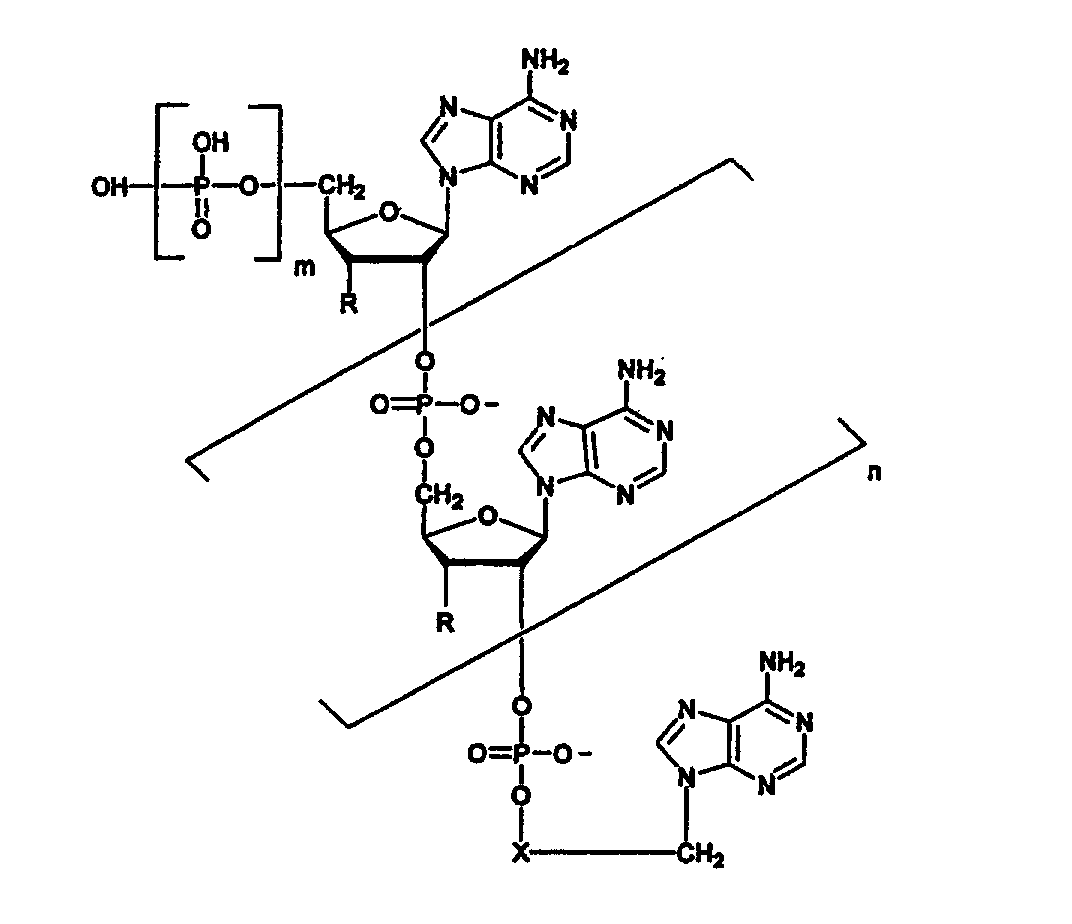
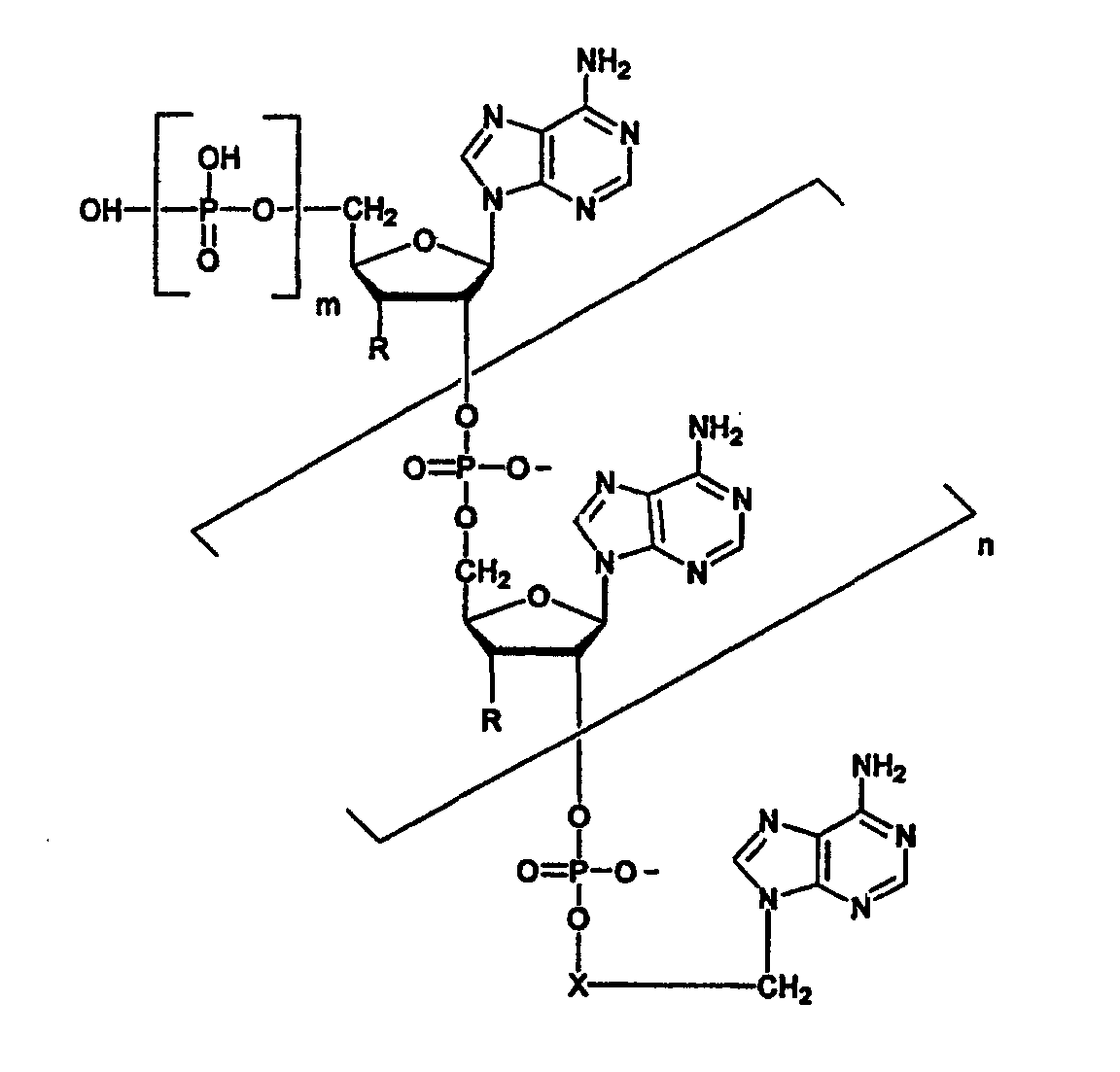
- the invention comprises a novel compound of Formula I wherein n is a whole positive integer from 1 to 8, m is 0, 1, 2 or 3, R is hydrogen, X is selected from C 1 to C 6 alkylene and C 1 to C 6 alkyleneoxy, or a pharmaceutically acceptable salt thereof.
- n is 1 to 3, most preferably 1 or 2.
- X is preferably selected from C 1 to C 6 alkylene and C 1 to C 3 alkyleneoxy.
- compositions and first and second medical uses are also claimed, the second medical use being inhibition of viral in mammals.
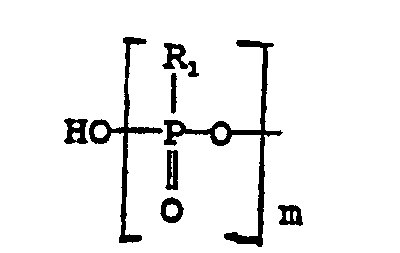
- the invention provides a conjugate comprising a compound according to Formula II wherein A is or X is NH 2 or CH 2 ; m is zero, 1, 2 or 3; n is an integer from 1 to 8; each R 1 is independently selected from O - , S - , sulfate, Se - , C 1 to C 8 alkyl and C 1 to C 8 alkoxy; each R 2 is independently selected from O - , S - , sulfate, Se, C 1 to C 8 alkyl and C 1 to C 8 alkoxy; each R 3 is independently selected from hydrogen, hydroxyl, amino and -OSi(CH 3 ) 2 -C(CH 3 ) 3 ; R 4 and R 5 are independently selected from hydrogen; hydroxyl; amino; C 1 to C 8 alkyl; C 1 to C 8 alkoxy; C 1 to C 8 alkylamino, alkylcarbonyl, alkylcarboxyl and haloalkyl; and C 1 to C
- Such conjugates on administration, simultaneously cause activation of the 2-5A synthetase/RNase L antiviral pathway of said mammal and inhibition of viral DNA polymerase.
- n is 1 to 3, most preferably 1 or 2.
- the alkyl, alkoxy, substituted alkyl or substituted alkoxy groups which may contain from one to 8 carbon atoms, preferably contain from 1 to 4 carbon atoms, most preferably from 1 to 3 carbon atoms.
- the halogen atom is preferably chlorine, bromine or fluorine, with chlorine being most preferred.
- the group A is wherein m is defined above; and more preferably, at least one of R 1 are S - , where each other R 1 is O - .
- An additional preferred embodiment provides that at least one of R 3 or R 4 is hydrogen, the remainder being hydroxyl.
- Vitamins (i) useful as adducts according to the present invention include, for example, vitamin B 12 , biotin, riboflavin and folic acid.
- the adduct comprises a lipophilic molecule or radical, such as the acyl group (iii) of the formula
- the adduct preferably contains a cholesteryl group.
- the compound to which the adduct is conjugated has the structure of Formula II wherein A is m is zero, 1, 2 or 3, n is an integer from 1 to 8, preferably 1, 2 or 3, each R 3 and R 4 is independently selected from hydrogen and hydroxyl, each R 2 is independently selected from S - and O - , R 5 is hydroxy, or a pharmaceutically acceptable salt thereof; which compound is covalently linked through the 2'-position of the 2'-terminal nucleotide thereof to the adduct.
- the invention provides a pharmaceutical composition comprising a pharmaceutical carrier and a compound according to formula I above wherein, in addition to the substitution possibilities set out above for formula I, R may be hydroxyl.
- the invention also provides first and second medical uses of such compounds (except those in which R is hydrogen), the second medical use being inhibition of viral infection in mammals.
- Fig. 1 is a diagram illustrating the 2-5A synthetase/RNase L intracellular enzyme pathway.
- Fig. 2A is a phase-contrast micrograph of H9 cells incubated for 5 hours with fluorescein-bovine serum albumin (BSA) covalently conjugated to folate (25 ⁇ g/ml) in folate-deficient medium.
- BSA fluorescein-bovine serum albumin
- Fig. 2B is a fluorescent micrograph of the same H9 cells shown in Fig. 2A.
- Fig. 2C is a phase-contrast micrograph of H9 cells incubated for 5 hours with fluorescein-BSA not conjugated to folate.
- Fig. 2D is a fluorescent micrograph of the same H9 cells shown in Fig. 2C.
- Therapeutic agents that activate the 2-5A synthetase/RNase L antiviral defense pathway and also inhibit the activity of virally-derived DNA polymers (particularly reverse transcriptase) are used for the treatment of viral disease states.
- treatment is meant to include also prophylaxis.
- dual effect therapeutic agents are selective, broad spectrum inhibitors of viral DNA polymerases that are produced during viral infection.
- the polymerases are critical for viral replication.
- the compounds utilized in the practice of the invention may be characterized as derivatives of authentic 2-5A with modifications in the 5'-terminal phosphate group, ribosyl moiety and/or the internucleotide bonds.
- one or more of the 3'-hydroxyl groups was replaced by hydrogen atoms to form the core 2',5'-cordycepin derivatives.
- This modification resulted in derivatives with increased resistance to degradation by phosphodiesterase.
- the preparation of such compounds is disclosed in U.S. Patent 4,464,359 (2',5'-oligocordycepin), and in U.S. Patent 4,859,768 (2',5'-oligocordycepin and mixed 2',5'-oligo(cordycepin/adenosine)).
- the core 2',5'-cordycepin derivatives are also non-toxic and have broad spectrum antiretroviral activity in infected cells (Montefiori, D.C. Sobol, R.W., Li, S.W., Reichenbach, N.L., Suhadolnik, R.J., Charubala, R., Pfleiderer, W., Modliszewski, A., Robinson, W.E., Jr., and Mitchell, W.M., Proc. Natl. Acad. Sci.
- 2-5A derivatives have been synthesized with other modifications of the 3'-hydroxyl groups, such as the substitution of amino and OSi(CH 3 ) 2 -C(CH 3 ) 3 , as described in Patent 4,859,768.
- Other 2-5A derivatives contain, in addition to or in lieu of 3'-hydroxyl modifications on one or more nucleotides, modifications in the 5'-terminal phosphate group.
- These 2-5A derivatives retain the ability to inhibit viral DNA polymerase and retain metabolic stability but, in addition, are able to activate RNase L.
- a variety of 2'-5'-oligoadenylate derivatives in addition to those already synthesized will exhibit enhanced antiviral activity.
- the internucleotide phosphodiester linkage is modified.
- sulfur is substituted for an oxygen atom to form the 2',5'-phosphorothioate oligoadenylates.
- the preparation of such compounds, including optical isomers, is described in U.S.Patent 4,924,624.
- the substitution of sulfur for oxygen in the 2',5'-phosphodiester backbone introduceschirality into the molecules and introduces a new chemistry of the backbone.
- the core 2',5'-phosphorothioates exhibit increased resistance to phosphodiesterase and phosphatases and new biological activities compared to authentic 2-5A cores.
- stereochemically modified molecules are the first 2',5'-linked core molecules able to activate RNase L.
- the 2',5'-phosphorothioates act through both the activation of the 2-5A synthetase/RNase L antiviral system and the inhibition of viral DNA polymerase.
- the 2',5'-phosphorothioate trimer 5'-monophosphates activate RNase L at nanomolar concentrations, similar to naturally occurring p 3 A 3 .
- Other molecular modifications of the internucleotide linkage provided for herein include the substitution of an oxygen atom by sulfate, selenium, C1-C8 alkyl and C1-C8 alkoxy.
- dual action, antiviral 2-5A derivatives having increased penetration into intact cells are prepared by conjugating the oligomer to an adduct.
- adducts comprise the water-soluble vitamins (including but not limited to biotin, folic acid, vitamin B 12 , or riboflavin).
- Other preferred adducts include lipophilic molecular and chemical groups such as, for example, acyl or cholesteryl groups.
- Such conjugates are internalized by intact cells by exploiting receptor-mediated endocytosis.
- 2-5A defect any manifestation, condition or interruption of the 2-5A pathway which results in a physiologically consequential change in the production of authentic 2-5A, and/or the interruption of 2-5A-dependent activation of RNase L.
- Afflictions characterized by a 2-5A defect include, for example, viral infections, particularly HTLV infection, most particularly HIV infection, chronic fatigue and other HHV-6 related disorders, hepatitis B and other infections of the hepatitis virus family, cutaneous T-cell lymphoma and other HTLV-1 related disorders, etc.
- diseases that are relevant include chronic myelogenous leukemia; acute leukemia; cancer; T-cell leukemia; Alzheimer's disease; Parkinson's disease; multiple sclerosis; autoimmune disease; and surgery- and other trauma-induced immune dysfunction.
- 2-5A pathway defects are particularly manifested in diseases characterized by both chronic viral infection and immune cell defects.
- Structural modification of the 2-5A molecule at the 3'-hydroxyl groups and elsewhere provides 2-5A analogues with remarkably increased metabolic stability to 2'-phosphodiesterases and cellular nucleuses, while maintaining the ability to activate RNase L and inhibit retroviral reverse transcriptase.
- modification of native 2-5A by substitution of the 3'-terminal nucleotide results in a more stable molecule. Persistent, high intracellular concentration of the metabolically stable 2-5A analogs are a consequence of their increased stability. Additionally, modifications of the 5'-terminal enhance the ability of the 2-5A molecule to activate RNase L.
- the longer-lasting pharmacological activity of the 2-5A analogs offer a more favorable therapeutic ratio. This allows a decreased frequency of administration relative to 2-5A, which is metabolically unstable. Decreased frequency of administration is important due to the chronic nature of many afflictions characterized by 2-5A pathway defects.
- certain modifications of 2-5A derivatives that facilitate penetration into the cell further increase the therapeutic ratio by reducing the amount of the derivative that must be administered to give a therapeutic effect.
- the 2-5A analogs are particularly useful in the treatment of infections caused by viruses.
- the 2-5A pathway defect associated with viral infection comprises the inactivation of the pathway caused by the virus' interference with the activation of 2-5A synthetase by dsRNA.
- 2-5A production, and hence activation of RNase L is reduced.
- exogenous, metabolically stable 2-5A analog is administered to counteract this virally-caused defect in the 2-5A pathway.
- the 2-5A analogs like authentic 2-5A, are capable of activating RNase L, which cleaves viral RNA.
- the 2-5A analogs are particularly useful in protecting against infection by the various human T-cell leukemia viruses (collectively "HTLV”), such as HTLV-I, which cause cutaneous T-cell lymphoma; HTLV-II, which causes Sezary lymphoma: HTLV-III; and HTLV-IV, which is presently believed to be the etiologic agent of multiple sclerosis.
- HTLV human T-cell leukemia viruses
- HTLV-I which cause cutaneous T-cell lymphoma
- HTLV-III which causes Sezary lymphoma
- HTLV-IV which is presently believed to be the etiologic agent of multiple sclerosis.
- Each of the HTLV viruses is a retrovirus.
- HIV-1 HTLV-III is responsible for causing acquired immune deficiency syndrome ("AIDS").
- HIV-2 a second serologically distinct HIV subtype.
- HIV shall mean either HIV-1 or HIV-2, and any other HIV subtypes now or herein
- the 2-5A analogues are also particularly useful in protecting against infection by the various hepatitis viruses which cause viral hepatitis.
- the hepatitis B virus in particular, is thought to be a composite of a retrovirus and a virus that employs replication of a DNA genome by DNA dependent DNA polymerase.
- the 2-5A analogues are also particularly useful in protecting against infection by viruses with a DNA genome, such as herpes viruses.
- HTLV-infected patients in particular HIV-1-infected patients, have been shown to demonstrate unusually low levels of 2-5A and/or RNase L activity in blood mononuclear cells.
- Blood mononuclear cells from healthy individuals by contrast, display higher 2-5A levels, on average, and RNase L activity is readily detectable.
- blood mononuclear cells of chronic fatigue-inflicted individuals exhibit low 2-5A levels, and evidence the appearance of novel RNA cleavage products, distinct from the specific cleavage products observed in blood mononuclear cells from normal individuals.
- HIV-1 infection which is generally regarded as a prototypical retrovirus and HbV infection, which has properties both of retroviruses and DNA genome viruses
- the method of the invention has application to the treatment of any diseases wherein the etiologic agent comprises a virus.
- Examples of compounds for use in the method of the invention include the following core compounds, their corresponding 5' mono-, di-, and triphosphates, and the pharmaceutically acceptable salts of any of them:
- C-C-ether-A a group collectively referred to as "C-C-ether-A”.
- A-A-ether-A the compounds are referred to collectively as "A-A-ether-A”.
- Both intracellular and extracellular HBV DNA were analyzed by procedures that are routine in the art in order to (1) allow for verification of compound efficacy, and (2) provide possible data on the target site in the HBV replication pathway for the compound from the examination of the pattern of viral replicative forms.
- the culture medium was changed daily during the treatment period to (1) prevent the buildup of potentially toxic metabolites from the test compounds, and (2) provide an analysis of HBV virion production during discrete 24-hour intervals which enables a quantitative comparison of any effect on virion production.
- HBV DNA levels were measure by comparison to known amounts of HBV DNA standards applied to every nitrocellulose membrane (gel or slot blot).
- An AMBIS beta scanner which measures the radioactive decay of the hybridized probes directly from the nitrocellulose membranes, was used for the quantitative analysis. Standard curves, generated by multiple analyses, were used to correlate cpm measurements made by the beta scanner with relative levels of target DNA.
- the levels of HBV virion DNA released into the culture medium were analyzed by a slot blot hybridization procedure. HBV DNA levels were then compared to those at day 0 to determine the effect of drug treatment.
- the levels of replicate intermediate and episomal monomers were used as an indicator of the relative levels of HBV replication.
- Integrated HBV DNA was used to normalize the relative amounts of DNA in each lane because the levels of this class of HBV DNA remain constant on a per cell basis. Inhibition of HBV DNA replication is indicated by the loss of replicative intermediates without changes in the level of integrated HBV DNA.
- the following 2-5A derivatives showed anti-HBV activity: xyloA 3 , A-A-ether-A, EHNA-AA, CAC, ACCA and dd benz.
- anti-HBV activity will be augmented further by conjugating said 5' modified and 5' unmodified 2-5A derivatives with lipophyllic adducts such as cholesterol, palmitate, folate, etc.
- Toxicity was determined by the inhibition of uptake of neutral red dye, as determined by the absorbance at 510 nanometers relative to untreated cells (Finter et al., J. Med. Chem 5 :419 (1969)), 24 hours following day 9 of treatment.
- RNase L is a key functional enzyme of the 2-5A synthetase/RNase L antiviral defense pathway.
- the activation of this unique 2-5A-dependent endoribonuclease by 2-5A derivatives and the subsequent hydrolysis of viral RNA is critical in the inhibition of virus replication and regulation of cell growth.
- Some of the antiretroviral properties of interferon are mediated by activation of the 2-5A synthetase/RNase L pathway. Direct activation of RNase L by 2-5A derivatives bypasses the requirement for interferon in establishing an antiretroviral state.
- 2-5A derivatives that are metabolically stable (and therefore resistant to degradation by phosphodiesterases and phosphatases) and biologically active (capable of activating RNase L).
- Manipulation of synthetic procedures permits the design and synthesis of 2-5A derivatives which (i) display increased metabolic stability against nucleolytic degradation, (ii) are phosphatase- resistant, (iii) do not require 5'-phosphorylation for activation of RNase L, and (iv) can be transported into intact cells.
- Chirality was introduced into the 2',5'-phosphodiester bond of the 2-5A molecule as an approach to differentiate between RNase L activation and inhibition at the molecular level.
- the pure dimers and trimers of the diastereomeric phosphorothioate derivatives of 2-5A were first synthesized enzymatically. More recently, chemical synthesis, purification and identification of the two dimer, four trimer and eight tetramer diastereomers have been achieved via the phosphotriester and phosphoramidite approach. These chiral molecules exhibit striking biological activities which altered the dogma that three adenylate residues and two 5'-terminal phosphates were required to activate RNase L.
- the 2',5'-phosphorothioate tetramer 5'--monophosphates were microinjected into the cytoplasm of HeLa cells and the cells were then challenged with VSV.
- the 2',5'-phosphorothioate tetramer 5'-monophosphates (pRpRpRp, pSpRpRp and pRpSpSp) all activated RNase L.
- the pSpSpSp isomer at concentrations as high as 10 -6 M did not. Microinjection of the pSpSpSp inhibitor simultaneously with 2-5A eliminated protection against VSV replication.
- the R p - and S p -2',5'-phosphorothioates inhibit HIV-1 replication in intact cells in culture.
- the 2',5'-phosphorothioates protect target cells from HIV-1 infection by inhibition of HIV-1 RT (measured in Triton X-100-activated lysates of HIV-1 virions from H9/HTLV-IIIB culture supernatants). HIV-1 RT was not inhibited by A 3 or p 3 A 3 at 0.25-256 ⁇ M.
- the 2',5'-phosphorothioate tetramer 5'-monophosphate derivatives are very effective inhibitors of HIV-1 RT activity.
- HIV-1 RT The most effective inhibitor of HIV-1 RT in HIV-1-infected cell lysates is p 3 A 3 ⁇ S with 50% inhibition observed at 0.5 ⁇ M.
- AMPS did not inhibit HIV-1 RT up to 200 ⁇ M, suggesting that degradation products are not responsible for the inhibition observed with 2',5'-phosphorothioates.
- d(T) 16 and tRNA Lys.3 bind specifically to the kinetically significant primer binding site of homogeneously pure recombinant p66 HIV-1 RT as demonstrated in UV crosslinking studies. Binding of oligo d(T) n to p66 RT is not affected by dNTPs; in competition assays, the primer analogs, Sd(C) 28 and d(C) 19-24 , the natural primer tRNA Lys.3 and p 3 A 3 ⁇ S inhibit oligo d(T) n -p66/RT complex formation in a first-order exponential manner. The inhibition of HIV-1 RT by 2-5A and 2-5A derivatives occurs at the primer binding site.
- 2',5'-A 3 core, 2',5'-pA 3 , 3',5'-A 3 core, 3',5'-pA 3 , 3',5'-p 3 A 3 and ATP do not inhibit binding of HIV-1 RT to d(T) 16 .
- the 2',5'-cordycepin trimer core and 5'-monophosphate (1 ⁇ M) (when incorporated into antibody-targeted liposomes specific for the T cell receptor molecule CD3) inhibited 90% of HIV-1 replication. See Table 1 of Müller, W.E.G., Weiler, B.E., Charubala, R., Pfleiderer, W., Leserman, L., Sobol, R.W., Suhadolnik, R.J., and Schröder, H.C., Biochemistry 30, 2027 (1991).
- antiretroviral molecules (2-5A derivatives) which possess dual effects on HIV-1-infected cells: (i) they activate the 2-5A synthetase/RNase L antiretroviral system and (ii) inhibit HIV-1 RT.
- the 2',5'-phosphorothioate cores and their 5'-monophosphates it is possible to prevent acute infection (by inhibition of HIV-1 RT) and simultaneously degrade HIV-1 mRNA by activation of RNase L.
- bioactive 2-5A derivatives are conjugated to water-soluble vitamins (folic acid, biotin, riboflavin, or vitamin B 12 ) or to lipophilic chemical groups.
- 2-5A derivatives may be delivered to intact cells without membrane damage.
- This approach involves (i) the synthesis of bioactive, metabolically stable derivatives, e.g., 2',5'-C n , 2',5'-phosphorothioates (prepared according to U.S. Patent 4,924,624), and other metabolically stable derivatives such as those disclosed in U.S. Patent 4,-859,768.
- 2-5A derivatives according to the disclosure of the above-mentioned documents, have been designed, synthesized and tested for their antiretroviral effect at the level of RNase L and inhibition of RT.
- 2',5'-Oligonucleotides may be prepared enzymatically in multistep chemical syntheses via the phosphotriester and phosphoramidite approach, in milligram and gram amounts, respectively. The correct choice of appropriate blocking groups for sugar, base and phosphate protection determines yields, ease of purification and chromatographic behavior.
- a first method of assisted delivery involves covalent conjugation of lipophilic groups (e.g., acyl or cholesteryl groups) to the 2',3'-terminus of the molecule.
- lipophilic groups e.g., acyl or cholesteryl groups
- the 2',5'-cordycepin trimer core may be synthesized and purified with palmitoyl (Formula III) or cholesterylformyl (Formula IV) ester linkages at the 2'-terminal hydroxyl group:
- esterified compounds have been found to inhibit HIV-1 replication in HIV-1 infected H9 cells in culture.
- 2-5A-analog cholesterol conjugates may be synthesized by reacting a conjugating compound of Formula V wherein m is 0, 1, 2 or 3 n is an integer from 1 to 8, R is independently selected from the group consisting of hydrogen and hydroxyl, R 1 is COOH or NH 2 , and R 2 is independently sulfur or oxygen R 3 is independently sulfur or oxygen, and x is an integer from 1 to 17 with chlotesterylchloroformate in the presence of dimethylaminopyridine (DMAP) and dichloromethane. Purification is accomplished by column chromatography.
- DMAP dimethylaminopyridine
- R groups are hydroxyl, that is, at least one R is hydrogen.
- n is 1 to 3, most preferably 1 or 2.
- the R 2 of the 5'-terminal phosphonyl group is preferably sulfur.
- the value of X is preferably from 1 to 8, most preferably 1 to 4.
- the conjugating 2-5A derivative according to Formula V may be prepared by functionalizing an appropriate 5'-phosphorylated 2',5'-oligoadenylate, 2',5'-oligocordycepin or mixed 2',5'-oligo(adenylate/cordycepin) oligomer, such as may be prepared from either U.S. Patent 4,464,359 or 4,859,768.
- the oligomer is functionalized by coupling the 2'-terminal nucleotide thereof to an alkyl linker -(CH 2 ) x -R 1 wherein X and R 1 are defined above.
- the conjugating 2-5A derivative of Formula V may be prepared by attaching the alkyl linker to the 2'-terminal nucleotide of a 2',5'-phosphorothioate oligonucleotide.
- the preparation of the 2',5'-phosphorothioates, including fully resolved enantiomers thereof (the phosphorothioates are optically active), is disclosed in U.S. Patent 4,924,624. It may be appreciated that by following the combined synthetic techniques of Patents 4,924,624 and 4,859,768, that a mixed 2',5'-(phosphodiester/phosphorothioate)-oligoadenylate may be prepared.
- the 5'-monophosphates are readily prepared by reacting the corresponding unphosphorylated core compound with POCl 3 .
- such treatment would result in the elimination of sulfur from the phosphorothioate internucleotide linkage, and the formation of a 2',5'-oligoadenylate.
- the 5'-monophosphates of phosphorothioate bond-containing core oligomers must be prepared from the corresponding fully protected core oligomer from which the monomethoxytrityl blocking groups on the 5'-terminal nucleotide has been removed.
- the procedure is described in detail in U.S. Patent 4,924,624, columns 26 through 31 thereof.
- 2-5-derivative/acyl conjugates may be synthesized by reacting the conjugating compound with acyl chloride, according to standard techniques.
- the 2',5'-oligomer may be synthesized directly with an acyl group or cholesteryl formyl group esterified to the 2'-terminal hydroxyl group.
- One such method is illustrated by but not limited to the preparation of the cholesterol conjugated and acylated cordycepin trimer compounds comprising compounds 12 and 13 of Scheme 1.
- a multistep chemical synthesis starts from 5'-O-dimethoxytrityl-N 6 -p-nitro-phenylethoxycarbonyl-cordycepin ( 1 ) and the corresponding 2'-O-succinate derivative ( 2 ).
- Compound 1 is reacted with colesteryl chloroformate to the carbonate 3 which is used as the 2'-terminal building block after detritylation to 4 .
- the succinate 2 is condensed with cholesterol to the ester 5 , and detritylation leads to compound 6 .
- cordycepin trimer conjugate 13 which carries an acyl residue at the 2'-terminal end of the oligonucleotide, is prepared.
- Lipophilic conjugates according to the present invention have the potential to enter the cell by diffusion, owing to their lipophilic nature. They may be introduced into intact cells with substantially the same biological activity as authentic 2-5A. Once inside the cell, the conjugates are hydrolyzed and release the 2-5A derivative.
- a second method of assisted oligonucleotide delivery involves covalent conjugation of 2-5A derivatives to water-soluble vitamins such as biotin, folic acid, riboflavin or vitamin B 12 .
- Covalent conjugation of 2-5A derivatives to water-soluble vitamins provides a method for co-delivery of active molecules into intact cells by exploiting receptor-mediated endocytosis with retention of essentially full biological activity.
- 2-5A derivatives can be covalently conjugated to water-soluble vitamins to facilitate delivery of the polar 2-5A molecule into intact cells without membrane damage.
- the water-soluble vitamins are covalently conjugated to the 2',3'-terminus of the 2-5A molecule to exploit receptor-mediated endocytosis for uptake into intact cells.
- Nondestructive delivery of polar molecules covalently conjugated to biotin, folic acid, riboflavin and vitamin B 12 into the cytoplasm and subsequent efficient uptake via receptor-mediated endocytosis has been well demonstrated. In this way, membrane damage arising from other established methods (such as microinjection, electroporation, sonication, detergent permeabilization) can be avoided by employing the natural vitamin endocytosis pathway to accomplish uptake.
- Vitamin uptake occurs in all dividing cells at reasonable rates. Based on the known efficiency of uptake of vitamin conjugates, it is believed that an intracellular concentration of a 2-5A/folic acid conjugate of about 10 -6 M can be achieved; these concentrations are sufficient to activate RNase L and inhibit HIV-1 RT. Similar intracellular concentrations are expected with 2-5A/biotin and the 2-5A/vitamin B 12 conjugates on the basis of the similar numbers of folate, biotin and vitamin B 12 receptors.
- a vitamin B 12 covalent conjugation of 2-5A or a bioactive 2-5A derivative is prepared by first converting vitamin B 12 to the mono-acid derivative thereof by mild acid hydrolysis (0.4 M HCl, 72 hours at room temperature).
- EDAC 1-ethyl-3-(dimethyl-amino-propyl)-carbodiimide HCl
- the 2-5A/vitamin B 12 conjugate is purified by either chromatography on Sephadex G-25 or reverse phase HPLC. Characterization is based on the reported molar extinction coefficients for 2-5A and vitamin B 12 .
- a suitable coupling reagent such as EDAC
- Trimer "core” cordycepin analogs according to Formula I i.e., compounds wherein m is O and n is 1 may be prepared according to Scheme 2, wherein “bz” is benzoyl, “MeOTr” is monomethoxytrityl, “npe” is 2-(4-nitrophenyl)ethyl and “npeoc” is [2-(4-nitrophenyl)-ethoxy]carbonyl.
- the compounds are prepared as ammonium salts, it being understood that the invention is not so limited.
- the Scheme is exemplified by the preparation of four compounds, 18 , 19 , 20 and 21 .
- the dinucleotide monophosphodiester 9 was prepared from 3'-deoxy-5'-O-(monomethoxytrityl)-N 6 -[2-(4-nitrophenyl)ethoxycarbonyl]adenosine ( 4 ) according to the method of Charubala et al ., Helv. Chim. Acta 70, 2028 (1987).
- Compound 4 which may be prepared according to Charubala et al ., was taken and converted into the 2'-phosphotriester 5 with a 2,5-dichlorophenyl and a 2-(4-nitrophenyl)ethyl group at the phosphate function (Scheme 1) according to the method of said Charubala et al . reference.
- the 2,5-dichlorophenyl group was cleaved off with 4-nitrobenzaldehyde oxime to give diester 6 .
- the 5'- O -monomethoxytrityl group was removed by acid to give the 5'-hydroxytriester 7 .
- These two building blocks 6 and 7 were condensed in presence of 2,4,6-triisopropylbenzenesulfonyl chloride and 1-methyl-1 H -imidazole to yield in 88%, after purification and drying, the dimeric phosphotriester 8 .
- the 2,5-dichlorophenyl group from this dimer block was cleaved off by the oximate method to give the corresponding dinucleotide monophosphodiester 9 .
- trimers 14 - 17 the above dimeric phosphodiester 9 was condensed with the suitably blocked appropriate acyclic nucleosides 10 - 13 in presence of 2,4,6-triisopropylbenzenesulfonyl chloride and l-methyl-lH-imidazole in yields of 70-75%.
- Acyclic nucleosides 10 - 13 may be prepared according to the procedure of Tychinskaya et al ., Bioorg. Khim (USSP) 5, 1059 (1979) and Mikhailov et al ., Izv. Akad. Nauk. Ser. Khim. 2582 (1974).
- Dimer diester 9 (1mmol) and the appropriate acyclic nucleoside analog 10 - 13 (0.75 mmol) were coevaporated with dry pyridine (5 x 10 ml), and finally dissolved in pyridine (10 ml). Then 0.46 ml (6 mmol) of l-methyl-lH-imidazole and 0.606 g (2 mmol) of 2,4,6-triisopropylbenzenesulfonyl chloride were added successively. The mixture was stirred at room temperatures for 20 hours, then diluted with CHCl 3 (100 ml), and washed with H 2 O(2 x 50 ml).
- trimers were deblocked sequentially, using 0.5M DBU (1,8-diazabicyclo[5.4.0]undec-7-ene) in dry pyridine for 20 hours at room temperature to cleave the 2-(4-nitrophenyl)ethyl groups, NH 3 in dioxane to remove the benzoyl groups, and finally acid treatment to deblock the 5'- O -monomethoxytrityl group yielding the corresponding fully deblocked trimers 18 - 21 , which were purified by DEAE sephadex column chromatography and paper chromatography.
- the trimers were characterized by TLC, UV, HPLC, and 1 H-NMR spectra (data not shown).
- Tetramers (C-C-C-ether-A) may be prepared by substituting for the dinucleotide monophosphodiester 9 in Scheme 2 the corresponding protected trinucleotide 9a which is condensed with the suitably blocked appropriate acyclic nucleoside, as above.
- higher oligomers of the present 3'-acyclic cordycepin oligomers may be prepared by selecting the appropriate higher oligonucleotide for condensation with the acyclic nucleoside.
- the 5'-monophosphates of the unphosphorylated core molecules may be prepared from the fully blocked trimers, e.g., 14 - 17 by detritylation with acid treatment, followed by reaction with di- p -nitrophenylethylphosphoryl chloride. Further deblocking and chromatography results in isolation of the 5'-monophosphate oligomers.
- the 5'-monophosphorylation procedure may be carried out according to the method of Example 6 of U.S. Patent 4,859,768.
- the 5'-diphosphates and 5'-triphosphates of the core molecules may be prepared according to the procedure of the aforesaid patent. Briefly, they may be prepared by adding 0.5 mM of tributylammonium pyrophosphate dissolved in 5 ml of dimethylformamide to 0.1mM of monophosphorylated core as the anhydrous tributylammonium salt in 1 ml of dimethylformamide and 0.5 mM of 1,1'-carbonyldiimidazole. After 20 hours at room temperature, the reactants are treated with 5ml of methanol, evaporated to dryness and chromatographed on a 2x20 cm DEAE cellulose column.
- the 5'- di- and triphosphates are isolated following a linear gradient (0-0.4M in 3 1 at pH 7.5) of triethylammoniumbicarbonate, according to the method of Hoard, et al ., J. Amer. Chem. Soc. 87, 1785-1788 (1965).
- the 5'-diphosphates and 5'-triphosphates may then be purified by DEAE-Sephadex® A25 and Sephadex®.
- the 2-5A analogs and conjugates may be administered according to the methods described in Patents 4,924,624, 4,859,768 and International Patent Application No. PCT/US85/03634 (International Publication No. WO 89/03683) in the dosages recommended therein.
- the 2',5'-oligoadenylate analogs may be taken up in pharmaceutically acceptable carriers.
- Such carriers for preparation of pharmaceutical compositions may be either organic or inorganic, solid or liquid in nature. Suitable liquid carriers include water and alcohols such as ethanol, benzyl alcohol and poly(ethylene glycols).
- the preferred liquid carriers for injectable preparations include water, saline solution, dextrose solution and glycol solutions such as aqueous propylene glycol or aqueous poly(ethylene glycol).
- the properties of the formulations may be enhanced by the addition of one or more adjuvants possessing properties as viscosity enhancers, surfactants, pH modifiers, preservatives, sweeteners, stability enhancers, coloring agents, suspending agents, granulating agents, coating agents, disintegration modifiers, propellants, emulsifying agents and hymectants.
- the resulting compositions may be in the form of solutions, suspensions, tablets, capsules, ointments, elixirs, injectable compositions and the like.
- the dosage administered depends upon the severity of the infection or affliction and the size and weight of the subject.
- the dosage may vary over a wide range depending on the nature of the affliction, and the size and weight of the subject.
- the compounds are prepared as a solution of 0.1-100 mg/ml in water, phosphate-buffered saline or other appropriate fluid, or may be prepared as a tablet containing 0.01-1 gram active compound.
- the compounds may be administered in the form of water-soluble salts.
- Pharmaceutically acceptable water-soluble salts include, for example, the sodium, potassium and ammonium salts of the active compounds. They are readily dissolved in water or saline solution.
- the formulation may contain additional agents, such as a sugar or protein, to maintain the osmotic balance.
- the 2',5'-oligoadenylate analogs may be administered in doses of about 0.1 mg to about 1 gram to animals or humans afflicted by, or suspected of affliction by, or at risk or affliction by, any of the various conditions characterized by a 2-5A pathway defect.
- the total daily dosage may vary, for example, from about 0.001 gram to about 1 gram, although lower or higher amounts may be administered.
- a preferred daily dose is from about 0.01 gram to about 0.1 g of active ingredient.
- the compounds may be administered by any of several routes, including, but not limited to, intravenous injection, intraperitoneal or intramuscular injection, and oral administration. Techniques for accomplishing such administration are routine and known in the medical art. Administration may be as frequent as several time a day or as infrequent as weekly. For intravenous injection, particularly for treatment of HIV, a solution containing about 0.1 to about 1.0 milligram per ml of active ingredient is preferred.
- the 2',5'-oligoadenylate analogs may be administered topically to treat skin lesions associated with any of the disease states characterized 2-5A pathway defect.
- a sufficient amount of a preparation containing one or more of the 2',5'-oligoadenylate analogs may be applied to cover the lesion or affected area.
- An effective concentration of active agent is from about 10 -3 M to about 10 -5 M, with about 10 -4 M being preferred.
- the dosage is based upon the weight of the 2-5A analog moiety.
- the 2-5A analogs may be administered by a variety of specialized oligonucleotide or nucleic acid delivery techniques, such as by encapsulation in unilameller liposomes or reconstituted sendai virus envelopes, or by conjugation to carrier molecules such as poly(L-lysine). Such methods are disclosed in International Patent Application No. PCT/-US85/03634.
- 2-5A derivatives and conjugates may be administered via microscopic nanometer-size polystyrene carriers which dissolve in the bloodstream to release the active drug.
- suitable carriers are discussed in the aforementioned patent documents.
Landscapes
- Health & Medical Sciences (AREA)
- Chemical & Material Sciences (AREA)
- Life Sciences & Earth Sciences (AREA)
- General Health & Medical Sciences (AREA)
- Organic Chemistry (AREA)
- Molecular Biology (AREA)
- Engineering & Computer Science (AREA)
- Pharmacology & Pharmacy (AREA)
- Animal Behavior & Ethology (AREA)
- Medicinal Chemistry (AREA)
- Public Health (AREA)
- Veterinary Medicine (AREA)
- Epidemiology (AREA)
- Bioinformatics & Cheminformatics (AREA)
- Biochemistry (AREA)
- Biotechnology (AREA)
- Genetics & Genomics (AREA)
- Immunology (AREA)
- Botany (AREA)
- Oncology (AREA)
- Chemical Kinetics & Catalysis (AREA)
- General Chemical & Material Sciences (AREA)
- Nuclear Medicine, Radiotherapy & Molecular Imaging (AREA)
- Virology (AREA)
- Communicable Diseases (AREA)
- Pharmaceuticals Containing Other Organic And Inorganic Compounds (AREA)
- Acyclic And Carbocyclic Compounds In Medicinal Compositions (AREA)
- Organic Low-Molecular-Weight Compounds And Preparation Thereof (AREA)
- Medicines That Contain Protein Lipid Enzymes And Other Medicines (AREA)
- Saccharide Compounds (AREA)
- Polysaccharides And Polysaccharide Derivatives (AREA)
Claims (35)
- Composé selon la formuledans laquelle
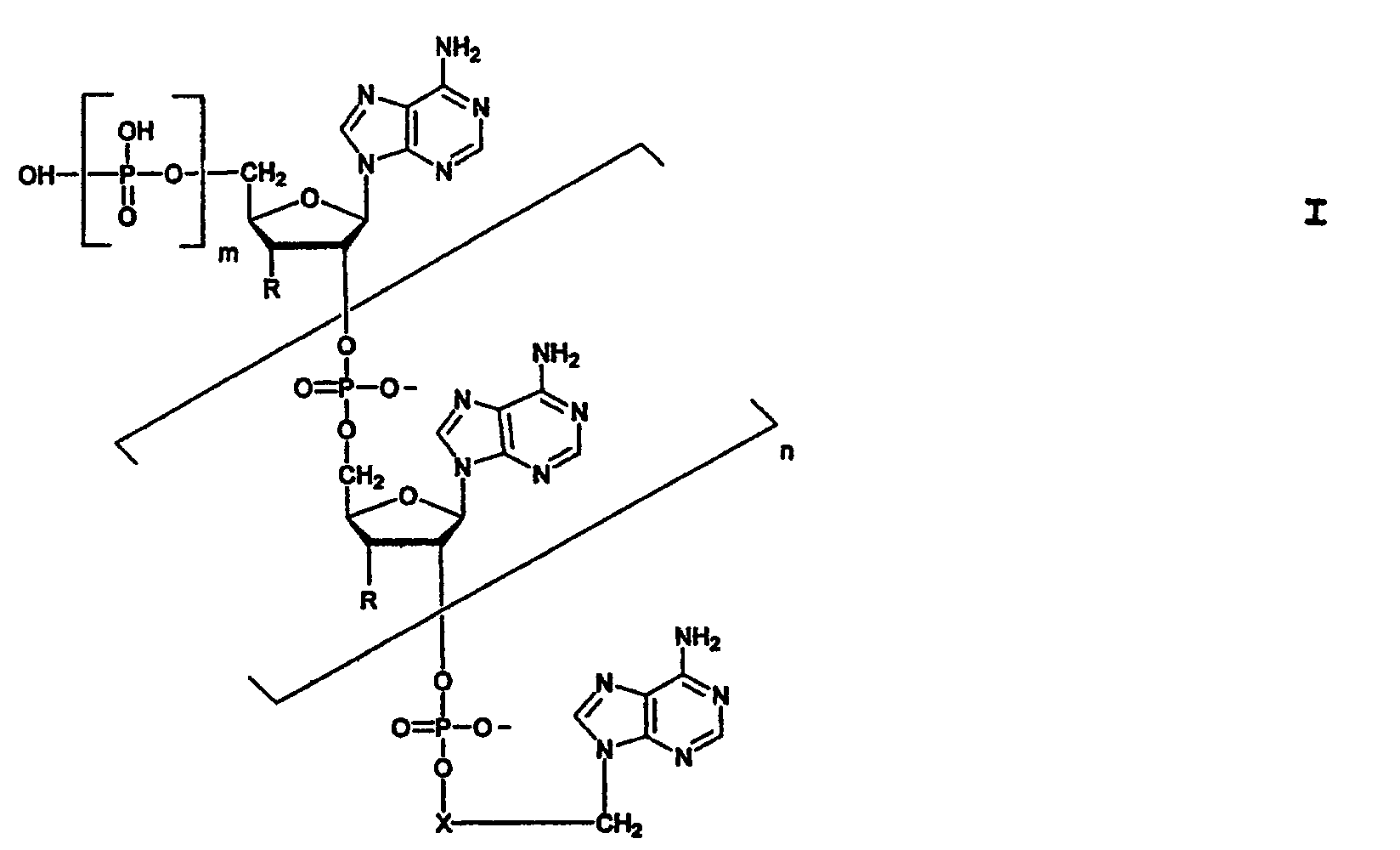
- n
- est un nombre entier positif de 1 à 8,
- m
- est 0, 1, 2 ou 3,
- R
- est un hydrogène,
- X
- est choisi parmi un alkylène en C1 à C6 et un alkylèneoxy en C1 à C6, ou un sel pharmaceutiquement acceptable de ceux-ci.
- Composé selon la revendication 1,
caractérisé en ce que
X est choisi parmi un alkylène en C1 à C3 et un alkylèneoxy en C1 à C3. - Composé selon la revendication 1
caractérisé en ce que
le composé est choisi parmi la 3'-désoxyadénylyl-(2'-5')-3'-désoxyadénylyl(2'-2')-9-(2'-hydroxyéthyl)adénine, les 5'-mono-, di- et tri-phosphates de celle-ci, et tous sels pharmaceutiquement acceptables de chacun d'entre eux. - Composé selon la revendication 1,
caractérisé en ce que
le composé est choisi parmi la 3'-désoxyadénylyl-(2'-5')-3'-désoxyadénylyl(2'-3')-9-(3'-hydroxypropyl)adénine, les 5'-mono-, di- et tri-phosphates de celle-ci, et tous sels pharmaceutiquement acceptables de chacun d'entre eux. - Composé selon la revendication 1
caractérisé en ce que
le composé est choisi parmi la 3'-désoxyadénylyl-(2'-5')-3'-désoxyadénylyl(2'-4')-9-(4'-hydroxybutyl)adénine, les 5'-mono-, di- et tri-phosphates de celle-ci, et tous sels pharmaceutiquement acceptables de chacun d'entre eux. - Composé selon la revendication 1
caractérisé en ce que
le composé est choisi parmi la 3'-désoxyadénylyl-(2'-5')-3'-désoxyadénylyl(2'-2')-9-[(2"-hydroxyéthoxy)méthyl] adénine, les 5'-mono-, di- et tri-phosphates de celle-ci, et tous sels pharmaceutiquement acceptables de chacun d'entre eux. - Composition pharmaceutique comprenant un composé selon l'une quelconque des revendications 2 à 6 et un excipient pharmaceutique.
- Composé selon l'une quelconque des revendications 1 à 6 pour l'utilisation en médecine.
- Utilisation d'un composé selon l'une quelconque des revendications 1 à 6 pour la fabrication d'un médicament pour inhiber l'infection virale chez un mammifère.
- Conjugué comprenant un composé selon la formuledans laquelle
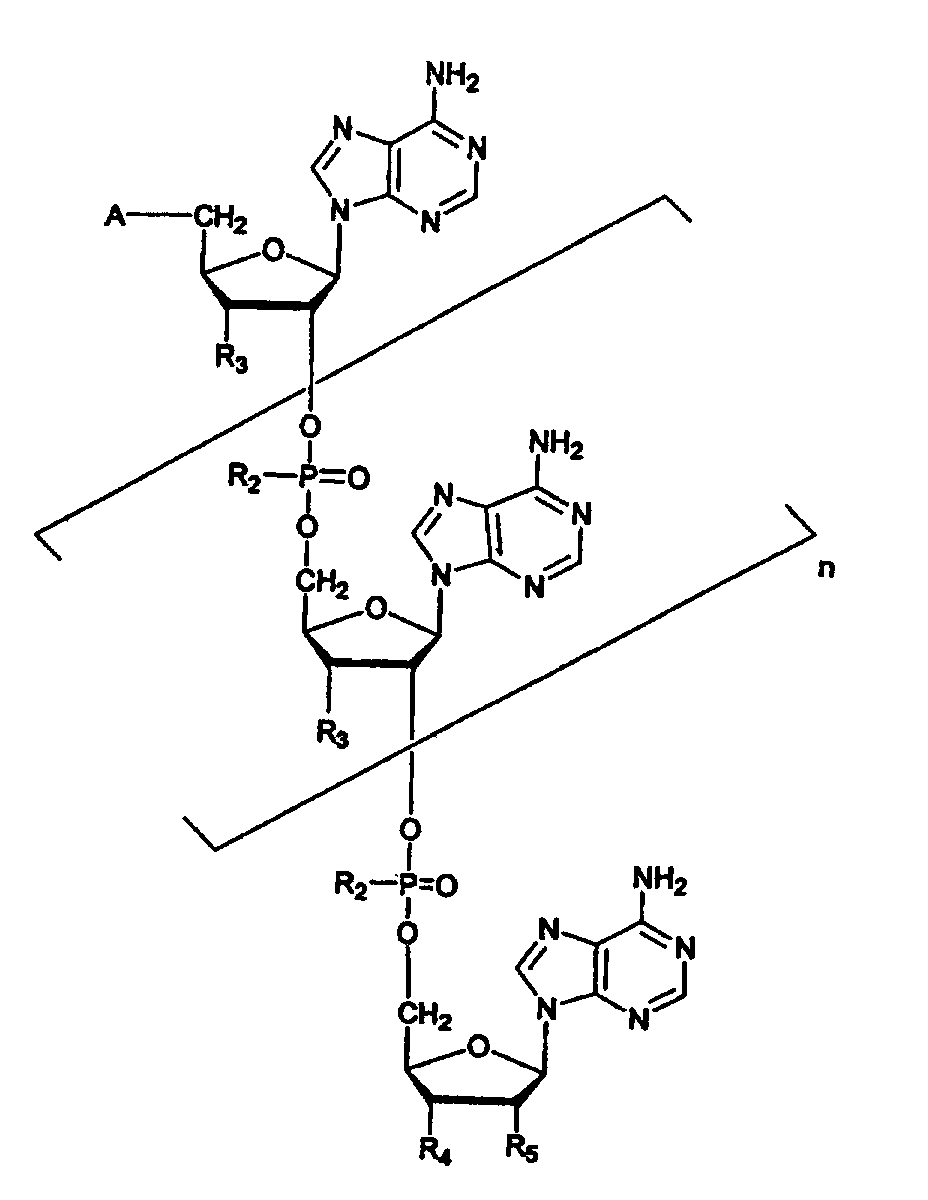
- A
- est
ou

- X
- est NH ou CH2 ;
- m
- est zéro, 1, 2 ou 3 ;
- n
- est un entier de 1 à 8 ;
chaque R2 est indépendamment choisi parmi O-, S-, un sulfate, Se-, un alkyle en C1 à C8 et un alkoxy en C1 à C8 ;
chaque R3 est indépendamment choisi parmi l'hydrogène, l'hydroxyle, un groupement amino et OSi (CH3)2 C(CH3)3;
R4 et R5 sont indépendamment choisis parmi l'hydrogène, l'hydroxyle, un groupement amino; un alkyle en C1 à C8 ; un alkoxy en C1 à C8 ;, un alkylamino en en C1 à C8 ; un alkoxycarbonyl, un alkoxycarboxyl et halogénoalkoxy ; ou les sels pharmaceutiquement acceptables de ceux-ci, excluant le 2',5'-oligoadénylate authentique et ses sels,
ce composé étant lié de manière covalente à un produit d'addition par un oxygène hydroxyle 2'- ou 3'- du nucléotide 2'-terminal du composé, lequel produit d'addition est choisi parmi (i) des vitamines qui ont des récepteurs correspondant à la surface des cellules pour l'endocytose régulée par des récepteurs, (ii) des produits d'addition contenant le groupe cholestéryle, et (iii) des groupes acyles de formuledans laquelle x est un entier de 1 à 20, et lequel produit d'addition engendre une augmentation de la pénétration du composé dans les cellules intactes.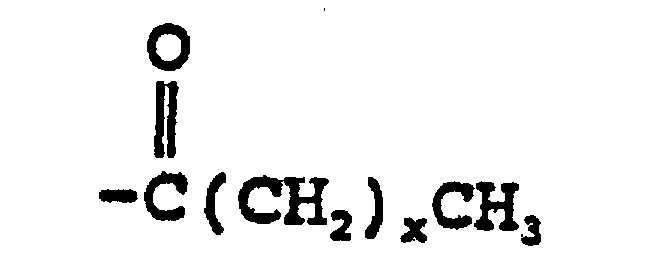
- Conjugué selon la revendication 10,
caractérisé en ce que
le produit d'addition est la vitamine B12. - Conjugué selon la revendication 10,
caractérisé en ce que
le produit d'addition est la biotine. - Conjugué selon la revendication 10,
caractérisé en ce que
le produit d'addition est l'acide folique. - Conjugué selon la revendication 10,
caractérisé en ce que
le produit d'addition est lipophile. - Conjugué selon la revendication 10,
caractérisé en ce que
le produit d'addition est un groupe acyle de formulem vaut 0, 1, 2 ou 3
n est un nombre entier de 1 à 8,
chaque R3 et R4 est choisi indépendamment entre l'hydrogène et un hydroxyle,
chaque R2 est choisi indépendamment entre S- et O-,
R5 est un hydroxy ou un sel de celui-ci pharmaceutiquement acceptable,
le composé étant lié en covalence au produit d'addition par la position 2' de son nucléotide 2'-terminal. - Conjugué selon la revendication 15,
caractérisé en ce que
le produit d'addition est une vitamine. - Conjugué selon la revendication 16,
caractérisé en ce que
la vitamine est choisie parmi le groupe constitué de la B12, l'acide folique et la biotine. - Conjugué selon la revendication 15,
caractérisé en ce que
le produit d'addition est lipophile. - Conjugué selon la revendication 15,
caractérisé en ce que
le produit d'addition contient un groupe cholestéryle. - Conjugué selon la revendication 18,
caractérisé en ce que
le produit d'addition est un groupe acyle de formuledans laquelle X est un entier de 1 à 20.
- Conjugué selon la revendication 20,
caractérisé en ce que
le produit d'addition est le palmitoyle. - Composition pharmaceutique comprenant un composé selon la formuledans laquelle

n est un nombre entier positif de 1 à 8,
m est 0, 1, 2 ou 3,
R est indépendamment un hydrogène ou un hydroxyle,
X est choisi parmi un alkylène en C1 à C6 et un alkylèneoxy en C1 à C6, ou un sel pharmaceutiquement acceptable de celui-ci, et un excipient pharmaceutique. - Composition pharmaceutique selon la revendication 22,
caractérisée en ce que
X es choisi parmi un alkylène en C1 à C3 et un alkylèneoxy en C1 à C3 et n est 1 à 3. - Composition selon la revendication 23,
caractérisée en ce que
X est un éhtylènoxy - Composition selon l'une quelconque des revendications 22 à 24,
caractérisée en ce que
R est un hydrogène. - Composition selon l'une quelconque des revendications 22 à 24,
caractérisée en ce que
R est un hydroxyle. - Composition selon l'une quelconque des revendications 22 à 26, dans laquelle m est zéro.
- Composé selon la formuledans la quelle
n est un nombre entier positif de 1 à 8,
m est 0, 1, 2 ou 3,
R est un hydroxyle,
X est choisi parmi un alkylène en C1 à C6 et un alkylènoxy en C1 à C6,
pour l'utilisation en médecine. - Composé selon la revendication 28,
caractérisé en ce que
X est choisi parmi un alkylène en C1 à C3 et un alkylènoxy en C1 à C3 et n est 1 à 3. - Composé selon la revendication 29,
caractérisé en ce que
X est un éthylènoxy. - Composé selon l'une quelconque des revendications 28 à 30, où m est zéro.
- Utilisation d'un composé selon la formuledans la quelle
n est un nombre entier positif de 1 à 8,
m est 0, 1, 2 ou 3,
R est un hydroxyle,
X est choisi parmi un alkylène en C1 à C6 et un alkylènoxy en C1 à C6,
pour la fabrication d'un médicament pour inhiber l'infection virale chez un mammifère. - Utilisation selon la revendication 32,
caractérisée en ce que
X est choisi parmi un alkylène en C1 à C3 et un alkylènoxy en C1 à C3 et n est 1 à 3. - Utilisation selon la revendication 33,
caractérisée en ce que
X est un alkylenoxy. - Utilisation selon l'une quelconque des revendications 32 à 34,
caractérisée en ce que
m est zéro.
Applications Claiming Priority (3)
| Application Number | Priority Date | Filing Date | Title |
|---|---|---|---|
| US84986592A | 1992-03-12 | 1992-03-12 | |
| US849865 | 1992-03-12 | ||
| PCT/US1993/001446 WO1993017692A1 (fr) | 1992-03-12 | 1993-02-18 | Derives antiviraux de 2'-5'-oligodenylate a double action et leurs utilisations |
Publications (3)
| Publication Number | Publication Date |
|---|---|
| EP0630249A1 EP0630249A1 (fr) | 1994-12-28 |
| EP0630249A4 EP0630249A4 (fr) | 1996-04-24 |
| EP0630249B1 true EP0630249B1 (fr) | 2002-09-18 |
Family
ID=25306711
Family Applications (1)
| Application Number | Title | Priority Date | Filing Date |
|---|---|---|---|
| EP93906054A Expired - Lifetime EP0630249B1 (fr) | 1992-03-12 | 1993-02-18 | Derives antiviraux de 2'-5'-oligodenylate a double action et leurs utilisations |
Country Status (12)
| Country | Link |
|---|---|
| EP (1) | EP0630249B1 (fr) |
| JP (1) | JPH07504900A (fr) |
| KR (1) | KR100272326B1 (fr) |
| CN (2) | CN1038592C (fr) |
| AT (1) | ATE224196T1 (fr) |
| AU (1) | AU664883B2 (fr) |
| CA (1) | CA2130926C (fr) |
| DE (1) | DE69332304T2 (fr) |
| IL (1) | IL104886A (fr) |
| NZ (1) | NZ249715A (fr) |
| TW (1) | TW263512B (fr) |
| WO (1) | WO1993017692A1 (fr) |
Families Citing this family (7)
| Publication number | Priority date | Publication date | Assignee | Title |
|---|---|---|---|---|
| US6040197A (en) * | 1994-05-17 | 2000-03-21 | Spallholz; Julian E. | Method for the preparation of free radical pharmaceuticals, diagnostics and devices using selenium conjugates |
| US5783454A (en) * | 1994-05-17 | 1998-07-21 | Spallholz; Julian E. | Method for the preparation of free radical pharmaceuticals using selenium conjugates |
| AU7804798A (en) | 1997-06-12 | 1998-12-30 | Temple University - Of The Commonwealth System Of Higher Education | Base-modified derivatives of 2',5'-oligoadenylate and antiviral uses thereof |
| US6362171B1 (en) | 1997-06-12 | 2002-03-26 | Temple University-Of The Commonwealth System Of Higher Education | Aminoaklanoyl-linked conjugates of 2′,5′-oligoadenylate and antiviral uses thereof |
| WO2007090071A2 (fr) * | 2006-01-27 | 2007-08-09 | Isis Pharmaceuticals, Inc. | Analogues d'acides nucleiques bicycliques modifies en position 6 |
| GB201019043D0 (en) | 2010-11-10 | 2010-12-22 | Protea Biopharma N V | Use of 2',5'-oligoadenylate derivative compounds |
| WO2022248881A1 (fr) | 2021-05-28 | 2022-12-01 | Enara Bio Limited | Nouveau complexe protéine-ligand |
Family Cites Families (5)
| Publication number | Priority date | Publication date | Assignee | Title |
|---|---|---|---|---|
| US72666A (en) * | 1867-12-24 | Improvement in fastening foe caeeiage-ouetains | ||
| US4464359A (en) * | 1981-04-10 | 1984-08-07 | Research Corporation | (2'-5')-Oligo (3'-deoxyadenylate) and derivatives thereof |
| US4859768A (en) * | 1984-07-11 | 1989-08-22 | Temple University Of The Commonwealth System Of Higher Education | Derivatives of 2', 5'-oligoadenylate and antiviral uses thereof |
| FR2567892B1 (fr) * | 1984-07-19 | 1989-02-17 | Centre Nat Rech Scient | Nouveaux oligonucleotides, leur procede de preparation et leurs applications comme mediateurs dans le developpement des effets des interferons |
| US4924624A (en) * | 1987-10-22 | 1990-05-15 | Temple University-Of The Commonwealth System Of Higher Education | 2,',5'-phosphorothioate oligoadenylates and plant antiviral uses thereof |
-
1993
- 1993-02-18 KR KR1019940703174A patent/KR100272326B1/ko not_active Expired - Fee Related
- 1993-02-18 WO PCT/US1993/001446 patent/WO1993017692A1/fr not_active Ceased
- 1993-02-18 DE DE69332304T patent/DE69332304T2/de not_active Expired - Lifetime
- 1993-02-18 JP JP5515698A patent/JPH07504900A/ja active Pending
- 1993-02-18 CA CA002130926A patent/CA2130926C/fr not_active Expired - Lifetime
- 1993-02-18 NZ NZ249715A patent/NZ249715A/en unknown
- 1993-02-18 EP EP93906054A patent/EP0630249B1/fr not_active Expired - Lifetime
- 1993-02-18 AU AU37237/93A patent/AU664883B2/en not_active Ceased
- 1993-02-18 AT AT93906054T patent/ATE224196T1/de not_active IP Right Cessation
- 1993-02-23 TW TW082101287A patent/TW263512B/zh active
- 1993-02-28 IL IL104886A patent/IL104886A/xx not_active IP Right Cessation
- 1993-03-11 CN CN93101986A patent/CN1038592C/zh not_active Expired - Fee Related
-
1997
- 1997-11-14 CN CNB971226822A patent/CN1198656C/zh not_active Expired - Lifetime
Also Published As
| Publication number | Publication date |
|---|---|
| IL104886A0 (en) | 1993-06-10 |
| EP0630249A4 (fr) | 1996-04-24 |
| JPH07504900A (ja) | 1995-06-01 |
| ATE224196T1 (de) | 2002-10-15 |
| EP0630249A1 (fr) | 1994-12-28 |
| WO1993017692A1 (fr) | 1993-09-16 |
| DE69332304T2 (de) | 2003-01-23 |
| CN1038592C (zh) | 1998-06-03 |
| AU664883B2 (en) | 1995-12-07 |
| CA2130926C (fr) | 2003-10-21 |
| DE69332304D1 (de) | 2002-10-24 |
| KR100272326B1 (ko) | 2000-11-15 |
| AU3723793A (en) | 1993-10-05 |
| CN1191753A (zh) | 1998-09-02 |
| IL104886A (en) | 1997-06-10 |
| CN1078473A (zh) | 1993-11-17 |
| KR950700315A (ko) | 1995-01-16 |
| NZ249715A (en) | 1997-07-27 |
| CN1198656C (zh) | 2005-04-27 |
| CA2130926A1 (fr) | 1993-09-16 |
| TW263512B (fr) | 1995-11-21 |
Similar Documents
| Publication | Publication Date | Title |
|---|---|---|
| US5550111A (en) | Dual action 2',5'-oligoadenylate antiviral derivatives and uses thereof | |
| US5643889A (en) | Cholesterol conjugates of 2'5'-oligoadenylate derivatives and antiviral uses thereof | |
| US6235886B1 (en) | Methods of synthesis and use | |
| US4924624A (en) | 2,',5'-phosphorothioate oligoadenylates and plant antiviral uses thereof | |
| US6828434B2 (en) | Oligonucleotide and nucleotide amine analogs, methods of synthesis and use | |
| US5700785A (en) | 3'-deoxy or 3'-O-substituted-2',5'-oligoadenylates as antiviral agents | |
| EP0630249B1 (fr) | Derives antiviraux de 2'-5'-oligodenylate a double action et leurs utilisations | |
| CA1335356C (fr) | Usages therapeutiques de 2',5'-oligoadenylates | |
| EP0777485B1 (fr) | Oligoadenylates de 2',5' phosphorothioate/phosphodiester et utilisations antivirales de ces derniers | |
| IL106709A (en) | Antiviral preparations containing viruses containing 2,5-oligoadnylates | |
| NZ240169A (en) | The use of 2',5'-olioadenylates to treat virus infections | |
| IE83348B1 (en) | Therapeutic uses of 2',5'-oligoadenylate derivatives |
Legal Events
| Date | Code | Title | Description |
|---|---|---|---|
| PUAI | Public reference made under article 153(3) epc to a published international application that has entered the european phase |
Free format text: ORIGINAL CODE: 0009012 |
|
| 17P | Request for examination filed |
Effective date: 19940909 |
|
| AK | Designated contracting states |
Kind code of ref document: A1 Designated state(s): AT BE CH DE DK ES FR GB GR IE IT LI LU MC NL PT SE |
|
| A4 | Supplementary search report drawn up and despatched |
Effective date: 19960312 |
|
| AK | Designated contracting states |
Kind code of ref document: A4 Designated state(s): AT BE CH DE DK ES FR GB GR IE IT LI LU MC NL PT SE |
|
| 17Q | First examination report despatched |
Effective date: 19980226 |
|
| GRAG | Despatch of communication of intention to grant |
Free format text: ORIGINAL CODE: EPIDOS AGRA |
|
| GRAG | Despatch of communication of intention to grant |
Free format text: ORIGINAL CODE: EPIDOS AGRA |
|
| GRAG | Despatch of communication of intention to grant |
Free format text: ORIGINAL CODE: EPIDOS AGRA |
|
| GRAH | Despatch of communication of intention to grant a patent |
Free format text: ORIGINAL CODE: EPIDOS IGRA |
|
| GRAH | Despatch of communication of intention to grant a patent |
Free format text: ORIGINAL CODE: EPIDOS IGRA |
|
| GRAA | (expected) grant |
Free format text: ORIGINAL CODE: 0009210 |
|
| AK | Designated contracting states |
Kind code of ref document: B1 Designated state(s): AT BE CH DE DK ES FR GB GR IE IT LI LU MC NL PT SE |
|
| PG25 | Lapsed in a contracting state [announced via postgrant information from national office to epo] |
Ref country code: NL Free format text: LAPSE BECAUSE OF FAILURE TO SUBMIT A TRANSLATION OF THE DESCRIPTION OR TO PAY THE FEE WITHIN THE PRESCRIBED TIME-LIMIT Effective date: 20020918 Ref country code: LI Free format text: LAPSE BECAUSE OF FAILURE TO SUBMIT A TRANSLATION OF THE DESCRIPTION OR TO PAY THE FEE WITHIN THE PRESCRIBED TIME-LIMIT Effective date: 20020918 Ref country code: IT Free format text: LAPSE BECAUSE OF FAILURE TO SUBMIT A TRANSLATION OF THE DESCRIPTION OR TO PAY THE FEE WITHIN THE PRE;WARNING: LAPSES OF ITALIAN PATENTS WITH EFFECTIVE DATE BEFORE 2007 MAY HAVE OCCURRED AT ANY TIME BEFORE 2007. THE CORRECT EFFECTIVE DATE MAY BE DIFFERENT FROM THE ONE RECORDED.SCRIBED TIME-LIMIT Effective date: 20020918 Ref country code: GR Free format text: LAPSE BECAUSE OF FAILURE TO SUBMIT A TRANSLATION OF THE DESCRIPTION OR TO PAY THE FEE WITHIN THE PRESCRIBED TIME-LIMIT Effective date: 20020918 Ref country code: CH Free format text: LAPSE BECAUSE OF FAILURE TO SUBMIT A TRANSLATION OF THE DESCRIPTION OR TO PAY THE FEE WITHIN THE PRESCRIBED TIME-LIMIT Effective date: 20020918 Ref country code: BE Free format text: LAPSE BECAUSE OF FAILURE TO SUBMIT A TRANSLATION OF THE DESCRIPTION OR TO PAY THE FEE WITHIN THE PRESCRIBED TIME-LIMIT Effective date: 20020918 Ref country code: AT Free format text: LAPSE BECAUSE OF FAILURE TO SUBMIT A TRANSLATION OF THE DESCRIPTION OR TO PAY THE FEE WITHIN THE PRESCRIBED TIME-LIMIT Effective date: 20020918 |
|
| REF | Corresponds to: |
Ref document number: 224196 Country of ref document: AT Date of ref document: 20021015 Kind code of ref document: T |
|
| REG | Reference to a national code |
Ref country code: GB Ref legal event code: FG4D |
|
| REG | Reference to a national code |
Ref country code: CH Ref legal event code: EP |
|
| REG | Reference to a national code |
Ref country code: IE Ref legal event code: FG4D |
|
| REF | Corresponds to: |
Ref document number: 69332304 Country of ref document: DE Date of ref document: 20021024 |
|
| PG25 | Lapsed in a contracting state [announced via postgrant information from national office to epo] |
Ref country code: SE Free format text: LAPSE BECAUSE OF FAILURE TO SUBMIT A TRANSLATION OF THE DESCRIPTION OR TO PAY THE FEE WITHIN THE PRESCRIBED TIME-LIMIT Effective date: 20021218 Ref country code: PT Free format text: LAPSE BECAUSE OF FAILURE TO SUBMIT A TRANSLATION OF THE DESCRIPTION OR TO PAY THE FEE WITHIN THE PRESCRIBED TIME-LIMIT Effective date: 20021218 Ref country code: DK Free format text: LAPSE BECAUSE OF FAILURE TO SUBMIT A TRANSLATION OF THE DESCRIPTION OR TO PAY THE FEE WITHIN THE PRESCRIBED TIME-LIMIT Effective date: 20021218 |
|
| PG25 | Lapsed in a contracting state [announced via postgrant information from national office to epo] |
Ref country code: LU Free format text: LAPSE BECAUSE OF NON-PAYMENT OF DUE FEES Effective date: 20030218 Ref country code: IE Free format text: LAPSE BECAUSE OF NON-PAYMENT OF DUE FEES Effective date: 20030218 |
|
| PG25 | Lapsed in a contracting state [announced via postgrant information from national office to epo] |
Ref country code: MC Free format text: LAPSE BECAUSE OF NON-PAYMENT OF DUE FEES Effective date: 20030228 |
|
| NLV1 | Nl: lapsed or annulled due to failure to fulfill the requirements of art. 29p and 29m of the patents act | ||
| ET | Fr: translation filed | ||
| PG25 | Lapsed in a contracting state [announced via postgrant information from national office to epo] |
Ref country code: ES Free format text: LAPSE BECAUSE OF FAILURE TO SUBMIT A TRANSLATION OF THE DESCRIPTION OR TO PAY THE FEE WITHIN THE PRESCRIBED TIME-LIMIT Effective date: 20030328 |
|
| REG | Reference to a national code |
Ref country code: CH Ref legal event code: PL |
|
| PLBE | No opposition filed within time limit |
Free format text: ORIGINAL CODE: 0009261 |
|
| STAA | Information on the status of an ep patent application or granted ep patent |
Free format text: STATUS: NO OPPOSITION FILED WITHIN TIME LIMIT |
|
| 26N | No opposition filed |
Effective date: 20030619 |
|
| REG | Reference to a national code |
Ref country code: IE Ref legal event code: MM4A |
|
| PGFP | Annual fee paid to national office [announced via postgrant information from national office to epo] |
Ref country code: FR Payment date: 20120306 Year of fee payment: 20 |
|
| PGFP | Annual fee paid to national office [announced via postgrant information from national office to epo] |
Ref country code: DE Payment date: 20120228 Year of fee payment: 20 |
|
| PGFP | Annual fee paid to national office [announced via postgrant information from national office to epo] |
Ref country code: GB Payment date: 20120224 Year of fee payment: 20 |
|
| REG | Reference to a national code |
Ref country code: DE Ref legal event code: R071 Ref document number: 69332304 Country of ref document: DE |
|
| REG | Reference to a national code |
Ref country code: DE Ref legal event code: R071 Ref document number: 69332304 Country of ref document: DE |
|
| REG | Reference to a national code |
Ref country code: GB Ref legal event code: PE20 Expiry date: 20130217 |
|
| PG25 | Lapsed in a contracting state [announced via postgrant information from national office to epo] |
Ref country code: DE Free format text: LAPSE BECAUSE OF EXPIRATION OF PROTECTION Effective date: 20130219 Ref country code: GB Free format text: LAPSE BECAUSE OF EXPIRATION OF PROTECTION Effective date: 20130217 |