EP0630351B1 - Nicht-toxische chemische sauerstoff generierende zusammensetzungen - Google Patents
Nicht-toxische chemische sauerstoff generierende zusammensetzungen Download PDFInfo
- Publication number
- EP0630351B1 EP0630351B1 EP93906990A EP93906990A EP0630351B1 EP 0630351 B1 EP0630351 B1 EP 0630351B1 EP 93906990 A EP93906990 A EP 93906990A EP 93906990 A EP93906990 A EP 93906990A EP 0630351 B1 EP0630351 B1 EP 0630351B1
- Authority
- EP
- European Patent Office
- Prior art keywords
- oxygen
- candle composition
- group
- generating
- additive
- Prior art date
- Legal status (The legal status is an assumption and is not a legal conclusion. Google has not performed a legal analysis and makes no representation as to the accuracy of the status listed.)
- Expired - Lifetime
Links
Images



Classifications
-
- C—CHEMISTRY; METALLURGY
- C01—INORGANIC CHEMISTRY
- C01B—NON-METALLIC ELEMENTS; COMPOUNDS THEREOF; METALLOIDS OR COMPOUNDS THEREOF NOT COVERED BY SUBCLASS C01C
- C01B13/00—Oxygen; Ozone; Oxides or hydroxides in general
- C01B13/02—Preparation of oxygen
- C01B13/0296—Generators releasing in a self-sustaining way pure oxygen from a solid charge, without interaction of it with a fluid nor external heating, e.g. chlorate candles or canisters containing them
-
- C—CHEMISTRY; METALLURGY
- C01—INORGANIC CHEMISTRY
- C01B—NON-METALLIC ELEMENTS; COMPOUNDS THEREOF; METALLOIDS OR COMPOUNDS THEREOF NOT COVERED BY SUBCLASS C01C
- C01B13/00—Oxygen; Ozone; Oxides or hydroxides in general
- C01B13/02—Preparation of oxygen
- C01B13/0203—Preparation of oxygen from inorganic compounds
- C01B13/0211—Peroxy compounds
-
- C—CHEMISTRY; METALLURGY
- C01—INORGANIC CHEMISTRY
- C01B—NON-METALLIC ELEMENTS; COMPOUNDS THEREOF; METALLOIDS OR COMPOUNDS THEREOF NOT COVERED BY SUBCLASS C01C
- C01B13/00—Oxygen; Ozone; Oxides or hydroxides in general
- C01B13/02—Preparation of oxygen
- C01B13/0203—Preparation of oxygen from inorganic compounds
- C01B13/0218—Chlorate
Definitions
- This invention is broadly concerned with an improved candle for generating breathable oxygen by initiation and decomposition of an alkaline metal chlorate or perchlorate source.
- an alkaline metal chlorate or perchlorate source During decomposition of the chlorate or perchlorate, toxic free chlorine gas may be evolved. Furthermore, irregular decomposition of the alkali metal chlorate or perchlorate will result in uneven evolution of oxygen.
- this invention specifically relates to an oxygen generating alkali metal chlorate or perchlorate candle composition having a non-toxic additive compound incorporated therein which regulates and smooths oxygen decomposition and suppresses formation of toxic free chlorine gas.
- Chemical oxygen generating candles containing alkali metal chlorates or perchlorates have long been used as an emergency supply of breathable oxygen where weight and space limitations are important factors. Exemplary in this respect are aircraft which fly at high altitudes, submarines, and other closed atmospheric enclosures which house personnel or passengers.
- BaO 2 barium peroxide
- a metal oxide catalyst has also commonly been used to facilitate decomposition of the oxygen source, and a powdered metal fuel such as iron powder incorporated to furnish extra heat to help sustain the reaction process.
- a small portion of glass powder and/or glass fibers have also been employed as a binder.
- alkali metal oxides such as Na 2 O, Na 2 O 2 and KO 2 have also been suggested as catalysts for NaClO 3 decomposition and to suppress acidic chlorine gas formation, but have not met with widespread usage.
- U.S. Patent Nos. 3,702,305 and 3,736,104 disclose use of sodium oxide and peroxide catalyst in a sodium chlorate oxygen candle.
- these alkali metal oxides are air sensitive and caustic. They will absorb moisture and CO 2 from the air and decompose, which results in decomposition upon exposure to air with concomitant production, use and storage problems. Candles using such compounds must be produced by a dry process, and production by wet processing is precluded.
- Cide No. 1035248A describes the use of lithium peroxide as a chlorine suppressant in a sodium chlorate oxygen candle.
- the formulation contains 2%-7% cobalt oxide, 0%-5% MnO 2 , 1%-6.5% Li 2 O 2 and 1%-8% kaolin.
- the ingredients were dry mixed and pressed.
- the total oxygen generation is 6 liters. Since magnesium is a very active metal and it can react with water and release hydrogen, the procedure is not practical if carried out as a wet process. Magnesium is also relatively difficult to ignite.
- a relatively high proportion of lithium peroxide is used, a similar high proportion of cobalt oxide must be employed and several percent of kaolin has to be incorporated to maintain the integrity of the candle. High catalyst and additive loading increases candle weight and lowers the oxygen yield.
- Cobalt oxide and lithium peroxide are also relatively expensive chemicals. High loading significantly increases the cost of the candle.
- the Chinese patent also describes low fuel or no fuel candle compositions. However, no fuel or very low fuel candles are generally more sensitive to environmental temperatures, and have difficulty functioning in cold environments.
- the present invention overcomes the problems noted above and provides a greatly improved oxygen-generating candle composition as claimed in claim 1 which contains no poisonous compounds such as barium peroxide or other toxic compounds, or highly unstable and caustic compounds such as sodium oxide and peroxide and potassium superoxide.
- the new formulation are suitable for either wet or dry processing.
- the oxygen candle additives described herein are non-toxic and reasonably stable in air and function both to smooth the sodium chlorate decomposition rate, and to suppress chlorine formation.
- the additive enhanced alkali metal chlorate or perchlorate formulations function well across a wide range of environmental temperatures.
- the oxygen generating candle includes an oxygen source which upon initiation and decomposition, yields oxygen, with a non-toxic additive being incorporated into the candle to smooth oxygen evolution and to suppress formation of residual chlorine gas resulting from the side reactions taking place.
- the candle includes: an alkali metal chlorate or perchlorate oxygen source; from about 0.05% to about 10% by weight of lithium aluminate, metaborate, tetraborate, phosphate or pyrophosphate, metasilicate or ozthosilicate, or carbonate, calcium phosphate or pyrophosphate, strontium carbonate or phosphate, or sodium metasilicate or ozthosilicate; a metal oxide catalyst; a metal powder fuel; and a binder or filler.
- LiAlO 2 , LiBO 2 , Li 2 B 4 O 7 , Li 2 SiO 3 , Li 3 PO 4 and Li 2 SiO 3 are preferred because of their relatively lower molar weight. Substitution of an equimolar amount of one of these lithium compounds for BaO 2 reduces the overall candle weight.
- Oxygen candles used in aircraft must function well in a wide temperature band which may range from -30°C to 60°C. If the candle burns substantially faster at higher surrounding temperatures, a much larger candle must be used in order for the candle to supply oxygen for a required duration over the requested wide range of temperatures.
- a sufficient amount of the alkaline additive is introduced into the candle body composition to increase the decomposition temperature of the alkali metal chlorate or perchlorate oxygen source to a level above the melting temperature thereof that assures steady oxygen generation.
- compositions based on additives other than those of the formula M a H b X c O d are given by way of comparison and do not belong to the claimed invention.
- a representative chemical oxygen generator 10 that may be used in accordance with the present invention is illustrated in Fig. 8 and includes candle 12 installed in a canister 14 along with suitable ignition means 16.
- candle 12 installed in a canister 14 along with suitable ignition means 16.
- suitable ignition means 16 suitable ignition means 16.
- the candle of the invention may be used in connection with any number of other oxygen generation devices.
- Canister 14 includes a tubular housing 18 closed by end caps 18a and 18b, an interior core locator partition 20, spatter shield 22, outlet valve 24 and a pair of relief valves 26, 28 mounted on end cap 18a. It is to be understood that the number and location of outlet and relief valves may vary with the overall size and intended use of the apparatus. Conventional filter material (not shown) occupies the space between core locator 20 and end cap 18a. Candle 12 is surrounded by thermal insulation 32, 34. Mounting lugs 36, 38, 40 are provided on the exterior of the canister surface.
- Ignition means 16 includes pull pin 42, spring 44, hammer 46 and primer 48. Although a percussion type ignition means is preferred, any suitable form of ignition means may be employed.
- Candle 12 broadly includes body 50 and an ignition pellet 52.
- the preferred candle 12 has a weight of between 222 grams and 228 grams and is 12.7 cm (5.0 inches) long with a diameter of 3.55 cm (1.4 inches) at the ignition end an 2.8 cm (1.1 inches) at the outlet end.
- the preferred ignition pellet 52 has a diameter of 1.4 cm (0.56 inches), is 6.4 mm (0.25 inch) thick and weighs 1.5 grams.
- Body 50 consists of an oxygen source and a nontoxic additive compound incorporated into the candle.
- Candle 12 may be formulated to further include a catalyst, a metal powder fuel, and a binder or filler.
- the candle 12 may be constructed of multiple layers of varying chemical composition. As shown in Fig.
- the candle may include a first composition layer 54 in contact with ignition pellet 52, and second composition layer 56 and layers thereafter including a nontoxic additive as described herein.
- the first composition layer 54 may also contain the nontoxic additive.
- the preferred candle includes additional layers 58, 60, 62, although any number of layers may be used.
- a user engages pull pin 42 either directly or by means of a cord or other similar remote activation mechanism.
- spring 44 is actuated, causing hammer 46 to hit primer 48 and effect ignition.
- Primer 48 ignites pellet 52 loaded at the top of the candle body 50. The heat generated from ignition pellet 52 then initiates reaction and therefore decomposition of the candle body. Once initiated, the candle will sustain an exothermic decomposition reaction at a uniform rate to release oxygen at a stable flow rate until the chemical core has completely reacted.
- the gaseous reaction products pass through filter material 30 to remove solid particles and any residual chlorine and carbon monoxide and thence through outlet valve 24 which may be connected to a gas manifold or other oxygen delivery means.
- outlet valve 24 which may be connected to a gas manifold or other oxygen delivery means.
- relief valves 26, 28 allow gases to escape.
- the generated oxygen which passes through outlet valve 24 has the high purity required for breathing.
- the chlorine level is lower than 50 ppb
- carbon monoxide level is lower then 3 ppm
- carbon dioxide is lower than 1500 ppm.
- the candle operates well over wide environmental temperatures.
- Alkali metal chlorates or perchlorates such as NaClO 3 , KClO 3 , LiClO 3 , KClO 4 , LiClO 4 and NaClO 4 or mixtures thereof can be used as oxygen generating sources.
- the preferred chlorate is sodium chlorate and the preferred perchlorate is potassium perchlorate.
- Sodium chlorate is a particularly preferred oxygen source because it has a relatively high oxygen yield per unit weight compared to potassium chlorate and a reasonably low decomposition temperature compared to potassium chlorate and perchlorate and lithium perchlorate. Decomposition of sodium chlorate is exothermic once initiated, which is essential for self-sustaining operation of the candle. The price of sodium chlorate is also lower than other alkali metal chlorates and perchlorates.
- One or more alkaline compounds of lithium, sodium, potassium, rubidium, cesium, magnesium, calcium, and strontium may be employed as additives to smooth out the chlorate decomposition rate and to suppress free chlorine formation.
- Lithium aluminate, lithium carbonate, lithium borates, lithium phosphates, lithium silicates, calcium phosphates and pyrophosphates, strontium carbonate, and strontium phosphate are particularly preferred additives because they are stable and have low solubility in water and do not readily hydrate.
- Sodium aluminate, sodium borates and sodium silicates are also preferred because of their stability and low price.
- Temperature programmed decompositions were conducted using a thermal balance such as the Model 409 Thermal Analyzer available from NETZSCH of Germany.
- the ingredients for each test were intimately mixed by grinding. Approximately 100 mg of the mixture was then heated to raise the temperature thereof at a rate of 20°C/min in an oxygen stream.
- the weight of each sample at an elevated temperature was compared against its original weight at room temperature. The weight of each sample was recorded and presented as a percentage of its original weight against its temperature presented in Figures 1, 1A, 2 and 2A, representing the results of the thermal gravimetric analyses using the Model 409 Analyzer.
- the temperature programmed decomposition profile of NaClO 3 mixed with 1.0% by weight of cobalt oxide catalyst is represented by the line identified by the numeral 1.
- Line 2 is the graphical profile representation for decomposition of sodium chlorate containing 1.0% cobalt oxide and 4.0% strontium carbonate.
- Line 3 is the graphical representation for sodium chlorate decomposition containing 1.0% lithium tetraborate and 1.0% CoO x .
- Line 4 depicts the decomposition curve for sodium chlorate catalyzed with 1.0% CoO x and containing 2.0% calcium pyrophosphate.
- Line 5 indicates the decomposition of sodium chlorate catalyzed with 1.0% CoO x and containing 2.0% sodium silicate.
- Line 6 shows the results of sodium chlorate decomposition catalyzed with 1.0% CoO x and 1.0% lithium phosphate.
- Fig. 1A graphically depicts the decomposition curves for sodium chlorate alone as indicated by the line 12 in that figure, while lines 7 to 11 inclusive show decomposition curves for sodium chlorate catalyzed with 1.0% CoO x and also containing as additives 1.0% calcium hydroxide (line 7), 1.0% lithium carbonate (line 8), 0.5% lithium peroxide (line 9), 4.0% barium oxide (line 10) and 1.0% lithium metaborate (line 11) respectively.
- Line 1 and line 12 in Figs. 2 and 2A depict the decomposition profiles of NaClO 3 catalyzed by 1.0% CoO x and NaClO 3 alone respectively.
- Lines 2-11 in Figs. 2 and 2A depict the decompositions curves of NaClO 3 catalyzed by 1.0% CoO x and containing 2% NaHCO 3 , 1% Na 2 CO 3 , 2% Na 2 Cr 2 O 7 .2H 2 O, 3% KOH, 3% Na 3 P 4 .12H 2 O, 3% NaOH, 4% Ba(OH) 2 , 2% LiOH, 2% NaBO 2 , and 2% Sr(OH) 2 .8H 2 O respectively.
- Nonuniform dispersion and irregular contact of the catalyst and NaClO 3 can cause a irregular oxygen evolution.
- the oxygen produced has to build up pressure and force its way out from inside of a candle core, which can also result in irregular oxygen flow.
- the pressure build up can rapture the candle core and result in cracks and thus produce more erratic operation for the candle.
- Curves 9 and 10 in Figure 1A are the decomposition profiles of NaClO 3 with 1.0% cobalt oxide and 0.5% Li 2 O 2 and 4.0% BaO 2 respectively.
- the lithium peroxide and barium oxide brought the decomposition above NaClO 3 's melting temperature and thus contributed to smooth oxygen evolution, the disadvantage of BaO 2 as an additive has been described, and the adverse consequences of high Li 2 O 2 levels has also been explained.
- Figs. 2 and 2A are less preferred than those set forth in Figs. 1 and 1A because the former are less stable, exhibit some hygroscopicity, or contain water. Furthermore, the additives of Figs. 2 and 2A are somewhat harder to disperse than those referred to in Figs. 1 and 1A.
- alkaline compounds of lithium, sodium, potassium, calcium, strontium, and barium all have an inhibiting effect on catalyzed NaClO 3 decomposition and thus can smooth the oxygen evolution and suppress chlorine formation.
- Rubidium and cesium are very close to sodium and potassium and magnesium is very close to calcium and strontium chemically. Therefore, basic compounds of rubidium, cesium and magnesium can work equally as well.
- the inhibiting effect depends on the alkalinity of the additives. Higher alkalinity additive usually provides more inhibiting effect. In basic media chlorine tends to disproportionate into chlorate and chloride especially at elevated temperatures. Therefore, these basic additives can suppress chlorine by either directly reacting with any chlorine formed or by making the candle basic and keeping chlorine from being formed, as a result of shifting of the equilibria involved in chlorate disproportionation.
- Additives with small particle size or high surface area are preferred because smaller particle can provide more intimate mixing and thus provide more inhibiting effect.
- Soluble alkaline compounds such as sodium silicate and borates have more effect because once dissolved the solution can interact with cobalt oxide and sodium chlorate more readily. But once dissolved, these compounds are somewhat more difficult to disperse and a certain degree of hydration and hydrolysis can occur, and thus makes it much harder to dry the candle.
- borates, carbonates, chromates, hydroxides, peroxides, phosphates and silicates of the defined alkali and alkaline earth elements are functional to smooth oxygen evolution and suppress chlorine. Therefore, it is manifest that other alkaline compounds of the said elements such as aluminates, manganates, stannates, titanates, tungstates and zirconates will function in the same manner.
- Basic salts containing complex anions such as polyphosphates and polysilicates are also useful as alkali metal chlorate or perchlorate candle additives for the same purposes as described previously.
- acid salts of the elements described previously can also be used to smooth the decomposition and suppress chlorine.
- Monobasic phosphates MH 2 PO 4 , and N(H 2 PO 4 ) 2 are generally acidic. But these acidic monobasic phosphates can decompose at relatively low temperature to form a basic salt and thus can also be used.
- NaH 2 PO 4 .2H 2 O loses 2 H 2 O at 100°C, and decomposes to form Na 2 H 2 P 2 O 7 at 200°C, and form Na 3 P 3 O 9 between 400°C and 500°C.
- These acid salts are generally less preferred because they tend to produce water upon decomposition.
- the decomposition temperature of sodium chlorate decreases with increasing cobalt oxide loading and increases with increasing alkaline compound loading.
- the inhibiting effect of these described alkaline additive compounds are less important to candles which employ alkali chlorates or perchlorates other than sodium chlorate as the oxygen source.
- the melting temperature of LiClO 3 and LiClO 4 are 129°C and 247°C respectively.
- the lithium compounds always decompose in liquid phase even when catalyzed by cobalt oxide with no alkaline additive added. An inhibitor is therefore not essential.
- the melting points of KClO 3 , KClO 4 and NaClO 4 are 357°C, 580°C and 468°C respectively. Making them decompose above their melting temperature requires a much higher fuel loading to sustain the decomposition and results in hotter generator.
- alkaline inhibitors are not as essential when any of these are used alone.
- NaClO 3 mixed with the other alkali metal chlorates or perchlorates
- the alkaline compounds work in the same way as for NaClO 3 by itself.
- Examples are NaClO 3 /LiClO 4 and NaClO 3 /KClO 4 mixtures.
- NaClO 3 can form eutectic with LiClO 4 or KClO 4 .
- the melting temperatures of the eutectics are a little lower than NaClO 3 's melting temperature.
- the alkaline additives can raise the decomposition temperature and provide smooth oxygen evolution.
- Lithium aluminate, metaborate, tetraborate, phosphates, silicates and carbonate, calcium phosphates and pyrophosphates, strontium carbonate are all stable compounds and have very low solubility in water and they do not hydrate. This is a great advantage over other alkaline compounds. Therefore, oxygen generating formulations with these compounds can be either dry or wet mixed. oxygen generated by candles containing these compounds has a low moisture level.
- Calcium phosphate and pyrophosphate are thermally stable. They are insoluble in water and do not hydrate. Both calcium phosphate and pyrophosphate are non-toxic and have long been used in animal food to provide calcium. Therefore, these two calcium compounds are excellent additives to be used in sodium chlorate candles to smooth oxygen evolution and suppress chlorine.
- CaHPO 4 and Ca(H 2 PO 4 ) 2 decompose at around 200°C to form Ca 3 (PO 4 ) 2 or Ca 2 P 2 O 7 and can thus be used.
- Strontium carbonate is very stable in air. It does not decompose until 1170°C. It does not dissolve in water or hydrate. SrCO 3 inhibits to a less extent and raises the decomposition temperature just above the melting point of NaClO 3 . Therefore, candle containing SrCO 3 can have less fuel and the operation temperature will be lower, which is advantageous.
- Lithium carbonate is chemically stable. It has low solubility in water and does not hydrate. At elevated temperatures it gradually decomposes to Li 2 O and CO 2 . The decomposition is very slow in air below 850°C but much faster in molten NaClO 3 . However, lithium carbonate is a very effective inhibitor. As little as 0.2% Li 2 CO 3 is enough to produce smooth oxygen evolution. Complete decomposition of the 0.2% Li 2 CO 3 would produce only less than 2000 ppm CO 2 in the oxygen generated compared to allowed CO 2 concentration of 5000 ppm allowed in many applications.
- Sodium metaborate and tetraborate, sodium metasilicate and orthosilicate are inexpensive and thermally very stable. Therefore, they are also good candidates as additives in the oxygen generator to smooth the decomposition and suppress chlorine formation.
- the preferred candle composition includes about 0.05% to about 5.0% by weight of LiAlO 2 , LiBO 2 , Li 2 CO 3 , Li 3 PO 4 , Li 2 SiO 3 , Li 2 B 4 O 7 , Na 2 SiO 3 , with 0.1% to 2.0% being particularly preferred and 0.05% to 10.0% Ca 2 P 2 O 7 or SrCO 3 , with about 0.2% to 4.0% by weight being particularly preferred.
- the chemicals purchased from Alfa Products or Aldrich Chemical Inc. have been found to be suitable.
- the same additives obtained from other sources are suitable so long as they have small particle size. If the additive chemicals as purchased are of relatively large particle size, these additives can also be made useable by grinding into fine powders.
- the preferred catalysts include the cobalt oxides, such as CoO, Co 3 O 4 , Co 2 O 3 , or CoO x , where x equals 1.0 to 1.5, and mixtures thereof.
- Cobalt oxide is particularly preferred as it can lower the decomposition temperature of sodium chlorate from 450°C to approximately 230°C. It may be obtained by decomposing cobalt carbonate or cobalt hydroxide. For example, cobalt carbonate may be decomposed at 260°C for 24 hours to produce a cobalt oxide with a specific surface area of approximately 100 m 2 /g.
- Iron, cobalt, or manganese powder having high purity and high surface area is especially preferred as a metal fuel.
- Iron is particularly suitable. It may be obtained electrolytically or by hydrogen reduction. These processes yield iron powder substantially free of carbon and other impurities which would produce toxic compounds upon operation of the candle. Use of iron powder in the oxygen-generating candle furnishes heat and assists in stabilizing chlorate decomposition. Candles containing iron are less sensitive to surrounding temperatures than catalyzed fuel free candles previously described.
- Preferred binders include glass powder, glass fiber, ceramic fiber, steel wool, and mixtures thereof. These binder materials can help to keep integrity of working candles and also help in mixing and pressing.
- lithium carbonate, metaborate, tetraborate, phosphate and silicate, sodium metasilicate and strontium carbonate are basic and suppress free chlorine formation by either directly reacting chlorine gas or increasing the alkalinity of the candle and keeping chlorine gas from being formed.
- the ignition pellet 52 typically may have a composition as follows: Fe 30% Fe 2 O 3 10% Co 2 O 3 10% Glass powder 5% NaClO 3 45%
- the candle lasted for 16.2 minutes with a oxygen release of 68.5 liters at room temperature by weight change.
- the impurities levels are 1,080 ppm CO 2 , 1 ppm CO, less than 20 ppb chlorine, and 6.6 mg water per liter oxygen.
- the oxygen flow over time is shown in Figure 3.
- the candle lasted for 10.5 minutes with a oxygen release of 64.9 liters at room temperature by weight change.
- the impurity levels are 995 ppm CO 2 , 1 ppm CO, less than 20 ppb chlorine, and 6.4 mg water per liter oxygen.
- the oxygen flow rate over time is shown in Figure 4.
- the candle lasted for 18.2 minutes with a oxygen release of 67.0 liters at room temperature by weight change.
- the oxygen contains 1 ppm CO, 920 ppm CO 2 , 0 ppb Cl 2 , and 4.8 mg H 2 O per liter oxygen.
- the oxygen flow rate over time is shown in Figure 5.
- the candle lasted for 15.3 minutes with a oxygen release of 69.3 liters at room temperature by weight change.
- the impurity levels are 1490 ppm CO 2 , 1 ppm CO, less than 20 ppb chlorine, 5.0 mg water per liter oxygen, and the oxygen evolution was smooth.
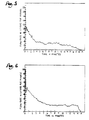
- the candle lasted for 14.7 minutes with a oxygen release of 67.8 liters at room temperature by weight change.
- the oxygen flow over time is given in Figure 6.
- the impurity levels of the oxygen are 0 ppm CO, 1530 ppm CO 2 , 0 ppb Cl 2 , and 7.3 mg H 2 O per liter oxygen.
- the candle lasted for 21.2 minutes with a oxygen release of 69.2 liters at room temperature by weight change.
- the oxygen flow over time is shown in Figure 7.
- the candle lasted for 14.5 minutes with a oxygen release of 66.2 liters at room temperature by weight change and the oxygen evolution was smooth.
- the impurity levels are 7 ppm CO, 580 ppm CO 2 , 0 ppb Cl 2 , and 6.1 mg H 2 O per liter oxygen.
- the candle lasted for 12.4 minutes with a oxygen release of 67.4 liters at room temperature by weight change and the oxygen evolution was smooth.
- the impurity levels are 8 ppm CO, 950 ppm CO 2 , 0 ppb Cl 2 , and 6.4 mg H 2 O per liter oxygen.
Landscapes
- Chemical & Material Sciences (AREA)
- Organic Chemistry (AREA)
- Inorganic Chemistry (AREA)
- Catalysts (AREA)
- Oxygen, Ozone, And Oxides In General (AREA)
Claims (28)
- In einer sauerstofferzeugenden Kerzenzusammensetzung, die bezogen auf das Gewicht eine Menge einer Alkalimetallchlorat- oder -perchloratsauerstoffquelle, die von Lithiumperchlorat allein verschieden ist, zusammen mit einem Metallbrennstoffpulver ausgewählt aus der Gruppe bestehend aus Eisen, Kobalt und Mangan umfaßt und die bei Zündung und Zersetzung derselben Sauerstoff und restliches Chlor ergibt, die Verbesserung, die ein nicht-toxisches Additiv eingeführt in die Kerzenzusammensetzung in einer Menge von etwa 0,05 bis 10 Gew.-% zur Unterdrückung des restlichen Chlors und zur Steigerung der gleichförmigen Sauerstofferzeugung und Sauerstofffreisetzung umfaßt, wobei das Additiv eine alkalische Verbindung ausgewählt aus der Gruppe bestehend aus Verbindungen der Formel MaHbXcOd ist, wobei M ein Alkalimetall oder ein Erdalkalimetall ist, a eine Zahl ist, die 1 oder größer ist, H Wasserstoff ist, b eine Zahl ist, die 0 ist oder 1 oder größer ist, X ein Element ausgewählt aus der Gruppe bestehend aus Elementen der Gruppe IIIA, den Elementen der Gruppe IVA, den Elementen bezeichnet mit den Nummern 15 und 51 der Gruppe VA, den Elementen der Gruppe IVB, den Elementen der Gruppe VB, den Elementen der Gruppe VIB und dem Element bezeichnet mit der Nummer 25 der Gruppe VIIB des Periodensystems ist, c eine Zahl ist, die 1 oder größer ist, O Sauerstoff ist und d eine Zahl ist, die 1 oder größer ist.
- Sauerstofferzeugende Kerzenzusammensetzung nach Anspruch 1, bei der das Additiv eine alkalische Verbindung ausgewählt aus der Gruppe bestehend aus Alkalimetall- und Erdalkalimetallaluminaten, -boraten, -carbonaten, -chromaten, -germanaten, -hafnaten, -manganaten, -molybdaten, -niobaten, -phosphaten, -silikaten, -stanaten, -tantalaten, -titanaten, -wolframaten, -vanadaten, -zirkonaten und Derivaten der zuvor genannten Verbindungen, in denen die Alkalimetall- und Erdalkalimetallkationen teilweise durch Wasserstoff ersetzt sind.
- Sauerstofferzeugende Kerzenzusammensetzung nach Anspruch 1, bei der das Additiv Lithiumtetraborat ist.
- Sauerstofferzeugende Kerzenzusammensetzung nach Anspruch 1, bei der das Additiv Lithiummetaborat ist.
- Sauerstofferzeugende Kerzenzusammensetzung nach Anspruch 1, bei der das Additiv Lithiumphosphat ist.
- Sauerstofferzeugende Kerzenzusammensetzung nach Anspruch 1, bei der das Additiv Lithiumcarbonat ist.
- Sauerstofferzeugende Kerzenzusammensetzung nach Anspruch 1, bei der das Additiv Lithiumsilikat ist.
- Sauerstofferzeugende Kerzenzusammensetzung nach Anspruch 1, bei der das Additiv eine Lithiumverbindung ist, die in einer Menge von etwa 0,05 % bis etwa 5 %, bezogen auf das Gewicht der Kerzenzusammensetzung, eingesetzt ist.
- Sauerstofferzeugende Kerzenzusammensetzung nach Anspruch 1, bei der das Additiv eine Lithiumverbindung ist, die in einer Menge von etwa 0,01 % bis etwa 2 %, bezogen auf das Gewicht der Kerzenzusammensetzung, eingesetzt ist.
- Sauerstofferzeugende Kerzenzusammensetzung nach Anspruch 1, bei der das Additiv eine Natriumverbindung ist, die in einer Menge von etwa 0,05 % bis etwa 5 %, bezogen auf das Gewicht der Kerzenzusammensetzung, eingesetzt ist.
- Sauerstofferzeugende Kerzenzusammensetzung nach Anspruch 1, bei der das Additiv eine Natriumverbindung ist, die in einer Menge von etwa 0,1 % bis etwa 2 %, bezogen auf das Gewicht der Kerzenzusammensetzung, eingesetzt ist.
- Sauerstofferzeugende Kerzenzusammensetzung nach Anspruch 1, bei der das Additiv eine Calciumverbindung ist, die in einer Menge von etwa 0,05 % bis etwa 10 %, bezogen auf das Gewicht der Kerzenzusammensetzung, eingesetzt ist.
- Sauerstofferzeugende Kerzenzusammensetzung nach Anspruch 1, bei der das Additiv eine Calciumverbindung ist, die in einer Menge von etwa 0,2 % bis etwa 4 %, bezogen auf das Gewicht der Kerzenzusammensetzung, eingesetzt ist.
- Sauerstofferzeugende Kerzenzusammensetzung nach Anspruch 1, bei der das Additiv eine Strontiumverbindung ist, die in einer Menge von etwa 0,05 % bis etwa 10 %, bezogen auf das Gewicht der Kerzenzusammensetzung, eingesetzt ist.
- Sauerstofferzeugende Kerzenzusammensetzung nach Anspruch 1, bei der das Additiv eine Strontiumverbindung ist, die in einer Menge von etwa 0,2 % bis etwa 4 %, bezogen auf das Gewicht der Kerzenzusammensetzung, eingesetzt ist.
- Sauerstofferzeugende Kerzenzusammensetzung nach Anspruch 1, bei der in der Kerzenzusammensetzung ferner ein Kobaltkatalysator enthalten ist.
- Sauerstofferzeugende Kerzenzusammensetzung nach Anspruch 16, bei der der Kobaltkatalysator ein Kobaltoxid ist.
- Sauerstofferzeugende Kerzenzusammensetzung nach Anspruch 17, bei der der Kobaltkatalysator ausgewählt ist aus der Gruppe bestehend aus CoO, Co3O4, Co2O3 und CoOx, wobei x im Bereich von etwa 1 bis etwa 1,5 liegt, und Mischungen der zuvor genannten.
- Sauerstofferzeugende Kerzenzusammensetzung nach Anspruch 18, bei der der Kobaltkatalysator in einer Menge von etwa 0,1 bis etwa 5 %, bezogen auf das Gewicht der Kerzenzusammensetzung vorhanden ist.
- Sauerstofferzeugende Kerzenzusammensetzung nach Anspruch 16, bei der der Brennstoff gepulvertes Eisen ist.
- Sauerstofferzeugende Kerzenzusammensetzung nach Anspruch 1, bei der ferner ein Bindemittel ausgewählt aus der Gruppe bestehend aus Glaspulver, Glasfasern, keramischen Fasern, Stahlwolle und Mischungen der vorangegangenen enthalten ist.
- In einem Verfahren zur Erzeugung von atembarem Sauerstoff als Ergebnis der Entzündung und des Betriebs einer Kerzenzusammensetzung, die eine mit Kobaltoxid katalysierte Alkalimetallchlorat- oder -perchloratsauerstoffquelle umfaßt, die von Lithiumperchlorat allein verschieden ist, wobei die Zusammensetzung ein Metallbrennstoffpulver ausgewählt aus der Gruppe bestehend aus Eisen, Kobalt und Mangan enthält, der verbesserte Schritt der Zugabe eines nicht-toxischen Additivs zu der Sauerstoffquelle, um die Zersetzungstemperatur des Alkalimetallchlorats oder -perchlorats auf ein Niveau oberhalb der Schmelztemperatur derselben anzuheben, was eine stetige Sauerstofferzeugung sicherstellt, wobei dieser Schritt die Einführung von etwa 0,05 bis 10 Gew.-% einer alkalischen Verbindung ausgewählt aus der Gruppe bestehend aus Verbindungen der Formel MaHbXcOd in das Chlorat oder Perchlorat vor der Entzündung desselben umfaßt, wobei M ein Alkalimetall oder ein Erdalkalimetall ist, a eine Zahl ist, die 1 oder größer ist, H Wasserstoff ist, b eine Zahl ist, die 0 oder 1 oder größer ist, X ein Element ist, das ausgewählt ist aus der Gruppe bestehend aus den Elementen der Gruppe IIIA, den Elementen der Gruppe IVA, den Elementen bezeichnet mit den Nummern 15 und 51 der Gruppe VA, den Elementen der Gruppe IVB, den Elementen der Gruppe VB, den Elementen der Gruppe VIB und dem Element bezeichnet mit der Nummer 25 der Gruppe VIIB des Periodensystems, c eine Zahl ist, die 1 oder größer ist, O Sauerstoff ist und d eine Zahl ist, die 1 oder größer ist.
- Verfahren zur Erzeugung von atembarem Sauerstoff gemäß Anspruch 22, bei dem der Schritt der Einführung einer alkalischen Verbindung in die Alkalimetallchlorat- oder -perchloratsauerstoffquelle die Zugabe einer Verbindung ausgewählt aus der Gruppe bestehend aus Alkalimetall- und Erdalkalimetallaluminaten, -boraten, -carbonaten, -chromaten, -germanaten, -hafnaten, -manganaten, -molybdaten, -niobaten, -phosphaten, -silikaten, -stanaten, -tantalaten, -titanaten, -wolframaten, -vanadaten, -zirkonaten und Derivaten der vorangegangenen Verbindungen umfaßt, in denen die Alkalimetall- und Erdalkalimetallkationen teilweise durch Wasserstoff ersetzt sind.
- Verfahren zur Erzeugung von atembarem Sauerstoff nach Anspruch 22, bei dem der Schritt der Einführung einer alkalischen Verbindung in die Alkalimetallchlorat- oder -perchloratsauerstoffquelle die Einführung einer Lithiumverbindung ausgewählt aus dieser Gruppe umfaßt, die in einer Menge von etwa 0,05 bis etwa 5 %, bezogen auf das Gewicht der Kerzenzusammensetzung, eingesetzt wird.
- Verfahren zur Erzeugung von atembarem Sauerstoff nach Anspruch 22, bei dem der Schritt der Einführung einer alkalischen Verbindung in die Alkalimetallchlorat- oder -perchloratsauerstoffquelle die Einführung einer Natriumverbindung ausgewählt aus dieser Gruppe umfaßt, die in einer Menge von etwa 0,05 bis etwa 5 %, bezogen auf das Gewicht der Kerzenzusammensetzung, eingesetzt wird.
- Verfahren zur Erzeugung von atembarem Sauerstoff nach Anspruch 22, bei dem der Schritt der Einführung einer alkalischen Verbindung in die Alkalimetallchlorat- oder -perchloratsauerstoffquelle die Einführung einer Kaliumverbindung ausgewählt aus dieser Gruppe umfaßt, die in einer Menge von etwa 0,05 bis etwa 5 %, bezogen auf das Gewicht der Kerzenzusammensetzung, eingesetzt wird.
- Verfahren zur Erzeugung von atembarem Sauerstoff nach Anspruch 22, bei dem die Einführung einer alkalischen Verbindung in die Alkalimetallchlorat- oder -perchloratsauerstoffquelle die Einführung einer Calciumverbindung ausgewählt aus dieser Gruppe umfaßt, die in einer Menge von etwa 0,05 bis etwa 5 %, bezogen auf das Gewicht der Kerzenzusammensetzung, eingesetzt wird.
- Verfahren zur Erzeugung von atembarem Sauerstoff nach Anspruch 22, bei dem der Schritt der Einführung einer alkalischen Verbindung in die Alkalimetallchlorat- oder -perchloratsauerstoffquelle die Einführung einer Strontiumverbindung ausgewählt aus dieser Gruppe umfaßt, die in einer Menge von etwa 0,05 bis etwa 5 %, bezogen auf das Gewicht der Kerzenzusammensetzung, eingesetzt wird.
Applications Claiming Priority (3)
| Application Number | Priority Date | Filing Date | Title |
|---|---|---|---|
| US851171 | 1992-03-13 | ||
| US07/851,171 US5298187A (en) | 1992-03-13 | 1992-03-13 | Non-toxic chemical oxygen generating compositions |
| PCT/US1993/001562 WO1993017961A1 (en) | 1992-03-13 | 1993-02-23 | Non-toxic chemical oxygen generating compositions |
Publications (3)
| Publication Number | Publication Date |
|---|---|
| EP0630351A1 EP0630351A1 (de) | 1994-12-28 |
| EP0630351A4 EP0630351A4 (de) | 1995-03-29 |
| EP0630351B1 true EP0630351B1 (de) | 1997-05-07 |
Family
ID=25310133
Family Applications (1)
| Application Number | Title | Priority Date | Filing Date |
|---|---|---|---|
| EP93906990A Expired - Lifetime EP0630351B1 (de) | 1992-03-13 | 1993-02-23 | Nicht-toxische chemische sauerstoff generierende zusammensetzungen |
Country Status (5)
| Country | Link |
|---|---|
| US (1) | US5298187A (de) |
| EP (1) | EP0630351B1 (de) |
| DE (1) | DE69310505T2 (de) |
| HK (1) | HK1006703A1 (de) |
| WO (1) | WO1993017961A1 (de) |
Cited By (1)
| Publication number | Priority date | Publication date | Assignee | Title |
|---|---|---|---|---|
| KR20150133189A (ko) * | 2013-03-25 | 2015-11-27 | 다테호 가가쿠 고교 가부시키가이샤 | 고형 산소 발생 조성물 |
Families Citing this family (17)
| Publication number | Priority date | Publication date | Assignee | Title |
|---|---|---|---|---|
| US5725834A (en) * | 1995-04-07 | 1998-03-10 | Daicel Chemical Industries, Ltd. | Chemical oxygen generator |
| US5783105A (en) * | 1995-11-09 | 1998-07-21 | Nellcor Puritan Bennett | Oxygen generating compositions |
| US5882545A (en) | 1996-05-15 | 1999-03-16 | Nellcor Puritan Bennett Incorporated | Oxygen generating compositions |
| US6007736A (en) * | 1996-05-15 | 1999-12-28 | Be Intellectual Property | Oxygen generating compositions catalyzed by copper and nickel oxides |
| US6143196A (en) * | 1998-01-30 | 2000-11-07 | Nellcor Puritan Bennett Incorporated | Oxygen generating formulation with high structural integrity |
| US6054067A (en) | 1998-01-30 | 2000-04-25 | Be Intellectual Property | Low temperature sensitivity oxygen generating compositions |
| US6866794B1 (en) * | 2000-11-15 | 2005-03-15 | Be Intellectual Property Inc. | Strontium peroxide catalyzed oxygen generating compositions |
| RU2302993C2 (ru) * | 2001-07-26 | 2007-07-20 | Недерландсе Органисати Вор Тугепаст-Натюрветенсхаппелейк Ондерзук Тно | Химический кислородный генератор |
| WO2008094490A1 (en) * | 2007-01-26 | 2008-08-07 | Avox Systems, Inc. | Oxygen generating composition |
| EP2851340B1 (de) * | 2013-09-23 | 2018-10-31 | Goodrich Lighting Systems GmbH | Orthophosphat-, orthovanadat oder orthophosphatvanadat komponenten zur verwendung in festen chemische sauerstofferzeugern |
| DE102015117838A1 (de) | 2015-10-20 | 2017-04-20 | Goodrich Lighting Systems Gmbh | Sauerstoff generierende Zusammensetzungen umfassend thermisch behandeltes (Li, Fe, Mg) O |
| DE102015117835A1 (de) * | 2015-10-20 | 2017-04-20 | Goodrich Lighting Systems Gmbh | Sauerstoff generierende Zusammensetzungen umfassend (Fe, Mg) O |
| DE102015117831A1 (de) * | 2015-10-20 | 2017-04-20 | Goodrich Lighting Systems Gmbh | Sauerstoff generierende Zusammensetzungen umfassend (Li,Fe,Mg)0 |
| DE102015117839A1 (de) | 2015-10-20 | 2017-04-20 | Goodrich Lighting Systems Gmbh | Sauerstoff generierende Zusammensetzungen umfassend thermisch behandeltes (Fe, Mg) O |
| CN111655612A (zh) * | 2018-01-30 | 2020-09-11 | 阿沃克斯系统公司 | 具有短和长持续时间的飞行器乘员化学氧系统 |
| CN111252738A (zh) * | 2020-01-21 | 2020-06-09 | 陕西斯达防爆安全科技股份有限公司 | 一种氧烛药 |
| US20230278861A1 (en) | 2020-05-08 | 2023-09-07 | Dacelo B.V. | Method, composition and system for generating an oxygen-flow |
Family Cites Families (9)
| Publication number | Priority date | Publication date | Assignee | Title |
|---|---|---|---|---|
| US1027333A (en) * | 1910-07-20 | 1912-05-21 | Zeiss Carl Fa | Oxygen-generating composition. |
| US2004243A (en) * | 1928-01-17 | 1935-06-11 | Ig Farbenindustrie Ag | Method of and means for operating breathing apparatus |
| US3293187A (en) * | 1963-10-23 | 1966-12-20 | Foote Mineral Co | Oxygen-generating product |
| US3405068A (en) * | 1965-04-26 | 1968-10-08 | Mine Safety Appliances Co | Gas generation |
| US3702305A (en) * | 1971-04-28 | 1972-11-07 | Life Support | Chemical oxygen generator |
| US3736104A (en) * | 1971-05-17 | 1973-05-29 | Life Support | Oxygen generator cell |
| CN1035248A (zh) * | 1989-01-28 | 1989-09-06 | 中国科学院青海盐湖研究所 | 氯酸钠氧烛 |
| US5049306A (en) * | 1989-09-29 | 1991-09-17 | Mine Safety Appliances Company | Oxygen generating candles |
| US5198147A (en) * | 1991-04-10 | 1993-03-30 | Puritan-Bennett Corporation | Chemical oxygen generator |
-
1992
- 1992-03-13 US US07/851,171 patent/US5298187A/en not_active Expired - Lifetime
-
1993
- 1993-02-23 WO PCT/US1993/001562 patent/WO1993017961A1/en not_active Ceased
- 1993-02-23 DE DE69310505T patent/DE69310505T2/de not_active Expired - Lifetime
- 1993-02-23 HK HK98106082A patent/HK1006703A1/en not_active IP Right Cessation
- 1993-02-23 EP EP93906990A patent/EP0630351B1/de not_active Expired - Lifetime
Cited By (2)
| Publication number | Priority date | Publication date | Assignee | Title |
|---|---|---|---|---|
| KR20150133189A (ko) * | 2013-03-25 | 2015-11-27 | 다테호 가가쿠 고교 가부시키가이샤 | 고형 산소 발생 조성물 |
| KR102144379B1 (ko) | 2013-03-25 | 2020-08-13 | 다테호 가가쿠 고교 가부시키가이샤 | 고형 산소 발생 조성물 |
Also Published As
| Publication number | Publication date |
|---|---|
| HK1006703A1 (en) | 1999-03-12 |
| EP0630351A1 (de) | 1994-12-28 |
| DE69310505T2 (de) | 1997-12-18 |
| DE69310505D1 (de) | 1997-06-12 |
| EP0630351A4 (de) | 1995-03-29 |
| US5298187A (en) | 1994-03-29 |
| WO1993017961A1 (en) | 1993-09-16 |
Similar Documents
| Publication | Publication Date | Title |
|---|---|---|
| EP0630351B1 (de) | Nicht-toxische chemische sauerstoff generierende zusammensetzungen | |
| US5338516A (en) | Chemical oxygen generator | |
| HK1006703B (en) | Non-toxic chemical oxygen generating compositions | |
| JP4087451B2 (ja) | 酸化銅及び酸化ニッケルで触媒される酸素生成組成物 | |
| US5279761A (en) | Chemical oxygen generating compositions containing LI202 | |
| WO1997017282A1 (en) | Oxygen generating compositions | |
| US6866794B1 (en) | Strontium peroxide catalyzed oxygen generating compositions | |
| US4490274A (en) | Oxygen-generating chemical composition | |
| US6054067A (en) | Low temperature sensitivity oxygen generating compositions | |
| Zhang et al. | Functions of barium peroxide in sodium chlorate chemical oxygen generators | |
| EP1049646B1 (de) | Sauerstoff erzeugendes stoffgemisch mit hoher strukturintegrität | |
| AU646161C (en) | Chemical oxygen generator | |
| RU2056341C1 (ru) | Пиротехнический состав для получения кислорода | |
| DE1933747B2 (de) | Brennbare feststoffmischung zur erzeugung von kohlendioxyd |
Legal Events
| Date | Code | Title | Description |
|---|---|---|---|
| PUAI | Public reference made under article 153(3) epc to a published international application that has entered the european phase |
Free format text: ORIGINAL CODE: 0009012 |
|
| 17P | Request for examination filed |
Effective date: 19940913 |
|
| AK | Designated contracting states |
Kind code of ref document: A1 Designated state(s): DE FR GB NL |
|
| RIN1 | Information on inventor provided before grant (corrected) |
Inventor name: CANNON, JAMES, C. Inventor name: ZHANG, YUNCHANG |
|
| RHK1 | Main classification (correction) |
Ipc: C01B 13/02 |
|
| A4 | Supplementary search report drawn up and despatched |
Effective date: 19950203 |
|
| AK | Designated contracting states |
Kind code of ref document: A4 Designated state(s): DE FR GB NL |
|
| 17Q | First examination report despatched |
Effective date: 19950110 |
|
| GRAG | Despatch of communication of intention to grant |
Free format text: ORIGINAL CODE: EPIDOS AGRA |
|
| GRAH | Despatch of communication of intention to grant a patent |
Free format text: ORIGINAL CODE: EPIDOS IGRA |
|
| GRAH | Despatch of communication of intention to grant a patent |
Free format text: ORIGINAL CODE: EPIDOS IGRA |
|
| GRAA | (expected) grant |
Free format text: ORIGINAL CODE: 0009210 |
|
| AK | Designated contracting states |
Kind code of ref document: B1 Designated state(s): DE FR GB NL |
|
| PG25 | Lapsed in a contracting state [announced via postgrant information from national office to epo] |
Ref country code: NL Free format text: LAPSE BECAUSE OF FAILURE TO SUBMIT A TRANSLATION OF THE DESCRIPTION OR TO PAY THE FEE WITHIN THE PRESCRIBED TIME-LIMIT Effective date: 19970507 |
|
| REF | Corresponds to: |
Ref document number: 69310505 Country of ref document: DE Date of ref document: 19970612 |
|
| ET | Fr: translation filed | ||
| NLV1 | Nl: lapsed or annulled due to failure to fulfill the requirements of art. 29p and 29m of the patents act | ||
| PLBE | No opposition filed within time limit |
Free format text: ORIGINAL CODE: 0009261 |
|
| STAA | Information on the status of an ep patent application or granted ep patent |
Free format text: STATUS: NO OPPOSITION FILED WITHIN TIME LIMIT |
|
| 26N | No opposition filed | ||
| REG | Reference to a national code |
Ref country code: GB Ref legal event code: 732E |
|
| REG | Reference to a national code |
Ref country code: GB Ref legal event code: IF02 |
|
| PGFP | Annual fee paid to national office [announced via postgrant information from national office to epo] |
Ref country code: FR Payment date: 20120221 Year of fee payment: 20 |
|
| PGFP | Annual fee paid to national office [announced via postgrant information from national office to epo] |
Ref country code: DE Payment date: 20120215 Year of fee payment: 20 |
|
| PGFP | Annual fee paid to national office [announced via postgrant information from national office to epo] |
Ref country code: GB Payment date: 20120222 Year of fee payment: 20 |
|
| REG | Reference to a national code |
Ref country code: DE Ref legal event code: R071 Ref document number: 69310505 Country of ref document: DE |
|
| REG | Reference to a national code |
Ref country code: DE Ref legal event code: R071 Ref document number: 69310505 Country of ref document: DE |
|
| REG | Reference to a national code |
Ref country code: GB Ref legal event code: PE20 Expiry date: 20130222 |
|
| PG25 | Lapsed in a contracting state [announced via postgrant information from national office to epo] |
Ref country code: DE Free format text: LAPSE BECAUSE OF EXPIRATION OF PROTECTION Effective date: 20130226 Ref country code: GB Free format text: LAPSE BECAUSE OF EXPIRATION OF PROTECTION Effective date: 20130222 |