EP0630409B1 - Defekte verpackende nicht-oncoviren vektoren aus mpmv - Google Patents
Defekte verpackende nicht-oncoviren vektoren aus mpmv Download PDFInfo
- Publication number
- EP0630409B1 EP0630409B1 EP93905485A EP93905485A EP0630409B1 EP 0630409 B1 EP0630409 B1 EP 0630409B1 EP 93905485 A EP93905485 A EP 93905485A EP 93905485 A EP93905485 A EP 93905485A EP 0630409 B1 EP0630409 B1 EP 0630409B1
- Authority
- EP
- European Patent Office
- Prior art keywords
- mpmv
- vector
- packaging
- sequence
- gene
- Prior art date
- Legal status (The legal status is an assumption and is not a legal conclusion. Google has not performed a legal analysis and makes no representation as to the accuracy of the status listed.)
- Expired - Lifetime
Links
Images


Classifications
-
- C—CHEMISTRY; METALLURGY
- C12—BIOCHEMISTRY; BEER; SPIRITS; WINE; VINEGAR; MICROBIOLOGY; ENZYMOLOGY; MUTATION OR GENETIC ENGINEERING
- C12N—MICROORGANISMS OR ENZYMES; COMPOSITIONS THEREOF; PROPAGATING, PRESERVING, OR MAINTAINING MICROORGANISMS; MUTATION OR GENETIC ENGINEERING; CULTURE MEDIA
- C12N15/00—Mutation or genetic engineering; DNA or RNA concerning genetic engineering, vectors, e.g. plasmids, or their isolation, preparation or purification; Use of hosts therefor
- C12N15/09—Recombinant DNA-technology
- C12N15/63—Introduction of foreign genetic material using vectors; Vectors; Use of hosts therefor; Regulation of expression
- C12N15/79—Vectors or expression systems specially adapted for eukaryotic hosts
- C12N15/85—Vectors or expression systems specially adapted for eukaryotic hosts for animal cells
- C12N15/86—Viral vectors
-
- A—HUMAN NECESSITIES
- A61—MEDICAL OR VETERINARY SCIENCE; HYGIENE
- A61P—SPECIFIC THERAPEUTIC ACTIVITY OF CHEMICAL COMPOUNDS OR MEDICINAL PREPARATIONS
- A61P43/00—Drugs for specific purposes, not provided for in groups A61P1/00-A61P41/00
-
- C—CHEMISTRY; METALLURGY
- C07—ORGANIC CHEMISTRY
- C07K—PEPTIDES
- C07K14/00—Peptides having more than 20 amino acids; Gastrins; Somatostatins; Melanotropins; Derivatives thereof
- C07K14/005—Peptides having more than 20 amino acids; Gastrins; Somatostatins; Melanotropins; Derivatives thereof from viruses
-
- C—CHEMISTRY; METALLURGY
- C12—BIOCHEMISTRY; BEER; SPIRITS; WINE; VINEGAR; MICROBIOLOGY; ENZYMOLOGY; MUTATION OR GENETIC ENGINEERING
- C12N—MICROORGANISMS OR ENZYMES; COMPOSITIONS THEREOF; PROPAGATING, PRESERVING, OR MAINTAINING MICROORGANISMS; MUTATION OR GENETIC ENGINEERING; CULTURE MEDIA
- C12N7/00—Viruses; Bacteriophages; Compositions thereof; Preparation or purification thereof
-
- A—HUMAN NECESSITIES
- A61—MEDICAL OR VETERINARY SCIENCE; HYGIENE
- A61K—PREPARATIONS FOR MEDICAL, DENTAL OR TOILETRY PURPOSES
- A61K39/00—Medicinal preparations containing antigens or antibodies
-
- A—HUMAN NECESSITIES
- A61—MEDICAL OR VETERINARY SCIENCE; HYGIENE
- A61K—PREPARATIONS FOR MEDICAL, DENTAL OR TOILETRY PURPOSES
- A61K48/00—Medicinal preparations containing genetic material which is inserted into cells of the living body to treat genetic diseases; Gene therapy
-
- C—CHEMISTRY; METALLURGY
- C12—BIOCHEMISTRY; BEER; SPIRITS; WINE; VINEGAR; MICROBIOLOGY; ENZYMOLOGY; MUTATION OR GENETIC ENGINEERING
- C12N—MICROORGANISMS OR ENZYMES; COMPOSITIONS THEREOF; PROPAGATING, PRESERVING, OR MAINTAINING MICROORGANISMS; MUTATION OR GENETIC ENGINEERING; CULTURE MEDIA
- C12N2740/00—Reverse transcribing RNA viruses
- C12N2740/00011—Details
- C12N2740/10011—Retroviridae
- C12N2740/13011—Gammaretrovirus, e.g. murine leukeamia virus
- C12N2740/13022—New viral proteins or individual genes, new structural or functional aspects of known viral proteins or genes
-
- C—CHEMISTRY; METALLURGY
- C12—BIOCHEMISTRY; BEER; SPIRITS; WINE; VINEGAR; MICROBIOLOGY; ENZYMOLOGY; MUTATION OR GENETIC ENGINEERING
- C12N—MICROORGANISMS OR ENZYMES; COMPOSITIONS THEREOF; PROPAGATING, PRESERVING, OR MAINTAINING MICROORGANISMS; MUTATION OR GENETIC ENGINEERING; CULTURE MEDIA
- C12N2740/00—Reverse transcribing RNA viruses
- C12N2740/00011—Details
- C12N2740/10011—Retroviridae
- C12N2740/13011—Gammaretrovirus, e.g. murine leukeamia virus
- C12N2740/13041—Use of virus, viral particle or viral elements as a vector
- C12N2740/13043—Use of virus, viral particle or viral elements as a vector viral genome or elements thereof as genetic vector
-
- C—CHEMISTRY; METALLURGY
- C12—BIOCHEMISTRY; BEER; SPIRITS; WINE; VINEGAR; MICROBIOLOGY; ENZYMOLOGY; MUTATION OR GENETIC ENGINEERING
- C12N—MICROORGANISMS OR ENZYMES; COMPOSITIONS THEREOF; PROPAGATING, PRESERVING, OR MAINTAINING MICROORGANISMS; MUTATION OR GENETIC ENGINEERING; CULTURE MEDIA
- C12N2740/00—Reverse transcribing RNA viruses
- C12N2740/00011—Details
- C12N2740/10011—Retroviridae
- C12N2740/13011—Gammaretrovirus, e.g. murine leukeamia virus
- C12N2740/13051—Methods of production or purification of viral material
- C12N2740/13052—Methods of production or purification of viral material relating to complementing cells and packaging systems for producing virus or viral particles
-
- C—CHEMISTRY; METALLURGY
- C12—BIOCHEMISTRY; BEER; SPIRITS; WINE; VINEGAR; MICROBIOLOGY; ENZYMOLOGY; MUTATION OR GENETIC ENGINEERING
- C12N—MICROORGANISMS OR ENZYMES; COMPOSITIONS THEREOF; PROPAGATING, PRESERVING, OR MAINTAINING MICROORGANISMS; MUTATION OR GENETIC ENGINEERING; CULTURE MEDIA
- C12N2740/00—Reverse transcribing RNA viruses
- C12N2740/00011—Details
- C12N2740/10011—Retroviridae
- C12N2740/16011—Human Immunodeficiency Virus, HIV
- C12N2740/16022—New viral proteins or individual genes, new structural or functional aspects of known viral proteins or genes
-
- C—CHEMISTRY; METALLURGY
- C12—BIOCHEMISTRY; BEER; SPIRITS; WINE; VINEGAR; MICROBIOLOGY; ENZYMOLOGY; MUTATION OR GENETIC ENGINEERING
- C12N—MICROORGANISMS OR ENZYMES; COMPOSITIONS THEREOF; PROPAGATING, PRESERVING, OR MAINTAINING MICROORGANISMS; MUTATION OR GENETIC ENGINEERING; CULTURE MEDIA
- C12N2740/00—Reverse transcribing RNA viruses
- C12N2740/00011—Details
- C12N2740/10011—Retroviridae
- C12N2740/16011—Human Immunodeficiency Virus, HIV
- C12N2740/16041—Use of virus, viral particle or viral elements as a vector
- C12N2740/16043—Use of virus, viral particle or viral elements as a vector viral genome or elements thereof as genetic vector
-
- C—CHEMISTRY; METALLURGY
- C12—BIOCHEMISTRY; BEER; SPIRITS; WINE; VINEGAR; MICROBIOLOGY; ENZYMOLOGY; MUTATION OR GENETIC ENGINEERING
- C12N—MICROORGANISMS OR ENZYMES; COMPOSITIONS THEREOF; PROPAGATING, PRESERVING, OR MAINTAINING MICROORGANISMS; MUTATION OR GENETIC ENGINEERING; CULTURE MEDIA
- C12N2740/00—Reverse transcribing RNA viruses
- C12N2740/00011—Details
- C12N2740/10011—Retroviridae
- C12N2740/16011—Human Immunodeficiency Virus, HIV
- C12N2740/16051—Methods of production or purification of viral material
- C12N2740/16052—Methods of production or purification of viral material relating to complementing cells and packaging systems for producing virus or viral particles
-
- C—CHEMISTRY; METALLURGY
- C12—BIOCHEMISTRY; BEER; SPIRITS; WINE; VINEGAR; MICROBIOLOGY; ENZYMOLOGY; MUTATION OR GENETIC ENGINEERING
- C12N—MICROORGANISMS OR ENZYMES; COMPOSITIONS THEREOF; PROPAGATING, PRESERVING, OR MAINTAINING MICROORGANISMS; MUTATION OR GENETIC ENGINEERING; CULTURE MEDIA
- C12N2740/00—Reverse transcribing RNA viruses
- C12N2740/00011—Details
- C12N2740/10011—Retroviridae
- C12N2740/16011—Human Immunodeficiency Virus, HIV
- C12N2740/16061—Methods of inactivation or attenuation
- C12N2740/16062—Methods of inactivation or attenuation by genetic engineering
-
- C—CHEMISTRY; METALLURGY
- C12—BIOCHEMISTRY; BEER; SPIRITS; WINE; VINEGAR; MICROBIOLOGY; ENZYMOLOGY; MUTATION OR GENETIC ENGINEERING
- C12N—MICROORGANISMS OR ENZYMES; COMPOSITIONS THEREOF; PROPAGATING, PRESERVING, OR MAINTAINING MICROORGANISMS; MUTATION OR GENETIC ENGINEERING; CULTURE MEDIA
- C12N2740/00—Reverse transcribing RNA viruses
- C12N2740/00011—Details
- C12N2740/10011—Retroviridae
- C12N2740/16011—Human Immunodeficiency Virus, HIV
- C12N2740/16111—Human Immunodeficiency Virus, HIV concerning HIV env
- C12N2740/16122—New viral proteins or individual genes, new structural or functional aspects of known viral proteins or genes
-
- C—CHEMISTRY; METALLURGY
- C12—BIOCHEMISTRY; BEER; SPIRITS; WINE; VINEGAR; MICROBIOLOGY; ENZYMOLOGY; MUTATION OR GENETIC ENGINEERING
- C12N—MICROORGANISMS OR ENZYMES; COMPOSITIONS THEREOF; PROPAGATING, PRESERVING, OR MAINTAINING MICROORGANISMS; MUTATION OR GENETIC ENGINEERING; CULTURE MEDIA
- C12N2740/00—Reverse transcribing RNA viruses
- C12N2740/00011—Details
- C12N2740/10011—Retroviridae
- C12N2740/16011—Human Immunodeficiency Virus, HIV
- C12N2740/16211—Human Immunodeficiency Virus, HIV concerning HIV gagpol
- C12N2740/16222—New viral proteins or individual genes, new structural or functional aspects of known viral proteins or genes
Definitions
- This invention relates to vectors and their use in gene transfer.
- the vectors are based on retroviruses, adapted so that they cannot package their own RNA, and which can be used as infectious agents to transfer foreign genes, e.g. for somatic gene therapy.
- Retroviruses are classified in several ways. They are divided into various groups on the basis of their morphology. These groups are A,B,C and D type viruses. They are also classified as belonging to one of three subfamilies, namely oncoviruses, spumaviruses and lentiviruses.
- Mason-Pfizer Monkey Virus is a D-type retrovirus first discovered in breast carcinoma tissue from a rhesus monkey. Despite this, and its classification into the oncovirus subfamily, it does not contain an identified oncogene and there is no evidence that it has oncogenic potential.
- D-type viruses are distinguished from other retrovirus families such as the C-type viruses.
- the latter are characterised by capsid assembly at the cell membrane, and include viruses of the lentivirus group, e.g. Human Immunodeficiency Virus (HIV).
- HAV Human Immunodeficiency Virus
- MMTV Mouse Mammary Tumor Virus
- MPMV is also distinguished from C-type viruses by the ability of the virus envelope to activate the human complement system. This leads to lysis of the virus.
- Retroviruses are RNA viruses which replicate through a DNA proviral intermediate which is integrated in the genome of the infected host cell.
- the virion particle contains a dimer of positive-strand genomic RNA molecules.
- This genomic RNA is the full-length species transcribed from the proviral DNA by the host RNA polymerase II. A proportion of these full length RNAs which encode the gag and pol genes of the virus are translated by the host cell ribosomes, to produce the structural and enzymic proteins required for production of virion particles.
- the provirus also gives rise to a variety of smaller singly and multiply-spliced mRNAs coding for the envelope proteins and, in the case of more complex retroviruses, a group of regulatory proteins.
- the genomic (and subgenomic) RNA molecules are structurally similar to cellular mRNAs in having a 5' m 7 G cap and a polyadenylated 3' tail.
- the full-length RNA must be packaged preferentially over the spliced viral messages as it is the only one carrying the full complement of genetic information for the next generation of virions.
- the virus must also specifically select the genomic RNA against the enormous quantity and variety of physically similar host cell mRNAs as, unlike many other viruses, retroviruses do not generally arrest host RNA synthesis. There must be a mechanism whereby genomic RNA to be packaged is recognised such that a proportion is either protected from being translated and transported to an assembly site or is associated with the gag precursor polyprotein for which it has just coded immediately after translation.
- Packaging the genome thus entails problems of specificity of selection of RNA and also considerations of RNA compartmentalisation.
- the virus overcomes these problems by the presence of cis -acting elements, i.e. "packaging signals", in the viral genomic mRNA.
- packetaging signals i.e. "packaging signals”
- studies on spontaneously arising and laboratory constructed viral mutants have confirmed that specific sequences are critical for RNA recognition and encapsidation.
- Deletion mutants have defined sequences necessary for RNA packaging in several retroviruses. In some of these, the extent of the sequence sufficient for packaging has also been mapped. Implicit in the description of packaging signals and RNA secondary structure is the premise that, if this sequence is introduced into heterologous RNA then, theoretically, the heterologous RNA should be encapsidated by retroviral particles. Constraints on packaging include the theoretical one (for which Mann et al , J. Virol. 54 :401-407 (1985) provide some circumstantial evidence) that sequences adjacent to the packaging signal (PSI) should not favour the formation of alternative secondary structures disrupting PSI. Additionally, the total length of RNA packaged is physically limited by the capacity of the virus to package RNA of a certain size.
- WO-A-9119798 discloses that an HIV-based vector containing essentially only the 5' leader sequence as a potential packaging signal was reported to be successfully encapsidated by an HIV-based packaging system. This work has not yet been confirmed. Indeed, there has been failure, confirmed herein, to encapsidate HIV RNA containing only the 5' leader sequence.
- a provirus is capable of producing MPMV proteins but is not replication-competent because the RNA cannot be packaged into virions.
- packaging-defective provirus vector packaging-defective cell lines can be created and used to investigate the packaging mechanism of the virus and to develop strategies to interfere with this packaging mechanism.
- Virions produced by such packaging-negative proviruses may be used for vaccines and as a system for efficiently introducing a desired gene into a mammalian cell.
- a vector capable of producing MPMV (Mason-Pfizer Monkey Virus) proteins and which has a deletion of packaging nucleotides between the MPMV primer-binding site and the MPMV 5' major splice donor, nucleotides 348-365 and 475-480 respectively, and which is not capable of packaging MPMV RNA.
- MPMV Mel-Pfizer Monkey Virus
- the invention also provides:
- the invention relates to MPMV.
- MPMV has several potential advantages as a retroviral vector, compared to other retroviruses which have already been used and are being developed as gene vectors for potential use in humans.
- MPMV has several potential advantages as a retroviral vector, compared to other retroviruses which have already been used and are being developed as gene vectors for potential use in humans.
- retroviral vector compared to other retroviruses which have already been used and are being developed as gene vectors for potential use in humans.
- the first aspect of the present invention is based on studies of the molecular biology and replication of wild-type and mutant MPMV and defective virus constructs made therefrom (vectors), in which major segments of the coding function have been deleted and replaced with marker genes in order to localise the cis acting signals involved in viral RNA packaging in MPMV. Signals both necessary and sufficient for packaging of RNA into a virion particle have been defined. It appears that the localisation of signals necessary and sufficient for RNA packaging differs from other viruses previously studied, and that the site of these signals could not have been predicted by direct analogy to other retroviruses and study of their packaging mechanism.
- Vectors have been constructed which themselves are replication-defective but whose RNA can be packaged in trans by wild-type virus and delivered to target cells for which MPMV itself is tropic by infection. These vectors integrate into the target cell chromosome and express the target gene efficiently enough in the case of antibiotic resistance markers to produce target cells which themselves are antibiotic-resistant.
- MPMV packaging-defective vectors and cell lines it has been discovered that it is possible to make MPMV packaging-defective vectors and cell lines. It has been found that the region between the primer-binding site and the 5' major splice donor in MPMV contains sequences necessary for packaging of MPMV RNA into virions.
- sequences preferably correspond to the genome of MPMV.
- the term corresponds means that conservative additions, deletions and substitutions are permitted.
- the primer-binding site (18 bp) and the 5' major splice donor are respectively numbered 348-365 and 475-480 in the genomic nucleotide sequence given by Sonigo et al , Cell 45 :375-385 (1986).
- the vector does not contain the MPMV packaging sequence corresponding to the segment immediately downstream of the primer-binding site and just upstream of the 5' major splice donor.
- the vector may contain nucleotides ranging from about 2 bases downstream of the primer-binding site to about 23 to 63 bases downstream of the primer-binding site and still be packaging-deficient.
- the packaging sequence absent from the vector contains the 121-base nucleotide sequence shown herein as SEQ ID No. 1.
- the packaging sequence comprises the 62-base segment sequence of bases 51 to 112 of SEQ ID No. 1.
- it comprises the 23-base segment of bases 28 to 50 of SEQ ID No. 1.
- SEQ ID No. 1 is
- the number of bases that need to be left out of the vector can vary greatly.
- the given 23-base pair deletion in MPMV is sufficient to result in loss of packaging ability.
- even smaller deletions in this region should also result in loss of packaging efficiency.
- a deletion as small as about 5 base pairs in this region should remove efficient packaging ability.
- the size of a particular deletion can readily be determined based on the present disclosure by the person of ordinary skill in the art.
- the vector should contain an MPMV nucleotide segment containing a sufficient number of nucleotides corresponding to nucleotides of the MPMV genome to express functional MPMV gene products, but as described above, should not contain a sufficient number of nucleotides corresponding to the region between the primer-binding site and the 5' major splice donor to permit efficient packaging of the viral RNA into virions.
- MPMV packaging-defective cell lines it is preferred that such cell lines do not produce any infectious MPMV.
- a cell line transformed by these packaging-defective deficient vectors would have low infectivity because the cells are packaging-defective, some RNA can still be packaged into the virion. Accordingly, it is preferable that the MPMV nucleotide segment does not correspond to the entire MPMV genome so that, if some of the viral RNA is packaged into the virion, what is packaged will not be replication-competent virus.
- a selected cell line is transformed using at least two different vectors, each containing a different portion of the MPMV genome and also not containing the sequence necessary for viral packaging. Then, by cotransfecting a cell with each vector, the cell would still be able to express all the MPMV structural and enzymatic proteins and produce virions.
- the or each vector does not contain sequences corresponding to an MPMV LTR (long terminal repeat sequence) but contains sequences corresponding to a promoter region and/or another genome's polyadenylation sequences. Selection of particular promoters and polyadenylation sequences can readily be determined based upon the particular host cell.
- the LTR to which the sequences do not correspond is the 3'LTR.
- one vector includes sequences permitting expression of MPMV proteins upstream of env and the second vector permits expression of the remaining proteins.
- one vector contains an MPMV nucleotide segment corresponding to a sufficient number of nucleotides upstream of the gag initiation codon to the env gene sequence to express the 5'-most gene products.
- the other vector contains an MPMV nucleotide segment corresponding to a sufficient number of nucleotides downstream of the gag gene sequence and including a functional env gene sequence.
- Such vectors can be chemically synthesised from the reported gene sequence of the MPMV genome or derived from the many available MPMV proviruses, by taking advantage of the known restriction endonuclease sites in these viruses by the skilled artisan based on the present disclosure.
- a different marker gene is added to each vector. Then, using a preselected cell line cotransfected with these different vectors, and by looking for a cell containing both markers, a cell that has been cotransfected with both vectors is found. Such a cell would be able to produce all of the MPMV proteins. Although virions would be produced, the RNA corresponding to the entire viral sequences would not be packaged in these virions.
- Retroviruses can in some cases be pseudotyped with the envelope glycoproteins of other viruses. Consequently, one can prepare a vector containing a sufficient number of nucleotides to correspond to an env gene from a different retrovirus. Preferably, the 5'LTR of this vector would be of the same genome as the env gene. Such a vector could be used instead of an MPMV env packaging-defective vector, to create virions. By such a change, the resultant vector systems could be used in a wider host range or could be restricted to a smaller host range, e.g. using an HIV env gene vector which would restrict the cell range to those bearing the CD4 protein.
- a mammalian cell line is used, for example CV-1, Hela, Raji, SW480 or CHO.
- promoter other than the 5' LTR e.g. by replacing the 5' LTR with a promoter that will preferentially express genes in CV-1 or HeLa cells.
- the particular promoter used can easily be determined by the person of ordinary skill in the art depending on the cell line used, based on the present disclosure.
- enhancer sequences can readily be determined by a person of ordinary skill in the art depending on the host cell line.
- virions can readily be obtained from the cells. For example, the cells are cultured and the supernatant harvested. Depending on the desired use, the supernatant containing the virions can be used or these virions can be separated from the supernatant by standard techniques such as gradient centrifugation, filtering etc.
- the virions can be used to generate an antibody response to MPMV virions and, because these virions are identical to the actual MPMV virions except that the interior of these virions do not contain the viral RNA, the vaccine created should be particularly useful.
- Pseudotyped virions produced from cell lines cotransfected with MPMV gag / pol and protease genes and containing the env gene from another virus may be useful in creating a vaccine against this other virus.
- an HIV env vector in the cell may give rise to a viral particle with an HIV env capable of eliciting an antibody response to HIV but without pathogenicity because of the absence of any other HIV proteins or HIV RNA.
- These virions can also be used to raise antibodies to the virion that can then be used for a variety of purposes, e.g. screening for the virion, developing target systems for the virions etc. Additionally these MPMV packaging-deficient cell lines can be extremely useful as a means of introducing a desired gene, for example a heterologous gene into mammalian cells, as described below.
- virions may be used as an extremely efficient way to package desired genetic sequences and deliver them to target cells infectable by MPMV. This may be done by preparing a vector containing a nucleotide segment containing a sufficient number of nucleotides corresponding to the packaging nucleotides of MPMV (MPMV packaging region), a predetermined gene and, flanking the packaging sequence and predetermined gene, sequences corresponding to a sufficient number of sequences from within and near the LTR for packaging, reverse transcription, integration of the vector into target cells and gene expression from the vector.
- MPMV packaging region MPMV packaging region
- the packaging region preferably corresponds to at least the region between the primer-binding site and the major 5' splice donor.
- the vector might also have the first 500 bp of the gag gene sequence of MPMV in order to enhance packaging efficiency. Further, it might specifically not include nucleotides corresponding to the sequence numbered 481-493 between the 5' major splice donor and the gag gene initiation codon, as absence of this sequence which appears to inhibit packaging might render the vector more packageable.
- a sufficient number of MPMV sequences to be packaged, reverse-transcribed, integrated into and expressed in the target cells would include the U3,R and U5 sequences of the LTRs, the packaging sequences and some sequences flanking the LTRs (required for reverse transcription).
- the packaging sequences described between the primer-binding site and the 5' major splice donor would be sufficient for packaging such a vector, it may be advantageous to include the first 500 nucleotides of the gag gene coding sequence as this appears to enhance packaging further, and it would be advantageous to omit the region corresponding to the sequence between the 5' major splice donor and the gag initiation codon.
- gag initiation codon would be acceptable to avoid translation starting from this point whilst still retaining the cis acting gag nucleotide sequence required for packaging.
- gag ATG could be mutated to ATC by site-directed mutagenesis.
- this vector When this vector is used to transfect one of the MPMV packaging-deficient cells, it is the nucleotide sequence from this vector that will be packaged in the virions. These MPMV packaged genes may then be targeted to cells infectable by MPMV. This method of transformation is expected to be much more efficient than current methods. Further, by appropriate choice of genes, the method of MPMV infection may be monitored.
- the vector could contain a sufficient number of nucleotides corresponding to both 5' and 3' LTRs of MPMV to be expressed, reverse-transcribed and integrated, a sufficient number of nucleotides corresponding to the MPMV packaging sequence to be packaged, for example a segment between the primer-binding site and the 5' major splice donor.
- the vector would also contain a sufficient number of nucleotides of the gene which is desired to be transferred to produce a functional gene (e.g. gene segment). This gene can be any gene desired, as described below.
- MPMV pSHRM15 The infectious proviral clone of MPMV pSHRM15 has been described by Weiss et al (ads.) in RNA Tumor Viruses, pub. Cold Spring Harbor. It comprises a complete provirus together with a hygromycin-resistance gene in the flanking sequence (Fig 3). Using oligonucleotide site-directed mutagenesis, a series of segments in the non-coding region has been deleted, between the primer-binding site (PBS) and the gag initiation codon. Deletion MPS1 encompasses the complete region from PBS to major splice donor, namely deletion from nucleotides 356-469 (SD).
- MPS2 comprises a deletion of the 5' region of the MPS1 deletion, namely from nucleotides 376-432, and MPS3 the 3' region of the MPS1 deletion, namely 403-464.
- MPS4 is a deletion between the SD and the gag initiation codon, namely from nucleotides 481-493. All of these nucleotide numberings refer to the numbering as used by Gerwin et al , J. Virol. 24 :478-488 (1977).
- deletions in a subcloned fragment of pSHRM15 were subcloned back into the intact infectious provirus (see Fig. 2 for summary).
- the same deletions were also cloned into a defective derivative of pSHRM15 comprising the two long terminal repeat sequences and 3' sequences from the Dra11 site in the envelope gene.
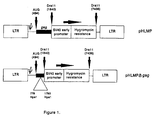
- the 5' leader sequence extending to include 1.5kB of the gag gene was included; between these was cloned a Hygromycin phosphotransferase gene cassette under control of an SV40 early promoter sequence in sense relative to the vector (Fig. 3).
- Into the 5' leader sequence was cloned one of the MPS1, 2, 3 and 4 deletions. Subsequent deletions were made in the gag gene such that either the 5' 0.5 kB of gag remained.
- Combinations of wild-type vector and deletion mutant provirus or deletion mutant vector and wild-type virus or deletion mutant vector and deletion mutant provirus were cotransfected into Cos 1 cells.
- the supernatants were filtered and plated on to Hela cells and the number of hygromycin-resistant colonies arising demonstrated efficiency of packaging of the hygromycin-containing vector.
- competition for packaging of RNA was established between vector and virus and the effect of deletion mutants in either vector or provirus on the balance of full length RNAs packaged was determined.
- deletion MPS1 led to virtual abolition of RNA packaging.
- MPS2 and MPS3 showed a packaging defect of equal severity and MPS4 did not affect packaging at all.
- vectors containing the MPS4 deletion appeared to package at a greater efficiency than did those with an intact region from SD to gag AUG. Deletion of gag sequence to leave only the 5' 0.5 kB led to an increase in packaging efficiency, suggesting that sequences in the distal region which were deleted have an inhibitory effect on RNA encapsidation.
- MPMV has a packaging signal requirement which is unique amongst retroviral packaging signals so far described, in that sequences between SD and gag ATG which (except for RSV) are almost universally required for packaging in other viruses are dispensable in MPMV and, on removal, lead to enhancement of packaging.
- a vector to be efficiently packaged preferably does not contain the nucleotides corresponding to those nucleotides between the SD and the gag initiation codon.
- Packaging can be obtained with sequences contained in the 5' half of the PBS-SD region and the first 0.5 kB of the gag gene, which distinguishes it from RSV.
- the region of gag 3' to the first 500 nucleotides apparently also has a relative inhibitory effect on encapsidation and is preferably excluded from a vector to be efficiently packaged.
- the foreign gene to be delivered can be any gene desired, for example the gene for neomycin phosphotransferase (Neo R ) or the gene for Hygromycin phosphotransferase (Hygro R ). More preferably, the gene expresses a product which is of therapeutic value in patients deficient for the gene, such as the gene for adenosine deaminase (ADA), for Aryl sulphatase A, or for the B domain-deleted factor VIII, which are defective in patients with, respectively, ADA deficiency, metachromatic leucodystrophy and haemophilia. They may be cloned into the vectors and delivered to desired target cells.
- ADA adenosine deaminase
- Aryl sulphatase A or for the B domain-deleted factor VIII
- the gene may express a product that adversely affects the replication of a pathogenic organism such as a trans-dominant inhibitor, an inhibitor of viral integration, an anti-sense RNA, a catalytic RNA or a soluble viral receptor derivative such as soluble CD4.
- a pathogenic organism such as a trans-dominant inhibitor, an inhibitor of viral integration, an anti-sense RNA, a catalytic RNA or a soluble viral receptor derivative such as soluble CD4.
- the gene may have a therapeutic use, such as the presentation of an antigenically important epitope of a pathogen or of a tumor cell on the target cell surface, in order to stimulate a protective or otherwise beneficial immune response against such a pathogen or tumor.
- the gene may encode the antigen recognition segment of the T lymphocyte receptor molecule such that, when lymphocytes are transformed with this vector, they express T cell receptors of the desired antigenic specificity.
- T cell receptor specificity is preferably directed against the important epitopes of either a pathogenic microorganism or against a tumor-specific antigen. Clonal expansion of such T cells (monoclonal T cells) would be useful as a therapeutic modality against infectious pathogens and as an agent against malignant disease.
- RNA of the vector would then be reverse-transcribed by the virion reverse transcriptase enzyme and integrated into the cellular DNA by the viral integrase enzyme.
- a promoter for the desired gene is included, although the LTR sequence itself can serve as a promoter. Virtually any promoter can be used, but preferably it facilitates expression of the gene in the host cell to which the gene is transferred.
- Preferred promoters include viral promoters, such as SL-3, murine retroviral LTR etc. Enhancer sequences are also preferably used in the vector.
- Polyadenylation sequences for the gene are preferably included. In the case of a gene in the sense orientation with respect to the vector, this function could be achieved by the 3' LTR. In the case of a gene in anti-sense with respect to the vector, an additional polyadenylation signal at the 3' end of the gene (i.e. in anti-sense to the vector) is preferably incorporated.
- the vector can contain more than one gene or pseudogene sequence, permitting the expression of multiple genes of interest.
- This vector can preferably be used with the packaging-defective vectors described above.
- MPMV LTRs are preferably in the vector corresponding to the genome of the packaging-deficient vector, to facilitate packaging efficiency.
- this vector can also be used with helper virus for gene transfer.
- Example 1 relates to MPMV-based vectors.
- the proviral clone pSHRM15 previously described (Fig. 3) was used as a helper virus to provide in trans all the structural and enzymatic proteins of the MPMV virion.
- a small vector was constructed, containing the MPMV 5' LTR sequence, the 5' leader sequence down to the Bal1 restriction site at position 1320 in the gag open reading frame, followed by the Hygromycin B resistance gene in anti-sense orientation to the vector, without a polyadenylation sequence, and finally the 3' terminal of the MPMV provirus from the Dra11 site at 7440 extending to the end of the 3' LTR (Fig. 3).
- the helper virus and/or the vector have had introduced into them the various deletions previously described, i.e.
- Vector and helper have been cotransfected into Cos-1 cells and the resulting virions harvested and used to infect Hela cells.
- the Hela cells have then been maintained in a medium containing the antibiotic Hygromycin and the number of colonies resistant to the drug in which the vector must have been integrated then counted. This gives a measure of the packageability of the vectors and the role of the sequences deleted in encapsidation of RNA into the virion particle.
- vector pHLMP was cotransfected into Cos-1 cells with the pSHRM15 proviral DIVA either in its wild-type form or with the MPS1, 2, 3, or 4 deletions in the 5' untranslated region. 48 hours later, the supernatants from the transfections were harvested and used to infect Hela cells and, after 24 hours, the cells were begun on selection with Hygromycin B (Hyg.). The results are given in Table 1: Mutant Colonies/ml Wild-Type 12 MPS1 106 MPS2 129 MPS3 157 MPS4 15 HLMP 0
- MPS4 deletion acts like the wild-type, suggesting that this can package itself as well as wild-type and that no important cis -acting sequences involved in packaging are present between the SD and the gag initiation codon.
- MPS1, 2 and 3 mutations have disrupted a significant part of the packaging signal, hence they do not compete with HLMP for packaging.
- Hygromycin-containing vectors were cotransfected with helper viruses, either or both of which had deletions in the packaging region. Results, given in Table 2, refer to Hygromycin-resistant colonies obtained after infection of supernatants from these transfections on to fresh Hela cells and Hygromycin B selection.
- HLMPS1 and HLMPS2 package and transfer extremely poorly, suggesting that this is the region of greatest importance for RNA encapsidation.
- HLMPS3 appears to package as well as HLMP. Although quantitatively different, the results using MPS3 are qualitatively the same and the numbers probably reflect variations between titres of virions obtained after transfection.
- HLMPS1 has a deletion in its primer-binding site and must have recombined with MPS3 to achieve transfer in this experiment.
- gag coding sequence clearly leads to enhanced packaging of the HLMP vector, suggesting that the region 3' of the Hpa 1 site at 1793 in gag has an inhibitory effect on RNA encapsidation.
- RT reverse transcriptase
- the effect of deleting the gag sequence has been quantified; it leads to an approximate 4-fold increase in the packaging of pHLMP.
- the helper virus competition for packaging is also clearly seen as WT virus allows for the packaging of approximately 60-fold less HLMP vector than does the MPS1 deletion mutant.
Landscapes
- Health & Medical Sciences (AREA)
- Life Sciences & Earth Sciences (AREA)
- Chemical & Material Sciences (AREA)
- Genetics & Genomics (AREA)
- Organic Chemistry (AREA)
- Engineering & Computer Science (AREA)
- Bioinformatics & Cheminformatics (AREA)
- Zoology (AREA)
- Wood Science & Technology (AREA)
- General Health & Medical Sciences (AREA)
- General Engineering & Computer Science (AREA)
- Biochemistry (AREA)
- Virology (AREA)
- Biomedical Technology (AREA)
- Biotechnology (AREA)
- Medicinal Chemistry (AREA)
- Biophysics (AREA)
- Microbiology (AREA)
- Molecular Biology (AREA)
- Plant Pathology (AREA)
- Physics & Mathematics (AREA)
- Gastroenterology & Hepatology (AREA)
- Proteomics, Peptides & Aminoacids (AREA)
- Immunology (AREA)
- General Chemical & Material Sciences (AREA)
- Chemical Kinetics & Catalysis (AREA)
- Nuclear Medicine, Radiotherapy & Molecular Imaging (AREA)
- Pharmacology & Pharmacy (AREA)
- Animal Behavior & Ethology (AREA)
- Public Health (AREA)
- Veterinary Medicine (AREA)
- Micro-Organisms Or Cultivation Processes Thereof (AREA)
- Measuring Or Testing Involving Enzymes Or Micro-Organisms (AREA)
- Medicines Containing Material From Animals Or Micro-Organisms (AREA)
- Medicines That Contain Protein Lipid Enzymes And Other Medicines (AREA)
- Packages (AREA)
- Packging For Living Organisms, Food Or Medicinal Products That Are Sensitive To Environmental Conditiond (AREA)
- Auxiliary Devices For And Details Of Packaging Control (AREA)
- Supplying Of Containers To The Packaging Station (AREA)
Claims (17)
- Vektor, der für die Herstellung von MPMV (Mason-Pfizer-Affenvirus)-Proteinen geeignet ist und der eine Deletion von Packungsnucleotiden zwischen der MPMV-Prlmer-Bindungsstelle und dem MPMV 5'-Haupt-Spleissdonor, Nucleotide 348 - 365 bzw. 475 - 480, aufweist, und der nicht zum Packen von MPMV RNA befähigt ist.
- Vektor nach Anspruch 1, wobei die Deletion die Basen 28 bis 50 der Sequenz ID Nr. 1, wie hier definiert, umfasst.
- Vektor nach Anspruch 1 oder Anspruch 2, wobei die Deletion die Basen 51 bis 112 von Sequenz ID Nr. 1, wie hier definiert, umfasst.
- Vektor nach einem der vorstehenden Ansprüche, wobei die Deletion Sequenz ID Nr. 1, wie hier definiert, umfasst.
- Vektor nach einem der vorstehenden Ansprüche, der Sequenzen enthält, die einer Promotorregion im MPMV-Genom und/oder einer Polyadenylierungssequenz eines anderen Genoms entsprechen, der jedoch keine Sequenzen entsprechend einer langen terminalen Wiederholungssequenz von MPMV enthält.
- Vektor nach einem der vorstehenden Ansprüche, der die Expression von MPMV-Proteinen stromaufwärts von env oder der restlichen Proteine erlaubt und der gegebenenfalls auch einen Marker einschließt.
- Vektor, der für die Packung geeignete RNA bildet und der Nucleotide entsprechend mindestens einer Region zwischen der MPMV-Primer-Bindungsstelle und der MPMV 5'-Haupt-Spleissstelle, ein heterologes Gen und, flankierend die Packungsnucleotide und das heterologe Gen, Sequenzen, die denen innerhalb oder nahe der MPMV LTR entsprechen, ausreichend für Packung, reverse Transkription und Integration des Vektors in Zielzellen und Expression des heterologen Gens, umfasst.
- Vektor nach Anspruch 7, der Nucleotide entsprechend Sequenz ID Nr. 1, wie hier definiert, umfasst.
- Vektor nach Anspruch 7 oder 8, der Nucleotide entsprechend den Basen 51 bis 112 von Sequenz ID Nr. 1, wie hier definiert, umfasst.
- Vektor nach einem der Ansprüche 7 bis 9, der die ersten 500 bp des MPMV gag-Gens umfasst.
- Vektor nach einem der Ansprüche 7 bis 10, der Nucleotide entsprechend der Sequenz, numeriert als 481 - 493, zwischen dem MPMV 5'-Haupt-Spleissdonor und dem MPMV-Initiationscodon, nicht umfasst.
- Vektor nach einem der Ansprüche 7 bis 11, der eine MPMV LTR-Sequenz als Promotor für das heterologe Gen umfasst.
- Vektor nach einem der Ansprüche 7 bis 11, wobei es sich bei dem heterologen Gen um ein Gen für ein Produkt, das für die Therapie nützlich ist, handelt.
- Vektor nach Anspruch 13 für die Verwendung in der Therapie durch Übertragung des heterologen Gens.
- Verfahren zur Herstellung von Virionen, das die Transfektion einer Zelle mit einem oder mehreren Vektoren nach einem der Ansprüche 1 bis 6 und einem Vektor nach einem der Ansprüche 7 bis 14 und gegebenenfalls das Kultivieren der Zelle umfasst.
- Verfahren für die Genübertragung, das das Kontaktieren eines Virions, hergestellt nach dem Verfahren gemäß Anspruch 15, mit einer Säugerzelle in vitro umfasst.
- Virion, hergestellt nach einem Verfahren gemäß Anspruch 15, für die Verwendung bei einem Verfahren der Therapie durch Genübertragung.
Priority Applications (1)
| Application Number | Priority Date | Filing Date | Title |
|---|---|---|---|
| EP02014431A EP1262554A3 (de) | 1992-02-28 | 1993-03-01 | Defekte verpackende nicht-Oncoviren Vektoren aus Mpmv und Hiv |
Applications Claiming Priority (7)
| Application Number | Priority Date | Filing Date | Title |
|---|---|---|---|
| GB929204350A GB9204350D0 (en) | 1992-02-28 | 1992-02-28 | Dtv agents |
| GB9204350 | 1992-02-28 | ||
| GB9208489 | 1992-04-16 | ||
| GB929208489A GB9208489D0 (en) | 1992-04-16 | 1992-04-16 | Ctv agents |
| GB929219935A GB9219935D0 (en) | 1992-04-16 | 1992-09-21 | Ctv agents |
| GB9219935 | 1992-09-21 | ||
| PCT/GB1993/000417 WO1993017118A2 (en) | 1992-02-28 | 1993-03-01 | Defective packaging non-oncoviral vectors based on mpmv and hiv |
Related Child Applications (1)
| Application Number | Title | Priority Date | Filing Date |
|---|---|---|---|
| EP02014431A Division EP1262554A3 (de) | 1992-02-28 | 1993-03-01 | Defekte verpackende nicht-Oncoviren Vektoren aus Mpmv und Hiv |
Publications (2)
| Publication Number | Publication Date |
|---|---|
| EP0630409A1 EP0630409A1 (de) | 1994-12-28 |
| EP0630409B1 true EP0630409B1 (de) | 2002-11-27 |
Family
ID=27266069
Family Applications (2)
| Application Number | Title | Priority Date | Filing Date |
|---|---|---|---|
| EP93905485A Expired - Lifetime EP0630409B1 (de) | 1992-02-28 | 1993-03-01 | Defekte verpackende nicht-oncoviren vektoren aus mpmv |
| EP02014431A Withdrawn EP1262554A3 (de) | 1992-02-28 | 1993-03-01 | Defekte verpackende nicht-Oncoviren Vektoren aus Mpmv und Hiv |
Family Applications After (1)
| Application Number | Title | Priority Date | Filing Date |
|---|---|---|---|
| EP02014431A Withdrawn EP1262554A3 (de) | 1992-02-28 | 1993-03-01 | Defekte verpackende nicht-Oncoviren Vektoren aus Mpmv und Hiv |
Country Status (11)
| Country | Link |
|---|---|
| US (2) | US5747307A (de) |
| EP (2) | EP0630409B1 (de) |
| JP (2) | JP3765103B2 (de) |
| AT (1) | ATE228569T1 (de) |
| AU (1) | AU671101B2 (de) |
| CA (2) | CA2557882C (de) |
| DE (1) | DE69332519T2 (de) |
| DK (1) | DK0630409T3 (de) |
| ES (1) | ES2187504T3 (de) |
| PT (1) | PT630409E (de) |
| WO (1) | WO1993017118A2 (de) |
Families Citing this family (17)
| Publication number | Priority date | Publication date | Assignee | Title |
|---|---|---|---|---|
| GB2269175A (en) * | 1992-07-31 | 1994-02-02 | Imperial College | Retroviral vectors |
| JPH09510361A (ja) * | 1994-03-24 | 1997-10-21 | シンジェニックス・リミテッド | パッケージング欠陥性レンチウイルス |
| US5714353A (en) * | 1994-05-24 | 1998-02-03 | Research Corporation Technologies, Inc. | Safe vectors for gene therapy |
| GB9510272D0 (en) * | 1995-05-22 | 1995-07-19 | Isis Innovation | Retroviral vectors |
| US6013516A (en) * | 1995-10-06 | 2000-01-11 | The Salk Institute For Biological Studies | Vector and method of use for nucleic acid delivery to non-dividing cells |
| FR2747046B1 (fr) * | 1996-04-05 | 1998-06-19 | Univ Paris Curie | Nouveaux vaccins issus de plasmovirus |
| US5994136A (en) * | 1997-12-12 | 1999-11-30 | Cell Genesys, Inc. | Method and means for producing high titer, safe, recombinant lentivirus vectors |
| US6218181B1 (en) | 1998-03-18 | 2001-04-17 | The Salk Institute For Biological Studies | Retroviral packaging cell line |
| US6797512B1 (en) | 1998-11-13 | 2004-09-28 | Cell Genesys, Inc. | Selection system for generating efficient packaging cells for lentiviral vectors |
| JP4482639B2 (ja) * | 1998-11-13 | 2010-06-16 | ジービーピー アイピー, エルエルシー | レンチウイルスベクターに対する効率的なパッケージング細胞を産生するための選択システム |
| US6790657B1 (en) * | 1999-01-07 | 2004-09-14 | The United States Of America As Represented By The Department Of Health And Human Services | Lentivirus vector system |
| AU778698B2 (en) * | 1999-04-29 | 2004-12-16 | Miltenyi Biotec B.V. & Co. KG | Method and means for producing high titer, safe, recombinant lentivirus vectors |
| WO2000072886A1 (en) | 1999-05-26 | 2000-12-07 | Dana-Farber Cancer Institute, Inc. | Episomally replicating lentiviral vectors |
| WO2002060490A1 (en) * | 2001-01-31 | 2002-08-08 | Duke University | Retroviral vector |
| GB0108065D0 (en) * | 2001-03-30 | 2001-05-23 | Syngenix Ltd | Viral vectors |
| EP1395293B1 (de) * | 2001-05-14 | 2009-07-22 | Gbp Ip, Llc | Lentivirale vektoren kodierend für gerinnungsfaktoren für die gentherapie |
| IL159371A0 (en) | 2001-06-29 | 2004-06-01 | Sloan Kettering Inst Cancer | Vector encoding human globin gene and use thereof in treatment of hemoglobinopathies |
Family Cites Families (7)
| Publication number | Priority date | Publication date | Assignee | Title |
|---|---|---|---|---|
| US5604114A (en) * | 1986-05-20 | 1997-02-18 | Dana-Farber Cancer Institute | Cis-acting repression sequences, cis-acting antirepression sequences, vectors, methods of preparation and use |
| US5716826A (en) * | 1988-03-21 | 1998-02-10 | Chiron Viagene, Inc. | Recombinant retroviruses |
| US5861282A (en) * | 1989-10-16 | 1999-01-19 | Whitehead Institute For Biomedical Research | Non-infectious HIV particles and uses therefor |
| JPH05501201A (ja) * | 1989-10-16 | 1993-03-11 | ホワイトヘツド・インスチチユート・フオー・バイオメデイカル・リサーチ | 非感染性hiv―1粒子およびそれらの使用 |
| US5981276A (en) * | 1990-06-20 | 1999-11-09 | Dana-Farber Cancer Institute | Vectors containing HIV packaging sequences, packaging defective HIV vectors, and uses thereof |
| WO1991019798A1 (en) * | 1990-06-20 | 1991-12-26 | Dana Farber Cancer Institute | Vectors containing hiv packaging sequences, packaging defective hiv vectors, and uses thereof |
| US6174666B1 (en) * | 1992-03-27 | 2001-01-16 | The United States Of America As Represented By The Department Of Health And Human Services | Method of eliminating inhibitory/instability regions from mRNA |
-
1993
- 1993-03-01 CA CA2557882A patent/CA2557882C/en not_active Expired - Lifetime
- 1993-03-01 EP EP93905485A patent/EP0630409B1/de not_active Expired - Lifetime
- 1993-03-01 AU AU36394/93A patent/AU671101B2/en not_active Ceased
- 1993-03-01 WO PCT/GB1993/000417 patent/WO1993017118A2/en not_active Ceased
- 1993-03-01 DK DK93905485T patent/DK0630409T3/da active
- 1993-03-01 ES ES93905485T patent/ES2187504T3/es not_active Expired - Lifetime
- 1993-03-01 DE DE69332519T patent/DE69332519T2/de not_active Expired - Fee Related
- 1993-03-01 JP JP51467993A patent/JP3765103B2/ja not_active Expired - Fee Related
- 1993-03-01 EP EP02014431A patent/EP1262554A3/de not_active Withdrawn
- 1993-03-01 PT PT93905485T patent/PT630409E/pt unknown
- 1993-03-01 US US08/295,737 patent/US5747307A/en not_active Expired - Fee Related
- 1993-03-01 CA CA002117607A patent/CA2117607A1/en not_active Abandoned
- 1993-03-01 AT AT93905485T patent/ATE228569T1/de not_active IP Right Cessation
-
1997
- 1997-12-18 US US08/994,001 patent/US6294165B1/en not_active Expired - Fee Related
-
2003
- 2003-09-02 JP JP2003309935A patent/JP3779966B2/ja not_active Expired - Fee Related
Also Published As
| Publication number | Publication date |
|---|---|
| JPH07504322A (ja) | 1995-05-18 |
| DE69332519D1 (de) | 2003-01-09 |
| AU671101B2 (en) | 1996-08-15 |
| WO1993017118A3 (en) | 1993-10-14 |
| US6294165B1 (en) | 2001-09-25 |
| ES2187504T3 (es) | 2003-06-16 |
| EP0630409A1 (de) | 1994-12-28 |
| CA2557882C (en) | 2010-05-18 |
| EP1262554A3 (de) | 2007-08-29 |
| CA2557882A1 (en) | 1993-09-02 |
| JP3765103B2 (ja) | 2006-04-12 |
| JP3779966B2 (ja) | 2006-05-31 |
| US5747307A (en) | 1998-05-05 |
| WO1993017118A2 (en) | 1993-09-02 |
| DE69332519T2 (de) | 2003-07-17 |
| EP1262554A2 (de) | 2002-12-04 |
| DK0630409T3 (da) | 2003-03-24 |
| ATE228569T1 (de) | 2002-12-15 |
| AU3639493A (en) | 1993-09-13 |
| JP2004000280A (ja) | 2004-01-08 |
| PT630409E (pt) | 2003-04-30 |
| CA2117607A1 (en) | 1993-09-02 |
Similar Documents
| Publication | Publication Date | Title |
|---|---|---|
| US6410326B1 (en) | Method for inhibiting human tumor cells | |
| US8034620B2 (en) | Lentiviral packaging cells and uses therefor | |
| US5747307A (en) | Mason-Pfizer Monkey Retroviral packaging defective vectors | |
| WO1991002805A2 (en) | Recombinant retroviruses delivering vector constructs to target cells | |
| JPH11512615A (ja) | 非分裂細胞への核酸運搬のためのベクターおよび使用方法 | |
| ES2627445T3 (es) | Partículas de vector de lentivirus resistentes a la inactivación por el complemento | |
| JP3264281B2 (ja) | Hivパッケージング配列を含むベクター、パッケージング不全hivベクター及びその使用 | |
| US6277601B1 (en) | Expression of a foamy virus envelope protein | |
| Celma et al. | Domains in the simian immunodeficiency virus gp41 cytoplasmic tail required for envelope incorporation into particles | |
| JPH11507244A (ja) | Srv−3エンベロープ糖タンパク質配列で偽型化したレトロウイルスベクター | |
| AU733948B2 (en) | Expression of a modified foamy virus envelope protein | |
| EP1183383B1 (de) | Auf siv basierende verpackungsdefiziente vektoren | |
| US20060067948A1 (en) | Viral vectors | |
| Baranick | Characterization and utilization of simple replication-competent retroviral vectors | |
| CA2229515A1 (en) | Expression of a foamy virus envelope protein |
Legal Events
| Date | Code | Title | Description |
|---|---|---|---|
| PUAI | Public reference made under article 153(3) epc to a published international application that has entered the european phase |
Free format text: ORIGINAL CODE: 0009012 |
|
| 17P | Request for examination filed |
Effective date: 19940920 |
|
| AK | Designated contracting states |
Kind code of ref document: A1 Designated state(s): AT BE CH DE DK ES FR GB GR IE IT LI LU MC NL PT SE |
|
| 17Q | First examination report despatched |
Effective date: 19990302 |
|
| GRAG | Despatch of communication of intention to grant |
Free format text: ORIGINAL CODE: EPIDOS AGRA |
|
| RTI1 | Title (correction) |
Free format text: DEFECTIVE PACKAGING NON-ONCOVIRAL VECTORS BASED ON MPMV |
|
| RTI1 | Title (correction) |
Free format text: DEFECTIVE PACKAGING NON-ONCOVIRAL VECTORS BASED ON MPMV |
|
| RTI1 | Title (correction) |
Free format text: DEFECTIVE PACKAGING NON-ONCOVIRAL VECTORS BASED ON MPMV |
|
| GRAG | Despatch of communication of intention to grant |
Free format text: ORIGINAL CODE: EPIDOS AGRA |
|
| GRAH | Despatch of communication of intention to grant a patent |
Free format text: ORIGINAL CODE: EPIDOS IGRA |
|
| RAP1 | Party data changed (applicant data changed or rights of an application transferred) |
Owner name: SYNGENIX LIMITED |
|
| GRAH | Despatch of communication of intention to grant a patent |
Free format text: ORIGINAL CODE: EPIDOS IGRA |
|
| GRAA | (expected) grant |
Free format text: ORIGINAL CODE: 0009210 |
|
| AK | Designated contracting states |
Kind code of ref document: B1 Designated state(s): AT BE CH DE DK ES FR GB GR IE IT LI LU MC NL PT SE |
|
| REF | Corresponds to: |
Ref document number: 228569 Country of ref document: AT Date of ref document: 20021215 Kind code of ref document: T |
|
| REG | Reference to a national code |
Ref country code: GB Ref legal event code: FG4D |
|
| REG | Reference to a national code |
Ref country code: CH Ref legal event code: EP |
|
| REG | Reference to a national code |
Ref country code: IE Ref legal event code: FG4D |
|
| REF | Corresponds to: |
Ref document number: 69332519 Country of ref document: DE Date of ref document: 20030109 |
|
| REG | Reference to a national code |
Ref country code: CH Ref legal event code: NV Representative=s name: PATENTANWAELTE SCHAAD, BALASS, MENZL & PARTNER AG |
|
| REG | Reference to a national code |
Ref country code: DK Ref legal event code: T3 |
|
| REG | Reference to a national code |
Ref country code: GR Ref legal event code: EP Ref document number: 20030400567 Country of ref document: GR |
|
| REG | Reference to a national code |
Ref country code: PT Ref legal event code: SC4A Free format text: AVAILABILITY OF NATIONAL TRANSLATION Effective date: 20030225 |
|
| ET | Fr: translation filed | ||
| REG | Reference to a national code |
Ref country code: ES Ref legal event code: FG2A Ref document number: 2187504 Country of ref document: ES Kind code of ref document: T3 |
|
| PLBE | No opposition filed within time limit |
Free format text: ORIGINAL CODE: 0009261 |
|
| STAA | Information on the status of an ep patent application or granted ep patent |
Free format text: STATUS: NO OPPOSITION FILED WITHIN TIME LIMIT |
|
| 26N | No opposition filed |
Effective date: 20030828 |
|
| PGFP | Annual fee paid to national office [announced via postgrant information from national office to epo] |
Ref country code: DK Payment date: 20040123 Year of fee payment: 12 |
|
| PGFP | Annual fee paid to national office [announced via postgrant information from national office to epo] |
Ref country code: CH Payment date: 20040317 Year of fee payment: 12 |
|
| PGFP | Annual fee paid to national office [announced via postgrant information from national office to epo] |
Ref country code: NL Payment date: 20040325 Year of fee payment: 12 |
|
| PGFP | Annual fee paid to national office [announced via postgrant information from national office to epo] |
Ref country code: SE Payment date: 20040326 Year of fee payment: 12 Ref country code: MC Payment date: 20040326 Year of fee payment: 12 Ref country code: LU Payment date: 20040326 Year of fee payment: 12 Ref country code: AT Payment date: 20040326 Year of fee payment: 12 |
|
| PGFP | Annual fee paid to national office [announced via postgrant information from national office to epo] |
Ref country code: IE Payment date: 20040329 Year of fee payment: 12 |
|
| PGFP | Annual fee paid to national office [announced via postgrant information from national office to epo] |
Ref country code: GR Payment date: 20040330 Year of fee payment: 12 |
|
| PGFP | Annual fee paid to national office [announced via postgrant information from national office to epo] |
Ref country code: PT Payment date: 20040401 Year of fee payment: 12 |
|
| PGFP | Annual fee paid to national office [announced via postgrant information from national office to epo] |
Ref country code: ES Payment date: 20040416 Year of fee payment: 12 |
|
| PGFP | Annual fee paid to national office [announced via postgrant information from national office to epo] |
Ref country code: BE Payment date: 20040518 Year of fee payment: 12 |
|
| PGFP | Annual fee paid to national office [announced via postgrant information from national office to epo] |
Ref country code: DE Payment date: 20050224 Year of fee payment: 13 |
|
| PG25 | Lapsed in a contracting state [announced via postgrant information from national office to epo] |
Ref country code: LU Free format text: LAPSE BECAUSE OF NON-PAYMENT OF DUE FEES Effective date: 20050301 Ref country code: IT Free format text: LAPSE BECAUSE OF NON-PAYMENT OF DUE FEES Effective date: 20050301 Ref country code: AT Free format text: LAPSE BECAUSE OF NON-PAYMENT OF DUE FEES Effective date: 20050301 |
|
| PG25 | Lapsed in a contracting state [announced via postgrant information from national office to epo] |
Ref country code: SE Free format text: LAPSE BECAUSE OF NON-PAYMENT OF DUE FEES Effective date: 20050302 Ref country code: ES Free format text: LAPSE BECAUSE OF NON-PAYMENT OF DUE FEES Effective date: 20050302 |
|
| PGFP | Annual fee paid to national office [announced via postgrant information from national office to epo] |
Ref country code: FR Payment date: 20050308 Year of fee payment: 13 |
|
| PG25 | Lapsed in a contracting state [announced via postgrant information from national office to epo] |
Ref country code: MC Free format text: LAPSE BECAUSE OF NON-PAYMENT OF DUE FEES Effective date: 20050331 Ref country code: LI Free format text: LAPSE BECAUSE OF NON-PAYMENT OF DUE FEES Effective date: 20050331 Ref country code: DK Free format text: LAPSE BECAUSE OF NON-PAYMENT OF DUE FEES Effective date: 20050331 Ref country code: CH Free format text: LAPSE BECAUSE OF NON-PAYMENT OF DUE FEES Effective date: 20050331 Ref country code: BE Free format text: LAPSE BECAUSE OF NON-PAYMENT OF DUE FEES Effective date: 20050331 |
|
| PG25 | Lapsed in a contracting state [announced via postgrant information from national office to epo] |
Ref country code: PT Free format text: LAPSE BECAUSE OF NON-PAYMENT OF DUE FEES Effective date: 20050901 |
|
| BERE | Be: lapsed |
Owner name: *SYNGENIX LTD Effective date: 20050331 |
|
| PG25 | Lapsed in a contracting state [announced via postgrant information from national office to epo] |
Ref country code: NL Free format text: LAPSE BECAUSE OF NON-PAYMENT OF DUE FEES Effective date: 20051001 |
|
| PG25 | Lapsed in a contracting state [announced via postgrant information from national office to epo] |
Ref country code: GR Free format text: LAPSE BECAUSE OF NON-PAYMENT OF DUE FEES Effective date: 20051004 |
|
| REG | Reference to a national code |
Ref country code: PT Ref legal event code: MM4A Effective date: 20050901 |
|
| EUG | Se: european patent has lapsed | ||
| REG | Reference to a national code |
Ref country code: CH Ref legal event code: PL |
|
| NLV4 | Nl: lapsed or anulled due to non-payment of the annual fee |
Effective date: 20051001 |
|
| REG | Reference to a national code |
Ref country code: DK Ref legal event code: EBP |
|
| REG | Reference to a national code |
Ref country code: IE Ref legal event code: MM4A |
|
| REG | Reference to a national code |
Ref country code: ES Ref legal event code: FD2A Effective date: 20050302 |
|
| PG25 | Lapsed in a contracting state [announced via postgrant information from national office to epo] |
Ref country code: DE Free format text: LAPSE BECAUSE OF NON-PAYMENT OF DUE FEES Effective date: 20061003 |
|
| REG | Reference to a national code |
Ref country code: FR Ref legal event code: ST Effective date: 20061130 |
|
| BERE | Be: lapsed |
Owner name: *SYNGENIX LTD Effective date: 20050331 |
|
| PG25 | Lapsed in a contracting state [announced via postgrant information from national office to epo] |
Ref country code: FR Free format text: LAPSE BECAUSE OF NON-PAYMENT OF DUE FEES Effective date: 20060331 |
|
| PGFP | Annual fee paid to national office [announced via postgrant information from national office to epo] |
Ref country code: GB Payment date: 20090225 Year of fee payment: 17 |
|
| GBPC | Gb: european patent ceased through non-payment of renewal fee |
Effective date: 20100301 |
|
| PG25 | Lapsed in a contracting state [announced via postgrant information from national office to epo] |
Ref country code: GB Free format text: LAPSE BECAUSE OF NON-PAYMENT OF DUE FEES Effective date: 20100301 |