EP0630883B1 - Neues Verfahren zur Herstellung von N-alkyl-3,4-dialkyl-2,6-dinitronilinen - Google Patents
Neues Verfahren zur Herstellung von N-alkyl-3,4-dialkyl-2,6-dinitronilinen Download PDFInfo
- Publication number
- EP0630883B1 EP0630883B1 EP94109725A EP94109725A EP0630883B1 EP 0630883 B1 EP0630883 B1 EP 0630883B1 EP 94109725 A EP94109725 A EP 94109725A EP 94109725 A EP94109725 A EP 94109725A EP 0630883 B1 EP0630883 B1 EP 0630883B1
- Authority
- EP
- European Patent Office
- Prior art keywords
- group
- dialkyl
- chosen
- alkyl
- formula
- Prior art date
- Legal status (The legal status is an assumption and is not a legal conclusion. Google has not performed a legal analysis and makes no representation as to the accuracy of the status listed.)
- Expired - Lifetime
Links
- 0 *NC(*C=*=*1)[N+]1[O-] Chemical compound *NC(*C=*=*1)[N+]1[O-] 0.000 description 1
Classifications
-
- C—CHEMISTRY; METALLURGY
- C07—ORGANIC CHEMISTRY
- C07C—ACYCLIC OR CARBOCYCLIC COMPOUNDS
- C07C211/00—Compounds containing amino groups bound to a carbon skeleton
- C07C211/43—Compounds containing amino groups bound to a carbon skeleton having amino groups bound to carbon atoms of six-membered aromatic rings of the carbon skeleton
- C07C211/44—Compounds containing amino groups bound to a carbon skeleton having amino groups bound to carbon atoms of six-membered aromatic rings of the carbon skeleton having amino groups bound to only one six-membered aromatic ring
- C07C211/52—Compounds containing amino groups bound to a carbon skeleton having amino groups bound to carbon atoms of six-membered aromatic rings of the carbon skeleton having amino groups bound to only one six-membered aromatic ring the carbon skeleton being further substituted by halogen atoms or by nitro or nitroso groups
-
- C—CHEMISTRY; METALLURGY
- C07—ORGANIC CHEMISTRY
- C07C—ACYCLIC OR CARBOCYCLIC COMPOUNDS
- C07C201/00—Preparation of esters of nitric or nitrous acid or of compounds containing nitro or nitroso groups bound to a carbon skeleton
- C07C201/06—Preparation of nitro compounds
- C07C201/08—Preparation of nitro compounds by substitution of hydrogen atoms by nitro groups
-
- C—CHEMISTRY; METALLURGY
- C07—ORGANIC CHEMISTRY
- C07C—ACYCLIC OR CARBOCYCLIC COMPOUNDS
- C07C201/00—Preparation of esters of nitric or nitrous acid or of compounds containing nitro or nitroso groups bound to a carbon skeleton
- C07C201/06—Preparation of nitro compounds
- C07C201/12—Preparation of nitro compounds by reactions not involving the formation of nitro groups
-
- C—CHEMISTRY; METALLURGY
- C07—ORGANIC CHEMISTRY
- C07C—ACYCLIC OR CARBOCYCLIC COMPOUNDS
- C07C209/00—Preparation of compounds containing amino groups bound to a carbon skeleton
- C07C209/02—Preparation of compounds containing amino groups bound to a carbon skeleton by substitution of hydrogen atoms by amino groups
-
- C—CHEMISTRY; METALLURGY
- C07—ORGANIC CHEMISTRY
- C07C—ACYCLIC OR CARBOCYCLIC COMPOUNDS
- C07C209/00—Preparation of compounds containing amino groups bound to a carbon skeleton
- C07C209/04—Preparation of compounds containing amino groups bound to a carbon skeleton by substitution of functional groups by amino groups
- C07C209/14—Preparation of compounds containing amino groups bound to a carbon skeleton by substitution of functional groups by amino groups by substitution of hydroxy groups or of etherified or esterified hydroxy groups
- C07C209/18—Preparation of compounds containing amino groups bound to a carbon skeleton by substitution of functional groups by amino groups by substitution of hydroxy groups or of etherified or esterified hydroxy groups with formation of amino groups bound to carbon atoms of six-membered aromatic rings or from amines having nitrogen atoms bound to carbon atoms of six-membered aromatic rings
Definitions
- the present invention concerns the improved process for preparing N-alkyl-3,4-dialkyl-2,6-dinitroanilines.
- the present invention more particularly concerns a commercially viable process to prepare the compound pendimethalin, (known by the chemical name N-(1-ethylpropyl)-2,6-dinitro-3,4-xylidine) its derivatives and its intermediates.
- Pendimethalin and its derivatives are reported by United States Patent Number 4,066,441 as excellent pre-emergent herbicides.
- o-Xylene is first chlorinated to form 4-chloro- o -xylene, which in turn is nitrated with fuming nitric acid to give the 3,4-dimethyl-2,6-dinitro-chlorobenzene in a yield of 27%.
- the low yield is not commercially viable.
- the chlorination step affords a mixture of chloro isomers, requiring the distillation of the product mixture to separate the 4-chloro- isomer from its 3-chloro isomer with only great difficulty due to their very close boiling points.
- the low yield of the nitration step stems from the need to purify the 3,4-dimethyl-2,6-dinitro-chlorobenzene from dangerous higher nitrated by products. This alone makes this process difficult for commercialization.
- a second process involves nitrating 3,4-dimethylaniline to form 3,4-dimethyl-2,6-dinitroaniline which is then reacted via a Sandmeyer reaction to form 3,4-dimethyl-2,6-dinitro-chlorobenzene.
- This process suffers from low yields and requires the laborious separation from various by-products.
- a third process illustrated by US 4,199,669 and US 4,261,926, is based on the reductive alkylation of 3,4-dimethylaniline with a ketone or directly from 4-nitro-o-xylene, thus: and the product is subsequently nitrated with concentrated nitric acid to give the 2,6-dinitro derivative.
- This process suffers from the fact that the preparation of the 4-nitro- o -xylene always is accompanied by the 3-nitro derivative, and their separation is very difficult.
- N-alkyl-3,4-dialkyl -2,6-dinitroanilines of the formula Wherein R 1 is hydrogen, C 1 to C 6 straight or branched chain alkyl group and R 2 , R 3 and R 4 , are independently C 1 to C 6 straight or branched chain alkyl group optionally substituted by one or more halogen groups, may be prepared comprising the steps of:
- alkyl groups of groups R 1 , R 2 , R 3 , R 4 and R 5 are methyl, ethyl, propyl, butyl, pentyl, hexyl, isopropyl, isobutyl, 1-methyl propyl, 1-ethyl propyl, 1-methylbutyl, 1-ethylbutyl, and the like.
- Stage I involves a direct and improved process to nitrate 3,4-dialkyl phenol with a minimum of by-products. This is effected using a two-phase system of an organic solvent and an aqueous nitric acid solution. Nitration of phenols using a two phase system has already been disclosed in East German Patent Number 12,348; West German Patent Number 1,092,025; and US Patent Numbers 2,802,883 and 4,621,157 using different conditions and different phenols.
- a solution of 3,4-dialkyl phenol in an organic solvent is slowly added to the aqueous solution of nitric acid at a temperature of from 10°C to 40°C over a period of 3 to 6 hours.
- the molar ratio of phenol to nitric acid may be 1:2 to 1:4, but preferably from 1:2 to 1:2.5.
- the reaction is carried out preferably at atmospheric pressure, when the concentration of nitric acid may be 15% to 55%, preferably 20% to 50%.
- the organic water-imiscible solvent may be any chlorinated aliphatic or aromatic derivative the phenol is soluble in. Examples are dichloromethane, 1,2-dichloroethane, 1,1,1-trichloroethane, carbon tetrachloride, chloroform, trichloroethylene, tetrachloroethylene, chlorobenzene, dichlorobenzene, benzene, dialkylethers and mixtures of these.
- the resulting reaction mixture may be worked up by separating the two phases and the nitrated product in the organic phase is separated by standard means.
- the aqueous acidic phase may be reused in this process after adjusting the concentration with fresh concentrated nitric acid.
- the 3,4-dialkyl phenol may be either commercially available, as in the case of 3,4-xylenol or prepared from 3,4-dialkyl benzenesulfonic acid as described in SU 577,202 and CZ 159,631.
- the 3,4-dialkyl benzenesulfonic acid may be prepared by the sultonation of o -dialkyl benzene according to Czech Patent Number 163,030.
- Stage II involves an alkylation of the hydroxylic group. namely O-alkylation.
- This reaction can be carried out using alkylating agents such as alkyl sulfate, alkylarylsulfonates or alkyl halides. Dimethyl and diethyl sulfates are preferred.
- the reaction is carried out in the presence of bases such as alkali hydroxides, alkali carbonates, or alkali hydrogen carbonates, with alkali carbonates preferred.
- the second stage is preferably run in the presence of a phase transfer catalyst.
- a phase transfer catalyst Preferred examples are tetra(aralkyl)-alkylammonium halides such as didecyldimethyl ammonium chloride, tricaprylmethyl ammonium chloride, benzyltrimethyl ammonium chloride, tetrabutyl ammonium chloride, triethylbenzyl ammonium chloride and the like. Most preferred are didecyldimethyl ammonium chloride, tricaprylmethyl ammonium chloride and triethylbenzyl ammonium chloride.
- This stage is carried out in an organic solvent.
- This solvent may be an aliphatic ketone (as acetone, methylethyl ketone, methylisobutyl ketone and the like), a cycloalkylketone (as cyclohexanone, cyclopentanone and the like), haloalkanes (as dichloromethane, 1,2-dichloroethane, methylchloroform, carbon tetrachloride and the like), an aromatic hydrocarbon (as benzene, toluene, xylene and the like), a cycloalkane as cyclohexane and mixtures of these. Haloalkanes are preferred with 1,2-dichloroethane most preferred.
- the reaction of State II is run at a temperature of from 40°C to 90°C, preferably from 60°C to 80°C.
- R 3 and R 4 are independently C 1 to C 6 straight or branched chain alkyl groups optionally substituted by one or more halogen groups and R 5 is an alkyl group having from 1 to 6 carbon atoms, provided that the compounds wherein R 3 and R 5 are CH 3 and R 4 is either -C(CH 3 ) 2 or -C(CH 3 ) 3 are excluded.
- Stage III involves the reaction of the alkoxy 2,6-dinitro-3,4-dialkyl benzene in a nucleophilic substitution (SNA r ) with the appropriate amine.
- the reaction is run neat (no solvent) with a molar ratio of amine to phenol derivative of from 2:1 to 6:1, preferably from 3:1 to 5:1, at a temperature of from 20°C to 40°C.
- the excess amine can be reused after distilling off at the end of the reaction.
- the reaction of Stage III was found to be catalyzed by bases chosen from the group consisting of alkali hydroxide (as sodium hydroxide, potassium hydroxide, lithium hydroxide), and halogenides as (calcium chloride, barium bromide and lithium chloride preferably calcium chloride) by lowering the reaction time to about 24 hours.
- the amount of catalyst added is one mole percent to 6 mole percent, preferably 3 mole percent to 5 mole percent, catalyst per mole alkoxy benzene derivative.
- Example 1 was repeated but, after washing of the organic phase with water, the dichloromethane was recovered by distillation leaving the residue of 2,6-dinitro-3,4-xylenol.
- the crude product was dissolved in a 6 percent solution of sodium hydroxide and thereafter acidified with 3,5-N-hydrochloric acid.
- the precipitated solid was filtered, washed with water and dried at 70°C. It was obtained as a product with melting point of 120-122°C.
- Example 3 was repeated in every detail except that sodium carbonate was replaced by potassium carbonate. The yield of 2,6-dinitro-3,4-dimethylanisole was 95%.
- Example 4 was repeated except that didecyldimethylammonium chloride was replaced with tricaprylmethyl ammonium chloride (Aliquat 336). The yield obtained was essentially the same.
- 2,6-dinitro-o-xylenol (0.1 mole) was dissolved in 200 ml acetone to which 0.12 moles potassium carbonate and 0.4 g triethylbenzylammonium chloride were added. Next 0.12 mole dimethylsulfate were added during ten minutes and the mixture was heated to reflux during 1 hour. Water (40 ml) and 7 g potassium carbonate were added to the reaction mixture and heating to reflux was continued for half an hour. Acetone was removed from the reaction mixture by distillation and to the residue were added with stirring 80 ml DCM and 100 ml water. The organic phase was washed with water to neutral and evaporated to obtain the 2,6-dinitro-3,4-dimethyl anisole with a yield of 94%.
- Example 5 was repeated except that 2,6-dinitro-3,4-xylenol was reacted with diethylsulphate 185g (1.2 mole). There was obtained 2.6 dinitro-3,4-dimethyl phenetole with a yield of 94%. Crystallization from ethyl alcohol gave a product with a melting point of 64-66°C.
- Example 8 The procedure of Example 8 was repeated but when the reaction was completed the mixture was poured into a solution of 10% aqueous hydrochloric acid with cooling and stirring. The insoluble N-(1-ethylpropyl)2,6 dinitro 3,4-xylidine was extracted with 50 ml dichloromethane and washed with a 5% aqueous sodium hydroxide followed by washing with water to neutral. Removal of dichloromethane left the desired product. The excess of 1-ethyl propylamine was recovered as the solid chlorohydrate by evaporation of the aqueous solution.
- Example 8 was repeated in every detail except that 2,6-dinitro-3,4-dimethyl phenetole was reacted with 1-ethylpropylamine in the presence of 5% mole lithium chloride as catalyst. The yield was essentially the same.
Landscapes
- Chemical & Material Sciences (AREA)
- Organic Chemistry (AREA)
- Chemical Kinetics & Catalysis (AREA)
- Organic Low-Molecular-Weight Compounds And Preparation Thereof (AREA)
- Low-Molecular Organic Synthesis Reactions Using Catalysts (AREA)
Claims (29)
- Verfahren zur Herstellung von N-Alkyl-3,4-dialkyl-2,6-dinitroanilinen nach folgender Formel:worin R1 gleich Wasserstoff oder gleich einer geraden oder verzweigten C1 bis C6 Alkylkettengruppe ist; und worin R2, R3 und R4 voneinander unabhängig gleich einer geraden oder verzweigten C1 bis C6 Alkylkettengruppe sind, die wahlweise mit einer oder mehreren Halogengruppen substituiert ist, dadurch gekennzeichnet, daß
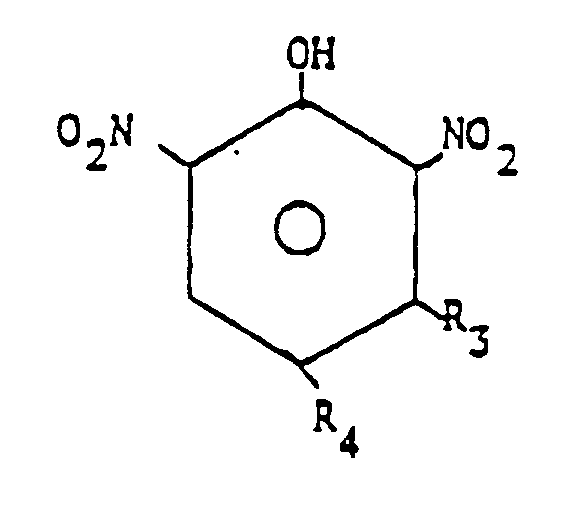
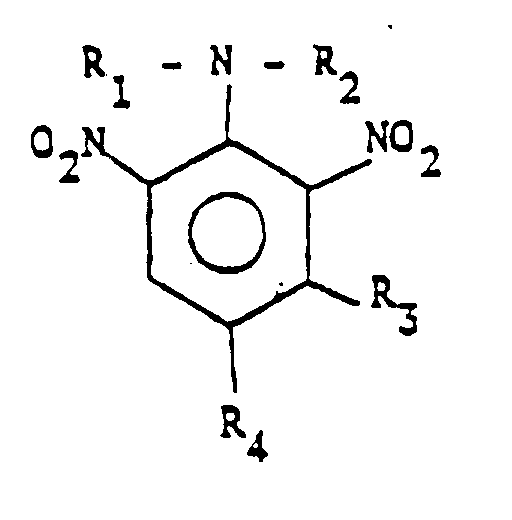 a. ein 3,4-Dialkylphenol nach folgender Formel:selektiv mit Salpetersäure in einem zweiphasigen System unter Ausbildung von 3,4-Dialkyl-2,6-dinitrophenol nach folgender Formel nitriert wird: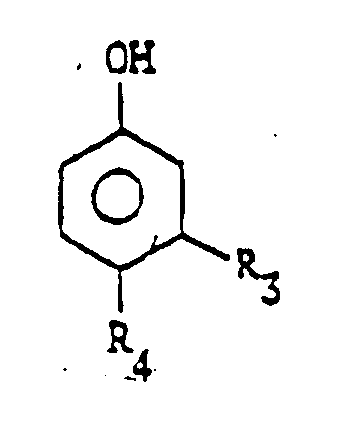
 b. das 3,4-Dialkyl-2,6-dinitrophenol mit einem Alkylierungsmittel in Gegenwart einer Base und einer katalytischen Menge eines Phasentransferkatalysators, der aus der Gruppe gewählt ist, die aus folgendem besteht:einem makrocyclischen Ether und Polyethylenglykolen nach folgender Formel:worin Q gleich N oder P ist; undworin X gleich Cl, Br, I oder HSO4 ist;
in einem organischen Lösungsmittel unter Ausbildung von 3,4-Dialkyl-2,6-dinitroalkoxybenzol nach folgender Formel:worin R5 eine Alkylgruppe mit 1 bis 6 Kohlenstoffatomen ist, alkyliert wird; c. das 3,4-Dialkyl-2,6-dinitroalkoxybenzol in Gegenwart einer katalytischen Menge an Base oder Halogenid mit einem Amin nach folgender Formel:worin R1 und R2 wie oben definiert sind, unter Ausbildung von N-Alkyl-3,4-dialkyl-2,6-dinitroanilin umgesetzt wird;
 d. und dadurch, daß das N-Alkyl-3,4-dialkyl-2,6-dinitroanilin gewonnen wird.
 - Verfahren nach Anspruch 1, wobei das Molverhältnis von Phenol zu Salpetersäure in Schritt I zwischen 1:2 und 1:4, vorzugsweise zwischen 1:2 und 1:2,5 liegt.
- Verfahren nach Anspruch 1 oder 2, wobei das Lösungsmittel in Schritt I aus der Gruppe gewählt ist, die aus Dichlormethan, 1,2-Dichlorethan, 1,1,1-Trichlorethan, Tetrachlorkohlenstoff, Chloroform, Trichlorethylen, Tetrachlorethylen, Chlorbenzol, Dichlorbenzol, Benzol, Dialkylether und Mischungen dieser besteht, wobei das Lösungsmittel vorzugsweise Dichlormethan ist.
- Verfahren nach jedem der Ansprüche 1 bis 3, wobei das Alkylierungsmittel von Schritt II aus der Gruppe gewählt ist, die aus Alkylsulfat, Alkylarylsulfonat oder Alkylhalogeniden besteht, und wobei das Alkylierungsmittel vorzugsweise aus der Gruppe gewählt ist, die aus Dimethylsulfat und Diethylsulfat besteht.
- Verfahren nach jedem der Ansprüche 1 bis 4, wobei der Phasentransferkatalysator in Schritt II ein Alkyl- oder Aralkylammoniumhalogenid ist, das vorzugsweise aus der Gruppe gewählt ist, die aus Didecyldimethylammoniumchlorid, Tricaprylmethylammoniumchlorid und Triethylbenzylammoniumchlorid besteht.
- Verfahren nach jedem der Ansprüche 1 bis 5, wobei das Lösungsmittel in Schritt II aus der Gruppe gewählt ist, die aus Aceton, Methylethylketon, Methylisobutylketon, Cyclohexanon, Cyclopentanon, Dichlormethan, 1,2-Dichlorethan, Methylchloroform, Tetrachlorkohlenstoff, Benzol, Toluol, Xylol, Cyclohexan und Mischungen daraus besteht, wobei das Lösungsmittel vorzugsweise aus der Gruppe gewählt ist, die aus Dichlorethan und Aceton besteht.
- Verfahren nach jedem der Ansprüche 1 bis 6, wobei das Amin in Schritt III ein Monoalkylamin ist.
- Verfahren nach jedem der Ansprüche 1 bis 7, wobei das Molverhältnis des Amins zum Alkoxyybenzolderivat in Schritt III zwischen 2:1 und 6:1 liegt, vorzugsweise zwischen 3:1 und 5:1.
- Verfahren nach jedem der Ansprüche 1 bis 8, wobei der Katalysator in Schritt III aus der Gruppe gewählt ist, die aus Natriumhydroxid, Kaliumhydroxid, Lithiumhydroxid, Calciumchlorid, Bariumbromid und Lithiumchlorid besteht, wobei der Katalysator vorzugsweise aus der Gruppe gewählt ist, die aus Calciumchlorid und Lithiumchlorid besteht.
- Verfahren zur Herstellung von N-Alkyl-3,4-dialkyl-2,6-dinitroanilin nach folgender Formel:worin R1 gleich Wasserstoff oder gleich einer geraden oder verzweigten C1 bis C6 Alkylkettengruppe ist; und worin R2, R3 und R4 unabhängig voneinander gleich einer geraden oder verzweigten C1 bis C6 Alkylkettengruppe sind, die wahlweise mit einer oder mehreren Halogengruppen substituiert ist, dadurch gekennzeichnet, daß
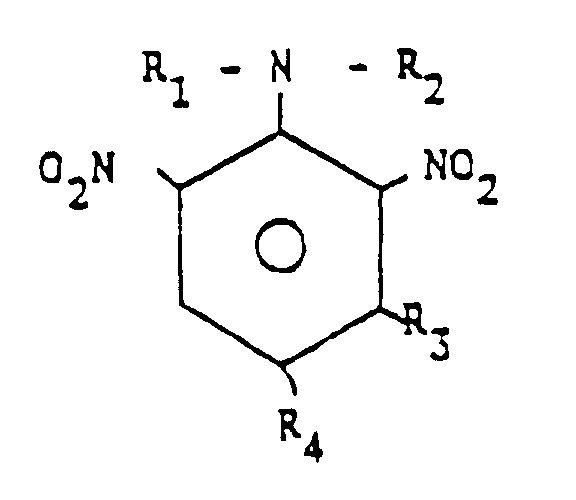 a. ein 3,4-Dialkyl-2,6-dinitrophenol nach folgender Formel:mit einem Alkylierungsmittel in Gegenwart einer Base und einer katalytischen Menge eines Phasentransferkatalysators, der aus der Gruppe gewählt ist, die aus folgendem besteht:
 einem makrocyclischen Ether und Polyethylenglykolen nach folgender Formel:worin Q gleich N oder P ist; undworin X gleich Cl, Br, I oder HSO4 ist;
in einem organischen Lösungsmittel unter Ausbildung von 3,4-Dialkyl-2,6-dinitroalkoxybenzol nach folgender Formel:worin R5 eine Alkylgruppe mit 1 bis 6 Kohlenstoffatomen ist, alkyliert wird;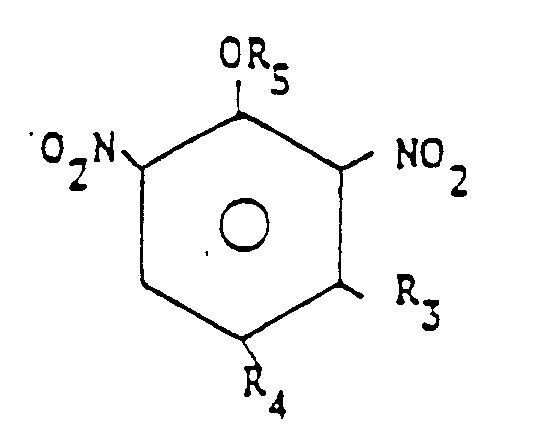 b. das 3,4-Dialkyl-2,6-dinitroalkoxyphenol in Gegenwart einer katalytischen Menge an Base mit einem Amin nach folgender Formel umgesetzt wird:worin R1 und R2 die oben definierte Bedeutung haben, unter Ausbildung von N-Alkyl-3,4-dialkyl-2,6-dinitroanilin; und
 c. und dadurch, daß das N-Alkyl-3,4-dialkyl-2,6-dinitroanilin gewonnen wird.
 - Verfahren nach Anspruch 10, wobei das Alkylierungsmittel in Schritt II aus der Gruppe gewählt ist, die aus Alkylsulfat, Alkylarylsulfonat und Alkylhalogeniden besteht, wobei das Alkylierungsmittel vorzugsweise aus der Gruppe gewählt ist, die aus Dimethylsulfat und Diethylsulfat besteht.
- Verfahren nach jedem der Ansprüche 10 oder 11, wobei der Phasentransferkatalysator in Schritt II ein Alkyl- oder Aralkylammoniumhalogenid ist, das vorzugsweise aus der Gruppe gewählt ist, die aus Didecyldimethylammoniumchlorid, Tricaprylmethylammoniumchlorid und Triethylbenzylammoniumchlorid besteht.
- Verfahren nach jedem der Ansprüche 10 bis 12, wobei das Lösungsmittel in Schritt II aus der Gruppe gewählt ist, die aus Aceton, Methylethylketon, Methylisobutylketon, Cyclohexanon, Cyclopentanon, Dichlormethan, 1,2-Dichlorethan, Methylchloroform, Tetrachlorkohlenstoff, Benzol, Toluol, Xylol, Cyclohexan und Mischungen daraus besteht, wobei das Lösungsmittel vorzugsweise aus der Gruppe gewählt ist, die aus Dichlorethan und Aceton besteht.
- Verfahren nach jedem der Ansprüche 10 bis 13, wobei das Amin in Schritt III ein Monoalkylamin ist.
- Verfahren nach jedem der Ansprüche 10 bis 14, wobei das Molverhältnis von Amin zu Alkoxybenzolderivat in Schritt III zwischen 2:1 und 6:1 liegt, vorzugsweise zwischen 3:1 und 5:1.
- Verfahren nach jedem der Ansprüche 10 bis 15, wobei der Katalysator in Schritt III aus der Gruppe gewählt ist, die aus Natriumhydroxid, Kaliumhydroxid, Lithiumhydroxid, Calciumchlorid, Bariumbromid und Lithiumchlorid besteht, wobei der Katalysator vorzugsweise aus der Gruppe gewählt wird, die aus Calciumchlorid und Lithiumchlorid besteht.
- Verfahren zur Herstellung von Verbindungen nach folgender Formel:worin R3 und R4 unabhängig voneinander gerade oder verzweigte C1 bis C6 Alkylkettengruppen sind, die wahlweise mit einer oder mehreren Halogengruppen substituiert sind, dadurch gekennzeichnet, daß ein 3,4-Dialkylphenol nach folgender Formel:
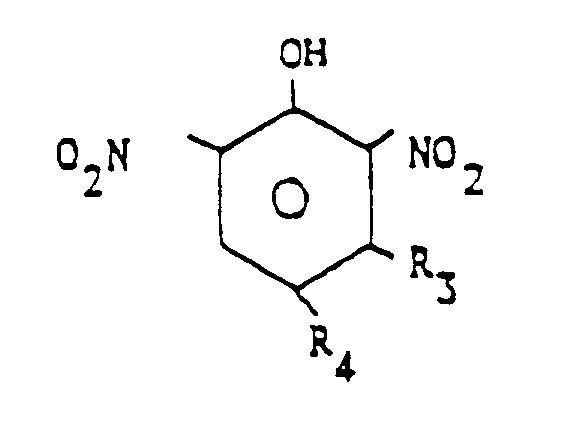 selektiv mit Salpetersäure in einem zweiphasigen System nitriert wird und daß das ausgebildete 3,4-Dialkyl-2,6-dinitrophenol gewonnen wird.
- Verfahren nach Anspruch 17, wobei das Molverhältnis von Phenol zu Salpetersäure zwischen 1:2 und 1:4 liegt, vorzugsweise zwischen 1:2 und 1:2,5.
- Verfahren nach jedem der Ansprüche 17 bis 18, wobei das Lösungsmittel aus der Gruppe gewählt ist, die aus Dichlormethan, 1,2-Dichlorethan, 1,1,1-Trichlorethan, Tetrachlorkohlenstoff, Chloroform, Trichlorethylen, Tetrachlorethylen, Chlorbenzol, Dichlorbenzol, Benzol, Dialkylether und Mischungen daraus besteht, wobei das Lösungsmittel vorzugsweise Dichlormethan ist.
- Verfahren zur Herstellung von Verbindungen nach folgender Formel:worin R3 und R4 unabhängig voneinander gerade oder verzweigte C1 bis C6 Alkylkettengruppen sind, die wahlweise mit einer oder mehreren Halogengruppen substituiert sind, und wobei R5 eine Alkylgruppe ist, die 1 bis 6 Kohlenstoffatome aufweist, vorausgesetzt, daß die Verbindungen, in denen R3 und R5 gleich CH3 sind und R4 gleich -C(CH3)2 oder gleich -C(CH3)3 ist, ausgenommen sind; dadurch gekennzeichnet, daß ein 3,4-Dialkyl-2,6-dinitrophenol nach folgender Formel:
 mit einem Alkylierungsmittel in einem organischen Lösungsmittel in Gegenwart einer Base und einer katalytischen Menge eines Phasentransferkatalysators umgesetzt wird, der aus der Gruppe gewählt ist, die aus folgendem besteht:
 dadurch, daß das gebildete 3,4-Dialkyl-2,6-dinitroalkoxybenzol gewonnen wird.worin R' gleiche oder verschiedene gerade oder verzweigte C1 bis C16 Alkylgruppen, Benzyl oder substituiertes Benzyl sein können;worin Q gleich N oder P ist; undworin X gleich Cl, Br, I oder HSO4 ist;einem makrocyclischen Ether und Polyethylenglykolen nach folgender Formel:worin n gleich einer ganzen Zahl von 10 bis 50 ist; und
 - Verfahren nach Anspruch 20, wobei das Alkylierungsmittel aus der Gruppe gewählt ist, die aus Alkylsulfat, Alkylarylsulfonat oder Alkylhalogeniden besteht, wobei das Alkylierungsmittel vorzugsweise aus der Gruppe gewählt ist, die aus Dimethylsulfat und Diethylsulfat besteht.
- Verfahren nach jedem der Ansprüche 20 oder 21, wobei der Phasentransferkatalysator ein Alkyl- oder Aralkylammoniumhalogenid ist, das vorzugsweise aus der Gruppe gewählt ist, die aus Didecyldimethylammoniumchlorid und Triethylbenzylammoniumchlorid besteht.
- Verfahren nach jedem der Ansprüche 20 bis 22, wobei das Lösungsmittel aus der Gruppe gewählt ist, die aus Aceton, Methylethylketon, Methylisobutylketon, Cyclohexanon, Cyclopentanon, Dichlormethan, 1,2-Dichlorethan, Methylchloroform, Tetrachlorkohlenstoff, Benzol, Toluol, Xylol, Cyclohexan und Mischungen daraus besteht, wobei das Lösungsmittel vorzugsweise aus der Gruppe gewählt ist, die aus Dichlorethan und Aceton besteht.
- Verfahren zur Herstellung von Verbindungen nach folgender Formel:worin R1 gleich Wasserstoff oder gleich einer geraden oder verzweigten C1 bis C6 Alkylkettengruppe ist, die wahlweise mit einer oder mehreren Halogengruppen substituiert ist; und

worin R2, R3 und R4 unabhängig voneinander gerade oder verzweigte C1 bis C6 Alkylkettengruppen sind, die wahlweise mit einer oder mehreren Halogengruppen substituiert sind, dadurch gekennzeichnet, daß ein 3,4-Dialkyl-2,6-dinitroalkoxybenzol nach folgender Formel:worin R5 eine Alkylgruppe mit 1 bis 6 Kohlenstoffatomen ist, in Gegenwart einer katalytischen Menge an Base oder Halogenid mit einem Amin umgesetzt wird, das folgende Formel aufweist: worin R1 und R2 wie oben definiert sind; und dadurch, daß die gebildeten N-Alkyl-3,4-dialkyl-2,6-dinitroaniline gewonnen werden.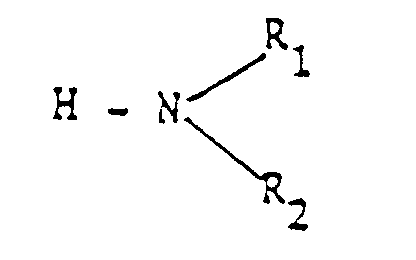
- Verfahren nach Anspruch 24, wobei das Amin ein Monoalkylamin ist.
- Verfahren nach Anspruch 24 oder 25, wobei das Molverhältnis von Amin zu Alkoxyybenzolderivat zwischen 2:1 und 6:1 liegt, vorzugsweise zwischen 3:1 und 5:1.
- Verfahren nach jedem der Ansprüche 24 bis 26, wobei der Katalysator aus der Gruppe gewählt ist, die aus Natriumhydroxid, Kaliumhydroxid, Lithiumhydroxid, Calciumchlorid, Bariumbromid und Lithiumchlorid besteht, wobei der Katalysator vorzugsweise aus der Gruppe gewählt ist, die aus Calciumchlorid und Lithiumchlorid besteht.
- Verbindungen nach folgender Formel:worin R3 und R4 unabhängig voneinander gerade oder verzweigte C1 bis C6 Alkylkettengruppen sind, die wahlweise mit einer oder mehreren Halogengruppen substituiert sind, vorausgesetzt, daß die Verbindungen, in denen R3 und R5 gleich CH3 sind und R4 gleich -C(CH3)2 oder gleich -C(CH3)3 ist, ausgenommen sind; und in denen R5 eine Alkylgruppe mit 1 bis 6 Kohlenstoffatomen ist.
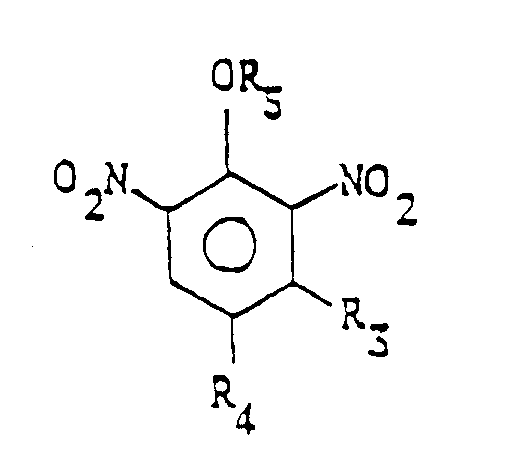
- Verbindungen nach Anspruch 28, worin R3 und R4 Methylgruppen sind, und worin R5 gleich einer Methyl- oder Ethylgruppe ist.
Applications Claiming Priority (2)
| Application Number | Priority Date | Filing Date | Title |
|---|---|---|---|
| IL10611893A IL106118A (en) | 1993-06-24 | 1993-06-24 | Process for preparing n-alkyl-3,4-dialkyl- 2,6-dinitro- anilines and intermediates thereof |
| IL10611893 | 1993-06-24 |
Publications (2)
| Publication Number | Publication Date |
|---|---|
| EP0630883A1 EP0630883A1 (de) | 1994-12-28 |
| EP0630883B1 true EP0630883B1 (de) | 1998-09-16 |
Family
ID=11064979
Family Applications (1)
| Application Number | Title | Priority Date | Filing Date |
|---|---|---|---|
| EP94109725A Expired - Lifetime EP0630883B1 (de) | 1993-06-24 | 1994-06-23 | Neues Verfahren zur Herstellung von N-alkyl-3,4-dialkyl-2,6-dinitronilinen |
Country Status (5)
| Country | Link |
|---|---|
| US (2) | US5475148A (de) |
| EP (1) | EP0630883B1 (de) |
| AT (1) | ATE171160T1 (de) |
| DE (1) | DE69413316T2 (de) |
| IL (1) | IL106118A (de) |
Families Citing this family (12)
| Publication number | Priority date | Publication date | Assignee | Title |
|---|---|---|---|---|
| US5689006A (en) * | 1995-06-29 | 1997-11-18 | Srm Chemical, Ltd. Co. | Process for producing n-alkyl-dinitroalkylanilines |
| FR2765575B1 (fr) * | 1997-07-02 | 1999-12-31 | Francais Prod Ind Cfpi | Procede de preparation des dinitroanilines 3,4-disubstituees |
| DE69802329D1 (de) * | 1997-04-07 | 2001-12-13 | Cfpi Nufarm Gennevilliers | Verfahren zur Herstellung von 3,4 disubstituirten Dinitroanilinen |
| FR2765576B1 (fr) * | 1997-07-02 | 1999-12-31 | Francais Prod Ind Cfpi | Procede de preparation des dinitroanilines 4-substituees |
| FR2761685B1 (fr) * | 1997-04-07 | 1999-06-11 | Francais Prod Ind Cfpi | Procede de preparation des dinitroanilines 4-substituees |
| EP0870755A1 (de) * | 1997-04-07 | 1998-10-14 | Cfpi Agro | Verfahren zur Herstellung von 4-substituierten Nitroanilinen |
| FR2761684B1 (fr) * | 1997-04-07 | 1999-06-11 | Francais Prod Ind Cfpi | Procede de preparation des dinitroanilines 3,4-disubstituees |
| FR2765574B1 (fr) * | 1997-07-02 | 1999-09-03 | Francais Prod Ind Cfpi | Nouveaux alpha-phenoxy-alcanols, leurs procedes de preparation et leurs applications |
| CN101434546B (zh) * | 2008-10-31 | 2012-05-23 | 浙江工业大学 | 一种2,6-二硝基-3,4-二甲苯基烷基醚的合成方法 |
| CN101935282B (zh) * | 2010-08-19 | 2013-08-14 | 合肥星宇化学有限责任公司 | 1,5-二氯-2-异丙-4-硝基苯合成方法 |
| CN109320424B (zh) * | 2017-07-31 | 2021-12-21 | 江苏永安化工有限公司 | 一种二甲戊灵的纯化方法 |
| CN117049967B (zh) * | 2023-07-10 | 2025-12-19 | 西华大学 | 2,6-二硝基-3,4-二甲基苯酚衍生物的制备方法及活性应用 |
Family Cites Families (21)
| Publication number | Priority date | Publication date | Assignee | Title |
|---|---|---|---|---|
| FR6953M (de) * | 1963-10-11 | 1969-05-19 | ||
| BE761850A (fr) * | 1970-01-21 | 1971-07-01 | Sherwin Williams Co | Procede d'amination a plusieurs phases |
| US4066441A (en) * | 1971-08-25 | 1978-01-03 | American Cyanamid Company | Preemergence herbicidal methods and compositions using 2,6-dinitroxylidine compounds |
| US3920742A (en) * | 1971-08-25 | 1975-11-18 | American Cyanamid Co | N-sec-alkyl-2,6-dinitro-3,4-xylidine herbicides |
| US4123250A (en) * | 1972-04-19 | 1978-10-31 | American Cyanamid Company | Inhibiting plant bud growth with substituted 2,6-di-nitroanilines |
| US4136117A (en) * | 1973-06-25 | 1979-01-23 | American Cyanamid Company | Preparation of 2,6-dinitroanilines |
| GB1442514A (en) * | 1973-06-25 | 1976-07-14 | American Cyanamid Co | N-alkyl-3,4-xylidines and their nitration |
| US4261926A (en) * | 1973-06-25 | 1981-04-14 | American Cyanamid Company | Reductive alkylation of substituted anilines |
| US3929916A (en) * | 1974-06-11 | 1975-12-30 | American Cyanamid Co | Process for the mononitration of ortho-xylene |
| US3929917A (en) * | 1974-06-11 | 1975-12-30 | American Cyanamid Co | Process for the mononitration of ortho-xylene |
| GB1539183A (en) * | 1975-07-31 | 1979-01-31 | Ici Ltd | Process for the manufacture of aromatic ethers |
| US4201926A (en) * | 1976-12-20 | 1980-05-06 | Chrysler Corporation | Electronic circuit for use in a variety of engine control systems |
| US4134917A (en) * | 1977-04-25 | 1979-01-16 | American Cyanamid Company | Method for the denitrosation of organic nitrosamines |
| AU519842B2 (en) * | 1978-02-16 | 1981-12-24 | American Cyanamid Company | Mononitro-n-alkyl-3, 4-xylidines |
| US4199669A (en) * | 1978-02-21 | 1980-04-22 | Coin Acceptors, Inc. | Coin-sensing assembly |
| US4391992A (en) * | 1979-08-24 | 1983-07-05 | American Cyanamid Company | N-Denitration of N,2,6-trinitroanilines with phase transfer catalysts |
| US4395572A (en) * | 1979-12-27 | 1983-07-26 | Union Carbide Corporation | Process for preparing N-alkyl-nitroanilines |
| US4621157A (en) * | 1984-05-07 | 1986-11-04 | Jerome A. Gross | Nitration processes |
| FR2584397B1 (fr) * | 1985-07-05 | 1988-02-12 | Rhone Poulenc Spec Chim | Procede de nitration de composes phenoliques |
| IL90704A (en) * | 1989-06-21 | 1994-10-07 | Makhteshim Chem Works Ltd | Method for the preparation of N-N-) 2,4,6-trichlorophenoxy (environmentally reliable ethylene) |
| DE4119664A1 (de) * | 1991-06-14 | 1992-12-17 | Bayer Ag | Verfahren zur herstellung von nitrophenyl-alkylethern |
-
1993
- 1993-06-24 IL IL10611893A patent/IL106118A/xx not_active IP Right Cessation
-
1994
- 1994-06-23 EP EP94109725A patent/EP0630883B1/de not_active Expired - Lifetime
- 1994-06-23 AT AT94109725T patent/ATE171160T1/de not_active IP Right Cessation
- 1994-06-23 US US08/264,450 patent/US5475148A/en not_active Expired - Fee Related
- 1994-06-23 DE DE69413316T patent/DE69413316T2/de not_active Expired - Fee Related
-
1995
- 1995-05-23 US US08/447,964 patent/US5602283A/en not_active Expired - Fee Related
Also Published As
| Publication number | Publication date |
|---|---|
| IL106118A0 (en) | 1993-10-20 |
| ATE171160T1 (de) | 1998-10-15 |
| US5475148A (en) | 1995-12-12 |
| IL106118A (en) | 1997-08-14 |
| DE69413316T2 (de) | 1999-05-06 |
| EP0630883A1 (de) | 1994-12-28 |
| US5602283A (en) | 1997-02-11 |
| DE69413316D1 (de) | 1998-10-22 |
Similar Documents
| Publication | Publication Date | Title |
|---|---|---|
| US5475148A (en) | Process and intermediate to prepare N-alkyl-3,4-dialkyl-2,6-dinitro-anilines | |
| HU195763B (en) | Process for production of derivatives of nitrosubstituated benzotrifluorid | |
| US5028728A (en) | Process for the preparation of reaction products of 2,2-bis-(4-hydroxphenyl)-hexafluoropropane and new derivatives of this type | |
| KR100656728B1 (ko) | 폴리할로겐화 파라트리플루오로메틸아닐린의 제조 방법 | |
| US4316988A (en) | N-Alkyldiphenylamines | |
| DK150471B (da) | Fremgangsmaade til fremstilling af trifluormethylphenoler | |
| RU2671581C1 (ru) | Способ получения динитропроизводных дифениловых и трифениловых эфиров | |
| CA2113973A1 (en) | 2,3-difluoro-6-nitrobenzonitrile and 2-chloro-5, 6-difluorobenzonitrile(2,3-difluoro-6-chlorobenzonitrile), process for their preparation and their use for the preparation of 2,3,6-trifluorobenzoic acid | |
| US4723043A (en) | Nitration of phenolic compounds | |
| US6028226A (en) | Process for 3,4-disubstituted dinitroanilines | |
| US4609759A (en) | Process for preparing amino-2, 4-dinitroaromatic herbicides | |
| US6342630B1 (en) | Chemical process | |
| JPH08337547A (ja) | フェノール樹脂オリゴマーの製造方法 | |
| KR880000203B1 (ko) | 3, 3'-디니트로디페닐에테르의 제조방법 | |
| US5981800A (en) | Preparation process for 4-substituted dinitroanilines | |
| EA012435B1 (ru) | Способ получения анилинов | |
| US7282610B2 (en) | Method of producing aromatic amine compound having alkylthio group | |
| EP1070038B1 (de) | Verfahren zur herstellung von 3-bromanisol und 3-bromnitrobenzol | |
| US20030176722A1 (en) | Process for preparation of 1,5-diaminonaphthalenes | |
| JPH07188132A (ja) | シクロアルキルおよびハロアルキルo−アミノフエニルケトン類の改良された製造方法 | |
| EP0994099B1 (de) | Verfahren zur Herstellung von 4-Cyano-3-nitrobenzotrifluorid aus 3-Brom-4-cyanbenzotrifluorid in Anwesenheit einer katalytischen Menge an Kupfercyanid und eines Phasetransferkatalysators. | |
| US4647700A (en) | Process for the preparation of meta-chloroanilines | |
| KR20010080147A (ko) | 화학적 방법 | |
| EP0477853A1 (de) | Verfahren und neues Zwischenprodukt zur Herstellung von 3,4-Diamino.Diphenyl-Ether | |
| US5274135A (en) | Process for preparing aminobenzocyclobutenes |
Legal Events
| Date | Code | Title | Description |
|---|---|---|---|
| PUAI | Public reference made under article 153(3) epc to a published international application that has entered the european phase |
Free format text: ORIGINAL CODE: 0009012 |
|
| AK | Designated contracting states |
Kind code of ref document: A1 Designated state(s): AT BE CH DE DK ES FR GB GR IE IT LI LU MC NL PT SE |
|
| 17P | Request for examination filed |
Effective date: 19950427 |
|
| 17Q | First examination report despatched |
Effective date: 19970710 |
|
| GRAG | Despatch of communication of intention to grant |
Free format text: ORIGINAL CODE: EPIDOS AGRA |
|
| GRAG | Despatch of communication of intention to grant |
Free format text: ORIGINAL CODE: EPIDOS AGRA |
|
| GRAH | Despatch of communication of intention to grant a patent |
Free format text: ORIGINAL CODE: EPIDOS IGRA |
|
| GRAG | Despatch of communication of intention to grant |
Free format text: ORIGINAL CODE: EPIDOS AGRA |
|
| GRAH | Despatch of communication of intention to grant a patent |
Free format text: ORIGINAL CODE: EPIDOS IGRA |
|
| GRAH | Despatch of communication of intention to grant a patent |
Free format text: ORIGINAL CODE: EPIDOS IGRA |
|
| GRAA | (expected) grant |
Free format text: ORIGINAL CODE: 0009210 |
|
| AK | Designated contracting states |
Kind code of ref document: B1 Designated state(s): AT BE CH DE DK ES FR GB GR IE IT LI LU MC NL PT SE |
|
| PG25 | Lapsed in a contracting state [announced via postgrant information from national office to epo] |
Ref country code: NL Free format text: LAPSE BECAUSE OF FAILURE TO SUBMIT A TRANSLATION OF THE DESCRIPTION OR TO PAY THE FEE WITHIN THE PRESCRIBED TIME-LIMIT Effective date: 19980916 Ref country code: IT Free format text: LAPSE BECAUSE OF FAILURE TO SUBMIT A TRANSLATION OF THE DESCRIPTION OR TO PAY THE FEE WITHIN THE PRE;WARNING: LAPSES OF ITALIAN PATENTS WITH EFFECTIVE DATE BEFORE 2007 MAY HAVE OCCURRED AT ANY TIME BEFORE 2007. THE CORRECT EFFECTIVE DATE MAY BE DIFFERENT FROM THE ONE RECORDED.SCRIBED TIME-LIMIT Effective date: 19980916 Ref country code: GR Free format text: LAPSE BECAUSE OF NON-PAYMENT OF DUE FEES Effective date: 19980916 Ref country code: FR Free format text: LAPSE BECAUSE OF FAILURE TO SUBMIT A TRANSLATION OF THE DESCRIPTION OR TO PAY THE FEE WITHIN THE PRESCRIBED TIME-LIMIT Effective date: 19980916 Ref country code: ES Free format text: THE PATENT HAS BEEN ANNULLED BY A DECISION OF A NATIONAL AUTHORITY Effective date: 19980916 Ref country code: BE Free format text: LAPSE BECAUSE OF FAILURE TO SUBMIT A TRANSLATION OF THE DESCRIPTION OR TO PAY THE FEE WITHIN THE PRESCRIBED TIME-LIMIT Effective date: 19980916 Ref country code: AT Free format text: LAPSE BECAUSE OF FAILURE TO SUBMIT A TRANSLATION OF THE DESCRIPTION OR TO PAY THE FEE WITHIN THE PRESCRIBED TIME-LIMIT Effective date: 19980916 |
|
| REF | Corresponds to: |
Ref document number: 171160 Country of ref document: AT Date of ref document: 19981015 Kind code of ref document: T |
|
| REG | Reference to a national code |
Ref country code: CH Ref legal event code: EP |
|
| REF | Corresponds to: |
Ref document number: 69413316 Country of ref document: DE Date of ref document: 19981022 |
|
| REG | Reference to a national code |
Ref country code: IE Ref legal event code: FG4D |
|
| PG25 | Lapsed in a contracting state [announced via postgrant information from national office to epo] |
Ref country code: SE Free format text: LAPSE BECAUSE OF FAILURE TO SUBMIT A TRANSLATION OF THE DESCRIPTION OR TO PAY THE FEE WITHIN THE PRESCRIBED TIME-LIMIT Effective date: 19981216 Ref country code: DK Free format text: LAPSE BECAUSE OF FAILURE TO SUBMIT A TRANSLATION OF THE DESCRIPTION OR TO PAY THE FEE WITHIN THE PRESCRIBED TIME-LIMIT Effective date: 19981216 |
|
| PG25 | Lapsed in a contracting state [announced via postgrant information from national office to epo] |
Ref country code: PT Free format text: LAPSE BECAUSE OF FAILURE TO SUBMIT A TRANSLATION OF THE DESCRIPTION OR TO PAY THE FEE WITHIN THE PRESCRIBED TIME-LIMIT Effective date: 19981218 |
|
| REG | Reference to a national code |
Ref country code: CH Ref legal event code: NV Representative=s name: A. BRAUN, BRAUN, HERITIER, ESCHMANN AG PATENTANWAE |
|
| EN | Fr: translation not filed | ||
| NLV1 | Nl: lapsed or annulled due to failure to fulfill the requirements of art. 29p and 29m of the patents act | ||
| PGFP | Annual fee paid to national office [announced via postgrant information from national office to epo] |
Ref country code: CH Payment date: 19990601 Year of fee payment: 6 |
|
| PG25 | Lapsed in a contracting state [announced via postgrant information from national office to epo] |
Ref country code: LU Free format text: LAPSE BECAUSE OF NON-PAYMENT OF DUE FEES Effective date: 19990623 Ref country code: IE Free format text: LAPSE BECAUSE OF NON-PAYMENT OF DUE FEES Effective date: 19990623 |
|
| PLBE | No opposition filed within time limit |
Free format text: ORIGINAL CODE: 0009261 |
|
| STAA | Information on the status of an ep patent application or granted ep patent |
Free format text: STATUS: NO OPPOSITION FILED WITHIN TIME LIMIT |
|
| 26N | No opposition filed | ||
| PG25 | Lapsed in a contracting state [announced via postgrant information from national office to epo] |
Ref country code: MC Free format text: LAPSE BECAUSE OF NON-PAYMENT OF DUE FEES Effective date: 19991231 |
|
| REG | Reference to a national code |
Ref country code: IE Ref legal event code: MM4A |
|
| PG25 | Lapsed in a contracting state [announced via postgrant information from national office to epo] |
Ref country code: LI Free format text: LAPSE BECAUSE OF NON-PAYMENT OF DUE FEES Effective date: 20000630 Ref country code: CH Free format text: LAPSE BECAUSE OF NON-PAYMENT OF DUE FEES Effective date: 20000630 |
|
| REG | Reference to a national code |
Ref country code: CH Ref legal event code: PL |
|
| REG | Reference to a national code |
Ref country code: GB Ref legal event code: IF02 |
|
| PGFP | Annual fee paid to national office [announced via postgrant information from national office to epo] |
Ref country code: DE Payment date: 20021227 Year of fee payment: 9 |
|
| PGFP | Annual fee paid to national office [announced via postgrant information from national office to epo] |
Ref country code: GB Payment date: 20030618 Year of fee payment: 10 |
|
| PG25 | Lapsed in a contracting state [announced via postgrant information from national office to epo] |
Ref country code: DE Free format text: LAPSE BECAUSE OF NON-PAYMENT OF DUE FEES Effective date: 20040101 |
|
| PG25 | Lapsed in a contracting state [announced via postgrant information from national office to epo] |
Ref country code: GB Free format text: LAPSE BECAUSE OF NON-PAYMENT OF DUE FEES Effective date: 20040623 |
|
| GBPC | Gb: european patent ceased through non-payment of renewal fee |
Effective date: 20040623 |