EP0630892A1 - Chirale Verbindungen - Google Patents
Chirale Verbindungen Download PDFInfo
- Publication number
- EP0630892A1 EP0630892A1 EP94107420A EP94107420A EP0630892A1 EP 0630892 A1 EP0630892 A1 EP 0630892A1 EP 94107420 A EP94107420 A EP 94107420A EP 94107420 A EP94107420 A EP 94107420A EP 0630892 A1 EP0630892 A1 EP 0630892A1
- Authority
- EP
- European Patent Office
- Prior art keywords
- compounds according
- bromine
- chlorine
- fluorine
- cyano
- Prior art date
- Legal status (The legal status is an assumption and is not a legal conclusion. Google has not performed a legal analysis and makes no representation as to the accuracy of the status listed.)
- Granted
Links
- 150000001875 compounds Chemical class 0.000 title claims abstract description 22
- 229910052794 bromium Inorganic materials 0.000 claims abstract description 12
- 239000000460 chlorine Chemical group 0.000 claims abstract description 12
- 229910052801 chlorine Inorganic materials 0.000 claims abstract description 12
- WKBOTKDWSSQWDR-UHFFFAOYSA-N Bromine atom Chemical group [Br] WKBOTKDWSSQWDR-UHFFFAOYSA-N 0.000 claims abstract description 11
- ZAMOUSCENKQFHK-UHFFFAOYSA-N Chlorine atom Chemical group [Cl] ZAMOUSCENKQFHK-UHFFFAOYSA-N 0.000 claims abstract description 11
- GDTBXPJZTBHREO-UHFFFAOYSA-N bromine Chemical group BrBr GDTBXPJZTBHREO-UHFFFAOYSA-N 0.000 claims abstract description 11
- 239000011737 fluorine Substances 0.000 claims abstract description 10
- 229910052731 fluorine Inorganic materials 0.000 claims abstract description 10
- 125000002887 hydroxy group Chemical group [H]O* 0.000 claims abstract description 9
- 125000004093 cyano group Chemical group *C#N 0.000 claims abstract description 7
- 125000001153 fluoro group Chemical group F* 0.000 claims abstract description 6
- 229910052757 nitrogen Inorganic materials 0.000 claims abstract description 6
- 125000001997 phenyl group Chemical group [H]C1=C([H])C([H])=C(*)C([H])=C1[H] 0.000 claims abstract description 5
- 229910052760 oxygen Inorganic materials 0.000 claims abstract description 4
- 238000003860 storage Methods 0.000 claims abstract description 4
- 229910052717 sulfur Inorganic materials 0.000 claims abstract description 4
- 230000003287 optical effect Effects 0.000 claims abstract description 3
- 230000005693 optoelectronics Effects 0.000 claims abstract description 3
- 238000002360 preparation method Methods 0.000 claims description 13
- 229910052739 hydrogen Inorganic materials 0.000 claims description 6
- UFHFLCQGNIYNRP-UHFFFAOYSA-N Hydrogen Chemical compound [H][H] UFHFLCQGNIYNRP-UHFFFAOYSA-N 0.000 claims description 5
- 239000001257 hydrogen Substances 0.000 claims description 5
- PXGOKWXKJXAPGV-UHFFFAOYSA-N Fluorine Chemical compound FF PXGOKWXKJXAPGV-UHFFFAOYSA-N 0.000 claims description 4
- 125000006850 spacer group Chemical group 0.000 claims description 4
- 238000004519 manufacturing process Methods 0.000 claims description 3
- 125000000217 alkyl group Chemical group 0.000 claims description 2
- 125000000391 vinyl group Chemical group [H]C([*])=C([H])[H] 0.000 claims description 2
- 125000004453 alkoxycarbonyl group Chemical group 0.000 claims 1
- 239000002019 doping agent Substances 0.000 claims 1
- 229920002554 vinyl polymer Polymers 0.000 claims 1
- HEDRZPFGACZZDS-UHFFFAOYSA-N Chloroform Chemical compound ClC(Cl)Cl HEDRZPFGACZZDS-UHFFFAOYSA-N 0.000 description 36
- YMWUJEATGCHHMB-UHFFFAOYSA-N Dichloromethane Chemical compound ClCCl YMWUJEATGCHHMB-UHFFFAOYSA-N 0.000 description 26
- XEKOWRVHYACXOJ-UHFFFAOYSA-N Ethyl acetate Chemical compound CCOC(C)=O XEKOWRVHYACXOJ-UHFFFAOYSA-N 0.000 description 25
- 239000000243 solution Substances 0.000 description 21
- 239000000203 mixture Substances 0.000 description 20
- OKKJLVBELUTLKV-UHFFFAOYSA-N Methanol Chemical compound OC OKKJLVBELUTLKV-UHFFFAOYSA-N 0.000 description 18
- YXFVVABEGXRONW-UHFFFAOYSA-N Toluene Chemical compound CC1=CC=CC=C1 YXFVVABEGXRONW-UHFFFAOYSA-N 0.000 description 18
- QTBSBXVTEAMEQO-UHFFFAOYSA-N Acetic acid Chemical compound CC(O)=O QTBSBXVTEAMEQO-UHFFFAOYSA-N 0.000 description 17
- RTZKZFJDLAIYFH-UHFFFAOYSA-N Diethyl ether Chemical compound CCOCC RTZKZFJDLAIYFH-UHFFFAOYSA-N 0.000 description 16
- 125000002496 methyl group Chemical group [H]C([H])([H])* 0.000 description 15
- 239000000047 product Substances 0.000 description 12
- ZMXDDKWLCZADIW-UHFFFAOYSA-N N,N-Dimethylformamide Chemical compound CN(C)C=O ZMXDDKWLCZADIW-UHFFFAOYSA-N 0.000 description 11
- JUJWROOIHBZHMG-UHFFFAOYSA-N Pyridine Chemical compound C1=CC=NC=C1 JUJWROOIHBZHMG-UHFFFAOYSA-N 0.000 description 10
- LFQSCWFLJHTTHZ-UHFFFAOYSA-N Ethanol Chemical compound CCO LFQSCWFLJHTTHZ-UHFFFAOYSA-N 0.000 description 9
- 238000004440 column chromatography Methods 0.000 description 9
- 238000006243 chemical reaction Methods 0.000 description 8
- FYSNRJHAOHDILO-UHFFFAOYSA-N thionyl chloride Chemical compound ClS(Cl)=O FYSNRJHAOHDILO-UHFFFAOYSA-N 0.000 description 8
- 239000002904 solvent Substances 0.000 description 7
- NGNBDVOYPDDBFK-UHFFFAOYSA-N 2-[2,4-di(pentan-2-yl)phenoxy]acetyl chloride Chemical compound CCCC(C)C1=CC=C(OCC(Cl)=O)C(C(C)CCC)=C1 NGNBDVOYPDDBFK-UHFFFAOYSA-N 0.000 description 6
- HEDRZPFGACZZDS-MICDWDOJSA-N Trichloro(2H)methane Chemical compound [2H]C(Cl)(Cl)Cl HEDRZPFGACZZDS-MICDWDOJSA-N 0.000 description 6
- OWKCFBYWQGPLSJ-RKDXNWHRSA-N [(3r,4r)-4-acetyloxy-3,4-dihydro-2h-pyran-3-yl] acetate Chemical compound CC(=O)O[C@@H]1COC=C[C@H]1OC(C)=O OWKCFBYWQGPLSJ-RKDXNWHRSA-N 0.000 description 6
- KDLHZDBZIXYQEI-UHFFFAOYSA-N Palladium Chemical compound [Pd] KDLHZDBZIXYQEI-UHFFFAOYSA-N 0.000 description 5
- 239000003208 petroleum Substances 0.000 description 5
- KDPNMYOJGHHPSY-JQWIXIFHSA-N (3s,6s)-6-(4-methoxyphenyl)oxan-3-ol Chemical compound C1=CC(OC)=CC=C1[C@H]1OC[C@@H](O)CC1 KDPNMYOJGHHPSY-JQWIXIFHSA-N 0.000 description 4
- CSCPPACGZOOCGX-UHFFFAOYSA-N Acetone Chemical compound CC(C)=O CSCPPACGZOOCGX-UHFFFAOYSA-N 0.000 description 4
- WEVYAHXRMPXWCK-UHFFFAOYSA-N Acetonitrile Chemical compound CC#N WEVYAHXRMPXWCK-UHFFFAOYSA-N 0.000 description 4
- UIIMBOGNXHQVGW-UHFFFAOYSA-M Sodium bicarbonate Chemical compound [Na+].OC([O-])=O UIIMBOGNXHQVGW-UHFFFAOYSA-M 0.000 description 4
- WQDUMFSSJAZKTM-UHFFFAOYSA-N Sodium methoxide Chemical compound [Na+].[O-]C WQDUMFSSJAZKTM-UHFFFAOYSA-N 0.000 description 4
- HCHKCACWOHOZIP-UHFFFAOYSA-N Zinc Chemical compound [Zn] HCHKCACWOHOZIP-UHFFFAOYSA-N 0.000 description 4
- NTTJWAQQVIEJDC-KBPBESRZSA-N [(3s,6s)-6-(4-methoxyphenyl)oxan-3-yl] acetate Chemical compound C1=CC(OC)=CC=C1[C@H]1OC[C@@H](OC(C)=O)CC1 NTTJWAQQVIEJDC-KBPBESRZSA-N 0.000 description 4
- 229960000583 acetic acid Drugs 0.000 description 4
- 239000002178 crystalline material Substances 0.000 description 4
- UMJSCPRVCHMLSP-UHFFFAOYSA-N pyridine Natural products COC1=CC=CN=C1 UMJSCPRVCHMLSP-UHFFFAOYSA-N 0.000 description 4
- 239000006188 syrup Substances 0.000 description 4
- 235000020357 syrup Nutrition 0.000 description 4
- 238000005160 1H NMR spectroscopy Methods 0.000 description 3
- VHYFNPMBLIVWCW-UHFFFAOYSA-N 4-Dimethylaminopyridine Chemical compound CN(C)C1=CC=NC=C1 VHYFNPMBLIVWCW-UHFFFAOYSA-N 0.000 description 3
- PZASAAIJIFDWSB-CKPDSHCKSA-N 8-[(1S)-1-[8-(trifluoromethyl)-7-[4-(trifluoromethyl)cyclohexyl]oxynaphthalen-2-yl]ethyl]-8-azabicyclo[3.2.1]octane-3-carboxylic acid Chemical compound FC(F)(F)C=1C2=CC([C@@H](N3C4CCC3CC(C4)C(O)=O)C)=CC=C2C=CC=1OC1CCC(C(F)(F)F)CC1 PZASAAIJIFDWSB-CKPDSHCKSA-N 0.000 description 3
- WFDIJRYMOXRFFG-UHFFFAOYSA-N Acetic anhydride Chemical compound CC(=O)OC(C)=O WFDIJRYMOXRFFG-UHFFFAOYSA-N 0.000 description 3
- CPELXLSAUQHCOX-UHFFFAOYSA-N Hydrogen bromide Chemical compound Br CPELXLSAUQHCOX-UHFFFAOYSA-N 0.000 description 3
- OKTJSMMVPCPJKN-UHFFFAOYSA-N activated carbon Substances [C] OKTJSMMVPCPJKN-UHFFFAOYSA-N 0.000 description 3
- 239000003054 catalyst Substances 0.000 description 3
- 239000003480 eluent Substances 0.000 description 3
- 238000002844 melting Methods 0.000 description 3
- 230000008018 melting Effects 0.000 description 3
- 230000010287 polarization Effects 0.000 description 3
- 230000002269 spontaneous effect Effects 0.000 description 3
- 230000007704 transition Effects 0.000 description 3
- XLYOFNOQVPJJNP-UHFFFAOYSA-N water Chemical compound O XLYOFNOQVPJJNP-UHFFFAOYSA-N 0.000 description 3
- 0 COC(B1)COC1*I Chemical compound COC(B1)COC1*I 0.000 description 2
- CURLTUGMZLYLDI-UHFFFAOYSA-N Carbon dioxide Chemical compound O=C=O CURLTUGMZLYLDI-UHFFFAOYSA-N 0.000 description 2
- WSFSSNUMVMOOMR-UHFFFAOYSA-N Formaldehyde Chemical compound O=C WSFSSNUMVMOOMR-UHFFFAOYSA-N 0.000 description 2
- 238000005481 NMR spectroscopy Methods 0.000 description 2
- WPYMKLBDIGXBTP-UHFFFAOYSA-N benzoic acid Chemical compound OC(=O)C1=CC=CC=C1 WPYMKLBDIGXBTP-UHFFFAOYSA-N 0.000 description 2
- 238000001816 cooling Methods 0.000 description 2
- 229960004132 diethyl ether Drugs 0.000 description 2
- 238000001914 filtration Methods 0.000 description 2
- 235000019256 formaldehyde Nutrition 0.000 description 2
- 238000005984 hydrogenation reaction Methods 0.000 description 2
- 150000002500 ions Chemical class 0.000 description 2
- 239000000463 material Substances 0.000 description 2
- PSHKMPUSSFXUIA-UHFFFAOYSA-N n,n-dimethylpyridin-2-amine Chemical compound CN(C)C1=CC=CC=N1 PSHKMPUSSFXUIA-UHFFFAOYSA-N 0.000 description 2
- 238000000655 nuclear magnetic resonance spectrum Methods 0.000 description 2
- 229910052763 palladium Inorganic materials 0.000 description 2
- 229920000642 polymer Polymers 0.000 description 2
- -1 polysiloxanes Polymers 0.000 description 2
- BWHMMNNQKKPAPP-UHFFFAOYSA-L potassium carbonate Chemical compound [K+].[K+].[O-]C([O-])=O BWHMMNNQKKPAPP-UHFFFAOYSA-L 0.000 description 2
- 230000035484 reaction time Effects 0.000 description 2
- 239000007787 solid Substances 0.000 description 2
- 239000000126 substance Substances 0.000 description 2
- 238000004809 thin layer chromatography Methods 0.000 description 2
- LEIMLDGFXIOXMT-UHFFFAOYSA-N trimethylsilyl cyanide Chemical compound C[Si](C)(C)C#N LEIMLDGFXIOXMT-UHFFFAOYSA-N 0.000 description 2
- 239000011701 zinc Substances 0.000 description 2
- 229910052725 zinc Inorganic materials 0.000 description 2
- SCYULBFZEHDVBN-UHFFFAOYSA-N 1,1-Dichloroethane Chemical compound CC(Cl)Cl SCYULBFZEHDVBN-UHFFFAOYSA-N 0.000 description 1
- 125000001140 1,4-phenylene group Chemical group [H]C1=C([H])C([*:2])=C([H])C([H])=C1[*:1] 0.000 description 1
- BDKLKNJTMLIAFE-UHFFFAOYSA-N 2-(3-fluorophenyl)-1,3-oxazole-4-carbaldehyde Chemical compound FC1=CC=CC(C=2OC=C(C=O)N=2)=C1 BDKLKNJTMLIAFE-UHFFFAOYSA-N 0.000 description 1
- HPZPFOIOJPBNKK-UHFFFAOYSA-N 4-(4-dodecoxyphenyl)benzoic acid Chemical group C1=CC(OCCCCCCCCCCCC)=CC=C1C1=CC=C(C(O)=O)C=C1 HPZPFOIOJPBNKK-UHFFFAOYSA-N 0.000 description 1
- NLXLAEXVIDQMFP-UHFFFAOYSA-N Ammonium chloride Substances [NH4+].[Cl-] NLXLAEXVIDQMFP-UHFFFAOYSA-N 0.000 description 1
- ZOXJGFHDIHLPTG-UHFFFAOYSA-N Boron Chemical compound [B] ZOXJGFHDIHLPTG-UHFFFAOYSA-N 0.000 description 1
- 229930182476 C-glycoside Natural products 0.000 description 1
- 150000000700 C-glycosides Chemical class 0.000 description 1
- VYPSYNLAJGMNEJ-UHFFFAOYSA-N Silicium dioxide Chemical compound O=[Si]=O VYPSYNLAJGMNEJ-UHFFFAOYSA-N 0.000 description 1
- 239000004990 Smectic liquid crystal Substances 0.000 description 1
- 229910021627 Tin(IV) chloride Inorganic materials 0.000 description 1
- ZYPMNZKYVVSXOJ-YNEHKIRRSA-N [(2r,3s,4r)-2,3,4-triacetyloxy-5-oxopentyl] acetate Chemical compound CC(=O)OC[C@@H](OC(C)=O)[C@H](OC(C)=O)[C@@H](OC(C)=O)C=O ZYPMNZKYVVSXOJ-YNEHKIRRSA-N 0.000 description 1
- 239000002253 acid Substances 0.000 description 1
- NIXOWILDQLNWCW-UHFFFAOYSA-N acrylic acid group Chemical group C(C=C)(=O)O NIXOWILDQLNWCW-UHFFFAOYSA-N 0.000 description 1
- 235000011114 ammonium hydroxide Nutrition 0.000 description 1
- 125000000129 anionic group Chemical group 0.000 description 1
- 125000003118 aryl group Chemical group 0.000 description 1
- CBHOOMGKXCMKIR-UHFFFAOYSA-N azane;methanol Chemical compound N.OC CBHOOMGKXCMKIR-UHFFFAOYSA-N 0.000 description 1
- 230000015572 biosynthetic process Effects 0.000 description 1
- 229910052796 boron Inorganic materials 0.000 description 1
- 125000004432 carbon atom Chemical group C* 0.000 description 1
- 239000001569 carbon dioxide Substances 0.000 description 1
- 229910002092 carbon dioxide Inorganic materials 0.000 description 1
- 230000003098 cholesteric effect Effects 0.000 description 1
- 238000010276 construction Methods 0.000 description 1
- IJKVHSBPTUYDLN-UHFFFAOYSA-N dihydroxy(oxo)silane Chemical compound O[Si](O)=O IJKVHSBPTUYDLN-UHFFFAOYSA-N 0.000 description 1
- 230000005684 electric field Effects 0.000 description 1
- 150000002148 esters Chemical class 0.000 description 1
- 125000001495 ethyl group Chemical group [H]C([H])([H])C([H])([H])* 0.000 description 1
- 239000000706 filtrate Substances 0.000 description 1
- 239000012362 glacial acetic acid Substances 0.000 description 1
- 239000011521 glass Substances 0.000 description 1
- 238000010438 heat treatment Methods 0.000 description 1
- 150000002431 hydrogen Chemical class 0.000 description 1
- 229910000042 hydrogen bromide Inorganic materials 0.000 description 1
- 235000021190 leftovers Nutrition 0.000 description 1
- 238000000034 method Methods 0.000 description 1
- 239000000178 monomer Substances 0.000 description 1
- 239000012434 nucleophilic reagent Substances 0.000 description 1
- 229920000058 polyacrylate Polymers 0.000 description 1
- 229920001296 polysiloxane Polymers 0.000 description 1
- 229910000027 potassium carbonate Inorganic materials 0.000 description 1
- 235000017281 sodium acetate Nutrition 0.000 description 1
- 229940087562 sodium acetate trihydrate Drugs 0.000 description 1
- 229910000030 sodium bicarbonate Inorganic materials 0.000 description 1
- 235000017557 sodium bicarbonate Nutrition 0.000 description 1
- 238000003756 stirring Methods 0.000 description 1
- 238000003786 synthesis reaction Methods 0.000 description 1
- HPGGPRDJHPYFRM-UHFFFAOYSA-J tin(iv) chloride Chemical compound Cl[Sn](Cl)(Cl)Cl HPGGPRDJHPYFRM-UHFFFAOYSA-J 0.000 description 1
Classifications
-
- C—CHEMISTRY; METALLURGY
- C07—ORGANIC CHEMISTRY
- C07D—HETEROCYCLIC COMPOUNDS
- C07D405/00—Heterocyclic compounds containing both one or more hetero rings having oxygen atoms as the only ring hetero atoms, and one or more rings having nitrogen as the only ring hetero atom
- C07D405/02—Heterocyclic compounds containing both one or more hetero rings having oxygen atoms as the only ring hetero atoms, and one or more rings having nitrogen as the only ring hetero atom containing two hetero rings
- C07D405/12—Heterocyclic compounds containing both one or more hetero rings having oxygen atoms as the only ring hetero atoms, and one or more rings having nitrogen as the only ring hetero atom containing two hetero rings linked by a chain containing hetero atoms as chain links
-
- C—CHEMISTRY; METALLURGY
- C07—ORGANIC CHEMISTRY
- C07D—HETEROCYCLIC COMPOUNDS
- C07D309/00—Heterocyclic compounds containing six-membered rings having one oxygen atom as the only ring hetero atom, not condensed with other rings
- C07D309/02—Heterocyclic compounds containing six-membered rings having one oxygen atom as the only ring hetero atom, not condensed with other rings having no double bonds between ring members or between ring members and non-ring members
- C07D309/08—Heterocyclic compounds containing six-membered rings having one oxygen atom as the only ring hetero atom, not condensed with other rings having no double bonds between ring members or between ring members and non-ring members with hetero atoms or with carbon atoms having three bonds to hetero atoms with at the most one bond to halogen, e.g. ester or nitrile radicals, directly attached to ring carbon atoms
- C07D309/10—Oxygen atoms
-
- C—CHEMISTRY; METALLURGY
- C07—ORGANIC CHEMISTRY
- C07D—HETEROCYCLIC COMPOUNDS
- C07D309/00—Heterocyclic compounds containing six-membered rings having one oxygen atom as the only ring hetero atom, not condensed with other rings
- C07D309/16—Heterocyclic compounds containing six-membered rings having one oxygen atom as the only ring hetero atom, not condensed with other rings having one double bond between ring members or between a ring member and a non-ring member
- C07D309/28—Heterocyclic compounds containing six-membered rings having one oxygen atom as the only ring hetero atom, not condensed with other rings having one double bond between ring members or between a ring member and a non-ring member with hetero atoms or with carbon atoms having three bonds to hetero atoms with at the most one bond to halogen, e.g. ester or nitrile radicals, directly attached to ring carbon atoms
-
- C—CHEMISTRY; METALLURGY
- C09—DYES; PAINTS; POLISHES; NATURAL RESINS; ADHESIVES; COMPOSITIONS NOT OTHERWISE PROVIDED FOR; APPLICATIONS OF MATERIALS NOT OTHERWISE PROVIDED FOR
- C09K—MATERIALS FOR MISCELLANEOUS APPLICATIONS, NOT PROVIDED FOR ELSEWHERE
- C09K19/00—Liquid crystal materials
- C09K19/04—Liquid crystal materials characterised by the chemical structure of the liquid crystal components, e.g. by a specific unit
- C09K19/0403—Liquid crystal materials characterised by the chemical structure of the liquid crystal components, e.g. by a specific unit the structure containing one or more specific, optionally substituted ring or ring systems
- C09K2019/0414—Liquid crystal materials characterised by the chemical structure of the liquid crystal components, e.g. by a specific unit the structure containing one or more specific, optionally substituted ring or ring systems containing a heterocyclic ring
Definitions
- Chiral, smectically liquid-crystalline materials which solidify glassy upon cooling from the liquid-crystalline phase to form a layer structure, are known to be used for many purposes in the electro-optical field.
- Examples include optical storage systems (DE-A-38 27 603 and DE-A-39 17 196), electrophotography (DE-A-39 30 667), liquid-crystalline display elements such as displays (Mol. Cryst. Liq. Cryst. , 114 , 151 (1990)) as well as electrical storage systems (Ferroelectrics, 104 , 241 (1990)) if the ferroelectric behavior is present at the same time.
- S c * phases In the layer structure of ferroelectric S c * phases, the longitudinal axes of the molecules within the individual layer are inclined with respect to the layer normal z. The direction of this inclination is specified by the director n, the angle between z and n is the so-called tilt angle ⁇ . S c * phases have two stable states with different directions of n, between which can be switched by applying an electric field (electro-optical effect).
- S c * phases occur in low molecular weight, liquid-crystalline materials, in oligomesogens and in polymer ferrolelectric materials, the essential properties of the S c * phases being the same.
- liquid-crystalline materials hitherto produced have disadvantages, for example low spontaneous polarization, small phase width, no stable, tilted smectic glass at room temperature or switching too slowly.
- the structure and special function of the chiral group in particular are of crucial importance for the occurrence of spontaneous polarization.
- the present invention has for its object to search for chiral groups for liquid-crystalline materials that interfere with the liquid-crystalline properties as little as possible, at the same time induce high spontaneous polarizations and are synthetically available.
- the invention therefore relates to compounds containing chiral radicals of the general formula I. in the B a single or double bond and R1 optionally substituted by fluorine, chlorine, bromine, cyano or hydroxy and optionally interrupted by O, S, NH, N (CH3), COO or OCO-C1 to C30 alkyl, optionally by fluorine , Chlorine, bromine, cyan, C1- to C20-alkyl, C1- to C20-alkoxy or C1- to C20-alkoxycarbonyl substituted phenyl or fluorine, chlorine, bromine or cyan and their use.
- the invention further relates to the production of polymers and oligomesogens from the monomers of the general formula I when X or is hydroxy, where R2 is methyl, chlorine, bromine, CN or preferably hydrogen, and their use for the construction of recording layers for laser-optical and electrical Recording elements, in electrophotography, for generating latent charge images, for building up or as a component of liquid-crystalline display elements and as colored reflectors.
- the molecular part X in low molecular weight ferroelectric materials is preferably hydrogen.
- X is preferably a hydroxyl or a vinyl group.
- an acrylic acid residue optionally substituted in the ⁇ -position by Cl, Br, CN or methyl is preferred for X.
- the molecular part A is preferably a C1- to C30-alkyl radical optionally substituted by fluorine, chlorine, bromine, cyano or hydroxy, in which every third C atom may be O, S, NH, N (CH3), OCO or COO can be replaced.
- Examples of particularly preferred radicals of the formula III are: Examples of the rest of the formula are the following groups: as well as the same residues with a single bond instead of the double bond.
- the compounds according to the invention are prepared by methods known per se (see, for example, DE-A-39 17 186 or Mol. Cryst. Liq. Cryst: 191 , 231 (1991)), in the following it is explained using an example which can be generalized.
- phase transition temperatures were determined with a Leitz polarizing microscope (Ortholux II pol) in connection with a Mettler microscope heating table (Mettler FP 800/84).
- Example 14 C8H17-Py-Ph-COO-THP- (CH2) 2CH3 K 70.9 S A 67.8 Ch 85.1 I
- Example 15 C10H21O-Ph-Ph-COO-THP- (CH2) 4CH3 K 123.7 S X 151.1
- Example 16 C8H17-Py-Ph-COO-THP- (CH2) 4CH3 K 75.8 S C * 96.8 S A 97.9 Ch 177.8 I
- Example 17 C10H21O-Ph-COO-Ph-COO-THP- (CH2) 3CH3 K 125.3 S A 151.7
- Example 18 C10H21O-Ph-Ph-COO-THP- (CH2) 5CH3 K 99.8 S C * 89.1 S A 134.6 Ch 136.1
- Example 19 C8H17-Py-Ph-COO-THP- (CH2) 5CH3 K 73.2 S A 95.0 Ch 10
Landscapes
- Chemical & Material Sciences (AREA)
- Organic Chemistry (AREA)
- Organic Low-Molecular-Weight Compounds And Preparation Thereof (AREA)
- Control And Other Processes For Unpacking Of Materials (AREA)
- Mechanical Coupling Of Light Guides (AREA)
- Pyrane Compounds (AREA)
- Liquid Crystal Substances (AREA)
Abstract

in der B eine Einfach- oder Doppelbindung und R¹ gegebenenfalls durch Fluor, Chlor, Brom, Cyan oder Hydroxy substituiertes und gegebenenfalls durch O, S, NH, N(CH₃), COO oder OCO unterbrochenes C₁- bis C₃₀-Alkyl, gegebenenfalls durch Fluor, Chlor, Brom, Cyan, C₁- bis C₂₀-Alkyl, C₁- bis C₂₀-Alkoxy oder C₁- bis C₂₀-Alkoxycarbonyl substituiertes Phenyl oder Fluor, Chlor, Brom oder Cyan sind.
Description
- Chirale, smektisch flüssigkristalline Materialien, die beim Abkühlen aus der flüssigkristallinen Phase glasartig unter Ausbildung einer Schichtstruktur erstarren, werden bekanntermaßen auf elektrooptischem Gebiet für viele Zwecke eingesetzt. Zu nennen sind hier beispielsweise optische Speichersysteme (DE-A-38 27 603 und DE-A-39 17 196), die Elektrophotografie (DE-A-39 30 667), flüssigkristalline Anzeigeelemente wie Displays (Mol. Cryst. Liq. Cryst., 114, 151 (1990)) sowie bei gleichzeitig vorliegendem ferroelektrischem Verhalten elektrische Speichersysteme (Ferroelectrics, 104, 241(1990)).
- In der Schichtstruktur ferroelektrischer Sc*-Phasen sind die Moleküllängsachsen innerhalb der einzelnen Schicht gegenüber der Schichtnormalen z geneigt. Die Richtung dieser Neigung wird durch den Direktor n angegeben, der Winkel zwischen z und n ist der sogenannte Tiltwinkel Θ. Sc*-Phasen weisen zwei stabile Zustände mit unterschiedlicher Richtung von n auf, zwischen denen durch Anlegen eines elektrischen Feldes geschaltet werden kann (elektrooptischer Effekt).
- Sc*-Phasen treten bei niedermolekularen, flüssigkristallinen Materialien, bei Oligomesogenen und bei polymer ferrolelektrischen Materialien auf, wobei die wesentlichen Eigenschaften der Sc*-Phasen übereinstimmen.
- Die bislang hergestellten flüssigkristallinen Materialien weisen jedoch Nachteile auf, zum Beispiel geringe spontane Polarisation, geringe Phasenbreite, kein stabiles, getiltet smektisches Glas bei Raumtemperatur oder zu langsames Schalten.
- Das Auftreten der flüssigkristallinen Sc*-Phase wird durch alle Gruppen des Moleküls, d.h. Spacer A, mesogene Gruppe M und die chirale Gruppe in erheblichem Ausmaß beeinflußt, sodaß kleinste Änderungen der molekularen Struktur Sc*-Phasen induzieren oder auch zum Verschwinden bringen können.
- Speziell die chirale Gruppe ist durch ihre Struktur und spezielle Funktion für das Zustandekommen einer spontanen Polarisation von entscheidender Bedeutung.
- Der vorliegenden Erfindung liegt die Aufgabe zugrunde, chirale Gruppen für flüssigkristalline Materialien zu suchen, die die flüssigkristallinen Eigenschaften möglichst wenig stören, gleichzeitig hohe spontane Polarisationen induzieren und synthetisch verfügbar sind.
- Die Erfindung betrifft daher Verbindungen enthaltend chirale Reste der allgemeinen Formel I

in der B eine Einfach- oder Doppelbindung und R¹ gegebenenfalls durch Fluor, Chlor, Brom, Cyan oder Hydroxy substituiertes und gegebenenfalls durch O, S, NH, N(CH₃), COO oder OCO unterbrochenes C₁- bis C₃₀-Alkyl, gegebenenfalls durch Fluor, Chlor, Brom, Cyan, C₁- bis C₂₀-Alkyl, C₁- bis C₂₀-Alkoxy oder C₁- bis C₂₀-Alkoxycarbonyl substituiertes Phenyl oder Fluor, Chlor, Brom oder Cyan ist und deren Verwendung. - Insbesondere betrifft die Erfindung Verbindungen der allgemeinen Formel II

in der - B
- eine Einfach- oder Doppelbindung,
- X
- eine polymerisierbare Gruppe oder Wasserstoff oder Hydroxy,
- Y
- eine direkte Bindung oder O, OCO, COO oder S,
- A
- ein Spacer und
- M
- eine mesogene Gruppe sind und
- R¹
- die angegebene Bedeutung hat.
- Weiterhin betrifft die Erfindung die Herstellung von Polymeren und Oligomesogenen aus den Monomeren der allgemeinen Formel I, wenn X

oder Hydroxy ist, wobei R² Methyl, Chlor, Brom, CN oder vorzugsweise Wasserstoff bedeutet, sowie deren Verwendung zum Aufbau von Aufzeichnungsschichten für laseroptische und elektrische Aufzeichnungselemente, in der Elektrophotografie, zur Erzeugung latenter Ladungsbilder, zum Aufbau oder als Bestandteil von flüssigkristallinen Anzeigeelementen sowie als farbige Reflektoren. - Die in den erfindungsgemäßen Verbindungen enthaltenen Reste der Formel
X - Y - A - M -
in der X, Y, A und M die oben angegebene Bedeutung haben, sind aus der Literatur, z.B. DE-A-39 17 196, bekannt. - Bei dem Molekülteil X handelt es sich bei niedermolekularen ferroelektrischen Materialien vorzugsweise um Wasserstoff. Zur Herstellung von Oligomesogenen, flüssigkristallinen Polyacrylaten oder Polysiloxanen im Sinne einer polymeranalogen Umsetzung ist X vorzugsweise eine Hydroxy- oder eine Vinylgruppe. Zur Herstellung von radikalisch oder anionisch zu polymerisierenden Verbindungen wird für X ein in α-Position gegebenenfalls durch Cl, Br, CN oder Methyl substituierter Acrylsäurerest bevorzugt.
- Bei dem Molekülteil A handelt es sich vorzugsweise um einen gegebenenfalls durch Fluor, Chlor, Brom, Cyan oder Hydroxy substituierten C₁- bis C₃₀-Alkylrest, bei dem gegebenenfalls jedes dritte C-Atom durch O, S, NH, N(CH₃), OCO oder COO ersetzt sein kann.
- Der mesogene Molekülteil M besteht aus einem aromatischen oder aliphatischen Ringsystem der allgemeinen Formel III
- Y¹ -( B¹ -Y¹)n- III
in dem die Reste - Y¹
- unabhängig voneinander eine Einfachbindung, O, COO, OCO, CH₂O, OCH₂, CH=N oder N=CH,
- B¹
- unabhängig voneinander p-Phenylen, Biphen-4,4'-ylen, 1,3,4-Thiadiazolylen-2,5, Pyrimidylen-2,5 oder Naphth-2,6-ylen und
- n
- eine ganze Zahl zwischen 1 und 3 bedeuten.
- Beispiele für besonders bevorzugte Reste der Formel III sind:


Beispiele für den Rest der Formel
sind folgende Gruppen:
sowie die gleichen Reste mit einer Einfachbindung anstelle der Doppelbindung. - Die Herstellung der erfindungsgemäßen Verbindungen erfolgt nach an sich bekannten Methoden (s. z.B. DE-A-39 17 186 oder Mol. Cryst. Liq. Cryst: 191, 231 (1991)), im folgenden sei sie anhand eines verallgemeinerungsfähigen Beispiels erläutert.
- Die Phasenumwandlungstemperaturen wurden mit einem Leitz Polarisationsmikroskop (Ortholux II pol) in Verbindung mit einem Mettler Mikroskopheiztisch (Mettler FP 800/84) bestimmt.
- Folgende Abkürzungen werden für die verschiedenen Phasen verwendet:
- K, K₁, K₂:
- unterschiedliche kristalline Phasen
- I:
- Isotrope Phase
- ch:
- cholesterische Phase
-

- a) Herstellung von 3,4-Di-O-acetyl-D-xylal
60 g (188 mmol) D-Xylosetetraacetat werden in 22ml Essigsäureanhydrid und 22 ml Essigsäure gelöst. Nach dem Abkühlen auf 0°C gibt man tropfenweise 130 ml Bromwasserstoff/Eisessig (33%ig) hinzu und läßt bei Raumtemperatur 2 h rühren. Die rohe Acetobromxylose-Lösung wird im Laufe von 30 min bei 0°C zu einer Reduktionsmischung aus 90 g Natriumacetat-Trihydrat, 150 ml Wasser, 150 ml Essigsäure, 300 ml Aceton und 250g Zink zugetropft. Die Temperatur sollte dabei unter 10°C gehalten werden. Nach einer Reaktionszeit von 180 min ist die Reaktion beendet. Nachdem man das Zink abfiltriert hat, wäscht man den Filterrückstand mit einem Essigsäure/Wasser-Gemisch (1:1). Das entstandene 3,4-Di-O-acetyl-D-xylal wird aus dem Filtrat durch dreimaliges Ausschütteln mit Chloroform extrahiert und der Extrakt dann mit gesättigter Natriumhydrogencarbonatlösung neutralisiert. Die Reinigung des Produktes erfolgt säulenchromatografisch (Kieselgel 60, Petrolether/Diethylether 3/1).
Ausbeute: 21 g (=60% d. Theorie)
[α]²⁰D = -87.8 (c=1, Chloroform)
Schmelzpunkt: 37°C - b) Herstellung von (2S,5S)-5-Hydroxy-2-cyano-2H-5,6-dihydropyran
200 mg 3,4-Di-O-acetyl-D-xylal und 100 mg Trimethylsilylcyanid in 10 ml absolutem Acetonitril werden mit 1 Tropfen Bortrifuoridetherat versetzt. Nach 10 min wird die Lösung mit festem Natriumhydrogencarbonat neutralisiert, das Lösungsmittel abgedampft und die Substanz säulenchromatografisch (Essigester/Toluol = 1/4) gereinigt.
Anschließend wird die Substanz in methanolischer Ammoniaklösung aufgenommen und über Nacht stehengelassen. Anschließend wird das Lösungsmittel abgedampft.
Ausbeute: 120 mg
[α]²⁰D = +271.0 (c=1, Chloroform) - c) Herstellung von (2S,5S)-5-(4'-Butoxyphenyl)-carboxyl-2-cyano-2H-5,6-dihydropyran
30 mg 4'-Butyloxyphenylcarbonsäure werden in der fünffachen Menge Thionylchlorid gelöst und mit einem Tropfen Dimethylformamid versetzt. Es wird bei Raumtemperatur gerührt, bis eine klare Lösung entstanden ist. Anschließend wird noch für 10 min auf 40°C erwärmt und dann das Lösungsmittel abdestilliert. Das Säurechlorid wird mehrere Stunden unter Ölpumpenvakuum getrocknet.
20 mg (2S,5S)-5-Hydroxy-2-cyano-2H-5,6-dihydropyran und 12 mg 4-Dimethylaminopyridin werden in der fünffachen Gewichtsmenge absolutem Pyridin gelöst und zu einer Lösung von 25 mg des Säurechlorides in absolutem Dichlormethan gegeben. Die Mischung rührt über Nacht bei Raumtemperatur und anschließend eine halbe Stunde bei 40°C. Dann wird das Lösungsmittel abdestilliert, dreimal in Toluol aufgenommen und wieder zur Trockne eingedampft. Die Reinigung erfolgt säulenchromatografisch mit Dichlormethan als Laufmittel.
Ausbeute: 19.2 mg
[α]²⁰D = +125.7 (c=1, Chloroform)
Schmelpunkt: 91.7°C -
- a) Darstellung der C-Glycoside
Zu einer Lösung von 2 g (10 mmol) Diacetylxylal in 20 ml Dichlorethan werden bei Raumtemperatur 10 mmol des nucleophielen Reagenz (Trimethylsilylpropin) gegeben. Nach 5 min Rühren werden 0,1 ml Zinntetrachlorid langsam dazugegeben. Nach einer Reaktionszeit von 120 min gibt man 300 mg Kaliumcarbonat hinzu und rührt weitere 30 min. Nach Filtration wird zur Trockene einrotiert und das entstandene Produkt säulenchromatographisch (Petrolether/Essigester, 4:1) aufgetrennt.
A-O-Acetyl-1-propinyl-2,3-didesoxy-β-D-glyceropento-2-enopyranosid
Ausbeute: 1,45 g (80) %, gelber Sirup, [α]D²⁰ = +237,3 (c = 1, Chloroform) ¹H-NMR (400 MHz, CDCl₃)
8 = 5,8 ppm (dd, 1H, H-2), 5,73 (m, 1H, H-3), 4,83 (m, 1H, H-4), 4,74 (m, 1H, H-1), 3,95 (dd, 1H, H-5eq), 3,67 (td, 1H, H-5ax), 2,10 (s, 3H, Acyl-CH₃), 1,88 (s, 3H, H-CH₃) J1,2 = 3,0,J,₂₃ = 10,2,J3,4 = 5,1 J4,5eq = 3,1,J4,5ax = 2,0,J5ax,5eq = 12,8 Hz
- b) Analog Beispiel 10a) wurde hergestellt:
4-O-Acetyl-1-pentinyl-2,3-dodesoxy-β-D-glyceropento-2-enopyranosid
Ausbeute: 1,9 g (91) %, gelber Sirup, [α]D²⁰ = +253,2 (c = 1, Chloroform) ¹H-NMR (400 MHz, CDCl₃)
δ = 5,82 ppm (dd, 1H, H-2), 5,74 (m, 1H, H-3), 4,85 (m, 1H, H-4) , 4,76 (m, 1H, H-1), 4,02 (dd, 1H, H-5eq), 3,69 (td, 1H, H-5ax) , 2,03 (dt, 2H, H-CH₃) , 1,90 (s, 3H, Acyl-CH₃) , 1,37 (m, 2H, H-CH₂), 0,81 (s, 3H, H-CH₃)
J1,2 = 3,0,J,₂₃ = 10,0,J3,4 = 5,0 J4,5eq = 3,0,J5ax,5eq = 12,8 JCH2CH3 = 7,1 Hz
- c) Analog Beispiel 10a) wurde hergestellt:
4-Acetyl-1-hexinyl-2,3-didesoxy-β-d-glyceropento-2-enopyranosid
Ausbeute: 1,75 g (79 %), gelber Sirup, [α]D²⁰ = +168,3 (c = 1, Chloroform)
δ = 5,82 ppm (dd, 1H, H-2), 5,74 (m, 1H, H-3), 4,83 (m, 1H, H-a), 4,00 (dd, 1H, H-5eq), 3,68 (td, 1H, H-5ax), 2,01 (dt, 2H, H-CH₂), 1,90 (s, 3H, Acyl-CH₃), 1,36 (m, 2H, H-CH₂), 1,25 (m, 2H, H-CH₂), 0,80 (s, 3H, H-CH₃)
H1,2 = 3,5,J,₂₃ = 10,0.J3,4 = 5,0 J4,5eq = 3,0,J5ax,5eq = 13,0,JCH2,CH3 = 7,1 Hz
-
- a) Hydrierung des Produktes aus Beispiel 10a):
500 mg (3 mmol) werden in 50 ml Essigester/Ethanol (3:1) gelöst und mit Palladium/Kohle (10 %ig) als Katalysator unter Normaldruck hydriert. Nach 6 h ist die Reaktion beendet. Nach Abfiltrieren des Katalysators wird im Vakuum eingeengt. Das entstandene Produkt wird säulenchromatographisch (Petrolether/Essigester, 4:1) aufgetrennt.
4-O-Acetyl-1-propanyl-2,3,5-tridesoxy-β-D-glyceropentopyranosid
Ausbeute: 378 mg (78 %), gelber Sirup, [α]D²⁰ = +64,6 (c = 1, Chloroform) ¹H-NMR (400 MHz, CDCl₃)
δ = 4,38 ppm (m, 1H, H-4), 4,08 (ddd, 1H, H-a), 3,82 (t, 2H, H-5ax,5eq), 2,29 (m, 1H-H-2eq), 2,10 (s, 3H, Acyl-CH₃), 1,89 (m, 1-H, H-3eq), 1,54-1,44 (m, 6H, H-2ax,3ax, dCH₂, bCH₂), 0,91 (s, 3H, H-CH₃)
J1,2ax = 10,51,H1,2eq = 5,0,J5ax,5eq = 10,1,2eq,3eq ∼ 0,J2eq,2ax=2eq,3ax = 13,0), J4,3eq = 5,1,J4,5ax = 10,5,J4,5eq = 5,0,JCH2,Ch3 = 6,6 HZ.
- b) Analog Beispiel 11a) wurde das Produkt von Beispiel 10b) hydriert:
Das NMR-Spektrum entsprechend dem des Produktes aus Beispiel 4 mit den in Bereich 1,54-1,44 ppm auftretenden NMR-Signalen für die zusätzlichen -CH₂-Gruppen.
Ausbeute: 75 %
- c) Hydrierung des Produktes aus Beispiel 10c) analog Beispiel 11a):
Das NMR-Spektrum entsprechend dem des Produktes aus Beispiel 4 mit den in Beispiel 1,54-1,44 ppm auftretenden NMR-Signalen für die zusätzlichen -CH₂-Gruppen.
Ausbeute: 68 % -
- a) Herstellung von 4-Hydroxyl-1-propanyl-2,3,5-tridesoxy-b-D-glyceropento-pyranosid:
1 mmol des Esters 4,5 oder 6 wird in 5 ml absolutem Methanol gelöst und bis zur basischen Reaktion mit 0,1 N methanolischer Natriummethanolat-Lösung tropfenweise versetzt und 6 h bei Raumtemperatur gerührt. Anschließend wird mit Kohlendioxid (fest) neutralisiert und abfiltriert. Die Reaktionskontrolle erfolgt mittels Dünnschichtchromatographie (Chlorophorm/Methanol 9:1). Auf eine Reinigung der Produkte wurde verzichtet.
Ausbeute: 95 %
- b) Herstellung von 4-Hydroxyl-1-pentanyl-2,3,5-tridesoxy-b-D-glyceropento-pyranosid
Analog Beispiel 12a) wurde 4-Hydroxyl-1-pentanyl-2,3,5-tridesoxy-b-D-glyceropento-pyranosid ausgehend von Beispiel 11b) hergestellt.
Ausbeute: 94 %
- c) Herstellung von 4-Hydroxyl-1-lhexanyl-2,3,5-tridesoxy-b-D-glyceropento-pyranosid
Analog Beispiel 12a) wurde 4-Hydroxyl-1-lhexanyl-2,3,5-tridesoxy-b-D-glyceropento-pyranosid ausgehend von Beispiel 11c) hergestellt.
Ausbeute: 96 %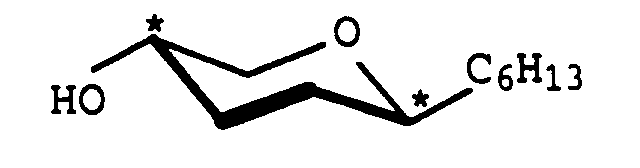
- Ein Äquivalent 4-Dodecyloxy-4'-carboxy-biphenyl wird mit der fünffachen Gewichtsmenge Thionylchlorid und einem Tropfen Dimethylformamid versetzt. Es wird bei Raumtemperatur gerührt, bis eine klare Lösung entstanden ist. Anschließend wird noch für 10 min auf 40°C erwärmt und dann eingedampft. Das Säurechlorid wird mehrere Stunden am Ölpumpenvakuum getrocknet. Das Säurechlorid, gelöst in Dichlormethan, wird zu einer Lösung der Verbindung aus Beispiel 12a) in der fünffachen Menge absolutem Pyridin gegeben. Die Mischung rührt über Nacht bei Raumtemperatur, dann noch 30 min bei 40°C. Anschließend wird das Pyridin mit Toluol codestilliert. Die Produkte werden säulenchromatographisch gereinigt (Dichlormethan).
Ausbeute: 75 %
Analog Beispiel 13 wurden die Verbindungen der Beispiele 14 bis 19 hergestellt. Die Ausbeuten betragen durchweg mehr als 70 %. - Die Phasenumwandlungstemperaturen der Beispiele 14 bis 19 sind in der Tabelle angegeben.
Produkte Umwandlungstemperaturen Beispiel 14 C₈H₁₇-Py-Ph-COO-THP-(CH₂)₂CH₃ K 70,9 SA 67,8 Ch 85,1 I Beispiel 15 C₁₀H₂₁O-Ph-Ph-COO-THP-(CH₂)₄CH₃ K 123,7 SX 151,1 I Beispiel 16 C₈H₁₇-Py-Ph-COO-THP-(CH₂)₄CH₃ K 75,8 SC* 96,8 SA 97,9 Ch 177,8 I Beispiel 17 C₁₀H₂₁O-Ph-COO-Ph-COO-THP-(CH₂)₃CH₃ K 125,3 SA 151,7 I Beispiel 18 C₁₀H₂₁O-Ph-Ph-COO-THP-(CH₂)₅CH₃ K 99,8 SC* 89,1 SA 134,6 Ch 136,1 I Beispiel 19 C₈H₁₇-Py-Ph-COO-THP-(CH₂)₅CH₃ K 73,2 SA 95,0 Ch 106,1 I -

-

- a) Herstellung von (2S,5S)-5-Acetyloxy-2-(4'-methoxyphenyl)-tetrahydropyran
500 mg (2S,5S)-5-Acetoxy-2-(4'-methoxyphenyl)-2H-5,6-dihydropyran werden in 100 ml eines Gemisches aus Ethanol/Ethylacetat (1/3) gelöst. Diese Lösung wird mit 5 mg Palladium auf Aktivkohle (10%) versetzt und unter Normaldruck einer Wasserstoffatmosphäre hydriert. Die Reaktionskontrolle erfolgt dünnschichtchromatografisch (Laufmittel: Petrolether/Ethylacetat = 9/1). Nach 12 Stunden ist die Reaktion beendet. Vom Katalysator wird abfiltriert und das Lösungsmittel am Rotationsverdampfer abgezogen. Die Aufarbeitung erfolgt säulenchromatografisch (Laufmittel: Petrolether/Ethylacetat = 9/1).
Ausbeute: 455 mg (91% d. Theorie)
[α]²⁰D = -64.2° (c=1, Chloroform)
Schmelzpunkt: 62.2 °C - b) Herstellung von (2S,5S)-5-Hydroxy-2-(4'-methoxyphenyl)-tetrahydropyran
400 mg (2S,5S)-5-Acetyloxy-2-(4'-methoxyphenyl)-tetrahydropyran werden in 50 ml absolutem Methanol gelöst, bis zur basischen Reaktion mit 0.1 N methanolischer Natriummethanolat-Lösung tropfenweise versetzt und 12 Stunden bei Raumtemperatur gerührt. Anschließend wird mit einem Ionenaustauscher in der H⁺-Form neutralisiert und vom Ionenaustauscher abfiltriert. Nach dem Einengen wird säulenchromatografisch (Laufmittel: Chloroform/Methanol=9/1) gereinigt. - c) Herstellung von (2S,5S)-5-[trans-4'-(4''-n-Heptylcyclohexyl)-phenyl]-carboxyl-2-(4'-methoxyphenyl)-2H tetrahydropyran
29 mg trans-4'-(4''-n-Heptylcyclohexyl)-phenylcarbonsäure werden in der fünffachen Gewichtsmenge Thionylchlorid gelöst und mit einem Tropfen Dimethylformamid versetzt. Dann rührt man bei Raumtemperatur bis eine klare Lösung entstanden ist. Anschließend wird noch für 10 min auf 40°C erwärmt und dann das Lösungsmittel abdestilliert. Das Säurechlorid wird mehrere Stunden unter Ölpumpenvakuum getrocknet.
20 mg (2S,5S)-5-Hydroxy-2-(4'-methoxyphenyl)-tetrahydropyran und 12 mg Dimethylaminopyridin werden in der fünffachen Gewichtsmenge absolutem Pyridin gelöst und dann zu einer Lösung von 30 mg des Säurechlorides in absolutem Dichlormethan gegeben. Die Mischung rührt über Nacht bei Raumtemperatur und anschließend eine halbe Stunde bei 40°C. Dann wird das Lösungsmittel abdestilliert, der Rückstand dreimal in Toluol aufgenommen und wieder zur Trockne eingedampft. Die Reinigung des so erhaltenen Produktes erfolgt säulenchromatografisch mit Dichlormethan als Laufmittel.
Ausbeute: 14.6 g (31% d. Theorie)
[α]²⁰D = 32.4 (c=1, Chloroform)
Phasenverhalten: K 100.1 Ch 221.0 I
Analog Beispiel 1 wurden die Verbindungen der Beispiele 2 bis 9 hergestellt:
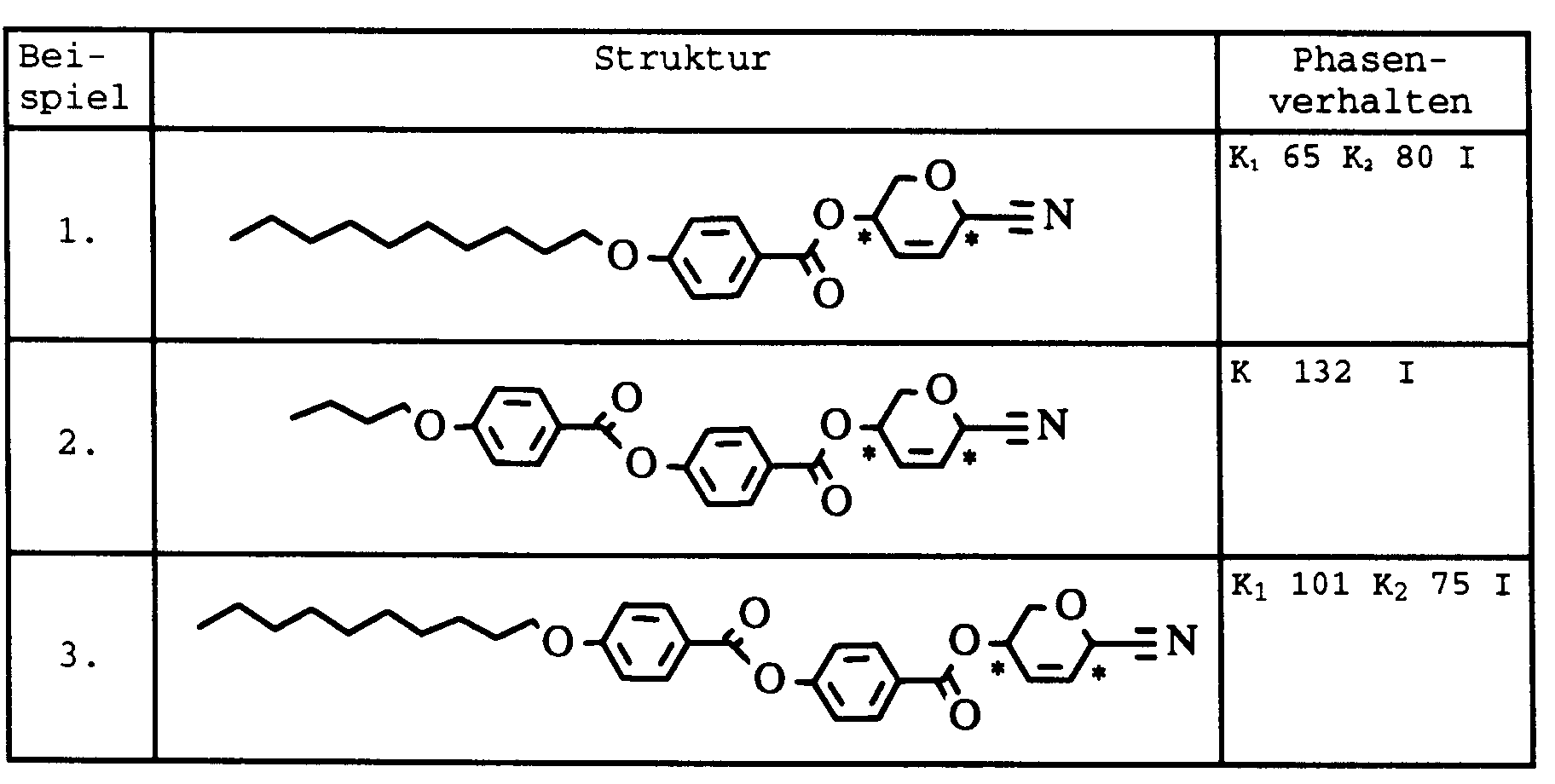


Analog Beispiel 20 wurden die Verbindungen der Beispiele 21 bis 30 hergestellt:


Claims (8)
- Verbindungen, enthaltend chirale Reste der allgemeinen Formel I

- Verbindungen gemäß Anspruch 1 der Formel II
 B eine Einfach- oder Doppelbindung,X eine polymerisierbare Gruppe oder Wasserstoff oder Hydroxy,Y eine direkte Bindung oder O, OCO, COO oder S,A ein Spacer undM eine mesogene Gruppe sind undR¹ die angegebene Bedeutung hat.
 - Verbindungen gemäß Anspruch 1 mit B als Einfachbindung.
- Verbindungen gemäß Anspruch 1 mit B als Doppelbindung.
- Verwendung der Verbindungen gemäß Anspruch 2 mit einer polymerisierbaren Gruppe X zur Herstellung polymerer chiraler Verbindungen.
- Verwendung der Verbindungen gemäß Anspruch 2 mit X=OH oder X=Vinyl zur Herstellung von chiralen Oligomesogenen.
- Verwendung der Verbindungen gemäß Anspruch 1 als Dotierstoff in flüssigkristallinen Medien.
- Verwendung von flüssigkristallinen Medien enthaltend Verbindungen gemäß Anspruch 1 in der Displaytechnologie, in optischen, elektronischen sowie opto-elektronischen Speichermedien, der elektronischen Datenverarbeitung und Vervielfältigung oder der Elektrophotografie sowie in Licht reflektierenden Schichten.
Applications Claiming Priority (6)
| Application Number | Priority Date | Filing Date | Title |
|---|---|---|---|
| DE19934316826 DE4316826A1 (de) | 1993-05-19 | 1993-05-19 | Verwendung der chiralen Gruppe 4-Hydroxyl-1-alkyl-2,3,5-tridesoxy-b-D-glyceropento-pyranosid zur Herstellung von polaren, flüssigkristallinen Materialien |
| DE4316826 | 1993-05-19 | ||
| DE19944408414 DE4408414A1 (de) | 1994-03-12 | 1994-03-12 | Chirale Verbindungen |
| DE4408413 | 1994-03-12 | ||
| DE4408414 | 1994-03-12 | ||
| DE19944408413 DE4408413A1 (de) | 1994-03-12 | 1994-03-12 | Chirale Verbindungen |
Publications (2)
| Publication Number | Publication Date |
|---|---|
| EP0630892A1 true EP0630892A1 (de) | 1994-12-28 |
| EP0630892B1 EP0630892B1 (de) | 1999-11-17 |
Family
ID=27205110
Family Applications (1)
| Application Number | Title | Priority Date | Filing Date |
|---|---|---|---|
| EP94107420A Expired - Lifetime EP0630892B1 (de) | 1993-05-19 | 1994-05-13 | Chirale Verbindungen |
Country Status (4)
| Country | Link |
|---|---|
| EP (1) | EP0630892B1 (de) |
| JP (1) | JPH0725866A (de) |
| AT (1) | ATE186725T1 (de) |
| DE (1) | DE59408926D1 (de) |
Cited By (10)
| Publication number | Priority date | Publication date | Assignee | Title |
|---|---|---|---|---|
| EP0747382A1 (de) * | 1995-06-09 | 1996-12-11 | BASF Aktiengesellschaft | Polymerisierbare chirale Verbindungen und deren Verwendung |
| EP0755929A3 (de) * | 1995-07-28 | 1997-05-02 | Rolic Ag | Photovernetzbare flüssigkristalline 1,4-Dioxan-2,3-diyl-Derivate |
| WO1998003610A1 (de) * | 1996-07-17 | 1998-01-29 | Basf Aktiengesellschaft | Flüssigkristalline zuckerderivate |
| WO1998014442A1 (de) * | 1996-10-01 | 1998-04-09 | Basf Aktiengesellschaft | Chirale verbindungen |
| US5820783A (en) * | 1994-11-30 | 1998-10-13 | Basf Aktiengesellschaft | Chiral compounds |
| US5851424A (en) * | 1995-07-28 | 1998-12-22 | Rolic Ag | Photo cross-linkable liquid crystalline 1,4-dioxane-2,3 diyl derivatives |
| EP0750029A3 (de) * | 1995-06-09 | 2000-01-05 | BASF Aktiengesellschaft | Polymerisierbare chirale Verbindungen und deren Verwendung |
| WO2004002979A3 (de) * | 2002-07-01 | 2004-04-22 | Basf Ag | Chirale 3,4-dihydro-2h-pyranverbindungen |
| CN101035779A (zh) * | 2004-10-04 | 2007-09-12 | 智索株式会社 | 四氢呋喃混合物、液晶组成物以及包含此液晶组成物的液晶显示元件 |
| JP2017002160A (ja) * | 2015-06-09 | 2017-01-05 | Jnc株式会社 | ジヒドロピラン化合物を含有する液晶組成物および液晶表示素子 |
Citations (4)
| Publication number | Priority date | Publication date | Assignee | Title |
|---|---|---|---|---|
| JPS62226974A (ja) * | 1986-03-28 | 1987-10-05 | Mitsui Petrochem Ind Ltd | テトラヒドロピラン誘導体の製造法 |
| EP0405983A2 (de) * | 1989-06-28 | 1991-01-02 | Mitsubishi Rayon Co., Ltd | Optisch aktive Substanz und Flüssigkristallzusammensetzung |
| EP0548947A1 (de) * | 1991-12-26 | 1993-06-30 | Kashima Oil Company | Optisch aktive fluorhaltige Verbindungen |
| WO1993013093A1 (de) * | 1991-12-28 | 1993-07-08 | Hoechst Aktiengesellschaft | Chirale oxiranylmethyl-ether und ihre verwendung als dotierstoffe in flüssigkristallmischungen |
-
1994
- 1994-05-13 EP EP94107420A patent/EP0630892B1/de not_active Expired - Lifetime
- 1994-05-13 DE DE59408926T patent/DE59408926D1/de not_active Expired - Fee Related
- 1994-05-13 AT AT94107420T patent/ATE186725T1/de not_active IP Right Cessation
- 1994-05-19 JP JP6105245A patent/JPH0725866A/ja not_active Withdrawn
Patent Citations (4)
| Publication number | Priority date | Publication date | Assignee | Title |
|---|---|---|---|---|
| JPS62226974A (ja) * | 1986-03-28 | 1987-10-05 | Mitsui Petrochem Ind Ltd | テトラヒドロピラン誘導体の製造法 |
| EP0405983A2 (de) * | 1989-06-28 | 1991-01-02 | Mitsubishi Rayon Co., Ltd | Optisch aktive Substanz und Flüssigkristallzusammensetzung |
| EP0548947A1 (de) * | 1991-12-26 | 1993-06-30 | Kashima Oil Company | Optisch aktive fluorhaltige Verbindungen |
| WO1993013093A1 (de) * | 1991-12-28 | 1993-07-08 | Hoechst Aktiengesellschaft | Chirale oxiranylmethyl-ether und ihre verwendung als dotierstoffe in flüssigkristallmischungen |
Non-Patent Citations (1)
| Title |
|---|
| PATENT ABSTRACTS OF JAPAN vol. 12, no. 92 (C - 483) 25 March 1988 (1988-03-25) * |
Cited By (16)
| Publication number | Priority date | Publication date | Assignee | Title |
|---|---|---|---|---|
| US5820783A (en) * | 1994-11-30 | 1998-10-13 | Basf Aktiengesellschaft | Chiral compounds |
| EP0747382A1 (de) * | 1995-06-09 | 1996-12-11 | BASF Aktiengesellschaft | Polymerisierbare chirale Verbindungen und deren Verwendung |
| EP0750029A3 (de) * | 1995-06-09 | 2000-01-05 | BASF Aktiengesellschaft | Polymerisierbare chirale Verbindungen und deren Verwendung |
| EP0755929A3 (de) * | 1995-07-28 | 1997-05-02 | Rolic Ag | Photovernetzbare flüssigkristalline 1,4-Dioxan-2,3-diyl-Derivate |
| US5851424A (en) * | 1995-07-28 | 1998-12-22 | Rolic Ag | Photo cross-linkable liquid crystalline 1,4-dioxane-2,3 diyl derivatives |
| CN1097048C (zh) * | 1995-07-28 | 2002-12-25 | 罗利克公司 | 可光交联的1,4-二噁烷-2,3-二基衍生物 |
| WO1998003610A1 (de) * | 1996-07-17 | 1998-01-29 | Basf Aktiengesellschaft | Flüssigkristalline zuckerderivate |
| WO1998014442A1 (de) * | 1996-10-01 | 1998-04-09 | Basf Aktiengesellschaft | Chirale verbindungen |
| WO2004002979A3 (de) * | 2002-07-01 | 2004-04-22 | Basf Ag | Chirale 3,4-dihydro-2h-pyranverbindungen |
| US7258902B2 (en) | 2002-07-01 | 2007-08-21 | Basf Aktiengesellschaft | Chiral 3,4-dihydro-2H-pyran compounds |
| CN100400532C (zh) * | 2002-07-01 | 2008-07-09 | 巴斯福股份公司 | 手性3,4-二氢-2h-吡喃化合物 |
| CN101035779A (zh) * | 2004-10-04 | 2007-09-12 | 智索株式会社 | 四氢呋喃混合物、液晶组成物以及包含此液晶组成物的液晶显示元件 |
| EP2128149A1 (de) * | 2004-10-04 | 2009-12-02 | Chisso Corporation | Tetrahydrofuran Verbindungen , Flüssigkristallzusammensetzungen und deren enthaltenden Flüssigkristall -Anzeigelement |
| US7842357B2 (en) | 2004-10-04 | 2010-11-30 | Chisso Corporation | Tetrahydropyran compound, liquid crystal, composition and liquid crystal display device containing the liquid crystal composition |
| CN101035779B (zh) * | 2004-10-04 | 2015-06-03 | Jnc株式会社 | 四氢哌喃混合物、液晶组成物以及包含此液晶组成物的液晶显示元件 |
| JP2017002160A (ja) * | 2015-06-09 | 2017-01-05 | Jnc株式会社 | ジヒドロピラン化合物を含有する液晶組成物および液晶表示素子 |
Also Published As
| Publication number | Publication date |
|---|---|
| JPH0725866A (ja) | 1995-01-27 |
| ATE186725T1 (de) | 1999-12-15 |
| EP0630892B1 (de) | 1999-11-17 |
| DE59408926D1 (de) | 1999-12-23 |
Similar Documents
| Publication | Publication Date | Title |
|---|---|---|
| WO1995022586A1 (de) | Neue polymerisierbare flüssigkristalline verbindungen | |
| EP0630892B1 (de) | Chirale Verbindungen | |
| DE69224836T2 (de) | Optisch aktive tetrahydropyran derivate, flüssigkristallzusammensetzungen und diese enthaltende flüssigkristallelemente | |
| DE3823154A1 (de) | Neue ferroelektrische fluessigkristalline polymere | |
| EP0321504B1 (de) | Chirale aryloxypropionsäureester und ihre verwendung als dotierstoff in flüssigkristall-phasen | |
| DE4332733A1 (de) | Flüssigkristalline Verbindungen | |
| DE3873016T2 (de) | Optisch aktive, delta-valerolacton-ring enthaltende verbindung und dieselbe enthaltende fluessigkristalline zusammensetzung. | |
| DE19640618A1 (de) | Chirale Verbindungen | |
| EP0295370A1 (de) | Flüssigkristalline 5-Phenylpyrimidin-Derivate mit Sc- oder Sc(Stern)-Phase und Verfahren zu ihrer Herstellung | |
| KR0162650B1 (ko) | 액정성 화합물, 이를 함유하는 액정 조성물 및 그의 용도 | |
| EP0750656B1 (de) | Chirale verbindungen | |
| DE69523211T2 (de) | Optisch aktive Tetrahydropyranderivate, flüssigkristalline Zusammensetzung und diese enthaltende Flüssigkristall-Vorrichtung. | |
| EP1136478A2 (de) | Chirale 1,3-Dioxanverbindungen | |
| EP1519931A2 (de) | Chirale 3,4-dihydro-2h-pyranverbindungen | |
| DE19628700A1 (de) | Flüssigkristalline Zuckerderivate | |
| DE69010147T2 (de) | Esterverbindungen und sie enthaltende flüssigkristalline Zusammensetzungen. | |
| DE4316826A1 (de) | Verwendung der chiralen Gruppe 4-Hydroxyl-1-alkyl-2,3,5-tridesoxy-b-D-glyceropento-pyranosid zur Herstellung von polaren, flüssigkristallinen Materialien | |
| EP0528268B1 (de) | Optisch aktive Phenoxi-propionsäureester | |
| DE69604117T2 (de) | Optisch aktive Dihydropyranderivate, Flüssigkristallzusammensetzung, Flüssigkristallvorrichtung, Flüssigkristallracematmischung | |
| DE4408414A1 (de) | Chirale Verbindungen | |
| WO1990000587A1 (de) | Neue ferroelektrische flüssigkristalline polymere, ein verfahren zu ihrer herstellung und ihre verwendung in elektrooptischen bauteilen | |
| WO1997049694A1 (de) | Chirale dotierstoffe für flüssigkristalline medien | |
| EP0755929A2 (de) | Photovernetzbare flüssigkristalline 1,4-Dioxan-2,3-diyl-Derivate | |
| DE4408413A1 (de) | Chirale Verbindungen | |
| DE4100176A1 (de) | Pyrimidincyclohexan-derivate, verfahren zu ihrer herstellung und ihre verwendung in fluessigkristallinen mischungen |
Legal Events
| Date | Code | Title | Description |
|---|---|---|---|
| PUAI | Public reference made under article 153(3) epc to a published international application that has entered the european phase |
Free format text: ORIGINAL CODE: 0009012 |
|
| 17P | Request for examination filed |
Effective date: 19940916 |
|
| AK | Designated contracting states |
Kind code of ref document: A1 Designated state(s): AT BE CH DE FR GB IT LI NL |
|
| 17Q | First examination report despatched |
Effective date: 19980505 |
|
| GRAG | Despatch of communication of intention to grant |
Free format text: ORIGINAL CODE: EPIDOS AGRA |
|
| GRAG | Despatch of communication of intention to grant |
Free format text: ORIGINAL CODE: EPIDOS AGRA |
|
| GRAH | Despatch of communication of intention to grant a patent |
Free format text: ORIGINAL CODE: EPIDOS IGRA |
|
| GRAH | Despatch of communication of intention to grant a patent |
Free format text: ORIGINAL CODE: EPIDOS IGRA |
|
| GRAA | (expected) grant |
Free format text: ORIGINAL CODE: 0009210 |
|
| AK | Designated contracting states |
Kind code of ref document: B1 Designated state(s): AT BE CH DE FR GB IT LI NL |
|
| PG25 | Lapsed in a contracting state [announced via postgrant information from national office to epo] |
Ref country code: IT Free format text: LAPSE BECAUSE OF FAILURE TO SUBMIT A TRANSLATION OF THE DESCRIPTION OR TO PAY THE FEE WITHIN THE PRE;WARNING: LAPSES OF ITALIAN PATENTS WITH EFFECTIVE DATE BEFORE 2007 MAY HAVE OCCURRED AT ANY TIME BEFORE 2007. THE CORRECT EFFECTIVE DATE MAY BE DIFFERENT FROM THE ONE RECORDED.SCRIBED TIME-LIMIT Effective date: 19991117 Ref country code: GB Free format text: LAPSE BECAUSE OF FAILURE TO SUBMIT A TRANSLATION OF THE DESCRIPTION OR TO PAY THE FEE WITHIN THE PRESCRIBED TIME-LIMIT Effective date: 19991117 Ref country code: NL Free format text: LAPSE BECAUSE OF FAILURE TO SUBMIT A TRANSLATION OF THE DESCRIPTION OR TO PAY THE FEE WITHIN THE PRESCRIBED TIME-LIMIT Effective date: 19991117 |
|
| REF | Corresponds to: |
Ref document number: 186725 Country of ref document: AT Date of ref document: 19991215 Kind code of ref document: T |
|
| REG | Reference to a national code |
Ref country code: CH Ref legal event code: EP |
|
| REF | Corresponds to: |
Ref document number: 59408926 Country of ref document: DE Date of ref document: 19991223 |
|
| ET | Fr: translation filed | ||
| NLV1 | Nl: lapsed or annulled due to failure to fulfill the requirements of art. 29p and 29m of the patents act | ||
| PG25 | Lapsed in a contracting state [announced via postgrant information from national office to epo] |
Ref country code: AT Free format text: LAPSE BECAUSE OF NON-PAYMENT OF DUE FEES Effective date: 20000513 |
|
| GBV | Gb: ep patent (uk) treated as always having been void in accordance with gb section 77(7)/1977 [no translation filed] |
Effective date: 19991117 |
|
| PG25 | Lapsed in a contracting state [announced via postgrant information from national office to epo] |
Ref country code: CH Free format text: LAPSE BECAUSE OF NON-PAYMENT OF DUE FEES Effective date: 20000531 Ref country code: BE Free format text: LAPSE BECAUSE OF NON-PAYMENT OF DUE FEES Effective date: 20000531 Ref country code: LI Free format text: LAPSE BECAUSE OF NON-PAYMENT OF DUE FEES Effective date: 20000531 |
|
| PLBE | No opposition filed within time limit |
Free format text: ORIGINAL CODE: 0009261 |
|
| STAA | Information on the status of an ep patent application or granted ep patent |
Free format text: STATUS: NO OPPOSITION FILED WITHIN TIME LIMIT |
|
| 26N | No opposition filed | ||
| BERE | Be: lapsed |
Owner name: BASF A.G. Effective date: 20000531 |
|
| REG | Reference to a national code |
Ref country code: CH Ref legal event code: PL |
|
| PGFP | Annual fee paid to national office [announced via postgrant information from national office to epo] |
Ref country code: FR Payment date: 20090515 Year of fee payment: 16 Ref country code: DE Payment date: 20090511 Year of fee payment: 16 |
|
| REG | Reference to a national code |
Ref country code: FR Ref legal event code: ST Effective date: 20110131 |
|
| PG25 | Lapsed in a contracting state [announced via postgrant information from national office to epo] |
Ref country code: DE Free format text: LAPSE BECAUSE OF NON-PAYMENT OF DUE FEES Effective date: 20101201 |
|
| PG25 | Lapsed in a contracting state [announced via postgrant information from national office to epo] |
Ref country code: FR Free format text: LAPSE BECAUSE OF NON-PAYMENT OF DUE FEES Effective date: 20100531 |