EP0631229A2 - Verfahren und Vorrichtung zur Speicherung und Rückspeicherung von Attributdaten von persistenten Objekten - Google Patents
Verfahren und Vorrichtung zur Speicherung und Rückspeicherung von Attributdaten von persistenten Objekten Download PDFInfo
- Publication number
- EP0631229A2 EP0631229A2 EP94108769A EP94108769A EP0631229A2 EP 0631229 A2 EP0631229 A2 EP 0631229A2 EP 94108769 A EP94108769 A EP 94108769A EP 94108769 A EP94108769 A EP 94108769A EP 0631229 A2 EP0631229 A2 EP 0631229A2
- Authority
- EP
- European Patent Office
- Prior art keywords
- data
- attribute
- persistent
- attributes
- storage
- Prior art date
- Legal status (The legal status is an assumption and is not a legal conclusion. Google has not performed a legal analysis and makes no representation as to the accuracy of the status listed.)
- Withdrawn
Links
Images



Classifications
-
- G—PHYSICS
- G06—COMPUTING OR CALCULATING; COUNTING
- G06F—ELECTRIC DIGITAL DATA PROCESSING
- G06F9/00—Arrangements for program control, e.g. control units
- G06F9/06—Arrangements for program control, e.g. control units using stored programs, i.e. using an internal store of processing equipment to receive or retain programs
- G06F9/44—Arrangements for executing specific programs
- G06F9/448—Execution paradigms, e.g. implementations of programming paradigms
- G06F9/4488—Object-oriented
- G06F9/4493—Object persistence
Definitions
- the present invention relates to data processing systems and more particularly to systems for creating application programs or operating system programs. Still more particularly, the present invention relates to object oriented systems having persistent object storage functions operable to store and restore persistent objects without operator modification.
- Object oriented programming uses a toolkit of system objects that can be assembled to perform the final task. Each object has certain data attributes and processes or methods that operate on that data. Data is said to be "encapsulated" by an object and can only be modified by the object methods. Methods are invoked by sending a message to an object identifying the method and supplying any needed arguments.
- Object oriented systems have two important properties in addition to encapsulation. "Inheritance' is the ability to derive a new object from an existing object and inherit all properties, including methods and data structure, from the existing object.
- the new object may have certain unique features which are supplied as overrides or modifications to the existing class. I.e. a new subclass needs to specify only the functions and data that distinguish that class from the existing more general class.
- a framework is a collection of base classes that can be used by a system implementor to create a final systems product.
- the framework is defined and developed to work together as a system.
- the framework is much like a set of standard hardware components used by computer hardware builders. Each of the components has certain defined functions and interfaces and the engineer assembles these components according to a particular design to create a unique hardware system.
- Objects created by a data processing system are typically maintained in the volatile memory of those systems. This allows faster processing, but does not provide a means to store data.
- Object oriented systems solve this problem by implementing "persistent objects.” "Persistence" means that an object's state can be preserved beyond the termination of the process that created that object.
- the persistent framework include methods that allow persistent objects to be stored in and retrieved from a non-volatile medium such as a hard disk drive or writable optical disk. Objects can be stored individually or grouped with other objects.
- a particular object oriented product typically provides one mechanism for storing persistent objects. This mechanism includes a definition of the non-volatile medium used, the structure of object groups stored on the medium and the structure of each particular object stored on the medium.
- a fixed storage scheme requires that the method for restoring data remains constant thereby constraining the developers from improving or enhancing the application.
- a change to the number or types of parameters to which an object responds would prevent restoration of previously stored objects in a fixed storage system.
- the existing technical problem addressed by the present invention is to provide a persistent object framework that provides flexible and upwardly compatible persistent object storage without requiring developer coding of the storage methods.
- An object oriented programming system operates on a computer system such as that shown in Figure 1.
- the computer system can be a "Personal Computer", workstation, minicomputer or mainframe type of computer.
- Figure 1 illustrates a personal computer such as the IBM PS/2 Model 95 computer (IBM and PS/2 are trademarks of the IBM Corporation.)
- the computer typically includes a system unit 100 which contains a processor or CPU 102 and memory 104 .
- An object oriented program 106 operates on the processor and is resident in memory 104 .
- the system will typically have a display device 108 such as a color or monochrome CRT, a keyboard 110 , a pointing device 112 such as a mouse or trackball, a fixed disk drive 114 , and optionally, a network connection 116 to a LAN or other network.
- a display device 108 such as a color or monochrome CRT
- a keyboard 110 such as a keyboard
- a pointing device 112 such as a mouse or trackball
- a fixed disk drive 114 such as a fixed disk drive 114
- a network connection 116 to a LAN or other network.
- An object encapsulates data and the methods needed to operate on that data.
- Objects can be represented by a "doughnut diagram" such as shown in Figure 2.
- Object data is shown in the center 202 surrounded by the applicable methods 204 to 214 .
- Data 202 may be modified only by the methods of that object.
- Methods 204-214 are invoked by receiving messages from other objects.
- a typical object oriented system will have a message router 220 that routes messages between objects.
- object 230 causes Method 208 to be invoked by sending a message 232 to the message router that in turn sends it 222 to Method 208 of object 200 .
- Object frameworks are constructed to provide a set of objects for application and system developers to use to construct a delivered system.
- the IBM System Object Model (SOM) framework for example, provides a language independent set of objects for use in systems development.
- the IBM OS/2 Version 2.0 Workplace shell is an example of an application developed using such an environment.
- Objects are grouped into classes of related objects.
- the class description contains information relevant to all objects in a class, including a description of instance variables maintained by each of the objects and the available object methods.
- An object instance is created (or "instantiated") based on that information and has the properties defined in the object class.
- the object class DOG can include the instance variables "dog_type” and “dog_name' and a "bark” method implementing the response to a bark message.
- An instance of dog e.g. ROVER, will maintain the type and name instance variables for itself and will respond to the bark message.
- Abstract classes are used to describe the interfaces and methods expected to be used by a class without providing detail on the implementation of those methods. Abstract classes are useful in frameworks where the implementation details are to be left to the implementor. Concrete classes are created as subclasses of abstract classes and implement those classes.
- Classes in an object oriented system are often derived from some single base class.
- This base class is named "SOMObject" in the IBM System Object Model.
- Figure 3 illustrates the preferred embodiment of the present invention by showing the class hierarchy for Persistent Objects using the System Object Model.
- PersistentObject 304 is a subclass of SOMObject 302 and contains the methods and variables necessary to create peristent objects. Because it is a subclass of SOMObject it inherits all methods and variables known to SOMObject. Also derived from SOMObject 302 are PersistentStorageManager 306 , IOGroupManager 308 , and EncoderDecoder 310 . These subclasses are abstract classes for implementing overall management of persistent objects (PersistentStorageManager), for controlling the structure and grouping of persistent objects on the persistent object storage medium (IOGroupManager), and for writing object information to the storage medium (EncoderDecoder.)
- the IOGroupManager abstract class 308 controls the grouping and organization of groups of objects on the persistent storage medium. Persistent objects are stored in related groups of objects.
- the structure of object group storage is called the Group Skeletal Format and defines a skeleton within which the objects are stored. The most straightforward structure is storing the object description in plain ASCII text with objects stored sequentially within a group.
- Figure 4 illustrates the group skeletal format for this object structure.
- the group skeletal format 400 contains a Object Group Header 402 that contains group data, a number of object separators 404 406 ... 412 and object storage blocks 414 416 ... 420 . Storage of objects within a storage block 414 is controlled by the EncoderDecoder class.
- EncoderDecoder 310 functions to reformat object instance data from the internal object storage format to a format that can be written to a persistent storage medium (e.g. a disk.)
- the persistent format must contain sufficient information to restore the object to internal storage in the same state as when it was written.
- EncoderDecoderAbstract class is implemented in the preferred embodiment to define the interfaces to concrete EncoderDecoder subclasses derived by the application developer or developer.
- the EncoderDecoderAbstract class defines the interface to the following methods. EncoderDecoderWrite formats and writes the instance data of a particular object using a selected media interface. EncoderDecoderRead reads from the selected media interface and restores the object from the persistent format to internal object format.
- the EncoderDecoder of the present invention sends messages to the selected IOGroupManger for all media specific functions, including preparing the device, opening and closing the device, and physically writing and reading the data from the device.
- the preferred embodiment of the present invention provides a DefaultEncoderDecoder to implement flexible, generalized storage of object information.
- the DefaultEncoderDecoder relies on a repository of information about the class of an object including the data types of attributes of the class. It further relies on a means to identify attributes of a class as persistent attributes.
- the repository used to contain the above information about an object is known as an Interface Repository.
- the DefaultEncoderDecoder relies on a "set” and a "get” method for each persistent attribute, a consistent mapping of persistent attribute name to the name of the method used to get/set the attribute and a consistent get/set method signature for each supported data type.
- the "get” method or methods control storage of the persistent object, while the "set” method or methods control restoration of the object.
- the preferred embodiment implements attributes as specified by the standards of the Object Management Group. Attributes are the public data associated with objects. Each attribute is required by the standards to have a get and set method. Persistent attributes are indicated by the keyword "persistent" next to the attribute names in the Interface Definition Language (IDL) entries for the object.
- IDL Interface Definition Language
- the DefaultEncoderDecoder is activated when storage of an object is required.
- the DefaultEncoderDecoder consults the Interface Repository to determine if the object has any data attributes and if so whether any of the data attributes have been identified as persistent. For each of the persistent object data attributes, the DefaultEncoderDecoder consults the Interface Repository to determine the data type of the attribute. Given the name of the persistent attribute and its data type, the DefaultEncoderDecoder constructs a "get" method request. The attribute "get” method is then invoked to retrieve the data to be stored. The DefaultEncoderDecoder generates a stream of data for each persistent data attribute.
- the stream of data includes the data type of the persistent attribute, the attribute name and the data returned from the attribute "get” method. All basic attribute data types are supported including integers, floating point numbers, character strings, arrays and sequences of these types and structures of any of these types.
- the resulting stream is concatenated with all streams generated from that object and written to persistent storage.
- the persistent stream is written as an ASCII stream of attribute names and parameters.
- ASCII stream any other format could be used, including EBCDIC or binary.
- the stream is in a readily parsed format to allow reconstruction of the object.
- the structure of the object can be understood by reference to the following example:
- the DefaultEncoderDecoder stores the essential object information as an ASCII string having the following preferred format:
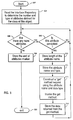
- the process starts at 502 and proceeds to reading the Interface Repository to determine the number and types of data attributes for the class of this object 504 .
- a test for the existence of more attributes is made at 506 . If no more attributes exist an "end of attributes" marker is stored 508 and the process terminated 520 . If more attributes exist, a test is made to determine if the next attribute is persistent 510 . If not, processing returns to test 506 . If a persistent attribute is found, the length of the attribute name is stored 512 and the attribute name and type are stored 514 .
- a "get" method request is constructed using the attribute name and data type and the method invoked 516 . Finally, the data returned from the "get” method is stored 518 and processing returns to test 506 .
- Objects are restored from persistent storage through the invocation of set methods for the persistent attributes of the object.
- the request to restore an object is initiated by the program by invoking a method on the Persistent Storage Manager.
- the Persistent Storage Manager then instantiates an IOGroupManager which in turn instantiates an EncoderDecoder (in this case the DefaultEncoderDecoder.)
- the restoration of an object is accomplished by the process steps illustrated in Figure 6.
- the process starts at 602 and proceeds immediately to step 604 that reads an attribute name from the persistent storage stream.
- the result is tested to determine whether or not it is an "end of attribute" marker 606 . If so, the restoration ends 616 . Otherwise, the system reads the attribute type 608 , allocates space to hold the restored data 610 , and reads the data stream into the allocated space 612 .
- a "set" method is constructed using the attribute name and data type and the method is then invoked 614 . Upon return, control passes to step 604 .
- This storage format allows the implementation and even the interface to the object to be changed without loss of persistent data. Upward compatibility of data is controlled by overriding the "set" methods to support the current structure.
Landscapes
- Engineering & Computer Science (AREA)
- Software Systems (AREA)
- Theoretical Computer Science (AREA)
- Physics & Mathematics (AREA)
- General Engineering & Computer Science (AREA)
- General Physics & Mathematics (AREA)
- Information Retrieval, Db Structures And Fs Structures Therefor (AREA)
- Stored Programmes (AREA)
Applications Claiming Priority (2)
| Application Number | Priority Date | Filing Date | Title |
|---|---|---|---|
| US77348 | 1987-07-24 | ||
| US08/077,348 US5797007A (en) | 1993-06-14 | 1993-06-14 | Persistent object storage system with default object encoder/decoder |
Publications (2)
| Publication Number | Publication Date |
|---|---|
| EP0631229A2 true EP0631229A2 (de) | 1994-12-28 |
| EP0631229A3 EP0631229A3 (de) | 1995-02-08 |
Family
ID=22137541
Family Applications (1)
| Application Number | Title | Priority Date | Filing Date |
|---|---|---|---|
| EP94108769A Withdrawn EP0631229A3 (de) | 1993-06-14 | 1994-06-08 | Verfahren und Vorrichtung zur Speicherung und Rückspeicherung von Attributdaten von persistenten Objekten. |
Country Status (3)
| Country | Link |
|---|---|
| US (1) | US5797007A (de) |
| EP (1) | EP0631229A3 (de) |
| JP (1) | JP2711220B2 (de) |
Cited By (11)
| Publication number | Priority date | Publication date | Assignee | Title |
|---|---|---|---|---|
| WO1997042573A1 (en) * | 1996-05-07 | 1997-11-13 | Electronic Data Systems Corporation | Persistent object support method and system |
| EP0735471A3 (de) * | 1995-03-31 | 1999-05-12 | Sun Microsystems, Inc. | Verfahren und Gerät zum Interpretieren von Ausnahmen in einem verteilten Objektsystem |
| EP0940745A1 (de) * | 1998-03-05 | 1999-09-08 | Alcatel | Verfahren zur Speicherung und Auspacken von Objektattributten |
| DE19819205A1 (de) * | 1998-04-29 | 1999-11-04 | Siemens Ag | Datenhaltungssystem für persistente Daten |
| EP1030249A1 (de) * | 1999-02-19 | 2000-08-23 | Sun Microsystems, Inc. | Vorrichtung und Verfahren zur Transformation von einer grammatik-abgeleiteten Zwischenform zu einer objektorientierten Konfigurationsdatenbank |
| EP1030250A1 (de) * | 1999-02-19 | 2000-08-23 | Sun Microsystems, Inc. | Inteligente Serialisierer für objekt-orientierte Konfigurationsdatenbanken |
| EP1030253A1 (de) * | 1999-02-19 | 2000-08-23 | Sun Microsystems, Inc. | Anpassung der Umwandlung beim komilieren und Serialisieren von Konfigurationsdatenbanken |
| EP1030248A1 (de) * | 1999-02-19 | 2000-08-23 | Sun Microsystems, Inc. | Grammatik zum Beschreiben einer hierarchischen Objekt-orientierten Datenbank |
| EP0967546A3 (de) * | 1998-06-25 | 2001-05-02 | Intellution Inc. | Vorrichtung und Verfahren zum Abspeichern und Wiederauffinden von Objekten |
| WO2002027489A3 (en) * | 2000-09-28 | 2003-12-24 | Curl Corp | Persistent data storage for client computer software programs |
| EP0817026A3 (de) * | 1996-07-01 | 2005-04-13 | Sun Microsystems, Inc. | Verfahren und Vorrichtung zum Speichern von dauerhaften Objekten in einem verteilten Objektnetzwerk |
Families Citing this family (9)
| Publication number | Priority date | Publication date | Assignee | Title |
|---|---|---|---|---|
| US6272554B1 (en) * | 1996-12-10 | 2001-08-07 | International Business Machines Corporation | Method and apparatus for a corba typecode data manipulator |
| US6003038A (en) * | 1997-03-31 | 1999-12-14 | Sun Microsystems, Inc. | Object-oriented processor architecture and operating method |
| US6668257B1 (en) * | 1997-11-06 | 2003-12-23 | International Business Machines Corporation | Migrating non-persistent objects when one or more of the superclass fields of the object are modified |
| US6223344B1 (en) * | 1998-06-11 | 2001-04-24 | Internationl Business Machines Corporation | Apparatus and method for versioning persistent objects |
| US7877390B2 (en) * | 2003-10-20 | 2011-01-25 | International Business Machines Corporation | Systems and methods for providing autonomous persistent storage systems |
| JP2006294152A (ja) * | 2005-04-12 | 2006-10-26 | Toshiba Corp | 情報記憶媒体、情報記録装置、および情報再生装置 |
| EP1750253B1 (de) * | 2005-08-04 | 2012-03-21 | Nuance Communications, Inc. | Sprachdialogsystem |
| US8095766B2 (en) * | 2008-04-07 | 2012-01-10 | International Business Machines Corporation | Method and system for approximating object sizes in an object-oriented system |
| JP7119448B2 (ja) * | 2018-03-16 | 2022-08-17 | 富士フイルムビジネスイノベーション株式会社 | 情報処理装置及び情報処理プログラム |
Family Cites Families (12)
| Publication number | Priority date | Publication date | Assignee | Title |
|---|---|---|---|---|
| CA1337132C (en) * | 1988-07-15 | 1995-09-26 | Robert Filepp | Reception system for an interactive computer network and method of operation |
| US5202981A (en) * | 1989-10-23 | 1993-04-13 | International Business Machines Corporation | Process and apparatus for manipulating a boundless data stream in an object oriented programming system |
| US5161225A (en) * | 1989-10-23 | 1992-11-03 | International Business Machines Corporation | Persistent stream for processing time consuming and reusable queries in an object oriented database management system |
| US5161223A (en) * | 1989-10-23 | 1992-11-03 | International Business Machines Corporation | Resumeable batch query for processing time consuming queries in an object oriented database management system |
| US5313629A (en) * | 1989-10-23 | 1994-05-17 | International Business Machines Corporation | Unit of work for preserving data integrity of a data-base by creating in memory a copy of all objects which are to be processed together |
| US5448726A (en) * | 1989-10-23 | 1995-09-05 | International Business Machines Corporation | Data base management system with data dictionary cache including a single loadable object descriptor |
| JPH0833862B2 (ja) * | 1989-10-23 | 1996-03-29 | インターナシヨナル・ビジネス・マシーンズ・コーポレーシヨン | オブジエクト指向コンピユータ・システム |
| AU639802B2 (en) * | 1990-08-14 | 1993-08-05 | Oracle International Corporation | Methods and apparatus for providing dynamic invocation of applications in a distributed heterogeneous environment |
| US5151987A (en) * | 1990-10-23 | 1992-09-29 | International Business Machines Corporation | Recovery objects in an object oriented computing environment |
| US5291593A (en) * | 1990-10-24 | 1994-03-01 | International Business Machines Corp. | System for persistent and delayed allocation object reference in an object oriented environment |
| US5295256A (en) * | 1990-12-14 | 1994-03-15 | Racal-Datacom, Inc. | Automatic storage of persistent objects in a relational schema |
| US5317730A (en) * | 1991-01-11 | 1994-05-31 | International Business Machines Corporation | System for modifying persistent database based upon set of data elements formed after selective insertion or deletion |
-
1993
- 1993-06-14 US US08/077,348 patent/US5797007A/en not_active Expired - Lifetime
-
1994
- 1994-04-27 JP JP6090233A patent/JP2711220B2/ja not_active Expired - Fee Related
- 1994-06-08 EP EP94108769A patent/EP0631229A3/de not_active Withdrawn
Non-Patent Citations (2)
| Title |
|---|
| 9TH PHOENIX CONF. ON COMPUTERS AND COMMUNICATIONS March 1990 , ARIZONA, USA pages 324 - 331 XP140018 ANCONA 'Persistent heaps' * |
| OOPSLA'89 October 1989 , NEW ORLEANS, USA pages 221 - 237 XP299246 PAEPCKE 'PCLOS: A Critical Review.' * |
Cited By (16)
| Publication number | Priority date | Publication date | Assignee | Title |
|---|---|---|---|---|
| EP0735471A3 (de) * | 1995-03-31 | 1999-05-12 | Sun Microsystems, Inc. | Verfahren und Gerät zum Interpretieren von Ausnahmen in einem verteilten Objektsystem |
| WO1997042573A1 (en) * | 1996-05-07 | 1997-11-13 | Electronic Data Systems Corporation | Persistent object support method and system |
| EP0817026A3 (de) * | 1996-07-01 | 2005-04-13 | Sun Microsystems, Inc. | Verfahren und Vorrichtung zum Speichern von dauerhaften Objekten in einem verteilten Objektnetzwerk |
| EP0940745A1 (de) * | 1998-03-05 | 1999-09-08 | Alcatel | Verfahren zur Speicherung und Auspacken von Objektattributten |
| FR2775804A1 (fr) * | 1998-03-05 | 1999-09-10 | Alsthom Cge Alcatel | Procedes de stockage et de depaquetage des attributs d'un objet |
| US6446078B1 (en) | 1998-03-05 | 2002-09-03 | Alcatel | Methods of storing and depackaging attributes of an object |
| DE19819205A1 (de) * | 1998-04-29 | 1999-11-04 | Siemens Ag | Datenhaltungssystem für persistente Daten |
| EP0967546A3 (de) * | 1998-06-25 | 2001-05-02 | Intellution Inc. | Vorrichtung und Verfahren zum Abspeichern und Wiederauffinden von Objekten |
| EP1030248A1 (de) * | 1999-02-19 | 2000-08-23 | Sun Microsystems, Inc. | Grammatik zum Beschreiben einer hierarchischen Objekt-orientierten Datenbank |
| EP1030253A1 (de) * | 1999-02-19 | 2000-08-23 | Sun Microsystems, Inc. | Anpassung der Umwandlung beim komilieren und Serialisieren von Konfigurationsdatenbanken |
| US6298354B1 (en) | 1999-02-19 | 2001-10-02 | Sun Microsystems, Inc. | Mechanism and process to transform a grammar-derived intermediate form to an object-oriented configuration database |
| EP1030250A1 (de) * | 1999-02-19 | 2000-08-23 | Sun Microsystems, Inc. | Inteligente Serialisierer für objekt-orientierte Konfigurationsdatenbanken |
| US6542899B1 (en) | 1999-02-19 | 2003-04-01 | Sun Microsystems, Inc. | Method and system for expressing information from an object-oriented database in a grammatical form |
| EP1030249A1 (de) * | 1999-02-19 | 2000-08-23 | Sun Microsystems, Inc. | Vorrichtung und Verfahren zur Transformation von einer grammatik-abgeleiteten Zwischenform zu einer objektorientierten Konfigurationsdatenbank |
| WO2002027489A3 (en) * | 2000-09-28 | 2003-12-24 | Curl Corp | Persistent data storage for client computer software programs |
| US6691113B1 (en) | 2000-09-28 | 2004-02-10 | Curl Corporation | Persistent data storage for client computer software programs |
Also Published As
| Publication number | Publication date |
|---|---|
| EP0631229A3 (de) | 1995-02-08 |
| JPH0798649A (ja) | 1995-04-11 |
| US5797007A (en) | 1998-08-18 |
| JP2711220B2 (ja) | 1998-02-10 |
Similar Documents
| Publication | Publication Date | Title |
|---|---|---|
| US5797007A (en) | Persistent object storage system with default object encoder/decoder | |
| US5613099A (en) | Persistent object storage system with modifiable group skeletal formats | |
| US5497491A (en) | System and method for importing and exporting data between an object oriented computing environment and an external computing environment | |
| US5623661A (en) | System for and method of providing delta-versioning of the contents of PCTE file objects | |
| US5729739A (en) | Persistent object mapping system and method with abstract schema mapper | |
| US6343265B1 (en) | System and method for mapping a design model to a common repository with context preservation | |
| US5911074A (en) | Process for manipulating data models used in software engineering | |
| US5848273A (en) | Method for generating OLE automation and IDL interfaces from metadata information | |
| US6173289B1 (en) | Apparatus and method for performing actions on object-oriented software objects in a directory services system | |
| US5301270A (en) | Computer-assisted software engineering system for cooperative processing environments | |
| US6430740B1 (en) | Object-oriented communications framework system with support for multiple remote machine types | |
| US5893106A (en) | Object oriented server process framework with interdependent-object creation | |
| US6339782B1 (en) | Persistence mechanism and method for objects | |
| US6658461B1 (en) | Method of, system for, and computer program product for providing a user interface for configuring connections between a local workstation file system and a remote host file system | |
| US6438617B1 (en) | Object-oriented communication system with support for multiple remote machine types | |
| US5261098A (en) | Method and apparatus for deriving object type and obtaining object type attribute values | |
| US6385767B1 (en) | Method and system for creating and manipulating extensions to version control systems | |
| Shapiro et al. | Persistence and Migration for C++ Objects. | |
| US5732261A (en) | Method of using an object-oriented communication system with support for multiple remote machine types | |
| US8667508B2 (en) | Method for providing stand-in objects | |
| JPH10111802A (ja) | 分散オブジェクトシステムの応用分野におけるコード生成器 | |
| US5978814A (en) | Native data signatures in a file system | |
| US5657447A (en) | Platform-transparent registration and build of stored procedures and user-defined functions | |
| US6832365B1 (en) | System and method for interacting with computer programming languages at semantic level | |
| US6125364A (en) | Flexible object persistence framework using data cursor objects loaded from superclasses |
Legal Events
| Date | Code | Title | Description |
|---|---|---|---|
| PUAI | Public reference made under article 153(3) epc to a published international application that has entered the european phase |
Free format text: ORIGINAL CODE: 0009012 |
|
| PUAL | Search report despatched |
Free format text: ORIGINAL CODE: 0009013 |
|
| AK | Designated contracting states |
Kind code of ref document: A2 Designated state(s): DE FR GB |
|
| AK | Designated contracting states |
Kind code of ref document: A3 Designated state(s): DE FR GB |
|
| 17P | Request for examination filed |
Effective date: 19950425 |
|
| STAA | Information on the status of an ep patent application or granted ep patent |
Free format text: STATUS: THE APPLICATION HAS BEEN WITHDRAWN |
|
| 18W | Application withdrawn |
Withdrawal date: 19980109 |