EP0632076B1 - Process for preparing multilayer coatings - Google Patents
Process for preparing multilayer coatings Download PDFInfo
- Publication number
- EP0632076B1 EP0632076B1 EP94109875A EP94109875A EP0632076B1 EP 0632076 B1 EP0632076 B1 EP 0632076B1 EP 94109875 A EP94109875 A EP 94109875A EP 94109875 A EP94109875 A EP 94109875A EP 0632076 B1 EP0632076 B1 EP 0632076B1
- Authority
- EP
- European Patent Office
- Prior art keywords
- weight
- polyisocyanates
- organic solvents
- groups
- aqueous
- Prior art date
- Legal status (The legal status is an assumption and is not a legal conclusion. Google has not performed a legal analysis and makes no representation as to the accuracy of the status listed.)
- Expired - Lifetime
Links
- 238000000576 coating method Methods 0.000 title claims abstract description 26
- 238000004519 manufacturing process Methods 0.000 title claims abstract description 21
- 239000005056 polyisocyanate Substances 0.000 claims abstract description 65
- 229920001228 polyisocyanate Polymers 0.000 claims abstract description 65
- 239000004814 polyurethane Substances 0.000 claims abstract description 32
- 229920002635 polyurethane Polymers 0.000 claims abstract description 32
- XLYOFNOQVPJJNP-UHFFFAOYSA-N water Substances O XLYOFNOQVPJJNP-UHFFFAOYSA-N 0.000 claims abstract description 31
- 239000007787 solid Substances 0.000 claims abstract description 30
- 239000011230 binding agent Substances 0.000 claims abstract description 29
- IQPQWNKOIGAROB-UHFFFAOYSA-N isocyanate group Chemical group [N-]=C=O IQPQWNKOIGAROB-UHFFFAOYSA-N 0.000 claims abstract description 26
- 125000005442 diisocyanate group Chemical group 0.000 claims abstract description 21
- 238000001035 drying Methods 0.000 claims abstract description 19
- 239000003960 organic solvent Substances 0.000 claims abstract description 16
- 239000007788 liquid Substances 0.000 claims abstract description 12
- 239000000049 pigment Substances 0.000 claims abstract description 12
- 101000623895 Bos taurus Mucin-15 Proteins 0.000 claims abstract description 9
- 125000004432 carbon atom Chemical group C* 0.000 claims abstract description 9
- 239000002253 acid Chemical group 0.000 claims abstract description 8
- 239000000654 additive Substances 0.000 claims abstract description 8
- 239000000758 substrate Substances 0.000 claims abstract description 8
- 238000000034 method Methods 0.000 claims abstract description 6
- 239000000178 monomer Substances 0.000 claims abstract description 6
- 125000003118 aryl group Chemical group 0.000 claims abstract description 5
- 125000002887 hydroxy group Chemical group [H]O* 0.000 claims abstract description 3
- 239000011248 coating agent Substances 0.000 claims description 19
- 239000004922 lacquer Substances 0.000 claims description 11
- 239000007795 chemical reaction product Substances 0.000 claims description 9
- 239000003795 chemical substances by application Substances 0.000 claims description 5
- 230000003472 neutralizing effect Effects 0.000 claims description 5
- 150000005846 sugar alcohols Polymers 0.000 claims description 3
- 239000003973 paint Substances 0.000 abstract description 20
- 239000008199 coating composition Substances 0.000 abstract description 7
- 238000006243 chemical reaction Methods 0.000 abstract description 6
- 125000000217 alkyl group Chemical group 0.000 abstract description 4
- 230000008569 process Effects 0.000 abstract description 3
- 239000000203 mixture Substances 0.000 description 22
- 239000002904 solvent Substances 0.000 description 15
- -1 alicyclic radical Chemical class 0.000 description 14
- 239000006185 dispersion Substances 0.000 description 10
- 150000001875 compounds Chemical class 0.000 description 9
- ZMANZCXQSJIPKH-UHFFFAOYSA-N Triethylamine Chemical compound CCN(CC)CC ZMANZCXQSJIPKH-UHFFFAOYSA-N 0.000 description 6
- 125000005587 carbonate group Chemical group 0.000 description 6
- 230000000052 comparative effect Effects 0.000 description 6
- 230000009477 glass transition Effects 0.000 description 6
- 235000019589 hardness Nutrition 0.000 description 6
- 125000003010 ionic group Chemical group 0.000 description 6
- XTHFKEDIFFGKHM-UHFFFAOYSA-N Dimethoxyethane Chemical compound COCCOC XTHFKEDIFFGKHM-UHFFFAOYSA-N 0.000 description 5
- LYCAIKOWRPUZTN-UHFFFAOYSA-N Ethylene glycol Chemical compound OCCO LYCAIKOWRPUZTN-UHFFFAOYSA-N 0.000 description 5
- 230000000694 effects Effects 0.000 description 5
- 239000012948 isocyanate Substances 0.000 description 5
- 150000002513 isocyanates Chemical class 0.000 description 5
- 229910052751 metal Inorganic materials 0.000 description 5
- 239000002184 metal Substances 0.000 description 5
- 239000004924 water-based lacquer Substances 0.000 description 5
- POAOYUHQDCAZBD-UHFFFAOYSA-N 2-butoxyethanol Chemical compound CCCCOCCO POAOYUHQDCAZBD-UHFFFAOYSA-N 0.000 description 4
- LRHPLDYGYMQRHN-UHFFFAOYSA-N N-Butanol Chemical compound CCCCO LRHPLDYGYMQRHN-UHFFFAOYSA-N 0.000 description 4
- 238000002474 experimental method Methods 0.000 description 4
- 125000001261 isocyanato group Chemical group *N=C=O 0.000 description 4
- 229920003009 polyurethane dispersion Polymers 0.000 description 4
- 238000002360 preparation method Methods 0.000 description 4
- 229920005989 resin Polymers 0.000 description 4
- 239000011347 resin Substances 0.000 description 4
- 239000002966 varnish Substances 0.000 description 4
- ZWEHNKRNPOVVGH-UHFFFAOYSA-N 2-Butanone Chemical compound CCC(C)=O ZWEHNKRNPOVVGH-UHFFFAOYSA-N 0.000 description 3
- PEDCQBHIVMGVHV-UHFFFAOYSA-N Glycerine Chemical compound OCC(O)CO PEDCQBHIVMGVHV-UHFFFAOYSA-N 0.000 description 3
- SJRJJKPEHAURKC-UHFFFAOYSA-N N-Methylmorpholine Chemical compound CN1CCOCC1 SJRJJKPEHAURKC-UHFFFAOYSA-N 0.000 description 3
- UEEJHVSXFDXPFK-UHFFFAOYSA-N N-dimethylaminoethanol Chemical compound CN(C)CCO UEEJHVSXFDXPFK-UHFFFAOYSA-N 0.000 description 3
- ZJCCRDAZUWHFQH-UHFFFAOYSA-N Trimethylolpropane Chemical compound CCC(CO)(CO)CO ZJCCRDAZUWHFQH-UHFFFAOYSA-N 0.000 description 3
- 229910052782 aluminium Inorganic materials 0.000 description 3
- 239000000945 filler Substances 0.000 description 3
- 238000009472 formulation Methods 0.000 description 3
- 238000010438 heat treatment Methods 0.000 description 3
- 125000004435 hydrogen atom Chemical group [H]* 0.000 description 3
- 238000010422 painting Methods 0.000 description 3
- 238000012545 processing Methods 0.000 description 3
- 150000003254 radicals Chemical class 0.000 description 3
- 150000003384 small molecules Chemical class 0.000 description 3
- 239000002562 thickening agent Substances 0.000 description 3
- NNOZGCICXAYKLW-UHFFFAOYSA-N 1,2-bis(2-isocyanatopropan-2-yl)benzene Chemical compound O=C=NC(C)(C)C1=CC=CC=C1C(C)(C)N=C=O NNOZGCICXAYKLW-UHFFFAOYSA-N 0.000 description 2
- AZYRZNIYJDKRHO-UHFFFAOYSA-N 1,3-bis(2-isocyanatopropan-2-yl)benzene Chemical compound O=C=NC(C)(C)C1=CC=CC(C(C)(C)N=C=O)=C1 AZYRZNIYJDKRHO-UHFFFAOYSA-N 0.000 description 2
- PCHXZXKMYCGVFA-UHFFFAOYSA-N 1,3-diazetidine-2,4-dione Chemical compound O=C1NC(=O)N1 PCHXZXKMYCGVFA-UHFFFAOYSA-N 0.000 description 2
- QRMPKOFEUHIBNM-UHFFFAOYSA-N 1,4-dimethylcyclohexane Chemical compound CC1CCC(C)CC1 QRMPKOFEUHIBNM-UHFFFAOYSA-N 0.000 description 2
- CSCPPACGZOOCGX-UHFFFAOYSA-N Acetone Chemical compound CC(C)=O CSCPPACGZOOCGX-UHFFFAOYSA-N 0.000 description 2
- NIXOWILDQLNWCW-UHFFFAOYSA-M Acrylate Chemical compound [O-]C(=O)C=C NIXOWILDQLNWCW-UHFFFAOYSA-M 0.000 description 2
- QGZKDVFQNNGYKY-UHFFFAOYSA-N Ammonia Chemical compound N QGZKDVFQNNGYKY-UHFFFAOYSA-N 0.000 description 2
- 239000005057 Hexamethylene diisocyanate Substances 0.000 description 2
- KFZMGEQAYNKOFK-UHFFFAOYSA-N Isopropanol Chemical compound CC(C)O KFZMGEQAYNKOFK-UHFFFAOYSA-N 0.000 description 2
- SECXISVLQFMRJM-UHFFFAOYSA-N N-Methylpyrrolidone Chemical compound CN1CCCC1=O SECXISVLQFMRJM-UHFFFAOYSA-N 0.000 description 2
- GWEVSGVZZGPLCZ-UHFFFAOYSA-N Titan oxide Chemical compound O=[Ti]=O GWEVSGVZZGPLCZ-UHFFFAOYSA-N 0.000 description 2
- NIXOWILDQLNWCW-UHFFFAOYSA-N acrylic acid group Chemical group C(C=C)(=O)O NIXOWILDQLNWCW-UHFFFAOYSA-N 0.000 description 2
- WNLRTRBMVRJNCN-UHFFFAOYSA-N adipic acid Chemical compound OC(=O)CCCCC(O)=O WNLRTRBMVRJNCN-UHFFFAOYSA-N 0.000 description 2
- 150000001298 alcohols Chemical class 0.000 description 2
- 125000001931 aliphatic group Chemical group 0.000 description 2
- XAGFODPZIPBFFR-UHFFFAOYSA-N aluminium Chemical compound [Al] XAGFODPZIPBFFR-UHFFFAOYSA-N 0.000 description 2
- 229910052799 carbon Inorganic materials 0.000 description 2
- 125000003178 carboxy group Chemical group [H]OC(*)=O 0.000 description 2
- 239000000470 constituent Substances 0.000 description 2
- 238000010276 construction Methods 0.000 description 2
- 238000005260 corrosion Methods 0.000 description 2
- 230000007797 corrosion Effects 0.000 description 2
- 239000008367 deionised water Substances 0.000 description 2
- 229910021641 deionized water Inorganic materials 0.000 description 2
- SWXVUIWOUIDPGS-UHFFFAOYSA-N diacetone alcohol Chemical compound CC(=O)CC(C)(C)O SWXVUIWOUIDPGS-UHFFFAOYSA-N 0.000 description 2
- RRAMGCGOFNQTLD-UHFFFAOYSA-N hexamethylene diisocyanate Chemical compound O=C=NCCCCCCN=C=O RRAMGCGOFNQTLD-UHFFFAOYSA-N 0.000 description 2
- 239000003112 inhibitor Substances 0.000 description 2
- QQVIHTHCMHWDBS-UHFFFAOYSA-N isophthalic acid Chemical compound OC(=O)C1=CC=CC(C(O)=O)=C1 QQVIHTHCMHWDBS-UHFFFAOYSA-N 0.000 description 2
- 150000002739 metals Chemical class 0.000 description 2
- 238000002156 mixing Methods 0.000 description 2
- 238000006386 neutralization reaction Methods 0.000 description 2
- 229920000058 polyacrylate Polymers 0.000 description 2
- 239000004417 polycarbonate Substances 0.000 description 2
- 229920000515 polycarbonate Polymers 0.000 description 2
- 239000007921 spray Substances 0.000 description 2
- 238000003756 stirring Methods 0.000 description 2
- 238000012360 testing method Methods 0.000 description 2
- XFNJVJPLKCPIBV-UHFFFAOYSA-N trimethylenediamine Chemical compound NCCCN XFNJVJPLKCPIBV-UHFFFAOYSA-N 0.000 description 2
- XSQUKJJJFZCRTK-UHFFFAOYSA-N urea group Chemical group NC(=O)N XSQUKJJJFZCRTK-UHFFFAOYSA-N 0.000 description 2
- JOYRKODLDBILNP-UHFFFAOYSA-N urethane group Chemical group NC(=O)OCC JOYRKODLDBILNP-UHFFFAOYSA-N 0.000 description 2
- RYHBNJHYFVUHQT-UHFFFAOYSA-N 1,4-Dioxane Chemical compound C1COCCO1 RYHBNJHYFVUHQT-UHFFFAOYSA-N 0.000 description 1
- IDQBJILTOGBZCR-UHFFFAOYSA-N 1-butoxypropan-1-ol Chemical compound CCCCOC(O)CC IDQBJILTOGBZCR-UHFFFAOYSA-N 0.000 description 1
- QVSDBRZMOOENGG-UHFFFAOYSA-N 1-ethenyl-2-isocyanatobenzene Chemical compound C=CC1=CC=CC=C1N=C=O QVSDBRZMOOENGG-UHFFFAOYSA-N 0.000 description 1
- LHENQXAPVKABON-UHFFFAOYSA-N 1-methoxypropan-1-ol Chemical compound CCC(O)OC LHENQXAPVKABON-UHFFFAOYSA-N 0.000 description 1
- ARXJGSRGQADJSQ-UHFFFAOYSA-N 1-methoxypropan-2-ol Chemical compound COCC(C)O ARXJGSRGQADJSQ-UHFFFAOYSA-N 0.000 description 1
- PTBDIHRZYDMNKB-UHFFFAOYSA-N 2,2-Bis(hydroxymethyl)propionic acid Chemical compound OCC(C)(CO)C(O)=O PTBDIHRZYDMNKB-UHFFFAOYSA-N 0.000 description 1
- GNDLGOZYDSQVAK-UHFFFAOYSA-N 2,7-diisocyanato-2,7-dimethyloctane Chemical compound O=C=NC(C)(C)CCCCC(C)(C)N=C=O GNDLGOZYDSQVAK-UHFFFAOYSA-N 0.000 description 1
- OAYXUHPQHDHDDZ-UHFFFAOYSA-N 2-(2-butoxyethoxy)ethanol Chemical compound CCCCOCCOCCO OAYXUHPQHDHDDZ-UHFFFAOYSA-N 0.000 description 1
- SVONRAPFKPVNKG-UHFFFAOYSA-N 2-ethoxyethyl acetate Chemical compound CCOCCOC(C)=O SVONRAPFKPVNKG-UHFFFAOYSA-N 0.000 description 1
- 125000003903 2-propenyl group Chemical group [H]C([*])([H])C([H])=C([H])[H] 0.000 description 1
- CCTFMNIEFHGTDU-UHFFFAOYSA-N 3-methoxypropyl acetate Chemical compound COCCCOC(C)=O CCTFMNIEFHGTDU-UHFFFAOYSA-N 0.000 description 1
- 101100117236 Drosophila melanogaster speck gene Proteins 0.000 description 1
- 206010013786 Dry skin Diseases 0.000 description 1
- KYIMHWNKQXQBDG-UHFFFAOYSA-N N=C=O.N=C=O.CCCCCC Chemical compound N=C=O.N=C=O.CCCCCC KYIMHWNKQXQBDG-UHFFFAOYSA-N 0.000 description 1
- 229920003171 Poly (ethylene oxide) Polymers 0.000 description 1
- 239000004721 Polyphenylene oxide Chemical group 0.000 description 1
- 229920002396 Polyurea Polymers 0.000 description 1
- GSEJCLTVZPLZKY-UHFFFAOYSA-N Triethanolamine Chemical compound OCCN(CCO)CCO GSEJCLTVZPLZKY-UHFFFAOYSA-N 0.000 description 1
- 235000011037 adipic acid Nutrition 0.000 description 1
- 239000001361 adipic acid Substances 0.000 description 1
- 125000003158 alcohol group Chemical group 0.000 description 1
- 229910021529 ammonia Inorganic materials 0.000 description 1
- 125000000129 anionic group Chemical group 0.000 description 1
- 239000002518 antifoaming agent Substances 0.000 description 1
- 150000004945 aromatic hydrocarbons Chemical class 0.000 description 1
- 230000015572 biosynthetic process Effects 0.000 description 1
- IISBACLAFKSPIT-UHFFFAOYSA-N bisphenol A Chemical class C=1C=C(O)C=CC=1C(C)(C)C1=CC=C(O)C=C1 IISBACLAFKSPIT-UHFFFAOYSA-N 0.000 description 1
- 230000037396 body weight Effects 0.000 description 1
- 230000001680 brushing effect Effects 0.000 description 1
- 125000002091 cationic group Chemical group 0.000 description 1
- 239000001913 cellulose Substances 0.000 description 1
- 229920002678 cellulose Polymers 0.000 description 1
- 238000004040 coloring Methods 0.000 description 1
- 239000013065 commercial product Substances 0.000 description 1
- 125000006165 cyclic alkyl group Chemical group 0.000 description 1
- 239000013530 defoamer Substances 0.000 description 1
- 238000005516 engineering process Methods 0.000 description 1
- 230000007613 environmental effect Effects 0.000 description 1
- 229920006332 epoxy adhesive Polymers 0.000 description 1
- 125000003700 epoxy group Chemical group 0.000 description 1
- 150000002148 esters Chemical class 0.000 description 1
- RTZKZFJDLAIYFH-UHFFFAOYSA-N ether Substances CCOCC RTZKZFJDLAIYFH-UHFFFAOYSA-N 0.000 description 1
- 239000007789 gas Substances 0.000 description 1
- 239000000499 gel Substances 0.000 description 1
- 150000002334 glycols Chemical class 0.000 description 1
- RBTKNAXYKSUFRK-UHFFFAOYSA-N heliogen blue Chemical compound [Cu].[N-]1C2=C(C=CC=C3)C3=C1N=C([N-]1)C3=CC=CC=C3C1=NC([N-]1)=C(C=CC=C3)C3=C1N=C([N-]1)C3=CC=CC=C3C1=N2 RBTKNAXYKSUFRK-UHFFFAOYSA-N 0.000 description 1
- ACCCMOQWYVYDOT-UHFFFAOYSA-N hexane-1,1-diol Chemical compound CCCCCC(O)O ACCCMOQWYVYDOT-UHFFFAOYSA-N 0.000 description 1
- 229910052739 hydrogen Inorganic materials 0.000 description 1
- WGCNASOHLSPBMP-UHFFFAOYSA-N hydroxyacetaldehyde Natural products OCC=O WGCNASOHLSPBMP-UHFFFAOYSA-N 0.000 description 1
- 230000005764 inhibitory process Effects 0.000 description 1
- 238000009434 installation Methods 0.000 description 1
- ZFSLODLOARCGLH-UHFFFAOYSA-N isocyanuric acid Chemical group OC1=NC(O)=NC(O)=N1 ZFSLODLOARCGLH-UHFFFAOYSA-N 0.000 description 1
- 150000002576 ketones Chemical class 0.000 description 1
- 239000004816 latex Substances 0.000 description 1
- 229920000126 latex Polymers 0.000 description 1
- 239000010985 leather Substances 0.000 description 1
- 239000000463 material Substances 0.000 description 1
- 230000004048 modification Effects 0.000 description 1
- 238000012986 modification Methods 0.000 description 1
- 239000000123 paper Substances 0.000 description 1
- 239000002245 particle Substances 0.000 description 1
- WXZMFSXDPGVJKK-UHFFFAOYSA-N pentaerythritol Chemical compound OCC(CO)(CO)CO WXZMFSXDPGVJKK-UHFFFAOYSA-N 0.000 description 1
- 125000000843 phenylene group Chemical group C1(=C(C=CC=C1)*)* 0.000 description 1
- 229920003023 plastic Polymers 0.000 description 1
- 239000004033 plastic Substances 0.000 description 1
- 239000006223 plastic coating Substances 0.000 description 1
- 229920000728 polyester Polymers 0.000 description 1
- 229920000570 polyether Chemical group 0.000 description 1
- 229920000642 polymer Polymers 0.000 description 1
- 239000000843 powder Substances 0.000 description 1
- YOSXAXYCARLZTR-UHFFFAOYSA-N prop-2-enoyl isocyanate Chemical compound C=CC(=O)N=C=O YOSXAXYCARLZTR-UHFFFAOYSA-N 0.000 description 1
- 238000010992 reflux Methods 0.000 description 1
- 238000000518 rheometry Methods 0.000 description 1
- 238000005507 spraying Methods 0.000 description 1
- 239000000126 substance Substances 0.000 description 1
- 238000010345 tape casting Methods 0.000 description 1
- 150000003512 tertiary amines Chemical class 0.000 description 1
- 239000004753 textile Substances 0.000 description 1
- 239000004408 titanium dioxide Substances 0.000 description 1
- 238000005829 trimerization reaction Methods 0.000 description 1
- 239000002023 wood Substances 0.000 description 1
Classifications
-
- C—CHEMISTRY; METALLURGY
- C08—ORGANIC MACROMOLECULAR COMPOUNDS; THEIR PREPARATION OR CHEMICAL WORKING-UP; COMPOSITIONS BASED THEREON
- C08G—MACROMOLECULAR COMPOUNDS OBTAINED OTHERWISE THAN BY REACTIONS ONLY INVOLVING UNSATURATED CARBON-TO-CARBON BONDS
- C08G18/00—Polymeric products of isocyanates or isothiocyanates
- C08G18/06—Polymeric products of isocyanates or isothiocyanates with compounds having active hydrogen
- C08G18/08—Processes
- C08G18/10—Prepolymer processes involving reaction of isocyanates or isothiocyanates with compounds having active hydrogen in a first reaction step
-
- C—CHEMISTRY; METALLURGY
- C08—ORGANIC MACROMOLECULAR COMPOUNDS; THEIR PREPARATION OR CHEMICAL WORKING-UP; COMPOSITIONS BASED THEREON
- C08G—MACROMOLECULAR COMPOUNDS OBTAINED OTHERWISE THAN BY REACTIONS ONLY INVOLVING UNSATURATED CARBON-TO-CARBON BONDS
- C08G18/00—Polymeric products of isocyanates or isothiocyanates
- C08G18/06—Polymeric products of isocyanates or isothiocyanates with compounds having active hydrogen
- C08G18/08—Processes
- C08G18/0804—Manufacture of polymers containing ionic or ionogenic groups
- C08G18/0819—Manufacture of polymers containing ionic or ionogenic groups containing anionic or anionogenic groups
- C08G18/0823—Manufacture of polymers containing ionic or ionogenic groups containing anionic or anionogenic groups containing carboxylate salt groups or groups forming them
-
- C—CHEMISTRY; METALLURGY
- C08—ORGANIC MACROMOLECULAR COMPOUNDS; THEIR PREPARATION OR CHEMICAL WORKING-UP; COMPOSITIONS BASED THEREON
- C08G—MACROMOLECULAR COMPOUNDS OBTAINED OTHERWISE THAN BY REACTIONS ONLY INVOLVING UNSATURATED CARBON-TO-CARBON BONDS
- C08G18/00—Polymeric products of isocyanates or isothiocyanates
- C08G18/06—Polymeric products of isocyanates or isothiocyanates with compounds having active hydrogen
- C08G18/08—Processes
- C08G18/10—Prepolymer processes involving reaction of isocyanates or isothiocyanates with compounds having active hydrogen in a first reaction step
- C08G18/12—Prepolymer processes involving reaction of isocyanates or isothiocyanates with compounds having active hydrogen in a first reaction step using two or more compounds having active hydrogen in the first polymerisation step
-
- C—CHEMISTRY; METALLURGY
- C08—ORGANIC MACROMOLECULAR COMPOUNDS; THEIR PREPARATION OR CHEMICAL WORKING-UP; COMPOSITIONS BASED THEREON
- C08G—MACROMOLECULAR COMPOUNDS OBTAINED OTHERWISE THAN BY REACTIONS ONLY INVOLVING UNSATURATED CARBON-TO-CARBON BONDS
- C08G18/00—Polymeric products of isocyanates or isothiocyanates
- C08G18/06—Polymeric products of isocyanates or isothiocyanates with compounds having active hydrogen
- C08G18/28—Polymeric products of isocyanates or isothiocyanates with compounds having active hydrogen characterised by the compounds used containing active hydrogen
- C08G18/65—Low-molecular-weight compounds having active hydrogen with high-molecular-weight compounds having active hydrogen
- C08G18/66—Compounds of groups C08G18/42, C08G18/48, or C08G18/52
- C08G18/6633—Compounds of group C08G18/42
- C08G18/6659—Compounds of group C08G18/42 with compounds of group C08G18/34
-
- C—CHEMISTRY; METALLURGY
- C08—ORGANIC MACROMOLECULAR COMPOUNDS; THEIR PREPARATION OR CHEMICAL WORKING-UP; COMPOSITIONS BASED THEREON
- C08G—MACROMOLECULAR COMPOUNDS OBTAINED OTHERWISE THAN BY REACTIONS ONLY INVOLVING UNSATURATED CARBON-TO-CARBON BONDS
- C08G18/00—Polymeric products of isocyanates or isothiocyanates
- C08G18/06—Polymeric products of isocyanates or isothiocyanates with compounds having active hydrogen
- C08G18/70—Polymeric products of isocyanates or isothiocyanates with compounds having active hydrogen characterised by the isocyanates or isothiocyanates used
- C08G18/72—Polyisocyanates or polyisothiocyanates
- C08G18/74—Polyisocyanates or polyisothiocyanates cyclic
- C08G18/76—Polyisocyanates or polyisothiocyanates cyclic aromatic
- C08G18/7614—Polyisocyanates or polyisothiocyanates cyclic aromatic containing only one aromatic ring
- C08G18/7628—Polyisocyanates or polyisothiocyanates cyclic aromatic containing only one aromatic ring containing at least one isocyanate or isothiocyanate group linked to the aromatic ring by means of an aliphatic group
- C08G18/7642—Polyisocyanates or polyisothiocyanates cyclic aromatic containing only one aromatic ring containing at least one isocyanate or isothiocyanate group linked to the aromatic ring by means of an aliphatic group containing at least two isocyanate or isothiocyanate groups linked to the aromatic ring by means of an aliphatic group having a primary carbon atom next to the isocyanate or isothiocyanate groups, e.g. xylylene diisocyanate or homologues substituted on the aromatic ring
-
- C—CHEMISTRY; METALLURGY
- C09—DYES; PAINTS; POLISHES; NATURAL RESINS; ADHESIVES; COMPOSITIONS NOT OTHERWISE PROVIDED FOR; APPLICATIONS OF MATERIALS NOT OTHERWISE PROVIDED FOR
- C09D—COATING COMPOSITIONS, e.g. PAINTS, VARNISHES OR LACQUERS; FILLING PASTES; CHEMICAL PAINT OR INK REMOVERS; INKS; CORRECTING FLUIDS; WOODSTAINS; PASTES OR SOLIDS FOR COLOURING OR PRINTING; USE OF MATERIALS THEREFOR
- C09D175/00—Coating compositions based on polyureas or polyurethanes; Coating compositions based on derivatives of such polymers
- C09D175/04—Polyurethanes
-
- B—PERFORMING OPERATIONS; TRANSPORTING
- B05—SPRAYING OR ATOMISING IN GENERAL; APPLYING FLUENT MATERIALS TO SURFACES, IN GENERAL
- B05D—PROCESSES FOR APPLYING FLUENT MATERIALS TO SURFACES, IN GENERAL
- B05D5/00—Processes for applying liquids or other fluent materials to surfaces to obtain special surface effects, finishes or structures
- B05D5/06—Processes for applying liquids or other fluent materials to surfaces to obtain special surface effects, finishes or structures to obtain multicolour or other optical effects
- B05D5/067—Metallic effect
- B05D5/068—Metallic effect achieved by multilayers
-
- B—PERFORMING OPERATIONS; TRANSPORTING
- B05—SPRAYING OR ATOMISING IN GENERAL; APPLYING FLUENT MATERIALS TO SURFACES, IN GENERAL
- B05D—PROCESSES FOR APPLYING FLUENT MATERIALS TO SURFACES, IN GENERAL
- B05D7/00—Processes, other than flocking, specially adapted for applying liquids or other fluent materials to particular surfaces or for applying particular liquids or other fluent materials
- B05D7/50—Multilayers
- B05D7/52—Two layers
- B05D7/53—Base coat plus clear coat type
Definitions
- the invention relates to a method for producing multi-layer coatings by applying a basecoat layer of aqueous coating compositions on a substrate and then applying a clear coat the basis of organic solvents. There are coatings with excellent Achieved gloss and excellent hardness.
- DE-A-41 15 015 and DE-A-41 15 042 are physically drying Water-based coating compositions, in particular for the production of Metallic coatings and for the production of plain-colored coatings, described.
- the metallic paints contain at least one binder, based on polyurethanes containing carbonate groups with a number average molecular weight (Mn) from 70,000 to 500,000 and others Polyurethanes with a Mn of 20,000 to 60,000.
- Such physically drying coating agents are due to their Ability to, for example, at room temperature or with slight heating cure up to 60 ° C, especially for refinishing suitable for motor vehicles.
- You can use transparent after application Topcoats are coated.
- the coating can be wet-on-wet after a short flash-off or after the basecoat has dried.
- the usual transparent lacquers from the motor vehicle sector come as clear lacquers to use.
- These are in particular two-component paints based on acrylate / isocyanate in conventional formulations.
- DE-A-27 88 442 describes aqueous dispersions of anionic and cationic or non-ionically hydrophilically modified polyurethanes. These aqueous dispersions are used to modify the application technology
- the addition of the diisocyanates must be mixed at a temperature between 0 and 50 ° C respectively.
- the temperature must be maintained until at least 50% of the isocyanate groups of the diisocyanate have reacted.
- the reaction is then optionally carried out by heating up to 100 ° C to the end.
- the exact adherence to the mentioned temperature conditions is according to the description to achieve the desired Effect, a coating of the latex particles present in the dispersion with a polyurea layer, essential.
- a disadvantage of the previously known multi-layer structures using of aqueous basecoats based on physically drying Polyurethanes is that after overpainting with Clear lacquer an insufficient hardness of the basecoat layer and thus the entire top coat results. Especially with thicker layers (of about 40 ⁇ m and more) the basecoat remains too soft. The one achieved Shine and water resistance remain unsatisfactory.
- the object of the invention is therefore to use multi-layer coatings of waterborne basecoats (plain and metallic) and overcoating with to provide solvent-based clear coats without comparing them with the use of conventional solvent-based basecoats to have to accept gloss and hardness.
- Component I of the binder used according to the invention is preferably in an amount of 99 to 90% by weight together with preferably 1 up to 10% by weight of component II, the% by weight being 100 Add% by weight.
- Multi-layer polyurethane base i.e. after overpainting solvent-based, in particular two-component, clear coats, in particular based on polyacrylate / polyisocyanate, very good hardness of the overall structure, especially with high layer thicknesses of the basecoat, as well as excellent Shine can be achieved.
- aqueous, physically drying polyurethane binders that can be used are they such as those in themselves known water-based paints, such as effect paints (metallic and mother-of-pearl paints) or plain-colored lacquers based on polyurethane.
- water-based lacquers known from polyisocyanate component II, that of the above specification of the polyurethane binders correspond to add.
- Such polyurethane basecoats are particularly suitable as effect basecoats, e.g. Metallic basecoats.
- they contain 8 to 30% by weight, based on the ready-to-apply lacquer, of the above defined binder mixture A) + B).
- each in the form of aqueous dispersions may be present (the wt .-% each refer to the resin solids).
- the polyurethanes used as component A) preferably have at least 200 milliequivalents per 100 g solids of chemically incorporated Carbonate groups -O-CO-O-. They preferably no longer contain as a total of 320 milliequivalents per 100 g solid of chemically incorporated Urethane groups -NH-CO-O- and optionally chemically built-in Urea groups -NH-CO-NH-.
- polyurethane binder component that can be used according to the invention I are binders or binder mixtures on the Basis of C) one or more polyurethanes containing carbonate groups with a glass transition temperature less than 0 ° C and D) one or several unsaturated reaction products of carboxy-functional polycondensates with ethylenically unsaturated monomers with a glass transition temperature greater than 0 ° C.
- the polyurethanes with the glass transition temperature e.g. below 0 ° C 50 - 90 wt .-% and the unsaturated reaction products with a glass transition temperature greater than 0 ° C to 10 - 50 %
- the% by weight relate to the binder solid and add up to 100 %.
- Such binder systems are particularly suitable for the production of plain-colored covers suitable.
- Such coatings preferably contain 5 to 30 wt .-% of the binder or binder mixture, based on the Weight of the ready-to-apply coating agent.
- the polyurethanes used as component C) preferably have at least 200 milliequivalents per 100 g solids of chemically incorporated Carbonate groups -O-CO-O-. They preferably no longer contain as a total of 320 milliequivalents per 100 g of solid built-in chemicals Urethane groups -NH-CO-O- and optionally chemically built-in Urea groups -NH-CO-NH-.
- polyurethane binders which can be used according to the invention are those based on acrylated polyurethanes, as described in DE-A-41 22 265 are described. Combinations of the binders mentioned are also possible.
- the single-color or metallic-colored coating agents used according to the invention water-based, for example, contain about 5 to 35 wt .-% binder (consisting of components I and II), 50 to 85% by weight Water, 1 to 20% by weight of one or more water-miscible solvents, e.g. Alcohols, such as butanol, isopropanol, glycols, such as butyl glycol, Ethylene glycol, aromatic hydrocarbons, such as Solvesso, ether alcohols, such as butoxypropanol, methoxypropanol, methoxypropylacetate, and 0.3 - 25 wt .-% pigments, and optionally neutralizing agents and usual additives in required, usual proportions.
- a water-miscible solvents e.g. Alcohols, such as butanol, isopropanol, glycols, such as butyl glycol, Ethylene glycol, aromatic hydrocarbons, such as Solvesso,
- the pigments can be opaque, transparent or effect Trade pigments.
- To formulate a metallic basecoat for example 0.3 - 4% by weight of one or more metal pigments and 0 - 10% by weight of one or more coloring or effect pigments contain. 5-20 are preferred for the formulation of solid-color basecoats % By weight of pigments.
- the waterborne basecoats partly contain neutralizing agents Neutralization of neutralizable groups.
- the degree of neutralization neutralizable groups is preferably 40-120% of the neutralizable groups Groups and is especially below 100%.
- a neutralizing agent come common bases in the paint sector such as ammonia, N, N-dimethylethanolamine or tertiary amines, such as triethylamine, triethanolamine, N-methylmorpholine in question.
- the waterborne basecoats may also contain conventional additives and auxiliaries as used in the paint sector.
- Aids and additives are thickeners that influence rheology Additives, anti-foaming agents, corrosion inhibitors (e.g. for Inhibition of the gassing of metal pigments).
- the additives are added in customary amounts familiar to the person skilled in the art.
- the aromatic radicals A have, for example, 6 or 10 carbon atoms; a An example is the phenylene residue. Alicyclic radicals A have, for example 5 or 6 carbon atoms, the cyclohexylene radical is preferred.
- the aromatic and alicyclic radicals can be unsubstituted or substituted, for example by one or more alkyl radicals with 1 to 4 carbon atoms.
- Sterically hindered polyisocyanates with 4 to 25, preferably 4 to 16 carbon atoms, one in the 2-position to the NCO group or two linear, branched or cyclic alkyl groups with 1 to 12, preferably 1 to 4 carbon atoms.
- the di- and polyisocyanates are preferably liquid at room temperature.
- the liquid or liquefied polyisocyanates preferably have Room temperature (23 ° C) a viscosity of 1 to 6000 mPa.s, preferably above 5 and below 3000 mPa.s, particularly preferably above 5 and below 1000 mPa.s.
- the average functionality of the polyisocyanates is preferred 1.5 to 5 reactive isocyanate groups per molecule, particularly preferred at least 2 and at most 3. They preferably have an NCO content of above 5% by weight, preferably below 35% by weight, particularly preferably below 25 % By weight.
- polyisocyanates are, for example, NCO-containing prepolymers, those from the diisocyanates by reaction with low molecular weight polar compounds can be obtained. Through partial installation of polyethylene oxide residues or ionizable groups can, for example the emulsifiability can be increased.
- diisocyanates of the general formula I derived polyisocyanates are higher homologues or modified derivatives from that.
- Higher homologues of sterically hindered diisocyanates according to formula I. can, for example, by reacting excess diisocyanate with Water, polyhydric polyalcohols, such as glycerol, trimethylolpropane, Pentaerythritol or suitable OH oligomers and subsequent distillative Obtain removal of the unreacted excess diisocyanate will.
- polyhydric polyalcohols such as glycerol, trimethylolpropane, Pentaerythritol or suitable OH oligomers
- Other polyisocyanates that can be used are uretdiones or isocyanurates the diisocyanates. In their manufacture arise depending on the selected Catalyzing mixtures of uretdione and / or isocyanurate groups Polyisocyanates.
- An example of another modification route is the reaction with defined amounts of water to form biurets.
- modifying the sterically hindered diisocyanates of the general Formula I can be mixed in a normal, that is, not sterically disabled Polyisocyanates are also used. Mixtures are preferred up to 40% by weight of sterically unhindered diisocyanates, the% by weight based on the total polyisocyanates.
- a Prepolymer suitable according to the invention can also be copolymerized a compound can be obtained which, in addition to a radical or ionically polymerizable double bond or at least one steric hindered isocyanate group contains, for example, allyl monoisocyanate, Vinyl phenyl isocyanate, (meth) acrylic acid- ⁇ -isocyanato ethyl ester, (meth) acryloyl isocyanate or preferably m- or p-isopropenyl, -di-methylbenzyl isocyanate.
- the polyisocyanates can be used to improve the emulsifiability with hydrophilic groups, such as carboxyl groups or polyether groups be modified.
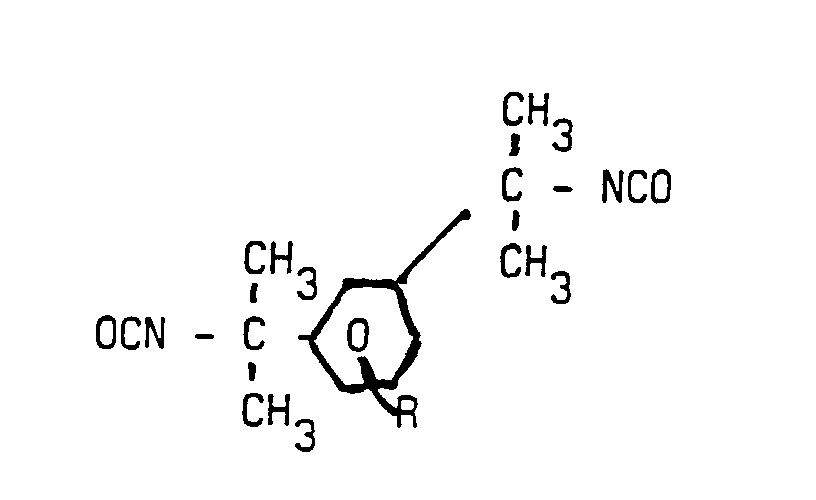
- Examples of the sterically hindered diisocyanates that can be used are 1,1,6,6-tetramethyl-hexamethylene diisocyanate, 1,6, -dibutyl-perntamethylene diisocyanate-1,5, 1,4-dimethyl-cyclohexane diisocyanate-1,4, p- or m -Tetramethylxylylene diisocyanate of the formulas wherein R has the meaning of H or C 1 - C 4 alkyl and the corresponding hydrogenated homologues.
- These diisocyanates can also be converted into higher-functionality compounds, for example by trimerization to isocyanurates, by reaction with water or with trimethylolpropane. Tetramethylxylyl diisocyanate and its reaction product with trimethylol propane are particularly preferred.
- the polyisocyanate component can be a mixture of different polyisocyanates, e.g. as any mixture of those mentioned above as examples Di- and polyisocyanates are present. Mixtures of two and more functional Polyisocyanates are preferred.
- the sterically hindered diisocyanates of the general formula I and polyisocyanates derived therefrom can be mixed with or several polyisocyanates with more than one free isocyanate group available. These are preferably those whose isocyanate groups are not sterically disabled. These are any organic polyisocyanates with aliphatic, cycloaliphatic, araliphatic and / or aromatically bound, free isocyanate groups which Are liquid at room temperature, which may be by adding organic Solvent is effected. They are preferably polyisocyanates or Polyisocyanate mixtures with only aliphatic and / or cycloaliphatic bound isocyanate groups with a medium NCO functionality from 1.5 to 5, preferably 2 to 3.
- the polyisocyanates described above or their are preferred Mixtures in suitable before adding them to the waterborne basecoats mentioned organic solvents pre-dissolved.
- the solvents are said to be water miscible and be water-emulsifiable, but should not or only very slowly react with isocyanates.
- Suitable solvents are, for example Glycol dialkyethers such as glycol dimethyl ether, esters such as ethyl glycol acetate, Ketones such as acetone or dioxane or N-methylpyrrolidone.
- Glycol dialkyethers such as glycol dimethyl ether
- esters such as ethyl glycol acetate
- Ketones such as acetone or dioxane or N-methylpyrrolidone.
- ketone alcohols or Alkoxyalkanols such as butoxyethanol, butyl diglycol, methoxyisopropanol or Diacetone alcohol.
- the polyisocyanate solution or corresponding liquid polyisocyanates immediately before applying the water-based paint, e.g. with stirring, admitted.
- the modified waterborne basecoat has a pot life of 1 up to 6 hours.
- An application outside the pot life can lead to blistering in the applied Lead coating.
- modified base coating compositions used according to the invention can be applied to various substrates using conventional coating processes are applied, for example by spraying, brushing or knife coating.
- substrates such as metals, Plastics, wood. Metals are particularly suitable.
- substrates may also have been pretreated, such as one primer and the application of another in a multi-layer construction usual layers, such as filler layers, filler layers and intermediate layers.
- the modified waterborne basecoats used according to the invention are physically drying, that means they do not require baking and can be dried, for example, at temperatures of 20 to 60 ° C. After application, they can be coated with transparent top coats will. The coating can be wet-on-wet, after a brief flash-off or after Drying the modified basecoat is done. The drying of the Clear coat can be done together with the basecoat.
- Clear coats come along with aqueous clear coats, powder clear coats and one-component clear varnishes based on solvents are preferred solvent-based two-component paints based on polyacrylate / polyisocyanate in question. Such clearcoats are described, for example, in EP-A-0 320 719 and DE-A-37 31 652, EP-A-0 012 98 13.
- sterically hindered di- and polyisocyanates are particularly easy to incorporate into the basecoats; the homogeneity is much better than when using sterically unhindered Di- and polyisocyanates. When using the latter comes it for speck formation; in addition, only short pot lives are achieved.
- water-based varnishes based on polyurethane modified according to the invention are very good hardnesses in multi-layer construction, especially at high layer thicknesses of the basecoat layer of 40 - 50 ⁇ m, and more excellent Achieved shine.
- the quality of such a multi-layer coating is comparable to a corresponding multi-layer structure based on conventional Basecoats.
- the waterborne basecoats modified according to the invention are used in of industrial, vehicle and vehicle parts painting for metal and Plastic coatings.
- the aqueous ones are preferably used Coating agent in vehicle refinishing and initial painting of vehicles or vehicle parts, in particular of motor vehicles and Commercial vehicles, at room temperature or forced drying.
- a reaction vessel with stirrer, internal thermometer, heating and reflux condenser 250 g of a linear polyester (built up from adipic acid, Isophthalic acid, hexanediol, OH number 77, acid number 10) with 80 g Methyl ethyl ketone and 53.3 g of N-methylpyrrolidone heated to 70 ° C and at this temperature 74 g of hydrogenated bisphenol A and 28.3 g of dimethylolpropionic acid added. The batch is heated to 120 ° C and a half Hour at this temperature. Then at 70 ° C 146.7 g of hexamethylene diisocyanate are added.
- the batch After an exothermic phase (temperature ⁇ 90 ° C) the batch is kept at 70 ° C until the residual isocyanate values are less than 1.8.
- the warm resin mixture is in 891 g of deionized water and 23.5 g of triethylamine with vigorous stirring dispersed. Five minutes after the end of the resin addition, 10.5 g of 1,3-propylenediamine added in 75 g of deionized water and the batch still stirred for an hour.
- a metallic waterborne basecoat is produced from the aqueous polyurethane dispersion prepared in Preparation Example 1 and has the following constituents: 35.5 Parts of the dispersion according to Preparation Example 1 47.7 Parts of water 2.0 Parts of n-butanol 8.1 Parts of butyl glycol 0.3 Parts of a commercially available corrosion inhibitor to prevent aluminum gassing 2.1 Parts of a commercially available thickener 0.2 Parts of N, N-dimethylethanolamine 4.1 Parts of a commercially available aluminum paste, 60% Al (the information is based on the weight)
- a polyisocyanate solution is then prepared by mixing the following components: 40 Parts of glycol dimethyl ether 60 Share TMXDI
- a plain waterborne basecoat with the following constituents is produced from the aqueous polyurethane dispersion prepared in Preparation Example 1: 35.5 Parts of the dispersion according to Preparation Example 1 21.1 Parts of water 12.1 Parts of butyl glycol 1.3 Parts of a commercially available thickener 0.14 Parts of N, N-dimethylethanolamine 22.1 Parts of a commercially available titanium dioxide pigment 0.5 Parts of a commercially available copper phthalocyanine pigment 0.16 Parts of a commercially available defoamer 8.1 Parts of a commercially available polyurethane grinder (the data are based on weight)
- the resulting uni basecoat has a viscosity of approx. 45 s (DIN-Becker, 4 mm nozzle, 23 ° C) and a solids content of 39.8%.
- a polyisocyanate solution is then prepared by mixing the following components: 40 Parts of glycol dimethyl ether 60 Share TMXDI
- a metallic water-based lacquer is produced in accordance with production example 2, but without the addition of the polyisocyanate solution.
Landscapes
- Chemical & Material Sciences (AREA)
- Organic Chemistry (AREA)
- Health & Medical Sciences (AREA)
- Chemical Kinetics & Catalysis (AREA)
- Medicinal Chemistry (AREA)
- Polymers & Plastics (AREA)
- Engineering & Computer Science (AREA)
- Life Sciences & Earth Sciences (AREA)
- Manufacturing & Machinery (AREA)
- Materials Engineering (AREA)
- Wood Science & Technology (AREA)
- Application Of Or Painting With Fluid Materials (AREA)
- Polyurethanes Or Polyureas (AREA)
- Paints Or Removers (AREA)
- Medicinal Preparation (AREA)
- Polymers With Sulfur, Phosphorus Or Metals In The Main Chain (AREA)
- Electroluminescent Light Sources (AREA)
Abstract
Description
Die Erfindung betrifft ein Verfahren zur Herstellung von Mehrschichtlackierungen durch Auftrag einer Basislackschicht aus wäßrigen Überzugsmitteln auf ein Substrat und anschließenden Auftrag eines Klarlacks auf der Basis organischer Lösemittel. Es werden Überzüge mit ausgezeichnetem Glanz und hervorragender Härte erzielt.The invention relates to a method for producing multi-layer coatings by applying a basecoat layer of aqueous coating compositions on a substrate and then applying a clear coat the basis of organic solvents. There are coatings with excellent Achieved gloss and excellent hardness.
Aus Umweltschutzgründen ist man bestrebt, die Lösemittelemission bei Beschichtungsprozessen merkbar zu reduzieren. Bei der Applikation von Basislacken ist aufgrund der festkörperarmen Formulierungen die Lösemittelemission besonders hoch. Deshalb ist es von besonderer Bedeutung, herkömmliche lösemittelhaltige Basislacke durch wäßrige Systeme zu ersetzen.For environmental reasons, efforts are being made to reduce solvent emissions Noticeably reduce coating processes. When applying Basecoats are solvent emissions due to the low solids formulations especially high. Therefore it is of particular importance conventional solventborne basecoats through aqueous systems replace.
In der DE-A-41 15 015 und DE-A-41 15 042 werden physikalisch trocknende Überzugsmittel auf wäßriger Basis, insbesondere für die Herstellung von Metallic-Überzügen und für die Herstellung von unifarbenen Überzügen, beschrieben. Die Metallic-Lacke enthalten mindestens ein Bindemittel, basierend auf Carbonatgruppierungen enthaltenden Polyurethanen mit einem zahlenmittleren Molekulargewicht (Mn) von 70000 bis 500000 und weiteren Polyurethanen mit einem Mn von 20000 bis 60000. Zur Herstellung der unifarbenen Überzüge werden Bindemittelmischungen auf Basis Carbonatgruppierungen enthaltender Polyurethane mit einer Glasübergangstemperatur (Tg) kleiner 0°C und ungesättigter Reaktionsprodukte von carboxyfunktionellen Polykondensaten mit ethylenisch ungesättigten Monomeren mit einer Glasübergangstemperatur größer 0°C eingesetzt.In DE-A-41 15 015 and DE-A-41 15 042 are physically drying Water-based coating compositions, in particular for the production of Metallic coatings and for the production of plain-colored coatings, described. The metallic paints contain at least one binder, based on polyurethanes containing carbonate groups with a number average molecular weight (Mn) from 70,000 to 500,000 and others Polyurethanes with a Mn of 20,000 to 60,000. For the production of Plain-colored coatings become binder mixtures based on carbonate groups containing polyurethane with a glass transition temperature (Tg) less than 0 ° C and unsaturated reaction products of carboxy functional Polycondensates with ethylenically unsaturated monomers with a Glass transition temperature greater than 0 ° C used.
Derartige physikalisch trocknende Überzugsmittel sind aufgrund ihrer Fähigkeit, bei Raumtemperatur bzw. bei geringfügigem Erwärmen, beispielsweise auf bis zu 60°C, auszuhärten, besonders für Reparaturlackierungen von Kraftfahrzeugen geeignet. Sie können nach der Applikation mit transparenten Decklacken beschichtet werden. Die Beschichtung kann naß-in-naß nach kurzem Ablüften oder nach Trocknen der Basislackschicht erfolgen. Als Klarlack kommen übliche transparente Lacke aus dem Kraftfahrzeugsektor zur Anwendung. Hierbei handelt es sich insbesondere um Zweikomponentenlacke auf Acrylat/Isocyanat-Basis in konventionellen Formulierungen.Such physically drying coating agents are due to their Ability to, for example, at room temperature or with slight heating cure up to 60 ° C, especially for refinishing suitable for motor vehicles. You can use transparent after application Topcoats are coated. The coating can be wet-on-wet after a short flash-off or after the basecoat has dried. The usual transparent lacquers from the motor vehicle sector come as clear lacquers to use. These are in particular two-component paints based on acrylate / isocyanate in conventional formulations.
Es ist bisher allgemein beschrieben worden, daß bei rein physikalisch trocknenden wäßrigen Polyurethandispersionen die Eigenschaften der erzielten Filme durch Zusatz spezieller dispergierbarer Polyisocyanate verbessert werden können (Lacke und Farben, Heft 10/1992, Information BAYER). Es wird nicht angegeben, um welche speziellen Polyisocyanate es sich dabei handelt und unter welchen Bedingungen konkrete Eigenschaften verbessert werden können.It has so far been generally described that at purely physical drying aqueous polyurethane dispersions the properties of achieved films by adding special dispersible polyisocyanates can be improved (paints and varnishes, issue 10/1992, information BAYER). It is not specified what special polyisocyanates it is it concerns and under what conditions concrete properties can be improved.
In der DE-A-27 88 442 werden wäßrige Dispersionen von anionisch, kationisch oder nicht-ionisch hydrophil modifizierten Polyurethanen beschrieben. Diesen wäßrigen Dispersionen werden zur Modifizierung der anwendungstechnischen Eigenschaften bei Raumtemperatur flüssige organische Diisocyanate mit einem maximalen mittleren Molekulargewicht von 400 in einer Menge von 1,5 - 80 Gew.-% und im Falle der Verwendung von Hexamethylendiisocyanat in einer Menge von 1,5 - 5 Gew.-%, bezogen auf den Gesamtfeststoffanteil der Dispersion, zugesetzt. Der Zusatz der Diisocyanate muß unter Durchmischen bei einer Temperatur zwischen 0 und 50°C erfolgen. Die Temperatur muß solange aufrechterhalten werden, bis mindestens 50 % der Isocyanatgruppen des Diisocyanats abreagiert sind. Die Umsetzung wird anschließend gegebenenfalls durch Erhitzen auf bis zu 100°C zu Ende geführt. Die genaue Einhaltung der genannten Temperaturbedingungen ist nach der Beschreibung zur Erreichung des angestrebten Effekts, einer Umhüllung der in der Dispersion vorliegenden Latexteilchen mit einer Polyharnstoffschicht, wesentlich. Diese Dispersionen werden vorwiegend zur Beschichtung von Leder, Papier und Textilien verwendet, deren Eigenschaften, Zugfestigkeit, Reibechtheit, Wasser- und Hochtemperaturbeständigkeit und Griff verbessert werden.DE-A-27 88 442 describes aqueous dispersions of anionic and cationic or non-ionically hydrophilically modified polyurethanes. These aqueous dispersions are used to modify the application technology Properties liquid organic at room temperature Diisocyanates with a maximum average molecular weight of 400 in an amount of 1.5 - 80 wt .-% and in the case of the use of hexamethylene diisocyanate in an amount of 1.5 - 5 wt .-%, based on the Total solids content of the dispersion added. The addition of the diisocyanates must be mixed at a temperature between 0 and 50 ° C respectively. The temperature must be maintained until at least 50% of the isocyanate groups of the diisocyanate have reacted. The The reaction is then optionally carried out by heating up to 100 ° C to the end. The exact adherence to the mentioned temperature conditions is according to the description to achieve the desired Effect, a coating of the latex particles present in the dispersion with a polyurea layer, essential. These dispersions will mainly used to coat leather, paper and textiles, their properties, tensile strength, rub fastness, water and high temperature resistance and grip can be improved.
Ein Nachteil der bisher bekannten Mehrschichtaufbauten unter Verwendung von wäßrigen Basislacken auf der Grundlage von physikalisch trocknenden Polyurethanen besteht jedoch darin, daß nach dem Überlackierungen mit Klarlack eine ungenügende Härte der Basislackschicht und damit der gesamten Decklackschicht resultiert. Besonders bei höheren Schichtdicken (von etwa 40 µm und mehr) bleibt der Basislack zu weich. Auch der erzielte Glanz und die Wasserbeständigkeit bleiben unbefriedigend.A disadvantage of the previously known multi-layer structures using of aqueous basecoats based on physically drying Polyurethanes, however, is that after overpainting with Clear lacquer an insufficient hardness of the basecoat layer and thus the entire top coat results. Especially with thicker layers (of about 40 µm and more) the basecoat remains too soft. The one achieved Shine and water resistance remain unsatisfactory.
Aufgabe der Erfindung ist es daher, Mehrschichtlackierungen unter Verwendung von Wasserbasislacken (uni und metallic) und Überlackierung mit lösemittelhaltigen Klarlacken bereitzustellen, ohne dabei im Vergleich mit der Verwendung konventioneller lösemittelhaltiger Basislacke Einbußen an Glanz und Härte hinnehmen zu müssen.The object of the invention is therefore to use multi-layer coatings of waterborne basecoats (plain and metallic) and overcoating with to provide solvent-based clear coats without comparing them with the use of conventional solvent-based basecoats to have to accept gloss and hardness.
Es hat sich gezeigt, daß diese Aufgabe gelöst werden kann durch das einen
Gegenstand der Erfindung bildende Verfahren zur Herstellung einer Mehrschichtlackierung
durch Auftrag einer Basislackschicht aus einem wäßrigen
Überzugsmittel auf ein Substrat und anschließenden Auftrag einer Schicht
aus einem organische Lösemittel enthaltenden Klarlack, das dadurch
gekennzeichnet ist, daß man zur Herstellung der Basislackschicht ein
wäßriges Überzugsmittel aufträgt, das neben Wasser, einem oder mehreren
Pigmenten, sowie gegebenenfalls einem oder mehreren organischen Lösemitteln,
Neutralisationsmitteln und lacküblichen Additiven als Bindemittel
enthält:
eine Kombination von
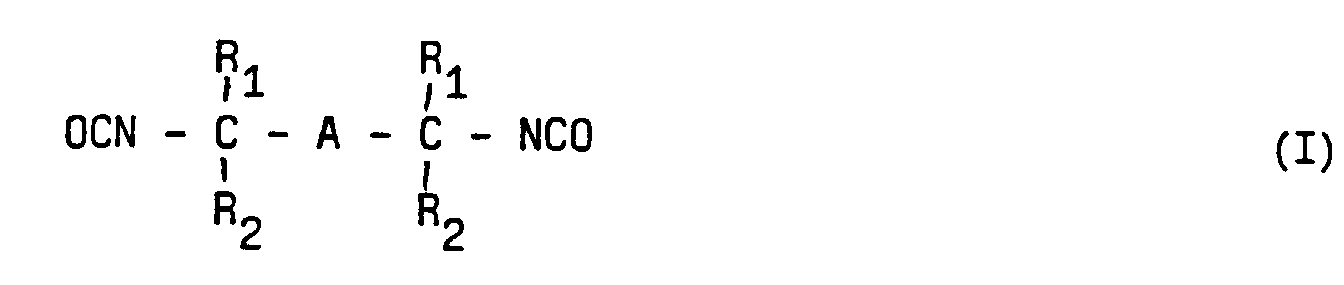
- R1 =
- -H oder -CnH2n+1
- R2 =
- -CnH2n+1
- A =
- eine einfache Bindung, ein aromatischer oder alicyclischer Rest, oder ein linearer oder verzweigter aliphatischer Rest mit 1 bis 12 Kohlenstoffatomen ist deren Umsetzungsprodukte mit Wasser oder mehrwertigen Alkoholen, deren Uretdione, Isocyanate und/oder Biurete, wobei bis 40 Gew.-%, bezogen auf das Festkörpergewicht der Polyisocyanatkomponente II durch ein oder mehrere, bei Raumtemperatur flüssige oder durch organische Lösemittel verflüssigte, davon verschiedene Polyisocyanate mit mehr als einer freien Isocyanatgruppe ersetzt sein können,
und daß man auf den so erhaltenen Basisüberzug nach dem Trocknen oder naß-in-naß die Klarlackschicht aufbringt und gegebenenfalls zusammen mit der Basislackschicht aushärtet.
a combination of
- R 1 =
- -H or -C n H 2n + 1
- R 2 =
- -C n H 2n + 1
- A =
- a simple bond, an aromatic or alicyclic radical, or a linear or branched aliphatic radical having 1 to 12 carbon atoms is their reaction products with water or polyhydric alcohols, their uretdiones, isocyanates and / or biurets, with up to 40% by weight, based on the solids weight of the polyisocyanate component II by one or more liquid at room temperature or liquefied by organic solvents, of which various polyisocyanates with more than one free isocyanate group can be replaced,
and that the clear coat is applied to the base coat thus obtained after drying or wet-on-wet and optionally cured together with the base coat.
Die Komponente I des erfindungsgemäß eingesetzten Bindemittels wird vorzugsweise in einer Menge von 99 bis 90 Gew.-% zusammen mit bevorzugt 1 bis 10 Gew.-% der Komponente II eingesetzt, wobei sich die Gew.-% auf 100 Gew.-% addieren. Component I of the binder used according to the invention is preferably in an amount of 99 to 90% by weight together with preferably 1 up to 10% by weight of component II, the% by weight being 100 Add% by weight.
Es wurde gefunden, daß durch Zusatz der vorstehend definierten speziellen Polyisocyanate II zu physikalisch trockenden Wasserbasislacken auf Polyurethanbasis im Mehrschichtaufbau, das heißt nach Überlackieren mit lösemittelhaltigen, insbesondere zweikomponentigen, Klarlacken, insbesondere auf Polyacrylat/Polyisocyanat-Basis, sehr gute Härte des Gesamtaufbaus, insbesondere bei hohen Schichtdicken des Basislackes, sowie ausgezeichneter Glanz erzielt werden.It has been found that by adding the specific ones defined above Polyisocyanate II to physically drying waterborne basecoats Multi-layer polyurethane base, i.e. after overpainting solvent-based, in particular two-component, clear coats, in particular based on polyacrylate / polyisocyanate, very good hardness of the overall structure, especially with high layer thicknesses of the basecoat, as well as excellent Shine can be achieved.
Bei den verwendbaren wäßrigen, physikalisch trocknenden Polyurethan-Bindemitteln handelt es sich um solche, wie sie beispielsweise in an sich bekannten Wasserbasislacken, wie Effektlacken (Metallic- und Perlmuttlacke) oder unifarbenen Lacken auf Polyurethanbasis eingesetzt werden. Im Prinzip ist es möglich, die Polyisocyanatkomponente II bekannten Wasserbasislacken, die der vorstehenden Spezifikation der Polyurethan-Bindemittel entsprechen, zuzusetzen.In the aqueous, physically drying polyurethane binders that can be used are they such as those in themselves known water-based paints, such as effect paints (metallic and mother-of-pearl paints) or plain-colored lacquers based on polyurethane. in the In principle, it is possible to use the water-based lacquers known from polyisocyanate component II, that of the above specification of the polyurethane binders correspond to add.
Beispiele für verwendbare Polyurethan-Basislacke, sind solche, die
Bindemittel oder Bindemittelgemische enthalten, basierend auf
Derartige Polyurethan-Basislacke sind besonders geeignet als Effekt-Basislacke, z.B. Metallic-Basislacke. Sie enthalten beispielsweise 8 bis 30 Gew.-%, bezogen auf den applikationsfertigen Lack, des vorstehend definierten Bindemittelgemisches A) + B).Such polyurethane basecoats are particularly suitable as effect basecoats, e.g. Metallic basecoats. For example, they contain 8 to 30% by weight, based on the ready-to-apply lacquer, of the above defined binder mixture A) + B).
In dem Bindemittelgemisch können die Polyurethane mit Mn 70000 bis 500000 zu 50 - 90 Gew.-% und die Polyurethane mit Mn 20000 - 60000 zu 10 - 50 Gew.-%, jeweils in Form wäßriger Dispersionen, enthalten sein (wobei sich die Gew.-% jeweils auf den Harzfestkörper beziehen). In the binder mixture, the polyurethanes with Mn 70000 to 500000 to 50 - 90 wt .-% and the polyurethanes with Mn 20000 - 60000 to 10 - 50 % By weight, each in the form of aqueous dispersions, may be present ( the wt .-% each refer to the resin solids).
Komponente A) ist erhältlich durch Umsetzung von
Bevorzugt weisen die als Komponente A) eingesetzten Polyurethane mindestens 200 Milliäquivalente pro 100 g Feststof an chemisch eingebauten Carbonatgruppierungen -O-CO-O- auf. Sie enthalten bevorzugt nicht mehr als ingesamt 320 Milliäquivalente pro 100 g Feststoff an chemisch eingebauten Urethangruppierungen -NH-CO-O- und gegebenenfalls chemisch eingebauten Harnstoffgruppierungen -NH-CO-NH-.The polyurethanes used as component A) preferably have at least 200 milliequivalents per 100 g solids of chemically incorporated Carbonate groups -O-CO-O-. They preferably no longer contain as a total of 320 milliequivalents per 100 g solid of chemically incorporated Urethane groups -NH-CO-O- and optionally chemically built-in Urea groups -NH-CO-NH-.
Beispiel für als Komponente B) eingesetzte Polyurethane sind solche, die
erhältlich sind durch Umsetzung von
Derartige Polyurethane, ihre Herstellung und Verwendung in Wasserbasislacken sind in der DE-A-41 15 042 ausführlich beschrieben.Such polyurethanes, their manufacture and use in waterborne basecoats are described in detail in DE-A-41 15 042.
Ein weiteres Beispiel für die erfindungsgemäß einsetzbare Polyurethan-Bindemittelkomponente I sind Bindemittel bzw. Bindemittelgemische auf der Basis von C) einem oder mehreren, Carbonatgruppierungen enthaltenden Polyurethanen mit einer Glasübergangstemperatur kleiner 0°C und D) einem oder mehreren ungesättigten Reaktionsprodukten von carboxyfunktionellen Polykondensaten mit ethylenisch ungesättigten Monomeren mit einer Glasübergangstemperatur größer 0°C. Die Polyurethane mit der Glasübergangstemperatur kleiner 0°C können z.B. zu 50 - 90 Gew.-% und die ungesättigten Reaktionsprodukte mit einer Glasübergangstemperatur größer 0°C zu 10 - 50 Gew.-%, jeweils in Form der wäßrigen Dispersionen, enthalten sein. Dabei beziehen sich die Gew.-% auf den Bindemittelfestkörper und addieren sich zu 100 %.Another example of the polyurethane binder component that can be used according to the invention I are binders or binder mixtures on the Basis of C) one or more polyurethanes containing carbonate groups with a glass transition temperature less than 0 ° C and D) one or several unsaturated reaction products of carboxy-functional polycondensates with ethylenically unsaturated monomers with a glass transition temperature greater than 0 ° C. The polyurethanes with the glass transition temperature e.g. below 0 ° C 50 - 90 wt .-% and the unsaturated reaction products with a glass transition temperature greater than 0 ° C to 10 - 50 % By weight, in each case in the form of the aqueous dispersions, may be present. Here the% by weight relate to the binder solid and add up to 100 %.
Derartige Bindemittelsysteme sind insbesondere zur Herstellung von unifarbenen Überzügen geeignet. Bevorzugt enthalten solche Überzüge 5 bis 30 Gew.-% des Bindemittels bzw. Bindemittelgemisches, bezogen auf das Gewicht des applikationsfertigen Überzugsmittels.Such binder systems are particularly suitable for the production of plain-colored covers suitable. Such coatings preferably contain 5 to 30 wt .-% of the binder or binder mixture, based on the Weight of the ready-to-apply coating agent.
Beispiele für die Komponente C) sind solche, die erhältlich sind durch
Umsetzung von
Bevorzugt weisen die als Komponente C) eingesetzten Polyurethane mindestens 200 Milliäquivalent pro 100 g Feststoff an chemisch eingebauten Carbonatgruppierungen -O-CO-O- auf. Sie enthalten bevorzugt nicht mehr als insgesamt 320 Milliäquivalent pro 100 g Feststoff an chemisch eingebauten Urethangruppierungen -NH-CO-O- und gegebenenfalls chemisch eingebauten Harnstoffgruppierungen -NH-CO-NH-.The polyurethanes used as component C) preferably have at least 200 milliequivalents per 100 g solids of chemically incorporated Carbonate groups -O-CO-O-. They preferably no longer contain as a total of 320 milliequivalents per 100 g of solid built-in chemicals Urethane groups -NH-CO-O- and optionally chemically built-in Urea groups -NH-CO-NH-.
Die als Komponente D) eingesetzten ungesättigten Reaktionsprodukte sind
erhältlich durch Umsetzung von
Derartige Polyurethane bzw. Gemische, ihre Herstellung und Verwendung in Wasserbasislacken sind in der DE-A-41 15 042 ausführlich beschrieben.Such polyurethanes or mixtures, their production and use in Waterborne basecoats are described in detail in DE-A-41 15 042.
Weitere Beispiele für erfindungsgemäß einsetzbare Polyurethanbindemittel sind solche auf Basis acrylierter Polyurethane, wie sie in DE-A-41 22 265 beschrieben sind. Auch Kombinationen der genannten Bindemittel sind möglich.Further examples of polyurethane binders which can be used according to the invention are those based on acrylated polyurethanes, as described in DE-A-41 22 265 are described. Combinations of the binders mentioned are also possible.
Die erfindungsgemäß eingesetzten uni- oder metallicfarbenen Überzugsmittel auf Wasserbasis enthalten beispielsweise etwa 5 bis 35 Gew.-% Bindemittelanteil (bestehend aus den Komponenten I und II), 50 bis 85 Gew.-% Wasser, 1 bis 20 Gew.-% eines oder mehrerer wassermischbarer Lösemittel, z.B. Alkohole, wie Butanol, Isopropanol, Glykole, wie Butylglykol, Ethylenglykol, aromatische Kohlenwasserstoffe, wie Solvesso, Etheralkohole, wie Butoxypropanol, Methoxypropanol, Methoxypropylacetat, sowie 0,3 - 25 Gew.-% Pigmente, sowie gegebenenfalls Neutralisationsmittel und übliche Additive in benötigten, üblichen Anteilen.The single-color or metallic-colored coating agents used according to the invention water-based, for example, contain about 5 to 35 wt .-% binder (consisting of components I and II), 50 to 85% by weight Water, 1 to 20% by weight of one or more water-miscible solvents, e.g. Alcohols, such as butanol, isopropanol, glycols, such as butyl glycol, Ethylene glycol, aromatic hydrocarbons, such as Solvesso, ether alcohols, such as butoxypropanol, methoxypropanol, methoxypropylacetate, and 0.3 - 25 wt .-% pigments, and optionally neutralizing agents and usual additives in required, usual proportions.
Bei den Pigmenten kann es sich um deckende, transparente oder effektgebende Pigmente handeln. Zur Formulierung eines Metallic-Basislackes sind beispielsweise 0,3 - 4 Gew.-% eines oder mehrerer Metallpigmente und 0 - 10 Gew.-% eines oder mehrerer färbender oder effektgebender Pigmente enthalten. Zur Formulierung von Uni-Basislacken sind bevorzugt 5 - 20 Gew.-% an Pigmenten enthalten. The pigments can be opaque, transparent or effect Trade pigments. To formulate a metallic basecoat for example 0.3 - 4% by weight of one or more metal pigments and 0 - 10% by weight of one or more coloring or effect pigments contain. 5-20 are preferred for the formulation of solid-color basecoats % By weight of pigments.
Die Wasserbasislacke enthalten Neutralisationsmittel zur teilweisen Neutralisation von neutralisierbaren Gruppen. Der Neutralisationsgrad neutralisierbarer Gruppen beträgt bevorzugt 40 - 120 % der neutralisierbaren Gruppen und liegt insbesondere unter 100 %. Als Neutralisationsmittel kommen auf dem Lacksektor übliche Basen wie Ammoniak, N,N-Dimethylethanolamin oder tert.Amine, wie Triethylamin, Triethanolamin, N-Methylmorpholin in Frage.The waterborne basecoats partly contain neutralizing agents Neutralization of neutralizable groups. The degree of neutralization neutralizable groups is preferably 40-120% of the neutralizable groups Groups and is especially below 100%. As a neutralizing agent come common bases in the paint sector such as ammonia, N, N-dimethylethanolamine or tertiary amines, such as triethylamine, triethanolamine, N-methylmorpholine in question.
Die Wasserbasislacke enthalten weiterhin gegebenenfalls übliche Additive und Hilfsstoffe, wie sie auf dem Lacksektor eingesetzt werden. Derartige Hilfsmittel und Additive sind Verdicker, die Rheologie beeinflussende Zusätze, Antischaummittel, Korrosionsinhibitoren (beispielsweise zur Inhibierung der Gasung von Metallpigmenten). Die Additive und Hilfsstoffe werden in üblichen, dem Fachmann geläufigen Mengen zugesetzt.The waterborne basecoats may also contain conventional additives and auxiliaries as used in the paint sector. Such Aids and additives are thickeners that influence rheology Additives, anti-foaming agents, corrosion inhibitors (e.g. for Inhibition of the gassing of metal pigments). The additives are added in customary amounts familiar to the person skilled in the art.
Für das erfindungsgemäße Verfahren werden zunächst Wasserbasislacke
bereitet, die sämtliche Komponenten mit Ausnahme der Polyisocyanatkomponente
II enthalten. Den so teilweise fertiggestellten Wasserbasislacken
werden erfindungsgemäß erst kurz vor der Applikation 0,5 - 15 Gew.-%,
vorzugsweise 1 - 10 Gew.-%, bezogen auf den Festkörperanteil des Bindemittels,
eines oder mehrerer sterisch gehinderter Polyisocyanatemit mehr
als einer freien Isocyanatgruppe aus der Gruppe der Diisocyanate der
allgemeinen Formel

- A =
- eine einfache Bindung, ein aromatischer oder alicyclischer Rest, oder ein linearer oder verzweigter aliphatischer Rest mit 1 bis 12 Kohlenstoffatomen ist,
- A =
- is a simple bond, an aromatic or alicyclic radical, or a linear or branched aliphatic radical having 1 to 12 carbon atoms,
Die aromatischen Reste A haben beispielsweise 6 oder 10 C-Atome; ein Beispiel ist der Phenylenrest. Alicyclische Reste A haben beispielsweise 5 oder 6 C-Atome, bevorzugt ist der Cyclohexylenrest. Die aromatischen und alicyclischen Reste können unsubstituiert oder substituiert sein, beispielsweise durch einen oder mehrere Alkylreste mit 1 bis 4 C-Atomen.The aromatic radicals A have, for example, 6 or 10 carbon atoms; a An example is the phenylene residue. Alicyclic radicals A have, for example 5 or 6 carbon atoms, the cyclohexylene radical is preferred. The aromatic and alicyclic radicals can be unsubstituted or substituted, for example by one or more alkyl radicals with 1 to 4 carbon atoms.
Besonders bevorzugt werden sterisch gehinderte Polyisocyanate mit 4 bis 25, vorzugsweise 4 bis 16 C-Atomen, die in 2-Stellung zur NCO-Gruppe eine oder zwei lineare, verzweigte oder cyclische Alkylgruppen mit 1 bis 12, bevorzugt 1 bis 4 C-Atomen, enthalten.Sterically hindered polyisocyanates with 4 to 25, preferably 4 to 16 carbon atoms, one in the 2-position to the NCO group or two linear, branched or cyclic alkyl groups with 1 to 12, preferably 1 to 4 carbon atoms.
Bevorzugt sind die Di- und Polyisocyanate bei Raumtemperatur flüssig. Bevorzugt weisen die flüssigen oder verflüssigten Polyisocyanate bei Raumtemperatur (23°C) eine Viskosität von 1 bis 6000 mPa.s, vorzugsweise über 5 und unter 3000 mPa.s, besonders bevorzugt über 5 und unter 1000 mPa.s auf. Die mittlere Funktionalität der Polyisocyanate beträgt bevorzugt 1,5 bis 5 reaktive Isocyanatgruppen pro Molekül, besonders bevorzugt mindestens 2 und höchstens 3. Sie haben bevorzugt einen NCO-Gehalt von über 5 Gew.-%, bevorzugt unter 35 Gew.-%, besonders bevorzugt unter 25 Gew.-%.The di- and polyisocyanates are preferably liquid at room temperature. The liquid or liquefied polyisocyanates preferably have Room temperature (23 ° C) a viscosity of 1 to 6000 mPa.s, preferably above 5 and below 3000 mPa.s, particularly preferably above 5 and below 1000 mPa.s. The average functionality of the polyisocyanates is preferred 1.5 to 5 reactive isocyanate groups per molecule, particularly preferred at least 2 and at most 3. They preferably have an NCO content of above 5% by weight, preferably below 35% by weight, particularly preferably below 25 % By weight.
Bei den von den Diisocyanaten der allgemeinen Formel I abgeleiteten Polyisocyanaten handelt es sich beispielsweise um NCO-haltige Prepolymere, die aus den Diisocyanaten durch Umsetzung mit niedermolekularen polaren Verbindungen erhalten werden können. Durch anteilweisen Einbau von Polyethylenoxidresten oder ionisierbaren Gruppen kann beispielsweise die Emulgierbarkeit erhöht werden.In those derived from the diisocyanates of general formula I. Polyisocyanates are, for example, NCO-containing prepolymers, those from the diisocyanates by reaction with low molecular weight polar compounds can be obtained. Through partial installation of polyethylene oxide residues or ionizable groups can, for example the emulsifiability can be increased.
Weitere Beispiele für von den Diisocyanaten der allgemeinen Formel I abgeleitete Polyisocyanate sind höhere Homologe bzw. modifizierte Derivate davon.Further examples of the diisocyanates of the general formula I derived polyisocyanates are higher homologues or modified derivatives from that.
Höhere Homologe der sterisch behinderten Diisocyanate nach Formel I können beispielsweise durch Umsetzung von überschüssigem Diisocyanat mit Wasser, mehrwertigen Polyalkoholen, wie Glycerin, Trimethylolpropan, Pentaerythrit oder geeigneten OH-Oligomeren und anschließende destillative Entfernung des nicht umgesetzten Diisocyanat-Überschusses erhalten werden. Weitere einsetzbare Polyisocyanate sind Uretdione oder Isocyanurate der Diisocyanate. Bei ihrer Herstellung entstehen je nach gewählter Katalysierung Gemische aus Uretdion- und/oder Isocyanurat-Gruppen aufweisenden Polyisocyanaten. Ein Beispiel für einen weiteren Modifizierungsweg ist die Reaktion mit definierten Wassermengen unter Bildung von Biureten.Higher homologues of sterically hindered diisocyanates according to formula I. can, for example, by reacting excess diisocyanate with Water, polyhydric polyalcohols, such as glycerol, trimethylolpropane, Pentaerythritol or suitable OH oligomers and subsequent distillative Obtain removal of the unreacted excess diisocyanate will. Other polyisocyanates that can be used are uretdiones or isocyanurates the diisocyanates. In their manufacture arise depending on the selected Catalyzing mixtures of uretdione and / or isocyanurate groups Polyisocyanates. An example of another modification route is the reaction with defined amounts of water to form biurets.
Bei der Modifizierung der sterisch gehinderten Diisocyanate der allgemeinen Formel I können im Gemisch normale, das heißt sterisch nicht behinderte Polyisocyanate mitverwendet werden. Dabei werden im Gemisch bevorzugt bis 40 Gew.-% sterisch nicht gehinderte Diisocyanate eingesetzt, wobei sich die Gew.-% auf die gesamten Polyisocyanate beziehen. Ein erfindungsgemäß geeignetes Prepolymer kann auch durch Einpolymerisieren einer Verbindung erhalten werden, die neben einer radikalisch oder ionisch polymerisierbaren Doppelbindung noch mindestens eine sterisch gehinderte Isocyanatgruppe enthält wie beispielsweise Allylmonoisocyanat, Vinyl-phenylisocyanat, (Meth)acrylsäure-β-isocyanato-ethylester, (Meth)acryloyl-isocyanat oder bevorzugt m- oder p-Isopropenyl-, -di-methylbenzylisocyanat. Zur Verbesserung der Emulgierbarkeit können die Polyisocyanate mit hydrophilen Gruppen, wie Carboxylgruppen oder Polyethergruppen modifiziert sein.When modifying the sterically hindered diisocyanates of the general Formula I can be mixed in a normal, that is, not sterically disabled Polyisocyanates are also used. Mixtures are preferred up to 40% by weight of sterically unhindered diisocyanates, the% by weight based on the total polyisocyanates. A Prepolymer suitable according to the invention can also be copolymerized a compound can be obtained which, in addition to a radical or ionically polymerizable double bond or at least one steric hindered isocyanate group contains, for example, allyl monoisocyanate, Vinyl phenyl isocyanate, (meth) acrylic acid-β-isocyanato ethyl ester, (meth) acryloyl isocyanate or preferably m- or p-isopropenyl, -di-methylbenzyl isocyanate. The polyisocyanates can be used to improve the emulsifiability with hydrophilic groups, such as carboxyl groups or polyether groups be modified.
Beispiele für die verwendbaren sterisch gehinderten Diisocyanate sind
1,1,6,6-Tetramethyl-hexamethylendiisocyanat-, 1,6,-Dibutyl-perntamethylendiisocyanat-1,5,
1,4-Dimethyl-cyclohexandiisocyanat-1,4, p- oder m-Tetramethylxylylendiisocyanat
der Formeln

Die Polyisocyanatkomponente kann als Gemisch verschiedener Polyisocyanate, z.B. als beliebige Mischung der vorstehend als Beispiele genannten Di- und Polyisocyanate vorliegen. Mischungen aus zwei- und höherfunktionellen Polyisocyanaten sind bevorzugt.The polyisocyanate component can be a mixture of different polyisocyanates, e.g. as any mixture of those mentioned above as examples Di- and polyisocyanates are present. Mixtures of two and more functional Polyisocyanates are preferred.
Die sterisch behinderten Diisocyanate der allgemeinen Formel I und die davon abgeleiteten Polyisocyanate können im Gemisch mit einem oder mehreren Polyisocyanaten mit mehr als einer freien Isocyanatgruppe vorliegen. Es handelt sich hierbei bevorzugt um solche, deren Isocyanatgruppen sterisch nicht behindert sind. Es handelt sich hierbei um beliebige organische Polyisocyanate mit aliphatisch, cycloaliphatisch, araliphatisch und/oder aromatisch gebundenen, freien Isocyanatgruppen, die bei Raumtemperatur flüssig sind, was gegebenenfalls durch Zusatz organischer Lösemittel bewirkt wird. Bevorzugt handelt es sich um Polyisocyanate oder Polyisocyanatgemische mit ausschließlich aliphatisch und/oder cycloaliphatisch gebundenen Isocyanatgruppen mit einer mittleren NCO-Funktionalität von 1,5 bis 5, bevorzugt 2 bis 3.The sterically hindered diisocyanates of the general formula I and polyisocyanates derived therefrom can be mixed with or several polyisocyanates with more than one free isocyanate group available. These are preferably those whose isocyanate groups are not sterically disabled. These are any organic polyisocyanates with aliphatic, cycloaliphatic, araliphatic and / or aromatically bound, free isocyanate groups which Are liquid at room temperature, which may be by adding organic Solvent is effected. They are preferably polyisocyanates or Polyisocyanate mixtures with only aliphatic and / or cycloaliphatic bound isocyanate groups with a medium NCO functionality from 1.5 to 5, preferably 2 to 3.
Bevorzugt werden die vorstehend beschriebenen Polyisocyanate bzw. ihre Gemische vor dem Zusatz zu den genannten Wasserbasislacken in geeigneten organischen Lösemitteln vorgelöst. Die Lösemittel sollen wassermischbar und gut wasseremulgierbar sein, sollen jedoch nicht oder nur sehr langsam mit Isocyanaten reagieren. Geeignete Lösemittel sind beispielsweise Glykoldialkyether wie Glykoldimethylether, Ester wie Ethylglykolacetat, Ketone wie Aceton oder Dioxan oder N-Methylpyrrolidon. Bevorzugt werden Alkohole mit sterisch gehinderten Alkoholgruppen, Ketonalkohole oder Alkoxyalkanole wie Butoxyethanol, Butyldiglykol, Methoxyisopropanol oder Diacetonalkohol.The polyisocyanates described above or their are preferred Mixtures in suitable before adding them to the waterborne basecoats mentioned organic solvents pre-dissolved. The solvents are said to be water miscible and be water-emulsifiable, but should not or only very slowly react with isocyanates. Suitable solvents are, for example Glycol dialkyethers such as glycol dimethyl ether, esters such as ethyl glycol acetate, Ketones such as acetone or dioxane or N-methylpyrrolidone. To be favoured Alcohols with sterically hindered alcohol groups, ketone alcohols or Alkoxyalkanols such as butoxyethanol, butyl diglycol, methoxyisopropanol or Diacetone alcohol.
Bevorzugt wird mit diesen Lösemitteln kurz vor der Verarbeitung ohne Erwärmen eine Polyisocyanat-Lösung hergestellt, die bei einem Festkörper von über 40 Gew.-%, bevorzugt 50 - 95 Gew.-%, eine Viskosität von 0,5 bis 2000 mPa.s, bevorzugt 1 - 20 mPa.s hat.These solvents are preferred shortly before processing without Warm up a polyisocyanate solution that is produced with a solid of more than 40% by weight, preferably 50-95% by weight, a viscosity of 0.5 to 2000 mPa.s, preferably 1 - 20 mPa.s.
Die Polyisocyanatlösung oder entsprechende flüssige Polyisocyanate werden unmittelbar vor der Applikation dem Wasserbasislack, z.B. unter Rühren, zugegeben. Der so modifizierte Wasserbasislack weist eine Topfzeit von 1 bis 6 Stunden auf.The polyisocyanate solution or corresponding liquid polyisocyanates immediately before applying the water-based paint, e.g. with stirring, admitted. The modified waterborne basecoat has a pot life of 1 up to 6 hours.
Eine Applikation außerhalb der Topfzeit kann zu Blasenbildung im applizierten Überzug führen.An application outside the pot life can lead to blistering in the applied Lead coating.
Die erfindungsgemäß eingesetzten modifizierten Basisbeschichtungsmittel können auf verschiedene Substrate nach üblichen Beschichtungsverfahren aufgebracht werden, beispielsweise durch Spritzen, Streichen oder Rakeln. Als Substrate kommen verschiedene Materialien in Frage, wie Metalle, Kunststoffe, Holz. Bevorzugt geeignet sind Metalle. Diese Substrate können auch einer Vorbehandlung unterzogen worden sein, wie beispielsweise einer Grundierung sowie des Auftrags von weiteren im Mehrschichtaufbau üblichen Schichten, wie Füllerschichten, Spachtelschichten und Zwischenschichten. The modified base coating compositions used according to the invention can be applied to various substrates using conventional coating processes are applied, for example by spraying, brushing or knife coating. Various materials are possible as substrates, such as metals, Plastics, wood. Metals are particularly suitable. These substrates may also have been pretreated, such as one primer and the application of another in a multi-layer construction usual layers, such as filler layers, filler layers and intermediate layers.
Die erfindungsgemäß verwendeten modifizierten Wasserbasislacke sind physikalisch trocknend, das heißt sie erfordern kein Einbrennen und können beispielsweise bei Temperaturen von 20 bis 60°C getrocknet werden. Sie können nach dem Aufbringen mit transparenten Decklacken beschichtet werden. Die Beschichtung kann naß-in-naß, nach kurzem Ablüften oder nach Trocknen der modifizierten Basislackschicht erfolgen. Die Trocknung der Klarlackschicht kann gemeinsam mit der Basislackschicht erfolgen. Als Klarlacke kommen neben wäßrigen Klarlacken, Pulverklarlacken und einkomponentigen Klarlacken auf Lösemittelbasis bevorzugt übliche lösemittelhaltige Zweikomponentenlacke auf Polyacrylat/Polyisocyanat-Basis in Frage. Derartige Klarlacke sind beispielsweise beschrieben in EP-A-0 320 719 und DE-A-37 31 652, EP-A-0 012 98 13.The modified waterborne basecoats used according to the invention are physically drying, that means they do not require baking and can be dried, for example, at temperatures of 20 to 60 ° C. After application, they can be coated with transparent top coats will. The coating can be wet-on-wet, after a brief flash-off or after Drying the modified basecoat is done. The drying of the Clear coat can be done together with the basecoat. As Clear coats come along with aqueous clear coats, powder clear coats and one-component clear varnishes based on solvents are preferred solvent-based two-component paints based on polyacrylate / polyisocyanate in question. Such clearcoats are described, for example, in EP-A-0 320 719 and DE-A-37 31 652, EP-A-0 012 98 13.
Durch den Einsatz der sterisch gehinderten Di- und Polyisocyanate ergibt sich eine besonders gute Einarbeitbarkeit in die Basislacke; die Homogenität ist wesentlich besser als bei Verwendung von sterisch nicht-gehinderten Di- und Polyisocyanaten. Bei der Verwendung letzterer kommt es zur Stippenbildung; außerdem werden nur kurze Topfzeiten erzielt.By using the sterically hindered di- and polyisocyanates are particularly easy to incorporate into the basecoats; the homogeneity is much better than when using sterically unhindered Di- and polyisocyanates. When using the latter comes it for speck formation; in addition, only short pot lives are achieved.
Mit den erfindungsgemäß modifizierten Wasserbasislacken auf Polyurethanbasis werden im Mehrschichtaufbau sehr gute Härten, insbesondere bei hohen Schichtdicken der Basislackschicht von 40 - 50 µm, und ausgezeichneter Glanz erzielt. Die Qualität einer solchen Mehrschichtlackierung ist vergleichbar mit einem entsprechenden Mehrschichtaufbau auf Basis konventioneller Basislacke.With the water-based varnishes based on polyurethane modified according to the invention are very good hardnesses in multi-layer construction, especially at high layer thicknesses of the basecoat layer of 40 - 50 µm, and more excellent Achieved shine. The quality of such a multi-layer coating is comparable to a corresponding multi-layer structure based on conventional Basecoats.
Die erfindungsgemäß modifizierten Wasserbasislacke finden Anwendung in der Industrie-, Fahrzeug- und Fahrzeugteilelackierung für Metall- und Kunststoffbeschichtungen. Bevorzugt angewendet werden die wäßrigen Überzugsmittel in der Fahrzeugreparaturlackierung und der Erstlackierung von Fahrzeugen oder Fahrzeugteilen, insbesondere von Kraftfahrzeugen und Nutzfahrzeugen, bei Raumtemperatur bzw. forcierter Trocknung.The waterborne basecoats modified according to the invention are used in of industrial, vehicle and vehicle parts painting for metal and Plastic coatings. The aqueous ones are preferably used Coating agent in vehicle refinishing and initial painting of vehicles or vehicle parts, in particular of motor vehicles and Commercial vehicles, at room temperature or forced drying.
Die Erfindung soll an Hand der nachfolgenden Beispiele und Vergleichsbeispiele näher erläutert werden. The invention is illustrated by the following examples and comparative examples are explained in more detail.
In einem Reaktionsgefäß mit Rührer, Innenthermometer, Heizung und Rückflußkühler werden 250 g eines linearen Polyesters (aufgebaut aus Adipinsäure, Isophthalsäure, Hexandiol, OH-Zahl 77, Säurezahl 10) mit 80 g Methylethylketon und 53,3 g N-Methylpyrrolidon auf 70°C erwärmt und bei dieser Temperatur 74 g hydriertes Bisphenol A sowie 28,3 g Dimethylolpropionsäure zugesetzt. Der Ansatz wird auf 120°C erwärmt und eine halbe Stunde bei dieser Temperatur gerührt. Anschließend werden bei 70°C 146,7 g Hexamethylendiisocyanat zugesetzt. Nach einer exothermen Phase (Temperatur < 90°C) wird der Ansatz so lange bei 70°C gehalten, bis die Restisocyanatzahlwerte kleiner als 1,8 sind. Die warme Harzmischung wird in 891 g entionisiertes Wasser und 23,5 g Triethylamin unter starkem Rühren dispergiert. Fünf Minuten nach Ende der Harzzugabe werden 10,5 g Propylendiamin-1,3 in 75 g entionisiertem Wasser zugesetzt und der Ansatz noch eine Stunde gerührt.In a reaction vessel with stirrer, internal thermometer, heating and reflux condenser 250 g of a linear polyester (built up from adipic acid, Isophthalic acid, hexanediol, OH number 77, acid number 10) with 80 g Methyl ethyl ketone and 53.3 g of N-methylpyrrolidone heated to 70 ° C and at this temperature 74 g of hydrogenated bisphenol A and 28.3 g of dimethylolpropionic acid added. The batch is heated to 120 ° C and a half Hour at this temperature. Then at 70 ° C 146.7 g of hexamethylene diisocyanate are added. After an exothermic phase (temperature <90 ° C) the batch is kept at 70 ° C until the residual isocyanate values are less than 1.8. The warm resin mixture is in 891 g of deionized water and 23.5 g of triethylamine with vigorous stirring dispersed. Five minutes after the end of the resin addition, 10.5 g of 1,3-propylenediamine added in 75 g of deionized water and the batch still stirred for an hour.
Es resultiert eine durchscheinende wäßrige Dispersion mit folgenden Kenndaten:
- Feststoffgehalt 30 %
- Viskosität (20°C) 109 mPa.s
- pH-Wert 9,8
- Säurezahl 27 (mg KOH pro g Festharz)
- Mn 34.000
- Solids content 30%
- Viscosity (20 ° C) 109 mPa.s
- pH 9.8
- Acid number 27 (mg KOH per g solid resin)
- Mn 34,000
Aus der in Herstellungsbeispiel 1 hergestellten wäßrigen Polyurethandispersion
wird ein Metallic-Wasserbasislack mit folgenden Bestandteilen
hergestellt:
Es resultiert ein Metallic-Basislack mit einer Viskosität von ca. 30 s (DIN-Becher, 4 mm Düse, 23°C) und einem Festkörpergehalt von 15,9 %.The result is a metallic basecoat with a viscosity of approx. 30 s (DIN cup, 4 mm nozzle, 23 ° C) and a solids content of 15.9%.
Anschließend wird eine Polyisocyanat-Lösung durch Vermischen folgender
Bestandteile hergestellt:
Unmittelbar vor der Verarbeitung werden 8 Gew.-% der Polyisocyanat-Lösung, bezogen auf den Festkörpergehalt des Bindemittels, zum Metallic-Wasserbasislack zugegeben.Immediately before processing, 8% by weight of the polyisocyanate solution, based on the solids content of the binder, to the metallic water-based paint admitted.
Aus der in Herstellungsbeispiel 1 hergestellten wäßrigen Polyurethandispersion
wird ein Uni-Wasserbasislack mit folgenden Bestandteilen hergestellt:
Der resultierende Uni-Basislack zeigt eine Viskosität von ca. 45 s (DIN-Becker, 4 mm Düse, 23°C) und einen Festkörpergehalt von 39,8 %.The resulting uni basecoat has a viscosity of approx. 45 s (DIN-Becker, 4 mm nozzle, 23 ° C) and a solids content of 39.8%.
Anschließend wird eine Polyisocyanat-Lösung durch Vermischen folgender
Bestandteile hergestellt:
Unmittelbar vor der Verarbeitung werden 8 Gew.-% der Polyisocyanat-Lösung, bezogen auf den Festkörpergehalt des Bindemittels, zum Uni-Wasserbasislack zugegeben.Immediately before processing, 8% by weight of the polyisocyanate solution, based on the solids content of the binder, to the uni water-based paint admitted.
Es wird ein Metallic-Wasserbasislack gemäß Herstellungsbeispiel 2 hergestellt, jedoch ohne Zusatz der Polyisocyanat-Lösung.A metallic water-based lacquer is produced in accordance with production example 2, but without the addition of the polyisocyanate solution.
Mit den in den Herstellungsbeispielen 2 bis 3 und Vergleichsversuch A hergestellten Wasserbasislacken werden Lackierungen wie folgt durchgeführt: With the in the production examples 2 to 3 and comparative experiment A Water-based paints produced are carried out as follows:
Lackieraufbau von zu bewertetenden Blechen:Painting structure of sheets to be assessed:
- Blankgeschliffenes KarosserieblechPolished body sheet
- Praxisübliche 2K-Epoxi-HaftgrundierungPractical 2K epoxy adhesive primer
- Praxisüblicher 2K-Polyurethan-FüllerPractical 2-component polyurethane filler
- WasserbasislackWater-based paint
-
Praxisüblicher 2K-Polyurethan-Klarlack (Acrylatbasis), Medium solid-Typ,
FK 47 %
2K = zweikomponenten; FK = FestkörpergewichtPractical 2-component polyurethane clear coat (acrylic base), medium solid type, FK 47%
2K = two components; FK = solid body weight
- Spritzapplikation der Wasser-BasislackeSpray application of water basecoats
- 40 Minuten Vortrocknung bei Raumtemperatur40 minutes pre-drying at room temperature
- Spritzapplikation des KlarlackesSpray application of the clear coat
- 10 Minuten ablüften bei RaumtemperaturFlash off for 10 minutes at room temperature
- 45 Minuten Trocknung bei 60°C45 minutes drying at 60 ° C
Zwecks Vergleich mit einem konventionellen Basislack wird eine zusätzliche Applikation vorgenommen. Dabei wird entsprechend Applikationsbeispiel 5 verfahren, jedoch anstelle der Wasserbasislacke wird ein üblicher konventioneller Basislack auf Celluloseacetobutyrat (CAB)Acrylat-Basis appliziert. Die Vortrocknung erfolgt 15 min. bei Raumtemperatur. Nach Applikation des Klarlackes erfolgt ein Ablüften von 10 min. bei Raumtemperatur und 45 min. Trocknung bei 60°C.For the purpose of comparison with a conventional basecoat, an additional one Application made. This is done according to the application example 5 procedure, but instead of the water-based paints a conventional one is used conventional basecoat based on cellulose acetobutyrate (CAB) acrylate applied. Predrying takes 15 minutes. at room temperature. After Application of the clear varnish takes 10 minutes. at room temperature and 45 min. Drying at 60 ° C.
Die Eigenschaften der erhaltenen Lackierungen sind in der folgenden
Tabelle zusammengestellt:
Die Vorteile des erfindungsgemäßen Einsatzes sterisch gehinderter Di- und Polyisocyanate gehen aus folgendem Vergleich hervor.The advantages of using sterically hindered di- and The following comparison shows polyisocyanates.
Zu dem nach Herstellungsbeispiel 2 erhaltenen Metallic-Wasserbasislack werden jeweils 10 Gew.-% (bezogen auf den Festkörperanteil des Bindemittels) einer Lösung aus 40 Gew.-Teilen Glykoldimethylether und 60 Gew.-Teilen Tetramethylxylylendiisocyanat (sterisch gehindertes Diisocyanat) und einer Lösung aus 40 Gew.-Teilen Glykoldimethylether und 60 Gew.-% eines handelsüblichen sterisch nicht-gehinderten Polyisocyanats (Urethdion auf der Basis von Hexandiisocyanat, Handelsprodukt Desmodur 2550) gegeben. Bei der Zugabe der Tetramethylxylylendiisocyanat enthaltenden Lösung ist der Ansatz nach 14 Stunden noch homogen und niedrig viskos; das Gemisch hat eine hohe Topfzeit. Das Gemisch, dem die Lösung des sterisch nicht-gehinderten Polyisocyanats zugesetzt wurde, beginnt nach 30 Minuten zu gasen und nach 12 Stunden geliert der Ansatz.To the metallic water-based paint obtained according to Production Example 2 10% by weight (based on the solids content of the binder) a solution of 40 parts by weight of glycol dimethyl ether and 60 parts by weight Tetramethylxylylene diisocyanate (sterically hindered diisocyanate) and a solution of 40 parts by weight of glycol dimethyl ether and 60% by weight a commercially available sterically unhindered polyisocyanate (urethdione based on hexane diisocyanate, commercial product Desmodur 2550) given. When adding the tetramethylxylylene diisocyanate The solution is still homogeneous and low viscosity after 14 hours; the mixture has a long pot life. The mixture to which the solution of the sterically unhindered polyisocyanate was added begins after Gas for 30 minutes and after 12 hours the mixture gels.
Claims (2)
- A method of producing a multi-layer coating by the application of a base lacquer coat of an aqueous coating medium to a substrate and the subsequent application of a coat of a clear lacquer containing an organic solvent, characterised in that for the production of the base lacquer coat an aqueous coating medium is applied which, in addition to water, one or more pigments and also optionally one or more organic solvents, neutralising agents and customary lacquer additives, contains the following as binder vehicles:
a combination ofwherein n = an integer from 1 to 6, andI) 99.5 to 85 % by weight of one or more aqueous, physically drying polyurethane binder vehicles with a content of OH groups and acid functions such that an OH number of 10 and an acid number of 30 are not exceeded, of which 10 to 50 % by weight, with respect to the weight of solids, of component I) can be replaced by one or more unsaturated reaction products of carboxy-functional polycondensates with ethylenically unsaturated monomers, andII) 0.5 to 15 % by weight of one or more polyisocyanates which are liquid at room temperature or which are liquefied by organic solvents and which contain more than one free isocyanate group, from the group comprising diisocyanates of general formulawherein the R1 and R2 radicals can each be the same or different, and wherein
- A =
- a single bond, an aromatic or alicyclic radical, or a linear or branched aliphatic radical containing 1 to 12 carbon atoms; or the reaction products thereof with water or polyhydric alcohols, or uretdiones, isocyanurates and/or biurets thereof, wherein 40 % by weight, with respect to the weight of solids, of polyisocyanate component II can be replaced by one or more polyisocyanates which are different therefrom, which are liquid at room temperature or which are liquefied by organic solvents, and which contain more than one free isocyanate group,
and that the clear lacquer coat is applied to the base coating thus obtained after drying or wet-into-wet and is optionally hardened together with the base lacquer coat. - A substrate provided with a multi-layer coating, characterised in that the multi-layer coating has been produced by the method of claim 1.
Applications Claiming Priority (2)
| Application Number | Priority Date | Filing Date | Title |
|---|---|---|---|
| DE4321534A DE4321534A1 (en) | 1993-06-29 | 1993-06-29 | Process for multi-layer painting |
| DE4321534 | 1993-06-29 |
Publications (3)
| Publication Number | Publication Date |
|---|---|
| EP0632076A2 EP0632076A2 (en) | 1995-01-04 |
| EP0632076A3 EP0632076A3 (en) | 1995-03-08 |
| EP0632076B1 true EP0632076B1 (en) | 1998-08-26 |
Family
ID=6491464
Family Applications (1)
| Application Number | Title | Priority Date | Filing Date |
|---|---|---|---|
| EP94109875A Expired - Lifetime EP0632076B1 (en) | 1993-06-29 | 1994-06-27 | Process for preparing multilayer coatings |
Country Status (8)
| Country | Link |
|---|---|
| US (1) | US5612095A (en) |
| EP (1) | EP0632076B1 (en) |
| JP (1) | JPH0770515A (en) |
| AT (1) | ATE170196T1 (en) |
| CA (1) | CA2126113A1 (en) |
| DE (2) | DE4321534A1 (en) |
| DK (1) | DK0632076T3 (en) |
| ES (1) | ES2121124T3 (en) |
Families Citing this family (15)
| Publication number | Priority date | Publication date | Assignee | Title |
|---|---|---|---|---|
| DE4437841A1 (en) * | 1994-10-22 | 1996-04-25 | Basf Lacke & Farben | Filler component for use in aqueous basecoats |
| DE4438504A1 (en) | 1994-10-28 | 1996-05-02 | Basf Lacke & Farben | Coating layer formulation for use in aqueous multi-layer coating systems |
| DE19512017C1 (en) * | 1995-03-31 | 1996-07-18 | Herberts Gmbh | Multi-layer lacquering for use in car industry |
| US6117931A (en) | 1996-07-01 | 2000-09-12 | Basf Corporation | Curable coating compositions having improved effect pigment orientation and a method of using the same |
| JP3430094B2 (en) * | 1998-12-10 | 2003-07-28 | 日産自動車株式会社 | Paint structure |
| US6113764A (en) * | 1999-05-26 | 2000-09-05 | Ppg Industries Ohio, Inc. | Processes for coating a metal substrate with an electrodeposited coating composition and drying the same |
| US6863935B2 (en) | 1999-05-26 | 2005-03-08 | Ppg Industries Ohio, Inc. | Multi-stage processes for coating substrates with multi-component composite coating compositions |
| US6291027B1 (en) | 1999-05-26 | 2001-09-18 | Ppg Industries Ohio, Inc. | Processes for drying and curing primer coating compositions |
| US7011869B2 (en) * | 1999-05-26 | 2006-03-14 | Ppg Industries Ohio, Inc. | Multi-stage processes for coating substrates with multi-component composite coating compositions |
| US6221441B1 (en) | 1999-05-26 | 2001-04-24 | Ppg Industries Ohio, Inc. | Multi-stage processes for coating substrates with liquid basecoat and powder topcoat |
| US6596347B2 (en) | 1999-05-26 | 2003-07-22 | Ppg Industries Ohio, Inc. | Multi-stage processes for coating substrates with a first powder coating and a second powder coating |
| US6231932B1 (en) | 1999-05-26 | 2001-05-15 | Ppg Industries Ohio, Inc. | Processes for drying topcoats and multicomponent composite coatings on metal and polymeric substrates |
| CA2708277A1 (en) * | 2007-12-20 | 2009-07-09 | E. I. Dupont De Nemours And Company | Process for producing a multilayer coating |
| DE102010025768A1 (en) | 2010-07-01 | 2012-01-05 | Basf Coatings Gmbh | Process for the preparation of a color and / or effect multilayer coating |
| RU2678038C1 (en) | 2015-05-22 | 2019-01-22 | БАСФ Коатингс ГмбХ | Water base coating material for obtaining a coating layer |
Family Cites Families (15)
| Publication number | Priority date | Publication date | Assignee | Title |
|---|---|---|---|---|
| GB1601033A (en) * | 1977-05-25 | 1981-10-21 | Lord Corp | Heat-resistant polyurethane latex compositions |
| DE2734576A1 (en) * | 1977-07-30 | 1979-02-08 | Bayer Ag | PROCESS FOR THE PREPARATION OF Aqueous DISPERSIONS OR SOLUTIONS OF ISOCYANATE POLYADDITION PRODUCTS |
| JPS57184475A (en) * | 1981-05-08 | 1982-11-13 | Ihara Chem Ind Co Ltd | Method of bonding urethane elastomer to metal |
| US4523003A (en) * | 1984-01-04 | 1985-06-11 | American Cyanamid Company | Storage stable, one package, heat curable polyurea/urethane coating compositions and method of preparation |
| US4794154A (en) * | 1988-05-06 | 1988-12-27 | Basf Corporation | Two-component urethane containing blocked isocyanate |
| DE3825278A1 (en) * | 1988-07-26 | 1990-02-01 | Basf Lacke & Farben | METHOD FOR PRODUCING MULTI-LAYER, PROTECTIVE AND / OR DECORATIVE COATINGS ON SUBSTRATE SURFACES |
| DE3903804C2 (en) * | 1989-02-09 | 2001-12-13 | Bollig & Kemper | Aqueous paint dispersions and their use |
| DE4010176A1 (en) * | 1990-03-30 | 1991-10-02 | Basf Lacke & Farben | METHOD FOR PRODUCING A MULTILAYER LACQUERING AND AQUEOUS LACQUER |
| DE4107136A1 (en) * | 1991-03-06 | 1992-09-10 | Basf Lacke & Farben | METHOD FOR PRODUCING A MULTILAYER, PROTECTIVE AND / OR DECORATIVE PAINT |
| US5284918A (en) * | 1991-05-01 | 1994-02-08 | W. R. Grace & Co.-Conn. | One package polyurethane/thermoplast plastisol composition |
| DE4115015A1 (en) * | 1991-05-08 | 1992-11-12 | Herberts Gmbh | PHYSICALLY DRYING BASE ON WAFERER BASE AND USE THEREOF |
| DE4115042A1 (en) * | 1991-05-08 | 1992-11-12 | Herberts Gmbh | PHYSICAL DRYING COATING AGENT ON AN AQUEOUS BASE AND ITS USE |
| US5279862A (en) * | 1991-10-21 | 1994-01-18 | E. I. Du Pont De Nemours And Company | Process for refinishing clear coat/color coat finish |
| US5283084A (en) * | 1992-05-08 | 1994-02-01 | Basf Corporation | Process for making wrinkle-free coating using solventborne clearcoat composition over waterborne basecoat composition |
| DE4224617A1 (en) * | 1992-07-25 | 1994-01-27 | Herberts Gmbh | Aqueous coating agent, process for its preparation and its use in multicoat paint systems |
-
1993
- 1993-06-29 DE DE4321534A patent/DE4321534A1/en not_active Withdrawn
-
1994
- 1994-06-17 CA CA002126113A patent/CA2126113A1/en not_active Abandoned
- 1994-06-27 DK DK94109875T patent/DK0632076T3/en active
- 1994-06-27 EP EP94109875A patent/EP0632076B1/en not_active Expired - Lifetime
- 1994-06-27 AT AT94109875T patent/ATE170196T1/en active
- 1994-06-27 ES ES94109875T patent/ES2121124T3/en not_active Expired - Lifetime
- 1994-06-27 DE DE59406759T patent/DE59406759D1/en not_active Expired - Fee Related
- 1994-06-28 JP JP6146297A patent/JPH0770515A/en active Pending
-
1996
- 1996-03-05 US US08/653,078 patent/US5612095A/en not_active Expired - Fee Related
Also Published As
| Publication number | Publication date |
|---|---|
| ATE170196T1 (en) | 1998-09-15 |
| EP0632076A2 (en) | 1995-01-04 |
| DK0632076T3 (en) | 1999-05-25 |
| JPH0770515A (en) | 1995-03-14 |
| DE59406759D1 (en) | 1998-10-01 |
| ES2121124T3 (en) | 1998-11-16 |
| US5612095A (en) | 1997-03-18 |
| DE4321534A1 (en) | 1995-01-12 |
| EP0632076A3 (en) | 1995-03-08 |
| CA2126113A1 (en) | 1994-12-30 |
Similar Documents
| Publication | Publication Date | Title |
|---|---|---|
| EP2152824B1 (en) | Water-based two-layer coating systems based on urethane, the use thereof and substrates coated with them | |
| DE4344063C1 (en) | Aqueous binder dispersion for physically drying coating compositions and their use | |
| EP0740674B1 (en) | Polyurethane resins, process for producing them and their use in water-dilutable coating agents | |
| EP0512524B1 (en) | Physically drying water-borne coatings, their preparation and their use | |
| EP0632076B1 (en) | Process for preparing multilayer coatings | |
| DE19715427A1 (en) | Aqueous 2-component binders and their use | |
| DE4413737A1 (en) | Aqueous dispersion based on polymer / polyurethane resins, process for their preparation, coating compositions and their use | |
| DE4339870A1 (en) | Process for producing a two-layer paint and aqueous paints | |
| DE4301991A1 (en) | Modular system and its use in processes for the production of aqueous coating compositions | |
| EP0512523B1 (en) | Physically drying water-borne coatings, their preparation and their use | |
| WO2004035646A1 (en) | Emulsifier-free microgel | |
| EP3292164A1 (en) | Method for producing a multi-layer lacquer finish | |
| DE4339085C1 (en) | Physically drying water-based coating compositions and their use | |
| EP0614951A2 (en) | Process for the preparation of aqueous uni-coloured coating compositions by use of module systems | |
| DE19643802A1 (en) | Aqueous binder dispersion for physically drying coating compositions and their use | |
| EP3291922A1 (en) | Method for producing a multilayered coating on plastic substrates | |
| EP1211273A1 (en) | Crosslinker and heatcurable lacquers | |
| DE19611646A1 (en) | Aqueous two-component polyurethane coating agent, process for its preparation and its use as a topcoat or clearcoat, and its use for coating plastics | |
| EP0998508B1 (en) | Coating agent and method for producing same | |
| EP3371240A1 (en) | Aqueous base paints containing cross-linked polyurethane binders and a special solvent composition | |
| DE10004726A1 (en) | Aqueous coating material curable thermally and / or with actinic radiation and its use | |
| EP0798323A1 (en) | Water-dilutable dispersion,preparation process therefor and coating therefrom | |
| EP0656924B1 (en) | Process for applying multiple layers of lacquer on a substrate | |
| EP0993479B1 (en) | Polyurethane resin, method for the production and use thereof in an aqueous dual component clear varnish | |
| DE10247845A1 (en) | Emulsifier-free, acrylate modified microgel dispersion obtainable by emulsion polymerization useful in the preparation of multilayer coatings, especially in the automobile industry, and for the preparation of base paint |
Legal Events
| Date | Code | Title | Description |
|---|---|---|---|
| PUAI | Public reference made under article 153(3) epc to a published international application that has entered the european phase |
Free format text: ORIGINAL CODE: 0009012 |
|
| AK | Designated contracting states |
Kind code of ref document: A2 Designated state(s): AT BE CH DE DK ES FR GB GR IT LI NL PT SE |
|
| PUAL | Search report despatched |
Free format text: ORIGINAL CODE: 0009013 |
|
| AK | Designated contracting states |
Kind code of ref document: A3 Designated state(s): AT BE CH DE DK ES FR GB GR IT LI NL PT SE |
|
| 17P | Request for examination filed |
Effective date: 19950817 |
|
| 17Q | First examination report despatched |
Effective date: 19970415 |
|
| GRAG | Despatch of communication of intention to grant |
Free format text: ORIGINAL CODE: EPIDOS AGRA |
|
| GRAG | Despatch of communication of intention to grant |
Free format text: ORIGINAL CODE: EPIDOS AGRA |
|
| GRAG | Despatch of communication of intention to grant |
Free format text: ORIGINAL CODE: EPIDOS AGRA |
|
| GRAH | Despatch of communication of intention to grant a patent |
Free format text: ORIGINAL CODE: EPIDOS IGRA |
|
| GRAH | Despatch of communication of intention to grant a patent |
Free format text: ORIGINAL CODE: EPIDOS IGRA |
|
| GRAA | (expected) grant |
Free format text: ORIGINAL CODE: 0009210 |
|
| AK | Designated contracting states |
Kind code of ref document: B1 Designated state(s): AT BE CH DE DK ES FR GB GR IT LI NL PT SE |
|
| REF | Corresponds to: |
Ref document number: 170196 Country of ref document: AT Date of ref document: 19980915 Kind code of ref document: T |
|
| REG | Reference to a national code |
Ref country code: CH Ref legal event code: EP |
|
| REG | Reference to a national code |
Ref country code: CH Ref legal event code: NV Representative=s name: DIETLIN & CIE S.A. |
|
| REF | Corresponds to: |
Ref document number: 59406759 Country of ref document: DE Date of ref document: 19981001 |
|
| REG | Reference to a national code |
Ref country code: ES Ref legal event code: FG2A Ref document number: 2121124 Country of ref document: ES Kind code of ref document: T3 |
|
| ET | Fr: translation filed | ||
| GBT | Gb: translation of ep patent filed (gb section 77(6)(a)/1977) |
Effective date: 19981117 |
|
| REG | Reference to a national code |
Ref country code: PT Ref legal event code: SC4A Free format text: AVAILABILITY OF NATIONAL TRANSLATION Effective date: 19980902 |
|
| PGFP | Annual fee paid to national office [announced via postgrant information from national office to epo] |
Ref country code: PT Payment date: 19990326 Year of fee payment: 6 |
|
| PGFP | Annual fee paid to national office [announced via postgrant information from national office to epo] |
Ref country code: BE Payment date: 19990329 Year of fee payment: 6 |
|
| PGFP | Annual fee paid to national office [announced via postgrant information from national office to epo] |
Ref country code: SE Payment date: 19990511 Year of fee payment: 6 |
|
| REG | Reference to a national code |
Ref country code: DK Ref legal event code: T3 |
|
| PGFP | Annual fee paid to national office [announced via postgrant information from national office to epo] |
Ref country code: GB Payment date: 19990527 Year of fee payment: 6 |
|
| PGFP | Annual fee paid to national office [announced via postgrant information from national office to epo] |
Ref country code: AT Payment date: 19990609 Year of fee payment: 6 |
|
| PGFP | Annual fee paid to national office [announced via postgrant information from national office to epo] |
Ref country code: FR Payment date: 19990610 Year of fee payment: 6 |
|
| PGFP | Annual fee paid to national office [announced via postgrant information from national office to epo] |
Ref country code: CH Payment date: 19990614 Year of fee payment: 6 |
|
| PGFP | Annual fee paid to national office [announced via postgrant information from national office to epo] |
Ref country code: NL Payment date: 19990630 Year of fee payment: 6 Ref country code: GR Payment date: 19990630 Year of fee payment: 6 Ref country code: ES Payment date: 19990630 Year of fee payment: 6 Ref country code: DK Payment date: 19990630 Year of fee payment: 6 |
|
| PLBE | No opposition filed within time limit |
Free format text: ORIGINAL CODE: 0009261 |
|
| STAA | Information on the status of an ep patent application or granted ep patent |
Free format text: STATUS: NO OPPOSITION FILED WITHIN TIME LIMIT |
|
| PGFP | Annual fee paid to national office [announced via postgrant information from national office to epo] |
Ref country code: DE Payment date: 19990806 Year of fee payment: 6 |
|
| 26N | No opposition filed | ||
| PG25 | Lapsed in a contracting state [announced via postgrant information from national office to epo] |
Ref country code: GB Free format text: LAPSE BECAUSE OF NON-PAYMENT OF DUE FEES Effective date: 20000627 Ref country code: DK Free format text: LAPSE BECAUSE OF NON-PAYMENT OF DUE FEES Effective date: 20000627 Ref country code: AT Free format text: LAPSE BECAUSE OF NON-PAYMENT OF DUE FEES Effective date: 20000627 |
|
| PG25 | Lapsed in a contracting state [announced via postgrant information from national office to epo] |
Ref country code: SE Free format text: LAPSE BECAUSE OF NON-PAYMENT OF DUE FEES Effective date: 20000628 Ref country code: ES Free format text: THE PATENT HAS BEEN ANNULLED BY A DECISION OF A NATIONAL AUTHORITY Effective date: 20000628 |
|
| PG25 | Lapsed in a contracting state [announced via postgrant information from national office to epo] |
Ref country code: LI Free format text: LAPSE BECAUSE OF NON-PAYMENT OF DUE FEES Effective date: 20000630 Ref country code: GR Free format text: LAPSE BECAUSE OF NON-PAYMENT OF DUE FEES Effective date: 20000630 Ref country code: CH Free format text: LAPSE BECAUSE OF NON-PAYMENT OF DUE FEES Effective date: 20000630 Ref country code: BE Free format text: LAPSE BECAUSE OF NON-PAYMENT OF DUE FEES Effective date: 20000630 |
|
| BERE | Be: lapsed |
Owner name: HERBERTS G.M.B.H. Effective date: 20000630 |
|
| PG25 | Lapsed in a contracting state [announced via postgrant information from national office to epo] |
Ref country code: PT Free format text: LAPSE BECAUSE OF NON-PAYMENT OF DUE FEES Effective date: 20001231 |
|
| PG25 | Lapsed in a contracting state [announced via postgrant information from national office to epo] |
Ref country code: NL Free format text: LAPSE BECAUSE OF NON-PAYMENT OF DUE FEES Effective date: 20010101 |
|
| REG | Reference to a national code |
Ref country code: DK Ref legal event code: EBP |
|
| GBPC | Gb: european patent ceased through non-payment of renewal fee |
Effective date: 20000627 |
|
| REG | Reference to a national code |
Ref country code: CH Ref legal event code: PL |
|
| EUG | Se: european patent has lapsed |
Ref document number: 94109875.8 |
|
| PG25 | Lapsed in a contracting state [announced via postgrant information from national office to epo] |
Ref country code: FR Free format text: LAPSE BECAUSE OF NON-PAYMENT OF DUE FEES Effective date: 20010228 |
|
| NLV4 | Nl: lapsed or anulled due to non-payment of the annual fee |
Effective date: 20010101 |
|
| REG | Reference to a national code |
Ref country code: FR Ref legal event code: ST |
|
| PG25 | Lapsed in a contracting state [announced via postgrant information from national office to epo] |
Ref country code: DE Free format text: LAPSE BECAUSE OF NON-PAYMENT OF DUE FEES Effective date: 20010403 |
|
| REG | Reference to a national code |
Ref country code: PT Ref legal event code: MM4A Free format text: LAPSE DUE TO NON-PAYMENT OF FEES Effective date: 20001231 |
|
| REG | Reference to a national code |
Ref country code: ES Ref legal event code: FD2A Effective date: 20020304 |
|
| PG25 | Lapsed in a contracting state [announced via postgrant information from national office to epo] |
Ref country code: IT Free format text: LAPSE BECAUSE OF NON-PAYMENT OF DUE FEES;WARNING: LAPSES OF ITALIAN PATENTS WITH EFFECTIVE DATE BEFORE 2007 MAY HAVE OCCURRED AT ANY TIME BEFORE 2007. THE CORRECT EFFECTIVE DATE MAY BE DIFFERENT FROM THE ONE RECORDED. Effective date: 20050627 |