EP0632103B1 - Azofarbstoffe - Google Patents
Azofarbstoffe Download PDFInfo
- Publication number
- EP0632103B1 EP0632103B1 EP19940109384 EP94109384A EP0632103B1 EP 0632103 B1 EP0632103 B1 EP 0632103B1 EP 19940109384 EP19940109384 EP 19940109384 EP 94109384 A EP94109384 A EP 94109384A EP 0632103 B1 EP0632103 B1 EP 0632103B1
- Authority
- EP
- European Patent Office
- Prior art keywords
- alkyl
- hydrogen
- azo compound
- dye
- compound according
- Prior art date
- Legal status (The legal status is an assumption and is not a legal conclusion. Google has not performed a legal analysis and makes no representation as to the accuracy of the status listed.)
- Expired - Lifetime
Links
- 239000000975 dye Substances 0.000 claims description 71
- -1 azo compound Chemical class 0.000 claims description 33
- 229910052739 hydrogen Inorganic materials 0.000 claims description 23
- 239000001257 hydrogen Substances 0.000 claims description 23
- 125000004169 (C1-C6) alkyl group Chemical group 0.000 claims description 16
- 229910052736 halogen Inorganic materials 0.000 claims description 9
- 150000002367 halogens Chemical class 0.000 claims description 9
- 150000002431 hydrogen Chemical class 0.000 claims description 9
- 125000004435 hydrogen atom Chemical group [H]* 0.000 claims description 9
- 229910021645 metal ion Inorganic materials 0.000 claims description 9
- 229910052751 metal Inorganic materials 0.000 claims description 8
- 239000002184 metal Substances 0.000 claims description 8
- 125000000449 nitro group Chemical group [O-][N+](*)=O 0.000 claims description 8
- 125000000753 cycloalkyl group Chemical group 0.000 claims description 7
- 125000002768 hydroxyalkyl group Chemical group 0.000 claims description 7
- 125000000041 C6-C10 aryl group Chemical group 0.000 claims description 6
- 125000003545 alkoxy group Chemical group 0.000 claims description 6
- 125000000217 alkyl group Chemical group 0.000 claims description 6
- 125000001589 carboacyl group Chemical group 0.000 claims description 6
- 125000004093 cyano group Chemical group *C#N 0.000 claims description 6
- UFHFLCQGNIYNRP-UHFFFAOYSA-N Hydrogen Chemical compound [H][H] UFHFLCQGNIYNRP-UHFFFAOYSA-N 0.000 claims description 5
- 125000003710 aryl alkyl group Chemical group 0.000 claims description 5
- 125000002915 carbonyl group Chemical group [*:2]C([*:1])=O 0.000 claims description 5
- 125000002496 methyl group Chemical group [H]C([H])([H])* 0.000 claims description 5
- 125000001997 phenyl group Chemical group [H]C1=C([H])C([H])=C(*)C([H])=C1[H] 0.000 claims description 5
- 125000003435 aroyl group Chemical group 0.000 claims description 4
- IOJUPLGTWVMSFF-UHFFFAOYSA-N benzothiazole Chemical group C1=CC=C2SC=NC2=C1 IOJUPLGTWVMSFF-UHFFFAOYSA-N 0.000 claims description 4
- 150000001924 cycloalkanes Chemical class 0.000 claims description 4
- 150000003512 tertiary amines Chemical class 0.000 claims description 3
- 238000004043 dyeing Methods 0.000 description 32
- XLYOFNOQVPJJNP-UHFFFAOYSA-N water Substances O XLYOFNOQVPJJNP-UHFFFAOYSA-N 0.000 description 32
- 239000000123 paper Substances 0.000 description 26
- 239000000243 solution Substances 0.000 description 26
- 238000000034 method Methods 0.000 description 22
- 238000012360 testing method Methods 0.000 description 22
- 239000000203 mixture Substances 0.000 description 19
- 239000002253 acid Substances 0.000 description 13
- 239000000654 additive Substances 0.000 description 12
- 230000000007 visual effect Effects 0.000 description 12
- 239000000835 fiber Substances 0.000 description 9
- KYARBIJYVGJZLB-UHFFFAOYSA-N 7-amino-4-hydroxy-2-naphthalenesulfonic acid Chemical compound OC1=CC(S(O)(=O)=O)=CC2=CC(N)=CC=C21 KYARBIJYVGJZLB-UHFFFAOYSA-N 0.000 description 8
- 238000001035 drying Methods 0.000 description 8
- 239000002585 base Substances 0.000 description 7
- 239000003795 chemical substances by application Substances 0.000 description 7
- 239000012954 diazonium Substances 0.000 description 7
- 150000001989 diazonium salts Chemical class 0.000 description 7
- 230000007935 neutral effect Effects 0.000 description 7
- JVBXVOWTABLYPX-UHFFFAOYSA-L sodium dithionite Chemical compound [Na+].[Na+].[O-]S(=O)S([O-])=O JVBXVOWTABLYPX-UHFFFAOYSA-L 0.000 description 7
- VEXZGXHMUGYJMC-UHFFFAOYSA-N Hydrochloric acid Chemical compound Cl VEXZGXHMUGYJMC-UHFFFAOYSA-N 0.000 description 6
- 239000005708 Sodium hypochlorite Substances 0.000 description 6
- GWEVSGVZZGPLCZ-UHFFFAOYSA-N Titan oxide Chemical compound O=[Ti]=O GWEVSGVZZGPLCZ-UHFFFAOYSA-N 0.000 description 6
- 239000011248 coating agent Substances 0.000 description 6
- 238000000576 coating method Methods 0.000 description 6
- 150000001875 compounds Chemical class 0.000 description 6
- WQYVRQLZKVEZGA-UHFFFAOYSA-N hypochlorite Chemical compound Cl[O-] WQYVRQLZKVEZGA-UHFFFAOYSA-N 0.000 description 6
- 238000007639 printing Methods 0.000 description 6
- 239000013055 pulp slurry Substances 0.000 description 6
- 150000003839 salts Chemical class 0.000 description 6
- 239000002002 slurry Substances 0.000 description 6
- SUKJFIGYRHOWBL-UHFFFAOYSA-N sodium hypochlorite Chemical compound [Na+].Cl[O-] SUKJFIGYRHOWBL-UHFFFAOYSA-N 0.000 description 6
- LPXPTNMVRIOKMN-UHFFFAOYSA-M sodium nitrite Chemical compound [Na+].[O-]N=O LPXPTNMVRIOKMN-UHFFFAOYSA-M 0.000 description 6
- 125000004432 carbon atom Chemical group C* 0.000 description 5
- 238000004040 coloring Methods 0.000 description 5
- 238000011156 evaluation Methods 0.000 description 5
- 239000002655 kraft paper Substances 0.000 description 5
- 239000007788 liquid Substances 0.000 description 5
- VTYYLEPIZMXCLO-UHFFFAOYSA-L Calcium carbonate Chemical compound [Ca+2].[O-]C([O-])=O VTYYLEPIZMXCLO-UHFFFAOYSA-L 0.000 description 4
- UXVMQQNJUSDDNG-UHFFFAOYSA-L Calcium chloride Chemical compound [Cl-].[Cl-].[Ca+2] UXVMQQNJUSDDNG-UHFFFAOYSA-L 0.000 description 4
- VYZAMTAEIAYCRO-UHFFFAOYSA-N Chromium Chemical compound [Cr] VYZAMTAEIAYCRO-UHFFFAOYSA-N 0.000 description 4
- LFQSCWFLJHTTHZ-UHFFFAOYSA-N Ethanol Chemical compound CCO LFQSCWFLJHTTHZ-UHFFFAOYSA-N 0.000 description 4
- GSEJCLTVZPLZKY-UHFFFAOYSA-N Triethanolamine Chemical class OCCN(CCO)CCO GSEJCLTVZPLZKY-UHFFFAOYSA-N 0.000 description 4
- 238000002835 absorbance Methods 0.000 description 4
- 150000001412 amines Chemical class 0.000 description 4
- 230000005540 biological transmission Effects 0.000 description 4
- 239000001110 calcium chloride Substances 0.000 description 4
- 229910001628 calcium chloride Inorganic materials 0.000 description 4
- 238000006243 chemical reaction Methods 0.000 description 4
- 238000005859 coupling reaction Methods 0.000 description 4
- 239000008367 deionised water Substances 0.000 description 4
- 229910021641 deionized water Inorganic materials 0.000 description 4
- 239000000945 filler Substances 0.000 description 4
- 239000011122 softwood Substances 0.000 description 4
- 230000003595 spectral effect Effects 0.000 description 4
- 238000003756 stirring Methods 0.000 description 4
- 239000000126 substance Substances 0.000 description 4
- 239000000758 substrate Substances 0.000 description 4
- 239000004094 surface-active agent Substances 0.000 description 4
- DGAQECJNVWCQMB-PUAWFVPOSA-M Ilexoside XXIX Chemical compound C[C@@H]1CC[C@@]2(CC[C@@]3(C(=CC[C@H]4[C@]3(CC[C@@H]5[C@@]4(CC[C@@H](C5(C)C)OS(=O)(=O)[O-])C)C)[C@@H]2[C@]1(C)O)C)C(=O)O[C@H]6[C@@H]([C@H]([C@@H]([C@H](O6)CO)O)O)O.[Na+] DGAQECJNVWCQMB-PUAWFVPOSA-M 0.000 description 3
- OKKJLVBELUTLKV-UHFFFAOYSA-N Methanol Chemical compound OC OKKJLVBELUTLKV-UHFFFAOYSA-N 0.000 description 3
- ZMXDDKWLCZADIW-UHFFFAOYSA-N N,N-Dimethylformamide Chemical compound CN(C)C=O ZMXDDKWLCZADIW-UHFFFAOYSA-N 0.000 description 3
- 238000006149 azo coupling reaction Methods 0.000 description 3
- 239000011230 binding agent Substances 0.000 description 3
- 150000001768 cations Chemical class 0.000 description 3
- 239000004927 clay Substances 0.000 description 3
- 238000006193 diazotization reaction Methods 0.000 description 3
- 238000001914 filtration Methods 0.000 description 3
- 239000000314 lubricant Substances 0.000 description 3
- 229910052708 sodium Inorganic materials 0.000 description 3
- 239000011734 sodium Substances 0.000 description 3
- 235000010288 sodium nitrite Nutrition 0.000 description 3
- 239000004408 titanium dioxide Substances 0.000 description 3
- 238000012546 transfer Methods 0.000 description 3
- KGZUHYIHYBDNLC-UHFFFAOYSA-N 2-(4-aminophenyl)-6-methyl-1,3-benzothiazole-7-sulfonic acid Chemical compound S1C2=C(S(O)(=O)=O)C(C)=CC=C2N=C1C1=CC=C(N)C=C1 KGZUHYIHYBDNLC-UHFFFAOYSA-N 0.000 description 2
- RSWGJHLUYNHPMX-UHFFFAOYSA-N Abietic-Saeure Natural products C12CCC(C(C)C)=CC2=CCC2C1(C)CCCC2(C)C(O)=O RSWGJHLUYNHPMX-UHFFFAOYSA-N 0.000 description 2
- UFWIBTONFRDIAS-UHFFFAOYSA-N Naphthalene Chemical compound C1=CC=CC2=CC=CC=C21 UFWIBTONFRDIAS-UHFFFAOYSA-N 0.000 description 2
- KHPCPRHQVVSZAH-HUOMCSJISA-N Rosin Natural products O(C/C=C/c1ccccc1)[C@H]1[C@H](O)[C@@H](O)[C@@H](O)[C@@H](CO)O1 KHPCPRHQVVSZAH-HUOMCSJISA-N 0.000 description 2
- FAPWRFPIFSIZLT-UHFFFAOYSA-M Sodium chloride Chemical compound [Na+].[Cl-] FAPWRFPIFSIZLT-UHFFFAOYSA-M 0.000 description 2
- 229920002472 Starch Polymers 0.000 description 2
- 150000007513 acids Chemical class 0.000 description 2
- 125000002252 acyl group Chemical group 0.000 description 2
- 125000001931 aliphatic group Chemical group 0.000 description 2
- DIZPMCHEQGEION-UHFFFAOYSA-H aluminium sulfate (anhydrous) Chemical compound [Al+3].[Al+3].[O-]S([O-])(=O)=O.[O-]S([O-])(=O)=O.[O-]S([O-])(=O)=O DIZPMCHEQGEION-UHFFFAOYSA-H 0.000 description 2
- 235000011114 ammonium hydroxide Nutrition 0.000 description 2
- 239000007900 aqueous suspension Substances 0.000 description 2
- 239000003139 biocide Substances 0.000 description 2
- 229910000019 calcium carbonate Inorganic materials 0.000 description 2
- 125000002091 cationic group Chemical group 0.000 description 2
- 238000010790 dilution Methods 0.000 description 2
- 239000012895 dilution Substances 0.000 description 2
- 239000006185 dispersion Substances 0.000 description 2
- 238000005562 fading Methods 0.000 description 2
- 150000007529 inorganic bases Chemical class 0.000 description 2
- 229920000126 latex Polymers 0.000 description 2
- 230000014759 maintenance of location Effects 0.000 description 2
- 238000005259 measurement Methods 0.000 description 2
- 235000013336 milk Nutrition 0.000 description 2
- 239000008267 milk Substances 0.000 description 2
- 210000004080 milk Anatomy 0.000 description 2
- LNOPIUAQISRISI-UHFFFAOYSA-N n'-hydroxy-2-propan-2-ylsulfonylethanimidamide Chemical compound CC(C)S(=O)(=O)CC(N)=NO LNOPIUAQISRISI-UHFFFAOYSA-N 0.000 description 2
- 239000005022 packaging material Substances 0.000 description 2
- 239000002244 precipitate Substances 0.000 description 2
- 238000002360 preparation method Methods 0.000 description 2
- 125000001453 quaternary ammonium group Chemical group 0.000 description 2
- 239000000344 soap Substances 0.000 description 2
- GEHJYWRUCIMESM-UHFFFAOYSA-L sodium sulfite Chemical compound [Na+].[Na+].[O-]S([O-])=O GEHJYWRUCIMESM-UHFFFAOYSA-L 0.000 description 2
- 238000004611 spectroscopical analysis Methods 0.000 description 2
- 239000008107 starch Substances 0.000 description 2
- 235000019698 starch Nutrition 0.000 description 2
- 239000007858 starting material Substances 0.000 description 2
- 229940014800 succinic anhydride Drugs 0.000 description 2
- 239000000725 suspension Substances 0.000 description 2
- KHPCPRHQVVSZAH-UHFFFAOYSA-N trans-cinnamyl beta-D-glucopyranoside Natural products OC1C(O)C(O)C(CO)OC1OCC=CC1=CC=CC=C1 KHPCPRHQVVSZAH-UHFFFAOYSA-N 0.000 description 2
- 239000000052 vinegar Substances 0.000 description 2
- 235000021419 vinegar Nutrition 0.000 description 2
- 125000001088 1-naphthoyl group Chemical group C1(=CC=CC2=CC=CC=C12)C(=O)* 0.000 description 1
- 125000001637 1-naphthyl group Chemical group [H]C1=C([H])C([H])=C2C(*)=C([H])C([H])=C([H])C2=C1[H] 0.000 description 1
- HBUBKKRHXORPQB-UUOKFMHZSA-N 2-fluoroadenosine Chemical compound C1=NC=2C(N)=NC(F)=NC=2N1[C@@H]1O[C@H](CO)[C@@H](O)[C@H]1O HBUBKKRHXORPQB-UUOKFMHZSA-N 0.000 description 1
- 125000001216 2-naphthoyl group Chemical group C1=C(C=CC2=CC=CC=C12)C(=O)* 0.000 description 1
- 125000001622 2-naphthyl group Chemical group [H]C1=C([H])C([H])=C2C([H])=C(*)C([H])=C([H])C2=C1[H] 0.000 description 1
- XBHOUXSGHYZCNH-UHFFFAOYSA-N 2-phenyl-1,3-benzothiazole Chemical group C1=CC=CC=C1C1=NC2=CC=CC=C2S1 XBHOUXSGHYZCNH-UHFFFAOYSA-N 0.000 description 1
- 125000000094 2-phenylethyl group Chemical group [H]C1=C([H])C([H])=C(C([H])=C1[H])C([H])([H])C([H])([H])* 0.000 description 1
- NYYSPVRERVXMLJ-UHFFFAOYSA-N 4,4-difluorocyclohexan-1-one Chemical compound FC1(F)CCC(=O)CC1 NYYSPVRERVXMLJ-UHFFFAOYSA-N 0.000 description 1
- YGNDWDUEMICDLW-UHFFFAOYSA-N 7-anilino-4-hydroxynaphthalene-2-sulfonic acid Chemical compound C=1C=C2C(O)=CC(S(O)(=O)=O)=CC2=CC=1NC1=CC=CC=C1 YGNDWDUEMICDLW-UHFFFAOYSA-N 0.000 description 1
- ZCYVEMRRCGMTRW-UHFFFAOYSA-N 7553-56-2 Chemical compound [I] ZCYVEMRRCGMTRW-UHFFFAOYSA-N 0.000 description 1
- WKBOTKDWSSQWDR-UHFFFAOYSA-N Bromine atom Chemical compound [Br] WKBOTKDWSSQWDR-UHFFFAOYSA-N 0.000 description 1
- GAWIXWVDTYZWAW-UHFFFAOYSA-N C[CH]O Chemical group C[CH]O GAWIXWVDTYZWAW-UHFFFAOYSA-N 0.000 description 1
- ZAMOUSCENKQFHK-UHFFFAOYSA-N Chlorine atom Chemical compound [Cl] ZAMOUSCENKQFHK-UHFFFAOYSA-N 0.000 description 1
- 229920000742 Cotton Polymers 0.000 description 1
- PXGOKWXKJXAPGV-UHFFFAOYSA-N Fluorine Chemical compound FF PXGOKWXKJXAPGV-UHFFFAOYSA-N 0.000 description 1
- WHXSMMKQMYFTQS-UHFFFAOYSA-N Lithium Chemical compound [Li] WHXSMMKQMYFTQS-UHFFFAOYSA-N 0.000 description 1
- ZLMJMSJWJFRBEC-UHFFFAOYSA-N Potassium Chemical compound [K] ZLMJMSJWJFRBEC-UHFFFAOYSA-N 0.000 description 1
- 244000010375 Talinum crassifolium Species 0.000 description 1
- 235000015055 Talinum crassifolium Nutrition 0.000 description 1
- XSQUKJJJFZCRTK-UHFFFAOYSA-N Urea Chemical compound NC(N)=O XSQUKJJJFZCRTK-UHFFFAOYSA-N 0.000 description 1
- 235000005811 Viola adunca Nutrition 0.000 description 1
- 240000009038 Viola odorata Species 0.000 description 1
- 235000013487 Viola odorata Nutrition 0.000 description 1
- 235000002254 Viola papilionacea Nutrition 0.000 description 1
- 238000010521 absorption reaction Methods 0.000 description 1
- 125000002777 acetyl group Chemical group [H]C([H])([H])C(*)=O 0.000 description 1
- 238000013019 agitation Methods 0.000 description 1
- 150000001298 alcohols Chemical class 0.000 description 1
- 229910052783 alkali metal Inorganic materials 0.000 description 1
- 229910001413 alkali metal ion Inorganic materials 0.000 description 1
- 150000001408 amides Chemical class 0.000 description 1
- 125000000129 anionic group Chemical group 0.000 description 1
- 239000003945 anionic surfactant Substances 0.000 description 1
- 239000012736 aqueous medium Substances 0.000 description 1
- 239000007864 aqueous solution Substances 0.000 description 1
- 150000004945 aromatic hydrocarbons Chemical class 0.000 description 1
- 125000003118 aryl group Chemical group 0.000 description 1
- 125000003236 benzoyl group Chemical group [H]C1=C([H])C([H])=C(C([H])=C1[H])C(*)=O 0.000 description 1
- 125000001797 benzyl group Chemical group [H]C1=C([H])C([H])=C(C([H])=C1[H])C([H])([H])* 0.000 description 1
- 230000008033 biological extinction Effects 0.000 description 1
- 238000004061 bleaching Methods 0.000 description 1
- 239000007844 bleaching agent Substances 0.000 description 1
- 230000000740 bleeding effect Effects 0.000 description 1
- GDTBXPJZTBHREO-UHFFFAOYSA-N bromine Substances BrBr GDTBXPJZTBHREO-UHFFFAOYSA-N 0.000 description 1
- 229910052794 bromium Inorganic materials 0.000 description 1
- 125000000484 butyl group Chemical group [H]C([*])([H])C([H])([H])C([H])([H])C([H])([H])[H] 0.000 description 1
- 125000004063 butyryl group Chemical group O=C([*])C([H])([H])C([H])([H])C([H])([H])[H] 0.000 description 1
- 239000004202 carbamide Substances 0.000 description 1
- 239000011111 cardboard Substances 0.000 description 1
- 239000000460 chlorine Substances 0.000 description 1
- 229910052801 chlorine Inorganic materials 0.000 description 1
- 229910052570 clay Inorganic materials 0.000 description 1
- 239000006255 coating slurry Substances 0.000 description 1
- 239000003086 colorant Substances 0.000 description 1
- 239000012141 concentrate Substances 0.000 description 1
- 230000008878 coupling Effects 0.000 description 1
- 238000010168 coupling process Methods 0.000 description 1
- 125000000582 cycloheptyl group Chemical group [H]C1([H])C([H])([H])C([H])([H])C([H])([H])C([H])(*)C([H])([H])C1([H])[H] 0.000 description 1
- 125000000113 cyclohexyl group Chemical group [H]C1([H])C([H])([H])C([H])([H])C([H])(*)C([H])([H])C1([H])[H] 0.000 description 1
- NKLCHDQGUHMCGL-UHFFFAOYSA-N cyclohexylidenemethanone Chemical group O=C=C1CCCCC1 NKLCHDQGUHMCGL-UHFFFAOYSA-N 0.000 description 1
- 125000000640 cyclooctyl group Chemical group [H]C1([H])C([H])([H])C([H])([H])C([H])([H])C([H])(*)C([H])([H])C([H])([H])C1([H])[H] 0.000 description 1
- 125000001511 cyclopentyl group Chemical group [H]C1([H])C([H])([H])C([H])([H])C([H])(*)C1([H])[H] 0.000 description 1
- 238000001212 derivatisation Methods 0.000 description 1
- 239000003623 enhancer Substances 0.000 description 1
- 125000001495 ethyl group Chemical group [H]C([H])([H])C([H])([H])* 0.000 description 1
- 239000000706 filtrate Substances 0.000 description 1
- 229910052731 fluorine Inorganic materials 0.000 description 1
- 239000011737 fluorine Substances 0.000 description 1
- 238000007429 general method Methods 0.000 description 1
- 125000003104 hexanoyl group Chemical group O=C([*])C([H])([H])C([H])([H])C([H])([H])C([H])([H])C([H])([H])[H] 0.000 description 1
- 125000004051 hexyl group Chemical group [H]C([H])([H])C([H])([H])C([H])([H])C([H])([H])C([H])([H])C([H])([H])* 0.000 description 1
- 239000003906 humectant Substances 0.000 description 1
- 125000001183 hydrocarbyl group Chemical group 0.000 description 1
- 125000002887 hydroxy group Chemical group [H]O* 0.000 description 1
- 229910052500 inorganic mineral Inorganic materials 0.000 description 1
- 239000000543 intermediate Substances 0.000 description 1
- 239000011630 iodine Substances 0.000 description 1
- 229910052740 iodine Inorganic materials 0.000 description 1
- 238000005342 ion exchange Methods 0.000 description 1
- 239000004816 latex Substances 0.000 description 1
- 229910052744 lithium Inorganic materials 0.000 description 1
- 238000004519 manufacturing process Methods 0.000 description 1
- 239000000463 material Substances 0.000 description 1
- 239000002609 medium Substances 0.000 description 1
- 239000011707 mineral Substances 0.000 description 1
- 238000002156 mixing Methods 0.000 description 1
- 125000001624 naphthyl group Chemical group 0.000 description 1
- 125000004923 naphthylmethyl group Chemical group C1(=CC=CC2=CC=CC=C12)C* 0.000 description 1
- 230000003472 neutralizing effect Effects 0.000 description 1
- 150000002826 nitrites Chemical class 0.000 description 1
- 239000011087 paperboard Substances 0.000 description 1
- 125000001147 pentyl group Chemical group C(CCCC)* 0.000 description 1
- 229910052700 potassium Inorganic materials 0.000 description 1
- 239000011591 potassium Substances 0.000 description 1
- 125000002924 primary amino group Chemical group [H]N([H])* 0.000 description 1
- 239000000047 product Substances 0.000 description 1
- 125000001325 propanoyl group Chemical group O=C([*])C([H])([H])C([H])([H])[H] 0.000 description 1
- 125000001436 propyl group Chemical group [H]C([*])([H])C([H])([H])C([H])([H])[H] 0.000 description 1
- 239000001044 red dye Substances 0.000 description 1
- 239000011347 resin Substances 0.000 description 1
- 229920005989 resin Polymers 0.000 description 1
- 238000004513 sizing Methods 0.000 description 1
- 239000011780 sodium chloride Substances 0.000 description 1
- 235000010265 sodium sulphite Nutrition 0.000 description 1
- 239000007787 solid Substances 0.000 description 1
- 239000002904 solvent Substances 0.000 description 1
- 239000011877 solvent mixture Substances 0.000 description 1
- 241000894007 species Species 0.000 description 1
- 125000001424 substituent group Chemical group 0.000 description 1
- 239000000979 synthetic dye Substances 0.000 description 1
- 239000001040 synthetic pigment Substances 0.000 description 1
- 238000010998 test method Methods 0.000 description 1
- 238000000411 transmission spectrum Methods 0.000 description 1
- 125000003774 valeryl group Chemical group O=C([*])C([H])([H])C([H])([H])C([H])([H])C([H])([H])[H] 0.000 description 1
- 238000010792 warming Methods 0.000 description 1
- 238000005303 weighing Methods 0.000 description 1
Classifications
-
- C—CHEMISTRY; METALLURGY
- C09—DYES; PAINTS; POLISHES; NATURAL RESINS; ADHESIVES; COMPOSITIONS NOT OTHERWISE PROVIDED FOR; APPLICATIONS OF MATERIALS NOT OTHERWISE PROVIDED FOR
- C09B—ORGANIC DYES OR CLOSELY-RELATED COMPOUNDS FOR PRODUCING DYES, e.g. PIGMENTS; MORDANTS; LAKES
- C09B67/00—Influencing the physical, e.g. the dyeing or printing properties of dyestuffs without chemical reactions, e.g. by treating with solvents grinding or grinding assistants, coating of pigments or dyes; Process features in the making of dyestuff preparations; Dyestuff preparations of a special physical nature, e.g. tablets, films
- C09B67/0071—Process features in the making of dyestuff preparations; Dehydrating agents; Dispersing agents; Dustfree compositions
- C09B67/0072—Preparations with anionic dyes or reactive dyes
-
- C—CHEMISTRY; METALLURGY
- C09—DYES; PAINTS; POLISHES; NATURAL RESINS; ADHESIVES; COMPOSITIONS NOT OTHERWISE PROVIDED FOR; APPLICATIONS OF MATERIALS NOT OTHERWISE PROVIDED FOR
- C09B—ORGANIC DYES OR CLOSELY-RELATED COMPOUNDS FOR PRODUCING DYES, e.g. PIGMENTS; MORDANTS; LAKES
- C09B29/00—Monoazo dyes prepared by diazotising and coupling
- C09B29/0003—Monoazo dyes prepared by diazotising and coupling from diazotized anilines
- C09B29/0011—Monoazo dyes prepared by diazotising and coupling from diazotized anilines from diazotized anilines directly substituted by a heterocyclic ring (not condensed)
-
- C—CHEMISTRY; METALLURGY
- C09—DYES; PAINTS; POLISHES; NATURAL RESINS; ADHESIVES; COMPOSITIONS NOT OTHERWISE PROVIDED FOR; APPLICATIONS OF MATERIALS NOT OTHERWISE PROVIDED FOR
- C09B—ORGANIC DYES OR CLOSELY-RELATED COMPOUNDS FOR PRODUCING DYES, e.g. PIGMENTS; MORDANTS; LAKES
- C09B29/00—Monoazo dyes prepared by diazotising and coupling
- C09B29/24—Monoazo dyes prepared by diazotising and coupling from coupling components containing both hydroxyl and amino directing groups
- C09B29/28—Amino naphthols
- C09B29/30—Amino naphtholsulfonic acid
-
- C—CHEMISTRY; METALLURGY
- C09—DYES; PAINTS; POLISHES; NATURAL RESINS; ADHESIVES; COMPOSITIONS NOT OTHERWISE PROVIDED FOR; APPLICATIONS OF MATERIALS NOT OTHERWISE PROVIDED FOR
- C09B—ORGANIC DYES OR CLOSELY-RELATED COMPOUNDS FOR PRODUCING DYES, e.g. PIGMENTS; MORDANTS; LAKES
- C09B69/00—Dyes not provided for by a single group of this subclass
- C09B69/02—Dyestuff salts, e.g. salts of acid dyes with basic dyes
- C09B69/04—Dyestuff salts, e.g. salts of acid dyes with basic dyes of anionic dyes with nitrogen containing compounds
- C09B69/045—Dyestuff salts, e.g. salts of acid dyes with basic dyes of anionic dyes with nitrogen containing compounds of anionic azo dyes
Definitions
- This invention relates to novel azo compounds useful as dyestuffs and to their preparation and use.
- the compounds of the invention are particularly useful for dyeing paper and other cellulosics.
- Dyestuffs based on aminonaphtholsulfonic acids such as "J acid" are known.
- H.M. Parmelee "Naphthalene Intermediates” in The Chemistry of Synthetic Dyes and Pigments , American Chemical Society Monograph Series, edited by H.A. Lubs (Malabar, Florida: Robert E. Krieger Publishing Company, 1955), pages 88-91.
- Azo dyestuffs based on dehydrothic-p-toluidinesulfonic acid (“DHTPTSA”) are also known.
- DHTPTSA dehydrothic-p-toluidinesulfonic acid
- U.S. Patent 5,173,086 The structural features of both starting materials have not previously been combined in a single azo dyestuff.
- Azo dyestuffs which contain a phenylbenzothiazole moiety are known from FR-A 2 536 082.
- azo compounds prepared from certain aminonaphtholsulfonic acids and DHTPTSA provide red dyestuffs having excellent coloristic and dyeing properties for cellulosic materials.
- This invention relates to azo compounds useful as a dyestuff having the formula (I) wherein
- the color properties of the dyestuffs of formula (I) of the invention can be varied somewhat by varying the substituents R 1 , R 2 , R 3 , and R 4 and, in some cases, the ionic cations M n+ . In general, however, the dyestuffs are red.
- C 1 -C 6 alkyl refers to straight or branched chain aliphatic hydrocarbon groups having from 1 to 6 carbon atoms. Examples of C 1 -C 6 alkyl are methyl, ethyl, propyl, butyl, pentyl, hexyl, and the isomeric forms thereof.
- C 2 -C 6 hydroxyalkyl refers to straight or branched chain aliphatic hydrocarbon groups having from 2 to 6 carbon atoms and substituted with a hydroxy group.
- Examples of C 2 -C 6 hydroxyalkyl are hydroxyethyl, hydroxypropyl, hydroxybutyl, hydroxypentyl, hydroxyhexyl, and isomeric forms thereof.
- C 5 -C 8 cycloalkyl refers to cycloaliphatic hydrocarbon groups having from 5 to 8 carbon atoms.
- Examples of C 5 -C 8 cycloalkyl are cyclopentyl, cyclohexyl, cycloheptyl, and cyclooctyl.
- C 6 -C 10 aryl refers to aromatic hydrocarbons, such as phenyl and 1- or 2-naphthyl. As used herein, the term “aryl” also refers to phenyl or naphthyl substituted with alkyl, alkoxy, halogen, cyano, and nitro as defined herein.
- C 7 -C 16 aralkyl refers to C 1 -C 6 alkyl substituted with C 6 -C 10 aryl such that the total number of carbon atoms is from 7 to 16.
- Examples of C 7 -C 16 aralkyl are benzyl, phenethyl, and naphthylmethyl.
- the term “aralkyl” also refers to groups in which the aromatic ring carbon atoms are substituted with alkyl, alkoxy, halogen, cyano, and nitro as defined herein.
- C 2 -C 6 alkanoyl refers to straight or branched chain alkanoyl groups having from 2 to 6 carbon atoms. Examples of C 2 -C 6 alkanoyl are acetyl, propanoyl, butanoyl, pentanoyl, hexanoyl, and the isomeric forms thereof.
- (C 5 -C 8 cycloalkane)carbonyl refers to acyl groups in which the carbonyl functionality is attached to a C 5 -C 8 cycloalkyl groups.
- Examples of (C 5 -C 8 cycloalkane)carbonyl include cyclopentanecarbonyl and cyclohexanecarbonyl.
- C 7 -C 11 aroyl refers to benzoyl and 1- or 2-naphthoyl.
- aroyl also refers to groups in which the aromatic ring carbon atoms are substituted with alkyl, alkoxy, halogen, cyano, and nitro as defined herein.
- halogen examples include fluorine, chlorine, bromine, and iodine.
- n-valent metal ion refers to ionized metal species having a positive charge n that are capable of forming water-soluble salts with the anionic moiety.
- the metal species can be a metal or, less preferably, a metal within a complex.
- certain metal ions are themselves capable of contributing color to the salts, preferred compounds of the invention are prepared using metal ions that contribute little or no color.
- the preferred metal ions include alkali metal ions, particularly lithium, sodium, and potassium.
- the process used to prepare the dyestuffs of the present invention is carried out by coupling a diazonium salt of formula (II) with a 6-amino-1-naphthol-3-sulfonic acid of formula (III), as illustrated in Scheme A. wherein R 1 , R 2 , R 3 , and R 4 are defined as above.
- the diazonium salt of formula (II) can be prepared using known diazotization methods from the corresponding amino compound of formula (IV) wherein R 1 is as defined above.
- amino compounds of formula (IV) are represented above as a zwitterion, this representation is not intended to exclude species having a different form.
- the amino compound (IV) is diazotized in water containing a nitrite salt (preferably an alkali metal nitrite such as sodium nitrite) and a mineral acid (preferably hydrochloric acid).
- Diazotizations according to this preferred method are typically carried out at temperatures of less than about 60°C (preferably about 40°C to 60°C), although it is possible but less preferred to use temperatures somewhat outside this range.
- the resultant diazonium salt of formula (II) is then coupled in aqueous medium with 6-amino-1-naphthol-3-sulfonic acid ("J acid”) or a corresponding O- and/or N-substituted derivative of formula (III) in the presence of a suitable base.
- Suitable bases are those which provide a basic environment but which do not otherwise react with the reactive species of the coupling reaction.
- Suitable bases include amines (such as R a R b R c N, wherein R a , R b , and R c are defined as above), quaternary ammonium hydroxides (such as R a R b R c R d N + OH - , wherein R a , R b , R c , and R d are defined as above), or inorganic bases (such as M(OH) n , wherein M represents an n-valent metal ion as defined above).
- the preferred bases are tertiary amines in which R a , R b , and R c are groups other than hydrogen.
- the azo coupling reaction is preferably carried out at temperatures of less than about 30°C (preferably about 15°C to 30°C), although it is also possible but less preferred to use temperatures somewhat outside this range.
- the resultant solution can be used directly or can be further processed, for example, by concentration or dilution; by exchange of cations M n+ ; or by derivatization, before being used as a dye.
- N-Substituted or N,N-disubstituted dyestuffs of formula (I) can be prepared directly using an appropriate N-substituted or N,N-disubstituted derivative of 6-amino-1-naphthol-3-sulfonic acid in the azo coupling reaction.
- N-substituted dyestuffs by first preparing unsubstituted dyestuffs of formula (I) in which R 2 and R 3 are both hydrogen and then forming the N-substituted or N,N-di-substituted derivative or by first preparing N-substituted dyestuffs of formula (I) in which only one of R 2 or R 3 is hydrogen and then forming the N,N-disubstituted derivative, for example, by using N-alkylating, N-arylating, or N-acylating reactions known in the art.
- O-Substituted dyestuffs of formula (I) can be prepared directly using an appropriate O-substituted derivative of 6-amino-1-naphthol-3-sulfonic acid in the azo coupling reaction. It is, however, often also possible to prepare O-substituted dyestuffs by first preparing unsubstituted dyestuffs of formula (I) in which R 4 is hydrogen and then forming the O-substituted derivative, for example, by using O-alkylating or O-acylating reactions known in the art.
- the cationic group M n+ can be varied by using any of various methods known in the art. For example, as discussed above, an amine or other base can be added during the coupling reaction to give the appropriate cation M n+ directly.
- the initially present cationic group can also be exchanged after the coupling reaction is carried out, for example, by adding an appropriate base (optionally after neutralizing the initially formed salt with acid).
- Suitable bases include amines (such as R a R b R c N, wherein R a , R b , and R c are defined as above), quaternary ammonium hydroxides (such as R a R b R c R d N + OH - , wherein R a , R b , R c , and R d are defined as above), or inorganic bases (such as M(OH) n , wherein M is an n-valent metal ion as defined above).
- amines such as R a R b R c N, wherein R a , R b , and R c are defined as above
- quaternary ammonium hydroxides such as R a R b R c R d N + OH - , wherein R a , R b , R c , and R d are defined as above
- inorganic bases such as M(OH) n , wherein M is an n
- the preferred azo compounds according to the invention are those in which R 1 is C 1 -C 6 alkyl (preferably methyl, especially methyl substituted at the 6-position of the benzothiazole); R 2 is hydrogen; R 3 is hydrogen or C 6 -C 10 aryl (preferably phenyl); R 4 is hydrogen; and M n+ is R a R b R c R d N + in which R a , R b , R c , and R d are independently hydrogen, C 1 -C 6 alkyl, or C 2 -C 6 hydroxyalkyl (preferably protonated tertiary amines R a R b R c R d N + in which only one of R a , R b , R c , and R d is hydrogen and the others of R a , R b , R c , and R d are independently C 1 -C 6 alkyl or C 2 -C 6 hydroxyalkyl, more preferably protonated tri
- the dyestuffs of the present invention are preferably applied to a substrate as aqueous solutions or dispersions.
- Suitable solvents include water and water-miscible organic liquids, such as water-miscible alcohols (for example, methanol and ethanol), amides (such as dimethylformamide), and other such organic liquids known in the art.
- Suitable solutions or dispersions can, of course, be prepared using solvent mixtures.
- Aqueous dyestuff solutions containing from about 8 to about 29% by weight of a dyestuff of the invention are particularly preferred.
- the dyestuffs of the present invention can be used to dye a variety of substrates but are particularly useful for dyeing and printing paper, paperboard, and cardboard, as well as other cellulosics.
- Particularly suitable substrates include, for example, bleached, sized, or unsized lignin-free paper, for which the starting material can be bleached or unbleached pulp, unbleached or semi-bleached pulps, and recycled and deinked fibers.
- Other cellulosic fibers, such as cotton can also be colored by the dyestuffs of the present invention.
- the dyestuffs can be applied by any of several methods known in the art, including application to a pulp in water suspension, surface dyeing, coating, and printing.
- pulp in a water suspension can be performed by batch addition to a holding tank or “hydrapulper", which generally provides excellent agitation. Batch addition is performed manually by weighing or volumetrically measuring the dyestuff into the pulp containing vessel.
- the dyestuffs of the present invention can also be added continuously to a flow of pulp in water by means of a metering device such as a gear or piston type pump.
- Surface dyeing can be performed, for example, on a paper machine with a set of rollers known as a "size press.” These rolls form a nip with the sheet of paper traveling between them.
- a pond of size press liquor which generally contains starch and other additives as well as the dyes, is metered to both sides of the sheet. The liquor is absorbed onto the surface of the sheet, thus imparting a color to the sheet.
- Surface coloring is often used in combination with internal dyeing techniques.
- Coating coloring can be applied by any of several methods on-line to or off-line from a paper machine.
- Coating slurries typically comprise a pigmented filler (such as clay or titanium dioxide), a latex binder, colorants (such as a dyestuff according to the present invention), and other known additives to enhance the coating performance.
- the coating mixture is typically applied to the sheet, generally using a roller covered with the coating mixture, and the excess is scraped off with a blade.
- Printing can be carried out using any of several known methods to obtain decorative designs or mass surface coverage.
- the dyestuffs of the present invention for example, can be mixed with other additives, such as binders and lubricants, and applied to a sheet surface using any of several known printing techniques, such as flexographic printing.
- additives refers to substances that aid the dyes of the present invention in bonding to the various substrates.
- auxiliaries refers to substances that are compatible with the dyes of the present invention and aid in the effective production of various grades of paper. Certain substances, of course, can serve as both additives and auxiliaries. Many additives and auxiliaries are useful in more than one of the above-mentioned application techniques. In practice, however, a narrower group of additives and auxiliaries is typically used for each application method.
- suitable additives include rosin size, aluminum sulfate, fixing agents (such as amine condensate-type products), retention aids, and inorganic salts (such as sodium chloride).
- suitable auxiliaries for internal dyeing include alkenyl succinic anhydride, alkyl ketene dimer, fiber retention aids, wet-strength resins, biocides, and defoamers.
- suitable additives include starch and surface active agents (surfactants).
- suitable auxiliaries for surface coloring include alkenyl succinic anhydride, and biocides.
- auxiliaries include fillers (such as clay, titanium dioxide, calcium carbonate, and the like), latices, lubricants, gloss enhancers, and defoamers.
- suitable additives include binders, fixing agents, lubricants, humectants, and viscosity controlling agents.
- Transmission spectra were obtained for known dilutions of each test dye and standard over a range of about 400 to 700 nm. Although the actual molar concentrations of the dyes of Examples 1 and 2 were not determined and their molar extinction coefficients (i.e., absolute absorbances) are thus not known, the relative color strengths of the dyes of Examples 1 and 2 and the standard dyes can be used to compare their color properties. In particular, the relative absorbances at the absorption maximum ( ⁇ max ) of each dye and standard were compared to determine the relative amounts of each dye and corresponding standard that should be applied to the paper samples to obtain dyed samples having similar reflectance strengths.
- ⁇ max absorption maximum
- Sample sheets of dyed kraft paper were prepared as described below using 1% solutions of appropriate dye standards and the indicated amounts of the dye solutions of Examples 1 and 2 (for which the quantities were adjusted as described above to account for the difference in relative light absorbances of the dye solutions).
- the dyed paper sheets were compared to determine reflectance color strengths (by visual evaluation and instrument measurements), shade (by visual evaluation and from instrument measurements), lightfastness (by visual evaluation), and bleedfastness (by visual evaluation) using the methods described below.
- two-sidedness was determined by the method described below.
- Bleaching tests were used to determine the amount of color removed from dyed paper using the common bleaching agents sodium hypochlorite, sodium hydrosulfite, or formamidine sulfinic acid ("FAS").
- FAS formamidine sulfinic acid
- sample sheets were re-pulped by blending vigorously in water. The pulp was collected on a screen and suspended in a container using sufficient water to form a 4% suspension of pulp. Separate samples were treated at 60°C for 30 minutes with 4.0% sodium hypochlorite at pH 10, with a mixture of 2.0% sodium sulfite and 2.0% sodium hydrosulfite, and 1.0% FAS at pH 10.
- the bleached pulp samples were then poured into a TAPPI sheet mold, pressed between blotters, and dried at about 93°C on an electric drum-type dryer.
- the resultant dyed sheets were compared to unbleached paper sheets for color strength. Samples having less color remaining are considered more bleachable. Results are reported in the tables as percent color remaining relative to the unbleached samples.
- Lightfastness was determined using the general method of AATCC Test Method 16E-1982. Covered strips of dyed paper sheets were placed in a xenon-light fade-ometer and a portion of each strip was exposed to the light source for a period of several hours, during which time the strips were examined periodically. Exposure to light was continued until the exposed portion of the strips exhibited a noticeable fading of color approximating a "Distinct" rating on the AATCC Gray Scale. The exposure time (in hours) needed to produce this degree of fading is reported in the tables.
- on-shade break indicates a faded condition that is the same shade, or hue, as the original unfaded dyeing.
- off-shade break indicates a faded condition that is a different hue from the original unfaded dyeing.
- a piece of dyed paper (25 mm x 25 mm) was placed between white, waterleaf blotter sheets and soaked in the selected bleeding medium (shown in each table).
- the sandwich of paper and blotter paper was pressed between metal plates under a five pound (2.3 kg) weight for five minutes.
- the blotters were removed from the strips and dried. Color transfer to the blotters is reported using AATCC Gray Scale difference terminology, with a rating of 1 indicating poor bleedfastness (i.e., a high degree of color transfer) and a rating of 5 indicating a high bleedfastness (i.e., no noticeable color transfer).
- Shorter paper fibers and fillers tend to concentrate more heavily on one side (top side) of a sheet of paper. Consequently, the two sides can exhibit different properties.
- the two sides of a sheet of paper are generally termed the top side (or felt side) and the bottom side (or wire side).
- Two-sidedness is the property of certain dyes to color more heavily the shorter paper fibers and fillers. The following method was used to determine two-sidedness for the dyes of Examples 1 and 2.
- Pulp mixtures were prepared by stirring 3 g (dry weight) of bleached, softwood kraft pulp in 100 ml of water artificially hardened to 200 ppm with calcium chloride. To the pulp slurry was added 1.0% (based on the dry weight of fiber) of an appropriate standard dye or an equivalent amount (as determined by the transmission spectral method described above) of a test dye (as well as any second standard dye). The dyed pulp mixture was stirred for twenty minutes, then further diluted with 100 ml of artificially hardened water and poured into a TAPPI sheet mold half filled with deionized water. A paper sheet was formed as the water was drained from the mold through the forming screen located at the bottom of the TAPPI mold.
- Example 3 (based on the dye of Example 1) are summarized in Table 1 and test results for Example 4 (based on the dye of Example 2) are summarized in Table 2.
- Example 3 (neutral dyeings based on Example 1) Results Dye solution Standard A Example 1 Dye amount (%) 1.0 0.58 Visual Strength (parts) 100 100 Shade -- much yellow Reflectance Strength (parts) 100 100 Shade (CIE) L* 67.6 68.9 a* 43.8 43.6 b* 12.2 14.1 C* 45.5 45.8 Bleedfastness Water 4-5 4 Milk 3-4 4 1:1 Water/alcohol 3 2 Soap 4-5 4 Vinegar 5 4 Test results Example 4 (neutral dyeings based on Example 2) Results Dye solution Standard B Standard C Example 2 Dye amount (%) 1.0 3.0 5.0 Visual Strength (parts) 100 100 100 Shade -- much red cons. brt. cons. red sl.
- Pulp mixtures were prepared by stirring 3 g (dry weight) of bleached, softwood kraft pulp in 100 ml of water artificially hardened to 200 ppm with calcium chloride. To the pulp slurry was added 1.0% (based on the dry weight of fiber) of an appropriate standard dye or an equivalent amount (as determined by the transmission spectral method described above) of a test dye (as well as any second standard dye). The dyed pulp mixture was stirred for two minutes, after which was added 4.0 ml of a 0.88% solution of Pexol® rosin size solution. After the slurry was stirred for an additional five minutes, 10.0 ml of a 1.5% aluminum sulfate solution was added to the slurry.
- Example 5 (based on the dye of Example 1) are summarized in Table 3 and test results for Example 6 (based on the dye of Example 2) are summarized in Table 4.
- Example 5 results Dye solution Standard A Example 1 Dye amount (%) 1.0 0.57 Visual Strength (parts) 100 100 Shade -- much yellow Reflectance Strength (parts) 100 100 Shade (CIE) L* 66.8 68.2 a* 43.0 42.7 b* 12.8 14.1 C* 44.9 45.0 Bleachability (% color remaining) Sodium hypochlorite 4.8 10.3 Sodium hydrosulfite 27.0 41.4 FAS 76.0 70.2 Lightfastness 2 hrs, on-shade break 2 hrs, off-shade break Sidedness slight top slight top Test results for Example 6 (acid dyeings based on Example 2) Results Dye solution Standard B Standard C Example 2 Dye amount (%) 1.0 3.0 5.0 Visual Strength (parts) 100 110 110 Shade -- much red cons.
- Pulp mixtures were prepared by stirring 3 g (dry weight) of bleached, softwood kraft pulp in 100 ml of water artificially hardened to 200 ppm with calcium chloride. A 3% calcium carbonate suspension (10 ml) was added to the pulp mixture, which was then allowed to mix for five minutes. To this pulp slurry was added 1.0% (based on the dry weight of fiber) of an appropriate standard dye or an equivalent amount (as determined by the transmission spectral method described above) of a test dye (as well as any second standard dye). The dyed pulp slurry was stirred for fifteen minutes, after which 2 ml of a 0.3% solution of alkyl ketene dimer sizing agent (available as HERCON 70 from Hercules) were added to the pulp mixture.
- alkyl ketene dimer sizing agent available as HERCON 70 from Hercules
- Example 7 (based on the dye of Example 2) are summarized in Table 5.
- Example 7 (alkaline dyeings based on Example 2) Results Dye solution Standard B Standard C Example 2 Dye amount (%) 1.0 3.0 5.0 Visual Strength (parts) 100 100 110 Shade -- much red cons. brt. cons. red Reflectance Strength (parts) 100 100.6 118.6 Shade (CIE) L* 60.2 66.9 64.1 a* 36.3 47.0 47.0 b* -14.4 -2.1 -0.1 C* 39.0 47.1 38.2 Bleachability (% color remaining) Sodium hypochlorite 30.7 3.9 2.5 Sodium hydrosulfite 11.6 2.9 60.2 FAS 20.0 4.6 80.0
- Example 8 Dyeings with a fixing agent
- Pulp mixtures were prepared by stirring 3 g (dry weight) of bleached, softwood kraft pulp in 100 ml of water artificially hardened to 200 ppm with calcium chloride. A 0.6% solution (5 ml) of LEVOGEN PM fixing agent (available from Miles Inc.) was added to the slurry, which was then mixed for two minutes. To the pulp slurry was added 1.0% (based on the dry weight of fiber) of an appropriate standard dye or an equivalent amount (as determined by the transmission spectral method described above) of a test dye (as well as any second standard dye).
- LEVOGEN PM fixing agent available from Miles Inc.
- Example 8 (based on the dye of Example 1) are summarized in Table 6.
- Example 8 (dyeings based on Example 1 in the presence of LEVOGEN PM fixing agent) Results Dye solution Standard A Example 1 Dye amount (%) 1.0 0.57 Reflectance Strength (parts) 210 58 Shade (CIE) L* 71.9 68.0 a* 31.5 39.9 b* 9.6 12.7 C* 32.9 41.9
- the dye solution of Example 1 had twice the coloristic strength and provided dyeings that were much yellower in shade, exhibited about the same bleedfastness when dyed under neutral conditions, and had similar hypochlorite bleachability when bleached after dyeing under acid conditions.
- the acid dyeing using the dyestuff of Example 1 exhibited somewhat poorer lightfastness due to an "off-shade break" result as compared to an "on-shade break" when using Standard A.
- the strength of the dye solution of Example 2 was about 20% that of the dye solution of Standard B.
- Acid and neutral dyeings using the dyestuff of Example 2 were considerably red and slightly dull in comparison to the corresponding dyeings of Standard B.
- Acid dyeings using the dyestuff of Example 2 exhibited lower lightfastness than acid dyeings of Standard B, were about equivalent in hypochlorite bleachability, and were evensided as compared to topsided results for Standard B.
- Neutral dyeings using the dyestuff of Example 2 exhibited slightly better bleedfastness when compared to neutral dyeings using Standard B.
- Alkaline dyeings using the dyestuff of Example 2 were considerably red in comparison to corresponding dyeings of Standard B and exhibited significantly higher bleachability in hypochlorite but significantly lower bleachability in sodium hydrosulfite in comparison to Standard B.
Landscapes
- Chemical & Material Sciences (AREA)
- Organic Chemistry (AREA)
- Chemical Kinetics & Catalysis (AREA)
- Paper (AREA)
- Coloring (AREA)
Claims (10)
- Azoverbindung mit der Formelwobei

- R1
- C1-C6-Alkyl, C5-C8-Cycloalkyl, Halogen oder Nitro ist,
- R2 und R3
- unabhängig Wasserstoff, C1-C6-Alkyl, C5-C8-Cycloalkyl oder C6-C10-Aryl, das unsubstituiert oder mit Alkyl, Alkoxy, Halogen, Cyan oder Nitro substituiert ist, oder C7-C16-Aralkyl, bei dem die aromatischen Ringkohlenstoffatome unsubstituiert oder mit Alkyl, Alkoxy, Halogen, Cyan oder Nitro substituiert sind, oder C2-C6-Alkanoyl, (C5-C8-Cycloalkan)carbonyl oder C7-C11-Aroyl, bei dem die aromatischen Ringkohlenstoffatome unsubstituiert oder mit Alkyl, Alkoxy, Halogen, Cyan oder Nitro substituiert sind, sind,
- R4
- Wasserstoff, C1-C6-Alkyl oder C2-C6-Alkanoyl ist und
- Mn+
-
- (a) RaRbRcRdN+, wobei Ra, Rb, Rc und Rd unabhängig Wasserstoff, C1-C6-Alkyl oder C2-C6-Hydroxyalkyl sind,
- (b) 1/n mol eines n-wertigen Metallions pro Mol der Azoverbindung, wobei das n-wertige Metallion ein ionisiertes Metall oder ein Metall innerhalb eines Komplexes mit einer positiven Ladung n ist, oder
- (c) H+ ist.
- Azoverbindung gemäß Anspruch 1, wobei R1 C1-C6-Alkyl ist, R2 Wasserstoff ist, R3 Wasserstoff oder C6-C10-Aryl ist, R4 Wasserstoff ist und Mn+ wie in Anspruch 1 definiert ist.
- Azoverbindung gemäß Anspruch 1, wobei R1 Methyl ist.
- Azoverbindung gemäß Anspruch 1, wobei R1 Methyl als Substituent auf Position 6 des Benzothiazols ist.
- Azoverbindung gemäß Anspruch 1, wobei R3 Wasserstoff oder Phenyl ist.
- Azoverbindung gemäß Anspruch 1, wobei Mn+ ein protoniertes tertiäres Amin RaRbRcRdN+ ist, wobei einer der Reste Ra, Rb, Rc und Rd Wasserstoff ist und die anderen unabhängig C1-C6-Alkyl oder C2-C6-Hydroxyalkyl sind.
- Azoverbindung gemäß Anspruch 1, wobei es sich bei Mn+ um (HOCH2CH2)3NH+ handelt.
- Azoverbindung gemäß Anspruch 1 mit der Formel

- Azoverbindung gemäß Anspruch 1 mit der Formel
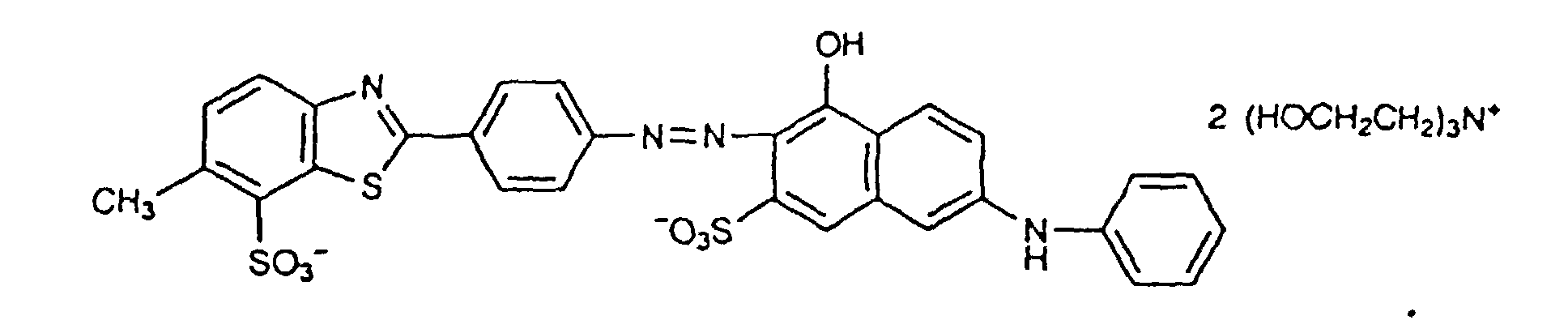
- Wäßrige Farbstofflösung, die 8 bis 29 Gew.-% eines Farbstoffs gemäß Anspruch 1 umfaßt.
Applications Claiming Priority (2)
| Application Number | Priority Date | Filing Date | Title |
|---|---|---|---|
| US8523393A | 1993-06-30 | 1993-06-30 | |
| US85233 | 1993-06-30 |
Publications (2)
| Publication Number | Publication Date |
|---|---|
| EP0632103A1 EP0632103A1 (de) | 1995-01-04 |
| EP0632103B1 true EP0632103B1 (de) | 1999-03-03 |
Family
ID=22190309
Family Applications (1)
| Application Number | Title | Priority Date | Filing Date |
|---|---|---|---|
| EP19940109384 Expired - Lifetime EP0632103B1 (de) | 1993-06-30 | 1994-06-17 | Azofarbstoffe |
Country Status (4)
| Country | Link |
|---|---|
| EP (1) | EP0632103B1 (de) |
| JP (1) | JPH0733994A (de) |
| CA (1) | CA2125612A1 (de) |
| DE (1) | DE69416732T2 (de) |
Family Cites Families (2)
| Publication number | Priority date | Publication date | Assignee | Title |
|---|---|---|---|---|
| FR2536082B1 (fr) * | 1982-11-11 | 1986-08-22 | Sandoz Sa | Nouveaux composes azoiques, leur preparation et leur utilisation comme colorants |
| DE3443595A1 (de) * | 1984-11-29 | 1986-05-28 | Bayer Ag, 5090 Leverkusen | Monoazofarbstoffe |
-
1994
- 1994-06-10 CA CA 2125612 patent/CA2125612A1/en not_active Abandoned
- 1994-06-17 DE DE1994616732 patent/DE69416732T2/de not_active Expired - Fee Related
- 1994-06-17 EP EP19940109384 patent/EP0632103B1/de not_active Expired - Lifetime
- 1994-06-24 JP JP16492894A patent/JPH0733994A/ja active Pending
Also Published As
| Publication number | Publication date |
|---|---|
| DE69416732T2 (de) | 1999-07-22 |
| EP0632103A1 (de) | 1995-01-04 |
| JPH0733994A (ja) | 1995-02-03 |
| DE69416732D1 (de) | 1999-04-08 |
| CA2125612A1 (en) | 1994-12-31 |
Similar Documents
| Publication | Publication Date | Title |
|---|---|---|
| US5697985A (en) | Process for the preparation storage-stable dye dispersions | |
| US6140478A (en) | Basic azo compounds, their production and use | |
| US4647409A (en) | Copper-phthalocyanine dyestuffs | |
| US5883233A (en) | Paper dye | |
| EP0632103B1 (de) | Azofarbstoffe | |
| US4198203A (en) | Dyestuff solutions of copper phthalocyanine derivatives for paper dyeing | |
| EP0103739B1 (de) | Kationische Farbstoffe, ihre Herstellung und Verwendung | |
| US6084078A (en) | Disazo dyestuffs for dyeing cellulosic materials | |
| US5034017A (en) | Process for the coloring of paper with disazo dyes containing sulfonated-naphthol groups to give fast blue shades | |
| JP2003500408A (ja) | トリフェンジオキサジン化合物 | |
| DE3011704A1 (de) | Trisazo- tri- oder -tetrasulfonsaeureverbindungen | |
| JP4908394B2 (ja) | 濃厚染料溶液 | |
| JPS6245800A (ja) | 紙の染色法 | |
| DE69707122T2 (de) | Basische monoazoverbindungen | |
| US5233027A (en) | Copper complexes of sulpho groups containing disazo dyestuffs | |
| Murray | Dyes and fluorescent whitening agents for paper | |
| EP0114043B1 (de) | Farbstoffmischungen und ihre Verwendung zum Färben von Papier | |
| EP0122458B1 (de) | Azoverbindungen | |
| KR100583392B1 (ko) | 포마잔 화합물 및 그를 사용하는 염색 방법 | |
| MXPA99006606A (en) | Tint for pa | |
| US4490151A (en) | Disazo sulfophenylpyrazolonestilbene dyes and direct dyes to color cellulose black | |
| ITRM940707A1 (it) | "ftalocianine d'alluminio cationiche, loro preparazione e loro impiego in procedimenti di tintura e di stampa" | |
| US4942232A (en) | Imidazolylmethylene-containing triphendioxazine dyes | |
| GB2079327A (en) | Liquid formulations of copper-containing dyes> | |
| JPH0526832B2 (de) |
Legal Events
| Date | Code | Title | Description |
|---|---|---|---|
| PUAI | Public reference made under article 153(3) epc to a published international application that has entered the european phase |
Free format text: ORIGINAL CODE: 0009012 |
|
| AK | Designated contracting states |
Kind code of ref document: A1 Designated state(s): CH DE FR GB LI |
|
| RAP1 | Party data changed (applicant data changed or rights of an application transferred) |
Owner name: BAYER CORPORATION |
|
| RAP1 | Party data changed (applicant data changed or rights of an application transferred) |
Owner name: BAYER CORPORATION |
|
| 17P | Request for examination filed |
Effective date: 19950531 |
|
| RAP1 | Party data changed (applicant data changed or rights of an application transferred) |
Owner name: BAYER CORPORATION |
|
| 17Q | First examination report despatched |
Effective date: 19971209 |
|
| GRAG | Despatch of communication of intention to grant |
Free format text: ORIGINAL CODE: EPIDOS AGRA |
|
| GRAG | Despatch of communication of intention to grant |
Free format text: ORIGINAL CODE: EPIDOS AGRA |
|
| GRAH | Despatch of communication of intention to grant a patent |
Free format text: ORIGINAL CODE: EPIDOS IGRA |
|
| GRAH | Despatch of communication of intention to grant a patent |
Free format text: ORIGINAL CODE: EPIDOS IGRA |
|
| GRAA | (expected) grant |
Free format text: ORIGINAL CODE: 0009210 |
|
| AK | Designated contracting states |
Kind code of ref document: B1 Designated state(s): CH DE FR GB LI |
|
| REG | Reference to a national code |
Ref country code: CH Ref legal event code: NV Representative=s name: E. BLUM & CO. PATENTANWAELTE Ref country code: CH Ref legal event code: EP |
|
| REF | Corresponds to: |
Ref document number: 69416732 Country of ref document: DE Date of ref document: 19990408 |
|
| ET | Fr: translation filed | ||
| PLBE | No opposition filed within time limit |
Free format text: ORIGINAL CODE: 0009261 |
|
| STAA | Information on the status of an ep patent application or granted ep patent |
Free format text: STATUS: NO OPPOSITION FILED WITHIN TIME LIMIT |
|
| 26N | No opposition filed | ||
| REG | Reference to a national code |
Ref country code: GB Ref legal event code: IF02 |
|
| PGFP | Annual fee paid to national office [announced via postgrant information from national office to epo] |
Ref country code: DE Payment date: 20030512 Year of fee payment: 10 |
|
| PGFP | Annual fee paid to national office [announced via postgrant information from national office to epo] |
Ref country code: GB Payment date: 20030611 Year of fee payment: 10 |
|
| PGFP | Annual fee paid to national office [announced via postgrant information from national office to epo] |
Ref country code: FR Payment date: 20030613 Year of fee payment: 10 |
|
| PGFP | Annual fee paid to national office [announced via postgrant information from national office to epo] |
Ref country code: CH Payment date: 20030630 Year of fee payment: 10 |
|
| PG25 | Lapsed in a contracting state [announced via postgrant information from national office to epo] |
Ref country code: GB Free format text: LAPSE BECAUSE OF NON-PAYMENT OF DUE FEES Effective date: 20040617 |
|
| PG25 | Lapsed in a contracting state [announced via postgrant information from national office to epo] |
Ref country code: LI Free format text: LAPSE BECAUSE OF NON-PAYMENT OF DUE FEES Effective date: 20040630 Ref country code: CH Free format text: LAPSE BECAUSE OF NON-PAYMENT OF DUE FEES Effective date: 20040630 |
|
| PG25 | Lapsed in a contracting state [announced via postgrant information from national office to epo] |
Ref country code: DE Free format text: LAPSE BECAUSE OF NON-PAYMENT OF DUE FEES Effective date: 20050101 |
|
| GBPC | Gb: european patent ceased through non-payment of renewal fee |
Effective date: 20040617 |
|
| REG | Reference to a national code |
Ref country code: CH Ref legal event code: PL |
|
| PG25 | Lapsed in a contracting state [announced via postgrant information from national office to epo] |
Ref country code: FR Free format text: LAPSE BECAUSE OF NON-PAYMENT OF DUE FEES Effective date: 20050228 |
|
| REG | Reference to a national code |
Ref country code: FR Ref legal event code: ST |