EP0632257A2 - Capteur de couple d'une tige de soupape - Google Patents
Capteur de couple d'une tige de soupape Download PDFInfo
- Publication number
- EP0632257A2 EP0632257A2 EP94108273A EP94108273A EP0632257A2 EP 0632257 A2 EP0632257 A2 EP 0632257A2 EP 94108273 A EP94108273 A EP 94108273A EP 94108273 A EP94108273 A EP 94108273A EP 0632257 A2 EP0632257 A2 EP 0632257A2
- Authority
- EP
- European Patent Office
- Prior art keywords
- strain
- mounting
- cylindrical member
- members
- generally
- Prior art date
- Legal status (The legal status is an assumption and is not a legal conclusion. Google has not performed a legal analysis and makes no representation as to the accuracy of the status listed.)
- Withdrawn
Links
Images


Classifications
-
- F—MECHANICAL ENGINEERING; LIGHTING; HEATING; WEAPONS; BLASTING
- F16—ENGINEERING ELEMENTS AND UNITS; GENERAL MEASURES FOR PRODUCING AND MAINTAINING EFFECTIVE FUNCTIONING OF MACHINES OR INSTALLATIONS; THERMAL INSULATION IN GENERAL
- F16K—VALVES; TAPS; COCKS; ACTUATING-FLOATS; DEVICES FOR VENTING OR AERATING
- F16K37/00—Special means in or on valves or other cut-off apparatus for indicating or recording operation thereof, or for enabling an alarm to be given
- F16K37/0025—Electrical or magnetic means
- F16K37/0041—Electrical or magnetic means for measuring valve parameters
-
- G—PHYSICS
- G01—MEASURING; TESTING
- G01L—MEASURING FORCE, STRESS, TORQUE, WORK, MECHANICAL POWER, MECHANICAL EFFICIENCY, OR FLUID PRESSURE
- G01L3/00—Measuring torque, work, mechanical power, or mechanical efficiency, in general
- G01L3/02—Rotary-transmission dynamometers
- G01L3/04—Rotary-transmission dynamometers wherein the torque-transmitting element comprises a torsionally-flexible shaft
- G01L3/10—Rotary-transmission dynamometers wherein the torque-transmitting element comprises a torsionally-flexible shaft involving electric or magnetic means for indicating
- G01L3/108—Rotary-transmission dynamometers wherein the torque-transmitting element comprises a torsionally-flexible shaft involving electric or magnetic means for indicating involving resistance strain gauges
-
- G—PHYSICS
- G01—MEASURING; TESTING
- G01L—MEASURING FORCE, STRESS, TORQUE, WORK, MECHANICAL POWER, MECHANICAL EFFICIENCY, OR FLUID PRESSURE
- G01L5/00—Apparatus for, or methods of, measuring force, work, mechanical power, or torque, specially adapted for specific purposes
- G01L5/0061—Force sensors associated with industrial machines or actuators
Definitions
- the present invention relates generally to torque sensors and, more particularly, to a system and method for sensing and measuring the torque in an existing valve stem or other transmission component for which the geometric and material properties are known.
- strain gauged bridge mounted directly to the surface of a well defined geometric volume and aligned for maximum output.
- a typical example of this configuration is a solid circular shaft with four strain gauges aligned at 45 to the axis of rotation.
- Such strain gauged shaft sections must have some type of flange or other means for connection to the component in which the torque is to be measured. This is because this type of torque sensor device is designed to operate in series with the load it measures and all the load that normally causes the torque must go through the torque sensor. Because of that requirement, provisions must be made to allow for proper and matching bolt hole locations, keyways, and other sizing requirements in the component in which the torque is to be measured. This requirement can preclude the use of such a torque sensor in many instances. A single and relatively simple drivetrain component such as a 1 inch diameter shaft must be cut and flanged or keyed to allow for the torque sensor. In addition the torque sensor will often have a profile larger than the member it is attached to, which can create interferences with other components.
- strain gauged cylindrical section torque sensor
- One technique being employed to overcome the difficulties of the above mentioned strain gauged, cylindrical section torque sensor is to apply strain gauges in a bridge directly to the member in which the torque is to be measured. Then, knowing the characteristics of the strain gauged bridge and gauge factor of the strain gauges, the strain can be determined. The strain is related to torque by geometric and material properties.
- strain gauges on existing operating equipment in field locations can be difficult. Mounting surfaces must be clean and smooth, and alignment of gauges is critical. In addition, curing of the epoxies or other adhesives used in the process can vary.
- the invention is a system for determining torsional loading on a generally cylindrical member comprising: mounting means for removable attachment to a portion of a cylindrical member surface and for moving in response to torsional deformations in the portion of the cylindrical member; and sensor means connected with the mounting means for sensing rotational movement of the mounting means resulting from torsional deformations in the portion of the cylindrical member and for generating signals proportional to the sensed movement.
- the invention is a stem torque sensor device comprising: first and second mounting members, each having an at least generally concave surface for attachment to an outer surface portion of a cylindrical member; and a torsion sensor fixedly coupled with each of the first and second mounting members, between the first and second mounting members, spacing the first and second mounting members apart from one another in an axial direction of the device with the at least generally concave surfaces of the first and second mounting members at least generally coincident in the axial direction so as to permit the concave surfaces to be applied simultaneously to an outer surface portion of a cylindrical member, the torsional sensor being oriented between the mounting members to respond to slight movements of the first and second mounting members with respect to one another resulting from torsional deformations in any cylindrical member to which the mounting members are secured.
- the invention is a method of measuring torsional strain in a cylindrical member comprising the steps of: immovably affixing to an outer surface of the cylindrical member, first and second mounting members of a sensor device, the mounting members being spaced apart axially from one another on the cylindrical member, the sensor device further including a sensor fixedly secured with each of the first and second mounting members, between the mounting members, the sensor being responsive to slight relative movements of the first and second mounting members with respect to one another; loading the cylindrical member at least across the first and second mounting members; and generating a signal with the sensor proportional to strain on the cylindrical member from the loading step.
- Systems of the present invention are designed to measure strain in a cylindrical member in a way in which the sensing device does not effect nor require any alterations to the member under torsional load so that torsional load may be determined indirectly.
- the relationships of strain to material and geometric properties of the cylindrical member yield torque.
- the modular design approach of the present invention uses a standard sensor unit containing a strain gauged member fastened to custom mounting members designed for the diameter of the surface of the cylindrical member being measured.
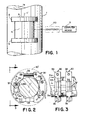
- Figure 1 depicts generally a system of the invention for determining (i.e. sensing and measuring) the torsional loading on a load-bearing, generally cylindrical member indicated by 1.
- the system includes a torsional strain or stem torque sensor device of the present invention indicated generally at 2, used for determining rotational deformations in the cylindrical member 1 which are proportional to its torsional loading.
- the device 2 includes mounting means in the form of first and second mounting members, collectively identified generally at 3, and sensor means, indicated generally at 4, connected to mounting means 3.
- the mounting means 3 and sensor means 4 together constitute the torsional strain or stem torque sensing device 2.
- the preferred system further comprises computer means, indicated generally at 5, which preferably comprises a programmed computer connected with the sensor means 4 of the torsional strain sensor device 2 for receiving data from the sensor device 2 and for determining torsional loading on the cylindrical member 1 from signals generated by the sensor means 4.
- An intermediate signal conditioner 40 (in phantom) may be desired to condition the signal from device 2 before transmission to the computer means 5.
- the individual members of the mounting means 3 are adapted for immovable attachment to a portion of the cylindrical member 1 spaced axially along the member 1 from one another and for moving with respect to one another in response to deformations in the portion of the cylindrical member 1 induced by loading on the cylindrical member.
- mounting means 3 contains first and second identical clamps 30, one of which is shown in Fig. 2 and a pair of which are shown in Fig. 3 fixedly attached to the cylindrical member 1.
- Each clamp 30 includes diametrically opposing clamp members or blocks 33 and 34.
- Clamp member 33 includes a generally concave preferably generally V-shaped clamping surface ag with an included V angle of between about 60 and about 165 and preferably about 120 to 160°.
- Clamp member 33 is rigidly secured to the sensor means 4 via mounting screws 32.
- the assembly 2 is rigidly secured to the cylindrical member 1 utilizing a corresponding pair of second clamp members or blocks 34, each of which is connected to the first clamp member 33 of the clamp by a hinge pin 35 on a first side of each of the clamp members 33 and 34.
- Second clamp member 34 also includes a V-block 36 providing a second clamping surface 34a, which is again preferably V-shaped with an included angle at least generally concave and preferably identical to the first surface 33a.
- Block 36 is preferably secured to the second member 34 utilizing a press fit dowel pin 37, which pivotally couples and allows V block 36 to rotate on second clamp member 34.
- the hinge pin 35 is preferably rigidly secured to the first member 33 preferably utilizing a press fit dowel pin 38.
- the hinge pin 35 is preferably rigidly secured to the second member 34 also preferably utilizing a dowel pin 38 but in a manner such that the hinge pin 35 can pivot or rotate on the pin 38 in the second member 34.
- This rotational effect of pin 35 in each clamp allows the clamping surfaces 33a and 34a of each clamp 30 to be pivoted or rotated towards or away from one another and the entire assembly to be able to open and close around the cylindrical member 1 for removably, fixedly securing the sensor device 2 to the member 1.
- the clamp 30 is generally circular in configuration, as indicated by broken line 30' so that they may be wrapped around a cylindrical member 1 within a confined area.
- the clamping action and clamping force needed to fixedly secure each clamp 30 to the member 1 preferably is achieved by the compressive force of a standard threaded bolt 39, which is mounted on the opposite side of the clamp 30 from hinge pin 35.
- Threaded bolt 39, screws and other similarly threaded releasable fasteners provide continually varying degrees of adjustment of the second sides of the members 33 and 34 with respect to one another for selectively continually varying the degree of compressive force applied by the clamps to the outer surface of cylindrical member 1.
- Clamping force is controlled by the amount of torque placed on each threaded bolt 39.
- the action of rotating each V block 36 in each second member 34 allows the clamping forces to be evenly distributed in each clamp 30 and on member 1 even when accounting for tolerances in the sensor clamping components or the cylindrical member 1.
- clamping surfaces 33a are reduced to the greatest degree permissible in the axial direction to more clearly locate and limit the axial contact of the clamp 30 with the cylinder 1 at the sensor 4. Reducing surface areas 33a in comparison with areas 34a also increases the pressure on the cylinder 1 under members 33 relative to the pressure under members 34, making the cylinder 1 less likely to slip on those surfaces 33a.
- floating spacers can be provided in larger embodiments of the device 2.
- One or both of the clamps 30 are provided with one or more pins 31 projecting axially from the second clamp member 34 to be slidably received in bores 31 a (phantom) provided in each opposing second clamp member 34 to receive the pins 31.
- Pins 31 keep the clamps 30 generally concentrically aligned, particularly when the device 2 is not secured to a member 1. This reduces the twisting on sensor 4, particularly in larger embodiments of device 2.
- sensor device 2 permits a standard sensor unit 4 to be used with various mounting means 3.
- Clamp members 30 also permit the custom fabrication of devices 2.
- clamp members 33 and 34 with hinge pins 35 and bolts 39 of different lengths, cylindrical members of various diameters can be accommodated.
- commonly sized members 33/34 might be used to accommodate cylindrical members over a half inch range of diameters with four sets of hinge pins 35, which vary successively about 1/8th inch in length.
- Other considerations for designing clamps and clamping sensors attached to cylindrical members and suitable equipment are disclosed in U.S. Patent 4,911,004, which is incorporated by reference herein in its entirety.
- one mounting member or block 130 of an alternative mounting means 3 contains a pair of generally concave mounting surfaces 133a and 134a on the ends of connected radial sections 133, 134, which surfaces match the radius of the outer surface of cylindrical member 1 and which are used as bonding surfaces to secure the mounting members 130 to the cylindrical member 1 by a suitable adhesive indicated at 140.
- Fastening means are provided in each of the two mounting members 130 such that the sensor means 4 can be rigidly secured to the mounting members 130.
- the fastening means consists of a separate pair of screws 132 through each member 130.
- Means are provided in each member 130 to remove the member 130 from the member 1 and preferably comprise an internally threaded hole 137 through the mounting member 130 and through which a set screw 136 or similar threaded device can be inserted and turned, causing the screw to move forward and contact the cylindrical member 1. Further turning of the set screw 136 will cause it to generate a separating force between the mounting member 130 and the cylindrical member 1, breaking the adhesive 140.
- Member 130 and its surfaces 133a and 134a collectively cover an arc of less than 180 ° on member 1 and thus must be attached to member 1 by means other than clamping.
- the sensor 4 is positioned for sensing movement of the mounting means 3 resulting from the rotational deformations in the portion of the cylindrical member 1 under torsional load.
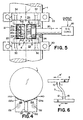
- the sensor 4 preferably comprises an I-shaped strain member 6 with a relatively long, thin center beam 7 flanked by opposing perpendicular end or cross beams 8 and 9, and four individual axial/longitudinal strain gauges 10, 11, 12, and 13. Strain gauges 10, 11, 12, and 13 are preferably mounted in pairs on opposing sides of the thin center beam 7, near the longitudinal ends of the beam 7 and its junctions with cross beams 8 and 9.
- the strain gauges 10, 11, 12, and 13 are electrically coupled together in a conventional balance bridge circuit to sense bending in the center beam 7 caused by the relative movement of the mounting members with respect to one another.
- a cable 20 is preferably connected to the strain gauges through insulated lead wires 20a, 20b, 20c, 20d, extending from the cable 20 to solder joints on a terminal strip 21.
- the terminal strip 21 preferably is adhesively secured to a terminal mounting bracket or "board" 22, which is preferably fastened to the strain member 6 by suitable means such as mounting screws 31.
- a cable clamp 23 is preferably secured to the terminal board 22 by suitable means such as two screws 24 to serve as a means for strain relief in the cable 20.
- Individual leads (not depicted for clarity) are extended from the connections of each of the lead wires 20a-20d and solder joints to separate ones of the strain gauges 10-13, respectively.
- the entire resulting assembly is preferably encapsulated with a flexible, stretchable material, such as a room temperature vulcanizing ("RTV”) silicone rubber, to provide environmental and mechanical protection to the various strain gauges 10-13.
- RTV room temperature vulcanizing
- the rubber material provides the required protection without appreciably altering a spring constant of the sensor 4.
- the encapsulated sensor 4 is preferably releasably but immovably secured to the mounting means 3, via four mounting screws 32, a pair of which are extended into each of the clamps 30 or mounting blocks 130 to complete the device 2.
- a conventional strain gauge conditioner 50 can be used to apply excitation signals across one pair of opposing junctions of the balance bridge and to remove signals from a remaining pair of opposing junctions of the balanced bridge on center beam 7 and output a scaled signal proportional to sensed movements of the mounting members 30 or 130 with respect to one another and thus the torsional strain which the cylindrical member 1 has undergone. More specifically, the removed signals are related to the bending movement of the center beam 7 of the strain member 6, which are induced by the rotational deformations of the cylindrical member 1 and which are transmitted to the strain member 6 through the mounting means 3.
- the output signal from the conditioner 30 can be passed on, for example, to the computer means 5.
- Fig. 6 depicts diagrammatically typical double bend deformation of the thin center beam 7 under torsional loading of member 1.
- strain gauges 10 and 13 are placed in tension while gauges 11 and 12 are placed in compression.
- center beam 7 is preferably aligned parallel with a central axis 1' of the cylindrical member 1 on which the device 2 is mounted.
- Another application of the present invention would be to measure torque on a valve stem or other cylindrical member upon which there may also be a tensile or compressive component of force along the central axis.
- the sensor device would measure torque just as described in the preferred embodiment but would have to be insensitive to the axial force.
- the layout of the strain gauges as described would create a cancelling effect for any axial force since each gauge would experience the same amount of compressive or tensile strain.
- the forces required to stretch the center beam of the strain member axially are much greater than those required to cause the bending of the center beam from which the sensitivity to torque is derived. These larger forces could be responsible for uneven slippage of the mounting members and could also or alternatively cause some non-cancelling effects with the strain gauges.
- a second embodiment strain member 106 is proposed and shown in Fig. 7 having an accommodation to allow low force deflection in the axial direction but to maintain sufficient stiffness in response to torsion for accurate torsional measurement.
- the accommodation is provided by suitably thinning at least one of the cross beams 108 (or 109) of member 106 sufficiently to allow that beam to bend readily under axial loading of the cylindrical member 1, which is transverse to the beam 108 or 109.
- the thinned cross beam 108 (or 109) can also be supplied with its own strain gauge (s), preferably four gauges 110, 111, 112, 113, also arrayed in a balance bridge configuration. Strain gauges thus applied to the accommodation (thinned beam 108) as a means of measuring just the axial response. In this manner, a sensor 104 has been created with two separate sets of gauges for measuring both torque and thrust simultaneously and independently.
- a sensor of this type would be particularly useful on the threaded shaft of a rising stem valve, which typically has components of torque and thrust.
- a valve is depicted in Fig. 8 with a sensor device 2 and explained in greater detail in U.S. Patent 4,805,451, which is incorporated by reference in its entirety.
- the valve includes a valve housing 50, containing a movable valve member 52 coupled with one end of cylindrical valve stem 54 with threads 55.
- An actuator 58 is coupled with a remaining end of stem 54.
- a yoke 60 extends partially around the valve stem 54 and fixedly couples the valve housing 50 and actuator 58.
- the device 2 is mounted on a portion of the stem exposed through the yoke.
- the design of sensor device 2 should account for the helical nature of the threads of the stem and the possibility that the two mounting members could secure differently and possibly unstably to the threaded stem.
- Such threads are generally provided in integer numbers of threads per inch. This possibility of unsuitable mounting can be minimized by centering each of the two mounting members on a thread major diameter. In general, considering standard threads and a mounting member centerline to centerline spacing of exactly one inch, or an integer multiple of one inch, it is possible to achieve a centered mounting since the number of threads would always divide equally into the one inch dimension. It may be necessary or desirable to reduce the axial length of the clamp surfaces 33a, as is indicated diagrammatically in Fig.
- the strain member 6 and mounting members 3 of the present application can be made from any of a variety of materials including, but not limited to, steel, titanium, beryllium copper and other alloys.
- the selected material should have high strength, be generally resistant to corrosion in the environment in which it will be used, be resiliently flexible and machineable or otherwise workable. For example, success has been had machining the strain members 6 from 17-4 PH stainless steel with H 900 temper as well as with beryllium copper.
- the components of clamp 30 and of mounting block 130 may also be made of the same materials. Suggested dimensions for the beam 7 might be, for example, 0.050 inches wide x 0.225 inches thick x 0.580 inches long.
- Clamping surfaces 33a and 130a should be as narrow as feasible in an axial direction (parallel to the apex of the surface V).
- Clamping surfaces 33a in Fig. 8 are less than 1/4 inch in axial length, suggestedly less than 1/1 Oth inch and preferably only about 0.090 inch or less in axial length.
- Clamping surfaces 34a are suggestedly as long as possible in an axial direction, particularly to permit their mounting on threaded cylindrical members where it may be necessary for the surfaces to span the peaks of adjoining threads.
- clamping surfaces 33a and 34a might also be made of a softer material, for example brass or other soft alloy, in order to better grip a particular cylindrical member 1.
- Strain gauges 10-13 and 110-113 may be suitable, commercially available devices such as Micro Measurements Catalog No. N2A-06-T012R-350 strain gauges of Measurements Group, Inc., Ra- leigh, North Carolina.
- the terminals may be, for example, Micro Measurements Catalog No. CPF-50C.
- the signal conditioner 30 may be any of a variety of devices such as a Vishay 2100 Series table model conditioners or P3500 portable conditioners.
- the room temperature vulcanizing rubber used to encase the sensor 4 might be, for example a General Electric RTV 60, room temperature vulcanizing silicone rubber with a 910 activator.
- the adhesive 140 used to bond the mounting blocks 130 to a cylindrical member 1 might be, for example, a Loctite 499 cyanoacrylate ester adhesive.
- the computer means 5 may be any of a variety of programmable personal computers or may be a dedicated microprocessor preprogrammed in firmware specifically to perform this task. Also, U.S. Patent 5,197,338 for SYSTEM AND METHOD FOR DETERMINING TORQUE OUTPUT OF MOTOR ACTUATED VALVE OPERATORS is incorporated by reference herein for its disclosures with respect to torque measurements of stem members.
- sensor device 2 of the present invention is preferably calibrated by mounting in a known, predetermined manner to a test cylindrical member of known composition and geometry and which is subjected to pure torsional loading.
- a calibration fixture 70 is shown diagrammatically in Fig. 9.
- a device 2 of the present invention is mounted on a cylinder 101 of known composition and geometry.
- clamp members 30 are clamped onto the test member 101 with a predetermined clamping load which is achieved by torquing the tightening bolts 39 to predetermined torques.
- the strain gauges of sensor device 2 are coupled with a suitable signal conditioner 30 which, in turn, is coupled with a suitable, preferably preprogrammed computer 5.
- Force is determined by a load cell 76 on the operating member 77 of the actuator 74.
- a continuous signal is provided from the load cell 76 through the conditioner 30, if appropriate, to the programmed computer 5 so that continuous outputs from the load cell 6 can be obtained and recorded with continuous outputs from the sensor device 2.
- the actuator 74 is actuated numerous times and data from the load cell 106 and the sensor device 2 are simultaneously taken, stored and/or displayed as traces 80 and 80b on a suitable display device 80 by the programmed computer 5.
- the computer 5 takes the known geometry and material characteristics of the test cylinder 101 calculates torque and strain on cylinder 101 and calculates a strain constant for the sensor device 2, which relates output of the strain sensor with the actual torsional load generated in the test cylinder 101 across the mounting means 3 of the device 2.
- the output of sensor 2 through conditioner 30 is directly proportional to the torsional strain on cylinder 101.
- Suitable conventional processing techniques such as a least squares fit approximation, is preferably used to determine the strain constant of the sensor device 2.
- the senor can be removed from the test fixture and thereafter installed in a similar fashion under the same torque on any other cylindrical member of which the geometry and material compositional are known. These may be known from a manufacturing standard or determined by initially testing the cylindrical member before installation or by testing several replacement cylindrical members to establish a baseline for such cylindrical members of this group.
- the same system comprising the sensor device 2, conditioning device 30 and processor 5 are employed in the field to measure torque loads.
- the processor is suitably programmed to output a determined torque value from the signals outputted by the sensor device 2 using the predetermined strain constants.
Landscapes
- Physics & Mathematics (AREA)
- General Physics & Mathematics (AREA)
- Engineering & Computer Science (AREA)
- General Engineering & Computer Science (AREA)
- Chemical & Material Sciences (AREA)
- Analytical Chemistry (AREA)
- Mechanical Engineering (AREA)
- Force Measurement Appropriate To Specific Purposes (AREA)
Applications Claiming Priority (2)
| Application Number | Priority Date | Filing Date | Title |
|---|---|---|---|
| US08/071,560 US5546817A (en) | 1993-06-04 | 1993-06-04 | Stem torque sensor |
| US71560 | 1993-06-04 |
Publications (2)
| Publication Number | Publication Date |
|---|---|
| EP0632257A2 true EP0632257A2 (fr) | 1995-01-04 |
| EP0632257A3 EP0632257A3 (fr) | 1995-04-05 |
Family
ID=22102115
Family Applications (1)
| Application Number | Title | Priority Date | Filing Date |
|---|---|---|---|
| EP94108273A Withdrawn EP0632257A3 (fr) | 1993-06-04 | 1994-05-28 | Capteur de couple d'une tige de soupape. |
Country Status (3)
| Country | Link |
|---|---|
| US (1) | US5546817A (fr) |
| EP (1) | EP0632257A3 (fr) |
| CA (1) | CA2125002A1 (fr) |
Cited By (8)
| Publication number | Priority date | Publication date | Assignee | Title |
|---|---|---|---|---|
| EP0750183A3 (fr) * | 1995-06-22 | 1997-11-19 | Liberty Technologies, Inc. | Méthode à jauge de contrainte pour mesurer enfoncement et couple sur tiges de soupape ne nécessitant pas de calibrages pour enfoncement et couple connus |
| FR2780503A1 (fr) * | 1998-06-30 | 1999-12-31 | G Tel | Capteur de detection des contraintes mecaniques dans un support, notamment pour engins de levage |
| FR2817322A1 (fr) * | 2000-11-30 | 2002-05-31 | Electricite De France | Dispositif de mise en place et de maintien de capteurs de mesure autour d'une tuyauterie, son procede d'installation et dispositif de mesure de debit dans ladite tuyauterie |
| WO2009043589A3 (fr) * | 2007-10-04 | 2009-06-18 | Univ Friedrich Alexander Er | Procédé et dispositif pour déterminer in situ les états de fonctionnements de machines-outils |
| CN103759963A (zh) * | 2014-01-27 | 2014-04-30 | 东北石油大学 | 用于模拟抽油杆柱扭转变形及弹性恢复的模拟器 |
| CN112082687A (zh) * | 2020-08-26 | 2020-12-15 | 东北电力大学 | 维间解耦三维无线无源传感器 |
| CN112683439A (zh) * | 2020-12-30 | 2021-04-20 | 东北电力大学 | 直筒t型维间解耦二维无线无源传感器 |
| JP2022532253A (ja) * | 2019-05-17 | 2022-07-13 | マサチューセッツ インスティテュート オブ テクノロジー | 機械システムの健全性及び性能を監視するための装置及び方法 |
Families Citing this family (18)
| Publication number | Priority date | Publication date | Assignee | Title |
|---|---|---|---|---|
| JP4010374B2 (ja) * | 1995-03-24 | 2007-11-21 | 日本ギア工業株式会社 | 弁装置の負荷検出装置 |
| US5747697A (en) * | 1996-10-16 | 1998-05-05 | Niagara Mohawk Power Corporation | Valve stem thrust measuring device |
| US6779409B1 (en) * | 1997-01-27 | 2004-08-24 | Southwest Research Institute | Measurement of torsional dynamics of rotating shafts using magnetostrictive sensors |
| FR2791133B1 (fr) * | 1999-03-19 | 2001-10-12 | Multidyn | Procede et dispositif de mesure d'un couple exerce sur une piece soumise a des efforts de couple et de flexion |
| US7100458B2 (en) * | 2003-05-22 | 2006-09-05 | Crane Nuclear, Inc. | Flexure system for strain-based instruments |
| US7207230B2 (en) * | 2003-05-22 | 2007-04-24 | Crane Nuclear, Inc. | High-stability instrument mounting system for repeatable field testing of equipment |
| US20090071262A1 (en) * | 2005-03-24 | 2009-03-19 | Baumer Holding Ag | Electrically measuring expansions on cylindrical bodies |
| US7971490B2 (en) * | 2006-03-03 | 2011-07-05 | Flowserve Management Company | Load measurement method and device |
| US8700191B2 (en) * | 2007-11-26 | 2014-04-15 | The Boeing Company | Controlled application of external forces to a structure for precision leveling and securing |
| JP5332640B2 (ja) * | 2009-01-20 | 2013-11-06 | 日産自動車株式会社 | 操舵力検出装置 |
| GB0911504D0 (en) * | 2009-07-03 | 2009-08-12 | Rolls Royce Plc | Test apparatus and method |
| DE102010025520A1 (de) | 2010-06-29 | 2011-12-29 | Voith Patent Gmbh | Drehmomenterfassungsvorrichtung |
| CN102564665B (zh) * | 2010-12-27 | 2014-05-28 | 财团法人车辆研究测试中心 | 梁型扭力感测器 |
| US8869630B2 (en) * | 2013-01-16 | 2014-10-28 | Thru Tubing Solutions, Inc. | Torque measuring vise and notification system and method of using same |
| WO2016125533A1 (fr) * | 2015-02-03 | 2016-08-11 | 日立オートモティブシステムズ株式会社 | Dispositif de détection de couple |
| CN106644210B (zh) * | 2015-10-30 | 2022-04-22 | 中石化石油工程技术服务有限公司 | 一种圆柱形工件测力装置 |
| US10620061B2 (en) | 2016-11-21 | 2020-04-14 | Honeywell International Inc. | Vulcanized metal plug for high fatigue application for load pin |
| US12018772B2 (en) | 2020-01-03 | 2024-06-25 | Bray International, Inc. | Valve with load cell |
Family Cites Families (37)
| Publication number | Priority date | Publication date | Assignee | Title |
|---|---|---|---|---|
| US2581264A (en) * | 1945-08-01 | 1952-01-01 | Brown & Sharpe Mfg | Gauge |
| US2566566A (en) * | 1945-12-19 | 1951-09-04 | Edgar T Howes | Torsion indicating device |
| DE1120754B (de) * | 1960-07-18 | 1961-12-28 | Philips Patentverwaltung | Schubkraftmesser fuer Kraftuebertragungsmittel |
| US3184962A (en) * | 1962-07-13 | 1965-05-25 | Herman P Gay | Strain type transducers |
| US3199057A (en) * | 1963-05-03 | 1965-08-03 | Lockheed Aircraft Corp | Load cell transducer |
| US3228240A (en) * | 1963-12-24 | 1966-01-11 | Alfred N Ormond | Linearization of load cells |
| US3535937A (en) * | 1968-12-31 | 1970-10-27 | Newport News S & D Co | Pipe pressure measuring apparatus |
| US3866473A (en) * | 1969-08-04 | 1975-02-18 | Bendix Corp | Pressure measuring transducer |
| US3603152A (en) * | 1970-02-05 | 1971-09-07 | Columbia Research Lab Inc | Transducer for detecting pressure changes in fluid flow |
| US3698248A (en) * | 1970-05-15 | 1972-10-17 | Bendix Corp | Pressure responsive transducer |
| US3698249A (en) * | 1970-08-03 | 1972-10-17 | Umc Electronics Co | Fluid pressure monitoring system |
| US3742760A (en) * | 1971-08-01 | 1973-07-03 | Toyoda Machine Works Ltd | Load transducer |
| US3750475A (en) * | 1972-08-03 | 1973-08-07 | Umc Electr Co | Fluid pressure monitoring system |
| GB1448445A (en) * | 1972-10-13 | 1976-09-08 | Cav Ltd | Transducers bolt anchoring devices |
| US3850030A (en) * | 1973-10-01 | 1974-11-26 | Acurex Corp | Apparatus for measuring the torsion of a rotating shaft |
| US3965745A (en) * | 1975-02-05 | 1976-06-29 | Columbia Research Laboratories, Inc. | Externally mounted transducer for detecting changes of fluid pressure in a pipe |
| DE2649358C3 (de) * | 1976-05-07 | 1980-09-18 | List, Hans, Prof. Dipl.-Ing. Dr.Dr. H.C., Graz (Oesterreich) | Einrichtung zur Erfassung des Innendruckes bzw. des Druckverlaufes in einer Rohrleitung |
| FR2368692A1 (fr) * | 1976-10-21 | 1978-05-19 | Robinet Jean Claude | Collier de mesure de la deformation radiale des echantillons cylindriques de materiau |
| US4251918A (en) * | 1979-12-03 | 1981-02-24 | Duggan Michael F | Extensometer |
| US4290311A (en) * | 1980-02-08 | 1981-09-22 | The United States Of America As Represented By The United States Department Of Energy | Dilatometer |
| DE3172259D1 (en) * | 1980-11-21 | 1985-10-17 | Ici Plc | Method and apparatus for leak detection in pipelines |
| US4412456A (en) * | 1982-02-16 | 1983-11-01 | Helm Instrument Company, Inc. | Load sensing probe |
| GB2116330B (en) * | 1982-02-22 | 1985-09-04 | British Hovercraft Corp Ltd | Torque measurment apparatus |
| FR2524603A1 (fr) * | 1982-03-31 | 1983-10-07 | Framatome Sa | Procede de controle du fonctionnement d'une soupape et banc d'essai mecanique pour la mise en oeuvre du procede |
| US4570903A (en) * | 1982-04-19 | 1986-02-18 | Crass Otto G | Method and apparatus for measurement of valve stem thrust |
| US4498336A (en) * | 1983-01-14 | 1985-02-12 | Dyna-Torque, Inc. | Torque measuring device |
| GB2138142B (en) * | 1983-04-12 | 1986-11-12 | Autosense Equipment Limited | A transducer for use in detecting the pressure of high pressure fuel in the injection supply pipe of a compression ignition engine |
| US4527335A (en) * | 1983-07-29 | 1985-07-09 | Mts Systems Corporation | Averaging axial-diametral strain measuring extensometer |
| US4549355A (en) * | 1984-01-04 | 1985-10-29 | Battelle Memorial Institute | Electronic dendrometer |
| US4587739A (en) * | 1985-07-18 | 1986-05-13 | The United States Of America As Represented By The United States Department Of Energy | Gage for measuring displacements in rock samples |
| US4759224A (en) * | 1986-04-11 | 1988-07-26 | Movats Incorporated | Torque measuring system for motor operated valve operators |
| WO1988008491A1 (fr) * | 1987-04-21 | 1988-11-03 | Movats Incorporated | Systeme servant a determiner la charge qui s'exerce sur une tige |
| US4787245A (en) * | 1987-05-13 | 1988-11-29 | Movats Incorporated | Torque measuring apparatus for valve operating system |
| US4911004A (en) * | 1988-08-15 | 1990-03-27 | Liberty Technology Center, Inc. | Devices and methods for determining axial loads |
| US4805451A (en) * | 1987-08-20 | 1989-02-21 | Liberty Technology Center, Inc. | System for evaluating the condition and performance of a valve and valve operator combination |
| US5103681A (en) * | 1990-07-09 | 1992-04-14 | Westinghouse Electric Corp. | Diametral clamp element for cylindrical members |
| US5197338A (en) * | 1991-07-22 | 1993-03-30 | Liberty Technology Center, Inc. | System and method for determining torque output of motor actuated valve operators |
-
1993
- 1993-06-04 US US08/071,560 patent/US5546817A/en not_active Expired - Fee Related
-
1994
- 1994-05-28 EP EP94108273A patent/EP0632257A3/fr not_active Withdrawn
- 1994-06-02 CA CA002125002A patent/CA2125002A1/fr not_active Abandoned
Cited By (9)
| Publication number | Priority date | Publication date | Assignee | Title |
|---|---|---|---|---|
| EP0750183A3 (fr) * | 1995-06-22 | 1997-11-19 | Liberty Technologies, Inc. | Méthode à jauge de contrainte pour mesurer enfoncement et couple sur tiges de soupape ne nécessitant pas de calibrages pour enfoncement et couple connus |
| FR2780503A1 (fr) * | 1998-06-30 | 1999-12-31 | G Tel | Capteur de detection des contraintes mecaniques dans un support, notamment pour engins de levage |
| EP0969265A1 (fr) * | 1998-06-30 | 2000-01-05 | G'Tel | Capteur de détection des contraintes mécaniques dans un support, notamment pour engins de levage |
| FR2817322A1 (fr) * | 2000-11-30 | 2002-05-31 | Electricite De France | Dispositif de mise en place et de maintien de capteurs de mesure autour d'une tuyauterie, son procede d'installation et dispositif de mesure de debit dans ladite tuyauterie |
| WO2009043589A3 (fr) * | 2007-10-04 | 2009-06-18 | Univ Friedrich Alexander Er | Procédé et dispositif pour déterminer in situ les états de fonctionnements de machines-outils |
| CN103759963A (zh) * | 2014-01-27 | 2014-04-30 | 东北石油大学 | 用于模拟抽油杆柱扭转变形及弹性恢复的模拟器 |
| JP2022532253A (ja) * | 2019-05-17 | 2022-07-13 | マサチューセッツ インスティテュート オブ テクノロジー | 機械システムの健全性及び性能を監視するための装置及び方法 |
| CN112082687A (zh) * | 2020-08-26 | 2020-12-15 | 东北电力大学 | 维间解耦三维无线无源传感器 |
| CN112683439A (zh) * | 2020-12-30 | 2021-04-20 | 东北电力大学 | 直筒t型维间解耦二维无线无源传感器 |
Also Published As
| Publication number | Publication date |
|---|---|
| EP0632257A3 (fr) | 1995-04-05 |
| CA2125002A1 (fr) | 1994-12-05 |
| US5546817A (en) | 1996-08-20 |
Similar Documents
| Publication | Publication Date | Title |
|---|---|---|
| US5546817A (en) | Stem torque sensor | |
| US5339696A (en) | Bolt torque and tension transducer | |
| EP1409880B1 (fr) | Systeme et procede pour mesurer la flexion dans un ergot | |
| US4488441A (en) | Apparatus for simultaneous measurement of mutually perpendicular forces and moments | |
| JP2716809B2 (ja) | 軸方向荷重を測定するための装置及び方法 | |
| US5499542A (en) | Diametral force sensor | |
| US4178799A (en) | Force and bending moment sensing arrangement and structure | |
| JP3792274B2 (ja) | 複数のせん断ひずみゲージを用いた六軸力センサ | |
| US4251918A (en) | Extensometer | |
| US5563349A (en) | Diametral extensometer | |
| US4312241A (en) | Load cell | |
| DE59914797D1 (de) | Messvorrichtung zur Bestimmung des Gesamtanzugsmoments, des Kopfreibungsmoments und der Vorspannkraft einer angezogenen Schraubverbindung | |
| US5777234A (en) | Pre-straining apparatus and method for strain sensors | |
| US6658942B1 (en) | Method and device for measuring a torque exerted on a part subjected to torque and bending loads | |
| JP4722393B2 (ja) | 回転構造部材の負荷を測定する装置 | |
| KR970000030B1 (ko) | 스템 하중 측정 시스템 | |
| US5747697A (en) | Valve stem thrust measuring device | |
| JPH03210447A (ja) | トルクレンチ校正器 | |
| JP7260095B2 (ja) | 荷重変換器 | |
| JP7515136B1 (ja) | センサ付きボルト及び締結方法 | |
| JPH0442027A (ja) | 螺子締付力測定装置 | |
| GB2264177A (en) | Material testing apparatus. | |
| SU1609637A1 (ru) | Устройство дл настройки гайковертов | |
| JPS63238440A (ja) | 曲げモーメントおよびねじりモーメント用の変換器 | |
| US5651284A (en) | Strain gage method for measuring thrust and torque on valve stems that does not require calibrations against a known thrust and torque |
Legal Events
| Date | Code | Title | Description |
|---|---|---|---|
| PUAI | Public reference made under article 153(3) epc to a published international application that has entered the european phase |
Free format text: ORIGINAL CODE: 0009012 |
|
| AK | Designated contracting states |
Kind code of ref document: A2 Designated state(s): BE CH DE ES FR GB LI SE |
|
| PUAL | Search report despatched |
Free format text: ORIGINAL CODE: 0009013 |
|
| AK | Designated contracting states |
Kind code of ref document: A3 Designated state(s): BE CH DE ES FR GB LI SE |
|
| 17P | Request for examination filed |
Effective date: 19950923 |
|
| 17Q | First examination report despatched |
Effective date: 19961223 |
|
| STAA | Information on the status of an ep patent application or granted ep patent |
Free format text: STATUS: THE APPLICATION IS DEEMED TO BE WITHDRAWN |
|
| 18D | Application deemed to be withdrawn |
Effective date: 19970503 |