EP0632421A1 - Méthode et dispositif pour aider la transmission de l'intention - Google Patents
Méthode et dispositif pour aider la transmission de l'intention Download PDFInfo
- Publication number
- EP0632421A1 EP0632421A1 EP94110098A EP94110098A EP0632421A1 EP 0632421 A1 EP0632421 A1 EP 0632421A1 EP 94110098 A EP94110098 A EP 94110098A EP 94110098 A EP94110098 A EP 94110098A EP 0632421 A1 EP0632421 A1 EP 0632421A1
- Authority
- EP
- European Patent Office
- Prior art keywords
- character information
- intent
- brain wave
- predetermined frequency
- switch
- Prior art date
- Legal status (The legal status is an assumption and is not a legal conclusion. Google has not performed a legal analysis and makes no representation as to the accuracy of the status listed.)
- Granted
Links
Images







Classifications
-
- G—PHYSICS
- G06—COMPUTING OR CALCULATING; COUNTING
- G06F—ELECTRIC DIGITAL DATA PROCESSING
- G06F3/00—Input arrangements for transferring data to be processed into a form capable of being handled by the computer; Output arrangements for transferring data from processing unit to output unit, e.g. interface arrangements
- G06F3/01—Input arrangements or combined input and output arrangements for interaction between user and computer
- G06F3/011—Arrangements for interaction with the human body, e.g. for user immersion in virtual reality
- G06F3/015—Input arrangements based on nervous system activity detection, e.g. brain waves [EEG] detection, electromyograms [EMG] detection, electrodermal response detection
-
- A—HUMAN NECESSITIES
- A61—MEDICAL OR VETERINARY SCIENCE; HYGIENE
- A61B—DIAGNOSIS; SURGERY; IDENTIFICATION
- A61B5/00—Measuring for diagnostic purposes; Identification of persons
- A61B5/24—Detecting, measuring or recording bioelectric or biomagnetic signals of the body or parts thereof
- A61B5/316—Modalities, i.e. specific diagnostic methods
- A61B5/369—Electroencephalography [EEG]
- A61B5/377—Electroencephalography [EEG] using evoked responses
- A61B5/378—Visual stimuli
-
- A—HUMAN NECESSITIES
- A61—MEDICAL OR VETERINARY SCIENCE; HYGIENE
- A61B—DIAGNOSIS; SURGERY; IDENTIFICATION
- A61B5/00—Measuring for diagnostic purposes; Identification of persons
- A61B5/74—Details of notification to user or communication with user or patient; User input means
- A61B5/742—Details of notification to user or communication with user or patient; User input means using visual displays
- A61B5/7435—Displaying user selection data, e.g. icons in a graphical user interface
-
- A—HUMAN NECESSITIES
- A61—MEDICAL OR VETERINARY SCIENCE; HYGIENE
- A61F—FILTERS IMPLANTABLE INTO BLOOD VESSELS; PROSTHESES; DEVICES PROVIDING PATENCY TO, OR PREVENTING COLLAPSING OF, TUBULAR STRUCTURES OF THE BODY, e.g. STENTS; ORTHOPAEDIC, NURSING OR CONTRACEPTIVE DEVICES; FOMENTATION; TREATMENT OR PROTECTION OF EYES OR EARS; BANDAGES, DRESSINGS OR ABSORBENT PADS; FIRST-AID KITS
- A61F4/00—Methods or devices enabling patients or disabled persons to operate an apparatus or a device not forming part of the body
-
- G—PHYSICS
- G09—EDUCATION; CRYPTOGRAPHY; DISPLAY; ADVERTISING; SEALS
- G09B—EDUCATIONAL OR DEMONSTRATION APPLIANCES; APPLIANCES FOR TEACHING, OR COMMUNICATING WITH, THE BLIND, DEAF OR MUTE; MODELS; PLANETARIA; GLOBES; MAPS; DIAGRAMS
- G09B21/00—Teaching, or communicating with, the blind, deaf or mute
-
- A—HUMAN NECESSITIES
- A61—MEDICAL OR VETERINARY SCIENCE; HYGIENE
- A61B—DIAGNOSIS; SURGERY; IDENTIFICATION
- A61B5/00—Measuring for diagnostic purposes; Identification of persons
- A61B5/74—Details of notification to user or communication with user or patient; User input means
- A61B5/742—Details of notification to user or communication with user or patient; User input means using visual displays
- A61B5/744—Displaying an avatar, e.g. an animated cartoon character
Definitions
- the present invention relates to an apparatus and a method for aiding the transmission of intent, which enable a severely physically-handicapped person, who has lost muscular energy due to amyotrophic lateral sclerosis (ALS), muscular dystrophy or the like, to transmit his/her intent through an electroencephalogram wave.
- ALS amyotrophic lateral sclerosis
- a disease such as ALS and muscular dystrophy causes the muscular function of a human body to be lost slowly and no aiding apparatus is available for transmitting intent, which can be used over the entire period of the progressive disease of a patient.
- a conventional apparatus limits an input device to an external mechanical switch, whereas the mechanical switch is not suited to a patient suffering from the advancement of muscular anergic disease.
- the present invention combines a mechanical switch and an electroencephalogram wave switch to meet the demand for transmission of intent over the whole period of such a disease.
- the conventional apparatus applies a general-purpose computer for non-handicapped persons and it is therefore disadvantageous to the physically-handicapped in that the operation is complicated and it is too large for them to handle easily.
- Fig. 3 is a block configuration diagram of a conversation aid apparatus, which applies a conventional general-purpose computer.
- a main unit employs a general-purpose computer, which is equipped with a keyboard input device 51, a mouse input device 52, a main controller 53, which controls the constituents, a sub controller 54, which controls a display device 55 and a speech synthesizer 58, an external storage 56, and a memory 57, and it has an external input terminal of a control switch 50, which is operated by muscular strength.
- conversational language 960 daily conversational sentences, which are frequently used by physically-handicapped persons, are registered in the external storage 56 through a floppy disk.
- the registered sentences are displayed in sequence by switching the screen and a desired sentence is selected by using the mouse input device 52, the mechanical switch 50 or the like.
- the conventional apparatus is operated in a manner similar to that for a regular computer.
- the conventional intent transmitting apparatus presents the following problems:
- an object of the present invention to provide an apparatus and a method, which employ a compact, light-weight, and easy-to-handle apparatus and which are based on continued use of a message displaying method using an input control means, which are operated by muscular strength or brain waves according to the progression of a disease.
- the present invention makes it possible to transmit intent by providing a brain wave switching circuit based on a brain wave detecting unit, which has a potential detecting circuit for extracting the beta wave component (an active current, which is generated in cerebral cells and nervous network in the cerebral cortex part when an intellectual activity of drawing a character or graphic image in the head in the course of human thinking or the like) of the brain waves, which is effectively used as a switch signal for determining a selection, and a switching device for input control operation through a mechanical switch device such as a micro-switch, which is operated by the muscular strength of a finger tip, toe, eyelid, etc., whereby to handle message characters, prepare words and sentences, and display on the screen of a character display under control, and by providing menu texts, a display for showing the information of the text panel for preparing sentences, an alarm generator for calling up messages, an alarm controller, and a controller which controls the memory, the display, and the alarm controller.
- a brain wave detecting unit which has a potential detecting circuit for extracting the beta wave
- the foregoing controller is characterized by a computing element built in and also by the brain wave switch based on the brain wave detecting unit, which configures a control means, that can be continuously used.
- the brain wave detecting unit for detecting active currents in the unit of a few ⁇ V of an effective brain wave component has an amplifier for each stage, an A/D converter, a digital band-pass filter, an integrator, and a controller for controlling the constituents, thereby producing fast, high-accuracy signals.
- the foregoing storage device does not have any mechanical rotary mechanisms but it includes a volatile storage element or a non-volatile storage element.
- the aforesaid display includes a non-thermal electronic element and it is located on the front surface of the main unit, no keyboard being provided.
- the character generation controller includes a non-volatile storage element and the characters, words, etc. are stored in advance. The function for transmitting voices is replaced by a method, wherein attention is drawn by the alarm generator, which generates an alarm sound, and the attention is led to a message on the display.
- the mechanical switch is provided with a controller based on a switch operating from brain waves in the system, which includes the aforesaid character generating unit for preparing message words and sentences and menu sentences (already registered message words and sentences) and graphic images, a recording unit comprising the storage element for registering them, and a display consisting of a non-thermal electronic element or the like such as liquid crystal, thus making it possible to specify a menu item (by confirming a selection through the switch) which corresponds to the intent of a user or to prepare a word or sentence by selecting (picking up by using the switch) characters from the character panel in a document preparing mode, thus allowing the intent information to be displayed on the display panel.
- a controller based on a switch operating from brain waves in the system, which includes the aforesaid character generating unit for preparing message words and sentences and menu sentences (already registered message words and sentences) and graphic images, a recording unit comprising the storage element for registering them, and a display consisting of a non-therm
- an automatic interval search (variable parameter) function is used to blink in order an area of characters, words or sentences, which is displayed on the screen and which is available for selection; the selection can be confirmed by a single control signal given through the mechanical switch or the electroencephalogram wave switch, thus enabling the transmission of intent in terms of characters through easy operation.
- Providing two types of input operating device enables a patient to use the switch unit, which is operated by muscular strength, in the early stage of a disease and to go through the training for operating the electroencephalogram wave switch as the patient loses the muscular strength according to the progression of the disease of the patient.
- the consistent operating procedure of the main unit of the apparatus permits minimized burden on the patient for learning how to operate it.
- the computing element built in the control element and the use of a solid-state component for the recording unit have achieved faster processes.
- Fig. 1 is the block diagram illustrating the configuration of the apparatus for aiding the transmission of intent according to the present invention.
- Numeral 1 denotes an electrode to be mounted on the forehead to detect currents generated in the head; it employs the bipolar lead-out method to efficiently catch a potential difference caused by the currents generated in the frontal lobe and the frontal area.
- the appropriate positions for mounting the electrodes are indicated by numeral 130 in Fig. 13.
- Numeral 2 denotes an amplifier for amplifying a weak current in the level of a few microvolts caught at the electrodes 1; it is connected with 1 through an electrical lead wire.
- Numeral 3 denotes a converter, which converts an analog signal to a digital signal for improving the accuracy of extracting a frequency peak component.
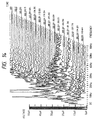
- a waveform after conversion is illustrated in Fig. 14.
- the axis of abscissa indicates frequency
- the axis of ordinate indicates the magnitude of current
- the depth indicates time.
- Numeral 4 denotes a frequency band-pass filter for the frequency component band to be used, mainly the beta-wave high frequency band of 20 to 40 Hz. By passing brain waves through this filter, the data of the frequency band necessary for being used as the brain wave switch are extracted from the brain waves measured through the electrode 1.
- Numeral 5 denotes a circuit for integrating peak currents in the brain wave beta-wave frequency, which can be used for the brain wave switch.
- Numeral 6 denotes an output amplifier, which amplifies a signal of 5 into a stable signal.
- Numeral 7 indicates a comparator for determining the level of an output signal in relation to a reference signal when turning the brain wave switch ON; it outputs to an electroencephalogram switch 9 that the level of an output signal has exceeded the level of the reference signal.
- the comparator serves also as a level adjustor.
- the electroencephalogram switch 9 applies a control signal for turning the switch ON to the controller of the main unit message display.
- Numeral 8 is an input unit consisting of a mechanical switch such as a microswitch operated by muscular strength of a part of a human body; it is connected to the main controller via a connection terminal.
- Numeral 11 denotes a display of the main unit message processor, which displays a message for transmitting intent on the screen.
- Numeral 16 denotes a pen digitizer for entering drawn information such as characters in the form of coordinate data.
- Numeral 10 is an alarm generator, which is actuated in response to an input instructing the generation of an alarm when confirmation is made or when a cell 43 in Fig. 4 is selected.
- Numeral 12 is an alarm controller, which controls 10.
- Numeral 15 is a character generation controller having a font ROM, which is used in a menu selection mode and a word processing mode; it generates character data to display desired characters on the display 11 and it has a simple character recognizing function to recognize a character drawn on the digitizer 16 when a cell 42 of Fig. 4 is selected to instruct the digitizer input mode.
- Numeral 14 indicates a memory for storing sentences, words and graphic images created by using 15 and 16 and also a control program for the processing procedure shown in the flowchart to be discussed later; it includes a ROM (read-only memory) and a RAM (random-access memory).
- ROM read-only memory
- RAM random-access memory
- Numeral 13 denotes a controller (CPU), which consists of a microcomputer having a computing element, which features low power consumption and fast computation; it controls the units described above in accordance with the control program stored in the memory 14. More specifically, the controller has the following control functions:
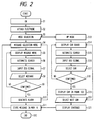
- the operation is started when a main unit power switch is turned ON in a step S1. Then in S2, the electrode attached to a head band or the like is mounted on the forehead.
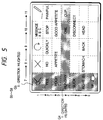
- the display 11 shows an initial screen, which has an area of a basic command line G1 to allow the selection of a mode as shown in Fig. 4.
- a cell 41 shows that a message selection mode, which is the main mode, has been selected ("MESSAGE" is highlighted).
- MESSAGE is highlighted.
- the system determines that an instruction for changing the mode has been given and it selects the word processing mode, which is different from the mode selected when the cell 41 was specified, and it reports to an operator that the currently selected mode is the word processing mode by highlighting "ABC.”
- the system starts automatic search at a given time intervals in direction X and direction Y of the square cells of the message list. For instance, the system first advances 1 to 5 steps in the direction of Y axis, then in the direction of X axis for 6 to 11 steps in order at intervals of 1 to 10 seconds (the parameter is set), thus repeating the automatic interval search.
- a step wherein a confirmation signal is entered on Y axis, is kept ON, skipping the rest, and the system starts search turning ON in the direction of axis X from 7 of G5.
- the parameter for the time interval of the automatic search is set according to a method to be discussed later.
- a string of items to be approved is illuminated brighter by one level, all strings being lighted in order at regular intervals.
- the user takes voluntary actions such as reading or drawing at a selected area, thus generating the an active brain current in the frontal area.
- the generated active brain current is detected as a potential in the scalp through the electrode 1, and the electroencephalogram wave component is processed; if the electroencephalogram wave switch 9 detects the information, which indicates that the electroencephalogram wave switch should be turned ON, then an ON switch signal is output to the controller 13 (S7).
- an alarm sound for notifying the presence of a message for transmitting intent is given by the alarm generator 10.
- the messages confirmed in S9 are stored in the memory 14 in the order in which they were confirmed (S11), and the system goes back to the initial screen display of the message selection mode as shown in Fig. 7 then repeats the processing, starting with S4 by selecting a return command G6 and confirming the selection.
- S11 if no input is given for a certain time or if a cell of "END" (not shown) is selected, then the system terminates the processing (S12).
- Direct drawing in a registration frame may be performed through the pen digitizer 16. Further, a pointing device may be used to specify a position.
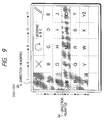
- S15 the automatic search of character strings is started in the X and Y directions as in S6. Then in S16, the brain waves generated by taking actions such as drawing in the head or reading are detected as in S7; in S17, characters are selected as in S8, and in S18, confirmation is performed as in S9. The characters thus selected are arranged and displayed in order in a sentence frame 100 as shown in Fig. 10 (S19).
- a message sentence or word is created by repeating the steps from S14 to S20.
- the system proceeds to S21 if no input is given for a certain time in S20.
- the sentence or word created in S21 is stored in the memory 14.
- the characters selected in S17 may be displayed in alphabets ("KIBUNII" (feel better)) in the sentence frame 100 as shown in Fig. 10 or they may alternatively be converted to katakana and displayed as shown in Fig. 11.
- the apparatus has the mechanical switch 8, so that the operator of the apparatus operates the mechanical switch as long as the operator retains muscular strength while at the same time taking voluntary actions such as reading and writing characters to turn the electroencephalogram wave switch ON.
- the difference between the turning ON timing of the mechanical switch and that of the electroencephalogram wave switch is detected, and the time interval of the automatic search performed in S6 and S15 of the flowchart shown in Fig. 2 is set in accordance with the difference.
- Storing the parameter in the memory 14 permits efficient automatic search display, which matches the characteristics of the operator and the characteristics of the apparatus.
- An apparatus and a method for aiding the transmission of intent whereby to enable a severely physically-handicapped person, who has lost muscular energy due to amyotrophic lateral sclerosis (ALS), muscular dystrophy or the like, to transmit his/her intent through an electroencephalogram wave.
- a mechanical switch and an electroencephalogram wave switch are used in combination to allow the transmission of intent over the whole period of such a disease.
Landscapes
- Engineering & Computer Science (AREA)
- Health & Medical Sciences (AREA)
- Life Sciences & Earth Sciences (AREA)
- General Health & Medical Sciences (AREA)
- Biomedical Technology (AREA)
- Physics & Mathematics (AREA)
- Veterinary Medicine (AREA)
- Public Health (AREA)
- Animal Behavior & Ethology (AREA)
- Heart & Thoracic Surgery (AREA)
- Theoretical Computer Science (AREA)
- Human Computer Interaction (AREA)
- Medical Informatics (AREA)
- General Engineering & Computer Science (AREA)
- Biophysics (AREA)
- General Physics & Mathematics (AREA)
- Pathology (AREA)
- Molecular Biology (AREA)
- Surgery (AREA)
- Dermatology (AREA)
- Neurology (AREA)
- Audiology, Speech & Language Pathology (AREA)
- Vascular Medicine (AREA)
- Psychiatry (AREA)
- Psychology (AREA)
- Business, Economics & Management (AREA)
- Neurosurgery (AREA)
- Educational Administration (AREA)
- Educational Technology (AREA)
- Measurement And Recording Of Electrical Phenomena And Electrical Characteristics Of The Living Body (AREA)
- User Interface Of Digital Computer (AREA)
- Electric Clocks (AREA)
- Measuring And Recording Apparatus For Diagnosis (AREA)
- Accommodation For Nursing Or Treatment Tables (AREA)
Applications Claiming Priority (2)
| Application Number | Priority Date | Filing Date | Title |
|---|---|---|---|
| JP160888/93 | 1993-06-30 | ||
| JP5160888A JP2899194B2 (ja) | 1993-06-30 | 1993-06-30 | 意思伝達支援装置及び意思伝達支援方法 |
Publications (2)
| Publication Number | Publication Date |
|---|---|
| EP0632421A1 true EP0632421A1 (fr) | 1995-01-04 |
| EP0632421B1 EP0632421B1 (fr) | 1998-12-23 |
Family
ID=15724540
Family Applications (1)
| Application Number | Title | Priority Date | Filing Date |
|---|---|---|---|
| EP94110098A Expired - Lifetime EP0632421B1 (fr) | 1993-06-30 | 1994-06-29 | Méthode et dispositif pour aider la transmission de l'intention |
Country Status (4)
| Country | Link |
|---|---|
| US (1) | US5967996A (fr) |
| EP (1) | EP0632421B1 (fr) |
| JP (1) | JP2899194B2 (fr) |
| DE (1) | DE69415418T2 (fr) |
Cited By (4)
| Publication number | Priority date | Publication date | Assignee | Title |
|---|---|---|---|---|
| WO1997037590A1 (fr) * | 1996-04-10 | 1997-10-16 | University Of Technology, Sydney | Systeme d'activation base sur l'electroencephalographie |
| GB2329063A (en) * | 1997-09-06 | 1999-03-10 | Paul Smales | Activity toy |
| AU722772B2 (en) * | 1996-04-10 | 2000-08-10 | University Of Technology, Sydney | EEG based activation system |
| US9389685B1 (en) | 2013-07-08 | 2016-07-12 | University Of South Florida | Vision based brain-computer interface systems for performing activities of daily living |
Families Citing this family (32)
| Publication number | Priority date | Publication date | Assignee | Title |
|---|---|---|---|---|
| JPH10207592A (ja) * | 1997-01-20 | 1998-08-07 | Technos Japan:Kk | 生体信号を利用した意思伝達装置 |
| JPH11203022A (ja) * | 1998-01-16 | 1999-07-30 | Technos Japan:Kk | 生体信号を機器の制御信号として応用する方法及びその装置 |
| US7760187B2 (en) | 2004-07-30 | 2010-07-20 | Apple Inc. | Visual expander |
| US6757558B2 (en) * | 2000-07-06 | 2004-06-29 | Algodyne, Ltd. | Objective pain measurement system and method |
| JP2004180817A (ja) * | 2002-12-02 | 2004-07-02 | National Institute Of Advanced Industrial & Technology | 生体信号を利用した作業支援マニピュレータシステム |
| US7546158B2 (en) * | 2003-06-05 | 2009-06-09 | The Regents Of The University Of California | Communication methods based on brain computer interfaces |
| US7307509B2 (en) * | 2004-11-02 | 2007-12-11 | Custom Lab Software Systems, Inc. | Assistive communication device |
| DE102005047044A1 (de) * | 2005-09-30 | 2007-04-12 | Siemens Ag | Verfahren zum Steuern eines medizinischen Geräts durch eine Bedienperson |
| DE102006010229B4 (de) * | 2006-03-02 | 2012-03-08 | Tobias Denninger | Verfahren und Vorrichtung zur Eingabe von Zeichen |
| US8570278B2 (en) | 2006-10-26 | 2013-10-29 | Apple Inc. | Portable multifunction device, method, and graphical user interface for adjusting an insertion point marker |
| US7856605B2 (en) | 2006-10-26 | 2010-12-21 | Apple Inc. | Method, system, and graphical user interface for positioning an insertion marker in a touch screen display |
| US10198958B2 (en) | 2007-05-04 | 2019-02-05 | Freer Logic | Method and apparatus for training a team by employing brainwave monitoring and synchronized attention levels of team trainees |
| US8201109B2 (en) | 2008-03-04 | 2012-06-12 | Apple Inc. | Methods and graphical user interfaces for editing on a portable multifunction device |
| US8650507B2 (en) * | 2008-03-04 | 2014-02-11 | Apple Inc. | Selecting of text using gestures |
| CN101932989B (zh) * | 2008-04-04 | 2013-04-17 | 松下电器产业株式会社 | 脑波识别方法的调整装置、方法以及计算机程序 |
| US20100235734A1 (en) | 2009-03-16 | 2010-09-16 | Bas Ording | Methods and Graphical User Interfaces for Editing on a Multifunction Device with a Touch Screen Display |
| TWI401584B (zh) * | 2009-11-11 | 2013-07-11 | Brain wave in English input system | |
| JP5472746B2 (ja) * | 2010-09-28 | 2014-04-16 | 独立行政法人産業技術総合研究所 | 意思伝達支援装置及び方法 |
| US9092130B2 (en) | 2011-05-31 | 2015-07-28 | Apple Inc. | Devices, methods, and graphical user interfaces for document manipulation |
| KR101293863B1 (ko) * | 2011-06-29 | 2013-08-16 | 한양대학교 산학협력단 | 안정상태 시각유발전위를 이용한 qwerty 타입의 문자 입력 인터페이스 장치 및 문자 입력 방법 |
| CN103099693A (zh) * | 2013-02-07 | 2013-05-15 | 王禹 | 基于脑电/语音指令助残控制系统 |
| KR101431203B1 (ko) | 2013-04-16 | 2014-08-18 | 고려대학교 산학협력단 | 뇌파를 이용한 의도 인식용 두뇌 기계 인터페이스 장치 및 방법 |
| EP3149662B1 (fr) * | 2014-05-30 | 2026-01-28 | The Regents of The University of Michigan | Interface cerveau-ordinateur pour faciliter la sélection directe de réponses à choix multiples et l'identification de changements d'état |
| CN104503593A (zh) * | 2015-01-23 | 2015-04-08 | 北京智谷睿拓技术服务有限公司 | 控制信息确定方法和装置 |
| ITUB20153680A1 (it) * | 2015-09-16 | 2017-03-16 | Liquidweb Srl | Sistema di controllo di tecnologie assistive e relativo metodo |
| JP6790856B2 (ja) * | 2017-01-18 | 2020-11-25 | 株式会社デンソー | 電子情報処理システム及びコンピュータプログラム |
| CN111629653B (zh) | 2017-08-23 | 2024-06-21 | 神经股份有限公司 | 具有高速眼睛跟踪特征的大脑-计算机接口 |
| KR102871382B1 (ko) | 2017-11-13 | 2025-10-16 | 뉴레이블 인크. | 고속, 정확도 및 직관적 사용자 상호작용을 위한 적응을 갖춘 두뇌-컴퓨터 인터페이스 |
| CN111712192B (zh) | 2018-01-18 | 2024-07-02 | 神经股份有限公司 | 具有对于高速、准确和直观的用户交互的适配的大脑-计算机接口 |
| US10664050B2 (en) | 2018-09-21 | 2020-05-26 | Neurable Inc. | Human-computer interface using high-speed and accurate tracking of user interactions |
| US11379113B2 (en) | 2019-06-01 | 2022-07-05 | Apple Inc. | Techniques for selecting text |
| TR202002077A2 (tr) * | 2020-02-12 | 2021-08-23 | Izmir Cigli Cigli Fen Lisesi | Engelli̇ i̇leti̇şi̇m si̇stemi̇ |
Citations (6)
| Publication number | Priority date | Publication date | Assignee | Title |
|---|---|---|---|---|
| US4013068A (en) * | 1974-10-15 | 1977-03-22 | Settle Wayne L | Electroencephalographic activated control system |
| GB2128786A (en) * | 1982-10-12 | 1984-05-02 | Possum Controls Ltd | Apparatus for controlling production of speech or text |
| US4651145A (en) * | 1984-05-31 | 1987-03-17 | Medical Research Institute | Communication system for the disabled in which a display target is selected by encephalogram response |
| EP0278989A1 (fr) * | 1987-01-06 | 1988-08-24 | Lorenzo Ruscello | Dispositif permettant aux handicapés de s'exprimer en utilisant des symboles choisis individuellement |
| GB2220089A (en) * | 1988-06-17 | 1989-12-28 | Brian Edwards | Brain-wave-controlled computer interface |
| US4926969A (en) * | 1988-11-18 | 1990-05-22 | Neurosonics, Inc. | Sensory-driven controller |
Family Cites Families (6)
| Publication number | Priority date | Publication date | Assignee | Title |
|---|---|---|---|---|
| US4056805A (en) * | 1976-12-17 | 1977-11-01 | Brady William M | Programmable electronic visual display systems |
| US4462411A (en) * | 1981-01-07 | 1984-07-31 | The University Of Melbourne | Evoked response audiometer |
| US4846190A (en) * | 1983-08-23 | 1989-07-11 | John Erwin R | Electroencephalographic system data display |
| US5010891A (en) * | 1987-10-09 | 1991-04-30 | Biometrak Corporation | Cerebral biopotential analysis system and method |
| US4987903A (en) * | 1988-11-14 | 1991-01-29 | William Keppel | Method and apparatus for identifying and alleviating semantic memory deficiencies |
| US5003986A (en) * | 1988-11-17 | 1991-04-02 | Kenneth D. Pool, Jr. | Hierarchial analysis for processing brain stem signals to define a prominent wave |
-
1993
- 1993-06-30 JP JP5160888A patent/JP2899194B2/ja not_active Expired - Fee Related
-
1994
- 1994-06-29 EP EP94110098A patent/EP0632421B1/fr not_active Expired - Lifetime
- 1994-06-29 DE DE69415418T patent/DE69415418T2/de not_active Expired - Lifetime
-
1997
- 1997-03-12 US US08/820,353 patent/US5967996A/en not_active Expired - Lifetime
Patent Citations (6)
| Publication number | Priority date | Publication date | Assignee | Title |
|---|---|---|---|---|
| US4013068A (en) * | 1974-10-15 | 1977-03-22 | Settle Wayne L | Electroencephalographic activated control system |
| GB2128786A (en) * | 1982-10-12 | 1984-05-02 | Possum Controls Ltd | Apparatus for controlling production of speech or text |
| US4651145A (en) * | 1984-05-31 | 1987-03-17 | Medical Research Institute | Communication system for the disabled in which a display target is selected by encephalogram response |
| EP0278989A1 (fr) * | 1987-01-06 | 1988-08-24 | Lorenzo Ruscello | Dispositif permettant aux handicapés de s'exprimer en utilisant des symboles choisis individuellement |
| GB2220089A (en) * | 1988-06-17 | 1989-12-28 | Brian Edwards | Brain-wave-controlled computer interface |
| US4926969A (en) * | 1988-11-18 | 1990-05-22 | Neurosonics, Inc. | Sensory-driven controller |
Cited By (6)
| Publication number | Priority date | Publication date | Assignee | Title |
|---|---|---|---|---|
| WO1997037590A1 (fr) * | 1996-04-10 | 1997-10-16 | University Of Technology, Sydney | Systeme d'activation base sur l'electroencephalographie |
| AU722772B2 (en) * | 1996-04-10 | 2000-08-10 | University Of Technology, Sydney | EEG based activation system |
| US6175762B1 (en) | 1996-04-10 | 2001-01-16 | University Of Technology, Sydney | EEG based activation system |
| GB2329063A (en) * | 1997-09-06 | 1999-03-10 | Paul Smales | Activity toy |
| GB2329063B (en) * | 1997-09-06 | 2001-07-04 | Paul Smales | Activity toy |
| US9389685B1 (en) | 2013-07-08 | 2016-07-12 | University Of South Florida | Vision based brain-computer interface systems for performing activities of daily living |
Also Published As
| Publication number | Publication date |
|---|---|
| DE69415418D1 (de) | 1999-02-04 |
| JPH0720774A (ja) | 1995-01-24 |
| JP2899194B2 (ja) | 1999-06-02 |
| US5967996A (en) | 1999-10-19 |
| EP0632421B1 (fr) | 1998-12-23 |
| DE69415418T2 (de) | 1999-06-10 |
Similar Documents
| Publication | Publication Date | Title |
|---|---|---|
| EP0632421B1 (fr) | Méthode et dispositif pour aider la transmission de l'intention | |
| US11237635B2 (en) | Nonverbal multi-input and feedback devices for user intended computer control and communication of text, graphics and audio | |
| JP7149492B2 (ja) | 文脈依存性ユーザインタフェースを備えた筋電位(emg)支援通信デバイス | |
| US20250253041A1 (en) | Medical device with natural language processor | |
| CN101201696B (zh) | 基于p300脑电电位的中文输入bci系统 | |
| US5899867A (en) | System for self-administration of electroencephalographic (EEG) neurofeedback training | |
| US7546158B2 (en) | Communication methods based on brain computer interfaces | |
| CN111656304B (zh) | 通信方法及系统 | |
| Riseberg et al. | Frustrating the user on purpose: Using biosignals in a pilot study to detect the user's emotional state | |
| CN109065184B (zh) | 基于脑机接口的脑卒中患者语音交流看护控制系统及方法 | |
| CN101464729A (zh) | 基于听觉认知神经信号的自主意愿表达方法 | |
| AU2022268375B2 (en) | Multiple switching electromyography (emg) assistive communications device | |
| Wickelgren | Tapping the mind | |
| US11029758B2 (en) | Dynamic command remapping for human-computer interface | |
| JP3591106B2 (ja) | 対話型自動問診方法及び装置 | |
| CN118625934A (zh) | 一种融合llm实现意图理解的混合脑机接口系统 | |
| Keryakos et al. | Analyzing stress situations for blind people | |
| CN117224141A (zh) | 一种波形图标记方法、波形图显示装置及可读存储介质 | |
| JPH08229132A (ja) | 生体信号測定・誘導装置 | |
| JP2001128944A (ja) | 手書き入力機能を備えた生体信号モニタ装置 | |
| CN112698729B (zh) | 一种基于脑信号与语音相结合的字符输入方法 | |
| Połok et al. | A low cost depth sensor-based computer control system for the disabled people | |
| Barour et al. | Electrooculography Signal Acquisition and Processing for Real-Time Virtual Keyboard | |
| CN121911019A (zh) | 控制方法、植入式闭环神经刺激系统及存储介质 | |
| Cincotti et al. | Interacting with the environment through non-invasive brain-computer interfaces |
Legal Events
| Date | Code | Title | Description |
|---|---|---|---|
| PUAI | Public reference made under article 153(3) epc to a published international application that has entered the european phase |
Free format text: ORIGINAL CODE: 0009012 |
|
| AK | Designated contracting states |
Kind code of ref document: A1 Designated state(s): DE FR GB |
|
| 17P | Request for examination filed |
Effective date: 19950522 |
|
| 17Q | First examination report despatched |
Effective date: 19970314 |
|
| GRAG | Despatch of communication of intention to grant |
Free format text: ORIGINAL CODE: EPIDOS AGRA |
|
| GRAG | Despatch of communication of intention to grant |
Free format text: ORIGINAL CODE: EPIDOS AGRA |
|
| GRAG | Despatch of communication of intention to grant |
Free format text: ORIGINAL CODE: EPIDOS AGRA |
|
| GRAH | Despatch of communication of intention to grant a patent |
Free format text: ORIGINAL CODE: EPIDOS IGRA |
|
| GRAH | Despatch of communication of intention to grant a patent |
Free format text: ORIGINAL CODE: EPIDOS IGRA |
|
| GRAA | (expected) grant |
Free format text: ORIGINAL CODE: 0009210 |
|
| AK | Designated contracting states |
Kind code of ref document: B1 Designated state(s): DE FR GB |
|
| REF | Corresponds to: |
Ref document number: 69415418 Country of ref document: DE Date of ref document: 19990204 |
|
| ET | Fr: translation filed | ||
| PLBE | No opposition filed within time limit |
Free format text: ORIGINAL CODE: 0009261 |
|
| STAA | Information on the status of an ep patent application or granted ep patent |
Free format text: STATUS: NO OPPOSITION FILED WITHIN TIME LIMIT |
|
| 26N | No opposition filed | ||
| REG | Reference to a national code |
Ref country code: GB Ref legal event code: IF02 |
|
| REG | Reference to a national code |
Ref country code: FR Ref legal event code: ST Effective date: 20110228 |
|
| PG25 | Lapsed in a contracting state [announced via postgrant information from national office to epo] |
Ref country code: FR Free format text: LAPSE BECAUSE OF NON-PAYMENT OF DUE FEES Effective date: 20100630 |
|
| PGFP | Annual fee paid to national office [announced via postgrant information from national office to epo] |
Ref country code: DE Payment date: 20120630 Year of fee payment: 19 |
|
| PGFP | Annual fee paid to national office [announced via postgrant information from national office to epo] |
Ref country code: GB Payment date: 20120626 Year of fee payment: 19 |
|
| GBPC | Gb: european patent ceased through non-payment of renewal fee |
Effective date: 20130629 |
|
| REG | Reference to a national code |
Ref country code: DE Ref legal event code: R119 Ref document number: 69415418 Country of ref document: DE Effective date: 20140101 |
|
| PG25 | Lapsed in a contracting state [announced via postgrant information from national office to epo] |
Ref country code: GB Free format text: LAPSE BECAUSE OF NON-PAYMENT OF DUE FEES Effective date: 20130629 Ref country code: DE Free format text: LAPSE BECAUSE OF NON-PAYMENT OF DUE FEES Effective date: 20140101 |
|
| PGFP | Annual fee paid to national office [announced via postgrant information from national office to epo] |
Ref country code: FR Payment date: 20090624 Year of fee payment: 16 |