EP0633108A1 - Verfahren und Vorrichtung zur Wiederaufbereitung von festem Polyestermaterial - Google Patents
Verfahren und Vorrichtung zur Wiederaufbereitung von festem Polyestermaterial Download PDFInfo
- Publication number
- EP0633108A1 EP0633108A1 EP19940105179 EP94105179A EP0633108A1 EP 0633108 A1 EP0633108 A1 EP 0633108A1 EP 19940105179 EP19940105179 EP 19940105179 EP 94105179 A EP94105179 A EP 94105179A EP 0633108 A1 EP0633108 A1 EP 0633108A1
- Authority
- EP
- European Patent Office
- Prior art keywords
- container
- component
- recycling
- recycling component
- primary component
- Prior art date
- Legal status (The legal status is an assumption and is not a legal conclusion. Google has not performed a legal analysis and makes no representation as to the accuracy of the status listed.)
- Granted
Links
- 238000004064 recycling Methods 0.000 title claims abstract description 48
- 238000000034 method Methods 0.000 title claims abstract description 34
- 229920000728 polyester Polymers 0.000 title claims abstract description 17
- 230000008569 process Effects 0.000 title claims abstract description 17
- 239000000463 material Substances 0.000 claims abstract description 36
- 238000002844 melting Methods 0.000 claims abstract description 12
- 230000008018 melting Effects 0.000 claims abstract description 12
- 238000012545 processing Methods 0.000 claims abstract description 12
- 239000000155 melt Substances 0.000 claims abstract description 5
- 239000002699 waste material Substances 0.000 claims abstract description 5
- 238000010438 heat treatment Methods 0.000 claims abstract description 4
- 238000003756 stirring Methods 0.000 claims abstract 2
- 238000011144 upstream manufacturing Methods 0.000 claims abstract 2
- 239000007789 gas Substances 0.000 claims description 12
- 238000006068 polycondensation reaction Methods 0.000 claims description 9
- IJGRMHOSHXDMSA-UHFFFAOYSA-N Atomic nitrogen Chemical compound N#N IJGRMHOSHXDMSA-UHFFFAOYSA-N 0.000 claims description 6
- 239000000203 mixture Substances 0.000 claims description 5
- 229910052757 nitrogen Inorganic materials 0.000 claims description 3
- 125000000896 monocarboxylic acid group Chemical group 0.000 claims 1
- 238000006243 chemical reaction Methods 0.000 description 10
- 125000002887 hydroxy group Chemical group [H]O* 0.000 description 9
- 239000000047 product Substances 0.000 description 9
- 239000007790 solid phase Substances 0.000 description 7
- LYCAIKOWRPUZTN-UHFFFAOYSA-N Ethylene glycol Chemical compound OCCO LYCAIKOWRPUZTN-UHFFFAOYSA-N 0.000 description 5
- 125000003178 carboxy group Chemical group [H]OC(*)=O 0.000 description 5
- 238000009833 condensation Methods 0.000 description 5
- 229920000139 polyethylene terephthalate Polymers 0.000 description 5
- 239000005020 polyethylene terephthalate Substances 0.000 description 5
- 239000007795 chemical reaction product Substances 0.000 description 4
- 230000005494 condensation Effects 0.000 description 4
- 238000002156 mixing Methods 0.000 description 4
- 229920000642 polymer Polymers 0.000 description 4
- 230000000694 effects Effects 0.000 description 3
- 230000032050 esterification Effects 0.000 description 3
- 238000005886 esterification reaction Methods 0.000 description 3
- 238000004519 manufacturing process Methods 0.000 description 3
- -1 polyethylene terephthalate Polymers 0.000 description 3
- 238000012958 reprocessing Methods 0.000 description 3
- 239000007787 solid Substances 0.000 description 3
- 239000000126 substance Substances 0.000 description 3
- 230000009471 action Effects 0.000 description 2
- 230000008859 change Effects 0.000 description 2
- 239000000470 constituent Substances 0.000 description 2
- 238000009826 distribution Methods 0.000 description 2
- 230000007062 hydrolysis Effects 0.000 description 2
- 238000006460 hydrolysis reaction Methods 0.000 description 2
- 239000007788 liquid Substances 0.000 description 2
- 239000012803 melt mixture Substances 0.000 description 2
- 238000007086 side reaction Methods 0.000 description 2
- 238000005245 sintering Methods 0.000 description 2
- 230000008646 thermal stress Effects 0.000 description 2
- 150000001299 aldehydes Chemical class 0.000 description 1
- 230000015572 biosynthetic process Effects 0.000 description 1
- 230000003139 buffering effect Effects 0.000 description 1
- 238000004140 cleaning Methods 0.000 description 1
- 150000001875 compounds Chemical class 0.000 description 1
- 238000005520 cutting process Methods 0.000 description 1
- 230000007547 defect Effects 0.000 description 1
- 238000003795 desorption Methods 0.000 description 1
- 238000011161 development Methods 0.000 description 1
- 230000018109 developmental process Effects 0.000 description 1
- 238000009792 diffusion process Methods 0.000 description 1
- 238000010494 dissociation reaction Methods 0.000 description 1
- 230000005593 dissociations Effects 0.000 description 1
- 150000002170 ethers Chemical class 0.000 description 1
- 230000034659 glycolysis Effects 0.000 description 1
- 238000000227 grinding Methods 0.000 description 1
- WGCNASOHLSPBMP-UHFFFAOYSA-N hydroxyacetaldehyde Natural products OCC=O WGCNASOHLSPBMP-UHFFFAOYSA-N 0.000 description 1
- 239000011261 inert gas Substances 0.000 description 1
- 238000005259 measurement Methods 0.000 description 1
- 238000006140 methanolysis reaction Methods 0.000 description 1
- 239000004745 nonwoven fabric Substances 0.000 description 1
- 239000012071 phase Substances 0.000 description 1
- 239000013502 plastic waste Substances 0.000 description 1
- 238000002360 preparation method Methods 0.000 description 1
- 238000004886 process control Methods 0.000 description 1
- 239000000376 reactant Substances 0.000 description 1
- 239000011541 reaction mixture Substances 0.000 description 1
- 238000006462 rearrangement reaction Methods 0.000 description 1
- 230000009467 reduction Effects 0.000 description 1
- 230000008929 regeneration Effects 0.000 description 1
- 238000011069 regeneration method Methods 0.000 description 1
- 239000007858 starting material Substances 0.000 description 1
- 230000003068 static effect Effects 0.000 description 1
- 230000003685 thermal hair damage Effects 0.000 description 1
- 238000012546 transfer Methods 0.000 description 1
- 230000001960 triggered effect Effects 0.000 description 1
- XLYOFNOQVPJJNP-UHFFFAOYSA-N water Substances O XLYOFNOQVPJJNP-UHFFFAOYSA-N 0.000 description 1
Images
Classifications
-
- C—CHEMISTRY; METALLURGY
- C08—ORGANIC MACROMOLECULAR COMPOUNDS; THEIR PREPARATION OR CHEMICAL WORKING-UP; COMPOSITIONS BASED THEREON
- C08J—WORKING-UP; GENERAL PROCESSES OF COMPOUNDING; AFTER-TREATMENT NOT COVERED BY SUBCLASSES C08B, C08C, C08F, C08G or C08H
- C08J11/00—Recovery or working-up of waste materials
- C08J11/04—Recovery or working-up of waste materials of polymers
- C08J11/10—Recovery or working-up of waste materials of polymers by chemically breaking down the molecular chains of polymers or breaking of crosslinks, e.g. devulcanisation
- C08J11/18—Recovery or working-up of waste materials of polymers by chemically breaking down the molecular chains of polymers or breaking of crosslinks, e.g. devulcanisation by treatment with organic material
- C08J11/22—Recovery or working-up of waste materials of polymers by chemically breaking down the molecular chains of polymers or breaking of crosslinks, e.g. devulcanisation by treatment with organic material by treatment with organic oxygen-containing compounds
-
- C—CHEMISTRY; METALLURGY
- C08—ORGANIC MACROMOLECULAR COMPOUNDS; THEIR PREPARATION OR CHEMICAL WORKING-UP; COMPOSITIONS BASED THEREON
- C08G—MACROMOLECULAR COMPOUNDS OBTAINED OTHERWISE THAN BY REACTIONS ONLY INVOLVING UNSATURATED CARBON-TO-CARBON BONDS
- C08G63/00—Macromolecular compounds obtained by reactions forming a carboxylic ester link in the main chain of the macromolecule
- C08G63/78—Preparation processes
- C08G63/785—Preparation processes characterised by the apparatus used
-
- B—PERFORMING OPERATIONS; TRANSPORTING
- B29—WORKING OF PLASTICS; WORKING OF SUBSTANCES IN A PLASTIC STATE IN GENERAL
- B29K—INDEXING SCHEME ASSOCIATED WITH SUBCLASSES B29B, B29C OR B29D, RELATING TO MOULDING MATERIALS OR TO MATERIALS FOR MOULDS, REINFORCEMENTS, FILLERS OR PREFORMED PARTS, e.g. INSERTS
- B29K2105/00—Condition, form or state of moulded material or of the material to be shaped
- B29K2105/0002—Condition, form or state of moulded material or of the material to be shaped monomers or prepolymers
-
- C—CHEMISTRY; METALLURGY
- C08—ORGANIC MACROMOLECULAR COMPOUNDS; THEIR PREPARATION OR CHEMICAL WORKING-UP; COMPOSITIONS BASED THEREON
- C08J—WORKING-UP; GENERAL PROCESSES OF COMPOUNDING; AFTER-TREATMENT NOT COVERED BY SUBCLASSES C08B, C08C, C08F, C08G or C08H
- C08J2367/00—Characterised by the use of polyesters obtained by reactions forming a carboxylic ester link in the main chain; Derivatives of such polymers
- C08J2367/02—Polyesters derived from dicarboxylic acids and dihydroxy compounds
-
- Y—GENERAL TAGGING OF NEW TECHNOLOGICAL DEVELOPMENTS; GENERAL TAGGING OF CROSS-SECTIONAL TECHNOLOGIES SPANNING OVER SEVERAL SECTIONS OF THE IPC; TECHNICAL SUBJECTS COVERED BY FORMER USPC CROSS-REFERENCE ART COLLECTIONS [XRACs] AND DIGESTS
- Y02—TECHNOLOGIES OR APPLICATIONS FOR MITIGATION OR ADAPTATION AGAINST CLIMATE CHANGE
- Y02P—CLIMATE CHANGE MITIGATION TECHNOLOGIES IN THE PRODUCTION OR PROCESSING OF GOODS
- Y02P20/00—Technologies relating to chemical industry
- Y02P20/50—Improvements relating to the production of bulk chemicals
- Y02P20/582—Recycling of unreacted starting or intermediate materials
-
- Y—GENERAL TAGGING OF NEW TECHNOLOGICAL DEVELOPMENTS; GENERAL TAGGING OF CROSS-SECTIONAL TECHNOLOGIES SPANNING OVER SEVERAL SECTIONS OF THE IPC; TECHNICAL SUBJECTS COVERED BY FORMER USPC CROSS-REFERENCE ART COLLECTIONS [XRACs] AND DIGESTS
- Y02—TECHNOLOGIES OR APPLICATIONS FOR MITIGATION OR ADAPTATION AGAINST CLIMATE CHANGE
- Y02W—CLIMATE CHANGE MITIGATION TECHNOLOGIES RELATED TO WASTEWATER TREATMENT OR WASTE MANAGEMENT
- Y02W30/00—Technologies for solid waste management
- Y02W30/50—Reuse, recycling or recovery technologies
- Y02W30/62—Plastics recycling; Rubber recycling
Definitions
- the invention relates to a method for reprocessing solid polyester material and to an apparatus for performing the method.
- polyester material polyethylene terephthalate or PET
- PET polyethylene terephthalate
- polyester Processes using inert gas, vacuum and elevated temperature are known for processing polyester in the solid phase.
- the polyester is often subjected to specific conditions, as described in DE-OS 31 05 767.
- a number of known processes for recycling PET production waste have in common that the problem of melting is solved by mixing recycling material with glycol or dicarboxylic acid ester (esterification product), for example in the corresponding processing stage of the manufacturing process.
- glycol or dicarboxylic acid ester esterification product
- hydrolysis or glycolysis of the long-chain molecules and mixing of the thermally stressed and possibly damaged molecules with the reacting esterification product occurs.
- the material must again go through the esterification process and the polycondensation process with the associated thermal stress.
- Side reactions cause defects in the condensing polymer molecules, since all substances present through the equilibrium reaction, for example also aldehydes and ether compounds, or crosslinked products are introduced with the recycling material.
- the invention has for its object to provide a method of the type mentioned and an apparatus for performing the method, which or the processing of polyester material with a minimum processing time, with the least possible thermal stress and with the addition of the smallest possible amounts of primary material to a high quality end product.
- the process according to the invention makes it possible to prepare waste material made of polyethylene terephthalate (PET) in solid form and with a higher starting viscosity (recyclate) for multivalent recycling and to condense it to a high viscosity.
- PET polyethylene terephthalate
- the process involves the chemical regeneration and conversion of the recyclate in the mixture with a primary component in continuously and discontinuously operating systems to a homogeneous product.
- the basic principle of the process is to heat, recrystallize and dry the material (recycling component) in the gas stream in a first step and then to complete the solid phase condensation at high temperature in the gas stream.
- a conversion process carried out in a second step requires mixing the material processed in this way with a second component, a condensate containing hydroxyl end groups. This condensate is placed in a melt reactor.
- the recycling component preferably contains an amorphous material content of more than 80%.
- this component preferably has a density of more than 0.1 kg / l.
- the recycling component is freed from all volatile constituents and reaction products in the solid phase in the gas stream and then condensed.
- the recycling component is preferably treated in the gas stream at temperatures of 140 ° C. to 210 ° C. A change in material structure occurs that is comparable to a sintering effect.
- the recycling component is then further increased to max. Heated up to 230 ° C.
- the material with the sintering effect of the recycling component is preferably in an air stream over a period of 120 min. is condensed at 190 ° C to 230 ° C.
- nitrogen with a temperature of 200 ° C. to 255 ° C. is preferably introduced into the recycling component.
- the recycling component pretreated in this way reacts in a mixture with a primary component consisting of a high molecular weight condensate containing hydroxyl end groups.
- a primary component consisting of a high molecular weight condensate containing hydroxyl end groups.
- a polycondensate (reaction product) with a normal distribution of the molecular weight in the equilibrium state is formed from the extremely long-chain and hydroxyl group-poor recycling component.
- the recycling component is preferably mixed up to 60% in the primary component.
- the primary component preferably has a COOH end group content of less than 35% myequ / g and an OH end group content of more than 58 myequ / g.
- the primary component Before the recycling component is admixed, the primary component preferably has a degree of polycondensation in the range from 50 to 135 units.
- the process according to the invention makes it possible to keep the concentration of the reactants which trigger side reactions when the material is thermally stressed during the processing processes low, so that a high-quality melt is produced.
- the recycling component When the recycling component is added to the primary component, which contains hydroxyl end groups and whose average molecular weight is below that of the recycling component, no glycose occurs, but predominantly polyesterification. In addition, no hydrolysis or methanolysis of the long-chain compounds of the recycling material occurs. It is therefore possible to produce a polymer melt mixture which does not degrade chemically during further processing. There are also no uncontrollable after-reactions. The products made from the material can be reprocessed due to the material quality achieved.
- the device according to the invention preferably has a shaft-shaped container provided with an agitator and internals, into which the recycling component is introduced in a finely divided form via a conveyor and volumetric metering.
- Air or gas can be introduced into the interior of the container through feed points which are distributed over the height of the container, the temperature being between 140 ° C and 230 ° C and a temperature gradient being generated.
- the agitator rotates the recycling component treated in this way, as a result of which it loses, divides and shreds the compact structure under the action of the internals.
- a device acting as an agglomerate metering is arranged, from which the recycling material treated in this way is optionally discharged into a melting reactor via a screw conveyor and a lock or, in the case of continuous operation, via an extruder.
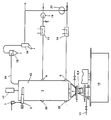
- the embodiment of the device shown in the drawing has a shaft-shaped container 3, which is provided with a stirrer and internals, into which a recycling component prepared for the process is introduced in finely divided form via a preferably pneumatic conveying element 1 and a volumetric metering 2.
- This recycling component is preferably a regrind with a density of more than 0.1 kg / l, which consists of more than 80% amorphous material.
- Air is introduced into the container 3 via an upper feed line 4 and gas via a lower feed line 5 with a temperature of 200 ° C. up to 230 ° C., combined with the generation of a temperature gradient, into the material to be ground.
- the period in which the recycling component is treated with the gas at a temperature from 190 ° C to 230 ° C is 120 min. Heated, dry air is preferably used as the treatment gas.
- a temperature gradient in the direction of the height of the container is suitably set between 140 ° C. and 230 ° C.
- the stirrer (not shown) rotates the recycling component treated in this way, as a result of which it loses, divides and shreds the compact structure under the action of the internals, which are also not shown.
- a melting reactor 10 passes into a melting reactor 10 via a device acting as agglomerate metering 7, via a screw conveyor 8 and a lock 9, or via an extruder, which is in place of the lock in the continuously operating device.
- the primary component is introduced in metered form into the melting reactor 10 via a line 11.
- the primary component is previously prepared as a polycondensate with a higher hydroxyl end group concentration.
- the reaction between the primary component containing hydroxyl end groups and the recycling component supplied in solid form then takes place in this melting reactor 10.
- the agglomerate in the primary component submitted changes to the liquid state with constant supply of heat.
- the mixing temperature can be approx. 280 ° C.
- the primary component condenses in the melt mixture formed from both components, while at the same time the conversion of the material fed into the solid phase is effected in an equilibrium reaction.
- the desired reactor progress is under a suitable process control in a time of 120 min. to realize.
- the degree of polycondensation achieved in the end is primarily due to the minimization of diffusion resistances, the mobility or the energy state of the molecules and the degree of the polyesterification reaction triggered in the second process phase of the solid phase condensation.
- the mixture in the melt container reacts at normal pressure or in vacuum to form a homogeneous polymer melt which can be discharged in strands or strips.
- the primary group component and the required viscosity which are required for re-use, can be set simply by the amount of agglomerate due to the presence of the primary component containing hydroxyl groups.
- the COOH end group concentration does not exceed the initial value or is a maximum of 15 myequ / g above the initial value of the recycling component used.
- the mixture is mixed up to max. 45 min. kept in the molten state and during this time subjected to a measurement of the viscosity and the degree of dissociation.
- the degree of polycondensation of the primary component presented is greater than 25 units and is preferably 120 units.
- this has the shape of a flow tube, each with an inlet connection for primary and secondary components, with a static mixer and with an outlet connection.
- reaction mixture of the primary component with a degree of polycondensation of 35 units and a carboxyl end group concentration of 19 myeq./g and the recycling component with non-uniform chemical properties shows good quality characteristics, no thermal damage, a degree of polycondensation of 135 units and a carboxyl to hydroxyl end group ratio of on average 1 to 2.
- the polyester hollow fraction from a plastic waste sorting is finely ground after cleaning and conveyed discontinuously into the container 3.
- a good column is formed in the container with a density of 0.35 kg / l.
- the recycling component is after the temperature of 190 ° C for a period of 40 min. flowed with air.
- the solid phase condensation takes place by raising the air temperature to 245 ° C.
- the material is then charged with nitrogen at a temperature of 235 ° C. via the second feed line 5.
- the treatment time is 60 min.
- the process of feeding the regrind to the reaction vessel is carried out as a function of the torque of the stirrer.
- the recycling component melts in the primary component presented here with those mentioned above Properties with constant supply of heat at 285 ° C.
- polyesterification reaction over a period of 25 min. the result is a recyclable product with a degree of polycondensation of 135 units and a carboxyl end group concentration of 21 myequ / g.
Landscapes
- Chemical & Material Sciences (AREA)
- Health & Medical Sciences (AREA)
- Chemical Kinetics & Catalysis (AREA)
- Medicinal Chemistry (AREA)
- Polymers & Plastics (AREA)
- Organic Chemistry (AREA)
- Life Sciences & Earth Sciences (AREA)
- Sustainable Development (AREA)
- Separation, Recovery Or Treatment Of Waste Materials Containing Plastics (AREA)
- Polyesters Or Polycarbonates (AREA)
Abstract
Description
- Die Erfindung bezieht sich auf ein Verfahren zur Wiederaufbereitung von festem Polyestermaterial sowie auf eine Vorrichtung zur Durchführung des Verfahrens.
- Derartiges Polyestermaterial (Polyäthylenterephthalat oder PET) fällt im wesentlichen sortenrein in einem Stoffkreislauf nach der bestimmungsgerechten Anwendung als Recyclingmaterial oder als Polyesterredukt/ -Abprodukt an.
- Zur Bearbeitung von Polyester in fester Phase sind Verfahren unter Anwendung von Inertgas, Vakuum und erhöhter Temperatur bekannt. Dabei wird häufig das Polyester spezifischen Bedingungen unterworfen, wie dies in der DE-OS 31 05 767 beschrieben ist.
- Einer Reihe bekannter Verfahren für das Recycling von PET-Produktionsabfall ist gemeinsam, daß das Problem des Aufschmelzens durch Vermischen von Recyclingmaterial mit Glykol oder Dikarbonsäureester (Veresterungsprodukt) z.B. in der entsprechenden Verarbeitungsstufe des Herstellungsprozesses gelöst wird. Bei dieser Verfahrensweise (GB-PS 1 254 209) tritt eine Hydrolyse bzw. Glykolyse der langkettigen Moleküle und eine Vermischung der thermisch beanspruchten und ggf. geschädigten Moleküle mit dem reagierenden Veresterungsprodukt ein. Das Material muß erneut den Veresterungsprozeß und dem Polykondensationsprozeß mit der damit verbundenen thermischen Beanspruchung durchlaufen. Durch Nebenreaktionen werden Fehlstellen in den kondensierenden Polymermolekülen verursacht, da alle durch Gleichgewichtreaktion vorhandenen Stoffe, z.B. auch Aldehyde und Ätherverbindungen, bzw. vernetzte Produkte mit dem Recyclingmaterial eingeschleust werden.
- Der Erfindung liegt die Aufgabe zugrunde, ein Verfahren der eingangs genannten Art sowie eine Vorrichtung zur Durchführung des Verfahrens zu schaffen, das bzw. die eine Aufbereitung von Polyestermaterial mit einer minimalen Verarbeitungszeit, mit einer geringst möglichen thermischen Belastung und unter Zumischung möglichst geringer Mengen an Primärmaterial zu einem hochwertigen Endprodukt ermöglicht.
- Diese Aufgabe wird durch die in den Ansprüchen 1 bzw. 9 angegebenen Merkmale gelöst.
- Vorteilhafte Ausgestaltungen und Weiterbildungen der Erfindung ergeben sich aus den jeweiligen Unteransprüchen.
- Durch das erfindungsgemäße Verfahren ist es möglich, Abfallmaterial aus Polyethylenterephthalat (PET) in fester Form und höherer Ausgangsviskosität (Recyclat) für eine multivalente Wiederverwertung aufzubereiten und auf eine hohe Viskosität nachzukondensieren. Das Verfahren beinhaltet die chemische Regenerierung und Umwandlung des Recyclates in der Mischung mit einer Primärkomponente in kontinuierlich und diskontinuierlich arbeitenden Systemen zu einem homogenen Produkt.
- Das Grundprinzip des Verfahrens besteht darin, das wiederaufzubereitende Material (Recyclingkomponente) in einem ersten Schritt im Gasstrom zu erwärmen, zu kristallisieren, zu trocknen und anschließend die Festphasenkondensation bei hoher Temperatur im Gasstrom abzuschließen. Ein in einem zweiten Schritt durchgeführter Umwandlungsprozess erfordert das Mischen des so bearbeiteten Materials mit einer zweiten Komponente, einem hydroxylendgruppenhaltigen Kondensat. Dieses Kondensat wird in einem Schmelzreaktor vorgelegt.
- Die Recyclingkomponente enthält vorzugsweise einen amorphen Materialanteil von mehr als 80%.
- Diese Komponente weist als Mahlgut vorzugsweise eine Dichte von mehr als 0,1 kg/l auf.
- Das Recyclingkomponente wird in dem ersten Schritt in fester Phase im Gasstrom von allen flüchtigen Bestandteilen und Reaktionsprodukten befreit und nachkondensiert.
- In diesem ersten Schritt wird die Recyclingkomponente vorzugsweise bei Temperaturen von 140°C bis 210°C im Gasstrom behandelt. Dabei tritt eine Materialstruktuänderung ein, die einem Sintereffekt vergleichbar ist. Die Recyclingkomponente wird anschließend weiter auf max. 230°C aufgeheizt.
- Das Material mit Sintereffekt der Recyclingkomponente wird vorzugsweise in einem Luftstrom über einen Zeitraum von 120 min. bei 190°C bis 230°C kondensiert wird.
- Nach dieser Behandlungszeit im Luftstrom wird in die Recylingkomponente vorzugsweise Stickstoff mit einer Temperatur von 200°C bis 255°C eingeleitet.
- In dem zweiten Schritt reagiert die so vorbehandelte Recyclingkomponente in Mischung mit einer Primärkomponente bestehend aus einem hochmolekularen hydroxylendgruppenhaltigen Kondensat. Durch Umlagerungsreaktion (dominierend ist die Polyumesterung) entsteht aus der extrem langkettigen und hydroxylgruppenarmen Recyclingkomponente ein Polykondensat (Reaktionsprodukt) mit einer normalen Verteilung des Molekulargewichts im Gleichgewichtszustand.
- Die Recyclingkomponente wird hierbei vorzugsweise bis zu 60% in der Primärkomponente gemischt.
- Die Primärkomponente hat vorzugsweise einen Gehalt an COOH-Endgruppen von weniger als 35% myäqu/g und einen Gehalt an OH-Endgruppen von mehr als 58 myäqu/g.
- Die Primärkomponente hat vorzugsweise vor der Zumischung der Recyclingkomponente einen Polykondensationsgrad im Bereich von 50 bis 135 Einheiten.
- Durch das erfindungsgemäße Verfahren ist es möglich, die Konzentration der Reaktanden, die bei thermischer Belastung des Materials während der Verarbeitungsprozesse Nebenreaktionen auslösen, niedrig zu halten, so daß eine qualitativ hochwertige Schmelze hergestellt wird.
- Bei der Zumischung der Recyclingkomponente zur Primärkomponente, die hydroxylendgruppenhaltig ist und deren mittleres Molekulargewicht unter dem der Recyclingkomponente liegt, tritt keine Glykose sondern dominierend eine Polyumesterung ein. Bei der Zumischung tritt weiterhin keine Hydrolyse oder Methanolyse der langkettigen Verbindungen des Recyclingmaterials auf. Daher ist eine bei der Weiterverarbeitung wenig chemisch abbauende Polymerschmelzemischung herstellbar. Es treten ferner keine unkontrollierbaren Nachreaktionen auf. Die aus dem Material hergestellten Produkte können infolge der erreichten Materialqualität erneut wiederverarbeitet werden.
- Die erfindungsgemäße Vorrichtung weist vorzugsweise einen mit einem Rührwerk und Einbauten versehenen schachtförmigen Behälter auf, in den die Recyclingkomponente in fein verteilter Form über eine Fördereinrichtung und eine volumetrische Dosierung eingeleitet wird.
- In das Innere des Behälters kann Luft bzw. Gas durch Einspeisungsstellen eingeleitet werden, die über über die Höhe des Behäters verteilt sind, wobei die Temperatur zwischen 140 °C bis zu 230°C liegt und ein Temperaturgradient erzeugt wird.
- Zur Herstellung der Fließfähigkeit versetzt das Rührwerk die so behandelte Recyclingkomponente in Drehung, wodurch sie unter der Wirkung der Einbauten die kompakte Struktur verliert, zerteilt und zerkleinert wird.
- An dem am unteren Ende des Behälters angeordneten Ausgang ist eine als Agglomeratedosierung wirkende Einrichtung angeordnet, von der aus das so behandelte Recyclingmaterial gegebenenfalls über eine Förderschnecke und eine Schleuse bzw. bei kontinuierlicher Betriebsweise über einen Extruder in einen Schmelzreaktor abgegeben wird.
- Ausführungsbeispiele der Erfindung werden nachfolgend anhand von Beispielen sowie einer in der Zeichnung dargestellten Ausführungsform der Vorrichtung näher erläutert.
- Die in der Zeichnung dargestellte Ausführungsform der Vorrichtung weist einen mit einem nicht dargestellten Rührwerk und Einbauten versehenen schachtförmigen Behälter 3 auf, in den eine für das Verfahren vorbereitete Recyclingkomponente in fein verteilter Form über ein vorzugsweise pneumatisches Förderorgan 1 und eine volumetrische Dosierung 2 eingeleitet wird.
- Diese Recyclingkomponente ist vorzugsweise ein Mahlgut mit einer Dichte von mehr als 0,1 kg/l, das zu über 80% aus amorphem Material besteht.
- In den Behälter 3 wir über eine obere Speiseleitung 4 Luft und über eine untere Speiseleitung 5 Gas mit einer Temperatur von 200°0 bis zu 230°C, verbunden mit der Erzeugung eines Temperaturgradienten, in das Mahlgut eingeleitet.
- Bei Temperaturen von 140°C bis 210°C treten aufgrund des erreichten Energiezustandes auf die Molekularbeweglichkeit zurückzuführende Oberflächeneffekte mit dem Ergebnis einer Strukturänderung des Mahlgutes ein. Die eingeleitete Luft dient ferner zur Entfernung des dem Mahlgut anhaftenden Wassers, weiterer fremder flüchtiger Bestandteile und zur Reduzierung der Gutfeuchte. Im oberen Temperaturbereich über 190°C setzt mit der Unterschreitung der Gleichgewichtskonzentration des in der Recyclingkomponente gelösten Ethylenglykols eine Festphasenkondensation ein, die zu einer Erhöhung des Polykondensationsgrades und einer Absenkung des Hydroxylendgruppengehaltes führt. Hierfür ist eine Gutdichte größer 0,1 kg/l herzustellen, die vorzugsweise im Bereich von 0,2 bis 0,4 kg/l liegt.
- Der Zeitraum, in dem die Recyclingkomponente mit dem Gas bei einer Temperatur von 190°C bis zu 230°C behandelt wird, beträgt 120 min. Vorzugsweise wird als Behandlungsgas erhitzte, trockene Luft eingesetzt. In Abhängigkeit von der Betriebsart der kontinuierlich oder diskontinuierlich arbeitenden Vorrichtung wird in geeigneter Weise ein Temperaturgradient in Richtung der Höhe des Behälters zwischen 140°C und 230°C eingestellt.
- Zur Vermeidung von superkristallinen Strukturen ist eine definierte Temperatur-Zeit-Fahrweise zu realisieren. Eine der Voraussetzungen hierfür ist die Herstellung der für den Stoffübergang und das Förderverhalten geeigneten Korngröße des Materials. Zur Anpassung der Fahrweise an die gewünschten Qualitätsmerkmale gestattet das Verfahren eine Kreislaufführung des Heizmediums. Die Auf- und Nachbereitung des Heizmediums wird in alternativer Fahrweise durch Führung über Wärmeübertrager 13 und 14, Abscheider/Kühler 15 und 16, Leitung 18 sowie Pumpen 19 und 21 erreicht.
- Zur Herstellung der Fließfähigkeit versetzt das nicht gezeigte Rührwerk die so behandelte Recyclingkomponente in Drehung, wodurch sie unter der Wirkung der ebenfalls niccht gezeigten Einbauten die kompakte Struktur verliert, zerteilt und zerkleinert wird.
- In dieser Form gelangt sie über eine als Agglomeratedosierung 7 wirkende Einrichtung über eine Förderschnecke 8 und eine Schleuse 9, bzw. über einen Extruder, der bei der kontinuierlich arbeitenden Vorrichtung an Stelle der Schleuse steht, in einen Schmelzreaktor 10.
- Es besteht die Möglichkeit, Material in einem Vorratsschuß 12 des Behälters 3 zu puffern, ohne Qualitätsminderungen zu verursachen.
- In den Schmelzreaktor 10 wird über eine Leitung 11 die Primärkomponente in dosierter Form eingeleitet.
- Die Primärkomponente wird als Polykondensat mit einer höheren Hydroxylendgruppenkonzentration vorher hergestellt.
- Inn diesem Schmelzreaktor 10 findet dann die Reaktion zwischen der hydroxylendgruppenhaltigen Primärkomponente und der in fester Form zugeführten Recyclingkomponente statt. Dazu geht das Agglomerat in der vorgelegten Primärkomponente unter ständiger Wärmezufuhr in den flüssigen Zustand über. Hierbei kann die Mischungstemperatur ca. 280°C betragen.
- In der aus beiden Komponenten gebildeten Schmelzmischung kondensiert als Folge der Desorption die Primärkomponente nach, während dadurch gleichzeitig in einer Gleichgewichtsreaktion die Umwandlung des in fester Phase eingespeisten Materials bewirkt wird.
- Der gewünschte Reaktorfortschritt ist unter einer geeigneten Prozeßführung in einer Zeit von 120 min. zu realisieren. Der am Ende erreichte Polykondensationsgrad ist vor allem der Minimierung der Diffusionswiderstände, der Beweglichkeit bzw. dem Energiezustand der Moleküle und dem Grad der im zweiten Prozeßabschnitt der Festphasenkondensation ausgelösten Polyveresterungsreaktion zuzuschreiben. So reagiert im Verlaufe einer kurzen Behandlungszeit die Mischung im Schmelzebehälter bei Normaldruck bzw. im Vakuum zu einer homogenen Polymerschmelze, die in Strängen oder Bändern ausgetragen werden kann.
- Bei dem beschriebenen Verfahren kann aufgrund der vorliegenden hydroyxylengruppenhaltigen Primärkomponente allein durch die Mengenzufuhr an Agglomerat das für einen Wiedereinsatz erforderliche Endgruppenverhältnis und die erforderliche Viskosität eingestellt werden.
- Eine Nachkondensation im flüssigem Zustand ist ebenfalls auf konventionelle Weise möglich. Die COOH-Endgruppenkonzentration überscheitet den Ausgangswert nicht, bzw. liegt bei maximal 15 myäqu/g über dem Ausgangswert der der eingesetzten Recyclingkomponente.
- Zur Einstellung eines definierten Gleichgewichtszustandes für die kontrollierte Weiterverarbeitung des Reaktionsproduktes, die zu über 50% aus der Recyclingkomponente besteht, deren Eigenschaften nicht homogen und gleichartig sein kann, wird die Mischung bis zu max. 45 min. in schmelzflüssigem Zustand gehalten und in dieser Zeit einer Messung der Viskosität und des Dissoziationsgrades unterzogen. Der Polykondensationsgrad der vorgelegten Primärkomponente ist größer 25 Einheiten und liegt vorzugsweise bei 120 Einheiten.
- Ausführlichere Beispiele für die Durchführung des Verfahrens sind wie folgt:
- Bei der Verarbeitung und nach dem Einsatz von Polyester-Vliesstoffen fallen (zur Verringerung des Transportaufwandes in Ballenform gepreßte) Materialmengen an, die einer stofflichen Wiederverarbeitung zugeführt werden müssen. Dieses Ausgangsmaterial wird durch eine Schneideinrichtung gefördert und dabei portioniert. Der dadurch erzeugte kontinuierliche Materialstrom gelangt nach der Vermahlung über einen Schneckenförderer in den vertikalen Recyclingprodukt-Behälter 3, in welchem die hier entstehende Gutsäule, die eine Dichte von 0,25 kg/l aufweist, im Luftstrom aufgeheizt wird. Die Gutsäule wird innerhalb von 50 min. auf 190°C gebracht, gesintert und danach auf dieser Temperatur max. 15 min. gehalten. Die gezielte Ausbildung des gewünschten Temperaturgradienten gestattet die Entfernung der flüchtigen Bestandteile bei einer minimalen thermischen Belastung. Durch eine weitere Gaseinströmung wird Luft mit einer Effektivtemperatur von 245°C eingespeist und damit das Material weitere 15 min. behandelt, bevor es über das Förderorgan in weiter zerkleineter, gesinterter Form dem Extruder am Ausgang des Behälters 3 zugeführt wird. Durch diesen gelangt das Material in den Schmelzreaktor. Dieser weist bei diesem Ausführungsbeispiel die Form eines Strömungsrohres mit je einem Eingangsstutzen für Primär- und Sekundärkomponente, mit einem statischen Mischer und mit einem Ausgangsstutzen auf. Das Reaktionsgemisch aus der Primärkomponente mit einem Polykondensationsgrad von 35 Einheiten und einer Carboxylendgruppenkonzentration von 19 myäqu./g und der Recyclingkomponente mit uneinheitlichen chemischen Eigenschaften weist nach Austrag, Abkühlung und Stranggranulierung in der Granulatmischung gute Qualitätsmerkmale, keine thermische Schädigung, einen Polykondensationsgrad von 135 Einheiten und ein Karboxyl-zu-Hydroxylendgruppenverhältnis von im Mittel 1 zu 2 auf.
- Damit ist eine Mehrfach- und Wiederverarbeitung des Produktes gewährleistet.
- Die Polyesterhohlkörperfraktion aus einer Kunststoffabfall-Sortierung wird nach der Reinigung fein nachgemahlen und diskontinuierlich in den Behälter 3 gefördert. Infolge der eingestellten Kornverteilung und der Gasbeaufschlagung bildet sich eine Gutsäule im Behälter mit einer Dichte von 0,35 kg/l. Die Recyclingkomponente wird nach Erreichen der Temperatur von 190°C über eine Zeit von 40 min. mit Luft durchströmt. Durch Anhebung der Lufttemperatur auf 245°C erfolgt die Festphasenkondensation. Über die zweite Speiseleitung 5 wird das Gut anschließend mit Stickstoff mit einer Temperatur von 235°C beaufschlagt. Die Behandlungszeit beträgt 60 min.
- Der Prozeß der Mahlgutzuführung zum Reaktionsbehälter wird in Abhängigkeit vom Drehmoment des Rührorgans geführt.
- Im Schmelzreaktor schmilzt die Recyclingkomponente in der hier vorgelegten Primärkomponente mit den oben genannten Eigenschaften bei ständiger Wärmezufuhr bei 285°C auf. Durch Polyumesterungsreaktion über einen Zeitraum von 25 min. entsteht ein wiederverwertbares Produkt mit einem Polykondensationsgrad von 135 Einheiten und einer Carboxylendgruppenkonzentration von 21 myäqu/g.
Claims (13)
- Verfahren zur Verarbeitung von Polyesterabfällen in einem kontinuierlich oder diskontinuierlich arbeitenden System, bestehend aus einem Reaktor oder vorgeschaltetem Behälter zur Aufbereitung der Recyclingkomponente sowie einem Schmelzereaktorsystem
dadurch gekennzeichnet, daß die Recyclingkomponente in einem erstenn Schritt bei Temperaturen von 140°C bis 210°C in einem Gasstrom gesintert wird und anschließend in einem zweiten Schritt mit einer gesinterten Struktur nach einer Aufheizung auf max. 230°C mit einer Polyesterprimärkomponente gemischt und über eine vorgegebene Zeit in reaktionsfähigem Zustand gehalten wird. - Verfahren nach Anspruch 1,
dadurch gekennzeichnet, daß die Recyclingkomponente einen amorphen Materialanteil größer 80% enthält. - Verfahren nach Anspruch 1 oder 2,
dadurch gekennzeichnet, daß die Recyclingkomponente mit bis zu 60% in der Polyesterprimärkomponente gemischt wird. - Verfahren nach einem der Ansprüche 1 bis 3,
dadurch gekenzeichnet, daß die Polyesterprimärkomponente einen COOH-Endgruppengehalt kleiner 35% myäqu/g und einen OH-Endgruppengehalt größer 58 myäqu/g aufweist. - Verfahren nach einem der Ansprüche 1 bis 4,
dadurch gekennzeichnet, daß die Mischung über max. 45 min. in reaktionsfähigem Zustand gehalten wird. - Verfahren nach einem der vorhergehenden Ansprüche,
dadurch gekennzeicchnet, daß das gesinterte Material der Recyclingkomponente im Luftstrom über einen Zeitraum von 120 min. bei 190°C bis 230°C kondensiert wird. - Verfahren nach einem der vorhergehenden Ansprüche,
dadurch gekennzeichnet, daß nach ca. 2 Stunden Behandlungszeit der Recyclingkomponente im Luftstrom vor der Zumischung zu der Polyesterprimärkomponente Stickstoff mit einer Temperatur von 200°C bis 255°C eingesetzt wird. - Verfahren nach einem der vorhergehenden Ansprüche,
dadurch gekennzeichnet, daß die Polyesterprimärkomponente vor der Zumischung einen Polykondensationsgrad im Bereich von 50 bis 135 Einheiten aufweist. - Vorrichtung zur Durcchführung des Verfahrens nach einem der Ansprüche 1 bis 8,
dadurch gekennnzeichnet, daß zur Behandlung der Recyclingkomponente ein Behälter (3) mit einem Eingangsende und einem Ausgangsende zur Ausbildung einer aus dem Recyclingmaterial bestehenden Gutsäule vorgesehen ist, daß der Behäter mit Rühr- und Auflockerungseinrichtungen versehen ist und mindestens eine Einspeisung (4,5) zur Einleitung eines auf eine Temperatur im Bereich von 150°C bis 250°C erhitzten Gases aufweist, daß das Eingangsende des Behälters (3) Zuführ- und Dosiereinrichtungen (1,2) zur Zuführung der Recyclingkomponente aufweist, und daß das Ausgangsende des Behälters (3) in steuerbarer Weise mit einem Eingang eines Schmelzreaktors (10) verbunden ist, der einen zweiten Eingang (11) zur dosierten Zuführung der Primärkomponente aufweist. - Vorrichtung nach Anspruch 9,
dadurch gekennzeichnet, daß der Behälter (3) langgestreckt und mit obenliegendem Eingangsende angeordnet ist, und daß der Schmelzreaktor (10) unterhalb des Behälters angeordnet ist. - Vorrichtung nach Anspruch 9 oder 10,
dadurch gekennzeichnet, daß die mindestens eine Speiseleitung (4,5) in einer den Behälter (3) ringförmig senkrecht zu dessen Längsachse umgebenden Ringleitung (20) endet, die über eine Vielzahl von am Umfang des Behälters verteilten Öffnungen mit dessen Innenraum inn Verbindung steht. - Vorrichtung nach einnem der Ansprüche 9 bis 11,
dadurch gekennzeichnet, daß zwischen dem Ausgangsende des Behälters und dem ersten Eingang des Schmelzreaktors (10) ein Extruder angeordnet ist. - Vorrichtung nach einnem der Ansprüche 9 bis 12,
dadurch gekennzeichnet, daß zwischen dem Ausgangsende des Behälters und dem ersten Eingang des Schmelzreaktors (10) ein Pufferbehälter (12) angeordnet ist.
Applications Claiming Priority (2)
| Application Number | Priority Date | Filing Date | Title |
|---|---|---|---|
| DE4314345 | 1993-04-30 | ||
| DE19934314345 DE4314345A1 (de) | 1993-04-30 | 1993-04-30 | Verfahren und Vorrichtung zur Wiederaufbereitung von festem Polyestermaterial |
Publications (2)
| Publication Number | Publication Date |
|---|---|
| EP0633108A1 true EP0633108A1 (de) | 1995-01-11 |
| EP0633108B1 EP0633108B1 (de) | 1998-06-10 |
Family
ID=6486877
Family Applications (1)
| Application Number | Title | Priority Date | Filing Date |
|---|---|---|---|
| EP19940105179 Expired - Lifetime EP0633108B1 (de) | 1993-04-30 | 1994-03-31 | Verfahren und Vorrichtung zur Wiederaufbereitung von festem Polyestermaterial |
Country Status (4)
| Country | Link |
|---|---|
| US (1) | US5597852A (de) |
| EP (1) | EP0633108B1 (de) |
| DE (2) | DE4314345A1 (de) |
| ES (1) | ES2117168T3 (de) |
Cited By (2)
| Publication number | Priority date | Publication date | Assignee | Title |
|---|---|---|---|---|
| WO2019162265A1 (de) * | 2018-02-20 | 2019-08-29 | Uhde Inventa-Fischer Gmbh | Vorrichtung und verfahren zum einmischen von recyclingmaterial in eine polyesterschmelze |
| CN111086118A (zh) * | 2019-12-18 | 2020-05-01 | 宣城亚邦化工有限公司 | 颜料用溶剂瓶再生处理装置及方法 |
Families Citing this family (11)
| Publication number | Priority date | Publication date | Assignee | Title |
|---|---|---|---|---|
| DE19709517A1 (de) * | 1997-03-10 | 1998-09-17 | Hoechst Trevira Gmbh & Co Kg | Vorrichtung zur Kristallisation von Polymergranulaten sowie Verfahren zur Kristallisation von Polymergranulaten |
| US5945460A (en) * | 1997-03-20 | 1999-08-31 | Eastman Chemical Company | Process for continuously producing polyester articles with scrap recycle in a continuous melt-to-preform process |
| US6147129A (en) * | 1998-10-01 | 2000-11-14 | The Coca-Cola Company | Method for treating polyesters and, in particular, cleaning and decontaminating polyesters |
| DE19953659A1 (de) * | 1999-11-08 | 2001-05-10 | Buehler Ag | Verfahren und Vorrichtung zur Dekontamination von Polykondensaten |
| US6490828B1 (en) | 2000-07-20 | 2002-12-10 | Steelcase Development Corporation | Partition wall system |
| KR100386771B1 (ko) * | 2001-02-08 | 2003-06-09 | 김시영 | 폐 에프알피의 처리 및 재활용 방법 |
| US20030134915A1 (en) * | 2001-12-17 | 2003-07-17 | Scantlebury Geoffrey Raymond | Production of transparent polyester using waste |
| ITPD20040037A1 (it) * | 2004-02-16 | 2004-05-16 | Plastic Systems Srl | Processo di deumidificazione e di iniezione e stampaggio di materie plastiche in granuli ed impianto predisposto per operare secondo tale processo |
| US7098299B1 (en) * | 2005-03-16 | 2006-08-29 | United Resource Recovery Corporation | Separation of contaminants from polyester materials |
| DE102012100897A1 (de) * | 2011-08-08 | 2013-02-14 | Kunststoff- Und Umwelttechnik Gmbh | Modulierbares Universalverfahren zur Herstellung von Syntheseprodukten |
| EP3517205A1 (de) | 2016-09-26 | 2019-07-31 | Servicios Industriales Cortes Y Salazar SPA | Reaktor, system und verfahren zur verarbeitung von polymeren |
Citations (6)
| Publication number | Priority date | Publication date | Assignee | Title |
|---|---|---|---|---|
| DE1420366A1 (de) * | 1958-04-28 | 1969-02-27 | Eastman Kodak Co | Verfahren zur Herstellung von Polyesterprodukten mit neuen Eigenschaften |
| US4138374A (en) * | 1978-02-03 | 1979-02-06 | E. I. Du Pont De Nemours And Company | Process for manufacturing shaped polyester article using scrap materials |
| DD253036A1 (de) * | 1986-10-02 | 1988-01-06 | Warnke Chemiefaserwerk Veb | Verfahren zur herstellung eines verspritzbaren polyestergranulates |
| EP0336520A1 (de) * | 1988-04-08 | 1989-10-11 | Dsm N.V. | Verfahren zur Verarbeitung von einem durch Polykondensation hergestellten thermoplastischen Polymer |
| EP0422282A1 (de) * | 1989-10-13 | 1991-04-17 | Phobos N.V. | Verfahren zur kontinuierlichen Herstellung von hochmolekularen Polyester-Harzen |
| EP0483665A2 (de) * | 1990-10-30 | 1992-05-06 | Hoechst Aktiengesellschaft | Verfahren zur Aufbereitung thermisch beanspruchter Polyester-Abfälle |
Family Cites Families (5)
| Publication number | Priority date | Publication date | Assignee | Title |
|---|---|---|---|---|
| US4485196A (en) * | 1983-09-26 | 1984-11-27 | Texaco Inc. | Liquid phase polyols which are alkylene oxide adducts of terephthalic esters from recycled polyethylene terephthalate |
| US5252615A (en) * | 1992-01-23 | 1993-10-12 | The Sherwin-Williams Company | Aqueous coating compositions from polyethylene terephthalate |
| US5236959A (en) * | 1992-03-12 | 1993-08-17 | Hoechst Celanese Corporation | Process for recycling polyester/cotton blends |
| DE4220473A1 (de) * | 1992-06-23 | 1994-01-05 | Zimmer Ag | Verfahren zur Herstellung von Polybutylenterephthalat aus PET-Abfall |
| DE4239260B4 (de) * | 1992-11-21 | 2005-07-28 | Zimmer Ag | Verfahren zur Herstellung von feinteilige Additive enthaltendem Polyester-Masterbatch |
-
1993
- 1993-04-30 DE DE19934314345 patent/DE4314345A1/de not_active Withdrawn
-
1994
- 1994-03-31 DE DE59406176T patent/DE59406176D1/de not_active Expired - Fee Related
- 1994-03-31 EP EP19940105179 patent/EP0633108B1/de not_active Expired - Lifetime
- 1994-03-31 ES ES94105179T patent/ES2117168T3/es not_active Expired - Lifetime
- 1994-04-29 US US08/235,297 patent/US5597852A/en not_active Expired - Lifetime
Patent Citations (6)
| Publication number | Priority date | Publication date | Assignee | Title |
|---|---|---|---|---|
| DE1420366A1 (de) * | 1958-04-28 | 1969-02-27 | Eastman Kodak Co | Verfahren zur Herstellung von Polyesterprodukten mit neuen Eigenschaften |
| US4138374A (en) * | 1978-02-03 | 1979-02-06 | E. I. Du Pont De Nemours And Company | Process for manufacturing shaped polyester article using scrap materials |
| DD253036A1 (de) * | 1986-10-02 | 1988-01-06 | Warnke Chemiefaserwerk Veb | Verfahren zur herstellung eines verspritzbaren polyestergranulates |
| EP0336520A1 (de) * | 1988-04-08 | 1989-10-11 | Dsm N.V. | Verfahren zur Verarbeitung von einem durch Polykondensation hergestellten thermoplastischen Polymer |
| EP0422282A1 (de) * | 1989-10-13 | 1991-04-17 | Phobos N.V. | Verfahren zur kontinuierlichen Herstellung von hochmolekularen Polyester-Harzen |
| EP0483665A2 (de) * | 1990-10-30 | 1992-05-06 | Hoechst Aktiengesellschaft | Verfahren zur Aufbereitung thermisch beanspruchter Polyester-Abfälle |
Non-Patent Citations (2)
| Title |
|---|
| DATABASE WPI Section Ch Week 8822, Derwent World Patents Index; Class AFE, AN 88-148025 C22! * |
| P. M. SUBRAMANIAN - (E. I. DU PONT DE NEMOURS AND CO. INC.): "MODIFICATION OF THE TOUGHNESS AND RHEOLOGICAL PROPERTIES OF VIRGIN AND RECYCLED PET. (FROM THE PROCEEDINGS OF THE "COMPALLOY" 1990).", 9 March 1990, SCHOTLAND BUSINESS RESEARCH INC., PRINCETON N.J. U.S.A. * |
Cited By (6)
| Publication number | Priority date | Publication date | Assignee | Title |
|---|---|---|---|---|
| WO2019162265A1 (de) * | 2018-02-20 | 2019-08-29 | Uhde Inventa-Fischer Gmbh | Vorrichtung und verfahren zum einmischen von recyclingmaterial in eine polyesterschmelze |
| CN111742001A (zh) * | 2018-02-20 | 2020-10-02 | 伍德依文达菲瑟有限责任公司 | 用于将回收的材料混入聚酯熔体中的装置和方法 |
| RU2744747C1 (ru) * | 2018-02-20 | 2021-03-15 | Уде Инвента-Фишер ГмбХ | Устройство и способ для примешивания рециклированного материала в расплав полиэфира |
| CN111742001B (zh) * | 2018-02-20 | 2023-02-28 | 伍德依文达菲瑟有限责任公司 | 用于将回收的材料混入聚酯熔体中的装置和方法 |
| US11814486B2 (en) | 2018-02-20 | 2023-11-14 | Uhde Inventa-Fischer Gmbh | Apparatus and method for mixing recycling material into a polyester melt |
| CN111086118A (zh) * | 2019-12-18 | 2020-05-01 | 宣城亚邦化工有限公司 | 颜料用溶剂瓶再生处理装置及方法 |
Also Published As
| Publication number | Publication date |
|---|---|
| ES2117168T3 (es) | 1998-08-01 |
| DE4314345A1 (de) | 1994-11-17 |
| EP0633108B1 (de) | 1998-06-10 |
| US5597852A (en) | 1997-01-28 |
| DE59406176D1 (de) | 1998-07-16 |
Similar Documents
| Publication | Publication Date | Title |
|---|---|---|
| EP0942035B1 (de) | Verfahren und Vorrichtung zur Rückgewinnung von linearem Polyester | |
| EP2021116B1 (de) | Verfahren und vorrichtung zur wiederverwertung von polyestermaterial | |
| DE69607828T2 (de) | Verfahren und vorrichtung zur herstellung des kristallinischen polymergranulats | |
| EP1441885B1 (de) | Verfahren und vorrichtung zur erhöhung der grenzviskosität von polyester | |
| DE69815559T2 (de) | Festphasenkondensation von PET | |
| EP0379684B1 (de) | Verfahren und Vorrichtung zum kontinuierlichen Kristallisieren von Polyestermaterial | |
| EP0633108B1 (de) | Verfahren und Vorrichtung zur Wiederaufbereitung von festem Polyestermaterial | |
| EP3755743A1 (de) | Vorrichtung und verfahren zum einmischen von recyclingmaterial in eine polyesterschmelze | |
| WO2007104579A1 (de) | Verfahren und vorrichtung zur kristallisation von polyestermaterial | |
| EP2029267B1 (de) | Verfahren und vorrichtung zur kontinuierlichen polymerisation von polymer in fester phase | |
| EP2559725A1 (de) | Verfahren und Vorrichtung zur Rückgewinnung von Lactid aus Polylactid bzw. Glycolid aus Polyglycolid | |
| DE102006027176B4 (de) | Verfahren und Vorrichtung zur Verringerung des Acetaldehydgehaltes von Polyestergranulat sowie Polyestergranulat | |
| DE19953659A1 (de) | Verfahren und Vorrichtung zur Dekontamination von Polykondensaten | |
| DE3105767A1 (de) | Verfahren zur herstellung von in form von einzelteilchen vorliegenden polyestern mit hohem molekulargewicht | |
| EP3650186B1 (de) | Verfahren und vorrichtung zur direktkristallisation von polykondensaten | |
| EP0032163A2 (de) | Verfahren zum Regenerieren und Aufarbeiten von inaktivem linearen Poly(alkylenterephthalat) | |
| DE69918709T2 (de) | Verfahren zur wiederverwertung von pulverlackfeingut | |
| DE19918650A1 (de) | Verfahren zur Herstellung von Polyesteralkoholen sowie Polyesteralkohole | |
| EP1727848A1 (de) | Verfahren zur herstellung von hochkondensierten polyestern in der festen phase | |
| EP1934030A1 (de) | Verfahren und vorrichtung zum behandeln von kunststoffmaterial und einrichtung zum fördern und gleichzeitigen heizen von material, insbesondere kunststoffteilen | |
| DE2723549C2 (de) | Verfahren zur Herstellung von thermoplastischen Polyestern und Polyamiden durch kontinuierliche Polykondensation in fester Phase | |
| DE10259694A1 (de) | Herstellung eines Polyester-Performs mit reduziertem Acetaldehydgehalt | |
| WO2006060930A1 (de) | Verfahren und vorrichtung zur herstellung von polyester-granulat und/oder -formteilen mit niedrigem acetaldehyd-gehalt | |
| AT525907B1 (de) | Verfahren zur Bearbeitung von Polykondensaten | |
| DE19646378C2 (de) | Verfahren und Vorrichtung zur Rückgewinnung von Dicarbonsäuren und Diolen aus Polyesterabfällen, insbesondere aus Polyethylenterephthalat(PET)-Abfällen beliebigen Polymerisationsgrades |
Legal Events
| Date | Code | Title | Description |
|---|---|---|---|
| PUAI | Public reference made under article 153(3) epc to a published international application that has entered the european phase |
Free format text: ORIGINAL CODE: 0009012 |
|
| AK | Designated contracting states |
Kind code of ref document: A1 Designated state(s): BE CH DE ES FR GB GR IE IT LI NL PT SE |
|
| 17P | Request for examination filed |
Effective date: 19950127 |
|
| RAP1 | Party data changed (applicant data changed or rights of an application transferred) |
Owner name: POLYMER ENGINEERING GMBH |
|
| 17Q | First examination report despatched |
Effective date: 19960920 |
|
| GRAG | Despatch of communication of intention to grant |
Free format text: ORIGINAL CODE: EPIDOS AGRA |
|
| GRAG | Despatch of communication of intention to grant |
Free format text: ORIGINAL CODE: EPIDOS AGRA |
|
| GRAH | Despatch of communication of intention to grant a patent |
Free format text: ORIGINAL CODE: EPIDOS IGRA |
|
| GRAH | Despatch of communication of intention to grant a patent |
Free format text: ORIGINAL CODE: EPIDOS IGRA |
|
| RAP1 | Party data changed (applicant data changed or rights of an application transferred) |
Owner name: LAUSMANN, PETER Owner name: WILTZER, KARL-HEINZ |
|
| GRAA | (expected) grant |
Free format text: ORIGINAL CODE: 0009210 |
|
| ITF | It: translation for a ep patent filed | ||
| AK | Designated contracting states |
Kind code of ref document: B1 Designated state(s): BE CH DE ES FR GB GR IE IT LI NL PT SE |
|
| PG25 | Lapsed in a contracting state [announced via postgrant information from national office to epo] |
Ref country code: GR Free format text: LAPSE BECAUSE OF NON-PAYMENT OF DUE FEES Effective date: 19980610 |
|
| REG | Reference to a national code |
Ref country code: CH Ref legal event code: EP |
|
| REG | Reference to a national code |
Ref country code: CH Ref legal event code: NV Representative=s name: ZIMMERLI, WAGNER & PARTNER AG |
|
| REF | Corresponds to: |
Ref document number: 59406176 Country of ref document: DE Date of ref document: 19980716 |
|
| REG | Reference to a national code |
Ref country code: ES Ref legal event code: FG2A Ref document number: 2117168 Country of ref document: ES Kind code of ref document: T3 |
|
| GBT | Gb: translation of ep patent filed (gb section 77(6)(a)/1977) |
Effective date: 19980729 |
|
| PG25 | Lapsed in a contracting state [announced via postgrant information from national office to epo] |
Ref country code: SE Free format text: LAPSE BECAUSE OF FAILURE TO SUBMIT A TRANSLATION OF THE DESCRIPTION OR TO PAY THE FEE WITHIN THE PRESCRIBED TIME-LIMIT Effective date: 19980910 |
|
| PG25 | Lapsed in a contracting state [announced via postgrant information from national office to epo] |
Ref country code: PT Free format text: LAPSE BECAUSE OF FAILURE TO SUBMIT A TRANSLATION OF THE DESCRIPTION OR TO PAY THE FEE WITHIN THE PRESCRIBED TIME-LIMIT Effective date: 19980915 |
|
| REG | Reference to a national code |
Ref country code: IE Ref legal event code: FG4D Free format text: GERMAN |
|
| ET | Fr: translation filed | ||
| PG25 | Lapsed in a contracting state [announced via postgrant information from national office to epo] |
Ref country code: IE Free format text: LAPSE BECAUSE OF NON-PAYMENT OF DUE FEES Effective date: 19990219 |
|
| REG | Reference to a national code |
Ref country code: IE Ref legal event code: FD4D |
|
| PLBE | No opposition filed within time limit |
Free format text: ORIGINAL CODE: 0009261 |
|
| STAA | Information on the status of an ep patent application or granted ep patent |
Free format text: STATUS: NO OPPOSITION FILED WITHIN TIME LIMIT |
|
| 26N | No opposition filed | ||
| PGFP | Annual fee paid to national office [announced via postgrant information from national office to epo] |
Ref country code: CH Payment date: 20000323 Year of fee payment: 7 |
|
| PG25 | Lapsed in a contracting state [announced via postgrant information from national office to epo] |
Ref country code: LI Free format text: LAPSE BECAUSE OF NON-PAYMENT OF DUE FEES Effective date: 20010331 Ref country code: CH Free format text: LAPSE BECAUSE OF NON-PAYMENT OF DUE FEES Effective date: 20010331 |
|
| REG | Reference to a national code |
Ref country code: CH Ref legal event code: PL |
|
| REG | Reference to a national code |
Ref country code: GB Ref legal event code: IF02 |
|
| PGFP | Annual fee paid to national office [announced via postgrant information from national office to epo] |
Ref country code: GB Payment date: 20020218 Year of fee payment: 9 |
|
| PGFP | Annual fee paid to national office [announced via postgrant information from national office to epo] |
Ref country code: ES Payment date: 20020222 Year of fee payment: 9 |
|
| PGFP | Annual fee paid to national office [announced via postgrant information from national office to epo] |
Ref country code: BE Payment date: 20020225 Year of fee payment: 9 |
|
| PGFP | Annual fee paid to national office [announced via postgrant information from national office to epo] |
Ref country code: FR Payment date: 20020228 Year of fee payment: 9 |
|
| PGFP | Annual fee paid to national office [announced via postgrant information from national office to epo] |
Ref country code: NL Payment date: 20020329 Year of fee payment: 9 |
|
| PG25 | Lapsed in a contracting state [announced via postgrant information from national office to epo] |
Ref country code: GB Free format text: LAPSE BECAUSE OF NON-PAYMENT OF DUE FEES Effective date: 20030331 Ref country code: BE Free format text: LAPSE BECAUSE OF NON-PAYMENT OF DUE FEES Effective date: 20030331 |
|
| PG25 | Lapsed in a contracting state [announced via postgrant information from national office to epo] |
Ref country code: ES Free format text: LAPSE BECAUSE OF NON-PAYMENT OF DUE FEES Effective date: 20030401 |
|
| BERE | Be: lapsed |
Owner name: *LAUSMANN PETER Effective date: 20030331 Owner name: *WILTZER KARL-HEINZ Effective date: 20030331 |
|
| PG25 | Lapsed in a contracting state [announced via postgrant information from national office to epo] |
Ref country code: NL Free format text: LAPSE BECAUSE OF NON-PAYMENT OF DUE FEES Effective date: 20031001 |
|
| GBPC | Gb: european patent ceased through non-payment of renewal fee |
Effective date: 20030331 |
|
| PG25 | Lapsed in a contracting state [announced via postgrant information from national office to epo] |
Ref country code: FR Free format text: LAPSE BECAUSE OF NON-PAYMENT OF DUE FEES Effective date: 20031127 |
|
| NLV4 | Nl: lapsed or anulled due to non-payment of the annual fee |
Effective date: 20031001 |
|
| REG | Reference to a national code |
Ref country code: FR Ref legal event code: ST |
|
| REG | Reference to a national code |
Ref country code: ES Ref legal event code: FD2A Effective date: 20030401 |
|
| PG25 | Lapsed in a contracting state [announced via postgrant information from national office to epo] |
Ref country code: IT Free format text: LAPSE BECAUSE OF NON-PAYMENT OF DUE FEES;WARNING: LAPSES OF ITALIAN PATENTS WITH EFFECTIVE DATE BEFORE 2007 MAY HAVE OCCURRED AT ANY TIME BEFORE 2007. THE CORRECT EFFECTIVE DATE MAY BE DIFFERENT FROM THE ONE RECORDED. Effective date: 20050331 |
|
| PGFP | Annual fee paid to national office [announced via postgrant information from national office to epo] |
Ref country code: DE Payment date: 20070531 Year of fee payment: 14 |
|
| PG25 | Lapsed in a contracting state [announced via postgrant information from national office to epo] |
Ref country code: DE Free format text: LAPSE BECAUSE OF NON-PAYMENT OF DUE FEES Effective date: 20081001 |