EP0633593A1 - Elektronenstrahlquelle, Vorrichtung zur Anlegung eines Elektronenstrahls und dieses anwendende elektronisches Gerät - Google Patents
Elektronenstrahlquelle, Vorrichtung zur Anlegung eines Elektronenstrahls und dieses anwendende elektronisches Gerät Download PDFInfo
- Publication number
- EP0633593A1 EP0633593A1 EP94304816A EP94304816A EP0633593A1 EP 0633593 A1 EP0633593 A1 EP 0633593A1 EP 94304816 A EP94304816 A EP 94304816A EP 94304816 A EP94304816 A EP 94304816A EP 0633593 A1 EP0633593 A1 EP 0633593A1
- Authority
- EP
- European Patent Office
- Prior art keywords
- electron beam
- beam source
- electron
- electrons
- potential barrier
- Prior art date
- Legal status (The legal status is an assumption and is not a legal conclusion. Google has not performed a legal analysis and makes no representation as to the accuracy of the status listed.)
- Withdrawn
Links
- 238000010894 electron beam technology Methods 0.000 title claims abstract description 165
- 230000004888 barrier function Effects 0.000 claims abstract description 27
- 230000035515 penetration Effects 0.000 claims abstract description 10
- 239000004020 conductor Substances 0.000 claims abstract 4
- 239000000463 material Substances 0.000 claims description 94
- 238000005036 potential barrier Methods 0.000 claims description 38
- 229910001218 Gallium arsenide Inorganic materials 0.000 claims description 34
- 239000013078 crystal Substances 0.000 claims description 33
- 239000000758 substrate Substances 0.000 claims description 22
- 239000004065 semiconductor Substances 0.000 claims description 16
- 238000005530 etching Methods 0.000 claims description 8
- 229910052751 metal Inorganic materials 0.000 claims description 6
- 239000002184 metal Substances 0.000 claims description 6
- 238000004458 analytical method Methods 0.000 claims description 5
- 239000010409 thin film Substances 0.000 claims description 5
- 230000008859 change Effects 0.000 claims description 3
- 150000001875 compounds Chemical class 0.000 claims description 3
- 230000007704 transition Effects 0.000 claims description 2
- 239000002772 conduction electron Substances 0.000 claims 2
- 238000010030 laminating Methods 0.000 claims 2
- 238000003466 welding Methods 0.000 claims 1
- 239000006185 dispersion Substances 0.000 abstract description 21
- 239000010410 layer Substances 0.000 description 58
- 230000000694 effects Effects 0.000 description 30
- 239000000523 sample Substances 0.000 description 27
- 239000010408 film Substances 0.000 description 20
- VYPSYNLAJGMNEJ-UHFFFAOYSA-N Silicium dioxide Chemical compound O=[Si]=O VYPSYNLAJGMNEJ-UHFFFAOYSA-N 0.000 description 18
- 230000008901 benefit Effects 0.000 description 16
- 238000000034 method Methods 0.000 description 13
- 230000001133 acceleration Effects 0.000 description 12
- 238000009826 distribution Methods 0.000 description 10
- 229910052681 coesite Inorganic materials 0.000 description 9
- 229910052906 cristobalite Inorganic materials 0.000 description 9
- 230000005684 electric field Effects 0.000 description 9
- 239000000377 silicon dioxide Substances 0.000 description 9
- 235000012239 silicon dioxide Nutrition 0.000 description 9
- 229910052682 stishovite Inorganic materials 0.000 description 9
- 229910052905 tridymite Inorganic materials 0.000 description 9
- 238000005259 measurement Methods 0.000 description 8
- 239000007787 solid Substances 0.000 description 7
- 229910000943 NiAl Inorganic materials 0.000 description 6
- NPXOKRUENSOPAO-UHFFFAOYSA-N Raney nickel Chemical compound [Al].[Ni] NPXOKRUENSOPAO-UHFFFAOYSA-N 0.000 description 6
- 230000006870 function Effects 0.000 description 6
- 230000008569 process Effects 0.000 description 6
- 238000005229 chemical vapour deposition Methods 0.000 description 5
- 239000012212 insulator Substances 0.000 description 5
- 238000001451 molecular beam epitaxy Methods 0.000 description 5
- 238000004519 manufacturing process Methods 0.000 description 4
- 229920002120 photoresistant polymer Polymers 0.000 description 4
- 230000009467 reduction Effects 0.000 description 4
- 230000004075 alteration Effects 0.000 description 3
- 239000007864 aqueous solution Substances 0.000 description 3
- RBFQJDQYXXHULB-UHFFFAOYSA-N arsane Chemical compound [AsH3] RBFQJDQYXXHULB-UHFFFAOYSA-N 0.000 description 3
- 238000000609 electron-beam lithography Methods 0.000 description 3
- 239000000203 mixture Substances 0.000 description 3
- 239000000243 solution Substances 0.000 description 3
- 239000000126 substance Substances 0.000 description 3
- XCZXGTMEAKBVPV-UHFFFAOYSA-N trimethylgallium Chemical compound C[Ga](C)C XCZXGTMEAKBVPV-UHFFFAOYSA-N 0.000 description 3
- 229910000980 Aluminium gallium arsenide Inorganic materials 0.000 description 2
- IJGRMHOSHXDMSA-UHFFFAOYSA-N Atomic nitrogen Chemical compound N#N IJGRMHOSHXDMSA-UHFFFAOYSA-N 0.000 description 2
- 229910008310 Si—Ge Inorganic materials 0.000 description 2
- 229910000070 arsenic hydride Inorganic materials 0.000 description 2
- 229910052798 chalcogen Inorganic materials 0.000 description 2
- 150000001787 chalcogens Chemical class 0.000 description 2
- 238000006243 chemical reaction Methods 0.000 description 2
- 239000013626 chemical specie Substances 0.000 description 2
- 238000001704 evaporation Methods 0.000 description 2
- 238000000605 extraction Methods 0.000 description 2
- 239000007789 gas Substances 0.000 description 2
- 238000010438 heat treatment Methods 0.000 description 2
- 239000012535 impurity Substances 0.000 description 2
- 239000007788 liquid Substances 0.000 description 2
- 238000001459 lithography Methods 0.000 description 2
- SBIBMFFZSBJNJF-UHFFFAOYSA-N selenium;zinc Chemical compound [Se]=[Zn] SBIBMFFZSBJNJF-UHFFFAOYSA-N 0.000 description 2
- 238000005211 surface analysis Methods 0.000 description 2
- 239000004094 surface-active agent Substances 0.000 description 2
- JLTRXTDYQLMHGR-UHFFFAOYSA-N trimethylaluminium Chemical compound C[Al](C)C JLTRXTDYQLMHGR-UHFFFAOYSA-N 0.000 description 2
- 230000005641 tunneling Effects 0.000 description 2
- 229910018999 CoSi2 Inorganic materials 0.000 description 1
- 229910018110 Se—Te Inorganic materials 0.000 description 1
- 229910018540 Si C Inorganic materials 0.000 description 1
- 229910007991 Si-N Inorganic materials 0.000 description 1
- 229910006294 Si—N Inorganic materials 0.000 description 1
- -1 a-Si Chemical class 0.000 description 1
- 239000012790 adhesive layer Substances 0.000 description 1
- PNEYBMLMFCGWSK-UHFFFAOYSA-N aluminium oxide Inorganic materials [O-2].[O-2].[O-2].[Al+3].[Al+3] PNEYBMLMFCGWSK-UHFFFAOYSA-N 0.000 description 1
- 229910021417 amorphous silicon Inorganic materials 0.000 description 1
- 230000015572 biosynthetic process Effects 0.000 description 1
- WUKWITHWXAAZEY-UHFFFAOYSA-L calcium difluoride Chemical compound [F-].[F-].[Ca+2] WUKWITHWXAAZEY-UHFFFAOYSA-L 0.000 description 1
- 229910001634 calcium fluoride Inorganic materials 0.000 description 1
- 230000015556 catabolic process Effects 0.000 description 1
- 238000004140 cleaning Methods 0.000 description 1
- 238000010276 construction Methods 0.000 description 1
- 229910052593 corundum Inorganic materials 0.000 description 1
- 238000002109 crystal growth method Methods 0.000 description 1
- 230000007423 decrease Effects 0.000 description 1
- 238000006731 degradation reaction Methods 0.000 description 1
- 238000005868 electrolysis reaction Methods 0.000 description 1
- 238000005430 electron energy loss spectroscopy Methods 0.000 description 1
- 238000011156 evaluation Methods 0.000 description 1
- 239000003574 free electron Substances 0.000 description 1
- 239000001307 helium Substances 0.000 description 1
- 229910052734 helium Inorganic materials 0.000 description 1
- SWQJXJOGLNCZEY-UHFFFAOYSA-N helium atom Chemical compound [He] SWQJXJOGLNCZEY-UHFFFAOYSA-N 0.000 description 1
- 239000002784 hot electron Substances 0.000 description 1
- 230000006872 improvement Effects 0.000 description 1
- 238000010884 ion-beam technique Methods 0.000 description 1
- 230000007246 mechanism Effects 0.000 description 1
- 229910052757 nitrogen Inorganic materials 0.000 description 1
- 230000000704 physical effect Effects 0.000 description 1
- 238000005268 plasma chemical vapour deposition Methods 0.000 description 1
- 238000005381 potential energy Methods 0.000 description 1
- 238000001878 scanning electron micrograph Methods 0.000 description 1
- 229910052710 silicon Inorganic materials 0.000 description 1
- 229910010271 silicon carbide Inorganic materials 0.000 description 1
- 229910000679 solder Inorganic materials 0.000 description 1
- 238000001179 sorption measurement Methods 0.000 description 1
- WFKWXMTUELFFGS-UHFFFAOYSA-N tungsten Chemical compound [W] WFKWXMTUELFFGS-UHFFFAOYSA-N 0.000 description 1
- 229910052721 tungsten Inorganic materials 0.000 description 1
- 239000010937 tungsten Substances 0.000 description 1
- 238000004506 ultrasonic cleaning Methods 0.000 description 1
- 229910001845 yogo sapphire Inorganic materials 0.000 description 1
Images


Classifications
-
- H—ELECTRICITY
- H01—ELECTRIC ELEMENTS
- H01J—ELECTRIC DISCHARGE TUBES OR DISCHARGE LAMPS
- H01J1/00—Details of electrodes, of magnetic control means, of screens, or of the mounting or spacing thereof, common to two or more basic types of discharge tubes or lamps
- H01J1/02—Main electrodes
- H01J1/30—Cold cathodes, e.g. field-emissive cathode
-
- H—ELECTRICITY
- H01—ELECTRIC ELEMENTS
- H01J—ELECTRIC DISCHARGE TUBES OR DISCHARGE LAMPS
- H01J37/00—Discharge tubes with provision for introducing objects or material to be exposed to the discharge, e.g. for the purpose of examination or processing thereof
- H01J37/02—Details
- H01J37/04—Arrangements of electrodes and associated parts for generating or controlling the discharge, e.g. electron-optical arrangement or ion-optical arrangement
- H01J37/06—Electron sources; Electron guns
- H01J37/073—Electron guns using field emission, photo emission, or secondary emission electron sources
Definitions
- the present invention relates to an electron beam source and an electron beam application apparatus, and particularly relates to an ultra-monochromatic electron beam source suitable for making the resolution of an electron microscope high and suitable for an analyzer for performing material evaluation based on energy analysis, and an electron beam application apparatus and an electronic apparatus using such an ultra-monochromatic electron beam source.
- a field emission electron gun is widely used as a conventional electron beam source of small energy dispersion.
- the operating theory of the field emission electron gun is described in "Electron-Ion Beam Handbook 2nd Edition", pp. 145-151, edited by a 132th committee of the Japan Society for the Promotion of Science (Nikkan Kogyo Shinbun Ltd., 1986).
- a tip of a tungsten (W) cathode is sharpened into a diameter of about 100 nm so that electric field is concentrated into the tip, and field emission electrons emitted from the tip into a vacuum are used.
- a concept that a cathode which comprises a multi-layer structure of Semiconductor/Insulator/ Semiconductor (SIS) being substituted for a conventional cathode which comprises Metal/Insulator/Metal structure (MIM) is disclosed in Takeuchi et al. entitled “Physics and Applications of a Tunneling Effect (Baifukan LTD.,), Chapter 6, pages 88-90, December, (1987). This document however fails to show any concrete structure thereof and a method for applying a voltage thereto. A voltage is applied between a substrate and an upper electrode of the MIM structure to draw out electrons in the substrate to the electrode by the tunneling effect. The potential between the substrate and the electrode becomes larger than a work function thereof, then the emitted electrons are easily emitted into a vacuum therefrom.
- SIS Semiconductor/Insulator/ Semiconductor
- MIM Metal/Insulator/Metal structure
- JP-A-5-74333 discloses a structure to obtain an electron beam on the basis of a resonant tunnelling effect using a quantum well layer.
- the Fermi distribution of electrons becomes steeper so that the high energy side dispersion is reduced.
- the energy width at half height is however about 0.2 eV even in the case of absolute zero temperature. This is because the dispersion on the low energy side dispersion with respect to a peak is determined on the basis of the transparency of the potential barrier and because the transparency does not change even in the temperature becomes low. Accordingly, sufficient monochromatic characteristic cannot be obtained in the conventional structure any more, so that there arises a problem that great improvement in resolution of a microscope cannot be attained.
- an energy analyzer is used in an electro-optical system. Accordingly, there arise problems that the quantity of the electron beam is reduced, that it is difficult to reduce apparatus size, and so on.
- a high resolution energy analyzer is used in order to obtain an electron beam of an energy width not larger than several tens meV and the quantity of the electron beam is so reduced that a long time is required for the measurement.
- a large deal of labor is required for assembling and positioning of a high-resolution energy analyzer, for adjustment of an electron beam, and so on.
- the size of the analyzer is increased if the focal length of the analyzer is selected to be large. Accordingly, the degree of freedom as to arrangement of the sample, electron beam source and the like is small, so that there arise problems that it is difficult to reduce the size of the apparatus and that it is difficult to multifunctionalize the apparatus in combination with any other apparatus.
- a concrete structure of the SIS have not been known.
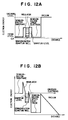
- the present inventors reached a structure which has a double potential barrier layer as a prior work (refer to Fig. 12A) in which the SIS structure is applied to the conventional MIM structure.
- a potential on the insulator becomes high as shown in Fig. 12B so that a construction in energy of the double potential barrier is asymmetry. Therefore, a resonant condition in which the electron transparency reaches perfectly 1 can not be obtained.
- the electrons, i.e. hot electrons, near the upper electrodes have a large energy so that they are liable to lose energy therefrom by scattering in a solid and it causes a problem that the emitted electrons have a wide distribution in energy.
- a main object of the present invention is to solve the aforementioned problems, to provide an electron beam source for emitting an electron beam of small energy dispersion on the basis of a new theory, and to provide a high-performance electron beam application apparatus and an electronic apparatus using a monochromatic electron beam.
- An electron beam source of small energy distribution can be formed when electrons having a specific energy level are extracted selectively from electrons in a solid on the basis of a resonant tunnelling effect using a double potential barrier type quantum well layer. As the width of selection becomes smaller, an electron beam of smaller energy dispersion can be obtained.
- a high-performance multifunctional apparatus using a monochromatic electron beam can be formed when an electron beam source of small energy distribution is used. As a result, the energy analyzer having resolution restricted considerably in use can be made unnecessary.
- two potential barrier layers with respect to electrons and a quantum well layer surrounded by the double potential barrier are formed in an electron emission path so that a resonant tunnelling effect based on the double potential barrier structure is utilized. That is, when an electron having an energy level coincident with the quantum level in the quantum well enters into the double potential barrier layer, the electron can pass through the double potential barrier layer at a high probability. Not only conditions for this resonance straggle in accordance with the quantum level but also the energy band of high transparency is very narrow. In other words, an electron wave interference filter is formed.
- the resonance condition that the transparency is perfectly 1 is obtained.
- Such a symmetric structure can be achieved particularly when two barriers are formed so as to be equal to each other in the barrier height, in the effective mass of electrons and in the barrier thickness.
- a double potential barrier structure is disposed between a solid and a vacuum in order to apply the resonant tunnelling effect to an electron beam source.
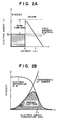
- a triangular potential barrier 31 constituted by a vacuum level under high electric field intensity is made to be one of the two barriers whereas a thin film 12 formed in the inside of the electron beam source is made to be the other barrier.
- the quantum well is constituted by a thin film 13.
- materials for the two barriers are different from each other because one barrier is constituted by a vacuum and the other is constituted by a solid. Accordingly, an ideal resonant condition cannot be obtained but a condition near the ideal resonant condition can be selected.
- the reciprocal of k(x) corresponds to the length of penetration of electron wave into the barrier.
- the value of D increases as the thickness decreases and as the penetration length increases.
- the value of D in one barrier and the value of D in the other barrier are substantially equal to each other and larger than the order of 1/1,000,000.
- this condition is achieved by controlling the potential barrier on the basis of external electric field. That is, electric field intensity in a range of from 3 V/nm to 10 V/nm is required.
- This condition is achieved by forming a structure having a convex tip like a field emission electric beam source.
- this condition can be achieved by setting the film thickness to be substantially equal to the penetration length determined on the basis of the effective mass m of electrons, the barrier height V and the electron energy E. That is, it is possible to provided a monochromatic electron beam source of very small energy dispersion which is an object of the present invention.
- a resonant tunnelling effect is generated between a solid and a vacuum, so that a condition for obtaining a sufficient quantity of electron beam is obtained differently from the case shown in Figs. 12A and 12B.
- an advantage that an electron beam excellent in monochromatic characteristic and sufficiently large in current intensity is obtained.
- the high-resolution energy analyzer which has been used in a conventional monochromatic electron beam apparatus becomes unnecessary. Accordingly, in a simpler structure, the electron beam can reach the surface of the sample without the energy loss of the electron beam. Accordingly, an analyzer capable of performing measurement in a short time can be provided.
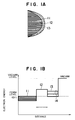
- FIG. 1A there is shown an embodiment of the present invention.
- a needle 11 of an n+ type GaAs single crystal extending in the (111) orientation and having a tip with a radius of curvature of 0.1 ⁇ m is used as a first material.
- a 1.4 nm-thick single crystal AlAs film 12 as a second material and a 7 nm-thick single crystal GaAs film 13 as a third material are grown successively one on one in this order in the tip region of the needle 11 by molecular beam epitaxy (MBE).
- MBE molecular beam epitaxy
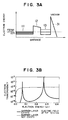
- a negative voltage is applied to an anode disposed as a counter electrode to an extent that the intensity of electric field in the vicinity of the tip of the needle 11 becomes a value in a range of from about 3 V/nm to about 10 V/nm, such a structure as shown in Fig. 3A is formed so that the number of tunnel emission electrons increases. Because electron transparency has such energy dependance as shown in Fig. 3B, an electron beam which is very small in energy dispersion is obtained. At room temperature, the thermal energy dispersion is about 26 meV.
- the GaAs quantum well layer 13 which is the outermost material, that is, the third material, is not subjected to impurity doping.
- Si which is n type impurity may be doped into the GaAs quantum well layer 13 by an amount of about 1012 per cm2 to thereby achieve an advantage that the surface potential is fixed to achieve a stable operation.
- This embodiment has shown the case where n+ type GaAs, 1.4 nm-thick AlAs and 7 nm-thick GaAs are respectively used as the first material for the base material 11, the second material for the barrier layer 12 and the third material for the quantum well layer 13 in the electron beam source.
- a combination of materials other than those mentioned above for example, a combination of n+ type GaAs, AlGaAs and GaAs, a combination of other Group III-Group V compound semiconductors, that is, a combination of lattice mismatch systems such as InGaAsP mixed crystal, a combination of Group II-Group VI compound semiconductors such as a combination of n+ type ZnSe, ZnS and ZnSe, or a combination of Group IV semiconductors such as a combination of n+ type Ge, Si-Ge and Ge is used, the same effect as described above can be achieved as long as the thickness of the barrier layer and the thickness of the quantum well layer are adjusted in accordance with the effective mass and electron potential of the respective materials because in those combinations, the materials have similar physical properties.
- the orientation small in effective mass may be selected as the direction of the running of electrons to heighten the effect.
- the direction of the running of electrons is selected as the crystal orientation small in work function of surface material, electron beams small in divergence angle and excellent in converging characteristic can be obtained so as to be suitable for high resolution in the case where this structure is applied to an electron microscope or the like.
- an electron beam source large in current quantity can be obtained in the case where a metal, a semimetal, or the like, larger in electron density than the semiconductor is used as the first material for the base material of the electron beam source.
- a metal, a semimetal, or the like larger in electron density than the semiconductor is used as the first material for the base material of the electron beam source.
- single crystal NiAl is used as the first material
- n+ type GaAs, AlGaAs and GaAs single crystals as the second and third materials can be grown on the first material.
- single crystal CoSi2 is used as the first material, Si and Ge single crystals can be grown.
- the same effect as in this embodiment can be achieved.
- single crystal CaF2 is combines with Si and GaAs and single crystal Al2O3 is combined with Si, single crystal growth can be achieved. Because the thermal strength of these combinations is higher than that of semiconductors, these combinations have an advantage that they can operate even in the condition of high current intensity. Accordingly, if such a metal, an insulator and a semiconductor are used in combination, the effect is heightened more greatly.
- this embodiment has shown the case where single crystals are used as materials, the same effect as in this embodiment can be achieved even in the case where amorphous materials having a thickness of not larger than about 1 nm are used. In the latter case, there arises an advantage that these amorphous materials can be easily formed on a known needle-shaped W electron beam source by a plasma CVD method, a low-temperature evaporation method, or the like.
- the amorphous materials include combinations of Group IV chalcogens such as a-Si, a-Si-C, a-Si-N, a-Si-Ge, etc., and combinations of S-Se-Te type chalcogens.
- this embodiment has shown the case where a pair of barrier layers and a quantum well layer making are used, the same effect as in this embodiment can be achieved even in the case where a plurality of pairs of barrier layers and quantum well layers are provided.
- electron beams can be obtained by a lower extraction voltage when the outer materials for the barrier layer and the quantum well layer are selected to be higher in electron potential, that is, lower in work function than the inner material.
- electron beams smaller in energy dispersion and larger in current can be obtained when the peak energy of state density of very small energy dispersion generated in the inner quantum well layer is made coincident with an electron wave interference filter constituted by the outer barrier layer and quantum well layer by voltage application or the like.
- this embodiment has shown the case where electric field is concentrated into a needle-shaped tip to thereby form a thin potential barrier 31 under vacuum conditions, the same effect as in this embodiment can be achieved even in the case where the tip is shaped like a wedge. In the latter case, linear electron beams can be obtained.
- this embodiment has shown the case where the radius of curvature of the tip is 0.1 ⁇ m, the same effect as in this embodiment can be achieved even in the case where the tip has a large radius of curvature of about 3 ⁇ m as long as the counter electrode can be brought close to about 10 ⁇ m.
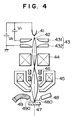
- FIG. 4 there is shown an embodiment in which the electron beam source according to the present invention is applied to an analyzer.
- the electron beam 42 having passed through the acceleration lens 43 is narrowed by a condenser lens 44 and an objective lens 45 and then radiated onto a sample 47.
- an SEM image is obtained.
- an electrostatic energy analyzer 49 is disposed so that reflected electrons 490 obtained by reflection on the sample 47 can be subjected to energy analysis. This is for the purpose of finding the surface state of the sample 47 by measuring the energy loss of the electron beam 42 on the sample 47.
- the electron state of the surface chemical species can be found in an energy loss range of from the order of eV to the order of hundreds of meV.
- the vibrational state of the surface chemical species can be found in an energy loss range of the order of tens of meV. Accordingly, there arises, for example, an advantage that elements and adsorbed molecules in the first layer of the sample surface as to kind and adsorption state can be analyzed locally. Further, there arises an advantage that measurement can be made in a short time because the electron beam device is simple in structure so that the electron beam reaches the sample surface without reduction of the quantity of the electron beam compared with a monochromatic electron beam device using a conventional high-resolution energy analyzer.
- the electron beam 42 has small energy dispersion of about 25 meV. Accordingly, even in the case where the acceleration voltage V0 is selected to be a small value of 100 V, chromatic aberration can be reduced to a small value so that the electron beam 42 on the sample 47 was narrowed to about 20 nm. That is, judging from the fact that the acceleration voltage in the conventional field emission electron beam source is about 0.1 ⁇ m, it is apparent that the electron beam source according to the present invention is suitable for high space resolution. On the other hand, with respect to energy analysis, small energy dispersion of about 25 meV was provided, so that the limit range of precision measurement of energy loss was about 30 meV. Judging from the fact that the limit range of measurement of energy loss is about 0.5 eV when this analysis is performed by the conventional field emission electron beam source, it is apparent that the electron beam source according to the present invention is very effective for high energy resolution in such an analyzer.
- a rotation mechanism for rotating the sample 47 and the energy analyzer 49 is provided so that measurement is performed while the incident angle of electrons is changed, orientation of a specific chemical bond can be found. If an electron lens is provided at an inlet of the energy analyzer 49 so that electrons from a wider range can be measured, a two-dimensional image of a surface chemical state can be obtained.
- an energy analyzer may be disposed between the electron beam source and the sample to form an analyzer of higher energy resolution.
- this embodiment has shown the case where a scan electron microscope is used as an example showing the fact that chromatic aberration can be reduced to thereby narrow the electron beam on the sample regardless of the small acceleration voltage when the energy dispersion of the electron beam is small
- this electron gun is also useful in the case where this electron gun is applied to an electron beam lithography machine used in the semiconductor production process.
- electron beam lithography an electron beam is radiated onto an organic resist film having been applied onto a surface of a substrate so that a fine pattern is formed on the basis of the local chemical reaction of the resist film.
- the conventional electron beam requires an acceleration voltage of not smaller than a value in a range of from the order of keV to the order of tens of keV. Because the high-speed electrons generate a large amount of secondary electrons in the substrate to cause the chemical reaction of the resist film, the resulting resist pattern becomes thicker than the electron beam size so that the formation of such a fine pattern is limited. Further, because the high-speed electrons are small in scattering cross-section with respect to the resist material, high current intensity of about 1 mA/sr as angular current intensity of the electron beam source is required for high-speed lithography. There arises a problem that the high current intensity causes unstabilization or degradation of the electron beam source.
- the acceleration voltage can be reduced so that these problems can be solved easily.
- the acceleration voltage is used in a range of from the order of eV to the order of tens of eV, the acceleration voltage acts directly on the chemical bonds of the resist material so that the scattering cross-section becomes very large.
- high-speed lithography can be performed even in the case where the angular current intensity is very low.
- generation of secondary electrons is almost suppressed, there arises an advantage that a more fine pattern can be formed.
- Figs. 5A through 5E there is shown an embodiment of the present invention.
- n+ type GaAs (111) B-side substrate 51 as a first material
- single crystal growth of a 1.4 nm-thick AlAs layer 52 as a second material and a 7 nm-thick GaAs layer 53 as a third material is performed by MBE (Fig. 5A).
- a 200 nm-thick SiO2 layer 54 is deposited thereon by CVD (Fig. 5B).
- a photoresist film 55 having a diameter of about 100 ⁇ m is formed on a desired region of a surface thereof (Fig. 5C).
- the SiO2 layer 54 having been masked with the photoresist film 55 is etched with an HF-NH4OF mixture solution (Fig. 5D).
- the GaAs layer 53, the AlAs layer 52 and the n+ type GaAs (100) substrate 51 having been masked with the thus formed SiO2 layer 54 are etched with an H2SO4-H2O2 mixture solution kept at 60 °C. Because GaAs is isotropically etched with this solution, downward etching of the substrate and side etching of GaAs under the SiO2 layer are performed simultaneously. Accordingly, when etching is stopped at a suitable point of time, a needle-shaped structure having a tip coated with GaAs/AlAs thin film is produced (Fig. 5E).
- This embodiment has an advantage that a large number of electron beam sources can be produced at once reproducibly.
- the back surface of the substrate 51 is cut so as to be made thin; a layer for ohmic contact such an Au-Ge-Ni film, etc. and an adhesive layer such as solder, Au, etc. are formed on the back surface of the substrate 51; and then electron beam source parts are cut off one from one, and stuck by heating onto metal mounts respectively.
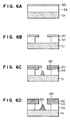
- a 2 ⁇ m-thick SiO2 layer 54 and a 500 nm-thick W layer 60 are deposited by CVD (Fig. 6A). Then, the W layer 60 masked with a photoresist film provided with a hole having a diameter of 2 ⁇ m is etched with an NH4OH-H2O2 aqueous solution to form a hole in the W layer 60 and then the SiO2 layer 54 is etched with an HF-NH4OF mixture aqueous solution.
- the time required for etching the SiO2 layer 54 is selected to be longer than the time required for etching the W layer 60, so that a larger hole than the hole of the W layer 60 is formed in the SiO2 layer 54 (Fig. 6B).
- the GaAs substrate is introduced in a super-high vacuum. Under super-high vacuum conditions, the surface of the GaAs substrate is heated at 540 °C for about 5 minutes so as to be cleaned. Then, the GaAs substrate is coated with 1.5 ⁇ m-thick NiAl by an evaporation method at the rate of about 0.1 nm/sec while the substrate temperature is kept about 540 °C.
- a polycrystalline NiAl film 62 is formed on the W layer and at the same time conical single crystal NiAl 61 as a first material is formed on the GaAs substrate 51 (Fig. 6C). Then, a multilayer film consisting of 1.4 nm-thick AlAs and 7 nm-thick GaAs as second and third materials is evaporated so that the surface of the single crystal NiAl 61 is coated with the single crystal AlAs-GaAs multilayer film 63 (Fig. 6D). The other region is provided as a polycrystal 64. As a result, an electron beam source having the same structure as in Embodiment 1 is produced.
- This embodiment has an advantage that a large number of electron beam sources can be produced at once reproducibly.
- the W layer 60 is used as an electrode for extracting electrons, there arises an advantage that not only a monochromatic electron beam can be obtained even in the case of a small extraction voltage but a small-sized monochromatic electron beam source device can be obtained because the distance between the cathode and the anode is in a small value of about 1 ⁇ m.
- a multibeam consisting of monochromatic electron beams is obtained so as to be effective for high throughput of the electron beam lithography machine, high speed of the CRT display, high precision thereof, reduction in size thereof, and so on.
- FIGs. 7A and 7B there is shown an embodiment of the present invention.
- a W needle 71 is obtained by electrolysis etching of W single crystal with a KOH aqueous solution.
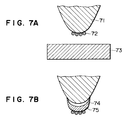
- the W needle 71 used as a probe of a scan tunnel microscope is approached to the distance of about 1 nm from an Au substrate 73 and then pulses of from -7 V to -15 V are applied to the needle.
- an adsorbed layer 72 of Au with the thickness of about one atom is formed on a very small region of the tip of the W needle as shown in Fig. 7A.
- the W needle 71 as a first material is heated in a temperature range of from 400 °C to 500 °C and trimethylaluminum (TMA), trimethylgallium (TMG) and arsine (AsH3) are introduced at the flow rate of 10 ⁇ 6 mol/s respectively, so that a 2 nm-thick Al 0.4 Ga 0.6 As film 74 as a second material is grown only on a region where the adsorbed layer 72 of Au is present.
- TMG and AsH3 are introduced therein, so that an 8 nm-thick GaAs film 75 is grown as a third material.
- a structure shown in Fig. 7B is obtained.
- this embodiment has shown the case where a surfactant (surface active agent) effect of Au attached to the tip of the needle under a scan tunnel microscope is used for selectively growing the barrier layer and the quantum well layer on the tip, it is to be understood that another material having the same effect as described above may be used and that the same effect as in this embodiment can be achieved in the case where the barrier layer and the quantum well layer are selectively grown on the tip of the W needle by the method of applying a voltage to the W needle to dissolve material gas through high electric field intensity on the tip without use of any scan tunnel microscope.
- a surfactant surface active agent
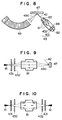
- FIG. 8 there is shown an embodiment of the present invention applied to a surface analyzer.
- An electron beam 42 from an electron gun 84 is radiated onto a surface of a sample 47 put in a super-high vacuum. Reflected electrons 490 obtained from the sample 47 are analyzed by an electrostatic energy analyzer 49 so that the energy loss of the electron beam 42 is measured.
- the electron gun 84 the electron beam 42 generated by an electron beam source 82 excellent in monochromatic characteristic and an acceleration lens 43 is converged onto the sample surface by an electrostatic electron lens 81. The position of convergence is adjusted by an electrostatic deflector 83. In this manner, the surface state of the sample can be found.
- Embodiment 2 has shown the case where a function of surface analysis as described above can be added to a scan electron microscope by using a monochromatic electron beam source.
- a monochromatic electron beam is obtained without use of any high-resolution energy analyzer, so that surface analysis can be performed through a very small-sized electron gun. Accordingly, this embodiment has an advantage that the surface analyzer can be provided as a surface monitor in an apparatus in which the surface state of the sample in a super-high vacuum is put in question, that is, for example, in a molecular beam epitaxy (MBE) apparatus.
- MBE molecular beam epitaxy
- the electron beam source 82 excellent in monochromatic characteristic an electron beam source having energy dispersion corresponding to necessary information is used.
- a needle-shaped W field emission electron beam source may be used because the energy loss is in a range of from the order of eV to the order of hundreds of eV.
- an electron beam source using a resonant tunnelling effect as shown in Embodiment 1 may be used because the energy loss is in a range of the order of tens of meV.
- the energy analyzer comprises an electron beam source 41, a first anode 431, a second anode 432, and an electrostatic electron lens 81. Reflected electrons 490 obtained from a surface of a sample 47 are converged to the electron beam source 41 by the electrostatic electron lens 81.
- An electron wave interference filter having a resonant tunnelling effect as shown in Figs. 3A and 3B is formed on the basis of a constant voltage (about 2.5 kV) applied between the electron beam source 41 and the first anode 431.
- the electron wave interference filter functions independent of the direction of the movement of electrons.
- electrons are allowed to enter from a vacuum into a solid only in the case where the energy level of electrons is coincident with the quantum level in the quantum well (13 in Fig. 3A). Accordingly, the current change is measured while the potential of the electron beam source 41 is swept in the vicinity of the energy of the reflected electrons 490, so that the energy distribution of the reflected electrons 490 can be measured with high accuracy.
- the width of the quantum well in the electron beam source 41 is selected to be smaller than that in Embodiment 1, that is, when, for example, the thickness of the GaAs layer of 7 nm in Embodiment 1 is changed to 4 nm, the energy of the quantum level in the quantum well increases so that incident electrons can be measured effectively while electron emission of the electron beam source 41 is suppressed.
- an electron beam resonator as shown in Fig. 10 can be formed by arranging the energy analyzer and the monochromatic electron gun so as to be directly opposite to each other.
- the potentials of the two electron beam sources are adjusted to make the emission electron energies coincide with each other, the current between the two electron beam sources becomes zero in the case of no loss, so that standing wave of electrons can be formed easily in a vacuum.
- FIGs. 11A and 11B there is shown an embodiment in which the electron beam source according to the present invention is applied to an analyzer.
- an n+ type GaAs single crystal needle 11 extending in the (111) direction is used as a first material.
- a 1.4 nm-thick single crystal AlAs film 12 as a second material and a 2 nm-thick single crystal GaAs film 13 as a third material are grown on a tip region of the needle by a molecular beam epitaxy (MBE) method thus to form a probe of a scan tunnel microscope. If the probe is approached to a distance of about 1 nm, energy levels as shown in Fig. 11B are formed.
- MBE molecular beam epitaxy
- the current increases with the increase of electron transparency on the basis of the resonant tunnelling effect at a point where the energy level of the surface of the sample 110 coincides with the quantum level 14 of the GaAs film 13.
- the electron state of the surface can be found.
- Information as to kind of elements in the surface, kind and adsorbed state of adsorbed molecules, etc. can be known in the same manner as in the case of the reflected electron energy loss spectrometry as shown in Embodiments 2 and 6.
- the probe is set in negative potential with respect to the substrate, the levels of the positions of absence of electrons are measured among the energy levels of the surface of the sample 110.
- the probe is set in positive potential, the levels of the positions of presence of electrons are measured.
- the scan tunnel microscope is very high in transverse space resolution, so that there arises an advantage that respective atoms or molecules can be observed directly when a plurality of scan tunnel microscopes are used in combination for measurement.
- an electron beam source for emitting an electron beam of very small energy dispersion is obtained in accordance with the present invention.
- a high-resolution electron microscope, a high-performance electron spectrometer, a high-performance electron beam diffractometer or a high-performance electron apparatus can be formed.
Landscapes
- Chemical & Material Sciences (AREA)
- Analytical Chemistry (AREA)
- Electron Sources, Ion Sources (AREA)
- Cold Cathode And The Manufacture (AREA)
Applications Claiming Priority (2)
| Application Number | Priority Date | Filing Date | Title |
|---|---|---|---|
| JP161621/93 | 1993-06-30 | ||
| JP16162193A JPH0721953A (ja) | 1993-06-30 | 1993-06-30 | 電子線源及びそれを用いた電子線応用装置と電子装置 |
Publications (1)
| Publication Number | Publication Date |
|---|---|
| EP0633593A1 true EP0633593A1 (de) | 1995-01-11 |
Family
ID=15738665
Family Applications (1)
| Application Number | Title | Priority Date | Filing Date |
|---|---|---|---|
| EP94304816A Withdrawn EP0633593A1 (de) | 1993-06-30 | 1994-06-30 | Elektronenstrahlquelle, Vorrichtung zur Anlegung eines Elektronenstrahls und dieses anwendende elektronisches Gerät |
Country Status (2)
| Country | Link |
|---|---|
| EP (1) | EP0633593A1 (de) |
| JP (1) | JPH0721953A (de) |
Cited By (2)
| Publication number | Priority date | Publication date | Assignee | Title |
|---|---|---|---|---|
| WO2000054301A1 (en) * | 1999-03-08 | 2000-09-14 | Motorola, Inc. | Method of providing uniform emission current |
| EP1134771A1 (de) * | 2000-03-16 | 2001-09-19 | Hitachi Europe Limited | Vorrichtung zum Erzeugen eines Stromes von Ladungsträgern |
Families Citing this family (1)
| Publication number | Priority date | Publication date | Assignee | Title |
|---|---|---|---|---|
| JP2006093141A (ja) * | 2004-09-24 | 2006-04-06 | Fei Co | 電子源及びその電子源を有する荷電粒子装置 |
Citations (3)
| Publication number | Priority date | Publication date | Assignee | Title |
|---|---|---|---|---|
| JPS62205658A (ja) * | 1986-03-05 | 1987-09-10 | Fujitsu Ltd | 高速半導体装置 |
| JPH0529605A (ja) * | 1991-07-18 | 1993-02-05 | Sony Corp | 真空電子素子 |
| JPH0574333A (ja) * | 1991-09-13 | 1993-03-26 | Fujitsu Ltd | 量子化電子線発生装置 |
-
1993
- 1993-06-30 JP JP16162193A patent/JPH0721953A/ja active Pending
-
1994
- 1994-06-30 EP EP94304816A patent/EP0633593A1/de not_active Withdrawn
Patent Citations (3)
| Publication number | Priority date | Publication date | Assignee | Title |
|---|---|---|---|---|
| JPS62205658A (ja) * | 1986-03-05 | 1987-09-10 | Fujitsu Ltd | 高速半導体装置 |
| JPH0529605A (ja) * | 1991-07-18 | 1993-02-05 | Sony Corp | 真空電子素子 |
| JPH0574333A (ja) * | 1991-09-13 | 1993-03-26 | Fujitsu Ltd | 量子化電子線発生装置 |
Non-Patent Citations (5)
| Title |
|---|
| K.L. JENSEN ET AL.: "The methodology of simulating particle trajectories through tunneling structures using a Wigner distribution approach.", IEEE TRANSACTIONS ON ELECTRON DEVICES, vol. 38, no. 10, October 1991 (1991-10-01), NEW YORK US, pages 2337 - 2347 * |
| PATENT ABSTRACTS OF JAPAN vol. 12, no. 63 (E - 585) 25 February 1988 (1988-02-25) * |
| PATENT ABSTRACTS OF JAPAN vol. 17, no. 313 (E - 1381) 15 June 1993 (1993-06-15) * |
| PATENT ABSTRACTS OF JAPAN vol. 17, no. 393 (E - 1402) 22 July 1993 (1993-07-22) * |
| V.G. LITOVCHENKO ET AL.: "Field emission from structures with quantum wells", JOURNAL OF VACUUM SCIENCE AND TECHNOLOGY: PART B., vol. 11, no. 2, April 1993 (1993-04-01), NEW YORK US, pages 362 - 365 * |
Cited By (3)
| Publication number | Priority date | Publication date | Assignee | Title |
|---|---|---|---|---|
| WO2000054301A1 (en) * | 1999-03-08 | 2000-09-14 | Motorola, Inc. | Method of providing uniform emission current |
| EP1134771A1 (de) * | 2000-03-16 | 2001-09-19 | Hitachi Europe Limited | Vorrichtung zum Erzeugen eines Stromes von Ladungsträgern |
| US6771012B2 (en) | 2000-03-16 | 2004-08-03 | Hitachi Europe, Ltd. | Apparatus for producing a flux of charge carriers |
Also Published As
| Publication number | Publication date |
|---|---|
| JPH0721953A (ja) | 1995-01-24 |
Similar Documents
| Publication | Publication Date | Title |
|---|---|---|
| US4983540A (en) | Method of manufacturing devices having superlattice structures | |
| Prietsch | Ballistic-electron emission microscopy (BEEM): Studies of metal/semiconductor interfaces with nanometer resolution | |
| US5294465A (en) | Microtip-controlled nanostructure fabrication and multi-tipped field emission tool for parallel-process nanostructure fabrication | |
| US6139760A (en) | Short-wavelength optoelectronic device including field emission device and its fabricating method | |
| JP2697474B2 (ja) | 微細構造の製造方法 | |
| US5077597A (en) | Microelectronic electron emitter | |
| KR101086901B1 (ko) | 면 방출형 전자원 및 묘화 장치 | |
| US5811819A (en) | Electron beam source and its manufacturing method and electron beam source apparatus and electron beam apparatus using the same | |
| US4831628A (en) | Denices fabricated using method of selective area epitaxial growth using ion beams | |
| US6184611B1 (en) | Electron-emitting element | |
| EP0633593A1 (de) | Elektronenstrahlquelle, Vorrichtung zur Anlegung eines Elektronenstrahls und dieses anwendende elektronisches Gerät | |
| Miyauchi et al. | Maskless ion beam writing of precise doping patterns with Be and Si for molecular beam epitaxially grown multilayer GaAs | |
| US4622093A (en) | Method of selective area epitaxial growth using ion beams | |
| JPH0778581A (ja) | 単色化電子線源およびその製造方法 | |
| JPH0831304A (ja) | 電子線源及びそれを用いた電子線応用装置と電子装置 | |
| EP1113482B1 (de) | Hochenergie elektronen beugungsgerät | |
| Coratger et al. | Schottky barrier formation at metal/n-ZnSe interfaces and characterization of Au/n-ZnSe by ballistic electron emission microscopy | |
| DE112023000195T5 (de) | Elektronenkanone und elektronenmikroskop | |
| Henini | Molecular beam epitaxy: from research to manufacturing | |
| JPH06162918A (ja) | 半導体電子放出素子並びにその製造方法 | |
| US6124147A (en) | Method for fabricating optoelectronic device in low-temperature deposition and thermal treatment | |
| JP3403165B2 (ja) | 電子放出素子の製造方法 | |
| GB2144151A (en) | Method of selective area epitaxial growth | |
| US5233196A (en) | Electron beam apparatus and method for driving the same | |
| JP2803555B2 (ja) | 極微細トンネル障壁の作製方法 |
Legal Events
| Date | Code | Title | Description |
|---|---|---|---|
| PUAI | Public reference made under article 153(3) epc to a published international application that has entered the european phase |
Free format text: ORIGINAL CODE: 0009012 |
|
| 17P | Request for examination filed |
Effective date: 19940719 |
|
| AK | Designated contracting states |
Kind code of ref document: A1 Designated state(s): DE FR GB NL |
|
| 17Q | First examination report despatched |
Effective date: 19951218 |
|
| STAA | Information on the status of an ep patent application or granted ep patent |
Free format text: STATUS: THE APPLICATION IS DEEMED TO BE WITHDRAWN |
|
| 18D | Application deemed to be withdrawn |
Effective date: 19970225 |