EP0633706A2 - Synchronisierungsschaltung für optische Pakete - Google Patents
Synchronisierungsschaltung für optische Pakete Download PDFInfo
- Publication number
- EP0633706A2 EP0633706A2 EP94304761A EP94304761A EP0633706A2 EP 0633706 A2 EP0633706 A2 EP 0633706A2 EP 94304761 A EP94304761 A EP 94304761A EP 94304761 A EP94304761 A EP 94304761A EP 0633706 A2 EP0633706 A2 EP 0633706A2
- Authority
- EP
- European Patent Office
- Prior art keywords
- packet
- delay
- switch
- packets
- time slot
- Prior art date
- Legal status (The legal status is an assumption and is not a legal conclusion. Google has not performed a legal analysis and makes no representation as to the accuracy of the status listed.)
- Withdrawn
Links
Images

Classifications
-
- H—ELECTRICITY
- H04—ELECTRIC COMMUNICATION TECHNIQUE
- H04L—TRANSMISSION OF DIGITAL INFORMATION, e.g. TELEGRAPHIC COMMUNICATION
- H04L7/00—Arrangements for synchronising receiver with transmitter
- H04L7/0075—Arrangements for synchronising receiver with transmitter with photonic or optical means
-
- H—ELECTRICITY
- H04—ELECTRIC COMMUNICATION TECHNIQUE
- H04Q—SELECTING
- H04Q11/00—Selecting arrangements for multiplex systems
- H04Q11/0001—Selecting arrangements for multiplex systems using optical switching
-
- H—ELECTRICITY
- H04—ELECTRIC COMMUNICATION TECHNIQUE
- H04Q—SELECTING
- H04Q11/00—Selecting arrangements for multiplex systems
- H04Q11/0001—Selecting arrangements for multiplex systems using optical switching
- H04Q11/0062—Network aspects
- H04Q11/0066—Provisions for optical burst or packet networks
-
- Y—GENERAL TAGGING OF NEW TECHNOLOGICAL DEVELOPMENTS; GENERAL TAGGING OF CROSS-SECTIONAL TECHNOLOGIES SPANNING OVER SEVERAL SECTIONS OF THE IPC; TECHNICAL SUBJECTS COVERED BY FORMER USPC CROSS-REFERENCE ART COLLECTIONS [XRACs] AND DIGESTS
- Y10—TECHNICAL SUBJECTS COVERED BY FORMER USPC
- Y10S—TECHNICAL SUBJECTS COVERED BY FORMER USPC CROSS-REFERENCE ART COLLECTIONS [XRACs] AND DIGESTS
- Y10S370/00—Multiplex communications
- Y10S370/901—Wide area network
- Y10S370/902—Packet switching
- Y10S370/903—Osi compliant network
- Y10S370/907—Synchronous optical network, SONET
Definitions
- This invention relates to optical packet switched data/voice communication systems.
- it is directed to a method and apparatus to continuously synchronize the packet arrival times at the inputs of a synchronously operated optical packet switch with local time slots.
- Previously proposed schemes to provide such packet synchronization rely on a plurality of delay devices located at the input to the optical packet switch. Each device provides a delay which is a fractional part of a packet transmission time, so that substantially any value of required delay may be generated to compensate for the difference between the packet arrival time and the beginning of a local time slot in the switch.
- Such delay devices are typically fabricated using fiber delay lines in combination with 2x2 Lithium Niobate optical modules such as Type Y-35-8771 manufactured by the GEC-Marcone Company of Baddow Chelmsford, Essex England.
- the problem with the above synchronization scheme is the resulting relatively large power penalty incurred due to the multiple coupling loss between the optical modules and the optical fiber delay lines(i.e., the optical signal travels several times in and out of the Lithium Niobate wafers.)
- the instant invention overcomes the foregoing problem by receiving a stream of packets, each having a time duration of ⁇ , which is equal to or less than half the duration of the local time slot of the optical packet switch; determining any packet delays required to adjust the incoming packet stream to a single packet per local time slot; and delaying selected packets to form a packet stream having one packet per local time slot based upon the delays established by the determining step.
- the instant scheme provides packet synchronization while reducing the power penalty associated with prior techniques.
- Figure 1 is a general view of a portion of an optical packet switched network generally indicated by the numeral 5.
- the network 5 is comprised of a plurality of optical nodes or packet switches 6a to 6e. End users are connected to the network 5 via lines 8.
- the switch 6 is comprised of two stages: the scheduling stage 12, and the switching stage 14. Each one of the stages 12 and 14 is a reconfigurably, non-blocking switching fabric design.
- the scheduling stage 12 is an n x m switch and the switching stage 14 is an m x n, where m ⁇ n.
- the delay of the delay line d i equals i packets in time duration.
- a plurality of delay synchronizers 17 are located at the front end of the switch 6, to receive the packets 20 to be synchronized and switched to appropriate outputs 23.
- An electronic control apparatus 22 is electrically connected to the delay synchronizers 17 as well as the switching stages 12 and 14.
- the dashed lines represent an electrical connection while the solid lines are optical connections.
- the delay synchronizer 17, shown in detail in Figure 3, is comprised of an optical splitter 18, which receives a stream of packets 20, and has a first output 36, optically connected to a detector 19.
- the detector 19, is electrically connected to synchronization circuitry 38 via output connection 39, and to the electronic control apparatus 22 (see Figure 2).
- the synchronization circuitry 38 is electrically connected to a synchronizer 42 via connection 41.
- a second output 44 from the splitter 18 is optically connected to the synchronizer 42 via a delay circuit 45.
- the output of synchronizer 42 is connected to the scheduling stage 12 ( Figure 2).
- a local clock 28 provides timing pulses to the synchronization circuitry 38.
- the energy of the packets 20, on each one of the input lines 21 to the delay synchronizer 17 of the switch 6 is optically split immediately after arrival by the splitter 18 ( Figure 3).
- a "small" fraction of the optical energy is passed to the detector 19, converted to an electrical signal and forwarded to the electronic control apparatus 22 ( Figure 2) and the synchronization circuitry 38.
- the remainder of the optical energy, representing packet 20, passes from the splitter 18 to the synchronizer 42 via delay circuit 45.
- the delay time provided by circuit 45 compensates for the delay in the optical energy passing through the detector 19 and the synchronization circuitry 38.
- the control apparatus 22, reads the header bits in the packet 20, to determine the required routing for the packet.
- the control apparatus 22 then drives the scheduling stage 12, and the switching stage 14, to switch the incoming packet 20, to an appropriate output 23.
- the synchronizer circuitry 38 processes the information from the detector 19 to control the synchronizer 42 to provide the appropriate delays to the received packets 20 so that they are synchronized with the local time slots of the switch 6.
- the switch 6 When the switch 6 is used as a part of an all-optical network 5, it is either necessary to ensure that all inputs to the switch are synchronized (i.e. that packets 20, arriving at different switch inputs 21 are aligned at the switch) or to operate the switch in an unsynchronized manner. If the switch 6, is to be unsynchronously operated, the scheduling and switching stages 12 and 14, respectively, should be non-blocking elements (i.e. as opposed to reconfigurably non-blocking elements) in the synchronized case. Otherwise, there is an additional penalty due to the blocking in the scheduling stage 12, and the switching stage 14. Undesirably, non-blocking stages with minimal cross-talk are difficult and very expensive to manufacture.
- a known technique as shown in Figure 4 may be used to synchronize a stream of packets 20, arriving at the inputs 21.
- Each packet 20 has a time duration equal to the local time slot of the switch 6.
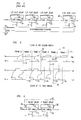
- a plurality of 2 x 2 Lithium Niobate modules 24, with delay elements 25, form a delay circuit 26 which are connected in tandem to form a delay line 27.
- Each delay element 25 has a delay equal to a fractional portion of a packet time slot.
- the synchronization circuitry 38 determines the packet 20 arrival time based on the information from the detector 19, (see Figure 2) and slot information from the local clock 28.
- the synchronization circuit 38 after comparing the arrival time of the packet 20, with the phase of the local slot clock 28, generates the appropriate setting for the modules 24, to switch-in or bypass the delay elements 25, so that the input stream of packets 20 passing through the delay line are aligned with the local clock 28. It can be seen that each delay element 25 may be switched into the delay line 27 or bypassed based upon control signals from the synchronization circuit 38. If the delay variations in the network 5 are slow, the adjustments to the delay line 27 will be infrequent.
- Packet flipping i.e. delaying
- packet time slots that are twice the length of the time duration of the packet 20.
- Prior art packet switching systems have packet time durations that are substantially the same as their allotted time slots. Therefore, with the instant technique, there will be a penalty of a 50% reduction in network capacity. However, this is in line with the philosophy that some part of the enormous optical bandwidth may be "wasted" to provide simpler control or operation of the all-optical network.
- the local clock 28 of each switch 6 in the network 5 has a period of 2 ⁇ , where ⁇ is the time duration of the packet 20.
- a 2 ⁇ -long time slot is referred to as a frame 29 as shown in Figure 5a.
- the clocks at different switches 6a to 6e are unsynchronized with each other.
- an optical signal with packets 20 positioned between the clock ticks 52 is called an s-characteristic signal (i.e. only one packet per frame 29.) If such traffic is presented to a first switch 6d, for example, with a slot duration equal to the frame 29 duration (i.e. twice the duration of the 5 optical packet), the switch 6 will preserve the s-characteristic.
- the instant synchronizer 42 in an exemplary embodiment is comprised of two serially connected delay circuits 26.
- Each delay circuit 26 has a 2 X 2 Lithium Niobate module 24 and an associated delay element 25.
- Each delay element 25 e.g. optical fiber
- the serial combination of the two delay circuits 26 provides three paths for packets 20 to pass through the synchronizer 42.
- Each delay circuit 26 can either addno extra delay or a delay of ⁇ to the received optical signal.
- the serial combination of the two delay circuits 26, in the synchronizer 42 can provide (1) no delay, (2) ⁇ delay or (3) 2 ⁇ delay under the control of the synchronization circuitry 38 over the connections 41. Therefore, if a packet 20 does not fall between two frame clock ticks 52 or if there are two packets per frame 28, an appropriate delay is provided by the synchronizer 42 to restore the s-characteristic using only two delay circuits 26.
- FIG. 7 An alternative apparatus to be used in the synchronizer 42 is shown in Figure 7.
- Three 2 X 2 Lithium Niobate modules 24 are connected in tandem with a delay element 25 located between the end modules 24 and the center module 24. There is also a direct connection 49 between the switches 24.
- the splitter 18 causes a small fraction of the received optical signal to be optically forwarded to the detector 19.
- the detector 19 outputs electrical signals representative of packet 20 to the synchronization circuitry 38 and the control 22.
- the synchronization circuitry 38 examines the input signal and the signal from the local clock 28 to determine the appropriate delay, if any, required to ensure the one packet per frame s-characteristic.
- the s-characteristic packets 20 are then forwarded to the scheduling and switching stages 12 and 14, respectively, and directed to the appropriate outputs 23 under the direction of control apparatus 22.
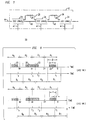
- Figure 5a shows a train of packets 20 at the input of the first optical packet switch 6d.
- the vertical dotted lines depict clock pulses 52 which define the frames 29 at the first switch 6d.
- the train of packets 20 is passed through the delay synchronizer 17, and each of the packets which violate the s-characteristic is delayed ⁇ resulting in the train of packets 20, shown in Figure 5b, at the output of the synchronizer 17, of the first switch 6d.
- four packets 20 are delayed an interval of ⁇ , while four packets receive no delay in order to attain s-synchronization of Figure 5b.
- Figure 5c depicts a train of packets 20, at the output of the first switch 6d (see Figure 1) which are to be inputs to the second switch 6e and a set of local clock pulses 54 which define the frames 28 of the second switch 6e.
- the train of packets 20 of Figure 5c are passed through the delay synchronizer 17, of the second switch 6e to flip (i.e. delay) the packets into the appropriate frame 29 so as to present the acceptable train of packets (see Figure 5d) to the second switch 6e.
- the packets 20, need only be flipped once, twice or not at all in order to adjust any sequence of received packets 20, to conform with the s-characteristic requirement.
- FIG. 8 shows a transmission of four packets 20, with two (unsynchronized) clocks A and B .
- the traffic has the s-characteristic with respect to the frames of clock A (i.e. A 1, A 2, A 3, and A 4), but not with respect to clock B .
- clock A time is measured on axis t while for clock B, time is measured on axis t'.
- the packet 20 traffic must be converted so that it exhibits the s-characteristic with respect to clock B .
- ⁇ ⁇ 2 ⁇ .
- each frame of clock A is associated with a frame of clock B , as shown in Figure 8 (i.e., A 1 is associated with B 1, etc.).
- a 1 is associated with B 1, etc.
- the claim is that under the above conditions, a packet either fits in a frame of clock B , or can be delayed by ⁇ and now fit in the frame.
Landscapes
- Engineering & Computer Science (AREA)
- Computer Networks & Wireless Communication (AREA)
- Physics & Mathematics (AREA)
- Optics & Photonics (AREA)
- Signal Processing (AREA)
- Optical Communication System (AREA)
- Use Of Switch Circuits For Exchanges And Methods Of Control Of Multiplex Exchanges (AREA)
- Data Exchanges In Wide-Area Networks (AREA)
- Synchronisation In Digital Transmission Systems (AREA)
Applications Claiming Priority (2)
| Application Number | Priority Date | Filing Date | Title |
|---|---|---|---|
| US8906893A | 1993-07-07 | 1993-07-07 | |
| US89068 | 1993-07-07 |
Publications (2)
| Publication Number | Publication Date |
|---|---|
| EP0633706A2 true EP0633706A2 (de) | 1995-01-11 |
| EP0633706A3 EP0633706A3 (de) | 1995-08-16 |
Family
ID=22215512
Family Applications (1)
| Application Number | Title | Priority Date | Filing Date |
|---|---|---|---|
| EP94304761A Withdrawn EP0633706A3 (de) | 1993-07-07 | 1994-06-29 | Synchronisierungsschaltung für optische Pakete. |
Country Status (4)
| Country | Link |
|---|---|
| US (1) | US5485298A (de) |
| EP (1) | EP0633706A3 (de) |
| JP (1) | JPH07154422A (de) |
| CA (1) | CA2116254A1 (de) |
Families Citing this family (11)
| Publication number | Priority date | Publication date | Assignee | Title |
|---|---|---|---|---|
| US5999292A (en) * | 1998-02-20 | 1999-12-07 | The United States Of America As Represented By The Secretary Of The Navy | Sagnac interferometer amplitude modulator based demultiplexer |
| JP3214490B2 (ja) | 1999-01-06 | 2001-10-02 | 日本電気株式会社 | パケット交換ネットワーク |
| US7016357B1 (en) * | 1999-10-26 | 2006-03-21 | Ciena Corporation | Methods and apparatus for arbitrary concatenation in a switch |
| EP1195940A1 (de) * | 2000-10-04 | 2002-04-10 | Alcatel | Verfahren zur synchronisierung optischer signalen, optische synchronisationsanordnungen und zugehöriger optischer netzknoten |
| US6711357B1 (en) * | 2000-10-31 | 2004-03-23 | Chiaro Networks Ltd. | Timing and synchronization for an IP router using an optical switch |
| US6965619B2 (en) * | 2000-12-04 | 2005-11-15 | Ciena Corporation | Flexible multiplexer/demultiplexer and method for transport of optical line data to a wide/metro area link |
| US7630363B2 (en) * | 2004-12-31 | 2009-12-08 | Samsung Electronics Co., Ltd. | Apparatus for adjusting receiving time point of burst data in optical burst switching network and method thereof |
| US9197329B2 (en) * | 2010-05-11 | 2015-11-24 | The Invention Science Fund I, Llc | Optical power transmission packeting systems and methods |
| US8971722B2 (en) | 2010-05-11 | 2015-03-03 | The Invention Science Fund I, Llc | Optical power distribution device and method |
| US8660435B2 (en) | 2010-05-11 | 2014-02-25 | The Invention Science Fund I, Llc | Optical power distribution system |
| US20110278479A1 (en) | 2010-05-11 | 2011-11-17 | Searete Llc, A Limited Liability Corporation Of The State Of Delaware | Optical power transmission system and method having counter-propagating control signal |
Family Cites Families (5)
| Publication number | Priority date | Publication date | Assignee | Title |
|---|---|---|---|---|
| JPS6047588A (ja) * | 1983-08-26 | 1985-03-14 | Nippon Telegr & Teleph Corp <Ntt> | 時分割形光交換機 |
| US4625190A (en) | 1985-03-04 | 1986-11-25 | Westinghouse Electric Corp. | Remotely controlled solenoid operated circuit breaker |
| US5115428A (en) * | 1989-09-05 | 1992-05-19 | The University Of Colorado Foundation, Inc. | Serial array time-slot interchangers |
| AT392555B (de) * | 1989-10-24 | 1991-04-25 | Alcatel Austria Ag | Verfahren zum uebertragen von binaerinformationen in einem optischen uebertragungsnetzwerk sowie optisches uebertragungsnetzwerk |
| JP2781633B2 (ja) * | 1990-01-10 | 1998-07-30 | 株式会社日立製作所 | セル信号処理回路及びそれを用いた光交換機 |
-
1994
- 1994-02-23 CA CA002116254A patent/CA2116254A1/en not_active Abandoned
- 1994-06-29 EP EP94304761A patent/EP0633706A3/de not_active Withdrawn
- 1994-07-06 JP JP6176165A patent/JPH07154422A/ja active Pending
-
1995
- 1995-03-07 US US08/400,402 patent/US5485298A/en not_active Expired - Fee Related
Also Published As
| Publication number | Publication date |
|---|---|
| JPH07154422A (ja) | 1995-06-16 |
| US5485298A (en) | 1996-01-16 |
| CA2116254A1 (en) | 1995-01-08 |
| EP0633706A3 (de) | 1995-08-16 |
Similar Documents
| Publication | Publication Date | Title |
|---|---|---|
| US4912706A (en) | Frame synchronization in a network of time multiplexed optical space switches | |
| RU2101867C1 (ru) | Система асинхронной временной оптической связи | |
| KR100324092B1 (ko) | 통신네크워크및이통신네트워크의이용방법 | |
| US5912753A (en) | Optical telecommunications network | |
| US5398129A (en) | Passive optical telecommunication system for narrow band and broadband integrated services digital networks | |
| US5303077A (en) | Optical switch and switching module therefor | |
| CA2036756C (en) | High-speed time-division switching system | |
| US5073980A (en) | Photonic switch employing shared data transmission facility | |
| RU2142204C1 (ru) | Система переупорядочивания элементов для переупорядочивающей части телекоммуникационной сети | |
| US5485298A (en) | Optical packet synchronization circuit | |
| EP0436958B1 (de) | Zellensignalverarbeitungsschaltung und optische Vermittlungseinrichtung unter Anwendung dieser Schaltung | |
| US7043164B1 (en) | Optical regenerator for high bit-rate OTDM signals | |
| US5206753A (en) | Optical switching system | |
| JPH0851451A (ja) | 同期方法および同期装置、端末、交換装置 | |
| Tsukada et al. | Ultrafast photonic ATM (ULPHA) switch and a video distribution experiment | |
| JP3810798B2 (ja) | 光スイッチ | |
| US4769809A (en) | Method of and circuit arrangement for through-switching broadband digital signals without phase jump in a synchronous broadband communication network | |
| Mehravari et al. | Frame synchronization in a photonic network of time multiplexed space switches via a feedback scheme | |
| JP3005997B2 (ja) | 同期多重方式 | |
| JPH08321843A (ja) | リング型ネットワーク | |
| WO1998030058A2 (en) | Method and apparatus to interconnect two or more cross-connects into a single pcm network | |
| JPH05268207A (ja) | フレーム同期システム | |
| JPH04152727A (ja) | 同期多重端局装置 |
Legal Events
| Date | Code | Title | Description |
|---|---|---|---|
| PUAI | Public reference made under article 153(3) epc to a published international application that has entered the european phase |
Free format text: ORIGINAL CODE: 0009012 |
|
| AK | Designated contracting states |
Kind code of ref document: A2 Designated state(s): DE FR GB IT |
|
| PUAL | Search report despatched |
Free format text: ORIGINAL CODE: 0009013 |
|
| AK | Designated contracting states |
Kind code of ref document: A3 Designated state(s): DE FR GB IT |
|
| 17P | Request for examination filed |
Effective date: 19960131 |
|
| STAA | Information on the status of an ep patent application or granted ep patent |
Free format text: STATUS: THE APPLICATION HAS BEEN WITHDRAWN |
|
| 18W | Application withdrawn |
Withdrawal date: 19970823 |