EP0633891B1 - Synthese d'oligonucleotides - Google Patents
Synthese d'oligonucleotides Download PDFInfo
- Publication number
- EP0633891B1 EP0633891B1 EP93911532A EP93911532A EP0633891B1 EP 0633891 B1 EP0633891 B1 EP 0633891B1 EP 93911532 A EP93911532 A EP 93911532A EP 93911532 A EP93911532 A EP 93911532A EP 0633891 B1 EP0633891 B1 EP 0633891B1
- Authority
- EP
- European Patent Office
- Prior art keywords
- formula
- group
- oligonucleotides
- optionally substituted
- compound according
- Prior art date
- Legal status (The legal status is an assumption and is not a legal conclusion. Google has not performed a legal analysis and makes no representation as to the accuracy of the status listed.)
- Expired - Lifetime
Links
- 0 C[C@@]1[C@@](C2)CCCC2*1 Chemical compound C[C@@]1[C@@](C2)CCCC2*1 0.000 description 3
- AKOYDCYIFPJXHB-UHFFFAOYSA-N CC(C1OC(CCC(OC(C)(C2)C(OC)OC2OC)=O)=O)C(OC)OC1OC Chemical compound CC(C1OC(CCC(OC(C)(C2)C(OC)OC2OC)=O)=O)C(OC)OC1OC AKOYDCYIFPJXHB-UHFFFAOYSA-N 0.000 description 1
- QVTHRPYPOSLWSC-UHFFFAOYSA-N CC(COC1)C1OC(C)=O Chemical compound CC(COC1)C1OC(C)=O QVTHRPYPOSLWSC-UHFFFAOYSA-N 0.000 description 1
Classifications
-
- C—CHEMISTRY; METALLURGY
- C07—ORGANIC CHEMISTRY
- C07F—ACYCLIC, CARBOCYCLIC OR HETEROCYCLIC COMPOUNDS CONTAINING ELEMENTS OTHER THAN CARBON, HYDROGEN, HALOGEN, OXYGEN, NITROGEN, SULFUR, SELENIUM OR TELLURIUM
- C07F9/00—Compounds containing elements of Groups 5 or 15 of the Periodic Table
- C07F9/02—Phosphorus compounds
- C07F9/547—Heterocyclic compounds, e.g. containing phosphorus as a ring hetero atom
- C07F9/655—Heterocyclic compounds, e.g. containing phosphorus as a ring hetero atom having oxygen atoms, with or without sulfur, selenium, or tellurium atoms, as the only ring hetero atoms
- C07F9/65515—Heterocyclic compounds, e.g. containing phosphorus as a ring hetero atom having oxygen atoms, with or without sulfur, selenium, or tellurium atoms, as the only ring hetero atoms the oxygen atom being part of a five-membered ring
-
- C—CHEMISTRY; METALLURGY
- C07—ORGANIC CHEMISTRY
- C07H—SUGARS; DERIVATIVES THEREOF; NUCLEOSIDES; NUCLEOTIDES; NUCLEIC ACIDS
- C07H21/00—Compounds containing two or more mononucleotide units having separate phosphate or polyphosphate groups linked by saccharide radicals of nucleoside groups, e.g. nucleic acids
Definitions
- This invention relates to a method for the synthesis of oligonucleotides and to novel compounds which may be used during operation of the method.
- Oligonucleotide sequences are routinely synthesised for use as linkers, adaptors, building blocks for synthetic genes, synthetic regulatory sequences, probes, primers and other purposes and a number of methods have been developed for producing such sequences. These methods rely on the initial attachment of a first suitably protected nucleoside to a solid support by a cleavable linkage followed by sequential reactions of precursors of individual nucleotides to the growing oligonucleotide strand with each addition of a precursor involving a number of chemical reactions. At present the method most generally employed for the production of a lone oligonucleotide is based on phosphoramidite chemistry.
- EP-A-67597 discloses a process of incorporating ribonucleotide units at locations in DNA. These provide predetermined cleavage sites allowing ease of chain cleavage from the solid support and a mechanism for separating the product from unwanted products.
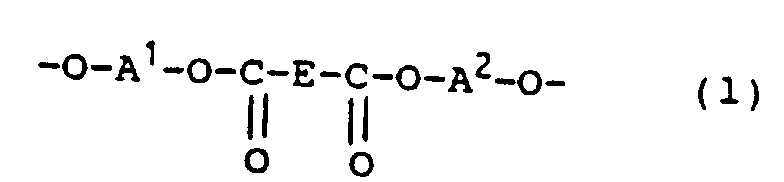
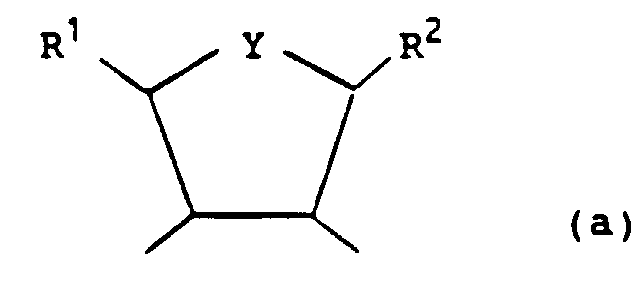
- a method for the synthesis of a plurality of oligonucleotides comprising the steps of: (i) forming a first oligonucleotide on a first cleavable link attached to a solid support; (ii) attaching to the first oligonucleotide a cleavable linker moiety; (iii) forming a second oligonucleotide on the cleavable linker moiety; and (iv) cleaving the first cleavable link and the cleavable linker moiety to give a plurality of oligonucleotides; wherein the cleavable linker moiety is of the Formula (1): wherein one or both of A 1 and A 2 is a divalent group of the formula (a): R 1 and R 2 are each independently H, optionally substituted alkyl, optionally substituted alkoxy or optionally substituted aryloxy, hal
- a 1 and A 2 are both of Formula (a) and n preferably has a value of from 1 to 3, more preferably 2.
- the support is preferably a solid support such as is used in automated oligonucleotide synthesis.
- the preferred solid support is, for example, a modified inorganic polymer such as those disclosed in the US Patent Specification 4,458,066, a silica gel, Porasil C, kieselguhr PDMA, polystyrene, polyacrylamide, Silica CPG (LCAA) or a controlled pore glass as used in, for example, the Applied Biosystems DNA synthesiser Model 380B.
- the oligonucleotides may be formed from precursors of individual nucleotides by conventional technology used for synthesising oligonucleotides, for example by using phosphoramidite chemistry on an automated oligonucleotide synthesiser as described above.
- the first oligonucleotide is preferably connected to the support by a hydrolysable group (e.g. a base labile group) as is known in the art.
- the first aspect of the invention may be illustrated by the formation of 2 oligonucleotides using different combinations of the phosphoramidites of 2'-deoxyadenosine (dA), 2'-deoxyguanosine (dG), 2'-deoxycytidine (dC), and 2'-deoxythymidine (dT) separated by the cleavable linker moiety of Formula (1) built up sequentially in a 3' to 5' direction from the 3' hydroxy of deoxyribose on a solid support according to the above method described by M.J. Gait. After synthesis the sequence may be represented by: wherein X is a cleavable link.
- the cleavable linker moiety connects the first and second oligonucleotides through a 3' and a 5' oxygen, more preferably through a phosphate, phosphite, phosphate ester, phosphite ester or H-phosphonate ester, one on each oligonucleotide.
- the identity of the first cleavable link is not believed to be critical, it is preferably base labile, and may be for example any of the cleavable links used in automated oligonucleotide synthesisers, such as a link which contains a base labile ester group.
- Organic residues of the cleaved linker moiety preferably do not remain attached to the oligonucleotides after cleavage step (iv) to avoid any adverse affects on the properties of the oligonucleotides which such residues can have.
- the first aspect of the invention includes repetition of steps (ii) and (iii) any desired number of times, for example 1 to 100 times, or preferably 1 to 5 times, to produce further oligonucleotides which are each connected through a cleavable linker moiety.
- steps (ii) and (iii) are repeated the further oligonucleotides are formed on the cleavable linker moiety attached to the previously formed oligonucleotide and may be the same as or different to the previously formed oligonucleotides.
- the cleavable linker moiety or moieties may be cleaved by base hydrolysis to give a mixture of individual oligonucleotides which may, if required, be purified and separated.
- Any suitable base may be used, for example, aqueous ammonia, methylamine.
- oligonucleotide includes an oligodeoxyribonucleotide, an oligoribonucleotide and analogues thereof (for example those which bear protecting groups), including those with methyl-phosphonate and phosphorothioate or phosphorodithioate diester backbones, and oligonucleotides with oligodeoxyribonucleotides, especially the 2'-oligodeoxyribonucleotides being more usually synthesised by the method of the invention.
- the preferred oligonucleotides are oligodeoxyribonucleotides, are essentially single stranded, and are preferably from at least two, more preferably at least 5, especially from 10 to 200 bases long.
- the method of the invention gives the advantage of more effective use of the apparatus and subsequently reducing the cost of production and purification of oligonucleotides.
- the DNA synthesiser can produce two or more oligonucleotides (which may be the same or different) on any one of its columns without being reprogrammed between each oligonucleotide.
- the synthesiser can go on to produce another without any intervention by an operative. This can significantly increase the productivity of such apparatus.
- the method of the invention is particularly useful for the synthesis of primers for the Polymerase Chain Reaction (PCR) technique.
- PCR Polymerase Chain Reaction
- oligonucleotides synthesised are for this purpose.
- Such primers are typically required in pairs and the method of the invention is convenient since it allows production of oligonucleotides in pairs. This is particularly an advantage when using single column synthesisers and/or for heavily used facilities for out-of hours working.
- the precursors of the individual nucleotides are nucleoside phosphoramidites protected at the 5' oxygen atom and optionally are base protected.
- Methods of protecting nucleoside bases are known in the art, for example by a protecting group which is removable by treatment with mild acid or alkali.
- Adenine and cytosine may be protected by an optionally substituted N-benzoyl group and Guanine by an N-isobutyryl group. Thymine and uracil generally do not require protection.
- Adenine and guanine may also be protected by a dimethylformamide or phenoxyacetyl group, and cytosine by an isobutyryl group.
- the protecting groups are preferably removed after separation of the protected oligonucleotide from the support. Cleavage of the linker moiety may be effected before, during or after the removal of the protecting groups depending upon the chemistry employed. It is preferred that the protecting groups are removable by treatment with aqueous base, particularly concentrated ammonia solution or methylamine.
- the cleavable linker moiety is cleavable under basic or alkaline conditions so that protecting group removal and cleavage of linker moieties can be effected in one step.
- Typical basic conditions employed are to mix the protected oligonucleotide with base, for example, concentrated aqueous ammonia, methylamine or a mixture of both, or for example, methanolic sodium hydroxide.
- the reaction may be carried out, for example at a temperature of room temperature (20°C) to 100°C, more preferably from 50 to 90°C, especially around 55° to 60°C.
- the reaction is typically carried out over a period of 48 hours, more particularly over a period up to 24 hours, especially from about 5 to 24 hours. It is preferred that a linker moiety is chosen such that cleavage is completed under these conditions.
- bases preferably volatile bases may be employed to effect cleavage.
- bases may conveniently be organic amines in water, for example piperidine, diethylamine, or triethylamine, preferably at a concentration from 10-70%.
- precursors of individual nucleotides suitable for use in the method there may be mentioned the 2-cyanoethyl-N,N-diisopropylaminophosphoramidites of 5'-dimethoxytrityl-N-4-benzoyl-2'-deoxycytidine, 5'-dimethoxytrityl-N-2-isobutyryl-2'-deoxyguanosine, 5'-dimethoxytrityl-N-6-benzoyl-2'-deoxyadenosine, and 5'dimethoxytritylthymidine.
- oligoribonucleotides precursors are, for example, the same as for oligodeoxyribonucleotides except that on the 2' position of the ribose there is a protected hydroxyl group, for example a tertiary butyl dimethyl silyloxy group or 2'-O-Fpmp phosphoramidites from Cruachem Ltd.
- step (iv) yields desired oligonucleotides each having a group selected from hydroxy and phosphate at the 3' and 5' position.
- the cleavable linker moiety of Formula (1) may be attached to the first oligonucleotide using a reagent of Formula (3) in place of a precursor of an individual nucleotide in a manner analogous to conventional oligonucleotide synthesis.
- the present invention provides a compound of Formula (3): wherein A 1 , A 2 and E are as hereinbefore defined; Z 1 is an acid labile protecting group; and -O-PA is a phosphoramidite group, a phosphate ester group or a H-phosphonate group.
- Suitable acid labile protecting groups represented by Z 1 will be apparent to those skilled in the art and include those discussed in 'Protective Groups in Organic Synthesis' by T.W. Greene, Wiley Interscience. Examples of such protecting groups include methoxytrityl (preferably for oligoribonucleotide synthesis only), dimethoxytrityl, pixyl, isobutyloxycarbonyl, t-butyl dimethylsilyl and like protecting groups. Preferably, Z 1 is dimethoxytrityl.
- E is preferably an organic spacer group having a length of 2 to 15, more preferably 2 to 6 carbon atoms.
- E is preferably an alkyl, alkenyl, aryl or aralkyl spacer group, optionally interrupted by an ether, thioether, amino or amido group.
- Preferred groups represented by E are optionally substituted phenylene, C 2-6 -alkylene, more preferably -CH 2 CH 2 -.
- R 1 and R 2 are preferably each independently H; straight or branched chain C 1-6 -alkyl, especially methyl, ethyl, propyl, butyl or tertiary butyl; or C 1-6 -alkoxy, especially methoxy, ethoxy, propoxy and butoxy, particularly methoxy; halogen, cyano, nitro, phenoxy, optionally protected hydroxy; optionally protected oxycarbonyl; or optionally protected NH 2 .
- Y is preferably CH 2 , CH 2 CH 2 , NH or O, more preferably CH 2 , CH 2 CH 2 or O, especially O.
- Each R 3 independently is preferably C 1-6 -alkyl, especially methyl, ethyl, propyl or butyl or, more preferably, H.
- Optional substituents are as defined for R 1 and R 2 .
- -O-PA is a H-phosphonate or a phosphoramidite
- these are oxidised to respectively a phosphate diester or phosphate tri-ester groups during operation of the method, for example using aqueous iodine or peroxide.
- the oxidation is preferably performed after step (iii) and before step (iv), whilst in the case of phosphoramidite it is preferably performed during step (i) and step (iii).
- phosphate ester groups and H-phosphonate groups there may be mentioned groups which, in the free acid form, are respectively of formula: wherein Z 2 is a protecting group, preferably a base labile protecting group, for example 2-chlorophenyl or 2,4-dichlorophenyl.
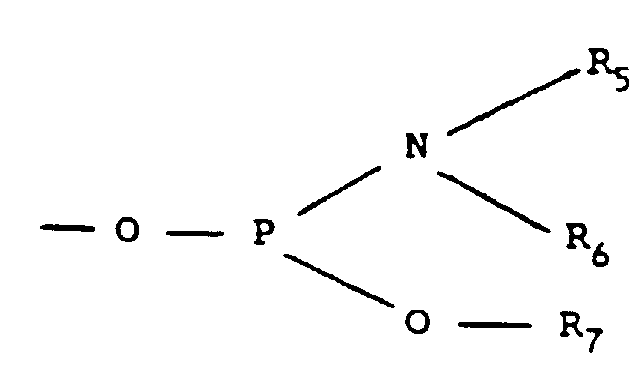
- -O-PA is a phosphoramidite of general structure: wherein R 5 and R 6 are each independently optionally substituted alkyl, especially C 1-4 -alkyl; optionally substituted aralkyl, especially optionally substituted benzyl; cycloalkyl and cycloalkylalkyl containing up to ten carbon atoms, such as cyclopentyl or cyclohexyl; or R 5 and R 6 taken together with the nitrogen atom to which they are attached form an optionally substituted pyrollidine or piperidine ring or R 5 and R 6 when taken together with the nitrogen atom to which they are attached form a saturated nitrogen heterocycle which optionally includes one or more additional hetero atom from the group consisting of nitrogen, oxygen and sulphur.
- R 5 and R 6 are preferably iso-propyl.
- R 7 represents a hydrogen atom or a protecting group, for example a phosphate protecting group.
- phosphate protecting groups there may be mentioned optionally substituted alkyl groups, for example methyl, 2-cyanoethyl, 2-chlorophenyl, 2,2,2-trihalo-1,1-dimethyl ethyl, 5-chloroquin-8-yl, 2-methylthioethyl and 2-phenylthioethyl groups in which the phenyl ring is optionally substituted, for example by a group selected from halogen, eg. chlorine, or NO 2 .
- R 7 is methyl or, more preferably, 2-cyanoethyl.
- the compounds of the present invention can exist in either the cis or trans form.
- the trans form of the compounds demonstrate a slower rate of cleavage and therefore result in oligonucleotides bearing terminal organic phosphate groups which may find applications in situations where the termini are required to be blocked.
- the compounds of Formula (3) are suitable reagents for attaching a cleavable linker moiety of formula between a first and second oligonucleotide as described by the method of the invention. Under suitable conditions, for example treatment with concentrated ammonium hydroxide, the compounds cleave to give the desired oligonucleotides free from any organic residue of the compound of Formula (3). This is of particular value where oligonucleotides are desired with free or phosphated 3' or 5' termini.
- Compounds of Formula (3) wherein -O-PA is a phosphoramidite may be prepared by reacting a compound of the formula with a compound of formula X 1 -PA in CH 2 Cl 2 using di(N-isopropyl)ethylamine as base.
- PA is preferably a phosphoramidite as defined above for -O-PA except that -O- is absent, and Z 1 , A 1 , E and A 2 are as hereinbefore defined, and X 1 is a leaving group, for example Cl or Br.
- the compound of Formula (3) may be prepared by reaction of a compound of formula with the triazolide of the corresponding free phosphate ester using a method analogous to that described in the above book by M.J. Gait.
- the compound of Formula (3) may be prepared by reaction in a compound of formula with PCl 3 in the presence of 1,2,4-triazole using a method analogous to that described by B.C.Froehler et al, Nucleic Acid Research, (1986), 14 , 5399-5407.
- the compound of formula may be prepared, for example, by reaction of a compound of formula with a compound of formula HO-A 2 -OH, preferably in an aprotic solvent using a suitable condensing agent such as the aforementioned DCCI or 1-(3-Dimethylaminopropyl)-3-ethylcarbodiimide.
- a suitable condensing agent such as the aforementioned DCCI or 1-(3-Dimethylaminopropyl)-3-ethylcarbodiimide.
- the compound of formula may be prepared by the reaction of the compound of formula Z 1 -O-A 1 -OH with an activated form of the compound of formula HO 2 C-E-CO 2 H, preferably in an aprotic solvent in the presence of a molar equivalent of base.
- the dicarboxylic acid may be activated to attack by the hydroxyl group by being present as the acid anhydride, the acid chloride or some other suitable derivative, or the reaction may be mediated by the presence of a coupling agent as described above.
- the compound of formula Z 1 -O-A 1 -OH may be prepared by the reaction of the compound of formula HO-A 1 -OH with Z 1 -Cl (or some other suitably activated form of Z 1 ) in an anhydrous aprotic solvent in the presence of a molar equivalent of base.
- the compound of formula Z 1 -O-A 1 -OH is preferably prepared by debenzoylation of a compound of formula Z 1 -O-A 1 -O-CO-Ph in methanol using methylamine.
- the compound of formula Z 1 -O-A 1 -O-CO-Ph may be prepared by reaction of compound of formula HO-A 1 -O-CO-Ph with Z 1 -X 1 , wherein X 1 is a leaving group, for example Cl.
- Z 1 , A 1 , E, A 2 , O, PA and Z 2 are as hereinbefore defined and DCCI is 1,3-dicylohexylcarbodiimide.
- a compound comprising two or more oligonucleotides linked, preferably by 3' and 5' oxygen atoms, by a group or groups containing a cleavable linker moiety of formula wherein A 1 , E and A 2 are as hereinbefore defined. It is preferred that the cleavable linker moiety of formula is connected to each oligonucleotide via a H-phosphonate, phosphate, phosphite, phosphate ester or phosphite ester linkage. It is preferred that one of the oligonucleotides is connected to a support.
- preferred phosphite linkages are of formula -P(-OR 6 )- wherein R 6 is as hereinbefore defined.
- DMT is 4,4'dimethoxytrityl.
- the dichloromethane solution was dried by the addition of anhydrous sodium sulphate and filtered. The filtrate was evaporated to a gum and redissolved in methanol saturated with methylamine. The resultant solution was incubated at room temperature until no starting material could be detected by TLC. The solvent was removed by rotary evaporation, and the residue redissolved in the minimum volume of dichloromethane/methanol (9/1) and loaded on a silica chromatography column. Elution with the same solvent gave the title compound as a white foam (22g, 54%).
- step 1 The product from step 1 (10g, 24.6mmol) was dissolved in dry pyridine (150ml) and succinic anhydride (10g, 100mmol) was added. When dissolution was complete, 4-(N,N-dimethylamino)pyridine (500mg) was added and the solution was stirred at room temperature overnight. The solvent was evaporated under reduced pressure and residual pyridine removed by repeated co-evaporation with toluene. The residue was redissolved in dichloromethane (500ml) and washed three times with ice cold 10% citric acid solution.
- step 2 The product from step 2 (10g, 19.5mmol) was dissolved in dry pyridine (200ml) containing 1,4-anhydroerythritol (10.4g, 100mmol). To this solution was added 1-(3-dimethylaminopropyl)-3-ethyl carbodiimide hydrochloride (Aldrich, 3.75g, 19.5mmol). The solution was stirred at room temperature overnight when TLC in dichloromethane:methanol (19:1) showed there to be no starting material present. The solvent was removed under reduced pressure and residual pyridine removed by repeated co-evaporation with toluene. The residue was redissolved in ethyl acetate and washed three times with saturated sodium bicarbonate solution and once with water.
- 1-(3-dimethylaminopropyl)-3-ethyl carbodiimide hydrochloride Aldrich, 3.75g, 19.5mmol
- step (2g, 3.3mmol) was dissolved in dry dichloromethane (50ml) and the solution stirred under a stream of dry argon. To this solution was added dry diisopropylethylamine (2.7ml, 16mmol) and 2-cyanoethyl-N,N-diisopropylaminochlorophosphine (1.05ml, 4.72mmol). The solution was stirred at room temperature under a stream of dry argon for 30 minutes when TLC in dichloromethane:triethylamine (19:1) showed there to be no starting material present. The reaction was quenched by addition of dry methanol (5ml) and the solution was diluted with ethyl acetate (200ml).
- oligonucleotide was formed on a solid support via a first (conventional) cleavable link using the protocol supplied with the Applied Biosystems 380B DNA synthesiser, using the 3'-(2-cyanoethyl)-N,N-diisopropylaminophosphoramidites of 5'-dimethoxytrityl-N 4 -benzoyl-2'deoxycytidine, 5'-dimethoxytrityl-N 2 -isobutyryl-2'deoxyguanosine, 5'-dimethoxytrityl-N 6 -benzoyl-2'deoxyadenosine and 5'-dimethoxytritylthymidine (Cruachem) as the precursors of the individual nucleotides.
- a cleavable linker moiety was attached to the first oligonucleotide by means of reagent A1.
- Reagent Al was dissolved in anhydrous acetonitrile to a concentration of 0.1M, and a bottle containing this solution was attached to one of the spare reagent ports on the DNA synthesiser.
- the synthesiser was then programmed to synthesise the following sequence: (whereby the cleavable linker moiety L' is introduced by means of reagent A1), using standard synthesis cycles employed on the Applied Biosystems 380B DNA synthesiser. The duration of the reaction steps and the volume of reagents used for coupling, oxidation, capping and detritylation were identical for each coupling, including that of reagent A1.
- the synthesiser was programmed to perform the conventional concentrated ammonia wash of the column to release the oligonucleotides into collection vials.
- the synthesiser achieves the steps of a) forming a first oligonucleotide of sequence (5'-3') TCGA by successive reaction of the nucleotide precursors with an oligonucleotide connected to the controlled pore glass support via the 3'-OH group and a (conventional) first cleavable link, b) attaching to the first oligonucleotide a cleavable linker moiety by means of reagent A1, and c) forming a second oligonucleotide on the cleavable linker moiety having the sequence (5'-3') TTTTTTTTTT, to give two oligonucleotides separated by a cleavable linker moiety and bound to a solid support by a cleavable link, as illustrated by the formula: wherein -L'- is a cleavable linker of formula: attached to the 5' and 3' oxygen of the first and second oligonu
- oligonucleotides were also synthesised by conventional procedures as described above but omitting the treatment with methylamine. These were designed to represent control molecules to be used in the analysis of products generated by the methylamine treatment above.
- oligonucleotides had the following sequences:
- oligonucleotides 1) and 2) are of identical length and sequence to the products expected from cleavage of the oligonucleotide containing the cleavable link
- oligonucleotides 3, 4 and 5 are representative of the products expected from partial cleavage of the oligonucleotide containing the cleavable link.
- step d) The mixture of oligonucleotides produced in step d) described above was analysed by ion-exchange HPLC on a pharmacia Mono-Q column using a linear gradient from 0-25% buffer B in buffer A over 35 minutes where buffer A was 50mM Tris-chloride (pH 7.5) and buffer B was 50mM Tris-chloride/800mM sodium chloride (pH 7.5).
- control oligonucleotide 1) had a retention time of 29 minutes
- control sequence 2) had a retention time of 9 minutes
- control sequence 3) had a retention time of 32 minutes
- control sequence 4) had a retention time of 13 minutes
- control sequence 5) had a retention time of 39 minutes.
- DMT 4,4'-dimethoxytrityl
- step 2) The product from Example 1), step 2) (10g, 19.5 mmol) was dissolved in dry pyridine (200ml) containing 2,2'-sulfonyldiethanol (15g, dried by azeotropic distillation with toluene below 45°C). To this solution was added 1-(3-dimethylaminopropyl)-3-ethylcarbodiimide hydrochloride (3.75g, 19.5 mmol) and the whole was stirred at room temperature overnight. The solvent was removed under reduced pressure and residual pyridine was removed by repeated co-evaporation with toluene.
- the reaction was quenched by the addition of dry methanol (5ml), and the solution was diluted with ethyl acetate (200ml). This solution was washed with brine (3 x 200ml) and water (200ml). The organic layer was separated, dried (MgSO 4 ), filtered and evaporated to a gum which was redissolved in the minimum volume of dichloromethane:hexane:triethylamine (42:55:3) and applied to a silica column.
- Example 2 The method of Example 2) was repeated to synthesise two oligodeoxyribonucleotides bound to a solid support, except that Reagent A2 was used, dissolved in anhydrous acetonitrile to a concentration of 0.1M, in place of Reagent A1.
- oligonucleotides found after step d) in the method of the invention were found to be identical to oligonucleotides 1) and 4) described in Example 2), demonstrating scission of the cleavable link and phosphorylation of the 5'-hydroxyl of the oligonucleotide formed in step i) in the method of the invention.
- DMT is 4,4'-dimethoxytrityl.
- 2,5-Dihydro-2,5-dimethoxyfuran (50g; Aldrich, cis/trans mixture) was dissolved in tetrahydrofuran (500ml) in a 5 litre, three-necked flask fitted with a mechanical stirrer. The contents of the flask were cooled to -5°C, and a solution of potassium permanganate (61.9g) in water (2250ml) was added dropwise with vigorous stirring at such a rate as to keep the temperature of the flask contents between 4° and 6°C. This addition took 80 minutes. The reaction mixture was then left stirring and allowed to warm to room temperature over 15 hours. The precipitated manganese dioxide was filtered off through Celite and washed with THF (200ml).
- step a) The product from step a) above (1.7g) was dissolved in dry pyridine (10ml) and 4-N,N-dimethylaminopyridine (DMAP) (100mg) was added. The mixture was swirled to dissolve the solid and benzoyl chloride (1.2ml) was added. The mixture was then left to stand at 20°C for 16 hours. The mixture was rotary evaporated, and residual pyridine was removed by repeated co-evaporation with toluene. The residual oil was partitioned between ethyl acetate and 1M HCl (40ml of each).
- DMAP 4-N,N-dimethylaminopyridine
- step b) above (2.47g), 4,4'-dimethoxytrityl chloride (3.12g) and DMAP (0.15g) were stirred in dry pyridine (20ml) at room temperature for 16 hours. The solvent was removed by rotary evaporation and residual pyridine was removed by repeated co-evaporation with toluene.
- step c) above (2.28g) was dissolved in dry pyridine (20ml) and succinic anhydride (0.55g) and DMAP (0.4g) were added. The mixture was swirled to dissolve the solids and then left at room temperature for 16 hours. The solvent was removed by rotary evaporation and residual pyridine was removed by repeated co-evaporation with toluene. The residue was partitioned between ethyl acetate and 10% (w/v) citric acid (50ml of each).
- step d) The product from step d) (1.881g) was dissolved in dry dichloromethane (5 ml) and N,N'-dicyclohexylcarbodiimide (0.384 g, 0.5 meq) was added. The solid was dissolved by swirling the flask, which was then left at 20°C for one hour. Dicyclohexylurea was filtered off and washed with dichloromethane (3 x 2 ml). The filtrate and washings were combined and rotary evaporated. To this was added a solution of the product from step 1) (0.708g, 1.27 meq) in dry pyridine (6 ml). When dissolution was complete, the flask was left at 20°C for thirty nine hours, and then rotary evaporated.
- the reaction was quenched by the addition of dry methanol (5ml), and the solution was diluted with ethyl acetate (200ml). This solution was washed with brine (3 x 200ml) and water (200ml). The organic layer was separated, dried (MgSO 4 ), filtered and evaporated to a gum which was redissolved in the minimum volume of dichloromethane:hexane:triethylamine (42:55:3) and applied to a silica column.
- Example 2 The method of Example 2) was repeated to synthesise two oligodeoxyribonucleotides bound to a solid support, except that Reagent A3 was used, dissolved in anhydrous acetonitrile to a concentration of 0.1M, in place of Reagent A1.
- oligonucleotides found after step iv) in the method of the invention were found to be identical to oligonucleotides 1) and 2) described in Example 2), demonstrating scission of the cleavable link and generation of the desired products.
Landscapes
- Chemical & Material Sciences (AREA)
- Organic Chemistry (AREA)
- Health & Medical Sciences (AREA)
- Life Sciences & Earth Sciences (AREA)
- Biochemistry (AREA)
- Molecular Biology (AREA)
- General Health & Medical Sciences (AREA)
- Engineering & Computer Science (AREA)
- Biotechnology (AREA)
- Genetics & Genomics (AREA)
- Saccharide Compounds (AREA)
- Preparation Of Compounds By Using Micro-Organisms (AREA)
Claims (20)
- Procédé de synthèse d'une pluralité d'oligonucléotides comprenant les étapes(i) de formation d'un premier oligonucléotide sur un pont clivable lié à un support solide;(ii) de fixation au premier oligonucléotide d'un résidu de liaison clivable;(iii) de formation d'un deuxième oligonucléotide sur le résidu de liaison clivable; et(iv) de clivage du premier pont clivable et du résidu de liaison clivable en vue d'obtenir une pluralité d'oligonucléotides; procédé dans lequel le résidu de liaison clivable répond à la formule (1) :dans laquelle l'un des symboles A1 et A2 ou les deux à la fois sont un groupe bivalent répondant à la formule (a) :

- Procédé selon la revendication 1, dans lequel le clivage du résidu de liaison clivable conduit à une pluralité d'oligonucléotides portant chacun en position 3' et 5' un groupe choisi parmi les groupes hydroxy et phosphate.
- Procédé selon la revendication 1 ou 2, dans lequel le clivage du résidu de liaison clivable conduit à une pluralité d'oligonucléotides portant chacun en position 3' un groupe hydroxy.
- Procédé selon l'une quelconque des revendications 1 à 3, dans lequel les étapes (i) à (iii) sont conduites à l'aide d'un synthétiseur d'oligonucléotides automatique et la réalisation de l'étape (iv) se fait en milieu basique à une température allant de 20 à 100°C dans un délai allant jusqu'à 48 heures.
- Procédé selon l'une quelconque des revendications précédentes, dans lequel le résidu de liaison clivable de formule (1) dérive d'un composé de formule (3) tel que défini dans l'une quelconque des revendications 6 à 18.
- Composé de formule (3) :


- Composé selon la revendication 6, dans lequel A1 et A2 sont tous les deux de formule (a).
- Composé selon la revendication 8, dans lequel A1 est le groupe de formule (a) et A2 est le groupe de formule (b).
- Composé selon l'une quelconque des revendications 6 à 8, dans lequel Y est O ou CH2
- Composé selon l'une quelconque des revendications 6 à 9, dans lequel E est un groupe intercalaire de type alkyle, aryle ou aralkyle, éventuellement entrecoupé d'un groupe éther, thioéther, amino ou amido.
- Composé selon la revendication 10, dans lequel E est éventuellement substitué par un groupe phénylène ou alkylène en C2 à C6.
- Composé selon l'une quelconque des revendications 6 à 11, dans lequel R1 et R2 désignent indépendamment chacun H, un groupe alkyle ou alkoxy.
- Composé selon l'une quelconque des revendications 6 à 12, dans lequel R3 désigne indépendamment un groupe alkyle en C1 à C4 ou H.
- Composé selon l'une quelconque des revendications 6 à 13, dans lequel Z1 est un groupe diméthoxytrityle.
- Composé selon l'une quelconque des revendications 6 à 14, dans lequel O-PA est un groupe phosphoramidite de formule :

- Composé selon l'une quelconque des revendications 6 à 15, dans lequel le groupe de formule (a) comporte O à la place de Y et R1 et R2 sont tous les deux soit des atomes d'hydrogène soit un groupe méthoxy; et le groupe de formule (b) est *-CH2CH2-SO2-CH2-CH2-.
- Composé selon l'une quelconque des revendications 6 à 16 dans lequel A1 et A2 sont tous les deux de formule (a), Y est O, R1 et R2 sont tous les deux un atome d'hydrogène ou un groupe méthoxy, E est -CH2CH2-, Z1 est un groupe diméthoxytrityle, et O-PA est un groupe phosphoramidite de formule
- Composé selon l'une quelconque des revendications 6 à 17 dans lequel A1 est de formule (a) dans laquelle Y est O et R1 et R2 sont tous les deux un atome d'hydrogène ou un groupe méthoxy et A2 est -*CH2CH2-SO2-CH2-CH2-, Z1 est un groupe diméthoxytrityle, et O-PA est un groupe phosphoramidite de formule

- Composé comprenant deux ou plusieurs oligonucléotides liés à un ou plusieurs groupes contenant un résidu de liaison clivable de formule

- Utilisation d'un composé de formule (3) tel que défini dans l'une quelconque des revendications 6 à 18 pour la synthèse d'une pluralité d'oligonucléotides.
Applications Claiming Priority (3)
| Application Number | Priority Date | Filing Date | Title |
|---|---|---|---|
| GB9207381 | 1992-04-03 | ||
| GB929207381A GB9207381D0 (en) | 1992-04-03 | 1992-04-03 | Synthesis of oligonucleotides |
| PCT/GB1993/000694 WO1993020092A1 (fr) | 1992-04-03 | 1993-04-02 | Synthese d'oligonucleotides |
Publications (2)
| Publication Number | Publication Date |
|---|---|
| EP0633891A1 EP0633891A1 (fr) | 1995-01-18 |
| EP0633891B1 true EP0633891B1 (fr) | 1997-01-22 |
Family
ID=10713445
Family Applications (1)
| Application Number | Title | Priority Date | Filing Date |
|---|---|---|---|
| EP93911532A Expired - Lifetime EP0633891B1 (fr) | 1992-04-03 | 1993-04-02 | Synthese d'oligonucleotides |
Country Status (12)
| Country | Link |
|---|---|
| US (2) | US5393877A (fr) |
| EP (1) | EP0633891B1 (fr) |
| JP (1) | JPH07505290A (fr) |
| AT (1) | ATE148129T1 (fr) |
| AU (1) | AU674847B2 (fr) |
| CA (1) | CA2131994A1 (fr) |
| DE (1) | DE69307689T2 (fr) |
| FI (1) | FI109702B (fr) |
| GB (1) | GB9207381D0 (fr) |
| NO (1) | NO309482B1 (fr) |
| RU (1) | RU94042224A (fr) |
| WO (1) | WO1993020092A1 (fr) |
Families Citing this family (51)
| Publication number | Priority date | Publication date | Assignee | Title |
|---|---|---|---|---|
| GB9207381D0 (en) * | 1992-04-03 | 1992-05-13 | Ici Plc | Synthesis of oligonucleotides |
| US5605798A (en) | 1993-01-07 | 1997-02-25 | Sequenom, Inc. | DNA diagnostic based on mass spectrometry |
| US5514789A (en) * | 1994-04-21 | 1996-05-07 | Barrskogen, Inc. | Recovery of oligonucleotides by gas phase cleavage |
| US6025335A (en) * | 1995-09-21 | 2000-02-15 | Lipitek International, Inc. | L-Nucleoside Dimer Compounds and therapeutic uses |
| AU1710997A (en) * | 1996-01-26 | 1997-08-20 | Codon Pharmaceuticals, Inc. | Oligonucleotide analogs |
| EP1460083B1 (fr) | 1996-11-06 | 2006-01-18 | Sequenom, Inc. | Procede d'analyse et dispositif |
| US6133436A (en) * | 1996-11-06 | 2000-10-17 | Sequenom, Inc. | Beads bound to a solid support and to nucleic acids |
| EP0954612A2 (fr) | 1996-11-06 | 1999-11-10 | Sequenom, Inc. | Diagnostics de l'adn fondes sur la spectrometrie de masse |
| US6046005A (en) * | 1997-01-15 | 2000-04-04 | Incyte Pharmaceuticals, Inc. | Nucleic acid sequencing with solid phase capturable terminators comprising a cleavable linking group |
| EP0968434A2 (fr) * | 1997-02-28 | 2000-01-05 | Burstein Laboratories, Inc. | Laboratoire sur disque |
| US7427678B2 (en) * | 1998-01-08 | 2008-09-23 | Sigma-Aldrich Co. | Method for immobilizing oligonucleotides employing the cycloaddition bioconjugation method |
| JP4503828B2 (ja) * | 1998-02-11 | 2010-07-14 | ユニバーシティー オブ ヒューストン | 光生成試薬を用いる化学反応および生化学反応のための方法および装置 |
| US7094943B2 (en) | 1998-04-27 | 2006-08-22 | Hubert Köster | Solution phase biopolymer synthesis |
| US6525185B1 (en) | 1998-05-07 | 2003-02-25 | Affymetrix, Inc. | Polymorphisms associated with hypertension |
| US6319674B1 (en) | 1999-09-16 | 2001-11-20 | Agilent Technologies, Inc. | Methods for attaching substances to surfaces |
| US6451998B1 (en) | 1999-10-18 | 2002-09-17 | Agilent Technologies, Inc. | Capping and de-capping during oligonucleotide synthesis |
| WO2002020541A2 (fr) * | 2000-09-05 | 2002-03-14 | University Technologies International Inc. | Methode de production de plusieurs oligonucleotides sur un support solide |
| US6806051B2 (en) | 2000-09-25 | 2004-10-19 | Picoliter Inc. | Arrays of partially nonhybridizing oligonucleotides and preparation thereof using focused acoustic energy |
| US7635571B2 (en) * | 2000-12-07 | 2009-12-22 | Siemens Healthcare Diagnostics Products Gmbh | Amplified signal in binding assays |
| US7211654B2 (en) * | 2001-03-14 | 2007-05-01 | Regents Of The University Of Michigan | Linkers and co-coupling agents for optimization of oligonucleotide synthesis and purification on solid supports |
| WO2003062452A2 (fr) * | 2002-01-23 | 2003-07-31 | Proligo, Llc | Methodes pour la synthese et la purification integrees d' oligonucleotides |
| US6971790B2 (en) * | 2002-10-11 | 2005-12-06 | Welch Allyn, Inc. | Thermometry probe calibration method |
| US7615629B2 (en) * | 2002-12-31 | 2009-11-10 | Sigma-Aldrich Co. | Methods and compositions for the tandem synthesis of two or more oligonucleotides on the same solid support |
| WO2005000859A2 (fr) * | 2003-04-14 | 2005-01-06 | University Of Houston | Nouveaux composes reactifs et procede de preparation et d'utilisation correspondants |
| CA2589935A1 (fr) | 2004-12-09 | 2006-06-15 | Regents Of The University Of Minnesota | Nucleosides presentant une activite antivirale et anticancereuse |
| US20060286572A1 (en) * | 2005-05-16 | 2006-12-21 | Kohne David E | Method for producing chemically synthesized and in vitro enzymatically synthesized nucleic acid oligomers |
| US8053191B2 (en) | 2006-08-31 | 2011-11-08 | Westend Asset Clearinghouse Company, Llc | Iterative nucleic acid assembly using activation of vector-encoded traits |
| US20090036660A1 (en) * | 2007-07-31 | 2009-02-05 | Joel Myerson | Methods and compositions for generating mixtures of nucleic acid molecules |
| US20090075840A1 (en) * | 2007-09-18 | 2009-03-19 | Joel Myerson | Methods And Compositions For Generating Mixtures Of Nucleic Acid Molecules |
| US8808986B2 (en) | 2008-08-27 | 2014-08-19 | Gen9, Inc. | Methods and devices for high fidelity polynucleotide synthesis |
| US10022454B2 (en) | 2008-09-23 | 2018-07-17 | Liposciences, Llc | Functionalized phosphorodiamites for therapeutic oligonucleotide synthesis |
| EP3067359A1 (fr) * | 2008-09-23 | 2016-09-14 | Scott G. Petersen | Pro-oligomères protégés par phosphate biolabiles auto-administrés pour agents thérapeutiques à base d'oligonucléotide et médiation d'arn interférence |
| US20120071358A1 (en) * | 2008-12-04 | 2012-03-22 | Xiaochuan Zhou | Fluidic devices and methods for multiplex chemical and biochemical reactions |
| KR101141544B1 (ko) | 2009-03-13 | 2012-05-03 | 한국과학기술원 | 에스아이알엔에이 다중 접합체 및 이의 제조방법 |
| US10207240B2 (en) | 2009-11-03 | 2019-02-19 | Gen9, Inc. | Methods and microfluidic devices for the manipulation of droplets in high fidelity polynucleotide assembly |
| US9216414B2 (en) | 2009-11-25 | 2015-12-22 | Gen9, Inc. | Microfluidic devices and methods for gene synthesis |
| US9217144B2 (en) | 2010-01-07 | 2015-12-22 | Gen9, Inc. | Assembly of high fidelity polynucleotides |
| US9295965B2 (en) | 2010-11-12 | 2016-03-29 | Gen9, Inc. | Methods and devices for nucleic acid synthesis |
| US10457935B2 (en) | 2010-11-12 | 2019-10-29 | Gen9, Inc. | Protein arrays and methods of using and making the same |
| US9752176B2 (en) | 2011-06-15 | 2017-09-05 | Ginkgo Bioworks, Inc. | Methods for preparative in vitro cloning |
| ES2737957T3 (es) | 2011-08-26 | 2020-01-17 | Gen9 Inc | Composiciones y métodos para el ensamblaje de alta fidelidad de ácidos nucleicos |
| EP3604555B1 (fr) | 2011-10-14 | 2024-12-25 | President and Fellows of Harvard College | Séquençage par assemblage de structure |
| US10202628B2 (en) | 2012-02-17 | 2019-02-12 | President And Fellows Of Harvard College | Assembly of nucleic acid sequences in emulsions |
| US9150853B2 (en) | 2012-03-21 | 2015-10-06 | Gen9, Inc. | Methods for screening proteins using DNA encoded chemical libraries as templates for enzyme catalysis |
| EP2841601B1 (fr) | 2012-04-24 | 2019-03-06 | Gen9, Inc. | Procédés de tri d'acides nucléiques et de clonage in vitro multiplex préparatoire |
| US9914967B2 (en) | 2012-06-05 | 2018-03-13 | President And Fellows Of Harvard College | Spatial sequencing of nucleic acids using DNA origami probes |
| CA2877823A1 (fr) | 2012-06-25 | 2014-01-03 | Gen9, Inc. | Procedes d'assemblage d'acides nucleiques et de sequencage a haut debit |
| US9476089B2 (en) | 2012-10-18 | 2016-10-25 | President And Fellows Of Harvard College | Methods of making oligonucleotide probes |
| IL316159A (en) | 2015-06-15 | 2024-12-01 | Mpeg La Llc | Defined Oligonucleotide Multimers and Methods for Manufacture Thereof |
| EP3576752A4 (fr) | 2017-02-06 | 2020-12-16 | Mpeg La, LLC | Oligonucléotides multimères ayant une clairance rénale diminuée |
| JP7826221B2 (ja) | 2020-04-30 | 2026-03-09 | エムペグ エルエイ リミテッド ライアビリティ カンパニー | 分割鎖を有する多量体オリゴヌクレオチド |
Family Cites Families (5)
| Publication number | Priority date | Publication date | Assignee | Title |
|---|---|---|---|---|
| EP0067597A1 (fr) * | 1981-05-29 | 1982-12-22 | ens BIO LOGICALS INC. | Méthode pour la synthèse de polynucléotides |
| US4775619A (en) * | 1984-10-16 | 1988-10-04 | Chiron Corporation | Polynucleotide determination with selectable cleavage sites |
| US5118605A (en) * | 1984-10-16 | 1992-06-02 | Chiron Corporation | Polynucleotide determination with selectable cleavage sites |
| GB9021625D0 (en) | 1990-10-04 | 1990-11-21 | Ici Plc | Synthesis of oligonucleotides |
| GB9207381D0 (en) * | 1992-04-03 | 1992-05-13 | Ici Plc | Synthesis of oligonucleotides |
-
1992
- 1992-04-03 GB GB929207381A patent/GB9207381D0/en active Pending
-
1993
- 1993-04-02 RU RU94042224/04A patent/RU94042224A/ru unknown
- 1993-04-02 WO PCT/GB1993/000694 patent/WO1993020092A1/fr not_active Ceased
- 1993-04-02 AU AU40424/93A patent/AU674847B2/en not_active Ceased
- 1993-04-02 CA CA002131994A patent/CA2131994A1/fr not_active Abandoned
- 1993-04-02 JP JP5517255A patent/JPH07505290A/ja active Pending
- 1993-04-02 EP EP93911532A patent/EP0633891B1/fr not_active Expired - Lifetime
- 1993-04-02 AT AT93911532T patent/ATE148129T1/de not_active IP Right Cessation
- 1993-04-02 DE DE69307689T patent/DE69307689T2/de not_active Expired - Fee Related
- 1993-04-05 US US08/041,599 patent/US5393877A/en not_active Expired - Fee Related
-
1994
- 1994-09-30 NO NO943660A patent/NO309482B1/no not_active IP Right Cessation
- 1994-09-30 FI FI944568A patent/FI109702B/fi not_active IP Right Cessation
- 1994-11-07 US US08/337,025 patent/US5552535A/en not_active Expired - Fee Related
Also Published As
| Publication number | Publication date |
|---|---|
| FI944568A0 (fi) | 1994-09-30 |
| AU674847B2 (en) | 1997-01-16 |
| EP0633891A1 (fr) | 1995-01-18 |
| RU94042224A (ru) | 1996-07-20 |
| JPH07505290A (ja) | 1995-06-15 |
| ATE148129T1 (de) | 1997-02-15 |
| US5552535A (en) | 1996-09-03 |
| DE69307689D1 (de) | 1997-03-06 |
| GB9207381D0 (en) | 1992-05-13 |
| AU4042493A (en) | 1993-11-08 |
| DE69307689T2 (de) | 1997-05-15 |
| FI944568L (fi) | 1994-09-30 |
| WO1993020092A1 (fr) | 1993-10-14 |
| CA2131994A1 (fr) | 1993-10-14 |
| US5393877A (en) | 1995-02-28 |
| NO309482B1 (no) | 2001-02-05 |
| FI109702B (fi) | 2002-09-30 |
| NO943660D0 (no) | 1994-09-30 |
| NO943660L (no) | 1994-09-30 |
Similar Documents
| Publication | Publication Date | Title |
|---|---|---|
| US5393877A (en) | Linkers for the synthesis of multiple oligonucleotides in seriatim from a single support attachment | |
| US5644048A (en) | Process for preparing phosphorothioate oligonucleotides | |
| DE69106376T2 (de) | Verfahren zum verbinden von nukleosiden mit einer siloxanbrücke. | |
| US8304532B2 (en) | Method for preparing oligonucleotides | |
| US5571902A (en) | Synthesis of oligonucleotides | |
| AU665174B2 (en) | Synthesis of oligonucleotides | |
| US6166198A (en) | Methods for oligonucleotide synthesis | |
| US5932718A (en) | Oligonucleotides having modified internucleoside linkages or terminal amino group | |
| EP0219342A2 (fr) | Méthode et réactifs pour la synthèse in vitro d'oligonucléotides | |
| EP0633890B1 (fr) | Support pour synthese d'oligonucleotides | |
| US5623068A (en) | Synthesis of DNA using substituted phenylacetyl-protected nucleotides | |
| WO1989011486A1 (fr) | Composes de thiophosphoramidite et de phosphorodithioate de nucleosides et de polynucleotides et procedes | |
| NZ225944A (en) | Biotinylated polynucleotides and analogues thereof, processes for their preparation and intermediates therefor | |
| US6340749B1 (en) | Preparation of nucleoside phosphoramidites and oligonucleotide synthesis | |
| JPH07188278A (ja) | オリゴヌクレオチド合成のためのヌクレオシドおよび酵素的に切断可能な保護基を有するヌクレオシド誘導体 | |
| EP0064796A2 (fr) | Agent de phosphorylation et procédé de phosphorylation de composés organiques hydroxyles | |
| JP4170665B2 (ja) | フェニル基を有する核酸塩基アナログが導入された核酸 |
Legal Events
| Date | Code | Title | Description |
|---|---|---|---|
| PUAI | Public reference made under article 153(3) epc to a published international application that has entered the european phase |
Free format text: ORIGINAL CODE: 0009012 |
|
| 17P | Request for examination filed |
Effective date: 19940901 |
|
| AK | Designated contracting states |
Kind code of ref document: A1 Designated state(s): AT BE CH DE DK ES FR GB GR IE IT LI LU MC NL PT SE |
|
| GRAG | Despatch of communication of intention to grant |
Free format text: ORIGINAL CODE: EPIDOS AGRA |
|
| 17Q | First examination report despatched |
Effective date: 19960314 |
|
| GRAH | Despatch of communication of intention to grant a patent |
Free format text: ORIGINAL CODE: EPIDOS IGRA |
|
| GRAH | Despatch of communication of intention to grant a patent |
Free format text: ORIGINAL CODE: EPIDOS IGRA |
|
| GRAH | Despatch of communication of intention to grant a patent |
Free format text: ORIGINAL CODE: EPIDOS IGRA |
|
| GRAA | (expected) grant |
Free format text: ORIGINAL CODE: 0009210 |
|
| AK | Designated contracting states |
Kind code of ref document: B1 Designated state(s): AT BE CH DE DK ES FR GB GR IE IT LI LU MC NL PT SE |
|
| PG25 | Lapsed in a contracting state [announced via postgrant information from national office to epo] |
Ref country code: NL Free format text: LAPSE BECAUSE OF FAILURE TO SUBMIT A TRANSLATION OF THE DESCRIPTION OR TO PAY THE FEE WITHIN THE PRESCRIBED TIME-LIMIT Effective date: 19970122 Ref country code: IT Free format text: LAPSE BECAUSE OF FAILURE TO SUBMIT A TRANSLATION OF THE DESCRIPTION OR TO PAY THE FEE WITHIN THE PRE;WARNING: LAPSES OF ITALIAN PATENTS WITH EFFECTIVE DATE BEFORE 2007 MAY HAVE OCCURRED AT ANY TIME BEFORE 2007. THE CORRECT EFFECTIVE DATE MAY BE DIFFERENT FROM THE ONE RECORDED.SCRIBED TIME-LIMIT Effective date: 19970122 Ref country code: GR Free format text: LAPSE BECAUSE OF FAILURE TO SUBMIT A TRANSLATION OF THE DESCRIPTION OR TO PAY THE FEE WITHIN THE PRESCRIBED TIME-LIMIT Effective date: 19970122 Ref country code: ES Free format text: THE PATENT HAS BEEN ANNULLED BY A DECISION OF A NATIONAL AUTHORITY Effective date: 19970122 Ref country code: DK Effective date: 19970122 Ref country code: BE Effective date: 19970122 Ref country code: AT Effective date: 19970122 |
|
| REF | Corresponds to: |
Ref document number: 148129 Country of ref document: AT Date of ref document: 19970215 Kind code of ref document: T |
|
| REG | Reference to a national code |
Ref country code: CH Ref legal event code: EP |
|
| REG | Reference to a national code |
Ref country code: CH Ref legal event code: NV Representative=s name: A. BRAUN, BRAUN, HERITIER, ESCHMANN AG PATENTANWAE |
|
| REF | Corresponds to: |
Ref document number: 69307689 Country of ref document: DE Date of ref document: 19970306 |
|
| REG | Reference to a national code |
Ref country code: IE Ref legal event code: FG4D Free format text: 71746 |
|
| ET | Fr: translation filed | ||
| PG25 | Lapsed in a contracting state [announced via postgrant information from national office to epo] |
Ref country code: IE Free format text: LAPSE BECAUSE OF NON-PAYMENT OF DUE FEES Effective date: 19970402 |
|
| PG25 | Lapsed in a contracting state [announced via postgrant information from national office to epo] |
Ref country code: PT Effective date: 19970422 |
|
| PG25 | Lapsed in a contracting state [announced via postgrant information from national office to epo] |
Ref country code: LU Free format text: LAPSE BECAUSE OF NON-PAYMENT OF DUE FEES Effective date: 19970430 |
|
| NLV1 | Nl: lapsed or annulled due to failure to fulfill the requirements of art. 29p and 29m of the patents act | ||
| PG25 | Lapsed in a contracting state [announced via postgrant information from national office to epo] |
Ref country code: MC Effective date: 19971031 |
|
| PLBE | No opposition filed within time limit |
Free format text: ORIGINAL CODE: 0009261 |
|
| STAA | Information on the status of an ep patent application or granted ep patent |
Free format text: STATUS: NO OPPOSITION FILED WITHIN TIME LIMIT |
|
| 26N | No opposition filed | ||
| REG | Reference to a national code |
Ref country code: GB Ref legal event code: 732E |
|
| REG | Reference to a national code |
Ref country code: CH Ref legal event code: PUE Owner name: SYNGENTA LIMITED TRANSFER- AVECIA LIMITED Ref country code: CH Ref legal event code: PFA Free format text: ZENECA LIMITED TRANSFER- SYNGENTA LIMITED |
|
| REG | Reference to a national code |
Ref country code: GB Ref legal event code: IF02 |
|
| REG | Reference to a national code |
Ref country code: FR Ref legal event code: TP |
|
| PGFP | Annual fee paid to national office [announced via postgrant information from national office to epo] |
Ref country code: CH Payment date: 20060329 Year of fee payment: 14 Ref country code: GB Payment date: 20060329 Year of fee payment: 14 |
|
| PGFP | Annual fee paid to national office [announced via postgrant information from national office to epo] |
Ref country code: DE Payment date: 20060330 Year of fee payment: 14 |
|
| PGFP | Annual fee paid to national office [announced via postgrant information from national office to epo] |
Ref country code: SE Payment date: 20060406 Year of fee payment: 14 |
|
| PGFP | Annual fee paid to national office [announced via postgrant information from national office to epo] |
Ref country code: FR Payment date: 20060410 Year of fee payment: 14 |
|
| REG | Reference to a national code |
Ref country code: CH Ref legal event code: PL |
|
| GBPC | Gb: european patent ceased through non-payment of renewal fee |
Effective date: 20070402 |
|
| PG25 | Lapsed in a contracting state [announced via postgrant information from national office to epo] |
Ref country code: DE Free format text: LAPSE BECAUSE OF NON-PAYMENT OF DUE FEES Effective date: 20071101 |
|
| PG25 | Lapsed in a contracting state [announced via postgrant information from national office to epo] |
Ref country code: CH Free format text: LAPSE BECAUSE OF NON-PAYMENT OF DUE FEES Effective date: 20070430 Ref country code: LI Free format text: LAPSE BECAUSE OF NON-PAYMENT OF DUE FEES Effective date: 20070430 |
|
| PG25 | Lapsed in a contracting state [announced via postgrant information from national office to epo] |
Ref country code: GB Free format text: LAPSE BECAUSE OF NON-PAYMENT OF DUE FEES Effective date: 20070402 |
|
| PG25 | Lapsed in a contracting state [announced via postgrant information from national office to epo] |
Ref country code: SE Free format text: LAPSE BECAUSE OF NON-PAYMENT OF DUE FEES Effective date: 20070403 |
|
| PG25 | Lapsed in a contracting state [announced via postgrant information from national office to epo] |
Ref country code: FR Free format text: LAPSE BECAUSE OF NON-PAYMENT OF DUE FEES Effective date: 20070430 |