EP0634474B1 - Behandeltes Labdanumöl, Verfahren zur Herstellung derselben, neue Ketonverbindung und dieses enthaltende Parfümzusammensetzung - Google Patents
Behandeltes Labdanumöl, Verfahren zur Herstellung derselben, neue Ketonverbindung und dieses enthaltende Parfümzusammensetzung Download PDFInfo
- Publication number
- EP0634474B1 EP0634474B1 EP19940110263 EP94110263A EP0634474B1 EP 0634474 B1 EP0634474 B1 EP 0634474B1 EP 19940110263 EP19940110263 EP 19940110263 EP 94110263 A EP94110263 A EP 94110263A EP 0634474 B1 EP0634474 B1 EP 0634474B1
- Authority
- EP
- European Patent Office
- Prior art keywords
- labdanum
- gum
- treated
- oil
- distillation
- Prior art date
- Legal status (The legal status is an assumption and is not a legal conclusion. Google has not performed a legal analysis and makes no representation as to the accuracy of the status listed.)
- Expired - Lifetime
Links
- 239000000203 mixture Substances 0.000 title claims description 46
- 239000002304 perfume Substances 0.000 title claims description 43
- 239000001507 cistus ladaniferus l. oil Substances 0.000 title claims description 23
- -1 ketone compound Chemical class 0.000 title claims description 7
- 238000004519 manufacturing process Methods 0.000 title claims description 6
- 239000001620 cistus ladaniferus gum Substances 0.000 claims description 36
- 235000005241 Cistus ladanifer Nutrition 0.000 claims description 35
- 240000008772 Cistus ladanifer Species 0.000 claims description 35
- 239000004869 Labdanum Substances 0.000 claims description 35
- 230000002378 acidificating effect Effects 0.000 claims description 28
- 150000001875 compounds Chemical class 0.000 claims description 22
- 239000000284 extract Substances 0.000 claims description 20
- 238000004821 distillation Methods 0.000 claims description 17
- 239000003513 alkali Substances 0.000 claims description 15
- 239000002994 raw material Substances 0.000 claims description 12
- 238000009835 boiling Methods 0.000 claims description 10
- QMVPMAAFGQKVCJ-UHFFFAOYSA-N citronellol Chemical compound OCCC(C)CCC=C(C)C QMVPMAAFGQKVCJ-UHFFFAOYSA-N 0.000 claims description 10
- 238000000034 method Methods 0.000 claims description 10
- 239000012299 nitrogen atmosphere Substances 0.000 claims description 9
- WRMNZCZEMHIOCP-UHFFFAOYSA-N 2-phenylethanol Chemical compound OCCC1=CC=CC=C1 WRMNZCZEMHIOCP-UHFFFAOYSA-N 0.000 claims description 8
- QAOWNCQODCNURD-UHFFFAOYSA-N Sulfuric acid Chemical compound OS(O)(=O)=O QAOWNCQODCNURD-UHFFFAOYSA-N 0.000 claims description 8
- CDOSHBSSFJOMGT-UHFFFAOYSA-N linalool Chemical compound CC(C)=CCCC(C)(O)C=C CDOSHBSSFJOMGT-UHFFFAOYSA-N 0.000 claims description 8
- VEXZGXHMUGYJMC-UHFFFAOYSA-N Hydrochloric acid Chemical compound Cl VEXZGXHMUGYJMC-UHFFFAOYSA-N 0.000 claims description 6
- 238000010438 heat treatment Methods 0.000 claims description 6
- 238000002156 mixing Methods 0.000 claims description 6
- QMVPMAAFGQKVCJ-SNVBAGLBSA-N (R)-(+)-citronellol Natural products OCC[C@H](C)CCC=C(C)C QMVPMAAFGQKVCJ-SNVBAGLBSA-N 0.000 claims description 5
- JGQFVRIQXUFPAH-UHFFFAOYSA-N beta-citronellol Natural products OCCC(C)CCCC(C)=C JGQFVRIQXUFPAH-UHFFFAOYSA-N 0.000 claims description 5
- 235000000484 citronellol Nutrition 0.000 claims description 5
- 150000002430 hydrocarbons Chemical class 0.000 claims description 5
- 239000000126 substance Substances 0.000 claims description 5
- XLYOFNOQVPJJNP-UHFFFAOYSA-N water Substances O XLYOFNOQVPJJNP-UHFFFAOYSA-N 0.000 claims description 5
- 239000001490 (3R)-3,7-dimethylocta-1,6-dien-3-ol Substances 0.000 claims description 4
- CDOSHBSSFJOMGT-JTQLQIEISA-N (R)-linalool Natural products CC(C)=CCC[C@@](C)(O)C=C CDOSHBSSFJOMGT-JTQLQIEISA-N 0.000 claims description 4
- 241000196324 Embryophyta Species 0.000 claims description 4
- NBIIXXVUZAFLBC-UHFFFAOYSA-N Phosphoric acid Chemical compound OP(O)(O)=O NBIIXXVUZAFLBC-UHFFFAOYSA-N 0.000 claims description 4
- 238000004508 fractional distillation Methods 0.000 claims description 4
- 229910003480 inorganic solid Inorganic materials 0.000 claims description 4
- 229930007744 linalool Natural products 0.000 claims description 4
- 229940057995 liquid paraffin Drugs 0.000 claims description 4
- 229940067107 phenylethyl alcohol Drugs 0.000 claims description 4
- 239000011347 resin Substances 0.000 claims description 4
- 229920005989 resin Polymers 0.000 claims description 4
- 150000008044 alkali metal hydroxides Chemical class 0.000 claims description 3
- 229910052783 alkali metal Inorganic materials 0.000 claims description 2
- 229910000288 alkali metal carbonate Inorganic materials 0.000 claims description 2
- 150000008041 alkali metal carbonates Chemical class 0.000 claims description 2
- 229910001860 alkaline earth metal hydroxide Inorganic materials 0.000 claims description 2
- 229910000147 aluminium phosphate Inorganic materials 0.000 claims description 2
- YXFVVABEGXRONW-UHFFFAOYSA-N Toluene Chemical compound CC1=CC=CC=C1 YXFVVABEGXRONW-UHFFFAOYSA-N 0.000 description 48
- VLKZOEOYAKHREP-UHFFFAOYSA-N n-Hexane Chemical compound CCCCCC VLKZOEOYAKHREP-UHFFFAOYSA-N 0.000 description 33
- RTZKZFJDLAIYFH-UHFFFAOYSA-N Diethyl ether Chemical compound CCOCC RTZKZFJDLAIYFH-UHFFFAOYSA-N 0.000 description 18
- 239000003205 fragrance Substances 0.000 description 15
- 239000010410 layer Substances 0.000 description 13
- HEMHJVSKTPXQMS-UHFFFAOYSA-M Sodium hydroxide Chemical compound [OH-].[Na+] HEMHJVSKTPXQMS-UHFFFAOYSA-M 0.000 description 12
- 239000002253 acid Substances 0.000 description 12
- 238000003756 stirring Methods 0.000 description 12
- 239000003960 organic solvent Substances 0.000 description 11
- 238000005191 phase separation Methods 0.000 description 9
- 239000000463 material Substances 0.000 description 8
- 239000000243 solution Substances 0.000 description 7
- UHOVQNZJYSORNB-UHFFFAOYSA-N Benzene Chemical compound C1=CC=CC=C1 UHOVQNZJYSORNB-UHFFFAOYSA-N 0.000 description 6
- LFQSCWFLJHTTHZ-UHFFFAOYSA-N Ethanol Chemical compound CCO LFQSCWFLJHTTHZ-UHFFFAOYSA-N 0.000 description 6
- KWYUFKZDYYNOTN-UHFFFAOYSA-M Potassium hydroxide Chemical compound [OH-].[K+] KWYUFKZDYYNOTN-UHFFFAOYSA-M 0.000 description 6
- 230000000052 comparative effect Effects 0.000 description 6
- 239000012044 organic layer Substances 0.000 description 6
- 239000007864 aqueous solution Substances 0.000 description 5
- 238000013329 compounding Methods 0.000 description 5
- 150000003839 salts Chemical class 0.000 description 5
- 235000010736 Cisto canescente Nutrition 0.000 description 4
- IMNFDUFMRHMDMM-UHFFFAOYSA-N N-Heptane Chemical compound CCCCCCC IMNFDUFMRHMDMM-UHFFFAOYSA-N 0.000 description 4
- HEDRZPFGACZZDS-MICDWDOJSA-N Trichloro(2H)methane Chemical compound [2H]C(Cl)(Cl)Cl HEDRZPFGACZZDS-MICDWDOJSA-N 0.000 description 4
- 239000002585 base Substances 0.000 description 4
- QUKGYYKBILRGFE-UHFFFAOYSA-N benzyl acetate Chemical compound CC(=O)OCC1=CC=CC=C1 QUKGYYKBILRGFE-UHFFFAOYSA-N 0.000 description 4
- 239000000344 soap Substances 0.000 description 4
- OKKJLVBELUTLKV-UHFFFAOYSA-N Methanol Chemical compound OC OKKJLVBELUTLKV-UHFFFAOYSA-N 0.000 description 3
- 239000001614 cistus ladaniferus l. absolute Substances 0.000 description 3
- 239000003599 detergent Substances 0.000 description 3
- FLKPEMZONWLCSK-UHFFFAOYSA-N diethyl phthalate Chemical compound CCOC(=O)C1=CC=CC=C1C(=O)OCC FLKPEMZONWLCSK-UHFFFAOYSA-N 0.000 description 3
- 238000000605 extraction Methods 0.000 description 3
- 238000004128 high performance liquid chromatography Methods 0.000 description 3
- 229930195733 hydrocarbon Natural products 0.000 description 3
- 239000004215 Carbon black (E152) Substances 0.000 description 2
- XDTMQSROBMDMFD-UHFFFAOYSA-N Cyclohexane Chemical compound C1CCCCC1 XDTMQSROBMDMFD-UHFFFAOYSA-N 0.000 description 2
- GLZPCOQZEFWAFX-UHFFFAOYSA-N Geraniol Chemical compound CC(C)=CCCC(C)=CCO GLZPCOQZEFWAFX-UHFFFAOYSA-N 0.000 description 2
- 235000015511 Liquidambar orientalis Nutrition 0.000 description 2
- CTQNGGLPUBDAKN-UHFFFAOYSA-N O-Xylene Chemical compound CC1=CC=CC=C1C CTQNGGLPUBDAKN-UHFFFAOYSA-N 0.000 description 2
- ISWSIDIOOBJBQZ-UHFFFAOYSA-N Phenol Chemical compound OC1=CC=CC=C1 ISWSIDIOOBJBQZ-UHFFFAOYSA-N 0.000 description 2
- VYPSYNLAJGMNEJ-UHFFFAOYSA-N Silicium dioxide Chemical compound O=[Si]=O VYPSYNLAJGMNEJ-UHFFFAOYSA-N 0.000 description 2
- PMZURENOXWZQFD-UHFFFAOYSA-L Sodium Sulfate Chemical compound [Na+].[Na+].[O-]S([O-])(=O)=O PMZURENOXWZQFD-UHFFFAOYSA-L 0.000 description 2
- 239000004870 Styrax Substances 0.000 description 2
- 244000028419 Styrax benzoin Species 0.000 description 2
- 235000000126 Styrax benzoin Nutrition 0.000 description 2
- 229940007550 benzyl acetate Drugs 0.000 description 2
- 150000001735 carboxylic acids Chemical class 0.000 description 2
- 239000010627 cedar oil Substances 0.000 description 2
- 238000002845 discoloration Methods 0.000 description 2
- 238000005516 engineering process Methods 0.000 description 2
- 238000011835 investigation Methods 0.000 description 2
- OSWPMRLSEDHDFF-UHFFFAOYSA-N methyl salicylate Chemical compound COC(=O)C1=CC=CC=C1O OSWPMRLSEDHDFF-UHFFFAOYSA-N 0.000 description 2
- 239000010446 mirabilite Substances 0.000 description 2
- 239000012046 mixed solvent Substances 0.000 description 2
- 238000006386 neutralization reaction Methods 0.000 description 2
- 239000003208 petroleum Substances 0.000 description 2
- 150000002989 phenols Chemical class 0.000 description 2
- 238000000746 purification Methods 0.000 description 2
- 239000011541 reaction mixture Substances 0.000 description 2
- 239000002453 shampoo Substances 0.000 description 2
- 239000000741 silica gel Substances 0.000 description 2
- 229910002027 silica gel Inorganic materials 0.000 description 2
- 239000002904 solvent Substances 0.000 description 2
- ZFNVDHOSLNRHNN-UHFFFAOYSA-N xi-3-(4-Isopropylphenyl)-2-methylpropanal Chemical compound O=CC(C)CC1=CC=C(C(C)C)C=C1 ZFNVDHOSLNRHNN-UHFFFAOYSA-N 0.000 description 2
- 239000008096 xylene Substances 0.000 description 2
- 238000001644 13C nuclear magnetic resonance spectroscopy Methods 0.000 description 1
- 238000005160 1H NMR spectroscopy Methods 0.000 description 1
- FACFHHMQICTXFZ-UHFFFAOYSA-N 2-(2-phenylimidazo[1,2-a]pyridin-3-yl)ethanamine Chemical compound N1=C2C=CC=CN2C(CCN)=C1C1=CC=CC=C1 FACFHHMQICTXFZ-UHFFFAOYSA-N 0.000 description 1
- 235000002548 Cistus Nutrition 0.000 description 1
- 241000984090 Cistus Species 0.000 description 1
- 239000005792 Geraniol Substances 0.000 description 1
- GLZPCOQZEFWAFX-YFHOEESVSA-N Geraniol Natural products CC(C)=CCC\C(C)=C/CO GLZPCOQZEFWAFX-YFHOEESVSA-N 0.000 description 1
- 244000061176 Nicotiana tabacum Species 0.000 description 1
- 235000002637 Nicotiana tabacum Nutrition 0.000 description 1
- HMKKIXGYKWDQSV-KAMYIIQDSA-N alpha-Amylcinnamaldehyde Chemical compound CCCCC\C(C=O)=C\C1=CC=CC=C1 HMKKIXGYKWDQSV-KAMYIIQDSA-N 0.000 description 1
- 239000008346 aqueous phase Substances 0.000 description 1
- 238000003287 bathing Methods 0.000 description 1
- 150000001732 carboxylic acid derivatives Chemical class 0.000 description 1
- CCRCUPLGCSFEDV-UHFFFAOYSA-N cinnamic acid methyl ester Natural products COC(=O)C=CC1=CC=CC=C1 CCRCUPLGCSFEDV-UHFFFAOYSA-N 0.000 description 1
- 239000001111 citrus aurantium l. leaf oil Substances 0.000 description 1
- 239000001926 citrus aurantium l. subsp. bergamia wright et arn. oil Substances 0.000 description 1
- 239000003086 colorant Substances 0.000 description 1
- 238000004040 coloring Methods 0.000 description 1
- 238000004440 column chromatography Methods 0.000 description 1
- 238000001816 cooling Methods 0.000 description 1
- 229940019836 cyclamen aldehyde Drugs 0.000 description 1
- 239000002781 deodorant agent Substances 0.000 description 1
- MTHSVFCYNBDYFN-UHFFFAOYSA-N diethylene glycol Chemical compound OCCOCCO MTHSVFCYNBDYFN-UHFFFAOYSA-N 0.000 description 1
- SZXQTJUDPRGNJN-UHFFFAOYSA-N dipropylene glycol Chemical compound OCCCOCCCO SZXQTJUDPRGNJN-UHFFFAOYSA-N 0.000 description 1
- 230000000694 effects Effects 0.000 description 1
- OAYLNYINCPYISS-UHFFFAOYSA-N ethyl acetate;hexane Chemical compound CCCCCC.CCOC(C)=O OAYLNYINCPYISS-UHFFFAOYSA-N 0.000 description 1
- XYIBRDXRRQCHLP-UHFFFAOYSA-N ethyl acetoacetate Chemical compound CCOC(=O)CC(C)=O XYIBRDXRRQCHLP-UHFFFAOYSA-N 0.000 description 1
- 239000000796 flavoring agent Substances 0.000 description 1
- 235000019634 flavors Nutrition 0.000 description 1
- 108700039708 galantide Proteins 0.000 description 1
- 229940113087 geraniol Drugs 0.000 description 1
- 230000020169 heat generation Effects 0.000 description 1
- 239000001675 jasminum grandiflorum l. oil Substances 0.000 description 1
- 239000010985 leather Substances 0.000 description 1
- SDQFDHOLCGWZPU-UHFFFAOYSA-N lilial Chemical compound O=CC(C)CC1=CC=C(C(C)(C)C)C=C1 SDQFDHOLCGWZPU-UHFFFAOYSA-N 0.000 description 1
- 239000007788 liquid Substances 0.000 description 1
- 238000005649 metathesis reaction Methods 0.000 description 1
- MARRJGBPDCCAEK-FSAOVCISSA-N methyl (1r,4ar,4bs,8as,10ar)-1,4a-dimethyl-7-propan-2-yl-2,3,4,4b,5,6,8a,9,10,10a-decahydrophenanthrene-1-carboxylate Chemical compound C1CC(C(C)C)=C[C@@H]2CC[C@H]3[C@@](C(=O)OC)(C)CCC[C@]3(C)[C@H]21 MARRJGBPDCCAEK-FSAOVCISSA-N 0.000 description 1
- 229960001047 methyl salicylate Drugs 0.000 description 1
- CCRCUPLGCSFEDV-BQYQJAHWSA-N methyl trans-cinnamate Chemical compound COC(=O)\C=C\C1=CC=CC=C1 CCRCUPLGCSFEDV-BQYQJAHWSA-N 0.000 description 1
- 238000012986 modification Methods 0.000 description 1
- 230000004048 modification Effects 0.000 description 1
- 229940067137 musk ketone Drugs 0.000 description 1
- 230000007935 neutral effect Effects 0.000 description 1
- 230000003472 neutralizing effect Effects 0.000 description 1
- 239000003921 oil Substances 0.000 description 1
- 235000019198 oils Nutrition 0.000 description 1
- 239000012074 organic phase Substances 0.000 description 1
- 230000003647 oxidation Effects 0.000 description 1
- 238000007254 oxidation reaction Methods 0.000 description 1
- 239000001738 pogostemon cablin oil Substances 0.000 description 1
- 238000002360 preparation method Methods 0.000 description 1
- 239000010666 rose oil Substances 0.000 description 1
- 235000019719 rose oil Nutrition 0.000 description 1
- 239000010671 sandalwood oil Substances 0.000 description 1
- 229930195734 saturated hydrocarbon Natural products 0.000 description 1
- 239000007921 spray Substances 0.000 description 1
- 239000007858 starting material Substances 0.000 description 1
- 239000002641 tar oil Substances 0.000 description 1
- 239000000341 volatile oil Substances 0.000 description 1
Classifications
-
- C—CHEMISTRY; METALLURGY
- C11—ANIMAL OR VEGETABLE OILS, FATS, FATTY SUBSTANCES OR WAXES; FATTY ACIDS THEREFROM; DETERGENTS; CANDLES
- C11B—PRODUCING, e.g. BY PRESSING RAW MATERIALS OR BY EXTRACTION FROM WASTE MATERIALS, REFINING OR PRESERVING FATS, FATTY SUBSTANCES, e.g. LANOLIN, FATTY OILS OR WAXES; ESSENTIAL OILS; PERFUMES
- C11B9/00—Essential oils; Perfumes
- C11B9/0042—Essential oils; Perfumes compounds containing condensed hydrocarbon rings
-
- C—CHEMISTRY; METALLURGY
- C11—ANIMAL OR VEGETABLE OILS, FATS, FATTY SUBSTANCES OR WAXES; FATTY ACIDS THEREFROM; DETERGENTS; CANDLES
- C11B—PRODUCING, e.g. BY PRESSING RAW MATERIALS OR BY EXTRACTION FROM WASTE MATERIALS, REFINING OR PRESERVING FATS, FATTY SUBSTANCES, e.g. LANOLIN, FATTY OILS OR WAXES; ESSENTIAL OILS; PERFUMES
- C11B9/00—Essential oils; Perfumes
- C11B9/02—Recovery or refining of essential oils from raw materials
- C11B9/022—Refining
Definitions
- This invention relates to a treated labdanum oil with an improved odor which is useful as a material of a perfume composition and a process for preparing the same. It also relates to a novel ketone compound having an animal and amber-like fragrance and a perfume composition containing the same.
- Labdanum is a black and highly viscous liquid obtained from plants belonging to the genus Cistus .
- Labdanum though of plant origin, has an animal and amber-like fragrance and is widely used as a natural amber material in various perfume compositions (see S. Arctander, Perfume and Flavor Chemicals and Osamu Okuda, KORYO KAGAKU SORAN ).
- Labdanum in general use includes labdanum gum obtained by boiling branches and leaves of Cistus Ladaniferus L. in water and then collecting a resin separated therefrom, labdanum gum extract obtained by removing inorganic solids from the labdanum gum, and labdanum gum distillate obtained by distillation or fractional distillation of the labdanum gum extract.
- labdanum gum, labdanum gum extract and labdanum gum distillate not only give off an undesired crude woody note like cedarwood oil as well as an amber-like fragrance but assume a black to brown black color. Therefore, where the labdanum product is used as such as a material of perfume compositions for soaps, detergents, etc. to give its characteristic amber animal fragrance, it deteriorates the smell of the scented products due to its rough, woody odor and also colors the products.
- An object of the present invention is to provide a treated labdanum oil which is free from the crude odor like cedarwood oil possessed by the conventional labdanum gum, labdanum gum extract and labdanum gum distillate, which has an animal and amber-like fragrance with an enhanced animal note, and which has a reduced color and a reduced viscosity.
- Another object of the present invention is to provide a process for preparing the above-mentioned treated labdanum oil.
- a further object of the present invention is to provide a perfume composition containing the above-mentioned treated labdanum oil.
- a still further object of the present invention is to provide a novel perfume component, in particular, a compound having an animal and ambler-like fragrance and useful as a material for perfume compounding.
- the present inventors have conducted extensive investigations on the components of labdanum. As a result, they have found that heat treatment of acid components contained in labdanum, such as carboxylic acids and phenols, under atmospheric pressure provides a perfume material having an enhanced animal fragrance and free from the unpleasant woody note and that the resulting heat-treated product can further be purified by distillation under specific conditions to provide a distillate with a reduced color and a reduced viscosity and containing a highly concentrated perfume component, which would be broadly applied to perfume compounding.
- acid components contained in labdanum such as carboxylic acids and phenols
- the present invention provides a process for preparing a treated labdanum oil which comprises:
- the present invention further provides a treated labdanum oil obtainable by the above-mentioned process and a perfume composition containing the thus prepared treated labdanum oil.
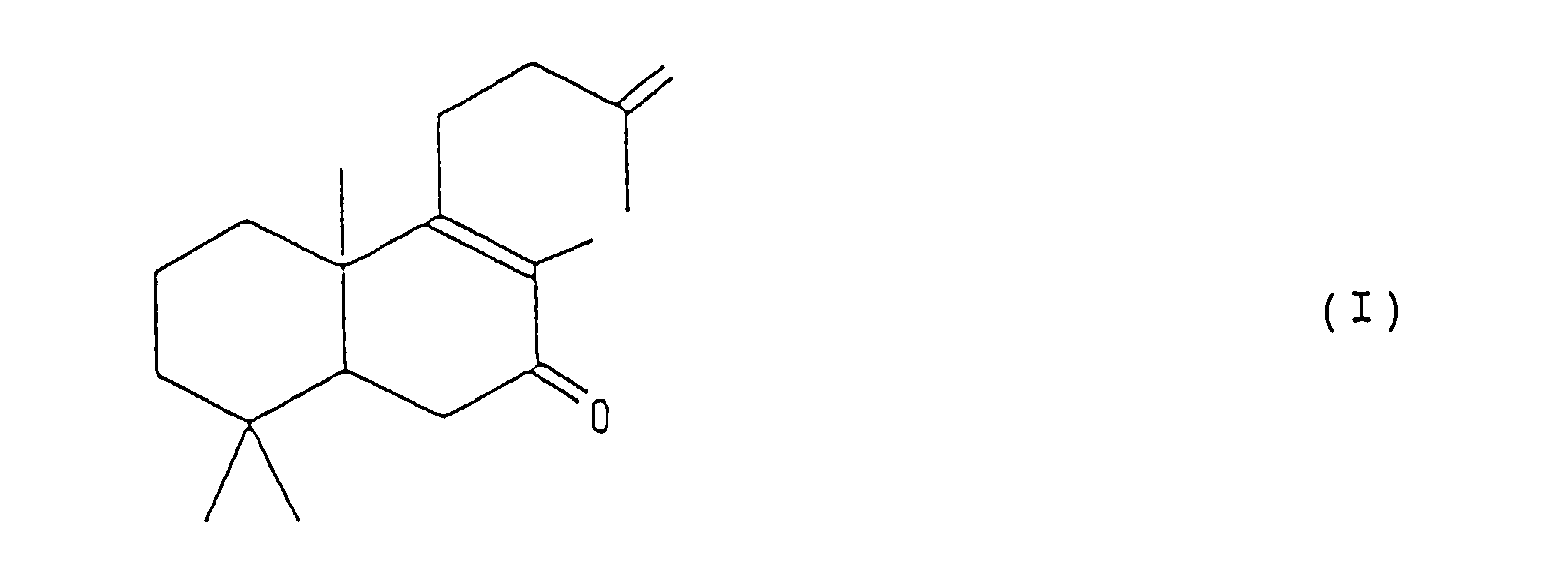
- the present invention furthermore provides 4-(3-methyl -3-butenyl )-4 ⁇ ,5,5,7,8,8 ⁇ -hexahydro-3,4 ⁇ ,8,8-tetramethyl-2(1H)-naphthalenone represented by formula (I): and a perfume composition containing the same.
- step (C) may preferably be followed by step (D) in which the heat-treated acidic components obtained in step (C) are subjected to further purified by distillation, since step (D) causes further reduction in the color and viscosity, and concentration of perfume components of the resulting product.
- the labdanum raw material which can be used in the present invention is not particularly limited but preferably includes (1) labdanum gum, which is a resin separated on boiling of a labdanum-containing plant in water, (2) labdanum gum extract obtained by removing inorganic solids from the labdanum gum, and (3) labdanum gum distillate obtained by distillation or fractional distillation of the labdanum gum extract. These raw materials may be used either individually or in combination of two or more thereof.
- the labdanum gum is a resin separated from Cistus ladaniferus L. in boiling water, usually in an aqueous alkali solution.
- Commercially available labdanum gum products may be used as such.
- the labdanum gum extract is obtained by dissolving labdanum gum in an organic solvent, such as ethanol, and removing the insoluble inorganic solid content.
- Commercially available labdanum gum extracts may be used as such.
- the labdanum gum distillate is obtained by subjecting the labdanum gum extract to distillation or fractional distillation under conditions of, for example, a column inner temperature of 140 to 240°C and under a pressure of 2 Torr. All of these labdanum raw materials have an unpleasant cedarwood-like woody odor.
- Step (a) is a step for extracting acidic components present in a labdanum raw material with an alkali.
- the extraction is carried out through ordinary neutralization with an alkali.
- an aqueous alkali solution is added to the labdanum raw material, followed by mixing with stirring.
- the alkali which can be used in step (a) is not particularly limited as long as it is capable of neutralizing the acidic components of labdanum, such as carboxylic acids and phenols, to form water-soluble neutral salts. From the economical standpoint, alkali metal hydroxides, alkaline earth metal hydroxides, alkali metal carbonates, and alkali metal hydrogencarbonates are preferred, with alkali metal hydroxides, such as sodium hydroxide and potassium hydroxide being more preferred.
- the alkali is used in an amount of from 0.5 to 10 times equivalents, and preferably from 1.0 to 5.0 times equivalents, based on the acid equivalent of the labdanum raw material.
- the acid equivalent of the labdanum raw material can be determined based on the acid value of the labdanum raw material.
- the mixing with stirring is preferably carried out in the presence of an organic solvent at a temperature of from 0 to 150°C, and preferably from 50 to 100°C, for a period of from 0.1 to 5 hours, and preferably from 0.5 to 2 hours.
- the organic solvent to be used is not particularly limited as long as it is stable under an alkaline condition. Examples of suitable organic solvents include hexane, heptane, cyclohexane, benzene, toluene, xylene, and mixtures thereof.
- the resulting reaction mixture is subjected to phase separation in a conventional manner, whereby the organic phase is removed to separate the aqueous phase.
- Step (B) is a step for subjecting the salts of the acidic components of the labdanum raw material to metathesis with an acid and recovering the thus released acidic components.
- the operation is carried out by adding an acid to the aqueous alkali solution of the salts, followed by stirring to make the solution acidic, and isolating the thus released acidic components of labdanum.
- the acid which can be used in step (b) is not particularly limited as long as it is capable of metathesizing the alkali and the like salt of a carboxylic acid, a phenol, etc., which are the acidic components of labdanum, to release the corresponding acid. From the economical viewpoint, sulfuric acid, hydrochloric acid or phosphoric acid is preferred.
- the acid is used in an amount of from 1.0 to 5 times, preferably from 1.2 to 3 times, the equivalents of the alkali used.
- While conditions for the above mixing and stirring are not restricted, it is preferable, taking heat generation of neutralization into consideration, that the acid is dropwise added to the salt in the presence of an organic solvent at a temperature of from 0 to 50°C, and particularly from 20 to 40°C, over a period of from 0.1 to 5 hours, and particularly from 0.3 to 1 hour, and the mixture is then stirred at a temperature of from 0 to 100°C, and particularly from 50 to 80°C, for a period of from 0.1 to 5 hours, and particularly from 0.5 to 2 hours.
- the organic solvent to be used is not particularly limited as long as it is stable under an acidic condition. Examples of suitable organic solvents are hexane, heptane, cyclohexane, benzene, toluene, xylene, and mixtures thereof.
- the excess acid can be removed by separating the reaction mixture into an aqueous layer and an organic layer in a usual manner. If desired, the organic layer is washed with water and subjected to distillation in a conventional manner.
- Step (C) is a step for heat-treating the acidic components of labdanum recovered in step (B).
- the heat treatment is carried out at a temperature of from 200 to 350°C, and preferably from 250 to 300°C, for a period of from 0.1 to 10 hours, and preferably from 0.5 to 2 hours while stirring under atmospheric pressure, preferably in a nitrogen atmosphere to avoid generation of an offensive odor or coloring due to oxidation.
- the resulting acidic components of labdanum is free from the rough, cedarwood-like unpleasant odor and has an enhanced animal note.
- step (C) For the purpose of further discoloration, viscosity reduction, and concentration of perfume components, the acidic components obtained in step (C) is preferably subjected to distillation as step (D).
- step (D) is a distillation purification step for discoloration, viscosity reduction and concentration of the heat-treated acidic components of labdanum obtained in step (C).
- Suitable hydrocarbons include saturated hydrocarbons having a boiling point of from 260 to 400°C, and preferably from 300 to 350°C, at 760 mmHg or mixtures thereof, with liquid paraffin being preferred. Distillation is preferably carried out under a reduced pressure of 1 to 3 mmHg while adjusting the highest column temperature at 220 to 250°C.
- the perfume composition according to the present invention comprises the thus obtained treated labdanum oil in a proportion of from 0.1 to 40 % by weight, and preferably from 0.5 to 15 % by weight.
- Compound (I) is present in the essential oil of Cistus Ladaniferus L. (labdanum) and can be isolated, for example, from labdanum gum as follows.
- the labdanum gum which can be used as a starting material is generally obtained by heating Cistus ladaniferus L. in a boiling aqueous alkali solution and collecting the thus released resinous component.
- Commercially available labdanum gum products may be used as such.
- An organic solvent such as ethyl ether, petroleum ether, methanol, ethanol, hexane or toluene
- ethyl ether such as ethyl ether, petroleum ether, methanol, ethanol, hexane or toluene
- the resulting extract is distilled to remove the organic solvent to obtain labdanum gum extract.
- the acidic components of the labdanum gum extract are then extracted with an aqueous solution of an alkali, such as sodium hydroxide or potassium hydroxide.
- the alkaline extract is neutralized with hydrochloric acid or sulfuric acid and then re-extracted with an organic solvent, such as petroleum ether, hexane or toluene.
- This treated labdanum oil may be the aforesaid treated labdanum oil according to the present invention.
- the treated labdanum oil is passed through a column of silica gel, for example, and developed first with an organic solvent, such as hexane, to elute hydrocarbon components and then with a mixed solvent of hexane and ethyl ether with an increasing concentration of ethyl ether.
- the effluent is collected into fractions of an adequate amount, and fractions containing compound (I) are combined.
- the solvent is removed from the combined fraction by distillation, and the residue is purified by high performance liquid chromatography using, for example, a hexane-ethyl acetate mixed solvent as a developing solution to obtain compound (I).
- the thus obtained compound (I) has an animal, phenolic, and amber-like fragrance with a faint tobacco note and is useful as a material for various perfume compositions.
- the amount of compound (I) in a perfume composition is not limited, for it varies depending on the kind of the composition and the desired fragrance, and the like. It is preferably used in an amount of from 0.1 to 10 % by weight, and particularly from 1 to 5 % by weight.
- compounding of compound (I) and phenylethyl alcohol at a ratio of 1:60 to 1:20 or compounding of compound (I) and citronellol at a ratio of 1:5 to 1:20 or compounding of compound (I) and linalool at a ratio of 1:60 to 1:20 provides a perfume composition with enhanced freshness.
- the perfume composition of the present invention essentially comprises the treated labdanum oil or compound (I) according to the present invention. If desired, it may contain base components and other perfume components commonly employed in general perfume composition, such as diethyl phthalate, dipropylene glycol, ethylene diglycol, and Hercolyn D (methyl dihydroabietate). It may also contain natural perfumes, such as sandalwood oil and patchouli oil, in amounts that will not impair the effect of the present invention.
- the perfume composition of the present invention is prepared by mixing the treated labdanum oil or compound (I) and other optional components with stirring in a conventional manner.
- the perfume composition of the present invention is applicable to a broad range of products to be scented with perfume, such as perfumes, eu de Cologne, soaps, shampoos, rinses, body shampoos, detergents, sprays, bathing preparations, deodorants, and the like.
- a perfume composition was prepared from the components shown in Table 1 below in a conventional manner.
- Component Example 2 (part by weight) Comparative Example 1 (part by weight) Bergamot oil base 300 300 Petitgrain oil from Paraguay 200 200 Benzyl acetate 100 100 Jasmin oil base 30 30 Rose oil Bulgaria base 20 20 Citronellol 100 100 Musk ketone 50 50 Styrax oil 80 80 Styrax Resinoid 20 20 Birch Tar Oil 50 50 Treated labdanum oil of Example 1 50 - Labdanum resinoid - 50 Total 1000 1000
- Example 2 had a leather note with an enhanced animal note as compared with the comparative composition.
- the inner temperature was cooled to 100°C, and 50 g of liquid paraffin #60S (produced by Chuo Kasei Co., Ltd.; boiling point: 278-422°C) was added thereto dropwise. After the first fraction of distillate (up to 150°C/2 Torr) was removed, the temperature was elevated to obtain 59 g of a fraction (185 to 240°C/2 Torr).
- liquid paraffin #60S produced by Chuo Kasei Co., Ltd.; boiling point: 278-422°C
- Fraction 1 was fractionated by high performance liquid chromatography (HPLC) (hexane/ethyl ether:90/10) to obtain a fraction (160 mg) in which compound (I) was concentrated to a purity of 58 %. The fraction was further subjected to HPLC (hexane/ethyl ether:95/5) to obtain 80 mg of compound (I).
- HPLC high performance liquid chromatography
- a muguet-like perfume composition was prepared from the components shown in Table 2 below in a conventional manner.
- Component Example 4 (part by weight) Comparative Example 2 (part by weight) Phenylethyl alcohol 203 203 Amylcinnamic aldehyde 200 200 2-Methyl-3-(p-isopropylphenyl)propionaldehyde (cyclamen aldehyde) 20 20 Geraniol 100 100 Citronellol 50 50 Linalool 180 180 Benzyl acetate 100 100 Ethyl acetoacetate 2 2 Methyl salicylate 10 10 Methyl cinnamate 10 10 6-Acetyl-1,1,3,4,4,6-hexamethyltetrahydronaphthalenone (Tenterome) 20 20 2-Methyl-3-(p-t-butylphenyl)propionaldehyde 100 100 Compound (I) 5 - Diethyl phthalate - 5
- the perfume composition of Example 4 had a muguet note with an enhanced freshness, an enhanced sweetness, and an enhanced softness as compared with the comparative composition.
- the treated labdanum oil of the present invention is free from a cedarwood-like rough odor and has an animal and amber fragrance with an enhanced animal note. Additionally, it has a greatly reduced color, and thus, is widely applicable as a material of perfume compositions for soaps, detergents, etc.
- Compound (I) of the present invention has an animal, ambler-like fragrance and is useful as a material of various perfume compositions.
- the perfume composition containing compound (I) is suited to perfumes, soaps, and the like.
Landscapes
- Chemical & Material Sciences (AREA)
- Life Sciences & Earth Sciences (AREA)
- Engineering & Computer Science (AREA)
- Chemical Kinetics & Catalysis (AREA)
- Oil, Petroleum & Natural Gas (AREA)
- Wood Science & Technology (AREA)
- Organic Chemistry (AREA)
- Fats And Perfumes (AREA)
- Organic Low-Molecular-Weight Compounds And Preparation Thereof (AREA)
- Cosmetics (AREA)
Claims (13)
- Verfahren zur Herstellung eines behandelten Labdanumöls, umfassend:(A) Mischen eines Labdanum-Ausgangsmaterials mit einer wäßrigen Alkali-Lösung und Trennen der wäßrigen Schicht;(B) Zugabe einer sauren Substanz zu der wäßrigen Schicht, die in Schritt (A) getrennt ist, und Trennen der somit freigesetzten, sauren Komponenten von Labdanum; und(C) Erwärmen der sauren Komponenten, die in Schritt (B) erhalten sind, bei einer Temperatur von 200 bis 350°C für eine Periode von 0,1 bis 10 h.
- Verfahren nach Anspruch 1, worin das Verfahren weiterhin umfaßt: (D) Reinigen der sauren Komponenten, die in Schritt (C) erhalten sind, durch Destillation.
- Verfahren nach Anspruch 1 oder 2, worin das Labdanum-Ausgangsmaterial zumindest eines ist, ausgewählt aus der Gruppe, bestehend aus (1) Labdanumgummi, das ein Harz ist, das beim Sieden einer Labdanum-haltigen Pflanze in Wasser getrennt ist, (2) Labdanumgummi-Extrakt, der durch Entfernen von anorganischen Feststoffen von dem Labdanumgummi erhalten ist, und (3) Labdanumgummi-Destillat, erhalten durch Destillation oder fraktionierte Destillation des Labdanumgummi-Extraktes.
- Verfahren nach einem der Ansprüche 1 bis 3, worin das im Schritt (A) verwendete Alkali zumindest eines ist, ausgewählt aus der Gruppe, bestehend aus einem Alkalimetallhydroxid, Erdalkalimetallhydroxid, Alkalimetallcarbonat und Alkalimetallhydrogencarbonat.
- Verfahren nach einem der Ansprüche 1 bis 4, worin die saure Substanz, die im Schritt (B) verwendet wird, zumindest eine ist, ausgewählt aus der Gruppe, bestehend aus Schwefelsäure, Salzsäure und Phosphorsäure.
- Verfahren nach einem der Ansprüche 1 bis 5, worin das Erwärmen im Schritt (C) in einer Stickstoffatmosphäre durchgeführt wird.
- Verfahren nach Anspruch 2, worin die Destillation im Schritt (D) durch Zugabe einer Kohlenwasserstoff-Verbindung mit einem Siedepunkt von 260 bis 400°C bei atmosphärischem Druck zu den sauren Komponenten und durch Sammeln einer Fraktion bis zu einem Siedepunkt von 250°C unter einem Druck von 1 mmHg durchgeführt wird.
- Verfahren nach Anspruch 7, worin die Kohlenwasserstoff-Verbindung flüssiges Paraffin ist.
- Behandeltes Labdanumöl, erhältlich durch ein Verfahren wie in einem der Ansprüche 1 bis 8 definiert.
- Parfümzusammensetzung, umfassend das behandelte Labdanumöl nach Anspruch 9.
- 4-(3-Methyl-3-butenyl)-4α,5,6,7,8,8α-hexahydro-3,4α,8,8-tetramethyl-2(1H)-naphthalinon, dargestellt durch die Formel (I):

- Parfümzusammensetzung, umfassend 4-(3-Methyl-3-butenyl)-4α,5,6,7,8,8α-hexahydro-3,4α,8,8-tetramethyl-2(1H)-naphthalinon, dargestellt durch die Formel (I):
- Parfümzusammensetzung nach Anspruch 12, die weiterhin zumindest eine Parfüm-Verbindung enthält, ausgewählt aus Phenylethylalkohol, Citronellol und Linalool.
Applications Claiming Priority (4)
| Application Number | Priority Date | Filing Date | Title |
|---|---|---|---|
| JP163491/93 | 1993-07-01 | ||
| JP16349193A JP2943038B2 (ja) | 1993-07-01 | 1993-07-01 | ラブダナム油の改質方法 |
| JP164806/93 | 1993-07-02 | ||
| JP16480693A JP2754135B2 (ja) | 1993-07-02 | 1993-07-02 | 新規ケトン及びこれを含有する香料組成物 |
Publications (3)
| Publication Number | Publication Date |
|---|---|
| EP0634474A2 EP0634474A2 (de) | 1995-01-18 |
| EP0634474A3 EP0634474A3 (de) | 1995-09-20 |
| EP0634474B1 true EP0634474B1 (de) | 1998-12-23 |
Family
ID=26488912
Family Applications (1)
| Application Number | Title | Priority Date | Filing Date |
|---|---|---|---|
| EP19940110263 Expired - Lifetime EP0634474B1 (de) | 1993-07-01 | 1994-07-01 | Behandeltes Labdanumöl, Verfahren zur Herstellung derselben, neue Ketonverbindung und dieses enthaltende Parfümzusammensetzung |
Country Status (3)
| Country | Link |
|---|---|
| EP (1) | EP0634474B1 (de) |
| DE (1) | DE69415424T2 (de) |
| ES (1) | ES2126678T3 (de) |
-
1994
- 1994-07-01 EP EP19940110263 patent/EP0634474B1/de not_active Expired - Lifetime
- 1994-07-01 ES ES94110263T patent/ES2126678T3/es not_active Expired - Lifetime
- 1994-07-01 DE DE1994615424 patent/DE69415424T2/de not_active Expired - Fee Related
Also Published As
| Publication number | Publication date |
|---|---|
| EP0634474A2 (de) | 1995-01-18 |
| ES2126678T3 (es) | 1999-04-01 |
| EP0634474A3 (de) | 1995-09-20 |
| DE69415424T2 (de) | 1999-06-02 |
| DE69415424D1 (de) | 1999-02-04 |
Similar Documents
| Publication | Publication Date | Title |
|---|---|---|
| DE602004005890T2 (de) | Moschus-geruchsstoffe | |
| JPS6160812B2 (de) | ||
| CH634032A5 (de) | Acyl-polyalkylindane. | |
| US4754090A (en) | Process for the preparation of hexamethyl tetracosanes | |
| US8349790B2 (en) | Substituted octane(ene) nitriles, methods for the synthesis thereof and uses thereof in perfumery | |
| FR2539624A1 (fr) | Derives de cyclohexanol et compositions de parfums les contenant | |
| EP0634474B1 (de) | Behandeltes Labdanumöl, Verfahren zur Herstellung derselben, neue Ketonverbindung und dieses enthaltende Parfümzusammensetzung | |
| GB2529901A (en) | Organic compounds | |
| JP2523903B2 (ja) | 新規な発香化合物 | |
| EP0462121A1 (de) | Polyalkylierte benzodioxin-muskus-zusammensetzungen. | |
| EP2060567B1 (de) | Regiospezifische Furanverbindungen und ihre Anwendung als Duftstoffe | |
| KR20070085865A (ko) | 유기 화합물 | |
| US2842598A (en) | Myrcene-methacrolein adduct and process therefor | |
| EP0618285B1 (de) | Behandeltes Labdanumöl, Verfahren zur Herstellung desselben und dieses enthaltende Parfumzusammensetzung | |
| US4031161A (en) | Process for producing mixture containing 4-(4'-methyl-4'-hydroxyamyl)-Δ3 -cyclohexene carboxaldehyde | |
| DE2461605C3 (de) | S-Acetyl-U.e-trimethyltricyclo [53 AO2·7!-dodeca-5-en, Verfahren zu seiner Herstellung und seine Verwendung als Riechstoff | |
| US3557188A (en) | 4,7-methanoindene derivatives | |
| JP2943038B2 (ja) | ラブダナム油の改質方法 | |
| US4322559A (en) | 4(5)-Acetyl-9,9-dimethyltricyclo-[4,4,0,18,10 ]-undec-1-ene, its preparation and use in perfumery compositions and as an odorant | |
| KR100734801B1 (ko) | β-페닐에틸 알콜의 정제 방법 | |
| WO1981000204A1 (en) | Novel norbornyl-substituted pyrans,method for their synthesis and use thereof in perfumery | |
| JP2754135B2 (ja) | 新規ケトン及びこれを含有する香料組成物 | |
| EP0035562A1 (de) | Substituierte cyclische alkohole, verfahren zur herstellung und sie enthaltende zusammensetzungen | |
| US4212812A (en) | 2,2-Dialkyltetrahydropyrans | |
| DE2707340A1 (de) | Verfahren zur herstellung neuer gemische und aus diolen bestehender zwischenprodukte |
Legal Events
| Date | Code | Title | Description |
|---|---|---|---|
| PUAI | Public reference made under article 153(3) epc to a published international application that has entered the european phase |
Free format text: ORIGINAL CODE: 0009012 |
|
| AK | Designated contracting states |
Kind code of ref document: A2 Designated state(s): CH DE ES FR GB LI |
|
| PUAL | Search report despatched |
Free format text: ORIGINAL CODE: 0009013 |
|
| AK | Designated contracting states |
Kind code of ref document: A3 Designated state(s): CH DE ES FR GB LI |
|
| 17P | Request for examination filed |
Effective date: 19960123 |
|
| GRAG | Despatch of communication of intention to grant |
Free format text: ORIGINAL CODE: EPIDOS AGRA |
|
| 17Q | First examination report despatched |
Effective date: 19980414 |
|
| GRAG | Despatch of communication of intention to grant |
Free format text: ORIGINAL CODE: EPIDOS AGRA |
|
| GRAH | Despatch of communication of intention to grant a patent |
Free format text: ORIGINAL CODE: EPIDOS IGRA |
|
| GRAH | Despatch of communication of intention to grant a patent |
Free format text: ORIGINAL CODE: EPIDOS IGRA |
|
| GRAA | (expected) grant |
Free format text: ORIGINAL CODE: 0009210 |
|
| AK | Designated contracting states |
Kind code of ref document: B1 Designated state(s): CH DE ES FR GB LI |
|
| REG | Reference to a national code |
Ref country code: CH Ref legal event code: EP |
|
| REF | Corresponds to: |
Ref document number: 69415424 Country of ref document: DE Date of ref document: 19990204 |
|
| REG | Reference to a national code |
Ref country code: CH Ref legal event code: NV Representative=s name: BOVARD AG PATENTANWAELTE |
|
| REG | Reference to a national code |
Ref country code: ES Ref legal event code: FG2A Ref document number: 2126678 Country of ref document: ES Kind code of ref document: T3 |
|
| ET | Fr: translation filed | ||
| PGFP | Annual fee paid to national office [announced via postgrant information from national office to epo] |
Ref country code: CH Payment date: 19990628 Year of fee payment: 6 |
|
| PGFP | Annual fee paid to national office [announced via postgrant information from national office to epo] |
Ref country code: GB Payment date: 19990630 Year of fee payment: 6 |
|
| PGFP | Annual fee paid to national office [announced via postgrant information from national office to epo] |
Ref country code: DE Payment date: 19990706 Year of fee payment: 6 |
|
| PGFP | Annual fee paid to national office [announced via postgrant information from national office to epo] |
Ref country code: FR Payment date: 19990709 Year of fee payment: 6 |
|
| PLBE | No opposition filed within time limit |
Free format text: ORIGINAL CODE: 0009261 |
|
| STAA | Information on the status of an ep patent application or granted ep patent |
Free format text: STATUS: NO OPPOSITION FILED WITHIN TIME LIMIT |
|
| 26N | No opposition filed | ||
| PG25 | Lapsed in a contracting state [announced via postgrant information from national office to epo] |
Ref country code: GB Free format text: LAPSE BECAUSE OF NON-PAYMENT OF DUE FEES Effective date: 20000701 |
|
| PG25 | Lapsed in a contracting state [announced via postgrant information from national office to epo] |
Ref country code: ES Free format text: LAPSE BECAUSE OF NON-PAYMENT OF DUE FEES Effective date: 20000702 |
|
| PG25 | Lapsed in a contracting state [announced via postgrant information from national office to epo] |
Ref country code: LI Free format text: LAPSE BECAUSE OF NON-PAYMENT OF DUE FEES Effective date: 20000731 Ref country code: CH Free format text: LAPSE BECAUSE OF NON-PAYMENT OF DUE FEES Effective date: 20000731 |
|
| GBPC | Gb: european patent ceased through non-payment of renewal fee |
Effective date: 20000701 |
|
| REG | Reference to a national code |
Ref country code: CH Ref legal event code: PL |
|
| PG25 | Lapsed in a contracting state [announced via postgrant information from national office to epo] |
Ref country code: FR Free format text: LAPSE BECAUSE OF NON-PAYMENT OF DUE FEES Effective date: 20010330 |
|
| REG | Reference to a national code |
Ref country code: FR Ref legal event code: ST |
|
| PG25 | Lapsed in a contracting state [announced via postgrant information from national office to epo] |
Ref country code: DE Free format text: LAPSE BECAUSE OF NON-PAYMENT OF DUE FEES Effective date: 20010501 |
|
| REG | Reference to a national code |
Ref country code: ES Ref legal event code: FD2A Effective date: 20010810 |