EP0634476B1 - Emulsions stables aqueuses de surfactants non-ioniques avec un agent controlant la viscosité - Google Patents
Emulsions stables aqueuses de surfactants non-ioniques avec un agent controlant la viscosité Download PDFInfo
- Publication number
- EP0634476B1 EP0634476B1 EP93870135A EP93870135A EP0634476B1 EP 0634476 B1 EP0634476 B1 EP 0634476B1 EP 93870135 A EP93870135 A EP 93870135A EP 93870135 A EP93870135 A EP 93870135A EP 0634476 B1 EP0634476 B1 EP 0634476B1
- Authority
- EP
- European Patent Office
- Prior art keywords
- hydrophobic
- hydrophilic
- nonionic surfactant
- hlb
- composition
- Prior art date
- Legal status (The legal status is an assumption and is not a legal conclusion. Google has not performed a legal analysis and makes no representation as to the accuracy of the status listed.)
- Expired - Lifetime
Links
Classifications
-
- C—CHEMISTRY; METALLURGY
- C07—ORGANIC CHEMISTRY
- C07D—HETEROCYCLIC COMPOUNDS
- C07D213/00—Heterocyclic compounds containing six-membered rings, not condensed with other rings, with one nitrogen atom as the only ring hetero atom and three or more double bonds between ring members or between ring members and non-ring members
- C07D213/02—Heterocyclic compounds containing six-membered rings, not condensed with other rings, with one nitrogen atom as the only ring hetero atom and three or more double bonds between ring members or between ring members and non-ring members having three double bonds between ring members or between ring members and non-ring members
- C07D213/04—Heterocyclic compounds containing six-membered rings, not condensed with other rings, with one nitrogen atom as the only ring hetero atom and three or more double bonds between ring members or between ring members and non-ring members having three double bonds between ring members or between ring members and non-ring members having no bond between the ring nitrogen atom and a non-ring member or having only hydrogen or carbon atoms directly attached to the ring nitrogen atom
- C07D213/60—Heterocyclic compounds containing six-membered rings, not condensed with other rings, with one nitrogen atom as the only ring hetero atom and three or more double bonds between ring members or between ring members and non-ring members having three double bonds between ring members or between ring members and non-ring members having no bond between the ring nitrogen atom and a non-ring member or having only hydrogen or carbon atoms directly attached to the ring nitrogen atom with hetero atoms or with carbon atoms having three bonds to hetero atoms with at the most one bond to halogen, e.g. ester or nitrile radicals, directly attached to ring carbon atoms
- C07D213/78—Carbon atoms having three bonds to hetero atoms, with at the most one bond to halogen, e.g. ester or nitrile radicals
- C07D213/79—Acids; Esters
-
- C—CHEMISTRY; METALLURGY
- C11—ANIMAL OR VEGETABLE OILS, FATS, FATTY SUBSTANCES OR WAXES; FATTY ACIDS THEREFROM; DETERGENTS; CANDLES
- C11D—DETERGENT COMPOSITIONS; USE OF SINGLE SUBSTANCES AS DETERGENTS; SOAP OR SOAP-MAKING; RESIN SOAPS; RECOVERY OF GLYCEROL
- C11D1/00—Detergent compositions based essentially on surface-active compounds; Use of these compounds as a detergent
- C11D1/66—Non-ionic compounds
- C11D1/825—Mixtures of compounds all of which are non-ionic
-
- C—CHEMISTRY; METALLURGY
- C11—ANIMAL OR VEGETABLE OILS, FATS, FATTY SUBSTANCES OR WAXES; FATTY ACIDS THEREFROM; DETERGENTS; CANDLES
- C11D—DETERGENT COMPOSITIONS; USE OF SINGLE SUBSTANCES AS DETERGENTS; SOAP OR SOAP-MAKING; RESIN SOAPS; RECOVERY OF GLYCEROL
- C11D11/00—Special methods for preparing compositions containing mixtures of detergents
- C11D11/0094—Process for making liquid detergent compositions, e.g. slurries, pastes or gels
-
- C—CHEMISTRY; METALLURGY
- C11—ANIMAL OR VEGETABLE OILS, FATS, FATTY SUBSTANCES OR WAXES; FATTY ACIDS THEREFROM; DETERGENTS; CANDLES
- C11D—DETERGENT COMPOSITIONS; USE OF SINGLE SUBSTANCES AS DETERGENTS; SOAP OR SOAP-MAKING; RESIN SOAPS; RECOVERY OF GLYCEROL
- C11D3/00—Other compounding ingredients of detergent compositions covered in group C11D1/00
- C11D3/16—Organic compounds
- C11D3/26—Organic compounds containing nitrogen
- C11D3/28—Heterocyclic compounds containing nitrogen in the ring
-
- C—CHEMISTRY; METALLURGY
- C11—ANIMAL OR VEGETABLE OILS, FATS, FATTY SUBSTANCES OR WAXES; FATTY ACIDS THEREFROM; DETERGENTS; CANDLES
- C11D—DETERGENT COMPOSITIONS; USE OF SINGLE SUBSTANCES AS DETERGENTS; SOAP OR SOAP-MAKING; RESIN SOAPS; RECOVERY OF GLYCEROL
- C11D3/00—Other compounding ingredients of detergent compositions covered in group C11D1/00
- C11D3/16—Organic compounds
- C11D3/26—Organic compounds containing nitrogen
- C11D3/33—Amino carboxylic acids
-
- C—CHEMISTRY; METALLURGY
- C11—ANIMAL OR VEGETABLE OILS, FATS, FATTY SUBSTANCES OR WAXES; FATTY ACIDS THEREFROM; DETERGENTS; CANDLES
- C11D—DETERGENT COMPOSITIONS; USE OF SINGLE SUBSTANCES AS DETERGENTS; SOAP OR SOAP-MAKING; RESIN SOAPS; RECOVERY OF GLYCEROL
- C11D3/00—Other compounding ingredients of detergent compositions covered in group C11D1/00
- C11D3/39—Organic or inorganic per-compounds
- C11D3/3902—Organic or inorganic per-compounds combined with specific additives
- C11D3/3905—Bleach activators or bleach catalysts
- C11D3/3907—Organic compounds
- C11D3/391—Oxygen-containing compounds
-
- C—CHEMISTRY; METALLURGY
- C11—ANIMAL OR VEGETABLE OILS, FATS, FATTY SUBSTANCES OR WAXES; FATTY ACIDS THEREFROM; DETERGENTS; CANDLES
- C11D—DETERGENT COMPOSITIONS; USE OF SINGLE SUBSTANCES AS DETERGENTS; SOAP OR SOAP-MAKING; RESIN SOAPS; RECOVERY OF GLYCEROL
- C11D3/00—Other compounding ingredients of detergent compositions covered in group C11D1/00
- C11D3/39—Organic or inorganic per-compounds
- C11D3/3947—Liquid compositions
Definitions
- the present invention relates to cleaning compositions. More particularly, the cleaning compositions according to the present invention are stable aqueous emulsions of nonionic surfactants which comprise a viscosity control agent.
- cleaning compositions have been described in the art.
- EP-A-0 598 170 a particular type of cleaning compositions is described which are aqueous emulsions of a nonionic surfactant system.
- Such emulsions find a preferred application in the formulation of bleaching compositions comprising hydrogen peroxide or water soluble sources thereof and a liquid hydrophobic bleach activator, or any other hydrophobic ingredient which needs to be separated from hydrogen peroxide.
- such emulsions can be used to formulate products which do not contain hydrogen peroxide.
- such emulsions can be useful because they allow to keep a given hydrophobic ingredient separate from the aqueous phase, with which said hydrophobic ingredient could react, e.g., by hydrolysis.
- viscosity is an essential aspect of cleaning compositions in relation to ease of pouring and dispensing, and spreadability. This latter aspect is particularly important when cleaning compositions are used to clean hard surfaces, especially on inclined or vertical surfaces such as toilet bowls, or in the context of laundry. In those instances, the cleaning compositions must be thick enough for a controlled application onto fabrics, and for a good cling onto surfaces.
- thickening agent or hydrotrope compounds are available for this purpose.
- thickening agent or hydrotrope compounds it is meant herein compounds whose sole function is to regulate the viscosity of the compositions.
- Such compounds are however rather undesirable for a variety of reasons. Indeed, they can significantly increase formula cost without participating to the overall cleaning performance, they may involve processing and safety issues, they may affect product stability, particularly in extreme acidic conditions, and they may affect the cleaning performance of the compositions.
- dipicolinic acid or derivatives thereof in an aqueous emulsion of nonionic surfactant.
- dipicolinic acid or, where appropriate, derivatives thereof will increase or decrease significantly the formulation's viscosity.
- Another advantage of the present invention is that it is only required to use a very small amount of dipicolinic acid or derivatives thereof in order to obtain the desired effect, which makes the present invention particularly cost-efficient.
- Another advantage of the present invention is that it allows for the formulation of compositions whith target viscosity which are pseudoplastic, i.e. which are less viscous at higher shear stresses.
- Pseudoplastic compositions achieve the multiple and somewhat contradictory objects of being easy to dispense, i.e. rather less viscous, and providing good cling onto surfaces, i.e. rather more viscous.
- dipicolinic acid or derivatives thereof have been found to provide additional stability to the compositions herein which may comprise hydrogen peroxide as an optional but preferred compound.
- Yet another advantage of the present invention is that it allows to achieve a given viscosity target with a lower surfactant level, compared to a composition without dipicolinic acid or derivatives thereof.
- Dipicolinic acid and derivatives and/or pyrazine derivatives appear to have been disclosed in US 3,956,159, EP 490 417, US 3,915,974, GB 1,505,654, US 4,311,843, JP-A-55067747, Chemical Abstract 77,1215.
- EP-B-0 358 412 and EP-A-0 266 904 disclose detegent compositions comprising dipicolinic acid or derivatives thereof.
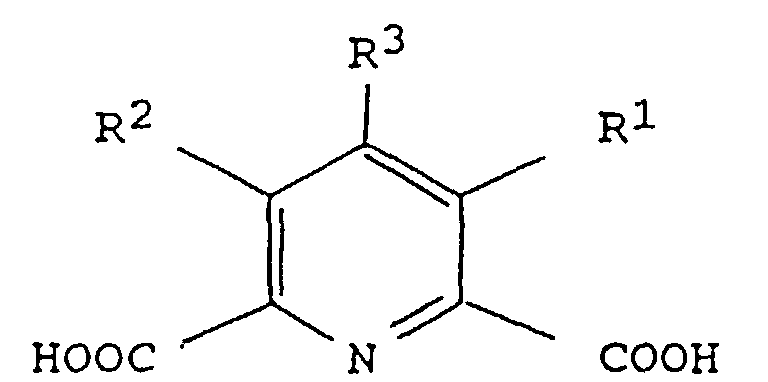
- the present invention is a stable aqueous emulsion comprising a nonionic surfactant, having an HLB above 11, a nonionic surfactant, having an HLB below 10, and from 0,01% to 10% of a compound of the formula: Wherein R 1 , R 2 and R 3 are independently H, or C 1-20 alkyl, alkenyl, or alkynyl; or salts thereof. Mixtures of said compounds are also suitable for use herein. Particularly preferred for use herein is dipicolinic acid, i.e where R 1 , R 2 and R 3 are all H.
- compositions according to the present invention are stable aqueous emulsions of nonionic surfactants.
- stable emulsion it is meant an emulsion which does not macroscopically separate into distinct layers, upon standing for at least two weeks at 20°C, more preferably at least six months.
- compositions according to the present invention are aqueous. Accordingly, the compositions according to the present invention may comprise from 10% to 95% by weight of the total composition of water, preferably from 30% to 90%, most preferably from 60% to 85%. Deionized water is preferably used.
- compositions according to the present invention are emulsions of nonionic surfactants.
- Said emulsions of nonionic surfactants comprise at least two nonionic surfactants.
- said two nonionic surfactants In order to form emulsions which are stable, said two nonionic surfactants must have different HLB values (hydrophilic lipophilic balance), and preferably the difference in value of the HLBs of said two surfactants is more than 1, more preferably at least 3.
- HLB values hydrophilic lipophilic balance
- nonionic surfactant used herein is a nonionic surfactant with an HLB above 11 (herein referred to as hydrophilic nonionic surfactant), whereas the other one,is a nonionic surfactant with an HLB below 10 (herein referred to as hydrophobic nonionic surfactant).
- Suitable nonionic surfactants for use herein include alkoxylated fatty alcohols. Indeed, a great variety of such alkoxylated fatty alcohols are commercially available which have very different HLB values (hydrophilic lipophilic balance).
- HLB values of such alkoxylated nonionic surfactants depend essentially on the nature of the alkoxylation and the degree of alkoxylation. Hydrophilic nonionic surfactants tend to have a higher degree of alkoxylation, while hydrophobic surfactants tend to have a lower degree of alkoxylation and a long chain fatty alcohol.
- Surfactants catalogs are available which list a number of surfactants including nonionics, together with their respective HLB values.
- compositions according to the present invention may comprise from 2 % to 70 % by weight of the total composition of said hydrophilic and hydrophobic nonionic surfactants, preferably from 3 % to 40 %, most preferably from 4 % to 30 %.
- compositions according to the present invention may further comprise other nonionic surfactants which should however not significantly alter the weighted average HLB value of the overall composition.
- compositions according to the present invention further comprise as an essential element a viscosity-regulating amount of dipicolinic acid (2,6 pyridine-dicarboxylic acid) or derivatives thereof.
- viscosity-regulating it is meant herein any amount of dipicolinic acid or derivatives thereof in a given composition which will provide an increase or decrease in viscosity compared to the same composition without dipicolinic acid or derivatives thereof, while maintaining acceptable stability.
- dipicolinic acid or derivatives thereof refers to compounds of the formula: Wherein R 1 , R 2 and R 3 are independently H, or C 1-20 alkyl, alkenyl, or alkynyl; or salts thereof. Mixtures of said compounds are also suitable for use herein. Particularly preferred for use herein is dipicolinic acid, i.e where R 1 , R 2 and R 3 are all H.
- compositions herein are not limited to any specific viscosity, and depending on the exact use envisioned, various viscosities may be achieved.
- the addition of the dipicolinic acid or derivatives thereof to a given composition may produce a viscosity increase or decrease of from 5 cps to 2000 cps, preferably from 50 cps to 1000 cps, at a given shear rate, compared to the same composition without dipicolinic acid or derivatives thereof.
- the decrease or increase is greater when measured at low shear rates (e.g. 12 rpm).
- the present invention offers great flexibility in viscosity control. Indeed, it has been found that dipicolinic acid decreases viscosity when it is added to the hydrophilic phase of the emulsion, i.e. the phase comprising said hydrophilic nonionic surfactant. On the contrary, dipicolinic acid or derivatives thereof increase the viscosity when it is added in certain amounts to the hydrophobic phase, i.e the phase comprising said hydrophobic nonionic surfactant.
- dipicolinic acid When added to the hydrophilic phase, only dipicolinic acid should be used. When added to the hydrophobic phase, dipicolinic acid can be used as well as derivatives thereof. It is speculated that the derivatives of dipicolinic acid herein are of interest as they are more hydrophobic than dipicolinic acid. Thus they are more soluble than dipicolinic acid in the hydrophobic phase and can therefore participate to increasing viscosity.
- compositions according to the present invention may comprise from 0.01 % to 10 % by weight of the total composition of dipicolinic acid or derivatives thereof, preferably from 0.01 % to 1 %. Additional flexibility in viscosity control can be obtained through the amount of dipicolinic acid or derivatives thereof added. Indeed it has been found that when it is added in the hydrophobic phase, dipicolinic acid or derivatives thereof increase viscosity when they are added in certain amounts, but then decrease viscosity if more dipicolinic acid or derivatives thereof is added. It is speculated that, at his point, dipicolinic acid or derivatives thereof start to form crystals which are no longer soluble in the hydrophobic phase, thus the viscosity start decreasing again.
- viscosity profile as a function of the amount of dipicolinic acid or derivative thereof further depends on the pH of the composition.
- viscosity profile curves can be plotted as a function of the amount of dipicolinic acid or derivatives thereof, and depending on whether dipicolinic acid is added in the hydrophilic phase, or wheter dipicolinic acid or derivatives thereof are added in the hydrophobic phase.
- the pH of the formulation influences its stability.
- bleaching ingredients being optional but preferred ingredients of the compositions herein, it is of course necessary, for chemical stability purposes to formulate the compositions herein with bleaches at a pH as is of from 0 to 6, preferably of from 0.5 to 5.
- the pH of the composition can be trimmed by all means available to the man skilled in the art.
- compositions according to the present invention comprise bleaches, i.e. hydrogen peroxide or water-soluble sources thereof.
- Suitable water-soluble sources of hydrogen peroxide include perborate, percarbonate and persilicate salts.
- Hydrogen peroxide is most preferred to be used in the compositions according to the present invention.
- the compositions according to the present invention comprise from 0.5% to 20% by weight of the total composition of hydrogen peroxide, preferably from 2% to 15%, most preferably from 3% to 10%.
- compositions according to the present invention may further comprise a bleach activator as an optional ingredient.
- bleach activator it is meant herein any compound which reacts with hydrogen peroxide to form a peracid.
- Suitable bleach activators for use herein typically belong to the class of esters, amides, imides, or anhydrides.
- a particular family of bleach activators of interest in the present invention were disclosed in WO-A-9312067 claiming priority from the applicant's European patent application No 91870207.7. Particularly preferred in that family is acetyl triethyl citrate which was also disclosed in the context of bar soaps in FR 2 362 210.
- Acetyl triethyl citrate has the advantages that it is environmentally friendly as it eventually degrades into citric acid and alcohol.
- acetyl triethyl citrate has a good hydrolytical stability in the product upon storage and it is an efficient bleach activator.
- the term bleach activator includes mixtures of bleach activators.
- the nonionic surfactant system to be chosen to emulsify said bleach activator depends on the HLB value of said bleach activator. Accordingly, a suitable way to proceed is to determine the HLB value of the hydrophobic liquid ingredient (bleach activator) , then select both the hydrophobic nonionic surfactants which have HLB values below said HLB value of said hydrophobic liquid ingredient and the hydrophilic nonionic surfactants which have HLB values above said HLB value of said hydrophobic liquid ingredient, wherein the difference in the HLB values of said hydrophobic and hydrophilic nonionic surfactants is preferably at least 3.
- an adequate nonionic surfactant system would comprise a hydrophobic nonionic surfactant with an HLB from 1 to 10, and a hydrophilic nonionic surfactant with an HLB of above 11.
- a particularly suitable system comprises a hydrophobic nonionic surfactant with an HLB of 6, for instance a Dobanol @ 23-2 and a hydrophilic nonionic surfactant with an HLB of 15, for instance a Dobanol @ 91-10.
- Another suitable nonionic surfactant system comprises a Dobanol@ 23-6.5 (HLB about 12) and a Dobanol@ 23 (HLB below 6). All these Dobanol @ surfactants are commercially available from Shell.
- compositions according to the present invention may further comprise the usual optional ingredients such as perfumes, dyes, optical brighteners, builders and chelants, pigments, enzymes, dye transfer inhibitors, solvents, buffering agents and the like.
- compositions according to the present invention are particularly useful as laundry pretreaters, i.e compositions which are dispensed and left to act onto fabrics before they are washed, or as laundry additives to be used together with detergents to boost their performance, or as dishwashing compositions to be used either in the dishwashing machines or by hand, or as hard surface cleaners, or as toilet bowl cleaners, or as carpet cleaners to be used either by direct application onto the carpets or in carpet cleaning machines.
- the present invention further encompasses a process for the manufacture of the compositions described herein.
- the process according to the present invention comprises at least three steps:
- a hydrophobic mixture which comprises said hydrophobic nonionic surfactant, together with other, optional, hydrophobic ingredients which are to be formulated in the composition, such as perfumes, solvents, enzymes, bleach activators and polymers.
- a hydrophilic mixture which comprises at least said water, and said hydrophilic nonionic surfactant.
- Said hydrophilic mixture preferably further comprises other hydrophilic ingredients which are to be formulated in the composition such as dyes, optical brighteners, builders, chelants, hydrogen peroxide and buffering agents.
- dipicolinic acid is added respectively in said first step or second step.
- first and said second steps can be performed in any order, i.e second step first is also suitable.
- said hydrophobic mixture and said hydrophilic mixture are mixed together.
- compositions are made which comprise the listed ingredients in the listed proportions (weight %).
- Viscosity (with Brookfield @ DV rotational viscosimeter, spindle No. 2) at 12 rpm, 20°c after 1 day: 470 cps (reference without dipicolinic acid 105 cps).
- Viscosity (with Brookfield @ DV rotational viscosimeter, spindle No.2) at 12 rpm, 20°c after 1 day 100 cps. Reference without dipicolinic acid: 105 cps.
- Viscosity (with Brookfield @ DV+ rotational viscometer, spindle No. 5) at 50 rpm, 25°c after 1 week 440 cps (reference without dipicolinic acid 632 cps).
- Viscosity (with Brookfield @ DV rotational viscosimeter, spindle No. 2) at 12 rpm, 20°c after 1 day: 670 cps (reference without dipicolinic acid 1300 cps).
Landscapes
- Chemical & Material Sciences (AREA)
- Organic Chemistry (AREA)
- Life Sciences & Earth Sciences (AREA)
- Engineering & Computer Science (AREA)
- Chemical Kinetics & Catalysis (AREA)
- Oil, Petroleum & Natural Gas (AREA)
- Wood Science & Technology (AREA)
- Inorganic Chemistry (AREA)
- Detergent Compositions (AREA)
- Organic Low-Molecular-Weight Compounds And Preparation Thereof (AREA)
- Cosmetics (AREA)
- Pyridine Compounds (AREA)
Claims (12)
- Emulsion aqueuse stable comprenant un tensioactif non-ionique ayant un indice HLB supérieur à 11, un tensioactif non-ionique ayant un indice HLB inférieur à 10, et de 0,01 % à 10 % en poids, par rapport à la composition totale, d'un composé ayant la formule :dans laquelle R1, R2 et R3 représentent chacun indépendamment des autres un atome d'hydrogène ou un groupe alkyle, alcényle ou alcynyle en C1-20 ; ou leurs sels ; ou leurs mélanges.
- Emulsion selon la revendication 1, dans laquelle ledit composé est l'acide dipicolinique.
- Emulsion selon les revendications 1 et 2, qui comprend de 0,01 % à 1 % en poids, par rapport à la composition totale, dudit composé.
- Composition selon les revendications précédentes, dans laquelle ledit composé est présent dans la phase hydrophobe comprenant ledit tensioactif non-ionique hydrophobe.
- Composition selon les revendications précédentes, dans laquelle ledit composé est présent dans la phase hydrophile comprenant ledit tensioactif non-ionique hydrophile.
- Emulsion selon l'une quelconque des revendications précédentes, dans laquelle la quantité du tensioactif non-ionique est de 2 à 70, de préférence de 3 à 40 et tout spécialement de 4 à 30 % en poids par rapport à l'émulsion totale.
- Emulsion selon l'une quelconque des revendications précédentes, dans laquelle la différence entre les indices HLB des tensioactifs non-ioniques hydrophiles et des tensioactifs non-ioniques hydrophobes est supérieure à 1 et est de préférence égale à 3.
- Emulsion selon l'une quelconque des revendications précédentes, qui comprend en outre de 0,5 à 20 % de peroxyde d'hydrogène ou d'une source soluble dans l'eau de ce dernier.
- Emulsion selon la revendication 8, qui comprend un activateur de blanchiment.
- Emulsion selon la revendication 9, dans laquelle ledit activateur de blanchiment est le citrate d'acétyltriéthyle.
- Procédé de préparation d'une composition selon l'une quelconque des revendications précédentes, qui comprend les étapes :de préparation d'un mélange hydrophobe comprenant ledit tensioactif non-ionique ayant un indice HLB inférieur à 10, avec d'autres ingrédients hydrophobes facultatifs destinés à être formulés dans la composition, tels que des parfums, des solvants, des enzymes, des activateurs de blanchiment et des polymères ;de préparation d'un mélange hydrophile comprenant au moins ladite eau, et ledit tensioactif non-ionique ayant un indice HLB supérieur à 11, et éventuellement d'autres ingrédients hydrophiles facultatifs destinés à être formulés dans la composition, tels que des colorants, des azurants optiques, des adjuvants, des chélatants, du peroxyde d'hydrogène et des agents tampons ;où l'acide dipicolinique est ajouté audit mélange hydrophobe ou audit mélange hydrophile, ou encore lesdits dérivés sont ajoutés à ladite phase hydrophobe,puis mélange dudit mélange hydrophobe et dudit mélange hydrophile l'un avec l'autre.
- Utilisation de composés de formuledans laquelle R1, R2 et R3 représentent chacun indépendamment des autres un atome d'hydrogène ou un groupe alkyle, alcényle ou alcynyle en C1-20 ; ou leurs sels ; ou leurs mélanges, en tant qu'agents régulateurs de viscosité assurant une augmentation ou une diminution de la viscosité.

Priority Applications (8)
| Application Number | Priority Date | Filing Date | Title |
|---|---|---|---|
| DE1993626757 DE69326757T2 (de) | 1993-07-12 | 1993-07-12 | Stabile, wässrige Emulsionen aus nichtionischen oberflächenaktiven Mitteln mit einem viskositätskontrollierendem Mittel |
| ES93870135T ES2137246T3 (es) | 1993-07-12 | 1993-07-12 | Emulsiones acuosas estables de tensioactivos no ionicos con un agente de control de la viscosidad. |
| EP93870135A EP0634476B1 (fr) | 1993-07-12 | 1993-07-12 | Emulsions stables aqueuses de surfactants non-ioniques avec un agent controlant la viscosité |
| AU73553/94A AU7355394A (en) | 1993-07-12 | 1994-06-16 | Stable aqueous emulsions of nonionic surfactants with a viscosity controlling agent |
| JP7504550A JPH09500379A (ja) | 1993-07-12 | 1994-06-16 | 粘度制御剤を含む非イオン界面活性剤の安定な水性乳濁液 |
| PCT/US1994/006847 WO1995002667A1 (fr) | 1993-07-12 | 1994-06-16 | Emulsions aqueuses stables de tensioactifs non ioniques comprenant un agent regulant la viscosite |
| US08/966,955 US5759989A (en) | 1993-07-12 | 1997-11-10 | Stable aqueous emulsions of nonionic surfactants with a viscosity controlling agent |
| GR990402424T GR3031529T3 (en) | 1993-07-12 | 1999-10-14 | Stable aqueous emulsions of nonionic surfactants with a viscosity controlling agent. |
Applications Claiming Priority (1)
| Application Number | Priority Date | Filing Date | Title |
|---|---|---|---|
| EP93870135A EP0634476B1 (fr) | 1993-07-12 | 1993-07-12 | Emulsions stables aqueuses de surfactants non-ioniques avec un agent controlant la viscosité |
Publications (2)
| Publication Number | Publication Date |
|---|---|
| EP0634476A1 EP0634476A1 (fr) | 1995-01-18 |
| EP0634476B1 true EP0634476B1 (fr) | 1999-10-13 |
Family
ID=8215367
Family Applications (1)
| Application Number | Title | Priority Date | Filing Date |
|---|---|---|---|
| EP93870135A Expired - Lifetime EP0634476B1 (fr) | 1993-07-12 | 1993-07-12 | Emulsions stables aqueuses de surfactants non-ioniques avec un agent controlant la viscosité |
Country Status (7)
| Country | Link |
|---|---|
| EP (1) | EP0634476B1 (fr) |
| JP (1) | JPH09500379A (fr) |
| AU (1) | AU7355394A (fr) |
| DE (1) | DE69326757T2 (fr) |
| ES (1) | ES2137246T3 (fr) |
| GR (1) | GR3031529T3 (fr) |
| WO (1) | WO1995002667A1 (fr) |
Families Citing this family (16)
| Publication number | Priority date | Publication date | Assignee | Title |
|---|---|---|---|---|
| US5902354A (en) * | 1994-04-12 | 1999-05-11 | The Procter & Gamble Company | Bleaching compositions |
| EP0751210A1 (fr) * | 1995-06-27 | 1997-01-02 | The Procter & Gamble Company | Compositions de blanchiment |
| BR9611791A (pt) * | 1995-11-27 | 1999-07-13 | Procter & Gamble | Composição para tratamento de manchas em itens de lavanderia e método de tratamento |
| DE69528179T2 (de) * | 1995-12-02 | 2003-04-30 | The Procter & Gamble Company, Cincinnati | Flüssige Bleichmittelzusammensetzungen, verpackt in einem Sprühspender, und ein Verfahren zur Vorbehandlung von Geweben damit |
| EP0779357A1 (fr) * | 1995-12-16 | 1997-06-18 | The Procter & Gamble Company | Emulsions stables contenant un ingrédient hydrophobe liquide |
| SE9604413D0 (sv) * | 1996-11-29 | 1996-11-29 | Eka Chemicals Ab | Chemical composition |
| EP0894849A1 (fr) * | 1997-07-29 | 1999-02-03 | Basf Corporation | Composition détergente à base de l'eau sans solvant contenant deux dérivés tensioactifs nonioniques |
| US6337366B1 (en) * | 1999-03-25 | 2002-01-08 | Rohm And Haas | Method of improving viscosity stability of aqueous compositions |
| EP1233055A1 (fr) * | 2001-02-15 | 2002-08-21 | Givaudan SA | Composition de blanchissement |
| FR2824552B1 (fr) | 2001-05-14 | 2004-04-02 | Lafarge Platres | Procede et dispositif pour la formation de couches denses dans un pate de platre |
| AU2002368083A1 (en) * | 2002-07-03 | 2004-01-23 | Deoflor S.P.A | System, liquid composition and method for cleaning and disinfecting a toilet bowl |
| EP3181671B1 (fr) | 2015-12-17 | 2024-07-10 | The Procter & Gamble Company | Composition de detergent de lave-vaisselle automatique |
| EP3181676B1 (fr) | 2015-12-17 | 2019-03-13 | The Procter and Gamble Company | Composition de detergent de lave-vaisselle automatique |
| EP3181670B1 (fr) * | 2015-12-17 | 2019-01-30 | The Procter and Gamble Company | Composition de detergent de lave-vaisselle automatique |
| EP3181675B2 (fr) | 2015-12-17 | 2022-12-07 | The Procter & Gamble Company | Composition de détergent de lave-vaisselle automatique |
| CA3200157A1 (fr) * | 2021-04-29 | 2022-11-03 | Marco Caggioni | Premelanges structurants et compositions liquides comprenant ceux-ci |
Citations (1)
| Publication number | Priority date | Publication date | Assignee | Title |
|---|---|---|---|---|
| US4648987A (en) * | 1985-02-13 | 1987-03-10 | The Clorox Company | Thickened aqueous prewash composition |
Family Cites Families (10)
| Publication number | Priority date | Publication date | Assignee | Title |
|---|---|---|---|---|
| GB1342095A (en) * | 1971-01-05 | 1973-12-25 | Unilever Ltd | Detergent compositions |
| US3915974A (en) * | 1973-06-29 | 1975-10-28 | Du Pont | Pyrazine compounds |
| US4092273A (en) * | 1974-10-03 | 1978-05-30 | Colgate-Palmolive Company | Liquid detergent of controlled viscosity |
| US3956159A (en) * | 1974-11-25 | 1976-05-11 | The Procter & Gamble Company | Stable concentrated liquid peroxygen bleach composition |
| GB1513550A (en) * | 1975-05-05 | 1978-06-07 | Unilever Ltd | Hard surface cleaning compositions |
| GB1505654A (en) * | 1975-05-05 | 1978-03-30 | Unilever Ltd | Process for the production of dipicolinic acid |
| JPS5567747A (en) * | 1978-11-15 | 1980-05-22 | Konishiroku Photo Ind Co Ltd | Developing solution for silver halide color photographic material |
| US4446044A (en) * | 1981-04-09 | 1984-05-01 | E. I. Du Pont De Nemours And Company | Aqueous water-in-oil cleaning emulsion |
| GB8624050D0 (en) * | 1986-10-07 | 1986-11-12 | Unilever Plc | Machine dishwashing compositions |
| GB8821032D0 (en) * | 1988-09-07 | 1988-10-05 | Unilever Plc | Detergent compositions |
-
1993
- 1993-07-12 EP EP93870135A patent/EP0634476B1/fr not_active Expired - Lifetime
- 1993-07-12 DE DE1993626757 patent/DE69326757T2/de not_active Expired - Fee Related
- 1993-07-12 ES ES93870135T patent/ES2137246T3/es not_active Expired - Lifetime
-
1994
- 1994-06-16 WO PCT/US1994/006847 patent/WO1995002667A1/fr not_active Ceased
- 1994-06-16 AU AU73553/94A patent/AU7355394A/en not_active Abandoned
- 1994-06-16 JP JP7504550A patent/JPH09500379A/ja active Pending
-
1999
- 1999-10-14 GR GR990402424T patent/GR3031529T3/el unknown
Patent Citations (1)
| Publication number | Priority date | Publication date | Assignee | Title |
|---|---|---|---|---|
| US4648987A (en) * | 1985-02-13 | 1987-03-10 | The Clorox Company | Thickened aqueous prewash composition |
Also Published As
| Publication number | Publication date |
|---|---|
| ES2137246T3 (es) | 1999-12-16 |
| WO1995002667A1 (fr) | 1995-01-26 |
| DE69326757D1 (de) | 1999-11-18 |
| DE69326757T2 (de) | 2000-05-31 |
| GR3031529T3 (en) | 2000-01-31 |
| JPH09500379A (ja) | 1997-01-14 |
| AU7355394A (en) | 1995-02-13 |
| EP0634476A1 (fr) | 1995-01-18 |
Similar Documents
| Publication | Publication Date | Title |
|---|---|---|
| EP0598170B1 (fr) | Compositions de nettoyage et de blanchiment | |
| EP0634476B1 (fr) | Emulsions stables aqueuses de surfactants non-ioniques avec un agent controlant la viscosité | |
| US5393468A (en) | Hard surface cleaner | |
| US5409630A (en) | Thickened stable acidic microemulsion cleaning composition | |
| US5759989A (en) | Stable aqueous emulsions of nonionic surfactants with a viscosity controlling agent | |
| EP0598693B1 (fr) | Emulsions stables d'agents tensioactifs non-ioniques contenant un agent de contrÔle de la viscosité | |
| US5851979A (en) | Pseudoplastic and thixotropic cleaning compositions with specifically defined viscosity profile | |
| US4566993A (en) | Liquid detergents containing cellulose ethers stabilized by glycerol | |
| EP0629691B1 (fr) | Emulsions aqueuses stables d'agents tensioactifs non-ioniques | |
| EP0638634B1 (fr) | Composition détergente sous forme de microémulsion stable | |
| EP0687726B1 (fr) | Compositions de blanchiment | |
| US4582636A (en) | Concentrated homogeneous built liquid detergent composition | |
| US5880079A (en) | Bleaching compositions | |
| AU719047B2 (en) | Improvements in or relating to organic compositions | |
| HK1013307A (en) | Stable aqueous emulsions of nonionic surfactants | |
| HK1005250A (en) | Thickened liquid hydrogen peroxide composition |
Legal Events
| Date | Code | Title | Description |
|---|---|---|---|
| PUAI | Public reference made under article 153(3) epc to a published international application that has entered the european phase |
Free format text: ORIGINAL CODE: 0009012 |
|
| AK | Designated contracting states |
Kind code of ref document: A1 Designated state(s): DE ES FR GB GR IT NL |
|
| 17P | Request for examination filed |
Effective date: 19950619 |
|
| 17Q | First examination report despatched |
Effective date: 19980310 |
|
| GRAG | Despatch of communication of intention to grant |
Free format text: ORIGINAL CODE: EPIDOS AGRA |
|
| GRAG | Despatch of communication of intention to grant |
Free format text: ORIGINAL CODE: EPIDOS AGRA |
|
| GRAH | Despatch of communication of intention to grant a patent |
Free format text: ORIGINAL CODE: EPIDOS IGRA |
|
| GRAH | Despatch of communication of intention to grant a patent |
Free format text: ORIGINAL CODE: EPIDOS IGRA |
|
| RBV | Designated contracting states (corrected) |
Designated state(s): DE ES FR GB GR IT NL |
|
| GRAA | (expected) grant |
Free format text: ORIGINAL CODE: 0009210 |
|
| AK | Designated contracting states |
Kind code of ref document: B1 Designated state(s): DE ES FR GB GR IT NL |
|
| REF | Corresponds to: |
Ref document number: 69326757 Country of ref document: DE Date of ref document: 19991118 |
|
| ITF | It: translation for a ep patent filed | ||
| REG | Reference to a national code |
Ref country code: ES Ref legal event code: FG2A Ref document number: 2137246 Country of ref document: ES Kind code of ref document: T3 |
|
| ET | Fr: translation filed | ||
| PGFP | Annual fee paid to national office [announced via postgrant information from national office to epo] |
Ref country code: GB Payment date: 20000614 Year of fee payment: 8 |
|
| PGFP | Annual fee paid to national office [announced via postgrant information from national office to epo] |
Ref country code: NL Payment date: 20000620 Year of fee payment: 8 |
|
| PGFP | Annual fee paid to national office [announced via postgrant information from national office to epo] |
Ref country code: FR Payment date: 20000707 Year of fee payment: 8 |
|
| PGFP | Annual fee paid to national office [announced via postgrant information from national office to epo] |
Ref country code: ES Payment date: 20000713 Year of fee payment: 8 |
|
| PGFP | Annual fee paid to national office [announced via postgrant information from national office to epo] |
Ref country code: GR Payment date: 20000726 Year of fee payment: 8 |
|
| PGFP | Annual fee paid to national office [announced via postgrant information from national office to epo] |
Ref country code: DE Payment date: 20000727 Year of fee payment: 8 |
|
| PLBE | No opposition filed within time limit |
Free format text: ORIGINAL CODE: 0009261 |
|
| STAA | Information on the status of an ep patent application or granted ep patent |
Free format text: STATUS: NO OPPOSITION FILED WITHIN TIME LIMIT |
|
| 26N | No opposition filed | ||
| PG25 | Lapsed in a contracting state [announced via postgrant information from national office to epo] |
Ref country code: GB Free format text: LAPSE BECAUSE OF NON-PAYMENT OF DUE FEES Effective date: 20010712 |
|
| PG25 | Lapsed in a contracting state [announced via postgrant information from national office to epo] |
Ref country code: ES Free format text: LAPSE BECAUSE OF NON-PAYMENT OF DUE FEES Effective date: 20010713 |
|
| PG25 | Lapsed in a contracting state [announced via postgrant information from national office to epo] |
Ref country code: GR Free format text: LAPSE BECAUSE OF NON-PAYMENT OF DUE FEES Effective date: 20010731 |
|
| PG25 | Lapsed in a contracting state [announced via postgrant information from national office to epo] |
Ref country code: NL Free format text: LAPSE BECAUSE OF NON-PAYMENT OF DUE FEES Effective date: 20020201 |
|
| GBPC | Gb: european patent ceased through non-payment of renewal fee |
Effective date: 20010712 |
|
| PG25 | Lapsed in a contracting state [announced via postgrant information from national office to epo] |
Ref country code: FR Free format text: LAPSE BECAUSE OF NON-PAYMENT OF DUE FEES Effective date: 20020329 |
|
| NLV4 | Nl: lapsed or anulled due to non-payment of the annual fee |
Effective date: 20020201 |
|
| PG25 | Lapsed in a contracting state [announced via postgrant information from national office to epo] |
Ref country code: DE Free format text: LAPSE BECAUSE OF NON-PAYMENT OF DUE FEES Effective date: 20020501 |
|
| REG | Reference to a national code |
Ref country code: FR Ref legal event code: ST |
|
| REG | Reference to a national code |
Ref country code: ES Ref legal event code: FD2A Effective date: 20020810 |
|
| PG25 | Lapsed in a contracting state [announced via postgrant information from national office to epo] |
Ref country code: IT Free format text: LAPSE BECAUSE OF NON-PAYMENT OF DUE FEES;WARNING: LAPSES OF ITALIAN PATENTS WITH EFFECTIVE DATE BEFORE 2007 MAY HAVE OCCURRED AT ANY TIME BEFORE 2007. THE CORRECT EFFECTIVE DATE MAY BE DIFFERENT FROM THE ONE RECORDED. Effective date: 20050712 |