EP0635006B1 - Europium und terbium chelatore für zeitgelöste fluorometrische teste - Google Patents
Europium und terbium chelatore für zeitgelöste fluorometrische teste Download PDFInfo
- Publication number
- EP0635006B1 EP0635006B1 EP93907728A EP93907728A EP0635006B1 EP 0635006 B1 EP0635006 B1 EP 0635006B1 EP 93907728 A EP93907728 A EP 93907728A EP 93907728 A EP93907728 A EP 93907728A EP 0635006 B1 EP0635006 B1 EP 0635006B1
- Authority
- EP
- European Patent Office
- Prior art keywords
- chelators
- fluorescent
- lanthanide
- assay
- chelates
- Prior art date
- Legal status (The legal status is an assumption and is not a legal conclusion. Google has not performed a legal analysis and makes no representation as to the accuracy of the status listed.)
- Expired - Lifetime
Links
- 229910052693 Europium Inorganic materials 0.000 title claims description 6
- 229910052771 Terbium Inorganic materials 0.000 title claims description 6
- OGPBJKLSAFTDLK-UHFFFAOYSA-N europium atom Chemical compound [Eu] OGPBJKLSAFTDLK-UHFFFAOYSA-N 0.000 title claims description 6
- GZCRRIHWUXGPOV-UHFFFAOYSA-N terbium atom Chemical compound [Tb] GZCRRIHWUXGPOV-UHFFFAOYSA-N 0.000 title claims description 6
- 239000002738 chelating agent Substances 0.000 title abstract description 58
- 238000007421 fluorometric assay Methods 0.000 title 1
- 229910052747 lanthanoid Inorganic materials 0.000 claims abstract description 49
- 150000002602 lanthanoids Chemical class 0.000 claims abstract description 48
- 239000013522 chelant Substances 0.000 claims description 35
- 238000003556 assay Methods 0.000 claims description 30
- 150000001875 compounds Chemical class 0.000 claims description 20
- HSHNITRMYYLLCV-UHFFFAOYSA-N 4-methylumbelliferone Chemical compound C1=C(O)C=CC2=C1OC(=O)C=C2C HSHNITRMYYLLCV-UHFFFAOYSA-N 0.000 claims description 14
- 229910019142 PO4 Inorganic materials 0.000 claims description 14
- 239000010452 phosphate Substances 0.000 claims description 14
- 229910052751 metal Inorganic materials 0.000 claims description 12
- 239000002184 metal Substances 0.000 claims description 12
- -1 galactoside esters Chemical class 0.000 claims description 10
- 150000002148 esters Chemical class 0.000 claims description 7
- NBIIXXVUZAFLBC-UHFFFAOYSA-K phosphate Chemical compound [O-]P([O-])([O-])=O NBIIXXVUZAFLBC-UHFFFAOYSA-K 0.000 claims description 7
- BCHIXGBGRHLSBE-UHFFFAOYSA-N (4-methyl-2-oxochromen-7-yl) dihydrogen phosphate Chemical compound C1=C(OP(O)(O)=O)C=CC2=C1OC(=O)C=C2C BCHIXGBGRHLSBE-UHFFFAOYSA-N 0.000 claims description 4
- QFBRTAZCGKXPJK-UHFFFAOYSA-N 4-chloro-6,7-dihydro-5h-cyclopenta[d]pyrimidine Chemical group ClC1=NC=NC2=C1CCC2 QFBRTAZCGKXPJK-UHFFFAOYSA-N 0.000 claims description 3
- 150000003014 phosphoric acid esters Chemical class 0.000 claims description 2
- 239000000758 substrate Substances 0.000 abstract description 44
- 102000004190 Enzymes Human genes 0.000 abstract description 32
- 108090000790 Enzymes Proteins 0.000 abstract description 32
- 238000003018 immunoassay Methods 0.000 abstract description 23
- KCXVZYZYPLLWCC-UHFFFAOYSA-N EDTA Chemical compound OC(=O)CN(CC(O)=O)CCN(CC(O)=O)CC(O)=O KCXVZYZYPLLWCC-UHFFFAOYSA-N 0.000 abstract description 12
- 238000001685 time-resolved fluorescence spectroscopy Methods 0.000 abstract description 2
- 102000002260 Alkaline Phosphatase Human genes 0.000 description 28
- 108020004774 Alkaline Phosphatase Proteins 0.000 description 28
- 239000000243 solution Substances 0.000 description 27
- 238000001514 detection method Methods 0.000 description 23
- 238000004020 luminiscence type Methods 0.000 description 21
- 238000000034 method Methods 0.000 description 21
- 239000012491 analyte Substances 0.000 description 15
- 238000011088 calibration curve Methods 0.000 description 13
- 229940071106 ethylenediaminetetraacetate Drugs 0.000 description 11
- 238000005259 measurement Methods 0.000 description 9
- 230000000694 effects Effects 0.000 description 8
- 230000035945 sensitivity Effects 0.000 description 8
- LENZDBCJOHFCAS-UHFFFAOYSA-N tris Chemical compound OCC(N)(CO)CO LENZDBCJOHFCAS-UHFFFAOYSA-N 0.000 description 8
- 239000007983 Tris buffer Substances 0.000 description 7
- 230000002255 enzymatic effect Effects 0.000 description 7
- 229910021645 metal ion Inorganic materials 0.000 description 7
- FAPWRFPIFSIZLT-UHFFFAOYSA-M Sodium chloride Chemical compound [Na+].[Cl-] FAPWRFPIFSIZLT-UHFFFAOYSA-M 0.000 description 6
- 239000000872 buffer Substances 0.000 description 6
- 210000002966 serum Anatomy 0.000 description 6
- XLYOFNOQVPJJNP-UHFFFAOYSA-N water Substances O XLYOFNOQVPJJNP-UHFFFAOYSA-N 0.000 description 6
- XUIIKFGFIJCVMT-GFCCVEGCSA-N D-thyroxine Chemical compound IC1=CC(C[C@@H](N)C(O)=O)=CC(I)=C1OC1=CC(I)=C(O)C(I)=C1 XUIIKFGFIJCVMT-GFCCVEGCSA-N 0.000 description 5
- 238000002820 assay format Methods 0.000 description 5
- 239000003085 diluting agent Substances 0.000 description 5
- 230000005284 excitation Effects 0.000 description 5
- 125000002887 hydroxy group Chemical group [H]O* 0.000 description 5
- 239000003446 ligand Substances 0.000 description 5
- 229940034208 thyroxine Drugs 0.000 description 5
- XUIIKFGFIJCVMT-UHFFFAOYSA-N thyroxine-binding globulin Natural products IC1=CC(CC([NH3+])C([O-])=O)=CC(I)=C1OC1=CC(I)=C(O)C(I)=C1 XUIIKFGFIJCVMT-UHFFFAOYSA-N 0.000 description 5
- 108091003079 Bovine Serum Albumin Proteins 0.000 description 4
- TWRXJAOTZQYOKJ-UHFFFAOYSA-L Magnesium chloride Chemical compound [Mg+2].[Cl-].[Cl-] TWRXJAOTZQYOKJ-UHFFFAOYSA-L 0.000 description 4
- 239000004793 Polystyrene Substances 0.000 description 4
- JUJWROOIHBZHMG-UHFFFAOYSA-N Pyridine Chemical compound C1=CC=NC=C1 JUJWROOIHBZHMG-UHFFFAOYSA-N 0.000 description 4
- 230000004075 alteration Effects 0.000 description 4
- 230000003321 amplification Effects 0.000 description 4
- 229940098773 bovine serum albumin Drugs 0.000 description 4
- 239000003153 chemical reaction reagent Substances 0.000 description 4
- 230000001900 immune effect Effects 0.000 description 4
- 150000002500 ions Chemical class 0.000 description 4
- 238000002372 labelling Methods 0.000 description 4
- 230000036963 noncompetitive effect Effects 0.000 description 4
- 238000003199 nucleic acid amplification method Methods 0.000 description 4
- 150000007523 nucleic acids Chemical class 0.000 description 4
- XHXFXVLFKHQFAL-UHFFFAOYSA-N phosphoryl trichloride Chemical compound ClP(Cl)(Cl)=O XHXFXVLFKHQFAL-UHFFFAOYSA-N 0.000 description 4
- 229920002223 polystyrene Polymers 0.000 description 4
- 230000005855 radiation Effects 0.000 description 4
- 238000012546 transfer Methods 0.000 description 4
- QABAUCFGPWONOG-UHFFFAOYSA-N 2-Amino-4-hydroxy-6-pteridinecarboxylic acid Chemical compound OC(=O)C1=CN=C2NC(N)=NC(=O)C2=N1 QABAUCFGPWONOG-UHFFFAOYSA-N 0.000 description 3
- RJPSHDMGSVVHFA-UHFFFAOYSA-N 2-[carboxymethyl-[(7-hydroxy-4-methyl-2-oxochromen-8-yl)methyl]amino]acetic acid Chemical compound OC(=O)CN(CC(O)=O)CC1=C(O)C=CC2=C1OC(=O)C=C2C RJPSHDMGSVVHFA-UHFFFAOYSA-N 0.000 description 3
- BRARRAHGNDUELT-UHFFFAOYSA-N 3-hydroxypicolinic acid Chemical compound OC(=O)C1=NC=CC=C1O BRARRAHGNDUELT-UHFFFAOYSA-N 0.000 description 3
- WEVYAHXRMPXWCK-UHFFFAOYSA-N Acetonitrile Chemical compound CC#N WEVYAHXRMPXWCK-UHFFFAOYSA-N 0.000 description 3
- HEMHJVSKTPXQMS-UHFFFAOYSA-M Sodium hydroxide Chemical compound [OH-].[Na+] HEMHJVSKTPXQMS-UHFFFAOYSA-M 0.000 description 3
- 230000008901 benefit Effects 0.000 description 3
- 230000015572 biosynthetic process Effects 0.000 description 3
- 238000006243 chemical reaction Methods 0.000 description 3
- 230000009918 complex formation Effects 0.000 description 3
- KAKKHKRHCKCAGH-UHFFFAOYSA-L disodium;(4-nitrophenyl) phosphate;hexahydrate Chemical compound O.O.O.O.O.O.[Na+].[Na+].[O-][N+](=O)C1=CC=C(OP([O-])([O-])=O)C=C1 KAKKHKRHCKCAGH-UHFFFAOYSA-L 0.000 description 3
- 238000006911 enzymatic reaction Methods 0.000 description 3
- 238000001914 filtration Methods 0.000 description 3
- 150000008195 galaktosides Chemical class 0.000 description 3
- 238000004128 high performance liquid chromatography Methods 0.000 description 3
- 238000009396 hybridization Methods 0.000 description 3
- HCZHHEIFKROPDY-UHFFFAOYSA-N kynurenic acid Chemical compound C1=CC=C2NC(C(=O)O)=CC(=O)C2=C1 HCZHHEIFKROPDY-UHFFFAOYSA-N 0.000 description 3
- 229910021644 lanthanide ion Inorganic materials 0.000 description 3
- 239000000203 mixture Substances 0.000 description 3
- UPUZGXILYFKSGE-UHFFFAOYSA-N quinoxaline-2-carboxylic acid Chemical compound C1=CC=CC2=NC(C(=O)O)=CN=C21 UPUZGXILYFKSGE-UHFFFAOYSA-N 0.000 description 3
- 238000003127 radioimmunoassay Methods 0.000 description 3
- 239000000523 sample Substances 0.000 description 3
- 239000011780 sodium chloride Substances 0.000 description 3
- 239000007787 solid Substances 0.000 description 3
- 241000894007 species Species 0.000 description 3
- 238000006467 substitution reaction Methods 0.000 description 3
- 229960000874 thyrotropin Drugs 0.000 description 3
- BNHPMQBVNXMPDU-UHFFFAOYSA-N 2-(7-hydroxy-2-oxochromen-4-yl)acetic acid Chemical compound C1=C(O)C=CC2=C1OC(=O)C=C2CC(=O)O BNHPMQBVNXMPDU-UHFFFAOYSA-N 0.000 description 2
- NMOWGWOAPRKWIR-UHFFFAOYSA-N 3-oxo-4h-quinoxaline-2-carboxylic acid Chemical compound C1=CC=C2NC(=O)C(C(=O)O)=NC2=C1 NMOWGWOAPRKWIR-UHFFFAOYSA-N 0.000 description 2
- VEJHUGGPLQWGPR-UHFFFAOYSA-N 4,7-bis(3-chloro-2-sulfophenyl)-1,10-phenanthroline-2,9-dicarboxylic acid Chemical compound C=12C=CC3=C(C=4C(=C(Cl)C=CC=4)S(O)(=O)=O)C=C(C(O)=O)N=C3C2=NC(C(=O)O)=CC=1C1=CC=CC(Cl)=C1S(O)(=O)=O VEJHUGGPLQWGPR-UHFFFAOYSA-N 0.000 description 2
- WHJTTWIMQIGVJK-UHFFFAOYSA-N 7-methyl-4-oxo-1h-1,8-naphthyridine-3-carboxylic acid Chemical compound N1C=C(C(O)=O)C(=O)C=2C1=NC(C)=CC=2 WHJTTWIMQIGVJK-UHFFFAOYSA-N 0.000 description 2
- IJGRMHOSHXDMSA-UHFFFAOYSA-N Atomic nitrogen Chemical compound N#N IJGRMHOSHXDMSA-UHFFFAOYSA-N 0.000 description 2
- 0 O=NC1=CC2C=CC(I)=CC2*=C1 Chemical compound O=NC1=CC2C=CC(I)=CC2*=C1 0.000 description 2
- 229920001213 Polysorbate 20 Polymers 0.000 description 2
- PXIPVTKHYLBLMZ-UHFFFAOYSA-N Sodium azide Chemical compound [Na+].[N-]=[N+]=[N-] PXIPVTKHYLBLMZ-UHFFFAOYSA-N 0.000 description 2
- 238000002105 Southern blotting Methods 0.000 description 2
- 102000011923 Thyrotropin Human genes 0.000 description 2
- 108010061174 Thyrotropin Proteins 0.000 description 2
- 239000012670 alkaline solution Substances 0.000 description 2
- 229940027991 antiseptic and disinfectant quinoline derivative Drugs 0.000 description 2
- WPYMKLBDIGXBTP-UHFFFAOYSA-N benzoic acid Chemical compound OC(=O)C1=CC=CC=C1 WPYMKLBDIGXBTP-UHFFFAOYSA-N 0.000 description 2
- 102000005936 beta-Galactosidase Human genes 0.000 description 2
- 108010005774 beta-Galactosidase Proteins 0.000 description 2
- 238000003776 cleavage reaction Methods 0.000 description 2
- 230000007423 decrease Effects 0.000 description 2
- 238000013461 design Methods 0.000 description 2
- 238000010790 dilution Methods 0.000 description 2
- 239000012895 dilution Substances 0.000 description 2
- 238000011534 incubation Methods 0.000 description 2
- 238000002796 luminescence method Methods 0.000 description 2
- 229910001629 magnesium chloride Inorganic materials 0.000 description 2
- 102000039446 nucleic acids Human genes 0.000 description 2
- 108020004707 nucleic acids Proteins 0.000 description 2
- 235000010486 polyoxyethylene sorbitan monolaurate Nutrition 0.000 description 2
- 239000000256 polyoxyethylene sorbitan monolaurate Substances 0.000 description 2
- UMJSCPRVCHMLSP-UHFFFAOYSA-N pyridine Natural products COC1=CC=CN=C1 UMJSCPRVCHMLSP-UHFFFAOYSA-N 0.000 description 2
- 238000011002 quantification Methods 0.000 description 2
- 150000003248 quinolines Chemical class 0.000 description 2
- 230000009467 reduction Effects 0.000 description 2
- 230000007017 scission Effects 0.000 description 2
- 238000000926 separation method Methods 0.000 description 2
- 239000000126 substance Substances 0.000 description 2
- 230000001748 thyrotropin Effects 0.000 description 2
- 210000001519 tissue Anatomy 0.000 description 2
- XVSWBEIQRFTJKH-UHFFFAOYSA-N (5-fluoro-2-hydroxyphenyl)methyl dihydrogen phosphate Chemical compound OC1=CC=C(F)C=C1COP(O)(O)=O XVSWBEIQRFTJKH-UHFFFAOYSA-N 0.000 description 1
- DRGAZIDRYFYHIJ-UHFFFAOYSA-N 2,2':6',2''-terpyridine Chemical group N1=CC=CC=C1C1=CC=CC(C=2N=CC=CC=2)=N1 DRGAZIDRYFYHIJ-UHFFFAOYSA-N 0.000 description 1
- YHPMRHPLAQSPHJ-UHFFFAOYSA-N 3-chloropyrazine-2-carboxamide Chemical compound NC(=O)C1=NC=CN=C1Cl YHPMRHPLAQSPHJ-UHFFFAOYSA-N 0.000 description 1
- BIRIVPOTERXIOW-UHFFFAOYSA-N 4-oxo-7-(trifluoromethyl)-1h-quinoline-3-carboxylic acid Chemical compound FC(F)(F)C1=CC=C2C(=O)C(C(=O)O)=CNC2=C1 BIRIVPOTERXIOW-UHFFFAOYSA-N 0.000 description 1
- JWPRICQKUNODPZ-UHFFFAOYSA-N 5-fluoro-2-hydroxybenzoic acid Chemical compound OC(=O)C1=CC(F)=CC=C1O JWPRICQKUNODPZ-UHFFFAOYSA-N 0.000 description 1
- SSPYSWLZOPCOLO-UHFFFAOYSA-N 6-azauracil Chemical compound O=C1C=NNC(=O)N1 SSPYSWLZOPCOLO-UHFFFAOYSA-N 0.000 description 1
- 102100023635 Alpha-fetoprotein Human genes 0.000 description 1
- 239000005711 Benzoic acid Substances 0.000 description 1
- 239000003298 DNA probe Substances 0.000 description 1
- 238000001712 DNA sequencing Methods 0.000 description 1
- 229910052692 Dysprosium Inorganic materials 0.000 description 1
- 238000002965 ELISA Methods 0.000 description 1
- 108020004711 Nucleic Acid Probes Proteins 0.000 description 1
- 108091028043 Nucleic acid sequence Proteins 0.000 description 1
- 102000045595 Phosphoprotein Phosphatases Human genes 0.000 description 1
- 108700019535 Phosphoprotein Phosphatases Proteins 0.000 description 1
- 108010089814 Plant Lectins Proteins 0.000 description 1
- CZPWVGJYEJSRLH-UHFFFAOYSA-N Pyrimidine Chemical compound C1=CN=CN=C1 CZPWVGJYEJSRLH-UHFFFAOYSA-N 0.000 description 1
- 229910052772 Samarium Inorganic materials 0.000 description 1
- 108010090804 Streptavidin Proteins 0.000 description 1
- 101710194518 T4 protein Proteins 0.000 description 1
- 239000004098 Tetracycline Substances 0.000 description 1
- 150000000475 acetylene derivatives Chemical class 0.000 description 1
- 125000000217 alkyl group Chemical group 0.000 description 1
- 108010026331 alpha-Fetoproteins Proteins 0.000 description 1
- 238000012801 analytical assay Methods 0.000 description 1
- 238000013459 approach Methods 0.000 description 1
- 239000007864 aqueous solution Substances 0.000 description 1
- 125000003118 aryl group Chemical group 0.000 description 1
- 235000010233 benzoic acid Nutrition 0.000 description 1
- 150000001558 benzoic acid derivatives Chemical class 0.000 description 1
- RWCCWEUUXYIKHB-UHFFFAOYSA-N benzophenone Chemical compound C=1C=CC=CC=1C(=O)C1=CC=CC=C1 RWCCWEUUXYIKHB-UHFFFAOYSA-N 0.000 description 1
- 239000012965 benzophenone Substances 0.000 description 1
- 102000023732 binding proteins Human genes 0.000 description 1
- 108091008324 binding proteins Proteins 0.000 description 1
- 239000013060 biological fluid Substances 0.000 description 1
- 230000000903 blocking effect Effects 0.000 description 1
- 210000004369 blood Anatomy 0.000 description 1
- 239000008280 blood Substances 0.000 description 1
- 244000309466 calf Species 0.000 description 1
- 150000001720 carbohydrates Chemical class 0.000 description 1
- 125000003178 carboxy group Chemical group [H]OC(*)=O 0.000 description 1
- 238000006555 catalytic reaction Methods 0.000 description 1
- 238000004113 cell culture Methods 0.000 description 1
- 230000008859 change Effects 0.000 description 1
- 230000009920 chelation Effects 0.000 description 1
- 239000011248 coating agent Substances 0.000 description 1
- 238000000576 coating method Methods 0.000 description 1
- 238000012875 competitive assay Methods 0.000 description 1
- 230000002860 competitive effect Effects 0.000 description 1
- 230000000295 complement effect Effects 0.000 description 1
- 230000008878 coupling Effects 0.000 description 1
- 238000010168 coupling process Methods 0.000 description 1
- 238000005859 coupling reaction Methods 0.000 description 1
- 230000003247 decreasing effect Effects 0.000 description 1
- 230000003111 delayed effect Effects 0.000 description 1
- 125000005594 diketone group Chemical group 0.000 description 1
- ZUOUZKKEUPVFJK-UHFFFAOYSA-N diphenyl Chemical class C1=CC=CC=C1C1=CC=CC=C1 ZUOUZKKEUPVFJK-UHFFFAOYSA-N 0.000 description 1
- WUUDJQVNZPEPKN-UHFFFAOYSA-L disodium;(4-methyl-2-oxochromen-7-yl) phosphate Chemical compound [Na+].[Na+].C1=C(OP([O-])([O-])=O)C=CC2=C1OC(=O)C=C2C WUUDJQVNZPEPKN-UHFFFAOYSA-L 0.000 description 1
- 239000012153 distilled water Substances 0.000 description 1
- 230000009977 dual effect Effects 0.000 description 1
- KBQHZAAAGSGFKK-UHFFFAOYSA-N dysprosium atom Chemical compound [Dy] KBQHZAAAGSGFKK-UHFFFAOYSA-N 0.000 description 1
- 230000005670 electromagnetic radiation Effects 0.000 description 1
- 230000007071 enzymatic hydrolysis Effects 0.000 description 1
- 238000006047 enzymatic hydrolysis reaction Methods 0.000 description 1
- 230000007717 exclusion Effects 0.000 description 1
- 238000002474 experimental method Methods 0.000 description 1
- 230000007274 generation of a signal involved in cell-cell signaling Effects 0.000 description 1
- 125000005843 halogen group Chemical group 0.000 description 1
- 125000001072 heteroaryl group Chemical group 0.000 description 1
- 125000000623 heterocyclic group Chemical group 0.000 description 1
- 229940088597 hormone Drugs 0.000 description 1
- 239000005556 hormone Substances 0.000 description 1
- XLYOFNOQVPJJNP-UHFFFAOYSA-M hydroxide Chemical compound [OH-] XLYOFNOQVPJJNP-UHFFFAOYSA-M 0.000 description 1
- 238000005286 illumination Methods 0.000 description 1
- 238000010324 immunological assay Methods 0.000 description 1
- 238000012296 in situ hybridization assay Methods 0.000 description 1
- 238000003017 in situ immunoassay Methods 0.000 description 1
- 238000011065 in-situ storage Methods 0.000 description 1
- 239000003112 inhibitor Substances 0.000 description 1
- 210000000936 intestine Anatomy 0.000 description 1
- 230000031700 light absorption Effects 0.000 description 1
- 239000011159 matrix material Substances 0.000 description 1
- 230000007246 mechanism Effects 0.000 description 1
- 238000005497 microtitration Methods 0.000 description 1
- 238000002156 mixing Methods 0.000 description 1
- 230000004048 modification Effects 0.000 description 1
- 238000012986 modification Methods 0.000 description 1
- 229910052757 nitrogen Inorganic materials 0.000 description 1
- 238000007899 nucleic acid hybridization Methods 0.000 description 1
- 239000002853 nucleic acid probe Substances 0.000 description 1
- 239000013110 organic ligand Substances 0.000 description 1
- 229940083251 peripheral vasodilators purine derivative Drugs 0.000 description 1
- 238000005371 permeation separation Methods 0.000 description 1
- 150000005041 phenanthrolines Chemical class 0.000 description 1
- UHZYTMXLRWXGPK-UHFFFAOYSA-N phosphorus pentachloride Chemical compound ClP(Cl)(Cl)(Cl)Cl UHZYTMXLRWXGPK-UHFFFAOYSA-N 0.000 description 1
- LFGREXWGYUGZLY-UHFFFAOYSA-N phosphoryl Chemical group [P]=O LFGREXWGYUGZLY-UHFFFAOYSA-N 0.000 description 1
- 239000003726 plant lectin Substances 0.000 description 1
- 210000002381 plasma Anatomy 0.000 description 1
- 238000001556 precipitation Methods 0.000 description 1
- 238000002360 preparation method Methods 0.000 description 1
- 102000004169 proteins and genes Human genes 0.000 description 1
- 108090000623 proteins and genes Proteins 0.000 description 1
- 125000000561 purinyl group Chemical class N1=C(N=C2N=CNC2=C1)* 0.000 description 1
- 150000003216 pyrazines Chemical class 0.000 description 1
- 150000003222 pyridines Chemical class 0.000 description 1
- 238000010791 quenching Methods 0.000 description 1
- 239000011541 reaction mixture Substances 0.000 description 1
- JZWFDVDETGFGFC-UHFFFAOYSA-N salacetamide Chemical group CC(=O)NC(=O)C1=CC=CC=C1O JZWFDVDETGFGFC-UHFFFAOYSA-N 0.000 description 1
- KZUNJOHGWZRPMI-UHFFFAOYSA-N samarium atom Chemical compound [Sm] KZUNJOHGWZRPMI-UHFFFAOYSA-N 0.000 description 1
- 159000000000 sodium salts Chemical class 0.000 description 1
- 239000002904 solvent Substances 0.000 description 1
- 238000001228 spectrum Methods 0.000 description 1
- 238000003756 stirring Methods 0.000 description 1
- 235000019364 tetracycline Nutrition 0.000 description 1
- 150000003522 tetracyclines Chemical class 0.000 description 1
- 229940040944 tetracyclines Drugs 0.000 description 1
- 230000009466 transformation Effects 0.000 description 1
- ULJUVCOAZNLCJZ-UHFFFAOYSA-K trichloroterbium;hexahydrate Chemical compound O.O.O.O.O.O.[Cl-].[Cl-].[Cl-].[Tb+3] ULJUVCOAZNLCJZ-UHFFFAOYSA-K 0.000 description 1
- 238000005406 washing Methods 0.000 description 1
Images


Classifications
-
- C—CHEMISTRY; METALLURGY
- C07—ORGANIC CHEMISTRY
- C07D—HETEROCYCLIC COMPOUNDS
- C07D213/00—Heterocyclic compounds containing six-membered rings, not condensed with other rings, with one nitrogen atom as the only ring hetero atom and three or more double bonds between ring members or between ring members and non-ring members
- C07D213/02—Heterocyclic compounds containing six-membered rings, not condensed with other rings, with one nitrogen atom as the only ring hetero atom and three or more double bonds between ring members or between ring members and non-ring members having three double bonds between ring members or between ring members and non-ring members
- C07D213/04—Heterocyclic compounds containing six-membered rings, not condensed with other rings, with one nitrogen atom as the only ring hetero atom and three or more double bonds between ring members or between ring members and non-ring members having three double bonds between ring members or between ring members and non-ring members having no bond between the ring nitrogen atom and a non-ring member or having only hydrogen or carbon atoms directly attached to the ring nitrogen atom
- C07D213/60—Heterocyclic compounds containing six-membered rings, not condensed with other rings, with one nitrogen atom as the only ring hetero atom and three or more double bonds between ring members or between ring members and non-ring members having three double bonds between ring members or between ring members and non-ring members having no bond between the ring nitrogen atom and a non-ring member or having only hydrogen or carbon atoms directly attached to the ring nitrogen atom with hetero atoms or with carbon atoms having three bonds to hetero atoms with at the most one bond to halogen, e.g. ester or nitrile radicals, directly attached to ring carbon atoms
- C07D213/78—Carbon atoms having three bonds to hetero atoms, with at the most one bond to halogen, e.g. ester or nitrile radicals
- C07D213/79—Acids; Esters
-
- C—CHEMISTRY; METALLURGY
- C07—ORGANIC CHEMISTRY
- C07D—HETEROCYCLIC COMPOUNDS
- C07D215/00—Heterocyclic compounds containing quinoline or hydrogenated quinoline ring systems
- C07D215/02—Heterocyclic compounds containing quinoline or hydrogenated quinoline ring systems having no bond between the ring nitrogen atom and a non-ring member or having only hydrogen atoms or carbon atoms directly attached to the ring nitrogen atom
- C07D215/16—Heterocyclic compounds containing quinoline or hydrogenated quinoline ring systems having no bond between the ring nitrogen atom and a non-ring member or having only hydrogen atoms or carbon atoms directly attached to the ring nitrogen atom with hetero atoms or with carbon atoms having three bonds to hetero atoms with at the most one bond to halogen, e.g. ester or nitrile radicals, directly attached to ring carbon atoms
- C07D215/48—Carbon atoms having three bonds to hetero atoms with at the most one bond to halogen
-
- C—CHEMISTRY; METALLURGY
- C07—ORGANIC CHEMISTRY
- C07D—HETEROCYCLIC COMPOUNDS
- C07D215/00—Heterocyclic compounds containing quinoline or hydrogenated quinoline ring systems
- C07D215/02—Heterocyclic compounds containing quinoline or hydrogenated quinoline ring systems having no bond between the ring nitrogen atom and a non-ring member or having only hydrogen atoms or carbon atoms directly attached to the ring nitrogen atom
- C07D215/16—Heterocyclic compounds containing quinoline or hydrogenated quinoline ring systems having no bond between the ring nitrogen atom and a non-ring member or having only hydrogen atoms or carbon atoms directly attached to the ring nitrogen atom with hetero atoms or with carbon atoms having three bonds to hetero atoms with at the most one bond to halogen, e.g. ester or nitrile radicals, directly attached to ring carbon atoms
- C07D215/48—Carbon atoms having three bonds to hetero atoms with at the most one bond to halogen
- C07D215/54—Carbon atoms having three bonds to hetero atoms with at the most one bond to halogen attached in position 3
- C07D215/56—Carbon atoms having three bonds to hetero atoms with at the most one bond to halogen attached in position 3 with oxygen atoms in position 4
-
- C—CHEMISTRY; METALLURGY
- C07—ORGANIC CHEMISTRY
- C07D—HETEROCYCLIC COMPOUNDS
- C07D241/00—Heterocyclic compounds containing 1,4-diazine or hydrogenated 1,4-diazine rings
- C07D241/36—Heterocyclic compounds containing 1,4-diazine or hydrogenated 1,4-diazine rings condensed with carbocyclic rings or ring systems
- C07D241/38—Heterocyclic compounds containing 1,4-diazine or hydrogenated 1,4-diazine rings condensed with carbocyclic rings or ring systems with only hydrogen or carbon atoms directly attached to the ring nitrogen atoms
- C07D241/40—Benzopyrazines
- C07D241/44—Benzopyrazines with hetero atoms or with carbon atoms having three bonds to hetero atoms with at the most one bond to halogen, e.g. ester or nitrile radicals, directly attached to carbon atoms of the hetero ring
-
- C—CHEMISTRY; METALLURGY
- C07—ORGANIC CHEMISTRY
- C07D—HETEROCYCLIC COMPOUNDS
- C07D311/00—Heterocyclic compounds containing six-membered rings having one oxygen atom as the only hetero atom, condensed with other rings
- C07D311/02—Heterocyclic compounds containing six-membered rings having one oxygen atom as the only hetero atom, condensed with other rings ortho- or peri-condensed with carbocyclic rings or ring systems
- C07D311/04—Benzo[b]pyrans, not hydrogenated in the carbocyclic ring
- C07D311/06—Benzo[b]pyrans, not hydrogenated in the carbocyclic ring with oxygen or sulfur atoms directly attached in position 2
- C07D311/08—Benzo[b]pyrans, not hydrogenated in the carbocyclic ring with oxygen or sulfur atoms directly attached in position 2 not hydrogenated in the hetero ring
- C07D311/16—Benzo[b]pyrans, not hydrogenated in the carbocyclic ring with oxygen or sulfur atoms directly attached in position 2 not hydrogenated in the hetero ring substituted in position 7
-
- C—CHEMISTRY; METALLURGY
- C07—ORGANIC CHEMISTRY
- C07D—HETEROCYCLIC COMPOUNDS
- C07D475/00—Heterocyclic compounds containing pteridine ring systems
- C07D475/02—Heterocyclic compounds containing pteridine ring systems with an oxygen atom directly attached in position 4
-
- C—CHEMISTRY; METALLURGY
- C07—ORGANIC CHEMISTRY
- C07F—ACYCLIC, CARBOCYCLIC OR HETEROCYCLIC COMPOUNDS CONTAINING ELEMENTS OTHER THAN CARBON, HYDROGEN, HALOGEN, OXYGEN, NITROGEN, SULFUR, SELENIUM OR TELLURIUM
- C07F5/00—Compounds containing elements of Groups 3 or 13 of the Periodic Table
- C07F5/003—Compounds containing elements of Groups 3 or 13 of the Periodic Table without C-Metal linkages
-
- C—CHEMISTRY; METALLURGY
- C12—BIOCHEMISTRY; BEER; SPIRITS; WINE; VINEGAR; MICROBIOLOGY; ENZYMOLOGY; MUTATION OR GENETIC ENGINEERING
- C12Q—MEASURING OR TESTING PROCESSES INVOLVING ENZYMES, NUCLEIC ACIDS OR MICROORGANISMS; COMPOSITIONS OR TEST PAPERS THEREFOR; PROCESSES OF PREPARING SUCH COMPOSITIONS; CONDITION-RESPONSIVE CONTROL IN MICROBIOLOGICAL OR ENZYMOLOGICAL PROCESSES
- C12Q1/00—Measuring or testing processes involving enzymes, nucleic acids or microorganisms; Compositions therefor; Processes of preparing such compositions
- C12Q1/34—Measuring or testing processes involving enzymes, nucleic acids or microorganisms; Compositions therefor; Processes of preparing such compositions involving hydrolase
-
- C—CHEMISTRY; METALLURGY
- C12—BIOCHEMISTRY; BEER; SPIRITS; WINE; VINEGAR; MICROBIOLOGY; ENZYMOLOGY; MUTATION OR GENETIC ENGINEERING
- C12Q—MEASURING OR TESTING PROCESSES INVOLVING ENZYMES, NUCLEIC ACIDS OR MICROORGANISMS; COMPOSITIONS OR TEST PAPERS THEREFOR; PROCESSES OF PREPARING SUCH COMPOSITIONS; CONDITION-RESPONSIVE CONTROL IN MICROBIOLOGICAL OR ENZYMOLOGICAL PROCESSES
- C12Q1/00—Measuring or testing processes involving enzymes, nucleic acids or microorganisms; Compositions therefor; Processes of preparing such compositions
- C12Q1/34—Measuring or testing processes involving enzymes, nucleic acids or microorganisms; Compositions therefor; Processes of preparing such compositions involving hydrolase
- C12Q1/42—Measuring or testing processes involving enzymes, nucleic acids or microorganisms; Compositions therefor; Processes of preparing such compositions involving hydrolase involving phosphatase
-
- G—PHYSICS
- G01—MEASURING; TESTING
- G01N—INVESTIGATING OR ANALYSING MATERIALS BY DETERMINING THEIR CHEMICAL OR PHYSICAL PROPERTIES
- G01N33/00—Investigating or analysing materials by specific methods not covered by groups G01N1/00 - G01N31/00
- G01N33/48—Biological material, e.g. blood, urine; Haemocytometers
- G01N33/50—Chemical analysis of biological material, e.g. blood, urine; Testing involving biospecific ligand binding methods; Immunological testing
- G01N33/53—Immunoassay; Biospecific binding assay; Materials therefor
- G01N33/531—Production of immunochemical test materials
- G01N33/532—Production of labelled immunochemicals
- G01N33/533—Production of labelled immunochemicals with fluorescent label
-
- G—PHYSICS
- G01—MEASURING; TESTING
- G01N—INVESTIGATING OR ANALYSING MATERIALS BY DETERMINING THEIR CHEMICAL OR PHYSICAL PROPERTIES
- G01N33/00—Investigating or analysing materials by specific methods not covered by groups G01N1/00 - G01N31/00
- G01N33/48—Biological material, e.g. blood, urine; Haemocytometers
- G01N33/50—Chemical analysis of biological material, e.g. blood, urine; Testing involving biospecific ligand binding methods; Immunological testing
- G01N33/53—Immunoassay; Biospecific binding assay; Materials therefor
- G01N33/536—Immunoassay; Biospecific binding assay; Materials therefor with immune complex formed in liquid phase
- G01N33/542—Immunoassay; Biospecific binding assay; Materials therefor with immune complex formed in liquid phase with steric inhibition or signal modification, e.g. fluorescent quenching
-
- G—PHYSICS
- G01—MEASURING; TESTING
- G01N—INVESTIGATING OR ANALYSING MATERIALS BY DETERMINING THEIR CHEMICAL OR PHYSICAL PROPERTIES
- G01N33/00—Investigating or analysing materials by specific methods not covered by groups G01N1/00 - G01N31/00
- G01N33/48—Biological material, e.g. blood, urine; Haemocytometers
- G01N33/50—Chemical analysis of biological material, e.g. blood, urine; Testing involving biospecific ligand binding methods; Immunological testing
- G01N33/58—Chemical analysis of biological material, e.g. blood, urine; Testing involving biospecific ligand binding methods; Immunological testing involving labelled substances
- G01N33/582—Chemical analysis of biological material, e.g. blood, urine; Testing involving biospecific ligand binding methods; Immunological testing involving labelled substances with fluorescent label
-
- C—CHEMISTRY; METALLURGY
- C12—BIOCHEMISTRY; BEER; SPIRITS; WINE; VINEGAR; MICROBIOLOGY; ENZYMOLOGY; MUTATION OR GENETIC ENGINEERING
- C12Q—MEASURING OR TESTING PROCESSES INVOLVING ENZYMES, NUCLEIC ACIDS OR MICROORGANISMS; COMPOSITIONS OR TEST PAPERS THEREFOR; PROCESSES OF PREPARING SUCH COMPOSITIONS; CONDITION-RESPONSIVE CONTROL IN MICROBIOLOGICAL OR ENZYMOLOGICAL PROCESSES
- C12Q2334/00—O-linked chromogens for determinations of hydrolase enzymes, e.g. glycosidases, phosphatases, esterases
- C12Q2334/20—Coumarin derivatives
- C12Q2334/22—4-Methylumbelliferyl, i.e. beta-methylumbelliferone, 4MU
Definitions
- This invention relates to florescent lanthanide metal chelates and their use in diagnostics.
- Fluorescent lanthanide metal chelates and in particular those for europium and terbium chelates have significant commercial application because of their use as labels in highly sensitive time-resolved fluorometric immunoassays (1-4).
- the first commercially available time-resolved fluorescence immunoassay system, Delfia® (available by Pharmacia-LKB, Sweden) uses Eu 3+ as immunological label (5,6).
- a second-generation time-resolved fluorometric immunoassay system uses the europium chelator 4,7-bis (chlorosulfophenyl)-1,10-phenanthroline-2,9-dicarboxylic acid (BCPDA) as immunological label (7.8).
- BCPDA europium chelator 4,7-bis (chlorosulfophenyl)-1,10-phenanthroline-2,9-dicarboxylic acid
- Tb 3+ and its chelates have been used as immunological and nucleic acid labels (9,10).
- Tb 3+ is inferior to Eu 3+ in terms of detectability.
- Eu 3+ and Tb 3+ can be used simultaneously for dual analyte assays (11).
- organic molecules-ligands can form highly fluorescent complexes with lanthanide metals, and in particular, with Eu 3+ and Tb 3+ .
- Some classes of compounds i.e. the diketones, tetracyclines, phenanthrolines, acetylene derivatives, five-membered heterocyclic ring derivatives, benzoic acid derivatives, biphenyl derivatives, pyridine derivatives, pyrimidine and pyrazine derivatives, di-and tripyridyl derivatives, quinoline derivatives, aza-uracil and purine derivatives and phosphorimido-derivatives have been identified as fluorogenic ligands of Eu 3+ and/or Tb 3+ (13).
- time-resolved fluorometric immunoassays it is desirable to use a chelate-label which can be detected down to the subpicomolar range (5).
- multiple labelling strategies can be used in order to achieve subpicomolar analyte sensitivity (1 and 4-16).
- the primary immunological label is alkaline phosphatase (ALP); its substrate is the phosphate ester of 5-fluorosalicylic acid (FSAP).
- ALP alkaline phosphatase
- FSAP 5-fluorosalicylic acid
- the nonhydrolysed ester (FSAP) and the hydrolysed ester (FSA) have different behaviour in Tb 3+ -EDTA solutions.
- FSA is added to an aqueous alkaline solution containing Tb 3+ -EDTA, a mixed complex is formed which emits long-lived fluorescence characteristic of Tb 3+ .
- FSA is an appropriate ligand for energy transfer to the metal ion.
- An intact hydroxyl group on the FSA molecule is essential for these highly fluorescent mixed complexes to be formed.
- FSAP does not form any fluorescent complexes with Tb 3+ -EDTA.
- WO 91/08490 also discloses a nonisotopic detection method based on time resolved fluorescence and compounds useful for use in such method in analytical assays.
- the compounds may be transformed by an enzyme from a compound which does not form a luminescent lanthanide chelate into a product which does form a luminescent lanthanide chelate.
- the compounds include various phosphoryl and salicyl compounds as well as benzoic acid, 2-phosphonooxy-derivatives, benzophenone and 4-phosphonooxy-derivatives ⁇ , ⁇ and ⁇ .
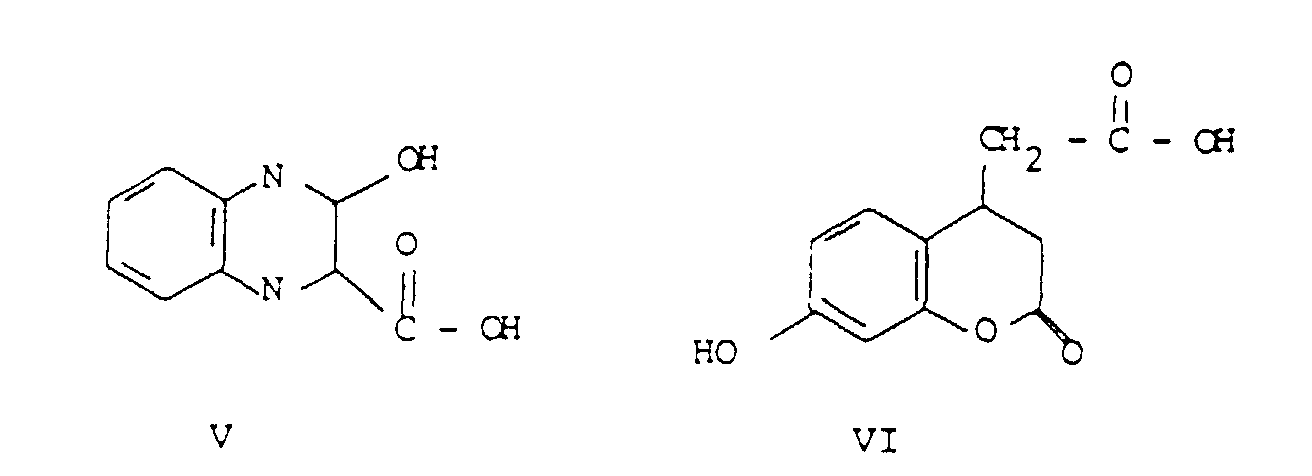
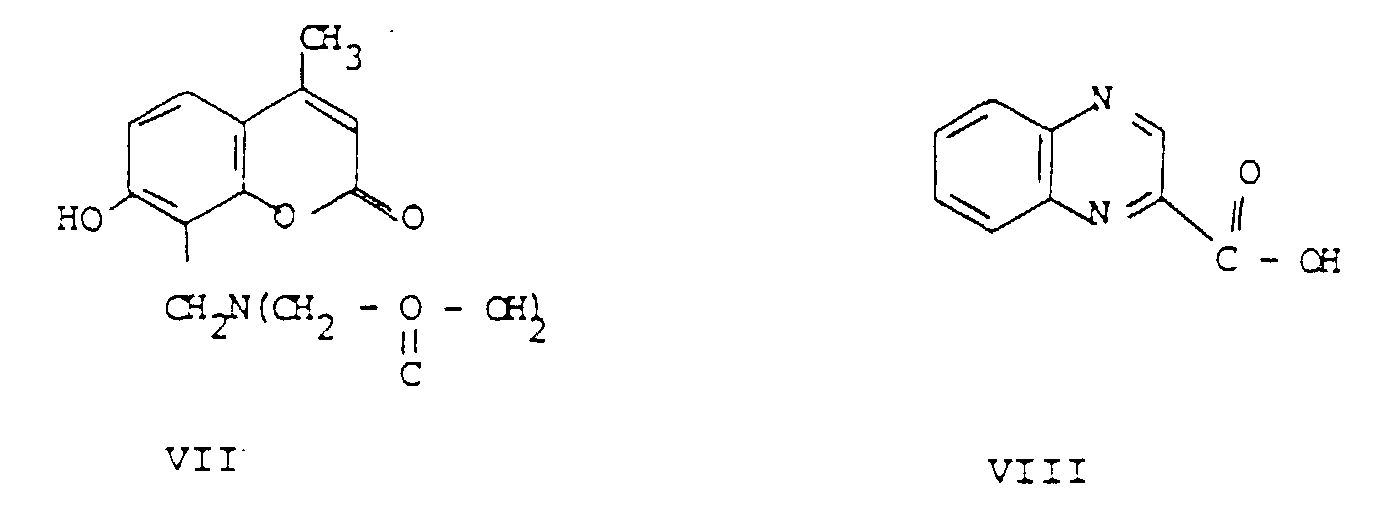
- fluorescent lanthanide metal chelates are selected from compounds of the following formulas I through X:
- the selected esters of chelates of formulas I through X are enzymatically treated to render the chelates either fluorescent or non-fluorescent when combined with a selected lanthanide metal.
- Figure 1 Logarithmic plots of fluorescence vs concentration of candidate fluorogenic lanthanide chelator. In all cases A to E but D, the fluorescence of each Eu 3+ chelate was higher or equal (C) to the corresponding fluorescence of the Tb 3+ chelate; the Eu 3+ -chelate fluorescence curve in plots A to E is thus on top of the Tb 3+ -chelate fluorescence curve, except in case D.
- the chelators represented are III (A, the third curve representing the lowest fluorescence is due to the Tb 3+ -EDTA-fluorosalicylate complex as described in (17); IV (B); II (C); VII (D); X (E); I (F, with Eu 3+ ); V (G, with Eu 3+ ); VI (H, with Eu 3+ ); VIII (I, lower curve with Eu 3+ ); IX (I, upper curve with Eu 3+ ).
- FIG. 1 Calibration curves for the proposed TSH assay (A). Fluorescence vs TSH concentration on linear axes (B). A percentage plot, where Bo is the fluorescence of the zero standard and B the fluorescence of all other standards. The concentration of the substrate used was (in mol/L from bottom to top): 5 x 10 -6 ; 1 x 10 -5 ; 2 x 10 -5 ; 5 x 10 -5 .
- Figure 3 Calibration curves for the proposed thyroxine assay (A). Double linear plots. (B) Double logarithmic plots. The substrate concentration and antibody dilutions used were: 5 x 10 -6 M and 10-fold (1); 5 x 10 -6 M and 20-fold (2); 2 x 10 -5 M and 10-fold (3); 2 x 10 -5 M and 20-fold (4).
- Molecules II, III, IV, and VII of the above formulae are good fluorogenic chelators for both Eu 3+ and Tb 3+ and molecules II, III, IV, V, VII and IX of the above formulae are good fluorogenic chelators for Eu 3+ .
- these chelators Under optimised measuring conditions of pH and presence or absence of EDTA, these chelators can be detected at levels ⁇ 10 -8 M.
- these substrates demonstrate utility in highly sensitive enzymatically amplified time-resolved fluorometric immunoassays.
- 4-methylumbelliferyl phosphate of formula X which is a substrate for alkaline phosphatase, was used as a model to develop new heterogeneous time-resolved fluorescence immunoassays for thyrotropin (TSH) and thyroxine (T4) in serum.
- TSH thyrotropin
- T4 thyroxine
- high detection sensitivity signal generation is achieved in a method for enzymatically amplifying signal detection through utilization of a selected substrate which is capable of being transformed by an enzyme from a compound which does not form a luminescent lanthanide chelate into a chelator which forms a luminescent lanthanide chelate with a lanthanide metal ion. This may occur in the presence or absence of a co-chelator.
- the substrate selected in unconverted form is non-competitive with the lanthanide metal chelate when exposed to radiation which causes the lanthanide metal chelate to luminesce.
- the selected substrate may have a degree of luminescence in the presence of the lanthanide metal.
- luminescence from the substrate does not interfere with the luminescence signal from the lanthanide metal ion chelate. This may be due to the luminescent emission from the substrate occurring at a different time than the emissions from the lanthanide metal chelate or may also be due to the emission from the substrate being considerably weaker than the emission occurring at the same time from the chelate or the substrate may be excited at a wavelength which is substantially different from that of the chelate. Any luminescence from the substrate, should it exist or not exist, results in a selected substrate which is hence non-competitive during the luminescent detection step with the lanthanide metal chelate.
- the luminescent lanthanide chelate thus formed is detected using either normal or time-resolved luminescence methods.
- This detection system can be utilized in many different heterogeneous assay formats, including microtitration plate formats for immunoassays and dot blot or Southern blot formats for hybridization assays. In addition, it may be utilized for a variety of homogeneous, heterogeneous or in situ assay formats and for specific enzyme activity.
- a new method for detection and/or quantification of an enzyme, where the enzyme is either used as a labelling group (for example bound to a hapten, antibody, binding protein, plant lectin, carbohydrate, hormone, or nucleic acid), or is itself the analyte of interest.
- a substrate is enzymatically converted from a compound which under the conditions of the luminescence measurement does not form a highly luminescent chelate with a lanthanide ion to a product (chelator) which does form such a luminescent lanthanide chelate.
- the necessary alteration in the luminescent properties of the product, resulting in a substantially increased yield of luminescent lanthanide complex formation on conversion from the substrate may be due to any combination of one or more of the following factors: more efficient net energy transfer from the product to the lanthanide ion in the chelate; more efficient light absorption by the product lanthanide chelate than for the substrate lanthanide chelate due to an alteration of spectroscopic properties energy levels; or, an increase in the number of groups coordinated to the lanthanide in the product compared to the substrate as a result of enzymatic action, for example due to addition of new coordinating groups, coupling of two species each containing coordinating groups, alteration of existing poorly coordinating groups to strongly coordinating groups, or removal of blocking groups in the vicinity of the chelating site which may hinder complex formation, any of which can result in a higher binding constant for the formation of complexes of the product with the lanthanide, and a higher yield of luminescence due to exclusion from the coordination sphere of
- the complex may contain other coordinating species present in the solution, such as buffer ions or ethylenediaminetetraacetate (EDTA) ion, which enhance the luminescence of the product:lanthanide chelate.
- buffer ions or ethylenediaminetetraacetate (EDTA) ion
- the method of the present invention can be applied to detection of a wider variety of enzymes than are currently used for other forms of detection, due to the large number of possible enzymatic reactions resulting in a significant alteration of the chelating or spectroscopic properties of the substrate.
- This imparts the advantage of improved background rejection compared to normal fluorophores, allowing improved detection limits for the enzyme.
- This is based on the specific luminescence properties of the lanthanide chelates which permit practical and inexpensive wavelength filtering and time-gating to be performed during the measurement in order to detect only the luminescence of the lanthanide chelate.
- the chelating agent is not directly attached as a labelling group.
- the present invention is differentiated from other luminescence methods for the detection or quantitation of specific enzymes where the enzyme is the analyte, in that the luminescence of the enzymatic product itself is not measured, rather the luminescence of the complex formed between the product and a lanthanide ion is quantitated.
- suitable lanthanides include, but are not limited to, terbium, europium, samarium and dysprosium.
- the amplification by the enzyme coupled with the lanthanide-chelate luminescence imparts the advantage of improved background rejection as compared to normal fluorophores thereby permitting improved detection limits for the enzyme. It is recognized in the present invention that it is the specific luminescence properties of the lanthanide chelates which permit practical and inexpensive wavelength filtering and time-gating to be performed during the measurement in order to detect only the luminescence of the lanthanide chelate.
- Another aspect of the present invention lies in the use of an enzyme as a label, or analyte, which reacts with the selected substrate to produce a non-chelator product which can subsequently react with a compound not capable of forming a luminescent lanthanide chelate, in order to form a second product chelating agent capable of forming such a chelate.
- the invention can be utilized for assay formats in which the labelling group is a first enzyme which produces a cofactor or substrate used by a second enzyme present in solution to subsequently produce the desired product capable of luminescent lanthanide chelate formation, or for a format in which a first enzyme produces an inhibitor for such a second enzyme, causing a reduction in measured signal when the first enzyme is present.
- the method is suitable for use in any assay format in which quantitation of the amount of enzyme present is appropriate.
- the enzyme may be directly or indirectly, covalently or noncovalently bound, and present as a single or multiple label.
- Such formats include the enzyme-linked immunosorbent assay, dot-blot, Southern blot or sandwich hybridization assays, in situ hybridization or immunoassays, and gel permeation separation assays.
- the luminescent product may be detected in solution, deposited onto a solid support, or suspended in an inhomogeneous matrix such as an electrophoretic gel.
- EP 0 192 168 (Dattagupta), EP 0 146 815 (Albarella & Anderson), EP 0 146 039 (Albarella et al.), WO 84/04970 (Ward et al.), WO 87/03622 (Schneider & Shank), EP 0 138 357 (Landes), and EP 0 131 830 (Dattagupta). All of these methodologies may be adapted by the method of the present invention.
- the method is suitable for use in assays for specific enzymes, with the choice of a suitable substrate, in order to establish the presence, specificity or specific activity of a particular enzyme in a sample, for example, in tissue, either homogenized or in section, in cell cultures, or immobilized on a solid support.
- the enzyme whose activity or concentration is to be determined may be present in other biological tissue samples such as whole blood, plasma or serum.
- the enzyme may be directly or indirectly conjugated to antibody which is part of the immunological complex in an immunoassay, present as an enzyme which is directly or indirectly conjugated to a nucleic acid probe which is part of a DNA-DNA or DNA-RNA duplex in a nucleic acid hybridization assay, or, by suitable means, the enzyme is immobilized on to a solid support.
- the invention is equally applicable to DNA sequencing techniques as well as DNA probes.
- the enzymatic reaction step of the present invention need not be performed under the same reaction conditions as the conditions for the formation of the lanthanide chelate and measurement of the luminescence.
- the lanthanide, and any co-chelating agents, such as EDTA, may be present during the enzymatic reaction or may be added subsequently.
- the pH of the solution may also be altered to improve complex formation.
- the luminescence of the product chelate is measured under conditions intended to optimize discrimination against any small background signals.
- the measurement of the luminescence may be performed under conditions of continuous illumination with ultraviolet light, with an excitation wavelength filter chosen to excite preferentially the product/lanthanide chelate over the substrate if possible, and an emission wavelength filter chosen to select for the lanthanide emission.
- the measurement is performed using, in addition to the aforementioned wavelength filtering, pulsed ultraviolet excitation and time-gated detection optimized with respect to the luminescence lifetime of the chelate; this method of measurement provides the best discrimination against nonspecific background luminescence signals.
- the candidate organic chelators tested are shown in Figure 1. All of them were obtained from Aldrich Chemical Co., Milwaukee, WI 53233. Calf intestine alkaline phosphatase (ALP) was obtained from Boehringer Mannheim Canada, Montreal PQ. Alkaline phosphatase-labelled streptavidin (SA-ALP) was obtained from Zymed Laboratories Inc., San Francisco, CA 94080, as a 0.75 mg/mL solution. White, opaque 12-well polystyrene microtiter strips coated with monoclonal anti-thyrotropin antibody (for the TSH assay) or a thyroxine-globulin conjugate (for the T4 assay) were obtained from CyberFluor.
- biotinylated detection antibodies, standards and buffers needed for the immunoassays were also from CyberFluor.
- Europium (III) chloride hexahydrate and terbium (III) chloride hexahydrate were from Aldrich. All other chemicals were from Sigma Chemical Co., St. Louis, MO 63178.
- the alkaline phosphatase substrate buffer was a 0.1 mol/L Tris, pH 9.0, containing 0.1 mol/L NaCl and 1 mmol/L MgCl 2 .
- the diluent for the biotinylated detection TSH antibody and the SA-ALP conjugate was a 6% (w/v) solution of bovine serum albumin (BSA) in a 50 mmol/L Tris buffer, pH 7.40, containing 0.5 g of sodium azide per litre.
- the wash solution was prepared by dissolving 9 g of NaCl and 0.5 mL of polyoxyethylenesorbitan monolaurate (Tween 20) in 1 litre of distilled water.
- All chelators were screened by mixing 100 ⁇ L of a chelator solution and 100 ⁇ L of a Eu 3+ or Tb 3+ solution, (4 x 10 -3 mol/L in water) and measuring the delayed fluorescence on the 615® Immunoanalyzer.
- the chelators according to preferred embodiments of the invention were further tested with Eu 3+ or Tb 3+ solutions of various pH, in the absence or presence of EDTA.
- Calibration curves and detection limits were constructed or calculated by adding 100 ⁇ L of an aqueous Eu 3+ or Tb 3+ solution to 100 ⁇ L of a chelator solution in a 0.1 mol/L Tris buffer of pH 9.0.
- chelator For the FSA chelator, we added 100 ⁇ L of a Tb 3+ -EDTA solution, 10 -3 mol/L in a 0.5 mol/L Tris buffer (18) of pH 12.5. For chelators of formula III and IV, we added 100 ⁇ L of a 4 x 10 -3 mol/L solution of Eu 3+ or Tb 3+ in a 0.1 mol/L Tris buffer, pH 11, containing 5 x 10 -3 mol/L EDTA.
- HTQC (10 g) (Chelator III) in pyridine (20 mL) was added with stirring to a cooled mixture of phosphoryl chloride (8.5 g) in pyridine (40 mL) such that the temperature remained below 5°C. After 30 min., the reaction mixture was decomposed by the addition of ice-cold water (100 mL). The solution was adjusted to pH 7.5 with 10M NaOH and solvents were removed under reduced pressure. The product, HTQCP, was purified by C18-reverse-phase, high performance liquid chromatography using a mobile phase of 10% acetonitrile in water and increasing it to 40% in 20 min.
- chelators of the formulae possess a hydroxyl group which could be converted to a phosphate ester or galactoside for the purpose of using them as substrates of alkaline phosphatase or ⁇ -galactosidase as has already been reported for the chelator of FSA which is included for comparison (17-19).
- sets of candidate chelators with only one group difference were tested i.e. chelators of formulae V and VIII, to demonstrate the importance of the different groups.
- Derivatives of a particular structure i.e. 4-methylumbelliferone (formulae VI, VII and X) and quinoline derivatives (formulae I and III) were tested.
- fluorescence of the complexes decreases dramatically in the presence of EDTA.
- the fluorescence measured is long-lived and lanthanide-specific. Native chelator fluorescence may also exist but is not detected by the time-resolved fluorometer.
- Fluorescence intensity of the complexes varies with pH as shown in Table 1.
- solutions of Eu 3+ and Tb 3+ in buffers of alkaline pH deteriorate quickly due to hydroxide precipitation.
- complexes are preferably formed with the addition of an aqueous solution of Eu 3+ or Tb 3+ (pH - 6.5) which is stable for long periods of time at room temperature.
- the Eu 3+ and Tb 3+ solutions were made in the presence of excess EDTA at pH 11. These solutions were also very stable when stored at room temperature.
- the fluorescence intensity of the complexes was highest when the Eu 3+ and Tb 3+ concentration in the final solution was around 2 x 10 -3 mol/L. Lower concentrations resulted in lower fluorescence signals.
- Fluorescence intensity remained stable ( ⁇ 10%) for at least 3 h in the case of chelators II, III, IV, V, VII and IX and Eu 3+ and/or Tb 3+ .
- Fluorescence intensity decreased with time (change ⁇ 10% per hour) in the case of chelators I, VI, VIII and X. This decrease was also noticed for FSA and previously reported (18).
- a phosphate ester may be formed by utilizing the hydroxyl group of the chelator and a suitable reagent, such as, phosphoryl chloride or phosphorus pentachloride.
- Example 3 demonstrates an aspect of the invention in that HTQC emits excellent fluorescence, whereas the phosphate ester of HTQC has a much lower level of fluorescence. Line 2, Fraction 6 of Figure 5, which is HTQCP, exhibits poor fluorescence.
- the HTQCP mixture includes a small amount of HTQC which is shown to elute at Fraction 21.
- the peak of line 1 of Figure 5 is the fluorescence of the enzymatically treated substrate; namely, HTQCP of Fraction 6, reacted with the alkaline phosphatase to produce HTQC.
- the HTQC of line 1 produces far greater fluorescence as compared to HTQCP.
- substitution of various entities of the compounds of formulae I to X may be done to enhance performance. Such substitutions may be with existing radicals or at other positions about the ringed structure. Such substitution may be in regard to other halogen groups, other alkyl groups and other alkaline groups and the like.
- Another interesting application of the invention is to have a pair of compounds A and B one of which, A, is an enzyme substrate that forms fluorescent complexes with Eu 3+ or Tb 3+ .
- A is an enzyme substrate that forms fluorescent complexes with Eu 3+ or Tb 3+ .
- the design of the TSH assay is of the non-competitive heterogeneous immunoassay format where an immunocomplex of the type solid-phase-coating antibody-TSH-detection antibody-biotin-streptavidin-alkaline phosphatase, is formed in polystyrene microtiter wells.
- the activity of ALP can then be measured in a number of different conventional ways. In this work, we detected ALP by adding the substrate X for 30 min, followed by addition of a 4 x 1 0 -3 mol/L Eu 3+ solution to form the fluorescent complex with the unreacted substrate. The calibration curves obtained are shown in Figure 2. The sensitivity and range of assay can be adjusted by adjusting the concentration of the substrate added.
- T4 a competitive assay for T4 was designed as follows: Polystyrene microtiter wells were coated with a T4-protein conjugate as described previously (20). In the assay, T4 in the sample competes with immobilized T4 for binding to a biotinylated anti-T4 monoclonal antibody. After washing out excess reagents, we added a SA-ALP conjugate to form the immunocomplex: solid-phase-T4-antibodybiotin-SA-ALP. The activity of ALP can then be quantified with use of the substrate, X. With a conventional detection system, the amount of signal generated by ALP is inversely related to the analyte concentration and the calibration curves have a shape similar to those of Figure 2.
- Enzymatically amplified time-resolved fluorescence immunoassays exhibit excellent sensitivity and can be used for the routine manual or automated assay of many analytes in biological fluids.
- the first system reported is based on alkaline phosphatase and the substrate 5-fluorosalicyl phosphate (FSAP) in combination with Tb 3+ (17-19).
- FSAP 5-fluorosalicyl phosphate
- Other possible chelators can be used which offer better detectability in comparison to FSA.
- some of these chelators form stable complexes with Eu 3+ and Tb 3+ thus being advantageous to the previously reported system in which fluorescence decays with time.
Landscapes
- Chemical & Material Sciences (AREA)
- Organic Chemistry (AREA)
- Health & Medical Sciences (AREA)
- Life Sciences & Earth Sciences (AREA)
- Immunology (AREA)
- Engineering & Computer Science (AREA)
- Molecular Biology (AREA)
- Urology & Nephrology (AREA)
- Biomedical Technology (AREA)
- Hematology (AREA)
- Biochemistry (AREA)
- General Health & Medical Sciences (AREA)
- Microbiology (AREA)
- Biotechnology (AREA)
- Physics & Mathematics (AREA)
- Analytical Chemistry (AREA)
- Zoology (AREA)
- Proteomics, Peptides & Aminoacids (AREA)
- Wood Science & Technology (AREA)
- Cell Biology (AREA)
- General Physics & Mathematics (AREA)
- Pathology (AREA)
- Medicinal Chemistry (AREA)
- Food Science & Technology (AREA)
- Biophysics (AREA)
- Bioinformatics & Cheminformatics (AREA)
- General Engineering & Computer Science (AREA)
- Genetics & Genomics (AREA)
- Measuring Or Testing Involving Enzymes Or Micro-Organisms (AREA)
- Investigating Or Analysing Materials By The Use Of Chemical Reactions (AREA)
- Analysing Materials By The Use Of Radiation (AREA)
- Luminescent Compositions (AREA)
- Steroid Compounds (AREA)
Claims (9)
- Fluoreszierende Lanthanoidmetallchelate ausgewählt aus Verbindungen der folgenden Formeln I bis X:



- Fluoreszierende Chelate gemäß Anspruch 1 für Europium und Terbium.
- Fluoreszierende Chelate gemäß Anspruch 2 für Europium ausgewählt aus Verbindungen der Formeln I, II, III, IV, V, VI, VII, VIII, IX und X.
- Fluoreszierende Chelate gemäß Anspruch 2 für Terbium ausgewählt aus Verbindungen der Formeln II, III, IV, VII und X.
- In einem zeitaufgelösten, auf Fluoreszenz basierenden Assay (fluorescent based assay) enzymatisches Behandeln von Estem von Chelaten der Formeln I bis X gemäß Anspruch 1, um die behandelten Chelate entweder fluoreszierend oder nicht fluoreszierend zu machen, wenn sie mit einem Lanthanoidmetall kombiniert werden bzw. sind.
- In dem Assay gemäß Anspruch 5 sind die Ester der Chelate ausgewählt aus Phosphat bzw. Phosphat- und Galactosidestern.
- In dem Assay gemäß Anspruch 6 sind die Ester Phosphatester.
- In dem Assay gemäß Anspruch 7 ist das Chelat 4-Hydroxy-7-trifluormethyl-3-chinolincarbonsäure (HTQC).
- In dem Assay gemäß Anspruch 5 ist die resultierende Verbindung 4-Methylumbelliferon, das minimale Fluoreszenz zeigt, und sein Ester, der ein fluoreszierendes Chelat mit einem Lanthanoidmetall bildet, ist 4-Methylumbelliferylphosphat.
Applications Claiming Priority (3)
| Application Number | Priority Date | Filing Date | Title |
|---|---|---|---|
| US07/863,746 US5312922A (en) | 1992-04-06 | 1992-04-06 | Europium and terbium chelators for time-resolved fluorometric assays |
| US863746 | 1992-04-06 | ||
| PCT/CA1993/000153 WO1993020054A1 (en) | 1992-04-06 | 1993-04-06 | Europium and terbium chelators for time-resolved fluorometric assays |
Publications (2)
| Publication Number | Publication Date |
|---|---|
| EP0635006A1 EP0635006A1 (de) | 1995-01-25 |
| EP0635006B1 true EP0635006B1 (de) | 1999-10-20 |
Family
ID=25341700
Family Applications (1)
| Application Number | Title | Priority Date | Filing Date |
|---|---|---|---|
| EP93907728A Expired - Lifetime EP0635006B1 (de) | 1992-04-06 | 1993-04-06 | Europium und terbium chelatore für zeitgelöste fluorometrische teste |
Country Status (6)
| Country | Link |
|---|---|
| US (2) | US5312922A (de) |
| EP (1) | EP0635006B1 (de) |
| AT (1) | ATE185801T1 (de) |
| AU (1) | AU3885393A (de) |
| DE (1) | DE69326834T2 (de) |
| WO (1) | WO1993020054A1 (de) |
Families Citing this family (42)
| Publication number | Priority date | Publication date | Assignee | Title |
|---|---|---|---|---|
| US5312922A (en) * | 1992-04-06 | 1994-05-17 | Nordion International Inc. | Europium and terbium chelators for time-resolved fluorometric assays |
| AU704152B2 (en) * | 1995-01-06 | 1999-04-15 | Ciba Specialty Chemicals Holding Inc. | Triboluminescent lanthanide III complexes |
| US5633380A (en) * | 1995-06-05 | 1997-05-27 | American Cyanamid Company | Substituted quinoline herbicide intermediates and process |
| US6441025B2 (en) * | 1996-03-12 | 2002-08-27 | Pg-Txl Company, L.P. | Water soluble paclitaxel derivatives |
| KR20000010533A (ko) * | 1996-04-19 | 2000-02-15 | 텍사스 테크 유니버시티 | 시각적 조직 특이성 조영제로서의 형광 킬레이트 |
| US6951760B2 (en) * | 1997-03-03 | 2005-10-04 | Johannes Willem Hofstraat | Diagnostic neodymium(III), ytterbium(III), or erbium(III) ion-ligand complexes |
| WO1998039654A2 (en) * | 1997-03-03 | 1998-09-11 | Akzo Nobel N.V. | Diagnostic neodymium(iii), ytterbium(iii), or erbium(iii) ion-ligand complexes |
| US7070921B2 (en) | 2000-04-28 | 2006-07-04 | Molecular Devices Corporation | Molecular modification assays |
| US7745142B2 (en) | 1997-09-15 | 2010-06-29 | Molecular Devices Corporation | Molecular modification assays |
| US7632651B2 (en) | 1997-09-15 | 2009-12-15 | Mds Analytical Technologies (Us) Inc. | Molecular modification assays |
| US7416703B2 (en) * | 1998-04-28 | 2008-08-26 | The Johns Hopkins University | Polymer based lanthanide luminescent sensors for the detection of organophosphorus compounds |
| US6749811B2 (en) * | 1998-04-28 | 2004-06-15 | The Johns Hopkins University | Molecularly imprinted polymer solution anion sensor |
| US6402986B1 (en) | 1999-07-16 | 2002-06-11 | The Trustees Of Boston University | Compositions and methods for luminescence lifetime comparison |
| US6329205B1 (en) | 1999-08-31 | 2001-12-11 | Molecular Probes, Inc. | Detection method using luminescent europium-based protein stains |
| US20030054977A1 (en) * | 1999-10-12 | 2003-03-20 | Cell Therapeutics, Inc. | Manufacture of polyglutamate-therapeutic agent conjugates |
| WO2001027699A1 (en) * | 1999-10-14 | 2001-04-19 | Meridian Chemical Technologies, Inc. | Method for authentication of an item |
| FI20000333A0 (fi) * | 2000-02-16 | 2000-02-16 | Jussi Nurmi | Homogeeninen menetelmä polynukleotidin havaitsemiseksi |
| DE10102839C2 (de) * | 2001-01-22 | 2003-02-06 | Tanja Steinkamp | Verfahren zur Bestimmung hydrolytischer Enzyme |
| US6962690B2 (en) * | 2001-10-22 | 2005-11-08 | Dow Global Technologies Inc. | Tissue specific fluorescent chelates possessing long wavelength UV excitation |
| GB0210535D0 (en) * | 2002-05-08 | 2002-06-19 | Novartis Ag | Organic compounds |
| EP1532576A4 (de) * | 2002-06-07 | 2006-09-27 | Univ Boston | System und verfahren zur produkt- und dokumentauthentifizierung |
| US7053249B2 (en) * | 2002-10-25 | 2006-05-30 | Idexx Laboratories, Inc. | Metal chelates and methods of using them for time-resolved fluorescence |
| AU2003296014B2 (en) * | 2002-11-26 | 2010-06-03 | University Of Maryland Biotechnology Institute | High-sensitivity assays for pathogen detection using metal-enhanced fluorescence |
| EP1711618B1 (de) | 2003-12-23 | 2010-08-04 | Mount Sinai Hospital Corporation | Verfahren zum nachweis von mit endometrialer krankheit oder phase assoziierten markern |
| WO2006020779A2 (en) * | 2004-08-10 | 2006-02-23 | Dow Global Technologies Inc. | Targeting chelants and chelates |
| US20080044919A1 (en) * | 2004-08-13 | 2008-02-21 | Dowben Robert M | Analyte Detection Using Time-Resolved Photon Counting Fluorescence |
| CA2581639C (en) | 2004-09-30 | 2016-07-26 | Molecular Devices Corporation | Luminescent lanthanide complexes |
| NZ570008A (en) | 2006-02-09 | 2011-10-28 | Univ South Florida | Detection of ovarian cancer by elevated levels of Bcl-2 in urine |
| US20100190662A1 (en) * | 2007-01-26 | 2010-07-29 | Rebecca Sutphen | Methods and materials for detection, diagnosis and management of ovarian cancer |
| WO2011084703A2 (en) * | 2009-12-21 | 2011-07-14 | Advanced Liquid Logic, Inc. | Enzyme assays on a droplet actuator |
| CA2618163A1 (en) | 2008-02-07 | 2009-08-07 | K. W. Michael Siu | Head and neck cancer biomarkers |
| US9207242B2 (en) | 2008-10-09 | 2015-12-08 | The University Of Hong Kong | Cadherin-17 as diagnostic marker and therapeutic target for liver cancer |
| JP6048660B2 (ja) | 2009-09-21 | 2016-12-21 | ランジュ ラルハン | 甲状腺癌を診断および処置するための方法および組成物 |
| EP2567235B1 (de) | 2010-05-04 | 2017-08-30 | Paul Walfish | Verfahren zur diagnose von epithelkarzinomen durch nachweis eines epicd-polypeptids |
| WO2012021969A1 (en) | 2010-08-16 | 2012-02-23 | Mount Sinai Hospital | Markers of the male urogenital tract |
| CN102520196B (zh) * | 2011-12-02 | 2013-06-26 | 广州市丰华生物工程有限公司 | 一种新生儿促甲状腺素/游离甲状腺素双标记检测试剂盒及相应的检测方法 |
| EP3730929A1 (de) | 2013-08-19 | 2020-10-28 | University Of Houston | Phosphoreszierende reporter |
| FR3027395B1 (fr) * | 2014-10-17 | 2016-10-21 | Biomerieux Sa | Composition pour dosage immuno-enzymatique par immunofluorescence et ses utilisations |
| FI125976B (en) * | 2014-10-27 | 2016-05-13 | Aqsens Oy | Method for determination of phosphonates |
| JP7337141B2 (ja) * | 2018-03-12 | 2023-09-01 | マサチューセッツ インスティテュート オブ テクノロジー | ヒドロキシキノリン増感キレートを介するキナーゼおよび/またはホスファターゼ感知 |
| US11629290B2 (en) * | 2020-04-15 | 2023-04-18 | Spectra Systems Corporation | Lanthanide metal chelate security feature |
| CN115753699B (zh) * | 2022-08-27 | 2024-05-03 | 吉林大学 | 一种水中四环素类抗生素的可视化检测方法 |
Family Cites Families (8)
| Publication number | Priority date | Publication date | Assignee | Title |
|---|---|---|---|---|
| EP0171978B1 (de) * | 1984-08-13 | 1990-11-07 | HSC Research Development Corporation | 1,10-Phenanthrolin-2,9-dicarbonsäure-Derivate und deren Verwendung für Fluoreszens-Immunoassay |
| GB8421318D0 (en) * | 1984-08-22 | 1984-09-26 | Ekins R P | Potentiating antibodies/other macro-molecules |
| US4680275A (en) * | 1985-02-11 | 1987-07-14 | Becton, Dickinson And Company | Homogeneous fluorescence immunoassay using a light absorbing material |
| EP0201211A1 (de) * | 1985-04-10 | 1986-11-12 | Whittaker Corporation | Methode und Zusammensetzung für visuelle Festphasen-Immunoassays auf der Basis lumineszierender kugelförmiger Mikropartikel |
| US5089423A (en) * | 1987-05-06 | 1992-02-18 | Cyberfluor Inc. | Immunoassay methods and reagents and methods for producing the latter |
| GB8927503D0 (en) * | 1989-12-04 | 1990-02-07 | Kronem Systems Inc | Enzyme-amplified lanthanide chelate luminescence |
| US5095099A (en) * | 1990-12-10 | 1992-03-10 | E. I. Du Pont De Nemours And Company | Fluorescent compounds for absorption and re-emission of radiation |
| US5312922A (en) * | 1992-04-06 | 1994-05-17 | Nordion International Inc. | Europium and terbium chelators for time-resolved fluorometric assays |
-
1992
- 1992-04-06 US US07/863,746 patent/US5312922A/en not_active Expired - Fee Related
-
1993
- 1993-04-06 US US08/313,300 patent/US5854008A/en not_active Expired - Fee Related
- 1993-04-06 WO PCT/CA1993/000153 patent/WO1993020054A1/en not_active Ceased
- 1993-04-06 DE DE69326834T patent/DE69326834T2/de not_active Expired - Fee Related
- 1993-04-06 AU AU38853/93A patent/AU3885393A/en not_active Abandoned
- 1993-04-06 AT AT93907728T patent/ATE185801T1/de not_active IP Right Cessation
- 1993-04-06 EP EP93907728A patent/EP0635006B1/de not_active Expired - Lifetime
Also Published As
| Publication number | Publication date |
|---|---|
| US5312922A (en) | 1994-05-17 |
| DE69326834D1 (de) | 1999-11-25 |
| US5854008A (en) | 1998-12-29 |
| EP0635006A1 (de) | 1995-01-25 |
| WO1993020054A1 (en) | 1993-10-14 |
| DE69326834T2 (de) | 2000-04-27 |
| ATE185801T1 (de) | 1999-11-15 |
| AU3885393A (en) | 1993-11-08 |
Similar Documents
| Publication | Publication Date | Title |
|---|---|---|
| US5854008A (en) | Europium and terbium chelators for the time-resolved fluorometric assays | |
| Evangelista et al. | Enzyme-amplified lanthanide luminescence for enzyme detection in bioanalytical assays | |
| Liu et al. | A fluorescent probe for hydrazine based on a newly developed 1-indanone-fused coumarin scaffold | |
| EP2305690B1 (de) | Signalisierungsverbindungen zur Verwendung bei Verfahren zur Erkennung von Wasserstoffperoxid | |
| Sammes et al. | Modern bioassays using metal chelates as luminescent probes | |
| EP0203047B1 (de) | Fluoreszierende Lanthanidchelate | |
| US5702887A (en) | Long emission wavelength chemiluminescent compounds and their use in test assays | |
| Diamandis | Europium and terbium chelators as candidate substrates for enzyme-labelled time-resolved fluorimetric immunoassays | |
| CA1338167C (en) | Enzyme activity determination method | |
| US6162610A (en) | Xanthan-ester and acridan substrates for horseradish peroxidase | |
| Saneyoshi et al. | Long-lived luminogenic probe for detection of RNA in a crude solution of living bacterial cells | |
| US5736320A (en) | Method of detecting substances by chemiluminescence | |
| EP0656005B1 (de) | Biotinylierte, chemolumineszente label, konjugate, assays sowie assay kits | |
| US6949632B2 (en) | Fluorogenic substrates | |
| JP3819294B2 (ja) | 燐酸酵素のような加水分解性酵素の化学発光基質 | |
| Papanastasiou-Diamandi et al. | Ultrasensitive thyrotropin immunoassay based on enzymatically amplified time-resolved fluorescence with a terbium chelate | |
| US7955859B2 (en) | Fluorescent labeling compound | |
| EP1509601B1 (de) | Fluoreszenznachweis von peroxidaseenzymen | |
| Meyer et al. | Enzyme-linked immunosorbent assays based on peroxidase labels and enzyme-amplified lanthanide luminescence detection | |
| CN107003303B (zh) | 用于利用免疫荧光的酶免疫测定的组合物及其用途 | |
| Scorilas et al. | Novel biotinylated acridinium derivatives: new reagents for fluorescence immunoassays and proteomics | |
| EP0778946B1 (de) | Verfahren und testsätze zur erzeugung von licht von einer acridan-verbindung | |
| Christopoulos et al. | Ultrasensitive determination of europium using microsecond time-resolved spectrofluorimetry | |
| Diwu et al. | Spectral properties and biological applications of ELF enzyme substrates that yield fluorescent precipitates at the enzymatic activity sites | |
| JP4286356B2 (ja) | ペルオキシダーゼ活性の測定方法 |
Legal Events
| Date | Code | Title | Description |
|---|---|---|---|
| PUAI | Public reference made under article 153(3) epc to a published international application that has entered the european phase |
Free format text: ORIGINAL CODE: 0009012 |
|
| 17P | Request for examination filed |
Effective date: 19941107 |
|
| AK | Designated contracting states |
Kind code of ref document: A1 Designated state(s): AT BE CH DE ES FR GB GR IE IT LI NL SE |
|
| 17Q | First examination report despatched |
Effective date: 19970929 |
|
| GRAG | Despatch of communication of intention to grant |
Free format text: ORIGINAL CODE: EPIDOS AGRA |
|
| GRAG | Despatch of communication of intention to grant |
Free format text: ORIGINAL CODE: EPIDOS AGRA |
|
| GRAH | Despatch of communication of intention to grant a patent |
Free format text: ORIGINAL CODE: EPIDOS IGRA |
|
| GRAH | Despatch of communication of intention to grant a patent |
Free format text: ORIGINAL CODE: EPIDOS IGRA |
|
| GRAA | (expected) grant |
Free format text: ORIGINAL CODE: 0009210 |
|
| AK | Designated contracting states |
Kind code of ref document: B1 Designated state(s): AT BE CH DE ES FR GB GR IE IT LI NL SE |
|
| PG25 | Lapsed in a contracting state [announced via postgrant information from national office to epo] |
Ref country code: SE Free format text: THE PATENT HAS BEEN ANNULLED BY A DECISION OF A NATIONAL AUTHORITY Effective date: 19991020 Ref country code: NL Free format text: LAPSE BECAUSE OF FAILURE TO SUBMIT A TRANSLATION OF THE DESCRIPTION OR TO PAY THE FEE WITHIN THE PRESCRIBED TIME-LIMIT Effective date: 19991020 Ref country code: LI Free format text: LAPSE BECAUSE OF FAILURE TO SUBMIT A TRANSLATION OF THE DESCRIPTION OR TO PAY THE FEE WITHIN THE PRESCRIBED TIME-LIMIT Effective date: 19991020 Ref country code: IT Free format text: LAPSE BECAUSE OF FAILURE TO SUBMIT A TRANSLATION OF THE DESCRIPTION OR TO PAY THE FEE WITHIN THE PRESCRIBED TIME-LIMIT;WARNING: LAPSES OF ITALIAN PATENTS WITH EFFECTIVE DATE BEFORE 2007 MAY HAVE OCCURRED AT ANY TIME BEFORE 2007. THE CORRECT EFFECTIVE DATE MAY BE DIFFERENT FROM THE ONE RECORDED. Effective date: 19991020 Ref country code: GR Free format text: LAPSE BECAUSE OF NON-PAYMENT OF DUE FEES Effective date: 19991020 Ref country code: ES Free format text: THE PATENT HAS BEEN ANNULLED BY A DECISION OF A NATIONAL AUTHORITY Effective date: 19991020 Ref country code: CH Free format text: LAPSE BECAUSE OF FAILURE TO SUBMIT A TRANSLATION OF THE DESCRIPTION OR TO PAY THE FEE WITHIN THE PRESCRIBED TIME-LIMIT Effective date: 19991020 Ref country code: BE Free format text: LAPSE BECAUSE OF FAILURE TO SUBMIT A TRANSLATION OF THE DESCRIPTION OR TO PAY THE FEE WITHIN THE PRESCRIBED TIME-LIMIT Effective date: 19991020 Ref country code: AT Free format text: LAPSE BECAUSE OF FAILURE TO SUBMIT A TRANSLATION OF THE DESCRIPTION OR TO PAY THE FEE WITHIN THE PRESCRIBED TIME-LIMIT Effective date: 19991020 |
|
| REF | Corresponds to: |
Ref document number: 185801 Country of ref document: AT Date of ref document: 19991115 Kind code of ref document: T |
|
| REG | Reference to a national code |
Ref country code: CH Ref legal event code: EP |
|
| REF | Corresponds to: |
Ref document number: 69326834 Country of ref document: DE Date of ref document: 19991125 |
|
| REG | Reference to a national code |
Ref country code: IE Ref legal event code: FG4D |
|
| ET | Fr: translation filed | ||
| NLV1 | Nl: lapsed or annulled due to failure to fulfill the requirements of art. 29p and 29m of the patents act | ||
| PG25 | Lapsed in a contracting state [announced via postgrant information from national office to epo] |
Ref country code: IE Free format text: LAPSE BECAUSE OF NON-PAYMENT OF DUE FEES Effective date: 20000406 |
|
| REG | Reference to a national code |
Ref country code: CH Ref legal event code: PL |
|
| PLBE | No opposition filed within time limit |
Free format text: ORIGINAL CODE: 0009261 |
|
| STAA | Information on the status of an ep patent application or granted ep patent |
Free format text: STATUS: NO OPPOSITION FILED WITHIN TIME LIMIT |
|
| 26N | No opposition filed | ||
| REG | Reference to a national code |
Ref country code: GB Ref legal event code: 732E |
|
| REG | Reference to a national code |
Ref country code: IE Ref legal event code: MM4A |
|
| GBPC | Gb: european patent ceased through non-payment of renewal fee |
Effective date: 20010406 |
|
| REG | Reference to a national code |
Ref country code: FR Ref legal event code: ST |
|
| REG | Reference to a national code |
Ref country code: FR Ref legal event code: TP Ref country code: FR Ref legal event code: CD |
|
| REG | Reference to a national code |
Ref country code: GB Ref legal event code: 728V |
|
| REG | Reference to a national code |
Ref country code: FR Ref legal event code: RN |
|
| REG | Reference to a national code |
Ref country code: FR Ref legal event code: FC |
|
| REG | Reference to a national code |
Ref country code: GB Ref legal event code: 728Y |
|
| PGFP | Annual fee paid to national office [announced via postgrant information from national office to epo] |
Ref country code: DE Payment date: 20050331 Year of fee payment: 13 |
|
| PGFP | Annual fee paid to national office [announced via postgrant information from national office to epo] |
Ref country code: GB Payment date: 20050406 Year of fee payment: 13 |
|
| PGFP | Annual fee paid to national office [announced via postgrant information from national office to epo] |
Ref country code: FR Payment date: 20050408 Year of fee payment: 13 |
|
| PG25 | Lapsed in a contracting state [announced via postgrant information from national office to epo] |
Ref country code: GB Free format text: LAPSE BECAUSE OF NON-PAYMENT OF DUE FEES Effective date: 20060406 |
|
| PG25 | Lapsed in a contracting state [announced via postgrant information from national office to epo] |
Ref country code: DE Free format text: LAPSE BECAUSE OF NON-PAYMENT OF DUE FEES Effective date: 20061101 |
|
| GBPC | Gb: european patent ceased through non-payment of renewal fee |
Effective date: 20060406 |
|
| REG | Reference to a national code |
Ref country code: FR Ref legal event code: ST Effective date: 20061230 |
|
| PG25 | Lapsed in a contracting state [announced via postgrant information from national office to epo] |
Ref country code: FR Free format text: LAPSE BECAUSE OF NON-PAYMENT OF DUE FEES Effective date: 20060502 |