EP0635378A2 - Hochdruckplatte und ihre Verwendung für dem Druck auf nicht absorbierenden harten Oberflächen - Google Patents
Hochdruckplatte und ihre Verwendung für dem Druck auf nicht absorbierenden harten Oberflächen Download PDFInfo
- Publication number
- EP0635378A2 EP0635378A2 EP94401651A EP94401651A EP0635378A2 EP 0635378 A2 EP0635378 A2 EP 0635378A2 EP 94401651 A EP94401651 A EP 94401651A EP 94401651 A EP94401651 A EP 94401651A EP 0635378 A2 EP0635378 A2 EP 0635378A2
- Authority
- EP
- European Patent Office
- Prior art keywords
- printing
- ink
- printed
- screen
- printing form
- Prior art date
- Legal status (The legal status is an assumption and is not a legal conclusion. Google has not performed a legal analysis and makes no representation as to the accuracy of the status listed.)
- Withdrawn
Links
- 238000007639 printing Methods 0.000 title claims abstract description 117
- 230000002745 absorbent Effects 0.000 title abstract description 16
- 239000002250 absorbent Substances 0.000 title abstract description 16
- 239000000463 material Substances 0.000 claims abstract description 29
- 238000000034 method Methods 0.000 claims abstract description 25
- 239000011521 glass Substances 0.000 claims abstract description 22
- 230000006641 stabilisation Effects 0.000 claims abstract description 5
- 238000007644 letterpress printing Methods 0.000 claims description 4
- 238000011105 stabilization Methods 0.000 claims description 4
- 238000010521 absorption reaction Methods 0.000 claims description 3
- 238000004090 dissolution Methods 0.000 claims description 3
- 238000004519 manufacturing process Methods 0.000 claims description 3
- 239000004033 plastic Substances 0.000 claims description 3
- 229920003023 plastic Polymers 0.000 claims description 3
- 230000005855 radiation Effects 0.000 claims description 2
- 239000007779 soft material Substances 0.000 claims description 2
- 239000000126 substance Substances 0.000 abstract 2
- 238000009826 distribution Methods 0.000 description 4
- 230000005587 bubbling Effects 0.000 description 3
- 239000004800 polyvinyl chloride Substances 0.000 description 3
- 238000005096 rolling process Methods 0.000 description 3
- 239000007787 solid Substances 0.000 description 3
- 239000011324 bead Substances 0.000 description 2
- 210000003298 dental enamel Anatomy 0.000 description 2
- 239000002184 metal Substances 0.000 description 2
- 229920003229 poly(methyl methacrylate) Polymers 0.000 description 2
- 229920000642 polymer Polymers 0.000 description 2
- 239000004926 polymethyl methacrylate Substances 0.000 description 2
- 229920000915 polyvinyl chloride Polymers 0.000 description 2
- 241001272720 Medialuna californiensis Species 0.000 description 1
- 238000009825 accumulation Methods 0.000 description 1
- 238000004026 adhesive bonding Methods 0.000 description 1
- 235000009508 confectionery Nutrition 0.000 description 1
- 238000010276 construction Methods 0.000 description 1
- 239000007788 liquid Substances 0.000 description 1
- 239000007769 metal material Substances 0.000 description 1
- 230000000704 physical effect Effects 0.000 description 1
- 238000012216 screening Methods 0.000 description 1
- 239000007858 starting material Substances 0.000 description 1
- 230000037072 sun protection Effects 0.000 description 1
- 230000001360 synchronised effect Effects 0.000 description 1
- 239000012780 transparent material Substances 0.000 description 1
Images

Classifications
-
- G—PHYSICS
- G03—PHOTOGRAPHY; CINEMATOGRAPHY; ANALOGOUS TECHNIQUES USING WAVES OTHER THAN OPTICAL WAVES; ELECTROGRAPHY; HOLOGRAPHY
- G03F—PHOTOMECHANICAL PRODUCTION OF TEXTURED OR PATTERNED SURFACES, e.g. FOR PRINTING, FOR PROCESSING OF SEMICONDUCTOR DEVICES; MATERIALS THEREFOR; ORIGINALS THEREFOR; APPARATUS SPECIALLY ADAPTED THEREFOR
- G03F5/00—Screening processes; Screens therefor
-
- B—PERFORMING OPERATIONS; TRANSPORTING
- B41—PRINTING; LINING MACHINES; TYPEWRITERS; STAMPS
- B41N—PRINTING PLATES OR FOILS; MATERIALS FOR SURFACES USED IN PRINTING MACHINES FOR PRINTING, INKING, DAMPING, OR THE LIKE; PREPARING SUCH SURFACES FOR USE AND CONSERVING THEM
- B41N1/00—Printing plates or foils; Materials therefor
- B41N1/12—Printing plates or foils; Materials therefor non-metallic other than stone, e.g. printing plates or foils comprising inorganic materials in an organic matrix
-
- B—PERFORMING OPERATIONS; TRANSPORTING
- B41—PRINTING; LINING MACHINES; TYPEWRITERS; STAMPS
- B41F—PRINTING MACHINES OR PRESSES
- B41F5/00—Rotary letterpress machines
- B41F5/24—Rotary letterpress machines for flexographic printing
-
- B—PERFORMING OPERATIONS; TRANSPORTING
- B41—PRINTING; LINING MACHINES; TYPEWRITERS; STAMPS
- B41M—PRINTING, DUPLICATING, MARKING, OR COPYING PROCESSES; COLOUR PRINTING
- B41M1/00—Inking and printing with a printer's forme
- B41M1/02—Letterpress printing, e.g. book printing
- B41M1/04—Flexographic printing
-
- B—PERFORMING OPERATIONS; TRANSPORTING
- B41—PRINTING; LINING MACHINES; TYPEWRITERS; STAMPS
- B41M—PRINTING, DUPLICATING, MARKING, OR COPYING PROCESSES; COLOUR PRINTING
- B41M1/00—Inking and printing with a printer's forme
- B41M1/26—Printing on other surfaces than ordinary paper
- B41M1/34—Printing on other surfaces than ordinary paper on glass or ceramic surfaces
-
- C—CHEMISTRY; METALLURGY
- C03—GLASS; MINERAL OR SLAG WOOL
- C03C—CHEMICAL COMPOSITION OF GLASSES, GLAZES OR VITREOUS ENAMELS; SURFACE TREATMENT OF GLASS; SURFACE TREATMENT OF FIBRES OR FILAMENTS MADE FROM GLASS, MINERALS OR SLAGS; JOINING GLASS TO GLASS OR OTHER MATERIALS
- C03C17/00—Surface treatment of glass, not in the form of fibres or filaments, by coating
- C03C17/001—General methods for coating; Devices therefor
-
- B—PERFORMING OPERATIONS; TRANSPORTING
- B41—PRINTING; LINING MACHINES; TYPEWRITERS; STAMPS
- B41F—PRINTING MACHINES OR PRESSES
- B41F31/00—Inking arrangements or devices
- B41F31/30—Arrangements for tripping, lifting, adjusting, or removing inking rollers; Supports, bearings, or forks therefor
Definitions
- the present invention relates to the production of a printing form for a rotary letterpress printing process. It further relates to the use of such a form of printing in a flexographic process for printing on materials to be printed formed from a non-absorbent or poorly absorbent hard material and in particular for printing on glass. , on certain plastics such as polyvinyl chloride (PVC), on metallic materials, etc.
- PVC polyvinyl chloride
- the transfer of ink onto the material to be printed is done directly by means of the printing form which is also called a plate and, in particular, by means of the raised parts of the form. printing.
- the printing form is, in this case, shaped as a printing plate and is stretched over the envelope surface of the printing cylinder.
- the printing pattern is produced in the form of a screen, the raised printing dots of which constitute solid printing surfaces on which the ink adheres. and from which the ink is transferred to the material to be printed.
- the ink column is divided on the points printing.
- a determined quantity of ink is transferred onto the material to be printed, while a part of the ink remains stuck on the dots. printing of the picture.
- the ratio of the quantity of ink transferred to the material to be printed to the quantity of ink presented by the plate is usually expressed by the so-called inking index. This ratio is very unfavorable with very smooth and non-absorbent or little absorbent printing materials, for example with glass surfaces, PVC surfaces, metal surfaces, etc. This means that only an insufficient quantity of ink is transferred to such materials to be printed, which leads to an insufficient intensity of the ink layer.
- PMMA polymethylmethacrylate
- the object of the invention is in particular to produce a printing form intended for a rotary typographic printing process, said form leading, even during the printing of a material to be printed formed from a non-absorbent or little absorbent material, to a clean image to be printed with a sufficient quantity of ink and an even distribution of the ink in each dot printed on said material to be printed.
- this object is achieved by means of a printing form in which the printing dots transferring the ink from the background screen forming the pattern are covered by a finer screen.
- the printing dots transferring the ink from the background screen forming the pattern having 4 to 40 lines per cm and having a dot coverage of 3 at 100% are thus covered by a fine weft counting 50 to 150 lines per cm and, in a particularly preferred manner, 50 to 120 lines per cm, and having a stitch coverage of 5 to 60% and, in a particularly preferred manner, 5 to 50%.
- a frame is, as we know, unambiguously defined by the number of lines per cm, also called "frame index” and by the coverage of the point in%.
- point printing point or printed point according to the invention, it is meant to mean not only a printing surface or a printed surface of circular shape, but also a printing surface or a printed surface of different shape, in particular a surface of geometric shape, for example of triangular shape, etc.
- the raster index therefore indicates the spacing or the distance of the printing dots or surfaces, that is to say the distance between the centers of two consecutive printing dots or surfaces of the same line.
- the stitch size is determined by the stitch coverage in%. Dot coverage in% is the ratio of the areas of printing dots to the total area of the halftone pattern.
- the printing form according to the invention has several advantages.
- On the one hand by the superimposed fine screening of the printing dots of the printing form, it is obtained that larger quantities of ink are transferred to the material to be printed because the surface of the printing dots of the shading is increased in this way and therefore that a greater quantity of ink adheres to the weft dots of the shading.
- On the other hand it has been found in particular that with a screen superimposed according to the invention, a uniform and homogeneous distribution of the ink is obtained in each dot printed from the printing dots of the screen background.
- a particular advantage is offered by the use of a printing form produced in accordance with the invention in the process flexographic, when this process must be applied to the printing of hard surfaces with little or no absorption as mentioned above.
- the flexographic process is basically suitable for printing hard materials, such as glass sheets, PVC sheets or metal sheets because the printing form consists of one or more relatively soft materials, for example rubber and / or a plastic material.
- the printing form consists, in this case, of a photopolymer plate on which the image is formed photochemically. In this case, a photosensitive polymer is exposed to UV light through a film carrying the selected weft, so that the exposed parts harden. The unexposed parts are then eliminated by dissolution.
- This technique for making printing plates made of a photopolymer is also called “development technique” or, more broadly, “photogravure technique”. It has been found that this technique is particularly suitable for making printing forms according to the invention and that particularly good results are obtained when printing hard non-absorbent or poorly absorbent surfaces such as surfaces glass, can be obtained using the flexographic process using such printing forms.
- the press proper comprises an inkwell 1 containing the ink, a bubbling roller 2 embedded in the ink, a plate cylinder 4 carrying the printer or plate form 3 and a screened ink roller 5 which, in turn, transfers the ink from the bubbling roller 2 to the printing form 3.
- the bubbling roller 2, the plate cylinder 4 and the screened ink roller 5 are mounted, in the manner usual, on a machine frame 6 and driven, synchronously, by a mechanism not shown in the drawings.
- the machine frame 6 carries a device by means of which the ink residue adhering to the printing form after the printing process is removed from the printing form.
- the removal of this ink residue can be done using an ink collecting roller, using a sheet of absorbent material, etc. and is done, according to FIG. 1, by means of a sheet 8 of absorbent printing material, for example, of paper, which is pressed by a roller 9 against the printing plate cylinder 4.
- the sheet of paper 8 is unwound from a supply roller 10, passes over two deflection rollers 11 between which it is kept tensioned by a valseur roller 12 and after contact with the plate cylinder 4, it is again wound on a roller 14 passing over a deflection roller 13.
- the printing machine in accordance with The invention requires a transport system by means of which the sheets of glass 18 to be printed are conveyed to the plate cylinder 4.
- a transport system can consist, for example, of a belt or conveyor system.
- a carriage transport system is preferably used due to the high demands placed on positioning accuracy.
- Such a trolley transport system comprises a movable trolley 20, on which the glass sheet 18 is positioned in a precisely defined location and is held in this position.
- the positioning of the glass sheet 18 on the carriage 20 is ensured, for example, by pins or slats of mechanical guidance. These positioning devices are known per se and are not shown in the drawings for the sake of clarity.
- the glass sheet 18 is fixed by means of a suitable vacuum system on the bearing surface of the carriage 20.
- a suitable vacuum system on the bearing surface of the carriage 20.
- Such vacuum devices for fixing the sheets of glass are also known and are not shown in the drawings.
- the carriage 20 is, moreover, provided with a height adjustment device also not shown. Using this height adjustment device, the height position of the carriage 20 can be adjusted as a function of the thickness of the glass sheet 18 to be printed and the pressure of application of the glass sheet to the cylinder. can be changed.
- the carriage 20 is mounted on rails 22, for example using linear bearings 23.
- the rails 22 are mounted on stable supports 24.
- the carriage 20 is provided with an appropriate drive system which is synchronized with the drive of the printing press rolls.
- the drive system and the synchronization of the carriage can in principle be carried out in various ways using conventional and known means.
- the printing form 3 used for the flexographic process has, as can be seen from FIGS. 2 to 4, in principle a structure in two layers and consists of a stabilization sheet 30 and a layer 31 of a photopolymer applied on top .
- a stabilization sheet 30 to compensate for any irregularities in the surface of the glass sheet 18 to be printed, of the plate 3 and of the plate cylinder 4, an intermediate layer 33 with a thickness of approximately 0.5 to 2.5 mm formed by a suitable expanded material is interposed between the printing form 3 and the cylinder body 4.
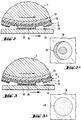
- FIGS. 2 and 2A schematically show, on a much larger scale, how the ink is transferred using a screen dot 35 in the case of a printer form conforming to the state of the technical.
- the weft point 35 it is, for example, a circular relief surface of a weft n ° 16, that is to say a punctual weft of 16 points per cm, as well as point coverage of 60%.
- the surface of this weft point 35 which transfers the ink onto the glass sheet 18 is shown as a solid.
- the ink is expelled at the side edge and at the rear edge of the printing point.
- the ink is distributed over the surface of the glass as observable in FIG. 2A, that is to say that an ink surface 36 is formed in a concentrated half-moon (bead of ink ). In the remaining area, the ink is distributed stochastically with a slight accumulation in the middle.
- FIGS. 3 and 3A show, on the contrary, also on a larger scale and schematically, the configuration of a printing point 39 of a printing form according to the invention and the ink surface 40 thus obtained on the glass sheet 18.
- the printing form 3 again comprises a stabilization sheet 30 and the photopolymer layer 31 carrying the printing screen according to the invention.
- an elastic expanded adhesion sheet 33 which compensates for any surface irregularities.
- the image to be printed is rasterized again, for example using a frame # 16 again with 60% dot coverage.
- the printing point 39 therefore corresponds in size to the printing point 35 in FIG. 2.
- the surface of the printing point 39 is however, in turn, provided with a fine punctual screen, for example of a weft from 60 to 80 stitches per cm.
- the point coverage of this fine point frame amounts, for example, to 40% based on the total area of the halftone print pattern.
- the surface of the printing points of the background screen is increased in proportion, so that a greater quantity of ink adheres thereto.
- the quantity of ink presented by the ink roller is so large that it completely fills the superimposed fine screen, that is to say that unlike the typographic printing methods usually used, the ink is not only on the raised parts, but also in intermediate spaces of the printing dots. This results in greater and overall more uniform ink transfer, as shown in Figure 3A.
- the ink in the intermediate spaces of the superimposed screen of the printing surface is not expelled during the rolling process and in addition to the quantity of ink transferred to the raised points of the superimposed frame, an ink transfer also takes place through the columns of ink in the intermediate spaces.
- a uniform, closed and thicker ink layer 40 is thus formed, the surface dimensions of which correspond to the printing point 39.
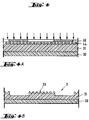
- the process for manufacturing a printing form in accordance with the invention from the photopolymer by photochemical route is explained below with reference to FIG. 4.
- the starting material for the printing form proper consists of a layer 31 formed of a photosensitive photopolymer which is cured by irradiation with UV light, applied to a stabilization sheet 30.
- the superimposed screen is produced by applying one to the other, first a negative film 44 for the fine screen, for example a screen no. 70, then a negative film 46 for the pattern or background screen, by example a frame n ° 16, on the photopolymer film 31 and exposing them simultaneously (FIG. 4A). Where UV radiation reaches the photopolymer layer 31 through the transparent regions of the negatives, the photopolymer layer 31 hardens on the surface. After removal of negatives 44 and 46, the photopolymer layer 31 is treated with a liquid by means of which the unexposed and therefore uncured polymer regions are removed by dissolution.
- the printing form shown in FIG. 4B is obtained, comprising a superposed screen, which, as it is, possibly after an additional hardening treatment, is stretched as a photograph on the cylinder body of the plate cylinder.
- screened sun protection layers made of a baking ink such as an enamel
- sheets of glass used as a transparent roof in vehicles. automobiles for example, a shading of 16 lines per cm and a 30% stitch coverage is superimposed, a fine frame of 70 lines per cm and a 50% stitch coverage.
Landscapes
- Engineering & Computer Science (AREA)
- Chemical & Material Sciences (AREA)
- General Chemical & Material Sciences (AREA)
- Geochemistry & Mineralogy (AREA)
- Mechanical Engineering (AREA)
- Life Sciences & Earth Sciences (AREA)
- Physics & Mathematics (AREA)
- Chemical Kinetics & Catalysis (AREA)
- Ceramic Engineering (AREA)
- General Physics & Mathematics (AREA)
- Materials Engineering (AREA)
- Organic Chemistry (AREA)
- Printing Methods (AREA)
- Manufacture Or Reproduction Of Printing Formes (AREA)
- Printing Plates And Materials Therefor (AREA)
- Photosensitive Polymer And Photoresist Processing (AREA)
Applications Claiming Priority (2)
| Application Number | Priority Date | Filing Date | Title |
|---|---|---|---|
| DE4324577A DE4324577C1 (de) | 1993-07-22 | 1993-07-22 | Druckform für ein Hochdruckverfahren, Verwendung der Druckform zum Bedrucken von Glasoberflächen sowie Verfahren zur Herstellung einer ein Druckraster aufweisenden Druckform für das Flexodruckverfahren |
| DE4324577 | 1993-07-22 |
Publications (2)
| Publication Number | Publication Date |
|---|---|
| EP0635378A2 true EP0635378A2 (de) | 1995-01-25 |
| EP0635378A3 EP0635378A3 (de) | 1995-11-29 |
Family
ID=6493421
Family Applications (1)
| Application Number | Title | Priority Date | Filing Date |
|---|---|---|---|
| EP94401651A Withdrawn EP0635378A3 (de) | 1993-07-22 | 1994-07-19 | Hochdruckplatte und ihre Verwendung für dem Druck auf nicht absorbierenden harten Oberflächen. |
Country Status (5)
| Country | Link |
|---|---|
| EP (1) | EP0635378A3 (de) |
| JP (1) | JPH07228068A (de) |
| KR (1) | KR950003016A (de) |
| CA (1) | CA2128282A1 (de) |
| DE (1) | DE4324577C1 (de) |
Cited By (3)
| Publication number | Priority date | Publication date | Assignee | Title |
|---|---|---|---|---|
| US5884560A (en) * | 1996-10-16 | 1999-03-23 | U.S. Philips Corporation | Printing form for a rotary relief-printing method |
| US6776100B2 (en) | 2001-12-21 | 2004-08-17 | Thomas V. Cutcher | Method and apparatus for transferring an image to a substrate |
| CN101501239B (zh) * | 2006-10-06 | 2012-03-07 | 株式会社爱发科 | 卷绕式真空成膜装置 |
Families Citing this family (11)
| Publication number | Priority date | Publication date | Assignee | Title |
|---|---|---|---|---|
| DE29801017U1 (de) * | 1998-01-23 | 1998-03-05 | MAN Roland Druckmaschinen AG, 63075 Offenbach | Beschichtungseinheit für eine Druckmaschine und Hochdruckplatte |
| DE10107556A1 (de) * | 2001-02-17 | 2002-09-05 | Saueressig Gmbh & Co | Druckform mit einer elastischen Funktionsschicht |
| US6718874B2 (en) * | 2001-11-06 | 2004-04-13 | Lawrence W. Gross | Apparatus and method for eliminating dot gain in flexographic printing systems |
| DE10201351B4 (de) * | 2002-01-16 | 2005-04-07 | Ovd Kinegram Ag | Druckverfahren und zugehörige Druckvorrichtung |
| EP1834214A2 (de) * | 2005-01-07 | 2007-09-19 | Amcor Rentsch Rickenbach AG | Prozess für reliefdruck |
| DE102007030197A1 (de) * | 2007-06-27 | 2009-01-02 | Hauni Maschinenbau Ag | Druckwerk einer Maschine der Tabak verarbeitenden Industrie |
| US8399177B2 (en) * | 2008-12-08 | 2013-03-19 | Eastman Kodak Company | Enhanced relief printing plate |
| DE102010045255A1 (de) * | 2010-09-14 | 2012-03-15 | Gizeh Verpackungen Gmbh & Co. Kg | Verfahren und Vorrichtung zum Bedrucken balliger und/oder taillierter rotationssymmetrischer Behälter |
| CN107249901B (zh) | 2015-02-27 | 2019-03-22 | 富士胶片株式会社 | 柔版印刷版、柔版印刷版的制造方法及柔版印刷版原版 |
| WO2017002648A1 (ja) * | 2015-06-30 | 2017-01-05 | 富士フイルム株式会社 | フレキソ印刷版、フレキソ印刷版原版、および、これらの製造方法 |
| EP3401113B1 (de) | 2016-01-04 | 2021-04-14 | FUJIFILM Corporation | Flexodruckplatte, flexodruckplattenvorläufer und herstellungsverfahren dafür |
Family Cites Families (10)
| Publication number | Priority date | Publication date | Assignee | Title |
|---|---|---|---|---|
| CH94696A (de) * | 1920-12-13 | 1922-05-01 | Winkler Fallert & Co Maschf | Klischee für Autotypiedruck. |
| GB432716A (en) * | 1934-01-29 | 1935-07-29 | Robinson E S & A Ltd | Improvements in or relating to letterpress or relief printing |
| GB901412A (en) * | 1957-05-02 | 1962-07-18 | Arthur Ernest Field | Improvements in or relating to printing plates |
| JPS5863495A (ja) * | 1981-10-12 | 1983-04-15 | Sanbii Kk | ゴム印版の製造方法 |
| DE3730194A1 (de) * | 1987-09-09 | 1989-03-23 | Bonner Zeitungsdruckerei | Druckplatte, insbesondere fuer den zeitungsrotations-hochdruck |
| CA2036424A1 (en) * | 1990-02-23 | 1991-08-24 | Albert C. Chiang | Photopolymer printing plates having a dimpled printing surface |
| US5189952A (en) * | 1990-03-09 | 1993-03-02 | Asahi Glass Company, Ltd. | Process for producing window glass with thin film thereon |
| DE4129578C2 (de) * | 1991-09-06 | 1994-12-22 | Ver Glaswerke Gmbh | Glasscheibe mit verminderter Lichtdurchlässigkeit und Verfahren zu ihrer Herstellung sowie ihre Verwendung |
| WO1993006942A1 (en) * | 1991-10-11 | 1993-04-15 | Webcraft Technologies, Inc. | Method of printing with viscous high solids, and microencapsulated materials, and resultant product |
| EP0619192B1 (de) * | 1993-04-05 | 1998-06-10 | De La Rue Giori S.A. | Druckplatte |
-
1993
- 1993-07-22 DE DE4324577A patent/DE4324577C1/de not_active Expired - Fee Related
-
1994
- 1994-07-18 CA CA002128282A patent/CA2128282A1/fr not_active Abandoned
- 1994-07-19 EP EP94401651A patent/EP0635378A3/de not_active Withdrawn
- 1994-07-22 JP JP6170872A patent/JPH07228068A/ja active Pending
- 1994-07-22 KR KR1019940017738A patent/KR950003016A/ko not_active Withdrawn
Cited By (3)
| Publication number | Priority date | Publication date | Assignee | Title |
|---|---|---|---|---|
| US5884560A (en) * | 1996-10-16 | 1999-03-23 | U.S. Philips Corporation | Printing form for a rotary relief-printing method |
| US6776100B2 (en) | 2001-12-21 | 2004-08-17 | Thomas V. Cutcher | Method and apparatus for transferring an image to a substrate |
| CN101501239B (zh) * | 2006-10-06 | 2012-03-07 | 株式会社爱发科 | 卷绕式真空成膜装置 |
Also Published As
| Publication number | Publication date |
|---|---|
| JPH07228068A (ja) | 1995-08-29 |
| EP0635378A3 (de) | 1995-11-29 |
| KR950003016A (ko) | 1995-02-16 |
| DE4324577C1 (de) | 1994-12-15 |
| CA2128282A1 (fr) | 1995-01-23 |
Similar Documents
| Publication | Publication Date | Title |
|---|---|---|
| EP0635378A2 (de) | Hochdruckplatte und ihre Verwendung für dem Druck auf nicht absorbierenden harten Oberflächen | |
| EP0091709B1 (de) | Tiefdruckmaschine zum Drucken von Wertpapieren | |
| CN101622121B (zh) | 通过凹版印刷印刷精细图形的方法以及通过凹版印刷印刷精细图形的印刷系统 | |
| US9023591B2 (en) | Inkjet printable flexography substrate and method of using | |
| CN105377566A (zh) | 使用软质光聚合物板的印刷工艺 | |
| CN1542550A (zh) | 在任意尺寸的柔顺介质上复制高分辨率三维压印图案的方法 | |
| US9726971B2 (en) | Printable laminates for flexo plates, methods of making, and methods of using | |
| CN103201113A (zh) | 使用无端带状印刷板的印刷装置及其印刷方法以及带状印刷板的安装方法 | |
| GB2066159A (en) | An intaglio printing plate and a printing method | |
| US4566384A (en) | Intaglio printing plate and printing method | |
| CH632854A5 (fr) | Forme imprimante vierge pour heliogravure et procede de fabrication de cette forme. | |
| JP2515521B2 (ja) | 改良されたマスキング露光方法及びそれを用いた製版方法 | |
| EP0806304B1 (de) | Übertragungsfläche für eine mehr oder weniger viskose Flüssigkeit und diese Fläche verwendendes Flachdruckverfahren | |
| FR2596676A1 (fr) | Procede de realisation d'une surface adhesive et support adhesif obtenu, en particulier en vue du transfert d'un element | |
| US9174480B2 (en) | Inkjet-printable flexography substrate, method of making, and method of using | |
| FR2507542A1 (fr) | Procede de glacage des images sur des objets imprimes et appareil pour la mise en oeuvre de ce procede | |
| FR2392420A1 (fr) | Dispositif pour produire une plaque d'un photo-polymere, ayant des zones d'image en relief | |
| EP1346847A3 (de) | Druckmaschine, Vorrichtung und Verfahren zum Regenerieren einer Druckplatte | |
| JP3923655B2 (ja) | クッション性を有する凹版 | |
| FR2544254A1 (fr) | Procede et dispositif de marquage par impression de produits tubulaires | |
| JPH06115049A (ja) | 水圧転写装置 | |
| WO1997035233A1 (fr) | Procede et dispositif industriels de preparation de plaques positives, destinees a l'impression offset, allegees ou pre-allegees | |
| FR2504062A1 (fr) | Duplicateur d'impression offset en couleurs tramees | |
| FR2559426A1 (fr) | Plaque flexographique | |
| US1562323A (en) | Method of lithographic printing |
Legal Events
| Date | Code | Title | Description |
|---|---|---|---|
| PUAI | Public reference made under article 153(3) epc to a published international application that has entered the european phase |
Free format text: ORIGINAL CODE: 0009012 |
|
| AK | Designated contracting states |
Kind code of ref document: A2 Designated state(s): BE CH DE ES FR GB IT LI LU NL PT SE |
|
| RAX | Requested extension states of the european patent have changed |
Free format text: SI PAYMENT 940722 |
|
| PUAL | Search report despatched |
Free format text: ORIGINAL CODE: 0009013 |
|
| AK | Designated contracting states |
Kind code of ref document: A3 Designated state(s): BE CH DE ES FR GB IT LI LU NL PT SE |
|
| 17P | Request for examination filed |
Effective date: 19960115 |
|
| 17Q | First examination report despatched |
Effective date: 19970320 |
|
| STAA | Information on the status of an ep patent application or granted ep patent |
Free format text: STATUS: THE APPLICATION IS DEEMED TO BE WITHDRAWN |
|
| 18D | Application deemed to be withdrawn |
Effective date: 19980311 |