EP0635480A1 - Dérivés de l'anthracène - Google Patents
Dérivés de l'anthracène Download PDFInfo
- Publication number
- EP0635480A1 EP0635480A1 EP94305123A EP94305123A EP0635480A1 EP 0635480 A1 EP0635480 A1 EP 0635480A1 EP 94305123 A EP94305123 A EP 94305123A EP 94305123 A EP94305123 A EP 94305123A EP 0635480 A1 EP0635480 A1 EP 0635480A1
- Authority
- EP
- European Patent Office
- Prior art keywords
- anthracene
- formula
- tris
- group
- hydroxybenzoyloxy
- Prior art date
- Legal status (The legal status is an assumption and is not a legal conclusion. Google has not performed a legal analysis and makes no representation as to the accuracy of the status listed.)
- Granted
Links
- 0 CCC(C)(CC(CC(C(C1CC1)C1CC(C)CC1)=C1*C1)CCC(C)(C1)C(C)C(C)C)CC1(C)C1(*)C2(CC2)C1C Chemical compound CCC(C)(CC(CC(C(C1CC1)C1CC(C)CC1)=C1*C1)CCC(C)(C1)C(C)C(C)C)CC1(C)C1(*)C2(CC2)C1C 0.000 description 2
- KUWSFWBUUJNOSS-AXDSSHIGSA-N CN[C@@H](C1)C1C1CCCCC1 Chemical compound CN[C@@H](C1)C1C1CCCCC1 KUWSFWBUUJNOSS-AXDSSHIGSA-N 0.000 description 1
Images

Classifications
-
- C—CHEMISTRY; METALLURGY
- C07—ORGANIC CHEMISTRY
- C07C—ACYCLIC OR CARBOCYCLIC COMPOUNDS
- C07C69/00—Esters of carboxylic acids; Esters of carbonic or haloformic acids
- C07C69/76—Esters of carboxylic acids having a carboxyl group bound to a carbon atom of a six-membered aromatic ring
- C07C69/84—Esters of carboxylic acids having a carboxyl group bound to a carbon atom of a six-membered aromatic ring of monocyclic hydroxy carboxylic acids, the hydroxy groups and the carboxyl groups of which are bound to carbon atoms of a six-membered aromatic ring
- C07C69/88—Esters of carboxylic acids having a carboxyl group bound to a carbon atom of a six-membered aromatic ring of monocyclic hydroxy carboxylic acids, the hydroxy groups and the carboxyl groups of which are bound to carbon atoms of a six-membered aromatic ring with esterified carboxyl groups
-
- H—ELECTRICITY
- H10—SEMICONDUCTOR DEVICES; ELECTRIC SOLID-STATE DEVICES NOT OTHERWISE PROVIDED FOR
- H10P—GENERIC PROCESSES OR APPARATUS FOR THE MANUFACTURE OR TREATMENT OF DEVICES COVERED BY CLASS H10
- H10P76/00—Manufacture or treatment of masks on semiconductor bodies, e.g. by lithography or photolithography
-
- C—CHEMISTRY; METALLURGY
- C07—ORGANIC CHEMISTRY
- C07C—ACYCLIC OR CARBOCYCLIC COMPOUNDS
- C07C2603/00—Systems containing at least three condensed rings
- C07C2603/02—Ortho- or ortho- and peri-condensed systems
- C07C2603/04—Ortho- or ortho- and peri-condensed systems containing three rings
- C07C2603/22—Ortho- or ortho- and peri-condensed systems containing three rings containing only six-membered rings
- C07C2603/24—Anthracenes; Hydrogenated anthracenes
Definitions
- This invention relates to an anthracene derivative usable as a material for semiconductors, an intermediate for medicines, an intermediate for dyes and a functional material for optical recording materials, etc., and particularly useful as a material for producing an antireflection coating in the field of semiconductors.
- Chemically amplified resist materials are now studied for applying to fine pattern formation using deep ultraviolet light (300 nm or less), such as KrF excimer laser beams (248.4 nm). But when these resist materials are used for highly reflective substrates such as aluminum wired substrates, there arise strong influences by in-layer multiple reflection caused by reflection of exposing light from semiconductor substrates due to high transmittivity of the resist materials for deep ultraviolet light, etc. When film thickness of resists is changed remarkably by level difference, etc. caused by the influences of in-layer multiple reflection, resist pattern dimension changes greatly, resulting in causing a problem of disconnection, and the like. In order to prevent the in-layer multiple reflection, the formation of an antireflection coating on a semiconductor substrate is now studying. But no suitable materials usable as antireflection coating for deep ultraviolet light such as KrF excimer laser beams are found yet.
- the present invention provides an anthracene derivative of the formula: wherein R1 and R2 are independently a hydrogen atom, an alkyl group, an alkoxy group, a halogen atom or a hydroxyl group; R3, R4, R5 and R6 are independently a hydrogen atom, an alkyl group, an alkoxy group, a halogen atom, or a group of the formula: wherein R1 and R2 are as defined above, provided that at least one of R3 through R6 is the group of the formula [II], and the group of the formula [II] in number of 3 cannot be positioned at the 1, 8 and 9 positions of the anthracene ring at the same time.
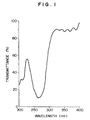
- Fig. 1 shows a ultraviolet spectroscopic curve of the antireflection coating obtained in Reference Example 2.
- Figs. 2A to 2E are cross-sectional views explaining the formation of a pattern using an antireflection coating material using the anthracene derivative of the present invention as an undercoating agent.
- the anthracene derivative of the present invention is represented by the formula: wherein R1 and R2 are independently a hydrogen atom, a lower alkyl group preferably having 1 to 6 carbon atoms, more preferably 1 to 4 carbon atoms, a lower alkoxy group preferably having 1 to 6 carbon atoms, more preferably 1 to 4 carbon atoms, a halogen atom such as chlorine, bromine and iodine, or a hydroxyl group; R3, R4, R5 and R6 are independently a hydrogen atom, a lower alkyl group preferably having 1 to 6 carbon atoms, more preferably 1 to 4 carbon atoms, a lower alkoxy group preferably having 1 to 6 carbon atoms, more preferably 1 to 4 carbon atoms, a halogen atom such as chlorine, bromine or iodine, or a group of the formula: wherein R1 and R2 are as defined above, provided that at least one of R3 to R6 is the group of the formula [II],
- the anthracene derivative of the formula [I] is particularly effective as a material for preparing an antireflection coating, which is used for preventing reflection of exposing light from a substrate at the time of resist pattern formation by lithography using deep ultraviolet light such as KrF excimer laser beams and is required to absorb deep ultraviolet light, to improve heat resistance of the antireflection coating and to have an ability not causing intermixing of the antireflection coating with a resist material coated thereon at the interface.
- the present inventors noticed a series of compounds having in the molecule two or more phenolic hydroxyl groups which are capable of causing crosslinking reaction with a resin having one or more glycidyl groups on heating and also having in the molecule an anthracene skeleton showing strong absorption at around 220-300 nm.
- the present inventors have successfully found out the compounds represented by the formula [I] having electron attractive groups such as -OCO- group introduced into the p- or m-position with regard to the phenolic hydroxyl group for facilitating said thermal crosslinking reaction.
- the compounds represented by the formula [I] can be easily synthesized by, for example, the following method (a), (b) or (c).
- an anthraquinone derivative having at least one hydroxyl group is dissolved in 5-20 times as large as in volume of acetic acid or propionic acid, followed by addition of excess amounts of concentrated hydrochloric acid and stannous chloride to carry out a reducing reaction at 10 to 120°C to form an anthracenetriol derivative.
- This anthracenetriol derivative (1 mole) is reacted with 2 moles or more (3 moles in the reaction scheme 1) of p-benzyloxybenzoyl chloride in the presence of 2 moles or more (3 moles in the reaction scheme 1) of a base (e.g.
- triethylamine, piperidine, NaOH, KOH, NaH or the like in 1-20 times as much volume of a suitable organic solvent (e.g., triethylamine, pyridine, methylene chloride, toluene, ethyl ether, tetrahydrofuran or the like) at 0-150°C for 30 minutes to 20 hours to give an objective compound wherein the hydroxyl group is protected (benzyl group in the case of the reaction scheme 1).
- a suitable organic solvent e.g., triethylamine, pyridine, methylene chloride, toluene, ethyl ether, tetrahydrofuran or the like
- This compound is then subjected to hydrogenation reaction in 1-20 times as much volume of a suitable organic solvent (e.g., methanol, ethanol, propanol, isopropanol, tetrahydrofuran, methylene chloride, chloroform or the like) in the presence of a catalyst such as Raney nickel, palladium on carbon or the like under normal pressure to 50 kg/cm2 (initial hydrogen pressure) at 0-50°C for 1-10 hours to give an objective compound of the formula [I].
- a suitable organic solvent e.g., methanol, ethanol, propanol, isopropanol, tetrahydrofuran, methylene chloride, chloroform or the like
- a catalyst such as Raney nickel, palladium on carbon or the like under normal pressure to 50 kg/cm2 (initial hydrogen pressure) at 0-50°C for 1-10 hours
- An anthraquinone derivative having 2 hydroxyl groups for example, 2,6-dihydroxyanthraquinone
- an alkylating agent such as dimethyl sulfate
- a base such as anhydrous potassium carbonate, etc.
- zinc/ammonia water to give, for example, 2,6-dimethoxyanthracene having the protected hydroxyl groups at the 2,6-positions.
- the protective groups of hydroxyl groups are eliminated by reaction with, for example, boron tribromide to form 2,6-dihydroxyanthracene.
- This is esterified with p-benzyloxybenzoyl chloride, etc. and subjected to hydrogenation reaction to eliminate the protective groups (benzyl group) in the same way as in the above-described method (a) to give a compound of the formula [I].
- An anthraquinone derivative having 3 or more hydroxyl groups for example, 6-methyl-1,3,8-trihydroxyanthraquinone
- the protective groups of this hydroxyl groups are eliminated by reaction with, for example, boron tribromide to form 6-methyl-1,3,8-trihydroxyanthracene.
- This is esterified with p-benzyloxybenzoyl chloride, etc. and then the protective groups (benzyl groups) of the hydroxyl groups are eliminated by catalytic reduction or other means to give an objective compound of the formula [I].
- An anthracene derivative of the formula [I] and a resin having at least one glycidyl group (an epoxy group) in the molecule for example, a homopolymer or copolymer of glycidyl methacrylate are dissolved in a suitable organic solvent such as propylene glycol monomethyl ether acetate, tetrahydrofurfuryl alcohol, diethylene glycol dimethyl ether, etc.
- a suitable organic solvent such as propylene glycol monomethyl ether acetate, tetrahydrofurfuryl alcohol, diethylene glycol dimethyl ether, etc.
- the resulting mixture is spin coated on a semiconductor substrate and heat at 150°C or higher.
- a crosslinking reaction between the glycidyl groups of the resin and the anthracene derivative of the formula [I] takes place as shown in the following formula (4) to give an antireflection coating excellent in heat resistance.
- Both the anthracene derivative of the formula [I] which functions as a crosslinking agent, and the resin having one or more glycidyl(epoxy) groups in the molecule are soluble in acetone and a solvent for resist materials, but the antireflection coating obtained by the crosslinking reaction of the formula (4) is not soluble in the above-mentioned solvents.
- a pattern is formed as follows.
- a resist material for KrF excimer laser beams for example, is spin coated, and baked to form a resist material.
- deep ultraviolet light such as KrF excimer laser beams
- the deep ultraviolet light such as KrF excimer laser beams transmitting via the resist film is absorbed due to the presence of anthracene ring in the antireflection coating to prevent the reflection from the semiconductor substrate.
- the undesirable influences caused by the in-layer multiple reflection which is a serious problem in this art can be prevented completely, resulting in causing no dimensional change even if a resist pattern is formed on a highly reflective substrate such as an aluminum wiring substrate, or a level different substrate.
- the antireflection coating formed from the anthracene derivative of the formula [I] and a resin having one or more glycidyl groups is not dissolved in a solution of resist, there brings about no intermixture with the resist at the interface. Thus, the dimensional change of the resist pattern does not take place.
- the anthracene compound of the formula [I] can also be used as an intermediate for medicines, dyes, etc., and a functional material for optical recording media, etc.
- An antireflection coating material having the following composition was prepared: poly(methyl methacrylate/glycidyl methacrylate/2,3-dihydroxypropyl methacrylate) (the resin of Reference Example 1) 4.0 g 2,6,9-tris(4-hydroxybenzoyloxy)anthracene (the compound of Example 1) 1.0 g tetrahydrofurfuryl alcohol 45.0 g propylene glycol monomethyl ether acetate 50.0 g
- the above-mentioned composition was spin coated on a substrate (silicon wafer) and baked at 200°C for 20 seconds on a hot plate to give a deep ultraviolet absorbing material film with 100 nm thick. Then, the resulting film was subjected to measurement with ultraviolet (UV) light.
- UV ultraviolet
- Fig. 1 shows UV spectrum. As is clear from Fig. 1, the film has an absorption at near 250 nm.
- the deep ultraviolet absorbent film was not dissolved in acetone at all. This showed that crosslinking reaction took place.
- a chemically amplified positive resist material having the following composition was prepared:
- the antireflection coating material 2 of Reference Example 2 was spin coated and baked at 200°C for 90 seconds on a hot plate to give an antireflection coating of 100 nm thick (Fig. 2A) and insoluble in acetone at all. Then, the chemically amplified positive resist material 3 mentioned above as spin coated on the antireflection coating, and prebaked at 90°C for 90 second on a hot plate to give a resist material film of 1.0 ⁇ m thick (Fig. 2B).
- the resulting substrate was exposed selectively via a mask 5 to KrF excimer laser beams 4 (248.4 nm) (Fig. 2C).
- a mask 5 to KrF excimer laser beams 4 (248.4 nm)
- Fig. 2C After post baking at 100°C for 90 seconds on a hot plate, development with an alkaline developing solution (an aqueous solution of 2.38% tetramethylammonium hydroxide) was carried out for 60 seconds to remove only exposed portions of the resist material 3 by dissolution.
- an alkaline developing solution an aqueous solution of 2.38% tetramethylammonium hydroxide
- the obtained positive type pattern had a resolution of line and space of 0.25 ⁇ m with good pattern shape (a rectangle).
- the exposing light amount was about 30 mJ/cm2.
- the deep ultraviolet light absorbing material film 2 and the aluminum substrate 1 were etched with an oxygen gas and a chlorine-based gas in this order (Fig. 2E).
- the formed etching pattern 1a had the same size as the resist pattern 3a without causing dimensional change with a good pattern.
- Antireflection coating materials having compositions as shown in Table 1 were prepared.
- Table 2 Reference Example No. Exposed light amount (mJ/cm2) 0.25 ⁇ m Pattern Halation 4 30 Good shape Effective for prevention 5 32 Good shape Effective for prevention 6 28 Good shape Effective for prevention 7 30 Good shape Effective for prevention 8 30 Good shape Effective for prevention 9 28 Good shape Effective for prevention 10 31 Good shape Effective for prevention
- a film forming material having the following composition was prepared: Poly(methyl methacrylate/glycidyl methacrylate/2,3-dihydroxypropyl methacrylate) [resin of Reference Example 1] 4.0 g 1,8,9-Tris(4-hydroxybenzoyloxy)-anthracene [compound disclosed in DE-OS 2,257,442] 1.0 g Tetrahydrofurfuryl alcohol 45.0 g Propylene glycol monomethyl ether acetate 50.0 g
- the above-mentioned composition was spin coated on a substrate (silicon wafer) and baked at 200°C for 90 seconds by a hot plate to give an absorbent film of 100 nm thick. When the absorbent film was immersed in acetone, it was easily dissolved.
- anthracene derivative of the formula [I] when mixed with a resin having at least one glycidyl group and coated on a highly reflective substrate made of aluminum, aluminum-silicon, or polysilicon, etc. or a level difference substrate as an undercoating material for an exposing resist material for deep ultraviolet light (300 nm or less) and KrF excimer laser beams (248.4 nm), there can be obtained good pattern shape with a quarter micron order without generating notching or halation which often causes disconnection of the substrate, while maintaining high resolution ability and high sensitivity.
- the anthracene derivative of the formula [I] has a great value in forming ultra-fine patterns in semiconductor industry.
Landscapes
- Chemical & Material Sciences (AREA)
- Organic Chemistry (AREA)
- Organic Low-Molecular-Weight Compounds And Preparation Thereof (AREA)
- Exposure Of Semiconductors, Excluding Electron Or Ion Beam Exposure (AREA)
Applications Claiming Priority (2)
| Application Number | Priority Date | Filing Date | Title |
|---|---|---|---|
| JP20036493 | 1993-07-20 | ||
| JP200364/93 | 1993-07-20 |
Publications (2)
| Publication Number | Publication Date |
|---|---|
| EP0635480A1 true EP0635480A1 (fr) | 1995-01-25 |
| EP0635480B1 EP0635480B1 (fr) | 1997-03-19 |
Family
ID=16423080
Family Applications (1)
| Application Number | Title | Priority Date | Filing Date |
|---|---|---|---|
| EP94305123A Expired - Lifetime EP0635480B1 (fr) | 1993-07-20 | 1994-07-13 | Dérivés de l'anthracène |
Country Status (4)
| Country | Link |
|---|---|
| US (1) | US5498748A (fr) |
| EP (1) | EP0635480B1 (fr) |
| KR (1) | KR100255985B1 (fr) |
| DE (1) | DE69402126T2 (fr) |
Cited By (4)
| Publication number | Priority date | Publication date | Assignee | Title |
|---|---|---|---|---|
| US6083665A (en) * | 1996-09-10 | 2000-07-04 | Tokyo Ohka Kogyo Co., Ltd. | Photoresist laminate and method for patterning using the same |
| WO2008062466A3 (fr) * | 2006-10-13 | 2008-09-25 | Reliance Life Sciences Pvt Ltd | Nouveaux agents chimiothérapeutiques contre l'inflammation et le cancer |
| EP1484645A4 (fr) * | 2002-02-19 | 2008-12-17 | Nissan Chemical Ind Ltd | Composition de formation d'un revetement antireflet |
| WO2009000864A1 (fr) * | 2007-06-25 | 2008-12-31 | Fundació Privada Institut D'investigació Biomèdica De Girona Dr. Josep Trueta | Nouveaux composés polyhydroxylés comme inhibiteurs d'acide gras synthases (fasn) |
Families Citing this family (16)
| Publication number | Priority date | Publication date | Assignee | Title |
|---|---|---|---|---|
| US5886102A (en) * | 1996-06-11 | 1999-03-23 | Shipley Company, L.L.C. | Antireflective coating compositions |
| US5976770A (en) * | 1998-01-15 | 1999-11-02 | Shipley Company, L.L.C. | Dyed photoresists and methods and articles of manufacture comprising same |
| US6190839B1 (en) | 1998-01-15 | 2001-02-20 | Shipley Company, L.L.C. | High conformality antireflective coating compositions |
| US6410209B1 (en) | 1998-09-15 | 2002-06-25 | Shipley Company, L.L.C. | Methods utilizing antireflective coating compositions with exposure under 200 nm |
| US6316165B1 (en) * | 1999-03-08 | 2001-11-13 | Shipley Company, L.L.C. | Planarizing antireflective coating compositions |
| EP1190277B1 (fr) * | 1999-06-10 | 2009-10-07 | AlliedSignal Inc. | Semiconducteur ayant un enduit antireflet spin-on-glass pour photolithographie |
| US6824879B2 (en) | 1999-06-10 | 2004-11-30 | Honeywell International Inc. | Spin-on-glass anti-reflective coatings for photolithography |
| KR20040075866A (ko) * | 2001-11-15 | 2004-08-30 | 허니웰 인터내셔날 인코포레이티드 | 포토리소그래피용 스핀-온 무반사 코팅 |
| US20050173803A1 (en) * | 2002-09-20 | 2005-08-11 | Victor Lu | Interlayer adhesion promoter for low k materials |
| US8053159B2 (en) | 2003-11-18 | 2011-11-08 | Honeywell International Inc. | Antireflective coatings for via fill and photolithography applications and methods of preparation thereof |
| US20060255315A1 (en) * | 2004-11-19 | 2006-11-16 | Yellowaga Deborah L | Selective removal chemistries for semiconductor applications, methods of production and uses thereof |
| US8642246B2 (en) * | 2007-02-26 | 2014-02-04 | Honeywell International Inc. | Compositions, coatings and films for tri-layer patterning applications and methods of preparation thereof |
| US8557877B2 (en) | 2009-06-10 | 2013-10-15 | Honeywell International Inc. | Anti-reflective coatings for optically transparent substrates |
| US8864898B2 (en) | 2011-05-31 | 2014-10-21 | Honeywell International Inc. | Coating formulations for optical elements |
| JP6803842B2 (ja) | 2015-04-13 | 2020-12-23 | ハネウェル・インターナショナル・インコーポレーテッドHoneywell International Inc. | オプトエレクトロニクス用途のためのポリシロキサン製剤及びコーティング |
| JP7302480B2 (ja) | 2017-12-22 | 2023-07-04 | 日産化学株式会社 | ジオール構造を有する保護膜形成組成物 |
Citations (1)
| Publication number | Priority date | Publication date | Assignee | Title |
|---|---|---|---|---|
| DE2257442A1 (de) * | 1971-11-26 | 1973-05-30 | Sterwin Ag | Anthracenderivate, verfahren zu deren herstellung und deren verwendung |
Family Cites Families (7)
| Publication number | Priority date | Publication date | Assignee | Title |
|---|---|---|---|---|
| JPH0612452B2 (ja) * | 1982-09-30 | 1994-02-16 | ブリュ−ワ−・サイエンス・インコ−ポレイテッド | 集積回路素子の製造方法 |
| US4822718A (en) * | 1982-09-30 | 1989-04-18 | Brewer Science, Inc. | Light absorbing coating |
| JPS59135748A (ja) * | 1983-01-24 | 1984-08-04 | Hitachi Ltd | 多層配線用層間絶縁膜を有する半導体装置 |
| US4843097A (en) * | 1984-06-13 | 1989-06-27 | Groupement D'interet Economique Dit: Centre International De Recherches Dermatologiques C.I.R.D. | 10-aryl-1,8-dihydroxy-9-anthrones and their esters, process for preparing same, and use of same in human and veterinary medicine and in cosmetics |
| FR2591222B1 (fr) * | 1985-12-11 | 1988-07-22 | Cird | Mono, di et tri-esters de dihydroxy-1,8 phenyl-10 anthrone-9 ou anthranol-9, leur procede de preparation et leur utilisation en medecine humaine ou veterinaire et en cosmetique |
| JPH04298505A (ja) * | 1991-02-28 | 1992-10-22 | Ipposha Oil Ind Co Ltd | 高分子の光安定化方法およびプラスチック用紫外線吸収剤 |
| JPH0547656A (ja) * | 1991-08-08 | 1993-02-26 | Mitsubishi Electric Corp | レジストパターンの形成方法および該方法に用いられる反射防止膜形成用有機シラン化合物 |
-
1994
- 1994-07-11 US US08/272,753 patent/US5498748A/en not_active Expired - Lifetime
- 1994-07-13 EP EP94305123A patent/EP0635480B1/fr not_active Expired - Lifetime
- 1994-07-13 DE DE69402126T patent/DE69402126T2/de not_active Expired - Fee Related
- 1994-07-19 KR KR1019940017434A patent/KR100255985B1/ko not_active Expired - Fee Related
Patent Citations (1)
| Publication number | Priority date | Publication date | Assignee | Title |
|---|---|---|---|---|
| DE2257442A1 (de) * | 1971-11-26 | 1973-05-30 | Sterwin Ag | Anthracenderivate, verfahren zu deren herstellung und deren verwendung |
Cited By (5)
| Publication number | Priority date | Publication date | Assignee | Title |
|---|---|---|---|---|
| US6083665A (en) * | 1996-09-10 | 2000-07-04 | Tokyo Ohka Kogyo Co., Ltd. | Photoresist laminate and method for patterning using the same |
| EP1484645A4 (fr) * | 2002-02-19 | 2008-12-17 | Nissan Chemical Ind Ltd | Composition de formation d'un revetement antireflet |
| WO2008062466A3 (fr) * | 2006-10-13 | 2008-09-25 | Reliance Life Sciences Pvt Ltd | Nouveaux agents chimiothérapeutiques contre l'inflammation et le cancer |
| WO2009000864A1 (fr) * | 2007-06-25 | 2008-12-31 | Fundació Privada Institut D'investigació Biomèdica De Girona Dr. Josep Trueta | Nouveaux composés polyhydroxylés comme inhibiteurs d'acide gras synthases (fasn) |
| EP2019091A1 (fr) * | 2007-06-25 | 2009-01-28 | Fundació Privada Institut d'Investigació Biomédica de Girona - Dr. Josep Trueta | Nouveaux composés polyhydroxydés en tant qu'inhibiteurs de l'acide gras synthase (FASN) |
Also Published As
| Publication number | Publication date |
|---|---|
| EP0635480B1 (fr) | 1997-03-19 |
| KR950004377A (ko) | 1995-02-17 |
| KR100255985B1 (ko) | 2000-06-01 |
| DE69402126T2 (de) | 1997-09-18 |
| DE69402126D1 (de) | 1997-04-24 |
| US5498748A (en) | 1996-03-12 |
Similar Documents
| Publication | Publication Date | Title |
|---|---|---|
| EP0635480B1 (fr) | Dérivés de l'anthracène | |
| EP0636941B1 (fr) | Composition absorbant dans l'UV profond et son utilisation lors de la réalisation de motifs | |
| KR101398293B1 (ko) | 비스(아미노페놀) 유도체 및 그 제조 방법, 및 폴리아미드 수지류, 포지티브형 감광성 수지 조성물, 보호막, 층간 절연막, 반도체 장치 및 표시 소자 | |
| US6492441B2 (en) | Anti reflective coating polymers and the preparation method thereof | |
| CN113200858B (zh) | 基于三蝶烯衍生物单分子树脂的合成、正性光刻胶及其在光刻中的应用 | |
| JP3268949B2 (ja) | 遠紫外光吸収材料及びこれを用いたパターン形成方法 | |
| KR20010057925A (ko) | 유기 반사방지 화합물 및 그의 제조방법 | |
| JP3417071B2 (ja) | 新規なアントラセン誘導体 | |
| JP4162389B2 (ja) | 有機反射防止膜の組成物及びその製造方法 | |
| US5250669A (en) | Photosensitive compound | |
| JP4507658B2 (ja) | 環状アミノフェノール化合物、環状熱硬化性樹脂、その製造法、絶縁膜用材料、絶縁膜用コーティングワニス、及び、これらを用いた絶縁膜並びに半導体装置 | |
| US6531632B2 (en) | Bis-o-aminophenols and o-aminophenolcarboxylic acids and process for preparing the same | |
| CN100376544C (zh) | 铝及铜技术中绝缘材质单体 | |
| CN112552280A (zh) | 一种高产酸的磺酰亚胺类光产酸剂 | |
| Akelah et al. | Photosensitive polymers containing pendent chalcone moieties via oxyethylene group | |
| CN117658997A (zh) | 磺酸酯类光产酸剂及其制备方法、图形化方法、抗蚀剂组合物及其应用 | |
| TWI650310B (zh) | 新穎脂環式酯化合物之製造方法、新穎脂環式酯化合物、該化合物所聚合而成之(甲基)丙烯酸酯共聚物、及含該共聚物之感光性樹脂組成物 | |
| Fujisawa et al. | Non-chemically amplified negative molecular resist materials using polarity change by EUV exposure | |
| TW201546042A (zh) | (甲基)丙烯酸酯化合物及其製造方法 | |
| JP2002105137A (ja) | 有機反射防止膜の組成物及びその製造方法 | |
| US6100008A (en) | Positive photoresist with improved contrast ratio and photospeed | |
| CN118580408A (zh) | 一类适用于多种波长光刻的联苯类非化学放大型光刻胶及其制备方法和应用 | |
| KR102806632B1 (ko) | 옥심에스테르계 화합물 및 옥심에스테르계 화합물 제조방법 | |
| JP2003192649A (ja) | カリックスアレーン誘導体およびその製造方法 | |
| CN121318842A (zh) | 一种磺酸酯类光产酸剂及其制备方法和应用 |
Legal Events
| Date | Code | Title | Description |
|---|---|---|---|
| PUAI | Public reference made under article 153(3) epc to a published international application that has entered the european phase |
Free format text: ORIGINAL CODE: 0009012 |
|
| AK | Designated contracting states |
Kind code of ref document: A1 Designated state(s): DE FR GB |
|
| 17P | Request for examination filed |
Effective date: 19950724 |
|
| GRAG | Despatch of communication of intention to grant |
Free format text: ORIGINAL CODE: EPIDOS AGRA |
|
| 17Q | First examination report despatched |
Effective date: 19960703 |
|
| GRAH | Despatch of communication of intention to grant a patent |
Free format text: ORIGINAL CODE: EPIDOS IGRA |
|
| GRAH | Despatch of communication of intention to grant a patent |
Free format text: ORIGINAL CODE: EPIDOS IGRA |
|
| GRAA | (expected) grant |
Free format text: ORIGINAL CODE: 0009210 |
|
| AK | Designated contracting states |
Kind code of ref document: B1 Designated state(s): DE FR GB |
|
| REF | Corresponds to: |
Ref document number: 69402126 Country of ref document: DE Date of ref document: 19970424 |
|
| ET | Fr: translation filed | ||
| PLBE | No opposition filed within time limit |
Free format text: ORIGINAL CODE: 0009261 |
|
| STAA | Information on the status of an ep patent application or granted ep patent |
Free format text: STATUS: NO OPPOSITION FILED WITHIN TIME LIMIT |
|
| 26N | No opposition filed | ||
| REG | Reference to a national code |
Ref country code: GB Ref legal event code: IF02 |
|
| PGFP | Annual fee paid to national office [announced via postgrant information from national office to epo] |
Ref country code: DE Payment date: 20080627 Year of fee payment: 15 |
|
| PGFP | Annual fee paid to national office [announced via postgrant information from national office to epo] |
Ref country code: FR Payment date: 20080724 Year of fee payment: 15 |
|
| PGFP | Annual fee paid to national office [announced via postgrant information from national office to epo] |
Ref country code: GB Payment date: 20080501 Year of fee payment: 15 |
|
| GBPC | Gb: european patent ceased through non-payment of renewal fee |
Effective date: 20090713 |
|
| REG | Reference to a national code |
Ref country code: FR Ref legal event code: ST Effective date: 20100331 |
|
| PG25 | Lapsed in a contracting state [announced via postgrant information from national office to epo] |
Ref country code: FR Free format text: LAPSE BECAUSE OF NON-PAYMENT OF DUE FEES Effective date: 20090731 |
|
| PG25 | Lapsed in a contracting state [announced via postgrant information from national office to epo] |
Ref country code: GB Free format text: LAPSE BECAUSE OF NON-PAYMENT OF DUE FEES Effective date: 20090713 |
|
| PG25 | Lapsed in a contracting state [announced via postgrant information from national office to epo] |
Ref country code: DE Free format text: LAPSE BECAUSE OF NON-PAYMENT OF DUE FEES Effective date: 20100202 |