EP0635488B1 - Procédé pour la préparation des composés d'azétidine et composés précurseurs pour ceci - Google Patents
Procédé pour la préparation des composés d'azétidine et composés précurseurs pour ceci Download PDFInfo
- Publication number
- EP0635488B1 EP0635488B1 EP94109711A EP94109711A EP0635488B1 EP 0635488 B1 EP0635488 B1 EP 0635488B1 EP 94109711 A EP94109711 A EP 94109711A EP 94109711 A EP94109711 A EP 94109711A EP 0635488 B1 EP0635488 B1 EP 0635488B1
- Authority
- EP
- European Patent Office
- Prior art keywords
- group
- phenyl
- alkyl group
- compound
- formula
- Prior art date
- Legal status (The legal status is an assumption and is not a legal conclusion. Google has not performed a legal analysis and makes no representation as to the accuracy of the status listed.)
- Expired - Lifetime
Links
- 0 C*(C1*)C(C)(*)C(*)(*)*1I Chemical compound C*(C1*)C(C)(*)C(*)(*)*1I 0.000 description 4
Classifications
-
- C—CHEMISTRY; METALLURGY
- C07—ORGANIC CHEMISTRY
- C07D—HETEROCYCLIC COMPOUNDS
- C07D205/00—Heterocyclic compounds containing four-membered rings with one nitrogen atom as the only ring hetero atom
- C07D205/02—Heterocyclic compounds containing four-membered rings with one nitrogen atom as the only ring hetero atom not condensed with other rings
- C07D205/06—Heterocyclic compounds containing four-membered rings with one nitrogen atom as the only ring hetero atom not condensed with other rings having one double bond between ring members or between a ring member and a non-ring member
- C07D205/08—Heterocyclic compounds containing four-membered rings with one nitrogen atom as the only ring hetero atom not condensed with other rings having one double bond between ring members or between a ring member and a non-ring member with one oxygen atom directly attached in position 2, e.g. beta-lactams
- C07D205/085—Heterocyclic compounds containing four-membered rings with one nitrogen atom as the only ring hetero atom not condensed with other rings having one double bond between ring members or between a ring member and a non-ring member with one oxygen atom directly attached in position 2, e.g. beta-lactams with a nitrogen atom directly attached in position 3
-
- C—CHEMISTRY; METALLURGY
- C07—ORGANIC CHEMISTRY
- C07D—HETEROCYCLIC COMPOUNDS
- C07D205/00—Heterocyclic compounds containing four-membered rings with one nitrogen atom as the only ring hetero atom
- C07D205/02—Heterocyclic compounds containing four-membered rings with one nitrogen atom as the only ring hetero atom not condensed with other rings
- C07D205/06—Heterocyclic compounds containing four-membered rings with one nitrogen atom as the only ring hetero atom not condensed with other rings having one double bond between ring members or between a ring member and a non-ring member
- C07D205/08—Heterocyclic compounds containing four-membered rings with one nitrogen atom as the only ring hetero atom not condensed with other rings having one double bond between ring members or between a ring member and a non-ring member with one oxygen atom directly attached in position 2, e.g. beta-lactams
-
- C—CHEMISTRY; METALLURGY
- C07—ORGANIC CHEMISTRY
- C07D—HETEROCYCLIC COMPOUNDS
- C07D217/00—Heterocyclic compounds containing isoquinoline or hydrogenated isoquinoline ring systems
- C07D217/22—Heterocyclic compounds containing isoquinoline or hydrogenated isoquinoline ring systems with hetero atoms or with carbon atoms having three bonds to hetero atoms with at the most one bond to halogen, e.g. ester or nitrile radicals, directly attached to carbon atoms of the nitrogen-containing ring
- C07D217/24—Oxygen atoms
-
- C—CHEMISTRY; METALLURGY
- C07—ORGANIC CHEMISTRY
- C07D—HETEROCYCLIC COMPOUNDS
- C07D239/00—Heterocyclic compounds containing 1,3-diazine or hydrogenated 1,3-diazine rings
- C07D239/70—Heterocyclic compounds containing 1,3-diazine or hydrogenated 1,3-diazine rings condensed with carbocyclic rings or ring systems
- C07D239/72—Quinazolines; Hydrogenated quinazolines
- C07D239/86—Quinazolines; Hydrogenated quinazolines with hetero atoms directly attached in position 4
- C07D239/88—Oxygen atoms
- C07D239/90—Oxygen atoms with acyclic radicals attached in position 2 or 3
-
- C—CHEMISTRY; METALLURGY
- C07—ORGANIC CHEMISTRY
- C07D—HETEROCYCLIC COMPOUNDS
- C07D265/00—Heterocyclic compounds containing six-membered rings having one nitrogen atom and one oxygen atom as the only ring hetero atoms
- C07D265/04—1,3-Oxazines; Hydrogenated 1,3-oxazines
- C07D265/12—1,3-Oxazines; Hydrogenated 1,3-oxazines condensed with carbocyclic rings or ring systems
- C07D265/14—1,3-Oxazines; Hydrogenated 1,3-oxazines condensed with carbocyclic rings or ring systems condensed with one six-membered ring
-
- C—CHEMISTRY; METALLURGY
- C07—ORGANIC CHEMISTRY
- C07D—HETEROCYCLIC COMPOUNDS
- C07D265/00—Heterocyclic compounds containing six-membered rings having one nitrogen atom and one oxygen atom as the only ring hetero atoms
- C07D265/04—1,3-Oxazines; Hydrogenated 1,3-oxazines
- C07D265/12—1,3-Oxazines; Hydrogenated 1,3-oxazines condensed with carbocyclic rings or ring systems
- C07D265/14—1,3-Oxazines; Hydrogenated 1,3-oxazines condensed with carbocyclic rings or ring systems condensed with one six-membered ring
- C07D265/20—1,3-Oxazines; Hydrogenated 1,3-oxazines condensed with carbocyclic rings or ring systems condensed with one six-membered ring with hetero atoms directly attached in position 4
- C07D265/22—Oxygen atoms
-
- C—CHEMISTRY; METALLURGY
- C07—ORGANIC CHEMISTRY
- C07D—HETEROCYCLIC COMPOUNDS
- C07D279/00—Heterocyclic compounds containing six-membered rings having one nitrogen atom and one sulfur atom as the only ring hetero atoms
- C07D279/10—1,4-Thiazines; Hydrogenated 1,4-thiazines
- C07D279/14—1,4-Thiazines; Hydrogenated 1,4-thiazines condensed with carbocyclic rings or ring systems
-
- C—CHEMISTRY; METALLURGY
- C07—ORGANIC CHEMISTRY
- C07D—HETEROCYCLIC COMPOUNDS
- C07D477/00—Heterocyclic compounds containing 1-azabicyclo [3.2.0] heptane ring systems, i.e. compounds containing a ring system of the formula:, e.g. carbapenicillins, thienamycins; Such ring systems being further condensed, e.g. 2,3-condensed with an oxygen-, nitrogen- or sulphur-containing hetero ring
- C07D477/02—Preparation
-
- C—CHEMISTRY; METALLURGY
- C07—ORGANIC CHEMISTRY
- C07D—HETEROCYCLIC COMPOUNDS
- C07D477/00—Heterocyclic compounds containing 1-azabicyclo [3.2.0] heptane ring systems, i.e. compounds containing a ring system of the formula:, e.g. carbapenicillins, thienamycins; Such ring systems being further condensed, e.g. 2,3-condensed with an oxygen-, nitrogen- or sulphur-containing hetero ring
- C07D477/02—Preparation
- C07D477/04—Preparation by forming the ring or condensed ring systems
-
- C—CHEMISTRY; METALLURGY
- C07—ORGANIC CHEMISTRY
- C07F—ACYCLIC, CARBOCYCLIC OR HETEROCYCLIC COMPOUNDS CONTAINING ELEMENTS OTHER THAN CARBON, HYDROGEN, HALOGEN, OXYGEN, NITROGEN, SULFUR, SELENIUM OR TELLURIUM
- C07F7/00—Compounds containing elements of Groups 4 or 14 of the Periodic Table
- C07F7/02—Silicon compounds
- C07F7/08—Compounds having one or more C—Si linkages
- C07F7/18—Compounds having one or more C—Si linkages as well as one or more C—O—Si linkages
- C07F7/1804—Compounds having Si-O-C linkages
-
- C—CHEMISTRY; METALLURGY
- C07—ORGANIC CHEMISTRY
- C07F—ACYCLIC, CARBOCYCLIC OR HETEROCYCLIC COMPOUNDS CONTAINING ELEMENTS OTHER THAN CARBON, HYDROGEN, HALOGEN, OXYGEN, NITROGEN, SULFUR, SELENIUM OR TELLURIUM
- C07F7/00—Compounds containing elements of Groups 4 or 14 of the Periodic Table
- C07F7/02—Silicon compounds
- C07F7/08—Compounds having one or more C—Si linkages
- C07F7/18—Compounds having one or more C—Si linkages as well as one or more C—O—Si linkages
- C07F7/1804—Compounds having Si-O-C linkages
- C07F7/1872—Preparation; Treatments not provided for in C07F7/20
- C07F7/1892—Preparation; Treatments not provided for in C07F7/20 by reactions not provided for in C07F7/1876 - C07F7/1888
Definitions
- the present invention relates to a novel process for preparing an azetidinone compound which is useful as a synthetic intermediate for a 1 ⁇ -methylcarbapenem derivative having an antibacterial activity, and a novel starting compound therefor.
- 1 ⁇ -Methylcarbapenem derivatives have been of great interests for their excellent antibacterial activities against a wide range of microorganisms including Gram positive and Gram negative bacteria, especially against Cephem-resistant bacteria, and their excellent stabilities in the human bodies.
- Said 1 ⁇ -methylcarbapenem derivatives have been synthesized by various processes up to now.
- the azetidinone compound having a ⁇ -methyl group at the 1'-position of the 4-side chain of the formula: wherein R is a protected or unprotected hydroxy-substituted lower alkyl group is especially important synthetic intermediate, which is prepared by removing 1'-hydrogen atom of the acetic acid moiety at the 4-position with a strong base, followed by introducing a methyl group to the product [cf. Heterocycles, 21 , 29 (1984)].
- Fuentes et al. suggest a process of reacting 4-acetoxyazetidinone compound with a specific propionimide in the presence of a complex reagent of a specific base and a Lewis acid (e.g. tin triflate-ethylpiperidine-zinc bromide, diethylboran triflate-diisopropylethylamine-zinc bromide, etc.) (cf. L.M. Fuentes et al., J. Am. Chem. Soc., 108 , 4675 (1986)).
- the similar process to Fuentes's is also reported by Nagao et al. (cf. Y. NAGAO et al., J. Am. Chem. Soc., 108, 4673 (1986)).
- An object of the present invention is to provide a novel process for stereoselectively preparing azetidinone compound having the 1'-substituent with ⁇ -configuration which is useful as a synthetic intermediate for 1 ⁇ -methylcarbapenem derivative having an antibacterial activity.
- Another object of the present invention is to provide a novel synthetic intermediate therefor.
- the present inventors have intensively studied a novel process for preparing a synthetic intermediate with desired 1'- ⁇ -configuration for carbapenem antibacterial agents without the defects of the conventional processes, and finally have found that the desired 1'- ⁇ -azetidinone compound is obtained by reacting an azetidinone compound having a leaving group with an alkanamide in the presence of a specific base without using a Lewis acid which is essential in the conventional processes.
- the present invention provides a novel process for preparing an azetidinone compound of the formula [III]: wherein R 1 is a C 1-6 alkyl group, R 2 and R 3 combine together with the adjacent nitrogen atom to form a heterocyclic group which is a member selected from the group consisting of a group of the formula: wherein X 1 is an oxygen atom or a sulfur atom, Y 1 is an oxygen atom, a sulfur atom, a methylene group or an imino group substituted by a C 1-20 alkyl group or a phenyl group, and R 11 , R 12 , R 13 and R 14 are the same or different and each a hydrogen atom, a C 1-5 alkyl group, a cyano group, a (C 1-20 alkyl)oxycarbonyl group, a phenyl-(C 1-20 )alkyl group, or a phenyl group, or R 11 and R 12 combine together to form a C 2-6 alkylene
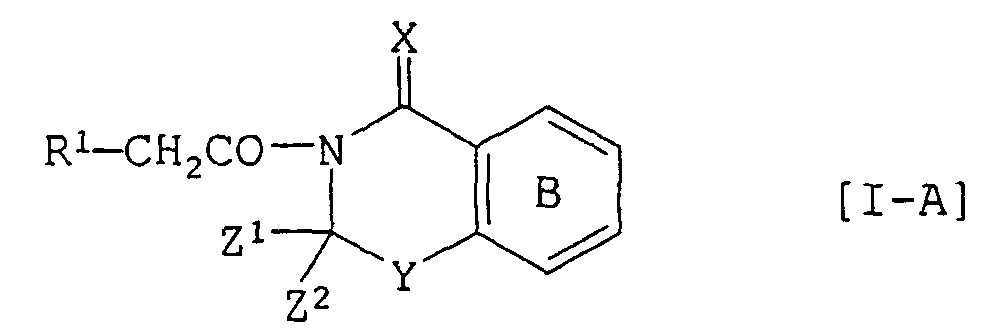
- the present invention also provides a novel compound of the formula [I-A]: wherein R 1 is a C 1-6 alkyl group; Ring B is a benzene ring which may have a substituent selected from the group consisting of a halogen, a C 1-6 alkyl group, a C 1-6 alkoxy group and a phenyl group; X is an oxygen atom or a sulfur atom; Y is an oxygen atom, a sulfur atom, a protected or unprotected imino group, or a methylene group; and Z 1 and Z 2 are the same or different and each a C 1-20 alkyl group, a C 3-8 cycloalkyl group, a phenyl group, or a phenyl-(C 1-20 )alkyl group, or both combine at the end thereof to form an alkytene group having 4 to 7 carbon atoms.
- the group represented by R 4 is a protected or unprotected 1-hydroxyethyl group, and the protecting group for said hydroxy group may be any ones which can easily be removed by a conventional method, for example, a lower alkoxycarbonyl group, a halogeno-lower alkoxycarbonyl group, a substituted or unsubstituted phenyl-lower alkyl group (e.g. benzyl group which may optionally be substituted by nitro group or a lower alkoxy group), a tri-lower alkylsilyl group, a substituted or unsubstituted phenyl-lower alkoxycarbonyl group (e.g. benzyloxycarbonyl group which may optionally be substituted by nitro group or a lower alkoxy group), and the like.
- a lower alkoxycarbonyl group e.g. benzyl group which may optionally be substituted by nitro group or a lower alkoxy group
- the group represented by R 4 is a protected or unprotected 1-hydroxyethyl group, and the protecting group for said hydroxy group may be any ones which can easity be removed by a conventional method, for example, a lower alkoxycarbonyl group, a halogeno-lower alkoxycarbonyl group, a substituted or unsubstituted phenyl-lower alkyl group (e.g benzyl group which may optionally be substituted by nitro group or a lower alkoxy group), a tri-lower alkylsilyl group, a substituted or unsubstituted phenyl-lower alkoxycarbonyl group (e.g. benzyloxycarbonyl group which may optionally be substituted by nitro group or a lower alkoxy group), and the like.
- a lower alkoxycarbonyl group e.g benzyl group which may optionally be substituted by nitro group or a lower alkoxy group
- the alkyl group for Z 1 and Z 2 includes alkyl groups having 1 to 20 carbon atoms, preferably ones having 1 to 15 carbon atoms.
- the cycloalkyl group includes, for example, ones having 4 to 7 carbon atoms, and the aryl group includes, for example, a substituted or unsubstituted phenyl group.
- the aralkyl group includes, for example, a lower alkyl group substituted by a substituted or unsubstituted phenyl group.
- the substituents for alkyl group, cycloalkyl group, and the substituents on the phenyl group in the aryl group or in the aralkyl group are preferably a lower alkoxy group, a halogen atom, a protected or unprotected amino group.
- the protecting group for amino group, or the protecting group for imino group represented by Y includes any group which is conventionally used as a protecting group in the field of Peptide Chemistry, and the examples of the protecting group are preferably a lower alkyl group, an acyl group (e.g. a lower alkanoyl group, a lower alkoxycarbonyl group, a substituted or unsubstituted phenylcarbonyl group, a substituted or unsubstituted phenyl-lower alkoxycarbonyl group).
- an acyl group e.g. a lower alkanoyl group, a lower alkoxycarbonyl group, a substituted or unsubstituted phenylcarbonyl group, a substituted or unsubstituted phenyl-lower alkoxycarbonyl group.
- the compound of the formula [I-A] is a novel compound.
- the compound [I-A] of the present invention is structurally quite different from the above-mentioned known compound in that the amido moiety (hereinafter referred to as "supporting group") of the compound [I-A] of the present invention is the benzene ring-condensed 6-membered heterocyclic group, while the known supporting group is the 5-membered heterocyclic groups such as thiozolidine or oxazolidine.
- Ring B is unsubstituted benzene ring
- X and Y are both oxygen atom
- Z 1 and Z 2 are a C 1-20 alkyl group; or both combine at the end thereof to form a unsubstituted alkylene group having 4 to 7 carbon atoms are more preferable.
- the base used in the reaction of the alkanamide compound [I] and the compound [II] to give the compound [III] includes any conventional organic and inorganic bases, but strong bases are more preferable.
- the preferable strong base is a base having enough basicity to make an enolate by removing hydrogen atom at ⁇ -position of the alkanamide compound [I] and the more preferable base is a base having basicity of pKb ⁇ -10.
- Examples of a base include an alkali metal salt or alkaline earth metal salt of amines (e.g.
- alkali metal bis(tri-lower alkylsilyl)amide or an alkali metal salt or alkaline earth metal salt of alcohols, more particularly lithium bis(trimethylsilyl)amide, sodium bis(trimethylsilyl)amide, potassium bis(trimethylsilyl)amide, lithium diisopropylamide, sodium amide, sodium methoxide, sodium ethoxide, potassium t-butoxide, and the like.
- the reaction of the alkanamide compound [I] and the compound [II] is preferably carried out in an appropriate inert solvent such as ethers (e.g. tetrahydrofuran, diethyl ether, dioxane, dimethoxyethane, diisopropyl ether, etc.), aromatic hydrogen carbons (e.g. toluene, xylene, etc.), and the like, and more preferably carried out in tetrahydrofuran.
- ethers e.g. tetrahydrofuran, diethyl ether, dioxane, dimethoxyethane, diisopropyl ether, etc.
- aromatic hydrogen carbons e.g. toluene, xylene, etc.
- the leaving group represented by L 1 in the compound [II] may be any conventional leaving group which can easily be removed during the reaction with the alkanamide compound [I], for example, an acyloxy group, a lower alkylsulfonyloxy group, an arylsulfonyloxy group, a lower alkylsulfonyl group, an arylsulfonyl group, an arylthio group, a halogen atom, and the like, and an acyloxy group is more preferable.
- the alkanamide compound [I] may be used in an amount of 1 to 1.5 moles, preferably 1.1 to 1.3 moles, per one mole of the compound [II].
- the base may be used in an amount of 1 to 2 moles, preferable 1.2 to 1.5 moles, per one mole of the compound [II].
- the reaction is usually carried out at a temperature of -80°C to 10°C, preferably at -60°C to -30°C.
- the alkanamide compound [I] including the novel starting compound [I-A] is prepared by reacting a compound of the formula [IV]: wherein R 2 and R 3 are the same as defined above, with a compound of the formula [V]: R 1 CH 2 COOH wherein R 1 is the same as defined above, or a reactive derivative thereof.
- the reaction of the compound [IV] and the compound [V] is carried out in an appropriate solvent in the presence of a dehydrating agent.
- the dehydrating agent is preferably carbonyldiimidazole, dicyclohexylcarbodiimide, N-hydroxysuccinimide, 1-hydroxybenzotriazole, and the like, and the solvent is preferably ether, methylene chloride, tetrahydrofuran, acetonitrile, and the like.
- the reaction is carried out at a temperature of -30°C to 70°C, preferably at 0°C to 30°C.
- the reaction of the compound [IV] and a reactive derivative of the compound [V] is carried out in an appropriate solvent in the presence or absence of an acid acceptor.
- the reactive derivative is preferably an acid halide or an acid anhydride of the compound [V].
- the acid acceptor includes, for example, an alkali metal hydride, an alkali metal, or an organic base such as a lower alkyl lithium compound, an aryl lithium compound, pyridine, a di-lower alkyl-aniline, a tri-lower alkylamine, etc.
- the solvent is preferably tetrahydrofuran, diethyl ether, benzene, toluene, dichloromethane, chloroform, and the like.
- the reaction is carried out at a temperature of -80°C to 50°C, preferably at a temperature of -20°C to 30°C.
- the compound [IV] can be prepared by a conventional method.
- the benzene compound of the formula[IV-2]: wherein Y 2 is oxygen atom, sulfur atom or an imino group which may have substituent(s), and Ring B, X, Z 1 and Z 2 are the same as defined above is prepared by the method disclosed in Journal of the American Chemical Society, 72, 721 (1950). That is, the compound [IV-2] is prepared by condensing a compound of the formula [XIII]: wherein Ring B, X and Y 2 are the same as defined above, with a compound of the formula [XIV]: wherein Z 1 and Z 2 are the same as defined above, in the presence of an acid (e.g. p-toluenesulfonic acid, sulfuric acid, hydrochloric acid, etc.).
- an acid e.g. p-toluenesulfonic acid, sulfuric acid, hydrochloric acid, etc.
- the compound [XIII] in which X is oxygen atom and Y 2 is sulfur atom may be prepared by halogenating a compound of the formula [XV]: wherein Ring B is the same as defined above, to give a compound of the formula [XVI]: wherein X 2 is a halogen atom, and Ring B is the same as defined above, subjecting the compound [XVI] to amidation to give a compound of the formula [XVII]: wherein Ring B is the same as defined above, and then reducing the compound [XVII].
- the compound [XIII] in which X is oxygen atom and Y 2 is an imino group which may have substituents(s) may be prepared by reacting a compound of the formula [XVIII]: wherein Y 3 is an imino group which may have substituent(s), and other symbols are the same as defined above, with ammonia.
- the compound [XIII] in which X is sulfur atom and Y 2 is sulfur atom or an imino group which may have substituent(s) may be prepared by subjecting the compound [XIII] in which X is oxygen atom and Y 2 is sulfur atom or an imino group which may have substituent(s) to thiocarbonylation.
- the benzene compound [IV-1] in which Y is methylene group may be prepared by reacting the compound of the formula: wherein L 3 is a halogen atom or hydroxy group, and Ring B is the same as defined above, with a compound of the formula: wherein Z 1 and Z 2 are the same as defined above, to give a compound of the formula: wherein the symbols are the same as defined above, reducing the compound to give a compound of the formula: wherein the symbols are the same as defined above, reacting the compound with a compound of the formula: wherein X is the same as defined above, and then subjecting the product to intramolecular cyclization.
- the aqueous layer is extracted with methylene chloride (50 ml), and the organic layers are combined, and washed successively with saturated sodium hydrogen carbonate solution and saturated saline solution, dried over anhydrous magnesium sulfate, and concentrated under reduced pressure.
- the azetidinone compound [III] which is useful as a synthetic intermediate for carbapenem derivatives, is prepared by reacting the alkanamide compound [I] with the compound [II] in the presence of a base without using a Lewis acid.
- the present invention can provide a synthetic intermediate useful for 1 ⁇ -methylcarbapenem derivative having an antibacterial activity.
- the compound [III-A] can be converted into the compound [XII] wherein R 1 and R 4 are the same as defined above and R 5 is a hydrogen atom or an ester residue and the compound [IX] wherein a group of formula -OA is an esterified hydroxy group, and R 1 , R 4 and R 5 are the same as defined above, without activating the 4-side chain of the compound [III-A] by chemical modification, and during the reaction from the compound [III-A] to the compound [XII] and the compound [IX], the group of the formula: wherein Ring B, X, Y, Z 1 and Z 2 are the same as defined above, can easily be removed and can be recovered as the compound [IV] after the reaction, and hence, the process for preparing the compound [IX] using the compound [III-A] is extremely excellent process from practical and economical points.
- novel alkanamide compound [I-A] can easily be prepared, and in particular, the compound [I-A] wherein both X and Y are oxygen atom and Ring B is unsubstituted benzene ring is industrailly excellent reagent because it can be prepared from a commercially available salicylamide by two steps.
Landscapes
- Chemical & Material Sciences (AREA)
- Organic Chemistry (AREA)
- Health & Medical Sciences (AREA)
- Life Sciences & Earth Sciences (AREA)
- Molecular Biology (AREA)
- Chemical Kinetics & Catalysis (AREA)
- Nitrogen Condensed Heterocyclic Rings (AREA)
- Pharmaceuticals Containing Other Organic And Inorganic Compounds (AREA)
- Plural Heterocyclic Compounds (AREA)
Claims (10)
- Procédé pour la préparation d'un composé d'azétidinone de la formule [III] :dans laquelle R1 est un groupe alkyle en C1 à C6, R2 et R3 se combinent ensemble avec l'atome d'azote adjacent pour former un groupe hétérocyclique qui est un élément choisi dans le groupe comprenant un groupe de la formule :
 où X1 est un atome d'oxygène ou un atome de soufre, Y1 est un atome d'oxygène, un atome de soufre, un groupe méthylène ou un groupe imino substitué par un groupe alkyle en C1 à C20 ou par un groupe phényle, et R11, R12, R13 et R14 sont identiques ou différents et représentent chacun un atome d'hydrogène, un groupe alkyle en C1 à C5, un groupe cyano, un groupe (alkyle en C1 à C20)-oxycarbonyle, un groupe phényl(alkyle en C1 à C20) ou un groupe phényle, ou bien R11 et R12 se combinent ensemble pour former une chaíne alkylène en C2 à C6 et, simultanément ou indépendamment, R13 et R14 se combinent ensemble pour former une chaíne alkylène en C2 à C6 ; un groupe de la formule :
 où X est un atome d'oxygène ou un atome de soufre, Y est un atome d'oxygène, un atome de soufre, un groupe imino protégé ou non protégé ou un groupe méthylène, Z1 et Z2 sont identiques ou différents et représentent chacun un atome d'hydrogène, un groupe alkyle en C1 à C20, un groupe cycloalkyle en C3 à C8, un groupe phényle ou un groupe phényl(alkyle en C1 à C20), ou bien les deux se combinent à leur extrémité pour former un groupe alkylène ayant de 4 à 7 atomes de carbone, et le noyau A est un noyau benzénique qui peut avoir un substituant choisi dans le groupe comprenant un halogène, un groupe alkyle en C1 à C6, un groupe alcoxy en C1 à C6 et un groupe phényle ; et un groupe de la formule :
 où X, Y et le noyau A sont tels que définis ci-dessus ; et R4 est un groupe alkyle en C1 à C6 à substitution hydroxy protégé ou non protégé,
ledit procédé comprenant la mise à réagir d'un composé alcanamide de la formule [I] :où R1, R2 et R3 sont tels que définis ci-dessus, avec un composé de la formule [II] : où L1 est un groupe partant et R4 est tel que défini ci-dessus, en présence d'une base sans utiliser d'acide de Lewis.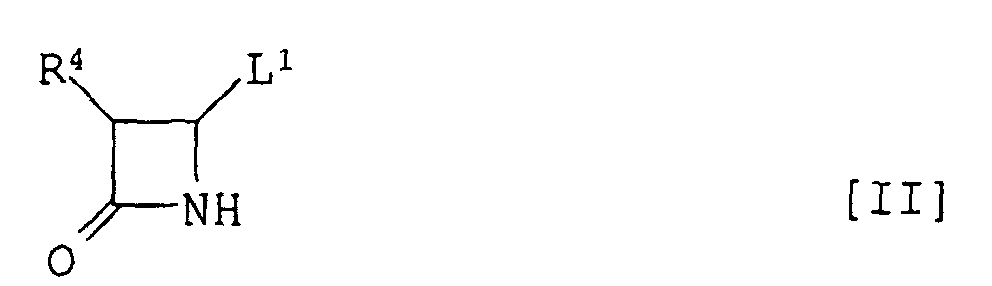
- Composé de la formule [I-A] :où R1 est un groupe alkyle en C1 à C6 ; le noyau B est un noyau benzénique qui peut avoir un substituant choisi dans le groupe comprenant un halogène, un groupe alkyle en C1 à C6, un groupe alcoxy en C1 à C6 et un groupe phényle ; X est un atome d'oxygène ou un atome de soufre ; Y est un atome d'oxygène, un atome de soufre, un groupe imino protégé ou non protégé ou un groupe méthylène ; et Z1 et Z2 sont identiques ou différents et représentent chacun un groupe alkyle en C1 à C20, un groupe cycloalkyle en C3 à C8, un groupe phényle ou un groupe phényl(alkyle en C1 à C20), ou bien les deux se combinent à leur extrémité pour former un groupe alkylène ayant de 4 à 7 atomes de carbone.
- Procédé selon la revendication 1, dans lequel ledit groupe hétérocyclique est un élément choisi dans le groupe comprenant un groupe de la formule :où X1 est un atome d'oxygène ou un atome de soufre, Y1 est un atome d'oxygène, un atome de soufre, un groupe méthylène ou un groupe imino substitué par un groupe alkyle en C1 à C20 ou par un groupe phényle, et R11, R12, R13 et R14 sont identiques ou différents et représentent chacun un atome d'hydrogène, un groupe alkyle en C1 à C5, un groupe cyano, un groupe (alkyle en C1 à C20)-oxycarbonyle, un groupe phényl(alkyle en C1 à C20) ou un groupe phényle, ou bien R11 et R12 se combinent ensemble pour former une chaíne alkylène en C2 à C6 et, simultanément ou indépendamment, R13 et R14 se combinent ensemble pour former une chaíne alkylène en C2 à C6 ; et un groupe de la formule :
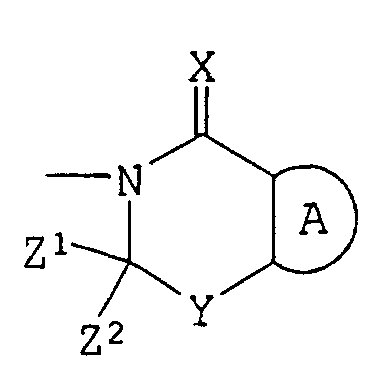
 où X est un atome d'oxygène ou un atome de soufre, Y est un atome d'oxygène, un atome de soufre, un groupe imino protégé ou non protégé ou un groupe méthylène, Z1 et Z2 sont identiques ou différents et représentent chacun un atome d'hydrogène, un groupe alkyle en C1 à C20, un groupe cycloalkyle en C3 à C8, un groupe phényle ou un groupe phényl(alkyle en C1 à C20), ou bien les deux se combinent à leur extrémité pour former un groupe alkylène ayant de 4 à 7 atomes de carbone, et le noyau A est un noyau benzénique qui peut avoir un substituant choisi dans le groupe comprenant un halogène, un groupe alkyle en C1 à C6, un groupe alcoxy en C1 à C6 et un groupe phényle.
- Procédé selon la revendication 1, dans lequel ledit groupe hétérocyclique est un groupe de la formule :où X est un atome d'oxygène ou un atome de soufre, Y est un atome d'oxygène, un atome de soufre, un groupe imino protégé ou non protégé ou un groupe méthylène, Z1 et Z2 sont identiques ou différents et représentent chacun un atome d'hydrogène, un groupe alkyle en C1 à C20, un groupe cycloalkyle en C3 à C8, un groupe phényle ou un groupe phényl(alkyle en C1 à C20), ou bien les deux se combinent à leur extrémité pour former un groupe alkylène ayant de 4 à 7 atomes de carbone, et le noyau A est un noyau benzénique qui peut avoir un substituant choisi dans le groupe comprenant un halogène, un groupe alkyle en C1 à C6, un groupe alcoxy en C1 à C6 et un groupe phényle.
- Procédé selon la revendication 1, dans lequel ledit groupe hétérocyclique est un groupe de la formule :où le noyau B est un noyau benzénique qui peut avoir un substituant choisi dans le groupe comprenant un halogène, un groupe alkyle en C1 à C6, un groupe alcoxy en C1 à C6 et un groupe phényle, X est un atome d'oxygène ou un atome de soufre, Y est un atome d'oxygène, un atome de soufre, un groupe imino protégé ou non protégé ou un groupe méthylène, et Z1 et Z2 sont identiques ou différents et représentent chacun un groupe alkyle en C1 à C20, un groupe cycloalkyle en C3 à C8, un groupe phényle ou un groupe phényl(alkyle en C1 à C20), ou bien les deux se combinent à leur extrémité pour former un groupe alkylène ayant de 4 à 7 atomes de carbone.

- Procédé selon la revendication 1, dans lequel ledit groupe hétérocyclique est un élément choisi dans le groupe comprenant le 2,2-diméthyl-4-oxo-2,3-dihydro-4H-1,3-benzoxadin-3-yle; le 2,2-diéthyl-4-oxo-2,3-dihydro-4H-1,3-benzoxadin-3-yle; le 2,2-diisopropyl-4-oxo-2,3-dihydro-4H-1,3-benzoxadin-3-yle; le 2,2-di-n-butyl-4-oxo-2,3-dihydro-4H-1,3-benzoxadin-3-yle; le spiro[4-oxo-2,3-dihydro-4H-1,3-benzoxadin-2,1'-cyclohexan]-3-yle; le 2,2-diméthyl-4-thioxo-2,3-dihydro-4H-1,3-benzoxadin-3-yle ; le spiro[4-thioxo-2,3-dihydro-4H-1,3-benzoxadin-2,1'-cyclohexan]-3-yle; et le spiro[4-oxo-2,3-dihydro-4H-1,3-benzothiazin-2,1'-cyclohexan]-3-yle.
- Composé selon la revendication 2, dans lequel Y est un atome d'oxygène ou un atome de soufre, Z1 et Z2 sont identiques ou différents et représentent chacun un un groupe alkyle en C1 à C20, un groupe cycloalkyle en C3 à C8, un groupe phényle ou un groupe phényl(alkyle en C1 à C20), ou bien les deux se combinent à leur extrémité pour former un groupe alkylène ayant de 4 à 7 atomes de carbone.
- Composé selon la revendication 2, dans lequel le noyau B est un noyau benzénique non substitué, X est un atome d'oxygène, Y est un atome d'oxygène, et Z1 et Z2 sont identiques ou différents et représentent chacun un un groupe alkyle en C1 à C20 ou bien les deux se combinent à leur extrémité pour former un groupe alkylène ayant de 4 à 7 atomes de carbone.
- Procédé selon la revendication 1, 3, 4, 5 ou 6, dans lequel la base a une basicité suffisante pour produire un énolate en enlevant un atome d'hydrogène au niveau de la position α dudit composé alcanamide de la formule (I).
- Procédé selon la revendication 1, 3, 4, 5 ou 6, dans lequel la base est le bis(triméthylsilyl)amide de lithium ou le bis(triméthylsilyl)amide de sodium.
Applications Claiming Priority (3)
| Application Number | Priority Date | Filing Date | Title |
|---|---|---|---|
| JP15189993 | 1993-06-23 | ||
| JP151899/93 | 1993-06-23 | ||
| JP15189993 | 1993-06-23 |
Publications (3)
| Publication Number | Publication Date |
|---|---|
| EP0635488A2 EP0635488A2 (fr) | 1995-01-25 |
| EP0635488A3 EP0635488A3 (fr) | 1995-08-23 |
| EP0635488B1 true EP0635488B1 (fr) | 2001-09-26 |
Family
ID=15528629
Family Applications (1)
| Application Number | Title | Priority Date | Filing Date |
|---|---|---|---|
| EP94109711A Expired - Lifetime EP0635488B1 (fr) | 1993-06-23 | 1994-06-23 | Procédé pour la préparation des composés d'azétidine et composés précurseurs pour ceci |
Country Status (3)
| Country | Link |
|---|---|
| US (2) | US5550229A (fr) |
| EP (1) | EP0635488B1 (fr) |
| DE (1) | DE69428403T2 (fr) |
Families Citing this family (28)
| Publication number | Priority date | Publication date | Assignee | Title |
|---|---|---|---|---|
| US5731431A (en) * | 1991-12-26 | 1998-03-24 | Nippon Soda Co., Ltd. | Process for preparing 4-substituted azetidinone derivatives |
| US5631365A (en) | 1993-09-21 | 1997-05-20 | Schering Corporation | Hydroxy-substituted azetidinone compounds useful as hypocholesterolemic agents |
| JPH09143156A (ja) * | 1995-11-17 | 1997-06-03 | Tanabe Seiyaku Co Ltd | アセトキシアゼチジノン誘導体の製法及びその合成中間体 |
| JP3450193B2 (ja) | 1998-07-24 | 2003-09-22 | 高砂香料工業株式会社 | 4−置換アゼチジノン誘導体の製造方法 |
| AR023463A1 (es) | 1999-04-16 | 2002-09-04 | Schering Corp | Uso de compuestos de azetidinona |
| US6982251B2 (en) | 2000-12-20 | 2006-01-03 | Schering Corporation | Substituted 2-azetidinones useful as hypocholesterolemic agents |
| RS20100015A (sr) | 2001-01-26 | 2010-12-31 | Schering Corporation | Kombinacija aktivatora receptora aktiviranog peroksizom- proliferatorom (ppar) fenofibrata sa inhibitorom apsorpcije sterola ezetimibom za vaskularne indikacije |
| US7071181B2 (en) | 2001-01-26 | 2006-07-04 | Schering Corporation | Methods and therapeutic combinations for the treatment of diabetes using sterol absorption inhibitors |
| PT1355644E (pt) | 2001-01-26 | 2006-11-30 | Schering Corp | Utilização de compostos azetidinona substituídos para o tratamento de sitosterolemia |
| US7053080B2 (en) | 2001-09-21 | 2006-05-30 | Schering Corporation | Methods and therapeutic combinations for the treatment of obesity using sterol absorption inhibitors |
| EP1429756B1 (fr) | 2001-09-21 | 2006-11-22 | Schering Corporation | Methodes et combinaisons therapeutiques utiles pour le traitement du xanthome effectue avec des inhibiteurs d'absorption du sterol |
| JP2006508188A (ja) | 2002-11-06 | 2006-03-09 | シェーリング コーポレイション | 脱髄の処置のためのコレステロール吸収インヒビター |
| CN1756755A (zh) | 2003-03-07 | 2006-04-05 | 先灵公司 | 取代的2-吖丁啶酮化合物、其制剂及其治疗高胆甾醇血症的用途 |
| US7459442B2 (en) | 2003-03-07 | 2008-12-02 | Schering Corporation | Substituted azetidinone compounds, processes for preparing the same, formulations and uses thereof |
| DE602004016123D1 (de) | 2003-03-07 | 2008-10-09 | Schering Corp | Substituierte azetidinon-derivate, deren pharmazeutische formulierungen und deren verwendung zur behandlung von hypercholesterolemia |
| CN1756756A (zh) | 2003-03-07 | 2006-04-05 | 先灵公司 | 取代的2-吖丁啶酮化合物、其制剂及其治疗高胆甾醇血症的用途 |
| US7667076B2 (en) * | 2005-09-14 | 2010-02-23 | Regents Of The University Of California | Amide forming chemical ligation |
| KR20110049823A (ko) * | 2008-07-30 | 2011-05-12 | 랜박시 래보러터리스 리미티드 | 카르바페넴 화합물의 제조 방법 |
| PT2464645T (pt) | 2009-07-27 | 2017-10-11 | Gilead Sciences Inc | Compostos heterocíclicos fusionados como moduladores do canal de iões |
| WO2011048583A1 (fr) | 2009-10-23 | 2011-04-28 | Ranbaxy Laboratories Limited | Procédé pour la préparation de composés de carbapénème |
| WO2012003392A1 (fr) | 2010-07-02 | 2012-01-05 | Gilead Sciences, Inc. | Composés hétérocycliques condensés en tant que modulateurs des canaux ioniques |
| AU2012253653A1 (en) | 2011-05-10 | 2013-05-02 | Gilead Sciences, Inc. | Fused heterocyclic compounds as sodium channel modulators |
| TWI622583B (zh) | 2011-07-01 | 2018-05-01 | 基利科學股份有限公司 | 作為離子通道調節劑之稠合雜環化合物 |
| NO3175985T3 (fr) | 2011-07-01 | 2018-04-28 | ||
| CN102367239B (zh) * | 2011-07-20 | 2015-10-28 | 沈阳药科大学 | 2-芳基-2,3-二氢-4h-1,3-苯并噻嗪-4-酮衍生物及其用途 |
| CN102977134A (zh) * | 2012-12-13 | 2013-03-20 | 凯莱英医药集团(天津)股份有限公司 | 碳青霉烯中间体β-甲基-ADC-8的制备方法 |
| US10695322B2 (en) | 2016-01-29 | 2020-06-30 | The Johns Hopkins University | Inhibitors of bacterial growth |
| CN111440102B (zh) * | 2020-04-26 | 2022-02-15 | 大连凯飞化学股份有限公司 | 一种二硫代二苯甲酰胺类化合物的制备方法 |
Family Cites Families (35)
| Publication number | Priority date | Publication date | Assignee | Title |
|---|---|---|---|---|
| AU433549B2 (en) * | 1968-10-10 | 1973-03-09 | Chhom Gyogyszer Es Vegyeszeti Termeker Ciara N | New 4 quinazoline derivatives and process forthe preparation thereof |
| US4194047A (en) * | 1975-11-21 | 1980-03-18 | Merck & Co., Inc. | Substituted N-methylene derivatives of thienamycin |
| EP0010348A1 (fr) * | 1978-09-12 | 1980-04-30 | Imperial Chemical Industries Plc | Dérivés hétérocycliques trichlorométhylés, procédé pour leur préparation et leur utilisation |
| US4640915A (en) * | 1982-03-29 | 1987-02-03 | Fujisawa Pharmaceutical Co., Ltd. | 1-azabicyclo[3.2.0]hept-2-ene-2-carboxylic acid derivatives |
| JPS6019764A (ja) * | 1983-07-13 | 1985-01-31 | Sankyo Co Ltd | アゼチジノン誘導体の製造法 |
| JPS60202886A (ja) * | 1984-03-27 | 1985-10-14 | Sankyo Co Ltd | 1―置換カルバペネム―3―カルボン酸誘導体 |
| JPS615081A (ja) * | 1984-06-18 | 1986-01-10 | Sankyo Co Ltd | 1−置換カルバペネム−3−カルボン酸誘導体の製造法 |
| DK270685A (da) * | 1984-06-29 | 1985-12-30 | Hoffmann La Roche | Carbapenemderivater |
| ATE107278T1 (de) * | 1985-03-29 | 1994-07-15 | Merck & Co Inc | Enantioselektives verfahren zur herstellung von 1-beta-methylcarbapenem- antibiotikumzwischenprodukten. |
| JPS61275267A (ja) * | 1985-03-29 | 1986-12-05 | メルク エンド カムパニ− インコ−ポレ−テツド | 1−β−メチルカルバペネム抗生物質中間体の鏡像異性選択的製造方法 |
| CA1282415C (fr) * | 1985-08-31 | 1991-04-02 | Yasuhiro Kuramoto | Derives d'azetidin-2-one et procede de production |
| JPS62158277A (ja) * | 1986-01-07 | 1987-07-14 | Sumitomo Pharmaceut Co Ltd | β−ラクタム誘導体 |
| JPS62252785A (ja) * | 1986-01-08 | 1987-11-04 | Sankyo Co Ltd | 4−置換β−ラクタム化合物 |
| JPS62169781A (ja) * | 1986-01-21 | 1987-07-25 | Sankyo Co Ltd | β−ラクタム化合物 |
| JP2789190B2 (ja) * | 1986-01-27 | 1998-08-20 | 住友製薬株式会社 | 新規なβ−ラクタム誘導体およびその製造法 |
| GB8607921D0 (en) * | 1986-04-01 | 1986-05-08 | Fujisawa Pharmaceutical Co | 3,4-disubstituted-2-azetidinone derivatives |
| JPH0759581B2 (ja) * | 1986-09-05 | 1995-06-28 | 日本レダリ−株式会社 | (1r)−1−メチルカルバペネム−3−カルボン酸誘導体 |
| JPS6363680A (ja) * | 1986-09-05 | 1988-03-22 | Nippon Redarii Kk | (1r)−1−メチルカルバペネム−3−カルボン酸誘導体 |
| DE3632916A1 (de) * | 1986-09-27 | 1988-03-31 | Bayer Ag | Enantiomerenreine 2-azetidinone, verfahren zu ihrer herstellung und ihre verwendung |
| JPH0713058B2 (ja) * | 1986-12-29 | 1995-02-15 | 日本レダリ−株式会社 | 4―置換アゼチジノン誘導体の製造方法 |
| JPS63255284A (ja) * | 1987-04-11 | 1988-10-21 | Nippon Redarii Kk | (1r,5s,6s)−2−〔(置換ピリジニウム−2−イル)メチル〕チオ−6−〔(r)−1−ヒドロキシエチル〕−1−メチル−カルバペネム−3−カルボキシレ−ト |
| JPS63255282A (ja) * | 1987-04-11 | 1988-10-21 | Nippon Redarii Kk | (1r,5s,6s)−2−〔(チアゾリウム−2−イル)または(イミダゾリウム−2−イル)メチル〕チオ−6−〔(r)−1−ヒドロキシエチル〕−1−メチル−カルバペネム−3−カルボキシレ−ト |
| JPS63255280A (ja) * | 1987-04-11 | 1988-10-21 | Nippon Redarii Kk | (1r,5s,6s)−2−置換−6−〔(r)−1−ヒドロキシエチル〕−1−メチル−カルバペネム−3−カルボン酸誘導体 |
| JPS63255283A (ja) * | 1987-04-11 | 1988-10-21 | Nippon Redarii Kk | (1r,5s,6s)−2−〔(3−置換イミダゾリニウム−1−イル)アルキル〕チオ−6−〔(r)−1−ヒドロキシエチル〕−1−メチル−カルバペネム−3−カルボキシレ−ト |
| JPS63255281A (ja) * | 1987-04-11 | 1988-10-21 | Nippon Redarii Kk | (1r,5s,6s)−2−〔(ピラジニウム−2−イル)メチル〕チオ−6−〔(r)−1−ヒドロキシエチル〕−1−メチル−カルバペネム−3−カルボキシレ−ト |
| JPS6425778A (en) * | 1987-04-11 | 1989-01-27 | Lederle Japan Ltd | (1r,5s,6s)-2-((1,2,3-thiadiazolium-4-yl)methyl)thio-6-((r)-1-hydroxyethyl)-1-methyl-carbapenem-3-carboxylate |
| JPS6425779A (en) * | 1987-04-11 | 1989-01-27 | Lederle Japan Ltd | (1r,5s,6s)-2-substituted-thio-6-((r)-1-hydroxyethyl)-1-methyl -carbapenem-3-carboxylic acid derivative |
| JPS63284176A (ja) * | 1987-05-15 | 1988-11-21 | Nippon Redarii Kk | (1r,5r,6s)−6−〔(1r)−1−ヒドロキシエチル〕−1−メチルカルバペネム−3−カルボン酸誘導体の高立体選択的製造方法 |
| JPH02788A (ja) * | 1988-01-07 | 1990-01-05 | Fujisawa Pharmaceut Co Ltd | 3,4―ジ置換―2―アゼチジノン誘導体 |
| DE68919508T2 (de) * | 1988-04-01 | 1995-07-20 | Sankyo Co | 2-(Heterocyclylthio)carbapenemderivate, deren Herstellung und deren Verwendung als Antibiotika. |
| JPH02292269A (ja) * | 1989-05-06 | 1990-12-03 | Lederle Japan Ltd | 活性アミド化合物 |
| CA2050255C (fr) * | 1990-09-07 | 1997-02-04 | Tameo Iwasaki | Derives du 1-methylcarbapenem et procede d'obtention |
| DE69231874T2 (de) * | 1991-12-26 | 2001-09-27 | Nippon Soda Co. Ltd., Tokio/Tokyo | Verfahren zur herstellung von 4-substituierten azetidinon-derivaten |
| JPH0665195A (ja) * | 1992-08-24 | 1994-03-08 | Banyu Pharmaceut Co Ltd | β−ラクタム誘導体の新規な製造法 |
| US5442055A (en) * | 1992-11-13 | 1995-08-15 | Tanabe Seiyaku Co., Ltd. | Azetidinone compound and process for preparation thereof |
-
1994
- 1994-06-21 US US08/262,892 patent/US5550229A/en not_active Expired - Lifetime
- 1994-06-23 DE DE69428403T patent/DE69428403T2/de not_active Expired - Lifetime
- 1994-06-23 EP EP94109711A patent/EP0635488B1/fr not_active Expired - Lifetime
-
1995
- 1995-06-05 US US08/462,676 patent/US5703234A/en not_active Expired - Lifetime
Also Published As
| Publication number | Publication date |
|---|---|
| US5703234A (en) | 1997-12-30 |
| DE69428403D1 (de) | 2001-10-31 |
| EP0635488A3 (fr) | 1995-08-23 |
| US5550229A (en) | 1996-08-27 |
| DE69428403T2 (de) | 2002-06-20 |
| EP0635488A2 (fr) | 1995-01-25 |
Similar Documents
| Publication | Publication Date | Title |
|---|---|---|
| US5703234A (en) | Heterocyclic alkanamide | |
| EP0362902B1 (fr) | Procédé et intermédiaires d'antibiotiques bêta-lactame | |
| US4269772A (en) | Synthesis of thienamycin via trans-3-carboxymethylene-4-carboxy-5-methyl-Δ2 -isoxazoline | |
| KR100231223B1 (ko) | 아제티디논 화합물 및 이의 제조방법 | |
| US5631363A (en) | Azetidinone compound and process for preparation thereof | |
| KR950013767B1 (ko) | 키랄성 아제티디논 화합물 및 이의 제조방법 | |
| KR900006449B1 (ko) | 아제티디논 화합물의 제조방법 | |
| US6011150A (en) | Azetidinone compound and process for preparation thereof | |
| IE842848L (en) | Producing penems | |
| JP3118143B2 (ja) | アゼチジノン化合物の新規な製法およびその新規原料化合物 | |
| US4440682A (en) | Stereospecific synthesis of isocephalosporins and 2-oxa isocephalosporins | |
| KR870000528B1 (ko) | 3-아지도 세팔로스포린의 제조방법 | |
| HU195772B (en) | Process for producing n-(substituted methyl)-azetidin-2-one compounds | |
| US6218550B1 (en) | Intermediates useful for the manufacture of carbapenem and a stereoselective manufacturing method therefor | |
| US5359059A (en) | Process for preparing carbapenem derivatives | |
| US4694083A (en) | Certain carbamate ester derivatives forming salts with pyridinium or picolinium cations which are useful as intermediates | |
| US4734495A (en) | Process and intermediates for beta-lactam antibiotics | |
| JP3242677B2 (ja) | 新規なβ−ラクタム化合物及びその製造法 | |
| JPH04128286A (ja) | ピペリジルチオカルバペネム誘導体 | |
| US5629419A (en) | Process for preparing 4-mercaptopyrrolidine intermediate compounds and a process for their use in preparing carbapenem -2-em-3 carboxylic acids | |
| RU2175971C2 (ru) | Способ получения 2-галогенметилпенемов и производные 2-азетидинона в качестве промежуточных соединений | |
| FI111942B (fi) | Uusi atsetidinoniyhdiste, menetelmä sen stereoselektiiviseksi valmistamiseksi ja sen käyttö synteettisenä välituotteena 1-beta-metyylikarbapeneemijohdannaisen valmistamiseksi | |
| SK27195A3 (en) | Penen derivatives, their preparation and pharmaceutical compositions containing them | |
| JPH03246274A (ja) | 光学活性1,3―ジ置換アゼチジノンの新規製造法 | |
| HK1007140B (en) | Process and intermediates for beta-lactam antibiotics |
Legal Events
| Date | Code | Title | Description |
|---|---|---|---|
| PUAI | Public reference made under article 153(3) epc to a published international application that has entered the european phase |
Free format text: ORIGINAL CODE: 0009012 |
|
| AK | Designated contracting states |
Kind code of ref document: A2 Designated state(s): DE FR GB IT |
|
| PUAL | Search report despatched |
Free format text: ORIGINAL CODE: 0009013 |
|
| AK | Designated contracting states |
Kind code of ref document: A3 Designated state(s): DE FR GB IT |
|
| 17P | Request for examination filed |
Effective date: 19951221 |
|
| 17Q | First examination report despatched |
Effective date: 19980603 |
|
| GRAG | Despatch of communication of intention to grant |
Free format text: ORIGINAL CODE: EPIDOS AGRA |
|
| GRAG | Despatch of communication of intention to grant |
Free format text: ORIGINAL CODE: EPIDOS AGRA |
|
| GRAH | Despatch of communication of intention to grant a patent |
Free format text: ORIGINAL CODE: EPIDOS IGRA |
|
| GRAH | Despatch of communication of intention to grant a patent |
Free format text: ORIGINAL CODE: EPIDOS IGRA |
|
| GRAH | Despatch of communication of intention to grant a patent |
Free format text: ORIGINAL CODE: EPIDOS IGRA |
|
| GRAA | (expected) grant |
Free format text: ORIGINAL CODE: 0009210 |
|
| AK | Designated contracting states |
Kind code of ref document: B1 Designated state(s): DE FR GB IT |
|
| REF | Corresponds to: |
Ref document number: 69428403 Country of ref document: DE Date of ref document: 20011031 |
|
| REG | Reference to a national code |
Ref country code: GB Ref legal event code: IF02 |
|
| ET | Fr: translation filed | ||
| PLBE | No opposition filed within time limit |
Free format text: ORIGINAL CODE: 0009261 |
|
| STAA | Information on the status of an ep patent application or granted ep patent |
Free format text: STATUS: NO OPPOSITION FILED WITHIN TIME LIMIT |
|
| 26N | No opposition filed | ||
| PGFP | Annual fee paid to national office [announced via postgrant information from national office to epo] |
Ref country code: GB Payment date: 20130624 Year of fee payment: 20 Ref country code: DE Payment date: 20130620 Year of fee payment: 20 |
|
| PGFP | Annual fee paid to national office [announced via postgrant information from national office to epo] |
Ref country code: IT Payment date: 20130617 Year of fee payment: 20 |
|
| PGFP | Annual fee paid to national office [announced via postgrant information from national office to epo] |
Ref country code: FR Payment date: 20130724 Year of fee payment: 20 |
|
| REG | Reference to a national code |
Ref country code: DE Ref legal event code: R071 Ref document number: 69428403 Country of ref document: DE |
|
| REG | Reference to a national code |
Ref country code: GB Ref legal event code: PE20 Expiry date: 20140622 |
|
| PG25 | Lapsed in a contracting state [announced via postgrant information from national office to epo] |
Ref country code: GB Free format text: LAPSE BECAUSE OF EXPIRATION OF PROTECTION Effective date: 20140622 |
|
| PG25 | Lapsed in a contracting state [announced via postgrant information from national office to epo] |
Ref country code: DE Free format text: LAPSE BECAUSE OF EXPIRATION OF PROTECTION Effective date: 20140624 |