EP0636107B1 - Procede et l'utilisation d'un appareil d'elimination de soufre d'un courant gazeux contenant de l'acide sulphydrique - Google Patents
Procede et l'utilisation d'un appareil d'elimination de soufre d'un courant gazeux contenant de l'acide sulphydrique Download PDFInfo
- Publication number
- EP0636107B1 EP0636107B1 EP93910604A EP93910604A EP0636107B1 EP 0636107 B1 EP0636107 B1 EP 0636107B1 EP 93910604 A EP93910604 A EP 93910604A EP 93910604 A EP93910604 A EP 93910604A EP 0636107 B1 EP0636107 B1 EP 0636107B1
- Authority
- EP
- European Patent Office
- Prior art keywords
- sulphur
- gas stream
- absorbent
- bed
- stream
- Prior art date
- Legal status (The legal status is an assumption and is not a legal conclusion. Google has not performed a legal analysis and makes no representation as to the accuracy of the status listed.)
- Expired - Lifetime
Links
Images

Classifications
-
- C—CHEMISTRY; METALLURGY
- C01—INORGANIC CHEMISTRY
- C01B—NON-METALLIC ELEMENTS; COMPOUNDS THEREOF; METALLOIDS OR COMPOUNDS THEREOF NOT COVERED BY SUBCLASS C01C
- C01B17/00—Sulfur; Compounds thereof
- C01B17/02—Preparation of sulfur; Purification
- C01B17/04—Preparation of sulfur; Purification from gaseous sulfur compounds including gaseous sulfides
- C01B17/0404—Preparation of sulfur; Purification from gaseous sulfur compounds including gaseous sulfides by processes comprising a dry catalytic conversion of hydrogen sulfide-containing gases, e.g. the Claus process
- C01B17/0408—Pretreatment of the hydrogen sulfide containing gases
-
- B—PERFORMING OPERATIONS; TRANSPORTING
- B01—PHYSICAL OR CHEMICAL PROCESSES OR APPARATUS IN GENERAL
- B01D—SEPARATION
- B01D53/00—Separation of gases or vapours; Recovering vapours of volatile solvents from gases; Chemical or biological purification of waste gases, e.g. engine exhaust gases, smoke, fumes, flue gases, aerosols
- B01D53/34—Chemical or biological purification of waste gases
- B01D53/46—Removing components of defined structure
- B01D53/48—Sulfur compounds
- B01D53/50—Sulfur oxides
- B01D53/508—Sulfur oxides by treating the gases with solids
-
- B—PERFORMING OPERATIONS; TRANSPORTING
- B01—PHYSICAL OR CHEMICAL PROCESSES OR APPARATUS IN GENERAL
- B01D—SEPARATION
- B01D53/00—Separation of gases or vapours; Recovering vapours of volatile solvents from gases; Chemical or biological purification of waste gases, e.g. engine exhaust gases, smoke, fumes, flue gases, aerosols
- B01D53/34—Chemical or biological purification of waste gases
- B01D53/46—Removing components of defined structure
- B01D53/48—Sulfur compounds
- B01D53/52—Hydrogen sulfide
-
- B—PERFORMING OPERATIONS; TRANSPORTING
- B01—PHYSICAL OR CHEMICAL PROCESSES OR APPARATUS IN GENERAL
- B01D—SEPARATION
- B01D53/00—Separation of gases or vapours; Recovering vapours of volatile solvents from gases; Chemical or biological purification of waste gases, e.g. engine exhaust gases, smoke, fumes, flue gases, aerosols
- B01D53/34—Chemical or biological purification of waste gases
- B01D53/46—Removing components of defined structure
- B01D53/48—Sulfur compounds
- B01D53/52—Hydrogen sulfide
- B01D53/523—Mixtures of hydrogen sulfide and sulfur oxides
-
- B—PERFORMING OPERATIONS; TRANSPORTING
- B01—PHYSICAL OR CHEMICAL PROCESSES OR APPARATUS IN GENERAL
- B01D—SEPARATION
- B01D53/00—Separation of gases or vapours; Recovering vapours of volatile solvents from gases; Chemical or biological purification of waste gases, e.g. engine exhaust gases, smoke, fumes, flue gases, aerosols
- B01D53/34—Chemical or biological purification of waste gases
- B01D53/74—General processes for purification of waste gases; Apparatus or devices specially adapted therefor
- B01D53/86—Catalytic processes
- B01D53/8603—Removing sulfur compounds
- B01D53/8609—Sulfur oxides
-
- B—PERFORMING OPERATIONS; TRANSPORTING
- B01—PHYSICAL OR CHEMICAL PROCESSES OR APPARATUS IN GENERAL
- B01D—SEPARATION
- B01D53/00—Separation of gases or vapours; Recovering vapours of volatile solvents from gases; Chemical or biological purification of waste gases, e.g. engine exhaust gases, smoke, fumes, flue gases, aerosols
- B01D53/34—Chemical or biological purification of waste gases
- B01D53/74—General processes for purification of waste gases; Apparatus or devices specially adapted therefor
- B01D53/86—Catalytic processes
- B01D53/8637—Simultaneously removing sulfur oxides and nitrogen oxides
-
- C—CHEMISTRY; METALLURGY
- C01—INORGANIC CHEMISTRY
- C01B—NON-METALLIC ELEMENTS; COMPOUNDS THEREOF; METALLOIDS OR COMPOUNDS THEREOF NOT COVERED BY SUBCLASS C01C
- C01B17/00—Sulfur; Compounds thereof
- C01B17/02—Preparation of sulfur; Purification
- C01B17/04—Preparation of sulfur; Purification from gaseous sulfur compounds including gaseous sulfides
- C01B17/0404—Preparation of sulfur; Purification from gaseous sulfur compounds including gaseous sulfides by processes comprising a dry catalytic conversion of hydrogen sulfide-containing gases, e.g. the Claus process
- C01B17/0456—Preparation of sulfur; Purification from gaseous sulfur compounds including gaseous sulfides by processes comprising a dry catalytic conversion of hydrogen sulfide-containing gases, e.g. the Claus process the hydrogen sulfide-containing gas being a Claus process tail gas
-
- C—CHEMISTRY; METALLURGY
- C01—INORGANIC CHEMISTRY
- C01B—NON-METALLIC ELEMENTS; COMPOUNDS THEREOF; METALLOIDS OR COMPOUNDS THEREOF NOT COVERED BY SUBCLASS C01C
- C01B17/00—Sulfur; Compounds thereof
- C01B17/02—Preparation of sulfur; Purification
- C01B17/04—Preparation of sulfur; Purification from gaseous sulfur compounds including gaseous sulfides
- C01B17/0473—Preparation of sulfur; Purification from gaseous sulfur compounds including gaseous sulfides by reaction of sulfur dioxide or sulfur trioxide containing gases with reducing agents other than hydrogen sulfide
Definitions
- the present invention relates to a process and apparatus for recovering sulphur from an ammonia acid gas stream containing hydrogen sulphide.
- the process also works on other sulphur-containing gas streams, e.g., light, saturated hydrocarbons, hydrogen or carbon monoxide gas streams containing H 2 S or H 2 S and sulphur oxides.
- Refinery streams are typically desulphurized by the Claus process wherein elemental sulphur is produced by reacting hydrogen sulphide and sulphur dioxide in the presence of a catalyst.
- the Claus system uses a combustion chamber which, at 950 °C to 1,350°C (1742°F-2462°F), converts 50 to 70% of sulphur contained in the feed gas into elemental sulphur.
- Sulphur is condensed by cooling the reaction gas to a temperature below the dew point of sulphur after which the remaining gas is heated and further reacted over a catalyst. Normally, the gas passes through at least two such Claus catalyst stages.
- the final Claus exhaust gas still contains small amounts of H 2 S, SO 2 , CS 2 , carbon oxysulphide, CO, and elemental sulphur in the form of a vapour or mist.
- the exhaust gas generally is subjected to post-combustion to convert substantially everything to SO 2 and then further purified by Claus after-treatments.
- Sulphur emitted as sulphur oxides ("SO x ") into the atmosphere with the exhaust gas may amount to 2-6% of the sulphur contained in the feed gas in the form of H 2 S. In view of air pollution and the loss of sulphur involved, further purification is imperative.
- SO x sulphur oxides
- One aftertreatment carried out before post-combustion, seeks to achieve by catalytic conversion as complete a reaction as possible between H 2 S and SO 2 .
- the reaction temperature is lowered to below the condensation point of sulphur, whereby the reaction equilibrium corresponding to equation II is shifted to form sulphur.
- a distinction is made between dry processes using alternating reactors in which the catalyst is intermittently charged with sulphur and discharged, and processes where H 2 S and SO 2 react in a high-boiling catalyst-containing liquid to form elemental sulphur which is drawn off continuously as a liquid product.
- a second aftertreatment catalytically hydrogenates SO 2 and S with H 2 and CO while COS and CS 2 are simultaneously hydrolyzed with H 2 O into H 2 S which can be treated conventionally.
- Hydrogenation/hydrolysis does not require a stoichiometric H 2 S/SO 2 ratio in the Claus exhaust gas. It almost completely converts COS and CS 2 so that sulphur yields of more than 99.8% can eventually be obtained.
- a third aftertreatment oxidizes all sulphur compounds into SO x which is then further processed. These processes are downstream of the post-combustion and therefore independent of the mode in which the Claus system is run. There are also dry processes, where SO 2 is adsorbed and returned to the Claus unit or processed to form sulphuric acid, and wet processes, where SO 2 is removed by absorptive scrubbing and further processed. For complete oxidation of COS and CS 2 into SO 2 , the energy requirements are high and following the after-combustion, very large exhaust gas flows have to be treated.
- the equilibrium conversion of the Claus reaction may be improved by condensing out part of the water in the gas.
- the gas is then reheated and charged to another Claus stage to form elemental sulphur.
- This produces waste water which is highly corrosive due to the formation of thiosulphuric acid, polythionic acids and sulphurous acid. Processing of such waste water is expensive. Unavoidable formation of deposits of elemental sulphur also occurs during H 2 O condensation. Moreover, there is no conversion of COS and CS 2 so the maximum recovery of sulphur is about 98%. As a result of these disadvantages, this process has not been used on a commercial scale.
- the aftertreatment involves conversion of all sulphur compounds into hydrogen sulphide
- the sulphur loaded catalyst is regenerated by passing hot oxygen-free gases containing hydrogen sulphide through the catalyst.
- sulphur compounds are removed from gas streams such as Claus plant tail gases by incineration, absorption on a SO 2 -binding material, regeneration of the loaded absorbent by contacting it with a reducing gas and optional conversion of the released SO 2 into elemental sulphur.
- Reducing gases are hydrogen or hydrocarbons such as methane.
- Ammonia acid gases typically are combusted sub-stoichiometrically at about 2300°F (1260°C) at the front of the sulphur plant combustion chamber to completely destroy the ammonia.
- a portion of a clean acid gas (ammonia free) is also introduced along the ammonia acid gas to control the temperature.
- the processing of the ammonia acid gas in the combustion chamber increases the sulphur plant size due to the increase in volume of the gases that need to be processed by the sulphur plant. For example, processing of ammonia may increase the hydraulic size of the plant by 20 to 50% based on the amount of ammonia acid gas that is processed. Further, ammonia that is not destroyed in the combustion chamber will form salts.
- the absorbent bed is provided in at least two fixed-bed reactors, and sulphur oxide containing gas stream from the incinerator is fed to a first one of said reactors until the bed therein is spent absorbed sulphur compounds; thereafter said sulphur oxide containing gas stream is fed to a second one of said reactors; and said hydrogen and/or hydrocarbon bearing gas stream is fed to said first one of said reactors to form said off gas stream and thus regenerate said first one of said reactors.
- said sulphur oxide containing gas stream and said hydrogen and/or hydrocarbon bearing gas stream are alternately fed to each one of said reactors, whereby each bed is first spent with said absorbed sulphur compounds, and then regenerated by said hydrogen and/or hydrocarbon bearing stream to form said off gas stream.
- said absorbent bed is in a fluidized bed system comprising a reactor, a regenerator, a conduit for feeding spent absorbent from the reactor to the regenerator, and another conduit for passing regenerated absorbent from the regenerator to the reactor; and wherein said sulphur oxide containing gas stream from the incinerator is fed to the reactor to absorb said sulphur oxide on the absorbent, and said hydrogen and/or hydrocarbon bearing stream is fed to the regenerator to reduce said absorbed sulphur compounds to said off gas stream.
- the absorbent bed may comprise a fixed bed solid absorbent or a granulated moving bed solid absorbent.
- the absorbent is preferably a metal oxide, or a mixtures of metal oxides, impregnated with a promoter: the metal oxide is preferably alumina, while the promoter is preferably a rare earth. Most preferably the promoter is CeO 2 and/or Pt.
- the absorbent may comprise Mg/Al spinels. 11, preferably a magnesium-aluminum-containing spinel impregnated with vanadium and cerium.
- the absorbent may be magnesium aluminate impregnated with an oxygen promoter.
- the off gas stream is desirably directed to a Claus sulphur recovery process where the sulphur compounds are converted to elemental sulphur.
- the absorbent may be reconstituted in the presence of water into a form which is active for further absorption of sulphur oxides.
- the absorbent may increase in weight from substantially 10 to substantially 60 wt. % due to absorbed sulphur oxides.
- greater than 70 vol. % of sulphur in the off gas stream is in the form of sulphur dioxide.
- the ammonia acid gas stream is combusted in the incinerator at a temperature of from substantially 1500°F (816°C) to substantially 2500°F (1371°C): this combustion desirably takes place with fuel gas.
- the ammonia acid gas stream may be stoichiometrically combusted; or it may be combusted with excess air or oxygen.
- An oxygen containing gas can be added to said nitrogen and sulphur oxide containing gas stream withdrawn from the incinerator.
- the nitrogen and sulphur oxide containing gas stream contacting said solid absorbent bed preferably has an oxygen content of from substantially 0.10 vol% to substantially 10 vol%, more preferably 2 vol% to 4 vol%.
- the absorbent bed while absorbing the sulphur oxides thereon is preferably operated at a gas hourly space velocity (GHSV) substantially 500 to substantially 20,000, a pressure of from substantially 0.1 atm to substantially 10 atm (10 to 1000 Kpa), and a temperature of from substantially 900°F (482°C) to substantially 1400°F (760°C). More preferably the GHSV is from substantially 3,000 to substantially 5,000, the temperature is from about 1,100°F (593°C) to substantially 1,300°F (704°C), and the pressure is from substantially 1.5 to substantially 3.0 atm (150 to 300 Kpa).
- GHSV gas hourly space velocity
- the absorbent bed while being regenerated is preferably operated at a temperature of from substantially 900°F (482°C) to substantially 1,400°F (760°C), at a pressure of from substantially 0.10 to substantially 10 atm (10 to 1000 Kpa), and a gas hourly space velocity of substantially 10 to substantially 1,000. More preferably the temperature is from about 1,100°F (593°C) to about 1,300°F (704°C), the pressure is from substantially 0.5 atm to substantially 3.0 atm (50 to 300 Kpa), and the GHSV is from substantially 100 to substantially 150.
- the nitrogen and sulphur oxide containing stream withdrawn from the incinerator may be passed through a heat exchanger and to a condenser for reducing the temperature of said enriched stream to from substantially 250°F (121°C) to substantially 300°F (149°C) to condense elemental sulphur out of said withdrawn stream as a liquid sulphur stream; thereafter said withdrawn stream may be looped back through said heat exchanger to be reheated to from substantially 900°F (482°C) to substantially 1,400°F (760°C) for contacting said solid absorbent bed.
- the nitrogen bearing stream from said absorber is fed to an incinerator or is vented.
- the means for recovering sulphur comprises a Claus sulphur recover apparatus.
- Means for supplying fuel gas to said combusting means may also be provided.
- the contacting means and the regenerating means comprises at least two fixed-bed reactors, each bed being formed of said absorbent.
- the apparatus further comprises switching means (1) for feeding said sulphur oxide containing gas stream withdrawn from the incinerator to a first one of said reactors until the bed therein is spent with absorbed sulphur compounds, and thereafter (2) for feeding said sulphur oxide containing gas stream to a second one of said reactors while feeding said hydrogen and/or hydrocarbon bearing gas stream to said first one of said reactors to form said off gas stream and thus regenerate said first one of said reactors.
- said contacting means comprises a reactor
- said absorbent bed regeneration means comprises a regenerator.
- the apparatus further comprises means for continuously feeding a fluidized bed of spent absorbent from the reactor to the regenerator, and for passing a fluidized bed of regenerated absorbent from the regenerator to the reactor; whereby said sulphur oxide containing gas stream from the incinerator is fed to said absorbent in the reactor for absorbing said sulphur oxide, and means for feeding said hydrogen and/or hydrocarbon bearing stream to the regenerator to reduce absorbed sulphur compounds to hydrogen sulphide and/or sulphur dioxide, and thus form said off gas stream.
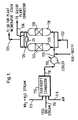
- an ammonia acid gas stream 110 containing hydrogen sulphide is fed to a relatively small combustion furnace 112.
- An air stream 114 and a fuel gas stream 116 are also fed to the combustion furnace 112 at rates sufficient to maintain the temperature in the furnace 112 within the range of 1500°F (815°C) to 2500°F (1371°C), and to maintain an atmosphere for stoichiometric combustion such that ammonia destruction is maximized and the ammonia is thus completely dissociated into N 2 and H 2 .
- the H 2 will burn to produce water, while the N 2 remains as an inert gas.
- the hydrogen sulphide is completely converted to sulphur oxides (SO x ).
- a nitrogen and sulphur oxide enriched gas stream 118 from the furnace 112 is cooled in a heat exchanger 113 to within a range of from about 900°F (482°C) to about 1400°F (760°C), and fed by line 119 to a first fixed-bed reactor 120 containing a solid absorbent bed 122.
- the solid absorbent bed 122 absorbs substantially all of the sulphur oxide from the nitrogen and sulphur oxide enriched gas stream 118, and provides a nitrogen bearing gas stream through outlet conduit 124.
- the nitrogen bearing stream is fed through a valve system (not shown) to a line 125 leading to an incinerator or to a stack.
- the reactor 120 While in an absorbent mode, the reactor 120 is operated at a temperature from about 900°F (482°C) to about 1,400°F (760°C). A temperature of from about 1,100°F (593°C) to about 1,300°F (704°C) is preferred.
- the oxygen content of the stream 119 entering the absorbent bed 122 is in an amount of from about 0.10 to about 10 vol%, 2 to about 4 vol% is preferred.
- Pressure within the reactor 120 should be maintained at a pressure of from about 0.1 to about 10 atmospheres (10 to 1000 Kpa), preferably from about 1.5 to about 3.0 atmospheres (150 to 300 Kpa).
- GHSV should be from about 500 to about 20,000, and preferably from about 3,000 to about 5,000 GHSV.
- An additional benefit of operating the reactor 122 during the absorbent mode within these parameters is that any carbon monoxide therein is converted into carbon dioxide which is released into the environment.
- Other gases released from the reactor 120 include nitrogen, oxygen, and trace amounts of sulphur dioxide along
- the combustor 112 When the combustor 112 is operated stoichiometrically as it is preferred to maximize ammonia destruction, air or oxygen must be added to maintain the oxygen content of the stream 119 as discussed above. However, it is contemplated that the combustor 112 may be operated with excess oxygen supplied by the air stream 114. In this latter case, air or oxygen may not have to be added to the feed stream 119 to the reactor 120.
- the absorbent can be in the form of balls, pebbles, spheres,extrudates, channelled monoliths, microspheres or pellets.
- This sulphur oxide-capturing absorbent provides absorbers or acceptors which absorb, and collect, or otherwise remove sulphur oxides from the influent gaseous stream.
- the bed 122 is Mg/Al spinels.
- the outlet conduit 124 is monitored by a sensor 126 until sulphur dioxide break-through occurs.
- a suitable sensor is a Siemens Ultramat 22P infrared analyzer. Of course, as will be understood by those skilled in the art, other comparable analyzing equipment can be used.
- Sulphur dioxide break-through occurs when a substantial increase in the concentration of sulphur dioxide occurs in the conduit 124. This increase will be in the order of from about 3 ppm to about 250 ppm in less than about 2 minutes.
- the nitrogen and sulphur oxide enriched gas stream 118 is directed through a suitable valve system (not shown) into a second fixed-bed reactor 128 having a solid absorbent bed 130 therein. Concurrently, the valve system directs a H 2 rich stream 32 to the first reactor 120 for regenerating the first absorbent bed 122.
- the H 2 rich stream 132 may contain H 2 and/or hydrocarbons.
- the temperature is maintained between about 900°F (482°C) to about 1,400°F (760°C); and the pressure in the reactor 120 is maintained at about 0.10 to about 10 atmospheres (10 to 1000 Kpa), preferably about 0.5 to about 3 atmospheres (150 to 300 Kpa).
- the H 2 and/or hydrocarbon stream 132 is directed into the reactor 120 at a gas hourly space velocity (GHSV) of about 10 to about 1,000,preferably about 100 to about 150.
- GHSV gas hourly space velocity
- a GHSV of about 300 is preferred when commencing regeneration of a fixed-bed absorbent so that a higher concentration of liberated gases can be removed from the regenerator.
- the GHSV can be reduced to about 50 as the concentration of liberated gases diminishes.
- hydrocarbon reducing gases can be used. These will preferably comprise C 1 through C 5 hydrocarbons. Substantially improved regeneration results are anticipated when water is co-fed into the reactor along with the hydrocarbons.
- the H 2 and/or hydrocarbon stream 132 may contain 0.0 to 50% water.
- Regeneration of the bed 122 provides a hydrogen sulphide and/or sulphur dioxide bearing stream through the outlet conduit 124, the valve system (not shown), and via line 134 to the sulphur plant for recovery of sulphur.
- the hydrogen sulphide and/or sulphur dioxide bearing stream may also contain water and unconverted reducing gas.
- the nitrogen and sulphur oxide enriched stream 118 and the hydrogen and/or hydrocarbon bearing stream 132 are alternately fed to each one of the reactors 120,128, whereby each bed 122,130 is first spent by sulphur oxides extracted from the stream 118, and then regenerated by the hydrogen and/or hydrocarbon bearing stream 132.
- the enriched stream 118 is passed through a heat exchanger 160, line 161 to a cooler/condenser 162 where the nitrogen and sulphur oxide enriched stream 118 is cooled to from about 250°F (121°C) to about 300°F (149°C) to allow elemental sulphur to condense out as a liquid sulphur stream 163.
- the remainder of the enriched stream is looped back through the heat exchanger 160 via line 164 to reheat the enriched stream to within the range of from about 900°F (482°C) to about 1400°F (760°C), and preferably from about 1,100°F (593°C) to about 1,300°F (704°C), for input by line 165 to one of the reactors 122,130. If there is stoichiometric combustion in the combustor 112, this cooling and reheating loop may extract from about 10% to about 60% of the sulphur content of the combustor output stream 118.
- the remaining elements of Fig. 2 function in the same manner as identically numbered elements of Fig. 1 described hereinabove.
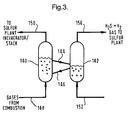
- a fluidized bed system comprising a reactor 140, a regenerator 142, a conduit 144 for feeding spent absorbent from the reactor to the regenerator 142, and another conduit for passing a fluidized bed of regenerated absorbent from the regenerator 142 to the reactor 140.
- a nitrogen and sulphur oxide enriched stream 148 from the combustor 112 (Fig. 1) is fed to the lower end of the reactor 140, over absorbent therein to strip out the sulphur oxides and provide a nitrogen enriched stream 150 for the incinerator or the stack.
- a hydrogen bearing stream 152 is fed to the bottom of the regenerator 142 to reduce the sulphur compounds on the spent absorbent to hydrogen sulphide and form a hydrogen sulphide and/or sulphur dioxide bearing outlet stream 150.
- the temperature in the fluidized bed reactor 140 is maintained at from about 900°F (482°C) to about 1,400°F (760°C), preferably between about 1,100°F 593°C) to about 1,300°F (704°C).
- the oxygen content of the stream 148 introduced into the reactor 140 is maintained in an amount of from about 0.1 to about 10 vol%, preferably 2 to about 4 vol%.
- Pressure in the reactor 140 should be maintained at about 0.1 to about 10 atmospheres (10 to 1000 Kpa), preferably about 1.5 to about 3 atmospheres (150 to 300 Kpa).
- the GHSV should be maintained at about 400 to about 7,000, preferably about 500 to about 2,500.
- absorbents which can be used preferably comprise substantially alumina, and most preferably alumina compounded with magnesia, for best results.
- ⁇ -alumina, ⁇ - ⁇ - ⁇ -alumina, ⁇ -alumina, and ⁇ -alumina are particularly useful as adsorbents and supports because of their high surface areas.
- adsorbent is used interchangeably herein with the term “absorbent.” While ⁇ -alumina and -alumina can be used as adsorbents, they are not as effective as ⁇ -alumina, ⁇ - ⁇ - ⁇ -alumina, ⁇ -alumina, and ⁇ -alumina.
- One or more oxides of other metals can also be used as adsorbents, either alone or in combination with alumina or as spinels, such as bismuth, manganese, yttrium, antimony, tin, copper, Group 1a metals, Group 2a metals, rare earth metals, and combinations thereof.
- Magnesium aluminate spinels are particularly useful as absorbers. Lanthanum and cerium are preferred rare earth metals.
- Naturally occurring rare earths such as in the form of baestenite, are also useful absorbers. Elemental copper or copper compound absorbers, such as copper oxide absorbers, can also be used.
- the copper oxide can be cuprous oxide and/or cupric oxide.
- Other copper compounds can be used, such as copper (II) sulphate, copper (II) acetate, copper (II) formate, copper (II) nitrate and/or copper (II) chloride.
- the absorbers can also be a blend/mixture of high density and low density materials.
- the metal or metal oxide part of the absorbers can be supported, carried and held on a refractory support or carrier material which also provides part of the absorbers.
- the support controls the attrition and surface area characteristics of the absorbers.
- the support preferably has a surface area greater than about 10 m 2 /g and most preferably from about 50 m 2 /g to about 500 m 2 /g for best results.
- Suitable supporters include, but are not limited to, silica, alumina, kaolin or other clays, diatomaceous earth, boria, and/or mullite.
- the support can comprise the same material as the metal or metal oxide part of the absorbers.
- the absorbers can be impregnated or otherwise coated with an oxidizing catalyst or promoter that promotes the removal of sulphur oxides and/or nitrogen oxides.
- an oxidizing catalyst or promoter that promotes the removal of sulphur oxides and/or nitrogen oxides.
- One useful catalyst is ceria (cerium oxide).
- Another useful catalyst is platinum.
- Other catalytic metals, both free and in combined form, preferably as an oxide form, can be used, either alone or in combination with each other or in combination with ceria and/or alumina, such as rare earth metals, metals from Group 8 of the Periodic Table, chromium, vanadium, rhenium, tungsten, silver and combinations thereof.
- the promoter can comprise the same material as the absorber. An even distribution of the promoter is preferred for best results and to minimize adsorbent erosion.
- Useful Group 1a metals include lithium, sodium, potassium, rubidium, and cesium.
- Useful Group 2a metals include magnesium, calcium, strontium, and barium.
- Useful Group 8 metals are the Group 8 noble metals (the platinum family of metals) including ruthenium, rhodium, palladium, osmium, iridium, and platinum. The rare earth metals are also useful and are referred to as the lanthanides.
- Suitable rare earth metals include cerium, praseodymium, neodymium, samarium, europium, gadolinium, terbium, dysprosium, holmium, erbium, thulium, ytterbium, and lutetium.
- absorbents useful in the practice of the present invention are the metal containing spinels disclosed in US-A-4790982.
- One absorbent in US-A-4790982 that is particularly suitable for use in the instant invention is the magnesium, aluminum-containing spinel impregnated with 2% vanadium and 10% cerium shown in Example 10 of the patent.
- a ceria/alumina sorbent was prepared by impregnating high pore value ⁇ -alumina (1/8" (0.32cm) extrudate from Dycat International) with a solution of 32.7 grams Ce(NO 3 )6.6H 2 O from Aldrich Chemical Company in 45 grams of water, using an incipient wetness technique. The material was dried for three hours at 120°C (248°F) and calcined one hour at 700°C (1,292°F), in air. The composition was approximately 11% CeO 2 /Al2O3. This material was crushed and sieved to 14/60 mesh (API).
- a magnesium aluminate sorbent was prepared, starting with two solutions.
- Solution I contained 461.5 grams magnesium nitrate, 68.6 grams of concentrated nitric acid, and 500 ml of water.
- Solution II contained 209.7 grams sodium aluminate, 10.7 grams sodium hydroxide, and 500 ml of water.
- To Solution I were added 2 litres of water, and then over a 30 minute period, Solution II.
- Sodium hydroxide was then added in an amount to bring the pH up to 10.7.
- the resulting mixture was aged for 16 hours and then filtered.
- the recovered solids were dried at 170°C (338°F) for 12 hours and sized to 14/60 mesh (API). This material had a composition of about Mg 2 Al2O 5 .
- a sorbent with approximately 10% ceria loading on magnesium aluminate was prepared by adding a solution of 9.71 grams cerium nitrate in 16 ml of water to 35 grams of magnesium aluminate from Example 1, using an incipient wetness method. The material was then dried for three hours at 120°C (248°F), calcined in air one hour at 700°C (1,292°F), and sized to 14/60 mesh (API).
Landscapes
- Chemical & Material Sciences (AREA)
- Engineering & Computer Science (AREA)
- Chemical Kinetics & Catalysis (AREA)
- Environmental & Geological Engineering (AREA)
- Organic Chemistry (AREA)
- Health & Medical Sciences (AREA)
- Biomedical Technology (AREA)
- Analytical Chemistry (AREA)
- General Chemical & Material Sciences (AREA)
- Oil, Petroleum & Natural Gas (AREA)
- Inorganic Chemistry (AREA)
- Treating Waste Gases (AREA)
Claims (42)
- Procédé d'élimination du soufre à partir d'un courant gazeux acide d'ammoniac contenant au moins un composé du soufre, lequel composé du soufre contient du sulfure d'hydrogène, dans lequel le courant gazeux acide d'ammoniac est chargé dans un incinérateur, lequel procédé comprend :(a) la combustion du courant gazeux acide d'ammoniac avec un gaz contenant de l'oxygène dans l'incinérateur à une température comprise dans la gamme de 816°C à 1371°C (1500°F à 2500°F) pour convertir l'ammoniac en azote et le composé du soufre ou chacun des composés du soufre en au moins un oxyde de soufre ;(b) le soutirage de l'incinérateur d'un courant gazeux contenant de l'azote et l'oxyde de soufre ou chacun des oxydes de soufre et l'envoi du courant gazeux contenant l'oxyde de soufre dans un absorbeur ayant un lit d'absorbant adapté pour éliminer les composés du soufre de telle sorte que le courant gazeux envoyé dans le lit d'absorbant quitte le lit sous la forme d'un courant transportant de l'azote ;(c) la mise en contact du lit d'absorbant avec un courant contenant de l'hydrogène et/ou un hydrocarbure pour régénérer le lit d'absorbant par réduction des composés du soufre absorbés dans le lit d'absorbant en sulfure d'hydrogène et/ou en dioxyde de soufre et formation de la sorte d'un courant de gaz d'échappement contenant du sulfure d'hydrogène et/ou du dioxyde de soufre ; et(d) récupération du soufre à partir du courant transportant du sulfure d'hydrogène et/ou du dioxyde de soufre.
- Procédé suivant la revendication 1, dans lequel ledit lit d'absorbant est disposé dans au moins deux réacteurs à lit fixe et le courant gazeux contenant de l'oxyde de soufre provenant de l'incinérateur est envoyé dans un premier desdits réacteurs jusqu'à ce que le lit qui s'y trouve soit usé par les composés du soufre absorbés ; puis ensuite ledit courant gazeux contenant de l'oxyde de soufre est envoyé dans un second desdits réacteurs ; et ledit courant gazeux transportant de l'hydrogène et/ou un hydrocarbure est introduit dans ledit premier desdits réacteurs pour former ledit gaz d'échappement et ainsi régénérer ledit premier desdits réacteurs.
- Procédé suivant la revendication 1 ou la revendication 2, dans lequel ledit courant gazeux contenant de l'oxyde de soufre et ledit courant gazeux transportant de l'hydrogène et/ou un hydrocarbure sont alternativement introduits dans chacun desdits réacteurs, de telle sorte que chaque lit est d'abord usé par lesdits composés du soufre absorbés et ensuite régénéré par ledit courant transportant de l'hydrogène et/ou un hydrocarbure pour former ledit courant de gaz d'échappement.
- Procédé suivant l'une quelconque des revendications précédentes, dans lequel ledit lit d'absorbant est dans un système à lit fluidisé comprenant un réacteur, un régénérateur, une conduite pour envoyer l'absorbant usé depuis le réacteur dans le régénérateur, et une autre conduite pour envoyer l'absorbant régénéré depuis le régénérateur dans le réacteur; et dans lequel ledit courant gazeux contenant de l'oxyde de soufre provenant de l'incinérateur est introduit dans le réacteur pour absorber ledit oxyde de soufre sur l'absorbant, et ledit courant transportant de l'hydrogène et/ou un hydrocarbure est introduit dans le régénérateur pour réduire lesdits composés du soufre absorbés en ledit courant de gaz d'échappement.
- Procédé suivant l'une quelconque des revendications précédentes, dans lequel ledit lit d'absorbant comprend un absorbant solide en lit fixe.
- Procédé suivant l'une quelconque des revendications précédentes 1 à 4, dans lequel ledit lit d'absorbant comprend un absorbant solide en lit mobile granulé.
- Procédé suivant l'une quelconque des revendications précédentes, dans lequel ledit absorbant comprend un oxyde métallique, ou un mélange d'oxydes métalliques, imprégné de promoteur.
- Procédé suivant la revendication 7, dans lequel l'oxyde métallique comprend de l'alumine et le promoteur comprend une terre rare.
- Procédé suivant la revendication 7, dans lequel ledit promoteur comprend du CeO2 et/ou du Pt.
- Procédé suivant l'une quelconque des revendications précédentes, dans lequel l'absorbant solide comprend un spinelle de Mg/Al.
- Procédé suivant la revendication 10, dans lequel l'absorbant solide comprend un spinelle contenant du magnésium et de l'aluminium imprégné de vanadium et de cérium.
- Procédé suivant l'une quelconque des revendications précédentes, dans lequel l'absorbant solide comprend un aluminate de magnésium imprégné de promoteur d'oxygène.
- Procédé suivant l'une quelconque des revendications précédentes, dans lequel ledit courant de gaz d'échappement est dirigé vers un procédé de récupération de soufre Claus dans lequel les composés du soufre sont convertis en soufre élémentaire.
- Procédé suivant l'une quelconque des revendications précédentes, dans lequel on fait fonctionner ledit absorbeur à une température de pratiquement 482°C (900°F) à pratiquement 760°C (1400°F).
- Procédé suivant l'une quelconque des revendications précédentes, dans lequel l'absorbant est reconstitué en présence d'eau en une forme qui est active pour l'absorption ultérieure d'oxydes de soufre.
- Procédé suivant l'une quelconque des revendications précédentes, dans lequel le poids dudit absorbant augmente de pratiquement 10% à pratiquement 60% en poids en raison des oxydes de soufre absorbés.
- Procédé suivant l'une quelconque des revendications précédentes, dans lequel plus de 70% en volume du soufre présent dans le courant de gaz d'échappement est sous la forme de dioxyde de soufre.
- Procédé suivant l'une quelconque des revendications précédentes, dans lequel le courant gazeux contenant des composés du soufre qui est introduit dans l'incinérateur contient du monoxyde de carbone et dans lequel plus de pratiquement 90% en volume dudit monoxyde de carbone sont convertis en dioxyde de carbone.
- Procédé suivant l'une quelconque des revendications précédentes, dans lequel ledit courant contenant de l'oxygène contient suffisamment d'oxygène de telle sorte que, lorsqu'il est introduit dans l'incinérateur, il est maintenu dans les gaz quittant l'incinérateur une teneur en oxygène de pratiquement 0,10% à pratiquement 10% en volume.
- Procédé suivant l'une quelconque des revendications précédentes, dans lequel la pression dans ledit absorbeur est de pratiquement 0,1 à pratiquement 10 atmosphères (10 à 1000 kPa).
- Procédé suivant l'une quelconque des revendications précédentes, dans lequel on fait fonctionner ledit absorbeur à une température de pratiquement 482°C (900°F) à pratiquement 760°C (1400°F), une pression de pratiquement 1 à pratiquement 2 atmosphères (100 à 200 kPa) et une GHSV (vitesse spatiale horaire du gaz) de pratiquement 500 à pratiquement 50 000.
- Procédé suivant la revendication 21, dans lequel on fait fonctionner l'absorbeur à une GHSV de pratiquement 2000 à pratiquement 5000, à une pression de pratiquement 1 à pratiquement 2 atmosphères (100 à 200 kPa) et à une température de pratiquement 593°C (1100°F) à pratiquement 732°C (1350°F).
- Procédé suivant l'une quelconque des revendications précédentes, dans lequel on fait fonctionner ledit absorbeur à une température de pratiquement 593°C (1100°F) à pratiquement 704°C (1300°F), à une GHSV de pratiquement 2000 à pratiquement 5000, à une pression de pratiquement 0,5 à pratiquement 3 atmosphères (50 à 300 kPa) et avec de l'oxygène en une quantité d'environ 2 à environ 5% en volume en présence d'un absorbant à base d'alumine et d'oxyde de cérium.
- Procédé suivant l'une quelconque des revendications précédentes, dans lequel ledit courant gazeux acide d'ammoniac est brûlé avec du gaz combustible.
- Procédé suivant l'une quelconque des revendications précédentes, dans lequel ledit courant gazeux acide d'ammoniac est brûlé de façon stoechiométrique.
- Procédé suivant l'une quelconque des revendications précédentes, dans lequel un gaz contenant de l'oxygène est ajouté audit courant gazeux contenant de l'azote et de l'oxyde de soufre soutiré de l'incinérateur.
- Procédé suivant l'une quelconque des revendications précédentes, dans lequel ledit courant gazeux acide d'ammoniac est brûlé avec de l'air ou de l'oxygène en excès.
- Procédé suivant l'une quelconque des revendications précédentes, dans lequel ledit courant gazeux contenant de l'azote et de l'oxyde de soufre en contact avec ledit lit d'absorbant solide a une teneur en oxygène de pratiquement 0,10% en volume à pratiquement 10% en volume.
- Procédé suivant l'une quelconque des revendications précédentes, dans lequel la teneur en oxygène est de pratiquement 2% en volume à pratiquement 4% en volume.
- Procédé suivant l'une quelconque des revendications précédentes, dans lequel on fait fonctionner ledit lit d'absorbant pendant l'absorption des oxydes de soufre sur celui-ci, à une GHSV de pratiquement 500 à pratiquement 20 000, à une pression de pratiquement 0,1 à pratiquement 10 atmosphères (10 à 1000 kPa) et à une température de pratiquement 482°C (900°F) à pratiquement 760°C (1400°F).
- Procédé suivant la revendication 30, dans lequel ladite GHSV est de pratiquement 3000 à pratiquement 5000, ladite température est d'environ 593°C (1100°F) à pratiquement 704°C (1300°F) et ladite pression est de pratiquement 1,5 à pratiquement 3,0 atmosphères (150 à 300 kPa).
- Procédé suivant l'une quelconque des revendications précédentes, dans lequel on fait fonctionner ledit lit d'absorbant, pendant sa régénération à une température de pratiquement 482°C (900°F) à pratiquement 760°C (1400°F), à une pression de pratiquement 0,10 à pratiquement 10 atmosphères (10 à 1000 kPa) et à une GHSV de pratiquement 10 à pratiquement 1000.
- Procédé suivant l'une quelconque des revendications précédentes, dans lequel ladite température est d'environ 593°C (1100°F) à environ 704°C (1300°F), ladite pression est de pratiquement 0,5 atmosphère à pratiquement 3,0 atmosphères (50 à 300 kPa) et ladite GHSV est de pratiquement 100 à pratiquement 150.
- Procédé suivant l'une quelconque des revendications précédentes, dans lequel ledit courant contenant de l'oxyde de soufre et de l'azote soutiré de l'incinérateur est envoyé à travers un échangeur de chaleur et dans un condenseur pour réduire la température dudit courant enrichi jusqu'à une température de pratiquement 121°C (250°F) à pratiquement 149°C (300°F) pour condenser le soufre élémentaire à partir dudit courant soutiré, sous la forme d'un courant de soufre liquide, puis ledit courant soutiré étant ensuite recyclé à travers ledit échangeur de chaleur pour être réchauffé à une température de pratiquement 482°C (900°F) à pratiquement 760°C (1400°F) pour la mise en contact avec ledit lit d'absorbant solide.
- Procédé suivant l'une quelconque des revendications précédentes, dans lequel ledit courant gazeux acide d'ammoniac est brûlé dans une atmosphère oxydante.
- Procédé suivant l'une quelconque des revendications précédentes, dans lequel ledit courant transportant de l'azote provenant dudit absorbeur est envoyé dans un incinérateur ou déchargé.
- Utilisation d'un appareil d'élimination du soufre à partir d'un courant gazeux acide d'ammoniac par un procédé suivant l'une quelconque des revendications précédentes, l'appareil comprenant :(a) un incinérateur pour la combustion du courant gazeux acide d'ammoniac avec un gaz contenant de l'oxygène à une température comprise dans la gamme de 816°C à 1371°C (1500°F à 2500°F) pour convertir l'ammoniac en azote et le composé du soufre ou chacun des composés du soufre en au moins un oxyde de soufre ;(b) un moyen de mise en contact d'un gaz contenant de l'oxyde de soufre et de l'azote soutiré de l'incinérateur avec un lit d'absorbant adapté pour éliminer les composés du soufre et pour ne pas absorber l'azote formé dans l'incinérateur à partir d'un courant gazeux contenant de l'oxyde de soufre et de l'azote soutiré de l'incinérateur ;(c) un moyen de régénération dudit lit d'absorbant par sa mise en contact avec un courant contenant de l'hydrogène et/ou un hydrocarbure de telle sorte que les composés du soufre absorbés dans ledit lit d'absorbant sont réduits en sulfure d'hydrogène et/ou en dioxyde de soufre de façon à former ainsi un courant de gaz d'échappement contenant du sulfure d'hydrogène et/ou du dioxyde de soufre ; et(d) un moyen de récupération du soufre à partir dudit courant transportant du sulfure d'hydrogène et/ou du dioxyde de soufre.
- Utilisation d'un appareil suivant la revendication 37, dans lequel ledit moyen de récupération du soufre comprend un appareil de récupération de soufre Claus.
- Utilisation d'un appareil suivant la revendication 37 ou la revendication 38, dans lequel ledit moyen de combustion fonctionne à une température de pratiquement 816°C (1500°F) à pratiquement 1371°C (2500°F).
- Utilisation d'un appareil suivant l'une quelconque des revendications 37 à 39, qui comprend de plus un moyen pour alimenter en gaz combustible ledit moyen de combustion.
- Utilisation d'un appareil suivant l'une quelconque des revendications 37 à 40, dans lequel le moyen de mise en contact et le moyen de régénération comprennent au moins deux réacteurs à lit fixe, chaque lit étant formé dudit absorbant ; et ledit appareil comprend de plus un moyen de commutation pour (1) introduire ledit courant gazeux contenant de l'oxyde de soufre soutiré de l'incinérateur dans un premier desdits réacteurs jusqu'à ce que le lit qui se trouve à l'intérieur soit usé par les composés du soufre absorbés, et ensuite pour (2) introduire ledit courant gazeux contenant de l'oxyde de soufre dans un second desdits réacteurs pendant que ledit courant gazeux contenant de l'hydrogène et/ou un hydrocarbure est envoyé dans ledit premier desdits réacteurs pour former ledit courant de gaz d'échappement et régénérer ainsi ledit premier desdits réacteurs.
- Utilisation d'un appareil suivant l'une quelconque des revendications 37 à 41, dans lequel ledit moyen de mise en contact comprend un réacteur et ledit moyen de régénération du lit d'absorbant comprend un régénérateur ; ledit appareil comprenant de plus un moyen pour alimenter de façon continue un lit fluidisé d'absorbant usé depuis le réacteur vers le régénérateur, et pour envoyer un lit fluidisé d'absorbant régénéré depuis le régénérateur vers le réacteur ; de telle sorte que ledit courant gazeux contenant de l'oxyde de soufre provenant de l'incinérateur est envoyé dans ledit absorbant dans le réacteur pour absorber ledit oxyde de soufre, et un moyen pour envoyer ledit courant gazeux transportant de l'hydrogène et/ou un hydrocarbure dans le régénérateur pour réduire les composés du soufre absorbés en sulfure d'hydrogène et/ou en dioxyde de soufre et former ainsi ledit gaz d'échappement.
Priority Applications (1)
| Application Number | Priority Date | Filing Date | Title |
|---|---|---|---|
| EP01111956A EP1156012A1 (fr) | 1992-04-15 | 1993-04-14 | Procédé et l appareil d élimination de soufre d un courant gazeux contenant de l acide sulphydrique |
Applications Claiming Priority (5)
| Application Number | Priority Date | Filing Date | Title |
|---|---|---|---|
| US868432 | 1992-04-15 | ||
| US07/868,432 US5229091A (en) | 1992-04-15 | 1992-04-15 | Process for desulfurizing Claus tail-gas |
| US877936 | 1992-05-04 | ||
| US07/877,936 US5292492A (en) | 1992-05-04 | 1992-05-04 | Recovering sulfur from ammonia acid gas stream |
| PCT/US1993/003534 WO1993021107A1 (fr) | 1992-04-15 | 1993-04-14 | Procede et appareil d'elimination de soufre d'un courant gazeux contenant de l'acide sulphydrique |
Related Child Applications (1)
| Application Number | Title | Priority Date | Filing Date |
|---|---|---|---|
| EP01111956A Division EP1156012A1 (fr) | 1992-04-15 | 1993-04-14 | Procédé et l appareil d élimination de soufre d un courant gazeux contenant de l acide sulphydrique |
Publications (3)
| Publication Number | Publication Date |
|---|---|
| EP0636107A1 EP0636107A1 (fr) | 1995-02-01 |
| EP0636107A4 EP0636107A4 (fr) | 1995-09-27 |
| EP0636107B1 true EP0636107B1 (fr) | 2002-02-13 |
Family
ID=27128055
Family Applications (2)
| Application Number | Title | Priority Date | Filing Date |
|---|---|---|---|
| EP93910604A Expired - Lifetime EP0636107B1 (fr) | 1992-04-15 | 1993-04-14 | Procede et l'utilisation d'un appareil d'elimination de soufre d'un courant gazeux contenant de l'acide sulphydrique |
| EP01111956A Withdrawn EP1156012A1 (fr) | 1992-04-15 | 1993-04-14 | Procédé et l appareil d élimination de soufre d un courant gazeux contenant de l acide sulphydrique |
Family Applications After (1)
| Application Number | Title | Priority Date | Filing Date |
|---|---|---|---|
| EP01111956A Withdrawn EP1156012A1 (fr) | 1992-04-15 | 1993-04-14 | Procédé et l appareil d élimination de soufre d un courant gazeux contenant de l acide sulphydrique |
Country Status (8)
| Country | Link |
|---|---|
| EP (2) | EP0636107B1 (fr) |
| JP (1) | JP3485116B2 (fr) |
| AU (1) | AU664754B2 (fr) |
| CA (1) | CA2118120C (fr) |
| DE (1) | DE69331577T2 (fr) |
| ES (1) | ES2170067T3 (fr) |
| SG (1) | SG44573A1 (fr) |
| WO (1) | WO1993021107A1 (fr) |
Cited By (3)
| Publication number | Priority date | Publication date | Assignee | Title |
|---|---|---|---|---|
| US7347929B2 (en) | 2003-12-05 | 2008-03-25 | Intercat, Inc. | Gasoline sulfur reduction using hydrotalcite like compounds |
| US7361319B2 (en) | 2003-12-05 | 2008-04-22 | Intercat, Inc. | Mixed metal oxide sorbents |
| US7361264B2 (en) | 2004-06-02 | 2008-04-22 | Intercat, Inc. | Mixed metal oxide additives |
Families Citing this family (5)
| Publication number | Priority date | Publication date | Assignee | Title |
|---|---|---|---|---|
| US5458861A (en) * | 1992-04-15 | 1995-10-17 | Mobil Oil Corporation | Desulfurizing a gas stream |
| EP1116511A1 (fr) * | 2000-01-17 | 2001-07-18 | Gastec N.C. | Procédé pour éliminer des composés sulfurés de mélanges gazeux |
| CA2567790C (fr) | 2004-07-12 | 2013-01-08 | Exxonmobil Upstream Research Company | Procedes d'enlevement de composes contenant du soufre |
| FR2919813B1 (fr) | 2007-08-06 | 2010-08-27 | Air Liquide | Procede de desoxygenation de fumees et installation pour sa mise en oeuvre |
| FR2944456B1 (fr) * | 2009-04-16 | 2011-05-06 | Inst Francais Du Petrole | Procede de desulfuration d'un effluent gazeux comportant un dispositif d'analyse en ligne et de controle |
Citations (1)
| Publication number | Priority date | Publication date | Assignee | Title |
|---|---|---|---|---|
| EP0495710A2 (fr) * | 1991-01-17 | 1992-07-22 | Institut Français du Pétrole | Installation de génération de chaleur comportant des moyens de désulfuration utilisant des absorbants régénérables |
Family Cites Families (10)
| Publication number | Priority date | Publication date | Assignee | Title |
|---|---|---|---|---|
| US3832445A (en) * | 1964-09-14 | 1974-08-27 | Shell Oil Co | Sulfur dioxide removal |
| NL169415C (nl) * | 1971-02-19 | 1983-01-17 | Shell Int Research | Werkwijze voor het omzetten in elementaire zwavel van zwaveloxyden, aanwezig in zwaveloxyden bevattende gassen. |
| US3821110A (en) * | 1971-08-11 | 1974-06-28 | Marathon Oil Co | Sour water purification process |
| NL176160C (nl) * | 1973-10-10 | 1985-03-01 | Comprimo Bv | Werkwijze voor het verbranden van een ammoniak en waterstofsulfide bevattend mengsel van gassen. |
| DE3143400A1 (de) * | 1981-11-02 | 1983-06-01 | Mobil Oil Corp., 10017 New York, N.Y. | Verfahren zur verringerung des schwefelgehaltes in gasstroemen unter gewinnung von elementarem schwefel |
| US4432862A (en) * | 1982-01-18 | 1984-02-21 | Exxon Research And Engineering Co. | Reforming and isomerization process |
| US4836993A (en) * | 1983-09-27 | 1989-06-06 | Amoco Corporation | Process for removing sulfur oxides from a gas |
| US4692318A (en) * | 1984-08-13 | 1987-09-08 | Amoco Corporation | Process for simultaneously removing nitrogen oxides, sulfur oxides, and particulates |
| FR2587236B1 (fr) * | 1985-09-13 | 1987-11-13 | Inst Francais Du Petrole | Procede d'elimination d'oxydes de soufre d'un gaz au moyen d'une masse d'absorption regenerable par reaction avec de l'hydrogene sulfure |
| US4855117A (en) * | 1985-09-13 | 1989-08-08 | Institut Francais Du Petrole | Process for removing sulfur oxides from a gas by means of an absorption mass regenerable by reaction with elemental sulfur |
-
1993
- 1993-04-14 EP EP93910604A patent/EP0636107B1/fr not_active Expired - Lifetime
- 1993-04-14 AU AU41037/93A patent/AU664754B2/en not_active Ceased
- 1993-04-14 JP JP51859993A patent/JP3485116B2/ja not_active Expired - Fee Related
- 1993-04-14 EP EP01111956A patent/EP1156012A1/fr not_active Withdrawn
- 1993-04-14 CA CA002118120A patent/CA2118120C/fr not_active Expired - Fee Related
- 1993-04-14 WO PCT/US1993/003534 patent/WO1993021107A1/fr not_active Ceased
- 1993-04-14 SG SG1996002799A patent/SG44573A1/en unknown
- 1993-04-14 DE DE69331577T patent/DE69331577T2/de not_active Expired - Fee Related
- 1993-04-14 ES ES93910604T patent/ES2170067T3/es not_active Expired - Lifetime
Patent Citations (1)
| Publication number | Priority date | Publication date | Assignee | Title |
|---|---|---|---|---|
| EP0495710A2 (fr) * | 1991-01-17 | 1992-07-22 | Institut Français du Pétrole | Installation de génération de chaleur comportant des moyens de désulfuration utilisant des absorbants régénérables |
Cited By (3)
| Publication number | Priority date | Publication date | Assignee | Title |
|---|---|---|---|---|
| US7347929B2 (en) | 2003-12-05 | 2008-03-25 | Intercat, Inc. | Gasoline sulfur reduction using hydrotalcite like compounds |
| US7361319B2 (en) | 2003-12-05 | 2008-04-22 | Intercat, Inc. | Mixed metal oxide sorbents |
| US7361264B2 (en) | 2004-06-02 | 2008-04-22 | Intercat, Inc. | Mixed metal oxide additives |
Also Published As
| Publication number | Publication date |
|---|---|
| DE69331577D1 (de) | 2002-03-21 |
| SG44573A1 (en) | 1997-12-19 |
| EP0636107A4 (fr) | 1995-09-27 |
| AU4103793A (en) | 1993-11-18 |
| ES2170067T3 (es) | 2002-08-01 |
| CA2118120A1 (fr) | 1993-10-28 |
| WO1993021107A1 (fr) | 1993-10-28 |
| AU664754B2 (en) | 1995-11-30 |
| EP0636107A1 (fr) | 1995-02-01 |
| DE69331577T2 (de) | 2002-10-31 |
| EP1156012A1 (fr) | 2001-11-21 |
| JP3485116B2 (ja) | 2004-01-13 |
| CA2118120C (fr) | 2002-12-24 |
| JPH07505856A (ja) | 1995-06-29 |
Similar Documents
| Publication | Publication Date | Title |
|---|---|---|
| US5229091A (en) | Process for desulfurizing Claus tail-gas | |
| US5514351A (en) | Desulfurizing tailgas from sulfur recovery unit | |
| US6610264B1 (en) | Process and system for desulfurizing a gas stream | |
| US5458861A (en) | Desulfurizing a gas stream | |
| US5741469A (en) | Process scheme for SOx removal from flue gases | |
| US5728358A (en) | Sox sorbent regeneration | |
| WO2002032810A1 (fr) | Procede et appareil destines a eliminer un compose sulfure a partir d'un gaz contenant de l'hydrogene sulfure, du mercaptan, du dioxyde de carbone et un hydrocarbure aromatique | |
| US4725417A (en) | Process for removing sulfur oxides from a gas by means of an absorption mass regenerable by reaction with hydrogen sulfide | |
| US6030597A (en) | Process for treating H2 S containing streams | |
| JP3766100B2 (ja) | H▲下2▼s及びso▲下2▼化合物を含有するガスの接触脱硫方法、並びに該方法を実施するための触媒 | |
| EP0636107B1 (fr) | Procede et l'utilisation d'un appareil d'elimination de soufre d'un courant gazeux contenant de l'acide sulphydrique | |
| US5292492A (en) | Recovering sulfur from ammonia acid gas stream | |
| JP3602268B2 (ja) | 天然ガス等に含まれる硫黄化合物の除去方法およびその装置 | |
| EP0159730A2 (fr) | Procédé pour l'élimination de composés soufrés de gaz d'échappement | |
| US5958359A (en) | Process for treating H2 S-lean streams, with recycle of SOx from burner | |
| CA1296508C (fr) | Elimination d'une partie de la vapeur d'eau apres regeneration d'un oxyde metallique absorbant, afin de deruire le debit de recyclage | |
| US4855117A (en) | Process for removing sulfur oxides from a gas by means of an absorption mass regenerable by reaction with elemental sulfur | |
| US4781903A (en) | Process for removing sulfur oxides from a gas by means of an absorption mass regenerable by reaction with elemental sulfur | |
| WO2001052974A1 (fr) | Procede pour eliminer des composes sulfures de melanges gazeux | |
| EP0256741A2 (fr) | Procédé de récupération de soufre par une purge avec un gaz réducteur en utilisant des absorbants d'oxydes métalliques | |
| JPH0475057B2 (fr) |
Legal Events
| Date | Code | Title | Description |
|---|---|---|---|
| PUAI | Public reference made under article 153(3) epc to a published international application that has entered the european phase |
Free format text: ORIGINAL CODE: 0009012 |
|
| 17P | Request for examination filed |
Effective date: 19940917 |
|
| AK | Designated contracting states |
Kind code of ref document: A1 Designated state(s): BE DE ES FR GB IT NL |
|
| A4 | Supplementary search report drawn up and despatched |
Effective date: 19950807 |
|
| AK | Designated contracting states |
Kind code of ref document: A4 Designated state(s): BE DE ES FR GB IT NL |
|
| 17Q | First examination report despatched |
Effective date: 19951221 |
|
| GRAG | Despatch of communication of intention to grant |
Free format text: ORIGINAL CODE: EPIDOS AGRA |
|
| RTI1 | Title (correction) |
Free format text: PROCESS AND USE OF AN APPARATUS FOR RECOVERING SULPHUR FROM A GAS STREAM CONTAINING HYDROGEN SULPHIDE |
|
| GRAG | Despatch of communication of intention to grant |
Free format text: ORIGINAL CODE: EPIDOS AGRA |
|
| GRAH | Despatch of communication of intention to grant a patent |
Free format text: ORIGINAL CODE: EPIDOS IGRA |
|
| GRAH | Despatch of communication of intention to grant a patent |
Free format text: ORIGINAL CODE: EPIDOS IGRA |
|
| RAP1 | Party data changed (applicant data changed or rights of an application transferred) |
Owner name: EXXONMOBIL OIL CORPORATION |
|
| GRAA | (expected) grant |
Free format text: ORIGINAL CODE: 0009210 |
|
| REG | Reference to a national code |
Ref country code: GB Ref legal event code: IF02 |
|
| AK | Designated contracting states |
Kind code of ref document: B1 Designated state(s): BE DE ES FR GB IT NL |
|
| REF | Corresponds to: |
Ref document number: 69331577 Country of ref document: DE Date of ref document: 20020321 |
|
| REG | Reference to a national code |
Ref country code: ES Ref legal event code: FG2A Ref document number: 2170067 Country of ref document: ES Kind code of ref document: T3 |
|
| PLBE | No opposition filed within time limit |
Free format text: ORIGINAL CODE: 0009261 |
|
| 26N | No opposition filed |
Effective date: 20021114 |
|
| PGFP | Annual fee paid to national office [announced via postgrant information from national office to epo] |
Ref country code: GB Payment date: 20080317 Year of fee payment: 16 |
|
| PGFP | Annual fee paid to national office [announced via postgrant information from national office to epo] |
Ref country code: ES Payment date: 20080409 Year of fee payment: 16 Ref country code: DE Payment date: 20080430 Year of fee payment: 16 |
|
| PGFP | Annual fee paid to national office [announced via postgrant information from national office to epo] |
Ref country code: BE Payment date: 20080507 Year of fee payment: 16 Ref country code: IT Payment date: 20080419 Year of fee payment: 16 |
|
| PGFP | Annual fee paid to national office [announced via postgrant information from national office to epo] |
Ref country code: NL Payment date: 20080325 Year of fee payment: 16 |
|
| PGFP | Annual fee paid to national office [announced via postgrant information from national office to epo] |
Ref country code: FR Payment date: 20080403 Year of fee payment: 16 |
|
| BERE | Be: lapsed |
Owner name: *EXXONMOBIL OIL CORP. Effective date: 20090430 |
|
| GBPC | Gb: european patent ceased through non-payment of renewal fee |
Effective date: 20090414 |
|
| NLV4 | Nl: lapsed or anulled due to non-payment of the annual fee |
Effective date: 20091101 |
|
| REG | Reference to a national code |
Ref country code: FR Ref legal event code: ST Effective date: 20091231 |
|
| PG25 | Lapsed in a contracting state [announced via postgrant information from national office to epo] |
Ref country code: DE Free format text: LAPSE BECAUSE OF NON-PAYMENT OF DUE FEES Effective date: 20091103 |
|
| PG25 | Lapsed in a contracting state [announced via postgrant information from national office to epo] |
Ref country code: NL Free format text: LAPSE BECAUSE OF NON-PAYMENT OF DUE FEES Effective date: 20091101 |
|
| PG25 | Lapsed in a contracting state [announced via postgrant information from national office to epo] |
Ref country code: GB Free format text: LAPSE BECAUSE OF NON-PAYMENT OF DUE FEES Effective date: 20090414 Ref country code: FR Free format text: LAPSE BECAUSE OF NON-PAYMENT OF DUE FEES Effective date: 20091222 |
|
| PG25 | Lapsed in a contracting state [announced via postgrant information from national office to epo] |
Ref country code: BE Free format text: LAPSE BECAUSE OF NON-PAYMENT OF DUE FEES Effective date: 20090430 |
|
| REG | Reference to a national code |
Ref country code: ES Ref legal event code: FD2A Effective date: 20090415 |
|
| PG25 | Lapsed in a contracting state [announced via postgrant information from national office to epo] |
Ref country code: ES Free format text: LAPSE BECAUSE OF NON-PAYMENT OF DUE FEES Effective date: 20090415 |
|
| PG25 | Lapsed in a contracting state [announced via postgrant information from national office to epo] |
Ref country code: IT Free format text: LAPSE BECAUSE OF NON-PAYMENT OF DUE FEES Effective date: 20090414 |