EP0636601A1 - Procédé de préparation de carbonates de dialkyle - Google Patents
Procédé de préparation de carbonates de dialkyle Download PDFInfo
- Publication number
- EP0636601A1 EP0636601A1 EP94111133A EP94111133A EP0636601A1 EP 0636601 A1 EP0636601 A1 EP 0636601A1 EP 94111133 A EP94111133 A EP 94111133A EP 94111133 A EP94111133 A EP 94111133A EP 0636601 A1 EP0636601 A1 EP 0636601A1
- Authority
- EP
- European Patent Office
- Prior art keywords
- reaction
- bar
- water
- alkanol
- weight
- Prior art date
- Legal status (The legal status is an assumption and is not a legal conclusion. Google has not performed a legal analysis and makes no representation as to the accuracy of the status listed.)
- Withdrawn
Links
- 150000004649 carbonic acid derivatives Chemical class 0.000 title claims abstract description 10
- 238000000034 method Methods 0.000 title claims description 23
- 238000002360 preparation method Methods 0.000 title claims description 4
- 238000006243 chemical reaction Methods 0.000 claims abstract description 47
- XLYOFNOQVPJJNP-UHFFFAOYSA-N water Substances O XLYOFNOQVPJJNP-UHFFFAOYSA-N 0.000 claims abstract description 27
- 239000011541 reaction mixture Substances 0.000 claims abstract description 18
- QVGXLLKOCUKJST-UHFFFAOYSA-N atomic oxygen Chemical compound [O] QVGXLLKOCUKJST-UHFFFAOYSA-N 0.000 claims abstract description 9
- 229910052760 oxygen Inorganic materials 0.000 claims abstract description 9
- 239000001301 oxygen Substances 0.000 claims abstract description 9
- UGFAIRIUMAVXCW-UHFFFAOYSA-N Carbon monoxide Chemical compound [O+]#[C-] UGFAIRIUMAVXCW-UHFFFAOYSA-N 0.000 claims abstract description 7
- 229910002091 carbon monoxide Inorganic materials 0.000 claims abstract description 7
- 150000003839 salts Chemical class 0.000 claims description 28
- IEJIGPNLZYLLBP-UHFFFAOYSA-N dimethyl carbonate Chemical compound COC(=O)OC IEJIGPNLZYLLBP-UHFFFAOYSA-N 0.000 claims description 17
- BVKZGUZCCUSVTD-UHFFFAOYSA-L Carbonate Chemical compound [O-]C([O-])=O BVKZGUZCCUSVTD-UHFFFAOYSA-L 0.000 claims description 14
- 238000004821 distillation Methods 0.000 claims description 8
- 238000004519 manufacturing process Methods 0.000 claims description 8
- 229910017489 Cu I Inorganic materials 0.000 claims description 5
- VEXZGXHMUGYJMC-UHFFFAOYSA-M Chloride anion Chemical compound [Cl-] VEXZGXHMUGYJMC-UHFFFAOYSA-M 0.000 claims description 4
- 125000002496 methyl group Chemical group [H]C([H])([H])* 0.000 claims description 4
- 239000012429 reaction media Substances 0.000 claims description 3
- 125000000217 alkyl group Chemical group 0.000 claims description 2
- 229910052799 carbon Inorganic materials 0.000 claims description 2
- 238000007599 discharging Methods 0.000 claims description 2
- 125000001495 ethyl group Chemical group [H]C([H])([H])C([H])([H])* 0.000 claims description 2
- 238000005194 fractionation Methods 0.000 claims description 2
- 239000000155 melt Substances 0.000 claims description 2
- 229910021591 Copper(I) chloride Inorganic materials 0.000 claims 1
- OXBLHERUFWYNTN-UHFFFAOYSA-M copper(I) chloride Chemical compound [Cu]Cl OXBLHERUFWYNTN-UHFFFAOYSA-M 0.000 claims 1
- 150000001879 copper Chemical class 0.000 abstract description 2
- 239000000126 substance Substances 0.000 abstract description 2
- OKKJLVBELUTLKV-UHFFFAOYSA-N Methanol Chemical compound OC OKKJLVBELUTLKV-UHFFFAOYSA-N 0.000 description 57
- 239000010949 copper Substances 0.000 description 15
- 239000000203 mixture Substances 0.000 description 14
- 239000003054 catalyst Substances 0.000 description 8
- 239000007789 gas Substances 0.000 description 7
- 150000001875 compounds Chemical class 0.000 description 6
- 125000005910 alkyl carbonate group Chemical group 0.000 description 5
- 239000000047 product Substances 0.000 description 5
- 239000006227 byproduct Substances 0.000 description 4
- 150000001805 chlorine compounds Chemical class 0.000 description 4
- 238000000926 separation method Methods 0.000 description 4
- WSFSSNUMVMOOMR-UHFFFAOYSA-N Formaldehyde Chemical compound O=C WSFSSNUMVMOOMR-UHFFFAOYSA-N 0.000 description 3
- WCUXLLCKKVVCTQ-UHFFFAOYSA-M Potassium chloride Chemical compound [Cl-].[K+] WCUXLLCKKVVCTQ-UHFFFAOYSA-M 0.000 description 3
- HEMHJVSKTPXQMS-UHFFFAOYSA-M Sodium hydroxide Chemical compound [OH-].[Na+] HEMHJVSKTPXQMS-UHFFFAOYSA-M 0.000 description 3
- 238000001816 cooling Methods 0.000 description 3
- 230000007797 corrosion Effects 0.000 description 3
- 238000005260 corrosion Methods 0.000 description 3
- 230000005496 eutectics Effects 0.000 description 3
- 239000011261 inert gas Substances 0.000 description 3
- -1 rhodanides Chemical class 0.000 description 3
- SPEUIVXLLWOEMJ-UHFFFAOYSA-N 1,1-dimethoxyethane Chemical compound COC(C)OC SPEUIVXLLWOEMJ-UHFFFAOYSA-N 0.000 description 2
- TWRXJAOTZQYOKJ-UHFFFAOYSA-L Magnesium chloride Chemical compound [Mg+2].[Cl-].[Cl-] TWRXJAOTZQYOKJ-UHFFFAOYSA-L 0.000 description 2
- UIIMBOGNXHQVGW-UHFFFAOYSA-M Sodium bicarbonate Chemical compound [Na+].OC([O-])=O UIIMBOGNXHQVGW-UHFFFAOYSA-M 0.000 description 2
- FAPWRFPIFSIZLT-UHFFFAOYSA-M Sodium chloride Chemical compound [Na+].[Cl-] FAPWRFPIFSIZLT-UHFFFAOYSA-M 0.000 description 2
- 230000015572 biosynthetic process Effects 0.000 description 2
- 239000007795 chemical reaction product Substances 0.000 description 2
- ORTQZVOHEJQUHG-UHFFFAOYSA-L copper(II) chloride Chemical compound Cl[Cu]Cl ORTQZVOHEJQUHG-UHFFFAOYSA-L 0.000 description 2
- VAYGXNSJCAHWJZ-UHFFFAOYSA-N dimethyl sulfate Chemical compound COS(=O)(=O)OC VAYGXNSJCAHWJZ-UHFFFAOYSA-N 0.000 description 2
- 238000001704 evaporation Methods 0.000 description 2
- 150000004820 halides Chemical class 0.000 description 2
- 239000000543 intermediate Substances 0.000 description 2
- 239000007788 liquid Substances 0.000 description 2
- 239000000463 material Substances 0.000 description 2
- 238000004064 recycling Methods 0.000 description 2
- UXVMQQNJUSDDNG-UHFFFAOYSA-L Calcium chloride Chemical compound [Cl-].[Cl-].[Ca+2] UXVMQQNJUSDDNG-UHFFFAOYSA-L 0.000 description 1
- 239000005749 Copper compound Substances 0.000 description 1
- 229910021592 Copper(II) chloride Inorganic materials 0.000 description 1
- GYHNNYVSQQEPJS-UHFFFAOYSA-N Gallium Chemical compound [Ga] GYHNNYVSQQEPJS-UHFFFAOYSA-N 0.000 description 1
- ISWSIDIOOBJBQZ-UHFFFAOYSA-N Phenol Chemical compound OC1=CC=CC=C1 ISWSIDIOOBJBQZ-UHFFFAOYSA-N 0.000 description 1
- YGYAWVDWMABLBF-UHFFFAOYSA-N Phosgene Chemical compound ClC(Cl)=O YGYAWVDWMABLBF-UHFFFAOYSA-N 0.000 description 1
- 229910000831 Steel Inorganic materials 0.000 description 1
- 150000001242 acetic acid derivatives Chemical class 0.000 description 1
- 125000005595 acetylacetonate group Chemical group 0.000 description 1
- 230000004913 activation Effects 0.000 description 1
- 125000001931 aliphatic group Chemical group 0.000 description 1
- 229910052783 alkali metal Inorganic materials 0.000 description 1
- 150000001340 alkali metals Chemical class 0.000 description 1
- 150000001412 amines Chemical class 0.000 description 1
- NEHMKBQYUWJMIP-UHFFFAOYSA-N anhydrous methyl chloride Natural products ClC NEHMKBQYUWJMIP-UHFFFAOYSA-N 0.000 description 1
- 150000004982 aromatic amines Chemical class 0.000 description 1
- 238000010533 azeotropic distillation Methods 0.000 description 1
- 238000009835 boiling Methods 0.000 description 1
- 150000003842 bromide salts Chemical class 0.000 description 1
- 239000001110 calcium chloride Substances 0.000 description 1
- 235000011148 calcium chloride Nutrition 0.000 description 1
- 229910001628 calcium chloride Inorganic materials 0.000 description 1
- 230000003197 catalytic effect Effects 0.000 description 1
- NEHMKBQYUWJMIP-NJFSPNSNSA-N chloro(114C)methane Chemical compound [14CH3]Cl NEHMKBQYUWJMIP-NJFSPNSNSA-N 0.000 description 1
- 239000008139 complexing agent Substances 0.000 description 1
- 150000001880 copper compounds Chemical class 0.000 description 1
- 210000003298 dental enamel Anatomy 0.000 description 1
- 230000003628 erosive effect Effects 0.000 description 1
- 230000008020 evaporation Effects 0.000 description 1
- 238000004880 explosion Methods 0.000 description 1
- 238000000605 extraction Methods 0.000 description 1
- 150000004675 formic acid derivatives Chemical class 0.000 description 1
- 229910052733 gallium Inorganic materials 0.000 description 1
- 239000011521 glass Substances 0.000 description 1
- 229910052738 indium Inorganic materials 0.000 description 1
- APFVFJFRJDLVQX-UHFFFAOYSA-N indium atom Chemical compound [In] APFVFJFRJDLVQX-UHFFFAOYSA-N 0.000 description 1
- 239000012948 isocyanate Substances 0.000 description 1
- 150000002513 isocyanates Chemical class 0.000 description 1
- 150000002611 lead compounds Chemical class 0.000 description 1
- 231100000053 low toxicity Toxicity 0.000 description 1
- 229910001629 magnesium chloride Inorganic materials 0.000 description 1
- 235000011147 magnesium chloride Nutrition 0.000 description 1
- 230000008018 melting Effects 0.000 description 1
- 238000002844 melting Methods 0.000 description 1
- 229910052751 metal Inorganic materials 0.000 description 1
- 239000002184 metal Substances 0.000 description 1
- 150000002739 metals Chemical class 0.000 description 1
- 238000010327 methods by industry Methods 0.000 description 1
- 229940050176 methyl chloride Drugs 0.000 description 1
- 230000011987 methylation Effects 0.000 description 1
- 238000007069 methylation reaction Methods 0.000 description 1
- 150000004780 naphthols Chemical class 0.000 description 1
- 150000002823 nitrates Chemical class 0.000 description 1
- 150000002825 nitriles Chemical class 0.000 description 1
- TVMXDCGIABBOFY-UHFFFAOYSA-N octane Chemical compound CCCCCCCC TVMXDCGIABBOFY-UHFFFAOYSA-N 0.000 description 1
- 238000006053 organic reaction Methods 0.000 description 1
- 150000003891 oxalate salts Chemical class 0.000 description 1
- 230000003647 oxidation Effects 0.000 description 1
- 238000007254 oxidation reaction Methods 0.000 description 1
- JUJWROOIHBZHMG-UHFFFAOYSA-N pyridine Substances C1=CC=NC=C1 JUJWROOIHBZHMG-UHFFFAOYSA-N 0.000 description 1
- 238000005956 quaternization reaction Methods 0.000 description 1
- 239000000376 reactant Substances 0.000 description 1
- 230000008929 regeneration Effects 0.000 description 1
- 238000011069 regeneration method Methods 0.000 description 1
- 239000011833 salt mixture Substances 0.000 description 1
- 238000005201 scrubbing Methods 0.000 description 1
- 235000017557 sodium bicarbonate Nutrition 0.000 description 1
- 229910000030 sodium bicarbonate Inorganic materials 0.000 description 1
- 239000011780 sodium chloride Substances 0.000 description 1
- 238000001179 sorption measurement Methods 0.000 description 1
- 229910001220 stainless steel Inorganic materials 0.000 description 1
- 239000010959 steel Substances 0.000 description 1
- 150000003467 sulfuric acid derivatives Chemical class 0.000 description 1
- 239000000725 suspension Substances 0.000 description 1
- 229910052715 tantalum Inorganic materials 0.000 description 1
- GUVRBAGPIYLISA-UHFFFAOYSA-N tantalum atom Chemical compound [Ta] GUVRBAGPIYLISA-UHFFFAOYSA-N 0.000 description 1
- 229910052716 thallium Inorganic materials 0.000 description 1
- BKVIYDNLLOSFOA-UHFFFAOYSA-N thallium Chemical compound [Tl] BKVIYDNLLOSFOA-UHFFFAOYSA-N 0.000 description 1
- 231100000331 toxic Toxicity 0.000 description 1
- 230000002588 toxic effect Effects 0.000 description 1
- 150000003673 urethanes Chemical class 0.000 description 1
- 238000005406 washing Methods 0.000 description 1
- 239000011592 zinc chloride Substances 0.000 description 1
- 235000005074 zinc chloride Nutrition 0.000 description 1
- JIAARYAFYJHUJI-UHFFFAOYSA-L zinc dichloride Chemical compound [Cl-].[Cl-].[Zn+2] JIAARYAFYJHUJI-UHFFFAOYSA-L 0.000 description 1
Images
Classifications
-
- C—CHEMISTRY; METALLURGY
- C07—ORGANIC CHEMISTRY
- C07C—ACYCLIC OR CARBOCYCLIC COMPOUNDS
- C07C51/00—Preparation of carboxylic acids or their salts, halides or anhydrides
- C07C51/16—Preparation of carboxylic acids or their salts, halides or anhydrides by oxidation
- C07C51/21—Preparation of carboxylic acids or their salts, halides or anhydrides by oxidation with molecular oxygen
- C07C51/23—Preparation of carboxylic acids or their salts, halides or anhydrides by oxidation with molecular oxygen of oxygen-containing groups to carboxyl groups
- C07C51/235—Preparation of carboxylic acids or their salts, halides or anhydrides by oxidation with molecular oxygen of oxygen-containing groups to carboxyl groups of —CHO groups or primary alcohol groups
-
- C—CHEMISTRY; METALLURGY
- C07—ORGANIC CHEMISTRY
- C07C—ACYCLIC OR CARBOCYCLIC COMPOUNDS
- C07C68/00—Preparation of esters of carbonic or haloformic acids
- C07C68/01—Preparation of esters of carbonic or haloformic acids from carbon monoxide and oxygen
Definitions
- the invention relates to an improved process for the preparation of dialkyl carbonates by oxycarbonylation of the underlying alkanols in the presence of Cu salts, the water content being limited to less than 10% by weight of the reaction mixture.
- Dialkyl carbonates especially dimethyl carbonate, are intermediates with low toxicity and can replace toxic intermediates, such as phosgene or dimethyl sulfate, in many reactions. They are also not corrosive. When used, there are no environmentally harmful by-products.
- Examples of such reactions of the dialkyl carbonates are the production of urethanes from aliphatic or aromatic amines, which in turn can be split into the corresponding isocyanates.
- Dimethyl carbonate can also replace, for example, dimethyl sulfate in the quaternization of amines or in the methylation of phenol or naphthols.
- Dimethyl carbonate can also be added to gasoline as an octane number improver, e.g. instead of lead compounds.
- octane number improver e.g. instead of lead compounds.
- the water content of the reaction mixture is controlled and reduced to low values.
- the water content is below 10%.
- the process of the invention is preferred when using a salt melt containing Cu salt, the Cu salt being Cu-I and Cu-II compounds and mixtures thereof.
- the Cu salt being Cu-I and Cu-II compounds and mixtures thereof.
- all known Cu salts are suitable, provided they are only slightly soluble in the salt melt.
- halides e.g. the chlorides or the bromides
- cyanides, rhodanides, sulfates, nitrates, carbonates, acetates, formates, oxalates, alcoholates e.g. Cu methoxy chloride.
- Cu can also be used in the form of complexed compounds, such as the acetylacetonates, or Cu-N complexes, such as Cu-pyridine or also Cu-dipyridyl complexes.
- eutectics can be formed by Cu salts with one another or by Cu salts and other salts.
- Cu salts In addition to the Cu salts, it is therefore possible in principle to use all chemically inert or catalytically active salts, ie those which reduce the activation energy for the oxycarbonylation of alkanols, in principle.
- a wide range of salts or salt-like compounds can be used. As a rule, mixtures of Cu salts and such salt-like compounds are used.
- the halides of the 1st to 3rd main and secondary groups are preferably used.
- the chlorides of alkali metals, such as NaCl or KCl, or chlorides of alkaline earths, such as CaCl2 or MgCl2, and ZnCl2 are particularly suitable.
- the use of less common compounds, such as the chlorides of thallium, indium or gallium is also possible.
- a well-suited melt consists, for example, of Cu-I chloride and KCl in different proportions.
- mixtures with a high content of Cu compounds e.g. a weight ratio of Cu-I chloride to KCl from 60 to 75 to 40 to 25.
- the reaction temperature is generally about 120 ° C. to 300 ° C., preferably 120 ° C. to 180 ° C., typical reaction temperatures are 120 ° C. to 150 ° C.
- the reaction can be carried out at normal pressure. In order to obtain a sufficiently high reaction rate, however, it is expedient to use at higher pressure, e.g. at 5 to 70 bar, preferably at 10 to 50 bar, particularly preferably at 25 to 50 bar.
- the molar ratios of the reaction components used are important for the reaction rate and for the selectivity of the reaction. If these relationships are not observed, the by-products include, for example, the dimethyl acetal of formaldehyde or - which is particularly troublesome - methyl chloride.
- the oxygen can be used, for example, in the form of atmospheric air or of air enriched with O2.
- the unconverted portions of methanol and CO can be recycled after separation of dialkyl carbonate and H2O, optionally also of CO2.
- All known procedural measures can be used to discharge the water. For example, one can proceed in such a way that after a certain progress of the reaction, e.g. at a conversion of the alkanol of 8 to 35%, preferably 10 to 27%, particularly preferably 15 to 25%, the organic portions of the reaction mixture are separated off in a manner known per se and the water of reaction is subsequently or simultaneously e.g. separated by distillation.
- Such a distillation takes place, for example in the case of the production of dimethyl carbonate, in such a way that a reaction mixture having a composition of 20 to 25% dimethyl carbonate, 4 to 6% water, the rest of methanol is passed into the middle of a fractionation column with about 25 theoretical plates and at about atmospheric pressure, water is discharged as the bottom product, mixtures of 20 to 27% dimethyl carbonate and the rest of methanol being obtained as the top product.
- This top product can be used again in the reaction with carbon monoxide and an oxygen-containing gas.
- reaction mixtures having a dialkyl carbonate content of 50 to 55% by weight being obtained with very high selectivities.
- a renewed and, if necessary, repeated removal of water can lead to a dialkyl carbonate content of about 75%.
- reaction mixtures with high dialkyl carbonate contents for example 50 to 70% by weight, are obtained which allow the pure dialkyl carbonate to be isolated in a particularly simple and economical manner.
- dewatering methods for example azeotropic distillation
- azeotropic distillation may also be used as process engineering methods for removing the water of reaction, if appropriate with the addition of an azeotrope former to the reaction mixture. Extraction methods can also be used advantageously. However, it is also possible to bind the water of reaction chemically or by adsorption. However, removal by distillation is preferred.
- the process according to the invention can be carried out in the various known reactor types.
- One can, for example, work in a stirrer vessel with a gassing stirrer. You can work discontinuously, but also continuously.
- Reaction vessel cascades with, for example, 3 to 5 reactors are also suitable for continuous operation.
- a single or multi-stage bubble column is also suitable for the process.
- the gas load can be varied within wide limits, depending on the pressure and temperature, so that space-time yields between 10 and 200 g / l.h can be achieved.
- the heat of reaction can be removed by cooling units.
- a so-called boiling reactor in which the heat of reaction is removed by evaporating product.
- the heat of reaction is absorbed by the evaporation of the alkanol; Cooling units on the reactor are not required.
- the reaction products dialkyl carbonate and water are discharged from the reactor by the gas stream.
- the concentration of the substances in the gas flow depends on the pressure and temperature. It may therefore be advantageous, especially at higher pressures, to relax briefly and then work again under pressure (so-called pressure swing technique).
- the procedure is such that one works for 1 min to 10 min at a higher pressure, for example 25 to 50 bar, and then the system pressure is reduced to about 10 to 0.8 bar, preferably 3 to 1 bar .
- the melt remains completely in the reaction zone and the organics, e.g. Dimethyl carbonate and methanol, almost completely distill out of the reactor.
- This cyclical change in the system pressure which facilitates the separation of the reaction products, is particularly suitable for the process according to the invention.
- Suitable materials for the reactors are, for example, corrosion-resistant stainless steels, steel enamel, glass or special metals such as tantalum.
- the process according to the invention can also be carried out industrially on a larger scale.
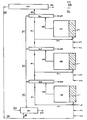
- One can, for example, according to FIG. 1 in a multi-stage, for example 3-stage reaction cascade, a distillation column for water removal being attached to each reactor unit, receiving a product stream with 55 to 57% by weight dialkyl carbonate.
- FIG. 1 shows the following apparatus: three reactors A, B and C; three associated distillation columns D, E and F for water removal; the distillation column G to obtain dialkyl carbonate; a gas scrubber H for washing out CO2 (formed as an undesirable by-product by oxidation of CO).
- Cu salt-containing melt (1) in A, B and C supplied CO (2) or O2 (3); supplied alkanol (4); discharged H2O (5); withdrawn organic reaction mixture (6); mixture to be recycled alkyl carbonate / alkanol (7); Mixture of alkyl carbonate / alkanol (8) to obtain alkyl carbonate; concentrated alkyl carbonate (9); alkanol (10) to be recycled, optionally in a mixture with alkyl carbonate; from D, E and F flowing CO / CO2 mixture (11), which may contain resiliches O2; incoming sodium hydroxide solution (12) for gas scrubbing; draining NaHCO3 (13); CO (14) to be recycled, optionally together with residual O2.
- Inert gas has not been mentioned for the sake of simplicity.
- Example 1 The reaction mixture from Example 1 obtained after three recirculations was dewatered in a distillation column and metered into the reactor under conditions as described in Example 1. After recycling three times, the methanol conversion was 55% and the dimethyl carbonate selectivity was 97%.
- a mixture of 50% methanol and 50% dimethyl carbonate was metered into the reactor under conditions as described in Example 1. After a single throughput, the methanol conversion was 56% and the dimethyl carbonate selectivity was 98%.
Landscapes
- Chemical & Material Sciences (AREA)
- Organic Chemistry (AREA)
- Engineering & Computer Science (AREA)
- Oil, Petroleum & Natural Gas (AREA)
- Organic Low-Molecular-Weight Compounds And Preparation Thereof (AREA)
- Low-Molecular Organic Synthesis Reactions Using Catalysts (AREA)
Applications Claiming Priority (2)
| Application Number | Priority Date | Filing Date | Title |
|---|---|---|---|
| DE4325651 | 1993-07-30 | ||
| DE4325651A DE4325651A1 (de) | 1993-07-30 | 1993-07-30 | Verfahren zur Herstellung von Dialkylcarbonaten |
Publications (1)
| Publication Number | Publication Date |
|---|---|
| EP0636601A1 true EP0636601A1 (fr) | 1995-02-01 |
Family
ID=6494110
Family Applications (1)
| Application Number | Title | Priority Date | Filing Date |
|---|---|---|---|
| EP94111133A Withdrawn EP0636601A1 (fr) | 1993-07-30 | 1994-07-18 | Procédé de préparation de carbonates de dialkyle |
Country Status (6)
| Country | Link |
|---|---|
| US (1) | US5599965A (fr) |
| EP (1) | EP0636601A1 (fr) |
| JP (1) | JPH0753475A (fr) |
| KR (1) | KR950003249A (fr) |
| CN (1) | CN1105015A (fr) |
| DE (1) | DE4325651A1 (fr) |
Cited By (3)
| Publication number | Priority date | Publication date | Assignee | Title |
|---|---|---|---|---|
| EP0659731A1 (fr) * | 1993-12-23 | 1995-06-28 | Bayer Ag | Procédé de préparation de diméthyl carbonate |
| DE102010036631A1 (de) | 2010-07-26 | 2012-01-26 | Philipps-Universität Marburg | Verfahren zur Herstellung von Dialkylcarbonaten, Kupferhaltiger Katalysator und Verwendung eines Kupfer-haltigen Katalysators |
| US9249082B2 (en) | 2010-02-09 | 2016-02-02 | King Abdulaziz City for Science and Technology (KACST) | Synthesis of dimethyl carbonate from carbon dioxide and methanol |
Families Citing this family (9)
| Publication number | Priority date | Publication date | Assignee | Title |
|---|---|---|---|---|
| DE19715907A1 (de) * | 1996-04-17 | 1997-11-13 | Jgc Corp | Verfahren zur Herstellung eines carbonsäurediesters,Verfahren zur Entfernung von Co2, C02-Absorbitionsmittel und Vorrichtung zur Herstellung des Carbonsäurediesters |
| JP3945724B2 (ja) * | 1996-04-17 | 2007-07-18 | 日揮株式会社 | 炭酸ジエステルの製造方法、co2除去方法、co2吸収剤および炭酸ジエステル製造装置 |
| US7345187B2 (en) * | 2001-08-14 | 2008-03-18 | General Electric Company | Method and apparatus for preparing a dialkyl carbonate, and its use in the preparation of diaryl carbonates and polycarbonates |
| US6784277B2 (en) | 2001-08-14 | 2004-08-31 | General Electric Company | Method for preparing a dialkyl carbonate, and its use in the preparation of diaryl carbonates and polycarbonates |
| US7514521B2 (en) * | 2001-08-14 | 2009-04-07 | Sabic Innovative Plastics Ip B.V. | Method for preparing a dialkyl carbonate, and its use in the preparation of diaryl carbonates and polycarbonates |
| US6977308B2 (en) | 2002-06-25 | 2005-12-20 | General Electric Company | Method and apparatus for preparing a dialkyl carbonate |
| CN101234965B (zh) * | 2007-01-30 | 2011-04-06 | 中国石油化学工业开发股份有限公司 | 碳酸二烷酯的制造方法 |
| US7799940B2 (en) * | 2007-02-16 | 2010-09-21 | Sabic Innovative Plastics Ip B.V. | Process for manufacturing dimethyl carbonate |
| EP2121563B1 (fr) * | 2007-02-16 | 2016-05-04 | SABIC Global Technologies B.V. | Procédé de fabrication du carbonate de diméthyle |
Citations (2)
| Publication number | Priority date | Publication date | Assignee | Title |
|---|---|---|---|---|
| EP0534545A2 (fr) * | 1991-09-23 | 1993-03-31 | ENICHEM SYNTHESIS S.p.A. | Procédé pour la fabrication de carbonates d'alkyle |
| EP0544162A1 (fr) * | 1991-11-26 | 1993-06-02 | Bayer Ag | Procédé de préparation de carbonates de dialkyle |
Family Cites Families (5)
| Publication number | Priority date | Publication date | Assignee | Title |
|---|---|---|---|---|
| USRE29338E (en) * | 1970-03-04 | 1977-08-02 | Snam Progetti S.P.A. | Process for the preparation of esters of carbonic acid |
| IT1070574B (it) * | 1976-09-30 | 1985-03-29 | Snam Progetti | Procedimento per la preparazione di esteri dell acido carbonico |
| GB8321199D0 (en) * | 1983-08-05 | 1983-09-07 | Ici Plc | Carbonate production |
| DE3926709A1 (de) * | 1989-08-12 | 1991-02-14 | Basf Ag | Verfahren zur herstellung von dialkylcarbonaten |
| DE4203796A1 (de) * | 1992-02-10 | 1993-08-12 | Bayer Ag | Verfahren zur herstellung von dialkylcarbonaten |
-
1993
- 1993-07-30 DE DE4325651A patent/DE4325651A1/de not_active Withdrawn
-
1994
- 1994-07-18 EP EP94111133A patent/EP0636601A1/fr not_active Withdrawn
- 1994-07-22 US US08/279,328 patent/US5599965A/en not_active Expired - Fee Related
- 1994-07-25 JP JP6192308A patent/JPH0753475A/ja active Pending
- 1994-07-28 KR KR1019940018399A patent/KR950003249A/ko not_active Withdrawn
- 1994-07-30 CN CN94108992A patent/CN1105015A/zh active Pending
Patent Citations (2)
| Publication number | Priority date | Publication date | Assignee | Title |
|---|---|---|---|---|
| EP0534545A2 (fr) * | 1991-09-23 | 1993-03-31 | ENICHEM SYNTHESIS S.p.A. | Procédé pour la fabrication de carbonates d'alkyle |
| EP0544162A1 (fr) * | 1991-11-26 | 1993-06-02 | Bayer Ag | Procédé de préparation de carbonates de dialkyle |
Cited By (5)
| Publication number | Priority date | Publication date | Assignee | Title |
|---|---|---|---|---|
| EP0659731A1 (fr) * | 1993-12-23 | 1995-06-28 | Bayer Ag | Procédé de préparation de diméthyl carbonate |
| US9249082B2 (en) | 2010-02-09 | 2016-02-02 | King Abdulaziz City for Science and Technology (KACST) | Synthesis of dimethyl carbonate from carbon dioxide and methanol |
| DE102010036631A1 (de) | 2010-07-26 | 2012-01-26 | Philipps-Universität Marburg | Verfahren zur Herstellung von Dialkylcarbonaten, Kupferhaltiger Katalysator und Verwendung eines Kupfer-haltigen Katalysators |
| WO2012013606A1 (fr) | 2010-07-26 | 2012-02-02 | Philipps-Universität Marburg | Procédé de production de carbonates de dialkyle, catalyseur contenant du cuivre et utilisation d'un catalyseur contenant du cuivre |
| DE102010036631B4 (de) | 2010-07-26 | 2021-12-16 | Marion Stricker | Verfahren zur Herstellung von Dialkylcarbonaten, Kupferhaltiger Katalysator und Verwendung eines Kupfer-haltigen Katalysators |
Also Published As
| Publication number | Publication date |
|---|---|
| KR950003249A (ko) | 1995-02-16 |
| US5599965A (en) | 1997-02-04 |
| CN1105015A (zh) | 1995-07-12 |
| DE4325651A1 (de) | 1995-02-02 |
| JPH0753475A (ja) | 1995-02-28 |
Similar Documents
| Publication | Publication Date | Title |
|---|---|---|
| EP0801051B1 (fr) | Procédé de fabrication continue de carbonates de diaryle | |
| EP0807619B1 (fr) | Procédé de fabrication de carbonates de diaryle | |
| EP1076654B1 (fr) | Procede de preparation continue de 1,3-dioxolane-2-ones | |
| DE69102826T3 (de) | Verfahren zur Herstellung von Dimethylcarbonat. | |
| EP0413215B1 (fr) | Procédé de préparation de carbonates de dialkyle | |
| DE4403075A1 (de) | Verfahren zur kontinuierlichen Herstellung von Diarylcarbonaten | |
| EP0634386A1 (fr) | Procédé de préparation du carbonate de diméthyle | |
| EP0555697B1 (fr) | Procédé de préparation de carbonates de dialkyle | |
| DE4325651A1 (de) | Verfahren zur Herstellung von Dialkylcarbonaten | |
| DE60109783T2 (de) | Verfahren zur herstellung von oxiranen | |
| EP0464460A2 (fr) | Procédé de préparation de carbonates de dialkyle | |
| EP0544162B1 (fr) | Procédé de préparation de carbonates de dialkyle | |
| DE69710148T2 (de) | Verfahren zum Herstellen von Diarylcarbonat | |
| EP0659731A1 (fr) | Procédé de préparation de diméthyl carbonate | |
| DE69605709T2 (de) | Verfahren zur kontinuierliche Herstellung von Dimethylkarbonat | |
| EP0654462B1 (fr) | Procédé de traitement des produits de réactions liquides provenant de la fabrication du carbonate de diméthyle catalysé par le cuivre | |
| DE69411254T2 (de) | Verfahren zum kontinuierlichen Herstellen von Dimethylcarbonat | |
| EP1171420B1 (fr) | Procede pour produire de la cyanhydrine d'acetone | |
| EP1140779B1 (fr) | Procede de production de diarylcarbonates | |
| EP0810988B1 (fr) | Procede de preparation en continu de formiate de methyle | |
| DE2314950C3 (de) | Verfahren zur Herstellung von Hydroxydiphenyl | |
| DE3816253C2 (fr) | ||
| DE68921224T2 (de) | Verfahren zur wiedergewinnung von katalysatorwerten. | |
| DE2603173A1 (de) | Verfahren zur herstellung einer ungeschwaerzten phthalsaeure aus dem entsprechenden tolylaldehyd | |
| DE2334916A1 (de) | Verfahren zur kontinuierlichen herstellung von phthalimid |
Legal Events
| Date | Code | Title | Description |
|---|---|---|---|
| PUAI | Public reference made under article 153(3) epc to a published international application that has entered the european phase |
Free format text: ORIGINAL CODE: 0009012 |
|
| AK | Designated contracting states |
Kind code of ref document: A1 Designated state(s): BE DE ES FR GB IT NL |
|
| 17P | Request for examination filed |
Effective date: 19950707 |
|
| 17Q | First examination report despatched |
Effective date: 19960705 |
|
| STAA | Information on the status of an ep patent application or granted ep patent |
Free format text: STATUS: THE APPLICATION HAS BEEN WITHDRAWN |
|
| 18W | Application withdrawn |
Withdrawal date: 19970313 |