EP0636617B1 - Verfahren zur Herstellung von N-(2-Hydroxyethyl)-piperazin - Google Patents
Verfahren zur Herstellung von N-(2-Hydroxyethyl)-piperazin Download PDFInfo
- Publication number
- EP0636617B1 EP0636617B1 EP94111340A EP94111340A EP0636617B1 EP 0636617 B1 EP0636617 B1 EP 0636617B1 EP 94111340 A EP94111340 A EP 94111340A EP 94111340 A EP94111340 A EP 94111340A EP 0636617 B1 EP0636617 B1 EP 0636617B1
- Authority
- EP
- European Patent Office
- Prior art keywords
- hydroxyethyl
- piperazine
- oxygen
- reaction
- calculated
- Prior art date
- Legal status (The legal status is an assumption and is not a legal conclusion. Google has not performed a legal analysis and makes no representation as to the accuracy of the status listed.)
- Expired - Lifetime
Links
- WFCSWCVEJLETKA-UHFFFAOYSA-N 2-piperazin-1-ylethanol Chemical compound OCCN1CCNCC1 WFCSWCVEJLETKA-UHFFFAOYSA-N 0.000 title claims description 16
- 238000000034 method Methods 0.000 title claims description 12
- 238000002360 preparation method Methods 0.000 title claims description 11
- QGZKDVFQNNGYKY-UHFFFAOYSA-N Ammonia Chemical compound N QGZKDVFQNNGYKY-UHFFFAOYSA-N 0.000 claims description 36
- 238000006243 chemical reaction Methods 0.000 claims description 20
- GSEJCLTVZPLZKY-UHFFFAOYSA-N Triethanolamine Chemical compound OCCN(CCO)CCO GSEJCLTVZPLZKY-UHFFFAOYSA-N 0.000 claims description 19
- 229910021529 ammonia Inorganic materials 0.000 claims description 18
- QVGXLLKOCUKJST-UHFFFAOYSA-N atomic oxygen Chemical compound [O] QVGXLLKOCUKJST-UHFFFAOYSA-N 0.000 claims description 16
- 150000001875 compounds Chemical class 0.000 claims description 16
- 239000001301 oxygen Substances 0.000 claims description 16
- 229910052760 oxygen Inorganic materials 0.000 claims description 16
- UFHFLCQGNIYNRP-UHFFFAOYSA-N Hydrogen Chemical compound [H][H] UFHFLCQGNIYNRP-UHFFFAOYSA-N 0.000 claims description 10
- PXHVJJICTQNCMI-UHFFFAOYSA-N Nickel Chemical compound [Ni] PXHVJJICTQNCMI-UHFFFAOYSA-N 0.000 claims description 10
- 239000001257 hydrogen Substances 0.000 claims description 10
- 229910052739 hydrogen Inorganic materials 0.000 claims description 10
- 239000002638 heterogeneous catalyst Substances 0.000 claims description 8
- RYGMFSIKBFXOCR-UHFFFAOYSA-N Copper Chemical compound [Cu] RYGMFSIKBFXOCR-UHFFFAOYSA-N 0.000 claims description 5
- 229910052802 copper Inorganic materials 0.000 claims description 5
- 239000010949 copper Substances 0.000 claims description 5
- 229910052759 nickel Inorganic materials 0.000 claims description 5
- ZOKXTWBITQBERF-UHFFFAOYSA-N Molybdenum Chemical compound [Mo] ZOKXTWBITQBERF-UHFFFAOYSA-N 0.000 claims description 4
- 229910017052 cobalt Inorganic materials 0.000 claims description 4
- 239000010941 cobalt Substances 0.000 claims description 4
- GUTLYIVDDKVIGB-UHFFFAOYSA-N cobalt atom Chemical compound [Co] GUTLYIVDDKVIGB-UHFFFAOYSA-N 0.000 claims description 4
- 229910052750 molybdenum Inorganic materials 0.000 claims description 4
- 239000011733 molybdenum Substances 0.000 claims description 4
- MCMNRKCIXSYSNV-UHFFFAOYSA-N Zirconium dioxide Chemical compound O=[Zr]=O MCMNRKCIXSYSNV-UHFFFAOYSA-N 0.000 claims 4
- JKQOBWVOAYFWKG-UHFFFAOYSA-N molybdenum trioxide Chemical compound O=[Mo](=O)=O JKQOBWVOAYFWKG-UHFFFAOYSA-N 0.000 claims 4
- 239000011149 active material Substances 0.000 claims 2
- PNEYBMLMFCGWSK-UHFFFAOYSA-N aluminium oxide Inorganic materials [O-2].[O-2].[O-2].[Al+3].[Al+3] PNEYBMLMFCGWSK-UHFFFAOYSA-N 0.000 claims 2
- 229910052593 corundum Inorganic materials 0.000 claims 2
- 229910001845 yogo sapphire Inorganic materials 0.000 claims 2
- 239000003054 catalyst Substances 0.000 description 9
- QPLDLSVMHZLSFG-UHFFFAOYSA-N Copper oxide Chemical compound [Cu]=O QPLDLSVMHZLSFG-UHFFFAOYSA-N 0.000 description 6
- 239000000203 mixture Substances 0.000 description 6
- IMNIMPAHZVJRPE-UHFFFAOYSA-N triethylenediamine Chemical compound C1CN2CCN1CC2 IMNIMPAHZVJRPE-UHFFFAOYSA-N 0.000 description 5
- GLUUGHFHXGJENI-UHFFFAOYSA-N Piperazine Chemical compound C1CNCCN1 GLUUGHFHXGJENI-UHFFFAOYSA-N 0.000 description 4
- 238000004821 distillation Methods 0.000 description 4
- HZAXFHJVJLSVMW-UHFFFAOYSA-N 2-Aminoethan-1-ol Chemical compound NCCO HZAXFHJVJLSVMW-UHFFFAOYSA-N 0.000 description 3
- VARKIGWTYBUWNT-UHFFFAOYSA-N 2-[4-(2-hydroxyethyl)piperazin-1-yl]ethanol Chemical compound OCCN1CCN(CCO)CC1 VARKIGWTYBUWNT-UHFFFAOYSA-N 0.000 description 3
- 229910018072 Al 2 O 3 Inorganic materials 0.000 description 3
- 239000012973 diazabicyclooctane Substances 0.000 description 3
- 238000004519 manufacturing process Methods 0.000 description 3
- KDLHZDBZIXYQEI-UHFFFAOYSA-N Palladium Chemical compound [Pd] KDLHZDBZIXYQEI-UHFFFAOYSA-N 0.000 description 2
- 238000005576 amination reaction Methods 0.000 description 2
- 230000015572 biosynthetic process Effects 0.000 description 2
- ZBCBWPMODOFKDW-UHFFFAOYSA-N diethanolamine Chemical class OCCNCCO ZBCBWPMODOFKDW-UHFFFAOYSA-N 0.000 description 2
- 239000007789 gas Substances 0.000 description 2
- 239000007788 liquid Substances 0.000 description 2
- 239000000376 reactant Substances 0.000 description 2
- 238000003786 synthesis reaction Methods 0.000 description 2
- XLYOFNOQVPJJNP-UHFFFAOYSA-N water Substances O XLYOFNOQVPJJNP-UHFFFAOYSA-N 0.000 description 2
- VYZAMTAEIAYCRO-UHFFFAOYSA-N Chromium Chemical compound [Cr] VYZAMTAEIAYCRO-UHFFFAOYSA-N 0.000 description 1
- IAYPIBMASNFSPL-UHFFFAOYSA-N Ethylene oxide Chemical compound C1CO1 IAYPIBMASNFSPL-UHFFFAOYSA-N 0.000 description 1
- 239000004952 Polyamide Substances 0.000 description 1
- 239000004480 active ingredient Substances 0.000 description 1
- 239000007864 aqueous solution Substances 0.000 description 1
- HNGSNSWYGHQTEH-UHFFFAOYSA-N azane;2-[bis(2-hydroxyethyl)amino]ethanol Chemical compound N.OCCN(CCO)CCO HNGSNSWYGHQTEH-UHFFFAOYSA-N 0.000 description 1
- 230000009286 beneficial effect Effects 0.000 description 1
- 239000007795 chemical reaction product Substances 0.000 description 1
- 229910052804 chromium Inorganic materials 0.000 description 1
- 239000011651 chromium Substances 0.000 description 1
- 230000000694 effects Effects 0.000 description 1
- 150000002169 ethanolamines Chemical class 0.000 description 1
- 238000004817 gas chromatography Methods 0.000 description 1
- 238000005984 hydrogenation reaction Methods 0.000 description 1
- 239000000543 intermediate Substances 0.000 description 1
- 229910052763 palladium Inorganic materials 0.000 description 1
- 239000000575 pesticide Substances 0.000 description 1
- 229920002647 polyamide Polymers 0.000 description 1
- 229920002635 polyurethane Polymers 0.000 description 1
- 239000004814 polyurethane Substances 0.000 description 1
- 239000000047 product Substances 0.000 description 1
- 238000007363 ring formation reaction Methods 0.000 description 1
- 238000000926 separation method Methods 0.000 description 1
- 239000007858 starting material Substances 0.000 description 1
- 239000000126 substance Substances 0.000 description 1
- 230000007306 turnover Effects 0.000 description 1
- 238000010626 work up procedure Methods 0.000 description 1
Classifications
-
- C—CHEMISTRY; METALLURGY
- C07—ORGANIC CHEMISTRY
- C07D—HETEROCYCLIC COMPOUNDS
- C07D295/00—Heterocyclic compounds containing polymethylene-imine rings with at least five ring members, 3-azabicyclo [3.2.2] nonane, piperazine, morpholine or thiomorpholine rings, having only hydrogen atoms directly attached to the ring carbon atoms
- C07D295/04—Heterocyclic compounds containing polymethylene-imine rings with at least five ring members, 3-azabicyclo [3.2.2] nonane, piperazine, morpholine or thiomorpholine rings, having only hydrogen atoms directly attached to the ring carbon atoms with substituted hydrocarbon radicals attached to ring nitrogen atoms
- C07D295/08—Heterocyclic compounds containing polymethylene-imine rings with at least five ring members, 3-azabicyclo [3.2.2] nonane, piperazine, morpholine or thiomorpholine rings, having only hydrogen atoms directly attached to the ring carbon atoms with substituted hydrocarbon radicals attached to ring nitrogen atoms substituted by singly bound oxygen or sulfur atoms
- C07D295/084—Heterocyclic compounds containing polymethylene-imine rings with at least five ring members, 3-azabicyclo [3.2.2] nonane, piperazine, morpholine or thiomorpholine rings, having only hydrogen atoms directly attached to the ring carbon atoms with substituted hydrocarbon radicals attached to ring nitrogen atoms substituted by singly bound oxygen or sulfur atoms with the ring nitrogen atoms and the oxygen or sulfur atoms attached to the same carbon chain, which is not interrupted by carbocyclic rings
- C07D295/088—Heterocyclic compounds containing polymethylene-imine rings with at least five ring members, 3-azabicyclo [3.2.2] nonane, piperazine, morpholine or thiomorpholine rings, having only hydrogen atoms directly attached to the ring carbon atoms with substituted hydrocarbon radicals attached to ring nitrogen atoms substituted by singly bound oxygen or sulfur atoms with the ring nitrogen atoms and the oxygen or sulfur atoms attached to the same carbon chain, which is not interrupted by carbocyclic rings to an acyclic saturated chain
-
- Y—GENERAL TAGGING OF NEW TECHNOLOGICAL DEVELOPMENTS; GENERAL TAGGING OF CROSS-SECTIONAL TECHNOLOGIES SPANNING OVER SEVERAL SECTIONS OF THE IPC; TECHNICAL SUBJECTS COVERED BY FORMER USPC CROSS-REFERENCE ART COLLECTIONS [XRACs] AND DIGESTS
- Y02—TECHNOLOGIES OR APPLICATIONS FOR MITIGATION OR ADAPTATION AGAINST CLIMATE CHANGE
- Y02P—CLIMATE CHANGE MITIGATION TECHNOLOGIES IN THE PRODUCTION OR PROCESSING OF GOODS
- Y02P20/00—Technologies relating to chemical industry
- Y02P20/50—Improvements relating to the production of bulk chemicals
- Y02P20/582—Recycling of unreacted starting or intermediate materials
Definitions
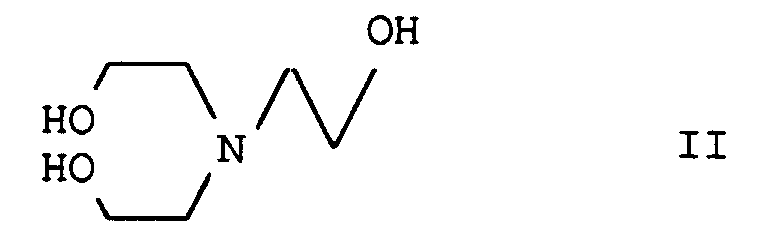
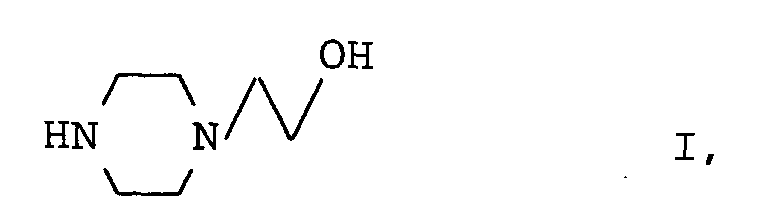
- the present invention relates to a process for the preparation of N- (2-hydroxyethyl) piperazine by aminating hydrogenation of triethanolamine in the liquid or gas phase at elevated pressure and elevated temperature in the presence of a catalyst, the ZrO 2 and / or Al 2 O 3 , CuO, CoO and / or NiO and / or MoO 3 contains.
- FR-A-13 81 243 describes the implementation of triethanolamine Ammonia in the presence of hydrogen to form a mixture Piperazine (unsubstituted) and 1,4-diazabicyclo (2,2,2) octane (DABCO) known.
- N, N'-bis (2-hydroxyethyl) piperazine is obtained according to the DD-A-249 017 in a discontinuous pressure reaction Triethanolamine and ammonia on crosslinked polyamides as Catalysts.
- the present invention was therefore based on the object by means of an alternative production process for N- (2-hydroxyethyl) piperazine, to remedy the disadvantages mentioned above.
- N- (2-hydroxyethyl) piperazine of the formula I found, which is characterized in that triethanolamine of the formula II with ammonia in the presence of hydrogen at temperatures from 100 to 500 ° C and pressures from 10 to 500 bar (1 to 50 MPa) containing heterogeneous catalysts with an active composition 20 to 85% by weight ZrO 2 and / or Al 2 O 3 , 1 to 30% by weight oxygen-containing compounds of copper, calculated as CuO, 1 to 60% by weight oxygen-containing compounds of cobalt calculated as CoO and / or oxygen-containing compounds of nickel, calculated as NiO and / or oxygen-containing compounds of molybdenum, calculated as MoO 3 , implements.
- Triethanolamine (II) and ammonia can be in the presence of hydrogen at temperatures from 100 to 500 ° C, preferably 150 to 300 ° C, particularly preferably 180 to 250 ° C. and pressures of 10 to 500 bar (1 to 50 MPa), preferably 30 to 400 bar (3 to 40 MPa), particularly preferably 35 to 300 bar (3.5 to 30 MPa) with Heterogeneous catalysts are implemented.
- Suitable heterogeneous catalysts are those which contain 20 to 85% by weight, preferably 25 to 80% by weight, particularly preferably 30 to 75% by weight of ZrO 2 and / or Al 2 O 3 , 1 to 30% by weight as the catalytically active composition.
- oxygen-containing compounds of copper such as copper-I-oxide and copper-II-oxide, preferably copper-I-oxide, particularly preferably copper-II-oxide , calculated as CuO, 1 to 60% by weight, preferably 1 to 30% by weight, particularly preferably 1 to 20% by weight of oxygen-containing compounds of cobalt, such as cobalt-I-oxide and cobalt-II-xoid, preferably cobalt-I -oxide, particularly preferably cobalt-II-oxide, calculated as CoO and / or oxygen-containing compounds of nickel such as nickel-I-oxide and nickel-II-oxide, preferably nickel-I-oxide, particularly preferably nickel-II-oxide as NiO and / or oxygen-containing compounds of molybdenum, preferably molybdenum-V-oxide, particularly preferably molybdenum-VI-oxide, calculated as MoO 3 .
- copper-I-oxide and copper-II-oxide preferably copper-I-oxid
- Ammonia generally becomes gaseous or liquid, in general but not in aqueous solution, in the molar ratio of ammonia to triethanolamine (II) from 1: 1 to 50: 1, preferably 1.5: 1 to 30: 1, particularly preferably 2: 1 to 20: 1. Of the Ammonia excess can easily be greater than 50: 1.
- the hydrogen will generally react in an amount from 5 to 400 1, preferably in an amount of 50 to 200 1 per Moles of triethanolamine supplied, the liter figures in each case Normal conditions were converted (S.T.P.).
- the implementation is carried out in such a way that one the heterogeneous catalyst, which is usually in a preferably located from the outside of the fixed-bed reactor desired reaction temperature and pressure Triethanolamine and ammonia are fed simultaneously. It is a burden the heterogeneous catalyst generally with 0.01 to 5.0, preferred 0.1 to 2.0 and particularly preferably 0.2 to 1.5 1 Triethanolamine per liter of heterogeneous catalyst per hour.
- the reactor can be used both in the bottom and in the trickle mode operated, d. H. one can get the reactants from both bottom up as well as top down through the reactor conduct.
- the reaction can be carried out batchwise or continuously be performed. In both cases, the excess Ammonia are circulated together with the hydrogen. If the turnover in the reaction is not complete, it can unreacted starting material also into the reaction zone to be led back.
- the water of reaction formed in the course of the reaction affects general on the degree of implementation, the reaction rate, the selectivity and the catalyst life do not interfere and can therefore only be used with distillation Workup of the reaction product can be removed from this.
- the N- (2-hydroxyethyl) piperazine (I) finds e.g. as intermediates for the synthesis of active ingredients, pesticides and in particular for the preparation of 1,4-diazabicyclo- (2,2,2) octane (DABCO), a catalyst for the production of polyurethanes (US-A-3,166,558) use.
- Triethanolamine together with NH 3 and H 2 is fed via a preheater to the high-pressure reactor, which is operated in the bottom mode and has an internal temperature of 220 to 230 ° C.
- a light exhaust gas (50 l / h / 1 1 contact) is expediently used to remove inert substances.
- the reactor is filled with a catalyst of the composition 10% CoO, 10% NiO, 4% CuO on ZrO 2 carrier, reduced with hydrogen (at 400 ° C last).
- the molar ratio of triethanolamine: ammonia is 1: 1.3, the catalyst load is 1.485 kg triethanolamine and 0.22 kg ammonia per 1 contact / hour.
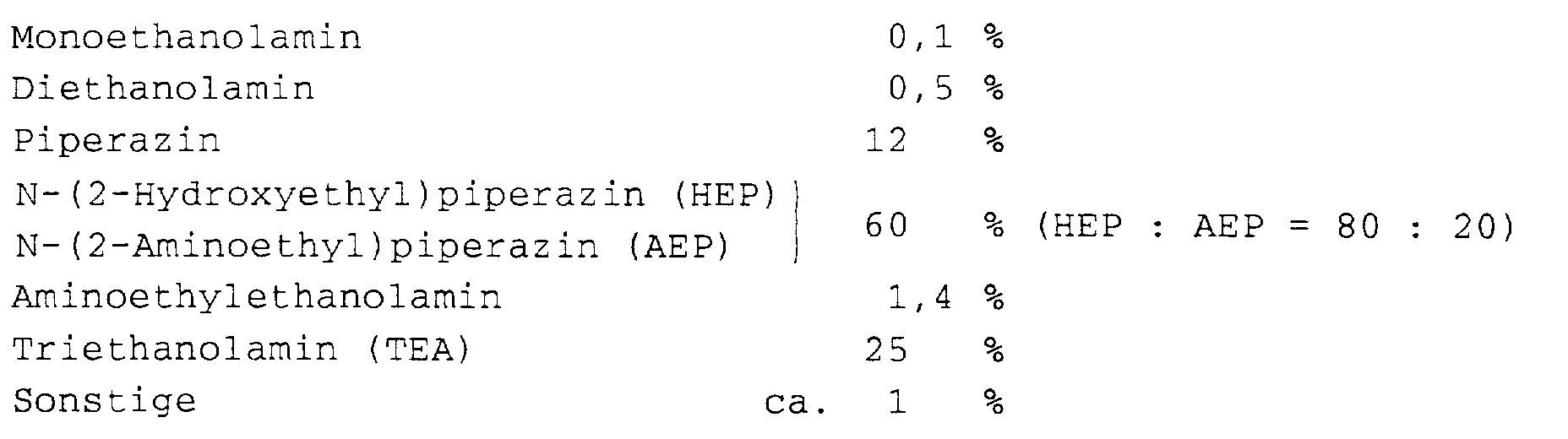
- the furnace discharge is expanded in two stages in a medium pressure separator and worked up by distillation. Excess NH 3 and unreacted triethanolamine (25%) are recycled after separation by distillation.
Landscapes
- Chemical & Material Sciences (AREA)
- Organic Chemistry (AREA)
- Low-Molecular Organic Synthesis Reactions Using Catalysts (AREA)
- Catalysts (AREA)
- Organic Low-Molecular-Weight Compounds And Preparation Thereof (AREA)
Description

| 20 bis 85 Gew.-% | ZrO2 und/oder Al2O3, |
| 1 bis 30 Gew.-% | sauerstoffhaltige Verbindungen des Kupfers, berechnet als CuO, |
| 1 bis 60 Gew.-% | sauerstoffhaltige Verbindungen des Cobalts berechnet als CoO und/oder sauerstoffhaltige Verbindungen des Nickels, berechnet als NiO und/oder sauerstoffhaltige Verbindungen des Molybdäns, berechnet als MoO3, |
Claims (7)
- Verfahren zur Herstellung von N-(2-Hydroxyethyl)-piperazin der Formel Idadurch gekennzeichnet, daß man Triethanolamin der Formel II
 mit Ammoniak bei einem Molverhältnis von Ammoniak zu Triethanolamin von 1:1 bis 50:1 in Gegenwart von Wasserstoff bei Temperaturen von 100 bis 500°C und Drücken von 10 bis 500 bar (1 bis 50 MPa) an Heterogenkatalysatoren mit einer aktiven Masse enthaltend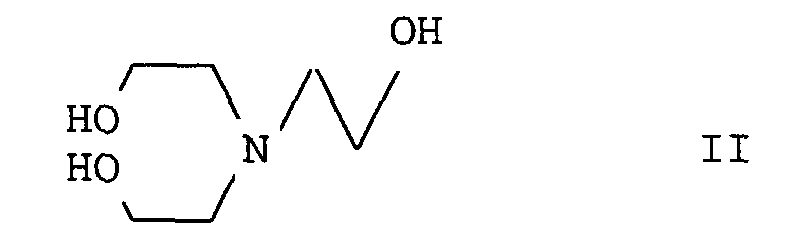
20 bis 85 Gew.-% ZrO2 und/oder Al2O3, 1 bis 30 Gew.-% sauerstoffhaltige Verbindungen des Kupfers, berechnet als CuO, 1 bis 60 Gew.-% sauerstoffhaltige Verbindungen des Cobalts berechnet als CoO und/oder sauerstoffhaltige Verbindungen des Nickels, berechnet als NiO und/oder sauerstoffhaltige Verbindungen des Molybdäns, berechnet als MoO3, - Verfahren zur Herstellung von N-(2-Hydroxyethyl)-piperazin der Formel I nach Anspruch 1, dadurch gekennzeichnet, daß man die Umsetzung bei Temperaturen von 150 bis 300°C durchführt.
- Verfahren zur Herstellung von N-(2-Hydroxyethyl)-piperazin der Formel I nach Anspruch 1, dadurch gekennzeichnet, daß man die Umsetzung bei Temperaturen von 180 bis 250°C durchführt.
- Verfahren zur Herstellung von N-(2-Hydroxyethyl)-piperazin der Formel I nach Anspruch 1, dadurch gekennzeichnet, daß man die Umsetzung bei Drücken von 30 bis 400 bar (3 bis 40 MPa) durchführt.
- Verfahren zur Herstellung von N-(2-Hydroxyethyl)-piperazin der Formel I nach Anspruch 1, dadurch gekennzeichnet, daß man die Umsetzung bei Drücken von 35 bis 300 bar (3,5 bis 30 MPa) durchführt.
- Verfahren zur Herstellung von N-(2-Hydroxyethyl)-piperazin der Formel I nach Anspruch 1, dadurch gekennzeichnet, daß man die Umsetzung mit einem Molverhältnis von Ammoniak zum Triethanolamin von 1 : 1 bis 50 : 1 durchführt.
- Verfahren zur Herstellung von N-(2-Hydroxyethyl)-piperazin der Formel I nach Anspruch 1, dadurch gekennzeichnet, daß man die Umsetzung in Gegenwart von Heterogenkatalysatoren mit einer aktiven Masse enthaltend
25 bis 80 Gew.-% ZrO2 und/oder Al2O3, 2 bis 25 Gew.-% sauerstoffhaltige Verbindungen des Kupfers, berechnet als CuO, 1 bis 30 Gew.-% sauerstoffhaltige Verbindungen des Cobalts, berechnet als CoO und/oder sauerstoffhaltige Verbindungen des Nickels, berechnet als NiO und/oder sauerstoffhaltige Verbindungen des Molybdäns, berechnet als MoO3,
Applications Claiming Priority (2)
| Application Number | Priority Date | Filing Date | Title |
|---|---|---|---|
| DE4325848 | 1993-07-31 | ||
| DE4325848A DE4325848A1 (de) | 1993-07-31 | 1993-07-31 | Verfahren zur Herstellung von N-(2-Hydroxyethyl)-piperazin |
Publications (3)
| Publication Number | Publication Date |
|---|---|
| EP0636617A2 EP0636617A2 (de) | 1995-02-01 |
| EP0636617A3 EP0636617A3 (de) | 1995-03-15 |
| EP0636617B1 true EP0636617B1 (de) | 1999-05-19 |
Family
ID=6494243
Family Applications (1)
| Application Number | Title | Priority Date | Filing Date |
|---|---|---|---|
| EP94111340A Expired - Lifetime EP0636617B1 (de) | 1993-07-31 | 1994-07-21 | Verfahren zur Herstellung von N-(2-Hydroxyethyl)-piperazin |
Country Status (5)
| Country | Link |
|---|---|
| US (1) | US5455352A (de) |
| EP (1) | EP0636617B1 (de) |
| JP (1) | JPH0753535A (de) |
| DE (2) | DE4325848A1 (de) |
| ES (1) | ES2133447T3 (de) |
Families Citing this family (37)
| Publication number | Priority date | Publication date | Assignee | Title |
|---|---|---|---|---|
| SE511531C2 (sv) * | 1995-02-08 | 1999-10-11 | Akzo Nobel Nv | Förfarande för framställning av aminoetyletanolamin och/eller hydroxietylpiperazin |
| EP2476756A1 (de) * | 2005-06-15 | 2012-07-18 | Massachusetts Institute of Technology | Aminhaltige Lipide und ihre Verwendungen |
| EP2356095B2 (de) * | 2008-10-06 | 2017-09-27 | Union Carbide Chemicals & Plastics Technology LLC | Verfahren zur herstellung von cyclischen n-aminofunktionellen triaminen |
| EP2344445B1 (de) * | 2008-10-06 | 2017-05-10 | Union Carbide Chemicals & Plastics Technology LLC | Verfahren zur selektiven herstellung von diethylentriamin (deta) oder anderen gewünschten ethylenaminen durch kontinuierliche transaminierung von ethylendiamin (eda) und anderen ethylenaminen über einem heterogenen katalysatorsystem |
| JP5806116B2 (ja) * | 2008-10-06 | 2015-11-10 | ユニオン カーバイド ケミカルズ アンド プラスティックス テクノロジー エルエルシー | 求核性化合物のトランスアルコキシル化 |
| US8188318B2 (en) * | 2008-10-06 | 2012-05-29 | Union Carbide Chemicals & Plastics Technology Llc | Method of manufacturing ethyleneamines |
| JP5480276B2 (ja) * | 2008-10-06 | 2014-04-23 | ユニオン カーバイド ケミカルズ アンド プラスティックス テクノロジー エルエルシー | 担体として酸性混合金属酸化物を含む低金属(ニッケル及びレニウム)触媒組成物 |
| CN102239002B (zh) | 2008-10-06 | 2013-10-30 | 联合碳化化学品及塑料技术公司 | 低金属负载的氧化铝载体的催化剂组合物和氨基化方法 |
| EP2487151B1 (de) * | 2008-10-06 | 2015-09-02 | Dow Global Technologies LLC | Verfahren zur Trennung von Alkylenethylenamin(e) aus Ethylenamin(e) Zusammensetzungen |
| MX2011004859A (es) | 2008-11-07 | 2011-08-03 | Massachusetts Inst Technology | Lipidoides de aminoalcohol y usos de los mismos. |
| PL3338765T3 (pl) | 2009-12-01 | 2019-06-28 | Translate Bio, Inc. | Pochodna steroidowa dla dostarczania mrna w ludzkich chorobach genetycznych |
| US9193827B2 (en) | 2010-08-26 | 2015-11-24 | Massachusetts Institute Of Technology | Poly(beta-amino alcohols), their preparation, and uses thereof |
| US8993759B2 (en) | 2010-11-10 | 2015-03-31 | Dow Global Technologies Llc | Transamination of nitrogen-containing compounds to make cyclic and cyclic/acyclic polyamine mixtures |
| US9238716B2 (en) | 2011-03-28 | 2016-01-19 | Massachusetts Institute Of Technology | Conjugated lipomers and uses thereof |
| PT2717893T (pt) | 2011-06-08 | 2019-08-20 | Translate Bio Inc | Composições de nanopartículas lipídicas e métodos para transferência de arnm |
| CN102658162B (zh) * | 2012-04-13 | 2013-10-30 | 中国科学院大连化学物理研究所 | 一种用于合成乙撑胺的催化剂及制备乙撑胺的方法 |
| WO2013185067A1 (en) | 2012-06-08 | 2013-12-12 | Shire Human Genetic Therapies, Inc. | Nuclease resistant polynucleotides and uses thereof |
| EP2882706A1 (de) | 2012-08-13 | 2015-06-17 | Massachusetts Institute of Technology | Aminhaltige lipoide und ihre verwendungen |
| ES2981185T3 (es) | 2013-03-14 | 2024-10-07 | Translate Bio Inc | Métodos para la purificación de ARN mensajero |
| EP2968586B1 (de) | 2013-03-14 | 2018-07-25 | Translate Bio, Inc. | Cftr-mrna-zusammensetzungen und zugehörige verfahren sowie verwendungen |
| WO2014179562A1 (en) | 2013-05-01 | 2014-11-06 | Massachusetts Institute Of Technology | 1,3,5-triazinane-2,4,6-trione derivatives and uses thereof |
| US11224642B2 (en) | 2013-10-22 | 2022-01-18 | Translate Bio, Inc. | MRNA therapy for argininosuccinate synthetase deficiency |
| MX2016005239A (es) | 2013-10-22 | 2016-08-12 | Shire Human Genetic Therapies | Tratamiento con acido ribonucleico mensajero para la fenilcetonuria. |
| WO2015061467A1 (en) | 2013-10-22 | 2015-04-30 | Shire Human Genetic Therapies, Inc. | Lipid formulations for delivery of messenger rna |
| WO2015084619A1 (en) | 2013-12-02 | 2015-06-11 | Dow Global Technologies Llc | Preparation of high molecular weight, branched, acyclic polyalkyleneamines and mixtures thereof |
| JP6571679B2 (ja) | 2014-04-25 | 2019-09-04 | トランスレイト バイオ, インコーポレイテッド | メッセンジャーrnaの精製方法 |
| US10022455B2 (en) | 2014-05-30 | 2018-07-17 | Translate Bio, Inc. | Biodegradable lipids for delivery of nucleic acids |
| CA2952824C (en) | 2014-06-24 | 2023-02-21 | Shire Human Genetic Therapies, Inc. | Stereochemically enriched compositions for delivery of nucleic acids |
| WO2016004202A1 (en) | 2014-07-02 | 2016-01-07 | Massachusetts Institute Of Technology | Polyamine-fatty acid derived lipidoids and uses thereof |
| CN106543104B (zh) * | 2016-11-04 | 2019-02-01 | 山东铂源药业有限公司 | 一种1-(2-羟基乙基)哌嗪的合成方法 |
| AU2018224326B2 (en) | 2017-02-27 | 2024-01-04 | Translate Bio, Inc. | Novel codon-optimized CFTR mRNA |
| MX2019013752A (es) | 2017-05-16 | 2020-07-20 | Translate Bio Inc | Tratamiento de la fibrosis quística mediante el suministro de arnm que codifica cftr optimizado en codones. |
| CN110776430B (zh) * | 2018-07-31 | 2022-10-14 | 中国石油化工股份有限公司 | 一种三(2-氨基乙基)胺的制备方法 |
| CN118421617A (zh) | 2018-08-24 | 2024-08-02 | 川斯勒佰尔公司 | 用于纯化信使rna的方法 |
| RU2685423C1 (ru) * | 2018-10-16 | 2019-04-18 | Акционерное общество "Химтэк Инжиниринг" | Способ получения N-(2-гидроксиалкил)пиперазина |
| EP3883592A1 (de) | 2018-11-21 | 2021-09-29 | Translate Bio, Inc. | Behandlung von zystischer fibrose durch verabreichung von vernebelter mrna, die cftr codiert |
| WO2021055609A1 (en) | 2019-09-20 | 2021-03-25 | Translate Bio, Inc. | Mrna encoding engineered cftr |
Family Cites Families (15)
| Publication number | Priority date | Publication date | Assignee | Title |
|---|---|---|---|---|
| DE249017C (de) * | ||||
| US3172891A (en) * | 1965-03-09 | Synthesis of trffithylenediamine | ||
| US2541260A (en) * | 1949-06-10 | 1951-02-13 | Colgate Palmolive Peet Co | Di-n-alkoxy substituted piperazine derivatives and method of preparing same |
| US3297701A (en) * | 1962-03-23 | 1967-01-10 | Jefferson Chem Co Inc | Synthesis of diazabicyclo-(2, 2, 2)-octane and derivatives |
| FR1381243A (fr) * | 1963-03-22 | 1964-12-14 | Jefferson Chem Co Inc | Procédé de préparation de composés hétérocycliques |
| GB1095027A (en) * | 1964-08-31 | 1967-12-13 | Jefferson Chem Co Inc | Syntheses of diamines and catalyst therefor |
| US3342820A (en) * | 1964-08-31 | 1967-09-19 | Jefferson Chem Co Inc | Synthesis of c-alkyl-triethylenediamine |
| US4328370A (en) * | 1979-03-15 | 1982-05-04 | The Dow Chemical Company | Ammonation of trialkanolamines |
| US4338443A (en) * | 1980-08-15 | 1982-07-06 | Texaco Inc. | Synthesis of N-(2-hydroxyethyl)piperazine |
| US4725681A (en) * | 1985-08-19 | 1988-02-16 | Ethyl Corporation | Production of triethylenediamine |
| US4709034A (en) * | 1986-02-14 | 1987-11-24 | Air Products And Chemicals, Inc. | Process for the synthesis of hydroxyalkyl amines and hydroxyalkyl piperazines |
| US5068330A (en) * | 1987-09-30 | 1991-11-26 | Union Carbide Chemicals And Plastics Technology Corporation | Aminoethyethanolamine and ethylenediamine producers composition and method for producing same |
| US5196588A (en) * | 1987-09-30 | 1993-03-23 | Union Carbide Chemicals & Plastics Technology Corporation | Ethylenediamine and diethylenetriamine producers composition and method for producing same |
| IT1224316B (it) * | 1988-04-21 | 1990-10-04 | Enichem Anic Spa | Procedimento di preparazione della n,n'-bis-(2-idrossietil)-piperazina |
| US5214215A (en) * | 1990-03-30 | 1993-05-25 | Union Carbide Chemicals & Plastics Technology Corporation | Selective production of aminoethylethanolamine |
-
1993
- 1993-07-31 DE DE4325848A patent/DE4325848A1/de not_active Withdrawn
-
1994
- 1994-07-21 ES ES94111340T patent/ES2133447T3/es not_active Expired - Lifetime
- 1994-07-21 DE DE59408268T patent/DE59408268D1/de not_active Expired - Fee Related
- 1994-07-21 EP EP94111340A patent/EP0636617B1/de not_active Expired - Lifetime
- 1994-07-28 US US08/282,073 patent/US5455352A/en not_active Expired - Lifetime
- 1994-07-29 JP JP6178851A patent/JPH0753535A/ja not_active Withdrawn
Also Published As
| Publication number | Publication date |
|---|---|
| US5455352A (en) | 1995-10-03 |
| EP0636617A2 (de) | 1995-02-01 |
| DE4325848A1 (de) | 1995-02-02 |
| ES2133447T3 (es) | 1999-09-16 |
| JPH0753535A (ja) | 1995-02-28 |
| DE59408268D1 (de) | 1999-06-24 |
| EP0636617A3 (de) | 1995-03-15 |
Similar Documents
| Publication | Publication Date | Title |
|---|---|---|
| DE4325848A1 (de) | Verfahren zur Herstellung von N-(2-Hydroxyethyl)-piperazin | |
| EP1106600B1 (de) | Verfahren zur Herstellung von Aminen | |
| EP0382049B1 (de) | Katalysator und Verfahren zur hydrierenden Aminierung von Alkoholen | |
| DE2907869C2 (de) | ||
| EP0697395B1 (de) | Verfahren zur Herstellung von Diaminen durch katalytische Aminierung von Aminoalkoholen | |
| EP1035106A1 (de) | Verfahren zur Herstellung von Aminen | |
| EP2855443B1 (de) | Verfahren zur herstellung eines mono-n-alkyl-piperazins | |
| EP1097122B1 (de) | Verfahren zur herstellung von aminen | |
| EP0445589B1 (de) | Verfahren zur Herstellung von 1,4-Alkylendiaminen | |
| EP1106601B1 (de) | Verfahren zur Herstellung von Monoisopropylamin | |
| WO2014184039A1 (de) | Verfahren zur herstellung von n-alkyl-piperazinen | |
| DE2738115A1 (de) | Verfahren zur gleichzeitigen herstellung einer morpholin-verbindung und eines 2- (2-aminoalkoxi)-alkanols | |
| EP0446783B1 (de) | Verfahren zur Herstellung von N-aryl-substituierten 2-Aminoalkyl-2-hydroxy-alkylaminen und N-arylsubstituierten Piperazinen | |
| DE4423346A1 (de) | Kupferoxid/Zirkonoxid-Katalysator | |
| EP0424738B1 (de) | Verfahren zur Herstellung von Aminen | |
| EP0424764A2 (de) | Verfahren zur Herstellung von Bis- und Tris-(3-dimethylaminopropyl)-amin | |
| WO2014184048A1 (de) | Verfahren zur herstellung von n-alkyl-piperazinen | |
| EP0844991B1 (de) | Verfahren zur herstellung von aminen aus olefinen an bor-beta-zeolithen | |
| EP1971568B1 (de) | Verfahren zur kontinuierlichen herstellung eines primären aromatischen amins | |
| EP2855442B1 (de) | Verfahren zur herstellung eines mono-n-alkyl-piperazins | |
| DE69118758T2 (de) | Gleichzeitige Herstellung von Morpholin und 2-(2-Aminoalkoxy)alkanolen | |
| DE69208129T2 (de) | Verfahren zur Darstellung von trisubstituierten Harnstoffen mittels reduktiver Carbonylierung | |
| EP1899291B1 (de) | Verfahren zur kontinuierlichen herstellung eines amins | |
| EP0648736B1 (de) | Verfahren zur Herstellung sekundärer oder tertiärer Amine | |
| DE102005043440A1 (de) | Verfahren zur Herstellung eines Ethylamins aus vergälltem Ethanol |
Legal Events
| Date | Code | Title | Description |
|---|---|---|---|
| PUAI | Public reference made under article 153(3) epc to a published international application that has entered the european phase |
Free format text: ORIGINAL CODE: 0009012 |
|
| PUAL | Search report despatched |
Free format text: ORIGINAL CODE: 0009013 |
|
| AK | Designated contracting states |
Kind code of ref document: A2 Designated state(s): BE DE ES FR GB IT NL |
|
| AK | Designated contracting states |
Kind code of ref document: A3 Designated state(s): BE DE ES FR GB IT NL |
|
| 17P | Request for examination filed |
Effective date: 19950303 |
|
| 17Q | First examination report despatched |
Effective date: 19970714 |
|
| GRAG | Despatch of communication of intention to grant |
Free format text: ORIGINAL CODE: EPIDOS AGRA |
|
| GRAG | Despatch of communication of intention to grant |
Free format text: ORIGINAL CODE: EPIDOS AGRA |
|
| GRAG | Despatch of communication of intention to grant |
Free format text: ORIGINAL CODE: EPIDOS AGRA |
|
| GRAH | Despatch of communication of intention to grant a patent |
Free format text: ORIGINAL CODE: EPIDOS IGRA |
|
| GRAH | Despatch of communication of intention to grant a patent |
Free format text: ORIGINAL CODE: EPIDOS IGRA |
|
| GRAA | (expected) grant |
Free format text: ORIGINAL CODE: 0009210 |
|
| AK | Designated contracting states |
Kind code of ref document: B1 Designated state(s): BE DE ES FR GB IT NL |
|
| GBT | Gb: translation of ep patent filed (gb section 77(6)(a)/1977) |
Effective date: 19990601 |
|
| REF | Corresponds to: |
Ref document number: 59408268 Country of ref document: DE Date of ref document: 19990624 |
|
| REG | Reference to a national code |
Ref country code: ES Ref legal event code: FG2A Ref document number: 2133447 Country of ref document: ES Kind code of ref document: T3 |
|
| ET | Fr: translation filed | ||
| PLBE | No opposition filed within time limit |
Free format text: ORIGINAL CODE: 0009261 |
|
| STAA | Information on the status of an ep patent application or granted ep patent |
Free format text: STATUS: NO OPPOSITION FILED WITHIN TIME LIMIT |
|
| 26N | No opposition filed | ||
| REG | Reference to a national code |
Ref country code: GB Ref legal event code: IF02 |
|
| PGFP | Annual fee paid to national office [announced via postgrant information from national office to epo] |
Ref country code: DE Payment date: 20070719 Year of fee payment: 14 |
|
| PGFP | Annual fee paid to national office [announced via postgrant information from national office to epo] |
Ref country code: ES Payment date: 20070824 Year of fee payment: 14 |
|
| PGFP | Annual fee paid to national office [announced via postgrant information from national office to epo] |
Ref country code: GB Payment date: 20070718 Year of fee payment: 14 |
|
| PGFP | Annual fee paid to national office [announced via postgrant information from national office to epo] |
Ref country code: NL Payment date: 20070703 Year of fee payment: 14 Ref country code: IT Payment date: 20070730 Year of fee payment: 14 |
|
| PGFP | Annual fee paid to national office [announced via postgrant information from national office to epo] |
Ref country code: BE Payment date: 20071004 Year of fee payment: 14 |
|
| PGFP | Annual fee paid to national office [announced via postgrant information from national office to epo] |
Ref country code: FR Payment date: 20070710 Year of fee payment: 14 |
|
| GBPC | Gb: european patent ceased through non-payment of renewal fee |
Effective date: 20080721 |
|
| NLV4 | Nl: lapsed or anulled due to non-payment of the annual fee |
Effective date: 20090201 |
|
| PG25 | Lapsed in a contracting state [announced via postgrant information from national office to epo] |
Ref country code: DE Free format text: LAPSE BECAUSE OF NON-PAYMENT OF DUE FEES Effective date: 20090203 |
|
| REG | Reference to a national code |
Ref country code: FR Ref legal event code: ST Effective date: 20090331 |
|
| PG25 | Lapsed in a contracting state [announced via postgrant information from national office to epo] |
Ref country code: NL Free format text: LAPSE BECAUSE OF NON-PAYMENT OF DUE FEES Effective date: 20090201 |
|
| PG25 | Lapsed in a contracting state [announced via postgrant information from national office to epo] |
Ref country code: GB Free format text: LAPSE BECAUSE OF NON-PAYMENT OF DUE FEES Effective date: 20080721 |
|
| PG25 | Lapsed in a contracting state [announced via postgrant information from national office to epo] |
Ref country code: IT Free format text: LAPSE BECAUSE OF NON-PAYMENT OF DUE FEES Effective date: 20080721 Ref country code: FR Free format text: LAPSE BECAUSE OF NON-PAYMENT OF DUE FEES Effective date: 20080731 |
|
| REG | Reference to a national code |
Ref country code: ES Ref legal event code: FD2A Effective date: 20080722 |
|
| PG25 | Lapsed in a contracting state [announced via postgrant information from national office to epo] |
Ref country code: ES Free format text: LAPSE BECAUSE OF NON-PAYMENT OF DUE FEES Effective date: 20080722 |
|
| PG25 | Lapsed in a contracting state [announced via postgrant information from national office to epo] |
Ref country code: BE Free format text: LAPSE BECAUSE OF NON-PAYMENT OF DUE FEES Effective date: 20080731 |