EP0636723A1 - Dispositif pour tenir le bout de fil de trame et métier à tisser avec un tel dispositif - Google Patents
Dispositif pour tenir le bout de fil de trame et métier à tisser avec un tel dispositif Download PDFInfo
- Publication number
- EP0636723A1 EP0636723A1 EP93810535A EP93810535A EP0636723A1 EP 0636723 A1 EP0636723 A1 EP 0636723A1 EP 93810535 A EP93810535 A EP 93810535A EP 93810535 A EP93810535 A EP 93810535A EP 0636723 A1 EP0636723 A1 EP 0636723A1
- Authority
- EP
- European Patent Office
- Prior art keywords
- weft
- sections
- weaving machine
- gap
- weft thread
- Prior art date
- Legal status (The legal status is an assumption and is not a legal conclusion. Google has not performed a legal analysis and makes no representation as to the accuracy of the status listed.)
- Withdrawn
Links
- 238000003780 insertion Methods 0.000 claims abstract description 13
- 230000037431 insertion Effects 0.000 claims abstract description 13
- 238000009941 weaving Methods 0.000 claims description 14
- 239000004744 fabric Substances 0.000 claims description 8
- 235000014676 Phragmites communis Nutrition 0.000 abstract description 6
- 244000208734 Pisonia aculeata Species 0.000 abstract 2
- 210000004013 groin Anatomy 0.000 description 5
- 238000011109 contamination Methods 0.000 description 2
- 229910000639 Spring steel Inorganic materials 0.000 description 1
- 239000000919 ceramic Substances 0.000 description 1
- 239000000835 fiber Substances 0.000 description 1
- 239000000463 material Substances 0.000 description 1
- 239000002184 metal Substances 0.000 description 1
Images
Classifications
-
- D—TEXTILES; PAPER
- D03—WEAVING
- D03D—WOVEN FABRICS; METHODS OF WEAVING; LOOMS
- D03D47/00—Looms in which bulk supply of weft does not pass through shed, e.g. shuttleless looms, gripper shuttle looms, dummy shuttle looms
- D03D47/40—Forming selvedges
Definitions
- the invention relates to a device for holding the weft end in a weaving machine according to the preamble of claim 1 and a weaving machine with such a device.
- a so-called edge clamp (CH-PS 255 691) which grips and holds the weft thread in the entry path until the weft thread has struck the edge of the goods.
- the clamping force In order to prevent the weft end from being torn out during the reed stop, the clamping force must be controlled.
- Clamping proves to be disadvantageous in the case of very long-fiber yarns, in particular if these surfaces have been treated, which leads to contamination of the edge clamp.
- the outlay on equipment is very great and the edge clamp is prone to failure at high machine speeds. Due to the necessarily high clamping force, pinch marks are finally visible in the tissue, which reduces the quality of the tissue.
- a device in which one on both sides Cutting device a holding element is arranged.
- the weft thread held on the one hand in the fabric and on the auxiliary edge is positioned in the holding elements with respect to the cutting device.
- the weft end lies freely in a holding element and detaches from the holding element before it is grasped by the last layer needle, depending on the extent of the detachment, the last layer needle detects the weft end differently and thus inserts different long thread sections, which is to be regarded as a disadvantage .
- the invention has for its object to provide a device for holding a weft thread protruding from the fabric edge, which ensures a perfect transfer of the weft thread under constant conditions while avoiding any clamping action.
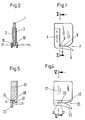
- the device contains a plate-shaped central part 1 and two hook-shaped parts 2 and 3.
- the hook-shaped parts 2 and 3 have a fastening section 4 and a catching section 5, which is bent with respect to the fastening section 4 and provided with a recess 6 is.
- the hook-shaped parts 2, 3 are each fastened on one side of the plate-shaped central part 1 in such a way that the catch sections 5 point in the same direction and form an inlet gap 7 with the plate-shaped central part 1 and that a section 8 of the plate-shaped central part 1 and a section 9 of the hook-shaped part 2, 3 overlap each other. Since the catching sections 5 are laterally offset with respect to the fastening section 4, there is in each case a gap 10 between the sections 8, 9, which form a zigzag receptacle.
- parts 1 to 3 consist of sheet metal. It is obvious to the person skilled in the art that other materials, for example plastic, ceramic or the like, can also be used.
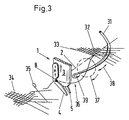
- the device described above is part of a strip laying device, which also includes a strip laying needle 31, in order to produce an insertion edge.
- the last laying device is arranged in such a way that it is located in the area of the stop edge 32 and between the fabric edge 33 and the auxiliary edge 34.
- the selvage needle 31 is arranged in the weaving machine in a manner known per se and is therefore not described in detail.
- the device is connected to a holder, not shown, which is movably arranged such that the device assumes a certain position when the weft thread is struck, as will be explained below.
- the weft thread is passed through the shed 35 past the device into the compartment of the auxiliary edge, the weft thread still being held on both sides. With the subsequent stop movement of the reed, the weft thread is pushed into the device 1 until the weft thread lies in the recesses 6. These recesses 6 form a retraction lock and prevent the weft thread from being pulled out of a position it has taken up in the warp-running direction when the reed is swung back after striking. After the weft, the weft thread is fixed in the fabric and in the auxiliary edge by crossing the warp thread. The weft thread is cut by means of a cutting device 35 on the side of the auxiliary edge 34.
- the weft end 36 produced in this way is then held on the one hand in the fabric 33 and on the other hand in the device.
- This holding of the weft end 35 is brought about by the triple deflection within the zigzag receptacle.
- the holding force results from the frictional force caused by the partial wrapping of parts 1 to 3 (Fig. 2).
- the friction force that occurs can be predetermined by the extent of the wrapping.
- the weft thread end 36 is placed around the provided groin needle 31 by means of the device.
- the movably arranged device performs, for example, a circular movement whose track 37 lies in a plane running approximately perpendicular to the track 38 of the groin needle 31.
- the weft thread end 35 is gripped by the hook 39 of the groin needle 31. While the device is performing this movement, the weft end is held so that the weft end does not become loose.
- the weft end is then inserted into the open shed in a manner known per se.
- the selvage needle pulls the weft end overcoming the holding force in the direction of its longitudinal extension from the zigzag receptacle, so that the weft end is taken over under a predetermined condition. This condition ensures a uniform insertion of the weft ends and consequently a uniform insertion edge on the fabric edge.
- FIGS. 4 and 5 show a device which is made in one piece, e.g. is designed as a pressed or cast part.
- the device has a substantially cuboid body 21, on which a flat section 22 and a hook-shaped section 23 are formed with a recess 24, which form an inlet gap 25 and overlap in sections 26, 27. Since section 22 and hook-shaped section 23 are spaced apart, there is a gap 28 between sections 22 and 23, which forms a zigzag receptacle.
- the device described above performs the same function as described in connection with FIG. 3.
- the device contains a body 1 to 3, which forms a gap with a retraction lock 8, in which a weft thread end inserted and fixed in a direction transverse to its longitudinal extension is held in a zigzag shape.
- the device is arranged in such a way that the gap with the retraction lock 8 extends in the warp direction in order to receive a weft end and interacts with a selvage needle 31, which weft end 36 against the holding force caused by a frictional resistance in the Pulls out the weft direction and places it in the open shed.
- the weft thread end 36 is held by the reed by the zigzag receptacle after the weft thread has struck and is transferred to the last laying needle under constant conditions in order to produce a uniform insertion edge.
Landscapes
- Engineering & Computer Science (AREA)
- Textile Engineering (AREA)
- Looms (AREA)
Priority Applications (1)
| Application Number | Priority Date | Filing Date | Title |
|---|---|---|---|
| EP93810535A EP0636723A1 (fr) | 1993-07-26 | 1993-07-26 | Dispositif pour tenir le bout de fil de trame et métier à tisser avec un tel dispositif |
Applications Claiming Priority (1)
| Application Number | Priority Date | Filing Date | Title |
|---|---|---|---|
| EP93810535A EP0636723A1 (fr) | 1993-07-26 | 1993-07-26 | Dispositif pour tenir le bout de fil de trame et métier à tisser avec un tel dispositif |
Publications (1)
| Publication Number | Publication Date |
|---|---|
| EP0636723A1 true EP0636723A1 (fr) | 1995-02-01 |
Family
ID=8215006
Family Applications (1)
| Application Number | Title | Priority Date | Filing Date |
|---|---|---|---|
| EP93810535A Withdrawn EP0636723A1 (fr) | 1993-07-26 | 1993-07-26 | Dispositif pour tenir le bout de fil de trame et métier à tisser avec un tel dispositif |
Country Status (1)
| Country | Link |
|---|---|
| EP (1) | EP0636723A1 (fr) |
Cited By (1)
| Publication number | Priority date | Publication date | Assignee | Title |
|---|---|---|---|---|
| US6107392A (en) * | 1994-01-21 | 2000-08-22 | E. I. Du Pont De Nemours And Company | Aqueous branched polymer dispersion |
Citations (3)
| Publication number | Priority date | Publication date | Assignee | Title |
|---|---|---|---|---|
| CH255691A (de) * | 1946-06-07 | 1948-07-15 | Sulzer Ag | Verfahren und Vorrichtung zur Herstellung von Geweben auf Greiferwebstühlen. |
| NL7704471A (en) * | 1977-04-22 | 1978-10-24 | Rueti Te Strake Bv | Weft thread clamp for selvedge in shuttleless loom - prevents loosening of threads and assists temples to maintain width |
| US5158119A (en) * | 1990-08-29 | 1992-10-27 | Vamatex S.P.A. | Selvedge forming device for shuttleless looms with linear motor control system |
-
1993
- 1993-07-26 EP EP93810535A patent/EP0636723A1/fr not_active Withdrawn
Patent Citations (3)
| Publication number | Priority date | Publication date | Assignee | Title |
|---|---|---|---|---|
| CH255691A (de) * | 1946-06-07 | 1948-07-15 | Sulzer Ag | Verfahren und Vorrichtung zur Herstellung von Geweben auf Greiferwebstühlen. |
| NL7704471A (en) * | 1977-04-22 | 1978-10-24 | Rueti Te Strake Bv | Weft thread clamp for selvedge in shuttleless loom - prevents loosening of threads and assists temples to maintain width |
| US5158119A (en) * | 1990-08-29 | 1992-10-27 | Vamatex S.P.A. | Selvedge forming device for shuttleless looms with linear motor control system |
Cited By (1)
| Publication number | Priority date | Publication date | Assignee | Title |
|---|---|---|---|---|
| US6107392A (en) * | 1994-01-21 | 2000-08-22 | E. I. Du Pont De Nemours And Company | Aqueous branched polymer dispersion |
Similar Documents
| Publication | Publication Date | Title |
|---|---|---|
| DE69519262T2 (de) | Blockier-/Fangsystem für das Fadenende in Bringergreifer einer Webmaschine | |
| DE2845299C2 (de) | Schützenlose Greifer-Webmaschine | |
| DE3033201C2 (fr) | ||
| EP0146663B1 (fr) | Organe d'insertion du fil de trame pour machines à tisser à griffes | |
| EP0644286A1 (fr) | Arrangement pour présenter des fils de trame | |
| DE2637618B2 (de) | Bandgewebe | |
| DE3200638A1 (de) | Schuetzenlose webmaschine | |
| EP0351361B1 (fr) | Appareil pneumatique pour la formation de lisières dans les métiers à tisser | |
| DE3240569C1 (de) | Vorrichtung an einer schuetzenlosen Webmaschine zum Bilden einer Gewebekante | |
| DE3812960A1 (de) | Greiferwebmaschine | |
| EP0624671B1 (fr) | Dispositif de retenue d'un fil pour une griffe d'amenée et métier à tisser à griffer avec un dispositif de retenue d'un fil | |
| DE1535414B1 (de) | Verfahren zum Bilden von verduennten Einlegekanten beim Herstellen von Geweben auf Webmaschinen mit Entnahme des Schussfadens von ortsfesten Vorratsspulen und Vorrichtung zur Durchfuehrung des Verfahrens | |
| DE2041432B2 (de) | Garnklemme für Schußgarneintragsorgane an Webmaschinen | |
| DE202019101093U1 (de) | Vorrichtung zum Schneiden der Schussfäden in einer Greiferwebmaschine ohne Bildung einer falschen Webkante | |
| DE7627209U1 (de) | Vorrichtung zur herstellung einer einlegeleiste an einem gewebe | |
| DE3002345C2 (de) | Nadel für Tuftingmaschinen | |
| DE1941404C3 (de) | Ein- und Ausfädelvorrichtung einer Greiferschützenwebmaschine | |
| EP1019573A1 (fr) | Pince donneuse pour un metier a tisser a pince | |
| DE2625746C2 (de) | Fadenklemme, insbesondere für Webmaschinen | |
| EP0776390B1 (fr) | Metier a tisser a pince | |
| DE2925694C2 (de) | Schußfadeneintragorgan einer schützenlosen Webmaschine | |
| DE9202068U1 (de) | Bringergreifer für Greiferwebmaschine | |
| AT264404B (de) | Schußfaden - Eintragglied für eine Webmaschine | |
| DE1535898C (de) | Fadenbremse fur Webschützen | |
| DE10040652A1 (de) | Vorrichtung zum Schneiden einer textilen Bahn |
Legal Events
| Date | Code | Title | Description |
|---|---|---|---|
| PUAI | Public reference made under article 153(3) epc to a published international application that has entered the european phase |
Free format text: ORIGINAL CODE: 0009012 |
|
| AK | Designated contracting states |
Kind code of ref document: A1 Designated state(s): BE DE IT |
|
| RBV | Designated contracting states (corrected) |
Designated state(s): BE DE IT |
|
| 17P | Request for examination filed |
Effective date: 19950705 |
|
| STAA | Information on the status of an ep patent application or granted ep patent |
Free format text: STATUS: THE APPLICATION HAS BEEN WITHDRAWN |
|
| 18W | Application withdrawn |
Withdrawal date: 19950830 |