EP0637105A2 - Dispositif pour sertir des éléments de contact sur des conducteurs électriques - Google Patents
Dispositif pour sertir des éléments de contact sur des conducteurs électriques Download PDFInfo
- Publication number
- EP0637105A2 EP0637105A2 EP94111188A EP94111188A EP0637105A2 EP 0637105 A2 EP0637105 A2 EP 0637105A2 EP 94111188 A EP94111188 A EP 94111188A EP 94111188 A EP94111188 A EP 94111188A EP 0637105 A2 EP0637105 A2 EP 0637105A2
- Authority
- EP
- European Patent Office
- Prior art keywords
- clamping
- anvil
- stripping
- conductors
- contacts
- Prior art date
- Legal status (The legal status is an assumption and is not a legal conclusion. Google has not performed a legal analysis and makes no representation as to the accuracy of the status listed.)
- Withdrawn
Links
Images

Classifications
-
- H—ELECTRICITY
- H01—ELECTRIC ELEMENTS
- H01R—ELECTRICALLY-CONDUCTIVE CONNECTIONS; STRUCTURAL ASSOCIATIONS OF A PLURALITY OF MUTUALLY-INSULATED ELECTRICAL CONNECTING ELEMENTS; COUPLING DEVICES; CURRENT COLLECTORS
- H01R43/00—Apparatus or processes specially adapted for manufacturing, assembling, maintaining, or repairing of line connectors or current collectors or for joining electric conductors
- H01R43/04—Apparatus or processes specially adapted for manufacturing, assembling, maintaining, or repairing of line connectors or current collectors or for joining electric conductors for forming connections by deformation, e.g. crimping tool
- H01R43/048—Crimping apparatus or processes
- H01R43/05—Crimping apparatus or processes with wire-insulation stripping
Definitions
- the invention relates to a device for fastening clamping contacts to electrical conductors with a clamping device consisting of two clamping jaws for detecting the inserted insulated conductors, behind which two stripping knives movable in opposite phases are attached to a stripping head which can be displaced in the longitudinal direction, above the stripping head directly behind the Clamping jaws a vertically movable stamping insert and an anvil is arranged below it, to which clamping contacts divided into strips can be fed via a transport device, one of the clamping jaws being vertically movable and the other clamping jaw being fixed, and a sensor for triggering the clamping process being attached to the stripping head which the embossing insert and the also vertically movable anvil are formed in two parts for clamping insulation and cable clamping tabs of the clamping contacts, and the transport device from a fixed to the anvil connected tape guide, on which the carrier tape equipped with clamping contacts can be moved transversely horizontally past the top of the anvil, a knife for separating the
- the known device is shown in Figure 1.
- the clamping jaws are provided on their adjacent sides with two half openings 3 and 4, which together result in a circular opening into which the conductor 5 to be treated, which usually consists of stranded wire, can be inserted.
- a stripping head 7 which can be moved in the longitudinal direction is provided behind the clamping jaws 1, 2 and contains two stripping knives 6 which can be moved in the transverse horizontal direction and behind which the sensor 8 is arranged.
- the stamping set 9 is arranged, which consists of two parts, only the stamping part for the stripped line being shown in the figure, while the stamping part for the tabs comprising the insulation is not shown for the sake of simplicity.
- This part has the same shape as the stamping set 9, but this stamping insert is provided on its lower side with a semicircular recess.
- the anvil 12, which in turn consists of two parts, is arranged below the embossing set 9, with only the anvil part 12 cooperating with the embossing set 9 being shown here for reasons of clarity.
- the anvil 12 is after tapers at the top, so that it can be gripped by the clothespin-shaped embossing set 9 in the working position.
- the anvil 12 is also firmly connected to the tape guide 13 and both anvil 12 or tape guide 13 and embossing set 9 can be moved in the vertical direction.
- the carrier tape 16 On the tape guide 13, the carrier tape 16 is moved transversely horizontally.
- This carrier tape contains a number of clamping contacts 14 arranged next to one another, the carrier tape 16 being guided laterally in alignment with the upper anvil surface past the anvil, so that a clamping contact 14 comes to rest on the upper anvil surface.
- the sequence of the crimping process is as follows:
- the insulated line 5, which can be a stranded line, is inserted between the fixed jaws 2 and the movable jaws 1.
- the stripping head 7 is in position A.
- the conductor 5 touches the sensor 8 in the stripping head 7.
- the sensor triggers the working cycle of the stripper crimper.
- the conductor is clamped with the movable jaw 1.
- the essential thing is that the conductor 5 remains in this position and is not suddenly moved downwards as in known arrangements. This advantage offers a good prerequisite for automatic processing of individual strands.
- the two stripping knives 6 are then moved evenly towards the center and penetrate with their cutting edges into the insulation without damaging the metal core of the conductor 5.
- the stripping head 7 then moves to position B, pulling the insulation off the conductor 5 and being suctioned off. Then the stripping blades 6 open and return to their starting position.
- the tape guide 13 and the anvil 12, which form a unit, move upwards after the stripping head 7 has been moved back to the position B and a mechanical lock has been released thereby.
- the contact 14 is brought to the conductor 5 and in the correct crimping position
- the embossing insert 9 moves downward and clamps the contact 14 onto the conductor 5 in such a way that the rear two contact tabs 10 encompass the insulation of the conductor 5 and the front contact tab 11 surround the core of the conductor 5.
- the knife 15 located between contact 14 and conductor 5 separates the clamping contact 14 from the carrier tape 16.
- the carrier tape 16 itself is cut into pieces in a fall separator, not shown.
- the movable jaw 1 opens and now leaves a window large enough to be able to remove the crimped contact from the stripper crimper.
- the object of the present invention is to design the known device in such a way that, while maintaining the basic process sequence, the simultaneous stripping of more than one electrical conductor is possible at the same time with subsequent fastening of only one common clamping contact.
- the device is designed according to the invention in such a way that the clamping jaws of the clamping device have half openings corresponding to the number of conductors for receiving several conductors lying next to one another, and that the stripping knives are provided with semicircular cutting edges corresponding to the number of conductors and are designed to be vertically movable with respect to one another , and that the embossing set is intended for several conductors together.
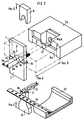
- the ladder is held by the jaws 1, 2.
- the stripping head 7a can be moved in the longitudinal direction and contains a sensor part 8a, 8b, which either contains only one sensor, but this has the disadvantage that, in the case of lines of different lengths, the stripping process is initiated at the first touch, so that the lines after the crimping process are of different lengths. This disadvantage is avoided by assigning a sensor to each line and only when all the sensors are actuated does the stripping process begin.
- the stripping knives 6a are arranged on the front of the stripping head and, in contrast to the known arrangement, can be moved vertically towards one another, the cutting edges 17 being correspondingly adapted to the shape of the lines.
- Figure 2 only the lower knife is shown to allow a better view of the inside of the stripping head 7.
- the upper knife is designed according to the lower one. Both knives only the stamped part for the stripped line is shown in the figure, while the stamped part for the tabs comprising the insulation is not shown for the sake of simplicity.
- This part has the same shape as the stamping insert 9, but this stamping insert is provided on its lower side with a semicircular recess.
- the anvil 12 which likewise consists of two parts, is arranged below the embossing insert 9, again only the anvil part 12 cooperating with the embossing insert 9 being shown here for reasons of clarity.
- the anvil 12 is again tapered upwards, as a result of which the embossing insert 9, which is shaped like a clothespin, can grip it in the working position.
- the carrier tape 16 is moved horizontally until the clamping contact 14 rests on the anvil 12 immediately below the two lines 5a, 5b.
- the embossing insert 9 then moves downward and carries out the crimping process. Both lines are only connected with one terminal contact.
Landscapes
- Engineering & Computer Science (AREA)
- Manufacturing & Machinery (AREA)
- Manufacturing Of Electrical Connectors (AREA)
Applications Claiming Priority (2)
| Application Number | Priority Date | Filing Date | Title |
|---|---|---|---|
| DE4325356 | 1993-07-28 | ||
| DE19934325356 DE4325356C1 (de) | 1993-07-28 | 1993-07-28 | Vorrichtung zum Befestigen von Klemmkontakten an elektrische Leiter |
Publications (2)
| Publication Number | Publication Date |
|---|---|
| EP0637105A2 true EP0637105A2 (fr) | 1995-02-01 |
| EP0637105A3 EP0637105A3 (fr) | 1996-06-12 |
Family
ID=6493933
Family Applications (1)
| Application Number | Title | Priority Date | Filing Date |
|---|---|---|---|
| EP94111188A Withdrawn EP0637105A3 (fr) | 1993-07-28 | 1994-07-18 | Dispositif pour sertir des éléments de contact sur des conducteurs électriques. |
Country Status (2)
| Country | Link |
|---|---|
| EP (1) | EP0637105A3 (fr) |
| DE (1) | DE4325356C1 (fr) |
Cited By (1)
| Publication number | Priority date | Publication date | Assignee | Title |
|---|---|---|---|---|
| DE102014005189A1 (de) * | 2014-04-09 | 2015-10-15 | Lisa Dräxlmaier GmbH | Einrichthilfe eines Crimpautomaten sowie Verfahren zum Einrichten eines Crimpautomaten |
Families Citing this family (4)
| Publication number | Priority date | Publication date | Assignee | Title |
|---|---|---|---|---|
| DE4435090C1 (de) * | 1994-09-30 | 1996-05-09 | Fraunhofer Ges Forschung | Vorrichtung zum Herstellen von für die Montage vorgefertigten, flexiblen, in der Länge zugeschnittenen, elektrischen Litzenleitungen |
| EP1528643B1 (fr) * | 2003-10-28 | 2007-02-14 | komax Holding AG | Appareil pour le confectionement d'un câble |
| JP5172072B2 (ja) | 2003-10-28 | 2013-03-27 | コマツクス・ホールデイング・アー・ゲー | ワイヤ処理装置 |
| DE102013018834B4 (de) | 2013-11-08 | 2019-03-21 | Komax SLE GmbH & Co. KG | Abisoliervorrichtung und -Verfahren |
Family Cites Families (4)
| Publication number | Priority date | Publication date | Assignee | Title |
|---|---|---|---|---|
| GB2033169B (en) * | 1978-09-29 | 1983-05-18 | Yazaki Corp | Wire harness |
| DE3528203C1 (en) * | 1985-08-06 | 1987-03-12 | Siemens Ag | Device and method for attaching terminal contacts to electrical conductors |
| US5109590A (en) * | 1989-12-21 | 1992-05-05 | Molex Incorporated | Multi core cable stripping |
| CH681836A5 (en) * | 1990-11-09 | 1993-05-28 | Ulrich Blecher | Crimping tool with crimper and cooperating anvil - with cooperating crimping profiles having three=dimensional curvature obtained via depth erosion process. |
-
1993
- 1993-07-28 DE DE19934325356 patent/DE4325356C1/de not_active Expired - Fee Related
-
1994
- 1994-07-18 EP EP94111188A patent/EP0637105A3/fr not_active Withdrawn
Cited By (2)
| Publication number | Priority date | Publication date | Assignee | Title |
|---|---|---|---|---|
| DE102014005189A1 (de) * | 2014-04-09 | 2015-10-15 | Lisa Dräxlmaier GmbH | Einrichthilfe eines Crimpautomaten sowie Verfahren zum Einrichten eines Crimpautomaten |
| DE102014005189B4 (de) * | 2014-04-09 | 2020-03-26 | Lisa Dräxlmaier GmbH | Einrichthilfe eines Crimpautomaten sowie Verfahren zum Einrichten eines Crimpautomaten |
Also Published As
| Publication number | Publication date |
|---|---|
| EP0637105A3 (fr) | 1996-06-12 |
| DE4325356C1 (de) | 1994-09-29 |
Similar Documents
| Publication | Publication Date | Title |
|---|---|---|
| DE2649920C2 (de) | Kontaktieranlage für isolierte elektrische Leitungsdrähte | |
| DE69111026T2 (de) | Entmantelungsverfahren elektrischer Kabel und Vorrichtung zum Auflockern elektrischer Kabel. | |
| DE60209094T2 (de) | Vorrichtung und Verfahren zum Anschliessen von Kabeln | |
| DE69517115T2 (de) | Verfahren und vorrichtung zum herstellen eines crimp-verbinders | |
| DE69517476T2 (de) | Verkabelungsvorrichtung eines elektrischen Anschlusskasten, Verfahren und Vorrichtung zur Bildung der Verkabelung | |
| DE68915183T2 (de) | Verfahren und Einrichtung für den Anschluss von flexiblen Drähten. | |
| DE1114234B (de) | Maschine zum Abisolieren des Endes eines isolierten Drahtes | |
| DE2909193C2 (de) | Maschine zum Anbringen von Verbindungselementen an elektrischen Drahtleitern | |
| DE2808518A1 (de) | Maschine zum anbringen von verbindungselementen an elektrischen drahtleitern | |
| DE68923071T2 (de) | Leiterentmantelung und -abschluss in Multiaderkabeln. | |
| DE4325356C1 (de) | Vorrichtung zum Befestigen von Klemmkontakten an elektrische Leiter | |
| DE2014146A1 (de) | Verfahren und Anlage zum Andrücken elektrischer Verbinder an Leiterenden | |
| DE1465095B2 (de) | Verfahren und vorrichtung zum elektrischen verbinden zweier auf einer schaltplatte befindlicher anschlusszapfen | |
| DE1802168B2 (de) | Elektrischer Verbinder, Verfahren und Vorrichtung zum Verbinden der einzelnen Drähte zweier Drahtpaare | |
| DE3528203C1 (en) | Device and method for attaching terminal contacts to electrical conductors | |
| DE2621502A1 (de) | Anschlussvorrichtung fuer elektrische leiter | |
| DE1465161B2 (de) | Verfahren zum elektrischen Anschluß eines Drahtleiters an einen festen Anschlußpunkt | |
| DE3315336A1 (de) | Kombinierte vorrichtung zum programmierten abschneiden | |
| DE2821512C3 (de) | Aufquetschvorrichtung für Kabelklemmen | |
| DE2360360A1 (de) | Verbindungsklemme fuer isolierte leiter und verfahren zur herstellung einer solchen klemme | |
| DE2516450C2 (de) | Vorrichtung zum Anquetschen von Leiterenden an elektrische Kontaktelemente | |
| EP3340400B1 (fr) | Dispositif et procédé de manipulation d'un conducteur interne | |
| DE2654766A1 (de) | Vorrichtung zum abisolieren der enden einer bandleitung | |
| DE2544770C2 (de) | Vorrichtung zum Anschlagen von Steckerstiften an elektrische Leitungen | |
| EP0036606B1 (fr) | Procédé et appareil pour l'introduction de fils séparés d'un câble plat dans une machine d'usinage |
Legal Events
| Date | Code | Title | Description |
|---|---|---|---|
| PUAI | Public reference made under article 153(3) epc to a published international application that has entered the european phase |
Free format text: ORIGINAL CODE: 0009012 |
|
| AK | Designated contracting states |
Kind code of ref document: A2 Designated state(s): AT BE CH DE FR GB IT LI NL |
|
| PUAL | Search report despatched |
Free format text: ORIGINAL CODE: 0009013 |
|
| AK | Designated contracting states |
Kind code of ref document: A3 Designated state(s): AT BE CH DE FR GB IT LI NL |
|
| STAA | Information on the status of an ep patent application or granted ep patent |
Free format text: STATUS: THE APPLICATION IS DEEMED TO BE WITHDRAWN |
|
| 18D | Application deemed to be withdrawn |
Effective date: 19970201 |