EP0640331A2 - Dispositif de fermeture pour produit hygiénique, notamment pour fermeture de couche - Google Patents
Dispositif de fermeture pour produit hygiénique, notamment pour fermeture de couche Download PDFInfo
- Publication number
- EP0640331A2 EP0640331A2 EP94112557A EP94112557A EP0640331A2 EP 0640331 A2 EP0640331 A2 EP 0640331A2 EP 94112557 A EP94112557 A EP 94112557A EP 94112557 A EP94112557 A EP 94112557A EP 0640331 A2 EP0640331 A2 EP 0640331A2
- Authority
- EP
- European Patent Office
- Prior art keywords
- closure device
- adhesive
- self
- band
- diaper
- Prior art date
- Legal status (The legal status is an assumption and is not a legal conclusion. Google has not performed a legal analysis and makes no representation as to the accuracy of the status listed.)
- Granted
Links
Images

Classifications
-
- A—HUMAN NECESSITIES
- A61—MEDICAL OR VETERINARY SCIENCE; HYGIENE
- A61F—FILTERS IMPLANTABLE INTO BLOOD VESSELS; PROSTHESES; DEVICES PROVIDING PATENCY TO, OR PREVENTING COLLAPSING OF, TUBULAR STRUCTURES OF THE BODY, e.g. STENTS; ORTHOPAEDIC, NURSING OR CONTRACEPTIVE DEVICES; FOMENTATION; TREATMENT OR PROTECTION OF EYES OR EARS; BANDAGES, DRESSINGS OR ABSORBENT PADS; FIRST-AID KITS
- A61F13/00—Bandages or dressings; Absorbent pads
- A61F13/15—Absorbent pads, e.g. sanitary towels, swabs or tampons for external or internal application to the body; Supporting or fastening means therefor; Tampon applicators
- A61F13/56—Supporting or fastening means
- A61F13/58—Adhesive tab fastener elements
Definitions
- the invention relates to a closure device for hygiene articles, such as incontinence diapers, children's panties, incontinence pads or the like, for connecting two parts of the hygiene article, with the features specified in the preamble of claim 1.
- the invention relates to a diaper closure for connecting a front and rear part of a diaper in the area of the outside of the hip.
- the hygiene articles mentioned at the outset and in particular with incontinence pads or diapers for adults there is basically the problem that the article should be adaptable to different body dimensions of the wearer in order to achieve pleasant wearing properties and a fit that is as precise as possible.
- the hygiene articles should be at least to a certain extent resilient when worn in order to be able to adapt to movements of the wearer.
- buttons on the tape are used, which are to be buttoned into corresponding button holes on the pads.
- connection system is comparatively complex to manufacture, which has such a disposable character Deposits are difficult to reconcile.
- buttoning of the elastic band is relatively cumbersome.
- the invention has for its object to improve a closure device for hygiene articles of the generic type so that the connecting element is structurally simplified and more convenient to use while maintaining the elastic properties of the closure device.
- the closure device should act on its own and not make any changes, e.g. Buttonholes, need on the hygiene article.
- the connecting element on the elastic band has a non-elastic covering which stiffens the band at least in a partial area and to which a self-adhesive element for reversibly releasable connection of the band to the article is attached.
- stiffening the tape in a partial area the basis is created for a self-adhesive element to be used in conjunction with an otherwise elastic tape.
- the closure device on the one hand has the required elastic properties, on the other hand, complex connecting elements, such as the buttons and buttonholes, can be completely dispensed with in the closure device according to the prior art.
- the closure device according to the invention can be permanently fixed with one end of the elastic band, for example on the rear part of a diaper or incontinence pad, and reversible with the other band end detachable, for example connected to the front part of the diaper or insert.
- the closure device forms a unit with the diaper and is thrown away with it.
- a closure device according to the invention can also be used as a reusable part together with disposable diapers or inserts.
- a support stiffening the elastic band is arranged in the two end regions of the band.
- a self-adhesive element for the reversibly releasable connection of the tape to the article can be attached to the two tape ends.
- the closure device according to the invention thus forms a reusable closure system, which is often used with e.g. Disposable adult diapers can be used. This requires a further reduction in costs in the manufacture and use of the closure device according to the invention or the corresponding hygiene articles, since after use the article itself is disposed of, but the closure device can still be used.
- Claims 3 to 5 characterize advantageous embodiments for the stiffening pads on the elastic band.
- Plastic film strips are used, which are made of polyester. Impregnated or siliconized paper strips are also conceivable.
- the stiffening pad can fulfill a double function.
- it serves for the durable fastening of a self-adhesive element designed as a self-adhesive strip
- the corresponding double-sided support can act in the manner of a so-called release tape, as is used in conventional diaper adhesive closures.
- the entire adhesive surface of the self-adhesive strip is glued onto the support for the intermediate storage of the closure device and is thus protected from dirt and the like.
- Claims 7 to 10 characterize advantageous designs of the self-adhesive element, which are used to connect the inelastic support in each case the elastic band with the diaper. It should be added that the configuration according to claim 8 has particular advantages with regard to comfort and hygiene articles provided with a closure device according to the invention. Since the self-adhesive element consists of a self-adhesive strip which is naturally flexible, the part of the closure device to be stuck onto the hygiene article can adapt flexibly to the body shape of the wearer and thus does not call any pressure points or the like. forth. This flexibility also results in optimized adhesive behavior.
- the elastic band of the closure device can be made from e.g. textile rubber band, an elastic fleece, an elastic mesh or an elastic film, which only has to be elastic in the longitudinal direction of the belt.
- stiffening pads with different adhesive strengths for a self-adhesive strip to be attached are attached to the respective band end both on the inside and on the outside. For example, achieve a relatively low adhesive force on one side for a self-adhesive strip to be attached by means of a siliconized polyester film or a siliconized paper. A pad with such a low adhesive force is used where the pad acts as a release tape, i.e. where the self-adhesive strip with its adhesive surface is only stuck on for temporary storage until the next reuse.
- the support extending around the end of the band according to claim 6 is also provided on one side with a corresponding coating - for example siliconization.
- the incontinence diaper 1 shown in FIG. 1 has a conventional diaper structure, not shown in more detail, with a cellulose flake absorbent body, a body-side nonwoven layer and a liquid-impermeable cover layer 2 made of thin polyethylene film facing away from the body.
- the rear part 3 and the front part 4 of the incontinence diaper 1 overlap one another in the applied state of the diaper and thereby form leg openings 5.
- Front 4 and rear part 3 are connected to one another by closure devices 6 in the area of the outside of the hip.
- This closure device 6 consists essentially of an elongated, elastic band 7, which is a textile band made of polyester threads with woven Rubber threads.
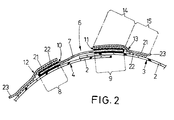
- the elastic tape 7 has in its two end regions 8, 9 on both sides a stiffening pad 10, 11, which makes the elastic tape 7 inelastic, each serving as a fastening base for self-adhesive strips 12, 13.
- the latter are connected with their one longitudinal half 14 to the support 10 or 11 and glued to the second longitudinal half 15 in the applied state with the cover layer 2 of the diaper 1.
- the closure device 6 Because of the above-described configuration of the closure device 6, a reliable fixation of the two diaper parts 3, 4 to one another is achieved on the one hand.
- the elasticity of the band 7 allows the diaper 1 to adapt optimally to the wearer of the body between the two end regions 8, 9 and to ensure that the diaper fits perfectly even when the wearer moves.
- the two supports 10, 11 in the two end regions 8, 9 of the band 7 each consist of a rectangular plastic film strip 16 made of a non-stretchable polyester film with a thickness of 125 ⁇ m.
- the strips 16 are each glued to the strip 7 in the end regions 8, 9 of the strip 7 by means of an adhesive layer 17 made of a heat-activatable polyester hot-melt adhesive.
- the strips 16 are applied such that they extend from one longitudinal side 18 of the elastic band 7 around the band end 19 to the second longitudinal side 20. As indicated by a thickened line in FIG.
- the plastic film strip 16 has a coating 29 in the form of a siliconization on the side facing the diaper when the diaper is in position - that is to say on the side facing the longitudinal side 18 of the elastic band 7.
- this coating 29 the self-adhesive strips 12, 13 adhere less in this area than on the uncoated part of the plastic film strips 16.
- the self-adhesive strips 12, 13 can be removed more easily from this side of the supports 10, 11. This further simplifies the handling of the diaper closure system according to the invention.
- the procedure is such that a web of the polyester film is provided with the adhesive layer 17 by means of a rotary melt screen printing process.
- a sieve with a mesh size of 11 mesh is used, with which the adhesive is applied with an application weight of 50 g / m2 to form small knobs.
- the web thus coated is cut into strips 16 which, as shown in FIG. 3, are wrapped around the end regions 8, 9 of the band 7 in the unstretched state.
- the strips 16 are then ironed on both sides by pressing and the action of temperature, so that a firm bond of the strips 16 with the band 7 is produced in the end regions 8, 9. This firm bond means that the elastic band in the end areas 8.9 is no longer stretchable.
- the pads 10, 11 can thus serve as a stable base for the attachment of an adhesive element for connecting the tape 7 to the diaper 1.
- the self-adhesive strips 12, 13 generally addressed with reference to FIG. 1 consist of a strip-shaped impregnated paper carrier 21 which is provided on one side with a coating 22 made of a self-adhesive hot-melt adhesive composition based on styrene-isoprene-styrene block copolymers.
- the coating 22 is applied using a rotary melt screen printing method using a 25 mesh screen and with an application weight of 35 g / m 2.
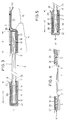
- the self-adhesive strips 12, 13 can be glued to their full length on the supports 10, 11 in a stored state (see FIG. 3, left part), as a result of which the latter act as release tape.
- the self-adhesive strips 12, 13 are pulled off in half, which is facilitated by the grip end 23 on the adhesive strips 12, 13 that remains free of the coating 22.
- the longitudinal half 15 pulled off from the support 10, 11 is then pressed onto the cover layer 2 of the diaper 1 and thus glued (see FIGS. 2 and 3, right part).
- This bond is due to the nature and nub-shaped design of the coating 22 reversibly detachable, so that the self-adhesive strip 12, 13 is removed from a used diaper 1 and the entire closure device 6 can be reused with a new diaper.
- the self-adhesive strips 12, 13 can be temporarily stored on the supports 10, 11, as shown in the left part in FIG. 3.
- the self-adhesive strips 12, 13 in the region of their longitudinal halves 14 can be completely removed from the supports 10, 11 and new adhesive strips can be applied.
- German patent application P 42 02 704.7 for the production process of the coating 22 or the adhesive layer 17, in which the rotary screen printing process used is discussed in detail.
- a closure device 6 ' there is again an elastic band 7', which is provided in its two end regions 9 'on one side with a support 11' made of a thermoplastic coating 24 on a Long side 18 'of the band.
- the coating 24 is produced, for example, by casting on a molten thermoplastic, which connects intimately to the textile structure of the elastic band 7 'and is firmly anchored to the elastic band 7' after cooling.
- the coating 24 is in turn provided with an adhesive layer 25 formed from small knobs, which is applied with the aid of the rotary melt screen printing method already mentioned. In this way, the closure device 6 'can in turn be reversibly releasably connected to a diaper 1.
- FIG. 4 left part, an embodiment of a closure device 6 ′′ is shown, in which the basic design of the support 10 ′ that makes the rubber band 7 ′′ inelastic corresponds to the embodiment according to FIG. 3.
- a die cut is provided on the basis of an impregnated paper strip 26, which on the outside is covered with the previously mentioned knob-shaped adhesive layer 25 'made of self-adhesive Adhesive is provided.
- This adhesive layer 25 ' is in turn to be applied using the rotary melt screen printing method already mentioned.
- On the inside of the paper strip 26 there is a permanently self-adhesive layer 27 with which the paper strip 26 is permanently connected to the elastic band 7 ′′. This fixed connection in turn makes the end region 8 'inelastic.
- the inside of the paper strip 26 can also be coated with a heat-activatable adhesive layer, the permanent connection being produced by melting the adhesive.
- a cover strip 28 made of siliconized paper is applied to the adhesive layer 25, 25 'and is removed before the closure device 6' or 6 '' is used to expose the adhesive layer 25, 25 ''.
- the exemplary embodiment shown in FIG. 5 essentially corresponds to the exemplary embodiment according to FIG. 3. Corresponding parts are therefore provided with the same reference numerals. As a difference, however, the plastic film strip 16 'is not drawn around the band end 19, but is only attached in the region of the outside long side 20. It is an uncoated polyester film strip on which the self-adhesive strip 13 adheres very well. On the inside long side 18 a paper strip 26 'is applied over the adhesive layer 17, which in turn has a coating 29 in the form of a siliconization on its outside. The self-adhesive strip 13 can thus be easily removed from the “intermediate storage position” shown in FIG. 5 from the paper strip 26 ′ and can be moved into the active position shown in FIG. 3, right part.
Landscapes
- Health & Medical Sciences (AREA)
- Life Sciences & Earth Sciences (AREA)
- Engineering & Computer Science (AREA)
- Biomedical Technology (AREA)
- Heart & Thoracic Surgery (AREA)
- Vascular Medicine (AREA)
- Epidemiology (AREA)
- Animal Behavior & Ethology (AREA)
- General Health & Medical Sciences (AREA)
- Public Health (AREA)
- Veterinary Medicine (AREA)
- Absorbent Articles And Supports Therefor (AREA)
- Orthopedics, Nursing, And Contraception (AREA)
Applications Claiming Priority (2)
| Application Number | Priority Date | Filing Date | Title |
|---|---|---|---|
| DE4327589A DE4327589A1 (de) | 1993-08-17 | 1993-08-17 | Verschlußvorrichtung für Hygieneartikel, insbesondere Windelverschluß |
| DE4327589 | 1993-08-17 |
Publications (3)
| Publication Number | Publication Date |
|---|---|
| EP0640331A2 true EP0640331A2 (fr) | 1995-03-01 |
| EP0640331A3 EP0640331A3 (fr) | 1995-06-14 |
| EP0640331B1 EP0640331B1 (fr) | 1999-10-20 |
Family
ID=6495357
Family Applications (1)
| Application Number | Title | Priority Date | Filing Date |
|---|---|---|---|
| EP94112557A Expired - Lifetime EP0640331B1 (fr) | 1993-08-17 | 1994-08-11 | Dispositif de fermeture pour produit hygiénique, notamment pour fermeture de couche |
Country Status (3)
| Country | Link |
|---|---|
| EP (1) | EP0640331B1 (fr) |
| DE (2) | DE4327589A1 (fr) |
| ES (1) | ES2139693T3 (fr) |
Cited By (3)
| Publication number | Priority date | Publication date | Assignee | Title |
|---|---|---|---|---|
| US5669901A (en) * | 1996-04-18 | 1997-09-23 | Kimberly-Clark Worldwide, Inc. | Absorbent article having an improved mechanical fastening system |
| US5704933A (en) * | 1996-04-18 | 1998-01-06 | Kimberly-Clark Worldwide, Inc. | Elastic strap fastening system with button fasteners |
| WO2003086260A1 (fr) * | 2002-04-12 | 2003-10-23 | 3M Innovative Properties Company | Languette elastique de fermeture |
Citations (2)
| Publication number | Priority date | Publication date | Assignee | Title |
|---|---|---|---|---|
| FR2137855A1 (fr) | 1971-05-12 | 1972-12-29 | Jacob Ezekiel | |
| WO1981003601A1 (fr) | 1980-06-19 | 1981-12-24 | Beghin Say Sa | Attaches elastiques pour couche-culotte |
Family Cites Families (8)
| Publication number | Priority date | Publication date | Assignee | Title |
|---|---|---|---|---|
| US2931747A (en) * | 1957-02-11 | 1960-04-05 | Fred F Dexter | Fabric fastener |
| US4074716A (en) * | 1977-01-03 | 1978-02-21 | Colgate-Palmolive Company | Diaper with elastic fastener tab |
| FR2403036A1 (fr) * | 1977-09-16 | 1979-04-13 | Celatose Sa | Couche-culotte pour bebe |
| DE8212480U1 (de) * | 1982-04-30 | 1982-08-05 | Beiersdorf Ag, 2000 Hamburg | Elastischer hoeschenwindelverschluss |
| DE3662830D1 (en) * | 1985-01-30 | 1989-05-24 | Kao Corp | A fastener tape for disposable diaper |
| JPS6350807U (fr) * | 1986-09-24 | 1988-04-06 | ||
| DE3710037A1 (de) * | 1987-03-30 | 1988-10-20 | Koester Kg | Klebeband zum verschliessen von hoeschen-windeln, hoeschenwindel und verfahren zur herstellung einer hoeschenwindel |
| DE4202704C2 (de) * | 1992-01-31 | 1994-12-01 | Schickedanz Ver Papierwerk | Höschenwindel mit selbstklebendem Verschlußsystem und Verfahren zu dessen Herstellung und seine Verwendung |
-
1993
- 1993-08-17 DE DE4327589A patent/DE4327589A1/de not_active Withdrawn
-
1994
- 1994-08-11 DE DE59408837T patent/DE59408837D1/de not_active Expired - Lifetime
- 1994-08-11 ES ES94112557T patent/ES2139693T3/es not_active Expired - Lifetime
- 1994-08-11 EP EP94112557A patent/EP0640331B1/fr not_active Expired - Lifetime
Patent Citations (2)
| Publication number | Priority date | Publication date | Assignee | Title |
|---|---|---|---|---|
| FR2137855A1 (fr) | 1971-05-12 | 1972-12-29 | Jacob Ezekiel | |
| WO1981003601A1 (fr) | 1980-06-19 | 1981-12-24 | Beghin Say Sa | Attaches elastiques pour couche-culotte |
Cited By (3)
| Publication number | Priority date | Publication date | Assignee | Title |
|---|---|---|---|---|
| US5669901A (en) * | 1996-04-18 | 1997-09-23 | Kimberly-Clark Worldwide, Inc. | Absorbent article having an improved mechanical fastening system |
| US5704933A (en) * | 1996-04-18 | 1998-01-06 | Kimberly-Clark Worldwide, Inc. | Elastic strap fastening system with button fasteners |
| WO2003086260A1 (fr) * | 2002-04-12 | 2003-10-23 | 3M Innovative Properties Company | Languette elastique de fermeture |
Also Published As
| Publication number | Publication date |
|---|---|
| EP0640331A3 (fr) | 1995-06-14 |
| DE4327589A1 (de) | 1995-02-23 |
| DE59408837D1 (de) | 1999-11-25 |
| EP0640331B1 (fr) | 1999-10-20 |
| ES2139693T3 (es) | 2000-02-16 |
Similar Documents
| Publication | Publication Date | Title |
|---|---|---|
| EP0951266B1 (fr) | Article d'hygiene a usage unique avec systeme de fermeture mecanique et adhesif | |
| DE69519295T2 (de) | Einweg-gewöhnungshöschen mit einstellbarem sitz oder inkontinenzkleidungsstück mit einer einwegeinrichtung | |
| DE69606232T2 (de) | Einzeln verpackte Damenbinde | |
| DE3874875T2 (de) | Aeusserlicher schutz fuer frauen mit rutschfester schicht zu dessen fixierung. | |
| DE69511105T3 (de) | Mehrschichtiges verschlusssystem | |
| DE2430881C2 (de) | Wegwerfwindel mit Befestigungssystem | |
| DE68907413T2 (de) | Wegwerfwindel mit Haftverschluss. | |
| DE69831291T2 (de) | Absorbierendes Wegwerfkleidungsstück mit einem Klebestreifen zum Entsorgen | |
| DE2644313C2 (de) | Wegwerfwindel | |
| EP0994689A1 (fr) | Article hygienique jetable | |
| DE112019005082T5 (de) | Wegwerfwindel | |
| DE112019005079T5 (de) | Wegwerfwindel | |
| DE2418209A1 (de) | Klebeverschluss fuer hoeschenwindeln | |
| DE19654456C2 (de) | Absorbierender Wegwerfartikel mit einem Mittel zum sicheren Entsorgen des Artikels | |
| DE60308007T2 (de) | Windel vom einweghöschentyp und herstellungsverfahren dafür | |
| EP0780109B1 (fr) | Bande de fermeture pour couche | |
| DE2223359A1 (de) | Windel fuer den einmaligen Gebrauch | |
| EP0656769B1 (fr) | Prothese mammaire | |
| DE69419162T2 (de) | Verstärkte aufnahmeoberfläche für flächenreissverschlüsse von wegwerfartikeln | |
| DE19727916C2 (de) | Hygieneartikel zum einmaligen Gebrauch | |
| DE60119391T2 (de) | Mechanisches klebebandbefestigungssystem für saugfähige einwegartikel | |
| DE60113590T2 (de) | Wegwerfunterwäsche | |
| DE60317754T2 (de) | Absorbierende Artikel mit flockigen Fasern | |
| EP0640331B1 (fr) | Dispositif de fermeture pour produit hygiénique, notamment pour fermeture de couche | |
| DE69214173T2 (de) | Wegwerfbare Damenbinde mit verbesserten Seitenlappen und Methode zur Herstellung davon |
Legal Events
| Date | Code | Title | Description |
|---|---|---|---|
| PUAI | Public reference made under article 153(3) epc to a published international application that has entered the european phase |
Free format text: ORIGINAL CODE: 0009012 |
|
| AK | Designated contracting states |
Kind code of ref document: A2 Designated state(s): DE ES FR GB IT NL SE |
|
| PUAL | Search report despatched |
Free format text: ORIGINAL CODE: 0009013 |
|
| AK | Designated contracting states |
Kind code of ref document: A3 Designated state(s): DE ES FR GB IT NL SE |
|
| 17P | Request for examination filed |
Effective date: 19951114 |
|
| RAP1 | Party data changed (applicant data changed or rights of an application transferred) |
Owner name: THE PROCTER & GAMBLE COMPANY |
|
| 17Q | First examination report despatched |
Effective date: 19961205 |
|
| GRAG | Despatch of communication of intention to grant |
Free format text: ORIGINAL CODE: EPIDOS AGRA |
|
| GRAG | Despatch of communication of intention to grant |
Free format text: ORIGINAL CODE: EPIDOS AGRA |
|
| GRAH | Despatch of communication of intention to grant a patent |
Free format text: ORIGINAL CODE: EPIDOS IGRA |
|
| GRAH | Despatch of communication of intention to grant a patent |
Free format text: ORIGINAL CODE: EPIDOS IGRA |
|
| GRAA | (expected) grant |
Free format text: ORIGINAL CODE: 0009210 |
|
| AK | Designated contracting states |
Kind code of ref document: B1 Designated state(s): DE ES FR GB IT NL SE |
|
| REF | Corresponds to: |
Ref document number: 59408837 Country of ref document: DE Date of ref document: 19991125 |
|
| ITF | It: translation for a ep patent filed | ||
| ITF | It: translation for a ep patent filed | ||
| ET | Fr: translation filed | ||
| GBT | Gb: translation of ep patent filed (gb section 77(6)(a)/1977) |
Effective date: 20000114 |
|
| REG | Reference to a national code |
Ref country code: ES Ref legal event code: FG2A Ref document number: 2139693 Country of ref document: ES Kind code of ref document: T3 |
|
| PLBE | No opposition filed within time limit |
Free format text: ORIGINAL CODE: 0009261 |
|
| STAA | Information on the status of an ep patent application or granted ep patent |
Free format text: STATUS: NO OPPOSITION FILED WITHIN TIME LIMIT |
|
| 26N | No opposition filed | ||
| REG | Reference to a national code |
Ref country code: GB Ref legal event code: IF02 |
|
| PGFP | Annual fee paid to national office [announced via postgrant information from national office to epo] |
Ref country code: NL Payment date: 20080715 Year of fee payment: 15 Ref country code: ES Payment date: 20080808 Year of fee payment: 15 |
|
| PGFP | Annual fee paid to national office [announced via postgrant information from national office to epo] |
Ref country code: IT Payment date: 20080816 Year of fee payment: 15 |
|
| PGFP | Annual fee paid to national office [announced via postgrant information from national office to epo] |
Ref country code: SE Payment date: 20080808 Year of fee payment: 15 |
|
| REG | Reference to a national code |
Ref country code: NL Ref legal event code: V1 Effective date: 20100301 |
|
| PG25 | Lapsed in a contracting state [announced via postgrant information from national office to epo] |
Ref country code: NL Free format text: LAPSE BECAUSE OF NON-PAYMENT OF DUE FEES Effective date: 20100301 |
|
| REG | Reference to a national code |
Ref country code: ES Ref legal event code: FD2A Effective date: 20090812 |
|
| PG25 | Lapsed in a contracting state [announced via postgrant information from national office to epo] |
Ref country code: IT Free format text: LAPSE BECAUSE OF NON-PAYMENT OF DUE FEES Effective date: 20090811 |
|
| PG25 | Lapsed in a contracting state [announced via postgrant information from national office to epo] |
Ref country code: SE Free format text: LAPSE BECAUSE OF NON-PAYMENT OF DUE FEES Effective date: 20090812 |
|
| PG25 | Lapsed in a contracting state [announced via postgrant information from national office to epo] |
Ref country code: ES Free format text: LAPSE BECAUSE OF NON-PAYMENT OF DUE FEES Effective date: 20090812 |
|
| PGFP | Annual fee paid to national office [announced via postgrant information from national office to epo] |
Ref country code: DE Payment date: 20130902 Year of fee payment: 20 |
|
| PGFP | Annual fee paid to national office [announced via postgrant information from national office to epo] |
Ref country code: FR Payment date: 20130725 Year of fee payment: 20 Ref country code: GB Payment date: 20130726 Year of fee payment: 20 |
|
| REG | Reference to a national code |
Ref country code: DE Ref legal event code: R071 Ref document number: 59408837 Country of ref document: DE |
|
| REG | Reference to a national code |
Ref country code: GB Ref legal event code: PE20 Expiry date: 20140810 |
|
| PG25 | Lapsed in a contracting state [announced via postgrant information from national office to epo] |
Ref country code: DE Free format text: LAPSE BECAUSE OF EXPIRATION OF PROTECTION Effective date: 20140812 |
|
| PG25 | Lapsed in a contracting state [announced via postgrant information from national office to epo] |
Ref country code: GB Free format text: LAPSE BECAUSE OF EXPIRATION OF PROTECTION Effective date: 20140810 |