EP0641102B1 - Récepteur pour accès multiple par multiplexage de code à séquence direct avec annuleur d'interférence pour utilisation multiples - Google Patents
Récepteur pour accès multiple par multiplexage de code à séquence direct avec annuleur d'interférence pour utilisation multiples Download PDFInfo
- Publication number
- EP0641102B1 EP0641102B1 EP94202349A EP94202349A EP0641102B1 EP 0641102 B1 EP0641102 B1 EP 0641102B1 EP 94202349 A EP94202349 A EP 94202349A EP 94202349 A EP94202349 A EP 94202349A EP 0641102 B1 EP0641102 B1 EP 0641102B1
- Authority
- EP
- European Patent Office
- Prior art keywords
- output
- coupled
- input
- receiver
- signal
- Prior art date
- Legal status (The legal status is an assumption and is not a legal conclusion. Google has not performed a legal analysis and makes no representation as to the accuracy of the status listed.)
- Expired - Lifetime
Links
Images


Classifications
-
- H—ELECTRICITY
- H04—ELECTRIC COMMUNICATION TECHNIQUE
- H04B—TRANSMISSION
- H04B1/00—Details of transmission systems, not covered by a single one of groups H04B3/00 - H04B13/00; Details of transmission systems not characterised by the medium used for transmission
- H04B1/69—Spread spectrum techniques
- H04B1/707—Spread spectrum techniques using direct sequence modulation
- H04B1/7097—Interference-related aspects
- H04B1/7103—Interference-related aspects the interference being multiple access interference
- H04B1/7107—Subtractive interference cancellation
-
- H—ELECTRICITY
- H04—ELECTRIC COMMUNICATION TECHNIQUE
- H04B—TRANSMISSION
- H04B1/00—Details of transmission systems, not covered by a single one of groups H04B3/00 - H04B13/00; Details of transmission systems not characterised by the medium used for transmission
- H04B1/69—Spread spectrum techniques
- H04B1/707—Spread spectrum techniques using direct sequence modulation
- H04B1/7097—Interference-related aspects
- H04B1/7103—Interference-related aspects the interference being multiple access interference
Definitions
- the present invention relates to a direct sequence code division multiple access (DS-CDMA) communication system and to a receiver for use in such a system.
- DS-CDMA direct sequence code division multiple access
- a digital signal for example digitised speech or data
- a coding sequence comprising a pseudo-random sequence which spreads the energy in the modulating signal, which energy is transmitted as a spread spectrum signal.
- the antenna signal is multiplied by the same pseudo-random sequence which is synchronised to the spreading sequence in order to recover the modulating signal. Due to multipath effects which will cause intersymbol interference, Rake combining is used to overcome these effects and to produce a modulating signal which can be demodulated satisfactory.
- a direct sequence-code division multiple access system having associated therewith cross correlation values among contemporaneous users, the system comprising a transmitter and a receiver, the transmitter having means for multiplying a modulating signal with a spreading sequence in order to form a spread spectrum signal and means for transmitting the spread spectrum signal on a CDMA channel, and the receiver comprising receiving means for receiving signals on said CDMA channel and interference cancelling means for cancelling multiple access interference, said interference cancelling means including an input coupled to the receiving means for receiving the received signals, feedforward filtering means coupled to the input for processing the received signals, quantizing means coupled to the feedforward filtering means for producing quantized decisions from information derived from the feedforward filtering means, tentative decision means for making tentative decisions on the received signals, characterising means, coupled to the tentative decision means and the quantizing means, for characterising the CDMA channel in dependence on the cross correlation values of all the contemporaneous users, and adjusting means responsive to the characterising means for adjusting tap weights of at least the feedforward filtering means so as to
- a receiver for receiving direct sequence-code division multiple access (DS-CDMA) signals on a CDMA channel, the signals being transmitted by contemporaneous users and having associated therewith cross correlation values, the receiver comprising means for cancelling multiple access interference, said means including feedforward filtering means, quantizing means for producing quantized decisions from information derived from the feedforward filtering means, means for making tentative decisions on the received DS-CDMA signal, characterising means, coupled to the tentative decision means and the quantizing means, for characterising the CDMA channel in dependence on the cross correlation values of all the contemporaneous users and adjusting means responsive to the characterising means for adjusting tap weights of at least the feedforward filtering means so as to cancel substantially multiple access interference.
- DS-CDMA direct sequence-code division multiple access
- the other of the two paths includes means for making tentative decisions on the output of the linear equalizer and using these to adjust the tap weights of the linear equalizer.
- An output of the tentative decision means is supplied to means for storing the tentative decisions for use in a feedforward section of a non-linear canceller whose output is coupled to a second input of the summing stage.
- An output of the summing stage is coupled to a final decision stage which has an output for coupling the final decisions back to storage means for use in a feedback section of the non-linear canceller.
- This known arrangement is intended as means for attachment to the linear equalizer.
- the canceller comprises a decision feedback circuit having a receiving filter with an input for the channel signal, means for sampling the output of the receiving filter at the bit rate, a summing stage having an input coupled to receive the sampled signal and an output coupled to a bit-by-bit detector which produces the final decisions.
- the final decisions are applied to a feedback filter for removing post cursive intersymbol interference, the output of which is applied to another, inverting, input of the summing stage.
- Pre-cursive intersymbol interference is removed by connecting a simple receiver for producing tentative decisions to the input of the receiving filter.
- the tentative decisions are applied to a feedforward filter which has an output connected to a further, inverting, input of the summing stage.
- Such known arrangements endeavour to produce the inverse of the channel impulse response which is used to cancel the interference.
- a problem with DS-CDMA is that there may be several different simultaneous transmissions on the same frequency channel, which transmissions may be asynchronous and at different bit rates. Accordingly in order to approach the performance of a single user it is not sufficient just to estimate the channel impulse response and perform combining.
- Figure 1 of the drawings illustrates a typical transmitter/receiver arrangement used in a DS-CDMA communication system.
- the transmitter Tx comprises a source 10 of digital data which may comprise a data terminal or a speech coder.
- the output from the source 10 comprises a stream of bits having a frequency F bits per second.
- the stream of bits is applied to a digital multiplier such as an EX-OR gate 12.
- a pseudo-random code generator 14 generates a coding sequence expressed in chips per bit, for example N chips per bit, which is applied to the EX-OR gate 12.
- the output of the EX-OR gate 12 comprises a stream of chips having a frequency FxN chips per second.
- the output from the EX-OR gate 12 is applied to a symbol generator 16 which in turn is coupled to a digital modulator (or mapper) 18 and finally to an antenna 20.
- a symbol generator 16 which in turn is coupled to a digital modulator (or mapper) 18 and finally to an antenna 20.
- a digital modulator or mapper
- one effect of spreading the spectrum of digital data from the source 10 is to spread the energy in the signal over a wider bandwidth so that it appears as noise when viewed on an oscilloscope.
- the receiver Rx comprises an antenna 22 connected to an rf amplifying stage 24.
- the received signal is then passed to a despreading stage 26 which is supplied with the same coding sequence from a code generator 28.
- the stage 26 would comprise an EX-OR stage whose output would be a signal at the bit rate.
- the stages 26,28 have to synchronise the locally generated code sequence with that in the signal, frequently by means of correlation, and also deal with multiple path intersymbol interference due to portions of the transmitted signal being reflected by obstructions such as a tall building 36 shown diagrammatically in Figure 1.
- bit rate signal from the stage 26 is applied to a demodulator 30, then to a decoder 32 after which the recovered signal is applied to a user equipment 34 such as a data terminal or speech decoder.
- ISI intersymbol interference
- the superposition of K spread spectrum signals can be thought of as multiuser ISI, caused by the partial overlap of the chips from different users.
- multiuser equalization is used to cancel ISI since it can be shown that the simultaneous demodulation of all active users in a multiple access channel can be regarded as a problem of periodically (or time) varying ISI.
- a receiver made in accordance with the present invention comprises a data aided multiuser interference canceller.
- a canceller 38 is shown in Figure 3.
- the canceller 38 comprises an input 40 and output 42.
- the signal applied to the input 40 may have already been despread using for example a bank of code matched filters (not shown), the outputs of which are combined in a summing stage.
- the signal at the terminal 40 is the data signal in bits.
- the signal may not already have been despread in which case the data signal is in chips.
- the signal at the output 42 comprises bits.
- a delay stage 44 and a simple receiver 46 are connected to the input 40.
- a linear synchronous equalizer 48 has an input connected to the delay stage 44 and an output coupled to an input 49 of a subtracting stage 50.
- a maximum likelihood decision stage 52 is coupled between an output of the subtracting stage 50 and the output 42 for deriving quantized decisions from the soft decision information presented at the output of the subtracting stage.
- Another subtracting stage 54 obtains the difference between the signals applied to, and derived from, the decision stage 52.
- a memory 56 formed by two first in first out (FIFO) sections 56A,56B has inputs 55,57 coupled to the output 42 and to the output of the receiver 46, respectively, for storing the quantized decisions and tentative (or preliminary) decisions derived respectively therefrom.
- a transversal filter 58 has an input coupled to the memory 56 and an output coupled to an input 51 of the subtracting stage 50.
- the output from the subtracting stage 54 comprises an error signal which is applied to the lineariser 48 and to the transversal filter 58 in order to recalculate the filter tap weights in accordance with for example a least mean square (LMS) algorithm or a recursive least squares (RLS) algorithm, known per se.
- LMS least mean square
- RLS recursive least squares
- stages 48, 50, 52 and 58 can more readily be understood by treating stages 48, 50, 52 and 58 as a decision feedback equalizer in which a feedforward section (the equalizer 48) processes the currently received bit signals and a feedback section (the decision stage 52 and the transversal filter 58) removes partly the ISI caused by the past decisions on the symbols from the equalizer 48 by subtraction from the output of the equalizer 48.
- any residual ISI and noise at the output of the equalizer 48 is further reduced by what is termed multivariate prediction. It is multivariate because what is being fed back are past decisions from all the random processes involved in the cancellation.
- the simple receiver 46 comprises a separate equalizer which makes preliminary decisions about future samples and when used in combination with decisions about past samples will provide a good representation of the precursor and post cursor ISI and very good cancellation of the ISI in the current sample at the output of the equalizer 48.
- These future and past decisions are stored in the memory 56 and are applied to the input of the transversal filter 58 consisting of parts 58A,58B.
- the part 58B has a greater number of stages for the future decisions than the part 58A for the past decisions.
- the amount of delay introduced by the stage 44 compensates for the transmission of the signal through the simple receiver 46.
- Means (not shown) are provided for clocking the various stages of the canceller 38 in synchronism.
- the linear synchronous equalizer 48 is replaced by a linear fractionally spaced equalizer 60 ( Figure 4).
- the equalizer 60 itself is a transverse equalizer into which chips are clocked by a sampling device 62 operating at a multiple of the chip frequency for example twice the chip frequency.
- the output of this equalizer is sampled by a sampling device 64 at the bit rate.
- the simple receiver 46 is replaced by either a fractionally spaced equalizer having an input coupled to the output of the sampling device or the combination of a code matched filter and an equalizer. In either case the output comprises a bit rate signal.
- the data aided multiuser interference canceller otherwise operates as described with reference to Figure 3.
- the error signal from the subtracting stage 54 is used to calculate the tap weights of the equalizer 60 and the transversal filter 58.
- the lengths of the equalizer 48 in the feedforward path is greater than or comparable to the length of the spreading sequence. If the length is not correct, the receiver's resistance to the near/far effect is affected.
- c n+1 c n + 2 ⁇ . ⁇ . v n
- c n+1 and c n are vectors representing the new and previous tap weights
- v n is a vector representing an input to the equalizer
- ⁇ is the error signal (from the subtracting stage 54)
- ⁇ is a constant which is critical when considering the near-far effect.
- the constant ⁇ has a value of 10 -6 .
- Figure 5 illustrates diagrammatically two approaches to cancelling multiple access interference in DS-CDMA transmissions using multivariate predication.
- a first approach concerns single input, single output (SISO) for a bit rate signal.
- the CDMA intersymbol interference canceller comprises either a multiple input multiple output (MIMO) arrangement, which would be used by a base station to recover signals from several users, or multiple input/single output (MISO) arrangement, which would be used by a base station to recover a signal for one user, consisting of a bank 80 of synchronised data aided interference cancellers (DAICs).
- MIMO multiple input multiple output
- MISO multiple input/single output
- DAICs synchronised data aided interference cancellers
- the data aided multiuser interference canceller can exploit the additional information coming from the code matched filters of the interfering users.
- the simple receiver 46 will then provide preliminary decisions of the future interfering symbols. These preliminary decisions do not necessarily have to be correct.
- An alternative approach relating to using SISO for a chip rate signal comprises a SISO or single input multiple output SIMO arrangement comprising a single data aided multiuser interference canceller (DAMIC) 82 of a type described with reference to Figures 3 and 4.
- DAMIC single data aided multiuser interference canceller
- the simple receiver 46 produces preliminary decisions of future data symbols (data of the user of interest). This does not necessarily mean that the future decisions have to be correct. Thus, the complexity requirements for the receiver 46 can be relaxed provided that the effect of incorrect tentative decisions to the overall receiver performance is not very significant.
- FIG. 6 illustrates a block schematic diagram of a MISO arrangement.
- a received signal r(t) on the input 40 is applied to a bank of code matched filters CMF1 to CMF5 each of which has an input for a respective user's code PRC1 to PRC5 in order to despread the signal.
- Each code matched filter which comprises a correlator and an integrator, or, alternatively, an FIR filter has an output coupled by respective bit rate sampling devices 98 to respective data aided multiuser interference cancellers C11 to C15.
- a summing stage 84 has inputs 85 to 89 coupled to outputs from the respective cancellers C11 to C15 and an output 90 connected to a decision stage 100.
- a k x k MIMO data aided multiuser interference canceller where k is the number of users, can be described by a matrix C(D) which denotes its transfer function in the frequency (D-transform) or time domain, as follows:- Any one row of this matrix describes a MISO detector which is equivalent to a SISO fractionally spaced (FS) data aided multiuser interference canceller.
- the matrix C(D) is derived by using the Minimum Mean Square criterion, known per se. In the case of Figure 6, the output of the decision stage (or quantizer) 100 minus the bits transmitted by the user of interest, squared has to be minimised.
- LOROC low rate orthogonal convolution
- data at the bit rate is applied to a shift register comprising K stages, which are clocked at the bit rate.
- a row of symbols from a 2 K x 2 K Hadamard matrix is selected in accordance with the number in the shift register and is read out and each symbol of the row is multiplied by each chip of the spreading code.
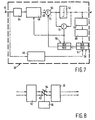
- Figure 7 illustrates a data aided multiuser multibit interference canceller suitable for use with block interleaved LOROC encoded signals having a constant chip rate, that is the product of bit rate x spreading factor is constant. Thus if the bit rate is reduced then the spreading factor is increased and vice versa.
- a deinterleaver 84 is used in place of the delay stage 44 and the output of the decision stage 52 is coupled a Green Machine 66 whose output is coupled to a Viterbi decoder 68 which provides decisions which are stored in the memory 56.
- the Green Machine 66 which is mentioned in the above article by Viterbi computes the correlation values of a code with all rows of the Hadamard matrix. The number of the row which has the largest correlation value is fed to the Viterbi decoder 68 which operates as a maximum likelihood decoder.
- the reliability of the decisions from the Viterbi decoder 68 is greater than when error protection coding is not used with the result that the canceller shown in Figure 7 has more effective performance.
- FIG. 3 to 7 can be optionally added to a known DS-CDMA system that has a voice dedicated channel.
- Figure 8 shows a Rake combiner 92 whose outputs 93 are connectable to the canceller 38 by switches 94 which are controlled by a control stage 96 which actuates the switches 94 in response to the result of an interference cancellation control algorithm.
- the Rake combiner 92 comprises a bank of code matched filters each having an input for a dynamically delayed version of the pseudo random code of any one particular user, delay means and a signal combiner.
- the Rake receiver can be used to combine optimally the multipath components, it is more effective in cancelling other users' interference and hence reducing the bit error rate (BER).
- the switches 94 are open and battery power is saved through not having to operate the canceller 38.
- the switches 94 are closed to connect the canceller 38 to the Rake combiner and provide multiuser cancellation. This effectively increases the capacity of the system, since the quality of the channel may be otherwise intolerable.
Landscapes
- Engineering & Computer Science (AREA)
- Computer Networks & Wireless Communication (AREA)
- Signal Processing (AREA)
- Cable Transmission Systems, Equalization Of Radio And Reduction Of Echo (AREA)
- Noise Elimination (AREA)
Claims (11)
- Système à accès multiple par répartition en code à séquence directe (DS-CDMA) auquel sont associées des valeurs d'intercorrélation entre des utilisateurs contemporains, le système comprenant un émetteur et un récepteur, l'émetteur comprenant un moyen (12) pour multiplier un signal modulant par une séquence d'étalement afin de former un signal à spectre étalé et un moyen (18, 20) pour transmettre le signal à spectre étalé sur un canal CDMA, et le récepteur comprenant un moyen de réception pour recevoir des signaux sur ledit canal CDMA et un moyen d'annulation de brouillage pour annuler un brouillage d'accès multiple, ledit moyen d'annulation de brouillage comprenant une entrée couplée au moyen de réception pour recevoir les signaux reçus, un moyen de filtrage avec anticipation (48 ou 60) couplé à l'entrée pour traiter les signaux reçus, un moyen de quantification (52) couplé au moyen de filtrage avec anticipation pour produire des décisions quantifiées à partir d'informations dérivées du moyen de filtrage avec anticipation, un moyen de décision provisoire (46) pour prendre des décisions provisoires concernant les signaux reçus, un moyen de caractérisation, couplé au moyen de décision provisoire et au moyen de quantification, pour caractériser le canal CDMA en fonction des valeurs d'intercorrélation de tous les utilisateurs contemporains, et un moyen de réglage réagissant au moyen de caractérisation pour régler des pondérations de prise d'au moins le moyen de filtrage avec anticipation de manière à annuler sensiblement le brouillage d'accès multiple.
- Système DS-CDMA suivant la revendication 1, caractérisé en ce que le moyen de caractérisation comprend un moyen de filtrage avec réaction (58) couplé à chacun du moyen de décision provisoire et du moyen de quantification pour traiter les décisions provisoires et les décisions quantifiées.
- Système DS-CDMA suivant la revendication 1, caractérisé en ce que le moyen de caractérisation comprend un moyen de mémoire (56) comportant un premier moyen d'entrée (55) couplé à la sortie du moyen de quantification, un deuxième moyen d'entrée (57) couplé à une sortie du moyen de décision provisoire (46) et un moyen de sortie, un moyen de filtrage avec réaction (58) comprenant un premier moyen d'entrée couplé au moyen de sortie du moyen de mémoire (56), et une sortie couplée à un premier moyen de soustraction dans lequel la sortie du moyen de filtrage avec réaction est soustraite d'une sortie du moyen de filtrage avec anticipation (48), un deuxième moyen de soustraction (54) comportant des première et deuxième entrées couplées respectivement à une entrée et une sortie du moyen de quantification et une sortie couplée à un moyen pour régler les pondérations de prise du moyen de filtrage avec anticipation et du moyen de filtrage avec réaction et en ce que la longueur du moyen de filtrage avec anticipation est sensiblement égale ou supérieure à la longueur d'une séquence d'étalement utilisée pour former le signal DS-CDMA.
- Récepteur pour recevoir des signaux DS-CDMA (accès multiple par répartition en code à séquence directe) sur un canal CDMA, les signaux étant transmis par des utilisateurs contemporains et auxquels sont associées des valeurs d'intercorrélation, le récepteur comprenant un moyen pour annuler un brouillage d'accès multiple, ledit moyen comprenant un moyen de filtrage avec anticipation (48 ou 60), un moyen de quantification (52) pour produire des décisions quantifiées à partir d'informations dérivées du moyen de filtrage avec anticipation, un moyen (46) pour prendre des décisions provisoires concernant le signal DS-CDMA reçu, un moyen de caractérisation, couplé au moyen de décision provisoire (46) et au moyen de quantification (52), pour caractériser le canal CDMA en fonction des valeurs d'intercorrélation de tous les utilisateurs contemporains, et un moyen de réglage réagissant au moyen de caractérisation pour régler des pondérations de prise d'au moins le moyen de filtrage avec anticipation de manière à annuler sensiblement le brouillage d'accès multiple.
- Récepteur suivant la revendication 4, caractérisé en ce que le moyen de caractérisation comprend un moyen de filtrage avec réaction (58) couplé à chacun du moyen de décision provisoire et du moyen de quantification pour traiter les décisions provisoires et les décisions quantifiées.
- Récepteur suivant la revendication 4, caractérisé en ce que le moyen de caractérisation comprend un moyen de mémoire (56) comportant un premier moyen d'entrée (55) couplé à la sortie du moyen de quantification, un deuxième moyen d'entrée (57) couplé à une sortie du moyen de décision provisoire (46) et un moyen de sortie, un moyen de filtrage avec réaction (58) comprenant un premier moyen d'entrée couplé au moyen de sortie du moyen de mémoire (56), et une sortie couplée à un premier moyen de soustraction dans lequel la sortie du moyen de filtrage avec réaction est soustraite d'une sortie du moyen de filtrage avec anticipation (48), un deuxième moyen de soustraction (54) comportant des première et deuxième entrées couplées respectivement à une entrée et une sortie du moyen de quantification et une sortie couplée à un moyen pour régler les pondérations de prise du moyen de filtrage avec anticipation et du moyen de filtrage avec réaction et en ce que la longueur du moyen de filtrage avec anticipation est sensiblement égale ou supérieure à la longueur d'une séquence d'étalement utilisée pour former le signal DS-CDMA.
- Récepteur suivant la revendication 6, dans lequel le moyen de filtrage avec réaction (58) comprend une pluralité d'étages de registre à décalage pour recevoir des décisions provisoires dérivées en fonctionnement et mémorisées dans le moyen de mémoire et des décisions passées dérivées en fonctionnement et mémorisées dans le moyen de mémoire, caractérisé en ce que le nombre d'étages de registre à décalage requis pour des décisions passées est inférieur au nombre d'étages de registre à décalage requis pour des décisions provisoires.
- Récepteur suivant l'une quelconque des revendications 4 à 7, caractérisé en ce que le moyen de filtrage avec anticipation comprend un égaliseur synchrone linéaire (48) et en ce qu'un moyen de désétalement de signal est couplé à une entrée de signal du moyen de filtrage avec anticipation.
- Récepteur suivant l'une quelconque des revendications 4 à 8, caractérisé en ce que le ou chaque dispositif d'annulation de brouillage comprend un moyen de décodage (68) couplé entre la sortie de signal de l'étage de décision et 1a première entrée du moyen de mémoire.
- Récepteur suivant la revendication 4, dans lequel pour plusieurs entrées, une seule sortie, le récepteur est caractérisé par une pluralité de filtres adaptés en code (CMF1 à CMF5) comprenant une entrée commune (r()) pour recevoir un signal d'entrée, un moyen pour appliquer un code d'étalement d'utilisateur différent (PRC1 à PRC5) à chacun des filtres adaptés en code, un moyen (98) pour échantillonner la sortie de chaque filtre adapté en code au débit binaire, une pluralité correspondante de dispositifs d'annulation de brouillage (C11 à C15) comportant des entrées couplées à un respectif du moyen d'échantillonnage, un moyen (84) couplé à des sorties des dispositifs d'annulation de brouillage pour soustraire des signaux non souhaités d'un signal souhaité et produire un signal de différence et un moyen de quantification (100) comportant une entrée pour recevoir le signal de différence.
- Récepteur suivant la revendication 4, dans lequel pour plusieurs entrées, une seule sortie, l'annulation de brouillage est décrite dans le domaine fréquentiel ou temporel par une matrice C(D), oùk étant le nombre d'utilisateurs.

Applications Claiming Priority (2)
| Application Number | Priority Date | Filing Date | Title |
|---|---|---|---|
| GB9317604 | 1993-08-24 | ||
| GB939317604A GB9317604D0 (en) | 1993-08-24 | 1993-08-24 | Receiver for ds-cdma signals |
Publications (3)
| Publication Number | Publication Date |
|---|---|
| EP0641102A2 EP0641102A2 (fr) | 1995-03-01 |
| EP0641102A3 EP0641102A3 (fr) | 1995-05-10 |
| EP0641102B1 true EP0641102B1 (fr) | 2004-03-10 |
Family
ID=10740963
Family Applications (1)
| Application Number | Title | Priority Date | Filing Date |
|---|---|---|---|
| EP94202349A Expired - Lifetime EP0641102B1 (fr) | 1993-08-24 | 1994-08-18 | Récepteur pour accès multiple par multiplexage de code à séquence direct avec annuleur d'interférence pour utilisation multiples |
Country Status (6)
| Country | Link |
|---|---|
| US (1) | US5550810A (fr) |
| EP (1) | EP0641102B1 (fr) |
| JP (1) | JP3529436B2 (fr) |
| KR (1) | KR100335711B1 (fr) |
| DE (1) | DE69433602T2 (fr) |
| GB (1) | GB9317604D0 (fr) |
Families Citing this family (122)
| Publication number | Priority date | Publication date | Assignee | Title |
|---|---|---|---|---|
| JP2570967B2 (ja) * | 1993-07-08 | 1997-01-16 | 日本電気株式会社 | Cdma受信機 |
| EP0696398A1 (fr) * | 1994-02-25 | 1996-02-14 | Koninklijke Philips Electronics N.V. | Systeme d'emission numerique a acces multiples, poste radio de base et recepteur utilisables dans un tel systeme |
| FI98108C (fi) * | 1995-05-17 | 1997-04-10 | Nokia Mobile Phones Ltd | Menetelmä yhteyden laadun arvioimiseksi ja vastaanotin |
| ZA965340B (en) | 1995-06-30 | 1997-01-27 | Interdigital Tech Corp | Code division multiple access (cdma) communication system |
| US5978413A (en) * | 1995-08-28 | 1999-11-02 | Bender; Paul E. | Method and system for processing a plurality of multiple access transmissions |
| FR2738694B1 (fr) * | 1995-09-08 | 1997-10-31 | France Telecom | Dispositif de filtrage avec retour de decision, dans le domaine frequentiel |
| US5694437A (en) * | 1995-10-10 | 1997-12-02 | Motorola, Inc. | Device and method for data signal detection in the presence of distortion and interference in communication systems |
| US6246715B1 (en) | 1998-06-26 | 2001-06-12 | Samsung Electronics Co., Ltd. | Data transmitter and receiver of a DS-CDMA communication system |
| JP4027444B2 (ja) * | 1996-03-11 | 2007-12-26 | 富士通株式会社 | 信号再生方法及び信号再生装置 |
| US6233272B1 (en) * | 1996-03-19 | 2001-05-15 | Yrp Mobile Telecommunications Key Technology Research Laboratories Co., Ltd. | Spread spectrum communication receiver |
| US5784366A (en) * | 1996-08-27 | 1998-07-21 | Transsky Corp. | Wideband code-division-multiple access system and method |
| JP3311943B2 (ja) * | 1996-10-18 | 2002-08-05 | 松下電器産業株式会社 | 干渉信号除去装置 |
| FI105517B (fi) | 1996-10-18 | 2000-08-31 | Nokia Networks Oy | Vastaanottomenetelmä ja vastaanotin |
| DE19717546B4 (de) * | 1996-12-05 | 2014-05-15 | Deutsche Telekom Ag | Verfahren und Vorrichtung zur Decodierung bei einem CDMA-Übertragungssystem zum Demodulieren eines Empfangssignals, das in serieller Codeverkettung vorliegt |
| US6377610B1 (en) * | 1997-04-25 | 2002-04-23 | Deutsche Telekom Ag | Decoding method and decoding device for a CDMA transmission system for demodulating a received signal available in serial code concatenation |
| JP3390900B2 (ja) * | 1996-12-20 | 2003-03-31 | 富士通株式会社 | 干渉キャンセラ及び仮判定方法 |
| US6553085B1 (en) | 1997-07-31 | 2003-04-22 | Francois Trans | Means and method for increasing performance of interference-suppression based receivers |
| US6904110B2 (en) * | 1997-07-31 | 2005-06-07 | Francois Trans | Channel equalization system and method |
| CA2302466A1 (fr) | 1997-07-31 | 1999-02-11 | Stanford Syncom Inc. | Dispositif et procede pour systeme de communication par reseau synchrone |
| KR100255565B1 (ko) | 1997-12-26 | 2000-05-01 | 정선종 | 코드분할 다중접속 시스템의 비동기 다중 경로 채널에서의다중 모드 감산형 잡음 제거 방법 및 장치 |
| US6175587B1 (en) | 1997-12-30 | 2001-01-16 | Motorola, Inc. | Communication device and method for interference suppression in a DS-CDMA system |
| US6175588B1 (en) | 1997-12-30 | 2001-01-16 | Motorola, Inc. | Communication device and method for interference suppression using adaptive equalization in a spread spectrum communication system |
| US6603801B1 (en) * | 1998-01-16 | 2003-08-05 | Intersil Americas Inc. | Spread spectrum transceiver for use in wireless local area network and having multipath mitigation |
| JP3335900B2 (ja) | 1998-02-27 | 2002-10-21 | 松下電器産業株式会社 | 干渉除去装置及び干渉除去方法 |
| CN1059998C (zh) * | 1998-06-22 | 2000-12-27 | 东南大学 | 多级迭代多用户检测方法 |
| JP2970656B1 (ja) * | 1998-06-25 | 1999-11-02 | 日本電気株式会社 | Ds−cdmaマルチユーザ干渉キャンセラ |
| FI981745A7 (fi) * | 1998-08-12 | 2000-02-13 | Nokia Mobile Phones Ltd | Menetelmä ja laite kanavakoodauksen ja -dekoodauksen toteuttamiseksi muistilla varustettujen modulaatiomenetelmien yhteydessä |
| US6775334B1 (en) * | 1998-11-03 | 2004-08-10 | Broadcom Corporation | Equalization and decision-directed loops with trellis demodulation in high definition TV |
| US6128330A (en) | 1998-11-24 | 2000-10-03 | Linex Technology, Inc. | Efficient shadow reduction antenna system for spread spectrum |
| US6438156B1 (en) | 1999-02-11 | 2002-08-20 | Adtran, Inc. | Stepwise adaptive finite impulse response filter for spread spectrum radio |
| US7952511B1 (en) | 1999-04-07 | 2011-05-31 | Geer James L | Method and apparatus for the detection of objects using electromagnetic wave attenuation patterns |
| EP1177618A1 (fr) * | 1999-04-14 | 2002-02-06 | Sapphire Communications, Inc. | Moyens et procede permettant d'ameliorer la performance des recepteurs a antiparasitage |
| US6400761B1 (en) | 1999-09-15 | 2002-06-04 | Princeton University | Method and apparatus for adaptively compensating channel or system variations in precoded communications system |
| US6584151B1 (en) * | 1999-11-12 | 2003-06-24 | Lsi Logic Corporation | Robust adaptive equalizer |
| GB9929132D0 (en) | 1999-12-10 | 2000-02-02 | Koninkl Philips Electronics Nv | Spread spectrum receiver |
| US6810502B2 (en) * | 2000-01-28 | 2004-10-26 | Conexant Systems, Inc. | Iteractive decoder employing multiple external code error checks to lower the error floor |
| DE10026615B4 (de) * | 2000-05-19 | 2004-12-23 | Systemonic Ag | Verfahren und Anordnung zum Empfang von CDMA-Signalen |
| US7068628B2 (en) * | 2000-05-22 | 2006-06-27 | At&T Corp. | MIMO OFDM system |
| US8363744B2 (en) | 2001-06-10 | 2013-01-29 | Aloft Media, Llc | Method and system for robust, secure, and high-efficiency voice and packet transmission over ad-hoc, mesh, and MIMO communication networks |
| FR2813726B1 (fr) * | 2000-09-01 | 2006-06-23 | Thomson Csf | Procede et dispositif pour demoduler des signaux provenant de multi-utilisateurs |
| FR2814014B1 (fr) * | 2000-09-14 | 2002-10-11 | Mitsubishi Electric Inf Tech | Methode de detection multi-utilisateur |
| FR2819659B1 (fr) * | 2001-01-15 | 2006-08-11 | Mitsubishi Electric Inf Tech | Methode simplifiee de detection par spheres en presence de faible rapport signal a bruit |
| US7012952B2 (en) * | 2001-08-01 | 2006-03-14 | Qualcomm Incorporated | Method and apparatus for adjusting delay in systems with time-burst pilot and fractionally spaced equalizers |
| US7359466B2 (en) * | 2001-08-24 | 2008-04-15 | Lucent Technologies Inc. | Signal detection by a receiver in a multiple antenna time-dispersive system |
| US7170926B2 (en) * | 2001-11-29 | 2007-01-30 | Interdigital Technology Corporation | Efficient multiple input multiple output system for multi-path fading channels |
| US7324584B1 (en) * | 2002-01-31 | 2008-01-29 | Nortel Networks Limited | Low complexity interference cancellation |
| US20030161258A1 (en) * | 2002-02-22 | 2003-08-28 | Jianzhong Zhang | Apparatus, and associated method, for a multiple-input, multiple-output communications system |
| US7593357B2 (en) * | 2002-03-28 | 2009-09-22 | Interdigital Technology Corporation | Transmit processing using receiver functions |
| US7809053B2 (en) * | 2002-04-04 | 2010-10-05 | Infineon Technologies Ag | Device and method for control scaling and quantization of soft output values from an equalizer |
| JP4654797B2 (ja) | 2005-06-30 | 2011-03-23 | 日本電気株式会社 | 等化装置および等化方法 |
| KR20120012960A (ko) | 2009-04-28 | 2012-02-13 | 엘에스아이 코포레이션 | 판독된 데이터 처리 시스템의 동적 스케일링을 위한 시스템 및 방법 |
| US8352841B2 (en) | 2009-06-24 | 2013-01-08 | Lsi Corporation | Systems and methods for out of order Y-sample memory management |
| US8418019B2 (en) | 2010-04-19 | 2013-04-09 | Lsi Corporation | Systems and methods for dynamic scaling in a data decoding system |
| US8862972B2 (en) | 2011-06-29 | 2014-10-14 | Lsi Corporation | Low latency multi-detector noise cancellation |
| US8595576B2 (en) | 2011-06-30 | 2013-11-26 | Lsi Corporation | Systems and methods for evaluating and debugging LDPC iterative decoders |
| US8650451B2 (en) | 2011-06-30 | 2014-02-11 | Lsi Corporation | Stochastic stream decoding of binary LDPC codes |
| US8566666B2 (en) | 2011-07-11 | 2013-10-22 | Lsi Corporation | Min-sum based non-binary LDPC decoder |
| US8656249B2 (en) | 2011-09-07 | 2014-02-18 | Lsi Corporation | Multi-level LDPC layer decoder |
| US8756478B2 (en) | 2011-09-07 | 2014-06-17 | Lsi Corporation | Multi-level LDPC layer decoder |
| US8996597B2 (en) | 2011-10-12 | 2015-03-31 | Lsi Corporation | Nyquist constrained digital finite impulse response filter |
| US8707144B2 (en) | 2011-10-17 | 2014-04-22 | Lsi Corporation | LDPC decoder with targeted symbol flipping |
| US8788921B2 (en) | 2011-10-27 | 2014-07-22 | Lsi Corporation | Detector with soft pruning |
| US8604960B2 (en) | 2011-10-28 | 2013-12-10 | Lsi Corporation | Oversampled data processing circuit with multiple detectors |
| US8700981B2 (en) | 2011-11-14 | 2014-04-15 | Lsi Corporation | Low latency enumeration endec |
| US8760991B2 (en) | 2011-11-14 | 2014-06-24 | Lsi Corporation | Systems and methods for post processing gain correction |
| US8719686B2 (en) | 2011-11-22 | 2014-05-06 | Lsi Corporation | Probability-based multi-level LDPC decoder |
| US8631300B2 (en) | 2011-12-12 | 2014-01-14 | Lsi Corporation | Systems and methods for scalable data processing shut down |
| US8625221B2 (en) | 2011-12-15 | 2014-01-07 | Lsi Corporation | Detector pruning control system |
| US8707123B2 (en) | 2011-12-30 | 2014-04-22 | Lsi Corporation | Variable barrel shifter |
| US8819515B2 (en) | 2011-12-30 | 2014-08-26 | Lsi Corporation | Mixed domain FFT-based non-binary LDPC decoder |
| US8751889B2 (en) | 2012-01-31 | 2014-06-10 | Lsi Corporation | Systems and methods for multi-pass alternate decoding |
| US8850295B2 (en) | 2012-02-01 | 2014-09-30 | Lsi Corporation | Symbol flipping data processor |
| US8775896B2 (en) | 2012-02-09 | 2014-07-08 | Lsi Corporation | Non-binary LDPC decoder with low latency scheduling |
| US8749907B2 (en) | 2012-02-14 | 2014-06-10 | Lsi Corporation | Systems and methods for adaptive decoder message scaling |
| US8782486B2 (en) | 2012-03-05 | 2014-07-15 | Lsi Corporation | Systems and methods for multi-matrix data processing |
| US8731115B2 (en) | 2012-03-08 | 2014-05-20 | Lsi Corporation | Systems and methods for data processing including pre-equalizer noise suppression |
| US8610608B2 (en) | 2012-03-08 | 2013-12-17 | Lsi Corporation | Systems and methods for reduced latency loop correction |
| US8873182B2 (en) | 2012-03-09 | 2014-10-28 | Lsi Corporation | Multi-path data processing system |
| US8977937B2 (en) | 2012-03-16 | 2015-03-10 | Lsi Corporation | Systems and methods for compression driven variable rate decoding in a data processing system |
| US9043684B2 (en) | 2012-03-22 | 2015-05-26 | Lsi Corporation | Systems and methods for variable redundancy data protection |
| US9230596B2 (en) | 2012-03-22 | 2016-01-05 | Avago Technologies General Ip (Singapore) Pte. Ltd. | Systems and methods for variable rate coding in a data processing system |
| US8612826B2 (en) | 2012-05-17 | 2013-12-17 | Lsi Corporation | Systems and methods for non-binary LDPC encoding |
| US8880986B2 (en) | 2012-05-30 | 2014-11-04 | Lsi Corporation | Systems and methods for improved data detection processing |
| US9324372B2 (en) | 2012-08-28 | 2016-04-26 | Avago Technologies General Ip (Singapore) Pte. Ltd. | Systems and methods for local iteration randomization in a data decoder |
| US8930780B2 (en) | 2012-08-28 | 2015-01-06 | Lsi Corporation | Systems and methods for non-zero syndrome based processing |
| US9019647B2 (en) | 2012-08-28 | 2015-04-28 | Lsi Corporation | Systems and methods for conditional positive feedback data decoding |
| US8751915B2 (en) | 2012-08-28 | 2014-06-10 | Lsi Corporation | Systems and methods for selectable positive feedback data processing |
| US8949702B2 (en) | 2012-09-14 | 2015-02-03 | Lsi Corporation | Systems and methods for detector side trapping set mitigation |
| US9112531B2 (en) | 2012-10-15 | 2015-08-18 | Avago Technologies General Ip (Singapore) Pte. Ltd. | Systems and methods for enhanced local iteration randomization in a data decoder |
| US8634152B1 (en) | 2012-10-15 | 2014-01-21 | Lsi Corporation | Systems and methods for throughput enhanced data detection in a data processing circuit |
| US9048870B2 (en) | 2012-11-19 | 2015-06-02 | Lsi Corporation | Low density parity check decoder with flexible saturation |
| US9130589B2 (en) | 2012-12-19 | 2015-09-08 | Avago Technologies General Ip (Singapore) Pte. Ltd. | Low density parity check decoder with dynamic scaling |
| US8929009B2 (en) | 2012-12-19 | 2015-01-06 | Lsi Corporation | Irregular low density parity check decoder with low syndrome error handling |
| US8773791B1 (en) | 2013-01-14 | 2014-07-08 | Lsi Corporation | Systems and methods for X-sample based noise cancellation |
| US9003263B2 (en) | 2013-01-15 | 2015-04-07 | Lsi Corporation | Encoder and decoder generation by state-splitting of directed graph |
| US9009557B2 (en) | 2013-01-21 | 2015-04-14 | Lsi Corporation | Systems and methods for reusing a layered decoder to yield a non-layered result |
| US8885276B2 (en) | 2013-02-14 | 2014-11-11 | Lsi Corporation | Systems and methods for shared layer data decoding |
| US8930792B2 (en) | 2013-02-14 | 2015-01-06 | Lsi Corporation | Systems and methods for distributed low density parity check decoding |
| US9214959B2 (en) | 2013-02-19 | 2015-12-15 | Avago Technologies General Ip (Singapore) Pte. Ltd. | Systems and methods for skip layer data decoding |
| US8797668B1 (en) | 2013-03-13 | 2014-08-05 | Lsi Corporation | Systems and methods for penalty based multi-variant encoding |
| US9048873B2 (en) | 2013-03-13 | 2015-06-02 | Lsi Corporation | Systems and methods for multi-stage encoding of concatenated low density parity check codes |
| US9048874B2 (en) | 2013-03-15 | 2015-06-02 | Lsi Corporation | Min-sum based hybrid non-binary low density parity check decoder |
| US9281843B2 (en) | 2013-03-22 | 2016-03-08 | Avago Technologies General Ip (Singapore) Pte. Ltd. | Systems and methods for reduced constraint code data processing |
| US9048867B2 (en) | 2013-05-21 | 2015-06-02 | Lsi Corporation | Shift register-based layered low density parity check decoder |
| US9274889B2 (en) | 2013-05-29 | 2016-03-01 | Avago Technologies General Ip (Singapore) Pte. Ltd. | Systems and methods for data processing using global iteration result reuse |
| US8959414B2 (en) | 2013-06-13 | 2015-02-17 | Lsi Corporation | Systems and methods for hybrid layer data decoding |
| US8917466B1 (en) | 2013-07-17 | 2014-12-23 | Lsi Corporation | Systems and methods for governing in-flight data sets in a data processing system |
| US8817404B1 (en) | 2013-07-18 | 2014-08-26 | Lsi Corporation | Systems and methods for data processing control |
| US9196299B2 (en) | 2013-08-23 | 2015-11-24 | Avago Technologies General Ip (Singapore) Pte. Ltd. | Systems and methods for enhanced data encoding and decoding |
| US8908307B1 (en) | 2013-08-23 | 2014-12-09 | Lsi Corporation | Systems and methods for hard disk drive region based data encoding |
| US9129651B2 (en) | 2013-08-30 | 2015-09-08 | Avago Technologies General Ip (Singapore) Pte. Ltd. | Array-reader based magnetic recording systems with quadrature amplitude modulation |
| US9047882B2 (en) | 2013-08-30 | 2015-06-02 | Lsi Corporation | Systems and methods for multi-level encoding and decoding |
| US9400797B2 (en) | 2013-09-17 | 2016-07-26 | Avago Technologies General Ip (Singapore) Pte. Ltd. | Systems and methods for recovered data stitching |
| CN104518801A (zh) | 2013-09-29 | 2015-04-15 | Lsi公司 | 非二进制的分层低密度奇偶校验解码器 |
| US9219503B2 (en) | 2013-10-16 | 2015-12-22 | Avago Technologies General Ip (Singapore) Pte. Ltd. | Systems and methods for multi-algorithm concatenation encoding and decoding |
| US9323606B2 (en) | 2013-11-21 | 2016-04-26 | Avago Technologies General Ip (Singapore) Pte. Ltd. | Systems and methods for FAID follower decoding |
| US9130599B2 (en) | 2013-12-24 | 2015-09-08 | Avago Technologies General Ip (Singapore) Pte. Ltd. | Systems and methods of converting detector output to multi-level soft information |
| RU2014104571A (ru) | 2014-02-10 | 2015-08-20 | ЭлЭсАй Корпорейшн | Системы и способы для эффективного с точки зрения площади кодирования данных |
| US9378765B2 (en) | 2014-04-03 | 2016-06-28 | Seagate Technology Llc | Systems and methods for differential message scaling in a decoding process |
| TWI640181B (zh) * | 2016-03-02 | 2018-11-01 | 晨星半導體股份有限公司 | 等化器裝置及使用在等化器裝置中以維特比演算法為基礎的決策方法 |
| CN112470472B (zh) | 2018-06-11 | 2023-03-24 | 无锡安科迪智能技术有限公司 | 盲压缩采样方法、装置及成像系统 |
| WO2020050004A1 (fr) * | 2018-09-03 | 2020-03-12 | 日本電気株式会社 | Dispositif de transmission, procédé de compensation de variation de temps de transmission, et support lisible par ordinateur non transitoire comprenant un programme de compensation de variation de temps de transmission stocké sur celui-ci |
Family Cites Families (3)
| Publication number | Priority date | Publication date | Assignee | Title |
|---|---|---|---|---|
| GB2144604B (en) * | 1983-08-04 | 1986-12-10 | Nec Corp | Orthogonally multiplexed parallel data transmission system |
| TW211095B (fr) * | 1991-12-11 | 1993-08-11 | Philips Nv | |
| US5341395A (en) * | 1992-11-24 | 1994-08-23 | At&T Bell Laboratories | Data recovery technique for asynchronous CDMA systems |
-
1993
- 1993-08-24 GB GB939317604A patent/GB9317604D0/en active Pending
-
1994
- 1994-08-18 EP EP94202349A patent/EP0641102B1/fr not_active Expired - Lifetime
- 1994-08-18 DE DE69433602T patent/DE69433602T2/de not_active Expired - Fee Related
- 1994-08-23 JP JP19872594A patent/JP3529436B2/ja not_active Expired - Fee Related
- 1994-08-24 KR KR1019940021284A patent/KR100335711B1/ko not_active Expired - Fee Related
- 1994-08-24 US US08/295,449 patent/US5550810A/en not_active Expired - Lifetime
Also Published As
| Publication number | Publication date |
|---|---|
| KR950007328A (ko) | 1995-03-21 |
| US5550810A (en) | 1996-08-27 |
| KR100335711B1 (ko) | 2002-09-04 |
| DE69433602T2 (de) | 2005-03-24 |
| EP0641102A2 (fr) | 1995-03-01 |
| EP0641102A3 (fr) | 1995-05-10 |
| HK1019025A1 (en) | 2000-01-14 |
| JP3529436B2 (ja) | 2004-05-24 |
| DE69433602D1 (de) | 2004-04-15 |
| GB9317604D0 (en) | 1993-10-06 |
| JPH07177124A (ja) | 1995-07-14 |
Similar Documents
| Publication | Publication Date | Title |
|---|---|---|
| US5550810A (en) | Direct sequence code division multiple access (DS-CDMA) communication system and a receiver for use in such a system | |
| US6009089A (en) | Pilot interference cancellation for a coherent wireless code division multiple access receiver | |
| US6067292A (en) | Pilot interference cancellation for a coherent wireless code division multiple access receiver | |
| JP2839039B2 (ja) | マルチユーザ干渉低減のための方法および装置 | |
| Kohno et al. | An adaptive canceller of cochannel interference for spread-spectrum multiple-access communication networks in a power line | |
| US8144748B2 (en) | Method and apparatus for equalizing CDMA signals | |
| JP2570967B2 (ja) | Cdma受信機 | |
| CN1757175B (zh) | 无线通信系统中针对软切换所接收的多个信号的均衡 | |
| Yoshida et al. | DS/CDMA adaptive interference canceller on differential detection in fast fading channel | |
| EP1035681A2 (fr) | Procédé de suppression des interferences | |
| Kohno | Spatial and temporal filtering for co-channel interference in CDMA | |
| US9236902B2 (en) | Combined equalizer and spread spectrum interference canceller method and implementation for the downlink of CDMA systems | |
| US6856646B2 (en) | T-spaced equalization for 1xEV systems | |
| EP1289162A2 (fr) | Méthode combinée d'égalisation et de suppression d'interférences à spectre étalé pour la liaison descendante de systèmes AMRC, aussi que l'implémentation correspondante | |
| WO2002078205A1 (fr) | Demodulation et desetalement dans des recepteurs amcr | |
| HK1019025B (en) | Direct sequence - code division multiple access receiver with multiuser interference canceller | |
| Sanchez et al. | Blind multiuser detection using CMA in a multicarrier CDMA receiver | |
| Lai et al. | Comparative performance of adaptive receivers for demodulating IS-95 downlink data | |
| Su et al. | Cochannel interference rejection in multipath channels | |
| Thomas | Multiuser interference suppression in wideband broadcast CDMA networks | |
| Bastug et al. | Optimization issues in combined chip and symbol level equalization for downlink WCDMA receivers | |
| Anderson | Practical multiuser detection algorithms for CDMA | |
| Kim et al. | Soft decision feedback receiver for CDMA communication in multipath | |
| Saadani et al. | An hybrid PIC based receiver using code estimation for HSDPA multiuser interference cancellation | |
| Chen et al. | Adaptive MDPSK DS/CDMA receivers with performance analysis |
Legal Events
| Date | Code | Title | Description |
|---|---|---|---|
| PUAI | Public reference made under article 153(3) epc to a published international application that has entered the european phase |
Free format text: ORIGINAL CODE: 0009012 |
|
| AK | Designated contracting states |
Kind code of ref document: A2 Designated state(s): DE FR GB IT |
|
| PUAL | Search report despatched |
Free format text: ORIGINAL CODE: 0009013 |
|
| AK | Designated contracting states |
Kind code of ref document: A3 Designated state(s): DE FR GB IT |
|
| 17P | Request for examination filed |
Effective date: 19951110 |
|
| 17Q | First examination report despatched |
Effective date: 20020717 |
|
| REG | Reference to a national code |
Ref country code: GB Ref legal event code: FG4D |
|
| GRAH | Despatch of communication of intention to grant a patent |
Free format text: ORIGINAL CODE: EPIDOS IGRA |
|
| GRAS | Grant fee paid |
Free format text: ORIGINAL CODE: EPIDOSNIGR3 |
|
| GRAA | (expected) grant |
Free format text: ORIGINAL CODE: 0009210 |
|
| AK | Designated contracting states |
Kind code of ref document: B1 Designated state(s): DE FR GB IT |
|
| REF | Corresponds to: |
Ref document number: 69433602 Country of ref document: DE Date of ref document: 20040415 Kind code of ref document: P |
|
| REG | Reference to a national code |
Ref country code: GB Ref legal event code: 746 Effective date: 20040811 |
|
| ET | Fr: translation filed | ||
| PLBE | No opposition filed within time limit |
Free format text: ORIGINAL CODE: 0009261 |
|
| STAA | Information on the status of an ep patent application or granted ep patent |
Free format text: STATUS: NO OPPOSITION FILED WITHIN TIME LIMIT |
|
| REG | Reference to a national code |
Ref country code: FR Ref legal event code: D6 |
|
| REG | Reference to a national code |
Ref country code: HK Ref legal event code: GR Ref document number: 1019025 Country of ref document: HK |
|
| 26N | No opposition filed |
Effective date: 20041213 |
|
| PGFP | Annual fee paid to national office [announced via postgrant information from national office to epo] |
Ref country code: IT Payment date: 20080728 Year of fee payment: 15 |
|
| PGFP | Annual fee paid to national office [announced via postgrant information from national office to epo] |
Ref country code: GB Payment date: 20080929 Year of fee payment: 15 |
|
| PGFP | Annual fee paid to national office [announced via postgrant information from national office to epo] |
Ref country code: DE Payment date: 20081017 Year of fee payment: 15 |
|
| PGFP | Annual fee paid to national office [announced via postgrant information from national office to epo] |
Ref country code: FR Payment date: 20081118 Year of fee payment: 15 |
|
| GBPC | Gb: european patent ceased through non-payment of renewal fee |
Effective date: 20090818 |
|
| REG | Reference to a national code |
Ref country code: FR Ref legal event code: ST Effective date: 20100430 |
|
| PG25 | Lapsed in a contracting state [announced via postgrant information from national office to epo] |
Ref country code: FR Free format text: LAPSE BECAUSE OF NON-PAYMENT OF DUE FEES Effective date: 20090831 Ref country code: DE Free format text: LAPSE BECAUSE OF NON-PAYMENT OF DUE FEES Effective date: 20100302 |
|
| PG25 | Lapsed in a contracting state [announced via postgrant information from national office to epo] |
Ref country code: GB Free format text: LAPSE BECAUSE OF NON-PAYMENT OF DUE FEES Effective date: 20090818 |
|
| PG25 | Lapsed in a contracting state [announced via postgrant information from national office to epo] |
Ref country code: IT Free format text: LAPSE BECAUSE OF NON-PAYMENT OF DUE FEES Effective date: 20090818 |