EP0641839A2 - Faserreaktive Farbstoffe, deren Herstellung und Verwendung - Google Patents
Faserreaktive Farbstoffe, deren Herstellung und Verwendung Download PDFInfo
- Publication number
- EP0641839A2 EP0641839A2 EP94810480A EP94810480A EP0641839A2 EP 0641839 A2 EP0641839 A2 EP 0641839A2 EP 94810480 A EP94810480 A EP 94810480A EP 94810480 A EP94810480 A EP 94810480A EP 0641839 A2 EP0641839 A2 EP 0641839A2
- Authority
- EP
- European Patent Office
- Prior art keywords
- formula
- sulfo
- substituted
- alkyl
- radical
- Prior art date
- Legal status (The legal status is an assumption and is not a legal conclusion. Google has not performed a legal analysis and makes no representation as to the accuracy of the status listed.)
- Granted
Links
- 239000000985 reactive dye Substances 0.000 title claims abstract description 24
- 238000002360 preparation method Methods 0.000 title claims description 5
- 239000000975 dye Substances 0.000 claims abstract description 62
- 238000004043 dyeing Methods 0.000 claims abstract description 24
- 239000002657 fibrous material Substances 0.000 claims abstract description 10
- -1 polyazo Polymers 0.000 claims description 167
- 150000003254 radicals Chemical class 0.000 claims description 49
- 150000001875 compounds Chemical class 0.000 claims description 33
- 125000000020 sulfo group Chemical group O=S(=O)([*])O[H] 0.000 claims description 31
- 125000000217 alkyl group Chemical group 0.000 claims description 30
- 239000000460 chlorine Substances 0.000 claims description 30
- 239000001257 hydrogen Substances 0.000 claims description 28
- 229910052739 hydrogen Inorganic materials 0.000 claims description 28
- 229920000742 Cotton Polymers 0.000 claims description 24
- 229910052801 chlorine Inorganic materials 0.000 claims description 24
- 125000002887 hydroxy group Chemical group [H]O* 0.000 claims description 23
- 239000011737 fluorine Chemical group 0.000 claims description 22
- 229910052731 fluorine Inorganic materials 0.000 claims description 22
- 229910052736 halogen Inorganic materials 0.000 claims description 22
- 150000002367 halogens Chemical group 0.000 claims description 21
- 125000001997 phenyl group Chemical group [H]C1=C([H])C([H])=C(*)C([H])=C1[H] 0.000 claims description 20
- 125000000956 methoxy group Chemical group [H]C([H])([H])O* 0.000 claims description 18
- 125000002496 methyl group Chemical group [H]C([H])([H])* 0.000 claims description 18
- 125000000391 vinyl group Chemical group [H]C([*])=C([H])[H] 0.000 claims description 18
- ZAMOUSCENKQFHK-UHFFFAOYSA-N Chlorine atom Chemical compound [Cl] ZAMOUSCENKQFHK-UHFFFAOYSA-N 0.000 claims description 17
- 229920002554 vinyl polymer Polymers 0.000 claims description 17
- 125000003178 carboxy group Chemical group [H]OC(*)=O 0.000 claims description 16
- PXGOKWXKJXAPGV-UHFFFAOYSA-N Fluorine Chemical group FF PXGOKWXKJXAPGV-UHFFFAOYSA-N 0.000 claims description 15
- 125000004178 (C1-C4) alkyl group Chemical group 0.000 claims description 14
- 238000000034 method Methods 0.000 claims description 14
- 125000002924 primary amino group Chemical group [H]N([H])* 0.000 claims description 14
- 125000000229 (C1-C4)alkoxy group Chemical group 0.000 claims description 13
- 125000004435 hydrogen atom Chemical group [H]* 0.000 claims description 12
- 125000001309 chloro group Chemical group Cl* 0.000 claims description 10
- 125000001495 ethyl group Chemical group [H]C([H])([H])C([H])([H])* 0.000 claims description 10
- UFHFLCQGNIYNRP-UHFFFAOYSA-N Hydrogen Chemical compound [H][H] UFHFLCQGNIYNRP-UHFFFAOYSA-N 0.000 claims description 9
- 125000000732 arylene group Chemical group 0.000 claims description 8
- GDTBXPJZTBHREO-UHFFFAOYSA-N bromine Chemical group BrBr GDTBXPJZTBHREO-UHFFFAOYSA-N 0.000 claims description 8
- 229910052794 bromium Inorganic materials 0.000 claims description 8
- WKBOTKDWSSQWDR-UHFFFAOYSA-N Bromine atom Chemical group [Br] WKBOTKDWSSQWDR-UHFFFAOYSA-N 0.000 claims description 7
- VGGSQFUCUMXWEO-UHFFFAOYSA-N Ethene Chemical compound C=C VGGSQFUCUMXWEO-UHFFFAOYSA-N 0.000 claims description 7
- 125000001153 fluoro group Chemical group F* 0.000 claims description 7
- 125000004573 morpholin-4-yl group Chemical group N1(CCOCC1)* 0.000 claims description 7
- QQONPFPTGQHPMA-UHFFFAOYSA-N propylene Natural products CC=C QQONPFPTGQHPMA-UHFFFAOYSA-N 0.000 claims description 7
- 125000002490 anilino group Chemical group [H]N(*)C1=C([H])C([H])=C([H])C([H])=C1[H] 0.000 claims description 6
- 230000008878 coupling Effects 0.000 claims description 6
- 238000010168 coupling process Methods 0.000 claims description 6
- 238000005859 coupling reaction Methods 0.000 claims description 6
- 125000004093 cyano group Chemical group *C#N 0.000 claims description 6
- VMKJWLXVLHBJNK-UHFFFAOYSA-N cyanuric fluoride Chemical compound FC1=NC(F)=NC(F)=N1 VMKJWLXVLHBJNK-UHFFFAOYSA-N 0.000 claims description 6
- 239000005977 Ethylene Substances 0.000 claims description 5
- 125000004805 propylene group Chemical group [H]C([H])([H])C([H])([*:1])C([H])([H])[*:2] 0.000 claims description 5
- 229910052770 Uranium Inorganic materials 0.000 claims description 4
- MGNCLNQXLYJVJD-UHFFFAOYSA-N cyanuric chloride Chemical compound ClC1=NC(Cl)=NC(Cl)=N1 MGNCLNQXLYJVJD-UHFFFAOYSA-N 0.000 claims description 4
- 239000013067 intermediate product Substances 0.000 claims description 4
- NYGZLYXAPMMJTE-UHFFFAOYSA-M metanil yellow Chemical group [Na+].[O-]S(=O)(=O)C1=CC=CC(N=NC=2C=CC(NC=3C=CC=CC=3)=CC=2)=C1 NYGZLYXAPMMJTE-UHFFFAOYSA-M 0.000 claims description 4
- 125000001624 naphthyl group Chemical group 0.000 claims description 4
- 229910052757 nitrogen Inorganic materials 0.000 claims description 4
- 239000002243 precursor Substances 0.000 claims description 4
- PYKYMHQGRFAEBM-UHFFFAOYSA-N anthraquinone Natural products CCC(=O)c1c(O)c2C(=O)C3C(C=CC=C3O)C(=O)c2cc1CC(=O)OC PYKYMHQGRFAEBM-UHFFFAOYSA-N 0.000 claims description 3
- 150000004056 anthraquinones Chemical class 0.000 claims description 3
- 125000003917 carbamoyl group Chemical group [H]N([H])C(*)=O 0.000 claims description 3
- 238000006193 diazotization reaction Methods 0.000 claims description 3
- PPSZHCXTGRHULJ-UHFFFAOYSA-N dioxazine Chemical compound O1ON=CC=C1 PPSZHCXTGRHULJ-UHFFFAOYSA-N 0.000 claims description 3
- 239000000463 material Substances 0.000 claims description 3
- VMGAPWLDMVPYIA-HIDZBRGKSA-N n'-amino-n-iminomethanimidamide Chemical compound N\N=C\N=N VMGAPWLDMVPYIA-HIDZBRGKSA-N 0.000 claims description 3
- 125000005184 naphthylamino group Chemical group C1(=CC=CC2=CC=CC=C12)N* 0.000 claims description 3
- 125000000843 phenylene group Chemical group C1(=C(C=CC=C1)*)* 0.000 claims description 3
- BOLDJAUMGUJJKM-LSDHHAIUSA-N renifolin D Natural products CC(=C)[C@@H]1Cc2c(O)c(O)ccc2[C@H]1CC(=O)c3ccc(O)cc3O BOLDJAUMGUJJKM-LSDHHAIUSA-N 0.000 claims description 3
- 125000003161 (C1-C6) alkylene group Chemical group 0.000 claims description 2
- 125000000954 2-hydroxyethyl group Chemical group [H]C([*])([H])C([H])([H])O[H] 0.000 claims description 2
- 125000001951 carbamoylamino group Chemical group C(N)(=O)N* 0.000 claims description 2
- 125000000951 phenoxy group Chemical group [H]C1=C([H])C([H])=C(O*)C([H])=C1[H] 0.000 claims description 2
- IEQIEDJGQAUEQZ-UHFFFAOYSA-N phthalocyanine Chemical compound N1C(N=C2C3=CC=CC=C3C(N=C3C4=CC=CC=C4C(=N4)N3)=N2)=C(C=CC=C2)C2=C1N=C1C2=CC=CC=C2C4=N1 IEQIEDJGQAUEQZ-UHFFFAOYSA-N 0.000 claims description 2
- 229920002678 cellulose Polymers 0.000 abstract description 6
- 239000001913 cellulose Substances 0.000 abstract description 6
- HEMHJVSKTPXQMS-UHFFFAOYSA-M Sodium hydroxide Chemical compound [OH-].[Na+] HEMHJVSKTPXQMS-UHFFFAOYSA-M 0.000 description 36
- 239000000243 solution Substances 0.000 description 34
- 125000004432 carbon atom Chemical group C* 0.000 description 30
- UHOVQNZJYSORNB-UHFFFAOYSA-N Benzene Chemical compound C1=CC=CC=C1 UHOVQNZJYSORNB-UHFFFAOYSA-N 0.000 description 19
- 239000004744 fabric Substances 0.000 description 17
- XLYOFNOQVPJJNP-UHFFFAOYSA-N water Substances O XLYOFNOQVPJJNP-UHFFFAOYSA-N 0.000 description 16
- 150000002431 hydrogen Chemical group 0.000 description 9
- 0 CC1(C=CC(NC)=CC=C1)S(*)(=O)=O Chemical compound CC1(C=CC(NC)=CC=C1)S(*)(=O)=O 0.000 description 8
- 238000006243 chemical reaction Methods 0.000 description 8
- 125000003545 alkoxy group Chemical group 0.000 description 7
- 150000003839 salts Chemical group 0.000 description 7
- VEXZGXHMUGYJMC-UHFFFAOYSA-N Hydrochloric acid Chemical compound Cl VEXZGXHMUGYJMC-UHFFFAOYSA-N 0.000 description 6
- CDBYLPFSWZWCQE-UHFFFAOYSA-L Sodium Carbonate Chemical compound [Na+].[Na+].[O-]C([O-])=O CDBYLPFSWZWCQE-UHFFFAOYSA-L 0.000 description 6
- FAPWRFPIFSIZLT-UHFFFAOYSA-M Sodium chloride Chemical compound [Na+].[Cl-] FAPWRFPIFSIZLT-UHFFFAOYSA-M 0.000 description 6
- 239000003599 detergent Substances 0.000 description 6
- 239000000835 fiber Substances 0.000 description 6
- 239000000203 mixture Substances 0.000 description 6
- 230000007935 neutral effect Effects 0.000 description 6
- 239000011734 sodium Substances 0.000 description 6
- LPXPTNMVRIOKMN-UHFFFAOYSA-M sodium nitrite Chemical compound [Na+].[O-]N=O LPXPTNMVRIOKMN-UHFFFAOYSA-M 0.000 description 6
- 125000001424 substituent group Chemical group 0.000 description 6
- 150000002790 naphthalenes Chemical class 0.000 description 5
- 229910004727 OSO3H Inorganic materials 0.000 description 4
- UIIMBOGNXHQVGW-UHFFFAOYSA-M Sodium bicarbonate Chemical compound [Na+].OC([O-])=O UIIMBOGNXHQVGW-UHFFFAOYSA-M 0.000 description 4
- 125000000738 acetamido group Chemical group [H]C([H])([H])C(=O)N([H])[*] 0.000 description 4
- 150000003863 ammonium salts Chemical class 0.000 description 4
- 239000000987 azo dye Substances 0.000 description 4
- 125000000664 diazo group Chemical group [N-]=[N+]=[*] 0.000 description 4
- 125000003754 ethoxycarbonyl group Chemical group C(=O)(OCC)* 0.000 description 4
- 229910052744 lithium Inorganic materials 0.000 description 4
- 125000001160 methoxycarbonyl group Chemical group [H]C([H])([H])OC(*)=O 0.000 description 4
- 229910052708 sodium Inorganic materials 0.000 description 4
- 239000002562 thickening agent Substances 0.000 description 4
- IOVCWXUNBOPUCH-UHFFFAOYSA-M Nitrite anion Chemical compound [O-]N=O IOVCWXUNBOPUCH-UHFFFAOYSA-M 0.000 description 3
- 239000002253 acid Substances 0.000 description 3
- 239000003513 alkali Substances 0.000 description 3
- 125000005236 alkanoylamino group Chemical group 0.000 description 3
- 125000004453 alkoxycarbonyl group Chemical group 0.000 description 3
- 125000004390 alkyl sulfonyl group Chemical group 0.000 description 3
- 239000012954 diazonium Substances 0.000 description 3
- 150000001989 diazonium salts Chemical class 0.000 description 3
- 125000001449 isopropyl group Chemical group [H]C([H])([H])C([H])(*)C([H])([H])[H] 0.000 description 3
- LNOPIUAQISRISI-UHFFFAOYSA-N n'-hydroxy-2-propan-2-ylsulfonylethanimidamide Chemical compound CC(C)S(=O)(=O)CC(N)=NO LNOPIUAQISRISI-UHFFFAOYSA-N 0.000 description 3
- 125000000449 nitro group Chemical group [O-][N+](*)=O 0.000 description 3
- WLFXSECCHULRRO-UHFFFAOYSA-N pyridine-2,6-diol Chemical compound OC1=CC=CC(O)=N1 WLFXSECCHULRRO-UHFFFAOYSA-N 0.000 description 3
- 235000017550 sodium carbonate Nutrition 0.000 description 3
- 229910000029 sodium carbonate Inorganic materials 0.000 description 3
- 239000011780 sodium chloride Substances 0.000 description 3
- 235000010288 sodium nitrite Nutrition 0.000 description 3
- LJRGBERXYNQPJI-UHFFFAOYSA-M sodium;3-nitrobenzenesulfonate Chemical compound [Na+].[O-][N+](=O)C1=CC=CC(S([O-])(=O)=O)=C1 LJRGBERXYNQPJI-UHFFFAOYSA-M 0.000 description 3
- 238000003756 stirring Methods 0.000 description 3
- 239000000725 suspension Substances 0.000 description 3
- 210000002268 wool Anatomy 0.000 description 3
- IXPNQXFRVYWDDI-UHFFFAOYSA-N 1-methyl-2,4-dioxo-1,3-diazinane-5-carboximidamide Chemical compound CN1CC(C(N)=N)C(=O)NC1=O IXPNQXFRVYWDDI-UHFFFAOYSA-N 0.000 description 2
- JVMSQRAXNZPDHF-UHFFFAOYSA-N 2,4-diaminobenzenesulfonic acid Chemical compound NC1=CC=C(S(O)(=O)=O)C(N)=C1 JVMSQRAXNZPDHF-UHFFFAOYSA-N 0.000 description 2
- IJGRMHOSHXDMSA-UHFFFAOYSA-N Atomic nitrogen Chemical compound N#N IJGRMHOSHXDMSA-UHFFFAOYSA-N 0.000 description 2
- LBLYYCQCTBFVLH-UHFFFAOYSA-N Cc1ccccc1S(O)(=O)=O Chemical compound Cc1ccccc1S(O)(=O)=O LBLYYCQCTBFVLH-UHFFFAOYSA-N 0.000 description 2
- 229920003043 Cellulose fiber Polymers 0.000 description 2
- RYGMFSIKBFXOCR-UHFFFAOYSA-N Copper Chemical group [Cu] RYGMFSIKBFXOCR-UHFFFAOYSA-N 0.000 description 2
- UFWIBTONFRDIAS-UHFFFAOYSA-N Naphthalene Chemical compound C1=CC=CC2=CC=CC=C21 UFWIBTONFRDIAS-UHFFFAOYSA-N 0.000 description 2
- 239000004952 Polyamide Substances 0.000 description 2
- XSQUKJJJFZCRTK-UHFFFAOYSA-N Urea Chemical compound NC(N)=O XSQUKJJJFZCRTK-UHFFFAOYSA-N 0.000 description 2
- 239000007864 aqueous solution Substances 0.000 description 2
- 125000000043 benzamido group Chemical group [H]N([*])C(=O)C1=C([H])C([H])=C([H])C([H])=C1[H] 0.000 description 2
- 125000001246 bromo group Chemical group Br* 0.000 description 2
- 125000000484 butyl group Chemical group [H]C([*])([H])C([H])([H])C([H])([H])C([H])([H])[H] 0.000 description 2
- 239000004202 carbamide Substances 0.000 description 2
- 238000009833 condensation Methods 0.000 description 2
- 230000005494 condensation Effects 0.000 description 2
- BNIILDVGGAEEIG-UHFFFAOYSA-L disodium hydrogen phosphate Chemical compound [Na+].[Na+].OP([O-])([O-])=O BNIILDVGGAEEIG-UHFFFAOYSA-L 0.000 description 2
- 125000001301 ethoxy group Chemical group [H]C([H])([H])C([H])([H])O* 0.000 description 2
- 125000005843 halogen group Chemical group 0.000 description 2
- 125000000959 isobutyl group Chemical group [H]C([H])([H])C([H])(C([H])([H])[H])C([H])([H])* 0.000 description 2
- 125000003253 isopropoxy group Chemical group [H]C([H])([H])C([H])(O*)C([H])([H])[H] 0.000 description 2
- 125000003506 n-propoxy group Chemical group [H]C([H])([H])C([H])([H])C([H])([H])O* 0.000 description 2
- 229920002647 polyamide Polymers 0.000 description 2
- 229920000728 polyester Polymers 0.000 description 2
- 239000000843 powder Substances 0.000 description 2
- 125000001436 propyl group Chemical group [H]C([*])([H])C([H])([H])C([H])([H])[H] 0.000 description 2
- JEXVQSWXXUJEMA-UHFFFAOYSA-N pyrazol-3-one Chemical compound O=C1C=CN=N1 JEXVQSWXXUJEMA-UHFFFAOYSA-N 0.000 description 2
- 229920006395 saturated elastomer Polymers 0.000 description 2
- 125000002914 sec-butyl group Chemical group [H]C([H])([H])C([H])([H])C([H])(*)C([H])([H])[H] 0.000 description 2
- 239000000661 sodium alginate Substances 0.000 description 2
- 235000010413 sodium alginate Nutrition 0.000 description 2
- 229940005550 sodium alginate Drugs 0.000 description 2
- 235000017557 sodium bicarbonate Nutrition 0.000 description 2
- 229910000030 sodium bicarbonate Inorganic materials 0.000 description 2
- 125000000999 tert-butyl group Chemical group [H]C([H])([H])C(*)(C([H])([H])[H])C([H])([H])[H] 0.000 description 2
- 125000004400 (C1-C12) alkyl group Chemical group 0.000 description 1
- YAIKCRUPEVOINQ-UHFFFAOYSA-N 2-aminonaphthalene-1,5-disulfonic acid Chemical compound OS(=O)(=O)C1=CC=CC2=C(S(O)(=O)=O)C(N)=CC=C21 YAIKCRUPEVOINQ-UHFFFAOYSA-N 0.000 description 1
- BYHQTRFJOGIQAO-GOSISDBHSA-N 3-(4-bromophenyl)-8-[(2R)-2-hydroxypropyl]-1-[(3-methoxyphenyl)methyl]-1,3,8-triazaspiro[4.5]decan-2-one Chemical compound C[C@H](CN1CCC2(CC1)CN(C(=O)N2CC3=CC(=CC=C3)OC)C4=CC=C(C=C4)Br)O BYHQTRFJOGIQAO-GOSISDBHSA-N 0.000 description 1
- APRRQJCCBSJQOQ-UHFFFAOYSA-N 4-amino-5-hydroxynaphthalene-2,7-disulfonic acid Chemical compound OS(=O)(=O)C1=CC(O)=C2C(N)=CC(S(O)(=O)=O)=CC2=C1 APRRQJCCBSJQOQ-UHFFFAOYSA-N 0.000 description 1
- KCBWAFJCKVKYHO-UHFFFAOYSA-N 6-(4-cyclopropyl-6-methoxypyrimidin-5-yl)-1-[[4-[1-propan-2-yl-4-(trifluoromethyl)imidazol-2-yl]phenyl]methyl]pyrazolo[3,4-d]pyrimidine Chemical compound C1(CC1)C1=NC=NC(=C1C1=NC=C2C(=N1)N(N=C2)CC1=CC=C(C=C1)C=1N(C=C(N=1)C(F)(F)F)C(C)C)OC KCBWAFJCKVKYHO-UHFFFAOYSA-N 0.000 description 1
- PJQUFZPSUQYROE-UHFFFAOYSA-N 7-[(2-acetamido-4-aminophenyl)diazenyl]naphthalene-1,3,6-trisulfonic acid Chemical compound CC(=O)NC1=CC(N)=CC=C1N=NC1=CC2=C(S(O)(=O)=O)C=C(S(O)(=O)=O)C=C2C=C1S(O)(=O)=O PJQUFZPSUQYROE-UHFFFAOYSA-N 0.000 description 1
- WDJHALXBUFZDSR-UHFFFAOYSA-N Acetoacetic acid Natural products CC(=O)CC(O)=O WDJHALXBUFZDSR-UHFFFAOYSA-N 0.000 description 1
- LSNNMFCWUKXFEE-UHFFFAOYSA-M Bisulfite Chemical compound OS([O-])=O LSNNMFCWUKXFEE-UHFFFAOYSA-M 0.000 description 1
- PPHQUIPUBYPZLD-UHFFFAOYSA-N CCN(C)c1ccccc1 Chemical compound CCN(C)c1ccccc1 PPHQUIPUBYPZLD-UHFFFAOYSA-N 0.000 description 1
- JLTDJTHDQAWBAV-UHFFFAOYSA-N CN(C)c1ccccc1 Chemical compound CN(C)c1ccccc1 JLTDJTHDQAWBAV-UHFFFAOYSA-N 0.000 description 1
- QRAXZXPSAGQUNP-UHFFFAOYSA-N CNc(cc1)ccc1S(O)(=O)=O Chemical compound CNc(cc1)ccc1S(O)(=O)=O QRAXZXPSAGQUNP-UHFFFAOYSA-N 0.000 description 1
- 244000025254 Cannabis sativa Species 0.000 description 1
- 235000012766 Cannabis sativa ssp. sativa var. sativa Nutrition 0.000 description 1
- 235000012765 Cannabis sativa ssp. sativa var. spontanea Nutrition 0.000 description 1
- WODGMMJHSAKKNF-UHFFFAOYSA-N Cc(ccc1ccccc11)c1S(O)(=O)=O Chemical compound Cc(ccc1ccccc11)c1S(O)(=O)=O WODGMMJHSAKKNF-UHFFFAOYSA-N 0.000 description 1
- IRLYGRLEBKCYPY-UHFFFAOYSA-N Cc1cc(S(O)(=O)=O)c(C)cc1 Chemical compound Cc1cc(S(O)(=O)=O)c(C)cc1 IRLYGRLEBKCYPY-UHFFFAOYSA-N 0.000 description 1
- DGAQECJNVWCQMB-PUAWFVPOSA-M Ilexoside XXIX Chemical compound C[C@@H]1CC[C@@]2(CC[C@@]3(C(=CC[C@H]4[C@]3(CC[C@@H]5[C@@]4(CC[C@@H](C5(C)C)OS(=O)(=O)[O-])C)C)[C@@H]2[C@]1(C)O)C)C(=O)O[C@H]6[C@@H]([C@H]([C@@H]([C@H](O6)CO)O)O)O.[Na+] DGAQECJNVWCQMB-PUAWFVPOSA-M 0.000 description 1
- WHXSMMKQMYFTQS-UHFFFAOYSA-N Lithium Chemical compound [Li] WHXSMMKQMYFTQS-UHFFFAOYSA-N 0.000 description 1
- 125000005118 N-alkylcarbamoyl group Chemical group 0.000 description 1
- PMZURENOXWZQFD-UHFFFAOYSA-L Sodium Sulfate Chemical compound [Na+].[Na+].[O-]S([O-])(=O)=O PMZURENOXWZQFD-UHFFFAOYSA-L 0.000 description 1
- GSEJCLTVZPLZKY-UHFFFAOYSA-N Triethanolamine Chemical compound OCCN(CCO)CCO GSEJCLTVZPLZKY-UHFFFAOYSA-N 0.000 description 1
- CIUQDSCDWFSTQR-UHFFFAOYSA-N [C]1=CC=CC=C1 Chemical compound [C]1=CC=CC=C1 CIUQDSCDWFSTQR-UHFFFAOYSA-N 0.000 description 1
- 125000002777 acetyl group Chemical group [H]C([H])([H])C(*)=O 0.000 description 1
- 125000003668 acetyloxy group Chemical group [H]C([H])([H])C(=O)O[*] 0.000 description 1
- 230000002378 acidificating effect Effects 0.000 description 1
- 125000002252 acyl group Chemical group 0.000 description 1
- 125000004423 acyloxy group Chemical group 0.000 description 1
- 125000001931 aliphatic group Chemical group 0.000 description 1
- 125000004466 alkoxycarbonylamino group Chemical group 0.000 description 1
- 125000004414 alkyl thio group Chemical group 0.000 description 1
- 150000001412 amines Chemical class 0.000 description 1
- 125000004397 aminosulfonyl group Chemical group NS(=O)(=O)* 0.000 description 1
- 239000001000 anthraquinone dye Substances 0.000 description 1
- 125000003118 aryl group Chemical group 0.000 description 1
- QVGXLLKOCUKJST-UHFFFAOYSA-N atomic oxygen Chemical compound [O] QVGXLLKOCUKJST-UHFFFAOYSA-N 0.000 description 1
- POJOORKDYOPQLS-UHFFFAOYSA-L barium(2+) 5-chloro-2-[(2-hydroxynaphthalen-1-yl)diazenyl]-4-methylbenzenesulfonate Chemical compound [Ba+2].C1=C(Cl)C(C)=CC(N=NC=2C3=CC=CC=C3C=CC=2O)=C1S([O-])(=O)=O.C1=C(Cl)C(C)=CC(N=NC=2C3=CC=CC=C3C=CC=2O)=C1S([O-])(=O)=O POJOORKDYOPQLS-UHFFFAOYSA-L 0.000 description 1
- 125000005605 benzo group Chemical group 0.000 description 1
- WDEQGLDWZMIMJM-UHFFFAOYSA-N benzyl 4-hydroxy-2-(hydroxymethyl)pyrrolidine-1-carboxylate Chemical compound OCC1CC(O)CN1C(=O)OCC1=CC=CC=C1 WDEQGLDWZMIMJM-UHFFFAOYSA-N 0.000 description 1
- 230000015572 biosynthetic process Effects 0.000 description 1
- 238000009835 boiling Methods 0.000 description 1
- 125000004106 butoxy group Chemical group [*]OC([H])([H])C([H])([H])C(C([H])([H])[H])([H])[H] 0.000 description 1
- 235000009120 camo Nutrition 0.000 description 1
- 125000002057 carboxymethyl group Chemical group [H]OC(=O)C([H])([H])[*] 0.000 description 1
- 235000005607 chanvre indien Nutrition 0.000 description 1
- YOCIQNIEQYCORH-UHFFFAOYSA-M chembl2028361 Chemical compound [Na+].OC1=CC=C2C=C(S([O-])(=O)=O)C=CC2=C1N=NC1=CC=CC=C1 YOCIQNIEQYCORH-UHFFFAOYSA-M 0.000 description 1
- 150000004696 coordination complex Chemical class 0.000 description 1
- 229910052802 copper Inorganic materials 0.000 description 1
- 239000010949 copper Substances 0.000 description 1
- 150000004699 copper complex Chemical class 0.000 description 1
- 125000004956 cyclohexylene group Chemical group 0.000 description 1
- 230000001419 dependent effect Effects 0.000 description 1
- WOWBFOBYOAGEEA-UHFFFAOYSA-N diafenthiuron Chemical compound CC(C)C1=C(NC(=S)NC(C)(C)C)C(C(C)C)=CC(OC=2C=CC=CC=2)=C1 WOWBFOBYOAGEEA-UHFFFAOYSA-N 0.000 description 1
- 238000009792 diffusion process Methods 0.000 description 1
- 239000002270 dispersing agent Substances 0.000 description 1
- 125000006125 ethylsulfonyl group Chemical group 0.000 description 1
- 125000004705 ethylthio group Chemical group C(C)S* 0.000 description 1
- 239000011487 hemp Substances 0.000 description 1
- 230000007062 hydrolysis Effects 0.000 description 1
- 238000006460 hydrolysis reaction Methods 0.000 description 1
- 238000010409 ironing Methods 0.000 description 1
- 125000002510 isobutoxy group Chemical group [H]C([H])([H])C([H])(C([H])([H])[H])C([H])([H])O* 0.000 description 1
- 125000005928 isopropyloxycarbonyl group Chemical group [H]C([H])([H])C([H])(OC(*)=O)C([H])([H])[H] 0.000 description 1
- 238000004519 manufacturing process Methods 0.000 description 1
- 125000002816 methylsulfanyl group Chemical group [H]C([H])([H])S[*] 0.000 description 1
- 125000004170 methylsulfonyl group Chemical group [H]C([H])([H])S(*)(=O)=O 0.000 description 1
- 125000006606 n-butoxy group Chemical group 0.000 description 1
- 125000004108 n-butyl group Chemical group [H]C([H])([H])C([H])([H])C([H])([H])C([H])([H])* 0.000 description 1
- 125000004123 n-propyl group Chemical group [H]C([H])([H])C([H])([H])C([H])([H])* 0.000 description 1
- 125000005146 naphthylsulfonyl group Chemical group C1(=CC=CC2=CC=CC=C12)S(=O)(=O)* 0.000 description 1
- QJGQUHMNIGDVPM-UHFFFAOYSA-N nitrogen group Chemical group [N] QJGQUHMNIGDVPM-UHFFFAOYSA-N 0.000 description 1
- 239000001301 oxygen Substances 0.000 description 1
- 229910052760 oxygen Inorganic materials 0.000 description 1
- 125000003170 phenylsulfonyl group Chemical group C1(=CC=CC=C1)S(=O)(=O)* 0.000 description 1
- 239000001007 phthalocyanine dye Substances 0.000 description 1
- 229910052700 potassium Inorganic materials 0.000 description 1
- 235000019353 potassium silicate Nutrition 0.000 description 1
- 230000009257 reactivity Effects 0.000 description 1
- 239000004627 regenerated cellulose Substances 0.000 description 1
- 239000013535 sea water Substances 0.000 description 1
- 125000005920 sec-butoxy group Chemical group 0.000 description 1
- 239000000344 soap Substances 0.000 description 1
- 239000001488 sodium phosphate Substances 0.000 description 1
- NTHWMYGWWRZVTN-UHFFFAOYSA-N sodium silicate Chemical compound [Na+].[Na+].[O-][Si]([O-])=O NTHWMYGWWRZVTN-UHFFFAOYSA-N 0.000 description 1
- 229910052938 sodium sulfate Inorganic materials 0.000 description 1
- 235000011152 sodium sulphate Nutrition 0.000 description 1
- 239000007858 starting material Substances 0.000 description 1
- 239000000126 substance Substances 0.000 description 1
- 230000035900 sweating Effects 0.000 description 1
- 125000004213 tert-butoxy group Chemical group [H]C([H])([H])C(O*)(C([H])([H])[H])C([H])([H])[H] 0.000 description 1
- 125000005931 tert-butyloxycarbonyl group Chemical group [H]C([H])([H])C(OC(*)=O)(C([H])([H])[H])C([H])([H])[H] 0.000 description 1
- 125000003396 thiol group Chemical group [H]S* 0.000 description 1
- 125000002023 trifluoromethyl group Chemical group FC(F)(F)* 0.000 description 1
- RYFMWSXOAZQYPI-UHFFFAOYSA-K trisodium phosphate Chemical compound [Na+].[Na+].[Na+].[O-]P([O-])([O-])=O RYFMWSXOAZQYPI-UHFFFAOYSA-K 0.000 description 1
- 229910000406 trisodium phosphate Inorganic materials 0.000 description 1
- 235000019801 trisodium phosphate Nutrition 0.000 description 1
- 238000005406 washing Methods 0.000 description 1
- 230000004584 weight gain Effects 0.000 description 1
- 235000019786 weight gain Nutrition 0.000 description 1
Classifications
-
- C—CHEMISTRY; METALLURGY
- C09—DYES; PAINTS; POLISHES; NATURAL RESINS; ADHESIVES; COMPOSITIONS NOT OTHERWISE PROVIDED FOR; APPLICATIONS OF MATERIALS NOT OTHERWISE PROVIDED FOR
- C09B—ORGANIC DYES OR CLOSELY-RELATED COMPOUNDS FOR PRODUCING DYES, e.g. PIGMENTS; MORDANTS; LAKES
- C09B62/00—Reactive dyes, i.e. dyes which form covalent bonds with the substrates or which polymerise with themselves
- C09B62/44—Reactive dyes, i.e. dyes which form covalent bonds with the substrates or which polymerise with themselves with the reactive group not directly attached to a heterocyclic ring
- C09B62/4401—Reactive dyes, i.e. dyes which form covalent bonds with the substrates or which polymerise with themselves with the reactive group not directly attached to a heterocyclic ring with two or more reactive groups at least one of them being directly attached to a heterocyclic system and at least one of them being directly attached to a non-heterocyclic system
- C09B62/4403—Reactive dyes, i.e. dyes which form covalent bonds with the substrates or which polymerise with themselves with the reactive group not directly attached to a heterocyclic ring with two or more reactive groups at least one of them being directly attached to a heterocyclic system and at least one of them being directly attached to a non-heterocyclic system the heterocyclic system being a triazine ring
- C09B62/4411—Azo dyes
-
- C—CHEMISTRY; METALLURGY
- C09—DYES; PAINTS; POLISHES; NATURAL RESINS; ADHESIVES; COMPOSITIONS NOT OTHERWISE PROVIDED FOR; APPLICATIONS OF MATERIALS NOT OTHERWISE PROVIDED FOR
- C09B—ORGANIC DYES OR CLOSELY-RELATED COMPOUNDS FOR PRODUCING DYES, e.g. PIGMENTS; MORDANTS; LAKES
- C09B62/00—Reactive dyes, i.e. dyes which form covalent bonds with the substrates or which polymerise with themselves
- C09B62/44—Reactive dyes, i.e. dyes which form covalent bonds with the substrates or which polymerise with themselves with the reactive group not directly attached to a heterocyclic ring
- C09B62/4401—Reactive dyes, i.e. dyes which form covalent bonds with the substrates or which polymerise with themselves with the reactive group not directly attached to a heterocyclic ring with two or more reactive groups at least one of them being directly attached to a heterocyclic system and at least one of them being directly attached to a non-heterocyclic system
- C09B62/4403—Reactive dyes, i.e. dyes which form covalent bonds with the substrates or which polymerise with themselves with the reactive group not directly attached to a heterocyclic ring with two or more reactive groups at least one of them being directly attached to a heterocyclic system and at least one of them being directly attached to a non-heterocyclic system the heterocyclic system being a triazine ring
-
- C—CHEMISTRY; METALLURGY
- C09—DYES; PAINTS; POLISHES; NATURAL RESINS; ADHESIVES; COMPOSITIONS NOT OTHERWISE PROVIDED FOR; APPLICATIONS OF MATERIALS NOT OTHERWISE PROVIDED FOR
- C09B—ORGANIC DYES OR CLOSELY-RELATED COMPOUNDS FOR PRODUCING DYES, e.g. PIGMENTS; MORDANTS; LAKES
- C09B62/00—Reactive dyes, i.e. dyes which form covalent bonds with the substrates or which polymerise with themselves
- C09B62/02—Reactive dyes, i.e. dyes which form covalent bonds with the substrates or which polymerise with themselves with the reactive group directly attached to a heterocyclic ring
- C09B62/04—Reactive dyes, i.e. dyes which form covalent bonds with the substrates or which polymerise with themselves with the reactive group directly attached to a heterocyclic ring to a triazine ring
- C09B62/08—Azo dyes
-
- D—TEXTILES; PAPER
- D06—TREATMENT OF TEXTILES OR THE LIKE; LAUNDERING; FLEXIBLE MATERIALS NOT OTHERWISE PROVIDED FOR
- D06P—DYEING OR PRINTING TEXTILES; DYEING LEATHER, FURS OR SOLID MACROMOLECULAR SUBSTANCES IN ANY FORM
- D06P1/00—General processes of dyeing or printing textiles, or general processes of dyeing leather, furs, or solid macromolecular substances in any form, classified according to the dyes, pigments, or auxiliary substances employed
- D06P1/38—General processes of dyeing or printing textiles, or general processes of dyeing leather, furs, or solid macromolecular substances in any form, classified according to the dyes, pigments, or auxiliary substances employed using reactive dyes
-
- D—TEXTILES; PAPER
- D06—TREATMENT OF TEXTILES OR THE LIKE; LAUNDERING; FLEXIBLE MATERIALS NOT OTHERWISE PROVIDED FOR
- D06P—DYEING OR PRINTING TEXTILES; DYEING LEATHER, FURS OR SOLID MACROMOLECULAR SUBSTANCES IN ANY FORM
- D06P3/00—Special processes of dyeing or printing textiles, or dyeing leather, furs, or solid macromolecular substances in any form, classified according to the material treated
- D06P3/58—Material containing hydroxyl groups
- D06P3/60—Natural or regenerated cellulose
- D06P3/66—Natural or regenerated cellulose using reactive dyes
Definitions
- the present invention relates to new reactive dyes, processes for their preparation and their use for dyeing or printing fiber materials.
- the present invention is therefore based on the object of finding new, improved reactive dyes for dyeing and printing fiber materials which have the qualities characterized above to a high degree.
- the new dyes should above all be distinguished by high fixing yields and high fiber-dye binding stabilities, and moreover the portions which are not fixed on the fiber should be easy to wash out. They should also give dyeings with good general fastness properties, for example light and wet fastness properties.
- the present invention relates to reactive dyes of the formula wherein D is the remainder of a monoazo, polyazo, metal complex azo, anthraquinone, phthalocyanine, formazan or dioxazine chromophore, R, R1 and R2 each independently represent hydrogen or optionally substituted by halogen, hydroxy, cyano, C1-C4-alkoxy, C1-C4-alkoxycarbonyl, carboxy, sulfamoyl, sulfo or sulfato, C1-C4-alkyl, X represents chlorine, fluorine, bromine, 3-carboxypyridin-1-yl or 3-carbamoylpyridin-1-yl, X1 and Z independently of one another each have one of the meanings given for X or for hydroxyl, C1-C4-alkoxy, phenoxy, C1-C4-alkylthio, morpholino, optionally substituted by non-reactive radicals
- C1-C4-alkyl generally means methyl, ethyl, n- or iso-propyl or n-, iso-, sec- or tert-butyl;
- C1-C4 alkoxy generally includes methoxy, ethoxy, n- or iso-propoxy and n-, iso-, sec- or tert-butoxy;
- Halogen is generally e.g.
- C1-C4 alkoxycarbonyl generally means methoxycarbonyl, ethoxycarbonyl, n- or iso-propoxycarbonyl or n-, iso-, sec.- or tert-butoxycarbonyl, preferably methoxycarbonyl or ethoxycarbonyl.
- Examples of C1-C4 alkanoyloxy are acetyloxy or propionyloxy.
- Examples of C1-C4 alkylthio are methylthio and ethylthio.
- alkyl radicals R, R1 and R2 are unsubstituted C1-C4-alkyl, carboxymethyl, ⁇ -carboxyethyl, ⁇ -carboxypropyl, methoxycarbonylmethyl, ethoxycarbonylethyl, ⁇ -methoxyethyl, ⁇ -ethoxyethyl, ⁇ -methoxypropyl, ⁇ -chloroethyl, ⁇ -hydroxyethyl , ⁇ -hydroxybutyl, ⁇ -cyanoethyl, sulfomethyl, ⁇ -sulfoethyl, ⁇ -sulfatoethyl and ⁇ -bromopropyl.
- R, R1 and R2 are each independently preferably hydrogen or C1-C1-alkyl, particularly preferably hydrogen, methyl or ethyl and particularly preferably hydrogen.
- X preferably denotes fluorine or chlorine.
- X1 or Z stand for amino which is optionally substituted by non-reactive radicals, it can be amino, N-C1-C4-alkylamino or N, N-di-C1-Cam-alkylamino, the alkyl optionally being e.g. is substituted by sulfo, sulfato, hydroxy, carboxy or phenyl, cyclohexylamino, N-C1-C4-alkyl-N-phenylamino or phenylamino or naphthylamino, the phenyl or naphthyl optionally being e.g. is substituted by C1-C4-alkyl, C1-C4-alkoxy, C2-C4-alkanoylamino, carboxy, sulfo or halogen.
- non-reactive radicals X1 and Z are independently amino, methylamino, ethylamino, ⁇ -hydroxyethylamino, N, N-di- ⁇ -hydroxyethylamino, ⁇ -sulfoethylamino, cyclohexylamino, morpholino, o-, m- or p-chlorophenylamino , o-, m- or p-methylphenylamino, o-, m- or p-methoxyphenylamino, o-, m- or p-sulfophenylamino, disulfophenylamino, o-carboxyphenylamino, 1- or 2-naphthylamino, 1-sulfo-2- naphthylamino, 4,8-disulfo-2-naphthylamino, N-ethyl-N-phenylamino, N
- X1 and Z independently of one another each preferably have the meaning C1-C4-alkoxy, C1-C4-alkylthio, hydroxy, amino, N-C1-C4-alkylamino which is unsubstituted in the alkyl part or by hydroxy, sulfato or sulfo is substituted, morpholino, phenylamino or N-C1-C4-alkyl-N-phenylamino, in which the phenyl is in each case unsubstituted or substituted by sulfo, carboxy, acetylamino, methyl or methoxy.
- non-reactive radicals X1 and Z are each independently amino, N-methylamino, N-ethylamino, morpholino, phenylamino, 2-, 3- or 4-sulfophenylamino or N-C1-C4-alkyl-N-phenylamino.
- Suitable leaving groups U are e.g. -Cl, -Br, -F, -OSO3H, -SSO3H, -OCO-CH3, -OPO3H2, -OCO-CCl3, -OCO-CHCl2, -OCO-CH2Cl, -OSO2-C1-C4-alkyl, -OSO2- N (C1-C4-alkyl) 2 or -OCO-C6H5.
- U is preferably a group of the formula -Cl, -OSO3H, -SSO3H, -OCO-CH3, -OCO-C6H5 or -OPO3H2, in particular -Cl or -OSO3H, preferably -OSO3H.
- Y preferably denotes vinyl, ⁇ -chloroethyl, ⁇ -sulfatoethyl, ⁇ -thiosulfatoethyl, ⁇ -acetoxyethyl, ⁇ -phenoxyethyl or ⁇ -phosphatoethyl and particularly preferably ⁇ -sulfatoethyl or vinyl.
- X2 is preferably bromine.
- Alk and alk ' are independent of each other e.g. a methylene, ethylene, 1,3-propylene, 1,4-butylene, 1,5-pentylene or 1,6-hexylene radical or their branched isomers.
- Alk and alk ' preferably each independently represent a C1-C4 alkylene radical and particularly preferably an ethylene radical or propylene radical.
- Arylene is preferably an 1,3- or 1,4-phenylene radical which is unsubstituted or substituted, for example, by sulfo, methyl, methoxy or carboxy, and particularly preferably an unsubstituted 1,3- or 1,4-phenylene radical.
- R6 is preferably hydrogen or C1-C4-alkyl, such as methyl, ethyl, propyl, isopropyl, butyl, isobutyl, sec-butyl or tert-butyl. R6 is particularly preferably hydrogen.
- R7 is preferably hydrogen, methyl or ethyl, especially hydrogen.
- R8 is preferably hydrogen.
- B preferably represents -NH- or -O- and particularly preferably -O-.
- W preferably denotes a group of the formula -CONH- or -NHCO-, in particular a group of the formula -CONH-.
- Particularly preferred fiber-reactive radicals X1 or Z correspond to the formula or wherein Y is vinyl or ⁇ -sulfatoethyl.
- X1 preferably represents chlorine, fluorine, amino, N-C1-C4-alkylamino which is unsubstituted or substituted by hydroxy, sulfato or sulfo in the alkyl part, morpholino or phenylamino or N-C1-C4-alkyl-N-phenylamino, in which the phenyl is in each case unsubstituted or substituted by sulfo, carboxy, acetylamino, methyl or methoxy.
- Chlorine or fluorine are particularly preferred for X 1.
- a preferred embodiment of the invention relates to compounds of formula (1), wherein X and X1 each represent fluorine.
- a further preferred embodiment of the invention relates to compounds of the formula (1) in which X is chlorine and X1 is fluorine.
- Z is preferably C1-C4-alkoxy, C1-C4-alkylthio, hydroxy, amino, N-C1-C4-alkylamino which is unsubstituted in the alkyl part or substituted by hydroxy, sulfato or sulfo, morpholino, phenylamino or N-C1-C4 -Alkyl-N-phenylamino, in which the phenyl is in each case unsubstituted or substituted by sulfo, carboxy, acetylamino, methyl or methoxy, or a reactive radical of the formulas (2a) to (2f) given above, in which W is a group of the formula -CONH- or -NHCO-, R6, R7 and R8 each hydrogen, B the radical -O- or -NH-, alk and alk 'independently of one another, each ethylene or propylene, arylene unsubstituted or substituted
- Z particularly preferably denotes amino, N-C1-C4-alkylamino which is unsubstituted in the alkyl part or substituted by hydroxyl, sulfato or sulfo, morpholino, phenylamino or N-C1-C4-alkyl-N-phenylamino, in which the phenyl in each case is unsubstituted or substituted by sulfo, carboxy, acetylamino, methyl or methoxy is, or a fiber-reactive radical of the formula or wherein Y is vinyl or ⁇ -sulfatoethyl.
- n and n 1 each independently preferably represent the number 1.
- substituents in radical D are: alkyl groups with 1 to 12 carbon atoms, in particular 1 to 4 carbon atoms, such as methyl, ethyl, propyl, isopropyl or butyl, alkoxy groups with 1 to 8 carbon atoms, in particular 1 to 4 carbon atoms, such as methoxy, Aethoxy, propoxy, isopropoxy or butoxy, alkanoylamino groups with 2 to 8 carbon atoms, in particular 2 to 4 carbon atoms, such as acetylamino or propionylamino, phenyl or naphthylamino, alkoxycarbonylamino groups with 2 to 8 carbon atoms, in particular 2 to 4 carbon atoms, alkanoyl groups with 2 to 8 carbon atoms , in particular 2 to 4 carbon atoms, alkoxycarbonyl having 1 to 4 carbon atoms in the alkoxy radical, such as methoxycarbonyl or ethoxycarbonyl, alkyl
- Fiber-reactive residues are to be understood as those which are able to react with the hydroxyl groups of cellulose, the amino, carboxy, hydroxyl and thiol groups in wool and silk, or with the amino and possibly carboxy groups of synthetic polyamides with the formation of covalent chemical bonds .
- the fiber-reactive residues are generally bound to the dye residue directly or via a bridge member.
- Suitable fiber-reactive radicals are, for example, those which contain at least one removable substituent on an aliphatic, aromatic or heterocyclic radical or in which the radicals mentioned are a radical suitable for reaction with the fiber material, such as e.g. contain a vinyl residue.
- D contains a fiber-reactive residue
- this preferably corresponds to the formula -SO2-Y (2g) or -CONR7-alk-SO2-Y (2h), wherein for alk, R7 and Y the meaning given above applies.
- D preferably represents a monoazo or disazochrome residue of the formula (3a), (3b), (3c), (4a) or (4b) and particularly preferably represents a monoazochrome residue.
- Particularly preferred monoazochrome residues D correspond to the formula or wherein (R9) 1 ⁇ 3 for 1 to 3 identical or different radicals from the group sulfo, methyl, methoxy, acetylamino, sulfamoyl and radical of the formula -SO2-Y or -CONH-alk-SO2-Y, wherein alk and Y each have the meaning given above, and (R10) 0 ⁇ 2 0 to 2 means the same or different radicals from the group methyl, 2-hydroxyethyl, methoxy, acetylamino, propionylamino, sulfo and ureido.
- Particularly preferred monoazochrome residues D correspond to the formula wherein (R9) 1 ⁇ 3 represents 1 to 3 identical or different radicals from the group sulfo, methyl, methoxy and radical of the formula -SO2-Y, where Y is vinyl or ⁇ -sulfatoethyl.
- Preferred disazochromophores D correspond to the formula wherein (R10) 0 ⁇ 2 has the meaning given above.
- a preferred embodiment of the present invention relates to compounds of the formula wherein for D, R, R1, R2, X, X1, Z, n and n1 each have the meanings given above and favors apply.
- a preferred subgroup is represented by compounds of the formula (1a) in which R1 and R2 each independently represent hydrogen, methyl or ethyl, n represents the number 1, X is fluorine or chlorine, X1 fluorine, chlorine, amino, N-C1- C4-alkylamino which is unsubstituted or substituted by hydroxy, sulfato or sulfo, morpholino or for phenylamino or N-C1-C4-alkyl-N-phenylamino, in which the phenyl is unsubstituted or by sulfo, carboxy, acetylamino, methyl or Methoxy is substituted, means Z C1-C4-alkoxy, C1-C4-alkylthio, hydroxy, amino, N-C1-C4-alkylamino which is unsubstituted in the alkyl part or substituted by hydroxy, sulfato or sulfo, morph
- a particularly preferred subgroup are compounds of formula (1a) in which R1 and R2 are each hydrogen, n is 1, X is fluorine or chlorine, X1 is fluorine, chlorine or morpholino, Z is amino, N-C1-C4 -Alkylamino, which is unsubstituted or substituted by hydroxy, sulfato or sulfo in the alkyl part, morpholino, phenylamino or N-C1-C4-alkyl-N-phenylamino, in which the phenyl in each case is unsubstituted or substituted by sulfo, carboxy, acetylamino, methyl or methoxy is, or a fiber-reactive radical of the formula or where Y is vinyl or ⁇ -sulfatoethyl, and D is a radical of the formula (9a) given above.
- Another preferred embodiment of the present invention relates to compounds of the formula wherein for D, R, R1, R2, X, X1, Z, n and n1 each have the meanings and preferences given above.
- Another preferred embodiment of the present invention relates to compounds of the formula wherein for D, R, R1, R2, X, X1, Z, n and n1 each have the meanings and preferences given above.
- the compounds of formula (1) have at least two and preferably four to eight permanent sulfo or sulfato groups, i.e. Sulfo or sulfato groups, which are not split off during the reaction of the reactive dye with the fiber material; these can each be in the form of the free acid or preferably in salt form, e.g. as Na, Li, K or ammonium salt.
- the compounds of formula (1) can also be used as a mixed salt, e.g. as Na / Li or Na / Li / ammonium salt.
- the compounds of the formula (1) can be prepared in a manner known per se, for example by adding approximately 1 equivalent of an organic dye of the formula D-NHR1 (12) or a dye precursor, in about 1 equivalent of 2,4,6-trifluoro-s-triazine (cyanuric fluoride) or 2,4,6-trichloro-s-triazine (cyanuric chloride), in about 1 equivalent of the compound of the formula in about 1 equivalent of the compound of the formula and about 1 equivalent of a compound of the formula wherein D, R, R1, R2, X, X1, Z, n and n1 each have the meaning given above and Hal is halogen, preferably fluorine or chlorine, reacted with one another in any order by diazotization and coupling, or, in the case of dye precursors, the intermediate products obtained converted into the desired dyes and optionally followed by a further conversion reaction.
- an organic dye of the formula D-NHR1 (12) or a dye precursor in about 1 equivalent of 2,4,6-trifluoro-
- the production of the final dyes from intermediate products is primarily about couplings that lead to azo dyes.
- reaction is carried out step by step, the sequence of simple reactions between the individual reaction components advantageously being dependent on the particular conditions.
- a preferred variant for the preparation of the compounds of the formula (1) relates to the preparation of a compound of the formula wherein D, R1, R2, X and n each have the meaning given above, diazotization of this compound and coupling with a compound of the formula wherein R, X1, Z and n1 each have the meaning given above.
- the invention further relates to a process for dyeing and printing cellulose-containing fiber materials with the dyes of the formula 1 according to the invention.
- the fiber materials are, for example, natural cellulose fibers such as cotton, linen and hemp, and also cellulose and regenerated cellulose.
- the dyes are also suitable for dyeing or printing fibers containing hydroxyl groups contained in blended fabrics, e.g. of mixtures of cotton with polyamide fibers, or in particular polyester fibers.
- the dyes according to the invention can be applied to the fiber material and fixed on the fiber in various ways, in particular in the form of aqueous dye solutions and printing pastes. They are suitable both for the exhaust process and for dyeing according to the foulard dyeing process, after which the goods are impregnated with aqueous, optionally salt-containing dye solutions, and the dyes are fixed after an alkali treatment or in the presence of alkali, if appropriate with the action of heat. After fixation, the dyeings or prints are thoroughly rinsed with cold and hot water, if appropriate with the addition of a dispersing agent which promotes the diffusion of the unfixed portions.
- the usual dyeing and printing processes are used for dyeing and printing.
- the dyes are characterized by good fixability and very good build-up. They can be used over a very wide temperature range after the pull-out process and are therefore also very suitable for dyeing cotton-polyester blended fabrics under the conditions recommended for such fabrics.
- the degrees of fixation are high and the difference between the degree of extension and the degree of fixation is remarkably small, i.e. the soap loss is very low. Easily reproducible, level colorations result.
- the dyes of formula (1) are also suitable for printing, especially on cotton, but also for printing nitrogen-containing fibers, e.g. wool or silk or blended fabrics containing wool or silk.
- the dyeings and prints on cellulose fiber materials produced with the dyes according to the invention have high color strength and high fiber-dye binding stability, both in the acidic and in the alkaline range, furthermore good light fastness and very good wet fastness properties, such as fastness to washing, water, sea water, over-dyeing and sweating, as well as good pleating fastness, ironing fastness and rubbing fastness and very good chlorine bath water fastness.
- the dyes of formula (1) are either in the form of their free sulfonic acid or preferably as their salts such as e.g. the alkali, alkaline earth or ammonium salts or as salts of an organic amine.
- their salts such as e.g. the alkali, alkaline earth or ammonium salts or as salts of an organic amine.
- Examples include the sodium, lithium or ammonium salts, the salt of triethanolamine or mixed salts, e.g. Na / Li or Na / NH4 / Li called.
- the solution obtained is cooled to about 0 ° C., mixed with 25 parts of 32% hydrochloric acid and 7 parts of sodium nitrite and stirred for about 1 hour. Excess nitrite is then destroyed with a little sulfamic acid and the suspension of the diazonium salt obtained is added dropwise to a neutral, cold, aqueous solution of 53 parts of 1- (4-N-ethyl-N-phenylamino-6-fluoro- [1,3,5] -triazin-2-yl-amino) -8-hydroxynaphthalene-3,6-disulfonic acid, the pH being kept constant by adding sodium hydroxide solution. The mixture is allowed to warm to room temperature, the solution is dialyzed, and the dye of the formula is evaporated a. The powder obtained dyes cellulose in a brilliant orange shade with good General realities.
- the cold solution 2 is mixed with 25 parts of 32% hydrochloric acid and 7 parts of sodium nitrite and allowed to stir for about 1 hour. After the excess nitrite has been destroyed with sulfamic acid, the suspension of the diazonium salt is dropped into a cooled aqueous solution of 53 parts of 1- (4-N-methyl-N-phenylamino-6-fluoro [1,3,5] triazin-2-yl -amino) -8-hydroxynaphthalene-3,6-disulfonic acid, the pH being kept constant by adding sodium hydroxide solution. The mixture is allowed to warm to room temperature, the solution is dialyzed, and the dye of the formula is evaporated a. The powder obtained dyes cellulose in a brilliant red shade with good general fastness properties.
- Example 2 parts of the dye obtained in Example 1 are dissolved in 400 parts of water; 1500 parts of a solution containing 53 g of sodium chloride per liter are added. This dye bath is mixed with 100 parts of a cotton fabric at 35 ° C. After 20 minutes, 100 parts of a solution containing 16 g of sodium hydroxide and 20 g of anhydrous Na2CO3 per liter are added. The temperature of the dyebath is kept at 35 ° C. for a further 15 minutes. The temperature is then raised to 60 ° C within 20 minutes. The temperature is held at 60 ° C for a further 35 minutes. The orange-colored goods are then rinsed, soaped at the boil with a nonionic detergent for a quarter of an hour, rinsed again and dried. The goods received are characterized by very good fastness properties.
- Example 2 8 parts of the dye obtained in Example 1 are dissolved in 400 parts of water; 1400 parts of a solution containing 100 g of sodium sulfate per liter are added. This dye bath is mixed with 100 parts of a cotton fabric at 25 ° C. After 10 minutes, 200 parts of a solution containing 150 g of trisodium phosphate per liter are added. The temperature of the dyebath is then raised to 60 ° C. within 10 minutes. The temperature is kept at 60 ° C. for a further 90 minutes. The orange-colored goods are then rinsed, soaped at the boil with a non-ionic detergent for a quarter of an hour, rinsed again and dried. The goods received are characterized by very good fastness properties.
- Example 2 4 parts of the dye obtained in Example 1 are dissolved in 50 parts of water. To this are added 50 parts of a solution containing 5 g of sodium hydroxide and 20 g of anhydrous Na2CO3 per liter. A cotton fabric is padded with the solution obtained so that it increases by 70% in weight, and then wound up on a drum. The cotton fabric is stored for 3 hours at room temperature. Then the navy-blue colored goods are rinsed, soaped at the boil with a nonionic detergent for a quarter of an hour, rinsed again and dried. The goods received are characterized by very good fastness properties.
- Example 2 6 parts of the dye obtained in Example 1 are dissolved in 50 parts of water. Add 50 parts of a solution containing 16 g sodium hydroxide and 0.04 liter water glass (38 ° Bé) per liter. A cotton fabric is padded with the solution obtained so that it increases by 70% in weight, and then wound up on a drum. The cotton fabric is stored for 10 hours at room temperature. The orange-colored goods are then rinsed, soaped at the boil with a nonionic detergent for a quarter of an hour, rinsed again and dried. The goods received are characterized by very good fastness properties.
- Example 2 parts of the dye obtained in Example 1 are dissolved in 100 parts of water with the addition of 0.5 part of sodium m-nitrobenzenesulfonate.
- a cotton fabric is impregnated with the solution obtained, making it 75% of its weight increases, and then dried. Then the fabric is impregnated with a 20 ° C warm solution containing 4 g of sodium hydroxide and 300 g of sodium chloride per liter, squeezed to 75% weight gain, the orange color is dampened for 30 seconds at 100 to 102 ° C, rinsed, soaped during a quarter of an hour in a 0.3% boiling solution of a non-ionic detergent, rinses and dries.
- the goods received are characterized by very good fastness properties.
- 3 parts of the dye obtained in Examples 1 are sprinkled with rapid stirring into 100 parts of a stock thickener containing 50 parts of 5% sodium alginate thickener, 27.8 parts of water, 20 parts of urea, 1 part of sodium m-nitrobenzenesulfonate and 1.2 parts of sodium hydrogen carbonate .
- a cotton fabric is printed with the printing paste thus obtained, and the printed material obtained is dried and steamed in saturated steam at 102 ° C. for 2 minutes. The orange-printed fabric is then rinsed, soaped at the boil, if necessary, and rinsed again, and then dried.
- the goods received are characterized by very good fastness properties.
- Example 1 5 parts of the dye obtained in Example 1 are sprinkled with rapid stirring into 100 parts of a stock thickener containing 50 parts of 5% sodium alginate thickener, 36.5 parts of water, 10 parts of urea, 1 part of sodium m-nitrobenzenesulfonate and 2.5 parts of sodium hydrogen carbonate .
- a cotton fabric is printed with the printing paste thus obtained, the stability of which corresponds to the technical requirements, and the orange printed material obtained is dried and steamed for 8 minutes at 102 ° C. in saturated steam. The printed fabric is then rinsed, if necessary soaped at the boil and rinsed again, and then dried.
- the goods received are characterized by very good fastness properties.
Landscapes
- Chemical & Material Sciences (AREA)
- Organic Chemistry (AREA)
- Engineering & Computer Science (AREA)
- Textile Engineering (AREA)
- Coloring (AREA)
- Paper (AREA)
Abstract
Description
- Die vorliegende Erfindung betrifft neue Reaktivfarbstoffe, Verfahren zu deren Herstellung und deren Verwendung zum Färben oder Bedrucken von Fasermaterialien.
- Die Praxis des Färbens mit Reaktivfarbstoffen hat in neuerer Zeit zu erhöhten Anforderungen an die Qualität der Färbungen und die Wirtschaftlichkeit des Färbeprozesses geführt. Infolge dessen besteht weiterhin ein Bedarf nach neuen Reaktivfarbstoffen, welche verbesserte Eigenschaften, insbesondere in bezug auf die Applikation, aufweisen.
- Für das Färben werden heute Reaktivfarbstoffe gefordert, die eine ausreichende Substantivität haben und die zugleich eine gute Auswaschbarkeit der nicht fixierten Anteile aufweisen. Sie sollen ferner eine gute färberische Ausbeute aufweisen und hohe Reaktivität besitzen, wobei insbesondere Färbungen mit hohen Fixiergraden geliefert werden sollen. Von den bekannten Farbstoffen werden diese Anforderungen nicht in allen Eigenschaften erfüllt.
- Der vorliegenden Erfindung liegt daher die Aufgabe zugrunde, neue, verbesserte Reaktivfarbstoffe für das Färben und Bedrucken von Fasermaterialien zu finden, welche die oben charakterisierten Qualitäten in hohem Masse besitzen. Die neuen Farbstoffe sollten sich vor allem durch hohe Fixierausbeuten und hohe Faser-Farbstoff-Bindungsstabilitäten auszeichnen, und ausserdem sollten die nicht auf der Faser fixierten Anteile leicht auswaschbar sein. Sie sollten ferner Färbungen mit guten Allgemeinechtheiten, beispielsweise Licht- und Nassechtheiten, ergeben.
- Es hat sich gezeigt, dass mit den weiter unten definierten neuen reaktiven Farbstoffen die gestellte Aufgabe weitgehend gelöst wird.
- Gegenstand der vorliegenden Erfindung sind Reaktivfarbstoffe der Formel

worin
D der Rest eines Monoazo-, Polyazo-, Metallkomplexazo-, Anthrachinon-, Phthalocyanin-, Formazan- oder Dioxazinchromophors ist,
R, R₁ und R₂ unabhängig voneinander je Wasserstoff oder gegebenenfalls durch Halogen, Hydroxy, Cyano, C₁-C₄-Alkoxy, C₁-C₄-Alkoxycarbonyl, Carboxy, Sulfamoyl, Sulfo oder Sulfato substituiertes C₁-C₄-Alkyl bedeuten,
X für Chlor, Fluor, Brom, 3-Carboxypyridin-1-yl oder 3-Carbamoylpyridin-1-yl steht,
X₁ und Z unabhängig voneinander je eine der für X genannten Bedeutungen haben oder für Hydroxy, C₁-C₄-Alkoxy, Phenoxy, C₁-C₄-Alkylthio, Morpholino, gegebenenfalls durch nicht-reaktive Reste substituiertes Amino oder für einen Reaktivrest der Formel


oder
stehen,
R₆ Wasserstoff, gegebenenfalls durch Hydroxy, Sulfo, Sulfato, Carboxy oder Cyano substituiertes C₁-C₄-Alkyl oder einen Rest
bedeutet,
R₇ für Wasserstoff oder C₁-C₄-Alkyl steht,
R₈ Wasserstoff, Hydroxy, Sulfo, Sulfato, Carboxy, Cyano, Halogen,
C₁-C₄-Alkoxycarbonyl, C₁-C₄-Alkanoyloxy, Carbamoyl oder die Gruppe -SO₂-Y ist, alk und alk' unabhängig voneinander C₁-C₆-Alkylen sind, arylen einen unsubstituierten oder durch Sulfo, Carboxy, C₁-C₄-Alkyl, C₁-C₄-Alkoxy oder Halogen substituierten Phenylen- oder Naphthylenrest bedeutet
Y Vinyl oder ein Rest -CH₂-CH₂-U und U eine Abgangsgruppe ist,
Y₁ für eine Gruppe -CHX₂-CH₂X₂ oder -CX₂=CH₂ steht und X₂ Chlor oder Brom bedeutet,
B den Rest -O- oder -NR₇- bedeutet,
W für eine Gruppe -SO₂-NR₆-, -CONR₆- oder -NR₆CO- steht, und
m die Zahl 0 oder 1, n die Zahl 1 oder 2 und n₁ die Zahl 0 oder 1 bedeuten. - C₁-C₄-Alkyl bedeutet generell Methyl, Ethyl, n- oder iso-Propyl oder n-, iso-, sec.- oder tert.-Butyl; C₁-C₄-Alkoxy umfasst generell Methoxy, Ethoxy, n- oder iso-Propoxy und n-, iso-, sec.- oder tert.-Butoxy; Halogen steht generell z.B. für Fluor, Brom oder insbesondere Chlor; C₁-C₄-Alkoxycarbonyl bedeutet generell Methoxycarbonyl, Ethoxycarbonyl, n- oder iso-Propoxycarbonyl oder n-, iso-, sec.- oder tert-Butoxycarbonyl, vorzugsweise Methoxycarbonyl oder Ethoxycarbonyl. Beispiele für C₁-C₄-Alkanoyloxy sind Acetyloxy oder Propionyloxy. Beispiele für C₁-C₄-Alkylthio sind Methylthio und Ethylthio.
- Beispiele für geeignete Alkylreste R, R₁ und R₂ sind unsubstituiertes C₁-C₄-Alkyl, Carboxymethyl, β-Carboxyethyl, β-Carboxypropyl, Methoxycarbonylmethyl, Ethoxycarbonylethyl, β-Methoxyethyl, β-Ethoxyethyl, β-Methoxypropyl, β-Chlorethyl, β-Hydroxyethyl, β-Hydroxybutyl, β-Cyanoethyl, Sulfomethyl, β-Sulfoethyl, β-Sulfatoethyl und γ-Bromopropyl.
- R, R₁ und R₂ stehen unabhängig voneinander je bevorzugt für Wasserstoff oder C₁-C₄-Alkyl, besonders bevorzugt für Wasserstoff, Methyl oder Ethyl und insbesondere bevorzugt für Wasserstoff.
- X bedeutet bevorzugt Fluor oder Chlor.
- Stehen X₁ oder Z für gegebenenfalls durch nicht-reaktive Reste substituiertes Amino, so kann es sich um Amino, N-C₁-C₄-Alkylamino oder N,N-Di-C₁-C₄-Alkylamino, wobei das Alkyl gegebenenfalls z.B. durch Sulfo, Sulfato, Hydroxy, Carboxy oder Phenyl substituiert ist, Cyclohexylamino, N-C₁-C₄-Alkyl-N-phenylamino oder Phenylamino oder Naphthylamino, wobei das Phenyl oder Naphthyl gegebenenfalls z.B. durch C₁-C₄-Alkyl, C₁-C₄-Alkoxy, C₂-C₄-Alkanoylamino, Carboxy, Sulfo oder Halogen substituiert ist, handeln.
- Beispiele für geeignete nicht-reaktive Reste X₁ und Z sind unabhängig voneinander Amino, Methylamino, Ethylamino, β-Hydroxyethylamino, N,N-Di-β-Hydroxyethylamino, β-Sulfoethylamino, Cyclohexylamino, Morpholino, o-, m- oder p-Chlorphenylamino, o-, m- oder p-Methylphenylamino, o-, m- oder p-Methoxyphenylamino, o-, m- oder p-Sulfophenylamino, Disulfophenylamino, o-Carboxyphenylamino, 1-oder 2-Naphthylamino, 1-Sulfo-2-naphthylamino, 4,8-Disulfo-2-naphthylamino, N-Ethyl-N-phenylamino, N-Methyl-N-phenylamino, Methoxy, Ethoxy, n- oder iso-Propoxy sowie Hydroxy.
- Als nicht-reaktiver Rest haben X₁ und Z unabhängig voneinander je vorzugsweise die Bedeutung C₁-C₄-Alkoxy, C₁-C₄-Alkylthio, Hydroxy, Amino, N-C₁-C₄-Alkylamino, das im Alkylteil unsubstituiert oder durch Hydroxy, Sulfato oder Sulfo substituiert ist, Morpholino, Phenylamino oder N-C₁-C₄-Alkyl-N-phenylamino, worin das Phenyl jeweils unsubstituiert oder durch Sulfo, Carboxy, Acetylamino, Methyl oder Methoxy substituiert ist.
- Besonders bevorzugte nicht-reaktive Reste X₁ und Z sind unabhängig voneinander je Amino, N-Methylamino, N-Ethylamino, Morpholino, Phenylamino, 2-, 3- oder 4-Sulfophenylamino oder N-C₁-C₄-Alkyl-N-phenylamino.
- Geeignete Abgangsgruppen U sind z.B. -Cl, -Br, -F, -OSO₃H, -SSO₃H, -OCO-CH₃, -OPO₃H₂, -OCO-CCl₃, -OCO-CHCl₂, -OCO-CH₂Cl, -OSO₂-C₁-C₄-Alkyl, -OSO₂-N(C₁-C₄-Alkyl)₂ oder -OCO-C₆H₅.
- Bevorzugt ist U eine Gruppe der Formel -Cl, -OSO₃H, -SSO₃H, -OCO-CH₃, -OCO-C₆H₅ oder -OPO₃H₂, insbesondere -Cl oder -OSO₃H, vorzugsweise -OSO₃H.
- Y bedeutet bevorzugt Vinyl, β-Chlorethyl, β-Sulfatoethyl, β-Thiosulfatoethyl, β-Acetoxyethyl, β-Phenoxyethyl oder β-Phosphatoethyl und besonders bevorzugt β-Sulfatoethyl oder Vinyl.
- X₂ bedeutet vorzugsweise Brom.
- Bei alk und alk' handelt es sich unabhängig voneinander z.B. um einen Methylen-, Äthylen-, 1,3-Propylen-, 1,4-Butylen-, 1,5-Pentylen- oder 1,6-Hexylenrest oder deren verzweigte Isomere.
- Bevorzugt stehen alk und alk' unabhängig voneinander je für einen C₁-C₄-Alkylenrest und insbesondere bevorzugt für einen Ethylenrest oder Propylenrest.
arylen ist vorzugsweise ein unsubstituierter oder z.B. durch Sulfo, Methyl, Methoxy oder Carboxy substituierter 1,3- oder 1,4-Phenylenrest und besonders bevorzugt ein unsubstituierter 1,3- oder 1,4-Phenylenrest. - R₆ ist vorzugsweise Wasserstoff oder C₁-C₄-Alkyl, wie Methyl, Aethyl, Propyl, Isopropyl, Butyl, Isobutyl, sek.-Butyl oder tert.-Butyl. Besonders bevorzugt ist R₆ Wasserstoff.
- R₇ bedeutet bevorzugt Wasserstoff, Methyl oder Aethyl, insbesondere Wasserstoff.
- R₈ bedeutet bevorzugt Wasserstoff.
- B steht vorzugsweise für -NH- oder -O- und insbesondere bevorzugt für -O-.
- W bedeutet bevorzugt eine Gruppe der Formel -CONH- oder -NHCO-, insbesondere eine Gruppe der Formel -CONH-.
- Bevorzugt als Reaktivreste der Formeln (2a) bis (2f) sind solche, worin W eine Gruppe der Formel -CONH- oder -NHCO-, R₆, R₇ und R₈ je Wasserstoff, B der Rest -O- oder -NH- , alk und alk' unabhängig voneinander je Ethylen oder Propylen, arylen unsubstituiertes oder durch Methyl, Methoxy, Carboxy oder Sulfo substituiertes Phenylen, Y Vinyl oder β-Sulfatoethyl, Y₁ -CHBr-CH₂Br oder -CBr=CH₂ und m die Zahl 0 bedeuten.
- Besonders bevorzugte faserreaktive Reste X₁ oder Z entsprechen der Formel

oder
worin Y Vinyl oder β-Sulfatoethyl ist. - X₁ steht bevorzugt für Chlor, Fluor, Amino, N-C₁-C₄-Alkylamino, das im Alkylteil unsubstituiert oder durch Hydroxy, Sulfato oder Sulfo substituiert ist, Morpholino oder für Phenylamino oder N-C₁-C₄-Alkyl-N-phenylamino, worin das Phenyl jeweils unsubstituiert oder durch Sulfo, Carboxy, Acetylamino, Methyl oder Methoxy substituiert ist. Besonders bevorzugt sind für X₁ die Bedeutungen Chlor oder Fluor. Eine bevorzugte Ausführungsform der Erfindung betrifft Verbindungen der Formel (1), worin X und X₁ jeweils Fluor bedeuten. Eine weitere bevorzugte Ausführungsform der Erfindung betrifft Verbindungen der Formel (1), worin X Chlor und X₁ Fluor bedeuten.
- Z bedeutet bevorzugt C₁-C₄-Alkoxy, C₁-C₄-Alkylthio, Hydroxy, Amino, N-C₁-C₄-Alkylamino, das im Alkylteil unsubstituiert oder durch Hydroxy, Sulfato oder Sulfo substituiert ist, Morpholino, Phenylamino oder N-C₁-C₄-Alkyl-N-phenylamino, worin das Phenyl jeweils unsubstituiert oder durch Sulfo, Carboxy, Acetylamino, Methyl oder Methoxy substituiert ist, oder einen Reaktivrest der zuvor angegebenen Formeln (2a) bis (2f), worin W eine Gruppe der Formel -CONH- oder -NHCO-, R₆, R₇ und R₈ je Wasserstoff, B der Rest -O- oder -NH- , alk und alk' unabhängig voneinander je Ethylen oder Propylen, arylen unsubstituiertes oder durch Methyl, Methoxy, Carboxy oder Sulfo substituiertes Phenylen, Y Vinyl oder β-Sulfatoethyl, Y₁ -CHBr-CH₂Br oder -CBr=CH₂ und m die Zahl 0 sind.
- Z bedeutet besonders bevorzugt Amino, N-C₁-C₄-Alkylamino, das im Alkylteil unsubstituiert oder durch Hydroxy, Sulfato oder Sulfo substituiert ist, Morpholino, Phenylamino oder N-C₁-C₄-Alkyl-N-phenylamino, worin das Phenyl jeweils unsubstituiert oder durch Sulfo, Carboxy, Acetylamino, Methyl oder Methoxy substituiert ist, oder einen faserreaktiven Rest der Formel

oder
worin Y Vinyl oder β-Sulfatoethyl ist. - Von besonderem Interesse sind Verbindungen der Formel (1), worin Z einen faserreaktiven Rest der zuvor angegebenen Formel (2c') oder (2d') bedeutet.
- n und n₁ bedeuten unabhängig voneinander jeweils bevorzugt die Zahl 1.
- Als Beispiele für Substituenten im Rest D seien genannt: Alkylgruppen mit 1 bis 12 Kohlenstoffatomen, insbesondere 1 bis 4 Kohlenstoffatomen, wie Methyl, Aethyl, Propyl, Isopropyl oder Butyl, Alkoxygruppen mit 1 bis 8 Kohlenstoffatomen, insbesondere 1 bis 4 Kohlenstoffatomen, wie Methoxy, Aethoxy, Propoxy, Isopropoxy oder Butoxy, Alkanoylaminogruppen mit 2 bis 8 Kohlenstoffatomen, insbesondere 2 bis 4 Kohlenstoffatomen, wie Acetylamino oder Propionylamino, Phenyl- oder Naphthylamino, Alkoxycarbonylaminogruppen mit 2 bis 8 Kohlenstoffatomen, insbesondere 2 bis 4 Kohlenstoffatomen, Alkanoylgruppen mit 2 bis 8 Kohlenstoffatomen, insbesondere 2 bis 4 Kohlenstoffatomen, Alkoxycarbonyl mit 1 bis 4 Kohlenstoffatomen im Alkoxyrest, wie Methoxycarbonyl oder Aethoxycarbonyl, Alkylsulfonyl mit 1 bis 4 Kohlenstoffatomen, wie Methylsulfonyl oder Aethylsulfonyl, Phenyl- oder Naphthylsulfonyl, Alkoxycarbonyl mit 1 bis 4 Kohlenstoffatomen im Alkoxyrest, wie Methoxycarbonyl oder Aethoxycarbonyl, Benzoyl, gegebenenfalls am Stickstoff durch C₁-C₄-Alkyl substituiertes Benzoylamino, Phenyl, Naphthyl, Amino, durch C₁-C₁₂-Alkyl, Phenyl oder Naphthyl mono- oder disubstituiertes Amino, Trifluormethyl, Nitro, Cyano, Hydroxyl, Halogen, wie Fluor, Chlor oder Brom, Carbamoyl, N-Alkylcarbamoyl mit 1 bis 4 Kohlenstoffatomen im Alkylrest, wie N-Methylcarbamoyl oder N-Aethylcarbamoyl, Sulfamoyl, N-Alkylsulfamoyl mit 1 bis 4 Kohlenstoffatomen, wie N-Methylsulfamoyl, N-Aethylsulfamoyl, N-Propylsulfamoyl, N-Isopropylsulfamoyl oder N-Butylsulfamoyl, N-(β-Hydroxyäthyl)-sulfamoyl, N,N-Di-(β-hydroxyäthyl)-sulfamoyl, N-Phenylsulfamoyl, Ureido, Carboxy, Sulfomethyl, Sulfo oder Sulfato sowie faserreaktive Reste, wobei die einen Alkyl-, Phenyl- oder Naphthylrest enthaltenden Substituenten im Alkyl-, Phenyl- oder Naphthylrest weitersubstituiert sein können, wie z.B. durch die oben für D genannten Substituenten. Die Alkylreste können zudem durch Sauerstoff (-O-) unterbrochen sein.
- Unter faserreaktiven Resten sind solche zu verstehen, die mit den Hydroxygruppen der Cellulose, den Amino-, Carboxy-, Hydroxy- und Thiolgruppen bei Wolle und Seide, oder mit den Amino- und eventuell Carboxygruppen von synthetischen Polyamiden unter Bildung kovalenter chemischer Bindungen zu reagieren vermögen. Die faserreaktiven Reste sind in der Regel direkt oder über ein Brückenglied an den Farbstoffrest gebunden. Geeignete faserreaktive Reste sind beispielsweise solche, die mindestens einen abspaltbaren Substituenten an einem aliphatischen, aromatischen oder heterocyclischen Rest enthalten oder worin die genannten Reste einen zur Reaktion mit dem Fasermaterial geeigneten Rest, wie z.B. einen Vinylrest, enthalten.
- Enthält D einen faserreaktiven Rest, so entspricht dieser bevorzugt der Formel
-SO₂-Y (2g) oder
-CONR₇-alk-SO₂-Y (2h),
worin für alk, R₇ und Y die zuvor genannte Bedeutung gilt. - Bevorzugte Bedeutungen von D betreffen:
- a) Farbstoffreste eines 1:1-Kupferkomplexazofarbstoffes der Benzol- oder Naphthalinreihe, worin das Kupferatom an je eine metallisierbare Gruppe beidseitig in ortho-Stellung zur Azobrücke gebunden ist.
- b) Farbstoffreste eines Mono- oder Disazofarbstoffes, der Formel
D*-N=N-(M-N=N)u-K- (3a),
-D*-N=N-(M-N=N)u-K (3b) oder
-D*-N=N-(M-N=N)u-K- (3c),
oder eines davon abgeleiteten Metallkomplexes; D* ist der Rest einer Diazokomponente der Benzol- oder Naphthalinreihe, M der Rest einer Mittelkomponente der Benzol- oder Naphthalinreihe, und K der Rest einer Kupplungskomponente der Benzol-, Naphthalin-, Pyrazolon-, 6-Hydroxypyridon-(2)- oder Acetessigsäurearylamid-Reihe, wobei D*, M und K bei Azofarbstoffen übliche Substituenten tragen können, insbesondere Hydroxy-, Amino-, Methyl-, Ethyl-, Methoxy- oder Ethoxygruppen, gegebenenfalls substituierte Alkanoylaminogruppen mit 2 bis 4 C-Atomen, gegebenenfalls substituierte Benzoylaminogruppen, Halogenatome; u = 0 oder 1 ist; und D*, M und K zusammen mindestens zwei Sulfogruppen, vorzugsweise drei oder vier Sulfogruppen, enthalten. - c) Farbstoffreste eines Disazofarbstoffes, der Formel
-D*-N=N-K₁-N=N-D₁* (4a) oder
-D*-N=N-K₁-N=N-D₁*- (4b),
worin D* und D₁* unabhängig voneinander der Rest einer Diazokomponente der Benzol- oder Naphthalinreihe sind und K₁ der Rest einer Kupplungskomponente der Naphthalinreihe ist; wobei D*, D₁* und K₁ bei Azofarbstoffen übliche Substituenten tragen können, insbesondere Hydroxy-, Amino-, Methyl, Ethyl-, Methoxy- oder Ethoxygruppen, gegebenenfalls substituierte Alkanoylaminogruppen mit 2 bis 4 C-Atomen, gegebenenfalls substituierte Benzoylaminogruppen, Halogenatome, und D*, D₁* und K₁ zusammen mindestens zwei Sulfogruppen, vorzugsweise drei oder vier Sulfogruppen, enthalten. - d) Farbstoffreste eines Formazanfarbstoffes, der Formel


- e) Farbstoffreste eines Anthrachinonfarbstoffes, der Formel

- f) Farbstoffreste eines Phthalocyaninfarbstoffes, der Formel

- g) Farbstoffreste eines Dioxazinfarbstoffes, der Formel


- D steht bevorzugt für einen Monoazo- oder Disazochromophorrest der Formel (3a), (3b), (3c), (4a) oder (4b) und besonders bevorzugt für einen Monoazochromophorrest.
- Insbesonders bevorzugte Monoazochromophorreste D entsprechen der Formel

oder
worin (R₉)₁₋₃ für 1 bis 3 gleiche oder verschiedene Reste aus der Gruppe Sulfo, Methyl, Methoxy, Acetylamino, Sulfamoyl und Rest der Formel -SO₂-Y oder -CONH-alk-SO₂-Y, worin alk und Y jeweils die zuvor angegebene Bedeutung haben, steht und (R₁₀)₀₋₂ 0 bis 2 gleiche oder verschiedene Reste aus der Gruppe Methyl, 2-Hydroxyethyl, Methoxy, Acetylamino, Propionylamino, Sulfo und Ureido bedeutet. - Besonders bevorzugte Monoazochromophorreste D entsprechen der Formel

worin (R₉)₁₋₃ für 1 bis 3 gleiche oder verschiedene Reste aus der Gruppe Sulfo, Methyl, Methoxy und Rest der Formel -SO₂-Y, worin Y Vinyl oder β-Sulfatoethyl ist, steht. - Bevorzugte Disazochromophore D entsprechen der Formel

worin (R₁₀)₀₋₂ die zuvor angegebene Bedeutung hat. - Eine bevorzugte Ausführungsform der vorliegenden Erfindung betrifft Verbindungen der Formel

worin für D, R, R₁, R₂, X, X₁, Z, n und n₁ jeweils die zuvor angegebenen Bedeutungen und Bevorzugungen gelten. - Eine bevorzugte Untergruppe stellen Verbindungen der Formel (1a) dar, worin R₁ und R₂ unabhängig voneinander je Wasserstoff, Methyl oder Ethyl bedeuten, n für die Zahl 1 steht, X Fluor oder Chlor ist, X₁ Fluor, Chlor, Amino, N-C₁-C₄-Alkylamino, das im Alkylteil unsubstituiert oder durch Hydroxy, Sulfato oder Sulfo substituiert ist, Morpholino oder für Phenylamino oder N-C₁-C₄-Alkyl-N-phenylamino, worin das Phenyl jeweils unsubstituiert oder durch Sulfo, Carboxy, Acetylamino, Methyl oder Methoxy substituiert ist, bedeutet, Z C₁-C₄-Alkoxy, C₁-C₄-Alkylthio, Hydroxy, Amino, N-C₁-C₄-Alkylamino, das im Alkylteil unsubstituiert oder durch Hydroxy, Sulfato oder Sulfo substituiert ist, Morpholino, Phenylamino oder N-C₁-C₄-Alkyl-N-phenylamino, worin das Phenyl jeweils unsubstituiert oder durch Sulfo, Carboxy, Acetylamino, Methyl oder Methoxy substituiert ist, oder einen Reaktivrest der zuvor angegebenen Formeln (2a) bis (2f), worin W eine Gruppe der Formel -CONH- oder -NHCO-, R₆, R₇ und R₈ je Wasserstoff, B der Rest -O- oder -NH- , alk und alk' unabhängig voneinander je Ethylen oder Propylen, arylen unsubstituiertes oder durch Methyl, Methoxy, Carboxy oder Sulfo substituiertes Phenylen, Y Vinyl oder β-Sulfatoethyl, Y₁ -CHBr-CH₂Br oder -CBr=CH₂ und m die Zahl 0 sind, ist und D einen Rest der zuvor angegebenen Formel (9) bedeutet.
- Eine besonders bevorzugte Untergruppe stellen Verbindungen der Formel (1a) dar, worin R₁ und R₂ je Wasserstoff bedeuten, n für die Zahl 1 steht, X Fluor oder Chlor ist, X₁ Fluor, Chlor oder Morpholino bedeutet, Z Amino, N-C₁-C₄-Alkylamino, das im Alkylteil unsubstituiert oder durch Hydroxy, Sulfato oder Sulfo substituiert ist, Morpholino, Phenylamino oder N-C₁-C₄-Alkyl-N-phenylamino, worin das Phenyl jeweils unsubstituiert oder durch Sulfo, Carboxy, Acetylamino, Methyl oder Methoxy substituiert ist, oder einen faserreaktiven Rest der Formel

oder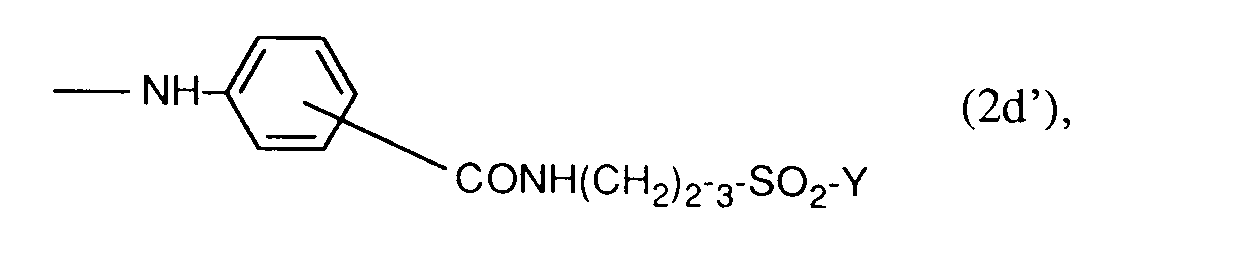
worin Y Vinyl oder β-Sulfatoethyl ist, bedeutet und D einen Rest der zuvor angegebenen Formel (9a) bedeutet. - Eine weitere bevorzugte Ausführungsform der vorliegenden Erfindung betrifft Verbindungen der Formel

worin für D, R, R₁, R₂, X, X₁, Z, n und n₁ jeweils die zuvor angegebenen Bedeutungen und Bevorzugungen gelten. - Eine weitere bevorzugte Ausführungsform der vorliegenden Erfindung betrifft Verbindungen der Formel

worin für D, R, R₁, R₂, X, X₁, Z, n und n₁ jeweils die zuvor angegebenen Bedeutungen und Bevorzugungen gelten. - Die Verbindungen der Formel (1) weisen mindestens zwei und vorzugsweise vier bis acht permanente Sulfo- oder Sulfatogruppen, d.h. Sulfo- oder Sulfatogruppen, welche bei der Reaktion des Reaktivfarbstoffes mit dem Fasermaterial nicht abgespalten werden, auf; diese können jeweils in Form der freien Säure oder vorzugsweise in Salzform, z.B. als Na-, Li-, K- oder Ammoniumsalz, vorliegen. Die Verbindungen der Formel (1) können auch als Mischsalz, z.B. als Na/Li- oder Na/Li/Ammoniumsalz, vorliegen.
- Die Verbindungen der Formel (1) können in an sich bekannter Weise hergestellt werden, z.B. indem man in etwa 1 Aequivalent eines organischen Farbstoffes der Formel
D-NHR₁ (12)
oder ein Farbstoffvorprodukt, in etwa 1 Aequivalent 2,4,6-Trifluor-s-triazin (Cyanurfluorid) oder 2,4,6-Trichlor-s-triazin (Cyanurchlorid), in etwa 1 Aequivalent der Verbindung der Formel
in etwa 1 Aequivalent der Verbindung der Formel
und in etwa 1 Aequivalent einer Verbindung der Formel
worin D, R, R₁, R₂, X, X₁, Z, n und n₁ jeweils die zuvor angegebene Bedeutung haben und Hal Halogen, vorzugsweise Fluor oder Chlor, bedeutet,
durch Diazotierung und Kupplung in beliebiger Reihenfolge miteinander umsetzt, oder, im Fall von Farbstoffvorprodukten, die erhaltenen Zwischenprodukte in die gewünschten Farbstoffe überführt und gegebenenfalls eine weitere Umwandlungsreaktion anschliesst. - Bei der Herstellung der Endfarbstoffe aus Vorprodukten handelt es sich vor allem um Kupplungen, die zu Azofarbstoffen führen.
- Da die einzelnen oben angegebenen Verfahrensschritte in unterschiedlicher Reihenfolge, gegebenenfalls teilweise auch gleichzeitig, ausgeführt werden können, sind verschiedene Verfahrensvarianten möglich. Im allgemeinen führt man die Umsetzung schrittweise nacheinander aus, wobei die Reihenfolge der einfachen Reaktionen zwischen den einzelnen Reaktionskomponenten sich vorteilhafterweise nach den besonderen Bedingungen richtet.
- Dabei hängt es von der Struktur der Ausgangsstoffe ab, welche der möglichen Verfahrensvarianten die besten Resultate ergeben, oder unter welchen speziellen Bedingungen, z.B. bei welcher Kondensationstemperatur, die Reaktion am vorteilhaftesten auszuführen ist. Da unter bestimmten Voraussetzungen Hydrolyse eines Halogentriazinylrestes eintritt, muss ein Zwischenprodukt, welches Acetylaminogruppen enthält, zwecks Abspaltung der Acetylgruppen verseift werden, bevor mit einem Halogentriazin kondensiert wird.
- Eine bevorzugte Variante zur Herstellung der Verbindungen der Formel (1) betrifft die Herstellung einer Verbindung der Formel

worin D, R₁, R₂, X und n jeweils die zuvor angegebene Bedeutung haben, Diazotierung dieser Verbindung und Kupplung mit einer Verbindung der Formel
worin R, X₁, Z und n₁ jeweils die zuvor angegebene Bedeutung haben. - Die Verbindungen der Formeln (16) und (17) sind an sich bekannt oder können nach an sich bekannten Methoden erhalten werden.
- Gegenstand der Erfindung ist ferner ein Verfahren zum Färben und Bedrucken von cellulosehaltigen Fasermaterialien mit den erfindungsgemässen Farbstoffen der Formel 1. Als Fasermaterialien kommen beispielsweise die natürlichen Cellulosefasern, wie Baumwolle, Leinen und Hanf, sowie Zellstoff und regenerierte Cellulose in Betracht. Die Farbstoffe sind auch zum Färben oder Bedrucken von hydroxylgruppenhaltigen Fasern geeignet, die in Mischgeweben enthalten sind, z.B. von Gemischen aus Baumwolle mit Polyamidfasern, oder insbesondere Polyesterfasern.
- Die erfindungsgemässen Farbstoffe lassen sich auf verschiedene Weise auf das Fasermaterial applizieren und auf der Faser fixieren, insbesondere in Form von wässrigen Farbstofflösungen und -druckpasten. Sie eignen sich sowohl für das Ausziehverfahren als auch zum Färben nach dem Foulard-Färbeverfahren, wonach die Ware mit wässrigen, gegebenenfalls salzhaltigen Farbstofflösungen imprägniert wird, und die Farbstoffe nach einer Alkalibehandlung oder in Gegenwart von Alkali, gegebenenfalls unter Wärmeeinwirkung fixiert werden. Nach dem Fixieren werden die Färbungen oder Drucke mit kaltem und heissem Wasser, gegebenenfalls unter Zusatz eines dispergierend wirkenden und die Diffusion der nicht fixierten Anteile fördernden Mittels gründlich gespült. Zum Färben und Bedrucken werden die üblichen Färbe- bzw. Druckverfahren angewendet.
- Die Farbstoffe zeichnen sich durch ein gutes Fixiervermögen und ein sehr gutes Aufbauvermögen aus. Sie können nach dem Ausziehverfahren über einen sehr grossen Temperaturbereich eingesetzt werden und eignen sich deshalb auch sehr gut zum Färben von Baumwolle-Polyester-Mischgeweben nach den für solche Gewebe empfohlenen Bedingungen. Die Fixiergrade sind hoch, und die Differenz zwischen Ausziehgrad und Fixiergrad ist bemerkenswert klein, d.h. der Seifverlust sehr gering. Es ergeben sich gut reproduzierbare, egale Färbungen. Die Farbstoffe der Formel (1) eignen sich auch zum Druck, vor allem auf Baumwolle, ebenso aber auch zum Bedrucken von stickstoffhaltigen Fasern, z.B. von Wolle oder Seide oder von Mischgeweben, die Wolle oder Seide enthalten.
- Die mit den erfindungsgemässen Farbstoffen hergestellten Färbungen und Drucke auf Cellulosefasermaterialien besitzen eine hohe Farbstärke und eine hohe Faser-Farbstoff-Bindungsstabilität, sowohl in saurem als auch in alkalischem Bereich, weiterhin eine gute Lichtechtheit und sehr gute Nassechtheitseigenschaften, wie Wasch-, Wasser-, Seewasser-, Ueberfärbe- und Schweissechtheiten, sowie eine gute Plissierechtheit, Bügelechtheit und Reibechtheit und eine sehr gute Chlorbadewasserechtheit.
- Die Farbstoffe der Formel (1) liegen entweder in der Form ihrer freien Sulfonsäure oder vorzugsweise als deren Salze wie z.B. der Alkali-, Erdalkali- oder Ammoniumsalze oder als Salze eines organischen Amins vor. Als Beispiele seien die Natrium-, Lithium- oder Ammoniumsalze, das Salz des Triäthanolamins oder auch Mischsalze, z.B. Na/Li oder Na/NH₄/Li, genannt.
- Die nachfolgenden Beispiele dienen zur Erläuterung der Erfindung. Die Temperaturen sind in Celsiusgraden angegeben, Teile sind Gewichtsteile, die Prozentangaben beziehen sich auf Gewichtsprozente, sofern nicht anders vermerkt.
- Zu einer neutralen Lösung von 53 Teilen 7-(2-Acetylamino-4-aminophenyl-azo)-naphthalin-1,3,6-trisulfonsäure und 5 Teilen Dinatriumhydrogenphosphat in 500 Teilen Wasser werden bei einer Temperatur von ca. 0-2°C 14 Teile Cyanurfluorid getropft und dabei der pH-Wert durch Zugabe von Natriumhydroxidlösung konstant gehalten. Nach beendeter Reaktion gibt man eine neutrale Lösung von 19 Teilen 1,3-Diaminobenzol-4-sulfonsäure in 100 Teilen Wasser zu, hält den pH-Wert durch Zugabe von Natriumhydroxidlösung bei 5,5 und lässt auf Raumtemperatur erwärmen. Die erhaltene Lösung wird auf ca. 0°C gekühlt, mit 25 Teilen 32%ige Salzsäure und 7 Teilen Natriumnitrit versetzt und ca. 1 Stunde gerührt. Man zerstört dann überflüssiges Nitrit mit wenig Sulfaminsäure und tropft die erhaltene Suspension des Diazoniumsalzes in eine neutrale, kalte, wässrige Lösung von 53 Teilen 1-(4-N-Ethyl-N-phenylamino-6-fluor-[1,3,5]-triazin-2-yl-amino)-8-hydroxynaphthalin-3,6-disulfonsäure, wobei man den pH-Wert durch Zugabe von Natriumhydroxidlösung konstant hält. Man lässt auf Raumtemperatur erwärmen, befreit die Lösung dialytisch von Salz und dampft den Farbstoff der Formel

ein. Das erhaltene Pulver färbt Cellulose in einer brillanten orangen Nuance mit guten Allgemeinechtheiten. - Zu einer neutralen Lösung von 32 Teilen 1-Amino-8-hydroxynaphthalin-3,6-disulfonsäure und 5 Teilen Dinatriumhydrogenphosphat in 500 Teilen Wasser werden bei einer Temperatur von ca. 0-2°C 14 Teile Cyanurfluorid getropft und dabei der pH-Wert durch Zugabe von Natriumhydroxidlösung konstant gehalten. Nach beendeter Reaktion gibt man eine neutrale Lösung von 19 Teilen 1,3-Diaminobenzol-4-sulfonsäure in 100 Teilen Wasser zu, hält den pH-Wert durch Zugabe von Natriumhydroxidlösung bei 5,5 und lässt auf Raumtemperatur erwärmen (Lösung 1).
- In eine neutrale Lösung von 30 Teilen 2-Aminonaphthalin-1,5-disulfonsäure in 300 ml Wasser gibt man bei ca. 0°C 25 Teile 32%ige Salzsäure und 7 Teile Natriumnitrit und lässt ca. 1 Stunde rühren. Man zerstört dann überflüssiges Nitrit mit wenig Sulfaminsäure und tropft die erhaltene Suspension des Diazoniumsalzes in die gekühlte Lösung 1, wobei man den pH-Wert durch Zugabe von Natriumhydroxidlösung konstant hält (Lösung 2).
- Die kalte Lösung 2 wird mit 25 Teilen 32%ige Salzsäure und 7 Teilen Natriumnitrit versetzt und ca. 1 Stunde rühren gelassen. Nach Zerstörung des Nitritüberschusses mit Sulfaminsäure tropft man die Suspension des Diazoniumsalzes in eine gekühlte wässrige Lösung von 53 Teilen 1-(4-N-Methyl-N-phenylamino-6-fluor-[1,3,5]-triazin-2-yl-amino)-8-hydroxynaphthalin-3,6-disulfonsäure, wobei man den pH-Wert durch Zugabe von Natriumhydroxidlösung konstant hält. Man lässt auf Raumtemperatur erwärmen, befreit die Lösung dialytisch von Salz und dampft den Farbstoff der Formel

ein. Das erhaltene Pulver färbt Cellulose in einer brillanten roten Nuance mit guten Allgemeinechtheiten. - Analog wie in den Beispielen 1 und 2 beschrieben lassen sich die Verbindungen der allgemeinen Formel

worin A und A₁ die in der folgenden Tabelle genannten Bedeutungen haben, herstellen, welche Baumwolle jeweils in einer roten Nuance mit guten Allgemeinechtheiten färben.








- Analog wie in den Beispielen 1 und 2 beschrieben lassen sich die Verbindungen der allgemeinen Formel

worin A und A₁ die in der folgenden Tabelle genannten Bedeutungen haben, herstellen, welche Baumwolle jeweils in einer roten Nuance mit guten Allgemeinechtheiten färben.


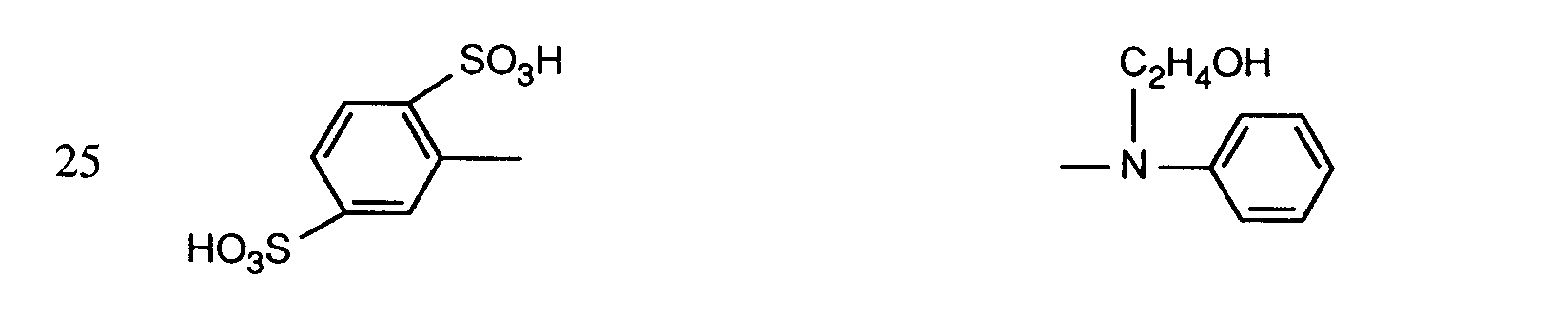





- Analog wie in den Beispielen 1 und 2 beschrieben lassen sich die Verbindungen der allgemeinen Formel

worin A und A₁ die in der folgenden Tabelle genannten Bedeutungen haben, herstellen, welche Baumwolle jeweils in einer roten Nuance mit guten Allgemeinechtheiten färben.




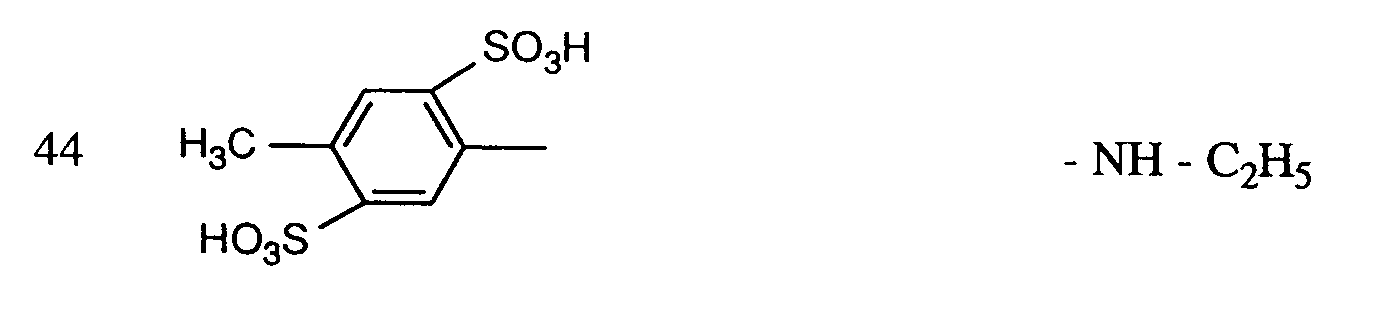


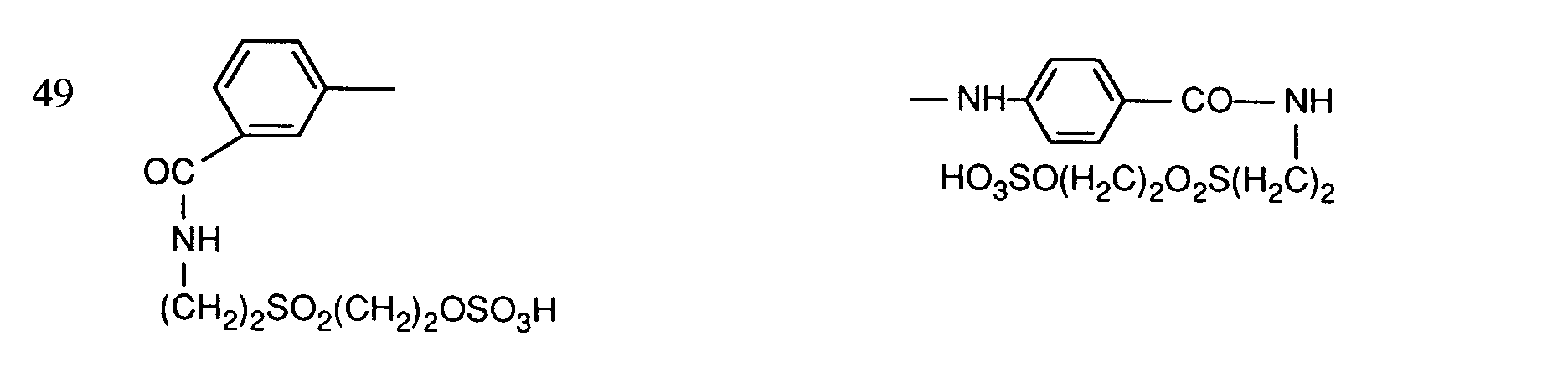



- Analog wie in den Beispielen 1 und 2 beschrieben lassen sich die Verbindungen der allgemeinen Formel

worin A und A₁ die in der folgenden Tabelle genannten Bedeutungen haben, herstellen, welche Baumwolle jeweils in einer roten Nuance mit guten Allgemeinechtheiten färben.


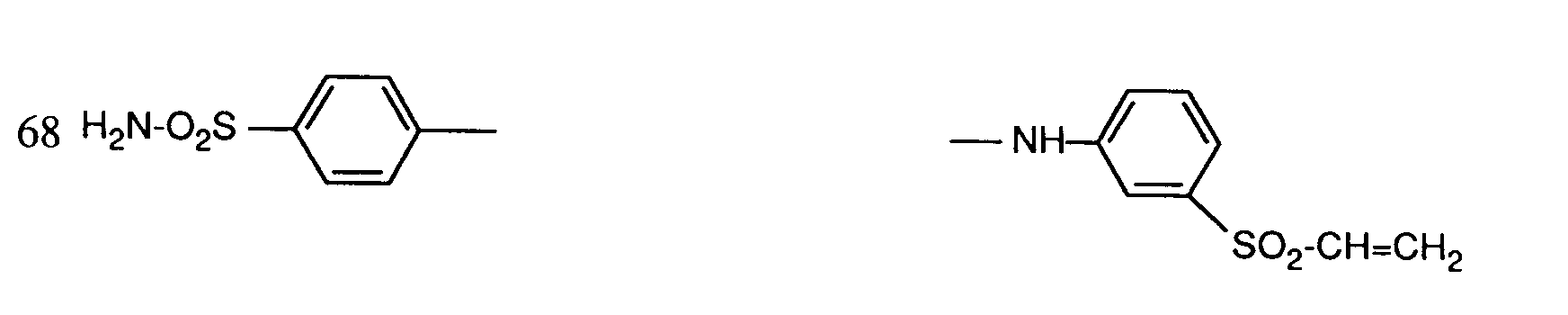


- Analog wie in den Beispielen 1 und 2 beschrieben lassen sich die Verbindungen der allgemeinen Formel

worin A und A₁ die in der folgenden Tabelle genannten Bedeutungen haben, herstellen, welche Baumwolle jeweils in einer roten Nuance mit guten Allgemeinechtheiten färben.





- Analog wie in den Beispielen 1 und 2 beschrieben lassen sich die Verbindungen der allgemeinen Formel

worin A₁, B, X und X₁ die in der folgenden Tabelle genannten Bedeutungen haben, herstellen, welche Baumwolle jeweils mit guten Allgemeinechtheiten färben.

- Analog wie in den Beispielen 1 und 2 beschrieben lassen sich die Verbindungen der allgemeinen Formel
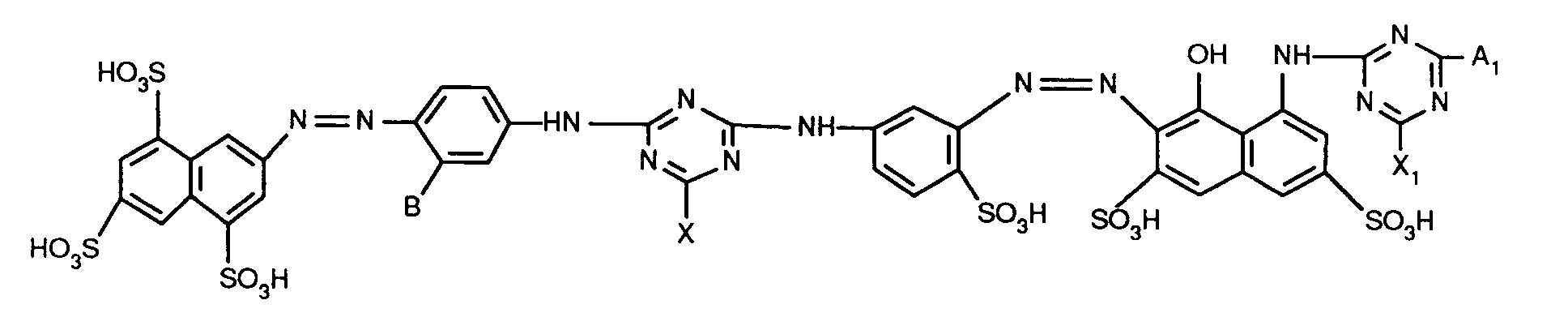
worin A₁, B, X und X₁ die in der folgenden Tabelle genannten Bedeutungen haben, herstellen, welche Baumwolle jeweils mit guten Allgemeinechtheiten färben.

- Analog wie in den Beispielen 1 und 2 beschrieben lassen sich die Verbindungen der allgemeinen Formel

worin A₁, B, X und X₁ die in der folgenden Tabelle genannten Bedeutungen haben, herstellen, welche Baumwolle jeweils mit guten Allgemeinechtheiten färben.
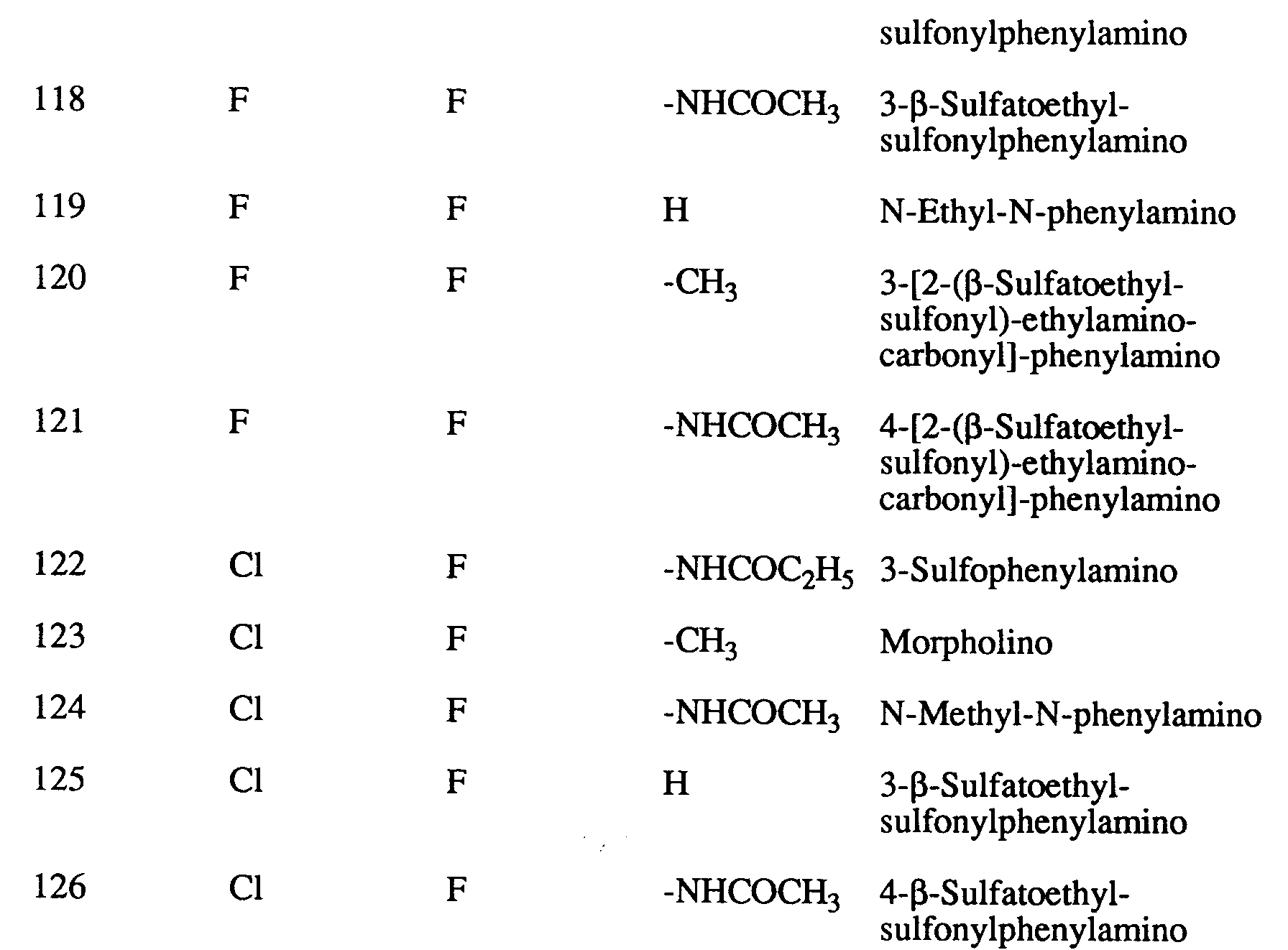
- Analog wie in den Beispielen 1 und 2 beschrieben lassen sich die Verbindungen der allgemeinen Formel

worin A₁, B, B₁, X und X₁ die in der folgenden Tabelle genannten Bedeutungen haben, herstellen, welche Baumwolle jeweils mit guten Allgemeinechtheiten färben.
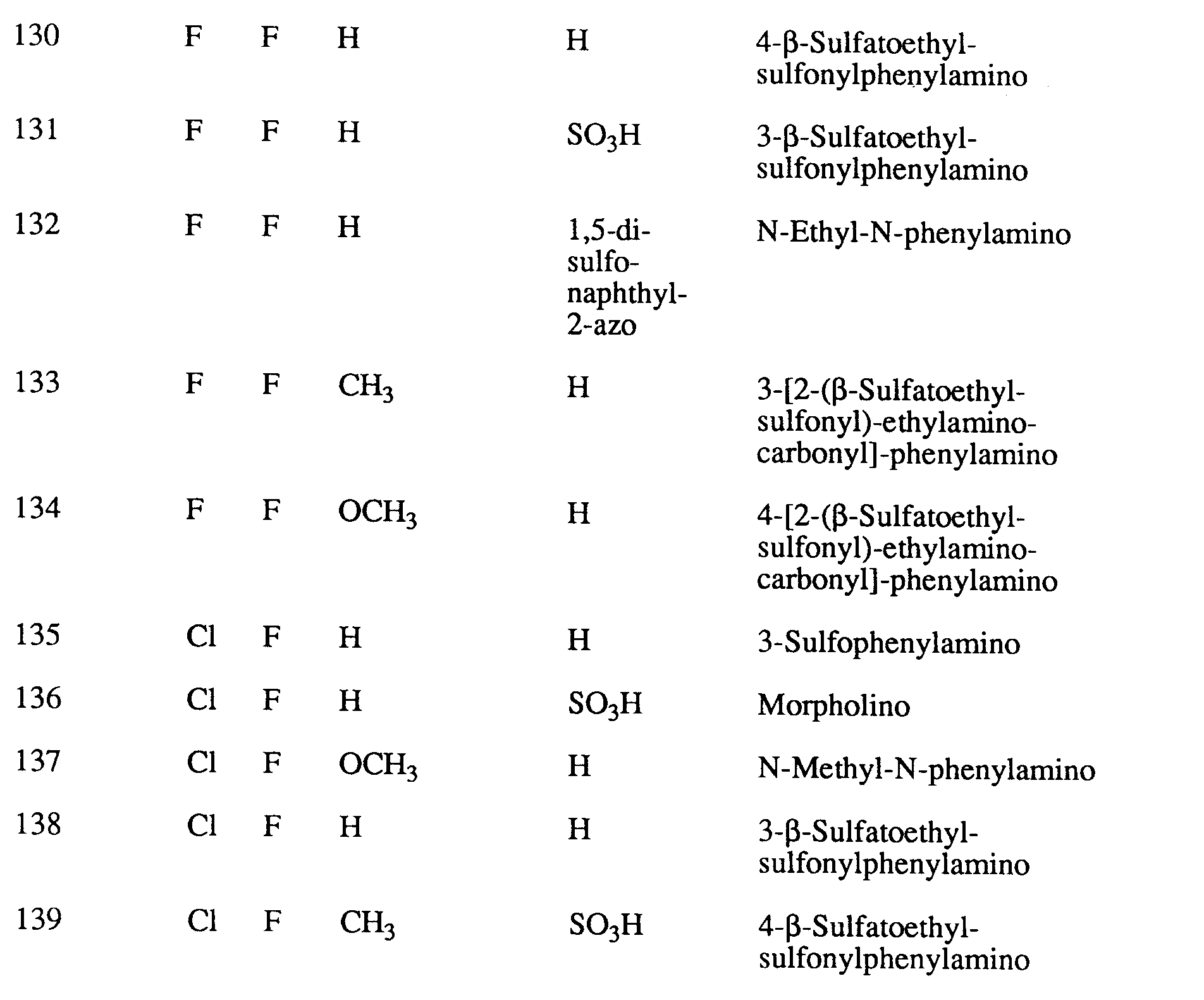
- Analog wie in den Beispielen 1 und 2 beschrieben lassen sich die Verbindungen der allgemeinen Formel

worin A, A₁, X und X₁ die in der Tabelle angegebenen Bedeutungen haben, herstellen, welche Baumwolle jeweils mit guten Allgemeinechtheiten färben.Beispiel X X₁ A A₁ Nr. 139a Cl F 2-Sulfophenyl N-Methyl-N-phenylamino 139b Cl F 1,5-Disulfo-2-naphthyl N-Methyl-N-phenylamino 139c Cl F 1-Sulfo-2-naphthyl N-Methyl-N-phenylamino 139d Cl Cl 4-Sulfatoethylsulfonylphenyl 3-Sulfophenylamino 139e Cl Morpholino 4-Sulfatoethylsulfonylphenyl Morpholino - 2 Teile Farbstoff gemäss Beispiel 1 werden in 400 Teilen Wasser gelöst; dazu gibt man 1500 Teile einer Lösung, die pro Liter 53 g Natriumchlorid enthält. In dieses Färbebad geht man bei 40°C mit 100 Teilen eines Baumwollgewebes ein. Nach 45 Minuten werden 100 Teile einer Lösung, die pro Liter 16 g Natriumhydroxyd und 20 g wasserfreies Na₂CO₃ enthält, zugegeben. Die Temperatur des Färbebades wird weitere 45 Minuten bei 40°C gehalten. Danach wird die orange gefärbte Ware gespült, während einer Viertelstunde mit einem nichtionogenen Waschmittel kochend geseift, nochmals gespült und getrocknet. Die erhaltene Ware zeichnet sich durch sehr gute Echtheiten aus.
- 2 Teile des gemäss Beispiel 1 erhaltenen Farbstoffes werden in 400 Teilen Wasser gelöst; dazu gibt man 1500 Teile einer Lösung, die pro Liter 53 g Natriumchlorid enthält. In dieses Färbebad geht man bei 35°C mit 100 Teilen eines Baumwollgewebes ein. Nach 20 Minuten werden 100 Teile einer Lösung, die pro Liter 16 g Natriumhydroxyd und 20 g wasserfreies Na₂CO₃ enthält, zugegeben. Die Temperatur des Färbebades wird weitere 15 Minuten bei 35°C gehalten. Danach wird die Temperatur innerhalb von 20 Minuten auf 60°C erhöht. Die Temperatur wird weitere 35 Minuten bei 60°C gehalten. Danach wird die orange gefärbte Ware gespült, während einer Viertelstunde mit einem nichtionogenen Waschmittel kochend geseift, nochmals gespült und getrocknet. Die erhaltene Ware zeichnet sich durch sehr gute Echtheiten aus.
- 8 Teile des gemäss Beispiel 1 erhaltenen Farbstoffes werden in 400 Teilen Wasser gelöst; dazu gibt man 1400 Teile einer Lösung, die pro Liter 100 g Natriumsulfat enthält. In dieses Färbebad geht man bei 25°C mit 100 Teilen eines Baumwollgewebes ein. Nach 10 Minuten werden 200 Teile einer Lösung, die pro Liter 150 g Trinatriumphosphat enthält, zugegeben. Danach wird die Temperatur des Färbebades innerhalb 10 Minuten auf 60°C erhöht. Die Temperatur wird weitere 90 Minuten auf 60°C gehalten. Danach wird die orange gefärbte Ware gespült, während einer Viertelstunde mit einem nicht-ionogenen Waschmittel kochend geseift, nochmals gespült und getrocknet. Die erhaltene Ware zeichnet sich durch sehr gute Echtheiten aus.
- 4 Teile des gemäss Beispiel 1 erhaltenen Farbstoffes werden in 50 Teilen Wasser gelöst. Dazu gibt man 50 Teile einer Lösung, die pro Liter 5 g Natriumhydroxyd und 20 g wasserfreies Na₂CO₃ enthält. Mit der erhaltenen Lösung wird ein Baumwollgewebe foulardiert, so dass es um 70 % seines Gewichtes zunimmt, und dann auf eine Kaule aufgewickelt. Das Baumwollgewebe wird so während 3 Stunden bei Raumtemperatur gelagert. Danach wird die marineblau gefärbte Ware gespült, während einer Viertelstunde mit einem nichtionogenen Waschmittel kochend geseift, nochmals gespült und getrocknet. Die erhaltene Ware zeichnet sich durch sehr gute Echtheiten aus.
- 6 Teile des gemäss Beispiel 1 erhaltenen Farbstoffes werden in 50 Teilen Wasser gelöst. Dazu gibt man 50 Teile einer Lösung, die pro Liter 16 g Natriumhydroxyd und 0,04 Liter Wasserglas (38°Bé) enthält. Mit der erhaltenen Lösung wird ein Baumwollgewebe foulardiert, so dass es um 70 % seines Gewichtes zunimmt, und dann auf eine Kaule aufgewickelt. Das Baumwollgewebe wird so während 10 Stunden bei Raumtemperatur gelagert. Danach wird die orange gefärbte Ware gespült, während einer Viertelstunde mit einem nichtionogenen Waschmittel kochend geseift, nochmals gespült und getrocknet. Die erhaltene Ware zeichnet sich durch sehr gute Echtheiten aus.
- 2 Teile des gemäss Beispiel 1 erhaltenen Farbstoffes werden unter Zusatz von 0,5 Teilen m-nitrobenzolsulfonsaurem Natrium in 100 Teilen Wasser gelöst. Mit der erhaltenen Lösung wird ein Baumwollgewebe imprägniert, so dass es um 75 % seines Gewichtes zunimmt, und dann getrocknet. Dann imprägniert man das Gewebe mit einer 20°C warmen Lösung, die pro Liter 4 g Natriumhydroxyd und 300 g Natriumchlorid enthält, quetscht auf 75 % Gewichtszunahme ab, dämpft die orange Färbung während 30 Sekunden bei 100 bis 102°C, spült, seift während einer Viertelstunde in einer 0,3%igen kochenden Lösung eines nichtionogenen Waschmittels, spült und trocknet. Die erhaltene Ware zeichnet sich durch sehr gute Echtheiten aus.
- 3 Teile des gemäss Beispiele 1 erhaltenen Farbstoffes werden unter schnellem Rühren in 100 Teile einer Stammverdickung, enthaltend 50 Teile 5%ige Natriumalginatverdickung, 27,8 Teile Wasser, 20 Teile Harnstoff, 1 Teil m-nitrobenzolsulfonsaures Natrium sowie 1,2 Teile Natriumhydrogencarbonat, eingestreut. Mit der so erhaltenen Druckpaste bedruckt man ein Baumwollgewebe, trocknet und dämpft den erhaltenen bedruckten Stoff 2 Minuten bei 102°C in gesättigtem Dampf. Das orange bedruckte Gewebe wird dann gespült, gegebenenfalls kochend geseift und nochmals gespült, und anschliessend getrocknet. Die erhaltene Ware zeichnet sich durch sehr gute Echtheiten aus.
- 5 Teile des gemäss Beispiel 1 erhaltenen Farbstoffes werden unter schnellem Rühren in 100 Teile einer Stammverdickung, enthaltend 50 Teile 5%ige Natriumalginatverdickung, 36,5 Teile Wasser, 10 Teile Harnstoff, 1 Teil m-nitrobenzolsulfonsaures Natrium sowie 2,5 Teile Natriumhydrogencarbonat, eingestreut. Mit der so erhaltenen Druckpaste, deren Stabilität den technischen Anforderungen entspricht, bedruckt man ein Baumwollgewebe, trocknet und dämpft den erhaltenen orange bedruckten Stoff 8 Minuten bei 102°C in gesättigtem Dampf. Das bedruckte Gewebe wird dann gespült, gegebenenfalls kochend geseift und nochmals gespült, und anschliessend getrocknet. Die erhaltene Ware zeichnet sich durch sehr gute Echtheiten aus.
Claims (16)
- Reaktivfarbstoffe der Formel

D der Rest eines Monoazo-, Polyazo-, Metallkomplexazo-, Anthrachinon-, Phthalocyanin-, Formazan- oder Dioxazinchromophors ist,
R, R₁ und R₂ unabhängig voneinander je Wasserstoff oder gegebenenfalls durch Halogen, Hydroxy, Cyano, C₁-C₄-Alkoxy, C₁-C₄-Alkoxycarbonyl, Carboxy, Sulfamoyl, Sulfo oder Sulfato substituiertes C₁-C₄-Alkyl bedeuten,
X für Chlor, Fluor, Brom, 3-Carboxypyridin-1-yl oder 3-Carbamoylpyridin-1-yl steht,
X₁ und Z unabhängig voneinander je eine der für X genannten Bedeutungen haben oder für Hydroxy, C₁-C₄-Alkoxy, Phenoxy, C₁-C₄-Alkylthio, Morpholino, gegebenenfalls durch nicht-reaktive Reste substituiertes Amino oder für einen Reaktivrest der Formel


R₆ Wasserstoff, gegebenenfalls durch Hydroxy, Sulfo, Sulfato, Carboxy oder Cyano substituiertes C₁-C₄-Alkyl oder einen Rest
R₇ für Wasserstoff oder C₁-C₄-Alkyl steht,
R₈ Wasserstoff, Hydroxy, Sulfo, Sulfato, Carboxy, Cyano, Halogen,
C₁-C₄-Alkoxycarbonyl, C₁-C₄-Alkanoyloxy, Carbamoyl oder die Gruppe -SO₂-Y ist, alk und alk' unabhängig voneinander C₁-C₆-Alkylen sind,
arylen einen unsubstituierten oder durch Sulfo, Carboxy, C₁-C₄-Alkyl, C₁-C₄-Alkoxy oder Halogen substituierten Phenylen- oder Naphthylenrest bedeutet
Y Vinyl oder ein Rest -CH₂-CH₂-U und U eine Abgangsgruppe ist,
Y₁ für eine Gruppe -CHX₂-CH₂X₂ oder -CX₂=CH₂ steht und X₂ Chlor oder Brom bedeutet,
B den Rest -O- oder -NR₇- bedeutet,
W für eine Gruppe -SO₂-NR₆-, -CONR₆- oder -NR₆CO- steht, und
m die Zahl 0 oder 1, n die Zahl 1 oder 2 und n₁ die Zahl 0 oder 1 bedeuten. - Reaktivfarbstoffe gemäss Anspruch 1, dadurch gekennzeichnet, dass R, R₁ und R₂ unabhängig voneinander je Wasserstoff, Methyl oder Ethyl bedeuten.
- Reaktivfarbstoffe gemäss Anspruch 1 oder 2, dadurch gekennzeichnet, dass X Chlor oder Fluor und X₁ Chlor, Fluor, Amino, N-C₁-C₄-Alkylamino, das im Alkylteil unsubstituiert oder durch Hydroxy, Sulfato oder Sulfo substituiert ist, Morpholino oder für Phenylamino oder N-C₁-C₄-Alkyl-N-phenylamino, worin das Phenyl jeweils unsubstituiert oder durch Sulfo, Carboxy, Acetylamino, Methyl oder Methoxy substituiert ist, bedeuten.
- Reaktivfarbstoffe gemäss Anspruch 1 der Formel (1), worin X₁ Chlor, Fluor, Brom, 3-Carboxypyridin-1-yl oder 3-Carbamoylpyridin-1-yl bedeutet.
- Reaktivfarbstoffe gemäss einem der Ansprüche 1 bis 4, dadurch gekennzeichnet, dass D für den Rest eines Monoazo- oder Disazochromophors steht.
- Reaktivfarbstoffe gemäss einem der Ansprüche 1 bis 5, dadurch gekennzeichnet, dass D für einen Monoazochromophor der Formel


- Reaktivfarbstoffe gemäss einem der Ansprüche 1 bis 6, dadurch gekennzeichnet, dass Z Amino, N-C₁-C₄-Alkylamino oder N,N-Di-C₁-C₄-Alkylamino, wobei das Alkyl gegebenenfalls durch Sulfo, Sulfato, Hydroxy, Carboxy oder Phenyl substituiert ist, Cyclohexylamino, N-C₁-C₄-Alkyl-N-phenylamino oder Phenylamino oder Naphthylamino, wobei das Phenyl oder Naphthyl gegebenenfalls durch C₁-C₄-Alkyl, C₁-C₄-Alkoxy, C₂-C₄-Alkanoylamino, Carboxy, Sulfo oder Halogen substituiert ist, bedeutet.
- Reaktivfarbstoffe gemäss einem der Ansprüche 1 bis 6, dadurch gekennzeichnet, dass Z ein Reaktivrest der Formel (2a) bis (2f) ist, worin W eine Gruppe der Formel -CONH- oder -NHCO-, R₆, R₇ und R₈ je Wasserstoff, B der Rest -O- oder -NH- , alk und alk' unabhängig voneinander je Ethylen oder Propylen, arylen unsubstituiertes oder durch Methyl, Methoxy, Carboxy oder Sulfo substituiertes Phenylen, Y Vinyl oder β-Sulfatoethyl, Y₁ -CHBr-CH₂Br oder -CBr=CH₂ und m die Zahl 0 bedeuten.
- Reaktivfarbstoffe gemäss einem der Ansprüche 1 bis 6 oder 8, dadurch gekennzeichnet, dass Z einen faserreaktiven Rest der Formel


- Reaktivfarbstoffe gemäss einem der Ansprüche 1 bis 6, dadurch gekennzeichnet, dass Z Amino, N-C₁-C₄-Alkylamino, das im Alkylteil unsubstituiert oder durch Hydroxy, Sulfato oder Sulfo substituiert ist, Morpholino, Phenylamino oder N-C₁-C₄-Alkyl-N-phenylamino, worin das Phenyl jeweils unsubstituiert oder durch Sulfo, Carboxy, Acetylamino, Methyl oder Methoxy substituiert ist, oder einen faserreaktiven Rest der Formel


- Reaktivfarbstoffe gemäss einem der Ansprüche 1 bis 10 der Formel

- Reaktivfarbstoffe gemäss Anspruch 11 der Formel (1a), dadurch gekennzeichnet, dass R₁ und R₂ unabhängig voneinander je Wasserstoff, Methyl oder Ethyl bedeuten, n für die Zahl 1 steht, X Fluor oder Chlor ist, X₁ Fluor, Chlor, Amino, N-C₁-C₄-Alkylamino, das im Alkylteil unsubstituiert oder durch Hydroxy, Sulfato oder Sulfo substituiert ist, Morpholino oder für Phenylamino oder N-C₁-C₄-Alkyl-N-phenylamino, worin das Phenyl jeweils unsubstituiert oder durch Sulfo, Carboxy, Acetylamino, Methyl oder Methoxy substituiert ist, bedeutet, Z C₁-C₄-Alkoxy, C₁-C₄-Alkylthio, Hydroxy, Amino, N-C₁-C₄-Alkylamino, das im Alkylteil unsubstituiert oder durch Hydroxy, Sulfato oder Sulfo substituiert ist, Morpholino, Phenylamino oder N-C₁-C₄-Alkyl-N-phenylamino, worin das Phenyl jeweils unsubstituiert oder durch Sulfo, Carboxy, Acetylamino, Methyl oder Methoxy substituiert ist, oder einen Reaktivrest der im Anspruch 1 angegebenen Formeln (2a) bis (2f), worin W eine Gruppe der Formel -CONH- oder -NHCO-, R₆, R₇ und R₈ je Wasserstoff, B der Rest -O- oder -NH-, alk und alk' unabhängig voneinander je Ethylen oder Propylen, arylen unsubstituiertes oder durch Methyl, Methoxy, Carboxy oder Sulfo substituiertes Phenylen, Y Vinyl oder β-Sulfatoethyl, Y₁ -CHBr-CH₂Br oder -CBr=CH₂ und m die Zahl 0 sind, ist und D einen Rest der im Anspruch 6 angegebenen Formel (9) bedeutet.
- Reaktivfarbstoffe gemäss Anspruch 11 der Formel (1a), dadurch gekennzeichnet, dass R₁ und R₂ je Wasserstoff bedeuten, n für die Zahl 1 steht, X Fluor oder Chlor ist, X₁ Fluor, Chlor oder Morpholino bedeutet, Z Amino, N-C₁-C₄-Alkylamino, das im Alkylteil unsubstituiert oder durch Hydroxy, Sulfato oder Sulfo substituiert ist, Morpholino, Phenylamino oder N-C₁-C₄-Alkyl-N-phenylamino, worin das Phenyl jeweils unsubstituiert oder durch Sulfo, Carboxy, Acetylamino, Methyl oder Methoxy substituiert ist, oder einen faserreaktiven Rest der Formel


- Verfahren zur Herstellung von Verbindungen der Formel (1) gemäss Anspruch 1, dadurch gekennzeichnet, dass man in etwa 1 Aequivalent eines organischen Farbstoffes der Formel
D-NHR₁ (12)
oder ein Farbstoffvorprodukt, in etwa 1 Aequivalent 2,4,6-Trifluor-s-triazin (Cyanurfluorid) oder 2,4,6-Trichlor-s-triazin (Cyanurchlorid), in etwa 1 Aequivalent der Verbindung der Formel


- Verfahren zum Färben oder Bedrucken von cellulosehaltigen Fasermaterialien, dadurch gekennzeichnet, dass man diese Materialien in Gegenwart eines oder mehrerer Reaktivfarbstoffe der Formel (1) gemäss Anspruch 1 färbt.
- Verfahren gemäss Anspruch 15 zum Färben von Baumwolle.
Applications Claiming Priority (3)
| Application Number | Priority Date | Filing Date | Title |
|---|---|---|---|
| CH2599/93 | 1993-09-01 | ||
| CH259993 | 1993-09-01 | ||
| CH259993 | 1993-09-01 |
Publications (3)
| Publication Number | Publication Date |
|---|---|
| EP0641839A2 true EP0641839A2 (de) | 1995-03-08 |
| EP0641839A3 EP0641839A3 (de) | 1995-04-05 |
| EP0641839B1 EP0641839B1 (de) | 2000-05-24 |
Family
ID=4237387
Family Applications (1)
| Application Number | Title | Priority Date | Filing Date |
|---|---|---|---|
| EP94810480A Expired - Lifetime EP0641839B1 (de) | 1993-09-01 | 1994-08-22 | Faserreaktive Farbstoffe, deren Herstellung und Verwendung |
Country Status (11)
| Country | Link |
|---|---|
| US (1) | US5599911A (de) |
| EP (1) | EP0641839B1 (de) |
| JP (1) | JP3754712B2 (de) |
| KR (1) | KR950008625A (de) |
| CN (1) | CN1066176C (de) |
| DE (1) | DE59409374D1 (de) |
| ES (1) | ES2147225T3 (de) |
| MY (1) | MY123670A (de) |
| PT (1) | PT641839E (de) |
| SG (1) | SG49611A1 (de) |
| TW (1) | TW293027B (de) |
Cited By (1)
| Publication number | Priority date | Publication date | Assignee | Title |
|---|---|---|---|---|
| WO2008017615A3 (en) * | 2006-08-11 | 2008-11-27 | Huntsman Adv Mat Switzerland | Red reactive dyes, their preparation and their use |
Families Citing this family (3)
| Publication number | Priority date | Publication date | Assignee | Title |
|---|---|---|---|---|
| JPH09324130A (ja) * | 1996-06-05 | 1997-12-16 | Sumitomo Chem Co Ltd | モノアゾ化合物及びそれを用いる繊維材料の染色又は捺染方法 |
| CN109294273B (zh) * | 2018-08-30 | 2021-03-19 | 东华大学 | 一类基于铜酞菁发色体的翠蓝色印花用活性染料及其制备方法和应用 |
| CN109021614B (zh) * | 2018-08-30 | 2021-03-19 | 东华大学 | 一类高固色率酞菁偶氮基双发色体活性染料及其制备方法和应用 |
Family Cites Families (9)
| Publication number | Priority date | Publication date | Assignee | Title |
|---|---|---|---|---|
| US3362948A (en) * | 1961-05-19 | 1968-01-09 | Ici Ltd | Monoazo dyestuffs containing both triazine and pyrimidine groups |
| US3349074A (en) * | 1962-12-19 | 1967-10-24 | Ici Ltd | Water-soluble azo dyestuffs |
| GB1063501A (en) * | 1962-12-19 | 1967-03-30 | Ici Ltd | New water-soluble reactive azo dyestuffs |
| GB1067152A (en) * | 1963-01-18 | 1967-05-03 | Ici Ltd | New reactive metallised azo dyes |
| DE3440777C2 (de) * | 1983-11-14 | 1998-09-03 | Clariant Finance Bvi Ltd | Neue sulfonsäuregruppenhaltige, basische Azoverbindungen, deren Herstellung und Verwendung als Farbstoffe |
| JPH0635554B2 (ja) * | 1985-07-04 | 1994-05-11 | 三菱化成株式会社 | ジスアゾ染料 |
| EP0302006B1 (de) * | 1987-07-03 | 1992-02-05 | Ciba-Geigy Ag | Reaktivfarbstoffe, Verfahren zu deren Herstellung und deren Verwendung |
| DE4113838A1 (de) * | 1991-04-27 | 1992-10-29 | Basf Ag | Azofarbstoffe mit mehreren reaktiven ankergruppen |
| DE59407983D1 (de) * | 1993-05-14 | 1999-04-29 | Ciba Geigy Ag | Faserreaktive Farbstoffe, ihre Herstellung und Verwendung |
-
1994
- 1994-08-02 TW TW083107046A patent/TW293027B/zh active
- 1994-08-05 MY MYPI94002040A patent/MY123670A/en unknown
- 1994-08-22 ES ES94810480T patent/ES2147225T3/es not_active Expired - Lifetime
- 1994-08-22 EP EP94810480A patent/EP0641839B1/de not_active Expired - Lifetime
- 1994-08-22 PT PT94810480T patent/PT641839E/pt unknown
- 1994-08-22 SG SG1996001005A patent/SG49611A1/en unknown
- 1994-08-22 DE DE59409374T patent/DE59409374D1/de not_active Expired - Lifetime
- 1994-08-25 US US08/296,206 patent/US5599911A/en not_active Expired - Lifetime
- 1994-08-30 JP JP20523694A patent/JP3754712B2/ja not_active Expired - Fee Related
- 1994-08-31 CN CN94115632A patent/CN1066176C/zh not_active Expired - Fee Related
- 1994-08-31 KR KR1019940021731A patent/KR950008625A/ko not_active Withdrawn
Cited By (2)
| Publication number | Priority date | Publication date | Assignee | Title |
|---|---|---|---|---|
| WO2008017615A3 (en) * | 2006-08-11 | 2008-11-27 | Huntsman Adv Mat Switzerland | Red reactive dyes, their preparation and their use |
| US8066809B2 (en) | 2006-08-11 | 2011-11-29 | Huntsman International Llc | Red reactive dyes, their preparation and their use |
Also Published As
| Publication number | Publication date |
|---|---|
| TW293027B (de) | 1996-12-11 |
| JPH0782502A (ja) | 1995-03-28 |
| DE59409374D1 (de) | 2000-06-29 |
| HK1005555A1 (en) | 1999-01-15 |
| SG49611A1 (en) | 2000-11-21 |
| EP0641839A3 (de) | 1995-04-05 |
| CN1066176C (zh) | 2001-05-23 |
| CN1103084A (zh) | 1995-05-31 |
| JP3754712B2 (ja) | 2006-03-15 |
| PT641839E (pt) | 2000-11-30 |
| MY123670A (en) | 2006-05-31 |
| KR950008625A (ko) | 1995-04-19 |
| ES2147225T3 (es) | 2000-09-01 |
| EP0641839B1 (de) | 2000-05-24 |
| US5599911A (en) | 1997-02-04 |
Similar Documents
| Publication | Publication Date | Title |
|---|---|---|
| EP1137716B1 (de) | Reaktivfarbstoffe, mischungen von reaktivfarbstoffen, deren herstellung und deren verwendung | |
| EP0625549B1 (de) | Reaktivfarbstoffe, Verfahren zu deren Herstellung und deren Verwendung | |
| EP0626429B1 (de) | Faserreaktive Farbstoffe, ihre Herstellung und Verwendung | |
| EP0623655B1 (de) | Faserreaktive Farbstoffe, ihre Herstellung und Verwendung | |
| EP0114032B1 (de) | Reaktivfarbstoffe, deren Herstellung und Verwendung | |
| EP0647683A1 (de) | Reaktivfarbstoffe, Verfahren zu deren Herstellung und deren Verwendung | |
| EP0716130B1 (de) | Reaktivfarbstoffe, deren Herstellung und Verwendung | |
| EP0764694B1 (de) | Reaktivfarbstoffe, ihre Herstellung und Verwendung | |
| EP0625551B1 (de) | Farbstoffmischungen, Verfahren zu deren Herstellung und deren Verwendung | |
| EP0803543B1 (de) | Faserreaktive Farbstoffe, ihre Herstellung und Verwendung | |
| EP0755985B1 (de) | Farbstoffmischungen, Verfahren zu ihrer Herstellung und ihre Verwendung | |
| EP0748850B1 (de) | Farbstoffe, Verfahren zu deren Herstellung und deren Verwendung | |
| EP0776947B1 (de) | Faserreaktive Farbstoffe, ihre Herstellung und Verwendung | |
| EP0761768B1 (de) | Reaktivfarbstoffe, Verfahren zu deren Herstellung und deren Verwendung | |
| EP0712905B1 (de) | Reaktivfarbstoffe, ihre Herstellung und Verwendung | |
| EP0641839B1 (de) | Faserreaktive Farbstoffe, deren Herstellung und Verwendung | |
| EP0305021A2 (de) | Reaktive Monoazofarbstoffe, deren Herstellung und Verwendung | |
| EP0812886B1 (de) | Reaktivfarbstoffe, ihre Herstellung und Verwendung | |
| EP0581729B1 (de) | Reaktivfarbstoffe, Verfahren zu deren Herstellung und deren Verwendung | |
| EP0581731B1 (de) | Reaktivfarbstoffe, Verfahren zu deren Herstellung und deren Verwendung | |
| EP0581732B1 (de) | Farbstoffmischungen, Verfahren zu deren Herstellung und deren Verwendung | |
| EP0581733B1 (de) | Reaktivfarbstoffe, Verfahren zu deren Herstellung und deren Verwendung | |
| EP0688832A2 (de) | Reaktivfarbstoffe, ihre Herstellung und Verwendung | |
| EP1095105B1 (de) | Reaktivfarbstoffe, deren herstellung und deren verwendung | |
| EP0478504B1 (de) | Reaktivfarbstoffe, Verfahren zu deren Herstellung und deren Verwendung |
Legal Events
| Date | Code | Title | Description |
|---|---|---|---|
| PUAI | Public reference made under article 153(3) epc to a published international application that has entered the european phase |
Free format text: ORIGINAL CODE: 0009012 |
|
| PUAL | Search report despatched |
Free format text: ORIGINAL CODE: 0009013 |
|
| AK | Designated contracting states |
Kind code of ref document: A2 Designated state(s): BE CH DE ES FR GB IT LI PT |
|
| AK | Designated contracting states |
Kind code of ref document: A3 Designated state(s): BE CH DE ES FR GB IT LI PT |
|
| 17P | Request for examination filed |
Effective date: 19950925 |
|
| RAP1 | Party data changed (applicant data changed or rights of an application transferred) |
Owner name: CIBA SC HOLDING AG |
|
| RAP3 | Party data changed (applicant data changed or rights of an application transferred) |
Owner name: CIBA SPECIALTY CHEMICALS HOLDING INC. |
|
| 17Q | First examination report despatched |
Effective date: 19980807 |
|
| GRAG | Despatch of communication of intention to grant |
Free format text: ORIGINAL CODE: EPIDOS AGRA |
|
| GRAG | Despatch of communication of intention to grant |
Free format text: ORIGINAL CODE: EPIDOS AGRA |
|
| GRAH | Despatch of communication of intention to grant a patent |
Free format text: ORIGINAL CODE: EPIDOS IGRA |
|
| GRAH | Despatch of communication of intention to grant a patent |
Free format text: ORIGINAL CODE: EPIDOS IGRA |
|
| GRAA | (expected) grant |
Free format text: ORIGINAL CODE: 0009210 |
|
| AK | Designated contracting states |
Kind code of ref document: B1 Designated state(s): BE CH DE ES FR GB IT LI PT |
|
| REG | Reference to a national code |
Ref country code: CH Ref legal event code: EP |
|
| REF | Corresponds to: |
Ref document number: 59409374 Country of ref document: DE Date of ref document: 20000629 |
|
| GBT | Gb: translation of ep patent filed (gb section 77(6)(a)/1977) |
Effective date: 20000620 |
|
| ITF | It: translation for a ep patent filed | ||
| REG | Reference to a national code |
Ref country code: ES Ref legal event code: FG2A Ref document number: 2147225 Country of ref document: ES Kind code of ref document: T3 |
|
| ET | Fr: translation filed | ||
| REG | Reference to a national code |
Ref country code: PT Ref legal event code: SC4A Free format text: AVAILABILITY OF NATIONAL TRANSLATION Effective date: 20000818 |
|
| PLBE | No opposition filed within time limit |
Free format text: ORIGINAL CODE: 0009261 |
|
| STAA | Information on the status of an ep patent application or granted ep patent |
Free format text: STATUS: NO OPPOSITION FILED WITHIN TIME LIMIT |
|
| 26N | No opposition filed | ||
| REG | Reference to a national code |
Ref country code: GB Ref legal event code: IF02 |
|
| PGFP | Annual fee paid to national office [announced via postgrant information from national office to epo] |
Ref country code: CH Payment date: 20030702 Year of fee payment: 10 |
|
| PGFP | Annual fee paid to national office [announced via postgrant information from national office to epo] |
Ref country code: BE Payment date: 20031009 Year of fee payment: 10 |
|
| PG25 | Lapsed in a contracting state [announced via postgrant information from national office to epo] |
Ref country code: LI Free format text: LAPSE BECAUSE OF NON-PAYMENT OF DUE FEES Effective date: 20040831 Ref country code: CH Free format text: LAPSE BECAUSE OF NON-PAYMENT OF DUE FEES Effective date: 20040831 Ref country code: BE Free format text: LAPSE BECAUSE OF NON-PAYMENT OF DUE FEES Effective date: 20040831 |
|
| BERE | Be: lapsed |
Owner name: *CIBA SPECIALTY CHEMICALS HOLDING INC. Effective date: 20040831 |
|
| REG | Reference to a national code |
Ref country code: CH Ref legal event code: PL |
|
| BERE | Be: lapsed |
Owner name: *CIBA SPECIALTY CHEMICALS HOLDING INC. Effective date: 20040831 |
|
| PGFP | Annual fee paid to national office [announced via postgrant information from national office to epo] |
Ref country code: PT Payment date: 20080627 Year of fee payment: 15 |
|
| PGFP | Annual fee paid to national office [announced via postgrant information from national office to epo] |
Ref country code: ES Payment date: 20080821 Year of fee payment: 15 |
|
| PGFP | Annual fee paid to national office [announced via postgrant information from national office to epo] |
Ref country code: IT Payment date: 20080816 Year of fee payment: 15 Ref country code: FR Payment date: 20080807 Year of fee payment: 15 |
|
| PGFP | Annual fee paid to national office [announced via postgrant information from national office to epo] |
Ref country code: GB Payment date: 20080708 Year of fee payment: 15 |
|
| REG | Reference to a national code |
Ref country code: PT Ref legal event code: MM4A Free format text: LAPSE DUE TO NON-PAYMENT OF FEES Effective date: 20100222 |
|
| GBPC | Gb: european patent ceased through non-payment of renewal fee |
Effective date: 20090822 |
|
| PG25 | Lapsed in a contracting state [announced via postgrant information from national office to epo] |
Ref country code: PT Free format text: LAPSE BECAUSE OF NON-PAYMENT OF DUE FEES Effective date: 20100222 |
|
| REG | Reference to a national code |
Ref country code: FR Ref legal event code: ST Effective date: 20100430 |
|
| PG25 | Lapsed in a contracting state [announced via postgrant information from national office to epo] |
Ref country code: FR Free format text: LAPSE BECAUSE OF NON-PAYMENT OF DUE FEES Effective date: 20090831 |
|
| REG | Reference to a national code |
Ref country code: ES Ref legal event code: FD2A Effective date: 20090824 |
|
| PG25 | Lapsed in a contracting state [announced via postgrant information from national office to epo] |
Ref country code: GB Free format text: LAPSE BECAUSE OF NON-PAYMENT OF DUE FEES Effective date: 20090822 |
|
| PGFP | Annual fee paid to national office [announced via postgrant information from national office to epo] |
Ref country code: DE Payment date: 20100831 Year of fee payment: 17 |
|
| PG25 | Lapsed in a contracting state [announced via postgrant information from national office to epo] |
Ref country code: IT Free format text: LAPSE BECAUSE OF NON-PAYMENT OF DUE FEES Effective date: 20090822 |
|
| PG25 | Lapsed in a contracting state [announced via postgrant information from national office to epo] |
Ref country code: ES Free format text: LAPSE BECAUSE OF NON-PAYMENT OF DUE FEES Effective date: 20090823 |
|
| REG | Reference to a national code |
Ref country code: DE Ref legal event code: R119 Ref document number: 59409374 Country of ref document: DE Effective date: 20120301 |
|
| PG25 | Lapsed in a contracting state [announced via postgrant information from national office to epo] |
Ref country code: DE Free format text: LAPSE BECAUSE OF NON-PAYMENT OF DUE FEES Effective date: 20120301 |