EP0641850B1 - Mesomorphe Verbindung, eine diese enthaltene Flüssigkristallzusammensetzung, eine diese Zusammensetzung verwendende Flüssigkristallvorrichtung, Flüssigkristallapparat und Anzeigeverfahren - Google Patents
Mesomorphe Verbindung, eine diese enthaltene Flüssigkristallzusammensetzung, eine diese Zusammensetzung verwendende Flüssigkristallvorrichtung, Flüssigkristallapparat und Anzeigeverfahren Download PDFInfo
- Publication number
- EP0641850B1 EP0641850B1 EP94113906A EP94113906A EP0641850B1 EP 0641850 B1 EP0641850 B1 EP 0641850B1 EP 94113906 A EP94113906 A EP 94113906A EP 94113906 A EP94113906 A EP 94113906A EP 0641850 B1 EP0641850 B1 EP 0641850B1
- Authority
- EP
- European Patent Office
- Prior art keywords
- diyl
- liquid crystal
- compound
- group
- single bond
- Prior art date
- Legal status (The legal status is an assumption and is not a legal conclusion. Google has not performed a legal analysis and makes no representation as to the accuracy of the status listed.)
- Expired - Lifetime
Links
- 239000004973 liquid crystal related substance Substances 0.000 title claims description 255
- 150000001875 compounds Chemical class 0.000 title claims description 201
- 239000000203 mixture Substances 0.000 title claims description 188
- 238000000034 method Methods 0.000 title claims description 10
- -1 pyridine-2,5-diyl Chemical group 0.000 claims description 204
- 229910052731 fluorine Inorganic materials 0.000 claims description 43
- 125000004122 cyclic group Chemical group 0.000 claims description 41
- 125000001140 1,4-phenylene group Chemical group [H]C1=C([H])C([*:2])=C([H])C([H])=C1[*:1] 0.000 claims description 37
- 229910052794 bromium Inorganic materials 0.000 claims description 37
- 229910052801 chlorine Inorganic materials 0.000 claims description 37
- 125000001424 substituent group Chemical group 0.000 claims description 37
- 125000000217 alkyl group Chemical group 0.000 claims description 36
- 125000004955 1,4-cyclohexylene group Chemical group [H]C1([H])C([H])([H])C([H])([*:1])C([H])([H])C([H])([H])C1([H])[*:2] 0.000 claims description 29
- 125000004432 carbon atom Chemical group C* 0.000 claims description 28
- 239000004990 Smectic liquid crystal Substances 0.000 claims description 22
- 239000000758 substrate Substances 0.000 claims description 14
- 125000004959 2,6-naphthylene group Chemical group [H]C1=C([H])C2=C([H])C([*:1])=C([H])C([H])=C2C([H])=C1[*:2] 0.000 claims description 13
- 230000015572 biosynthetic process Effects 0.000 claims description 9
- 125000005842 heteroatom Chemical group 0.000 claims description 7
- 230000000694 effects Effects 0.000 claims description 5
- 229910052736 halogen Inorganic materials 0.000 claims description 5
- 150000002367 halogens Chemical class 0.000 claims description 5
- 229910020587 CmF2m+1 Inorganic materials 0.000 claims description 4
- 125000005714 2,5- (1,3-dioxanylene) group Chemical group [H]C1([H])OC([H])([*:1])OC([H])([H])C1([H])[*:2] 0.000 claims 2
- 230000004044 response Effects 0.000 description 80
- 239000005262 ferroelectric liquid crystals (FLCs) Substances 0.000 description 77
- 238000005259 measurement Methods 0.000 description 62
- 210000004027 cell Anatomy 0.000 description 46
- XEKOWRVHYACXOJ-UHFFFAOYSA-N Ethyl acetate Chemical compound CCOC(C)=O XEKOWRVHYACXOJ-UHFFFAOYSA-N 0.000 description 42
- 239000010410 layer Substances 0.000 description 40
- 125000004051 hexyl group Chemical group [H]C([H])([H])C([H])([H])C([H])([H])C([H])([H])C([H])([H])C([H])([H])* 0.000 description 31
- 239000011521 glass Substances 0.000 description 30
- 238000002156 mixing Methods 0.000 description 28
- VYPSYNLAJGMNEJ-UHFFFAOYSA-N Silicium dioxide Chemical compound O=[Si]=O VYPSYNLAJGMNEJ-UHFFFAOYSA-N 0.000 description 27
- 230000003287 optical effect Effects 0.000 description 27
- KFZMGEQAYNKOFK-UHFFFAOYSA-N Isopropanol Chemical compound CC(C)O KFZMGEQAYNKOFK-UHFFFAOYSA-N 0.000 description 24
- YXFVVABEGXRONW-UHFFFAOYSA-N Toluene Chemical compound CC1=CC=CC=C1 YXFVVABEGXRONW-UHFFFAOYSA-N 0.000 description 24
- 230000005684 electric field Effects 0.000 description 24
- XLYOFNOQVPJJNP-UHFFFAOYSA-N water Substances O XLYOFNOQVPJJNP-UHFFFAOYSA-N 0.000 description 21
- LRHPLDYGYMQRHN-UHFFFAOYSA-N N-Butanol Chemical compound CCCCO LRHPLDYGYMQRHN-UHFFFAOYSA-N 0.000 description 19
- 239000011541 reaction mixture Substances 0.000 description 18
- 239000000243 solution Substances 0.000 description 18
- DEXFNLNNUZKHNO-UHFFFAOYSA-N 6-[3-[4-[2-(2,3-dihydro-1H-inden-2-ylamino)pyrimidin-5-yl]piperidin-1-yl]-3-oxopropyl]-3H-1,3-benzoxazol-2-one Chemical compound C1C(CC2=CC=CC=C12)NC1=NC=C(C=N1)C1CCN(CC1)C(CCC1=CC2=C(NC(O2)=O)C=C1)=O DEXFNLNNUZKHNO-UHFFFAOYSA-N 0.000 description 17
- 238000006243 chemical reaction Methods 0.000 description 17
- 229920001721 polyimide Polymers 0.000 description 17
- KWYUFKZDYYNOTN-UHFFFAOYSA-M potassium hydroxide Inorganic materials [OH-].[K+] KWYUFKZDYYNOTN-UHFFFAOYSA-M 0.000 description 17
- OKKJLVBELUTLKV-UHFFFAOYSA-N Methanol Chemical compound OC OKKJLVBELUTLKV-UHFFFAOYSA-N 0.000 description 15
- 229940093499 ethyl acetate Drugs 0.000 description 14
- 235000019439 ethyl acetate Nutrition 0.000 description 14
- 239000009719 polyimide resin Substances 0.000 description 14
- 238000003756 stirring Methods 0.000 description 14
- 239000011248 coating agent Substances 0.000 description 13
- 238000000576 coating method Methods 0.000 description 13
- 239000000377 silicon dioxide Substances 0.000 description 13
- 125000001570 methylene group Chemical group [H]C([H])([*:1])[*:2] 0.000 description 12
- GMMJBMZFXQFJRQ-UHFFFAOYSA-N 2-[2-(2,2,3,3,4,4,4-heptafluorobutoxy)ethoxy]ethyl 4-methylbenzenesulfonate Chemical compound CC1=CC=C(S(=O)(=O)OCCOCCOCC(F)(F)C(F)(F)C(F)(F)F)C=C1 GMMJBMZFXQFJRQ-UHFFFAOYSA-N 0.000 description 11
- 238000011049 filling Methods 0.000 description 11
- 230000010287 polarization Effects 0.000 description 11
- 239000002243 precursor Substances 0.000 description 11
- 241000894007 species Species 0.000 description 11
- 230000002269 spontaneous effect Effects 0.000 description 11
- WFKAJVHLWXSISD-UHFFFAOYSA-N isobutyramide Chemical compound CC(C)C(N)=O WFKAJVHLWXSISD-UHFFFAOYSA-N 0.000 description 10
- 239000000047 product Substances 0.000 description 10
- 238000000605 extraction Methods 0.000 description 9
- 230000004043 responsiveness Effects 0.000 description 9
- 238000007789 sealing Methods 0.000 description 9
- 239000002904 solvent Substances 0.000 description 9
- LFQSCWFLJHTTHZ-UHFFFAOYSA-N Ethanol Chemical compound CCO LFQSCWFLJHTTHZ-UHFFFAOYSA-N 0.000 description 8
- 229910052681 coesite Inorganic materials 0.000 description 8
- 230000000052 comparative effect Effects 0.000 description 8
- 229910052906 cristobalite Inorganic materials 0.000 description 8
- 239000003480 eluent Substances 0.000 description 8
- 238000010898 silica gel chromatography Methods 0.000 description 8
- 229910052682 stishovite Inorganic materials 0.000 description 8
- 238000003786 synthesis reaction Methods 0.000 description 8
- 125000003718 tetrahydrofuranyl group Chemical group 0.000 description 8
- 229910052905 tridymite Inorganic materials 0.000 description 8
- VEXZGXHMUGYJMC-UHFFFAOYSA-N Hydrochloric acid Chemical compound Cl VEXZGXHMUGYJMC-UHFFFAOYSA-N 0.000 description 7
- 238000001723 curing Methods 0.000 description 7
- 230000005621 ferroelectricity Effects 0.000 description 7
- VLKZOEOYAKHREP-UHFFFAOYSA-N n-Hexane Chemical compound CCCCCC VLKZOEOYAKHREP-UHFFFAOYSA-N 0.000 description 7
- 230000007704 transition Effects 0.000 description 7
- SDTPOMADHFFMFD-UHFFFAOYSA-N 2-[2-(2,2,3,3,4,4,4-heptafluorobutoxy)ethoxy]ethanol Chemical compound OCCOCCOCC(F)(F)C(F)(F)C(F)(F)F SDTPOMADHFFMFD-UHFFFAOYSA-N 0.000 description 6
- ZQXLMMBXCPBEIQ-UHFFFAOYSA-N 2-[2-(2-chloroethoxy)ethoxy]oxane Chemical compound ClCCOCCOC1CCCCO1 ZQXLMMBXCPBEIQ-UHFFFAOYSA-N 0.000 description 6
- PMZURENOXWZQFD-UHFFFAOYSA-L Sodium Sulfate Chemical compound [Na+].[Na+].[O-]S([O-])(=O)=O PMZURENOXWZQFD-UHFFFAOYSA-L 0.000 description 6
- 239000011324 bead Substances 0.000 description 6
- 230000003247 decreasing effect Effects 0.000 description 6
- 238000004821 distillation Methods 0.000 description 6
- 229910052739 hydrogen Inorganic materials 0.000 description 6
- 239000007788 liquid Substances 0.000 description 6
- 239000011159 matrix material Substances 0.000 description 6
- 125000000956 methoxy group Chemical group [H]C([H])([H])O* 0.000 description 6
- 238000002834 transmittance Methods 0.000 description 6
- VZSRBBMJRBPUNF-UHFFFAOYSA-N 2-(2,3-dihydro-1H-inden-2-ylamino)-N-[3-oxo-3-(2,4,6,7-tetrahydrotriazolo[4,5-c]pyridin-5-yl)propyl]pyrimidine-5-carboxamide Chemical compound C1C(CC2=CC=CC=C12)NC1=NC=C(C=N1)C(=O)NCCC(N1CC2=C(CC1)NN=N2)=O VZSRBBMJRBPUNF-UHFFFAOYSA-N 0.000 description 5
- QTBSBXVTEAMEQO-UHFFFAOYSA-M Acetate Chemical compound CC([O-])=O QTBSBXVTEAMEQO-UHFFFAOYSA-M 0.000 description 5
- 0 CC(C1)NN*C1C1CCCCC1 Chemical compound CC(C1)NN*C1C1CCCCC1 0.000 description 5
- 239000004372 Polyvinyl alcohol Substances 0.000 description 5
- 238000001816 cooling Methods 0.000 description 5
- 238000001035 drying Methods 0.000 description 5
- 239000004744 fabric Substances 0.000 description 5
- 125000001147 pentyl group Chemical group C(CCCC)* 0.000 description 5
- 229920002451 polyvinyl alcohol Polymers 0.000 description 5
- 239000011347 resin Substances 0.000 description 5
- 229920005989 resin Polymers 0.000 description 5
- 238000005406 washing Methods 0.000 description 5
- HUTXVUPGARJNHM-UHFFFAOYSA-N 1-(2-chloroethoxy)ethanol Chemical compound CC(O)OCCCl HUTXVUPGARJNHM-UHFFFAOYSA-N 0.000 description 4
- OTHFLWUBEUPDGC-UHFFFAOYSA-N 2-[2-[2-(2,2,3,3,4,4,4-heptafluorobutoxy)ethoxy]ethoxy]oxane Chemical compound FC(F)(F)C(F)(F)C(F)(F)COCCOCCOC1CCCCO1 OTHFLWUBEUPDGC-UHFFFAOYSA-N 0.000 description 4
- YYROPELSRYBVMQ-UHFFFAOYSA-N 4-toluenesulfonyl chloride Chemical compound CC1=CC=C(S(Cl)(=O)=O)C=C1 YYROPELSRYBVMQ-UHFFFAOYSA-N 0.000 description 4
- XTHFKEDIFFGKHM-UHFFFAOYSA-N Dimethoxyethane Chemical compound COCCOC XTHFKEDIFFGKHM-UHFFFAOYSA-N 0.000 description 4
- 235000003403 Limnocharis flava Nutrition 0.000 description 4
- 244000278243 Limnocharis flava Species 0.000 description 4
- CSNNHWWHGAXBCP-UHFFFAOYSA-L Magnesium sulfate Chemical compound [Mg+2].[O-][S+2]([O-])([O-])[O-] CSNNHWWHGAXBCP-UHFFFAOYSA-L 0.000 description 4
- SECXISVLQFMRJM-UHFFFAOYSA-N N-Methylpyrrolidone Chemical compound CN1CCCC1=O SECXISVLQFMRJM-UHFFFAOYSA-N 0.000 description 4
- JUJWROOIHBZHMG-UHFFFAOYSA-N Pyridine Chemical compound C1=CC=NC=C1 JUJWROOIHBZHMG-UHFFFAOYSA-N 0.000 description 4
- 239000006087 Silane Coupling Agent Substances 0.000 description 4
- FAPWRFPIFSIZLT-UHFFFAOYSA-M Sodium chloride Chemical compound [Na+].[Cl-] FAPWRFPIFSIZLT-UHFFFAOYSA-M 0.000 description 4
- JAWMENYCRQKKJY-UHFFFAOYSA-N [3-(2,4,6,7-tetrahydrotriazolo[4,5-c]pyridin-5-ylmethyl)-1-oxa-2,8-diazaspiro[4.5]dec-2-en-8-yl]-[2-[[3-(trifluoromethoxy)phenyl]methylamino]pyrimidin-5-yl]methanone Chemical compound N1N=NC=2CN(CCC=21)CC1=NOC2(C1)CCN(CC2)C(=O)C=1C=NC(=NC=1)NCC1=CC(=CC=C1)OC(F)(F)F JAWMENYCRQKKJY-UHFFFAOYSA-N 0.000 description 4
- 125000002947 alkylene group Chemical group 0.000 description 4
- 239000007864 aqueous solution Substances 0.000 description 4
- 239000003795 chemical substances by application Substances 0.000 description 4
- 239000012043 crude product Substances 0.000 description 4
- 230000007423 decrease Effects 0.000 description 4
- 238000001914 filtration Methods 0.000 description 4
- 238000013007 heat curing Methods 0.000 description 4
- 239000001257 hydrogen Substances 0.000 description 4
- 238000004519 manufacturing process Methods 0.000 description 4
- 239000002245 particle Substances 0.000 description 4
- 229920006395 saturated elastomer Polymers 0.000 description 4
- XOLBLPGZBRYERU-UHFFFAOYSA-N tin dioxide Chemical compound O=[Sn]=O XOLBLPGZBRYERU-UHFFFAOYSA-N 0.000 description 4
- UMFMXRRFSGULCK-UHFFFAOYSA-N 6-(2-hexyl-1,3-thiazol-5-yl)naphthalen-2-ol Chemical compound S1C(CCCCCC)=NC=C1C1=CC=C(C=C(O)C=C2)C2=C1 UMFMXRRFSGULCK-UHFFFAOYSA-N 0.000 description 3
- YMWUJEATGCHHMB-UHFFFAOYSA-N Dichloromethane Chemical compound ClCCl YMWUJEATGCHHMB-UHFFFAOYSA-N 0.000 description 3
- ZMXDDKWLCZADIW-UHFFFAOYSA-N N,N-Dimethylformamide Chemical compound CN(C)C=O ZMXDDKWLCZADIW-UHFFFAOYSA-N 0.000 description 3
- 239000004952 Polyamide Substances 0.000 description 3
- 230000008901 benefit Effects 0.000 description 3
- 230000008859 change Effects 0.000 description 3
- 238000004891 communication Methods 0.000 description 3
- 210000002858 crystal cell Anatomy 0.000 description 3
- 125000001033 ether group Chemical group 0.000 description 3
- 239000000463 material Substances 0.000 description 3
- 229920002647 polyamide Polymers 0.000 description 3
- 238000012545 processing Methods 0.000 description 3
- 125000006850 spacer group Chemical group 0.000 description 3
- WYURNTSHIVDZCO-UHFFFAOYSA-N tetrahydrofuran Substances C1CCOC1 WYURNTSHIVDZCO-UHFFFAOYSA-N 0.000 description 3
- YLQBMQCUIZJEEH-UHFFFAOYSA-N tetrahydrofuran Natural products C=1C=COC=1 YLQBMQCUIZJEEH-UHFFFAOYSA-N 0.000 description 3
- WXJFKAZDSQLPBX-UHFFFAOYSA-N 2,2,3,3,4,4,4-heptafluorobutan-1-ol Chemical compound OCC(F)(F)C(F)(F)C(F)(F)F WXJFKAZDSQLPBX-UHFFFAOYSA-N 0.000 description 2
- DPTWRXWFSXSUDK-UHFFFAOYSA-N 2-[4-[2-[2-(2,2,3,3,4,4,4-heptafluorobutoxy)ethoxy]ethoxy]phenyl]-5-(4-methylhexyl)pyrimidine Chemical compound N1=CC(CCCC(C)CC)=CN=C1C1=CC=C(OCCOCCOCC(F)(F)C(F)(F)C(F)(F)F)C=C1 DPTWRXWFSXSUDK-UHFFFAOYSA-N 0.000 description 2
- YLZOPXRUQYQQID-UHFFFAOYSA-N 3-(2,4,6,7-tetrahydrotriazolo[4,5-c]pyridin-5-yl)-1-[4-[2-[[3-(trifluoromethoxy)phenyl]methylamino]pyrimidin-5-yl]piperazin-1-yl]propan-1-one Chemical compound N1N=NC=2CN(CCC=21)CCC(=O)N1CCN(CC1)C=1C=NC(=NC=1)NCC1=CC(=CC=C1)OC(F)(F)F YLZOPXRUQYQQID-UHFFFAOYSA-N 0.000 description 2
- RQSLECZIOJQGMX-UHFFFAOYSA-N 5-[6-[2-[2-(2,2,3,3,4,4,4-heptafluorobutoxy)ethoxy]ethoxy]naphthalen-2-yl]-2-hexyl-1,3-thiazole Chemical compound S1C(CCCCCC)=NC=C1C1=CC=C(C=C(OCCOCCOCC(F)(F)C(F)(F)C(F)(F)F)C=C2)C2=C1 RQSLECZIOJQGMX-UHFFFAOYSA-N 0.000 description 2
- 229910052582 BN Inorganic materials 0.000 description 2
- PZNSFCLAULLKQX-UHFFFAOYSA-N Boron nitride Chemical compound N#B PZNSFCLAULLKQX-UHFFFAOYSA-N 0.000 description 2
- QOSSAOTZNIDXMA-UHFFFAOYSA-N Dicylcohexylcarbodiimide Chemical compound C1CCCCC1N=C=NC1CCCCC1 QOSSAOTZNIDXMA-UHFFFAOYSA-N 0.000 description 2
- BUDQDWGNQVEFAC-UHFFFAOYSA-N Dihydropyran Chemical compound C1COC=CC1 BUDQDWGNQVEFAC-UHFFFAOYSA-N 0.000 description 2
- YCKRFDGAMUMZLT-UHFFFAOYSA-N Fluorine atom Chemical compound [F] YCKRFDGAMUMZLT-UHFFFAOYSA-N 0.000 description 2
- UFHFLCQGNIYNRP-UHFFFAOYSA-N Hydrogen Chemical compound [H][H] UFHFLCQGNIYNRP-UHFFFAOYSA-N 0.000 description 2
- MKYBYDHXWVHEJW-UHFFFAOYSA-N N-[1-oxo-1-(2,4,6,7-tetrahydrotriazolo[4,5-c]pyridin-5-yl)propan-2-yl]-2-[[3-(trifluoromethoxy)phenyl]methylamino]pyrimidine-5-carboxamide Chemical compound O=C(C(C)NC(=O)C=1C=NC(=NC=1)NCC1=CC(=CC=C1)OC(F)(F)F)N1CC2=C(CC1)NN=N2 MKYBYDHXWVHEJW-UHFFFAOYSA-N 0.000 description 2
- NIPNSKYNPDTRPC-UHFFFAOYSA-N N-[2-oxo-2-(2,4,6,7-tetrahydrotriazolo[4,5-c]pyridin-5-yl)ethyl]-2-[[3-(trifluoromethoxy)phenyl]methylamino]pyrimidine-5-carboxamide Chemical compound O=C(CNC(=O)C=1C=NC(=NC=1)NCC1=CC(=CC=C1)OC(F)(F)F)N1CC2=C(CC1)NN=N2 NIPNSKYNPDTRPC-UHFFFAOYSA-N 0.000 description 2
- AFCARXCZXQIEQB-UHFFFAOYSA-N N-[3-oxo-3-(2,4,6,7-tetrahydrotriazolo[4,5-c]pyridin-5-yl)propyl]-2-[[3-(trifluoromethoxy)phenyl]methylamino]pyrimidine-5-carboxamide Chemical compound O=C(CCNC(=O)C=1C=NC(=NC=1)NCC1=CC(=CC=C1)OC(F)(F)F)N1CC2=C(CC1)NN=N2 AFCARXCZXQIEQB-UHFFFAOYSA-N 0.000 description 2
- UFWIBTONFRDIAS-UHFFFAOYSA-N Naphthalene Chemical compound C1=CC=CC2=CC=CC=C21 UFWIBTONFRDIAS-UHFFFAOYSA-N 0.000 description 2
- 239000004642 Polyimide Substances 0.000 description 2
- KEAYESYHFKHZAL-UHFFFAOYSA-N Sodium Chemical compound [Na] KEAYESYHFKHZAL-UHFFFAOYSA-N 0.000 description 2
- 239000002253 acid Substances 0.000 description 2
- 125000003545 alkoxy group Chemical group 0.000 description 2
- VCCBEIPGXKNHFW-UHFFFAOYSA-N biphenyl-4,4'-diol Chemical compound C1=CC(O)=CC=C1C1=CC=C(O)C=C1 VCCBEIPGXKNHFW-UHFFFAOYSA-N 0.000 description 2
- 238000009835 boiling Methods 0.000 description 2
- 230000003098 cholesteric effect Effects 0.000 description 2
- 238000013500 data storage Methods 0.000 description 2
- 238000010586 diagram Methods 0.000 description 2
- RTZKZFJDLAIYFH-UHFFFAOYSA-N ether Substances CCOCC RTZKZFJDLAIYFH-UHFFFAOYSA-N 0.000 description 2
- 125000000816 ethylene group Chemical group [H]C([H])([*:1])C([H])([H])[*:2] 0.000 description 2
- 239000000706 filtrate Substances 0.000 description 2
- 239000011737 fluorine Substances 0.000 description 2
- 238000010438 heat treatment Methods 0.000 description 2
- 150000002431 hydrogen Chemical class 0.000 description 2
- PJXISJQVUVHSOJ-UHFFFAOYSA-N indium(III) oxide Inorganic materials [O-2].[O-2].[O-2].[In+3].[In+3] PJXISJQVUVHSOJ-UHFFFAOYSA-N 0.000 description 2
- AMGQUBHHOARCQH-UHFFFAOYSA-N indium;oxotin Chemical compound [In].[Sn]=O AMGQUBHHOARCQH-UHFFFAOYSA-N 0.000 description 2
- 229910010272 inorganic material Inorganic materials 0.000 description 2
- 239000011147 inorganic material Substances 0.000 description 2
- 239000011810 insulating material Substances 0.000 description 2
- 125000001449 isopropyl group Chemical group [H]C([H])([H])C([H])(*)C([H])([H])[H] 0.000 description 2
- 125000005010 perfluoroalkyl group Chemical group 0.000 description 2
- UMJSCPRVCHMLSP-UHFFFAOYSA-N pyridine Natural products COC1=CC=CN=C1 UMJSCPRVCHMLSP-UHFFFAOYSA-N 0.000 description 2
- 230000000717 retained effect Effects 0.000 description 2
- 229910002027 silica gel Inorganic materials 0.000 description 2
- 239000000741 silica gel Substances 0.000 description 2
- 235000002639 sodium chloride Nutrition 0.000 description 2
- 239000011780 sodium chloride Substances 0.000 description 2
- 239000012312 sodium hydride Substances 0.000 description 2
- 229910000104 sodium hydride Inorganic materials 0.000 description 2
- QAOWNCQODCNURD-UHFFFAOYSA-N sulfuric acid Substances OS(O)(=O)=O QAOWNCQODCNURD-UHFFFAOYSA-N 0.000 description 2
- 238000012546 transfer Methods 0.000 description 2
- 239000013598 vector Substances 0.000 description 2
- ADFXKUOMJKEIND-UHFFFAOYSA-N 1,3-dicyclohexylurea Chemical compound C1CCCCC1NC(=O)NC1CCCCC1 ADFXKUOMJKEIND-UHFFFAOYSA-N 0.000 description 1
- YIWGJFPJRAEKMK-UHFFFAOYSA-N 1-(2H-benzotriazol-5-yl)-3-methyl-8-[2-[[3-(trifluoromethoxy)phenyl]methylamino]pyrimidine-5-carbonyl]-1,3,8-triazaspiro[4.5]decane-2,4-dione Chemical compound CN1C(=O)N(c2ccc3n[nH]nc3c2)C2(CCN(CC2)C(=O)c2cnc(NCc3cccc(OC(F)(F)F)c3)nc2)C1=O YIWGJFPJRAEKMK-UHFFFAOYSA-N 0.000 description 1
- HLICONSJYQXRKU-UHFFFAOYSA-N 1-[2-[2-(2,2,3,3,4,4,4-heptafluorobutoxy)ethoxy]ethoxy]-4-[4-[2-[2-(2,2,3,3,4,4,4-heptafluorobutoxy)ethoxy]ethoxy]phenyl]benzene Chemical group C1=CC(OCCOCCOCC(F)(F)C(F)(F)C(F)(F)F)=CC=C1C1=CC=C(OCCOCCOCC(F)(F)C(F)(F)C(F)(F)F)C=C1 HLICONSJYQXRKU-UHFFFAOYSA-N 0.000 description 1
- DRJOFTVUQKHRBE-UHFFFAOYSA-N 2-[4-[2-[2-(2,2,3,3,4,4,4-heptafluorobutoxy)ethoxy]ethoxy]phenyl]-5-octyl-1,3-benzothiazole Chemical compound N=1C2=CC(CCCCCCCC)=CC=C2SC=1C1=CC=C(OCCOCCOCC(F)(F)C(F)(F)C(F)(F)F)C=C1 DRJOFTVUQKHRBE-UHFFFAOYSA-N 0.000 description 1
- YSMYHWBQQONPRD-UHFFFAOYSA-N 2-chlorofuran Chemical compound ClC1=CC=CO1 YSMYHWBQQONPRD-UHFFFAOYSA-N 0.000 description 1
- AQFOPOSIKGCYAM-UHFFFAOYSA-N 4-(5-decylpyrimidin-2-yl)phenol Chemical compound N1=CC(CCCCCCCCCC)=CN=C1C1=CC=C(O)C=C1 AQFOPOSIKGCYAM-UHFFFAOYSA-N 0.000 description 1
- KETUDJUMKYPJMA-UHFFFAOYSA-N 4-(6-octyl-1,3-benzothiazol-2-yl)phenol Chemical compound CCCCCCCCc1ccc2nc(sc2c1)-c1ccc(O)cc1 KETUDJUMKYPJMA-UHFFFAOYSA-N 0.000 description 1
- ASCMGELNUMAEPW-UHFFFAOYSA-N 4-[5-(1-fluoroheptyl)-1,3,4-thiadiazol-2-yl]phenol Chemical compound CCCCCCC(F)c1nnc(s1)-c1ccc(O)cc1 ASCMGELNUMAEPW-UHFFFAOYSA-N 0.000 description 1
- DPOLTWDQWLPLLK-UHFFFAOYSA-N 4-[5-(4-methylhexyl)pyrimidin-2-yl]phenol Chemical compound CCC(C)CCCc1cnc(nc1)-c1ccc(O)cc1 DPOLTWDQWLPLLK-UHFFFAOYSA-N 0.000 description 1
- VRZIOFMNNXWUSX-UHFFFAOYSA-N 5-decyl-2-[4-[2-[2-(2,2,3,3,4,4,4-heptafluorobutoxy)ethoxy]ethoxy]phenyl]pyrimidine Chemical compound N1=CC(CCCCCCCCCC)=CN=C1C1=CC=C(OCCOCCOCC(F)(F)C(F)(F)C(F)(F)F)C=C1 VRZIOFMNNXWUSX-UHFFFAOYSA-N 0.000 description 1
- 229920000178 Acrylic resin Polymers 0.000 description 1
- 239000004925 Acrylic resin Substances 0.000 description 1
- 238000012935 Averaging Methods 0.000 description 1
- 229920000877 Melamine resin Polymers 0.000 description 1
- 239000004640 Melamine resin Substances 0.000 description 1
- VCUFZILGIRCDQQ-KRWDZBQOSA-N N-[[(5S)-2-oxo-3-(2-oxo-3H-1,3-benzoxazol-6-yl)-1,3-oxazolidin-5-yl]methyl]-2-[[3-(trifluoromethoxy)phenyl]methylamino]pyrimidine-5-carboxamide Chemical compound O=C1O[C@H](CN1C1=CC2=C(NC(O2)=O)C=C1)CNC(=O)C=1C=NC(=NC=1)NCC1=CC(=CC=C1)OC(F)(F)F VCUFZILGIRCDQQ-KRWDZBQOSA-N 0.000 description 1
- 239000004988 Nematic liquid crystal Substances 0.000 description 1
- 239000004962 Polyamide-imide Substances 0.000 description 1
- 239000004793 Polystyrene Substances 0.000 description 1
- CZPWVGJYEJSRLH-UHFFFAOYSA-N Pyrimidine Chemical compound C1=CN=CN=C1 CZPWVGJYEJSRLH-UHFFFAOYSA-N 0.000 description 1
- 229910052581 Si3N4 Inorganic materials 0.000 description 1
- GWEVSGVZZGPLCZ-UHFFFAOYSA-N Titan oxide Chemical compound O=[Ti]=O GWEVSGVZZGPLCZ-UHFFFAOYSA-N 0.000 description 1
- 229920001807 Urea-formaldehyde Polymers 0.000 description 1
- FHKPLLOSJHHKNU-INIZCTEOSA-N [(3S)-3-[8-(1-ethyl-5-methylpyrazol-4-yl)-9-methylpurin-6-yl]oxypyrrolidin-1-yl]-(oxan-4-yl)methanone Chemical compound C(C)N1N=CC(=C1C)C=1N(C2=NC=NC(=C2N=1)O[C@@H]1CN(CC1)C(=O)C1CCOCC1)C FHKPLLOSJHHKNU-INIZCTEOSA-N 0.000 description 1
- DHKHKXVYLBGOIT-UHFFFAOYSA-N acetaldehyde Diethyl Acetal Natural products CCOC(C)OCC DHKHKXVYLBGOIT-UHFFFAOYSA-N 0.000 description 1
- 150000001241 acetals Chemical class 0.000 description 1
- PNEYBMLMFCGWSK-UHFFFAOYSA-N aluminium oxide Inorganic materials [O-2].[O-2].[O-2].[Al+3].[Al+3] PNEYBMLMFCGWSK-UHFFFAOYSA-N 0.000 description 1
- QVGXLLKOCUKJST-UHFFFAOYSA-N atomic oxygen Chemical compound [O] QVGXLLKOCUKJST-UHFFFAOYSA-N 0.000 description 1
- 230000006399 behavior Effects 0.000 description 1
- XSCHRSMBECNVNS-UHFFFAOYSA-N benzopyrazine Natural products N1=CC=NC2=CC=CC=C21 XSCHRSMBECNVNS-UHFFFAOYSA-N 0.000 description 1
- 230000005540 biological transmission Effects 0.000 description 1
- 239000012461 cellulose resin Substances 0.000 description 1
- 229910000420 cerium oxide Inorganic materials 0.000 description 1
- 238000010276 construction Methods 0.000 description 1
- 239000013078 crystal Substances 0.000 description 1
- 125000006165 cyclic alkyl group Chemical group 0.000 description 1
- 230000003111 delayed effect Effects 0.000 description 1
- 238000011161 development Methods 0.000 description 1
- 238000003618 dip coating Methods 0.000 description 1
- 229920006332 epoxy adhesive Polymers 0.000 description 1
- 230000001747 exhibiting effect Effects 0.000 description 1
- NBVXSUQYWXRMNV-UHFFFAOYSA-N fluoromethane Chemical compound FC NBVXSUQYWXRMNV-UHFFFAOYSA-N 0.000 description 1
- 230000006870 function Effects 0.000 description 1
- 239000003365 glass fiber Substances 0.000 description 1
- 230000003993 interaction Effects 0.000 description 1
- ORUIBWPALBXDOA-UHFFFAOYSA-L magnesium fluoride Chemical compound [F-].[F-].[Mg+2] ORUIBWPALBXDOA-UHFFFAOYSA-L 0.000 description 1
- 229910001635 magnesium fluoride Inorganic materials 0.000 description 1
- 238000007726 management method Methods 0.000 description 1
- PSHKMPUSSFXUIA-UHFFFAOYSA-N n,n-dimethylpyridin-2-amine Chemical compound CN(C)C1=CC=CC=N1 PSHKMPUSSFXUIA-UHFFFAOYSA-N 0.000 description 1
- SFMJNHNUOVADRW-UHFFFAOYSA-N n-[5-[9-[4-(methanesulfonamido)phenyl]-2-oxobenzo[h][1,6]naphthyridin-1-yl]-2-methylphenyl]prop-2-enamide Chemical compound C1=C(NC(=O)C=C)C(C)=CC=C1N1C(=O)C=CC2=C1C1=CC(C=3C=CC(NS(C)(=O)=O)=CC=3)=CC=C1N=C2 SFMJNHNUOVADRW-UHFFFAOYSA-N 0.000 description 1
- 239000012044 organic layer Substances 0.000 description 1
- 239000011368 organic material Substances 0.000 description 1
- TWNQGVIAIRXVLR-UHFFFAOYSA-N oxo(oxoalumanyloxy)alumane Chemical compound O=[Al]O[Al]=O TWNQGVIAIRXVLR-UHFFFAOYSA-N 0.000 description 1
- BMMGVYCKOGBVEV-UHFFFAOYSA-N oxo(oxoceriooxy)cerium Chemical compound [Ce]=O.O=[Ce]=O BMMGVYCKOGBVEV-UHFFFAOYSA-N 0.000 description 1
- 229910052760 oxygen Inorganic materials 0.000 description 1
- 239000001301 oxygen Substances 0.000 description 1
- RVTZCBVAJQQJTK-UHFFFAOYSA-N oxygen(2-);zirconium(4+) Chemical compound [O-2].[O-2].[Zr+4] RVTZCBVAJQQJTK-UHFFFAOYSA-N 0.000 description 1
- 238000004806 packaging method and process Methods 0.000 description 1
- 125000001997 phenyl group Chemical group [H]C1=C([H])C([H])=C(*)C([H])=C1[H] 0.000 description 1
- 229920002120 photoresistant polymer Polymers 0.000 description 1
- 229920003055 poly(ester-imide) Polymers 0.000 description 1
- 229920000052 poly(p-xylylene) Polymers 0.000 description 1
- 229920002312 polyamide-imide Polymers 0.000 description 1
- 229920000515 polycarbonate Polymers 0.000 description 1
- 239000004417 polycarbonate Substances 0.000 description 1
- 229920000728 polyester Polymers 0.000 description 1
- 229920000642 polymer Polymers 0.000 description 1
- 229920006254 polymer film Polymers 0.000 description 1
- 229920002223 polystyrene Polymers 0.000 description 1
- 229920002689 polyvinyl acetate Polymers 0.000 description 1
- 239000011118 polyvinyl acetate Substances 0.000 description 1
- 239000004800 polyvinyl chloride Substances 0.000 description 1
- 229920000915 polyvinyl chloride Polymers 0.000 description 1
- 238000010992 reflux Methods 0.000 description 1
- 238000011160 research Methods 0.000 description 1
- 238000007761 roller coating Methods 0.000 description 1
- 238000007650 screen-printing Methods 0.000 description 1
- 239000003566 sealing material Substances 0.000 description 1
- HBMJWWWQQXIZIP-UHFFFAOYSA-N silicon carbide Chemical compound [Si+]#[C-] HBMJWWWQQXIZIP-UHFFFAOYSA-N 0.000 description 1
- 229910010271 silicon carbide Inorganic materials 0.000 description 1
- HQVNEWCFYHHQES-UHFFFAOYSA-N silicon nitride Chemical compound N12[Si]34N5[Si]62N3[Si]51N64 HQVNEWCFYHHQES-UHFFFAOYSA-N 0.000 description 1
- 229910052814 silicon oxide Inorganic materials 0.000 description 1
- 239000002356 single layer Substances 0.000 description 1
- 239000007787 solid Substances 0.000 description 1
- 238000005507 spraying Methods 0.000 description 1
- 230000003068 static effect Effects 0.000 description 1
- 229910052717 sulfur Inorganic materials 0.000 description 1
- UJJLJRQIPMGXEZ-SCSAIBSYSA-N tetrahydrofuran-2-carboxylic acid Chemical compound OC(=O)[C@H]1CCCO1 UJJLJRQIPMGXEZ-SCSAIBSYSA-N 0.000 description 1
- OGIDPMRJRNCKJF-UHFFFAOYSA-N titanium oxide Inorganic materials [Ti]=O OGIDPMRJRNCKJF-UHFFFAOYSA-N 0.000 description 1
- 238000007740 vapor deposition Methods 0.000 description 1
- 229920002554 vinyl polymer Polymers 0.000 description 1
- 229910001928 zirconium oxide Inorganic materials 0.000 description 1
Images


Classifications
-
- C—CHEMISTRY; METALLURGY
- C07—ORGANIC CHEMISTRY
- C07D—HETEROCYCLIC COMPOUNDS
- C07D239/00—Heterocyclic compounds containing 1,3-diazine or hydrogenated 1,3-diazine rings
- C07D239/02—Heterocyclic compounds containing 1,3-diazine or hydrogenated 1,3-diazine rings not condensed with other rings
- C07D239/24—Heterocyclic compounds containing 1,3-diazine or hydrogenated 1,3-diazine rings not condensed with other rings having three or more double bonds between ring members or between ring members and non-ring members
- C07D239/26—Heterocyclic compounds containing 1,3-diazine or hydrogenated 1,3-diazine rings not condensed with other rings having three or more double bonds between ring members or between ring members and non-ring members with only hydrogen atoms, hydrocarbon or substituted hydrocarbon radicals, directly attached to ring carbon atoms
-
- C—CHEMISTRY; METALLURGY
- C07—ORGANIC CHEMISTRY
- C07D—HETEROCYCLIC COMPOUNDS
- C07D237/00—Heterocyclic compounds containing 1,2-diazine or hydrogenated 1,2-diazine rings
- C07D237/02—Heterocyclic compounds containing 1,2-diazine or hydrogenated 1,2-diazine rings not condensed with other rings
- C07D237/06—Heterocyclic compounds containing 1,2-diazine or hydrogenated 1,2-diazine rings not condensed with other rings having three double bonds between ring members or between ring members and non-ring members
- C07D237/10—Heterocyclic compounds containing 1,2-diazine or hydrogenated 1,2-diazine rings not condensed with other rings having three double bonds between ring members or between ring members and non-ring members with hetero atoms or with carbon atoms having three bonds to hetero atoms with at the most one bond to halogen, e.g. ester or nitrile radicals, directly attached to ring carbon atoms
- C07D237/14—Oxygen atoms
-
- C—CHEMISTRY; METALLURGY
- C07—ORGANIC CHEMISTRY
- C07D—HETEROCYCLIC COMPOUNDS
- C07D239/00—Heterocyclic compounds containing 1,3-diazine or hydrogenated 1,3-diazine rings
- C07D239/02—Heterocyclic compounds containing 1,3-diazine or hydrogenated 1,3-diazine rings not condensed with other rings
- C07D239/24—Heterocyclic compounds containing 1,3-diazine or hydrogenated 1,3-diazine rings not condensed with other rings having three or more double bonds between ring members or between ring members and non-ring members
- C07D239/28—Heterocyclic compounds containing 1,3-diazine or hydrogenated 1,3-diazine rings not condensed with other rings having three or more double bonds between ring members or between ring members and non-ring members with hetero atoms or with carbon atoms having three bonds to hetero atoms with at the most one bond to halogen, directly attached to ring carbon atoms
- C07D239/32—One oxygen, sulfur or nitrogen atom
- C07D239/34—One oxygen atom
-
- C—CHEMISTRY; METALLURGY
- C07—ORGANIC CHEMISTRY
- C07D—HETEROCYCLIC COMPOUNDS
- C07D241/00—Heterocyclic compounds containing 1,4-diazine or hydrogenated 1,4-diazine rings
- C07D241/02—Heterocyclic compounds containing 1,4-diazine or hydrogenated 1,4-diazine rings not condensed with other rings
- C07D241/10—Heterocyclic compounds containing 1,4-diazine or hydrogenated 1,4-diazine rings not condensed with other rings having three double bonds between ring members or between ring members and non-ring members
- C07D241/14—Heterocyclic compounds containing 1,4-diazine or hydrogenated 1,4-diazine rings not condensed with other rings having three double bonds between ring members or between ring members and non-ring members with hetero atoms or with carbon atoms having three bonds to hetero atoms with at the most one bond to halogen, e.g. ester or nitrile radicals, directly attached to ring carbon atoms
- C07D241/18—Oxygen or sulfur atoms
-
- C—CHEMISTRY; METALLURGY
- C07—ORGANIC CHEMISTRY
- C07D—HETEROCYCLIC COMPOUNDS
- C07D241/00—Heterocyclic compounds containing 1,4-diazine or hydrogenated 1,4-diazine rings
- C07D241/02—Heterocyclic compounds containing 1,4-diazine or hydrogenated 1,4-diazine rings not condensed with other rings
- C07D241/10—Heterocyclic compounds containing 1,4-diazine or hydrogenated 1,4-diazine rings not condensed with other rings having three double bonds between ring members or between ring members and non-ring members
- C07D241/14—Heterocyclic compounds containing 1,4-diazine or hydrogenated 1,4-diazine rings not condensed with other rings having three double bonds between ring members or between ring members and non-ring members with hetero atoms or with carbon atoms having three bonds to hetero atoms with at the most one bond to halogen, e.g. ester or nitrile radicals, directly attached to ring carbon atoms
- C07D241/24—Carbon atoms having three bonds to hetero atoms with at the most one bond to halogen, e.g. ester or nitrile radicals
-
- C—CHEMISTRY; METALLURGY
- C07—ORGANIC CHEMISTRY
- C07D—HETEROCYCLIC COMPOUNDS
- C07D277/00—Heterocyclic compounds containing 1,3-thiazole or hydrogenated 1,3-thiazole rings
- C07D277/02—Heterocyclic compounds containing 1,3-thiazole or hydrogenated 1,3-thiazole rings not condensed with other rings
- C07D277/20—Heterocyclic compounds containing 1,3-thiazole or hydrogenated 1,3-thiazole rings not condensed with other rings having two or three double bonds between ring members or between ring members and non-ring members
- C07D277/22—Heterocyclic compounds containing 1,3-thiazole or hydrogenated 1,3-thiazole rings not condensed with other rings having two or three double bonds between ring members or between ring members and non-ring members with only hydrogen atoms, hydrocarbon or substituted hydrocarbon radicals, directly attached to ring carbon atoms
- C07D277/24—Radicals substituted by oxygen atoms
-
- C—CHEMISTRY; METALLURGY
- C07—ORGANIC CHEMISTRY
- C07D—HETEROCYCLIC COMPOUNDS
- C07D277/00—Heterocyclic compounds containing 1,3-thiazole or hydrogenated 1,3-thiazole rings
- C07D277/60—Heterocyclic compounds containing 1,3-thiazole or hydrogenated 1,3-thiazole rings condensed with carbocyclic rings or ring systems
- C07D277/62—Benzothiazoles
- C07D277/64—Benzothiazoles with only hydrocarbon or substituted hydrocarbon radicals attached in position 2
- C07D277/66—Benzothiazoles with only hydrocarbon or substituted hydrocarbon radicals attached in position 2 with aromatic rings or ring systems directly attached in position 2
-
- C—CHEMISTRY; METALLURGY
- C07—ORGANIC CHEMISTRY
- C07D—HETEROCYCLIC COMPOUNDS
- C07D333/00—Heterocyclic compounds containing five-membered rings having one sulfur atom as the only ring hetero atom
- C07D333/02—Heterocyclic compounds containing five-membered rings having one sulfur atom as the only ring hetero atom not condensed with other rings
- C07D333/04—Heterocyclic compounds containing five-membered rings having one sulfur atom as the only ring hetero atom not condensed with other rings not substituted on the ring sulphur atom
- C07D333/06—Heterocyclic compounds containing five-membered rings having one sulfur atom as the only ring hetero atom not condensed with other rings not substituted on the ring sulphur atom with only hydrogen atoms, hydrocarbon or substituted hydrocarbon radicals, directly attached to the ring carbon atoms
- C07D333/14—Radicals substituted by singly bound hetero atoms other than halogen
- C07D333/16—Radicals substituted by singly bound hetero atoms other than halogen by oxygen atoms
-
- C—CHEMISTRY; METALLURGY
- C09—DYES; PAINTS; POLISHES; NATURAL RESINS; ADHESIVES; COMPOSITIONS NOT OTHERWISE PROVIDED FOR; APPLICATIONS OF MATERIALS NOT OTHERWISE PROVIDED FOR
- C09K—MATERIALS FOR MISCELLANEOUS APPLICATIONS, NOT PROVIDED FOR ELSEWHERE
- C09K19/00—Liquid crystal materials
- C09K19/02—Liquid crystal materials characterised by optical, electrical or physical properties of the components, in general
- C09K19/0225—Ferroelectric
-
- C—CHEMISTRY; METALLURGY
- C09—DYES; PAINTS; POLISHES; NATURAL RESINS; ADHESIVES; COMPOSITIONS NOT OTHERWISE PROVIDED FOR; APPLICATIONS OF MATERIALS NOT OTHERWISE PROVIDED FOR
- C09K—MATERIALS FOR MISCELLANEOUS APPLICATIONS, NOT PROVIDED FOR ELSEWHERE
- C09K19/00—Liquid crystal materials
- C09K19/04—Liquid crystal materials characterised by the chemical structure of the liquid crystal components, e.g. by a specific unit
-
- C—CHEMISTRY; METALLURGY
- C09—DYES; PAINTS; POLISHES; NATURAL RESINS; ADHESIVES; COMPOSITIONS NOT OTHERWISE PROVIDED FOR; APPLICATIONS OF MATERIALS NOT OTHERWISE PROVIDED FOR
- C09K—MATERIALS FOR MISCELLANEOUS APPLICATIONS, NOT PROVIDED FOR ELSEWHERE
- C09K19/00—Liquid crystal materials
- C09K19/04—Liquid crystal materials characterised by the chemical structure of the liquid crystal components, e.g. by a specific unit
- C09K19/06—Non-steroidal liquid crystal compounds
- C09K19/08—Non-steroidal liquid crystal compounds containing at least two non-condensed rings
- C09K19/10—Non-steroidal liquid crystal compounds containing at least two non-condensed rings containing at least two benzene rings
- C09K19/12—Non-steroidal liquid crystal compounds containing at least two non-condensed rings containing at least two benzene rings at least two benzene rings directly linked, e.g. biphenyls
-
- C—CHEMISTRY; METALLURGY
- C09—DYES; PAINTS; POLISHES; NATURAL RESINS; ADHESIVES; COMPOSITIONS NOT OTHERWISE PROVIDED FOR; APPLICATIONS OF MATERIALS NOT OTHERWISE PROVIDED FOR
- C09K—MATERIALS FOR MISCELLANEOUS APPLICATIONS, NOT PROVIDED FOR ELSEWHERE
- C09K19/00—Liquid crystal materials
- C09K19/04—Liquid crystal materials characterised by the chemical structure of the liquid crystal components, e.g. by a specific unit
- C09K19/06—Non-steroidal liquid crystal compounds
- C09K19/08—Non-steroidal liquid crystal compounds containing at least two non-condensed rings
- C09K19/10—Non-steroidal liquid crystal compounds containing at least two non-condensed rings containing at least two benzene rings
- C09K19/12—Non-steroidal liquid crystal compounds containing at least two non-condensed rings containing at least two benzene rings at least two benzene rings directly linked, e.g. biphenyls
- C09K19/126—Compounds containing at least one asymmetric carbon atom
-
- C—CHEMISTRY; METALLURGY
- C09—DYES; PAINTS; POLISHES; NATURAL RESINS; ADHESIVES; COMPOSITIONS NOT OTHERWISE PROVIDED FOR; APPLICATIONS OF MATERIALS NOT OTHERWISE PROVIDED FOR
- C09K—MATERIALS FOR MISCELLANEOUS APPLICATIONS, NOT PROVIDED FOR ELSEWHERE
- C09K19/00—Liquid crystal materials
- C09K19/04—Liquid crystal materials characterised by the chemical structure of the liquid crystal components, e.g. by a specific unit
- C09K19/06—Non-steroidal liquid crystal compounds
- C09K19/08—Non-steroidal liquid crystal compounds containing at least two non-condensed rings
- C09K19/10—Non-steroidal liquid crystal compounds containing at least two non-condensed rings containing at least two benzene rings
- C09K19/14—Non-steroidal liquid crystal compounds containing at least two non-condensed rings containing at least two benzene rings linked by a carbon chain
-
- C—CHEMISTRY; METALLURGY
- C09—DYES; PAINTS; POLISHES; NATURAL RESINS; ADHESIVES; COMPOSITIONS NOT OTHERWISE PROVIDED FOR; APPLICATIONS OF MATERIALS NOT OTHERWISE PROVIDED FOR
- C09K—MATERIALS FOR MISCELLANEOUS APPLICATIONS, NOT PROVIDED FOR ELSEWHERE
- C09K19/00—Liquid crystal materials
- C09K19/04—Liquid crystal materials characterised by the chemical structure of the liquid crystal components, e.g. by a specific unit
- C09K19/06—Non-steroidal liquid crystal compounds
- C09K19/08—Non-steroidal liquid crystal compounds containing at least two non-condensed rings
- C09K19/10—Non-steroidal liquid crystal compounds containing at least two non-condensed rings containing at least two benzene rings
- C09K19/14—Non-steroidal liquid crystal compounds containing at least two non-condensed rings containing at least two benzene rings linked by a carbon chain
- C09K19/16—Non-steroidal liquid crystal compounds containing at least two non-condensed rings containing at least two benzene rings linked by a carbon chain the chain containing carbon-to-carbon double bonds, e.g. stilbenes
-
- C—CHEMISTRY; METALLURGY
- C09—DYES; PAINTS; POLISHES; NATURAL RESINS; ADHESIVES; COMPOSITIONS NOT OTHERWISE PROVIDED FOR; APPLICATIONS OF MATERIALS NOT OTHERWISE PROVIDED FOR
- C09K—MATERIALS FOR MISCELLANEOUS APPLICATIONS, NOT PROVIDED FOR ELSEWHERE
- C09K19/00—Liquid crystal materials
- C09K19/04—Liquid crystal materials characterised by the chemical structure of the liquid crystal components, e.g. by a specific unit
- C09K19/06—Non-steroidal liquid crystal compounds
- C09K19/08—Non-steroidal liquid crystal compounds containing at least two non-condensed rings
- C09K19/10—Non-steroidal liquid crystal compounds containing at least two non-condensed rings containing at least two benzene rings
- C09K19/14—Non-steroidal liquid crystal compounds containing at least two non-condensed rings containing at least two benzene rings linked by a carbon chain
- C09K19/18—Non-steroidal liquid crystal compounds containing at least two non-condensed rings containing at least two benzene rings linked by a carbon chain the chain containing carbon-to-carbon triple bonds, e.g. tolans
-
- C—CHEMISTRY; METALLURGY
- C09—DYES; PAINTS; POLISHES; NATURAL RESINS; ADHESIVES; COMPOSITIONS NOT OTHERWISE PROVIDED FOR; APPLICATIONS OF MATERIALS NOT OTHERWISE PROVIDED FOR
- C09K—MATERIALS FOR MISCELLANEOUS APPLICATIONS, NOT PROVIDED FOR ELSEWHERE
- C09K19/00—Liquid crystal materials
- C09K19/04—Liquid crystal materials characterised by the chemical structure of the liquid crystal components, e.g. by a specific unit
- C09K19/06—Non-steroidal liquid crystal compounds
- C09K19/08—Non-steroidal liquid crystal compounds containing at least two non-condensed rings
- C09K19/10—Non-steroidal liquid crystal compounds containing at least two non-condensed rings containing at least two benzene rings
- C09K19/20—Non-steroidal liquid crystal compounds containing at least two non-condensed rings containing at least two benzene rings linked by a chain containing carbon and oxygen atoms as chain links, e.g. esters or ethers
-
- C—CHEMISTRY; METALLURGY
- C09—DYES; PAINTS; POLISHES; NATURAL RESINS; ADHESIVES; COMPOSITIONS NOT OTHERWISE PROVIDED FOR; APPLICATIONS OF MATERIALS NOT OTHERWISE PROVIDED FOR
- C09K—MATERIALS FOR MISCELLANEOUS APPLICATIONS, NOT PROVIDED FOR ELSEWHERE
- C09K19/00—Liquid crystal materials
- C09K19/04—Liquid crystal materials characterised by the chemical structure of the liquid crystal components, e.g. by a specific unit
- C09K19/06—Non-steroidal liquid crystal compounds
- C09K19/08—Non-steroidal liquid crystal compounds containing at least two non-condensed rings
- C09K19/10—Non-steroidal liquid crystal compounds containing at least two non-condensed rings containing at least two benzene rings
- C09K19/20—Non-steroidal liquid crystal compounds containing at least two non-condensed rings containing at least two benzene rings linked by a chain containing carbon and oxygen atoms as chain links, e.g. esters or ethers
- C09K19/2007—Non-steroidal liquid crystal compounds containing at least two non-condensed rings containing at least two benzene rings linked by a chain containing carbon and oxygen atoms as chain links, e.g. esters or ethers the chain containing -COO- or -OCO- groups
-
- C—CHEMISTRY; METALLURGY
- C09—DYES; PAINTS; POLISHES; NATURAL RESINS; ADHESIVES; COMPOSITIONS NOT OTHERWISE PROVIDED FOR; APPLICATIONS OF MATERIALS NOT OTHERWISE PROVIDED FOR
- C09K—MATERIALS FOR MISCELLANEOUS APPLICATIONS, NOT PROVIDED FOR ELSEWHERE
- C09K19/00—Liquid crystal materials
- C09K19/04—Liquid crystal materials characterised by the chemical structure of the liquid crystal components, e.g. by a specific unit
- C09K19/06—Non-steroidal liquid crystal compounds
- C09K19/08—Non-steroidal liquid crystal compounds containing at least two non-condensed rings
- C09K19/30—Non-steroidal liquid crystal compounds containing at least two non-condensed rings containing saturated or unsaturated non-aromatic rings, e.g. cyclohexane rings
- C09K19/3001—Cyclohexane rings
-
- C—CHEMISTRY; METALLURGY
- C09—DYES; PAINTS; POLISHES; NATURAL RESINS; ADHESIVES; COMPOSITIONS NOT OTHERWISE PROVIDED FOR; APPLICATIONS OF MATERIALS NOT OTHERWISE PROVIDED FOR
- C09K—MATERIALS FOR MISCELLANEOUS APPLICATIONS, NOT PROVIDED FOR ELSEWHERE
- C09K19/00—Liquid crystal materials
- C09K19/04—Liquid crystal materials characterised by the chemical structure of the liquid crystal components, e.g. by a specific unit
- C09K19/06—Non-steroidal liquid crystal compounds
- C09K19/08—Non-steroidal liquid crystal compounds containing at least two non-condensed rings
- C09K19/30—Non-steroidal liquid crystal compounds containing at least two non-condensed rings containing saturated or unsaturated non-aromatic rings, e.g. cyclohexane rings
- C09K19/3001—Cyclohexane rings
- C09K19/3003—Compounds containing at least two rings in which the different rings are directly linked (covalent bond)
-
- C—CHEMISTRY; METALLURGY
- C09—DYES; PAINTS; POLISHES; NATURAL RESINS; ADHESIVES; COMPOSITIONS NOT OTHERWISE PROVIDED FOR; APPLICATIONS OF MATERIALS NOT OTHERWISE PROVIDED FOR
- C09K—MATERIALS FOR MISCELLANEOUS APPLICATIONS, NOT PROVIDED FOR ELSEWHERE
- C09K19/00—Liquid crystal materials
- C09K19/04—Liquid crystal materials characterised by the chemical structure of the liquid crystal components, e.g. by a specific unit
- C09K19/06—Non-steroidal liquid crystal compounds
- C09K19/08—Non-steroidal liquid crystal compounds containing at least two non-condensed rings
- C09K19/30—Non-steroidal liquid crystal compounds containing at least two non-condensed rings containing saturated or unsaturated non-aromatic rings, e.g. cyclohexane rings
- C09K19/3001—Cyclohexane rings
- C09K19/3066—Cyclohexane rings in which the rings are linked by a chain containing carbon and oxygen atoms, e.g. esters or ethers
-
- C—CHEMISTRY; METALLURGY
- C09—DYES; PAINTS; POLISHES; NATURAL RESINS; ADHESIVES; COMPOSITIONS NOT OTHERWISE PROVIDED FOR; APPLICATIONS OF MATERIALS NOT OTHERWISE PROVIDED FOR
- C09K—MATERIALS FOR MISCELLANEOUS APPLICATIONS, NOT PROVIDED FOR ELSEWHERE
- C09K19/00—Liquid crystal materials
- C09K19/04—Liquid crystal materials characterised by the chemical structure of the liquid crystal components, e.g. by a specific unit
- C09K19/06—Non-steroidal liquid crystal compounds
- C09K19/32—Non-steroidal liquid crystal compounds containing condensed ring systems, i.e. fused, bridged or spiro ring systems
-
- C—CHEMISTRY; METALLURGY
- C09—DYES; PAINTS; POLISHES; NATURAL RESINS; ADHESIVES; COMPOSITIONS NOT OTHERWISE PROVIDED FOR; APPLICATIONS OF MATERIALS NOT OTHERWISE PROVIDED FOR
- C09K—MATERIALS FOR MISCELLANEOUS APPLICATIONS, NOT PROVIDED FOR ELSEWHERE
- C09K19/00—Liquid crystal materials
- C09K19/04—Liquid crystal materials characterised by the chemical structure of the liquid crystal components, e.g. by a specific unit
- C09K19/06—Non-steroidal liquid crystal compounds
- C09K19/32—Non-steroidal liquid crystal compounds containing condensed ring systems, i.e. fused, bridged or spiro ring systems
- C09K19/322—Compounds containing a naphthalene ring or a completely or partially hydrogenated naphthalene ring
-
- C—CHEMISTRY; METALLURGY
- C09—DYES; PAINTS; POLISHES; NATURAL RESINS; ADHESIVES; COMPOSITIONS NOT OTHERWISE PROVIDED FOR; APPLICATIONS OF MATERIALS NOT OTHERWISE PROVIDED FOR
- C09K—MATERIALS FOR MISCELLANEOUS APPLICATIONS, NOT PROVIDED FOR ELSEWHERE
- C09K19/00—Liquid crystal materials
- C09K19/04—Liquid crystal materials characterised by the chemical structure of the liquid crystal components, e.g. by a specific unit
- C09K19/06—Non-steroidal liquid crystal compounds
- C09K19/34—Non-steroidal liquid crystal compounds containing at least one heterocyclic ring
- C09K19/3441—Non-steroidal liquid crystal compounds containing at least one heterocyclic ring having nitrogen as hetero atom
- C09K19/3444—Non-steroidal liquid crystal compounds containing at least one heterocyclic ring having nitrogen as hetero atom the heterocyclic ring being a six-membered aromatic ring containing one nitrogen atom, e.g. pyridine
-
- C—CHEMISTRY; METALLURGY
- C09—DYES; PAINTS; POLISHES; NATURAL RESINS; ADHESIVES; COMPOSITIONS NOT OTHERWISE PROVIDED FOR; APPLICATIONS OF MATERIALS NOT OTHERWISE PROVIDED FOR
- C09K—MATERIALS FOR MISCELLANEOUS APPLICATIONS, NOT PROVIDED FOR ELSEWHERE
- C09K19/00—Liquid crystal materials
- C09K19/04—Liquid crystal materials characterised by the chemical structure of the liquid crystal components, e.g. by a specific unit
- C09K19/06—Non-steroidal liquid crystal compounds
- C09K19/34—Non-steroidal liquid crystal compounds containing at least one heterocyclic ring
- C09K19/3441—Non-steroidal liquid crystal compounds containing at least one heterocyclic ring having nitrogen as hetero atom
- C09K19/345—Non-steroidal liquid crystal compounds containing at least one heterocyclic ring having nitrogen as hetero atom the heterocyclic ring being a six-membered aromatic ring containing two nitrogen atoms
- C09K19/3452—Pyrazine
-
- C—CHEMISTRY; METALLURGY
- C09—DYES; PAINTS; POLISHES; NATURAL RESINS; ADHESIVES; COMPOSITIONS NOT OTHERWISE PROVIDED FOR; APPLICATIONS OF MATERIALS NOT OTHERWISE PROVIDED FOR
- C09K—MATERIALS FOR MISCELLANEOUS APPLICATIONS, NOT PROVIDED FOR ELSEWHERE
- C09K19/00—Liquid crystal materials
- C09K19/04—Liquid crystal materials characterised by the chemical structure of the liquid crystal components, e.g. by a specific unit
- C09K19/06—Non-steroidal liquid crystal compounds
- C09K19/34—Non-steroidal liquid crystal compounds containing at least one heterocyclic ring
- C09K19/3441—Non-steroidal liquid crystal compounds containing at least one heterocyclic ring having nitrogen as hetero atom
- C09K19/345—Non-steroidal liquid crystal compounds containing at least one heterocyclic ring having nitrogen as hetero atom the heterocyclic ring being a six-membered aromatic ring containing two nitrogen atoms
- C09K19/3455—Pyridazine
-
- C—CHEMISTRY; METALLURGY
- C09—DYES; PAINTS; POLISHES; NATURAL RESINS; ADHESIVES; COMPOSITIONS NOT OTHERWISE PROVIDED FOR; APPLICATIONS OF MATERIALS NOT OTHERWISE PROVIDED FOR
- C09K—MATERIALS FOR MISCELLANEOUS APPLICATIONS, NOT PROVIDED FOR ELSEWHERE
- C09K19/00—Liquid crystal materials
- C09K19/04—Liquid crystal materials characterised by the chemical structure of the liquid crystal components, e.g. by a specific unit
- C09K19/06—Non-steroidal liquid crystal compounds
- C09K19/34—Non-steroidal liquid crystal compounds containing at least one heterocyclic ring
- C09K19/3441—Non-steroidal liquid crystal compounds containing at least one heterocyclic ring having nitrogen as hetero atom
- C09K19/345—Non-steroidal liquid crystal compounds containing at least one heterocyclic ring having nitrogen as hetero atom the heterocyclic ring being a six-membered aromatic ring containing two nitrogen atoms
- C09K19/3458—Uncondensed pyrimidines
- C09K19/3463—Pyrimidine with a carbon chain containing at least one asymmetric carbon atom, i.e. optically active pyrimidines
-
- C—CHEMISTRY; METALLURGY
- C09—DYES; PAINTS; POLISHES; NATURAL RESINS; ADHESIVES; COMPOSITIONS NOT OTHERWISE PROVIDED FOR; APPLICATIONS OF MATERIALS NOT OTHERWISE PROVIDED FOR
- C09K—MATERIALS FOR MISCELLANEOUS APPLICATIONS, NOT PROVIDED FOR ELSEWHERE
- C09K19/00—Liquid crystal materials
- C09K19/04—Liquid crystal materials characterised by the chemical structure of the liquid crystal components, e.g. by a specific unit
- C09K19/06—Non-steroidal liquid crystal compounds
- C09K19/34—Non-steroidal liquid crystal compounds containing at least one heterocyclic ring
- C09K19/3441—Non-steroidal liquid crystal compounds containing at least one heterocyclic ring having nitrogen as hetero atom
- C09K19/345—Non-steroidal liquid crystal compounds containing at least one heterocyclic ring having nitrogen as hetero atom the heterocyclic ring being a six-membered aromatic ring containing two nitrogen atoms
- C09K19/3458—Uncondensed pyrimidines
- C09K19/3466—Pyrimidine with at least another heterocycle in the chain
-
- C—CHEMISTRY; METALLURGY
- C09—DYES; PAINTS; POLISHES; NATURAL RESINS; ADHESIVES; COMPOSITIONS NOT OTHERWISE PROVIDED FOR; APPLICATIONS OF MATERIALS NOT OTHERWISE PROVIDED FOR
- C09K—MATERIALS FOR MISCELLANEOUS APPLICATIONS, NOT PROVIDED FOR ELSEWHERE
- C09K19/00—Liquid crystal materials
- C09K19/04—Liquid crystal materials characterised by the chemical structure of the liquid crystal components, e.g. by a specific unit
- C09K19/06—Non-steroidal liquid crystal compounds
- C09K19/34—Non-steroidal liquid crystal compounds containing at least one heterocyclic ring
- C09K19/3441—Non-steroidal liquid crystal compounds containing at least one heterocyclic ring having nitrogen as hetero atom
- C09K19/345—Non-steroidal liquid crystal compounds containing at least one heterocyclic ring having nitrogen as hetero atom the heterocyclic ring being a six-membered aromatic ring containing two nitrogen atoms
- C09K19/3458—Uncondensed pyrimidines
- C09K19/3469—Pyrimidine with a specific end-group other than alkyl, alkoxy or -C*-
-
- C—CHEMISTRY; METALLURGY
- C09—DYES; PAINTS; POLISHES; NATURAL RESINS; ADHESIVES; COMPOSITIONS NOT OTHERWISE PROVIDED FOR; APPLICATIONS OF MATERIALS NOT OTHERWISE PROVIDED FOR
- C09K—MATERIALS FOR MISCELLANEOUS APPLICATIONS, NOT PROVIDED FOR ELSEWHERE
- C09K19/00—Liquid crystal materials
- C09K19/04—Liquid crystal materials characterised by the chemical structure of the liquid crystal components, e.g. by a specific unit
- C09K19/06—Non-steroidal liquid crystal compounds
- C09K19/34—Non-steroidal liquid crystal compounds containing at least one heterocyclic ring
- C09K19/3441—Non-steroidal liquid crystal compounds containing at least one heterocyclic ring having nitrogen as hetero atom
- C09K19/3477—Non-steroidal liquid crystal compounds containing at least one heterocyclic ring having nitrogen as hetero atom the heterocyclic ring being a five-membered aromatic ring containing at least one nitrogen atom
-
- C—CHEMISTRY; METALLURGY
- C09—DYES; PAINTS; POLISHES; NATURAL RESINS; ADHESIVES; COMPOSITIONS NOT OTHERWISE PROVIDED FOR; APPLICATIONS OF MATERIALS NOT OTHERWISE PROVIDED FOR
- C09K—MATERIALS FOR MISCELLANEOUS APPLICATIONS, NOT PROVIDED FOR ELSEWHERE
- C09K19/00—Liquid crystal materials
- C09K19/04—Liquid crystal materials characterised by the chemical structure of the liquid crystal components, e.g. by a specific unit
- C09K19/06—Non-steroidal liquid crystal compounds
- C09K19/34—Non-steroidal liquid crystal compounds containing at least one heterocyclic ring
- C09K19/3491—Non-steroidal liquid crystal compounds containing at least one heterocyclic ring having sulfur as hetero atom
-
- C—CHEMISTRY; METALLURGY
- C09—DYES; PAINTS; POLISHES; NATURAL RESINS; ADHESIVES; COMPOSITIONS NOT OTHERWISE PROVIDED FOR; APPLICATIONS OF MATERIALS NOT OTHERWISE PROVIDED FOR
- C09K—MATERIALS FOR MISCELLANEOUS APPLICATIONS, NOT PROVIDED FOR ELSEWHERE
- C09K19/00—Liquid crystal materials
- C09K19/04—Liquid crystal materials characterised by the chemical structure of the liquid crystal components, e.g. by a specific unit
- C09K19/06—Non-steroidal liquid crystal compounds
- C09K19/34—Non-steroidal liquid crystal compounds containing at least one heterocyclic ring
- C09K19/3491—Non-steroidal liquid crystal compounds containing at least one heterocyclic ring having sulfur as hetero atom
- C09K19/3497—Non-steroidal liquid crystal compounds containing at least one heterocyclic ring having sulfur as hetero atom the heterocyclic ring containing sulfur and nitrogen atoms
-
- C—CHEMISTRY; METALLURGY
- C09—DYES; PAINTS; POLISHES; NATURAL RESINS; ADHESIVES; COMPOSITIONS NOT OTHERWISE PROVIDED FOR; APPLICATIONS OF MATERIALS NOT OTHERWISE PROVIDED FOR
- C09K—MATERIALS FOR MISCELLANEOUS APPLICATIONS, NOT PROVIDED FOR ELSEWHERE
- C09K19/00—Liquid crystal materials
- C09K19/04—Liquid crystal materials characterised by the chemical structure of the liquid crystal components, e.g. by a specific unit
- C09K19/42—Mixtures of liquid crystal compounds covered by two or more of the preceding groups C09K19/06 - C09K19/40
- C09K19/46—Mixtures of liquid crystal compounds covered by two or more of the preceding groups C09K19/06 - C09K19/40 containing esters
-
- C—CHEMISTRY; METALLURGY
- C09—DYES; PAINTS; POLISHES; NATURAL RESINS; ADHESIVES; COMPOSITIONS NOT OTHERWISE PROVIDED FOR; APPLICATIONS OF MATERIALS NOT OTHERWISE PROVIDED FOR
- C09K—MATERIALS FOR MISCELLANEOUS APPLICATIONS, NOT PROVIDED FOR ELSEWHERE
- C09K19/00—Liquid crystal materials
- C09K19/04—Liquid crystal materials characterised by the chemical structure of the liquid crystal components, e.g. by a specific unit
- C09K19/06—Non-steroidal liquid crystal compounds
- C09K19/34—Non-steroidal liquid crystal compounds containing at least one heterocyclic ring
- C09K19/3402—Non-steroidal liquid crystal compounds containing at least one heterocyclic ring having oxygen as hetero atom
- C09K19/3405—Non-steroidal liquid crystal compounds containing at least one heterocyclic ring having oxygen as hetero atom the heterocyclic ring being a five-membered ring
-
- C—CHEMISTRY; METALLURGY
- C09—DYES; PAINTS; POLISHES; NATURAL RESINS; ADHESIVES; COMPOSITIONS NOT OTHERWISE PROVIDED FOR; APPLICATIONS OF MATERIALS NOT OTHERWISE PROVIDED FOR
- C09K—MATERIALS FOR MISCELLANEOUS APPLICATIONS, NOT PROVIDED FOR ELSEWHERE
- C09K19/00—Liquid crystal materials
- C09K19/04—Liquid crystal materials characterised by the chemical structure of the liquid crystal components, e.g. by a specific unit
- C09K2019/0444—Liquid crystal materials characterised by the chemical structure of the liquid crystal components, e.g. by a specific unit characterized by a linking chain between rings or ring systems, a bridging chain between extensive mesogenic moieties or an end chain group
-
- C—CHEMISTRY; METALLURGY
- C09—DYES; PAINTS; POLISHES; NATURAL RESINS; ADHESIVES; COMPOSITIONS NOT OTHERWISE PROVIDED FOR; APPLICATIONS OF MATERIALS NOT OTHERWISE PROVIDED FOR
- C09K—MATERIALS FOR MISCELLANEOUS APPLICATIONS, NOT PROVIDED FOR ELSEWHERE
- C09K19/00—Liquid crystal materials
- C09K19/04—Liquid crystal materials characterised by the chemical structure of the liquid crystal components, e.g. by a specific unit
- C09K19/06—Non-steroidal liquid crystal compounds
- C09K19/34—Non-steroidal liquid crystal compounds containing at least one heterocyclic ring
- C09K19/3402—Non-steroidal liquid crystal compounds containing at least one heterocyclic ring having oxygen as hetero atom
- C09K2019/3422—Non-steroidal liquid crystal compounds containing at least one heterocyclic ring having oxygen as hetero atom the heterocyclic ring being a six-membered ring
-
- C—CHEMISTRY; METALLURGY
- C09—DYES; PAINTS; POLISHES; NATURAL RESINS; ADHESIVES; COMPOSITIONS NOT OTHERWISE PROVIDED FOR; APPLICATIONS OF MATERIALS NOT OTHERWISE PROVIDED FOR
- C09K—MATERIALS FOR MISCELLANEOUS APPLICATIONS, NOT PROVIDED FOR ELSEWHERE
- C09K2323/00—Functional layers of liquid crystal optical display excluding electroactive liquid crystal layer characterised by chemical composition
Definitions
- the present invention relates to a mesomorphic compound, a liquid crystal composition, a liquid crystal device, a display apparatus and a display method, and more particularly to a mesomorphic compound, a liquid crystal composition containing the compound with improved responsiveness to an electric field, a liquid crystal device using the composition for use in a display device, a liquid crystal-optical shutter, etc., a liquid crystal apparatus using the device particularly as a display device, and a display method of using the composition.
- liquid crystal devices have been used as an electro-optical device in various fields.
- Most liquid crystal devices which have been put into practice use TN (twisted nematic) type liquid crystals, as shown in "Voltage-Dependent Optical Activity of a Twisted Nematic Liquid Crystal” by M. Schadt and W. Helfrich “Applied Physics Letters” Vol. 18, No. 4 (Feb. 15, 1971) pp. 127-128.
- an electrode arrangement wherein scanning electrodes and signal electrodes are arranged in a matrix, and for driving, a multiplex driving scheme is adopted wherein an address signal is sequentially, periodically and selectively applied to the scanning electrodes and prescribed data signals are selectively applied in parallel to the signal electrodes in synchronism with the address signal.
- a certain electric field is applied to regions where a scanning electrode is selected and signal electrodes are not selected (or regions where a scanning electrode is not selected and a signal electrode is selected), which regions are called "half-selected points". If the difference between a voltage applied to the selected points and a voltage applied to the half-selected points is sufficiently large, and a voltage threshold level required for allowing liquid crystal molecules to be aligned or oriented perpendicular to an electric field is set to a value therebetween, display devices normally operate.
- liquid crystal molecules are horizontally oriented with respect to the electrode surface as stable state and is vertically oriented with respect to the electrode surface only when an electric field is effectively applied) is driven (i.e. repeatedly scanned) by making use of a time storage effect.
- the voltage averaging method, the two-frequency driving method, the multiple matrix method, etc. have been already proposed.
- any method is not sufficient to overcome the above-mentioned drawbacks.
- the development of large image area or high packaging density in respect to display elements is delayed because it is difficult to sufficiently increase the number of scanning lines.
- liquid crystal devices having bistability have been proposed by Clark and Lagerwall (e.g. Japanese Laid-Open Patent Appln. No. 56-107216; U.S. Patent No. 4,367,924, etc.).
- ferroelectric liquid crystals having chiral smectic C-phase (SmC*) or H-phase (SmH*) are generally used as the liquid crystals having bistability. These liquid crystals have bistable states of first and second stable states with respect to an electric field applied thereto.
- the bistable liquid crystal molecules are oriented to first and second optically stable states with respect to one and the other electric field vectors, respectively. Further, this type of liquid crystal has a property (bistability) of assuming either one of the two stable states in response to an applied electric and retaining the resultant state in the absence of an electric field.
- ferroelectric liquid crystal (hereinafter sometimes abbreviated as "FLC") has an excellent property, i.e., a high-speed responsiveness. This is because the spontaneous polarization of the ferroelectric liquid crystal and an applied electric field directly interact with each other to induce transition of orientation states. The resultant response speed is faster than the response speed due to the interaction between dielectric anisotropy and an electric field by 3 to 4 digits.
- a ferroelectric liquid crystal potentially has very excellent characteristics, and by making use of these properties, it is possible to provide essential improvements to many of the above-mentioned problems with the conventional TN-type devices.
- the application to a high-speed optical shutter and a display of a high density and a large picture is expected.
- liquid crystal materials showing ferroelectricity there has been made extensive research with respect to liquid crystal materials showing ferroelectricity.
- previous ferroelectric liquid crystal materials do not sufficiently satisfy characteristics required for a liquid crystal device including low-temperature operation characteristic, high-speed responsiveness, high contrast, etc.
- ⁇ ⁇ /(Ps ⁇ E)...(II) , where E is an applied voltage.
- E an applied voltage.
- the driving voltage has a certain upper limit in view of driving with IC, etc., and should desirably be as low as possible. Accordingly, it is actually necessary to lower the viscosity or increase the spontaneous polarization.
- a ferroelectric chiral smectic liquid crystal having a large spontaneous polarization generally provides a large internal electric field in a cell given by the spontaneous polarization and is liable to pose many constraints on the device construction giving bistability. Further, an excessively large spontaneous polarization is liable to accompany an increase in viscosity, so that remarkable increase in response speed may not be attained as a result.
- the response speed changes by a factor of about 20, so that it actually exceeds the range controllable by driving voltage and frequency.
- a tile angle ⁇ in a ferroelectric liquid crystal with a non-helical structure obtained by alignment with a polyimide film treated by rubbing of the prior art has become smaller as compared with a tilt angle H ⁇ (the angle H ⁇ is a half of the apex angle of the cone shown in Figure 4 as described below) in the ferroelectric liquid crystal having a helical structure, thus resulting in a lower transmittance.
- liquid crystal molecules fluctuate due to a slight electric field at a non-selection period of time in a matrix drive scheme in the case of applying a voltage to the liquid crystal molecules for providing a display image, thus resulting in the display image including a light (or pale) black display state, i.e., a decrease in a contrast.
- the above-mentioned liquid crystal composition is required to optimize its properties such as spontaneous polarization, an chiral smectic C (SmC*) pitch, a cholesteric (Ch) pitch, a temperature range showing a mesomorphic phase, optical anisotropy, a tilt angle and dielectric anisotropy.
- WO-A-93/223 96 discloses a fluorine-containing achiral (optically inactive) liquid crystal compound and specifically the following compound: showing smectic mesophases or latent smectic mesophases.
- An object of the present invention is to provide a mesomorphic compound providing a high speed responsiveness, a high contrast and a decreased temperature-dependence of response speed; a liquid crystal composition, particularly a chiral smectic liquid crystal composition containing the mesomorphic compound for providing a practical ferroelectric liquid crystal device as described above; a liquid crystal device including the liquid crystal composition and affording good display performances; a liquid crystal apparatus including the device; and a display method using the composition.
- a mesomorphic compound represented by the following formula (I): C m F 2m+1 (CH 2 ) n O(CH 2 ) p O(CH 2 ) q -Y 1 -A 1 -R 1 as defined in claim 1 (optically inactive) and claim 7 (optically active).
- liquid crystal composition containing at least one species of the above-mentioned mesomorphic compound.
- the present invention provides a liquid crystal device comprising a pair of electrode plates and the liquid crystal composition described above disposed between the electrode plates.
- the present invention further provides a liquid crystal apparatus including the liquid crystal device, particularly including a display panel comprising the liquid crystal device.
- the present invention still further provides a display method using the liquid crystal composition described above and controlling the alignment direction of liquid crystal molecules to effect display.
- a mesomorphic quinoxaline compound represented by the formula (I) having at least two ether groups between alkylene groups in a specific terminal alkoxy perfluoroalkyl group provides a wider temperature range showing a mesomorphic phase, a good compatibility with another compound and a low viscosity, and thus is suitable as a component of a liquid crystal composition, particularly a ferroelectric liquid crystal composition and a liquid crystal device including the liquid crystal composition which provide good display characteristics based on improvements in various characteristics such as an alignment characteristic, switching characteristic, responsiveness, a temperature-dependence of response speed, a contrast, and a stability of a layer structure of a liquid crystal.
- the mesomorphic compound of the formula (I) has a good compatibility with another (mesomorphic or optically active) compound used herein, it is possible to use the mesomorphic compound of the formula (I) for controlling various properties such as spontaneous polarization, SmC* pitch, Ch pitch, a temperature range showing a mesomorphic phase, optical anisotropy, a tilt angle and dielectric anisotropy, with respect to a liquid crystal mixture or composition.
- the mesomorphic compound of the formula (I) according to the present invention is characterized by a specific alkoxy perfluoroalkyl group: C m F 2m+1 (CH 2 ) n O(CH 2 ) p O(CH 2 ) q in which at least two ether groups is disposed between alkylene group.
- the mesomorphic compound of the formula (I) may be an optically active compound or an optically inactive compound.
- mesomorphic compound of the formula (I) is an optically active compound or an optically inactive compound
- preferred examples of such a mesomorphic compound may include those comprising any one of the mesomorphic compounds (Ia) to (Ic) of the formula (I) below in view of control of various properties including a temperature range of a mesomorphic phase, miscibility, viscosity and alignment characteristic.
- mesomorphic compound of the formula (I) which is optically active or optically inactive may include those comprising any one of the following mesomorphic compounds (Iba) to (Ice) of the formula (I):
- mesomorphic compound of the formula (I) is an optically inactive compound
- such a compound may, in particular, preferably be any one of the following mesomorphic compounds (Ibba) to (Icea) of the formula (I):
- a 2 and A 3 is a divalent cyclic group selected from thiophene-2,5-diyl; thiazole-2,5-diyl; thiadiazole-2,5-diyl; benzoxazole-2,5-diyl; benzoxazole-2,6-diyl; benzothiazole-2,5-diyl; benzothiazole-2,6-diyl; quinoxaline-2,6-diyl; quinoline-2,6-diyl; indan-2,5-diyl; 2-alkylindan-2,5-diyl having a linear or branched alkyl group having 1 - 18 carbon atoms; indanone-2,6-diyl; 2-alkylindanone-2,6-diyl having a linear or branched alkyl group having 1 - 18 carbon atoms
- m may preferably be an integer of 1 - 12 and n and p each may preferably be integer of 1 - 5 provided that m+n+p+q ⁇ 15 ; and R 1 in the formula (I) may preferably be any one of the following groups (i) to (vii):
- R 1 in the formula (I) may preferably be any one of the following optically active groups (i*) to (x*): in which a , s and d each are an integer of 1 - 16; b, g, h and t each are an integer of 0 - 10; e and f each are an integer of 0 - 7 with the proviso that a+b ⁇ 16 and d+e+f ⁇ 15 , Z 1 is CH 3 , CF 3 , F or CN; Y 2 is a single bond, -O-, -COO- or -OCO-; Y 3 is a single bond, -O-, -COO-, -OCO-, -CH 2 O- or -CH 2 OCO-; and * denotes the location of an optically active center.
- R 1 may be a cyclized alkyl group (e.g., the groups (ix*) to (x*) as described above.
- cyclized alkyl group means a cyclic alkyl group or an alkyl group having a partially cyclized structure in which the cyclized structure can be constituted by methylene group and/or at least one heteroatom (e.g., oxygen) and at least one methylene group in the alkyl group can be replaced with -O- or -CO-.
- the mesomorphic compound of the formula (I) (optically active or optically inactive) may generally be synthesized through, e.g., the following reaction schemes.
- mesomorphic compound covers not only a compound assuming a mesomorphic (liquid crystal) phase but also a compound not assuming a mesomorphic phase per se as long as a liquid crystal composition containing such a compound assumes a mesomorphic phase.
- optically inactive mesomorphic compound of the formula (I) may include those represented by the following structural formulae (Example Compounds Nos. 1 to 253) including abbreviations for respective cyclic groups listed below.
- t, q and h each are an integer of 0 - 10.
- optically active mesomorphic compound of the formula (I) may include those represented by the following structural formulae (Ex. Comp. Nos. 1* to 231*) including the abbreviations for respective cyclic groups described above.
- the liquid crystal composition according to the present invention may be obtained by mixing at least one species of the mesomorphic compound represented by the formula (I) and at least one species, preferably 1 - 50 species, more preferably 1 - 30 species, particularly 3 - 30 species, of another mesomorphic compound, in appropriate proportions determined by taking account of usage or uses of a liquid crystal device using the composition, characteristics required therefor, etc.
- the liquid crystal composition according to the present invention may preferably be formulated as a liquid crystal composition capable of showing ferroelectricity, particularly a liquid crystal composition showing a chiral smectic phase.
- preferred compounds thereof may include those represented by the following formulas (IVa) to (IVc): wherein j denotes 0 or 1; Y 1 '', Y 2 '' and Y 3 '' respectively denote H, halogen, CH 3 or CF 3 ; X 1 ' and X 2 ' respectively denote a single bond, -O- and and X 3 ' and X 4 ' respectively denote a single bond, -CH 2 O-, -OCH 2 -, -CH 2 CH 2 -, or -O-.
- preferred compounds thereof may include those represented by the following formulas (VIa) to (VIf):
- R 1 ' and R 2 ' respectively denote a linear or branched alkyl group having 1 - 18 carbon atoms capable of including one or non-neighboring two or more methylene groups which can be replaced with -CH halogen- and capable of further including one or two or more non-neighboring methylene groups other than those directly connected to X 1 ' or X 2 ' which can be replaced with at least one species of -O-, with proviso that R 1 ' and R 2 ' respectively do not connect to a ring structure by a single bond when R 1 ' and R 2 ' respectively denote a halogenated alkyl group containing one methylene group replaced with -CH halogen- or -CH(CF 3 )-.
- R 1 ' and R 2 ' may respectively include those represented by the following groups (i) to (ix):
- more preferred compounds thereof may include those represented by the formulas (VIaa) to (VIfa): wherein E denotes 0 or 1; X 1 ' and X 2 ' respectively denote a single bond, -O- or and X 3 ' denotes a single bond, -CH 2 O- -or -OCH 2 -. wherein F and G respectively denote 0 or 1; X 1 ' and X 2 ' respectively denote a single bond, or -O-; and X 3 ' and X 4 ' respectively denote a single bond, -CH 2 O- or -OCH 2 -.
- preferred compounds thereof may include those represented by the following formulas (VIIa) and (VIIb):
- preferred compounds thereof may include those represented by the follwoing formulas (VIIIa) and (VIIIb).
- More preferred compounds of the formula (VIIIb) may include those represented by the formulas (VIIIba) to (VIIIbb):
- R 3 ' and R 4 ' respectively denote a linear or branched alkyl group having 1 - 18 carbon atoms capable of including one or non-neighboring two or more methylene groups which can be replaced with -CH halogen- and capable of further including one or two or more non-neighboring methylene groups other than those directly connected to X 1 ' or X 2 ' which can be replaced with at least one species of -O-, with proviso that R 3 ' and R 4 ' respectively do not connect to a ring structure by a single bond when R 3 ' and R 4 ' respectively denote a halogenated alkyl group containing one methylene group replaced with -CH halogen-.
- R 3 ' and R 4 ' may respectively include those represented by the following groups (i) to (vii):
- preferred compounds thereof may include those represented by the following formulas (IXa) to (IXc):
- preferred compounds thereof may include those represented by the following formulas (XIIa) and (XIId):
- preferred compounds thereof may include those represented by the following formulas (XIa) to (XIg):
- R 5 ' and R 6 ' respectively denote a linear or branched alkyl group having 1 - 18 carbon atoms capable of including one non-neighboring two or more methylene groups other than those directly connected to X 1 ' or X 2 ' which can be replaced with at least one species of -O-,
- R 5 ' and R 6 ' may respectively include those represented by the following groups (i) to (vi):
- At least one terminal group i.e., R 1 ' and/or R 2 ', R 3 ' and/or R 4 ', or R 5 ' and/or R 6 '
- E is an integer of 0 - 10
- G is an integer of 1 - 15.
- mesomorphic compounds represented by the following formulae (XIII) to (XVIII) may also be used as another mesomorphic compound.
- Another mesomorphic compound may also include those represented by the following formulae (XIII) to (XVIII) including abbreviations for respective cyclic groups listed below in addition to those described above.
- R 7 ' and R 8 ' respectively denote hydrogen or a linear or branched alkyl group having 1 - 18 carbon atoms capable of including one or non-neighboring two or more methylene groups which can be replaced with -O-, -CO-, -CH(CN)- or -CCH 3 (CN)-provided that heteroatoms are not adjacent to each other and capable of including at least one H which can be replaced with F.
- R 7 ' and R 8 ' may respectively include those represented by the following groups (i) to (viii):
- N, Q, R and T are 0 or 1; Y 7 ', Y 8 ' and Y 9 ' are H or F; A 4 ' is Ph or Np; and X 7 ' and X 8 ' respectively denote a single bond, -COO-, -OCO-, -CH 2 O- or -OCH 2 -.
- the compound of the formula (XIII) may preferably include a compound represented by the following formula (XIIIa): R 7 '-(Py2)-(Ph)-OCO-(Tn)-R 8 '
- the compound of the formula (XVI) may preferably include compounds represented by the following formulae (XVIa) and (XVIb): R 7 '-(Tz1)-(Ph)-R 8 ' and R 7 '-(PhY' 7 )-(Tz1)-(PhY' 8 )-R 8 '
- the compound of the formula (XVII) may preferably include compounds represented by the following formulae (XVIIa) and (XVIIb): R 7 '-(Boa2)-(Ph)-O-R 8 ' and R 7 '-(Boa2)-(Np)-O-R 8 '
- the compounds of the formula (XVIII) may preferably include compounds represented by the following formulae (XVIIIa) to (XVIIIc): R 7 '-(Btb2)-(Ph)-R 8 ' R 7 '-(Btb2)-(Ph)-O-R 8 ' and R 7 '-(Btb2)-(Np)-O-R 8 '
- the compounds of the formula (XVIa) and (XVIb) may preferably include compounds represented by the following formulae (XVIa) to (XVIc): R 7 '-(Tz1)-(Ph)-O-R 8 ' R 7 '-(Ph)-(Tz1)-(Ph)-R 8 ' R 7 '-(Ph)-(Tz1)-(Ph)-O-R 8 ' and R 7 '-(Ph)-(Tz1)-(Ph)-OCO-R 8 '
- the liquid crystal composition may desirably contain 1 - 80 wt. %, preferably 1 - 60 wt. %, more preferably 1 - 40 wt. % of a mesomorphic compound represented by the formula (I) (optically active or inactive).
- the liquid crystal composition may desirably contain 1 - 80 wt. %, preferably 1 - 60 wt. %, more preferably 1 - 40 wt. %, of the two or more species of the mesomorphic compounds represented by the formula (I) (optically active or inactive).
- the liquid crystal device according to the present invention may preferably be prepared by heating the liquid crystal composition as prepared above into an isotropic liquid under vacuum, filling a blank cell comprising a pair of oppositely spaced electrode plates with the composition, gradually cooling the cell to form a liquid crystal layer and restoring the normal pressure.
- Figure 1 is a schematic sectional view of an embodiment of the liquid crystal device utilizing ferroelectricity as prepared above for explanation of the structure thereof.
- the liquid crystal device includes a liquid crystal layer 1 assuming a chiral smectic phase disposed between a pair of glass substrates 2 each having thereon a transparent electrode 3 and an insulating alignment control layer 4.
- the transparent electrode 3 may be formed on one of the substrates 2.
- the glass substrates 2 are placed or arranged opposite each other.
- Lead wires 6 are connected to the electrodes so as to apply a driving voltage to the liquid crystal layer 1 from a power supply 7.
- a pair of polarizers 8 are disposed so as to modulate incident light I 0 from a light source 9 in cooperation with the liquid crystal 1 to provide modulated light I.
- Each of two glass substrates 2 is coated with a transparent electrode 3 comprising a film of In 2 O 3 , SnO 2 or ITO (indium-tin-oxide) to form an electrode plate.
- a transparent electrode 3 comprising a film of In 2 O 3 , SnO 2 or ITO (indium-tin-oxide) to form an electrode plate.
- an insulating alignment control layer 4 is formed by rubbing a film of a polymer such as polyimide with gauze or acetate fiber-planted cloth so as to uniaxially align the liquid crystal molecules in the rubbing direction (uniaxial alignment treatment).
- the alignment control layer 4 of two layers, e.g., by first forming an insulating layer of an inorganic material, such as silicon nitride, silicon carbide containing hydrogen, silicon oxide, boron nitride, boron nitride containing hydrogen, cerium oxide, aluminum oxide, zirconium oxide, titanium oxide, or magnesium fluoride, and forming thereon an alignment control layer of an organic insulating material, such as polyvinyl alcohol, polyimide, polyamide-imide, polyester-imide, polyparaxylylene, polyester, polycarbonate, polyvinyl acetal, polyvinyl chloride, polyvinyl acetate, polyamide, polystyrene, cellulose resin, melamine resin, urea resin, acrylic resin, or photoresist resin.
- an inorganic material such as silicon nitride, silicon carbide containing hydrogen, silicon oxide, boron nitride, boron nitride containing hydrogen, cerium oxide,
- inorganic insulating alignment control layer comprising the above-mentioned inorganic material or organic insulating alignment control layer comprising the above-mentioned organic material.
- An inorganic insulating alignment control layer may be formed by vapor deposition, while an organic insulating alignment control layer may be formed by applying a solution of an organic insulating material or a precursor thereof in a concentration of 0.1 to 20 wt. %, preferably 0.2 - 10 wt. %, by spinner coating, dip coating, screen printing, spray coating or roller coating, followed by curing or hardening under prescribed hardening condition (e.g., by heating).
- the insulating alignment control layer 4 may have a thickness of ordinarily 10 ⁇ - 1 micron, preferably 10 - 3000 ⁇ , further preferably 10 - 1000 ⁇ .
- the two glass substrates 2 with transparent electrodes 3 (which may be inclusively referred to herein as "electrode plates") and further with insulating alignment control layers 4 thereof are held to have a prescribed (but arbitrary) gap with a spacer 5.
- a cell structure with a prescribed gap may be formed by sandwiching spacers of silica beads or alumina beads having a prescribed diameter with two glass plates, and then sealing the periphery thereof with, a sealing material comprising, e.g., an epoxy adhesive.
- a polymer film or glass fiber may also be used as a spacer. Between the two glass plates, a liquid crystal composition assuming a chiral smectic phase is sealed up to provide a liquid crystal layer 1 in a thickness of generally 0.5 to 20 ⁇ m, preferably 1 to 5 ⁇ m.
- the transparent electrodes 3 are connected to the external power supply 7 through the lead wires 6. Further, outside the glass substrates 2, a pair of polarizers 8 arranged in, e.g., right angle cross nicol relationship are applied.
- the device shown in Figure 1 is of a transmission type and accordingly is provided with a light source 9 at the back of one of the polarizers 8.
- FIG. 2 is a schematic illustration of a liquid crystal cell (device) utilizing ferroelectricity for explaining operation thereof.
- Reference numerals 21a and 21b denote substrates (glass plates) on which a transparent electrode of, e.g., In 2 O 3 , SnO 2 , ITO (indium-tin-oxide), etc., is disposed, respectively.
- a liquid crystal of an SmC*-phase (chiral smectic C phase) or SmH*-phase (chiral smectic H phase) in which liquid crystal molecular layers 22 are aligned perpendicular to surfaces of the glass plates is hermetically disposed therebetween.
- Lines 23 show liquid crystal molecules.
- Each liquid crystal molecule 23 has a dipole moment (P ⁇ ) 24 in a direction perpendicular to the axis thereof.
- the liquid crystal molecules 23 continuously form a helical structure in the direction of extension of the substrates.
- a voltage higher than a certain threshold level is applied between electrodes formed on the substrates 21a and 21b, a helical structure of the liquid crystal molecule 23 is unwound or released to change the alignment direction of respective liquid crystal molecules 23 so that the dipole moments (P ⁇ ) 24 are all directed in the direction of the electric field.
- the liquid crystal molecules 23 have an elongated shape and show refractive anisotropy between the long axis and the short axis thereof.
- the liquid crystal cell when, for instance, polarizers arranged in a cross nicol relationship, i.e., with their polarizing directions crossing each other, are disposed on the upper and the lower surfaces of the glass plates, the liquid crystal cell thus arranged functions as a liquid crystal optical modulation device of which optical characteristics vary depending upon the polarity of an applied voltage.
- the helical structure of the liquid crystal molecules is unwound to provide a non-helical structure even in the absence of an electric field, whereby the dipole moment assumes either of the two states, i.e., Pa in an upper direction 34a or Pb in a lower direction 34b as shown in Figure 3, thus providing a bistable condition.
- the response speed is quite fast.
- Second is that the orientation of the liquid crystal shows bistability.
- the second advantage will be further explained, e.g., with reference to Figure 3.
- the electric field Ea is applied to the liquid crystal molecules, they are oriented in the first stable state 33a. This state is stably retained even if the electric field is removed.
- the electric field Eb of which direction is opposite to that of the electric field Ea is applied thereto, the liquid crystal molecules are oriented to the second stable state 33b, whereby the directions of molecules are changed. This state is similarly stably retained even if the electric field is removed.
- the liquid crystal molecules are placed in the respective orientation states.
- Figures 5A and 5B are waveform diagrams showing driving voltage waveforms adopted in driving a ferroelectric liquid crystal panel as an embodiment of the liquid crystal device according to the present invention.
- S S is shown a selection scanning signal waveform applied to a selected scanning line
- S N is shown a non-selection scanning signal waveform applied to a non-selected scanning line
- I S is shown a selection data signal waveform (providing a black display state) applied to a selected data line
- I N is shown a non-selection data signal waveform (providing a white display state) applied to a non-selected data line.
- FIG. 5B shows a time-serial waveform used for providing a display state as shown in Figure 6.
- a minimum duration ⁇ t of a single polarity voltage applied to a pixel on a selected scanning line corresponds to the period of a writing phase t 2
- the period of a one-line clearing phase t 1 is set to 2 ⁇ t.
- the parameters V S , V I and ⁇ t in the driving waveforms shown in Figures 5A and 5B are determined depending on switching characteristics of a ferroelectric liquid crystal material used.
- a large bias ratio corresponds to a large amplitude of a data signal and leads to an increase in flickering and a lower contrast, thus being undesirable in respect of image quality. According to our study, a bias ratio of about 1/3 - 1/4 was practical.
- the liquid crystal device according to the present invention is used as an element, particularly a display element, for various liquid crystal apparatus.
- a liquid crystal display apparatus of the present invention which uses the liquid crystal device according to the present invention as a display panel portion.
- the ferroelectric liquid crystal display apparatus 101 includes a graphic controller 102, a display panel 103, a scanning line drive circuit 104, a data line drive circuit 105, a decoder 106, a scanning signal generator 107, a shift resistor 108, a line memory 109, a data signal generator 110, a drive control circuit 111, a graphic central processing unit (GCPU) 112, a host central processing unit (host CPU) 113, and an image data storage memory (VRAM) 114.
- Image data are generated in the graphic controller 102 in an apparatus body and transferred to a display panel 103 by signal transfer means.
- the graphic controller 102 principally comprises a CPU (central processing unit, hereinafter referred to as "GCPU") 112 and a VRAM (video-RAM, image data storage memory) 114 and is in charge of management and communication of image data between a host CPU 113 and the liquid crystal display apparatus (FLCD) 101.
- the control of the display apparatus is principally performed by the graphic controller 102.
- a light source (not shown) is disposed at the back of the display panel 103.
- phase Iso: isotropic phase
- Ch cholesteric phase
- SmA smectic A phase
- SmC smectic C phase
- Sm3 smectic phase other than SmA and SmC
- SmC* chiral smectic phase
- Cryst. crystal.
- reaction mixture for three times was poured into water all together and subjected to extraction with ethyl acetate, followed by washing with water, drying with anhydrous magnesium sulfate and distilling-off of the solvent to obtain a residue.
- the reaction mixture was poured into water and acidified by diluted hydrochloric acid, followed by extraction with ethyl acetate.
- the resultant organic layer was washed with water and dried with anhydrous sodium sulfate, followed by distilling-off of the solvent to obtain a crude product.
- Example 1-1 0.25 g of an objective product was prepared in the same manner as in Example 1-1 except that 1.12 mM of 4-(5-decylpyrimidine-2-yl)phenol was used instead of 2 mM of 6-hydroxy-2-(2-hexyl-1,3-thiazole-5-yl)naphthalene, and that 1.35 mM of potassium hydroxide, 3.8 ml of 1-butanol and 1.13 mM of 8,8,9,9,10,10,10-heptafluoro-3,6-dioxadecyl p-toluenesulfonate were used (Yield: 38.3 %).
- 0.16 g of an objective product was prepared in the same manner as in Example 1-1 except that 0.44 mM of 4-(6-octylbenzothiazole-2-yl)phenol was used instead of 2 mM of 6-hydroxy-2-(2-hexyl-1,3-thiazole-5-yl)naphthalene, and that 0.55 mM of potassium hydroxide, 1 ml of dimethylformamide to be used instaed of 1-butanol and 0.45 mM of 8,8,9,9,10,10,10-heptafluoro-3,6-dioxadecyl p-toluenesulfonate were used (Yield: 58.2 %).
- Example 2 2.3 g of an objective product was prepared in the same manner as in Example 1-1 except that 5.1 mM of biphenyl-4,4'-diol was used instead of 2 mM of 6-hydroxy-2-(2-hexyl-1,3-thiazole-5-yl)naphthalene, and that 10.2 mM of potassium hydroxide, 30 ml of ethanol to be used instead of 1-butanol and 6.8 mM of 8,8,9,9,10,10,10-heptafluoro-3,6-dioxadecyl p-toluenesulfonate were used (Yield: 62 %).
- the mesomorphic compounds prepared in Examples 1-1 to 1-4 showed the following phase transition series.
- a liquid crystal composition 1-A was prepared by mixing the following compounds in the indicated proportions.
- Structural formula wt.parts C 9 H 19 -Py2-Ph-OC 9 H 19 6 C 10 H 21 -Py2-Ph-OC 8 H 17 6 C 8 H 17 O-Pr1-Ph-O(CH 2 ) 5 *CH(CH 3 )C 2 H 5 7 C 11 H 23 O-Py2-Ph-O(CH 2 ) 2 *CH(CH 3 )C 2 H 5 14 C 10 H 21 -Pr2-Ph-C 6 H 13 8 C 6 H 13 -Py2-Ph-Ph-C 4 H 9 4 C 8 H 17 -Ph-Pr2-Ph-OC 5 H 11 2 C 3 H 7 -Cy-COO-Ph-Py1-C 12 H 25 10 C 5 H 11 -Cy-COO-Ph-Py1-C 12 H 25 5 C 10 H 21 O-Ph-COS-Ph-OC 8 H 17 10
- the liquid crystal composition 1-A was further mixed with the following example compounds in the indicated proportions to provide a liquid crystal composition 1-B.
- a liquid crystal composition 1-B Ex. Comp.No. Structural formula wt.parts 3 CF 3 CH 2 O(CH 2 ) 2 OCH 2 -Ph-Py1-C 7 H 15 3 27 C 2 F 5 CH 2 O(CH 2 ) 2 O(CH 2 ) 4 O-Ph-Pr1-C 11 H 23 4 Composition 1-A 93
- Two 0.7 mm-thick glass plates were provided and respectively coated with an ITO film to form an electrode for voltage application, which was further coated with an insulating layer of vapor-deposited SiO 2 .
- an insulating layer of vapor-deposited SiO 2 On the insulating layer, a 0.2 %-solution of silane coupling agent (KBM-602, available from Shinetsu Kagaku K.K.) in isopropyl alcohol was applied by spinner coating at a speed of 2000 rpm for 15 second and subjected to hot curing treatment at 120 °C for 20 min.
- each glass plate provided with an ITO film and treated in the above described manner was coated with a 1.5 %-solution of polyimide resin precursor (SP-510, available from Toray K.K.) in dimethylacetoamide by a spinner coater rotating at 2000 rpm for 15 seconds. Thereafter, the coating film was subjected to heat curing at 300 °C for 60 min. to obtain about 250 ⁇ -thick film. The coating film was rubbed with acetate fiber-planted cloth. The thus treated two glass plates were washed with isopropyl alcohol.
- SP-510 polyimide resin precursor
- liquid crystal composition 1-B prepared above was heated into an isotropic liquid, and injected into the above prepared cell under vacuum and, after sealing, was gradually cooled to 25 °C at a rate of 20 °C/hour to prepare a ferroelectric liquid crystal device.
- the cell gap was found to be about 2 microns as measured by a Berek compensator.
- the ferroelectric liquid crystal device was subjected to measurement of an optical response time (time from voltage application until the transmittance change reaches 90 % of the maximum under the application of a peak-to-peak voltage Vpp of 20 V in combination with right-angle cross-nicol polarizers) and observation of switching states. In the device, a monodomain with a good and uniform alignment characteristic was observed. The results of the measurement of response time are shown below. 10°C 25°C 40°C Response time ( ⁇ sec) 569 307 167
- a ferroelectric liquid crystal device was prepared and subjected to measurement of response time in the same manner as in Example 1-5 except for injecting the composition 1-A alone used in Example 1-5 into a blank cell, whereby the following results were obtained. 10°C 25°C 40°C Response time ( ⁇ sec) 668 340 182
- a liquid crystal composition 1-C was prepared by mixing the following Example Compounds instead of those of Example 1-5 in the indicated proportions with the liquid crystal composition 1-A.
- a ferroelectric liquid crystal device was prepared in the same manner as in Example 1-5 except that the above liquid crystal composition 1-C was used, and the device was subjected to measurement of optical response time and observation of switching states. In the device, a monodomain with a good and uniform alignment characteristic was observed. The results of the measurement are shown below. 10°C 25°C 40°C Response time ( ⁇ sec) 556 292 161
- a liquid crystal composition 1-D was prepared by mixing the following Example Compounds instead of those of Example 1-5 in the indicated proportions with the liquid crystal composition 1-A.
- Structural formula wt.parts 110 C 5 F 11 (CH 2 ) 2 O(CH 2 ) 2 O(CH 2 ) 4 O-Ph-C ⁇ C-Ph-C 10 H 21 3 216 C 11 F 23 CH 2 O(CH 2 ) 3 O(CH 2 ) 2 O-Ph-Dx1-C 6 H 13 3
- Composition 1-A 94
- a ferroelectric liquid crystal device was prepared in the same manner as in Example 1-5 except that the above liquid crystal composition 1-D was used, and the device was subjected to measurement of optical response time and observation of switching states. In the device, a monodomain with a good and uniform alignment characteristic was observed. The results of the measurement are shown below. 10°C 25°C 40°C Response time ( ⁇ sec) 572 303 163
- a liquid crystal composition 1-E was prepared by mixing the following compounds in the indicated proportions.
- Structural formula wt.parts C 7 H 15 -Py2-Ph-OC 9 H 19 12 C 11 H 23 -Py2-Ph-OC 6 H 13 10 C 8 H 17 -Pr2-Ph-O(CH 2 ) 5 *CH(CH 3 )C 2 H 5 10 C 10 H 21 -Py2-Ph-O(CH 2 ) 4 CH(CH 3 )OCH 3 3 C 8 H 17 -Py2-Ph-Ph-OC 6 H 13 8 C 6 H 13 O-Ph-OCO-Np-OC 9 H 19 4 C 3 H 7 -Cy-COO-Ph-Py1-C 11 H 23 6 C 8 H 17 -Cy-COO-Ph-Py1-C 11 H 23 2 C 5 H 11 -Cy-COO-Ph-Py1-C 11 H 23 8 C 10 H 21 O-Ph-COO-Ph-P
- the liquid crystal composition 1-E was further mixed with the following compounds in the proportions indicated below to provide a liquid crystal composition 1-F.
- a liquid crystal composition 1-F Ex. Comp. No. Structural Formula wt.parts 28 C 2 F 5 (CH 2 ) 2 O(CH 2 ) 2 O(CH 2 ) 2 O-Py2-Ph-OCO-Cy-C 6 H 13 2 80 C 4 F 9 CH 2 O(CH 2 ) 2 O(CH 2 ) 2 O-Pr2-Ph-OCO-Tn-C 4 H 9 2 125 C 5 F 11 CH 2 O(CH 2 ) 3 O(CH 2 ) 2 O-Ph-Ph-Tz1-C 6 H 13 2 Composition 1-E 94
- a ferroelectric liquid crystal device was prepared in the same manner as in Example 1-5 except that the above liquid crystal composition 1-F was used, and the device was subjected to measurement of optical response time. The results are shown below. 10°C 25°C 40°C Response time ( ⁇ sec) 603 296 159
- a ferroelectric liquid crystal device was prepared and subjected to measurement of response time in the same manner as in Example 1-5 except for injecting the composition 1-E alone used in Example 1-8 into a blank cell, whereby the following results were obtained. 10°C 25°C 40°C Response time ( ⁇ sec) 784 373 197
- a liquid crystal composition 1-G was prepared by mixing the following Example Compounds instead of those of Example 1-8 in the indicated proportions with the liquid crystal composition 1-E.
- Structural formula wt.parts 39 C 2 F 5 (CH 2 ) 8 O(CH 2 ) 3 O(CH 2 ) 2 O-Ph-COO-Ph-Tn-C 4 H 9 3 85 C 4 F 9 CH 2 O(CH 2 ) 2 O(CH 2 ) 2 O-Ph-Ph23F-C 6 H 13 3 192 C 8 F 17 CH 2 O(CH 2 ) 4 O(CH 2 ) 2 O-Py2-Ph-OCH 2 -Ph-C 5 H 11 2 Composition 1-E 92
- a ferroelectric liquid crystal device was prepared in the same manner as in Example 1-5 except that the above liquid crystal composition 1-G was used, and the device was subjected to measurement of optical response time and observation of switching states. In the device, a monodomain with a good and uniform alignment characteristic was observed. The results of the measurement are shown below. 10°C 25°C 40°C Response time ( ⁇ sec) 565 291 157
- a liquid crystal composition 1-H was prepared by mixing the following Example Compounds instead of those of Example 1-8 in the indicated proportions with the liquid crystal composition 1-E.
- Example Compounds instead of those of Example 1-8 in the indicated proportions with the liquid crystal composition 1-E.
- a ferroelectric liquid crystal device was prepared in the same manner as in Example 1-5 except that the above liquid crystal composition 1-H was used, and the device was subjected to measurement of optical response time and observation of switching states. In the device, a monodomain with a good and uniform alignment characteristic was observed. The results of the measurement are shown below. 10°C 25°C 40°C Response time ( ⁇ sec) 604 313 172
- a liquid crystal composition 1-J was prepared by mixing the following compounds in the indicated proportions.
- Structural formula wt.parts C 8 H 17 -Py2-Ph-OC 6 H 13 10 C 8 H 17 -Py2-Ph-OC 9 H 19 5 C 10 H 21 -Py2-Ph-OCOC 8 H 17 7 C 10 H 21 -Py2-Ph-O(CH 2 ) 3 CH(CH 3 )OC 3 H 7 7 C 12 H 25 -Py2-Ph-O(CH 2 ) 4 CH(CH 3 )OCH 3 6 C 5 H 11 -Py2-Ph-Ph-C 6 H 13 5 C 7 H 15 -Py2-Ph-Ph-C 6 H 13 5 C 4 H 9 -Cy-COO-Ph-Py1-C 12 H 25 8 C 3 H 7 -Cy-COO-Ph-Py1-C 10 H 21 8 C 9 H 19 O-Ph-COO-Ph-Py1-C 10 H 21
- the liquid crystal composition 1-J was further mixed with the following compounds in the proportions indicated below to provide a liquid crystal composition 1-K.
- Composition 1-J 91
- a ferroelectric liquid crystal device was prepared in the same manner as in Example 1-5 except that the above liquid crystal composition 1-K was used, and the device was subjected to measurement of optical response time and observation of switching states. In the device, a monodomain with a good and uniform alignment characteristic was observed. The results of the measurement are shown below. 10°C 25°C 40°C Response time ( ⁇ sec) 460 232 120
- a ferroelectric liquid crystal device was prepared and subjected to measurement of response time in the same manner as in Example 1-5 except for injecting the composition 1-J alone used in Example 1-11 into the cell, whereby the following results were obtained. 10°C 25°C 40°C Response time ( ⁇ sec) 653 317 159
- a liquid crystal composition 1-L was prepared by mixing the following Example Compounds instead of those of Example 1-11 in the indicated proportions with the liquid crystal composition 1-J.
- Structural formula wt.parts 38 C 2 F 5 CH 2 O(CH 2 ) 2 O(CH 2 ) 7 OCO-Ph-Ep2-C 6 H 13 2 76 C 3 F 7 CH 2 O(CH 2 ) 8 O(CH 2 ) 2 O-Ph-Ph-Ph-C 5 H 11 4 167 C 7 F 15 CH 2 O(CH 2 ) 2 O(CH 2 ) 2 O-Py2-Ph-OCO-Ph-F 3
- Composition 1-J 91
- a ferroelectric liquid crystal device was prepared in the same manner as in Example 1-5 except that the above liquid crystal composition 1-L was used, and the device was subjected to measurement of optical response time and observation of switching states. In the device, a monodomain with a good and uniform alignment characteristic was observed. The results of the measurement are shown below. 10°C 25°C 40°C Response time ( ⁇ sec) 464 234 121
- a liquid crystal composition 1-M was prepared by mixing the following Example Compounds instead of those of Example 1-11 in the indicated proportions with the liquid crystal composition 1-J.
- a ferroelectric liquid crystal device was prepared in the same manner as in Example 1-5 except that the above liquid crystal composition 1-M was used, and the device was subjected to measurement of optical response time and observation of switching states. In the device, a monodomain with a good and uniform alignment characteristic was observed. The results of the measurement are shown below. 10°C 25°C 40°C Response time ( ⁇ sec) 474 237 122
- the ferroelectric liquid crystal device including the liquid crystal compositions 1-B, 1-C, 1-D, 1-F, 1-G, 1-H, 1-K, 1-L, and 1-M i.e., compositions containing a mesomorphic compound of the formula (I) according to the present invention, provided improved operation characteristic at a lower temperature, high speed responsiveness and a decreased temperature dependence of response speed.
- a blank cell was prepared in the same manner as in Example 1-5 by using a 2 % aqueous solution of polyvinyl alcohol resin (PVA-117, available from Kuraray K.K.) instead of the 1.5 %-solution of polyimide resin precursor in dimethylacetoamide on each electrode plate.
- a ferroelectric liquid crystal device was prepared by filling the blank cell with the liquid crystal composition 1-B used in Example 1-5. The liquid crystal device was subjected to measurement response time in the same manner as in Example 1-5. The results are shown below. 10°C 25°C 40°C Response time ( ⁇ sec) 572 308 167
- a blank cell was prepared in the same manner as in Example 1-5 except for omitting the SiO 2 layer to form an alignment control layer composed of the polyimide resin layer alone on each electrode plate.
- a ferroelectric liquid crystal devices were prepared by filling such a blank cell with liquid crystal composition 1-B used in Example 1-5. The liquid crystal device was subjected to measurement of response time in the same manner as in Example 1-5. The results are shown below. 10°C 25°C 40°C Response time ( ⁇ sec) 558 298 161
- the device containing the ferroelectric liquid crystal composition 1-B according to the present invention provided an improved low-temperature operation characteristic and a decreased temperature dependence of response speed similarly as in Example 1-5.
- a liquid crystal composition 1-N was prepared by mixing the following compounds in the indicated proportions.
- Structural formula wt.parts C 6 H 13 -Py2-Ph-O(CH 2 ) 4 C 3 F 7 5 C 11 H 23 -Py2-Ph-OCH 2 C 4 F 9 10 C 8 H 17 O-Pr1-Ph-O(CH 2 ) 5 CH(CH 3 )C 2 H 5 5 C 10 H 21 -Py2-Ph-O(CH 2 ) 4 CH(CH 3 )OCH 3 10 C 6 H 13 -Py2-Ph-Ph-C 8 H 17 7 C 8 H 17 -Py2-Ph-OC 6 H 13 15 C 5 H 11 -Cy-COO-Ph-Py1-C 12 H 25 5 C 4 H 9 -Cy-COO-Ph-Py1-C 11 H 23 5 C 3 H 7 -Cy-COO-Ph-Py1-C 11 H 23 5 C 12 H 25 O-Ph-
- the liquid crystal composition 1-N was further mixed with the following example compounds in the indicated proportions to provide a liquid crystal composition 1-P.
- Structural formula wt.parts 43 C 2 F 5 CH 2 O(CH 2 ) 4 OCH 2 -Ph-Tz1-Ph-C 6 H 13 3 57 C 3 F 7 CH 2 O(CH 2 ) 2 O(CH 2 ) 2 O-Ph-Ph-Cy-C 8 H 17 2 236 C 3 F 7 (CH 2 ) 2 O(CH 2 ) 4 O(CH 2 ) 3 -Ph-Btb1-C 6 H 13 3
- Composition 1-N 92
- Two 0.7 mm-thick glass plates were provided and respectively coated with an ITO film to form an electrode for voltage application, which was further coated with an insulating layer of vapor-deposited SiO 2 .
- an insulating layer of vapor-deposited SiO 2 On the insulating layer, a 0.2 %-solution of silane coupling agent (KBM-602, available from Shinetsu Kagaku K.K.) in isopropyl alcohol was applied by spinner coating at a speed of 2000 rpm for 15 second and subjected to hot curing treatment at 120 °C for 20 min.
- each glass plate provided with an ITO film and treated in the above described manner was coated with a 1.0 %-solution of polyimide resin precursor (SP-510, available from Toray K.K.) in dimethylacetoamide by a spinner coater rotating at 2000 rpm for 15 seconds. Thereafter, the coating film was subjected to heat curing at 300 °C for 60 min. to obtain about 120 ⁇ -thick film. The coating film was rubbed with acetate fiber-planted cloth. The thus treated two glass plates were washed with isopropyl alcohol.
- SP-510 polyimide resin precursor
- silica beads with an average particle size of 1.5 microns were dispersed on one of the glass plates, the two glass plates were applied to each other with a bonding sealing agent (Lixon Bond, available from Chisso K.K.) so that their rubbed directions were parallel to each other and heated at 100 °C for 60 min. to form a blank cell.
- the cell gap was found to be about 1.5 microns as measured by a Berek compensator.
- liquid crystal composition 1-P prepared above was heated into an isotropic liquid, and injected into the above prepared cell under vacuum and, after sealing, was gradually cooled to 25 °C at a rate of 20 °C/hour to prepare a ferroelectric liquid crystal device.
- a ferroelectric liquid crystal device was prepared and subjected to measurement of a contrast ratio in the same manner as in Example 1-16 except for injecting the composition 1-N alone used in Example 1-16 into a blank cell, whereby a contrast ratio of 8.1 was obtained.
- a liquid crystal composition 1-Q was prepared by mixing the following Example Compounds instead of those of Example 1-16 in the indicated proportions with the liquid crystal composition 1-N.
- Structural formula wt.parts 40 C 2 F 5 CH 2 O(CH 2 ) 3 O(CH 2 ) 3 -Ph-CH 2 O-Ph-OCH(CH 3 )CH 2 OC 3 H 7 2 89 C 4 F 9 CH 2 O(CH 2 ) 2 O(CH 2 ) 4 O-Py2-Ph3F-C 6 H 13 3 245 C 4 F 9 (CH 2 ) 2 O(CH 2 ) 2 O(CH 2 ) 2 O-Ph-Py1-(CH 2 ) 5 C 2 F 5 3
- Composition 1-N Composition 1-N 92
- a ferroelectric liquid crystal device was prepared in the same manner as in Example 1-16 except that the above liquid crystal composition 1-Q was used, and the device was subjected to measurement of a contrast ratio, whereby a contrast ratio of 21.0 was obtained.
- a liquid crystal composition 1-R was prepared by mixing the following Example Compounds instead of those of Example 1-16 in the indicated proportions with the liquid crystal composition 1-N.
- Structural formula wt.parts 187 C 8 F 17 CH 2 O(CH 2 ) 2 O(CH 2 ) 2 O-Ph-Td-C 9 H 19 2 230 C 4 F 9 CH 2 O(CH 2 ) 2 O(CH 2 ) 2 O-Py2-Ph-C 8 F 17 2 233 C 3 F 7 CH 2 O(CH 2 ) 4 O(CH 2 ) 2 CH CH-Ph-Ph-C 6 H 13 2 Composition 1-N 94
- a ferroelectric liquid crystal device was prepared in the same manner as in Example 1-16 except that the above liquid crystal composition 1-R was used, and the device was subjected to measurement of a contrast ratio, whereby a contrast ratio of 20.5 was obtained.
- a liquid crystal composition 1-S was prepared by mixing the following Example Compounds instead of those of Example 1-16 in the indicated proportions with the liquid crystal composition 1-N.
- Example Compounds instead of those of Example 1-16 in the indicated proportions with the liquid crystal composition 1-N.
- Structural formula wt.parts 97 C 4 F 9 CH 22 O(CH 2 ) 4 O(CH 2 ) 2 O-Py2-Np-OCH 2 C 10 F 21 2 137 C 5 F 11 CH 2 O(CH 2 ) 7 O(CH 2 ) 4 O-Py2-Id2-C 8 H 17 3 242 C 4 F 9 CH 2 O(CH 2 ) 2 O(CH 2 ) 2 O-Ph-Py1-O(CH 2 ) 2 O(CH 2 ) 3 C 2 F 5 2 Composition 1-N 93
- a ferroelectric liquid crystal device was prepared in the same manner as in Example 1-16 except that the above liquid crystal composition 1-S was used, and the device was subjected to measurement of a contrast ratio, whereby a contrast ratio of 23.6 was obtained.
- the ferroelectric liquid crystal device including the liquid crystal compositions 1-P, 1-Q, 1-R and 1-S, i.e., compositions containing a mesomorphic compound of the formula (I) according to the present invention, provided a higher contrast ratio when driven.
- a blank cell was prepared in the same manner as in Example 1-16 by using a 2 % aqueous solution of polyvinyl alcohol resin (PVA-117, available from Kuraray K.K.) instead of the 1.0 %-solution of polyimide resin precursor in dimethylacetoamide on each electrode plate.
- a ferroelectric liquid crystal device was prepared by filling the blank cell with the liquid crystal composition 1-P used in Example 1-16. The liquid crystal device was subjected to measurement a contrast ratio in the same manner as in Example 1-16, whereby a contrast ratio of 23.4 was obtained.
- a blank cell was prepared in the same manner as in Example 1-16 except for omitting the SiO 2 layer to form an alignment control layer composed of the polyimide resin layer alone on each electrode plate.
- a ferroelectric liquid crystal device was prepared by filling such a blank cell with liquid crystal composition 1-P used in Example 1-16. The liquid crystal device was subjected to measurement of response time in the same manner as in Example 1-16, whereby a contrast ratio of 18.6 was obtained.
- a blank cell was prepared in the same manner as in Example 1-16 except that a 1.0 %-solution of polyamide acid (LQ-1802, available from Hitachi Kasei K.K.) in NMP (N-methylpyrrolidone) was formed instead of the 1.0 %-solution of polyimide resin precursor in dimethylacetoamide on each electrode plate and that the hot curing treatment thereof was effected at 270 o C for 1 hour.
- a ferroelectric liquid crystal device was prepared by filling the blank cell with the liquid crystal composition 1-P used in Example 1-16. The liquid crystal device was subjected to measurement a contrast ratio in the same manner as in Example 1-16, whereby a contrast ratio of 34.7 was obtained.
- the device containing the ferroelectric liquid crystal composition 1-P according to the present invention provided a higher contrast ratio similarly as in Example 1-16.
- a liquid crystal device using the liquid crystal composition according to the present invention provided a higher contrast ratio compared with a liquid crystal device using a liquid crystal composition containing no mesomorphic compound of the formula (I) of the present invention.
- reaction mixture for three times was poured into water all together and subjected to extraction with ethyl acetate, followed by washing with water, drying with anhydrous magnesium sulfate and distilling-off of the solvent to obtain a residue.
- the reaction mixture was poured into water and subjected to extraction with toluene, followed by washing with water, drying with anhydrous sodium sulfate and distilling-off of the solvent to obtain a residue.
- the residue was recrystallized from methanol and further recrystallized from hexane to obtain 0.17 g of optically active 2-(1-fluoroheptyl)-5-[4-(8,8,9,9,10,10,10-heptafluoro-3,6-dioxadecyloxy-phenyl)]-1,3,4-thiadiazole (Yield: 17.4 %).
- a liquid crystal composition 2-Z was prepared by mixing the following compounds including the Example Compound (Ex. Comp. No. 57*) in the indicated proportions.
- the liquid crystal composition 2-Z showed the following phase transition series.
- Two 0.7 mm-thick glass plates were provided and respectively coated with an ITO film to form an electrode for voltage application, which was further coated with an insulating layer of vapor-deposited SiO 2 .
- an insulating layer of vapor-deposited SiO 2 On the insulating layer, a 0.2 %-solution of silane coupling agent (KBM-602, available from Shinetsu Kagaku K.K.) in isopropyl alcohol was applied by spinner coating at a speed of 2000 rpm for 15 second and subjected to hot curing treatment at 120 o C for 20 min.
- each glass plate provided with an ITO film and treated in the above described manner was coated with a 1.5 %-solution of polyimide resin precursor (SP-510, available from Toray K.K.) in dimethylacetoamide by a spinner coater rotating at 2000 rpm for 15 seconds. Thereafter, the coating film was subjected to heat curing at 300 o C for 60 min. to obtain about 250 ⁇ -thick film. The coating film was rubbed with acetate fiber-planted cloth. The thus treated two glass plates were washed with isopropyl alcohol.
- SP-510 polyimide resin precursor
- the liquid crystal composition 2-Z prepared in Example 2-4 was heated into an isotropic liquid, and injected into the above prepared cell under vacuum and, after sealing, was gradually cooled to 25 o C at a rate of 20 o C/hour to prepare a ferroelectric liquid crystal device.
- the cell gap was found to be about 2 microns as measured by a Berek compensator.
- the ferroelectric liquid crystal device was subjected to measurement of the magnitude of spontaneous polarization (Ps) and an optical response time (time from voltage application until the transmittance change reaches 90 % of the maximum under the application of a peak-to-peak voltage Vpp of 20 V in combination with right-angle cross-nicol polarizers).
- Ps spontaneous polarization
- Vpp peak-to-peak voltage
- the results of the measurement of response time are shown below. 10°C 20°C 30°C Response time ( ⁇ sec) 349 180 119 Ps (nC/cm 2 ) 14.6 12.0 9.9
- a liquid crystal composition 2-A was prepared by mixing the following compounds in the indicated proportions.
- Structural formula wt.parts C 9 H 19 -Py2-Ph-OC 9 H 19 6 C 10 H 21 -Py2-Ph-OC 8 H 17 6 C 8 H 17 O-Pr1-Ph-O(CH 2 ) 5 *CH(CH 3 )C 2 H 5 7 C 11 H 23 O-Py2-Ph-O(CH 2 ) 2 *CH(CH 3 )C 2 H 5 14 C 10 H 21 -Pr2-Ph-C 6 H 13 8 C 6 H 13 -Py2-Ph-Ph-C 4 H 9 4 C 8 H 17 -Ph-Pr2-Ph-OC 5 H 11 2 C 3 H 7 -Cy-COO-Ph-Py1-C 12 H 25 10 C 5 H 11 -Cy-COO-Ph-Py1-C 12 H 25 5 C 10 H 21 O-Ph-COS-Ph-OC 8 H 17 10
- liquid crystal composition 2-A was further mixed with the following example compounds in the indicated proportions to provide a liquid crystal composition 2-B.
- a ferroelectric liquid crystal device was prepared in the same manner as in Example 2-5 except that the above liquid crystal composition 2-B was used, and the device was subjected to measurement of optical response time and observation of switching states. In the device, a monodomain with a good and uniform alignment characteristic was observed. The results of the measurement are shown below. 10°C 25°C 40°C Response time ( ⁇ sec) 407 214 124
- a ferroelectric liquid crystal device was prepared and subjected to measurement of response time in the same manner as in Example 2-5 except for injecting the composition 2-A prepared in Example 2-6 into a blank cell, whereby the following results were obtained. 10°C 25°C 40°C Response time ( ⁇ sec) 668 340 182
- a liquid crystal composition 2-C was prepared by mixing the following Example Compounds instead of those of Example 2-6 in the indicated proportions with the liquid crystal composition 2-A.
- a ferroelectric liquid crystal device was prepared in the same manner as in Example 2-5 except that the above liquid crystal composition 2-C was used, and the device was subjected to measurement of optical response time and observation of switching states. In the device, a monodomain with a good and uniform alignment characteristic was observed. The results of the measurement are shown below. 10°C 25°C 40°C Response time ( ⁇ sec) 401 211 121
- a liquid crystal composition 2-D was prepared by mixing the following Example Compounds instead of those of Example 2-6 in the indicated proportions with the liquid crystal composition 2-A.
- a ferroelectric liquid crystal device was prepared in the same manner as in Example 2-5 except that the above liquid crystal composition 2-D was used, and the device was subjected to measurement of optical response time and observation of switching states. In the device, a monodomain with a good and uniform alignment characteristic was observed. The results of the measurement are shown below. 10°C 25°C 40°C Response time ( ⁇ sec) 391 206 119
- a liquid crystal composition 2-E was prepared by mixing the following compounds in the indicated proportions.
- Structural formula wt.parts C 7 H 15 -Py2-Ph-OC 9 H 19 12 C 11 H 23 -Py2-Ph-OC 6 H 13 10 C 8 H 17 -Pr2-Ph-O(CH 2 ) 5 *CH(CH 3 )C 2 H 5 10 C 10 H 21 - Py2 - Ph - O (CH 2 ) 4 CH (CH 3 ) OCH 3 3 C 8 H 17 -Py2-Ph-Ph-OC 6 H 13 8 C 6 H 13 O-Ph-OCO-Np-OC 9 H 19 4 C 3 H 7 -Cy-COO-Ph-Py1-C 11 H 23 6 C 8 H 17 -Cy-COO-Ph-Py1-C 11 H 23 2 C 5 H 11 -Cy-COO-Ph-Py1-C 11 H 23 8 C 10 H 21 O-Ph-COO-Ph-
- liquid crystal composition 2-E was further mixed with the following compounds in the proportions indicated below to provide a liquid crystal composition 2-F.
- a ferroelectric liquid crystal device was prepared in the same manner as in Example 2-5 except that the above liquid crystal composition 2-F was used, and the device was subjected to measurement of optical response time. The results are shown below. 10°C 25°C 40°C Response time ( ⁇ sec) 410 206 116
- a ferroelectric liquid crystal device was prepared and subjected to measurement of response time in the same manner as in Example 2-5 except for injecting the composition 2-E alone used in Example 2-9 into a blank cell, whereby the following results were obtained. 10°C 25°C 40°C Response time ( ⁇ sec) 784 373 197
- a liquid crystal composition 2-G was prepared by mixing the following Example Compounds instead of those of Example 2-9 in the indicated proportions with the liquid crystal composition 2-E.
- a ferroelectric liquid crystal device was prepared in the same manner as in Example 2-5 except that the above liquid crystal composition 2-G was used, and the device was subjected to measurement of optical response time and observation of switching states. In the device, a monodomain with a good and uniform alignment characteristic was observed. The results of the measurement are shown below. 10°C 25°C 40°C Response time ( ⁇ sec) 457 227 131
- a liquid crystal composition 2-H was prepared by mixing the following Example Compounds instead of those of Example 2-9 in the indicated proportions with the liquid crystal composition 2-E.
- a ferroelectric liquid crystal device was prepared in the same manner as in Example 2-5 except that the above liquid crystal composition 2-H was used, and the device was subjected to measurement of optical response time and observation of switching states. In the device, a monodomain with a good and uniform alignment characteristic was observed. The results of the measurement are shown below. 10°C 25°C 40°C Response time ( ⁇ sec) 443 221 126
- a liquid crystal composition 2-I was prepared by mixing the following compounds in the indicated proportions.
- Structural formula wt.parts C 8 H 17 -Py2-Ph-OC 6 H 13 10 C 8 H 17 -Py2-Ph-OC 9 H 19 5 C 10 H 21 -Py2-Ph-OCOC 8 H 17 7 C 10 H 21 -Py2-Ph-O(CH 2 ) 3 CH(CH 3 )OC 3 H 7 7 C 12 H 25 -Py2-Ph-O(CH 2 ) 4 CH(CH 3 )OCH 3 6 C 5 H 11 -Py2-Ph-Ph-C 6 H 13 5 C 7 H 15 -Py2-Ph-Ph-C 6 H 13 5 C 4 H 9 -Cy-COO-Ph-Py1-C 12 H 25 8 C 3 H 7 -Cy-COO-Ph-Py1-C 10 H 21 8 C 9 H 19 O-Ph-COO-Ph-Py1-C 10 H 21
- liquid crystal composition 2-I was further mixed with the following compounds in the proportions indicated below to provide a liquid crystal composition 2-J.
- a ferroelectric liquid crystal device was prepared in the same manner as in Example 2-5 except that the above liquid crystal composition 2-J was used, and the device was subjected to measurement of optical response time and observation of switching states. In the device, a monodomain with a good and uniform alignment characteristic was observed. The results of the measurement are shown below. 10°C 25°C 40°C Response time ( ⁇ sec) 397 199 105
- a ferroelectric liquid crystal device was prepared and subjected to measurement of response time in the same manner as in Example 2-5 except for injecting the composition 2-I alone used in Example 2-12 into the cell, whereby the following results were obtained. 10°C 25°C 40°C Response time ( ⁇ sec) 653 317 159
- a liquid crystal composition 2-K was prepared by mixing the following Example Compounds instead of those of Example 1-12 in the indicated proportions with the liquid crystal composition 2-I.
- a ferroelectric liquid crystal device was prepared in the same manner as in Example 2-5 except that the above liquid crystal composition 2-K was used, and the device was subjected to measurement of optical response time and observation of switching states. In the device, a monodomain with a good and uniform alignment characteristic was observed. The results of the measurement are shown below. 10°C 25°C 40°C Response time ( ⁇ sec) 424 212 111
- a liquid crystal composition 2-L was prepared by mixing the following Example Compounds instead of those of Example 2-12 in the indicated proportions with the liquid crystal composition 2-I.
- a ferroelectric liquid crystal device was prepared in the same manner as in Example 2-5 except that the above liquid crystal composition 2-L was used, and the device was subjected to measurement of optical response time and observation of switching states. In the device, a monodomain with a good and uniform alignment characteristic was observed. The results of the measurement are shown below. 10°C 25°C 40°C Response time ( ⁇ sec) 380 193 101
- the ferroelectric liquid crystal device including the liquid crystal compositions 2-B, 2-C, 2-D, 2-F, 2-G, 2-H, 2-J, 2-K, and 2-L i.e., compositions containing a mesomorphic compound of the formula (I) according to the present invention, provided improved operation characteristic at a lower temperature, high speed responsiveness and a decreased temperature dependence of response speed.
- a blank cell was prepared in the same manner as in Example 2-5 by using a 2 % aqueous solution of polyvinyl alcohol resin (PVA-117, available from Kuraray K.K.) instead of the 1.5 %-solution of polyimide resin precursor in dimethylacetoamide on each electrode plate.
- a ferroelectric liquid crystal device was prepared by filling the blank cell with the liquid crystal composition 2-B used in Example 2-6. The liquid crystal device was subjected to measurement response time in the same manner as in Example 2-5. The results are shown below. 10°C 25°C 40°C Response time ( ⁇ sec) 405 213 124
- a blank cell was prepared in the same manner as in Example 2-5 except for omitting the SiO 2 layer to form an alignment control layer composed of the polyimide resin layer alone on each electrode plate.
- a ferroelectric liquid crystal devices were prepared by filling such a blank cell with liquid crystal composition 2-B used in Example 2-6. The liquid crystal device was subjected to measurement of response time in the same manner as in Example 2-5. The results are shown below. 10°C 25°C 40°C Response time ( ⁇ sec) 400 202 120
- the device containing the ferroelectric liquid crystal composition 2-B according to the present invention provided an improved low-temperature operation characteristic and a decreased temperature dependence of response speed similarly as in Example 2-6.
- a liquid crystal composition 2-M was prepared by mixing the following compounds in the indicated proportions.
- Structural formula wt.parts C 6 H 13 -Py2-Ph-O(CH 2 ) 4 C 3 F 7 5 C 11 H 23 -Py2-Ph-OCH 2 C 4 F 9 10 C 8 H 17 O-Pr1-Ph-O(CH 2 ) 5 CH(CH 3 )C 2 H 5 5 C 10 H 21 -Py2-Ph-O(CH 2 ) 4 CH(CH 3 )OCH 3 10 C 6 H 13 -Py2-Ph-Ph-C 8 H 17 7 C 8 H 17 -Py2-Ph-OC 6 H 13 15 C 5 H 11 -Cy-COO-Ph-Py1-C 12 H 25 5 C 4 H 9 -Cy-COO-Ph-Py1-C 11 H 23 5 C 3 H 7 -Cy-COO-Ph-Py1-C 11 H 23 5 C 12 H 25 O-Ph-
- the liquid crystal composition 2-M was further mixed with the following example compounds in the indicated proportions to provide a liquid crystal composition 2-N.
- Two 0.7 mm-thick glass plates were provided and respectively coated with an ITO film to form an electrode for voltage application, which was further coated with an insulating layer of vapor-deposited SiO 2 .
- an insulating layer of vapor-deposited SiO 2 On the insulating layer, a 0.2 %-solution of silane coupling agent (KBM-602, available from Shinetsu Kagaku K.K.) in isopropyl alcohol was applied by spinner coating at a speed of 2000 rpm for 15 second and subjected to hot curing treatment at 120 o C for 20 min.
- each glass plate provided with an ITO film and treated in the above described manner was coated with a 1.0 %-solution of polyimide resin precursor (SP-510, available from Toray K.K.) in dimethylacetoamide by a spinner coater rotating at 2000 rpm for 15 seconds. Thereafter, the coating film was subjected to heat curing at 300 o C for 60 min. to obtain about 120 ⁇ -thick film. The coating film was rubbed with acetate fiber-planted cloth. The thus treated two glass plates were washed with isopropyl alcohol.
- SP-510 polyimide resin precursor
- silica beads with an average particle size of 1.5 microns were dispersed on one of the glass plates, the two glass plates were applied to each other with a bonding sealing agent (Lixon Bond, available from Chisso K.K.) so that their rubbed directions were parallel to each other and heated at 100 °C for 60 min. to form a blank cell.
- the cell gap was found to be about 1.5 microns as measured by a Berek compensator.
- liquid crystal composition 2-N prepared above was heated into an isotropic liquid, and injected into the above prepared cell under vacuum and, after sealing, was gradually cooled to 25 °C at a rate of 20 o C/hour to prepare a ferroelectric liquid crystal device.
- a ferroelectric liquid crystal device was prepared and subjected to measurement of a contrast ratio in the same manner as in Example 2-17 except for injecting the composition 2-M alone used in Example 2-17 into a blank cell, whereby a contrast ratio of 8.1 was obtained.
- a liquid crystal composition 2-O was prepared by mixing the following Example Compounds instead of those of Example 2-17 in the indicated proportions with the liquid crystal composition 2-M.
- a ferroelectric liquid crystal device was prepared in the same manner as in Example 2-17 except that the above liquid crystal composition 2-O was used, and the device was subjected to measurement of a contrast ratio, whereby a contrast ratio of 25.2 was obtained.
- a liquid crystal composition 2-P was prepared by mixing the following Example Compounds instead of those of Example 2-17 in the indicated proportions with the liquid crystal composition 2-M.
- a ferroelectric liquid crystal device was prepared in the same manner as in Example 2-17 except that the above liquid crystal composition 2-P was used, and the device was subjected to measurement of a contrast ratio, whereby a contrast ratio of 23.4 was obtained.
- a liquid crystal composition 2-Q was prepared by mixing the following Example Compounds instead of those of Example 2-17 in the indicated proportions with the liquid crystal composition 2-M.
- a ferroelectric liquid crystal device was prepared in the same manner as in Example 2-17 except that the above liquid crystal composition 2-Q was used, and the device was subjected to measurement of a contrast ratio, whereby a contrast ratio of 24.8 was obtained.
- the ferroelectric liquid crystal device including the liquid crystal compositions 2-N, 2-O, 2-P and 2-Q, i.e., compositions containing a mesomorphic compound of the formula (I) according to the present invention, provided improved a higher contrast ratio when driven.
- a blank cell was prepared in the same manner as in Example 2-17 by using a 2 % aqueous solution of polyvinyl alcohol resin (PVA-117, available from Kuraray K.K.) instead of the 1.0 %-solution of polyimide resin precursor in dimethylacetoamide on each electrode plate.
- a ferroelectric liquid crystal device was prepared by filling the blank cell with the liquid crystal composition 2-N used in Example 2-17. The liquid crystal device was subjected to measurement a contrast ratio in the same manner as in Example 2-17, whereby a contrast ratio of 23.9 was obtained.
- a blank cell was prepared in the same manner as in Example 2-17 except for omitting the SiO 2 layer to form an alignment control layer composed of the polyimide resin layer alone on each electrode plate.
- a ferroelectric liquid crystal device was prepared by filling such a blank cell with liquid crystal composition 2-N used in Example 2-17. The liquid crystal device was subjected to measurement of contrast ratio in the same manner as in Example 2-17, whereby a contrast ratio of 19.4 was obtained.
- a blank cell was prepared in the same manner as in Example 2-17 except that a 1.0 %-solution of polyamide acid (LQ-1802, available from Hitachi Kasei K.K.) in NMP (N-methylpyrrolidone) was formed instead of the 1.0 %-solution of polyimide resin precursor in dimethylacetoamide on each electrode plate and that the hot curing treatment thereof was effected at 270 o C for 1 hour.
- a ferroelectric liquid crystal device was prepared by filling the blank cell with the liquid crystal composition 2-N used in Example 2-17. The liquid crystal device was subjected to measurement a contrast ratio in the same manner as in Example 2-17, whereby a contrast ratio of 34.6 was obtained.
- the device containing the ferroelectric liquid crystal composition 2-N according to the present invention provided a higher contrast ratio similarly as in Example 2-17.
- a liquid crystal device using the liquid crystal composition according to the present invention provided a higher contrast ratio compared with a liquid crystal device using a liquid crystal composition containing no mesomorphic compound of the formula (I) of the present invention.
- a liquid crystal device providing improved characteristic such as a good alignment characteristic, a good switching property, high-speed responsiveness, a decreased temperature-dependence of response speed, a high contrast ratio, and a stable layer structure of liquid crystal molecules.
- liquid crystal device when used as a display device in combination with a light source, drive circuit, etc., a liquid crystal apparatus, such as a liquid crystal display apparatus, providing good display characteristics can be realized.
- a mesomorphic compound of the formula (I) according to Claim 1 characterized by having at least two ether groups between alkylene groups in a specific alkoxy perfluoroalkyl terminal group is suitable as a component for a liquid crystal composition providing improved response characteristics and a high contrast.
- a liquid crystal device is constituted by disposing the liquid crystal composition between a pair of substrates. The liquid crystal device is used as a display panel constituting a liquid crystal apparatus providing good display characteristics.
Landscapes
- Chemical & Material Sciences (AREA)
- Organic Chemistry (AREA)
- Crystallography & Structural Chemistry (AREA)
- Engineering & Computer Science (AREA)
- Materials Engineering (AREA)
- Liquid Crystal Substances (AREA)
- Plural Heterocyclic Compounds (AREA)
Claims (27)
- Optisch inaktive mesomorphe Verbindung, die durch die folgende Formel (I) wiedergegeben wird:m, n, p und q unabhängig eine ganze Zahl von 1 bis 15 bezeichnen, wobei vorausgesetzt ist, dassY1 eine Einfachbindung, ―O―, ―CO―, ―COO―, ―OCO―, ―CH=CH― oder ―C≡C― bezeichnet undA1 ―A2―, ―A2―X1―A3― oder ―A2―X1―A3―X2―A4― bezeichnet, worinA2, A3 und A4 unabhängig eine zweiwertige cyclische Gruppe bezeichnen, die aus der Gruppe ausgewählt ist, die aus 1,4-Phenylen, das einen oder zwei Substituenten haben kann, die F, Cl, Br, CH3, CF3 oder CN umfassen; Pyridin-2,5-diyl; Pyrimidin-2,5-diyl; Pyrazin-2,5-diyl; Pyridazin-3,6-diyl; 1,4-Cyclohexylen; 1,3-Dioxan-2,5-diyl; 1,3-Dithian-2,5-diyl; Thiophen-2,5-diyl; Thiazol-2,5-diyl; Thiadiazol-2,5-diyl; Benzoxazol-2,5-diyl; Benzoxazol-2,6-diyl; Benzothiazol-2,5-diyl; Benzothiazol-2,6-diyl; Chinoxalin-2,6-diyl; Chinolin-2,6-diyl; 2,6-Naphthylen; Indan-2,5-diyl; 2-Alkylindan-2,5-diyl, das eine lineare oder verzweigte Alkylgruppe mit 1 bis 18 Kohlenstoffatomen hat; Indanon-2,6-diyl; 2-Alkylindanon-2,6-diyl, das eine lineare oder verzweigte Alkylgruppe mit 1 bis 18 Kohlenstoffatomen hat; Cumaran-2,5-diyl und 2-Alkylcumaran-2,5-diyl, das eine lineare oder verzweigte Alkylgruppe mit 1 bis 18 Kohlenstoffatomen hat, besteht; undX1 und X2 unabhängig eine Einfachbindung, ―COO―, ―OCO―, ―CH2O―, ―OCH2―, ―CH2CH2―, ―CH=CH― oder ―C≡C― bezeichnen, worin
mindestens eine von A2 und A3 eine zweiwertige cyclische Gruppe bezeichnet, die aus der Gruppe ausgewählt ist, die aus Thiophen-2,5-diyl; Thiazol-2,5-diyl; Thiadiazol-2,5-diyl; Benzoxazol-2,5-diyl; Benzoxazol-2,6-diyl; Benzothiazol-2,5-diyl; Benzothiazol-2,6-diyl; Chinoxalin-2,6-diyl; Chinolin-2,6-diyl; Indan-2,5-diyl; 2-Alkylindan-2,5-diyl, das eine lineare oder verzweigte Alkylgruppe mit 1 bis 18 Kohlenstoffatomen hat; Indanon-2,6-diyl; 2-Alkylindanon-2,6-diyl, das eine lineare oder verzweigte Alkylgruppe mit 1 bis 18 Kohlenstoffatomen hat; Cumaran-2,5-diyl und 2-Alkylcumaran-2,5-diyl, das eine lineare oder verzweigte Alkylgruppe mit 1 bis 18 Kohlenstoffatomen hat, besteht. - Verbindung nach Anspruch 1, bei der R1 in der Formel (I) H, Halogen, CN oder eine lineare, verzweigte oder cyclische Alkylgruppe mit 1 bis 20 Kohlenstoffatomen bezeichnet, die mindestens eine ―CH2―Gruppe enthalten kann, die durch ―O―, ―S―, ―CO―, ―CH(CN)―, ―CH=CH― oder ―C≡C― ersetzt sein kann, wobei vorausgesetzt ist, dass Heteroatome einander nicht benachbart sind, und mindestens ein H enthalten kann, das durch F ersetzt sein kann.
- Verbindung nach Anspruch 1, die irgendeine der folgenden mesomorphen Verbindungen (Ia) bis (Ic) der Formel (I) ist:Verbindung (Ia), bei der A1 ―A2― bezeichnet und A2 eine zweiwertige cyclische Gruppe bezeichnet, die aus der Gruppe ausgewählt ist, die aus Chinoxalin-2,6-diyl und Chinolin-2,6-diyl besteht;Verbindung (Ib), bei der A1 ―A2―X1―A3― bezeichnet, worin eine von A2 und A3 eine zweiwertige cyclische Gruppe bezeichnet, die aus der Gruppe ausgewählt ist, die aus 1,4-Phenylen, das einen oder zwei Substituenten haben kann, die F, Cl, Br, CH3, CF3 oder CN umfassen; 1,4-Cyclohexylen; Pyridin-2,5-diyl und Pyrimidin-2,5-diyl besteht; undVerbindung (Ic), bei der A1 ―A2―X1―A3―X2―A4― bezeichnet, worin eine oder zwei von A2, A3 und A4 außer einer Kombination von A2 und A3 1,4-Phenylen bezeichnen, das einen oder zwei Substituenten haben kann, die F, Cl, Br, CH3, CF3 oder CN umfassen, und der Rest von A2, A3 und A4, der A2 oder A3 einschließt, eine zweiwertige Gruppe bezeichnet, die aus der Gruppe ausgewählt ist, die aus Thiazol-2,5-diyl; Thiadiazol-2,5-diyl; Indan-2,5-diyl und Cumaran-2,5-diyl besteht.
- Verbindung nach Anspruch 1, die irgendeine der folgenden mesomorphen Verbindungen (Ibb) bis (Ice) der Formel (I) ist:Verbindung (Ibb), bei der A1 ―A2―X1―A3― bezeichnet, worin eine der Gruppen A2 und A3 1,4-Phenylen bezeichnet, das einen oder zwei Substituenten haben kann, die F, Cl, Br, CH3, CF3 oder CN umfassen; die andere Gruppe A2 oder A3 eine zweiwertige cyclische Gruppe bezeichnet, die aus der Gruppe ausgewählt ist, die aus Thiophen-2,5-diyl, Thiazol-2,5-diyl, Thiadiazol-2,5-diyl, Benzoxazol-2,5-diyl, Benzothiazol-2,6-diyl, Chinoxalin-2,6-diyl, Chinolin-2,6-diyl, Indan-2,5-diyl und Cumaran-2,5-diyl besteht; und X1 eine Einfachbindung bezeichnet;Verbindung (Ibc), bei der A1 ―A2―X1―A3― bezeichnet, worin eine der Gruppen A2 und A3 Pyridin-2,5-diyl bezeichnet; die andere Gruppe A2 oder A3 eine zweiwertige cyclische Gruppe bezeichnet, die aus der Gruppe ausgewählt ist, die aus Indan-2,5-diyl und Cumaran-2,5-diyl besteht; und X1 eine Einfachbindung bezeichnet;Verbindung (Ibd), bei der A1 ―A2―X1―A3― bezeichnet, worin eine der Gruppen A2 und A3 Pyrimidin-2,5-diyl bezeichnet; die andere Gruppe A2 oder A3 eine zweiwertige cyclische Gruppe bezeichnet, die aus der Gruppe ausgewählt ist, die aus Indan-2,5-diyl und Cumaran-2,5-diyl besteht; und X1 eine Einfachbindung bezeichnet;Verbindung (Icb), bei der A1 ―A2―X1―A3―X2―A4― bezeichnet, worin A2 und A4 oder A3 und A4 von A2, A3 und A4 1,4-Phenylen bezeichnen, das einen oder zwei Substituenten haben kann, die F, Cl, Br, CH3, CF3 oder CN umfassen; und die Restgruppe A2 oder A3 eine zweiwertige cyclische Gruppe bezeichnet, die aus der Gruppe ausgewählt ist, die aus Thiazol-2,5-diyl, Thiadiazol-2,5-diyl, Indan-2,5-diyl und Cumaran-2,5-diyl besteht; und X1 und X2 Einfachbindungen bezeichnen;Verbindung (Icc) , bei der A1 ―A2―X1―A3―X2―A4― bezeichnet, worin A4 Pyridin-2,5-diyl bezeichnet; A2 eine zweiwertige cyclische Gruppe bezeichnet, die aus der Gruppe ausgewählt ist, die aus Thiophen-2,5-diyl und Indan-2,5-diyl besteht; A3 1,4-Phenylen bezeichnet, das einen oder zwei Substituenten haben kann, die F, Cl, Br, CH3, CF3 oder CN umfassen; und eine der Gruppen X1 und X2 eine Einfachbindung bezeichnet und die andere Gruppe X1 oder X2 ―OCO―, ―OCH2― oder ―CH2CH2― bezeichnet;Verbindung (Icd), bei der A1 ―A2―X1―A3―X2―A4― bezeichnet, worin A4 Pyrimidin-2,5-diyl bezeichnet; A2 eine zweiwertige cyclische Gruppe bezeichnet, die aus der Gruppe ausgewählt ist, die aus Thiophen-2,5-diyl und Indan-2,5-diyl besteht; A3 1,4-Phenylen bezeichnet, das einen oder zwei Substituenten haben kann, die F, Cl, Br, CH3, CF3 oder CN umfassen; und eine der Gruppen X1 und X2 eine Einfachbindung bezeichnet und die andere Gruppe X1 oder X2 ―OCO―, ―OCH2― oder ―CH2CH2― bezeichnet; undVerbindung (Ice), bei der A1 ―A2―X1―A3―X2―A4― bezeichnet, worin A4 1,4-Cyclohexylen bezeichnet; A2 eine zweiwertige cyclische Gruppe bezeichnet, die aus der Gruppe ausgewählt ist, die aus Thiophen-2,5-diyl und Indan-2,5-diyl besteht; A3 1,4-Phenylen bezeichnet, das einen oder zwei Substituenten haben kann, die F, Cl, Br, CH3, CF3 oder CN umfassen; und eine der Gruppen X1 und X2 eine Einfachbindung bezeichnet und die andere Gruppe X1 oder X2 ―OCO―, ―OCH2― oder ―CH2CH2― bezeichnet.
- Verbindung nach Anspruch 1, die irgendeine der folgenden mesomorphen Verbindungen (Ibba) bis (Ibda) der Formel (I) ist:Verbindung (Ibba), bei der A1 ―A2―X1―A3― bezeichnet, worin A2 1,4-Phenylen bezeichnet, das einen oder zwei Substituenten haben kann, die F, Cl, Br, CH3, CF3 oder CN umfassen; A3 eine zweiwertige cyclische Gruppe bezeichnet, die aus der Gruppe ausgewählt ist, die aus Thiophen-2,5-diyl, Thiazol-2,5-diyl, Thiadiazol-2,5-diyl, Benzoxazol-2,5-diyl, Benzothiazol-2,6-diyl, Chinoxalin-2,6-diyl, Chinolin-2,6-diyl, Indan-2,5-diyl und Cumaran-2,5-diyl besteht; und X1 eine Einfachbindung bezeichnet;Verbindung (Ibca), bei der A1 ―A2―X1―A3― bezeichnet, worin A2 Pyridin-2,5-diyl bezeichnet; A3 eine zweiwertige cyclische Gruppe bezeichnet, die aus der Gruppe ausgewählt ist, die aus Indan-2,5-diyl und Cumaran-2,5-diyl besteht; und X1 eine Einfachbindung bezeichnet; undVerbindung (Ibda), bei der A1 ―A2―X1―A3― bezeichnet, worin A2 Pyrimidin-2,5-diyl bezeichnet; A3 eine zweiwertige cyclische Gruppe bezeichnet, die aus Indan-2,5-diyl und Cumaran-2,5-diyl ausgewählt ist; und X1 eine Einfachbindung bezeichnet.
- Verbindung nach Anspruch 1, bei der m eine ganze Zahl von 1 bis 12 bezeichnet und n und p jeweils eine ganze Zahl von 1 bis 5 bezeichnen, wobei vorausgesetzt ist, dass(i) Cm'F2m'+1(CH2)n'O(CH2)p'O(CH2)q'―Y1'―,(ii) n-CaH2a+1―Y1'―,(iii)
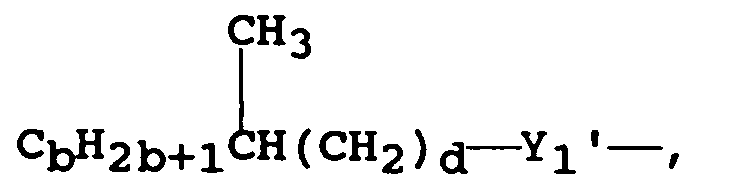 (iv)
(iv) (v) ChF2h+1(CH2)i―Y1'―,(vi) F und(vii) H,
worin a eine ganze Zahl von 1 bis 16 bezeichnet; m' eine ganze Zahl von 1 bis 12 bezeichnet; n', p' und q' jeweils eine ganze Zahl von 1 bis 5 bezeichnen; d, g und i jeweils eine ganze Zahl von 0 bis 7 bezeichnen; b, e und h jeweils eine ganze Zahl von 1 bis 10 bezeichnen und f 0 oder 1 bezeichnet, wobei vorausgesetzt ist, dass - Optisch aktive mesomorphe Verbindung, die durch die folgende Formel (I) wiedergegeben wird:m, n, p und q unabhängig eine ganze Zahl von 1 bis 15 bezeichnen, wobei vorausgesetzt ist, dassY1 eine Einfachbindung, ―O―, ―CO―, ―COO―, ―OCO―, ―CH=CH― oder ―C≡C― bezeichnet undA1 ―A2―, ―A2―X1―A3― oder ―A2―X1―A3―X2―A4― bezeichnet, worinA2, A3 und A4 unabhängig eine zweiwertige cyclische Gruppe bezeichnen, die aus der Gruppe ausgewählt ist, die aus 1,4-Phenylen, das einen oder zwei Substituenten haben kann, die F, Cl, Br, CH3, CF3 oder CN umfassen; Pyridin-2,5-diyl; Pyrimidin-2,5-diyl; Pyrazin-2,5-diyl; Pyridazin-3,6-diyl; 1,4-Cyclohexylen; 1,3-Dioxan-2,5-diyl; 1,3-Dithian-2,5-diyl; Thiophen-2,5-diyl; Thiazol-2,5-diyl; Thiadiazol-2,5-diyl; Benzoxazol-2,5-diyl; Benzoxazol-2,6-diyl; Benzothiazol-2,5-diyl; Benzothiazol-2,6-diyl; Chinoxalin-2,6-diyl; Chinolin-2,6-diyl; 2,6-Naphthylen; Indan-2,5-diyl; 2-Alkylindan-2,5-diyl, das eine lineare oder verzweigte Alkylgruppe mit 1 bis 18 Kohlenstoffatomen hat; Indanon-2,6-diyl; 2-Alkylindanon-2,6-diyl, das eine lineare oder verzweigte Alkylgruppe mit 1 bis 18 Kohlenstoffatomen hat; Cumaran-2,5-diyl und 2-Alkylcumaran-2,5-diyl, das eine lineare oder verzweigte Alkylgruppe mit 1 bis 18 Kohlenstoffatomen hat, besteht; undX1 und X2 unabhängig eine Einfachbindung, ―COO―, ―OCO―, ―CH2O―, ―OCH2―, ―CH2CH2―, ―CH=CH― oder ―C≡C― bezeichnen, wobei
die erwähnte optisch aktive mesomorphe Verbindung der Formel (I) in dem Fall, dass A1 ―A2―X1―A3―X2―A4― bezeichnet, keinenthält.
- Verbindung nach Anspruch 7, bei der R1 irgendeine der folgenden Gruppen (i*) bis (x*) bezeichnet:
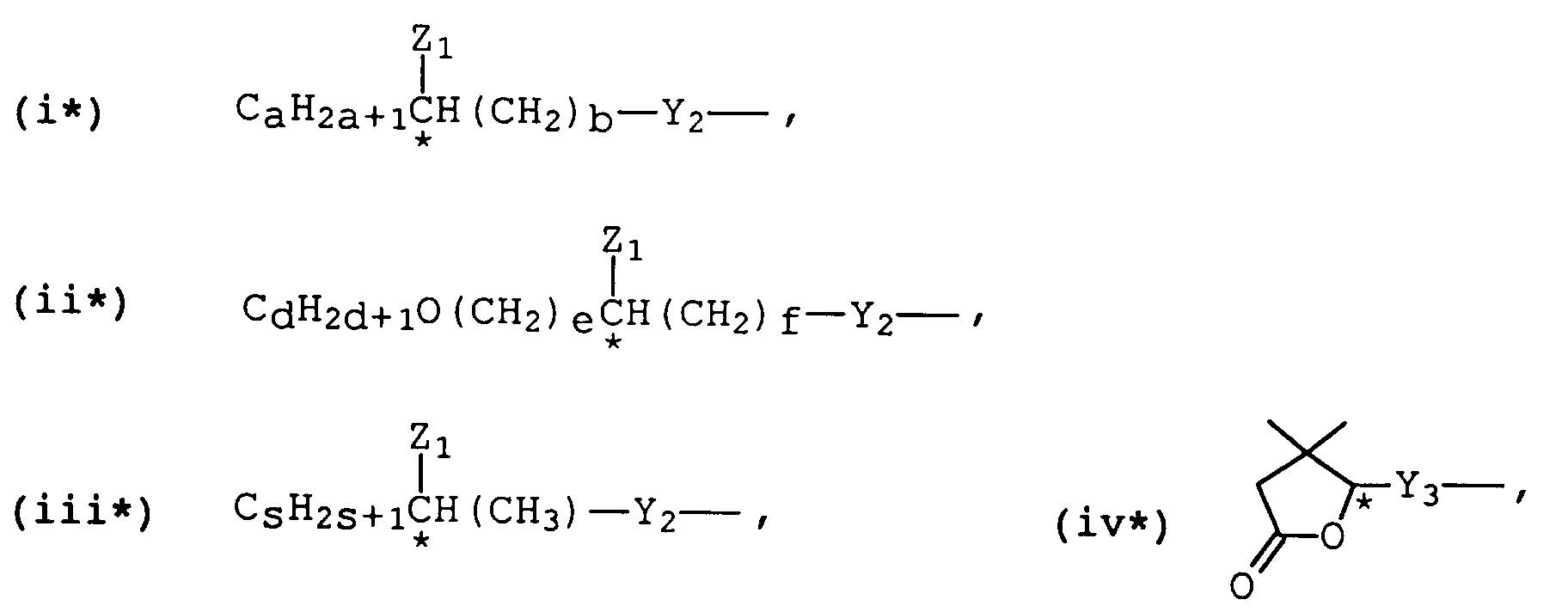 worin a, s und d jeweils eine ganze Zahl von 1 bis 16 bezeichnen; b, g, h und t jeweils eine ganze Zahl von 0 bis 10 bezeichnen und e und f jeweils eine ganze Zahl von 0 bis 7 bezeichnen, wobei vorausgesetzt ist, dass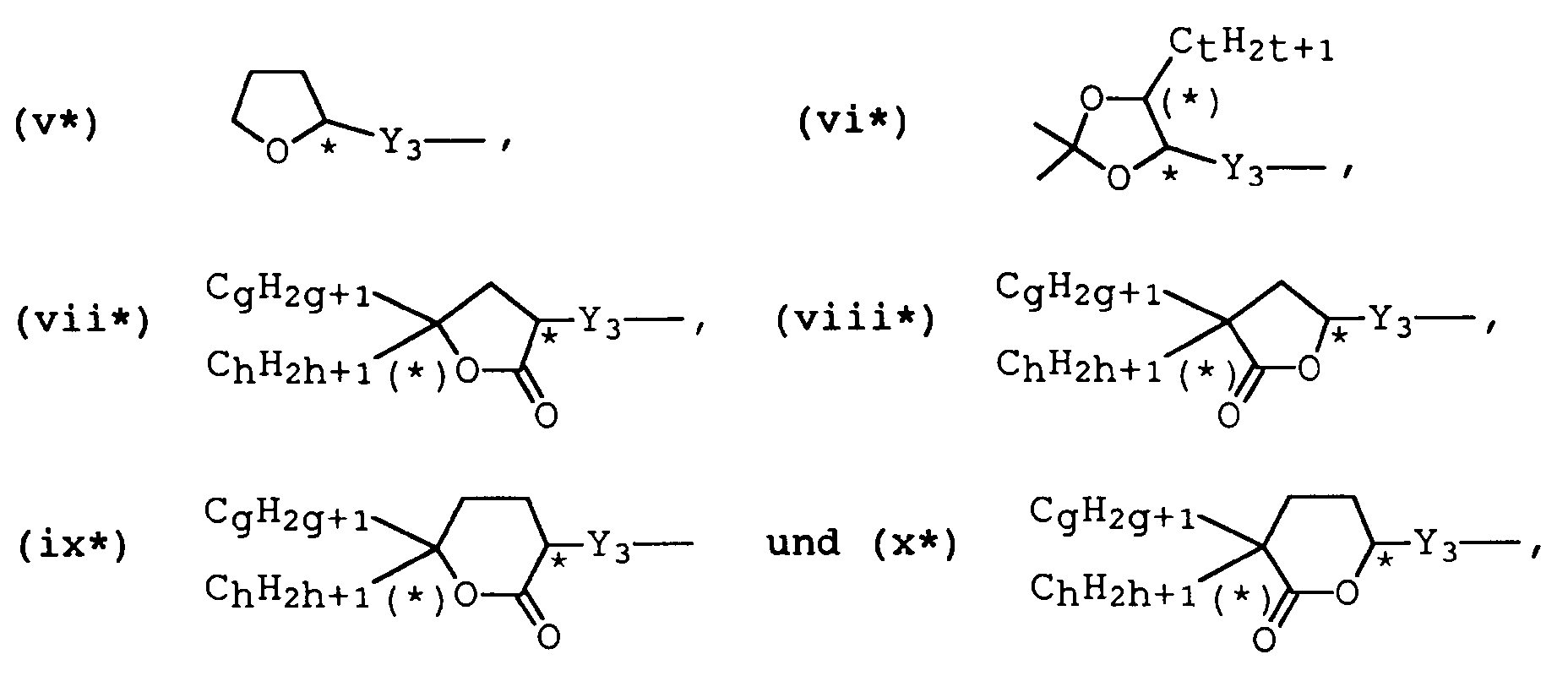
- Verbindung nach Anspruch 7, die irgendeine der folgenden mesomorphen Verbindungen (Ia) bis (Ic) der Formel (I) ist:Verbindung (Ia), bei der A1 ―A2― bezeichnet und A2 eine zweiwertige cyclische Gruppe bezeichnet, die aus 1,4-Phenylen, das einen oder zwei Substituenten haben kann, die F, Cl, Br, CH3, CF3 oder CN umfassen; 1,4-Cyclohexylen; Chinoxalin-2,6-diyl; Chinolin-2,6-diyl und 2,6-Naphthylen ausgewählt ist;Verbindung (Ib), bei der A1 ―A2―X1―A3― bezeichnet, worin mindestens eine von A2 und A3 eine zweiwertige cyclische Gruppe bezeichnet, die aus 1,4-Phenylen, das einen oder zwei Substituenten haben kann, die F, Cl, Br, CH3, CF3 oder CN umfassen; 1,4-Cyclohexylen; Pyridin-2,5-diyl und Pyrimidin-2,5-diyl ausgewählt ist; undVerbindung (Ic), bei der A1 ―A2―X1―A3―X2―A4― bezeichnet, worin mindestens eine von A2, A3 und A4 1,4-Phenylen bezeichnet, das einen oder zwei Substituenten haben kann, die F, Cl, Br, CH3, CF3 oder CN umfassen, und der Rest von A2, A3 und A4 eine zweiwertige Gruppe bezeichnet, die aus 1,4-Phenylen, das einen oder zwei Substituenten haben kann, die F, Cl, Br, CH3, CF3 oder CN umfassen; Pyridin-2,5-diyl; Pyrimidin-2,5-diyl; 1,4-Cyclohexylen; Thiazol-2,5-diyl; Thiadiazol-2,5-diyl; Indan-2,5-diyl und Cumaran-2,5-diyl ausgewählt ist.
- Verbindung nach Anspruch 7, die irgendeine der folgenden mesomorphen Verbindungen (Iba) bis (Ice) der Formel (I) ist:Verbindung (Iba), bei der A1 ―A2―X1―A3― bezeichnet, worin jede von A2 und A3 1,4-Phenylen bezeichnet, das einen oder zwei Substituenten haben kann, die F, Cl, Br, CH3, CF3 oder CN umfassen; und X1 eine Einfachbindung, ―COO―, ―CH2O―, ―CH2CH2― oder ―C≡C― bezeichnet;Verbindung (Ibb), bei der A1 ―A2―X1―A3― bezeichnet, worin eine der Gruppen A2 und A3 1,4-Phenylen bezeichnet, das einen oder zwei Substituenten haben kann, die F, Cl, Br, CH3, CF3 oder CN umfassen; die andere Gruppe A2 oder A3 eine zweiwertige cyclische Gruppe bezeichnet, die aus Pyridin-2,5-diyl, Pyrimidin-2,5-diyl, Pyrazin-2,5-diyl, Pyridazin-3,6-diyl, 1,4-Cyclohexylen, Thiophen-2,5-diyl, Thiazol-2,5-diyl, Thiadiazol-2,5-diyl, Benzoxazol-2,5-diyl, Benzothiazol-2,6-diyl, Chinoxalin-2,6-diyl, Chinolin-2,6-diyl, 2,6-Naphthylen, Indan-2,5-diyl und Cumaran-2,5-diyl ausgewählt ist; und X1 eine Einfachbindung bezeichnet;Verbindung (Ibc), bei der A1 ―A2―X1―A3― bezeichnet, worin eine der Gruppen A2 und A3 Pyridin-2,5-diyl bezeichnet; die andere Gruppe A2 oder A3 eine zweiwertige cyclische Gruppe bezeichnet, die aus 1,4-Cyclohexylen, 2,6-Naphthylen, Indan-2,5-diyl und Cumaran-2,5-diyl ausgewählt ist; und X1 eine Einfachbindung bezeichnet;Verbindung (Ibd), bei der A1 ―A2―X1―A3― bezeichnet, worin eine der Gruppen A2 und A3 Pyrimidin-2,5-diyl bezeichnet; die andere Gruppe A2 oder A3 eine zweiwertige cyclische Gruppe bezeichnet, die aus 1,4-Cyclohexylen, 2,6-Naphthylen, Indan-2,5-diyl und Cumaran-2,5-diyl ausgewählt ist; und X1 eine Einfachbindung bezeichnet;Verbindung (Icb), bei der A1 ―A2―X1―A3―X2―A4― bezeichnet, worin zwei von A2, A3 und A4 1,4-Phenylen bezeichnen, das einen oder zwei Substituenten haben kann, die F, Cl, Br, CH3, CF3 oder CN umfassen; und der Rest von A2, A3 und A4 eine zweiwertige cyclische Gruppe bezeichnet, die aus Pyridin-2,5-diyl, Pyrimidin-2,5-diyl, 1,4-Cyclohexylen, Thiazol-2,5-diyl, Thiadiazol-2,5-diyl, Indan-2,5-diyl und Cumaran-2,5-diyl ausgewählt ist; und X1 und X2 Einfachbindungen bezeichnen;Verbindung (Icc), bei der A1 ―A2―X1―A3―X2―A4― bezeichnet, worin eine der Gruppen A2 und A4 Pyridin-2,5-diyl bezeichnet und die andere Gruppe A2 oder A4 eine zweiwertige cyclische Gruppe bezeichnet, die aus 1,4-Phenylen, das einen oder zwei Substituenten haben kann, die F, Cl, Br, CH3, CF3 oder CN umfassen, 1,4-Cyclohexylen, Thiophen-2,5-diyl und Indan-2,5-diyl ausgewählt ist; A3 1,4-Phenylen bezeichnet, das einen oder zwei Substituenten haben kann, die F, Cl, Br, CH3, CF3 oder CN umfassen; und eine der Gruppen X1 und X2 eine Einfachbindung bezeichnet und die andere Gruppe X1 oder X2 ―OCO―, ―OCH2― oder ―CH2CH2― bezeichnet;Verbindung (Icd), bei der A1 ―A2―X1―A3―X2―A4― bezeichnet, worin eine der Gruppen A2 und A4 Pyrimidin-2,5-diyl bezeichnet und die andere Gruppe A2 oder A4 eine zweiwertige cyclische Gruppe bezeichnet, die aus 1,4-Phenylen, das einen oder zwei Substituenten haben kann, die F, Cl, Br, CH3, CF3 oder CN umfassen, 1,4-Cyclohexylen, Thiophen-2,5-diyl und Indan-2,5-diyl ausgewählt ist; A3 1,4-Phenylen bezeichnet, das einen oder zwei Substituenten haben kann, die F, Cl, Br, CH3, CF3 oder CN umfassen; und eine der Gruppen X1 und X2 eine Einfachbindung bezeichnet und die andere Gruppe X1 oder X2 ―OCO―, ―OCH2― oder ―CH2CH2― bezeichnet; undVerbindung (Ice), bei der A1 ―A2―X1―A3―X2―A4― bezeichnet, worin eine der Gruppen A2 und A4 1,4-Cyclohexylen bezeichnet und die andere Gruppe A2 oder A4 eine zweiwertige cyclische Gruppe bezeichnet, die aus 1,4-Phenylen, das einen oder zwei Substituenten haben kann, die F, Cl, Br, CH3, CF3 oder CN umfassen, 1,4-Cyclohexylen, Thiophen-2,5-diyl und Indan-2,5-diyl ausgewählt ist; A3 1,4-Phenylen bezeichnet, das einen oder zwei Substituenten haben kann, die F, Cl, Br, CH3, CF3 oder CN umfassen; und eine der Gruppen X1 und X2 eine Einfachbindung bezeichnet und die andere Gruppe X1 oder X2 ―OCO―, ―OCH2― oder ―CH2CH2― bezeichnet.
- Verbindung nach Anspruch 7, bei der mindestens eine von A2 und A3 eine zweiwertige cyclische Gruppe bezeichnet, die aus Thiophen-2,5-diyl; Thiazol-2,5-diyl; Thiadiazol-2,5-diyl; Benzoxazol-2,5-diyl; Benzoxazol-2,6-diyl; Benzothiazol-2,5-diyl; Benzothiazol-2,6-diyl; Chinoxalin-2,6-diyl; Chinolin-2,6-diyl; Indan-2,5-diyl; 2-Alkylindan-2,5-diyl, das eine lineare oder verzweigte Alkylgruppe mit 1 bis 18 Kohlenstoffatomen hat; Indanon-2,6-diyl; 2-Alkylindanon-2,6-diyl, das eine lineare oder verzweigte Alkylgruppe mit 1 bis 18 Kohlenstoffatomen hat; Cumaran-2,5-diyl und 2-Alkylcumaran-2,5-diyl, das eine lineare oder verzweigte Alkylgruppe mit 1 bis 18 Kohlenstoffatomen hat, ausgewählt ist.
- Flüssigkristallmischung, die mindestens zwei Verbindungen umfasst, von denen mindestens eine eine mesomorphe Verbindung der Formel (I) nach einem der Ansprüche 1 bis 11 ist.
- Flüssigkristallmischung nach Anspruch 12, die 1 bis 80 Masse% einer mesomorphen Verbindung der Formel (I) enthält.
- Flüssigkristallmischung nach Anspruch 12, die 1 bis 60 Masse% einer mesomorphen Verbindung der Formel (I) enthält.
- Flüssigkristallmischung nach Anspruch 12, die 1 bis 40 Masse% einer mesomorphen Verbindung der Formel (I) enthält.
- Flüssigkristallmischung nach Anspruch 12, die eine chirale smektische Phase hat.
- Flüssigkristallmischung nach Anspruch 12, bei der die erwähnte mesomorphe Verbindung der Formel (I) mindestens zwei Arten der erwähnten mesomorphen Verbindung der Formel (I) umfasst.
- Flüssigkristallmischung nach Anspruch 12, die 3 bis 30 Arten einer anderen mesomorphen Verbindung enthält.
- Flüssigkristallvorrichtung, die ein Paar Substrate und eine zwischen den Substraten angeordnete Flüssigkristallmischung nach Anspruch 12 umfasst.
- Vorrichtung nach Anspruch 19, die ferner eine Ausrichtungssteuerungsschicht umfasst.
- Vorrichtung nach Anspruch 20, bei der die Ausrichtungssteuerungsschicht einer uniaxialen Ausrichtungsbehandlung unterzogen worden ist.
- Vorrichtung nach Anspruch 19, bei der die Flüssigkristallmischung zwischen den Substraten in einer Dicke angeordnet ist, die die Bildung einer schraubenförmigen Struktur von Flüssigkristallmolekülen unterdrückt.
- Flüssigkristallgerät, das eine Flüssigkristallvorrichtung nach Anspruch 19 umfasst.
- Gerät nach Anspruch 23, bei dem die Flüssigkristallvorrichtung als Anzeigevorrichtung angewendet wird.
- Gerät nach Anspruch 23, das ferner eine Ansteuerungsschaltung für die Flüssigkristallvorrichtung umfasst.
- Gerät nach Anspruch 24, das ferner eine Lichtquelle umfasst.
- Anzeigeverfahren, bei demeine Flüssigkristallmischung nach Anspruch 12 bereitgestellt wird unddie Ausrichtungsrichtung von Flüssigkristallmolekülen gesteuert wird, um eine Anzeige zu bewirken.
Applications Claiming Priority (6)
| Application Number | Priority Date | Filing Date | Title |
|---|---|---|---|
| JP5243578A JPH0776543A (ja) | 1993-09-06 | 1993-09-06 | 液晶性化合物、それを含有する液晶組成物、それを有する液晶素子及びそれらを用いた表示方法、表示装置 |
| JP243578/93 | 1993-09-06 | ||
| JP24357993 | 1993-09-06 | ||
| JP243579/93 | 1993-09-06 | ||
| JP5243579A JPH0772442A (ja) | 1993-09-06 | 1993-09-06 | 光学活性化合物、それを含有する液晶組成物、それを有する液晶素子及びそれらを用いた表示方法、表示装置 |
| JP24357893 | 1993-09-06 |
Publications (2)
| Publication Number | Publication Date |
|---|---|
| EP0641850A1 EP0641850A1 (de) | 1995-03-08 |
| EP0641850B1 true EP0641850B1 (de) | 2000-04-26 |
Family
ID=26536328
Family Applications (1)
| Application Number | Title | Priority Date | Filing Date |
|---|---|---|---|
| EP94113906A Expired - Lifetime EP0641850B1 (de) | 1993-09-06 | 1994-09-05 | Mesomorphe Verbindung, eine diese enthaltene Flüssigkristallzusammensetzung, eine diese Zusammensetzung verwendende Flüssigkristallvorrichtung, Flüssigkristallapparat und Anzeigeverfahren |
Country Status (3)
| Country | Link |
|---|---|
| US (1) | US5868960A (de) |
| EP (1) | EP0641850B1 (de) |
| DE (1) | DE69424102T2 (de) |
Cited By (1)
| Publication number | Priority date | Publication date | Assignee | Title |
|---|---|---|---|---|
| US7618688B2 (en) | 2005-11-15 | 2009-11-17 | Chisso Corporation | Liquid crystal compound having lactone ring, liquid crystal composition, and liquid crystal display device |
Families Citing this family (13)
| Publication number | Priority date | Publication date | Assignee | Title |
|---|---|---|---|---|
| US5702637A (en) * | 1995-04-19 | 1997-12-30 | Minnesota Mining And Manufacturing Company | Liquid crystal compounds having a chiral fluorinated terminal portion |
| US5858269A (en) * | 1995-09-20 | 1999-01-12 | Canon Kabushiki Kaisha | Liquid crystal device and liquid crystal apparatus |
| US5658491A (en) * | 1995-10-12 | 1997-08-19 | Minnesota Mining And Manufacturing Company | Process for controlling cone tilt angle in mixtures of smectic liquid crystal compounds |
| US5855812A (en) * | 1997-04-11 | 1999-01-05 | Minnesota Mining And Manufacturing Company | Compounds and process for controlling cone tilt angle in mixtures of smectic liquid crystal compounds |
| EP0916715A1 (de) * | 1997-11-11 | 1999-05-19 | Aventis Research & Technologies GmbH & Co. KG | Chiral smektische Flüssigkristallmischung enthaltend Verbindungen mit flourierten Seitenketten |
| US6309561B1 (en) | 1997-12-24 | 2001-10-30 | 3M Innovative Properties Company | Liquid crystal compounds having a chiral fluorinated terminal portion |
| US6528940B1 (en) | 1999-09-28 | 2003-03-04 | Canon Kabushiki Kaisha | Conductive liquid crystal device, and organic electroluminescence device |
| JP2001100257A (ja) | 1999-10-01 | 2001-04-13 | Canon Inc | 液晶素子 |
| JP3619174B2 (ja) | 2000-07-24 | 2005-02-09 | キヤノン株式会社 | 高分子液晶性化合物、それらを含む電解質および二次電池 |
| JP2007153738A (ja) | 2005-11-30 | 2007-06-21 | Kuraray Co Ltd | 1,3−ブタジエンを含む混合物およびその製造方法 |
| US9246108B2 (en) | 2012-12-28 | 2016-01-26 | Dow Global Technologies Llc | Quinoline-benzoxazole derived compounds for electronic films and devices |
| DE102017010942A1 (de) * | 2016-12-08 | 2018-06-14 | Merck Patent Gmbh | Additive für Flüssigkristallmischungen |
| WO2019233978A1 (en) * | 2018-06-07 | 2019-12-12 | Merck Patent Gmbh | Additives for liquid-crystal mixtures |
Family Cites Families (7)
| Publication number | Priority date | Publication date | Assignee | Title |
|---|---|---|---|---|
| CA1341010C (en) * | 1986-06-30 | 2000-05-30 | Minnesota Mining And Manufacturing Company | Compounds useful in preparing fluorine-containing chiral smectic liquid crystals |
| DE3825424A1 (de) * | 1988-07-27 | 1990-03-29 | Merck Patent Gmbh | Fluorierte alkoxyverbindungen |
| US5082587A (en) * | 1988-09-23 | 1992-01-21 | Janulis Eugene P | Achiral fluorine-containing liquid crystals |
| US5141669A (en) * | 1989-06-30 | 1992-08-25 | Polaroid Corporation | Liquid crystal compounds having chiral ester head groups |
| DE4006743A1 (de) * | 1989-07-11 | 1991-01-24 | Merck Patent Gmbh | Chirale oder achirale ringverbindungen |
| US5262082A (en) * | 1992-04-28 | 1993-11-16 | Minnesota Mining And Manufacturing Company | Ferroelectric liquid crystal compounds having perfluoroether terminal portions |
| US5399291A (en) * | 1993-09-30 | 1995-03-21 | Minnesota Mining And Manufacturing Company | Liquid crystal compounds having a fluoroether terminal portion |
-
1994
- 1994-09-05 DE DE69424102T patent/DE69424102T2/de not_active Expired - Fee Related
- 1994-09-05 EP EP94113906A patent/EP0641850B1/de not_active Expired - Lifetime
-
1997
- 1997-01-09 US US08/781,062 patent/US5868960A/en not_active Expired - Fee Related
Cited By (2)
| Publication number | Priority date | Publication date | Assignee | Title |
|---|---|---|---|---|
| US7618688B2 (en) | 2005-11-15 | 2009-11-17 | Chisso Corporation | Liquid crystal compound having lactone ring, liquid crystal composition, and liquid crystal display device |
| US7875327B2 (en) | 2005-11-15 | 2011-01-25 | Chisso Corporation | Liquid crystal compound having lactone ring, liquid crystal composition, and liquid crystal display device |
Also Published As
| Publication number | Publication date |
|---|---|
| EP0641850A1 (de) | 1995-03-08 |
| DE69424102T2 (de) | 2000-12-21 |
| US5868960A (en) | 1999-02-09 |
| DE69424102D1 (de) | 2000-05-31 |
Similar Documents
| Publication | Publication Date | Title |
|---|---|---|
| EP0625513B1 (de) | Mesomorphe Verbindung, Flüssigkristallzusammensetzung die diese enthält, Vorrichtung die diese verwendet, Anzeigevorrichtung und Methode | |
| EP0667385B1 (de) | Mesomorphe Verbindung, sie enthaltende flüssigkristalline Zusammensetzung, flüssigkristalline die Zusammensetzung verwendende Vorrichtung und Anzeigegerät | |
| EP0364923B1 (de) | Mesomorphe Verbindung, diese enthaltende Flüssigkristall-Zusammensetzung und deren Anwendung in einer Flüssigkristall-Vorrichtung | |
| EP0606090B1 (de) | Mesomorphe Verbindung, Flüssigkristallzusammensetzung und Flüssigkristallvorrichtung | |
| US5462694A (en) | Mesomorphic compound, liquid crystal composition containing the compound, liquid crystal device using the composition, liquid crystal apparatus and display method | |
| EP0640676B1 (de) | Mesomorphe Verbindung, eine diese enthaltene Flüssigkristallzusammensetzung, eine diese Zusammensetzung verwendende Flüssigkristallvorrichtung, Flüssigkristallapparat und Anzeigeverfahren | |
| EP0641850A1 (de) | Mesomorphe Verbindung, eine diese enthaltene Flüssigkristallzusammensetzung, eine diese Zusammensetzung verwendende Flüssigkristallvorrichtung, Flüssigkristallapparat und Anzeigeverfahren | |
| EP0498277B1 (de) | Optisch-aktive Benzthiazole, flüssigkristalline Zusammensetzung, flüssigkristalline Vorrichtung, Display-Apparat und Display-Verfahren | |
| EP0622359B1 (de) | Quinoxalineverbindungen, diese enthaltende Flüssigkristallzusammensetzung sowie diese enthaltende Anzeigevorrichtung | |
| EP0459406A1 (de) | Mesomorphe Verbindung, FlÀ¼ssigkristallzusammensetzung, Verfahren und Vorrichtung zur Flüssigkristallanzeige | |
| EP0546338B1 (de) | Mesomorphe Verbindung, Flüssigkristallzusammensetzung, Flüssigkristallvorrichtung, Anzeigevorrichtung sowie Anzeigeverfahren | |
| EP0611119B1 (de) | Optisch aktive Verbindung, eine diese enthaltende Flüssigkristallzusammensetzung, Flüssigkristallvorrichtung, Anzeigeapparat und Anzeigemethode | |
| EP0476567A1 (de) | Mesomorphverbindung, flüssigkristalline Zusammensetzung, flüssigkristalline Vorrichtung, Display-Apparat und Display-Verfahren | |
| EP0393613B1 (de) | Mesomorphische Verbindung, sie enthaltende Flüssigkristallzusammensetzung und sie enthaltende Flüssigkristallvorrichtung | |
| EP0347942B1 (de) | Ferroelektrische chirale smektische Flüssigkristallzusammensetzung und Vorrichtung mit dieser Zusammensetzung | |
| EP0555843B1 (de) | Mesomorphe Verbindung, flüssigkristalline Zusammensetzung, flüssigkristalline Vorrichtung, Display-Apparat und Display-Methode | |
| EP0440134B1 (de) | Mesomorphe Verbindung, sie enthaltende flüssigkristalline Zusammensetzung, sie verwendende flüssigkristalline Vorrichtung und Anzeigeapparat | |
| EP0460703B1 (de) | Mesomorphe Verbindungen, Flüssigkristallzusammensetzung, Flüssigkristalleinrichtung, Anzeigevorrichtung und Anzeigemethode | |
| EP0401522B1 (de) | Flüssig-Kristall-Zusammensetzung und deren Anwendung in einer Flüssigkristall-Vorrichtung | |
| EP0611815B1 (de) | Mesomorphe Verbindungen, Flüssigkristallzusammensetzung, Flüssigkristallvorrichtung, Anzeigeapparat und Anzeigemethode | |
| EP0499221B1 (de) | Optisch-aktive Verbindung, flüssigkristalline Zusammensetzung, flüssigkristalline Vorrichtung, Display-Apparat und Display-Verfahren | |
| EP0644249B1 (de) | Optisch inaktive, mesomorphe Verbindung, eine diese enthaltene Flüssigkristallzusammensetzung, eine diese Zusammensetzung verwendende Flüssigkristallvorrichtung, Flüssigkristallvorrichtung und Anzeigeverfahren | |
| EP0460624B1 (de) | Flüssigkristallzusammensetzung, Flüssigkristallvorrichtung, Anzeigevorrichtung und Anzeigemethode | |
| EP0461620B1 (de) | Mesomorphe Verbindung, flüssigkristalline Zusammensetzung, flüssigkristalline Vorrichtung, Anzeigeelement und Anzeigemethode | |
| EP0439170B1 (de) | Mesomorph-Verbindung, Flüssigkristallzusammensetzung dieselbe enthaltend, Vorrichtung mit derselben und Anzeigesystem |
Legal Events
| Date | Code | Title | Description |
|---|---|---|---|
| PUAI | Public reference made under article 153(3) epc to a published international application that has entered the european phase |
Free format text: ORIGINAL CODE: 0009012 |
|
| 17P | Request for examination filed |
Effective date: 19940905 |
|
| AK | Designated contracting states |
Kind code of ref document: A1 Designated state(s): CH DE ES FR GB IT LI NL SE |
|
| 17Q | First examination report despatched |
Effective date: 19960705 |
|
| GRAG | Despatch of communication of intention to grant |
Free format text: ORIGINAL CODE: EPIDOS AGRA |
|
| GRAG | Despatch of communication of intention to grant |
Free format text: ORIGINAL CODE: EPIDOS AGRA |
|
| GRAG | Despatch of communication of intention to grant |
Free format text: ORIGINAL CODE: EPIDOS AGRA |
|
| GRAH | Despatch of communication of intention to grant a patent |
Free format text: ORIGINAL CODE: EPIDOS IGRA |
|
| GRAH | Despatch of communication of intention to grant a patent |
Free format text: ORIGINAL CODE: EPIDOS IGRA |
|
| GRAH | Despatch of communication of intention to grant a patent |
Free format text: ORIGINAL CODE: EPIDOS IGRA |
|
| GRAA | (expected) grant |
Free format text: ORIGINAL CODE: 0009210 |
|
| AK | Designated contracting states |
Kind code of ref document: B1 Designated state(s): CH DE ES FR GB IT LI NL SE |
|
| PG25 | Lapsed in a contracting state [announced via postgrant information from national office to epo] |
Ref country code: NL Free format text: LAPSE BECAUSE OF FAILURE TO SUBMIT A TRANSLATION OF THE DESCRIPTION OR TO PAY THE FEE WITHIN THE PRESCRIBED TIME-LIMIT Effective date: 20000426 Ref country code: LI Free format text: LAPSE BECAUSE OF FAILURE TO SUBMIT A TRANSLATION OF THE DESCRIPTION OR TO PAY THE FEE WITHIN THE PRESCRIBED TIME-LIMIT Effective date: 20000426 Ref country code: IT Free format text: LAPSE BECAUSE OF FAILURE TO SUBMIT A TRANSLATION OF THE DESCRIPTION OR TO PAY THE FEE WITHIN THE PRE;WARNING: LAPSES OF ITALIAN PATENTS WITH EFFECTIVE DATE BEFORE 2007 MAY HAVE OCCURRED AT ANY TIME BEFORE 2007. THE CORRECT EFFECTIVE DATE MAY BE DIFFERENT FROM THE ONE RECORDED.SCRIBED TIME-LIMIT Effective date: 20000426 Ref country code: ES Free format text: THE PATENT HAS BEEN ANNULLED BY A DECISION OF A NATIONAL AUTHORITY Effective date: 20000426 Ref country code: CH Free format text: LAPSE BECAUSE OF FAILURE TO SUBMIT A TRANSLATION OF THE DESCRIPTION OR TO PAY THE FEE WITHIN THE PRESCRIBED TIME-LIMIT Effective date: 20000426 |
|
| REG | Reference to a national code |
Ref country code: CH Ref legal event code: EP |
|
| REF | Corresponds to: |
Ref document number: 69424102 Country of ref document: DE Date of ref document: 20000531 |
|
| ET | Fr: translation filed | ||
| PG25 | Lapsed in a contracting state [announced via postgrant information from national office to epo] |
Ref country code: SE Free format text: LAPSE BECAUSE OF FAILURE TO SUBMIT A TRANSLATION OF THE DESCRIPTION OR TO PAY THE FEE WITHIN THE PRESCRIBED TIME-LIMIT Effective date: 20000726 |
|
| NLV1 | Nl: lapsed or annulled due to failure to fulfill the requirements of art. 29p and 29m of the patents act | ||
| REG | Reference to a national code |
Ref country code: CH Ref legal event code: PL |
|
| PLBE | No opposition filed within time limit |
Free format text: ORIGINAL CODE: 0009261 |
|
| STAA | Information on the status of an ep patent application or granted ep patent |
Free format text: STATUS: NO OPPOSITION FILED WITHIN TIME LIMIT |
|
| 26N | No opposition filed | ||
| REG | Reference to a national code |
Ref country code: GB Ref legal event code: IF02 |
|
| PGFP | Annual fee paid to national office [announced via postgrant information from national office to epo] |
Ref country code: FR Payment date: 20050823 Year of fee payment: 12 |
|
| PGFP | Annual fee paid to national office [announced via postgrant information from national office to epo] |
Ref country code: GB Payment date: 20050831 Year of fee payment: 12 |
|
| PGFP | Annual fee paid to national office [announced via postgrant information from national office to epo] |
Ref country code: DE Payment date: 20050902 Year of fee payment: 12 |
|
| PG25 | Lapsed in a contracting state [announced via postgrant information from national office to epo] |
Ref country code: DE Free format text: LAPSE BECAUSE OF NON-PAYMENT OF DUE FEES Effective date: 20070403 |
|
| GBPC | Gb: european patent ceased through non-payment of renewal fee |
Effective date: 20060905 |
|
| REG | Reference to a national code |
Ref country code: FR Ref legal event code: ST Effective date: 20070531 |
|
| PG25 | Lapsed in a contracting state [announced via postgrant information from national office to epo] |
Ref country code: GB Free format text: LAPSE BECAUSE OF NON-PAYMENT OF DUE FEES Effective date: 20060905 |
|
| PG25 | Lapsed in a contracting state [announced via postgrant information from national office to epo] |
Ref country code: FR Free format text: LAPSE BECAUSE OF NON-PAYMENT OF DUE FEES Effective date: 20061002 |