EP0643156A2 - Photo-elektrisch chemische Vorrichtung mit Kohlenstoff-Cluster-Elektrode - Google Patents
Photo-elektrisch chemische Vorrichtung mit Kohlenstoff-Cluster-Elektrode Download PDFInfo
- Publication number
- EP0643156A2 EP0643156A2 EP94113088A EP94113088A EP0643156A2 EP 0643156 A2 EP0643156 A2 EP 0643156A2 EP 94113088 A EP94113088 A EP 94113088A EP 94113088 A EP94113088 A EP 94113088A EP 0643156 A2 EP0643156 A2 EP 0643156A2
- Authority
- EP
- European Patent Office
- Prior art keywords
- electrode
- electrolyte
- photo
- carbon cluster
- electric chemical
- Prior art date
- Legal status (The legal status is an assumption and is not a legal conclusion. Google has not performed a legal analysis and makes no representation as to the accuracy of the status listed.)
- Granted
Links
Images
Classifications
-
- C—CHEMISTRY; METALLURGY
- C25—ELECTROLYTIC OR ELECTROPHORETIC PROCESSES; APPARATUS THEREFOR
- C25B—ELECTROLYTIC OR ELECTROPHORETIC PROCESSES FOR THE PRODUCTION OF COMPOUNDS OR NON-METALS; APPARATUS THEREFOR
- C25B1/00—Electrolytic production of inorganic compounds or non-metals
- C25B1/50—Processes
- C25B1/55—Photoelectrolysis
-
- Y—GENERAL TAGGING OF NEW TECHNOLOGICAL DEVELOPMENTS; GENERAL TAGGING OF CROSS-SECTIONAL TECHNOLOGIES SPANNING OVER SEVERAL SECTIONS OF THE IPC; TECHNICAL SUBJECTS COVERED BY FORMER USPC CROSS-REFERENCE ART COLLECTIONS [XRACs] AND DIGESTS
- Y02—TECHNOLOGIES OR APPLICATIONS FOR MITIGATION OR ADAPTATION AGAINST CLIMATE CHANGE
- Y02E—REDUCTION OF GREENHOUSE GAS [GHG] EMISSIONS, RELATED TO ENERGY GENERATION, TRANSMISSION OR DISTRIBUTION
- Y02E60/00—Enabling technologies; Technologies with a potential or indirect contribution to GHG emissions mitigation
- Y02E60/30—Hydrogen technology
- Y02E60/36—Hydrogen production from non-carbon containing sources, e.g. by water electrolysis
-
- Y—GENERAL TAGGING OF NEW TECHNOLOGICAL DEVELOPMENTS; GENERAL TAGGING OF CROSS-SECTIONAL TECHNOLOGIES SPANNING OVER SEVERAL SECTIONS OF THE IPC; TECHNICAL SUBJECTS COVERED BY FORMER USPC CROSS-REFERENCE ART COLLECTIONS [XRACs] AND DIGESTS
- Y10—TECHNICAL SUBJECTS COVERED BY FORMER USPC
- Y10S—TECHNICAL SUBJECTS COVERED BY FORMER USPC CROSS-REFERENCE ART COLLECTIONS [XRACs] AND DIGESTS
- Y10S136/00—Batteries: thermoelectric and photoelectric
- Y10S136/291—Applications
Definitions
- the present invention relates to a photo-electric chemical apparatus and particularly to a photo-electric chemical apparatus for generating hydrogen and oxygen from water by utilizing light energy.
- titanium dioxide is used as a semiconductor electrode for the electrolysis of water, because it has a wide band gap and is very stable in the electrolyte.
- a flat band potential of a titanium dioxide semiconductor is substantially equal to a reduction potential of hydrogen ion
- a potential of the titanium dioxide semiconductor must come nearer to the flat band condition in order to cause hydrogen ion reduction.
- electrons and holes generated by light beam are not immediately separated and, if separated, couple again at a high rate, causing a photo current to become remarkably small.
- a photo-electric chemical apparatus employing a titanium dioxide semiconductor electrode and a platinum electrode, little photo current flows when both electrodes are short-circuited and irradiated with light beam.
- a photo current does not flow even if such a semiconductor is short-circuited to a platinum electrode. Therefore, it is necessary to apply a large negative bias to the platinum electrode in order to achieve effective generation of hydrogen and oxygen.
- electrolysis of water by means of a light energy using a combination of a platinum electrode and a semiconductor, such as titanium dioxide, iron oxide, tungsten oxide, tin oxide, lead oxide, indium oxide and iron titanic acid essentially requires the application of a bias voltage. This results in the necessity of extra associated apparatuses and extra supplies of energy.
- a photo-electric chemical apparatus comprises an electrolyte; a first electrode having an n-type semiconductor member disposed to be in touch with the electrolyte; and a second electrode having a carbon cluster member disposed to be in touch with the electrolyte, the first and second electrodes being short-circuited and irradiated with a light beam to thereby generate oxygen and hydrogen.
- the first electrode is preferably a laminated member consisting of a light transmitting glass, a transparent conducting layer and an n-type semiconductor layer.
- the second electrode is preferably a laminated member consisting of a light transmitting glass, a transparent conducting layer and a carbon cluster thin film.
- the photo-electric chemical apparatus of the present invention can be provided with a variable bias source which can apply a variable bias voltage across the transparent conducting layers of the first and second electrodes. By adjusting the bias voltage, the apparatus can vary any amount of oxygen and hydrogen to be generated therefrom.
- the n-type semiconductor electrode and the carbon cluster electrode are soaked in the electrolyte or set in contact with the electrolyte and these electrodes are short-circuited.
- these electrodes are irradiated with a light beam, oxidation of water occurs on the surface of the n-type semiconductor electrode, while reduction to the hydrogen ion occurs on the surface of the carbon cluster electrode. That is, water contained in the electrolyte is decomposed to generate hydrogen and oxygen.
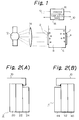
- Fig. 1 is a schematic diagram of a photo-electric chemical apparatus of the present invention.
- This apparatus comprises a vessel 6 provided with an n-type semiconductor electrode 2 and a carbon cluster electrode 4.
- An electrolyte 8 is within vessel 6. These electrodes 2, 4 are short-circuited with a lead wire 10.
- n-type semiconductor electrode 2 titanium dioxide, iron oxide, tungsten oxide, tin oxide, lead oxide, indium oxide or iron titanic acid is used.
- a carbon cluster used for the electrode 4 an isolated material of a fullerence of C60 or C70 or a mixture thereof is suitable.
- Fig. 2(A) illustrates a detailed structure of the n-type semiconductor electrode 2
- Fig. 2(B) illustrates a detailed structure of the carbon cluster electrode 4.
- the electrode 2 can be formed by coating one surface of a light transmitting glass 20 with tin oxide to form a transparent conducting layer 22 and then covering the conducting layer 22 with a fine particle thin film 26 of titanium oxide (n-type semiconductor) by a sol-gel method.
- the electrode 4 can be formed by coating one surface of a light transmitting glass 40 with tin oxide to form a transparent conducting layer 42 and then covering the conducting layer 42 with a C60 carbon cluster thin film 44 obtained by a benzene solution cast method.
- the electrodes 2 and 4 being formed in such a manner as shown in Figs. 2(A) and 2(B), titanium dioxide fine particle thin film 24 and C60 carbon cluster thin film 44 are in contact with the electrolyte 8.
- a xenon lamp 12 and a lens systems 14 for converting the light emitted from the xenon lamp 12 to a parallel light beam are provided outside of the vessel 6.
- the titanium dioxide fine particle thin film 24, when irradiated by the xenon lamp 12, is excited and generates electrons and holes. Simultaneously, the carbon cluster thin film 44 is also irradiated with the light beam passing through the electrode 2.
- a current/voltage tracer 16 is inserted to evaluate the generation of hydrogen. Hydrogen is generated by transfer of electrons among the electrode interfaces, water molecules and hydrogen ion. When a closed loop is established by short-circuiting the electrodes 2, 4 with the lead wire 10, a current flows through the lead wire 10 simultaneously with the generation of hydrogen. This current is measured with the current/voltage tracer 16.
- the current/voltage tracer 16 incorporates a variable bias source 18 which can operate to apply a variable bias voltage across the electrodes 2 and 4.
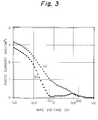
- Fig. 3 shows bias voltage-photo current characteristics obtained by tests conducted on a photo-electric chemical apparatus of the present invention and a prior art apparatus.
- a bias voltage applied across both electrodes is plotted along the horizontal axis, while a photo current flowing through the lead wire 10 along the vertical axis.
- a curve (a) shows a current/voltage characteristic of a photo-electric chemical apparatus using the carbon cluster electrode 4 according to the present invention. According to this characteristic curve (a), it can be seen that a photo current rises at about 0.6 V and flows even at zero bias voltage. This shows that water is decomposed by means of irradiation of light beam on the electrodes 2, 4 to generate hydrogen without applying any bias voltage.
- a curve (b) shows the result of measurement using a platinum electrode, which has been considered to be effective for the generation of hydrogen, in place of the carbon cluster electrode 4. According to the curve (b), it can be seen that a photo current rises at about -0.1 V and that the application of a bias voltage of about -0.3 V is required to generate a photo current similar to that generated by the carbon cluster electrode.
- the carbon cluster electrode 4 can be replaced with a carbon cluster covered electrode.
Landscapes
- Chemical & Material Sciences (AREA)
- Inorganic Chemistry (AREA)
- Engineering & Computer Science (AREA)
- Chemical Kinetics & Catalysis (AREA)
- Electrochemistry (AREA)
- Materials Engineering (AREA)
- Metallurgy (AREA)
- Organic Chemistry (AREA)
- Electrolytic Production Of Non-Metals, Compounds, Apparatuses Therefor (AREA)
- Electrodes For Compound Or Non-Metal Manufacture (AREA)
- Hybrid Cells (AREA)
- Electrodes Of Semiconductors (AREA)
Applications Claiming Priority (2)
| Application Number | Priority Date | Filing Date | Title |
|---|---|---|---|
| JP229407/93 | 1993-08-23 | ||
| JP5229407A JPH0773909A (ja) | 1993-08-23 | 1993-08-23 | 光電気化学装置 |
Publications (3)
| Publication Number | Publication Date |
|---|---|
| EP0643156A2 true EP0643156A2 (de) | 1995-03-15 |
| EP0643156A3 EP0643156A3 (de) | 1995-06-14 |
| EP0643156B1 EP0643156B1 (de) | 1998-01-14 |
Family
ID=16891737
Family Applications (1)
| Application Number | Title | Priority Date | Filing Date |
|---|---|---|---|
| EP94113088A Expired - Lifetime EP0643156B1 (de) | 1993-08-23 | 1994-08-22 | Photo-elektrisch chemische Vorrichtung mit Kohlenstoff-Cluster-Elektrode |
Country Status (4)
| Country | Link |
|---|---|
| US (1) | US5723029A (de) |
| EP (1) | EP0643156B1 (de) |
| JP (1) | JPH0773909A (de) |
| DE (1) | DE69407903T2 (de) |
Cited By (2)
| Publication number | Priority date | Publication date | Assignee | Title |
|---|---|---|---|---|
| GB2414243A (en) * | 2004-03-15 | 2005-11-23 | Hydrogen Solar Ltd | Photoelectrochemical system |
| CN102713010A (zh) * | 2010-01-22 | 2012-10-03 | 松下电器产业株式会社 | 氢生成设备 |
Families Citing this family (12)
| Publication number | Priority date | Publication date | Assignee | Title |
|---|---|---|---|---|
| US6471834B2 (en) | 2000-01-31 | 2002-10-29 | A. Nicholas Roe | Photo-assisted electrolysis apparatus |
| US7132201B2 (en) * | 2003-09-12 | 2006-11-07 | Micron Technology, Inc. | Transparent amorphous carbon structure in semiconductor devices |
| US7129180B2 (en) * | 2003-09-12 | 2006-10-31 | Micron Technology, Inc. | Masking structure having multiple layers including an amorphous carbon layer |
| AT412972B (de) * | 2003-10-14 | 2005-09-26 | Bierbaumer Hans Peter Dr | Vorrichtung zur umwandlung von energie |
| US7459065B2 (en) * | 2004-02-18 | 2008-12-02 | General Motors Corporation | Hydrogen generator photovoltaic electrolysis reactor system |
| JP5424594B2 (ja) * | 2008-08-19 | 2014-02-26 | 国立大学法人弘前大学 | 有機光応答素子用反応セル |
| US20100258446A1 (en) * | 2009-04-03 | 2010-10-14 | Board Of Regents Of The Nevada System Of Higher Education, On Behalf Of The University Of Nevada | Systems including nanotubular arrays for converting carbon dioxide to an organic compound |
| JP2010276488A (ja) * | 2009-05-29 | 2010-12-09 | Hitachi Ltd | プローブ顕微鏡 |
| JP5988090B2 (ja) * | 2012-07-06 | 2016-09-07 | 国立研究開発法人産業技術総合研究所 | 可視光応答性の半導体光電極の安定化方法及び該方法を用いた水分解反応装置 |
| JP6031277B2 (ja) * | 2012-07-09 | 2016-11-24 | シャープ株式会社 | 電解析出装置 |
| MX2015012746A (es) * | 2013-03-15 | 2016-06-10 | Arturo Solis Herrera | Proceso electroquimico y sistema para producir glucosa. |
| JP6492676B2 (ja) * | 2015-01-15 | 2019-04-03 | 株式会社豊田中央研究所 | 還元反応用電極及びそれを用いた反応デバイス |
Family Cites Families (6)
| Publication number | Priority date | Publication date | Assignee | Title |
|---|---|---|---|---|
| US3925212A (en) * | 1974-01-02 | 1975-12-09 | Dimiter I Tchernev | Device for solar energy conversion by photo-electrolytic decomposition of water |
| US4011149A (en) * | 1975-11-17 | 1977-03-08 | Allied Chemical Corporation | Photoelectrolysis of water by solar radiation |
| US4643817A (en) * | 1985-06-07 | 1987-02-17 | Electric Power Research Institute, Inc. | Photocell device for evolving hydrogen and oxygen from water |
| US5320723A (en) * | 1990-05-07 | 1994-06-14 | Canon Kabushiki Kaisha | Method of removing short-circuit portion in photoelectric conversion device |
| US5171373A (en) * | 1991-07-30 | 1992-12-15 | At&T Bell Laboratories | Devices involving the photo behavior of fullerenes |
| JPH05335614A (ja) * | 1992-06-03 | 1993-12-17 | Idemitsu Kosan Co Ltd | 光電変換素子 |
-
1993
- 1993-08-23 JP JP5229407A patent/JPH0773909A/ja active Pending
-
1994
- 1994-08-22 EP EP94113088A patent/EP0643156B1/de not_active Expired - Lifetime
- 1994-08-22 DE DE69407903T patent/DE69407903T2/de not_active Expired - Fee Related
-
1997
- 1997-03-28 US US08/825,396 patent/US5723029A/en not_active Expired - Fee Related
Cited By (3)
| Publication number | Priority date | Publication date | Assignee | Title |
|---|---|---|---|---|
| GB2414243A (en) * | 2004-03-15 | 2005-11-23 | Hydrogen Solar Ltd | Photoelectrochemical system |
| CN102713010A (zh) * | 2010-01-22 | 2012-10-03 | 松下电器产业株式会社 | 氢生成设备 |
| CN102713010B (zh) * | 2010-01-22 | 2015-10-07 | 松下知识产权经营株式会社 | 氢生成设备 |
Also Published As
| Publication number | Publication date |
|---|---|
| JPH0773909A (ja) | 1995-03-17 |
| US5723029A (en) | 1998-03-03 |
| EP0643156A3 (de) | 1995-06-14 |
| DE69407903D1 (de) | 1998-02-19 |
| DE69407903T2 (de) | 1998-08-13 |
| EP0643156B1 (de) | 1998-01-14 |
Similar Documents
| Publication | Publication Date | Title |
|---|---|---|
| EP0643156B1 (de) | Photo-elektrisch chemische Vorrichtung mit Kohlenstoff-Cluster-Elektrode | |
| Mavroides et al. | Photoelectrolysis of water in cells with SrTiO3 anodes | |
| Frank et al. | Semiconductor electrodes. 12. Photoassisted oxidations and photoelectrosynthesis at polycrystalline titanium dioxide electrodes | |
| US4545872A (en) | Method for reducing carbon dioxide to provide a product | |
| US4523981A (en) | Means and method for reducing carbon dioxide to provide a product | |
| US3925212A (en) | Device for solar energy conversion by photo-electrolytic decomposition of water | |
| CA1141697A (en) | Hydrogen gas generation utilizing a bromide electrolyte and radiant energy | |
| US4080488A (en) | Dye-titanium dioxide photogalvanic cell | |
| JPH10158900A (ja) | 電極、該電極を用いた電解エッチング方法、電解エッチング装置、及び光起電力素子の製造方法 | |
| US4061555A (en) | Water photolysis apparatus | |
| CA2051614A1 (fr) | Collecteurs de courant pour generateurs electrochimiques securitaires, procedes de preparation et generateurs obtenus | |
| JPS554957A (en) | Gas type laser beam generator | |
| US4236984A (en) | Hydrogen gas generation utilizing a bromide electrolyte, an amorphous silicon semiconductor and radiant energy | |
| NL7907602A (nl) | Werkwijze voor het voortbrengen van waterstofgas uit een elektrolietoplossing. | |
| US7318888B2 (en) | Method of photoelectrolysis | |
| US4379740A (en) | Photoassisted generation of hydrogen from water | |
| EP0015949B1 (de) | Photochemische elektrode | |
| Calabrese et al. | Photoelectrochemical Reduction of 2‐t‐Butyl‐9, 10‐Anthraquinone at Illuminated P‐Type Si: An Approach to the Photochemical Synthesis of Hydrogen Peroxide | |
| Arita et al. | Photoelectrochemical properties of anodic oxide film on niobium | |
| US4639296A (en) | Method for forming ethylene glycol from sodium methoxide | |
| JPH01222082A (ja) | イオン交換膜を電解質とする電気化学装置 | |
| Maeda et al. | Determination of intrinsic quantum efficiencies of photoelectrochemical reactions on semiconductor electrodes by temperature measurement | |
| JP2989339B2 (ja) | オゾン発生装置 | |
| JPS56129602A (en) | Oxygen pump | |
| JPS56134789A (en) | Lateral exciting type laser oscillator |
Legal Events
| Date | Code | Title | Description |
|---|---|---|---|
| PUAI | Public reference made under article 153(3) epc to a published international application that has entered the european phase |
Free format text: ORIGINAL CODE: 0009012 |
|
| AK | Designated contracting states |
Kind code of ref document: A2 Designated state(s): CH DE LI |
|
| PUAL | Search report despatched |
Free format text: ORIGINAL CODE: 0009013 |
|
| AK | Designated contracting states |
Kind code of ref document: A3 Designated state(s): CH DE LI |
|
| 17P | Request for examination filed |
Effective date: 19951213 |
|
| GRAG | Despatch of communication of intention to grant |
Free format text: ORIGINAL CODE: EPIDOS AGRA |
|
| 17Q | First examination report despatched |
Effective date: 19961001 |
|
| GRAH | Despatch of communication of intention to grant a patent |
Free format text: ORIGINAL CODE: EPIDOS IGRA |
|
| GRAH | Despatch of communication of intention to grant a patent |
Free format text: ORIGINAL CODE: EPIDOS IGRA |
|
| GRAA | (expected) grant |
Free format text: ORIGINAL CODE: 0009210 |
|
| AK | Designated contracting states |
Kind code of ref document: B1 Designated state(s): CH DE LI |
|
| REG | Reference to a national code |
Ref country code: CH Ref legal event code: EP |
|
| REF | Corresponds to: |
Ref document number: 69407903 Country of ref document: DE Date of ref document: 19980219 |
|
| PLBE | No opposition filed within time limit |
Free format text: ORIGINAL CODE: 0009261 |
|
| STAA | Information on the status of an ep patent application or granted ep patent |
Free format text: STATUS: NO OPPOSITION FILED WITHIN TIME LIMIT |
|
| 26N | No opposition filed | ||
| PGFP | Annual fee paid to national office [announced via postgrant information from national office to epo] |
Ref country code: DE Payment date: 20070816 Year of fee payment: 14 |
|
| REG | Reference to a national code |
Ref country code: CH Ref legal event code: PFA Owner name: EBARA RESEARCH CO., LTD. Free format text: EBARA RESEARCH CO., LTD.#4-2-1, HONFUJISAWA#FUJISAWA-SHI KANAGAWA-KEN (JP) -TRANSFER TO- EBARA RESEARCH CO., LTD.#4-2-1, HONFUJISAWA#FUJISAWA-SHI KANAGAWA-KEN (JP) |
|
| PGFP | Annual fee paid to national office [announced via postgrant information from national office to epo] |
Ref country code: CH Payment date: 20070815 Year of fee payment: 14 |
|
| REG | Reference to a national code |
Ref country code: CH Ref legal event code: PL |
|
| PG25 | Lapsed in a contracting state [announced via postgrant information from national office to epo] |
Ref country code: LI Free format text: LAPSE BECAUSE OF NON-PAYMENT OF DUE FEES Effective date: 20080831 Ref country code: CH Free format text: LAPSE BECAUSE OF NON-PAYMENT OF DUE FEES Effective date: 20080831 |
|
| PG25 | Lapsed in a contracting state [announced via postgrant information from national office to epo] |
Ref country code: DE Free format text: LAPSE BECAUSE OF NON-PAYMENT OF DUE FEES Effective date: 20090303 |