EP0643164B1 - Verfahren zur Herstellung von Papier und damit verwendete Vorrichtung - Google Patents
Verfahren zur Herstellung von Papier und damit verwendete Vorrichtung Download PDFInfo
- Publication number
- EP0643164B1 EP0643164B1 EP94305938A EP94305938A EP0643164B1 EP 0643164 B1 EP0643164 B1 EP 0643164B1 EP 94305938 A EP94305938 A EP 94305938A EP 94305938 A EP94305938 A EP 94305938A EP 0643164 B1 EP0643164 B1 EP 0643164B1
- Authority
- EP
- European Patent Office
- Prior art keywords
- fraction
- backwater
- tank
- papermaking
- stock
- Prior art date
- Legal status (The legal status is an assumption and is not a legal conclusion. Google has not performed a legal analysis and makes no representation as to the accuracy of the status listed.)
- Expired - Lifetime
Links
- 238000000034 method Methods 0.000 title claims abstract description 44
- 239000007787 solid Substances 0.000 claims abstract description 62
- XLYOFNOQVPJJNP-UHFFFAOYSA-N water Substances O XLYOFNOQVPJJNP-UHFFFAOYSA-N 0.000 claims abstract description 61
- 239000002699 waste material Substances 0.000 claims abstract description 13
- 238000007599 discharging Methods 0.000 claims abstract description 5
- 239000007788 liquid Substances 0.000 claims description 11
- 230000002093 peripheral effect Effects 0.000 claims description 8
- 238000004062 sedimentation Methods 0.000 claims description 8
- 239000013049 sediment Substances 0.000 claims description 7
- 229920000867 polyelectrolyte Polymers 0.000 claims description 4
- 230000015572 biosynthetic process Effects 0.000 claims description 3
- 230000000717 retained effect Effects 0.000 claims description 3
- 238000005189 flocculation Methods 0.000 claims description 2
- 230000016615 flocculation Effects 0.000 claims description 2
- 239000000463 material Substances 0.000 description 12
- 239000013505 freshwater Substances 0.000 description 7
- 230000014759 maintenance of location Effects 0.000 description 7
- 210000000038 chest Anatomy 0.000 description 6
- 239000011888 foil Substances 0.000 description 6
- 239000000835 fiber Substances 0.000 description 5
- 239000002002 slurry Substances 0.000 description 5
- 239000007921 spray Substances 0.000 description 5
- GWEVSGVZZGPLCZ-UHFFFAOYSA-N Titan oxide Chemical compound O=[Ti]=O GWEVSGVZZGPLCZ-UHFFFAOYSA-N 0.000 description 4
- 238000000926 separation method Methods 0.000 description 4
- 238000007792 addition Methods 0.000 description 3
- 238000010276 construction Methods 0.000 description 3
- 229910052500 inorganic mineral Inorganic materials 0.000 description 3
- 239000011707 mineral Substances 0.000 description 3
- 238000004537 pulping Methods 0.000 description 3
- 230000009467 reduction Effects 0.000 description 3
- 239000002351 wastewater Substances 0.000 description 3
- VTYYLEPIZMXCLO-UHFFFAOYSA-L Calcium carbonate Chemical compound [Ca+2].[O-]C([O-])=O VTYYLEPIZMXCLO-UHFFFAOYSA-L 0.000 description 2
- 229920003043 Cellulose fiber Polymers 0.000 description 2
- 230000002301 combined effect Effects 0.000 description 2
- 230000000694 effects Effects 0.000 description 2
- NLYAJNPCOHFWQQ-UHFFFAOYSA-N kaolin Chemical compound O.O.O=[Al]O[Si](=O)O[Si](=O)O[Al]=O NLYAJNPCOHFWQQ-UHFFFAOYSA-N 0.000 description 2
- 239000013055 pulp slurry Substances 0.000 description 2
- 239000004408 titanium dioxide Substances 0.000 description 2
- 239000005995 Aluminium silicate Substances 0.000 description 1
- 229920001131 Pulp (paper) Polymers 0.000 description 1
- 238000009825 accumulation Methods 0.000 description 1
- 235000012211 aluminium silicate Nutrition 0.000 description 1
- 229910000019 calcium carbonate Inorganic materials 0.000 description 1
- 238000010586 diagram Methods 0.000 description 1
- 238000010790 dilution Methods 0.000 description 1
- 239000012895 dilution Substances 0.000 description 1
- 239000006185 dispersion Substances 0.000 description 1
- 238000006073 displacement reaction Methods 0.000 description 1
- 210000004907 gland Anatomy 0.000 description 1
- 238000012423 maintenance Methods 0.000 description 1
- 239000012764 mineral filler Substances 0.000 description 1
- 229910001220 stainless steel Inorganic materials 0.000 description 1
- 239000010935 stainless steel Substances 0.000 description 1
- 238000005406 washing Methods 0.000 description 1
Images

Classifications
-
- D—TEXTILES; PAPER
- D21—PAPER-MAKING; PRODUCTION OF CELLULOSE
- D21F—PAPER-MAKING MACHINES; METHODS OF PRODUCING PAPER THEREON
- D21F1/00—Wet end of machines for making continuous webs of paper
- D21F1/66—Pulp catching, de-watering, or recovering; Re-use of pulp-water
- D21F1/68—Pulp catching, de-watering, or recovering; Re-use of pulp-water using hydrocyclones
-
- D—TEXTILES; PAPER
- D21—PAPER-MAKING; PRODUCTION OF CELLULOSE
- D21F—PAPER-MAKING MACHINES; METHODS OF PRODUCING PAPER THEREON
- D21F1/00—Wet end of machines for making continuous webs of paper
- D21F1/66—Pulp catching, de-watering, or recovering; Re-use of pulp-water
Definitions
- This invention relates to a papermaking process and apparatus for use therewith. More particularly, it is concerned with such a process and apparatus having as its purpose to improve the retention of solids materials within the process, thereby reducing both materials wastage and the unacceptable discharge of such materials as effluent into the environment.
- the papermaking process involves the slushing together of papermaking fibres and water in a machine such as a hydrapulper to form an aqueous slurry.
- the papermaking fibres may be introduced as sheet woodpulp or (where the papermachine forms part of an integrated pulping and papermaking process) as a pulp slurry fed from the pulp mill.
- Mineral fillers may also be added at this stage, typically being china clay, calcium carbonate or titanium dioxide.
- the slurry from the pulper is held in stock chests and then fed through refiners and stock cleaners to the paper machine after dilution to a suitable consistency.
- Small quantities of polyelectrolyte may also be added so as to improve retention of the solids materials after the aqueous dispersion has been laid down to form a web on the papermachine wire.
- a papermaking process includes preparing a papermaking stock and delivering that stock to a headbox of a paper machine for delivery onto a machine wire, draining the stock on the wire and processing the backwater or white water thus obtained to obtain a first fraction which has a higher solids content than a second fraction characterised by delivering said backwater to a centrifugal and sedimentation separator device which comprises a tank open to atmosphere in which the backwater is introduced tangentially to produce a slow peripheral rotation defining a single vortex with low turbulence to cause the solids to migrate towards an outer annular region adjacent a peripheral wall of said tank and to sediment towards a bottom of the tank, withdrawing said first fraction from the bottom of the tank and delivering it for use in preparing papermaking stock and withdrawing said second fraction from the centre of the single vortex and discharging said second fraction to waste or for re-use as process water in the papermaking process.
- a centrifugal and sedimentation separator device which comprises a tank open to atmosphere in which the backwater is introduced
- the centrifugal separator can supply a volume of water containing concentrated solids to each new fill of pulp to be slushed in a hyrapulper.
- the residual clarified water is either allowed to flow to waste, perhaps after more limited effluent treatment, or used for other purposes. Due to the substantial reduction in the solids content of the clarified water, there is a corresponding substantial reduction in the load on the effluent treatment plant.
- centrifugal separator combines the normal storage function of a backwater tank with the function of a saveall system so as to reduce material losses.
- the separator thus permits storage of an appropriate volume of backwater or white water carrying concentrated solids for re-use in the pulp slushing process whilst leaving a residual low solids concentration in the surplus water flowing to waste.
- This method rather than employing a separate saveall system such a disc filter, both capital and running costs are reduced significantly.
- both energy and maintenance costs are minimised since there are no moving parts to the system.
- the process uses a centrifugal separator comprising an upper cylindrical portion and a lower portion which can be tapered or dish-shaped and includes introducing the liquid tangentially near an outer wall in the upper portion so as to generate a slow peripheral rotation defining a single vortex with low turbulence, thus causing the solids in the liquid to be retained and concentrated in the annular region adjacent said wall and to sediment to the bottom of the lower portion.
- a centrifugal separator comprising an upper cylindrical portion and a lower portion which can be tapered or dish-shaped and includes introducing the liquid tangentially near an outer wall in the upper portion so as to generate a slow peripheral rotation defining a single vortex with low turbulence, thus causing the solids in the liquid to be retained and concentrated in the annular region adjacent said wall and to sediment to the bottom of the lower portion.
- the water separating from the solids migrates inwardly and is then caused to flow upwardly in the centre of the separator as a result of displacement by new incoming backwater. As it is withdrawn this water is discharged directly or through an effluent plant to waste, or alternatively is re-used as appropriate in the papermaking process.
- Apparatus for carrying out the process set forth above comprises means for preparing papermaking stock, a papermachine having a headbox and a machine wire, means for delivering prepared stock to the headbox of the papermachine and, means for removing backwater drained through said machine wire during formation of a paper web characterised by means for delivering said backwater to a centrifugal and sedimentation separator device comprising a tank open to atmosphere for generating a first fraction having a higher solids content than a second fraction having a lower solids content than that of the first fraction, means for introducing the backwater tangentially into said tank to produce a slow peripheral rotation defining a single vortex with low turbulence to cause the solids in the water to migrate towards an outer annular region adjacent an outer wall of said tank and to sediment towards the bottom of the tank, means for delivering the first fraction from the bottom of the tank to said means for preparing papermaking stock, and means to deliver said second fraction from the centre of said single vortex to waste or for re-use in the process
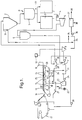
- this shows a hydrapulper 1 into which raw pulp is fed as indicated at P to be slushed with water from a combined backwater tank and centrifugal separator 2 (which is described in more detail below with reference to Figures 2 and 3).
- the pulp P fed to the hydrapulper 1 may be in the form of bales of dry papermaking pulp, or when the system is embodied in an integrated pulp and papermaking system, a pulp slurry fed from the pulping plant. Slushed pulp from the pulping plant is stored into stock chests 3 from which it is then withdrawn as required by a pump 4 and fed through refiners 5 to a small header chest 6.
- the slurry is withdrawn from the chest 6 by pump 8 through a valve 7 and fed to cyclone cleaners 9 to the headbox 10 of the papermachine.
- Slurry entering the pump 8 is reduced to an acceptable consistency for paper formation by the addition of high solids backwater, the source of which is described below, through the connection 11.
- a polyelectrolyte may be added from a supply 12 thereof as to improve retention of papermaking materials on the papermachine.
- Papermaking stock from the headbox 10 is laid down on a papermachine wire 13 and drained with the assistance of underwire foils 14 and vacuum boxes 15.
- the formed web 16 is then lifted from the wire and fed into the press section of the papermachine, the first press of which is shown at 17.
- sprays 19, utilising clean water are used to wash solids residues from the wire.
- Water withdrawn by drainage through the first set 20 of the foils 14 is drained directly into a high solids backwater tank 21.
- Vacuum is applied to the vacuum box 15 by a vacuum pump or exhauster 22 which applies vacuum through a vacuum separator 23.
- Water collected in the holding tank 23 is withdrawn by a pump 24 and fed into the backwater tank 21.
- Water drained from the set of foils 20 and from the vacuum boxes 15 has a relatively high solids content and is fed through the line 11 in order to adjust the consistency of the aqueous slurry being withdrawn from the header chest 6 by the pumps.
- Water from the second set 25 of foils 14 has a lower solids content and is allowed to drain directly into the machine pit 26.
- This water together with the wash water from the sprays 19 which collects in the machine pit 26 is passed to a medium solids backwater tank 28.
- Further water extracted from the sheet or derived from the felt washing sprays (not shown) in the first press 17 is withdrawn by a pump 29 and also fed to the medium solids backwater tank 28.
- Water collected in the hogpit 27 is derived from the sprays 32 immediately thereabove and has a high fibre content. This water is returned directly to the stock chests 3 through connection 33.
- the medium solids backwater collected in the tank 28 is withdrawn by a pump 30 and fed to the separator 2, the operation of which is described below with reference to Figures 2 and 3.
- Clarified water withdrawn from outlet 31 of the separator 2 is fed either to an effluent pit 34 or for reuse in the cleaner sprays 19, pump seals etc. in the process as indicated at 35.
- Water flowing to the effluent pit 34 is withdrawn by a pump 36 and fed to an effluent plant 37 of known kind. Clean water from the effluent plant may then be discharged to the environment through line 38 whilst residual solids are retained at 39 for disposal.
- the volume of residual solids is substantially less than in the same process in which a conventional backwater tank is used in place of the separator 2.
- the separator comprises a stainless steel circular tank 40 with a conical lower portion 41.
- the tank had a diameter of 4 metres and a capacity of the order of 30 m 3 .
- Incoming backwater was pumped from the medium solids backwater tank 28 into the outer zone of the separator through a pipe 42, the water discharge being tangential so as to produce a vortex with a slow liquid rotation at a minimum velocity of approximately 0.3 m/sec. as indicated by arrows 43 in Figure 3.
- a cylindrical baffle 46 extends downwards into the water in the tank and a weir 47 is provided in the form of an annular trough 48.
- the trough 48 has a lower wall 49, an outer side wall 50 and an inner annular wall 51, the upper edge 52 of which is below the upper level 53 of the liquid in the tank when it is full. Liquid escaping over the weir is indicated by arrows 54 and the clarified water is removed from the trough 48 by a pipe 55 which exists from the lower wall 49 of the trough.
- the lower portion 41 is conical but it could be dish-shaped or any other convenient shape which promotes the collection of solids.
- Operation of such apparatus was typically as follows. For a backwater separator of 30 m 3 capacity, the rate of flow of backwater from the papermachine to the separator was 80 m 3 /hour. The concentration of solids in the incoming backwater was measured at 165 mg/1 with the solids comprising cellulose fibre, kaolin and titanium dioxide. During a period of one hour, the pulper was filled twice with a total of 60 m 3 of backwater. Clarified water overflowed from the separator for 15 minutes flowing to waste and then to Effluent Treatment. The suspended solids present in the clarified water was measured and was found to be 40 mg/1. The backwater separator therefore functioned to reduce the solids in the waste water from 165 mg/1 to 40 mg/1. This represents a typical saving.
- Some papermaking machines employ a backwater silo. In such machines the separator of the present invention will be operated in place of this silo.
Landscapes
- Paper (AREA)
- Diaphragms For Electromechanical Transducers (AREA)
- Cyclones (AREA)
Claims (15)
- Verfahren zur Papierherstellung, welches die Aufbereitung eines Stoffes zur Papierherstellung und das Fördern dieses Stoffes zum Stoffauflaufkasten (10) einer Papiermaschine zum Weiterfördern auf einem Maschinensieb (13), sowie das Entwässern des Stoffes auf dem Sieb (13) und die Aufbereitung des auf diese Weise gewonnenen Rückwassers umfaßt, um eine erste Fraktion zu erhalten, welche einen höheren Feststoffgehalt aufweist, als eine zweite Fraktion,
dadurch gekennzeichnet,
daß man das Rückwasser zu einer Zentrifugal- und Sedimentations-Tiennvorrichtung (2) fördert, wobei diese Zentrifugal- und Sedimentations- Trennvorrichtung einen zur Umgebung hin offenen Behälter (40) umfaßt, in welchen das Rückwasser tangential eingeleitet wird, um eine langsame, einen einzigen Wirbel mit geringer Turbulenz bildende Umfangsdrehung zu erzeugen, um die Feststoffe zu veranlassen, zu einem äußeren, einer Umfangswandung des Behälters benachbarten Ringbereich zu wandern und sich in Richtung eines Bodens des Behälters abzusetzen, daß man die erste Fraktion von dem Boden des Behälters entnimmt und sie zur Verwendung bei der Aufbereitung des Stoffes zur Papierherstellung fördert, und daß man die zweite Fraktion aus der Mitte des einzigen Wirbels entnimmt und die zweite Fraktion zur Entsorgung oder zur Wiederverwendung als Prozeßwasser in dem Verfahren zur Papierherstellung ableitet. - Verfahren zur Papierherstellung nach Anspruch 1,
dadurch gekennzeichnet,
daß die Zentrifugal-Trennvorrichtung einen oberen zylindrischen
Abschnitt und einen unteren Abschnitt (41) umfaßt, welcher sich verjüngt oder schüsselförmig ist und welcher das tangentiale Einleiten der Flüssigkeit nahe einer äußeren Wand in dem oberen Abschnitt umfaßt, um so eine langsame, einen einzigen Wirbel mit geringer Turbulenz bildende Umfangsdrehung zu erzeugen, was dazu führt, daß die Feststoffe in der Flüssigkeit in dem der Wand benachbarten Ringbereich zurückgehalten und konzentriert werden und sich in Richtung des Bodens des unteren Abschnitts (41) absetzen. - Verfahren zur Papierherstellung nach Anspruch 1 oder 2,
dadurch gekennzeichnet,
daß es das Einführen des Wassers in die Zentrifugal-Trennvorrichtung umfaßt, zur Herbeiführung eines einzigen Wirbels mit langsamer Flüssigkeitsrotation bei einer Mindestgeschwindigkeit von 0,3 Metern/Sekunde. - Verfahren zur Papierherstellung nach einem der vorhergehenden Ansprüche 1 bis 3,
dadurch gekennzeichnet,
daß es das Einführen des Wassers in die Trennvorrichtung (2) bei einer Mindestgeschwindigkeit umfaßt, die gemäß der Formel
- Verfahren zur Papierherstellung nach einem der vorhergehenden Ansprüche 1 bis 4,
dadurch gekennzeichnet,
daß es umfaßt, daß die von den Feststoffen getrennte Flüssigkeit veranlaßt wird, nach innen und oben zu wandern, wo sie entnommen und direkt oder durch eine Abwasseranlage (37) zur Entsorgung, oder zur Wiederverwendung in dem Verfahren zur Papierherstellung abgeleitet wird. - Verfahren zur Papierherstellung nach einem der vorhergehenden Ansprüche 1 bis 5,
dadurch gekennzeichnet,
daß es umfaßt, die Fraktion mit einem höheren Feststoffgehalt einem Hydrapulper (1) zuzuführen. - Verfahren zur Papierherstellung nach Anspruch 6,
dadurch gekennzeichnet,
daß es die Verwendung der Zentrifugal- Trennvorrichtung (2) ais einen Rückwasserbehälter, und die Zuführung der Fraktion mit einem höheren Feststoffgehalt zu jeder neuen Zellstoffüllung, die in dem Hydrapulper (1) aufzuschlämmen ist, umfaßt. - Verfahren zur Papierstellung nach einem der vorhergehenden Ansprüche 1 bis 7,
dadurch gekennzeichnet,
daß es die Zugabe von Polyelektrolyten (12) zu dem Rückwasser umfaßt, welches der Zentrifugal-Trennvorrichtung (2) zugeführt wird, um das Ausflocken der Feststoffe zu erhöhen. - Verfahren zur Papierherstellung nach einem der vorangegangenen Ansprüche 1 bis 8,
dadurch gekennzeichnet,
daß es die Zugabe eines Ausflockungsmittels sowie von Luft zu dem einlaufenden Rückwasser oder weißem Wasser, welches der Zentrifugal-Trennvorrichtung (2) zugeführt wird, umfaßt. - Vorrichtung zur Papierherstellung, welche Mittel (1) zur Aufbereitung des Stoffes zur Papierherstellung, eine Papiermaschine, welche einen Stoffauflaufkasten (10) und ein Maschinensieb (13) aufweist, sowie Mittel zum Fördern des aufbereiteten Stoffes zu dem Stoffauflaufkasten (10) der Papiermaschine und Mittel zum Entfernen des durch das Maschinensieb (13) während der Entstehung einer Papierbahn (16) entzogenen Rückwassers, umfaßt,
gekennzeichnet durch,
Mittel zum Fördern des Rückwassers zu einer Zentrifugal- und Sedimentations-Trennvorrichtung (2), wobei diese Zentrifugal- und Sedimentations-Trennvorrichtung einen zur umgebung hin offenen Behälter (40) umfaßt, um eine erste Fraktion zu erzeugen, die einen höheren Feststoffgehalt hat, als eine zweite Fraktion, welche einen geringeren Feststoffgehalt hat, als die erste Fraktion, Mittel zum tangentialen Einleiten des Rückwasser in den Behälter (40), um eine langsame, einen einzigen Wirbel mit geringer Turbulenz bildende Umfangsdrehung zu erzeugen, um die Feststoffe in dem Wasser zu veranlassen, zu einem äußeren, einer äußeren Wandung des Behälters (40) benachbarten Ringbereich zu wandern und sich in Richtung des Bodens des Behälters abzusetzen, Mittel zum Fördern der ersten Fraktion von dem Boden des Behälters zu den Mitteln (1) zur Aufbereitung des Stoffes zur Papierherstellung, und Mittel zur Förderung der zweiten Fraktion aus der Mitte des einzigen Wirbels zur Entsorgung oder zur Wiederverwendung in dem Verfahren. - Vorrichtung nach Anspruch 10,
dadurch gekennzeichnet,
daß der Behälter einen oberen zylindrischen Abschnitt mit einer äußeren Wand, einen unteren Abschnitt (41) umfaßt, welcher sich verjüngt oder schüsselförmig ist, und Mittel zum tangentialen Einleiten des Rückwassers nahe der äußeren Wand in den oberen Abschnitt umfaßt. - Vorrichtung nach Anspruch 10 oder 11,
dadurch gekennzeichnet,
daß die Vorrichtung Mittel umfaßt, um die zweite Fraktion zu veranlassen nach innen und oben zu wandern, sowie Mittel (48,55) zur Entnahme und zur direkten Ableitung der zweiten Fraktion zur Entsorgung in eine Abwasseranlage (37), oder zur Wiederverwendung in dem Verfahren zur Papierherstellung. - Vorrichtung nach Anspruch 12,
dadurch gekennzeichnet,
daß die Vorrichtung Mittel zur Entnahme und zur Ableitung der zweiten Fraktion, einen in der Mitte des einzigen Wirbels angeordneten Überlauf (48) umfaßt, über welchen die Flüssigkeit aus dem Behälter (2) austreten kann. - Vorrichtung nach einem der vorhergehenden Ansprüche 10 bis 13, dadurch gekennzeichnet,
daß das Fassungsvermögen der Zentrifugal-und Sedimentations-
Trennvorrichtung (2) bezüglich der Fraktion mit dem hohen Feststoffanteil ausreichend ist, um genug Flüssigkeit bereitzuhalten, um als ein Rückwasserbehälter zu dienen, zur Beförderung der ersten Fraktion zu jeder neuen Zellstofffüllung , die in den Mitteln (1) zur Aufbereitung des Stoffes zur Papierherstellung aufzuschlämmen ist. - Vorrichtung nach einem der vorhergehenden Ansprüche 10 - 14,
dadurch gekennzeichnet,
daß die Mittel zur Aufbereitung des Papierstoffes einen Hydropulper (1) umfassen, zu welchem die erste Fraktion gefördert wird.
Applications Claiming Priority (2)
| Application Number | Priority Date | Filing Date | Title |
|---|---|---|---|
| GB939317817A GB9317817D0 (en) | 1993-08-27 | 1993-08-27 | Papermaking process and apparatus for use therewith |
| GB9317817 | 1993-08-27 |
Publications (2)
| Publication Number | Publication Date |
|---|---|
| EP0643164A1 EP0643164A1 (de) | 1995-03-15 |
| EP0643164B1 true EP0643164B1 (de) | 1997-11-26 |
Family
ID=10741113
Family Applications (1)
| Application Number | Title | Priority Date | Filing Date |
|---|---|---|---|
| EP94305938A Expired - Lifetime EP0643164B1 (de) | 1993-08-27 | 1994-08-11 | Verfahren zur Herstellung von Papier und damit verwendete Vorrichtung |
Country Status (12)
| Country | Link |
|---|---|
| EP (1) | EP0643164B1 (de) |
| JP (1) | JPH07207592A (de) |
| AT (1) | ATE160602T1 (de) |
| AU (1) | AU667015B2 (de) |
| BR (1) | BR9403343A (de) |
| CA (1) | CA2130712A1 (de) |
| DE (1) | DE69407007T2 (de) |
| FI (1) | FI114872B (de) |
| GB (2) | GB9317817D0 (de) |
| IE (1) | IE940642A1 (de) |
| NZ (1) | NZ264280A (de) |
| ZA (1) | ZA946261B (de) |
Cited By (5)
| Publication number | Priority date | Publication date | Assignee | Title |
|---|---|---|---|---|
| US6749721B2 (en) | 2000-12-22 | 2004-06-15 | Kimberly-Clark Worldwide, Inc. | Process for incorporating poorly substantive paper modifying agents into a paper sheet via wet end addition |
| US6916402B2 (en) | 2002-12-23 | 2005-07-12 | Kimberly-Clark Worldwide, Inc. | Process for bonding chemical additives on to substrates containing cellulosic materials and products thereof |
| US6984290B2 (en) | 2001-03-07 | 2006-01-10 | Kimberly-Clark Worldwide, Inc. | Method for applying water insoluble chemical additives with to pulp fiber |
| US7670459B2 (en) | 2004-12-29 | 2010-03-02 | Kimberly-Clark Worldwide, Inc. | Soft and durable tissue products containing a softening agent |
| US7749356B2 (en) | 2001-03-07 | 2010-07-06 | Kimberly-Clark Worldwide, Inc. | Method for using water insoluble chemical additives with pulp and products made by said method |
Families Citing this family (12)
| Publication number | Priority date | Publication date | Assignee | Title |
|---|---|---|---|---|
| FI117102B (fi) | 1996-05-23 | 2006-06-15 | Metso Paper Inc | Menetelmä paperikoneella sen vesikiertojen järjestämiseksi |
| FI971126A7 (fi) * | 1997-03-18 | 1998-09-19 | Valmet Corp | Paperikoneen perälaatikon laimennusveden käsittely- ja kiertojärjestelmä |
| US6423183B1 (en) | 1997-12-24 | 2002-07-23 | Kimberly-Clark Worldwide, Inc. | Paper products and a method for applying a dye to cellulosic fibers |
| FI110796B (fi) * | 2000-12-19 | 2003-03-31 | Metso Paper Inc | Menetelmä ilman poistamiseksi paperikoneen viiravesisäiliöstä ja vastaava viiravesisäiliö |
| DE102006034186A1 (de) * | 2006-07-24 | 2008-01-31 | Siemens Ag | Einrichtung zur Papierherstellung, insbesondere Altpapier |
| FR2918678A1 (fr) * | 2007-07-13 | 2009-01-16 | Arjowiggins Licensing Soc Par | Procede de traitement des eaux blanches provenant d'une machine de type machine a papier |
| DE102011002751A1 (de) * | 2011-01-17 | 2012-07-19 | Voith Patent Gmbh | Papiermaschine |
| KR101330831B1 (ko) * | 2011-12-30 | 2013-11-18 | 김용철 | 절전형 펄프 회수장치 |
| JP6042161B2 (ja) * | 2012-10-04 | 2016-12-14 | 有限会社エムエスエンジニアリング | 固液分離装置 |
| CN104562825B (zh) * | 2013-10-18 | 2017-06-13 | 上海东冠纸业有限公司 | 一种高效的白水盘排污装置 |
| WO2016041773A1 (de) * | 2014-09-18 | 2016-03-24 | Voith Patent Gmbh | Verfahren und vorrichtung zur herstellung eines vliesstoffes |
| CN106758476B (zh) * | 2017-03-21 | 2018-03-09 | 李飞 | 一种制浆造纸白水的封闭循环系统及处理方法 |
Family Cites Families (8)
| Publication number | Priority date | Publication date | Assignee | Title |
|---|---|---|---|---|
| GB1053496A (de) * | 1900-01-01 | |||
| GB280456A (en) * | 1927-05-30 | 1927-11-17 | John Stanley Hancock | Improved method of and means for preparing a wet mixture of fibre and cementitious material |
| GB526866A (en) * | 1939-03-27 | 1940-09-26 | August Reiss | Improvements in and relating to treatment of waste water in the manufacture of paper |
| US3415253A (en) * | 1967-01-13 | 1968-12-10 | Philip Morris Inc | Process for manufacturing reconstituted tobacco sheet material in a substantially closed system |
| CH560651A5 (de) * | 1973-10-04 | 1975-04-15 | Stoecklin & Cie | |
| SE448889B (sv) * | 1985-11-06 | 1987-03-23 | Sunds Defibrator | Sett for behandling av returpapper |
| DE68914666T2 (de) * | 1989-10-10 | 1994-08-18 | Nils Anders Lennart Wikdahl | Verfahren und Vorrichtung zur Herstellung eines Cellulosebreis von verbesserter Qualität. |
| US5196090A (en) * | 1989-11-03 | 1993-03-23 | Glauco Corbellini | Method for recovering pulp solids from whitewater using a siphon |
-
1993
- 1993-08-27 GB GB939317817A patent/GB9317817D0/en active Pending
-
1994
- 1994-08-11 AT AT94305938T patent/ATE160602T1/de not_active IP Right Cessation
- 1994-08-11 GB GB9416214A patent/GB2281319B/en not_active Expired - Lifetime
- 1994-08-11 EP EP94305938A patent/EP0643164B1/de not_active Expired - Lifetime
- 1994-08-11 DE DE69407007T patent/DE69407007T2/de not_active Expired - Fee Related
- 1994-08-15 IE IE940642A patent/IE940642A1/en not_active IP Right Cessation
- 1994-08-17 AU AU70314/94A patent/AU667015B2/en not_active Ceased
- 1994-08-18 ZA ZA946261A patent/ZA946261B/xx unknown
- 1994-08-19 NZ NZ264280A patent/NZ264280A/en unknown
- 1994-08-23 CA CA002130712A patent/CA2130712A1/en not_active Abandoned
- 1994-08-24 FI FI943895A patent/FI114872B/fi not_active IP Right Cessation
- 1994-08-26 BR BR9403343A patent/BR9403343A/pt not_active Application Discontinuation
- 1994-08-29 JP JP6227259A patent/JPH07207592A/ja active Pending
Cited By (7)
| Publication number | Priority date | Publication date | Assignee | Title |
|---|---|---|---|---|
| US6749721B2 (en) | 2000-12-22 | 2004-06-15 | Kimberly-Clark Worldwide, Inc. | Process for incorporating poorly substantive paper modifying agents into a paper sheet via wet end addition |
| US7678232B2 (en) | 2000-12-22 | 2010-03-16 | Kimberly-Clark Worldwide, Inc. | Process for incorporating poorly substantive paper modifying agents into a paper sheet via wet end addition |
| US6984290B2 (en) | 2001-03-07 | 2006-01-10 | Kimberly-Clark Worldwide, Inc. | Method for applying water insoluble chemical additives with to pulp fiber |
| US7749356B2 (en) | 2001-03-07 | 2010-07-06 | Kimberly-Clark Worldwide, Inc. | Method for using water insoluble chemical additives with pulp and products made by said method |
| US7993490B2 (en) | 2001-03-07 | 2011-08-09 | Kimberly-Clark Worldwide, Inc. | Method for applying chemical additives to pulp during the pulp processing and products made by said method |
| US6916402B2 (en) | 2002-12-23 | 2005-07-12 | Kimberly-Clark Worldwide, Inc. | Process for bonding chemical additives on to substrates containing cellulosic materials and products thereof |
| US7670459B2 (en) | 2004-12-29 | 2010-03-02 | Kimberly-Clark Worldwide, Inc. | Soft and durable tissue products containing a softening agent |
Also Published As
| Publication number | Publication date |
|---|---|
| BR9403343A (pt) | 1995-08-08 |
| ZA946261B (en) | 1995-07-05 |
| IE940642A1 (en) | 1995-03-08 |
| DE69407007T2 (de) | 1998-04-16 |
| GB2281319B (en) | 1997-03-05 |
| FI943895A0 (fi) | 1994-08-24 |
| FI114872B (fi) | 2005-01-14 |
| EP0643164A1 (de) | 1995-03-15 |
| GB9416214D0 (en) | 1994-10-05 |
| NZ264280A (en) | 1995-10-26 |
| GB9317817D0 (en) | 1993-10-13 |
| FI943895L (fi) | 1995-02-28 |
| AU7031494A (en) | 1995-03-09 |
| CA2130712A1 (en) | 1995-02-28 |
| AU667015B2 (en) | 1996-02-29 |
| JPH07207592A (ja) | 1995-08-08 |
| ATE160602T1 (de) | 1997-12-15 |
| GB2281319A (en) | 1995-03-01 |
| DE69407007D1 (de) | 1998-01-08 |
Similar Documents
| Publication | Publication Date | Title |
|---|---|---|
| AU667015B2 (en) | Papermaking process and apparatus for use therewith | |
| CA2682652C (en) | An apparatus for removing gas in connection with a paper machine or corresponding | |
| US5626718A (en) | Use of polymers in the recycled fiber washing/deinking process | |
| US4983258A (en) | Conversion of pulp and paper mill waste solids to papermaking pulp | |
| US5137599A (en) | Conversion of pulp and paper mill sludge to papermaking pulp | |
| Krofta et al. | Total closing of paper mills with reclamation and deinking installations | |
| US3833468A (en) | System for recovery of fiber from paper mill effluent, including a sieve bend screen | |
| EP1126076B1 (de) | Verfahren und Vorrichtung zur Halbstoffreinigung | |
| AR010648A1 (es) | Un metodo para fabricar productos sanitarios de papel a partir de periodicos reciclados | |
| US3538680A (en) | Papermaking apparatus and process | |
| US3884755A (en) | Closed cycle paper sheet production | |
| CA2089078C (en) | Method and apparatus for stabilizing and simplifying an approach flow system for a paper-making machine | |
| FI108304B (fi) | Menetelmä ja laitteisto mineraalipitoisen kuitususpension kuten päällystetyn hylyn käsittelyyn paperin valmistuksessa | |
| US5679221A (en) | Method for aluminum reduction in recycled pulp and paper | |
| EP0786030B1 (de) | Zellstoffwaschen mittels eines endlosen trägergewebes | |
| US4863107A (en) | Process and a device for removing foreign solids from pulpers | |
| CN109208372A (zh) | 一种废纸制浆过程精筛渣的回收方法 | |
| JP2766734B2 (ja) | 繊維分級装置付の白水回収システム | |
| WO1996011297A9 (en) | Washing pulp using an endless support fabric | |
| Shammas et al. | Completely closed water systems in paper mills | |
| EP1010804B1 (de) | Verfahren und Vorrichtung zur Behandlung von Ausschuss | |
| EP0398846A2 (de) | Deinkungsvorrichtung in der Partie mit konstanter Dichte einer Papierherstellungsanlage | |
| Holik | Stock preparation | |
| CA2095342A1 (en) | Method and apparatus for removing ink from waste paper material | |
| Evans | Century-old board mill operates with zero effluent discharge |
Legal Events
| Date | Code | Title | Description |
|---|---|---|---|
| PUAI | Public reference made under article 153(3) epc to a published international application that has entered the european phase |
Free format text: ORIGINAL CODE: 0009012 |
|
| AK | Designated contracting states |
Kind code of ref document: A1 Designated state(s): AT BE CH DE DK ES FR IT LI NL PT SE |
|
| 17P | Request for examination filed |
Effective date: 19950511 |
|
| 17Q | First examination report despatched |
Effective date: 19961122 |
|
| GRAG | Despatch of communication of intention to grant |
Free format text: ORIGINAL CODE: EPIDOS AGRA |
|
| GRAH | Despatch of communication of intention to grant a patent |
Free format text: ORIGINAL CODE: EPIDOS IGRA |
|
| GRAH | Despatch of communication of intention to grant a patent |
Free format text: ORIGINAL CODE: EPIDOS IGRA |
|
| GRAA | (expected) grant |
Free format text: ORIGINAL CODE: 0009210 |
|
| AK | Designated contracting states |
Kind code of ref document: B1 Designated state(s): AT BE CH DE DK ES FR IT LI NL PT SE |
|
| PG25 | Lapsed in a contracting state [announced via postgrant information from national office to epo] |
Ref country code: LI Free format text: LAPSE BECAUSE OF FAILURE TO SUBMIT A TRANSLATION OF THE DESCRIPTION OR TO PAY THE FEE WITHIN THE PRESCRIBED TIME-LIMIT Effective date: 19971126 Ref country code: ES Free format text: THE PATENT HAS BEEN ANNULLED BY A DECISION OF A NATIONAL AUTHORITY Effective date: 19971126 Ref country code: DK Free format text: LAPSE BECAUSE OF NON-PAYMENT OF DUE FEES Effective date: 19971126 Ref country code: CH Free format text: LAPSE BECAUSE OF FAILURE TO SUBMIT A TRANSLATION OF THE DESCRIPTION OR TO PAY THE FEE WITHIN THE PRESCRIBED TIME-LIMIT Effective date: 19971126 Ref country code: BE Free format text: LAPSE BECAUSE OF FAILURE TO SUBMIT A TRANSLATION OF THE DESCRIPTION OR TO PAY THE FEE WITHIN THE PRESCRIBED TIME-LIMIT Effective date: 19971126 Ref country code: AT Free format text: LAPSE BECAUSE OF FAILURE TO SUBMIT A TRANSLATION OF THE DESCRIPTION OR TO PAY THE FEE WITHIN THE PRESCRIBED TIME-LIMIT Effective date: 19971126 |
|
| REF | Corresponds to: |
Ref document number: 160602 Country of ref document: AT Date of ref document: 19971215 Kind code of ref document: T |
|
| ITF | It: translation for a ep patent filed | ||
| REG | Reference to a national code |
Ref country code: CH Ref legal event code: EP |
|
| RAP2 | Party data changed (patent owner data changed or rights of a patent transferred) |
Owner name: ARJO WIGGINS FINE PAPERS LIMITED |
|
| REF | Corresponds to: |
Ref document number: 69407007 Country of ref document: DE Date of ref document: 19980108 |
|
| ET | Fr: translation filed | ||
| NLT2 | Nl: modifications (of names), taken from the european patent patent bulletin |
Owner name: ARJO WIGGINS FINE PAPERS LIMITED |
|
| PG25 | Lapsed in a contracting state [announced via postgrant information from national office to epo] |
Ref country code: PT Free format text: LAPSE BECAUSE OF FAILURE TO SUBMIT A TRANSLATION OF THE DESCRIPTION OR TO PAY THE FEE WITHIN THE PRESCRIBED TIME-LIMIT Effective date: 19980226 |
|
| REG | Reference to a national code |
Ref country code: CH Ref legal event code: PL |
|
| PLBE | No opposition filed within time limit |
Free format text: ORIGINAL CODE: 0009261 |
|
| STAA | Information on the status of an ep patent application or granted ep patent |
Free format text: STATUS: NO OPPOSITION FILED WITHIN TIME LIMIT |
|
| 26N | No opposition filed | ||
| PGFP | Annual fee paid to national office [announced via postgrant information from national office to epo] |
Ref country code: NL Payment date: 20080718 Year of fee payment: 15 Ref country code: DE Payment date: 20080725 Year of fee payment: 15 |
|
| PGFP | Annual fee paid to national office [announced via postgrant information from national office to epo] |
Ref country code: SE Payment date: 20080716 Year of fee payment: 15 |
|
| REG | Reference to a national code |
Ref country code: NL Ref legal event code: V1 Effective date: 20100301 |
|
| PG25 | Lapsed in a contracting state [announced via postgrant information from national office to epo] |
Ref country code: NL Free format text: LAPSE BECAUSE OF NON-PAYMENT OF DUE FEES Effective date: 20100301 Ref country code: DE Free format text: LAPSE BECAUSE OF NON-PAYMENT OF DUE FEES Effective date: 20100302 |
|
| PG25 | Lapsed in a contracting state [announced via postgrant information from national office to epo] |
Ref country code: SE Free format text: LAPSE BECAUSE OF NON-PAYMENT OF DUE FEES Effective date: 20090812 |
|
| PGFP | Annual fee paid to national office [announced via postgrant information from national office to epo] |
Ref country code: FR Payment date: 20130902 Year of fee payment: 20 |
|
| PGFP | Annual fee paid to national office [announced via postgrant information from national office to epo] |
Ref country code: IT Payment date: 20130808 Year of fee payment: 20 |