EP0643331A2 - Masque à décalage de phase en demi-teinte, masque à décalage de phase vierge en demi-teinte et méthode de fabrication du masque vierge - Google Patents
Masque à décalage de phase en demi-teinte, masque à décalage de phase vierge en demi-teinte et méthode de fabrication du masque vierge Download PDFInfo
- Publication number
- EP0643331A2 EP0643331A2 EP94112836A EP94112836A EP0643331A2 EP 0643331 A2 EP0643331 A2 EP 0643331A2 EP 94112836 A EP94112836 A EP 94112836A EP 94112836 A EP94112836 A EP 94112836A EP 0643331 A2 EP0643331 A2 EP 0643331A2
- Authority
- EP
- European Patent Office
- Prior art keywords
- chromium
- phase shift
- halftone phase
- layer
- atoms
- Prior art date
- Legal status (The legal status is an assumption and is not a legal conclusion. Google has not performed a legal analysis and makes no representation as to the accuracy of the status listed.)
- Granted
Links
Images







Classifications
-
- G—PHYSICS
- G03—PHOTOGRAPHY; CINEMATOGRAPHY; ANALOGOUS TECHNIQUES USING WAVES OTHER THAN OPTICAL WAVES; ELECTROGRAPHY; HOLOGRAPHY
- G03F—PHOTOMECHANICAL PRODUCTION OF TEXTURED OR PATTERNED SURFACES, e.g. FOR PRINTING, FOR PROCESSING OF SEMICONDUCTOR DEVICES; MATERIALS THEREFOR; ORIGINALS THEREFOR; APPARATUS SPECIALLY ADAPTED THEREFOR
- G03F1/00—Originals for photomechanical production of textured or patterned surfaces, e.g., masks, photo-masks, reticles; Mask blanks or pellicles therefor; Containers specially adapted therefor; Preparation thereof
- G03F1/26—Phase shift masks [PSM]; PSM blanks; Preparation thereof
- G03F1/32—Attenuating PSM [att-PSM], e.g. halftone PSM or PSM having semi-transparent phase shift portion; Preparation thereof
-
- G—PHYSICS
- G03—PHOTOGRAPHY; CINEMATOGRAPHY; ANALOGOUS TECHNIQUES USING WAVES OTHER THAN OPTICAL WAVES; ELECTROGRAPHY; HOLOGRAPHY
- G03F—PHOTOMECHANICAL PRODUCTION OF TEXTURED OR PATTERNED SURFACES, e.g. FOR PRINTING, FOR PROCESSING OF SEMICONDUCTOR DEVICES; MATERIALS THEREFOR; ORIGINALS THEREFOR; APPARATUS SPECIALLY ADAPTED THEREFOR
- G03F1/00—Originals for photomechanical production of textured or patterned surfaces, e.g., masks, photo-masks, reticles; Mask blanks or pellicles therefor; Containers specially adapted therefor; Preparation thereof
- G03F1/26—Phase shift masks [PSM]; PSM blanks; Preparation thereof
Definitions
- the present invention relates to a photomask used for producing integrated circuits of high integration density, e.g., large-scale integrated circuits (LSI), very large-scale integrated circuits (VLSI), etc., and to a photomask blank used to produce the photomask.
- the present invention also relates to a method of producing the photomask blank. More particularly, the present invention relates to a halftone phase shift photomask whereby a projected image of very small size can be obtained, and also to a halftone phase shift photomask blank for producing the halftone phase shift photomask. Further, the present invention relates to a method of producing the halftone phase shift photomask blank.
- phase shift photomasks are produced by repeating lithography processes using photomasks.
- IC integrated circuits
- LSI LSI
- VLSI etc.
- phase shift photomasks having various arrangements have been proposed.
- halftone phase shift photomask such as is disclosed in Japanese Patent Application Laid-Open (KOKAI) No. 4-136854 (1992), U.S. Patent No.
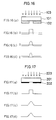
- Figs. 16(a) to 16(d) show the principle of the halftone phase shift lithography
- Figs. 17(a) to 17(d) show a conventional lithography method
- Figs. 16(a) and 17(a) are sectional views showing photomasks.
- Figs. 16(b) and 17(b) each show the amplitude of light on the photomask.
- Figs. 16(c) and 17(c) each show the amplitude of light on a wafer.
- Figs. 16(d) and 17(d) each show the light intensity on the wafer.
- Reference numerals 101 and 201 denote substrates, and 202 a 100% light-blocking film.
- a semitransparent film 102 shifts the phase of incident light through substantially 180 o and has a transmittance of 1% to 50%.
- Reference numerals 103 and 203 denote incident light.
- the 100% light-blocking film 202 which is made of chromium, for example, is formed on the substrate 201, which is made of quartz (fused silica), for example, and the light-blocking film 202 is merely formed with a light-transmitting portion in a desired pattern. Accordingly, the light intensity distribution on the wafer has a gentle slope, as shown in Fig. 17(d).
- the resolution is degraded.
- the light passing through the semitransparent film 102 and the light passing through the opening in the film 102 are in substantially inverse relation to each other in terms of phase. Accordingly, the light intensity at the pattern boundary portion on the wafer is 0, as shown in Fig. 16(d). Thus, it is possible to prevent the light intensity distribution from exhibiting a gentle slope. Accordingly, the resolution can be improved.
- phase shift lithography process of a type other than the halftone phase shift lithography requires at least two photoengraving processes to produce a mask pattern because the light-blocking film and the phase shifter film have different patterns, whereas the halftone phase shift lithography essentially requires only one photoengraving process because it involves only one pattern; this is a great advantage of the halftone phase shift lithography.
- the semitransparent film 102 of the halftone phase shift photomask is demanded to perform two functions, that is, phase inversion and transmittance control.
- the phase inversion function the semitransparent film 102 should be arranged such that exposure light passing through the halftone phase shift portion and exposure light passing through the opening in the film 102 are in substantially inverse relation to each other in terms of phase. If the semitransparent film 102 is treated as an absorbing film which is shown in M. Born, E. Wolf "Principles of Optics", pp.628-632, for example, multiple interference can be neglected.
- phase shift effect is obtained when ⁇ falls within the range of n ⁇ /3 radians (n is an odd integer).
- the transmittance for exposure light of the halftone phase shift portion that is most suitable for obtaining the halftone phase shift effect is determined by the size, area, layout, configuration, etc., of the transfer pattern. That is, the optimal transmittance varies with each particular transfer pattern. Practically, it is necessary in order to obtain the halftone phase shift effect to set the exposure light transmittance of the halftone phase shift portion within the range of optimal transmittance (determined by each transfer pattern) ⁇ several %. In general, the optimal transmittance varies in a wide range, i.e., from 1% to 50%, according to transfer patterns, when the transmittance at the opening of the halftone phase shift layer is assumed to be 100%. That is, halftone phase shift masks having various levels of transmittance are demanded in order to deal with various patterns.
- the phase inversion function and transmittance control function are determined by the complex index of refraction (refractive index and extinction coefficient) of a substrate material and a material constituting a halftone phase shift film (a material constituting each layer, in the case of a multilayer film) and the film thickness. That is, a material usable as a halftone phase shift layer of a halftone phase shift photomask is required to have a transmittance for exposure light in the range of from 1% to 50% when the halftone phase shift film is formed on a substrate with the film thickness controlled so that the phase difference ⁇ obtained by the above equation (1) falls within the range of n ⁇ /3 radians (n is an odd integer).
- films which are composed mainly of a chromium compound are known, as disclosed, for example, in Japanese Patent Application Laid-Open (KOKAI) No. 5-127361 (1993).
- the films composed mainly of a chromium compound are chromium oxide, chromium nitride, chromium oxide nitride, chromium oxide carbide, and chromium oxide carbide nitride, and the transmittances for exposure light of these films largely depend on the wavelength of exposure light.
- Fig. 18 shows a spectral transmittance curve of a chromium oxide film formed on a synthetic quartz substrate by reactive sputtering in an oxygen atmosphere using a chromium target.
- the thickness of the chromium oxide film is about 50 nm.
- a halftone phase shift photomask that uses the chromium oxide film as a halftone phase shifter layer can be used for exposure at the g-line (436 nm) and i-line (365 nm) of a super-high pressure mercury lamp, but cannot be used for exposure using krypton fluoride excimer laser light (248 nm), whereby higher resolution can be realized, because the transmittance is excessively low.
- the chromium nitride, chromium oxide nitride, chromium oxide carbide and chromium oxide carbide nitride films cannot be used for exposure using krypton fluoride excimer laser light and are therefore impossible to use for high-resolution lithography.
- the object of the present invention is to provide a halftone phase shift photomask having a sufficiently high transmittance for light of short wavelength and usable for high-resolution lithography effected by exposure using deep-ultraviolet radiation, e.g., krypton fluoride excimer laser light, and also provide a blank used to produce the halftone phase shift photomask.
- deep-ultraviolet radiation e.g., krypton fluoride excimer laser light
- the present inventors conducted exhaustive studies in order to develop a halftone phase shift material having a transmittance falling within a range in which it is usable as a halftone phase shift layer when formed into a film having a thickness at which the phase of deep-ultraviolet light, e.g., krypton fluoride excimer laser light, is inverted. As a result, we accomplished the present invention.
- deep-ultraviolet light e.g., krypton fluoride excimer laser light
- the present invention relates to a halftone phase shift photomask having a halftone phase shift layer which includes at least one layer composed mainly of a chromium compound containing at least fluorine atoms, and a blank used to produce the halftone phase shift photomask, and also relates to a method of producing the halftone phase shift photomask blank.
- a film which is composed mainly of a chromium compound containing fluorine atoms is superior in the transmittance in the short wavelength region to the conventional film composed mainly of chromium oxide, chromium nitride, chromium oxide nitride, chromium oxide carbide, or chromium oxide carbide nitride, which contains no fluorine atoms.
- the refractive index and extinction coefficient for exposure light of a film that constitutes a halftone phase shift layer are obtained, for example, by ellipsometry, and the film is adjusted so that the transmittance of the film when formed on a transparent substrate to a thickness adequate to invert the phase of exposure light, which is obtained from the above equation (1), is equal to the optimal transmittance determined by the relevant transfer pattern and so forth.
- the conventional film composed mainly of chromium oxide, chromium nitride, chromium oxide nitride, chromium oxide carbide, or chromium oxide carbide nitride, which contains no fluorine atoms, cannot be used as a halftone phase shift layer because the transmittance at the film thickness adequate for phase inversion is excessively low.
- the chromium compound containing fluorine atoms according to the present invention varies in refractive index and extinction coefficient according to the proportions of fluorine atoms and other atoms contained.
- the composition of the chromium compound can be adjusted so that the transmittance for exposure light at a film thickness adequate for phase inversion is equal to the optimal transmittance required.
- the chromium compound film may be used as a halftone phase shift layer in the form of a single layer.
- the arrangement may be such that a chromium compound film is first formed so that the transmittance for exposure light is higher than is required, and then a light-blocking layer is stacked thereon to adjust the transmittance within the range in which the phase inversion function is not impaired.
- the halftone phase shift photomask and halftone phase shift photomask blank of the present invention in which a chromium compound containing fluorine atoms is used as a halftone phase shift layer, have an advantage in that the transmittance for exposure light can be changed by heating them to 150 o C or higher in the air or a vacuum after the production thereof.
- the transmittance for exposure light can also be changed by exposing them to an oxidizing atmosphere, e.g., air, water vapor, etc., or a reducing atmosphere, e.g., hydrogen. In these cases, the transmittance for exposure light can be changed even more effectively by exposing the photomask or the blank to the plasma of a gas such as is described above.
- the chromium compound containing fluorine atoms according to the present invention can be formed by using a conventional thin-film forming technique, e.g., sputtering, vacuum deposition, ion plating, etc.
- a target composed mainly of metal chromium with or without a fluorinated surface is used, and film formation by sputtering is effected by inducing DC or RF electric discharge in an atmosphere which contains only a sputter gas, e.g., argon, neon, xenon, helium, nitrogen, etc., or a combination of such a sputter gas and a fluorine source gas, e.g., fluorine, carbon tetrafluoride, sulfur hexafluoride, nitrogen trifluoride, chlorine trifluoride, etc.
- a sputter gas e.g., argon, neon, xenon, helium, nitrogen, etc.
- fluorine source gas e.g., fluorine, carbon tetrafluoride, sulfur hexafluoride, nitrogen trifluoride, chlorine trifluoride, etc.
- the atmosphere may be mixed with an oxygen, nitrogen or carbon source gas, e.g., oxygen, nitrogen or carbon dioxide gas.
- an oxygen, nitrogen or carbon source gas e.g., oxygen, nitrogen or carbon dioxide gas.
- the refractive index and extinction coefficient of the resulting film can be controlled by changing film forming conditions such as the composition of the atmosphere gas, pressure, sputter power, etc. to thereby change the composition, texture, structure, etc. of the film.
- metal chromium or prefluorinated chromium is used as an evaporation source, and vacuum evaporation is carried out by either the resistance heating method using a tungsten basket, a tungsten-plated coil or boat, a carbon crucible, etc., or the EB (Electron Beam) evaporation method by irradiation with electron rays.
- EB Electro Beam
- the vacuum evaporation is an atmosphere which contains a fluorine source gas, i.e., fluorine, carbon tetrafluoride or other carbon fluoride compound, sulfur hexafluoride or other sulfur fluoride compound, nitrogen trifluoride, chlorine trifluoride, etc.
- a fluorine source gas i.e., fluorine, carbon tetrafluoride or other carbon fluoride compound, sulfur hexafluoride or other sulfur fluoride compound, nitrogen trifluoride, chlorine trifluoride, etc.
- the fluorine source gas may be mixed with an oxygen, nitrogen or carbon source gas, e.g., oxygen, nitrogen or carbon dioxide gas.
- the refractive index and extinction coefficient of the resulting film can be controlled by changing the evaporation conditions to thereby change the composition, texture, structure, etc. of the film.
- metal chromium or prefluorinated chromium is used an evaporation source, and a fluorine source gas, e.g., fluorine, carbon tetrafluoride, sulfur hexafluoride, nitrogen trifluoride, chlorine trifluoride, etc. is used to form an atmosphere.
- a fluorine source gas e.g., fluorine, carbon tetrafluoride, sulfur hexafluoride, nitrogen trifluoride, chlorine trifluoride, etc.
- the fluorine source gas may be mixed with an oxygen, nitrogen or carbon source gas, e.g., oxygen, nitrogen or carbon dioxide gas.
- the refractive index and extinction coefficient of the resulting film can be controlled by changing the film forming conditions.
- the optical constant of the film is determined by the content of fluorine and other component, as described above. Therefore, it is important to precisely control the composition of the film in order to obtain a halftone phase shift photomask of high accuracy. It is rare for a stoichiometrically stable compound to fulfill both the phase inversion function and the transmittance control function. Therefore, it is generally demanded to form a film of an intermediate compound. Accordingly, the present invention also provides a novel method of forming a film of such an intermediate compound with a desired composition and at high accuracy.
- the method of producing a chromium compound containing fluorine atoms according to the present invention is a thin-film forming method in which chromium is evaporated in a vacuum chamber and deposited on a transparent substrate for a photomask.
- the evaporated chromium is allowed to react with fluorine atoms before being deposited on the substrate.
- the reaction of chromium with fluorine atoms is carried out by allowing the evaporated chromium to pass through the plasma of a gas containing fluorine atoms.
- the chromium evaporation source may be either pure metal chromium or a chromium compound.
- Preferable methods for evaporating the chromium evaporation source are bombardment with accelerated electrons by an electron gun and bombardment with ions by an ion gun. It is also possible to employ resistance heating using a coil or a boat.
- the above-described plasma may be generated by applying a capacitance- or inductively-coupled RF electric field to a space where a gas containing fluorine atoms has previously been introduced.
- the plasma may also be generated by using a DC electric field.
- a gas ionized by an ion gun is supplied to the space where a gas containing fluorine atoms has previously been introduced, or a method wherein a gas containing fluorine atoms is ionized by an ion gun before being introduced into the space.
- the gas containing fluorine atoms it is possible to use fluorine, a carbon fluoride gas, sulfur hexafluoride, nitrogen trifluoride, chlorine trifluoride, etc.
- a fluorine atom-containing chromium compound film having a uniform thickness and a desired composition by generating chromium particles from a chromium target by sputtering and further generating a plasma from a fluorine atom-containing gas by an ion gun.
- the optical constant of the compound film formed by the film forming method can be controlled by controlling the reaction taking place in the above-described plasma space, i.e., the quantity of chromium to be evaporated, the flow rate of the fluorine atom-containing gas, pressure, and the electric power applied for generation of plasma. Since the configuration of the reaction space, the gas introducing method and other characteristics of a system used for the film formation also have effects on the optical characteristics of the film formed, it is preferable to properly set reaction conditions by taking into consideration the characteristics of the system. It is also possible to heat the substrate on which the chromium compound containing fluorine atoms is to be deposited.
- the above-described method of producing a chromium compound containing fluorine atoms enables a desired composition to be accurately realized even in an intermediate state which is not stoichiometrically stable, and hence makes it possible to form halftone phase shift films having various optical constants.
- the method also has an advantage in that it is possible to readily obtain a film reduced in the residual stress and improved in the adhesion to the substrate. In addition, the deposition rate is also satisfactory for practical use.
- the present invention has been explained with regard to a single-layer film of a chromium fluoride compound, it should be noted that the present invention is similarly applicable to a halftone phase shift photomask and a halftone phase shift photomask blank, in which the halftone phase shift layer has a multilayer structure.
- a chromium compound film containing fluorine atoms formed by the method of the present invention is used as a halftone phase shift layer in the form of a single layer, it can be patterned by approximately the same method as that used for the chromium light-blocking film of the conventional photomask because the chromium compound film in the present invention has chromium atoms as the matrix.
- Films are formed on a satisfactorily cleaned silicon wafer with the argon gas/carbon tetrafluoride gas flow rate ratio varied. Then, the refractive index and extinction coefficient of each film are measured with a commercially available spectroellipsometer. Further, a film thickness required for shifting the phase of exposure light through 180 o is calculated with regard to exposure process using, for example, krypton fluoride excimer laser light (wavelength: 248 nm), and a synthetic quartz substrate. If the transmittance for exposure light of the film when actually formed to the calculated thickness on the synthetic quartz substrate for a photomask falls within the range of from 1% to 50%, the film can be used as a halftone phase shift film.
- Fig. 8 shows the results of measurement of the refractive index and extinction coefficient at the wavelength 250 nm for various argon gas/carbon tetrafluoride gas flow rate ratios: 100:0, 90:10, 80:20, 78:22, 76:24, 74:26, 72:28, and 65:35.
- an ordinary planar DC magnetron sputtering system was used, and the film formation was carried out under the conditions that the gas pressure was 4.0 mTorr; the overall gas flow rate of the argon gas and the carbon tetrafluoride gas was 100 sccm; and the sputter current density was 0.01 A/cm2.
- ES-4G manufactured by Sopra
- software MOSS manufactured by Sopra
- Fig. 9 shows the film thickness required to shift the phase of exposure light of 250 nm through 180 o , which is obtained from the above equation (1), for various gas flow rate ratios. It will be understood from the figure that although the required film thickness varies with the gas flow rate ratio, the phase of exposure light of wavelength 250 nm is inverted at the film thickness range of from 120 nm to 220 nm.
- Fig. 10 shows the transmittance for light (250 nm) of a film formed to about 170 nm on a synthetic quartz substrate for a photomask of 90 mil in thickness for each gas flow rate ratio.
- a spectrophotometer HP8450A, manufactured by Hewlett-Packard Co.
- HP8450A manufactured by Hewlett-Packard Co.
- a fluorine atom-containing chromium compound film usable as a halftone phase shift layer is obtained when the argon gas/carbon tetrafluoride gas flow rate ratio is in a region where the proportion of the carbon tetrafluoride gas flow rate is higher than at least 10%.
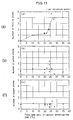
- Figs. 11(a) to 11(c) show the composition ratios of chromium, fluorine, carbon and oxygen in the film for each flow rate ratio, measured by X-ray photoelectron spectroscopy (XPS).
- XPS X-ray photoelectron spectroscopy
- the film was analyzed into chromium, fluorine, carbon, and oxygen.
- Figs. 11(a), 11(b) and 11(c) respectively show the numbers of fluorine, carbon and oxygen atoms existing per 100 chromium atoms.
- the X-ray photoelectron spectroscopy was carried out under the conditions described later. As will be clear from Figs.
- the transmittance for exposure light at which phase inversion takes place becomes higher.
- an exposure light transmittance in the range of from 1% to 50% is required to obtain the halftone phase shift effect.
- the fluorine atom content in the film it is particularly necessary for the fluorine atom content in the film to be at least 100 fluorine atoms per 100 chromium atoms. If the number of fluorine atoms is smaller than 100 per 100 chromium atoms, the resulting film is a light-blocking film close to a metal film, as will be clear from Figs. 10 and 11(a).
- a film containing 350 or more fluorine atoms per 100 chromium atoms cannot provide the halftone phase shift effect in this state, but it can be used as a halftone phase shift film if it is combined with a film having high light-blocking properties within the range in which the amount of phase shift is not substantially changed.
- Figs. 11(b) and 11(c) there is no clear correlation between carbon and oxygen atoms and the halftone phase shift function as is observed in the case of fluorine atoms.
- the chromium compound film formed under the above-described conditions contains not more than 250 carbon atoms and not more than 150 oxygen atoms per 100 chromium atoms, as shown in Figs. 11(b) and 11(c).
- no clear relation can be found between the carbon and oxygen atom contents and the characteristics required for the halftone phase shift film as is recognized with the fluorine atom content. It is considered that the carbon atoms are supplied from the carbon tetrafluoride gas during the sputtering process.
- the carbon atoms may also be considered to be contaminant migrating from the film forming atmosphere or the analytical atmosphere. Particularly, in the case of a vacuum, there is a strong possibility of contamination being caused by a vacuum pump or the like. In the case of the above-described conditions, oxygen atoms are not positively supplied during the sputtering process. Therefore, the oxygen atoms are considered to be supplied by leakage in the film forming system or oxidation during the analysis made after the film forming process. In any case, a film, in which the numbers of carbon and oxygen atoms are not larger than 250 and not larger than 150, respectively, per 100 chromium atoms, can be satisfactorily used as a halftone phase shift film, as will be clear from Figs. 8 to 11(c).
- a fluorine atom-containing chromium compound film usable as a halftone phase shift layer is obtained when the argon gas/carbon tetrafluoride gas flow rate ratio is in a region where the proportion of the carbon tetrafluoride gas flow rate is higher than at least 10%, as has been described above.
- the above flow rate ratio region differs according to film forming conditions and systems.
- the composition ratio between chromium and fluorine atoms in particular, only when the number of fluorine atoms is at least 100 per 100 chromium atoms, it is possible to obtain a compound film that provides the halftone phase shift effect regardless of the film forming conditions and film forming system used.
- the resulting film can be used as a halftone phase shift layer as long as the composition ratio between chromium and fluorine atoms falls within the above-described range.
- the numbers of carbon and oxygen atoms are only required to be not larger than 250 and not larger than 150, respectively, per 100 chromium atoms.
- composition ratios similarly apply in the case of exposure light in other deep-ultraviolet wavelength regions. It is also possible to apply the present invention to exposure carried out at wavelengths in the range of from the ultraviolet region to the visible region, e.g., at the wavelength of the g-line (436 nm) and i-line (365 nm) of a super-high pressure mercury lamp.
- the X-ray photoelectron spectroscopy was carried out as follows: As an X-ray photoelectron spectroscope, ESCALAB210, manufactured by VG SCIENTIFIC, was used. The electron energy analyzer of ESCALAB210 was a 150 o concentric hemispherical analyzer, and an X-ray photoelectron spectrum was measured by using a 5-channel thoron detector.
- the data processor was DEC Micro PDPll/53, and VGS DATA SYSTEM VGS5250 Version Jan. 1992 was used as software to execute quantitative calculation and other processing.
- the analyzer work function of this system was 4.63 eV.
- the measuring conditions were as follows: As an X-ray source, the exciting line of AlK ⁇ rays (1486.60 eV) was used, and measurement was carried out at 300 W.
- the angle of incidence of X-rays was about 60 o from the normal to the sample.
- the detector was disposed on the line normal to the sample.
- the degree of vacuum was in the range of from 5x10 ⁇ 10 mbar to 1x10 ⁇ 6 mbar.
- the evacuation system was composed of an ion pump 207-0230 (220 l/s), manufactured by Perkin-Elmer, and DIGITEL500 controller.
- the XPS spectrum was measured for each binding energy as follows: Wide scan: 1,100 eV to 0 eV (B.E.) Cr 2p: 620 eV to 570 eV (B.E.) F ls: 670 eV to 710 eV (B.E.) O ls: 560 eV to 520 eV (B.E.) C ls: 320 eV to 270 eV (B.E.)
- the pass energy was 100 eV, with 1 eV step, and the number of times of scanning was 3. In the other cases, the pass energy was 20 eV, with 0.1 eV step, and the number of times of scanning was 3. In all the cases, the channel time was 50 ms.
- the element composition quantitative calculation procedure was as follows: The subtraction of the background was made by using the Shirley type in the software. Determination of the background was made by giving careful consideration so that there would be no effect of a satellite of the main peak and that the most natural peak configuration would be obtained. The quantitative calculation was made on the basis of Scofield's relative sensitivity coefficients in the software. That is, the peak area obtained by measurement was divided by the relative sensitivity coefficient, and the composition ratio of each element was calculated from the resulting quotient.
- composition ratio of each constituent element As the composition ratio of each constituent element, the value of the calculated composition ratio that had become approximately constant independently of the etching time was employed.
- the etching conditions were as follows: As an ion gun, EX05 differential exhaust type two-stage electrostatic lens-mounted electron bombardment ion gun was used, and as a controller, 400X gun supply unit was used. The magnification of the physical image unit was set at 1.
- sample current meter 626 sample current meter was used.
- Etching was carried out in the vacuum range of from 1x10 ⁇ 7 mbar to 1x10 ⁇ 6 mbar and in the sample current range of about -0.5 ⁇ A to -1.5 ⁇ A.
- the filament current was 2.4 A
- the emission current was 5 mA to 10 mA
- the source energy was 3kV to 5 kV.
- etching gas As an etching gas, argon gas was used.
- the etching time depended on the etch rate of the substrate. Etching and XPS spectral measurement were alternately carried out until the existence ratio of each particular element detected was regarded as being approximately constant.
- measuring conditions and etching conditions in the present invention are merely an example. In general, measurement of equal spectrum quality can be made under other conditions as long as sensitivity and resolving power are not impaired.
- a chromium compound film containing fluorine atoms formed by the method of the present invention in a case where a chromium compound film containing fluorine atoms formed by the method of the present invention is used as a halftone phase shift layer in the form of a single layer, it can be patterned by approximately the same method as that used for the light-blocking film of the conventional photomask because the chromium compound film in the present invention has chromium atoms as the matrix.
- the halftone phase shift photomask of the present invention has on a transparent substrate a halftone phase shift layer which includes at least one layer composed mainly of a chromium compound, wherein the chromium compound contains at least fluorine atoms in addition to chromium atoms.
- the chromium compound may contain atoms of at least one element selected from the group consisting of oxygen, carbon, sulfur, nitrogen, and hydrogen, in addition to chromium and fluorine atoms.
- the layer composed mainly of the chromium compound may contain impurity atoms other than chromium, fluorine, oxygen, carbon, sulfur, nitrogen and hydrogen atoms within the range in which the refractive index for exposure light that is obtained by ellipsometry will not be changed by 0.1 or more.
- the transmittance for exposure light of the halftone phase shift layer is preferably in the range of from 1% to 50% when the transmittance at an opening of the halftone phase shift layer for the exposure light is assumed to be 100%.
- the halftone phase shift layer may include at least a layer of a chromium compound containing fluorine, and a layer of a material selected from the group consisting of chromium, chromium oxide, chromium nitride, chromium oxide nitride, chromium oxide carbide, and chromium oxide carbide nitride.
- the above-described chromium compound preferably contains at least 100 fluorine atoms per 100 chromium atoms as analyzed by X-ray photoelectron spectroscopy. It is also preferable for the chromium compound to contain not more than 150 oxygen atoms per 100 chromium atoms and/or not more than 250 carbon atoms per 100 chromium atoms.
- the halftone phase shift photomask blank of the present invention has on a transparent substrate a halftone phase shift layer which includes at least one layer composed mainly of a chromium compound, wherein the chromium compound contains at least fluorine atoms in addition to chromium atoms.
- the chromium compound may contain atoms of at least one element selected from the group consisting of oxygen, carbon, sulfur, nitrogen, and hydrogen, in addition to chromium and fluorine atoms.
- the layer composed mainly of the chromium compound may contain impurity atoms other than chromium, fluorine, oxygen, carbon, sulfur, nitrogen and hydrogen atoms within the range in which the refractive index for exposure light that is obtained by ellipsometry will not be changed by 0.1 or more.
- the transmittance for exposure light of the halftone phase shift layer is preferably in the range of from 1% to 50% when the transmittance of the transparent substrate for the exposure light is assumed to be 100%.
- the halftone phase shift layer may include at least a layer of a chromium compound containing fluorine, and a layer of a material selected from the group consisting of chromium, chromium oxide, chromium nitride, chromium oxide nitride, chromium oxide carbide, and chromium oxide carbide nitride.
- the above-described chromium compound preferably contains at least 100 fluorine atoms per 100 chromium atoms as analyzed by X-ray photoelectron spectroscopy. It is also preferable for the chromium compound to contain not more than 150 oxygen atoms per 100 chromium atoms and/or not more than 250 carbon atoms per 100 chromium atoms.
- the present invention further provides a method of producing a halftone phase shift photomask blank having on a transparent substrate a halftone phase shift layer which includes at least one layer composed mainly of a chromium compound, wherein chromium is evaporated or sputtered from metal chromium or a chromium compound in a plasma generated from a gas containing fluorine atoms, thereby forming on the transparent substrate a layer composed mainly of a chromium fluoride compound.
- the evaporation of chromium may be effected by bombardment with electrons accelerated by an electron gun, or bombardment with an ionized gas.
- the plasma that is produced from a gas containing fluorine atoms may be generated by ionizing a fluorine atom-containing gas while introducing it into the space between the chromium source and the transparent substrate, or introducing a previously ionized, fluorine atom-containing gas into the space between the chromium source and the transparent substrate.
- the plasma may also be generated by introducing a previously ionized gas into the space between the chromium source and the transparent substrate while introducing a fluorine atom-containing gas into the same space.
- the layer composed mainly of a chromium compound, which is used to constitute a halftone phase shift layer contains at least fluorine atoms in addition to chromium atoms. Therefore, it is possible to obtain a transmittance higher than a predetermined level even in exposure carried out at a relatively short wavelength. Accordingly, the halftone phase shift photomask of the present invention can be used for exposure using deep-ultraviolet radiation, e.g., krypton fluoride excimer laser light. Thus, high-resolution lithography can be realized. In addition, since the photomask can be formed by approximately the same method as in the case of the conventional photomasks, it is possible to improve the yield and reduce the cost.
- a halftone phase shift photomask blank according to the present invention will be described below with reference to Figs. 1(a) and 1(b).
- a chromium compound film 402 was formed to a thickness of about 30 nm by sputtering under the following conditions, thereby obtaining a sample 407 for ellipsometry:
- a chromium compound film 404 was formed to a thickness of about 130 nm on an optically polished, satisfactorily cleaned high-purity synthetic quartz substrate 403 under the above-described film forming conditions, thereby obtaining a halftone phase shift photomask blank 408 according to the present invention wherein the transmittance for light of wavelength 248 nm was about 5%.
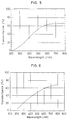
- the spectral transmittance curve of this blank is shown in the graph of Fig. 5.
- the surface of the blank 501 obtained in Example 1 was provided with a desired resist pattern 502 of a material containing an organic substance as a principal component by conventional electron beam lithography or photolithography.
- the remaining resist 504 was removed by a conventional method, thus obtaining a halftone phase shift photomask 505 of the present invention, as shown in Fig.
- the halftone phase shift photomask 505 was practicable in terms of all requirements, i.e., the dimensional accuracy of the etched portions, cross-sectional configuration, film thickness distribution, transmittance distribution, adhesion of the film to the substrate, etc.
- a halftone phase shift photomask obtained in the same way as in Example 2 was heated for 1 hour at 200 o C in a convection oven having an air atmosphere.
- the transmittance for light of wavelength 248 nm of the halftone phase shift portion changed from about 5% to about 8%.
- the halftone phase shift photomask was also practicable in terms of all requirements, i.e., the dimensional accuracy of the etched portions, cross-sectional configuration, film thickness distribution, transmittance distribution, adhesion of the film to the substrate, etc., at any stage of the transmittance changing process.
- a chromium compound film 1402 containing fluorine atoms was formed to a thickness of about 50 nm by sputtering under the following conditions, thereby obtaining a sample 1407 for ellipsometry:
- a chromium compound film 1404 was formed to a thickness of about 180 nm on an optically polished, satisfactorily cleaned high-purity synthetic quartz substrate 1403 under the above-described film forming conditions, thereby obtaining a single-layer halftone phase shift photomask blank 1408 according to the present invention wherein the transmittance for light of wavelength 250 nm was about 10.5%.
- the spectral transmittance curve of this blank is shown in the graph of Fig. 6.
- the surface of the blank obtained as described above was provided with a desired resist pattern 1405 of a material containing an organic substance as a principal component by conventional electron beam lithography or photolithography.
- the etch rate of the chromium compound film was about 0.6 nm/sec.
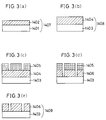
- the remaining resist was removed by a conventional method, thus obtaining a single-layer halftone phase shift photomask 1409 of the present invention, as shown in Fig. 3(e).
- the single-layer halftone phase shift photomask was also practicable in terms of all requirements, i.e., the dimensional accuracy of the etched portions, cross-sectional configuration, film thickness distribution, transmittance distribution, adhesion of the film to the substrate, etc.
- a metal chromium film 1602 was formed to a thickness of about 40 nm by sputtering under the following conditions.
- the surface of the blank 1604 was provided with a desired resist pattern 1605 of a material containing an organic substance as a principal component by conventional electron beam lithography or photolithography.
- the remaining resist was removed by a conventional method, thus obtaining a multilayer halftone phase shift photomask 1607 of the present invention, as shown in Fig. 4(d).
- the chromium compound layer 1603 containing fluorine atoms has chromium atoms as the matrix in the same way as the metal chromium film 1602, the etching characteristics of the chromium compound layer 1603 and the metal film 1602 are substantially the same. Accordingly, the pattern processing characteristics of the multilayer halftone phase shift photomask are approximately the same as those of the single-layer halftone phase shift photomask as shown in Example 4.
- the multilayer halftone phase shift photomask was also practicable in terms of all requirements, i.e., the dimensional accuracy, cross-sectional configuration, film thickness distribution, transmittance distribution, adhesion of the film to the substrate, etc.
- Fig. 12 illustrates one example of a system used to produce the halftone phase shift photomask blank of the present invention.
- a vacuum tank 601 is connected to an evacuation system through a butterfly valve 602.
- a chromium evaporation source 603, an electron gun 604, and a photomask substrate 605 are disposed in the vacuum chamber 601.
- Reference numeral 606 denotes a reaction gas supply port, and 607 an RF current supply coil.
- the inside of the vacuum chamber 601 is evacuated to a predetermined degree of vacuum. Thereafter, carbon tetrafluoride gas is introduced into the vacuum chamber 601 through the supply port 606 with the flow rate controlled by a mass flow controller 608.
- the pressure in the vacuum chamber 601 is controlled to a degree of vacuum suitable for generating a plasma by controlling the butterfly valve 602, and an RF current is supplied to the coil 607, thereby generating a plasma in the space between the substrate 605 and the evaporation source 603.
- accelerated electrons from the electron gun 604 are directed at the evaporation source 603 of pure-metal chromium to initiate evaporation of chromium.
- a shutter 609 covering the substrate 605 is opened to initiate film formation, thereby forming a film to a predetermined thickness.
- FIG. 13 illustrates another example of a system used to carry out the halftone phase shift photomask blank producing method of the present invention.
- a vacuum chamber 701 has the same arrangement as that of the vacuum chamber 601 shown in Fig. 12 except that it is equipped with an ion gun 704.
- the ion gun 704 ionizes a gas supplied into the chamber 701 from a carrier gas inlet port 707, thereby generating a carrier gas plasma in the space between the chromium evaporation source 703 and the photomask substrate 705.
- the ion gun 704 further directs the ionized gas at the chromium evaporation source 703 to evaporate chromium.
- the butterfly valve 702 is opened, and the inside of the vacuum chamber 701 is evacuated to a predetermined degree of vacuum. Thereafter, argon is supplied into the vacuum chamber 701 with the flow rate controlled by the mass flow controller 710. In addition, the pressure is controlled to a level suitable for generating a plasma by controlling the butterfly valve 702. Then, an electric current is supplied to the filament in the ion gun 704, and a voltage is applied to the ion beam drawing electrode, thereby ionizing argon passing through the ion gun 704, and thus generating an argon plasma in the vacuum chamber 701. A convergence coil 711 controls the spread of the plasma. Next, carbon tetrafluoride is supplied into the vacuum chamber 701 from the gas supply port 706 with the flow rate controlled by the mass flow controller 708. After the plasma has become stabilized, the shutter 709 is opened to initiate film formation on the substrate 705.
- FIG. 14 illustrates still another example of a system used to carry out the halftone phase shift photomask blank producing method of the present invention.
- a vacuum chamber 801 has the same arrangement as that of the vacuum chamber 601 shown in Fig. 12 except that it is equipped with an ion gun 804.
- the ion gun 804 ionizes a gas supplied into the vacuum chamber 801 from a carrier gas inlet port 807, thereby generating a carrier gas plasma in the space between the chromium target 803 and the photomask substrate 805.
- the mass flow controller 808 supplies a fluorine atom-containing gas into the vacuum chamber 801 from the gas supply port 806 while controlling the flow rate in the same way as in the system shown in Fig. 13.
- An RF or DC voltage is applied between the chromium target 803 and the photomask substrate 805 from a power supply 812 to generate chromium particles by sputtering.
- the chromium particles are allowed to react with the fluorine atom-containing gas plasma, thereby forming a fluorine atom-containing chromium compound film on the photomask substrate 805.
- a halftone phase shift photomask blank was produced by using the system shown in Fig. 12. With the butterfly valve 602 opened, the inside of the vacuum chamber 601 was evacuated to 1 x 10 ⁇ 5 Torr. Thereafter, carbon tetrafluoride gas was introduced into the vacuum chamber 601 through the supply port 606 with the flow rate controlled to 100 sccm by the mass flow controller 608. Next, the pressure in the vacuum chamber 601 was controlled to 5 x 10 ⁇ 3 Torr by controlling the butterfly valve 602, and an RF current (13.56 MHz) of 150 W was supplied to the coil 607, thereby generating a plasma in the space between the substrate 605 and the evaporation source 603.
- a film thickness required for 180 o shifting the phase of transmitted light of wavelength 248 nm by the film when formed on a photomask substrate was calculated. The required film thickness was determined to be 170 nm.
- a fluorine atom-containing chromium compound film was formed to about 170 nm on an optically polished, satisfactorily cleaned high-purity synthetic quartz substrate under the same conditions as the above.
- the transmittance of this film is shown in the graph of Fig. 15. It should be noted that the transmittance for light of wavelength 248 nm was about 10.5%.
- the halftone phase shift photomask blank can be formed into a mask by approximately the same method as in the case of the conventional photomasks. Thus, the blank can be processed into an excellent halftone phase shift photomask for KrF excimer laser exposure.
- a halftone phase shift photomask blank of the present invention was produced by using the system shown in Fig. 13.
- the inside of the vacuum chamber 701 was evacuated to 1 x 10 ⁇ 5 Torr. Thereafter, argon was supplied into the vacuum chamber 701 with the flow rate controlled to 50 sccm by the mass flow controller 710. At this time, the pressure was controlled to 5 x 10 ⁇ 3 Torr by controlling the butterfly valve 702. Thereafter, an electric current was supplied to the filament in the ion gun 704, and a voltage was applied to the ion beam drawing electrode, thereby ionizing argon passing through the ion gun 704, and thus generating an argon plasma in the vacuum chamber 701. The spread of the plasma was controlled by the convergence coil 711.
- carbon tetrafluoride was supplied into the vacuum chamber 701 from the gas supply port 706 with the flow rate controlled to 50 sccm by the mass flow controller 708. After the plasma had become stabilized, the shutter 709 was opened to initiate film formation on the substrate 705.
- the fluorine atom-containing chromium compound film formed by this method exhibited approximately the same characteristics as those of the film formed in Example 6. Thus, the film served as an excellent shifter for a halftone phase shift photomask.
- the layer composed mainly of a chromium compound, which is used to constitute a halftone phase shift layer contains at least fluorine atoms in addition to chromium atoms. Therefore, it is possible to obtain a transmittance higher than a predetermined level even in exposure carried out at a relatively short wavelength. Accordingly, the halftone phase shift photomask of the present invention can be used for exposure using deep-ultraviolet radiation, e.g., krypton fluoride excimer laser light. Thus, high-resolution lithography can be realized. In addition, since the photomask can be formed by approximately the same method as in the case of the conventional photomasks, it is possible to improve the yield and reduce the cost.
Landscapes
- Physics & Mathematics (AREA)
- General Physics & Mathematics (AREA)
- Preparing Plates And Mask In Photomechanical Process (AREA)
- Exposure And Positioning Against Photoresist Photosensitive Materials (AREA)
Applications Claiming Priority (9)
| Application Number | Priority Date | Filing Date | Title |
|---|---|---|---|
| JP203234/93 | 1993-08-17 | ||
| JP20323493 | 1993-08-17 | ||
| JP20323493 | 1993-08-17 | ||
| JP8948894 | 1994-04-27 | ||
| JP89488/94 | 1994-04-27 | ||
| JP8948894A JPH07295203A (ja) | 1994-04-27 | 1994-04-27 | ハーフトーン位相シフトフォトマスク用ブランクスの製造方法 |
| JP105209/94 | 1994-05-19 | ||
| JP10520994A JP3262303B2 (ja) | 1993-08-17 | 1994-05-19 | ハーフトーン位相シフトフォトマスク及びハーフトーン位相シフトフォトマスク用ブランクス |
| JP10520994 | 1994-05-19 |
Publications (3)
| Publication Number | Publication Date |
|---|---|
| EP0643331A2 true EP0643331A2 (fr) | 1995-03-15 |
| EP0643331A3 EP0643331A3 (fr) | 1996-09-18 |
| EP0643331B1 EP0643331B1 (fr) | 2000-03-29 |
Family
ID=27306126
Family Applications (1)
| Application Number | Title | Priority Date | Filing Date |
|---|---|---|---|
| EP94112836A Expired - Lifetime EP0643331B1 (fr) | 1993-08-17 | 1994-08-17 | Masque à décalage de phase en demi-teinte, masque à décalage de phase vierge en demi-teinte et méthode de fabrication du masque vierge |
Country Status (4)
| Country | Link |
|---|---|
| US (2) | US5738959A (fr) |
| EP (1) | EP0643331B1 (fr) |
| KR (1) | KR100311704B1 (fr) |
| DE (1) | DE69423686T2 (fr) |
Cited By (7)
| Publication number | Priority date | Publication date | Assignee | Title |
|---|---|---|---|---|
| GB2306699A (en) * | 1995-10-25 | 1997-05-07 | Hyundai Electronics Ind | Phase shifting mask |
| US5897977A (en) * | 1996-05-20 | 1999-04-27 | E. I. Du Pont De Nemours And Company | Attenuating embedded phase shift photomask blanks |
| US5897976A (en) * | 1996-05-20 | 1999-04-27 | E. I. Du Pont De Nemours And Company | Attenuating embedded phase shift photomask blanks |
| EP0686876B1 (fr) * | 1994-05-31 | 1999-10-20 | Advanced Micro Devices, Inc. | Masque déphaseur atténué et procédé pour fabriquer ce masque |
| EP1116999A1 (fr) * | 2000-01-05 | 2001-07-18 | Shin-Etsu Chemical Co., Ltd. | Ebauche de masque à décalage de phase, masque à décalage de phase et procédé pour sa fabrication |
| EP1152291A3 (fr) * | 2000-04-25 | 2002-05-29 | Shin-Etsu Chemical Co., Ltd. | Ebauche pour photomasque et photomasque |
| CN104937490A (zh) * | 2013-04-17 | 2015-09-23 | 爱发科成膜株式会社 | 相移掩膜的制造方法及相移掩膜 |
Families Citing this family (21)
| Publication number | Priority date | Publication date | Assignee | Title |
|---|---|---|---|---|
| WO2000007072A1 (fr) * | 1998-07-31 | 2000-02-10 | Hoya Corporation | Ebauche pour photomasque, photomasque, ses procedes de fabrication et procede de formage de micromodeles |
| JP4197378B2 (ja) * | 1999-08-18 | 2008-12-17 | 大日本印刷株式会社 | ハーフトーン位相シフトフォトマスク及びそのためのハーフトーン位相シフトフォトマスク用ブランクス並びにこれを用いたパターン形成方法 |
| JP4328922B2 (ja) | 1999-09-21 | 2009-09-09 | 信越化学工業株式会社 | 位相シフト型フォトマスク |
| KR20010082981A (ko) * | 2000-02-22 | 2001-08-31 | 윤종용 | CrAIO(N)F를 위상 쉬프터 물질로서 사용한 위상쉬프트 마스크 및 그 제조방법 |
| JP2001235849A (ja) * | 2000-02-24 | 2001-08-31 | Shin Etsu Chem Co Ltd | 位相シフトマスク及びその製造方法 |
| JP2001290257A (ja) * | 2000-04-04 | 2001-10-19 | Dainippon Printing Co Ltd | ハーフトーン位相シフトフォトマスク及びそのためのハーフトーン位相シフトフォトマスク用ブランクス並びにこれを用いたパターン形成方法 |
| TW541605B (en) * | 2000-07-07 | 2003-07-11 | Hitachi Ltd | Fabrication method of semiconductor integrated circuit device |
| US6524431B1 (en) * | 2000-11-10 | 2003-02-25 | Helix Technology Inc. | Apparatus for automatically cleaning mask |
| US7027226B2 (en) | 2001-09-17 | 2006-04-11 | Euv Llc | Diffractive optical element for extreme ultraviolet wavefront control |
| JP3711063B2 (ja) * | 2001-11-08 | 2005-10-26 | 大日本印刷株式会社 | 防塵装置付きフォトマスク及びこれを用いた露光方法 |
| US7008730B2 (en) | 2003-01-07 | 2006-03-07 | Taiwan Semiconductor Manufacturing Co., Ltd. | Application of high transmittance attenuating phase shifting mask with dark tone for sub-0.1 micrometer logic device contact hole pattern in 193 NM lithography |
| US20050238922A1 (en) * | 2003-12-25 | 2005-10-27 | Hoya Corporation | Substrate with a multilayer reflection film, reflection type mask blank for exposure, reflection type mask for exposure and methods of manufacturing them |
| KR101143005B1 (ko) * | 2004-12-14 | 2012-05-08 | 삼성전자주식회사 | 마스크 및 이를 이용한 반도체 소자의 제조 방법 및 박막트랜지스터 표시판의 제조 방법 |
| JP2006292840A (ja) * | 2005-04-06 | 2006-10-26 | Advanced Lcd Technologies Development Center Co Ltd | 露光方法及びハーフトーン型位相シフトマスク |
| JP4516560B2 (ja) * | 2005-12-26 | 2010-08-04 | Hoya株式会社 | マスクブランク及びフォトマスク |
| US7985513B2 (en) * | 2008-03-18 | 2011-07-26 | Advanced Micro Devices, Inc. | Fluorine-passivated reticles for use in lithography and methods for fabricating the same |
| KR100940271B1 (ko) * | 2008-04-07 | 2010-02-04 | 주식회사 하이닉스반도체 | 하프톤 위상반전마스크의 제조방법 |
| US20110265874A1 (en) * | 2010-04-29 | 2011-11-03 | Primestar Solar, Inc. | Cadmium sulfide layers for use in cadmium telluride based thin film photovoltaic devices and methods of their manufacture |
| JP5516184B2 (ja) * | 2010-07-26 | 2014-06-11 | 信越化学工業株式会社 | 合成石英ガラス基板の製造方法 |
| JP6722421B2 (ja) * | 2014-04-04 | 2020-07-15 | 大日本印刷株式会社 | 位相シフトマスクおよびその製造方法 |
| CN108345171B (zh) * | 2018-02-11 | 2020-01-21 | 京东方科技集团股份有限公司 | 一种相移掩膜板的制作方法及相移掩膜板 |
Family Cites Families (5)
| Publication number | Priority date | Publication date | Assignee | Title |
|---|---|---|---|---|
| JPS6381426A (ja) * | 1986-09-26 | 1988-04-12 | Hoya Corp | フオトマスクブランクとフオトマスク |
| JP2765016B2 (ja) * | 1989-03-15 | 1998-06-11 | 凸版印刷株式会社 | フオトマスクブランクおよびフオトマスク |
| JP3105234B2 (ja) * | 1990-09-28 | 2000-10-30 | 株式会社日立製作所 | 半導体装置の製造方法 |
| US5380608A (en) * | 1991-11-12 | 1995-01-10 | Dai Nippon Printing Co., Ltd. | Phase shift photomask comprising a layer of aluminum oxide with magnesium oxide |
| US5419988A (en) * | 1992-08-07 | 1995-05-30 | Dai Nippon Printing Co., Ltd. | Photomask blank and phase shift photomask |
-
1994
- 1994-08-16 KR KR1019940020172A patent/KR100311704B1/ko not_active Expired - Lifetime
- 1994-08-17 DE DE69423686T patent/DE69423686T2/de not_active Expired - Lifetime
- 1994-08-17 EP EP94112836A patent/EP0643331B1/fr not_active Expired - Lifetime
-
1996
- 1996-10-17 US US08/722,439 patent/US5738959A/en not_active Expired - Lifetime
-
1998
- 1998-01-13 US US09/006,587 patent/US5916712A/en not_active Expired - Lifetime
Cited By (9)
| Publication number | Priority date | Publication date | Assignee | Title |
|---|---|---|---|---|
| EP0686876B1 (fr) * | 1994-05-31 | 1999-10-20 | Advanced Micro Devices, Inc. | Masque déphaseur atténué et procédé pour fabriquer ce masque |
| GB2306699A (en) * | 1995-10-25 | 1997-05-07 | Hyundai Electronics Ind | Phase shifting mask |
| US5897977A (en) * | 1996-05-20 | 1999-04-27 | E. I. Du Pont De Nemours And Company | Attenuating embedded phase shift photomask blanks |
| US5897976A (en) * | 1996-05-20 | 1999-04-27 | E. I. Du Pont De Nemours And Company | Attenuating embedded phase shift photomask blanks |
| EP1116999A1 (fr) * | 2000-01-05 | 2001-07-18 | Shin-Etsu Chemical Co., Ltd. | Ebauche de masque à décalage de phase, masque à décalage de phase et procédé pour sa fabrication |
| US6511778B2 (en) | 2000-01-05 | 2003-01-28 | Shin-Etsu Chemical Co., Ltd. | Phase shift mask blank, phase shift mask and method of manufacture |
| EP1152291A3 (fr) * | 2000-04-25 | 2002-05-29 | Shin-Etsu Chemical Co., Ltd. | Ebauche pour photomasque et photomasque |
| US6589699B2 (en) | 2000-04-25 | 2003-07-08 | Shin-Etsu Chemical Co., Ltd. | Photomask blank and photomask |
| CN104937490A (zh) * | 2013-04-17 | 2015-09-23 | 爱发科成膜株式会社 | 相移掩膜的制造方法及相移掩膜 |
Also Published As
| Publication number | Publication date |
|---|---|
| US5916712A (en) | 1999-06-29 |
| EP0643331B1 (fr) | 2000-03-29 |
| DE69423686T2 (de) | 2000-07-27 |
| US5738959A (en) | 1998-04-14 |
| EP0643331A3 (fr) | 1996-09-18 |
| KR100311704B1 (ko) | 2001-12-15 |
| DE69423686D1 (de) | 2000-05-04 |
| KR950006959A (ko) | 1995-03-21 |
Similar Documents
| Publication | Publication Date | Title |
|---|---|---|
| EP0643331B1 (fr) | Masque à décalage de phase en demi-teinte, masque à décalage de phase vierge en demi-teinte et méthode de fabrication du masque vierge | |
| EP0872767B1 (fr) | Masque à décalage de phase en demi-teinte et ébauche de masque à décalage de phase en demi-teinte | |
| US5429730A (en) | Method of repairing defect of structure | |
| US5981075A (en) | Optical articles and devices with a thin film containing krypton, xenon, or radon atoms | |
| US6087047A (en) | Phase shift mask and phase shift mask blank | |
| US6740208B2 (en) | Photo mask blank and method of manufacturing the same | |
| KR20040073400A (ko) | 광 마스크 블랭크, 광 마스크, 광 마스크 블랭크 제조방법 및 제조 장치 | |
| US11835851B2 (en) | Substrate with multilayer reflection film for EUV mask blank, manufacturing method thereof, and EUV mask blank | |
| US6756160B2 (en) | Ion-beam deposition process for manufacturing attenuated phase shift photomask blanks | |
| JP2004525423A (ja) | 多層減衰位相シフトフォトマスクブランクを製造するためのイオンビーム蒸着法 | |
| JP3262303B2 (ja) | ハーフトーン位相シフトフォトマスク及びハーフトーン位相シフトフォトマスク用ブランクス | |
| EP1116999B1 (fr) | Ebauche de masque à décalage de phase, masque à décalage de phase et procédé pour sa fabrication | |
| US6756161B2 (en) | Ion-beam deposition process for manufacture of binary photomask blanks | |
| JP3351892B2 (ja) | ハーフトーン位相シフトフォトマスク及びハーフトーン位相シフトフォトマスク用ブランクス | |
| US5849439A (en) | Method for preparing phase shift mask blank, and phase mask | |
| JPH0728224A (ja) | ハーフトーン位相シフトフォトマスク及びハーフトーン位相シフトフォトマスク用ブランクス | |
| JPH07295203A (ja) | ハーフトーン位相シフトフォトマスク用ブランクスの製造方法 | |
| JP3332230B2 (ja) | ハーフトーン位相シフトフォトマスク及びハーフトーン位相シフトフォトマスク用ブランクス | |
| EP1386198A2 (fr) | Procede de deposition par faisceaux ioniques en vue de la fabrication de plaques supports photomasques binaires | |
| US20040115537A1 (en) | Ion-beam deposition process for manufacturing attenuated phase shift photomask blanks | |
| JPH08272074A (ja) | ハーフトーン位相シフトフォトマスク及びハーフトーン位相シフトフォトマスク用ブランクス | |
| JP3605485B2 (ja) | フオトマスク用エッチング装置 | |
| JP3174741B2 (ja) | 位相シフトマスクブランクおよび位相シフトマスク | |
| JPH09244211A (ja) | ハーフトーン位相シフトフォトマスク用ブランク、ハーフトーン位相シフトフォトマスク及びその製造方法 | |
| KR20010095837A (ko) | 에너지 트랩을 이용하여 소정 파장의 빛에 대한 투과율을조절한 위상 쉬프트 마스크 및 그 제조방법 |
Legal Events
| Date | Code | Title | Description |
|---|---|---|---|
| PUAI | Public reference made under article 153(3) epc to a published international application that has entered the european phase |
Free format text: ORIGINAL CODE: 0009012 |
|
| AK | Designated contracting states |
Kind code of ref document: A2 Designated state(s): DE FR GB NL |
|
| RAP1 | Party data changed (applicant data changed or rights of an application transferred) |
Owner name: MITSUBISHI ELECTRIC CORPORATION |
|
| RAP1 | Party data changed (applicant data changed or rights of an application transferred) |
Owner name: MITSUBISHI ELECTRIC CORPORATION Owner name: DAI NIPPON PRINTING CO., LTD. |
|
| PUAL | Search report despatched |
Free format text: ORIGINAL CODE: 0009013 |
|
| AK | Designated contracting states |
Kind code of ref document: A3 Designated state(s): DE FR GB NL |
|
| 17P | Request for examination filed |
Effective date: 19970311 |
|
| 17Q | First examination report despatched |
Effective date: 19971029 |
|
| GRAG | Despatch of communication of intention to grant |
Free format text: ORIGINAL CODE: EPIDOS AGRA |
|
| GRAG | Despatch of communication of intention to grant |
Free format text: ORIGINAL CODE: EPIDOS AGRA |
|
| GRAG | Despatch of communication of intention to grant |
Free format text: ORIGINAL CODE: EPIDOS AGRA |
|
| GRAH | Despatch of communication of intention to grant a patent |
Free format text: ORIGINAL CODE: EPIDOS IGRA |
|
| GRAH | Despatch of communication of intention to grant a patent |
Free format text: ORIGINAL CODE: EPIDOS IGRA |
|
| GRAA | (expected) grant |
Free format text: ORIGINAL CODE: 0009210 |
|
| AK | Designated contracting states |
Kind code of ref document: B1 Designated state(s): DE FR GB NL |
|
| PG25 | Lapsed in a contracting state [announced via postgrant information from national office to epo] |
Ref country code: NL Free format text: LAPSE BECAUSE OF FAILURE TO SUBMIT A TRANSLATION OF THE DESCRIPTION OR TO PAY THE FEE WITHIN THE PRESCRIBED TIME-LIMIT Effective date: 20000329 |
|
| REF | Corresponds to: |
Ref document number: 69423686 Country of ref document: DE Date of ref document: 20000504 |
|
| ET | Fr: translation filed | ||
| NLV1 | Nl: lapsed or annulled due to failure to fulfill the requirements of art. 29p and 29m of the patents act | ||
| PLBE | No opposition filed within time limit |
Free format text: ORIGINAL CODE: 0009261 |
|
| STAA | Information on the status of an ep patent application or granted ep patent |
Free format text: STATUS: NO OPPOSITION FILED WITHIN TIME LIMIT |
|
| 26N | No opposition filed | ||
| REG | Reference to a national code |
Ref country code: GB Ref legal event code: IF02 |
|
| REG | Reference to a national code |
Ref country code: FR Ref legal event code: TQ |
|
| PGFP | Annual fee paid to national office [announced via postgrant information from national office to epo] |
Ref country code: DE Payment date: 20130930 Year of fee payment: 20 |
|
| PGFP | Annual fee paid to national office [announced via postgrant information from national office to epo] |
Ref country code: FR Payment date: 20130821 Year of fee payment: 20 Ref country code: GB Payment date: 20130830 Year of fee payment: 20 |
|
| REG | Reference to a national code |
Ref country code: DE Ref legal event code: R071 Ref document number: 69423686 Country of ref document: DE |
|
| REG | Reference to a national code |
Ref country code: DE Ref legal event code: R071 Ref document number: 69423686 Country of ref document: DE |
|
| REG | Reference to a national code |
Ref country code: GB Ref legal event code: PE20 Expiry date: 20140816 |
|
| PG25 | Lapsed in a contracting state [announced via postgrant information from national office to epo] |
Ref country code: DE Free format text: LAPSE BECAUSE OF EXPIRATION OF PROTECTION Effective date: 20140819 |
|
| PG25 | Lapsed in a contracting state [announced via postgrant information from national office to epo] |
Ref country code: GB Free format text: LAPSE BECAUSE OF EXPIRATION OF PROTECTION Effective date: 20140816 |