EP0644855B1 - Procede d'extraction d'oxyde d'aluminium - Google Patents
Procede d'extraction d'oxyde d'aluminium Download PDFInfo
- Publication number
- EP0644855B1 EP0644855B1 EP93909835A EP93909835A EP0644855B1 EP 0644855 B1 EP0644855 B1 EP 0644855B1 EP 93909835 A EP93909835 A EP 93909835A EP 93909835 A EP93909835 A EP 93909835A EP 0644855 B1 EP0644855 B1 EP 0644855B1
- Authority
- EP
- European Patent Office
- Prior art keywords
- slurry
- alumina
- particle fraction
- concentration
- fine particle
- Prior art date
- Legal status (The legal status is an assumption and is not a legal conclusion. Google has not performed a legal analysis and makes no representation as to the accuracy of the status listed.)
- Expired - Lifetime
Links
- PNEYBMLMFCGWSK-UHFFFAOYSA-N aluminium oxide Inorganic materials [O-2].[O-2].[O-2].[Al+3].[Al+3] PNEYBMLMFCGWSK-UHFFFAOYSA-N 0.000 title claims abstract description 72
- 238000000034 method Methods 0.000 title claims abstract description 50
- 238000000605 extraction Methods 0.000 title claims abstract description 26
- 239000002002 slurry Substances 0.000 claims abstract description 65
- 239000003518 caustics Substances 0.000 claims abstract description 61
- 229910001570 bauxite Inorganic materials 0.000 claims abstract description 47
- 239000010419 fine particle Substances 0.000 claims abstract description 32
- 239000011362 coarse particle Substances 0.000 claims abstract description 19
- 239000000463 material Substances 0.000 claims abstract description 17
- 239000012670 alkaline solution Substances 0.000 claims abstract description 16
- 238000010438 heat treatment Methods 0.000 claims abstract description 10
- 239000007791 liquid phase Substances 0.000 claims abstract description 8
- 239000011343 solid material Substances 0.000 claims abstract description 7
- 239000007788 liquid Substances 0.000 claims abstract description 4
- CDBYLPFSWZWCQE-UHFFFAOYSA-L Sodium Carbonate Chemical compound [Na+].[Na+].[O-]C([O-])=O CDBYLPFSWZWCQE-UHFFFAOYSA-L 0.000 claims description 24
- 150000004682 monohydrates Chemical class 0.000 claims description 13
- 239000007787 solid Substances 0.000 claims description 13
- 229910000029 sodium carbonate Inorganic materials 0.000 claims description 12
- 239000002245 particle Substances 0.000 claims description 11
- 150000004684 trihydrates Chemical class 0.000 claims description 10
- 238000004090 dissolution Methods 0.000 claims description 6
- 230000029087 digestion Effects 0.000 description 18
- 238000004131 Bayer process Methods 0.000 description 4
- 230000003628 erosive effect Effects 0.000 description 4
- 239000000203 mixture Substances 0.000 description 4
- 238000001238 wet grinding Methods 0.000 description 4
- HEMHJVSKTPXQMS-UHFFFAOYSA-M Sodium hydroxide Chemical compound [OH-].[Na+] HEMHJVSKTPXQMS-UHFFFAOYSA-M 0.000 description 3
- 238000005260 corrosion Methods 0.000 description 3
- 238000002156 mixing Methods 0.000 description 3
- 238000000926 separation method Methods 0.000 description 3
- 239000000243 solution Substances 0.000 description 3
- VYPSYNLAJGMNEJ-UHFFFAOYSA-N Silicium dioxide Chemical compound O=[Si]=O VYPSYNLAJGMNEJ-UHFFFAOYSA-N 0.000 description 2
- XAGFODPZIPBFFR-UHFFFAOYSA-N aluminium Chemical compound [Al] XAGFODPZIPBFFR-UHFFFAOYSA-N 0.000 description 2
- 229910052782 aluminium Inorganic materials 0.000 description 2
- 239000004411 aluminium Substances 0.000 description 2
- 229910001593 boehmite Inorganic materials 0.000 description 2
- 238000010276 construction Methods 0.000 description 2
- 230000007797 corrosion Effects 0.000 description 2
- 229910052593 corundum Inorganic materials 0.000 description 2
- 229910001679 gibbsite Inorganic materials 0.000 description 2
- 238000000227 grinding Methods 0.000 description 2
- FAHBNUUHRFUEAI-UHFFFAOYSA-M hydroxidooxidoaluminium Chemical compound O[Al]=O FAHBNUUHRFUEAI-UHFFFAOYSA-M 0.000 description 2
- 239000011268 mixed slurry Substances 0.000 description 2
- 239000000047 product Substances 0.000 description 2
- 229910001845 yogo sapphire Inorganic materials 0.000 description 2
- 239000003513 alkali Substances 0.000 description 1
- 150000004645 aluminates Chemical class 0.000 description 1
- 229940115440 aluminum sodium silicate Drugs 0.000 description 1
- -1 boehmite Chemical class 0.000 description 1
- 229910001648 diaspore Inorganic materials 0.000 description 1
- 238000010790 dilution Methods 0.000 description 1
- 239000012895 dilution Substances 0.000 description 1
- 230000000694 effects Effects 0.000 description 1
- XLYOFNOQVPJJNP-UHFFFAOYSA-M hydroxide Chemical compound [OH-] XLYOFNOQVPJJNP-UHFFFAOYSA-M 0.000 description 1
- 238000002347 injection Methods 0.000 description 1
- 239000007924 injection Substances 0.000 description 1
- 238000004519 manufacturing process Methods 0.000 description 1
- 239000002244 precipitate Substances 0.000 description 1
- 238000005086 pumping Methods 0.000 description 1
- 239000002994 raw material Substances 0.000 description 1
- 230000000717 retained effect Effects 0.000 description 1
- 229920006395 saturated elastomer Polymers 0.000 description 1
- 239000000377 silicon dioxide Substances 0.000 description 1
- 229910052665 sodalite Inorganic materials 0.000 description 1
- 239000000429 sodium aluminium silicate Substances 0.000 description 1
- 235000012217 sodium aluminium silicate Nutrition 0.000 description 1
- XLYOFNOQVPJJNP-UHFFFAOYSA-N water Chemical compound O XLYOFNOQVPJJNP-UHFFFAOYSA-N 0.000 description 1
- 229910001868 water Inorganic materials 0.000 description 1
Images
Classifications
-
- C—CHEMISTRY; METALLURGY
- C01—INORGANIC CHEMISTRY
- C01F—COMPOUNDS OF THE METALS BERYLLIUM, MAGNESIUM, ALUMINIUM, CALCIUM, STRONTIUM, BARIUM, RADIUM, THORIUM, OR OF THE RARE-EARTH METALS
- C01F7/00—Compounds of aluminium
- C01F7/02—Aluminium oxide; Aluminium hydroxide; Aluminates
- C01F7/04—Preparation of alkali metal aluminates; Aluminium oxide or hydroxide therefrom
- C01F7/06—Preparation of alkali metal aluminates; Aluminium oxide or hydroxide therefrom by treating aluminous minerals or waste-like raw materials with alkali hydroxide, e.g. leaching of bauxite according to the Bayer process
- C01F7/062—Digestion
Definitions
- This invention relates to a process for the extraction of alumina from alumina-containing solid material, particularly the alumna-containing ores known as bauxite.
- the most important commercial alumina extraction process is that known as the Bayer process in which alumina-containing ore is digested with an aqueous alkaline solution at an elevated temperature to extract from the ore the alumina values, i.e. the components of the ore which under the extraction conditions are removed from the body of the ore and can be recovered by processing in the form of alumina.
- the alumina thereby produced has a wide range of uses including as a raw material for the production of aluminium by conventional electrochemical processes.
- bauxite is digested by an aqueous alkaline solution at elevated temperatures, with the rate and efficiency of digestion depending upon both the temperature used and the concentration of the alkaline solution.
- sodium hydroxide (caustic) is used as the alkali and its concentration in the extracting solution is usually described in terms of both the concentration of total caustic expressed as equivalent sodium carbonate, and the concentration of free caustic, again expressed as equivalent sodium carbonate.
- Free caustic is the hydroxide which is not associated with the aluminate Al(OH) 4 , which is the dissolved form of alumina.
- A/C alumina to caustic
- the alumina in bauxite generally exists in the form of alumina trihydrate (Al 2 O 3 .3H 2 O or gibbsite) and/or alumina monohydrate (Al 2 O 3 .H 2 O or boehmite, diaspore).
- alumina trihydrate is the main alumina component. The difference in solubility between the trihydrate and the monohydrate in aqueous alkaline solutions requires different conditions in the digestion process.
- Alumina monohydrate is not as easily dissolved as alumina trihydrate.
- a higher caustic concentration and/or a higher digestion temperature and/or a lower alumina to caustic digestion ratio is required to dissolve substantially all the alumina monohydrate from the bauxite.
- a higher digestion temperature is used to digest the monohydrate.
- the bauxite for the Bayer process is usually ground before the extraction procedure.
- the grinding process is often a wet grinding process in which part of the spent liquor (usually between 5 and 25 per cent) is used. The other part of the spent liquor is directly used for the digestion step.
- the digestion process may be classified on the basis of the preheating procedure into a one-stream process in which the bauxite and the aqueous alkaline solution necessary for the extraction are mixed together whereafter the mixture is subjected to preheating and extraction, and a two-stream process in which a slurry of the bauxite in a part of the aqueous alkaline solution, which slurry is usually obtained in the above-mentioned wet grinding process, and the remainder of the aqueous alkaline solution are preheated individually, mixed together and then subjected to extraction.
- JP-A-63190709 discloses an extraction process in which, unlike the present invention, an intermediate insoluble residue separation step takes place.
- a process for the extraction of alumina values from an alumina-containing solid material which method comprises:-
- not all of the alkaline solution is used to prepare the slurry of bauxite particles, but rather a portion is used to dilute the slurry prior to passing through the heat exchangers, and also not all of the fine particle fraction is heated, but rather some of it is added unheated to the coarse particle portion and is sent directly to the high temperature digesters.
- the alumina-containing solid material is bauxite and the alumina present in the material is in the form of alumina monohydrate, such as boehmite, and alumina trihydrate, such as gibbsite.
- Some two stream extraction processes are based on the difference in solubilities of alumina monohydrate and alumina trihydrate.
- the present invention is based on classifying the bauxite slurry according to particle size prior to digestion. After classification, all or part of the fine particle size material is sent through the plurality of heat exchangers where it is heated to a higher temperature, while the coarse material is sent directly to the high temperature digesters, and bypasses the plurality of heat exchangers.
- the process of the present invention resides in subjecting the extracting alkaline solution which is usually recycled spent extraction liquor from the end of the process containing typically from 200 to 350 g/l of total caustic, more usually between 250 and 280 g/l total caustic and usually 160 to 170 g/l of free caustic, and an A/C ratio of about 0.35, to two successive stages of reaction with bauxite with a slurry classification stage being used prior to the first of these two stages.
- the slurry to be classified in this preliminary stage is produced by any conventional grinding process, but the concentration of free caustic therein should be sufficient at the temperature reached in the first extraction stage to dissolve at least some and preferably all of the aluminium values in the alumina-containing material extracted in that stage.
- the bauxite slurry is split into two portions by classification on a screen or by a hydrocyclone, or by any other known process.
- the heat exchangers are fed with a slurry containing only fine particles of bauxite, generally between 35 and 100 mesh (US Tyler), with smaller than 74 mesh (US Tyler) being preferred for the conditions described in the following description.
- a portion of the slurry produced by the wet grinding of bauxite in spent liquor is subjected to the two stage treatment.
- the bauxite slurry is split into two portions by classification on a screen or by hydrocyclone, one portion contains the fines less than 74 mesh size, the second contains the coarse particles greater than 74 mesh.
- the slurry containing the fines is injected into the bulk of the spent liquor to give a mixed slurry containing 40 to 120 g/l, and more usually 60 to 100 g/l of fines, and passed through the low temperature heat exchangers where it is subjected to a relatively low temperature of between 120 and 160oC.
- the fine particles in the slurry dissolve quickly, and give a liquor with an A/C ratio of 0.45, corresponding to a loading of 30 to 35 g/l of dissolved alumina.
- This treatment effectively reduces the free caustic concentration from 160 g/l to 135 g/l which poses no danger to the high temperature heat exchange equipment which follows in the circuit.
- the slurry is then passed through the high temperature heat exchangers which will heat it to about 240oC or higher. There is no danger in heating to 240oC or higher under these conditions, because the free caustic concentration in the liquor has been reduced to the safe concentration of below 145 g/l by virtue of the first stage treatment with the fine particles of bauxite.
- the mixed slurry is fed into digesters which provide the required residence time for the extraction reaction, and is then heated by injection of steam to the temperature of 240oC and higher required for the extraction of the more difficult to dissolve boehmitic alumina content of the bauxite.
- the fine bauxite slurry required for passing through the first low temperature heat exchangers is obtained by classification of the bauxite slurry produced by the wet grinding mills.
- the slurry from the mills is discharged into a desilication circuit made up of a series of holding tanks held at temperatures between 60 and 100oC.
- the kaolinitic silica content of the bauxite dissolves quickly, and then slowly precipitates as Bayer sodalite which is an insoluble form of sodium aluminium silicate.
- the slurry is diluted with additional spent liquor, and then is classified by either passing it through a hydrocyclone or through a screen such as an inclined washed DSM RTM (Dutch State Mines) screen to give a coarse fraction, which is retained by US Tyler Screen size of 74 mesh, and a fine fraction which passes through the 74 mesh Tyler Screen.
- DSM RTM Dutch State Mines
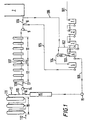
- the slurry of bauxite 101 from the wet mills (not shown) containing about 35 to 60% by weight of solids is discharged into the first of the four tanks 1, 2, 3, 4 of the desilication circuit. These tanks operate in a back flow fashion at temperatures ranging from about 60 to 100oC, with the overflow from each tank being returned to the preceding tank in the series, while the underflow is pumped to the next tank in the series.
- Part of the discharge 102 from tank 3 is injected with spent liquor 106 from tank 7 to provide the dilution required to carry out particle size classification, and is sent to a classification device, in this embodiment a hydrocyclone 6.
- the underflow 103 from the hydrocyclone 6 containing from 30 to at least 60% solid material is discharged into holding tank 4, while the overflow 104 containing 10 to 30%, or 150 to 450 g/l, of the fine material of less than 74 mesh is sent to the surge tank 5.
- the slurry of fine bauxite 105 from surge tank 5 is then combined at junction point 8 with additional spent liquor 106 from the spent liquor tank 7, which contains 250 g/l total caustic, 160 g/l of free caustic, and has an A/C ratio of around 0.35.
- This slurry is then forced by pump 9 through the series of low temperature heat exchangers 10, in this embodiment five heat exchangers being used.
- the fine bauxite in the combined streams dissolves rapidly, so that the composition of the combined streams at the first heating stage outlet 10 is about 45 g/l solids at an A/C ratio of 0.45.
- the temperature of the slurry 107 has been raised to between 150 and 170oC, and most of the fine bauxite particles are dissolved, so that the final concentration of solids is about 16 g/l, and the concentration of free caustic in the liquid phase of the slurry is reduced to 130 g/l.
- the free caustic content of this slurry has now been lowered sufficiently by virtue of the dissolution of the fine bauxite particles that it can be safely heated in the high temperature heat exchangers.
- the slurry continues through a second series of high temperature heat exchangers 12 - in this embodiment four exchangers are used - and at the exit 13 of this series the exiting slurry 108 has a temperature of 200 to 230oC, the solids concentration therein is between 9 and 30 g/l, and the free caustic concentration is around 120 g/l.
- the slurry of coarse bauxite 109 from tank 4 is sent by pump 19 to the high pressure pump 15 to the junction point 16. Here it is combined with the preheated slurry 108 exiting from pump 14. To raise the temperature still further, the combined streams 110 are injected with live steam at 17. This stream 111 is then fed into the high temperature digesters 18, in this embodiment three digesters are shown. Additional steam may be injected into the digesters to obtain the required temperatures.
- the composition of the combined slurry 111 entering the digesters 18 is 250 g/l of total caustic and 130 g/l of free caustic. The slurry of this composition can be safely heated to 240oC or higher to dissolve the coarse particles of bauxite and obtain the complete dissolution of the boehmitic alumina in the residence time available in the high temperature digesters 18 to yield product stream 112.
- the product stream 112 is then cooled and stripped of at least some of its alumina values by conventional means (not shown) and the spent liquor can, if desired, be recycled after the addition of fresh caustic as slurry stream 106, and can be used to make slurry stream 101.
Landscapes
- Life Sciences & Earth Sciences (AREA)
- Chemical & Material Sciences (AREA)
- Organic Chemistry (AREA)
- Health & Medical Sciences (AREA)
- General Health & Medical Sciences (AREA)
- Nutrition Science (AREA)
- General Life Sciences & Earth Sciences (AREA)
- Geochemistry & Mineralogy (AREA)
- Geology (AREA)
- Inorganic Chemistry (AREA)
- Compounds Of Alkaline-Earth Elements, Aluminum Or Rare-Earth Metals (AREA)
Abstract
Claims (18)
- Procédé pour l'extraction de valeurs d'alumine à partir d'un matériau solide contenant de l'alumine, ce procédé comprenant :(a) la fourniture du matériau sous la forme d'une suspension dans une solution alcaline ayant une concentration de soude caustique libre dans celle-ci qui est suffisante, à la température atteinte au cours de l'étape (c), pour dissoudre des valeurs d'alumine,(b) la classification de la suspension en une fraction de particules fines et une fraction de particules grossières,(c) le chauffage de la fraction de particules fines à une température suffisante pour dissoudre au moins une partie des valeurs d'alumine dans celle-ci, avec une réduction consécutive de la concentration de soude caustique libre dans la phase liquide de la suspension de fraction fine, et(d) la combinaison de la fraction de particules grossières de l'étape (b) avec le liquide de suspension appauvri en soude caustique libre de l'étape (c) à une température supérieure à celle atteinte dans l'étape (c), de façon à dissoudre au moins une partie des valeurs d'alumine dans la fraction de particules grossières.
- Procédé selon la revendication 1, dans lequel le matériau solide contenant de l'alumine est de la bauxite, et l'alumine est présente dans le matériau sous la forme de monohydrate d'alumine et de trihydrate d'alumine.
- Procédé selon la revendication 1 ou la revendication 2, dans lequel la suspension dans l'étape (a) a une concentration de soude caustique libre d'au moins 140 g/l exprimée en équivalent carbonate de sodium.
- Procédé selon la revendication 3, dans lequel la suspension dans l'étape (a) a une concentration de soude caustique libre comprise entre 160 et 170 g/l exprimée en équivalent carbonate de sodium.
- Procédé selon l'une quelconque des revendications précédentes, dans lequel la suspension dans l'étape (a) a une concentration de soude caustique totale comprise entre 200 et 350 g/l exprimée en équivalent carbonate de sodium.
- Procédé selon la revendication 5, dans lequel la suspension dans l'étape (a) a une concentration de soude caustique totale comprise entre 250 et 280 g/l exprimée en équivalent carbonate de sodium.
- Procédé selon l'une quelconque des revendications précédentes, dans lequel la phase liquide appauvrie en soude caustique libre de la suspension de fraction fine de l'étape (c) a une concentration de soude caustique libre qui n'est pas supérieure à 145 g/l, exprimée en équivalent carbonate de sodium.
- Procédé selon la revendication 6, dans lequel la phase liquide appauvrie en soude caustique libre de la suspension de fraction fine de l'étape (c) a une concentration de soude caustique libre comprise entre 60 et 130 g/l.
- Procédé selon l'une quelconque des revendications précédentes, dans lequel, dans l'étape de classification de l'étape (b), la fraction de particules fines formée contient sensiblement la totalité des particules d'une taille comprise entre 35 et 100 mesh (US Tyler).
- Procédé selon la revendication 9, dans lequel, dans l'étape de classification de l'étape (b), la fraction de particules fines formée contient sensiblement toutes les particules d'une taille inférieure à 74 mesh (US Tyler).
- Procédé selon l'une quelconque des revendications précédentes, dans lequel, dans l'étape (b), la suspension est chauffée à une température comprise entre 120 et 160°C.
- Procédé selon la revendication 11, dans lequel la suspension est chauffée à une température inférieure à 160°C.
- Procédé selon l'une quelconque des revendications précédentes, dans lequel sensiblement toutes lesdites valeurs d'alumine sont dissoutes au cours de l'étape (c).
- Procédé selon l'une quelconque des revendications précédentes, dans lequel, dans l'étape (d), la température de dissolution est d'au moins 200°C.
- Procédé selon la revendication 14, dans lequel la température de dissolution est d'au moins 240°C.
- Procédé selon l'une quelconque des revendications précédentes, dans lequel sensiblement toutes lesdites valeurs d'alumine sont dissoutes au cours de l'étape (d).
- Procédé selon l'une quelconque des revendications précédentes, comprenant les étapes suivantes :(a) la fourniture du matériau sous la forme d'une suspension dans une partie de la solution alcaline ayant une concentration de soude caustique libre dans celle-ci qui est suffisante, à la température atteinte au cours de l'étape (c), pour dissoudre les valeurs d'alumine à l'intérieur de celle-ci,(b) la classification de la suspension en une fraction de particules fines et une fraction de particules grossières,(c) l'addition d'une quantité suffisante de cette fraction de particules fines à une autre partie de la solution alcaline de telle sorte que la dissolution de l'alumine de cette fraction de particules fines réduise la soude caustique libre dans la solution alcaline-fraction de particules fines combinée à moins de 145 g/l,(d) le chauffage de la solution alcaline-fraction de particules fines combinée à une température suffisante pour dissoudre sensiblement toutes les valeurs d'alumine dans celle-ci, avec une réduction consécutive de la concentration de soude caustique libre dans la phase liquide, et(e) la combinaison de la fraction de particules grossières et de la fraction de particules fines restante, qui n'a pas été utilisée au cours de l'étape (c), et l'addition de ce courant combiné à la solution alcaline-fraction de particules fines combinée chauffée de l'étape (d), de façon à dissoudre sensiblement toutes les valeurs d'alumine des solides dans celle-ci.
- Procédé pour l'extraction de valeurs d'alumine à partir d'une bauxite, qui peut être composée d'une quantité significative de monohydrate ou d'alumine boehmitique, comprenant :la mise en suspension de la bauxite dans la liqueur usée qui contient entre 200 et 350 g/l de soude caustique totale et plus de 140 g/l de soude caustique libre, exprimées en équivalent Na2CO3;la classification du courant de suspension de charge de bauxite en une fraction de particules fines et une fraction de particules grossières ;le chauffage de la fraction de particules fines dans deux séries d'au moins un échangeur de chaleur indirect ;dans la première série d'échangeurs de chaleur indirects, le chauffage de la suspension à environ 160°C, après quoi les particules fines de bauxite se dissolvent rapidement de façon à donner une liqueur contenant moins de 145 g/l de soude caustique libre exprimée en équivalent Na2CO3;dans le deuxième jeu d'échangeurs de chaleur indirects, le chauffage de la suspension à environ 220°C ;la combinaison du courant des échangeurs de chaleur indirects avec la suspension contenant les particules les plus grossières ; etla délivrance des courants combinés à au moins un digesteur à haute pression et à haute température, où l'extraction des valeurs d'alumine des courants combinés est obtenue.
Applications Claiming Priority (3)
| Application Number | Priority Date | Filing Date | Title |
|---|---|---|---|
| GB929209313A GB9209313D0 (en) | 1992-04-30 | 1992-04-30 | Process for the extraction of alumina |
| GB9209313 | 1992-04-30 | ||
| PCT/EP1993/000999 WO1993022238A1 (fr) | 1992-04-30 | 1993-04-26 | Procede d'extraction d'oxyde d'aluminium |
Publications (2)
| Publication Number | Publication Date |
|---|---|
| EP0644855A1 EP0644855A1 (fr) | 1995-03-29 |
| EP0644855B1 true EP0644855B1 (fr) | 1997-06-04 |
Family
ID=10714770
Family Applications (1)
| Application Number | Title | Priority Date | Filing Date |
|---|---|---|---|
| EP93909835A Expired - Lifetime EP0644855B1 (fr) | 1992-04-30 | 1993-04-26 | Procede d'extraction d'oxyde d'aluminium |
Country Status (5)
| Country | Link |
|---|---|
| EP (1) | EP0644855B1 (fr) |
| AU (1) | AU663785B2 (fr) |
| ES (1) | ES2104146T3 (fr) |
| GB (1) | GB9209313D0 (fr) |
| WO (1) | WO1993022238A1 (fr) |
Families Citing this family (2)
| Publication number | Priority date | Publication date | Assignee | Title |
|---|---|---|---|---|
| FR2715153B1 (fr) * | 1994-01-18 | 1996-03-01 | Pechiney Aluminium | Procédé de traitement de bauxite à trihydrate d'alumine. |
| RU2494965C1 (ru) * | 2012-03-01 | 2013-10-10 | Федеральное государственное автономное образовательное учреждение высшего профессионального образования "Уральский федеральный университет имени первого Президента России Б.Н. Ельцина" | Способ переработки бокситов на глинозем |
Family Cites Families (5)
| Publication number | Priority date | Publication date | Assignee | Title |
|---|---|---|---|---|
| US3241910A (en) * | 1960-09-29 | 1966-03-22 | Arthur F Johnson | Process for separating ai-values from ores |
| US3681013A (en) * | 1970-02-02 | 1972-08-01 | Aluminum Co Of America | Extraction of alumina from bauxite |
| JPS6164166A (ja) * | 1984-09-06 | 1986-04-02 | Toshiba Corp | 半導体装置 |
| US4614641A (en) * | 1985-06-19 | 1986-09-30 | Aluminum Company Of America | Parallel purification of alumina with physical pretreatment |
| GB8906500D0 (en) * | 1989-03-21 | 1989-05-04 | Shell Int Research | Process for the production of aluminium hydroxide from bauxite |
-
1992
- 1992-04-30 GB GB929209313A patent/GB9209313D0/en active Pending
-
1993
- 1993-04-26 ES ES93909835T patent/ES2104146T3/es not_active Expired - Lifetime
- 1993-04-26 WO PCT/EP1993/000999 patent/WO1993022238A1/fr not_active Ceased
- 1993-04-26 AU AU40620/93A patent/AU663785B2/en not_active Ceased
- 1993-04-26 EP EP93909835A patent/EP0644855B1/fr not_active Expired - Lifetime
Also Published As
| Publication number | Publication date |
|---|---|
| AU4062093A (en) | 1993-11-29 |
| GB9209313D0 (en) | 1992-06-17 |
| ES2104146T3 (es) | 1997-10-01 |
| AU663785B2 (en) | 1995-10-19 |
| EP0644855A1 (fr) | 1995-03-29 |
| WO1993022238A1 (fr) | 1993-11-11 |
Similar Documents
| Publication | Publication Date | Title |
|---|---|---|
| AU619149B2 (en) | Process for producing alumina from bauxite | |
| CA1179149A (fr) | Methode d'extraction de l'alumine des minerais de l'aluminium | |
| EP0618882B1 (fr) | Procede de separation ameliore de boue rouge, utilise dans la production d'alumine a partir de la bauxite | |
| EP0389061B1 (fr) | Procédé de production d'hydroxyde d'aluminium à partir de bauxite | |
| US3413087A (en) | Method for extracting alumina from its ores | |
| US6299846B1 (en) | Process for producing aluminum hydroxide from alumina-containing ore | |
| EP0515407B1 (fr) | Procede de precipitation d'hydroxyde d'aluminium a partir d'une liqueur du procede bayer | |
| AU663785B2 (en) | Process for the extraction of alumina | |
| US4128618A (en) | Process for extracting alumina from alumina-containing ores | |
| US4614641A (en) | Parallel purification of alumina with physical pretreatment | |
| US3681013A (en) | Extraction of alumina from bauxite | |
| AU4555393A (en) | Digestion of bauxite | |
| WO1994002416A1 (fr) | Procede d'extraction d'alumine de la bauxite | |
| US3868442A (en) | Alumina extraction | |
| EP0564659B1 (fr) | Procede pour la production d'hydroxyde d'aluminium a partir d'un minerai contenant de l'alumine | |
| AU2003285414B2 (en) | Method for attacking bauxite enhancing filterability of sludge in attack output | |
| US3241910A (en) | Process for separating ai-values from ores | |
| AU668979B2 (en) | Extracting alumina from bauxite | |
| Bott et al. | Filtration of Pregnant Hot Slurries with HiBar Filtration–A Key for Innovating the Digestion Process | |
| WO2006031098A1 (fr) | Procede et appareil pour l'extraction de gibbsite a partir de bauxite |
Legal Events
| Date | Code | Title | Description |
|---|---|---|---|
| PUAI | Public reference made under article 153(3) epc to a published international application that has entered the european phase |
Free format text: ORIGINAL CODE: 0009012 |
|
| 17P | Request for examination filed |
Effective date: 19941117 |
|
| AK | Designated contracting states |
Kind code of ref document: A1 Designated state(s): ES IE IT |
|
| 17Q | First examination report despatched |
Effective date: 19950810 |
|
| GRAG | Despatch of communication of intention to grant |
Free format text: ORIGINAL CODE: EPIDOS AGRA |
|
| GRAH | Despatch of communication of intention to grant a patent |
Free format text: ORIGINAL CODE: EPIDOS IGRA |
|
| GRAH | Despatch of communication of intention to grant a patent |
Free format text: ORIGINAL CODE: EPIDOS IGRA |
|
| GRAA | (expected) grant |
Free format text: ORIGINAL CODE: 0009210 |
|
| AK | Designated contracting states |
Kind code of ref document: B1 Designated state(s): ES IE IT |
|
| REG | Reference to a national code |
Ref country code: ES Ref legal event code: FG2A Ref document number: 2104146 Country of ref document: ES Kind code of ref document: T3 |
|
| PLBE | No opposition filed within time limit |
Free format text: ORIGINAL CODE: 0009261 |
|
| STAA | Information on the status of an ep patent application or granted ep patent |
Free format text: STATUS: NO OPPOSITION FILED WITHIN TIME LIMIT |
|
| 26N | No opposition filed | ||
| PG25 | Lapsed in a contracting state [announced via postgrant information from national office to epo] |
Ref country code: IT Free format text: LAPSE BECAUSE OF NON-PAYMENT OF DUE FEES Effective date: 20050426 |
|
| PGFP | Annual fee paid to national office [announced via postgrant information from national office to epo] |
Ref country code: IE Payment date: 20080425 Year of fee payment: 16 |
|
| REG | Reference to a national code |
Ref country code: IE Ref legal event code: MM4A |
|
| PG25 | Lapsed in a contracting state [announced via postgrant information from national office to epo] |
Ref country code: IE Free format text: LAPSE BECAUSE OF NON-PAYMENT OF DUE FEES Effective date: 20090427 |
|
| PGFP | Annual fee paid to national office [announced via postgrant information from national office to epo] |
Ref country code: ES Payment date: 20110426 Year of fee payment: 19 |
|
| REG | Reference to a national code |
Ref country code: ES Ref legal event code: FD2A Effective date: 20130715 |
|
| PG25 | Lapsed in a contracting state [announced via postgrant information from national office to epo] |
Ref country code: ES Free format text: LAPSE BECAUSE OF NON-PAYMENT OF DUE FEES Effective date: 20120427 |