EP0645395B1 - Vinyl- und Alkoxygruppe enthaltende Organosiliciumverbindungen und Verfahren zu deren Herstellung - Google Patents
Vinyl- und Alkoxygruppe enthaltende Organosiliciumverbindungen und Verfahren zu deren Herstellung Download PDFInfo
- Publication number
- EP0645395B1 EP0645395B1 EP94115295A EP94115295A EP0645395B1 EP 0645395 B1 EP0645395 B1 EP 0645395B1 EP 94115295 A EP94115295 A EP 94115295A EP 94115295 A EP94115295 A EP 94115295A EP 0645395 B1 EP0645395 B1 EP 0645395B1
- Authority
- EP
- European Patent Office
- Prior art keywords
- alkoxy
- vinyl
- functional organosilicon
- organosilicon compound
- vime
- Prior art date
- Legal status (The legal status is an assumption and is not a legal conclusion. Google has not performed a legal analysis and makes no representation as to the accuracy of the status listed.)
- Expired - Lifetime
Links
Images


Classifications
-
- C—CHEMISTRY; METALLURGY
- C07—ORGANIC CHEMISTRY
- C07F—ACYCLIC, CARBOCYCLIC OR HETEROCYCLIC COMPOUNDS CONTAINING ELEMENTS OTHER THAN CARBON, HYDROGEN, HALOGEN, OXYGEN, NITROGEN, SULFUR, SELENIUM OR TELLURIUM
- C07F7/00—Compounds containing elements of Groups 4 or 14 of the Periodic Table
- C07F7/02—Silicon compounds
- C07F7/08—Compounds having one or more C—Si linkages
- C07F7/0834—Compounds having one or more O-Si linkage
- C07F7/0838—Compounds with one or more Si-O-Si sequences
- C07F7/0872—Preparation and treatment thereof
- C07F7/089—Treatments not covered by a preceding group
-
- C—CHEMISTRY; METALLURGY
- C07—ORGANIC CHEMISTRY
- C07F—ACYCLIC, CARBOCYCLIC OR HETEROCYCLIC COMPOUNDS CONTAINING ELEMENTS OTHER THAN CARBON, HYDROGEN, HALOGEN, OXYGEN, NITROGEN, SULFUR, SELENIUM OR TELLURIUM
- C07F7/00—Compounds containing elements of Groups 4 or 14 of the Periodic Table
- C07F7/02—Silicon compounds
- C07F7/08—Compounds having one or more C—Si linkages
- C07F7/0834—Compounds having one or more O-Si linkage
- C07F7/0838—Compounds with one or more Si-O-Si sequences
-
- C—CHEMISTRY; METALLURGY
- C07—ORGANIC CHEMISTRY
- C07F—ACYCLIC, CARBOCYCLIC OR HETEROCYCLIC COMPOUNDS CONTAINING ELEMENTS OTHER THAN CARBON, HYDROGEN, HALOGEN, OXYGEN, NITROGEN, SULFUR, SELENIUM OR TELLURIUM
- C07F7/00—Compounds containing elements of Groups 4 or 14 of the Periodic Table
- C07F7/02—Silicon compounds
- C07F7/08—Compounds having one or more C—Si linkages
- C07F7/0834—Compounds having one or more O-Si linkage
- C07F7/0838—Compounds with one or more Si-O-Si sequences
- C07F7/0872—Preparation and treatment thereof
- C07F7/0874—Reactions involving a bond of the Si-O-Si linkage
-
- C—CHEMISTRY; METALLURGY
- C08—ORGANIC MACROMOLECULAR COMPOUNDS; THEIR PREPARATION OR CHEMICAL WORKING-UP; COMPOSITIONS BASED THEREON
- C08K—Use of inorganic or non-macromolecular organic substances as compounding ingredients
- C08K5/00—Use of organic ingredients
- C08K5/54—Silicon-containing compounds
- C08K5/541—Silicon-containing compounds containing oxygen
- C08K5/5415—Silicon-containing compounds containing oxygen containing at least one Si—O bond
- C08K5/5419—Silicon-containing compounds containing oxygen containing at least one Si—O bond containing at least one Si—C bond
Definitions
- the invention relates to vinyl- and alkoxy-functional organosilicon compounds that contain alkoxy group which is highly reactive with the silanol group and to a method for their preparation
- alkoxy-functional organosilicon compounds in which alkoxy is bonded to silicon are already known. These are widely used as coupling agents for bonding glass fibers and organic resins and as chain extenders and crosslinkers for silicone polymers and organic polymers.
- alkoxy-functional organosilicon compounds include monofunctional alkoxysilanes (1 silicon-bonded alkoxy group is present), difunctional alkoxysilanes (2 silicon-bonded alkoxy groups are present), trifunctional alkoxysilanes (3 silicon-bonded alkoxy groups are present), and tetrafunctional alkoxysilanes (4 silicon-bonded alkoxy groups are present).
- EP-A 0 480 680 describes a silicone rubber laminate comprising a dielectric layer formed from a silicone rubber composition in cured form comprising an organopolysiloxane containing alkenyl groups and an organosilicon compound having an alkenyl group per molecule and a methoxy group.
- a silicone rubber composition in cured form comprising an organopolysiloxane containing alkenyl groups and an organosilicon compound having an alkenyl group per molecule and a methoxy group.
- the inventors have proposed an alkoxy-functional organosilicon compound with the following formula for use as a chain extender in US Patent 5,300,612, issued April 5, 1994, to Toshio Saruyama, ((CH 3 ) 3 SiO) 2 Si(OCH 3 ) 2 .
- the alkoxy groups in this particular organosilicon compound do not have a very high condensation reactivity with the silanol group, and this compound is therefore not fully satisfactory for some applications.
- the vinyl-containing alkoxysilanes as typified by vinylmethyldimethoxysilane and vinyltrimethoxysilane, contain a different type of alkoxy-functional group in terms of the alkoxysilyl moiety, and one would expect that they could also be used as chain extenders and crosslinkers. Unfortunately, the alkoxy group in these vinyl-containing alkoxysilanes also exhibits an unsatisfactory condensation reactivity with the silanol group.
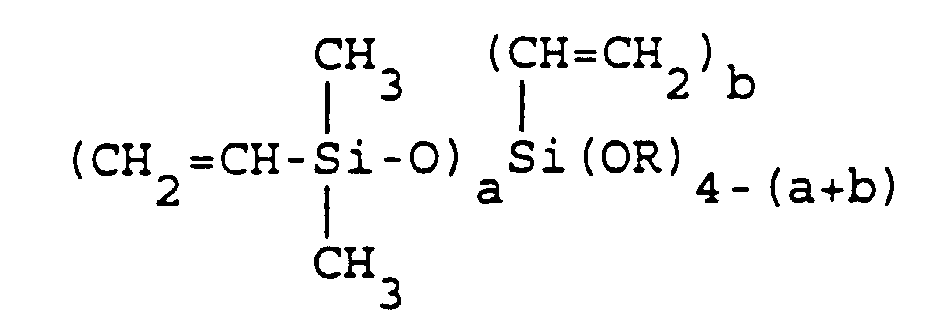
- the invention provides vinyl- and alkoxy-functional organosilicon compounds with the general formula in which R denotes C 1 to C 4 alkyl and a is 1, 2, or 3, b is 0 or 1, and a + b is 2 or 3.
- Another aspect of this invention is a method for the preparation of a vinyl- and alkoxy-functional organosilicon compound with a general formula in which R denotes C 1 to C 4 alkyl and a is 1, 2, or 3, b is 0 or 1, and a + b is 2 or 3, comprising mixing sym-divinyltetramethyldisiloxane and vinyltrialkoxysilane or tetraalkoxysilane in the presence of an acid catalyst and heating at a temperature of from 70°C and 150°C promoting an exchange reaction between sym-divinyltetramethyldisiloxane and vinyltrialkoxysilane or heating at a temperature of from 70°C to 200°C promoting an exchange reaction between sym-divinyltetramethyldisiloxane and tetraalkoxysilane.
- the vinyl- and alkoxy-functional organosilicon compounds according to the present invention are expressed by the following general formula. in which R in the preceding formula denotes C 1 to C 4 alkyl and is exemplified by methyl, ethyl, n-propyl, isopropyl, n-butyl, isobutyl, and tert-butyl. Methyl and ethyl are preferred and the methyl group is particularly preferred.
- the subscript a has a value of 1, 2, or 3.
- the subscript b is 0 or 1.
- the sum of a - b is 2 or 3.
- the subject (vinyl + alkoxy)-functional organosilicon compounds are exemplified by compounds with the following formulas, (ViMe 2 SiO) 2 SiVi (OMe) 1 (ViMe 2 SiO) 1 SiVi(OMe) 2 (ViMe 2 SiO) 2 SiVi (OEt) 1 (ViMe 2 SiO) 1 SiVi (OEt) 2 (ViMe 2 SiO) 3 Si(OMe) 1 (ViMe 2 SiO) 2 Si(OMe) 2 (ViMe 2 SiO) 3 Si(OEt) 1 (ViMe 2 SiO) 2 Si(OEt) 2
- Vi represents a vinyl group
- Me represents a methyl group
- Et represents an ethyl group.
- the (vinyl + alkoxy)-functional organosilicon compounds of this invention can be prepared by running an acid-catalyzed exchange reaction between symdivinyltetra-methyldisiloxane and vinyltrialkoxysilane or an acid-catalyzed exchange reaction between sym-divinyltetramethyldisiloxane and tetraalkoxysilane.
- the sym-divinyltetramethyldisiloxane, vinyltrialkoxy-silane, and tetraalkoxysilane used in our method are widely used in industry.
- vinyltrialkoxysilanes are vinyltrimethoxysilane, vinyltriethoxy-silane, and vinyltri-n-propoxysilane.
- tetraalkoxy-silane are tetramethoxysilane, tetraethoxysilane, tetra-(n-propoxy)silane, and tetra-(isobutoxy)silane.
- the standard addition is 1 or 2 moles of sym-divinyltetramethyldisiloxane per 1 mole of vinyltrialkoxysilane to introduce, respectively, 1 or 2 ViMe 2 SiO groups into the vinyltrialkoxysilane.
- the amount of symdivinyltetramethyldisiloxane to be used with respect to 1 mole of tetraalkoxysilane is 2 or 3 moles, respectively.
- Any acid catalyst may be used in the method of the invention which does not have a negative influence on the reaction system.
- the acid catalyst is exemplified by acid-treated inorganic compounds such as activated clay, trifluorosulfonic acid, and dodecylbenzene-sulfonic acid.
- the reaction product afforded by the sym-divinyltetra-methyldisiloxane and vinyltrialkoxysilane exchange reaction comprises a mixture whose components are organosilicon compounds with the formula (ViMe 2 SiO) x SiVi(OR) 3-x .
- R denotes C 1 to C 4 alkyl
- x 0 to 3.
- Vinyl- and alkoxy-functional organosilicon compounds of this invention can be obtained by distilling this mixture.
- One molecule of vinyldimethylalkoxysilane ViMe 2 SiOR is produced in this exchange reaction as by-product for each alkoxy group in the vinyltrialkoxysilane that is replaced by the group of the formula ViMe 2 SiO.
- the reaction is preferably promoted by distilling the former compound.
- the vinyldimethyl-alkoxysilane by-product can be hydrolyzed to make sym-divinyltetramethyldisiloxane, which can be re-used as starting material in the preparative method of our invention.
- Other organosilicon compound by-products can be re-used by addition to a subsequent exchange reaction.
- the subject exchange reaction begins at around 70°C and ultimately finishes at 100°C to 150°C.
- the temperature at which the vinyldimethylalkoxysilane by-product can be distilled rises as the reaction progresses.
- the acid catalyst is preferably eliminated from the reaction product after completion of the reaction, by neutralization and/or filtration of the reaction product. This reaction may be run in organic solvent.
- the product of the exchange reaction between symdivinyltetramethyldisiloxane and the tetraalkoxysilane is a mixture comprised of the organosilicon compounds represented by the formula (ViMe 2 SiO) y Si(OR) 3-y (where y represents a number 0, 1, 2, 3, or 4).
- y represents a number 0, 1, 2, 3, or 4
- vinyl- and alkoxy-functional organosilicon compounds of this invention can be obtained.
- each time one of the alkoxy groups in the tetraalkoxysilane is substituted by the group represented by the formula ViMe 2 SiO one molecule of vinyldimethylalkoxysilane represented by formula ViMe 2 SiOR is generated as a by-product.
- the vinyldimethylalkoxysilane by-product is hydrolyzed to sym-divinyltetramethyldisiloxane, which is recycled as the feed material in the manufacturing method of this invention.
- other organosilicon compound by-products may be recycled to the exchange reaction.
- This exchange reaction starts at near 70°C, and it finally reaches completion at 150°C to 200°C.
- the temperature at which the vinyldimethylalkoxysilane by-product can be removed by distillation is increased.
- the reaction product be neutralized or filtered, to remove the acidic catalyst. Also, it is possible to carry out this reaction in the presence of an organic solvent.
- a single silicon atom carries the alkoxy groups, vinyl group in some compounds, and dimethylvinylsiloxy groups.
- the alkoxy group has a high condensation reactivity with the silanol group as a result, while these compounds can also participate in other reactions by virtue of the presence of the vinyl group.
- compositions which cure at room temperature can be obtained by using the vinyl- and alkoxy-functional organosilicon compounds of this invention in combination with polydiorganosiloxanes with condensable groups, such as hydroxyl endblocked polydimethylsiloxane.
- Other ingredients can also be present with the condensable polydiorganosiloxane and vinyl- and alkoxy-functional organosilicon compounds of this invention, such as crosslinkers, fillers, and catalysts. These ingredients are well known in the art of making silicone sealants.
- the invention is further explained through the following working examples.
- the vinyl-and alkoxy-functional organosilicon compounds were determined by 1 H-nuclear magnetic resonance analysis and infrared spectroscopic analysis. The values reported for the viscosity were measured at 25°C.
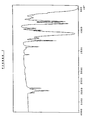
- Figure 1 contains the infrared absorption spectrogram of the (vinyl + alkoxy)-functional organosilicon compound synthesized in Example 1.
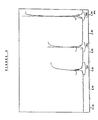
- Figure 2 contains the 1 H-nuclear magnetic resonance spectrogram of the (vinyl + alkoxy)-functional organosilicon compound synthesized in Example 1.
- Figure 3 contains the infrared absorption spectrogram of the (vinyl + alkoxy)-functional organosilicon compound synthesized in Example 2.
- Figure 4 contains the 1 H-nuclear magnetic resonance spectrogram of the (vinyl + alkoxy)-functional organosilicon compound synthesized in Example 2.
- Figure 5 contains the IR absorption spectrum of the (vinyl + alkoxy)-functional organosilicon compound manufactured in Application Example 3 of this invention.
- Figure 6 contains the 1 H-NMR spectrum of the (vinyl + alkoxy)-functional organosilicon compound manufactured in Application Example 3 of this invention.
- Figure 7 contains the IR absorption spectrum of the (vinyl + alkoxy)-functional organosilicon compound manufactured in Application Example 4 of this invention.
- Figure 8 contains the 1 H-NMR spectrum of the (vinyl + alkoxy)-functional organosilicon compound manufactured in Application Example 4 of this invention.
- the (vinyl + alkoxy)-functional organosilicon compound with the formula (ViMe 2 SiO)SiVi(OMe) 2 accounted for 35 to 40 weight% of the reaction mixture 20 hours after the start of the reaction.
- the reaction was stopped at this point, and, after cooling, the reaction mixture was filtered to eliminate the cation-exchange resin.
- the filtered reaction mixture was then fractionated on a Vigreux distillation setup to give 170 g of a crude fraction with a high content of (vinyl + alkoxy)-functional organosilicon compound with the formula (ViMe 2 SiO)SiVi(OMe) 2 .
- a filtered reaction mixture obtained according to Example 1 was fractionated on a Vigreux distillation setup to give 45 g of a crude fraction with a high content of (vinyl + alkoxy)-functional organosilicon compound with the formula (ViMe 2 SiO) 2 SiVi(OMe).
- This crude fraction was subjected to vacuum distillation using a spinning band precision distillation apparatus to give 28 g (vinyl + alkoxy)-functional organosilicon compound with the formula (ViMe 2 SiO) 2 SiVi(OMe) at bp 102°C/20 mmHg (2.7 kPa).
- This (vinyl + alkoxy)-functional organosilicon compound had a purity of 98% and a refractive index of 1.4161.
- Figure 3 shows the infrared absorption spectrogram of the (vinyl + alkoxy)-functional organosilicon compound with the formula (ViMe 2 SiO) 2 SiVi(OMe) produced in this example.
- Figure 4 depicts the 1 H-nuclear magnetic resonance spectrogram of the (vinyl + alkoxy)-functional organosilicon compound with the formula (ViMe 2 SiO) 2 SiVi(OMe) produced in this example.
- a (vinyl + alkoxy)-functional organosilicon compound according to the invention was evaluated for its reactivity with silanol-endblocked dimethylpolysiloxane.
- a room-temperature curable organopolysiloxane composition was prepared as above, but in this case using an organosilicon compound with the formula (Me 3 SiO) 2 Si(OMe) 2 in place of the (vinyl + alkoxy)-functional organosilicon compound prepared in Example 1 and used in Application Example 1.
- the viscosity change of this comparison composition measured after 3 hours as above, was only 210%.
- a room-temperature curable organopolysiloxane composition was prepared, but in this case using methylvinyldimethoxysilane in place of the (vinyl + alkoxy)-functional organosilicon compound prepared in Example 1.
- the viscosity change of this composition measured after 3 hours as above, did not exceed 101%.
- the reaction product was sampled frequently for gas chromatographic analysis. It was found that at 36 hours after the beginning of the reaction, the content of the (vinyl + alkoxy)-functional organosilicon compound represented by formula (ViMe 2 SiO) 3 SiOMe was 25-30 wt%. The reaction was stopped at this point. After cooling, the obtained reaction mixture was filtered, and the cation-exchange resin was removed. Then, the filtered reaction mixture was loaded into a Vigreux fractionating apparatus for fractionation, from which 53.7 g of a crude fraction of distillate containing a large amount of the (vinyl + alkoxy)-functional organosilicon compound represented by the formula (ViMe 2 SiO) 3 SiOMe were obtained.
- the filtered reaction mixture prepared in the same way as in Example 3, was loaded into a Vigreux fractionating apparatus for fractionation, from which 112.6 g of a crude fraction of distillate containing a large amount of the (vinyl + alkoxy)-functional organosilicon compound represented by the formula (ViMe 2 SiO) 2 Si(OMe) 2 were obtained.
- the crude fraction of distillate was then subjected to distillation under a reduced pressure using a spinning-band precision fractionating apparatus, from which 60 g of the (vinyl + alkoxy)-functional organosilicon compound represented by the formula (ViMe 2 SiO) 3 Si(OMe) 2 with a boiling point of 100°C/20 mm Hg (2.7 kPa) were obtained.
- FIG. 7 shows the IR absorption spectrum of the (vinyl + alkoxy)-functional organosilicon compound represented by the formula (ViMe 2 SiO) 2 Si(OMe) 2 produced in this example.
- Figure 8 depicts the 1 H-NMR spectrum of the (vinyl + alkoxy)-functional organosilicon compound represented by the formula (ViMe 2 SiO) 2 Si(OMe) 2 produced in this example.
- the reactivity of the (vinyl + alkoxy)-functional organosilicon compound of this invention with respect to a dimethylpolysiloxane with both terminals blocked by silanols was evaluated. 5 g of dimethylpolysiloxane with both terminals blocked by silanols (viscosity of 12.5 Pa.s) were blended with a mixture of 0.3 g of the (vinyl + alkoxy)-functional organo-silicon compound obtained in Example 4 and 0.03 g of dibutyltin laurate to form an organopolysiloxane that can be cured at room temperature. After the composition was set at room temperature for 3 hours, the rate of change in the viscosity was measured, and was found to be 320%.
- the (vinyl + alkoxy)-functional organosilicon compounds of the present invention are novel compounds that contain both the vinyl group and alkoxy, which is characterized by a high condensation reactivity with the silanol group.
- the preparative method of the invention has the capacity to produce the subject (vinyl + alkoxy)-functional organosilicon compounds in a highly efficient manner.
Landscapes
- Chemical & Material Sciences (AREA)
- Organic Chemistry (AREA)
- Chemical Kinetics & Catalysis (AREA)
- Health & Medical Sciences (AREA)
- Medicinal Chemistry (AREA)
- Polymers & Plastics (AREA)
- Silicon Polymers (AREA)
Claims (4)
- Vinyl- und alkoxyfunktionelle Organosiliciumverbindung der allgemeinen Formel:worin R für C1-C4-Alkyl steht, a 1, 2 oder 3 bedeutet und b 0 oder 1 ist und a+b 2 oder 3 bedeutet.
- Vinyl- und alkoxyfunktionelle Organosiliciumverbindung nach Anspruch 1, worin R für Methyl steht.
- Verfahren zur Herstellung der vinyl- und alkoxyfunktionellen Organosiliciumverbindung nach Anspruch 1 durch Vermischen von sym-Divinyltetramethyldisiloxan und Vinyltrialkoxysilan oder Tetraalkoxysilan in Gegenwart eines Säurekatalysators und Erwärmen auf eine Temperatur von 70°C bis 150°C zur Förderung einer Austauschreaktion zwischen sym-Divinyltetramethyldisiloxan und Vinyltrialkoxysilan oder Erwärmen auf eine Temperatur von 70°C bis 200°C zur Förderung einer Austauschreaktion zwischen sym-Divinyltetramethyldisiloxan und Tetraalkoxysilan.
- Bei Raumtemperatur härtbare Zusammensetzung die ein Polydiorganosiloxan mit silicium-gebundenen hydrolysierbaren Gruppen und die vinyl- und alkoxyfunktionelle Organosiliciumverbindung nach Anspruch 1 enthält.
Applications Claiming Priority (4)
| Application Number | Priority Date | Filing Date | Title |
|---|---|---|---|
| JP26558593A JPH0797386A (ja) | 1993-09-29 | 1993-09-29 | アルコキシ官能性有機ケイ素化合物およびその製造方法 |
| JP265585/93 | 1993-09-29 | ||
| JP5307367A JPH07138267A (ja) | 1993-11-12 | 1993-11-12 | ビニルアルコキシ官能性有機ケイ素化合物およびその製造方法 |
| JP307367/93 | 1993-11-12 |
Publications (2)
| Publication Number | Publication Date |
|---|---|
| EP0645395A1 EP0645395A1 (de) | 1995-03-29 |
| EP0645395B1 true EP0645395B1 (de) | 1999-04-07 |
Family
ID=26547056
Family Applications (1)
| Application Number | Title | Priority Date | Filing Date |
|---|---|---|---|
| EP94115295A Expired - Lifetime EP0645395B1 (de) | 1993-09-29 | 1994-09-28 | Vinyl- und Alkoxygruppe enthaltende Organosiliciumverbindungen und Verfahren zu deren Herstellung |
Country Status (3)
| Country | Link |
|---|---|
| US (1) | US5470934A (de) |
| EP (1) | EP0645395B1 (de) |
| DE (1) | DE69417668T2 (de) |
Families Citing this family (8)
| Publication number | Priority date | Publication date | Assignee | Title |
|---|---|---|---|---|
| DE19545363A1 (de) | 1995-12-05 | 1997-06-12 | Wacker Chemie Gmbh | Niedermolekulare Organosiliciumverbindungen, Verfahren zu deren Herstellung sowie deren Verwendung in vernetzbaren Organopolysiloxanmassen |
| JP3999827B2 (ja) * | 1996-01-31 | 2007-10-31 | 東レ・ダウコーニング株式会社 | オルガノペンタシロキサンの製造方法 |
| US6093833A (en) * | 1999-01-14 | 2000-07-25 | Akzo Nobel N.V. | Process for producing trivalent titanium coordination complex |
| US20030134152A1 (en) * | 1999-06-24 | 2003-07-17 | Toda Kogyo | Magnetic composite particles for magnetic recording medium, process for producing the same and magnetic recording medium the same |
| DE10242415A1 (de) * | 2002-09-12 | 2004-03-25 | Wacker-Chemie Gmbh | Organopolysiloxane und deren Einsatz in bei Raumtemperatur vernetzbaren Massen |
| DE10259613A1 (de) * | 2002-12-19 | 2004-07-08 | Wacker-Chemie Gmbh | Organopolysiloxanzusammensetzungen und deren Einsatz in bei Raumtemperatur vernetzbaren niedermoduligen Massen |
| DE102014222826A1 (de) | 2014-11-07 | 2016-05-12 | Wacker Chemie Ag | Vernetzbare Organopolysiloxanzusammensetzungen |
| TWI861243B (zh) * | 2019-10-30 | 2024-11-11 | 日商陶氏東麗股份有限公司 | 有機聚矽氧烷、其製造方法以及導熱性矽組成物 |
Family Cites Families (6)
| Publication number | Priority date | Publication date | Assignee | Title |
|---|---|---|---|---|
| JPH03197486A (ja) * | 1989-12-26 | 1991-08-28 | Shin Etsu Chem Co Ltd | アルコキシシリル基を有するオルガノシロキサンの製造方法 |
| JPH0633334B2 (ja) * | 1990-02-22 | 1994-05-02 | 信越化学工業株式会社 | シリコーン粉末の製造方法 |
| JPH03287664A (ja) * | 1990-04-04 | 1991-12-18 | Shin Etsu Chem Co Ltd | 室温硬化性オルガノポリシロキサン組成物及び硬化物 |
| JPH0767784B2 (ja) * | 1990-10-11 | 1995-07-26 | 信越化学工業株式会社 | シリコーンゴム積層体及びその製造方法 |
| US5162480A (en) * | 1990-12-14 | 1992-11-10 | Union Carbide Chemicals & Plastics Technology Corporation | Self-curing ceramicizable polysiloxanes |
| JP3210424B2 (ja) * | 1992-06-22 | 2001-09-17 | 東レ・ダウコーニング・シリコーン株式会社 | 室温硬化性シリコーンエラストマー組成物 |
-
1994
- 1994-09-15 US US08/306,788 patent/US5470934A/en not_active Expired - Lifetime
- 1994-09-28 DE DE69417668T patent/DE69417668T2/de not_active Expired - Lifetime
- 1994-09-28 EP EP94115295A patent/EP0645395B1/de not_active Expired - Lifetime
Also Published As
| Publication number | Publication date |
|---|---|
| US5470934A (en) | 1995-11-28 |
| EP0645395A1 (de) | 1995-03-29 |
| DE69417668T2 (de) | 1999-09-16 |
| DE69417668D1 (de) | 1999-05-12 |
Similar Documents
| Publication | Publication Date | Title |
|---|---|---|
| CN109627444B (zh) | D/t型环状支链硅氧烷的混合物和其转化产物 | |
| EP0195936B1 (de) | Verfahren zur Herstellung von Polyorganosiloxanen und die so hergestellten Polymere | |
| KR100280586B1 (ko) | 알콕시 말단차단된 폴리디오가노실록산, 이의 제조방법 및 이로부터 제조된 실온 경화성 실리콘 엘라스토머 | |
| CA1311076C (en) | Moisture curable polyisobutylenes | |
| EP0388028B1 (de) | Härtbare Polysiloxanzusammensetzungen, die norbonyl-funktionelle Gruppen enthalten | |
| US5206328A (en) | Process for the production of an organopolysiloxane | |
| CN111386300A (zh) | 制备在硅氧烷部分中支化的SiOC连接的聚醚硅氧烷的方法 | |
| CN113166474A (zh) | 反应性硅氧烷 | |
| JPH0562129B2 (de) | ||
| EP0530496B1 (de) | Organosiliziumverbindungen und Verfahren zu ihrer Herstellung | |
| GB2108984A (en) | Hydrolysis of alkoxysilanes | |
| KR20160129888A (ko) | 한정된 반응성의 반응성 작용기를 지닌 알콕시 기 함유 실리콘 | |
| US5110967A (en) | Crosslinkers and chain extenders for room temperature vulcanization or crosslinking of polymers | |
| EP0645395B1 (de) | Vinyl- und Alkoxygruppe enthaltende Organosiliciumverbindungen und Verfahren zu deren Herstellung | |
| KR101055597B1 (ko) | 유기관능성 실록산 혼합물 | |
| JPH0791386B2 (ja) | 非水系によるシリコーンオリゴマー調製法 | |
| KR100344475B1 (ko) | 오가노실록산화합물 | |
| US5786493A (en) | Cyclic silane esters and solvolysis products thereof, and processes for the preparation of the cyclic silane esters and the solvolysis products | |
| CN107001638B (zh) | 用于生产具有氨基的有机硅化合物的方法 | |
| JP3410486B2 (ja) | アルコキシ基含有シリコーンレジンの製造方法 | |
| KR102894692B1 (ko) | 실록산-작용화된 실리카 | |
| CA1096875A (en) | Alkenyloxy silicon compositions | |
| EP1101767B1 (de) | Organosiloxan und Verfahren zu deren Herstellung | |
| US3529007A (en) | New organosilicon compounds,their preparation and their use | |
| US5239099A (en) | Azasilacycloalkyl functional alkoxysilanes and azasilacycloalkyl functional tetramethyldisiloxanes |
Legal Events
| Date | Code | Title | Description |
|---|---|---|---|
| PUAI | Public reference made under article 153(3) epc to a published international application that has entered the european phase |
Free format text: ORIGINAL CODE: 0009012 |
|
| AK | Designated contracting states |
Kind code of ref document: A1 Designated state(s): DE FR GB |
|
| 17P | Request for examination filed |
Effective date: 19950530 |
|
| 17Q | First examination report despatched |
Effective date: 19971021 |
|
| GRAG | Despatch of communication of intention to grant |
Free format text: ORIGINAL CODE: EPIDOS AGRA |
|
| GRAG | Despatch of communication of intention to grant |
Free format text: ORIGINAL CODE: EPIDOS AGRA |
|
| GRAH | Despatch of communication of intention to grant a patent |
Free format text: ORIGINAL CODE: EPIDOS IGRA |
|
| GRAH | Despatch of communication of intention to grant a patent |
Free format text: ORIGINAL CODE: EPIDOS IGRA |
|
| GRAA | (expected) grant |
Free format text: ORIGINAL CODE: 0009210 |
|
| AK | Designated contracting states |
Kind code of ref document: B1 Designated state(s): DE FR GB |
|
| REF | Corresponds to: |
Ref document number: 69417668 Country of ref document: DE Date of ref document: 19990512 |
|
| ET | Fr: translation filed | ||
| PLBE | No opposition filed within time limit |
Free format text: ORIGINAL CODE: 0009261 |
|
| STAA | Information on the status of an ep patent application or granted ep patent |
Free format text: STATUS: NO OPPOSITION FILED WITHIN TIME LIMIT |
|
| 26N | No opposition filed | ||
| REG | Reference to a national code |
Ref country code: GB Ref legal event code: IF02 |
|
| PGFP | Annual fee paid to national office [announced via postgrant information from national office to epo] |
Ref country code: GB Payment date: 20090923 Year of fee payment: 16 |
|
| PGFP | Annual fee paid to national office [announced via postgrant information from national office to epo] |
Ref country code: DE Payment date: 20090923 Year of fee payment: 16 |
|
| PGFP | Annual fee paid to national office [announced via postgrant information from national office to epo] |
Ref country code: FR Payment date: 20091012 Year of fee payment: 16 |
|
| GBPC | Gb: european patent ceased through non-payment of renewal fee |
Effective date: 20100928 |
|
| REG | Reference to a national code |
Ref country code: FR Ref legal event code: ST Effective date: 20110531 |
|
| REG | Reference to a national code |
Ref country code: DE Ref legal event code: R119 Ref document number: 69417668 Country of ref document: DE Effective date: 20110401 |
|
| PG25 | Lapsed in a contracting state [announced via postgrant information from national office to epo] |
Ref country code: FR Free format text: LAPSE BECAUSE OF NON-PAYMENT OF DUE FEES Effective date: 20100930 Ref country code: DE Free format text: LAPSE BECAUSE OF NON-PAYMENT OF DUE FEES Effective date: 20110401 |
|
| PG25 | Lapsed in a contracting state [announced via postgrant information from national office to epo] |
Ref country code: GB Free format text: LAPSE BECAUSE OF NON-PAYMENT OF DUE FEES Effective date: 20100928 |