EP0645401B1 - Procédé de préparation de polyoléfines - Google Patents
Procédé de préparation de polyoléfines Download PDFInfo
- Publication number
- EP0645401B1 EP0645401B1 EP94114431A EP94114431A EP0645401B1 EP 0645401 B1 EP0645401 B1 EP 0645401B1 EP 94114431 A EP94114431 A EP 94114431A EP 94114431 A EP94114431 A EP 94114431A EP 0645401 B1 EP0645401 B1 EP 0645401B1
- Authority
- EP
- European Patent Office
- Prior art keywords
- group
- indenyl
- methyl
- zrcl
- different
- Prior art date
- Legal status (The legal status is an assumption and is not a legal conclusion. Google has not performed a legal analysis and makes no representation as to the accuracy of the status listed.)
- Expired - Lifetime
Links
- 229920000098 polyolefin Polymers 0.000 title claims abstract description 15
- 238000000034 method Methods 0.000 title claims description 18
- 239000003054 catalyst Substances 0.000 claims abstract description 17
- 238000009826 distribution Methods 0.000 claims abstract description 16
- 150000001336 alkenes Chemical class 0.000 claims abstract description 15
- ZMMRKRFMSDTOLV-UHFFFAOYSA-N cyclopenta-1,3-diene zirconium Chemical compound [Zr].C1C=CC=C1.C1C=CC=C1 ZMMRKRFMSDTOLV-UHFFFAOYSA-N 0.000 claims abstract description 12
- 229910052740 iodine Inorganic materials 0.000 claims abstract description 10
- 229910052723 transition metal Inorganic materials 0.000 claims abstract description 10
- 150000003624 transition metals Chemical class 0.000 claims abstract description 10
- 230000002902 bimodal effect Effects 0.000 claims abstract description 8
- -1 rac-phenyl(methyl)silyl(indenyl) Chemical group 0.000 claims description 70
- 229910007928 ZrCl2 Inorganic materials 0.000 claims description 60
- 125000005843 halogen group Chemical group 0.000 claims description 55
- 238000006116 polymerization reaction Methods 0.000 claims description 33
- 125000004435 hydrogen atom Chemical group [H]* 0.000 claims description 31
- 125000000008 (C1-C10) alkyl group Chemical group 0.000 claims description 27
- 229910052739 hydrogen Inorganic materials 0.000 claims description 27
- 239000001257 hydrogen Substances 0.000 claims description 25
- 125000000041 C6-C10 aryl group Chemical group 0.000 claims description 24
- 125000004429 atom Chemical group 0.000 claims description 18
- VPGLGRNSAYHXPY-UHFFFAOYSA-L zirconium(2+);dichloride Chemical compound Cl[Zr]Cl VPGLGRNSAYHXPY-UHFFFAOYSA-L 0.000 claims description 18
- YBYIRNPNPLQARY-UHFFFAOYSA-N 1H-indene Natural products C1=CC=C2CC=CC2=C1 YBYIRNPNPLQARY-UHFFFAOYSA-N 0.000 claims description 17
- UFHFLCQGNIYNRP-UHFFFAOYSA-N Hydrogen Chemical compound [H][H] UFHFLCQGNIYNRP-UHFFFAOYSA-N 0.000 claims description 16
- 150000001875 compounds Chemical class 0.000 claims description 16
- 125000006374 C2-C10 alkenyl group Chemical group 0.000 claims description 15
- 125000003118 aryl group Chemical group 0.000 claims description 14
- 229910052801 chlorine Inorganic materials 0.000 claims description 14
- 125000001997 phenyl group Chemical group [H]C1=C([H])C([H])=C(*)C([H])=C1[H] 0.000 claims description 14
- 125000003454 indenyl group Chemical group C1(C=CC2=CC=CC=C12)* 0.000 claims description 13
- 125000003837 (C1-C20) alkyl group Chemical group 0.000 claims description 12
- 125000003860 C1-C20 alkoxy group Chemical group 0.000 claims description 12
- 125000003358 C2-C20 alkenyl group Chemical group 0.000 claims description 12
- 239000000460 chlorine Substances 0.000 claims description 11
- 125000004122 cyclic group Chemical group 0.000 claims description 11
- 125000002496 methyl group Chemical group [H]C([H])([H])* 0.000 claims description 11
- 239000000203 mixture Substances 0.000 claims description 11
- 238000004519 manufacturing process Methods 0.000 claims description 10
- XUIMIQQOPSSXEZ-UHFFFAOYSA-N Silicon Chemical compound [Si] XUIMIQQOPSSXEZ-UHFFFAOYSA-N 0.000 claims description 9
- 229910052732 germanium Inorganic materials 0.000 claims description 9
- GNPVGFCGXDBREM-UHFFFAOYSA-N germanium atom Chemical compound [Ge] GNPVGFCGXDBREM-UHFFFAOYSA-N 0.000 claims description 9
- 229910052710 silicon Inorganic materials 0.000 claims description 9
- 239000004215 Carbon black (E152) Substances 0.000 claims description 8
- ZAMOUSCENKQFHK-UHFFFAOYSA-N Chlorine atom Chemical compound [Cl] ZAMOUSCENKQFHK-UHFFFAOYSA-N 0.000 claims description 8
- 229930195733 hydrocarbon Natural products 0.000 claims description 8
- QQONPFPTGQHPMA-UHFFFAOYSA-N propylene Natural products CC=C QQONPFPTGQHPMA-UHFFFAOYSA-N 0.000 claims description 8
- 125000000027 (C1-C10) alkoxy group Chemical group 0.000 claims description 7
- VGGSQFUCUMXWEO-UHFFFAOYSA-N Ethene Chemical compound C=C VGGSQFUCUMXWEO-UHFFFAOYSA-N 0.000 claims description 7
- ATJFFYVFTNAWJD-UHFFFAOYSA-N Tin Chemical compound [Sn] ATJFFYVFTNAWJD-UHFFFAOYSA-N 0.000 claims description 7
- 229910052718 tin Inorganic materials 0.000 claims description 7
- 239000005977 Ethylene Substances 0.000 claims description 6
- 125000000058 cyclopentadienyl group Chemical group C1(=CC=CC1)* 0.000 claims description 6
- ZSWFCLXCOIISFI-UHFFFAOYSA-N endo-cyclopentadiene Natural products C1C=CC=C1 ZSWFCLXCOIISFI-UHFFFAOYSA-N 0.000 claims description 6
- JRZJOMJEPLMPRA-UHFFFAOYSA-N olefin Natural products CCCCCCCC=C JRZJOMJEPLMPRA-UHFFFAOYSA-N 0.000 claims description 6
- 125000004805 propylene group Chemical group [H]C([H])([H])C([H])([*:1])C([H])([H])[*:2] 0.000 claims description 6
- 239000010703 silicon Substances 0.000 claims description 6
- 229910052726 zirconium Inorganic materials 0.000 claims description 6
- 125000000217 alkyl group Chemical group 0.000 claims description 5
- 125000003983 fluorenyl group Chemical group C1(=CC=CC=2C3=CC=CC=C3CC12)* 0.000 claims description 5
- QCWXUUIWCKQGHC-UHFFFAOYSA-N Zirconium Chemical group [Zr] QCWXUUIWCKQGHC-UHFFFAOYSA-N 0.000 claims description 4
- 125000004432 carbon atom Chemical group C* 0.000 claims description 4
- 239000007789 gas Substances 0.000 claims description 4
- 239000000725 suspension Substances 0.000 claims description 4
- 125000004169 (C1-C6) alkyl group Chemical group 0.000 claims description 3
- 125000002733 (C1-C6) fluoroalkyl group Chemical group 0.000 claims description 3
- 238000007334 copolymerization reaction Methods 0.000 claims description 3
- DFAOFZJCCQQUIP-UHFFFAOYSA-L CC(c1ccccc1)=[Zr](Cl)(Cl)(C1C=CC=C1)C1c2ccccc2-c2ccccc12 Chemical compound CC(c1ccccc1)=[Zr](Cl)(Cl)(C1C=CC=C1)C1c2ccccc2-c2ccccc12 DFAOFZJCCQQUIP-UHFFFAOYSA-L 0.000 claims description 2
- SVHPGKHHBXQFLQ-UHFFFAOYSA-L Cl[Zr](Cl)(C1C=CC=C1)(C1c2ccccc2-c2ccccc12)=C(c1ccccc1)c1ccccc1 Chemical compound Cl[Zr](Cl)(C1C=CC=C1)(C1c2ccccc2-c2ccccc12)=C(c1ccccc1)c1ccccc1 SVHPGKHHBXQFLQ-UHFFFAOYSA-L 0.000 claims description 2
- 229910052799 carbon Inorganic materials 0.000 claims description 2
- 125000002950 monocyclic group Chemical group 0.000 claims 3
- AGKZDUBMFACJPR-UHFFFAOYSA-L C12=CC=CC=C2C2=CC=CC=C2C1[Zr](Cl)(Cl)(=C(C)C)C1C=CC=C1 Chemical compound C12=CC=CC=C2C2=CC=CC=C2C1[Zr](Cl)(Cl)(=C(C)C)C1C=CC=C1 AGKZDUBMFACJPR-UHFFFAOYSA-L 0.000 claims 1
- QNIDLSXEFKFXDN-UHFFFAOYSA-N CC1=CC2=CC=CC=C2C1[Zr](C)(C1=CC=CC=C1)[SiH3].Cl.Cl Chemical compound CC1=CC2=CC=CC=C2C1[Zr](C)(C1=CC=CC=C1)[SiH3].Cl.Cl QNIDLSXEFKFXDN-UHFFFAOYSA-N 0.000 claims 1
- 229910007926 ZrCl Inorganic materials 0.000 description 30
- YXFVVABEGXRONW-UHFFFAOYSA-N Toluene Chemical compound CC1=CC=CC=C1 YXFVVABEGXRONW-UHFFFAOYSA-N 0.000 description 15
- 229920000642 polymer Polymers 0.000 description 15
- 125000005018 aryl alkenyl group Chemical group 0.000 description 10
- 125000003710 aryl alkyl group Chemical group 0.000 description 10
- 125000004407 fluoroaryl group Chemical group 0.000 description 9
- 239000000243 solution Substances 0.000 description 9
- 125000003709 fluoroalkyl group Chemical group 0.000 description 8
- 239000004743 Polypropylene Substances 0.000 description 7
- 125000002877 alkyl aryl group Chemical group 0.000 description 7
- 230000037048 polymerization activity Effects 0.000 description 7
- XLYOFNOQVPJJNP-UHFFFAOYSA-N water Substances O XLYOFNOQVPJJNP-UHFFFAOYSA-N 0.000 description 7
- 241000282326 Felis catus Species 0.000 description 6
- 230000000694 effects Effects 0.000 description 6
- 229920001155 polypropylene Polymers 0.000 description 6
- 229910052782 aluminium Inorganic materials 0.000 description 5
- 239000007787 solid Substances 0.000 description 5
- 125000006273 (C1-C3) alkyl group Chemical group 0.000 description 4
- 0 C*(C)C(C(*)C(C)(C1C)C2=CCCC2)C(C2)=C1C=CCC2(C)*(C)C Chemical compound C*(C)C(C(*)C(C)(C1C)C2=CCCC2)C(C2)=C1C=CCC2(C)*(C)C 0.000 description 4
- 229910052731 fluorine Inorganic materials 0.000 description 4
- 239000011737 fluorine Substances 0.000 description 4
- 150000002430 hydrocarbons Chemical class 0.000 description 4
- 150000002431 hydrogen Chemical class 0.000 description 4
- 239000007788 liquid Substances 0.000 description 4
- 125000006656 (C2-C4) alkenyl group Chemical group 0.000 description 3
- 125000006736 (C6-C20) aryl group Chemical group 0.000 description 3
- WKBOTKDWSSQWDR-UHFFFAOYSA-N Bromine atom Chemical compound [Br] WKBOTKDWSSQWDR-UHFFFAOYSA-N 0.000 description 3
- VYPSYNLAJGMNEJ-UHFFFAOYSA-N Silicium dioxide Chemical compound O=[Si]=O VYPSYNLAJGMNEJ-UHFFFAOYSA-N 0.000 description 3
- 238000000071 blow moulding Methods 0.000 description 3
- 125000001309 chloro group Chemical group Cl* 0.000 description 3
- 238000004140 cleaning Methods 0.000 description 3
- 229920001577 copolymer Polymers 0.000 description 3
- 239000012442 inert solvent Substances 0.000 description 3
- 125000000959 isobutyl group Chemical group [H]C([H])([H])C([H])(C([H])([H])[H])C([H])([H])* 0.000 description 3
- 238000000465 moulding Methods 0.000 description 3
- VLKZOEOYAKHREP-UHFFFAOYSA-N n-Hexane Chemical compound CCCCCC VLKZOEOYAKHREP-UHFFFAOYSA-N 0.000 description 3
- OFBQJSOFQDEBGM-UHFFFAOYSA-N n-pentane Natural products CCCCC OFBQJSOFQDEBGM-UHFFFAOYSA-N 0.000 description 3
- 239000000047 product Substances 0.000 description 3
- 125000004178 (C1-C4) alkyl group Chemical group 0.000 description 2
- LIKMAJRDDDTEIG-UHFFFAOYSA-N 1-hexene Chemical compound CCCCC=C LIKMAJRDDDTEIG-UHFFFAOYSA-N 0.000 description 2
- KWKAKUADMBZCLK-UHFFFAOYSA-N 1-octene Chemical compound CCCCCCC=C KWKAKUADMBZCLK-UHFFFAOYSA-N 0.000 description 2
- WSSSPWUEQFSQQG-UHFFFAOYSA-N 4-methyl-1-pentene Chemical compound CC(C)CC=C WSSSPWUEQFSQQG-UHFFFAOYSA-N 0.000 description 2
- KZBUYRJDOAKODT-UHFFFAOYSA-N Chlorine Chemical compound ClCl KZBUYRJDOAKODT-UHFFFAOYSA-N 0.000 description 2
- PXGOKWXKJXAPGV-UHFFFAOYSA-N Fluorine Chemical compound FF PXGOKWXKJXAPGV-UHFFFAOYSA-N 0.000 description 2
- YCKRFDGAMUMZLT-UHFFFAOYSA-N Fluorine atom Chemical compound [F] YCKRFDGAMUMZLT-UHFFFAOYSA-N 0.000 description 2
- 238000004566 IR spectroscopy Methods 0.000 description 2
- IMNFDUFMRHMDMM-UHFFFAOYSA-N N-Heptane Chemical compound CCCCCCC IMNFDUFMRHMDMM-UHFFFAOYSA-N 0.000 description 2
- 125000003545 alkoxy group Chemical group 0.000 description 2
- XAGFODPZIPBFFR-UHFFFAOYSA-N aluminium Chemical compound [Al] XAGFODPZIPBFFR-UHFFFAOYSA-N 0.000 description 2
- 125000004104 aryloxy group Chemical group 0.000 description 2
- 229920001585 atactic polymer Polymers 0.000 description 2
- 239000011127 biaxially oriented polypropylene Substances 0.000 description 2
- 229920006378 biaxially oriented polypropylene Polymers 0.000 description 2
- 229910052794 bromium Inorganic materials 0.000 description 2
- 239000012876 carrier material Substances 0.000 description 2
- 239000000498 cooling water Substances 0.000 description 2
- DIOQZVSQGTUSAI-UHFFFAOYSA-N decane Chemical compound CCCCCCCCCC DIOQZVSQGTUSAI-UHFFFAOYSA-N 0.000 description 2
- 239000012530 fluid Substances 0.000 description 2
- 239000000499 gel Substances 0.000 description 2
- 238000005227 gel permeation chromatography Methods 0.000 description 2
- 238000001746 injection moulding Methods 0.000 description 2
- 229920001580 isotactic polymer Polymers 0.000 description 2
- 229910052751 metal Inorganic materials 0.000 description 2
- 239000002184 metal Substances 0.000 description 2
- 239000012968 metallocene catalyst Substances 0.000 description 2
- CPOFMOWDMVWCLF-UHFFFAOYSA-N methyl(oxo)alumane Chemical compound C[Al]=O CPOFMOWDMVWCLF-UHFFFAOYSA-N 0.000 description 2
- UAEPNZWRGJTJPN-UHFFFAOYSA-N methylcyclohexane Chemical compound CC1CCCCC1 UAEPNZWRGJTJPN-UHFFFAOYSA-N 0.000 description 2
- 239000000178 monomer Substances 0.000 description 2
- 238000004806 packaging method and process Methods 0.000 description 2
- 238000002360 preparation method Methods 0.000 description 2
- 238000004080 punching Methods 0.000 description 2
- 239000010865 sewage Substances 0.000 description 2
- 239000002904 solvent Substances 0.000 description 2
- 125000001424 substituent group Chemical group 0.000 description 2
- 238000001644 13C nuclear magnetic resonance spectroscopy Methods 0.000 description 1
- PNEYBMLMFCGWSK-UHFFFAOYSA-N Alumina Chemical class [O-2].[O-2].[O-2].[Al+3].[Al+3] PNEYBMLMFCGWSK-UHFFFAOYSA-N 0.000 description 1
- XJONFIGVOQMBIP-UHFFFAOYSA-L Cl[Zr](Cl)C1C=CC=C1 Chemical compound Cl[Zr](Cl)C1C=CC=C1 XJONFIGVOQMBIP-UHFFFAOYSA-L 0.000 description 1
- XDTMQSROBMDMFD-UHFFFAOYSA-N Cyclohexane Chemical compound C1CCCCC1 XDTMQSROBMDMFD-UHFFFAOYSA-N 0.000 description 1
- NHTMVDHEPJAVLT-UHFFFAOYSA-N Isooctane Chemical compound CC(C)CC(C)(C)C NHTMVDHEPJAVLT-UHFFFAOYSA-N 0.000 description 1
- 239000004698 Polyethylene Substances 0.000 description 1
- NXCVISSWZBMIOI-UHFFFAOYSA-L [Cl-].[Cl-].C1(=CC=CC=C1)[SiH](C1=CC=CC=C1)[Zr+2]C1=C(C=C(C1)C)C Chemical compound [Cl-].[Cl-].C1(=CC=CC=C1)[SiH](C1=CC=CC=C1)[Zr+2]C1=C(C=C(C1)C)C NXCVISSWZBMIOI-UHFFFAOYSA-L 0.000 description 1
- 125000001931 aliphatic group Chemical group 0.000 description 1
- 150000001338 aliphatic hydrocarbons Chemical class 0.000 description 1
- 150000004945 aromatic hydrocarbons Chemical class 0.000 description 1
- 125000001797 benzyl group Chemical group [H]C1=C([H])C([H])=C(C([H])=C1[H])C([H])([H])* 0.000 description 1
- 229920001400 block copolymer Polymers 0.000 description 1
- GDTBXPJZTBHREO-UHFFFAOYSA-N bromine Substances BrBr GDTBXPJZTBHREO-UHFFFAOYSA-N 0.000 description 1
- 239000001273 butane Substances 0.000 description 1
- 239000000969 carrier Substances 0.000 description 1
- 238000006243 chemical reaction Methods 0.000 description 1
- 239000007795 chemical reaction product Substances 0.000 description 1
- 238000005094 computer simulation Methods 0.000 description 1
- 239000004035 construction material Substances 0.000 description 1
- 238000002425 crystallisation Methods 0.000 description 1
- 230000008025 crystallization Effects 0.000 description 1
- 230000006735 deficit Effects 0.000 description 1
- 239000002283 diesel fuel Substances 0.000 description 1
- JVSWJIKNEAIKJW-UHFFFAOYSA-N dimethyl-hexane Natural products CCCCCC(C)C JVSWJIKNEAIKJW-UHFFFAOYSA-N 0.000 description 1
- 238000006073 displacement reaction Methods 0.000 description 1
- 125000001495 ethyl group Chemical group [H]C([H])([H])C([H])([H])* 0.000 description 1
- 238000001125 extrusion Methods 0.000 description 1
- 238000007380 fibre production Methods 0.000 description 1
- 239000006260 foam Substances 0.000 description 1
- 239000011888 foil Substances 0.000 description 1
- 238000010528 free radical solution polymerization reaction Methods 0.000 description 1
- 229910052735 hafnium Inorganic materials 0.000 description 1
- VBJZVLUMGGDVMO-UHFFFAOYSA-N hafnium atom Chemical compound [Hf] VBJZVLUMGGDVMO-UHFFFAOYSA-N 0.000 description 1
- 229910052736 halogen Inorganic materials 0.000 description 1
- 150000002367 halogens Chemical class 0.000 description 1
- 229920006158 high molecular weight polymer Polymers 0.000 description 1
- PNDPGZBMCMUPRI-UHFFFAOYSA-N iodine Chemical compound II PNDPGZBMCMUPRI-UHFFFAOYSA-N 0.000 description 1
- 239000003446 ligand Substances 0.000 description 1
- GYNNXHKOJHMOHS-UHFFFAOYSA-N methyl-cycloheptane Natural products CC1CCCCCC1 GYNNXHKOJHMOHS-UHFFFAOYSA-N 0.000 description 1
- TVMXDCGIABBOFY-UHFFFAOYSA-N n-Octanol Natural products CCCCCCCC TVMXDCGIABBOFY-UHFFFAOYSA-N 0.000 description 1
- IJDNQMDRQITEOD-UHFFFAOYSA-N n-butane Chemical compound CCCC IJDNQMDRQITEOD-UHFFFAOYSA-N 0.000 description 1
- SJYNFBVQFBRSIB-UHFFFAOYSA-N norbornadiene Chemical compound C1=CC2C=CC1C2 SJYNFBVQFBRSIB-UHFFFAOYSA-N 0.000 description 1
- JFNLZVQOOSMTJK-KNVOCYPGSA-N norbornene Chemical compound C1[C@@H]2CC[C@H]1C=C2 JFNLZVQOOSMTJK-KNVOCYPGSA-N 0.000 description 1
- 238000006384 oligomerization reaction Methods 0.000 description 1
- 230000003287 optical effect Effects 0.000 description 1
- 239000002574 poison Substances 0.000 description 1
- 231100000614 poison Toxicity 0.000 description 1
- 229920000573 polyethylene Polymers 0.000 description 1
- 239000000843 powder Substances 0.000 description 1
- XOJVVFBFDXDTEG-UHFFFAOYSA-N pristane Chemical compound CC(C)CCCC(C)CCCC(C)CCCC(C)C XOJVVFBFDXDTEG-UHFFFAOYSA-N 0.000 description 1
- 230000004043 responsiveness Effects 0.000 description 1
- 238000000926 separation method Methods 0.000 description 1
- 239000000741 silica gel Substances 0.000 description 1
- 229910002027 silica gel Inorganic materials 0.000 description 1
- 239000000377 silicon dioxide Substances 0.000 description 1
- 238000004088 simulation Methods 0.000 description 1
- 239000007858 starting material Substances 0.000 description 1
- 238000010557 suspension polymerization reaction Methods 0.000 description 1
- 230000036962 time dependent Effects 0.000 description 1
Classifications
-
- C—CHEMISTRY; METALLURGY
- C08—ORGANIC MACROMOLECULAR COMPOUNDS; THEIR PREPARATION OR CHEMICAL WORKING-UP; COMPOSITIONS BASED THEREON
- C08F—MACROMOLECULAR COMPOUNDS OBTAINED BY REACTIONS ONLY INVOLVING CARBON-TO-CARBON UNSATURATED BONDS
- C08F110/00—Homopolymers of unsaturated aliphatic hydrocarbons having only one carbon-to-carbon double bond
- C08F110/04—Monomers containing three or four carbon atoms
- C08F110/06—Propene
-
- C—CHEMISTRY; METALLURGY
- C07—ORGANIC CHEMISTRY
- C07F—ACYCLIC, CARBOCYCLIC OR HETEROCYCLIC COMPOUNDS CONTAINING ELEMENTS OTHER THAN CARBON, HYDROGEN, HALOGEN, OXYGEN, NITROGEN, SULFUR, SELENIUM OR TELLURIUM
- C07F17/00—Metallocenes
-
- C—CHEMISTRY; METALLURGY
- C08—ORGANIC MACROMOLECULAR COMPOUNDS; THEIR PREPARATION OR CHEMICAL WORKING-UP; COMPOSITIONS BASED THEREON
- C08F—MACROMOLECULAR COMPOUNDS OBTAINED BY REACTIONS ONLY INVOLVING CARBON-TO-CARBON UNSATURATED BONDS
- C08F10/00—Homopolymers and copolymers of unsaturated aliphatic hydrocarbons having only one carbon-to-carbon double bond
-
- C—CHEMISTRY; METALLURGY
- C08—ORGANIC MACROMOLECULAR COMPOUNDS; THEIR PREPARATION OR CHEMICAL WORKING-UP; COMPOSITIONS BASED THEREON
- C08F—MACROMOLECULAR COMPOUNDS OBTAINED BY REACTIONS ONLY INVOLVING CARBON-TO-CARBON UNSATURATED BONDS
- C08F4/00—Polymerisation catalysts
- C08F4/42—Metals; Metal hydrides; Metallo-organic compounds; Use thereof as catalyst precursors
- C08F4/44—Metals; Metal hydrides; Metallo-organic compounds; Use thereof as catalyst precursors selected from light metals, zinc, cadmium, mercury, copper, silver, gold, boron, gallium, indium, thallium, rare earths or actinides
- C08F4/60—Metals; Metal hydrides; Metallo-organic compounds; Use thereof as catalyst precursors selected from light metals, zinc, cadmium, mercury, copper, silver, gold, boron, gallium, indium, thallium, rare earths or actinides together with refractory metals, iron group metals, platinum group metals, manganese, rhenium technetium or compounds thereof
- C08F4/62—Refractory metals or compounds thereof
- C08F4/64—Titanium, zirconium, hafnium or compounds thereof
- C08F4/659—Component covered by group C08F4/64 containing a transition metal-carbon bond
- C08F4/65904—Component covered by group C08F4/64 containing a transition metal-carbon bond in combination with another component of C08F4/64
-
- C—CHEMISTRY; METALLURGY
- C08—ORGANIC MACROMOLECULAR COMPOUNDS; THEIR PREPARATION OR CHEMICAL WORKING-UP; COMPOSITIONS BASED THEREON
- C08F—MACROMOLECULAR COMPOUNDS OBTAINED BY REACTIONS ONLY INVOLVING CARBON-TO-CARBON UNSATURATED BONDS
- C08F4/00—Polymerisation catalysts
- C08F4/42—Metals; Metal hydrides; Metallo-organic compounds; Use thereof as catalyst precursors
- C08F4/44—Metals; Metal hydrides; Metallo-organic compounds; Use thereof as catalyst precursors selected from light metals, zinc, cadmium, mercury, copper, silver, gold, boron, gallium, indium, thallium, rare earths or actinides
- C08F4/60—Metals; Metal hydrides; Metallo-organic compounds; Use thereof as catalyst precursors selected from light metals, zinc, cadmium, mercury, copper, silver, gold, boron, gallium, indium, thallium, rare earths or actinides together with refractory metals, iron group metals, platinum group metals, manganese, rhenium technetium or compounds thereof
- C08F4/62—Refractory metals or compounds thereof
- C08F4/64—Titanium, zirconium, hafnium or compounds thereof
- C08F4/659—Component covered by group C08F4/64 containing a transition metal-carbon bond
- C08F4/65912—Component covered by group C08F4/64 containing a transition metal-carbon bond in combination with an organoaluminium compound
-
- C—CHEMISTRY; METALLURGY
- C08—ORGANIC MACROMOLECULAR COMPOUNDS; THEIR PREPARATION OR CHEMICAL WORKING-UP; COMPOSITIONS BASED THEREON
- C08F—MACROMOLECULAR COMPOUNDS OBTAINED BY REACTIONS ONLY INVOLVING CARBON-TO-CARBON UNSATURATED BONDS
- C08F4/00—Polymerisation catalysts
- C08F4/42—Metals; Metal hydrides; Metallo-organic compounds; Use thereof as catalyst precursors
- C08F4/44—Metals; Metal hydrides; Metallo-organic compounds; Use thereof as catalyst precursors selected from light metals, zinc, cadmium, mercury, copper, silver, gold, boron, gallium, indium, thallium, rare earths or actinides
- C08F4/60—Metals; Metal hydrides; Metallo-organic compounds; Use thereof as catalyst precursors selected from light metals, zinc, cadmium, mercury, copper, silver, gold, boron, gallium, indium, thallium, rare earths or actinides together with refractory metals, iron group metals, platinum group metals, manganese, rhenium technetium or compounds thereof
- C08F4/62—Refractory metals or compounds thereof
- C08F4/64—Titanium, zirconium, hafnium or compounds thereof
- C08F4/659—Component covered by group C08F4/64 containing a transition metal-carbon bond
- C08F4/65916—Component covered by group C08F4/64 containing a transition metal-carbon bond supported on a carrier, e.g. silica, MgCl2, polymer
-
- C—CHEMISTRY; METALLURGY
- C08—ORGANIC MACROMOLECULAR COMPOUNDS; THEIR PREPARATION OR CHEMICAL WORKING-UP; COMPOSITIONS BASED THEREON
- C08F—MACROMOLECULAR COMPOUNDS OBTAINED BY REACTIONS ONLY INVOLVING CARBON-TO-CARBON UNSATURATED BONDS
- C08F4/00—Polymerisation catalysts
- C08F4/42—Metals; Metal hydrides; Metallo-organic compounds; Use thereof as catalyst precursors
- C08F4/44—Metals; Metal hydrides; Metallo-organic compounds; Use thereof as catalyst precursors selected from light metals, zinc, cadmium, mercury, copper, silver, gold, boron, gallium, indium, thallium, rare earths or actinides
- C08F4/60—Metals; Metal hydrides; Metallo-organic compounds; Use thereof as catalyst precursors selected from light metals, zinc, cadmium, mercury, copper, silver, gold, boron, gallium, indium, thallium, rare earths or actinides together with refractory metals, iron group metals, platinum group metals, manganese, rhenium technetium or compounds thereof
- C08F4/62—Refractory metals or compounds thereof
- C08F4/64—Titanium, zirconium, hafnium or compounds thereof
- C08F4/659—Component covered by group C08F4/64 containing a transition metal-carbon bond
- C08F4/6592—Component covered by group C08F4/64 containing a transition metal-carbon bond containing at least one cyclopentadienyl ring, condensed or not, e.g. an indenyl or a fluorenyl ring
- C08F4/65922—Component covered by group C08F4/64 containing a transition metal-carbon bond containing at least one cyclopentadienyl ring, condensed or not, e.g. an indenyl or a fluorenyl ring containing at least two cyclopentadienyl rings, fused or not
- C08F4/65927—Component covered by group C08F4/64 containing a transition metal-carbon bond containing at least one cyclopentadienyl ring, condensed or not, e.g. an indenyl or a fluorenyl ring containing at least two cyclopentadienyl rings, fused or not two cyclopentadienyl rings being mutually bridged
Definitions
- the invention relates to a process for the production of polyolefins Broad molecular weight distribution and high molecular weight.
- Metallocene catalysts in conjunction with aluminoxanes are known to be able to polymerize olefins to polyolefins with a narrow molecular weight distribution (M w / M n of 2-3) (J. Polym. Sci, Pol. Chem. Ed. 23 (1985) 2117; EP -A 302 424).
- M w / M n of 2-3
- Such narrowly distributed polyolefins are suitable, for example, for applications in precision injection molding, injection molding in general and for fiber production.
- broader or bimodal molar mass distributions are required.
- stereoblock polypropylene with M w / M n of 13-15 is known from DE-OS 3 640 924.
- These catalyst systems are also unsuitable for forming polyolefins with high tacticity.
- the activities of the metallocenes which can be achieved at technically relevant polymerization temperatures and the molar masses of the polymer products are too low.
- the proposed catalysts only provide atactic polymer at such polymerization temperatures.
- EP-A 310 734 proposes catalyst systems consisting of a mixture of a hafnocene and a zirconocene for the production of polypropylene.
- the products have wide to bimodal distributions with M w / M n from 3.7 to 10.3.
- EP-A-0 516 018 describes the use of two zirconocenes for the preparation described by polymers with a broad molecular weight distribution. These However, metallocenes described have deficits in polymerization activity and achievable molecular weight at technically relevant polymerisation temperatures over 50 ° C.
- the new procedure should be lower due to the Avoid high residual ash contents and the Enable the production of high molecular weight polymer molding compounds for example for the production of pressed sheets or extruded sheets and tubes as well as for hollow and large hollow blow molding.
- Preferred areas of use for such polymers with low flowability are for example blow-molded cases with film hinges, contour packaging, Punching plates, hot water tanks, sewage and hot water pipes, pressure pipes, Filter plates, heat exchangers, solid rods or automotive parts such as brake fluid and Cooling water tank.
- Molding compounds used for tear-resistant BOPP films are used for example blow-molded cases with film hinges, contour packaging, Punching plates, hot water tanks, sewage and hot water pipes, pressure pipes, Filter plates, heat exchangers, solid rods or automotive parts such as brake fluid and Cooling water tank.
- a catalyst system consisting of at least two stereorigid zirconocenes, of which has at least one substituted indenyl ligand on the six-membered ring, and one Aluminum compound as a cocatalyst.
- Halogen means Fluorine, chlorine, bromine or iodine, preferably fluorine or chlorine.
- R 1 and R 2 are the same or different and represent a hydrogen atom, a C 1 -C 10 , preferably C 1 -C 3 alkyl group, a C 1 -C 10 , preferably C 1 -C 3 alkoxy group, a C.
- R 3 is hydrogen, a halogen atom, preferably a fluorine, chlorine or bromine atom, a C 1 -C 10 , preferably C 1 -C 4 alkyl group which can be halogenated, a C 6 -C 10 , preferably C 6 -C 8 aryl group, a C 2 -C 10 , preferably C 2 -C 4 alkenyl group, a C 7 -C 40 , preferably C 7 -C 10 arylalkyl group, a C 7 -C 40 , preferably C 7 -C 12 alkylaryl group, a C 8 -C 40 , preferably C 8 -C 12 arylalkenyl group, an -NR 2 10 , -SR 10 , -OSiR 3 10 , -OR 10 , -SiR 3 10 or - PR 2 10 radical, in which R 10 is a halogen atom, preferably chlorine atom, or a C 1 -C 10
- the radicals R 4 are identical or different and represent a hydrogen atom, a halogen atom, a C 1 -C 20 , preferably C 1 -C 10 alkyl group, a C 1 -C 20 fluoroalkyl group, preferably C 1 -C 10 fluoroalkyl Group, a C 6 -C 30 , preferably C 6 -C 20 aryl group, a C 6 -C 30 fluoroaryl group, preferably a C 6 -C 20 fluoroaryl group, a C 1 -C 20 , preferably C 1 -C 10 alkoxy group, a C 2 -C 20 , preferably C 2 -C 10 alkenyl group, a C 7 -C 40 , preferably C 7 -C 20 arylalkyl group, a C 8 -C 40 , preferably C 8 -C 22 arylalkenyl group or a C 7 -C 40 , preferably C 7 -C 22 al
- R 5 and R 6 are identical or different and mean a halogen atom, preferably a fluorine, chlorine or bromine atom, a C 1 -C 10 , preferably C 1 -C 4 alkyl group which can be halogenated, a C 6 -C 10 -, preferably C 6 -C 8 aryl group, a C 2 -C 10 -, preferably C 2 -C 4 alkenyl group, a C 7 -C 40 -, preferably C 7 -C 10 arylalkyl group, a C 7 -C 40 , preferably C 7 -C 12 alkylaryl group, a C 8 -C 40 , preferably C 8 -C 12 arylalkenyl group, an -NR 2 10 , -OSiR 3 10 , -OR 10 , -SiR 3 10 or -PR 2 10 radical, in which R 10 is a halogen atom, preferably chlorine atom, or a C 1
- n and n are the same or different and are zero, 1 or 2, preferably zero or 1, where m plus n is zero, 1 or 2, preferably zero or 1.
- R 14 and R 15 are preferably fluorenyl, indenyl and cyclopentadienyl, it being possible for these base bodies to carry additional substituents in the meaning of R 4 .
- the six-membered ring must not contain any substituents other than hydrogen if the five-membered ring in the 2-position (adjacent to the bridge - (CR 8 R 9 ) m -R 7 - (CR 8 R 9 ) -) has one radical R 5 or R 6 different from hydrogen.
- Metallocenes with C 5 symmetry can be used to produce a syndiotactic fraction in the polyolefin.
- C s symmetry means that the corresponding metallocenes have a mirror plane perpendicular to the plane spanned by Zr, R 1 and R 2 .
- the bisector of R 1 -Zr-R 2 runs in this mirror plane.
- This consideration of symmetry is limited to a part of the zirconocene molecule, ie the bridge - (CR 8 R 9 ) n -R 7 - (CR 8 R 9 ) m - is not taken into account.
- the term C s symmetry is to be understood as formal or idealized. For example, displacements in the named part of the molecule, which can be caused by the bridge and are only accessible for a structural elucidation, are not considered for the purposes of the present invention.
- the chiral metallocenes are used as racemates for the production of highly isotactic polyolefins used. But can also be used pure R or S shape. With these pure stereoisomeric forms, one is optical active polymer can be produced. However, the meso form of the should be separated Metallocenes, since the polymerization-active center (the metal atom) in these Connections is no longer chiral due to mirror symmetry at the central metal and therefore cannot produce a highly isotactic polymer. Will not be the meso shape separated, atactic polymer is formed in addition to isotactic polymers. For certain applications - soft molded articles, for example - can do this be desirable.
- the olefin is polymerized to give the polyolefin and its average molecular weight M w and its molar mass distribution M w / M n are determined by means of gel permeation chromatography. Depending on the desired molecular weight distribution, the metallocenes are then combined.
- the number of zirconocenes to be used in the method according to the invention is preferably 2 or 3, in particular 2. However, it can also be a larger one Number of different zirconocenes (such as 4 or 5) of the formulas I and la be used.
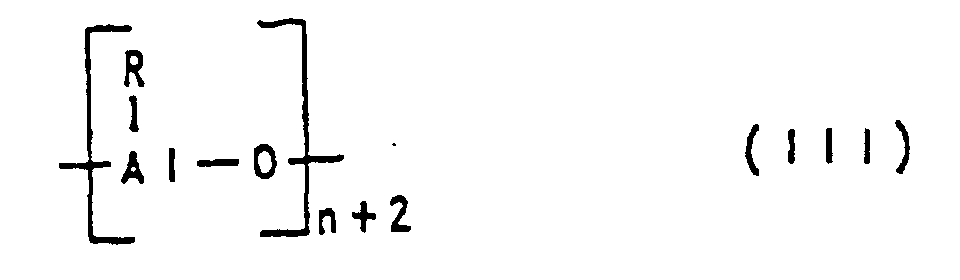
- n is an integer from 0-50, preferably 10-35.
- radicals R are preferably the same and are methyl, isobutyl, phenyl or Benzyl, particularly preferably methyl.
- radicals R are different, they are preferably methyl and hydrogen or alternatively methyl and isobutyl, hydrogen or isobutyl preferably containing 0.01-40% (number of the radicals R).
- aluminoxane a mixture consisting of aluminoxane and AlR 3 can be used as the cocatalyst in the polymerization, where R has the meaning given above, and in this case R can also be ethyl.
- the aluminoxane can be prepared in various ways by known methods.
- One of the methods is, for example, that an aluminum hydrocarbon compound and / or a hydridoaluminum hydrocarbon compound is reacted with water (gaseous, solid, liquid or bound - for example as water of crystallization) in an inert solvent (such as toluene).
- an inert solvent such as toluene
- AlR 3 + AlR ' 3 two different aluminum trialkyls (AlR 3 + AlR ' 3 ) are reacted with water according to the desired composition (see S. Pasynkiewicz, Polyhedron 9 (1990) 429 and EP-A 302 424).
- all aluminoxane solutions are one changing content of unreacted aluminum starting compound, which in free form or as an adduct, together.
- the metallocenes are preactivated in solution.
- the metallocenes are preferably dissolved as a solid in a solution of the aluminoxane in an inert hydrocarbon.
- An aliphatic or aromatic hydrocarbon is suitable as the inert hydrocarbon.
- Toluene or a C 6 -C 10 hydrocarbon is preferably used.
- the concentration of the aluminoxane in the solution is in the range from about 1% by weight to the saturation limit, preferably from 5 to 30% by weight, based in each case on the total solution.
- the metallocenes can be used in the same concentration but is preferably used in an amount of 10 -4 - 1 mol per mol of aluminoxane.
- the preactivation time is 1 minute to 60 hours, preferably 2 to 60 minutes. One works at a temperature of -78 ° C to 100 ° C, preferably 0 to 70 ° C.
- the metallocenes can also be prepolymerized or applied to a support become.
- prepolymerization preference is given to (or one of the) in the Polymerization used olefin (s) used.
- Suitable carriers are, for example, silica gels, aluminum oxides, solid Aluminoxane, combinations of aluminoxane on a support such as Silica gel, or other inorganic carrier materials.
- the carrier material is also a polyolefin powder in finely divided form.
- a further possible embodiment of the process according to the invention consists in using a salt-like compound of the formula R x NH 4 -x BR ' 4 or the formula R 3 PHBR' 4 as a cocatalyst instead of or in addition to an aluminoxane.
- X 1, 2 or 3
- R alkyl or aryl, identical or different
- R ' aryl, which can also be fluorinated or partially fluorinated.
- the catalyst consists of the reaction product of the metallocenes with one of the compounds mentioned (cf. EP-A 277 004).
- cleaning with an aluminum alkyl for example AIMe 3 or AIEt 3 is advantageous. This cleaning can take place both in the polymerization system itself, or the olefin is brought into contact with the Al compound before it is added to the polymerization system and then separated off again.
- the polymerization or copolymerization is carried out in a known manner in solution, in suspension or in the gas phase, continuously or batchwise, in one or more stages at a temperature of 50 to 200 ° C., preferably 50 to 100 ° C.
- R a and R b are the same or different and represent a hydrogen atom or an alkyl radical having 1 to 14 carbon atoms. However, R a and R b can also form a ring with the C atoms connecting them.
- olefins examples include ethylene, propylene, 1-butene, 1-hexene, 4-methyl-1-pentene, 1-octene, norbornene or norbornadiene.
- propylene and ethylene are polymerized.
- hydrogen is added as the molecular weight regulator.
- Different hydrogen responsiveness of the metallocenes, as well as the Possibility to change the amount of hydrogen during the polymerization lead to a further desired broadening of the molecular weight distribution.
- the total pressure in the polymerization system is 0.5 to 100 bar. Is preferred the polymerization in the technically particularly interesting pressure range of 5 up to 64 bar.
- the metallocenes are used in a concentration, based on the transition metal, of 10 -3 to 10 -8 , preferably 10 -4 to 10 -7 mol, transition metal per dm 3 solvent or per dm 3 reactor volume.
- the aluminum oxane or the mixture aluminoxane / AlR 3 is used in a concentration of 10 -5 to 10 -1 mol, preferably 10 -4 to 10 -2 mol per dm 3 solvent or per dm 3 reactor volume. In principle, however, higher concentrations are also possible.
- the polymerization as a suspension or solution polymerization becomes a customary for the Ziegler low pressure process inert solvent used.
- an aliphatic or cycloaliphatic hydrocarbon such as butane, Pentane, hexane, heptane, decane, isooctane, cyclohexane, methylcyclohexane.
- a gasoline or hydrogenated diesel oil fraction can also be used.
- Toluene can also be used.
- Polymerization is preferably carried out in the liquid monomer.
- the monomers become gaseous or liquid added.
- the duration of the polymerization is arbitrary, since that to be used according to the invention Catalyst system only a small time-dependent drop in the Shows polymerization activity.
- the process according to the invention is characterized in that the metallocenes described produce polymers with a broad, bimodal or multimodal molecular weight distribution, very high molecular weight, high stereospecificity and good grain morphology in the technically interesting temperature range between 50 and 100 ° C. with very high polymerization activity.
- the metallocene activity is 50-60 ° C. polymerization temperature> 140 kg polymer / g cat xh, preferably> 160 kg polymer / g cat x h. At polymerization temperatures> 60 ° C the metallocene activity is over 350, preferably over 400 kg polymer / g cat x h.
- the polymers according to the invention have a VZ> 260, preferably> 360 cm 3 / g at polymerization temperatures of 50-60 ° C, the VZ is above 200, preferably above 260 cm 3 / g at polymerization temperatures> 60 ° C. Accordingly, the molecular weight M w is greater than 200,000 g / mol at polymerization temperatures above 60 ° C.
- M w / M n is ⁇ 3.0, preferably ⁇ 4.0.
- M w / M n is preferably ⁇ 50, particularly preferably ⁇ 30.
- the polymers according to the invention are particularly suitable for the production of pressed plates or extruded plates and pipes and for the hollow and Large hollow blow molding.
- Preferred areas of use for such polymers low-flow properties include blow-molded cases with film hinges, Contour packaging, punching plates, hot water tanks, sewage and Hot water pipes, pressure pipes, filter plates, heat exchangers, solid rods or automotive parts such as brake fluid and cooling water tanks.
- foam-molded cases with film hinges Contour packaging, punching plates, hot water tanks, sewage and Hot water pipes, pressure pipes, filter plates, heat exchangers, solid rods or automotive parts such as brake fluid and cooling water tanks.
- In the field of film applications such molding compounds are used for tear-resistant BOPP films.
- the metallocenes intended for the polymerization were mixed (for amounts and metallocene compounds, see Table 1) and dissolved in 10 cm 3 of toluene methylaluminoxane solution (13 mmol of Al) and added to the reactor after 2 minutes.
- the polymerization was carried out at the polymerization temperature given in Table 1 for 1 h and then the polymerization reaction was stopped with 12 Ndm 3 CO 2 gas. The polymer was dried in vacuo at 80 ° C. for 24 h.
Landscapes
- Chemical & Material Sciences (AREA)
- Organic Chemistry (AREA)
- Health & Medical Sciences (AREA)
- Chemical Kinetics & Catalysis (AREA)
- Medicinal Chemistry (AREA)
- Polymers & Plastics (AREA)
- Transition And Organic Metals Composition Catalysts For Addition Polymerization (AREA)
- Addition Polymer Or Copolymer, Post-Treatments, Or Chemical Modifications (AREA)
Claims (10)
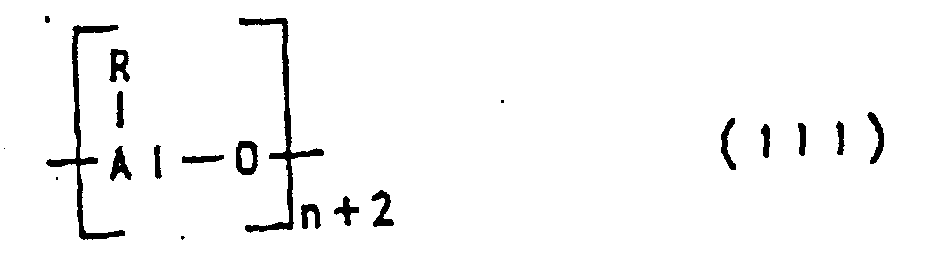
- Procédé de préparation d'une polyoléfine ayant une répartition des masses moléculaires Mw/Mn ≥ 3,0, qui peut être monomodale, bimodale ou multimodale, par polymérisation ou copolymérisation d'une oléfine de formule RaCH=CHRb, où Ra et Rb sont identiques ou différents et représentent chacun un atome d'hydrogène ou un radical alkyle ayant de 1 à 14 atomes de carbone, ou encore Ra et Rb, avec les atomes qui les relient, peuvent former un système cyclique, à une température de 50 à 200°C, sous une pression de 0,5 à 100 bar, en solution, en suspension ou en phase gazeuse, en présence d'un catalyseur, qui est constitué d'un composant à base d'un métal de transition (métallocène) et d'un aluminoxane de formule IIpour le type linéaire, et/ou de formule III
 pour le type cyclique, où, dans les formules II et III, les radicaux R peuvent être identiques ou différents et représentent chacun un groupe alkyle en C1-C6, un groupe fluoralkyle en C1-C6, un groupe aryle en C6-C18, un groupe fluoraryle en C1-C6 ou un atome d'hydrogène, et n est un nombre entier de 0 à 50, ou encore, au lieu de l'aluminoxane, d'un mélange d'un aluminoxane de formule II et/ou de formule III et d'un composé AlR3, caractérisé en ce qu'on utilise en tant que composant à base d'un métal de transition au moins un zirconocène de formule I et au moins un zirconocène de formule Ia, ou encore au moins 2 zirconocènes de formule I
 où
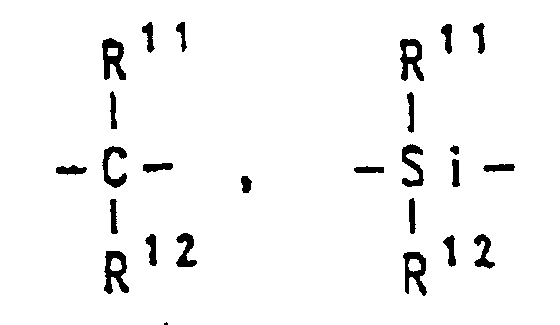
où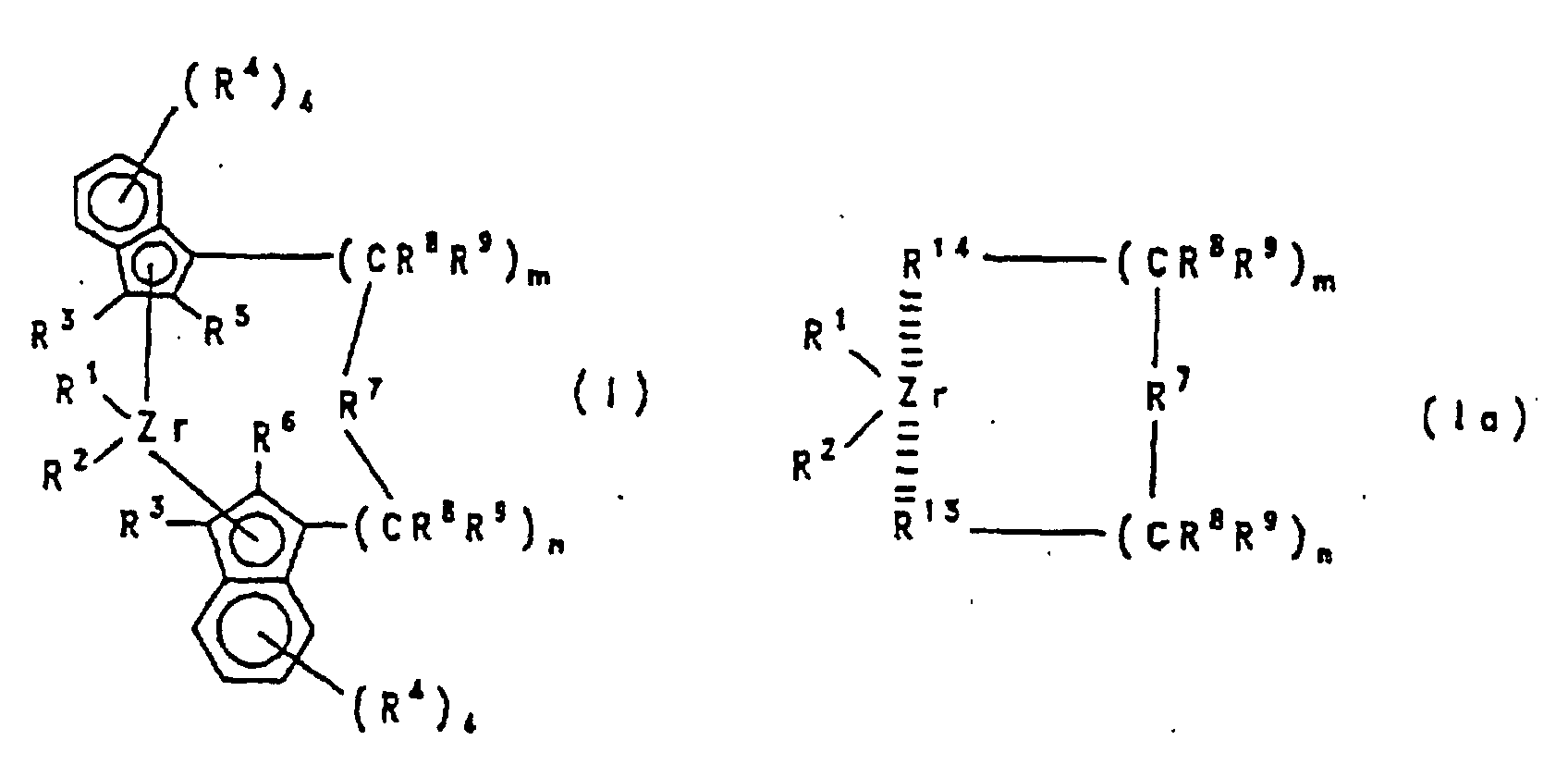 R1 et R2 sont identiques ou différents et représentent chacun un atome d'hydrogène, un groupe alkyle en C1-C10, un groupe alcoxy en C1-C10, un groupe aryle en C6-C10, un groupe aryloxy en C6-C10, un groupe alcényle en C2-C10, un groupe arylalkyle en C7-C40, un groupe alkylaryle en C7-C40, un groupe arylalcényle en C8-C40 ou un atome d'hydrogène,R3 est un atome d'hydrogène, un atome d'halogène, un groupe alkyle en C1-C10 pouvant être halogéné, un groupe aryle en C6-C10, un groupe alcényle en C2-C10, un groupe arylalkyle en C7-C40, un groupe alkyloxy en C7-C40, un groupe arylalcényle en C8-C40, un radical -NR2 10, -OR10, -SR10, -OSiR3 10, -SiR3 10 ou -PR2 10, où R10 est un atome d'halogène, un groupe alkyle en C1-C10 ou un groupe aryle en C6-C10,les radicaux R4 sont identiques ou différents et représentent chacun un atome d'hydrogène, un atome d'halogène, un groupe alkyle en C1-C20, un groupe fluoralkyle en C1-C20, un groupe aryle en C6-C30, un groupe fluoraryle en C6-C30, un groupe alcoxy en C1-C20, un groupe alcényle en C2-C20, un groupe arylalkyle en C7-C40, un groupe arylalcényle en C8-C40, un groupe alkylaryle en C7-C40, un radical -NR2 10, -OR10, -SR10, -OSiR3 10, -SiR3 10 ou -PR2 10, où R10 est un atome d'halogène, un groupe alkyle en C1-C10 ou un groupe aryle en C6-C10, où au moins un radical R4 par noyau indényle est différent de l'hydrogène, ou encore au moins deux radicaux R4 forment un système cyclique avec les atomes qui les relient,R5 et R6 sont identiques ou différents et représentent chacun un atome d'halogène, un groupe alkyle en C1-C10 pouvant être halogéné, un groupe aryle en C6-C10, un groupe alcényle en C2-C10, un groupe arylalkyle en C7-C40, un groupe alkyloxy en C7-C40, un groupe arylalcényle en C8-C40, un radical -NR2 10, -OR10, -SR10, -OSiR3 10, -SiR3 10 ou -PR2 10, où R10 est un atome d'halogène, un groupe alkyle en C1-C10 ou un groupe aryle en C6-C10,R7 est
 =BR11, =AlR11, -Ge-, -Sn-, -O-, -S-, =SO, =SO2, =NR11, =CO, =PR11 ou =P(O)R11,
 où R11, R12 et R13 sont identiques ou différents et représentent chacun un atome d'hydrogène, un atome d'halogène, un groupe alkyle en C1-C20, un groupe fluoralkyle en C1-C20, un groupe aryle en C6-C30, un groupe fluoraryle en C6-C30, un groupe alcoxy en C1-C20, un groupe alcényle en C2-C20, un groupe arylalkyle en C7-C40, un groupe arylalcényle en C8-C40, un groupe alkylaryle en C7-C40 ou encore les couples R11 et R12, ou R11 et R13, forment chacun un cycle avec les atomes qui les relient,M1 est le silicium, le germanium ou l'étain,R8 et R9 sont identiques ou différents et représentent chacun un atome d'hydrogène, un atome d'halogène, un groupe alkyle en C1-C20, un groupe fluoralkyle en C1-C20, un groupe aryle en C6-C30, un groupe fluoraryle en C6-C30, un groupe alcoxy en C1-C20, un groupe alcényle en C2-C20, un groupe arylalkyle en C7-C40, un groupe arylalcényle en C8-C40, un groupe alkylaryle en C7-C40, ou encore R8 et R9, avec les atomes qui les relient, forment un cycle,R14 et R15 sont identiques ou différents et représentent chacun un radical hydrocarboné à un ou plusieurs noyaux, qui avec l'atome de zirconium peut former une structure sandwich, etm et n sont identiques ou différents et valent chacun zéro, 1 ou 2, m plus n valant zéro, 1 ou 2.
 - Procédé selon la revendication 1, caractérisé en ce que, dans la formule I, R1 et R2 sont identiques ou différents et représentent chacun le groupe méthyle ou chloro, R3 est un atome d'hydrogène, R7 est un radicalet n plus m vaut zéro ou 1, et, dans la formule Ia, R14 et R15 sont identiques ou différents et représentent chacun un groupe fluorényle, indényle ou cyclopentadiényle, qui peut aussi être substitué.

- Procédé selon la revendication 1 ou 2, caractérisé en ce qu'on utilise, en tant que composé de formule I, les composés suivants :diméfhylsilanediylbis(2-méthyl-4-phényl-1-indényl)ZrCl2,phényl(méthyl)silanediylbis(2-méthyl-4-phényl-1-indényl)ZrCl2,diméthylsilanediylbis(2-méthyl-4-(1-,naphtl)-1-indényl)ZrCl2,diméthylsilanediylbis(2-méthyl-4-(2-naphtyl)-1-indényl)ZrCl2,diméthylsilanediylbis(2-éthyl-4-(1-naphtyl)-1-indényl)ZrCl2,diméthylsilanediylbis(2-méthyl-4,6-diisopropyl-1-indényl)ZrCl2,diméthylsilanediylbis(2,4,6-triméthyl-1-indényl)ZrCl2,phényl(méthyl)silanediylbis(2-méthyl-4,6-diisopropyl-1-indényl)ZrCl2,phényl(méthyl)silanediylbis(2,4,6-triméthyl-1-indényl)ZrCl2,1,2-éthanediylbis(2-méthyl-4,6-diisopropyl-1-indényl)ZrCl2,1,2-butanediylbis(2-méthyl-4,6-diisopropyl-1-indényl)ZrCl2,diméthylsilanediylbis(2-méthyl-4-éthyl-1-indényl)ZrCl2,diméthylsilanediylbis(2-méthyl-4-isopropyl-1-indényl)ZrCl2,diméthylsilanediylbis(2-méthyl-4-tert-butyl-1-indényl)ZrCl2,phényl(méthyl)silanediylbis(2-méthyl-4-isopropyl-1-indényl)ZrCl2,diméthylsilanediylbis(2-éthyl-4-méthyl-1-indényl)ZrCl2,diméthylsilanediylbis(2,4-diméthyl-1-indényl)ZrCl2,diméthylsilanediylbis(2-méthyl-4-éthyl-1-indényl)ZrCl2,diméthylsilanediylbis(2-méthyl-α-acénaphth-1-indényl)ZrCl2,phényl(méthyl)silanediylbis(2-méthyl-4,5-benzo-1-indényl)ZrCl2,phényl(méthyl)silanediylbis(2-méthyl-α-acénaphth-1-indényl)ZrCl2,1,2-éthanediylbis(2-méthyl-4,5-benzo-1-indényl)ZrCl2,1,2-butanediylbis(2-méthyl-4,5-benzo-1-indényl)ZrCl2,diméthylsilanediylbis(2-méthyl-4,5-benzo-1-indényl)ZrCl2,1,2-butanediylbis(2-éthyl-4-phényl-1-indényl)-ZrCl2,diméthylsilanediylbis(2-éthyl-4-phényl-1-indényl)ZrCl2,diméthylsilanediylbis(2-méthyl-5-isobutyl-1-indényl)ZrCl2,phényl(méthyl)silanediylbis(2-méthyl-5-isobutyl-1-indényl)ZrCl2,diméthylsilanediylbis(2-méthyl-5-tert-butyl-1-indényl)ZrCl2,diméthylsilanediylbis(2,5,6-triméthyl-1-indényl)ZrCl2
- Procédé selon l'une ou plusieurs des revendications 1 à 3, caractérisé en ce que, dans la formule la, R1 et R2 sont identiques ou différents et représentent chacun le groupe méthyle ou chloro, R7 est un radicalet

R14 et R15 sont identiques ou différents et représentent chacun un groupe fluorényle, indényle, ou encore cyclopentadiényle substitué. - Procédé selon l'une ou plusieurs des revendications 1 à 4, caractérisé en ce qu'on utilise en tant que composé de formule Ia le dichlorure de rac-phényl(méthyl)silyl(indényl)2zirconium, le dichlorure de diphénylméthylène(9-fluorényl)(cyclopentadiényl)zirconium, le dichlorure de phényl(méthyl)-méthylène(9-fluorényl)(cyclopentadiényl)zirconium, le dichlorure d'isopropylidène(9-fluorényl)(cyclopentadiényl)zirconium, le dichlorure de rac-diméthylsilyl(2,3,5-triméthyl-1-cyclopentadiényl)2zirconium, le dichlorure de rac-diméthylsilyl(indényl)2zirconium, le dichlorure de rac-diméthylgermyl-(indényl)2zirconium, le dichlorure de rac-diméthylsilyl(indényl)2zirconium, le dichlorure de rac-phényl(vinyl)silyl(indényl)2zirconium, le dichlorure de rac-le dichlorure de rac-diméthylsilyl(2,4-diméthylcyclopentadiényl)2zirconium, le dichlorure de rac-isopropylidène-(indényl)2zirconium, le dichlorure de rac-diméthylsilyl(2-méthyl-4,5,6,7-tétrahydro-1-indényl)2zirconium, le dichlorure de rac-éthylène(indényl)2-zirconium, le dichlorure de rac-méthylène(3-tert-butyl-1-cyclopentadiényl)2-zirconium, le dichlorure de rac-diméthylsilyl(4,7-diméthyl-1-indényl)2-zirconium, le dichlorure de rac-diméthylsilyl(2-méthyl-1-indényl)2zirconium, le dichlorure de rac-phényl(méthyl)silyl(2-méthyl-1-indényl)zirconium, le dichlorure de rac-diméthylsilyl(2-éthyl-1-indényl)2zirconium, le dichlorure de rac-dimélhylsilyl(4,5-benzo-1-indényl)2zirconium et dichlorure de rac-diméthylsilyl(4-phenyl-1-indényl)2zirconium.

- Procédé selon l'une ou plusieurs des revendications 1 à 5, caractérisé en ce qu'on polymérise du propylène ou que l'on copolymérise du propylène et de l'éthylène.
- Mélange de métallocènes, caractérisé en ce qu'il contient au moins un zirconocène de formule I et au moins un zirconocène de formule la, ou encore au moins 2 zirconocènes de formule Ioù
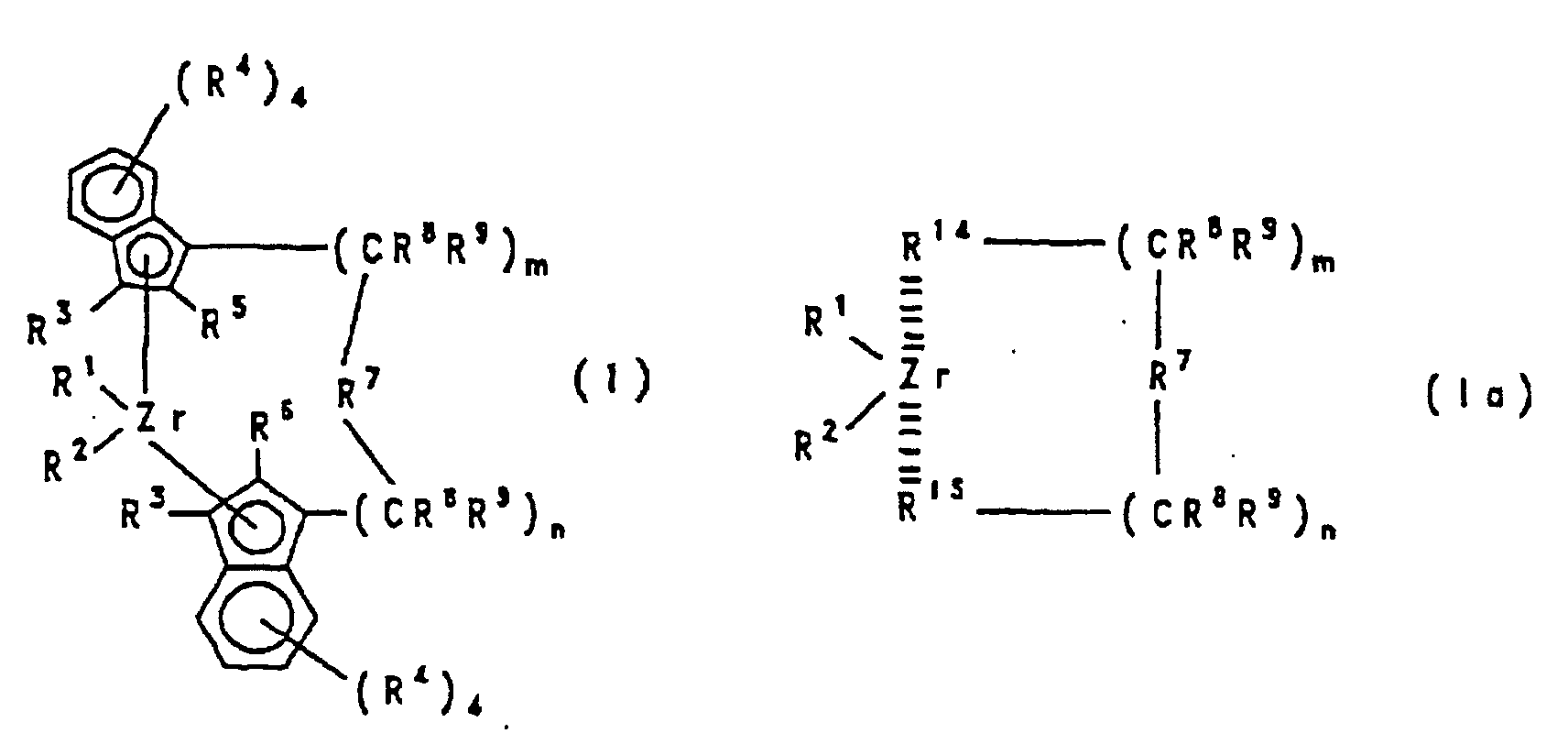 R1 et R2 sont identiques ou différents et représentent chacun un atome d'hydrogène, un groupe alkyle en C1-C10, un groupe alcoxy en C1-C10, un groupe aryle en C6-C10, un groupe aryloxy en C6-C10, un groupe alcényle en C2-C10, un groupe arylalkyle en C7-C40, un groupe alkylaryle en C7-C40, un groupe arylalcényle en C8-C40 ou un atome d'hydrogène,R3 est un atome d'hydrogène, un atome d'halogène, un groupe alkyle en C1-C10 pouvant être halogéné, un groupe aryle en C6-C10, un groupe alcényle en C2-C10, un groupe arylalkyle en C7-C40, un groupe alkyloxy en C7-C40, un groupe arylalcényle en C8-C40, un radical -NR2 10, -OR10, -SR10, -OSiR3 10 ou -PR2 10, où R10 est un atome d'halogène, un groupe alkyle en C1-C10 ou un groupe aryle en C6-C10,les radicaux R4 sont identiques ou différents et représentent chacun un atome d'hydrogène, un atome d'halogène, un groupe alkyle en C1-C20, un groupe fluoralkyle en C1-C20, un groupe aryle en C6-C30, un groupe fluoraryle en C6-C30, un groupe alcoxy en C1-C20, un groupe alcényle en C2-C20, un groupe arylalkyle en C7-C40, un groupe arylalcényle en C8-C40, un groupe alkylaryle en C7-C40, un radical -NR2 10, -OR10, -SR10, -OSiR3 10, -SiR3 10 ou -PR2 10, où R10 est un atome d'halogène, un groupe alkyle en C1-C10 ou un groupe aryle en C6-C10, où au moins un radical R4 par noyau indényle est différent de l'hydrogène, ou encore au moins deux radicaux R4 forment un système cyclique avec les atomes qui les relient,R5 et R6 sont identiques ou différents et représentent chacun un atome d'halogène, un groupe alkyle en C1-C10 pouvant être halogéné, un groupe aryle en C6-C10, un groupe alcényle en C2-C10, un groupe arylalkyle en C7-C40, un groupe alkyloxy en C7-C40, un groupe arylalcényle en C8-C40, un radical -NR2 10, -OR10, -SR10, -OSiR3 10, -SiR3 10 ou -PR2 10, où R10 est un atome d'halogène, un groupe alkyle en C1-C10 ou un groupe aryle en C6-C10,R7 est
 =BR11, =AlR11, -Ge-, -Sn-, -O-, -S-, =SO, =SO2, =NR11, =CO, =PR11 ou =P(O)R11,
 où R11, R12 et R13 sont identiques ou différents et représentent chacun un atome d'hydrogène, un atome d'halogène, un groupe alkyle en C1-C20, un groupe fluoralkyle en C1-C20, un groupe aryle en C6-C30, un groupe fluoraryle en C6-C30, un groupe alcoxy en C1-C20, un groupe alcényle en C2-C20, un groupe arylalkyle en C7-C40, un groupe arylalcényle en C8-C40, un groupe alkylaryle en C7-C40 ou encore les couples R11 et R12, ou R11 et R13, forment chacun un cycle avec les atomes qui les relient,M1 est le silicium, le germanium ou l'étain,R8 et R9 sont identiques ou différents et représentent chacun un atome d'hydrogène, un atome d'halogène, un groupe alkyle en C1-C20, un groupe fluoralkyle en C1-C20, un groupe aryle en C6-C30, un groupe fluoraryle en C6-C30, un groupe alcoxy en C1-C20, un groupe alcényle en C2-C20, un groupe arylalkyle en C7-C40, un groupe arylalcényle en C8-C40, un groupe alkylaryle en C7-C40, ou encore R8 et R9, avec les atomes qui les relient, forment un cycle,R14 et R15 sont identiques ou différents et représentent chacun un radical hydrocarboné à un ou plusieurs noyaux, qui avec l'atome de zirconium peut former une structure sandwich, etm et n sont identiques ou différents et valent chacun zéro, 1 ou 2, m plus n valant zéro, 1 ou 2.
 - Mélange de métallocènes selon la revendication 7, caractérisé en ce que, dans la formule I, R1 et R2 sont identiques ou différents et représentent chacun un groupe méthyle ou chloro, R3 est un atome d'hydrogène, R7 est un radicalet n plus m vaut zéro ou 1, et, dans la formule Ia, R14 et R15 sont identiques ou différents et représentent chacun un groupe fluorényle, indényle ou cyclopentadiényle, qui peut aussi être substitué.
- Catalyseur, qui est constitué d'un composant à base d'un métal de transition (métallocène) et d'un aluminoxane de formule IIpour le type linéaire, et/ou de formule III
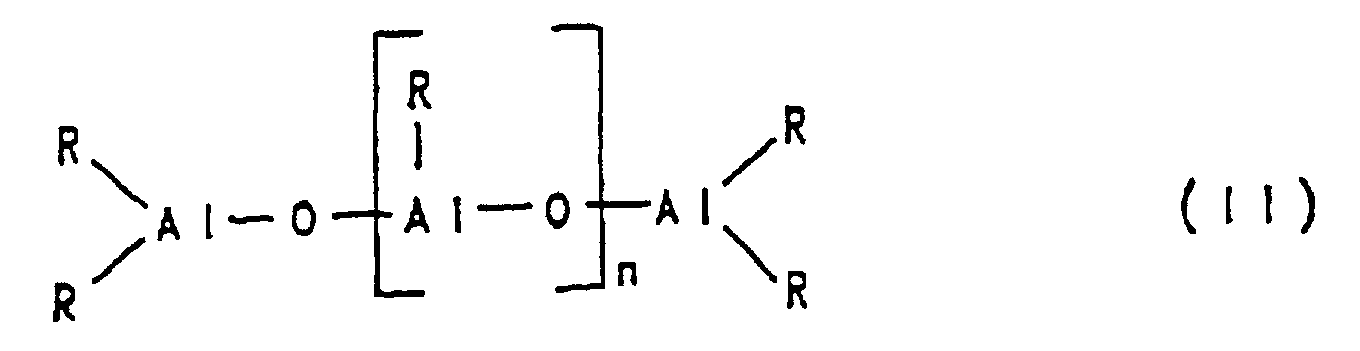 pour le type cyclique, où, dans les formules II et III, les radicaux R peuvent être identiques ou différents et représentent chacun un groupe alkyle en C1-C6, un groupe fluoralkyle en C1-C6, un groupe aryle en C6-C18, un groupe fluoraryle en C1-C6 ou un atome d'hydrogène, et n est un nombre entier de 0 à 50, ou encore, au lieu de l'aluminoxane, d'un mélange d'un aluminoxane de formule II et/ou de formule III et d'un composé AlR3, caractérisé en ce qu'on utilise en tant que composant à base d'un métal de transition au moins un zirconocène de formule I et au moins un zirconocène de formule Ia, ou encore au moins 2 zirconocènes de formule I
 où
où R1 et R2 sont identiques ou différents et représentent chacun un atome d'hydrogène, un groupe alkyle en C1-C10, un groupe alcoxy en C1-C10, un groupe aryle en C6-C10, un groupe aryloxy en C6-C10, un groupe alcényle en C2-C10, un groupe arylalkyle en C7-C40, un groupe alkylaryle en C7-C40, un groupe arylalcényle en C8-C40 ou un atome d'hydrogène,R3 est un atome d'hydrogène, un atome d'halogène, un groupe alkyle en C1-C10 pouvant être halogéné, un groupe aryle en C6-C10, un groupe alcényle en C2-C10, un groupe arylalkyle en C7-C40, un groupe alkyloxy en C7-C40, un groupe arylalcényle en C8-C40, un radical -NR2 10, -OR10, -SR10, -OSiR3 10 ou -PR2 10, où R10 est un atome d'halogène, un groupe alkyle en C1-C10 ou un groupe aryle en C6-C10,les radicaux R4 sont identiques ou différents et représentent chacun un atome d'hydrogène, un atome d'halogène, un groupe alkyle en C1-C20, un groupe fluoralkyle en C1-C20, un groupe aryle en C6-C30, un groupe fluoraryle en C6-C30, un groupe alcoxy en C1-C20, un groupe alcényle en C2-C20, un groupe arylalkyle en C7-C40, un groupe arylalcényle en C8-C40, un groupe alkylaryle en C7-C40, un radical -NR2 10, -OR10, -SR10, -OSiR3 10, -SiR3 10 ou -PR2 10, où R10 est un atome d'halogène, un groupe alkyle en C1-C10 ou un groupe aryle en C6-C10, où au moins un radical R4 par noyau indényle est différent de l'hydrogène, ou encore au moins deux radicaux R4 forment un système cyclique avec les atomes qui les relient,R5 et R6 sont identiques ou différents et représentent chacun un atome d'halogène, un groupe alkyle en C1-C10 pouvant être halogéné, un groupe aryle en C6-C10, un groupe alcényle en C2-C10, un groupe arylalkyle en C7-C40, un groupe alkyloxy en C7-C40, un groupe arylalcényle en C8-C40, un radical -NR2 10, -OR10, -SR10, -OSiR3 10, -SiR3 10 ou -PR2 10, où R10 est un atome d'halogène, un groupe alkyle en C1-C10 ou un groupe aryle en C6-C10,R7 est
 =BR11, =AlR11, -Ge-, -Sn-, -O-, -S-, =SO, =SO2, =NR11, =CO, =PR11 ou =P(O)R11,
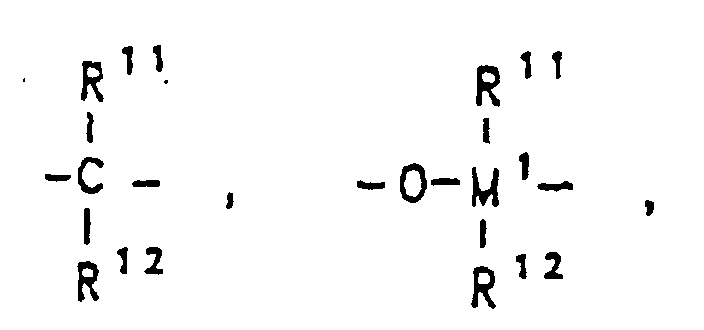 où R11, R12 et R13 sont identiques ou différents et représentent chacun un atome d'hydrogène, un atome d'halogène, un groupe alkyle en C1-C20, un groupe fluoralkyle en C1-C20, un groupe aryle en C6-C30, un groupe fluoraryle en C6-C30, un groupe alcoxy en C1-C20, un groupe alcényle en C2-C20, un groupe arylalkyle en C7-C40, un groupe arylalcényle en C8-C40, un groupe alkylaryle en C7-C40 ou encore les couples R11 et R12, ou R11 et R13, forment chacun un cycle avec les atomes qui les relient,M1 est le silicium, le germanium ou l'étain,R8 et R9 sont identiques ou différents et représentent chacun un atome d'hydrogène, un atome d'halogène, un groupe alkyle en C1-C20, un groupe fluoralkyle en C1-C20, un groupe aryle en C6-C30, un groupe fluoraryle en C6-C30, un groupe alcoxy en C1-C20, un groupe alcényle en C2-C20, un groupe arylalkyle en C7-C40, un groupe arylalcényle en C8-C40, un groupe alkylaryle en C7-C40, ou encore R8 et R9, avec les atomes qui les relient, forment un cycle,R14 et R15 sont identiques ou différents et représentent chacun un radical hydrocarboné à un ou plusieurs noyaux, qui avec l'atome de zirconium peut former une structure sandwich, etm et n sont identiques ou différents et valent chacun zéro, 1 ou 2, m plus n valant zéro, 1 ou 2.
 - Catalyseur selon la revendication 9, contenant i) au lieu ou en plus d'un aluminoxane, un composé de type sel de formule RxNH4-xBR'4 ou de formule R3PHBR'4 en tant que catalyseur, où x = 1, 2 ou 3, les radicaux R sont des groupes alkyle ou aryle qui sont identiques ou différents, et R' est un groupe aryle, qui peut aussi être fluoré ou partiellement fluoré, et/ou ii) éventuellement un support.
Applications Claiming Priority (2)
| Application Number | Priority Date | Filing Date | Title |
|---|---|---|---|
| DE4333128 | 1993-09-29 | ||
| DE4333128A DE4333128A1 (de) | 1993-09-29 | 1993-09-29 | Verfahren zur Herstellung von Polyolefinen |
Publications (2)
| Publication Number | Publication Date |
|---|---|
| EP0645401A1 EP0645401A1 (fr) | 1995-03-29 |
| EP0645401B1 true EP0645401B1 (fr) | 2001-12-05 |
Family
ID=6498932
Family Applications (1)
| Application Number | Title | Priority Date | Filing Date |
|---|---|---|---|
| EP94114431A Expired - Lifetime EP0645401B1 (fr) | 1993-09-29 | 1994-09-14 | Procédé de préparation de polyoléfines |
Country Status (8)
| Country | Link |
|---|---|
| US (3) | US5700886A (fr) |
| EP (1) | EP0645401B1 (fr) |
| JP (1) | JP3701333B2 (fr) |
| AT (1) | ATE210158T1 (fr) |
| CA (1) | CA2133181A1 (fr) |
| DE (2) | DE4333128A1 (fr) |
| ES (1) | ES2169057T3 (fr) |
| FI (1) | FI112236B (fr) |
Cited By (9)
| Publication number | Priority date | Publication date | Assignee | Title |
|---|---|---|---|---|
| US7223822B2 (en) | 2002-10-15 | 2007-05-29 | Exxonmobil Chemical Patents Inc. | Multiple catalyst and reactor system for olefin polymerization and polymers produced therefrom |
| US7294681B2 (en) | 2002-10-15 | 2007-11-13 | Exxonmobil Chemical Patents Inc. | Mutliple catalyst system for olefin polymerization and polymers produced therefrom |
| US7541402B2 (en) | 2002-10-15 | 2009-06-02 | Exxonmobil Chemical Patents Inc. | Blend functionalized polyolefin adhesive |
| US7550528B2 (en) | 2002-10-15 | 2009-06-23 | Exxonmobil Chemical Patents Inc. | Functionalized olefin polymers |
| US7700707B2 (en) | 2002-10-15 | 2010-04-20 | Exxonmobil Chemical Patents Inc. | Polyolefin adhesive compositions and articles made therefrom |
| US8008412B2 (en) | 2002-09-20 | 2011-08-30 | Exxonmobil Chemical Patents Inc. | Polymer production at supersolution conditions |
| US8058371B2 (en) | 2002-09-20 | 2011-11-15 | Exxonmobil Chemical Patents Inc. | Super-solution homogeneous propylene polymerization |
| US8242237B2 (en) | 2006-12-20 | 2012-08-14 | Exxonmobil Chemical Patents Inc. | Phase separator and monomer recycle for supercritical polymerization process |
| US8318875B2 (en) | 2008-01-18 | 2012-11-27 | Exxonmobil Chemical Patents Inc. | Super-solution homogeneous propylene polymerization and polypropylenes made therefrom |
Families Citing this family (100)
| Publication number | Priority date | Publication date | Assignee | Title |
|---|---|---|---|---|
| US6294625B1 (en) * | 1990-03-20 | 2001-09-25 | Exxonmobil Chemical Patents Inc. | Catalyst system of enhanced productivity and its use in polymerization process |
| US5594078A (en) * | 1991-07-23 | 1997-01-14 | Phillips Petroleum Company | Process for producing broad molecular weight polyolefin |
| SG66278A1 (en) * | 1993-05-25 | 1999-07-20 | Exxon Chemical Patents Inc | Novel polyolefin fibers and their fabrics |
| EP0629632B2 (fr) † | 1993-06-07 | 2015-01-21 | Mitsui Chemicals, Inc. | Polypropylène |
| IT1272923B (it) * | 1995-01-23 | 1997-07-01 | Spherilene Srl | Composti metallocenici,procedimento per la loro preparazione,e loro utilizzo in catalizzatori per la polimerizzazione delle olefine |
| DE19516803A1 (de) * | 1995-05-08 | 1996-11-14 | Hoechst Ag | Organometallverbindung |
| DE19544828A1 (de) * | 1995-12-01 | 1997-06-05 | Hoechst Ag | Hochmolekulare Copolymere |
| US5786291A (en) * | 1996-02-23 | 1998-07-28 | Exxon Chemical Patents, Inc. | Engineered catalyst systems and methods for their production and use |
| DE19622207A1 (de) * | 1996-06-03 | 1997-12-04 | Hoechst Ag | Chemische Verbindung |
| DE19623707A1 (de) * | 1996-06-14 | 1997-12-18 | Hoechst Ag | Übergangsmetallverbindung |
| US6576306B2 (en) | 1996-09-04 | 2003-06-10 | Exxonmobil Chemical Patents Inc. | Propylene polymers for films |
| CN1115360C (zh) | 1996-09-04 | 2003-07-23 | 埃克森美孚化学专利公司 | 改进的用于取向薄膜的丙烯聚合物 |
| US6583227B2 (en) | 1996-09-04 | 2003-06-24 | Exxonmobil Chemical Patents Inc. | Propylene polymers for films |
| DE19738051A1 (de) * | 1997-09-01 | 1999-03-04 | Targor Gmbh | Spritzgieß-Artikel aus Metallocen-Polypropylen |
| JP3533923B2 (ja) * | 1998-01-28 | 2004-06-07 | 住友化学工業株式会社 | オレフィン重合体、オレフィン重合用触媒およびオレフィン重合体の製造方法 |
| CN1133660C (zh) | 1998-03-04 | 2004-01-07 | 埃克森美孚化学专利公司 | 烯烃的高温聚合方法 |
| US6784269B2 (en) | 1998-05-13 | 2004-08-31 | Exxonmobil Chemical Patents Inc. | Polypropylene compositions methods of making the same |
| US6306960B1 (en) | 1998-05-13 | 2001-10-23 | Exxonmobil Chemical Patents Inc. | Articles formed from foamable polypropylene polymer |
| CA2327497A1 (fr) | 1998-05-13 | 1999-11-18 | Exxon Chemical Patents, Inc. | Homopolymeres de propylene et leur procede de fabrication |
| US6207606B1 (en) | 1998-05-15 | 2001-03-27 | Univation Technologies, Llc | Mixed catalysts and their use in a polymerization process |
| US6818585B2 (en) * | 1998-12-30 | 2004-11-16 | Univation Technologies, Llc | Catalyst compounds, catalyst systems thereof and their use in a polymerization process |
| US6034192A (en) * | 1998-12-30 | 2000-03-07 | Univation Technologies, Llc | Germanium bridged metallocenes producing polymers with increased melt strength |
| US6174930B1 (en) | 1999-04-16 | 2001-01-16 | Exxon Chemical Patents, Inc. | Foamable polypropylene polymer |
| US6420580B1 (en) * | 1999-11-05 | 2002-07-16 | Univation Technologies, Llc | Catalyst compositions and method of polymerization therewith |
| US6884747B2 (en) * | 2000-10-06 | 2005-04-26 | Univation Technologies, Llc | Linear low density polyethylenes with high melt strength and high melt index ratio |
| US6734265B1 (en) * | 2000-10-06 | 2004-05-11 | Univation Technologies, Llc. | Linear low density polyethylenes with high melt strength and high melt index ratio |
| US7132486B2 (en) * | 2000-10-06 | 2006-11-07 | Univation Technologies, Llc | Linear low density polyethylenes with high melt strength and high melt index ratio |
| GB0111443D0 (en) * | 2001-05-10 | 2001-07-04 | Borealis Tech Oy | Olefin polymerisation process |
| JP4332029B2 (ja) * | 2001-06-12 | 2009-09-16 | バーゼル・ポリオレフィン・ゲーエムベーハー | 1−ブテンの重合方法 |
| WO2002100908A1 (fr) * | 2001-06-12 | 2002-12-19 | Basell Polyolefine Gmbh | Procede de polymerisation de 1-butene |
| US6878334B2 (en) * | 2001-08-14 | 2005-04-12 | Carrier Corporation | Condensing heat exchanger formed of norbornene polymer |
| US6562930B2 (en) * | 2001-09-18 | 2003-05-13 | Cornell Research Foundation, Inc. | Bis(salicylaldiminato)titanium complex catalysts, highly syndiotactic polypropylene by a chain-end control mechanism, block copolymers containing this |
| US7998579B2 (en) | 2002-08-12 | 2011-08-16 | Exxonmobil Chemical Patents Inc. | Polypropylene based fibers and nonwovens |
| US7531594B2 (en) | 2002-08-12 | 2009-05-12 | Exxonmobil Chemical Patents Inc. | Articles from plasticized polyolefin compositions |
| US8003725B2 (en) | 2002-08-12 | 2011-08-23 | Exxonmobil Chemical Patents Inc. | Plasticized hetero-phase polyolefin blends |
| CN100345896C (zh) | 2002-08-12 | 2007-10-31 | 埃克森美孚化学专利公司 | 增塑聚烯烃组合物 |
| US7271209B2 (en) | 2002-08-12 | 2007-09-18 | Exxonmobil Chemical Patents Inc. | Fibers and nonwovens from plasticized polyolefin compositions |
| EP1405866A1 (fr) * | 2002-09-27 | 2004-04-07 | ATOFINA Research | Production de Polyoléfines |
| WO2004037872A2 (fr) | 2002-10-24 | 2004-05-06 | Exxonmobil Chemical Patents Inc. | Polypropylene cristallin ramifie |
| WO2004037871A1 (fr) * | 2002-10-24 | 2004-05-06 | Exxonmobil Chemical Patents Inc. | Polypropylene cristallin ramifie |
| US7176158B2 (en) * | 2002-10-25 | 2007-02-13 | Exxonmobil Chemical Patents Inc. | Polymerization catalyst composition |
| WO2004044013A1 (fr) | 2002-11-14 | 2004-05-27 | Idemitsu Kosan Co., Ltd. | Procede de production d'un copolymere sequence propylene/ethylene et copolymere sequence propylene/ethylene |
| US7589160B2 (en) * | 2002-12-04 | 2009-09-15 | Basell Polyolefine Gmbh | Process for preparing 1-butene polymers |
| DE60329523D1 (de) * | 2002-12-04 | 2009-11-12 | Basell Polyolefine Gmbh | 1-Buten-Copolymere und Herstellungsverfahren dafür |
| US7199072B2 (en) * | 2002-12-31 | 2007-04-03 | Univation Technologies, Llc | Process of producing a supported mixed catalyst system and polyolefins therefrom |
| US8192813B2 (en) | 2003-08-12 | 2012-06-05 | Exxonmobil Chemical Patents, Inc. | Crosslinked polyethylene articles and processes to produce same |
| ATE361323T1 (de) * | 2004-03-12 | 2007-05-15 | Saudi Basic Ind Corp | Katalysatorzusammensetzung für die polymerisation von olefinen und polymerisationsverfahren unter dessen verwendung |
| US7645829B2 (en) * | 2004-04-15 | 2010-01-12 | Exxonmobil Chemical Patents Inc. | Plasticized functionalized propylene copolymer adhesive composition |
| DE602005010255D1 (de) | 2004-07-08 | 2008-11-20 | Exxonmobil Chem Patents Inc | Katalysator system für die olefinpolymerisation und verfahren zu seiner verwendung |
| EP1650232A1 (fr) * | 2004-10-25 | 2006-04-26 | Total Petrochemicals Research Feluy | Préparation de polymères du type LDPE à l'aide des ligands à base de bisindenyl avec des anneaux différents |
| US20080188632A1 (en) * | 2004-10-25 | 2008-08-07 | Total Petrochemicals Research Feluy | Linear Low Density Polymers Having Optical and Processing Capabilities of Low Density Polyethyelene |
| EP1650233A1 (fr) * | 2004-10-25 | 2006-04-26 | Total Petrochemicals Research Feluy | Composant catalytique comprenant au moins trois composés métallocènes bisindényl pontés |
| US8389615B2 (en) | 2004-12-17 | 2013-03-05 | Exxonmobil Chemical Patents Inc. | Elastomeric compositions comprising vinylaromatic block copolymer, polypropylene, plastomer, and low molecular weight polyolefin |
| JP2006248159A (ja) * | 2005-03-14 | 2006-09-21 | Seiko Epson Corp | インクカートリッジおよびその製造方法 |
| US9644092B2 (en) | 2005-06-22 | 2017-05-09 | Exxonmobil Chemical Patents Inc. | Heterogeneous in-situ polymer blend |
| US7951872B2 (en) | 2005-06-22 | 2011-05-31 | Exxonmobil Chemical Patents Inc. | Heterogeneous polymer blend with continuous elastomeric phase and process of making the same |
| US9745461B2 (en) | 2005-06-22 | 2017-08-29 | Exxonmobil Chemical Patents Inc. | Vulcanized polymer blends |
| US8022142B2 (en) * | 2008-12-15 | 2011-09-20 | Exxonmobil Chemical Patents Inc. | Thermoplastic olefin compositions |
| US7928164B2 (en) * | 2005-06-22 | 2011-04-19 | Exxonmobil Chemical Patents Inc. | Homogeneous polymer blend and process of making the same |
| US7812085B2 (en) * | 2005-06-24 | 2010-10-12 | Exxonmobil Chemical Patents Inc. | Functionalized propylene copolymer adhesive composition |
| CN101218296B (zh) | 2005-07-15 | 2010-12-08 | 埃克森美孚化学专利公司 | 弹性体组合物 |
| US8003739B2 (en) | 2007-10-17 | 2011-08-23 | Fina Technology, Inc. | Multi-component catalyst systems and polymerization processes for forming in-situ heterophasic copolymers and/or varying the xylene solubles content of polyolefins |
| EP2039720A1 (fr) * | 2007-09-21 | 2009-03-25 | Total Petrochemicals Research Feluy | Tuyaux pour le transport d'eau contenant du chlore |
| US8459283B2 (en) | 2007-09-21 | 2013-06-11 | Total Petrochemicals Research Feluy | Pipes for transporting water containing chlorine dioxide |
| CN101802080B (zh) * | 2007-09-21 | 2014-04-09 | 道达尔石油化学产品研究弗吕公司 | 用于输送含有氯气的水的管道 |
| US8835577B2 (en) | 2007-11-15 | 2014-09-16 | Univation Technologies, Llc | Catalyst systems having a tailored hydrogen response |
| TW200936619A (en) * | 2007-11-15 | 2009-09-01 | Univation Tech Llc | Polymerization catalysts, methods of making, methods of using, and polyolefin products made therefrom |
| WO2009083500A1 (fr) * | 2007-12-28 | 2009-07-09 | Basell Poliolefine Italia S.R.L. | Réservoirs en matière plastique faits à partir de copolymères statistiques de propylène et d'hexène-1 |
| JP5297838B2 (ja) * | 2008-04-18 | 2013-09-25 | 日本ポリプロ株式会社 | ポリプロピレン系発泡延伸フィルム |
| JP5297834B2 (ja) * | 2008-05-12 | 2013-09-25 | 日本ポリプロ株式会社 | ポリプロピレン系発泡フィルム |
| US8399725B2 (en) | 2008-06-20 | 2013-03-19 | Exxonmobil Chemical Patents Inc. | Functionalized high vinyl terminated propylene based oligomers |
| US8802797B2 (en) | 2008-06-20 | 2014-08-12 | Exxonmobil Chemical Patents Inc. | Vinyl-terminated macromonomer oligomerization |
| US8283428B2 (en) | 2008-06-20 | 2012-10-09 | Exxonmobil Chemical Patents Inc. | Polymacromonomer and process for production thereof |
| US8372930B2 (en) | 2008-06-20 | 2013-02-12 | Exxonmobil Chemical Patents Inc. | High vinyl terminated propylene based oligomers |
| US8283419B2 (en) | 2008-06-20 | 2012-10-09 | Exxonmobil Chemical Patents Inc. | Olefin functionalization by metathesis reaction |
| US8293856B2 (en) * | 2008-08-19 | 2012-10-23 | Mitsui Chemicals, Inc. | Process for preparing olefin polymer using mixed catalyst |
| CA2757045C (fr) | 2009-05-14 | 2017-03-07 | Univation Technologies, Llc | Systemes catalytiques metalliques mixtes ayant une reponse sur mesure a l'hydrogene |
| GB0918736D0 (en) | 2009-10-26 | 2009-12-09 | Isis Innovation | Catalysts |
| EP3848401A1 (fr) | 2013-07-17 | 2021-07-14 | ExxonMobil Chemical Patents Inc. | Polymères de propylène isotactique |
| US9938364B2 (en) | 2013-07-17 | 2018-04-10 | Exxonmobil Chemical Patents Inc. | Substituted metallocene catalysts |
| EP3022238B1 (fr) | 2013-07-17 | 2017-09-20 | ExxonMobil Chemical Patents Inc. | Métallocènes et compositions de catalyseurs dérivées de ceux-ci |
| JP2016531978A (ja) | 2013-07-17 | 2016-10-13 | エクソンモービル ケミカル パテンツ インコーポレイテッド | 置換メタロセン触媒 |
| ES2703344T3 (es) | 2013-07-17 | 2019-03-08 | Exxonmobil Chemical Patents Inc | Metalocenos y composiciones catalíticas derivadas de ellos |
| US9834628B2 (en) | 2013-07-17 | 2017-12-05 | Exxonmobil Chemical Patents Inc. | Cyclopropyl substituted metallocene catalysts |
| GB201407000D0 (en) | 2014-04-17 | 2014-06-04 | Isis Innovation | Catalysts |
| CN107108799B (zh) | 2015-01-06 | 2020-07-21 | Scg化学有限公司 | SiO2层状双氢氧化物微球及其作为乙烯聚合中的催化剂载体的用途 |
| PL3245258T3 (pl) | 2015-01-06 | 2020-01-31 | Scg Chemicals Co., Ltd. | MIKROSFERY SiO₂ Z WARSTWOWYM PODWÓJNYM WODOROTLENKIEM I SPOSOBY ICH OTRZYMYWANIA |
| WO2016196331A1 (fr) | 2015-06-05 | 2016-12-08 | Exxonmobil Chemical Patents Inc. | Systèmes de catalyseurs métallocènes supportés pour polymérisation |
| US10280235B2 (en) | 2015-06-05 | 2019-05-07 | Exxonmobil Chemical Patents Inc. | Catalyst system containing high surface area supports and sequential polymerization to produce heterophasic polymers |
| US10570219B2 (en) | 2015-06-05 | 2020-02-25 | Exxonmobil Chemical Patents Inc. | Production of heterophasic polymers in gas or slurry phase |
| US10294316B2 (en) | 2015-06-05 | 2019-05-21 | Exxonmobil Chemical Patents Inc. | Silica supports with high aluminoxane loading capability |
| US10280233B2 (en) | 2015-06-05 | 2019-05-07 | Exxonmobil Chemical Patents Inc. | Catalyst systems and methods of making and using the same |
| WO2016196334A1 (fr) | 2015-06-05 | 2016-12-08 | Exxonmobil Chemical Patents Inc. | Production en réacteur unique de polymères en phase gazeuse ou en suspension |
| US9809664B2 (en) | 2015-06-05 | 2017-11-07 | Exxonmobil Chemical Patents Inc. | Bimodal propylene polymers and sequential polymerization |
| US10329360B2 (en) | 2015-06-05 | 2019-06-25 | Exxonmobil Chemical Patents Inc. | Catalyst system comprising supported alumoxane and unsupported alumoxane particles |
| GB201608384D0 (en) | 2016-05-12 | 2016-06-29 | Scg Chemicals Co Ltd | Unsymmetrical metallocene catalysts and uses thereof |
| US11059918B2 (en) | 2016-05-27 | 2021-07-13 | Exxonmobil Chemical Patents Inc. | Metallocene catalyst compositions and polymerization process therewith |
| US11193008B2 (en) | 2017-04-10 | 2021-12-07 | Exxonmobil Chemical Patents Inc. | Methods for making polyolefin polymer compositions |
| CN110770265B (zh) | 2017-05-10 | 2023-05-05 | 尤尼威蒂恩技术有限责任公司 | 催化剂体系及其使用方法 |
| US11472828B2 (en) | 2019-10-11 | 2022-10-18 | Exxonmobil Chemical Patents Inc. | Indacene based metallocene catalysts useful in the production of propylene polymers |
Family Cites Families (20)
| Publication number | Priority date | Publication date | Assignee | Title |
|---|---|---|---|---|
| US4530914A (en) * | 1983-06-06 | 1985-07-23 | Exxon Research & Engineering Co. | Process and catalyst for producing polyethylene having a broad molecular weight distribution |
| US4935474A (en) * | 1983-06-06 | 1990-06-19 | Exxon Research & Engineering Company | Process and catalyst for producing polyethylene having a broad molecular weight distribution |
| DE3640924A1 (de) * | 1986-11-29 | 1988-06-01 | Hoechst Ag | 1-olefin-stereoblockpolymer und verfahren zu seiner herstellung |
| US4939217A (en) * | 1987-04-03 | 1990-07-03 | Phillips Petroleum Company | Process for producing polyolefins and polyolefin catalysts |
| DE3726067A1 (de) * | 1987-08-06 | 1989-02-16 | Hoechst Ag | Verfahren zur herstellung von 1-olefinpolymeren |
| EP0310734B1 (fr) * | 1987-09-11 | 1994-11-23 | Fina Technology, Inc. | Système catalytique de production de polyoléfines à grande distribution de poids moléculaire |
| US4975403A (en) * | 1987-09-11 | 1990-12-04 | Fina Technology, Inc. | Catalyst systems for producing polyolefins having a broad molecular weight distribution |
| US4892851A (en) * | 1988-07-15 | 1990-01-09 | Fina Technology, Inc. | Process and catalyst for producing syndiotactic polyolefins |
| DE3825814A1 (de) * | 1988-07-29 | 1990-02-01 | Hoechst Ag | Verfahren zur herstellung von l-olefinpolymeren |
| DE3907964A1 (de) * | 1989-03-11 | 1990-09-13 | Hoechst Ag | Verfahren zur herstellung eines syndiotaktischen polyolefins |
| DE3916555A1 (de) * | 1989-05-20 | 1990-11-22 | Hoechst Ag | Verfahren zur herstellung von ethylenpolymeren |
| US5243001A (en) * | 1990-11-12 | 1993-09-07 | Hoechst Aktiengesellschaft | Process for the preparation of a high molecular weight olefin polymer |
| CA2060019A1 (fr) * | 1991-03-04 | 1992-09-05 | Phil Marvin Stricklen | Procede d'obtention de polyolefines a distribution bimodale des pm |
| DE59209897D1 (de) * | 1991-05-27 | 2001-04-26 | Targor Gmbh | Verfahren zur Herstellung von Polyolefinen mit breiter Molmassenverteilung |
| DE4120009A1 (de) * | 1991-06-18 | 1992-12-24 | Basf Ag | Loesliche katalysatorsysteme zur herstellung von polyalk-1-enen mit hohen molmassen |
| US5328696A (en) * | 1991-07-22 | 1994-07-12 | Dow Corning Corporation | Devices using silicone pressure sensitive adhesives containing organic wax |
| TW300901B (fr) * | 1991-08-26 | 1997-03-21 | Hoechst Ag | |
| ATE286918T1 (de) * | 1991-10-15 | 2005-01-15 | Basell Polyolefine Gmbh | Verfahren zur herstellung eines olefinpolymers unter verwendung von metallocenen mit speziell substituierten indenylliganden |
| TW318184B (fr) * | 1991-11-30 | 1997-10-21 | Hoechst Ag | |
| TW294669B (fr) * | 1992-06-27 | 1997-01-01 | Hoechst Ag |
-
1993
- 1993-09-29 DE DE4333128A patent/DE4333128A1/de not_active Withdrawn
-
1994
- 1994-09-14 DE DE59409990T patent/DE59409990D1/de not_active Expired - Lifetime
- 1994-09-14 EP EP94114431A patent/EP0645401B1/fr not_active Expired - Lifetime
- 1994-09-14 AT AT94114431T patent/ATE210158T1/de not_active IP Right Cessation
- 1994-09-14 ES ES94114431T patent/ES2169057T3/es not_active Expired - Lifetime
- 1994-09-27 FI FI944480A patent/FI112236B/fi not_active IP Right Cessation
- 1994-09-28 JP JP23361394A patent/JP3701333B2/ja not_active Expired - Lifetime
- 1994-09-28 CA CA002133181A patent/CA2133181A1/fr not_active Abandoned
-
1995
- 1995-05-31 US US08/454,962 patent/US5700886A/en not_active Expired - Lifetime
-
1996
- 1996-06-24 US US08/667,477 patent/US5696045A/en not_active Expired - Lifetime
-
1997
- 1997-08-26 US US08/920,141 patent/US6150481A/en not_active Expired - Fee Related
Cited By (13)
| Publication number | Priority date | Publication date | Assignee | Title |
|---|---|---|---|---|
| US8008412B2 (en) | 2002-09-20 | 2011-08-30 | Exxonmobil Chemical Patents Inc. | Polymer production at supersolution conditions |
| US8058371B2 (en) | 2002-09-20 | 2011-11-15 | Exxonmobil Chemical Patents Inc. | Super-solution homogeneous propylene polymerization |
| US7541402B2 (en) | 2002-10-15 | 2009-06-02 | Exxonmobil Chemical Patents Inc. | Blend functionalized polyolefin adhesive |
| US7223822B2 (en) | 2002-10-15 | 2007-05-29 | Exxonmobil Chemical Patents Inc. | Multiple catalyst and reactor system for olefin polymerization and polymers produced therefrom |
| US7550528B2 (en) | 2002-10-15 | 2009-06-23 | Exxonmobil Chemical Patents Inc. | Functionalized olefin polymers |
| US7700707B2 (en) | 2002-10-15 | 2010-04-20 | Exxonmobil Chemical Patents Inc. | Polyolefin adhesive compositions and articles made therefrom |
| US7524910B2 (en) | 2002-10-15 | 2009-04-28 | Exxonmobil Chemical Patents Inc. | Polyolefin adhesive compositions and articles made therefrom |
| US7294681B2 (en) | 2002-10-15 | 2007-11-13 | Exxonmobil Chemical Patents Inc. | Mutliple catalyst system for olefin polymerization and polymers produced therefrom |
| US8071687B2 (en) | 2002-10-15 | 2011-12-06 | Exxonmobil Chemical Patents Inc. | Multiple catalyst system for olefin polymerization and polymers produced therefrom |
| US8088867B2 (en) | 2002-10-15 | 2012-01-03 | Exxonmobil Chemical Patents Inc. | Multiple catalyst system for olefin polymerization and polymers produced therefrom |
| US8957159B2 (en) | 2002-10-15 | 2015-02-17 | Exxonmobil Chemical Patents Inc. | Multiple catalyst system for olefin polymerization and polymers produced therefrom |
| US8242237B2 (en) | 2006-12-20 | 2012-08-14 | Exxonmobil Chemical Patents Inc. | Phase separator and monomer recycle for supercritical polymerization process |
| US8318875B2 (en) | 2008-01-18 | 2012-11-27 | Exxonmobil Chemical Patents Inc. | Super-solution homogeneous propylene polymerization and polypropylenes made therefrom |
Also Published As
| Publication number | Publication date |
|---|---|
| DE59409990D1 (de) | 2002-01-17 |
| JP3701333B2 (ja) | 2005-09-28 |
| FI944480A0 (fi) | 1994-09-27 |
| US5700886A (en) | 1997-12-23 |
| US5696045A (en) | 1997-12-09 |
| FI112236B (fi) | 2003-11-14 |
| CA2133181A1 (fr) | 1995-03-30 |
| EP0645401A1 (fr) | 1995-03-29 |
| US6150481A (en) | 2000-11-21 |
| FI944480L (fi) | 1995-03-30 |
| JPH07179512A (ja) | 1995-07-18 |
| ES2169057T3 (es) | 2002-07-01 |
| ATE210158T1 (de) | 2001-12-15 |
| DE4333128A1 (de) | 1995-03-30 |
Similar Documents
| Publication | Publication Date | Title |
|---|---|---|
| EP0645401B1 (fr) | Procédé de préparation de polyoléfines | |
| EP0702030B1 (fr) | Procédé de préparation de polyoléfines à large répartition de poids moléculaire | |
| EP0516019B1 (fr) | Procédé de préparation de polyoléfines syndiotactiques à grande distribution de poids moléculaire | |
| EP1188763B1 (fr) | Metallocènes, et leur utilisation dans la polymérisation d'oléfines | |
| EP0537686B1 (fr) | Procédé de préparation d'un polymère oléfinique à l'aide de métallocènes ayant des ligands indényl substituées d'une manière spécifique | |
| EP0584609B1 (fr) | Procédé de préparation de polyoléfines | |
| EP0722956B1 (fr) | Procédé de préparation d'un polymère d'oléfine | |
| DE69818705T2 (de) | Makromonomere enthaltende propylenpolymere | |
| EP0688801B1 (fr) | Procédé de préparation de copolymères de cyclooléfines | |
| EP0690078B1 (fr) | Polymères de cyclooléfines | |
| EP0659756B1 (fr) | Métallocènes | |
| EP0700937B1 (fr) | Procédé de préparation de polymères d'éthylène | |
| EP0563917A1 (fr) | Catalysateur pour la polymérisation d'oléfines, procédé pour sa préparation et sa utilisation | |
| DE4015254A1 (de) | Verfahren zur herstellung eines polyolefins | |
| EP0553757B1 (fr) | Catalyseur et procédé de polymérisation ou copolymérisation d'oléfines | |
| EP0480390B1 (fr) | Procédé de préparation d'une polyoléfine | |
| EP0560090B1 (fr) | Copolymère-bloc de cyclo-oléfine et méthode pour les préparer | |
| EP0588208A2 (fr) | Masse à mouler à base de polyoléfine à large plage de fusion, procédé pour la préparation et son utilisation | |
| EP0336127B2 (fr) | Procédé de préparation de polymères d'alpha-oléfines | |
| EP0839824B1 (fr) | Métallocènes contenant des pi-ligands partiellement hydrogénés | |
| DE3825814A1 (de) | Verfahren zur herstellung von l-olefinpolymeren | |
| DE4121368A1 (de) | Katalysator und verfahren zur herstellung von hochmolekularen polyolefinen |
Legal Events
| Date | Code | Title | Description |
|---|---|---|---|
| PUAI | Public reference made under article 153(3) epc to a published international application that has entered the european phase |
Free format text: ORIGINAL CODE: 0009012 |
|
| AK | Designated contracting states |
Kind code of ref document: A1 Designated state(s): AT BE DE ES FR GB IT NL SE |
|
| 17P | Request for examination filed |
Effective date: 19950929 |
|
| RAP1 | Party data changed (applicant data changed or rights of an application transferred) |
Owner name: TARGOR GMBH |
|
| GRAG | Despatch of communication of intention to grant |
Free format text: ORIGINAL CODE: EPIDOS AGRA |
|
| 17Q | First examination report despatched |
Effective date: 19990608 |
|
| GRAG | Despatch of communication of intention to grant |
Free format text: ORIGINAL CODE: EPIDOS AGRA |
|
| GRAG | Despatch of communication of intention to grant |
Free format text: ORIGINAL CODE: EPIDOS AGRA |
|
| GRAG | Despatch of communication of intention to grant |
Free format text: ORIGINAL CODE: EPIDOS AGRA |
|
| RAP1 | Party data changed (applicant data changed or rights of an application transferred) |
Owner name: BASELL POLYOLEFINE GMBH |
|
| GRAG | Despatch of communication of intention to grant |
Free format text: ORIGINAL CODE: EPIDOS AGRA |
|
| GRAH | Despatch of communication of intention to grant a patent |
Free format text: ORIGINAL CODE: EPIDOS IGRA |
|
| GRAH | Despatch of communication of intention to grant a patent |
Free format text: ORIGINAL CODE: EPIDOS IGRA |
|
| RAP1 | Party data changed (applicant data changed or rights of an application transferred) |
Owner name: BASELL POLYOLEFINE GMBH |
|
| GRAA | (expected) grant |
Free format text: ORIGINAL CODE: 0009210 |
|
| AK | Designated contracting states |
Kind code of ref document: B1 Designated state(s): AT BE DE ES FR GB IT NL SE |
|
| REF | Corresponds to: |
Ref document number: 210158 Country of ref document: AT Date of ref document: 20011215 Kind code of ref document: T |
|
| REG | Reference to a national code |
Ref country code: GB Ref legal event code: IF02 |
|
| REF | Corresponds to: |
Ref document number: 59409990 Country of ref document: DE Date of ref document: 20020117 |
|
| GBT | Gb: translation of ep patent filed (gb section 77(6)(a)/1977) |
Effective date: 20020130 |
|
| PG25 | Lapsed in a contracting state [announced via postgrant information from national office to epo] |
Ref country code: SE Free format text: LAPSE BECAUSE OF FAILURE TO SUBMIT A TRANSLATION OF THE DESCRIPTION OR TO PAY THE FEE WITHIN THE PRESCRIBED TIME-LIMIT Effective date: 20020305 |
|
| ET | Fr: translation filed | ||
| REG | Reference to a national code |
Ref country code: ES Ref legal event code: FG2A Ref document number: 2169057 Country of ref document: ES Kind code of ref document: T3 |
|
| PG25 | Lapsed in a contracting state [announced via postgrant information from national office to epo] |
Ref country code: AT Free format text: LAPSE BECAUSE OF NON-PAYMENT OF DUE FEES Effective date: 20020914 |
|
| PLBE | No opposition filed within time limit |
Free format text: ORIGINAL CODE: 0009261 |
|
| STAA | Information on the status of an ep patent application or granted ep patent |
Free format text: STATUS: NO OPPOSITION FILED WITHIN TIME LIMIT |
|
| 26N | No opposition filed | ||
| PGFP | Annual fee paid to national office [announced via postgrant information from national office to epo] |
Ref country code: NL Payment date: 20050816 Year of fee payment: 12 |
|
| PG25 | Lapsed in a contracting state [announced via postgrant information from national office to epo] |
Ref country code: NL Free format text: LAPSE BECAUSE OF NON-PAYMENT OF DUE FEES Effective date: 20070401 |
|
| NLV4 | Nl: lapsed or anulled due to non-payment of the annual fee |
Effective date: 20070401 |
|
| BECA | Be: change of holder's address |
Owner name: *NOVOLEN TECHNOLOGY HOLDINGS C.V.OOSTDUINLAAN 75, Effective date: 20061218 |
|
| PGFP | Annual fee paid to national office [announced via postgrant information from national office to epo] |
Ref country code: GB Payment date: 20090929 Year of fee payment: 16 |
|
| PGFP | Annual fee paid to national office [announced via postgrant information from national office to epo] |
Ref country code: DE Payment date: 20091002 Year of fee payment: 16 |
|
| PGFP | Annual fee paid to national office [announced via postgrant information from national office to epo] |
Ref country code: IT Payment date: 20090929 Year of fee payment: 16 |
|
| GBPC | Gb: european patent ceased through non-payment of renewal fee |
Effective date: 20100914 |
|
| PG25 | Lapsed in a contracting state [announced via postgrant information from national office to epo] |
Ref country code: IT Free format text: LAPSE BECAUSE OF NON-PAYMENT OF DUE FEES Effective date: 20100914 |
|
| REG | Reference to a national code |
Ref country code: FR Ref legal event code: ST Effective date: 20110531 |
|
| REG | Reference to a national code |
Ref country code: DE Ref legal event code: R119 Ref document number: 59409990 Country of ref document: DE Effective date: 20110401 |
|
| PG25 | Lapsed in a contracting state [announced via postgrant information from national office to epo] |
Ref country code: FR Free format text: LAPSE BECAUSE OF NON-PAYMENT OF DUE FEES Effective date: 20100930 Ref country code: DE Free format text: LAPSE BECAUSE OF NON-PAYMENT OF DUE FEES Effective date: 20110401 |
|
| PG25 | Lapsed in a contracting state [announced via postgrant information from national office to epo] |
Ref country code: GB Free format text: LAPSE BECAUSE OF NON-PAYMENT OF DUE FEES Effective date: 20100914 |
|
| PGFP | Annual fee paid to national office [announced via postgrant information from national office to epo] |
Ref country code: FR Payment date: 20091006 Year of fee payment: 16 |
|
| PGFP | Annual fee paid to national office [announced via postgrant information from national office to epo] |
Ref country code: ES Payment date: 20110926 Year of fee payment: 18 |
|
| REG | Reference to a national code |
Ref country code: ES Ref legal event code: FD2A Effective date: 20131021 |
|
| PG25 | Lapsed in a contracting state [announced via postgrant information from national office to epo] |
Ref country code: ES Free format text: LAPSE BECAUSE OF NON-PAYMENT OF DUE FEES Effective date: 20120915 |
|
| PGFP | Annual fee paid to national office [announced via postgrant information from national office to epo] |
Ref country code: BE Payment date: 20130927 Year of fee payment: 20 |