EP0646593A1 - Corticoid-17,21-dicarbonsäureester sowie Corticosteroid-17-carbonsäureester-21-Kohlensäureester, Verfahren zu deren Herstellung und diese enthaltende Arzneimittel - Google Patents
Corticoid-17,21-dicarbonsäureester sowie Corticosteroid-17-carbonsäureester-21-Kohlensäureester, Verfahren zu deren Herstellung und diese enthaltende Arzneimittel Download PDFInfo
- Publication number
- EP0646593A1 EP0646593A1 EP94115348A EP94115348A EP0646593A1 EP 0646593 A1 EP0646593 A1 EP 0646593A1 EP 94115348 A EP94115348 A EP 94115348A EP 94115348 A EP94115348 A EP 94115348A EP 0646593 A1 EP0646593 A1 EP 0646593A1
- Authority
- EP
- European Patent Office
- Prior art keywords
- acid
- prednisolone
- carboxylic acid
- alkyl
- butyrate
- Prior art date
- Legal status (The legal status is an assumption and is not a legal conclusion. Google has not performed a legal analysis and makes no representation as to the accuracy of the status listed.)
- Granted
Links
- 238000000034 method Methods 0.000 title claims description 36
- 238000004519 manufacturing process Methods 0.000 title claims description 3
- 239000003814 drug Substances 0.000 title claims 3
- 150000001875 compounds Chemical class 0.000 claims abstract description 97
- 150000001732 carboxylic acid derivatives Chemical class 0.000 claims abstract description 18
- 125000003118 aryl group Chemical group 0.000 claims abstract description 15
- 229910052801 chlorine Inorganic materials 0.000 claims abstract description 14
- 125000001072 heteroaryl group Chemical group 0.000 claims abstract description 8
- 229910052739 hydrogen Inorganic materials 0.000 claims abstract description 8
- 229910052731 fluorine Inorganic materials 0.000 claims abstract description 7
- 125000000217 alkyl group Chemical group 0.000 claims abstract description 6
- 208000017520 skin disease Diseases 0.000 claims abstract description 6
- 125000002496 methyl group Chemical group [H]C([H])([H])* 0.000 claims abstract description 5
- QOSSAOTZNIDXMA-UHFFFAOYSA-N Dicylcohexylcarbodiimide Chemical compound C1CCCCC1N=C=NC1CCCCC1 QOSSAOTZNIDXMA-UHFFFAOYSA-N 0.000 claims description 42
- XLYOFNOQVPJJNP-UHFFFAOYSA-N water Substances O XLYOFNOQVPJJNP-UHFFFAOYSA-N 0.000 claims description 26
- 125000004178 (C1-C4) alkyl group Chemical group 0.000 claims description 25
- 239000002253 acid Substances 0.000 claims description 20
- 150000008064 anhydrides Chemical class 0.000 claims description 19
- 239000000460 chlorine Substances 0.000 claims description 14
- 229910052757 nitrogen Inorganic materials 0.000 claims description 13
- 229920006395 saturated elastomer Polymers 0.000 claims description 10
- 229910052794 bromium Inorganic materials 0.000 claims description 9
- 125000001424 substituent group Chemical group 0.000 claims description 9
- PXGOKWXKJXAPGV-UHFFFAOYSA-N Fluorine Chemical compound FF PXGOKWXKJXAPGV-UHFFFAOYSA-N 0.000 claims description 8
- ZAMOUSCENKQFHK-UHFFFAOYSA-N Chlorine atom Chemical compound [Cl] ZAMOUSCENKQFHK-UHFFFAOYSA-N 0.000 claims description 6
- 239000001257 hydrogen Substances 0.000 claims description 6
- 229910052760 oxygen Inorganic materials 0.000 claims description 6
- 125000004209 (C1-C8) alkyl group Chemical group 0.000 claims description 5
- CFGDUGSIBUXRMR-UHFFFAOYSA-N 1,2-dihydropyrrol-2-ide Chemical compound C=1C=[C-]NC=1 CFGDUGSIBUXRMR-UHFFFAOYSA-N 0.000 claims description 5
- UFHFLCQGNIYNRP-UHFFFAOYSA-N Hydrogen Chemical compound [H][H] UFHFLCQGNIYNRP-UHFFFAOYSA-N 0.000 claims description 5
- 239000011737 fluorine Substances 0.000 claims description 5
- 229910052736 halogen Inorganic materials 0.000 claims description 5
- 150000002367 halogens Chemical class 0.000 claims description 5
- 230000009021 linear effect Effects 0.000 claims description 5
- 150000004820 halides Chemical class 0.000 claims description 4
- 150000002431 hydrogen Chemical class 0.000 claims description 4
- 150000003839 salts Chemical class 0.000 claims description 4
- 125000005208 trialkylammonium group Chemical group 0.000 claims description 4
- 239000003153 chemical reaction reagent Substances 0.000 claims description 3
- 229910052717 sulfur Inorganic materials 0.000 claims description 3
- 150000001447 alkali salts Chemical class 0.000 claims description 2
- 125000005227 alkyl sulfonate group Chemical group 0.000 claims description 2
- 150000001768 cations Chemical class 0.000 claims description 2
- 125000005842 heteroatom Chemical group 0.000 claims description 2
- 229910052700 potassium Inorganic materials 0.000 claims description 2
- RPACBEVZENYWOL-XFULWGLBSA-M sodium;(2r)-2-[6-(4-chlorophenoxy)hexyl]oxirane-2-carboxylate Chemical compound [Na+].C=1C=C(Cl)C=CC=1OCCCCCC[C@]1(C(=O)[O-])CO1 RPACBEVZENYWOL-XFULWGLBSA-M 0.000 claims description 2
- LMBFAGIMSUYTBN-MPZNNTNKSA-N teixobactin Chemical compound C([C@H](C(=O)N[C@@H]([C@@H](C)CC)C(=O)N[C@@H](CO)C(=O)N[C@H](CCC(N)=O)C(=O)N[C@H]([C@@H](C)CC)C(=O)N[C@@H]([C@@H](C)CC)C(=O)N[C@@H](CO)C(=O)N[C@H]1C(N[C@@H](C)C(=O)N[C@@H](C[C@@H]2NC(=N)NC2)C(=O)N[C@H](C(=O)O[C@H]1C)[C@@H](C)CC)=O)NC)C1=CC=CC=C1 LMBFAGIMSUYTBN-MPZNNTNKSA-N 0.000 claims description 2
- 239000000654 additive Substances 0.000 claims 1
- -1 R(3) equal to H Chemical group 0.000 abstract description 27
- 150000002148 esters Chemical class 0.000 abstract description 22
- 230000003110 anti-inflammatory effect Effects 0.000 abstract description 16
- 230000009885 systemic effect Effects 0.000 abstract description 13
- 239000003795 chemical substances by application Substances 0.000 abstract description 8
- 239000003470 adrenal cortex hormone Substances 0.000 abstract description 4
- RKHQGWMMUURILY-UHRZLXHJSA-N cortivazol Chemical compound C([C@H]1[C@@H]2C[C@H]([C@]([C@@]2(C)C[C@H](O)[C@@H]1[C@@]1(C)C2)(O)C(=O)COC(C)=O)C)=C(C)C1=CC1=C2C=NN1C1=CC=CC=C1 RKHQGWMMUURILY-UHRZLXHJSA-N 0.000 abstract description 4
- 230000002757 inflammatory effect Effects 0.000 abstract description 4
- 230000000699 topical effect Effects 0.000 abstract description 3
- RTZKZFJDLAIYFH-UHFFFAOYSA-N Diethyl ether Chemical compound CCOCC RTZKZFJDLAIYFH-UHFFFAOYSA-N 0.000 description 163
- YMWUJEATGCHHMB-UHFFFAOYSA-N Dichloromethane Chemical compound ClCCl YMWUJEATGCHHMB-UHFFFAOYSA-N 0.000 description 105
- JUJWROOIHBZHMG-UHFFFAOYSA-N Pyridine Chemical compound C1=CC=NC=C1 JUJWROOIHBZHMG-UHFFFAOYSA-N 0.000 description 105
- 229960005205 prednisolone Drugs 0.000 description 84
- OIGNJSKKLXVSLS-VWUMJDOOSA-N prednisolone Chemical compound O=C1C=C[C@]2(C)[C@H]3[C@@H](O)C[C@](C)([C@@](CC4)(O)C(=O)CO)[C@@H]4[C@@H]3CCC2=C1 OIGNJSKKLXVSLS-VWUMJDOOSA-N 0.000 description 82
- UMJSCPRVCHMLSP-UHFFFAOYSA-N pyridine Natural products COC1=CC=CN=C1 UMJSCPRVCHMLSP-UHFFFAOYSA-N 0.000 description 51
- LFQSCWFLJHTTHZ-UHFFFAOYSA-N Ethanol Chemical compound CCO LFQSCWFLJHTTHZ-UHFFFAOYSA-N 0.000 description 40
- 238000003756 stirring Methods 0.000 description 39
- 229940049953 phenylacetate Drugs 0.000 description 35
- WLJVXDMOQOGPHL-UHFFFAOYSA-N phenylacetic acid Chemical compound OC(=O)CC1=CC=CC=C1 WLJVXDMOQOGPHL-UHFFFAOYSA-N 0.000 description 34
- 239000003208 petroleum Substances 0.000 description 33
- ZMXDDKWLCZADIW-UHFFFAOYSA-N N,N-Dimethylformamide Chemical compound CN(C)C=O ZMXDDKWLCZADIW-UHFFFAOYSA-N 0.000 description 30
- 238000006243 chemical reaction Methods 0.000 description 29
- 239000000047 product Substances 0.000 description 26
- 239000007795 chemical reaction product Substances 0.000 description 22
- 238000004809 thin layer chromatography Methods 0.000 description 22
- XEKOWRVHYACXOJ-UHFFFAOYSA-N Ethyl acetate Chemical compound CCOC(C)=O XEKOWRVHYACXOJ-UHFFFAOYSA-N 0.000 description 21
- RYHBNJHYFVUHQT-UHFFFAOYSA-N 1,4-Dioxane Chemical compound C1COCCO1 RYHBNJHYFVUHQT-UHFFFAOYSA-N 0.000 description 19
- 239000002904 solvent Substances 0.000 description 19
- FAPWRFPIFSIZLT-UHFFFAOYSA-M Sodium chloride Chemical compound [Na+].[Cl-] FAPWRFPIFSIZLT-UHFFFAOYSA-M 0.000 description 18
- SEOVTRFCIGRIMH-UHFFFAOYSA-N indole-3-acetic acid Chemical compound C1=CC=C2C(CC(=O)O)=CNC2=C1 SEOVTRFCIGRIMH-UHFFFAOYSA-N 0.000 description 18
- 229960003424 phenylacetic acid Drugs 0.000 description 18
- 239000003279 phenylacetic acid Substances 0.000 description 18
- QAOWNCQODCNURD-UHFFFAOYSA-N Sulfuric acid Chemical compound OS(O)(=O)=O QAOWNCQODCNURD-UHFFFAOYSA-N 0.000 description 17
- 239000000203 mixture Substances 0.000 description 16
- WOGITNXCNOTRLK-VOTSOKGWSA-N (e)-3-phenylprop-2-enoyl chloride Chemical compound ClC(=O)\C=C\C1=CC=CC=C1 WOGITNXCNOTRLK-VOTSOKGWSA-N 0.000 description 15
- OKKJLVBELUTLKV-UHFFFAOYSA-N Methanol Chemical compound OC OKKJLVBELUTLKV-UHFFFAOYSA-N 0.000 description 15
- 229960002537 betamethasone Drugs 0.000 description 15
- UREBDLICKHMUKA-DVTGEIKXSA-N betamethasone Chemical compound C1CC2=CC(=O)C=C[C@]2(C)[C@]2(F)[C@@H]1[C@@H]1C[C@H](C)[C@@](C(=O)CO)(O)[C@@]1(C)C[C@@H]2O UREBDLICKHMUKA-DVTGEIKXSA-N 0.000 description 15
- VHYFNPMBLIVWCW-UHFFFAOYSA-N 4-Dimethylaminopyridine Chemical compound CN(C)C1=CC=NC=C1 VHYFNPMBLIVWCW-UHFFFAOYSA-N 0.000 description 14
- 239000002244 precipitate Substances 0.000 description 14
- QYPWRPSMKLUGJZ-UHFFFAOYSA-N pyridin-1-ium;sulfate Chemical compound [O-]S([O-])(=O)=O.C1=CC=[NH+]C=C1.C1=CC=[NH+]C=C1 QYPWRPSMKLUGJZ-UHFFFAOYSA-N 0.000 description 14
- 238000012360 testing method Methods 0.000 description 13
- WEVYAHXRMPXWCK-UHFFFAOYSA-N Acetonitrile Chemical compound CC#N WEVYAHXRMPXWCK-UHFFFAOYSA-N 0.000 description 12
- UIIMBOGNXHQVGW-UHFFFAOYSA-M Sodium bicarbonate Chemical compound [Na+].OC([O-])=O UIIMBOGNXHQVGW-UHFFFAOYSA-M 0.000 description 12
- WYURNTSHIVDZCO-UHFFFAOYSA-N Tetrahydrofuran Chemical compound C1CCOC1 WYURNTSHIVDZCO-UHFFFAOYSA-N 0.000 description 12
- ZAFNJMIOTHYJRJ-UHFFFAOYSA-N Diisopropyl ether Chemical compound CC(C)OC(C)C ZAFNJMIOTHYJRJ-UHFFFAOYSA-N 0.000 description 11
- 150000001735 carboxylic acids Chemical class 0.000 description 11
- 238000010626 work up procedure Methods 0.000 description 11
- SMNDYUVBFMFKNZ-UHFFFAOYSA-N 2-furoic acid Chemical compound OC(=O)C1=CC=CO1 SMNDYUVBFMFKNZ-UHFFFAOYSA-N 0.000 description 10
- 238000007792 addition Methods 0.000 description 10
- 238000004587 chromatography analysis Methods 0.000 description 10
- 238000002425 crystallisation Methods 0.000 description 10
- 230000008025 crystallization Effects 0.000 description 10
- 229960003957 dexamethasone Drugs 0.000 description 10
- UREBDLICKHMUKA-CXSFZGCWSA-N dexamethasone Chemical compound C1CC2=CC(=O)C=C[C@]2(C)[C@]2(F)[C@@H]1[C@@H]1C[C@@H](C)[C@@](C(=O)CO)(O)[C@@]1(C)C[C@@H]2O UREBDLICKHMUKA-CXSFZGCWSA-N 0.000 description 10
- PKUPAJQAJXVUEK-UHFFFAOYSA-N 2-phenoxyacetyl chloride Chemical compound ClC(=O)COC1=CC=CC=C1 PKUPAJQAJXVUEK-UHFFFAOYSA-N 0.000 description 9
- CSCPPACGZOOCGX-UHFFFAOYSA-N Acetone Chemical compound CC(C)=O CSCPPACGZOOCGX-UHFFFAOYSA-N 0.000 description 9
- ZMANZCXQSJIPKH-UHFFFAOYSA-N Triethylamine Chemical compound CCN(CC)CC ZMANZCXQSJIPKH-UHFFFAOYSA-N 0.000 description 9
- 230000032050 esterification Effects 0.000 description 9
- 238000005886 esterification reaction Methods 0.000 description 9
- 238000002955 isolation Methods 0.000 description 9
- 239000003921 oil Substances 0.000 description 9
- 235000019198 oils Nutrition 0.000 description 9
- 238000001556 precipitation Methods 0.000 description 9
- FNPXMHRZILFCKX-KAJVQRHHSA-N prednicarbate Chemical compound C1CC2=CC(=O)C=C[C@]2(C)[C@@H]2[C@@H]1[C@@H]1CC[C@@](C(=O)COC(=O)CC)(OC(=O)OCC)[C@@]1(C)C[C@@H]2O FNPXMHRZILFCKX-KAJVQRHHSA-N 0.000 description 9
- ADFXKUOMJKEIND-UHFFFAOYSA-N 1,3-dicyclohexylurea Chemical compound C1CCCCC1NC(=O)NC1CCCCC1 ADFXKUOMJKEIND-UHFFFAOYSA-N 0.000 description 8
- QTBSBXVTEAMEQO-UHFFFAOYSA-N Acetic acid Chemical compound CC(O)=O QTBSBXVTEAMEQO-UHFFFAOYSA-N 0.000 description 8
- VEXZGXHMUGYJMC-UHFFFAOYSA-N Hydrochloric acid Chemical compound Cl VEXZGXHMUGYJMC-UHFFFAOYSA-N 0.000 description 8
- VYPSYNLAJGMNEJ-UHFFFAOYSA-N Silicium dioxide Chemical compound O=[Si]=O VYPSYNLAJGMNEJ-UHFFFAOYSA-N 0.000 description 8
- 230000015572 biosynthetic process Effects 0.000 description 8
- 230000008018 melting Effects 0.000 description 8
- 238000002844 melting Methods 0.000 description 8
- XHQZJYCNDZAGLW-UHFFFAOYSA-N meta-methoxylbenzoic acid Natural products COC1=CC=CC(C(O)=O)=C1 XHQZJYCNDZAGLW-UHFFFAOYSA-N 0.000 description 8
- 238000002360 preparation method Methods 0.000 description 8
- 239000000741 silica gel Substances 0.000 description 8
- 229910002027 silica gel Inorganic materials 0.000 description 8
- QAEDZJGFFMLHHQ-UHFFFAOYSA-N trifluoroacetic anhydride Chemical compound FC(F)(F)C(=O)OC(=O)C(F)(F)F QAEDZJGFFMLHHQ-UHFFFAOYSA-N 0.000 description 8
- OFTKFKYVSBNYEC-UHFFFAOYSA-N 2-furoyl chloride Chemical compound ClC(=O)C1=CC=CO1 OFTKFKYVSBNYEC-UHFFFAOYSA-N 0.000 description 7
- 241000700159 Rattus Species 0.000 description 7
- WFDIJRYMOXRFFG-UHFFFAOYSA-N acetic acid anhydride Natural products CC(=O)OC(C)=O WFDIJRYMOXRFFG-UHFFFAOYSA-N 0.000 description 7
- 238000009835 boiling Methods 0.000 description 7
- 230000000694 effects Effects 0.000 description 7
- 239000011541 reaction mixture Substances 0.000 description 7
- 239000011780 sodium chloride Substances 0.000 description 7
- WBYWAXJHAXSJNI-VOTSOKGWSA-M .beta-Phenylacrylic acid Natural products [O-]C(=O)\C=C\C1=CC=CC=C1 WBYWAXJHAXSJNI-VOTSOKGWSA-M 0.000 description 6
- UHOVQNZJYSORNB-UHFFFAOYSA-N Benzene Chemical compound C1=CC=CC=C1 UHOVQNZJYSORNB-UHFFFAOYSA-N 0.000 description 6
- PMZURENOXWZQFD-UHFFFAOYSA-L Sodium Sulfate Chemical compound [Na+].[Na+].[O-]S([O-])(=O)=O PMZURENOXWZQFD-UHFFFAOYSA-L 0.000 description 6
- YXFVVABEGXRONW-UHFFFAOYSA-N Toluene Chemical compound CC1=CC=CC=C1 YXFVVABEGXRONW-UHFFFAOYSA-N 0.000 description 6
- 238000013459 approach Methods 0.000 description 6
- 239000003960 organic solvent Substances 0.000 description 6
- 230000000144 pharmacologic effect Effects 0.000 description 6
- VDVJGIYXDVPQLP-UHFFFAOYSA-N piperonylic acid Chemical compound OC(=O)C1=CC=C2OCOC2=C1 VDVJGIYXDVPQLP-UHFFFAOYSA-N 0.000 description 6
- 229960002794 prednicarbate Drugs 0.000 description 6
- 229910000030 sodium bicarbonate Inorganic materials 0.000 description 6
- 235000017557 sodium bicarbonate Nutrition 0.000 description 6
- 229910052938 sodium sulfate Inorganic materials 0.000 description 6
- 235000011152 sodium sulphate Nutrition 0.000 description 6
- YLQBMQCUIZJEEH-UHFFFAOYSA-N tetrahydrofuran Natural products C=1C=COC=1 YLQBMQCUIZJEEH-UHFFFAOYSA-N 0.000 description 6
- JOXIMZWYDAKGHI-UHFFFAOYSA-N toluene-4-sulfonic acid Chemical compound CC1=CC=C(S(O)(=O)=O)C=C1 JOXIMZWYDAKGHI-UHFFFAOYSA-N 0.000 description 6
- 238000001665 trituration Methods 0.000 description 6
- NGNBDVOYPDDBFK-UHFFFAOYSA-N 2-[2,4-di(pentan-2-yl)phenoxy]acetyl chloride Chemical compound CCCC(C)C1=CC=C(OCC(Cl)=O)C(C(C)CCC)=C1 NGNBDVOYPDDBFK-UHFFFAOYSA-N 0.000 description 5
- WLJVXDMOQOGPHL-PPJXEINESA-N 2-phenylacetic acid Chemical compound O[14C](=O)CC1=CC=CC=C1 WLJVXDMOQOGPHL-PPJXEINESA-N 0.000 description 5
- 229920002527 Glycogen Polymers 0.000 description 5
- JCKYGMPEJWAADB-UHFFFAOYSA-N chlorambucil Chemical compound OC(=O)CCCC1=CC=C(N(CCCl)CCCl)C=C1 JCKYGMPEJWAADB-UHFFFAOYSA-N 0.000 description 5
- 229930016911 cinnamic acid Natural products 0.000 description 5
- 235000013985 cinnamic acid Nutrition 0.000 description 5
- 238000001035 drying Methods 0.000 description 5
- 229940096919 glycogen Drugs 0.000 description 5
- JYGXADMDTFJGBT-VWUMJDOOSA-N hydrocortisone Chemical compound O=C1CC[C@]2(C)[C@H]3[C@@H](O)C[C@](C)([C@@](CC4)(O)C(=O)CO)[C@@H]4[C@@H]3CCC2=C1 JYGXADMDTFJGBT-VWUMJDOOSA-N 0.000 description 5
- 239000003617 indole-3-acetic acid Substances 0.000 description 5
- WBYWAXJHAXSJNI-UHFFFAOYSA-N methyl p-hydroxycinnamate Natural products OC(=O)C=CC1=CC=CC=C1 WBYWAXJHAXSJNI-UHFFFAOYSA-N 0.000 description 5
- 239000000126 substance Substances 0.000 description 5
- CGOJOQBYEAVATL-QPJJXVBHSA-N (e)-3-(4-methoxyphenyl)prop-2-enoyl chloride Chemical compound COC1=CC=C(\C=C\C(Cl)=O)C=C1 CGOJOQBYEAVATL-QPJJXVBHSA-N 0.000 description 4
- DMJDEZUEYXVYNO-DHZHZOJOSA-N (e)-3-(4-phenylphenyl)prop-2-enoic acid Chemical compound C1=CC(/C=C/C(=O)O)=CC=C1C1=CC=CC=C1 DMJDEZUEYXVYNO-DHZHZOJOSA-N 0.000 description 4
- MFEILWXBDBCWKF-UHFFFAOYSA-N 3-phenylpropanoyl chloride Chemical compound ClC(=O)CCC1=CC=CC=C1 MFEILWXBDBCWKF-UHFFFAOYSA-N 0.000 description 4
- ZEYHEAKUIGZSGI-UHFFFAOYSA-N 4-methoxybenzoic acid Chemical compound COC1=CC=C(C(O)=O)C=C1 ZEYHEAKUIGZSGI-UHFFFAOYSA-N 0.000 description 4
- FERIUCNNQQJTOY-UHFFFAOYSA-N Butyric acid Natural products CCCC(O)=O FERIUCNNQQJTOY-UHFFFAOYSA-N 0.000 description 4
- WQZGKKKJIJFFOK-GASJEMHNSA-N Glucose Natural products OC[C@H]1OC(O)[C@H](O)[C@@H](O)[C@@H]1O WQZGKKKJIJFFOK-GASJEMHNSA-N 0.000 description 4
- KFZMGEQAYNKOFK-UHFFFAOYSA-N Isopropanol Chemical compound CC(C)O KFZMGEQAYNKOFK-UHFFFAOYSA-N 0.000 description 4
- 229960000583 acetic acid Drugs 0.000 description 4
- 150000007513 acids Chemical class 0.000 description 4
- 239000002585 base Substances 0.000 description 4
- SOQJPQZCPBDOMF-YCUXZELOSA-N betamethasone benzoate Chemical compound O([C@]1([C@@]2(C)C[C@H](O)[C@]3(F)[C@@]4(C)C=CC(=O)C=C4CC[C@H]3[C@@H]2C[C@@H]1C)C(=O)CO)C(=O)C1=CC=CC=C1 SOQJPQZCPBDOMF-YCUXZELOSA-N 0.000 description 4
- 229960000870 betamethasone benzoate Drugs 0.000 description 4
- 229960004630 chlorambucil Drugs 0.000 description 4
- 125000004663 dialkyl amino group Chemical group 0.000 description 4
- 239000000706 filtrate Substances 0.000 description 4
- 239000008103 glucose Substances 0.000 description 4
- 230000002401 inhibitory effect Effects 0.000 description 4
- 210000004185 liver Anatomy 0.000 description 4
- 238000001819 mass spectrum Methods 0.000 description 4
- PSHKMPUSSFXUIA-UHFFFAOYSA-N n,n-dimethylpyridin-2-amine Chemical compound CN(C)C1=CC=CC=N1 PSHKMPUSSFXUIA-UHFFFAOYSA-N 0.000 description 4
- 229960004618 prednisone Drugs 0.000 description 4
- XOFYZVNMUHMLCC-ZPOLXVRWSA-N prednisone Chemical compound O=C1C=C[C@]2(C)[C@H]3C(=O)C[C@](C)([C@@](CC4)(O)C(=O)CO)[C@@H]4[C@@H]3CCC2=C1 XOFYZVNMUHMLCC-ZPOLXVRWSA-N 0.000 description 4
- 230000035484 reaction time Effects 0.000 description 4
- 238000001228 spectrum Methods 0.000 description 4
- 150000003431 steroids Chemical class 0.000 description 4
- FEIQOMCWGDNMHM-KBXRYBNXSA-N (2e,4e)-5-phenylpenta-2,4-dienoic acid Chemical compound OC(=O)\C=C\C=C\C1=CC=CC=C1 FEIQOMCWGDNMHM-KBXRYBNXSA-N 0.000 description 3
- AFDXODALSZRGIH-QPJJXVBHSA-N (E)-3-(4-methoxyphenyl)prop-2-enoic acid Chemical compound COC1=CC=C(\C=C\C(O)=O)C=C1 AFDXODALSZRGIH-QPJJXVBHSA-N 0.000 description 3
- FUFLCEKSBBHCMO-UHFFFAOYSA-N 11-dehydrocorticosterone Natural products O=C1CCC2(C)C3C(=O)CC(C)(C(CC4)C(=O)CO)C4C3CCC2=C1 FUFLCEKSBBHCMO-UHFFFAOYSA-N 0.000 description 3
- WHBHBVVOGNECLV-UHFFFAOYSA-N 11-deoxy-17-hydroxy-corticosterone Natural products O=C1CCC2(C)C3CCC(C)(C(CC4)(O)C(=O)CO)C4C3CCC2=C1 WHBHBVVOGNECLV-UHFFFAOYSA-N 0.000 description 3
- WHBHBVVOGNECLV-OBQKJFGGSA-N 11-deoxycortisol Chemical compound O=C1CC[C@]2(C)[C@H]3CC[C@](C)([C@@](CC4)(O)C(=O)CO)[C@@H]4[C@@H]3CCC2=C1 WHBHBVVOGNECLV-OBQKJFGGSA-N 0.000 description 3
- MBIZFBDREVRUHY-UHFFFAOYSA-N 2,6-Dimethoxybenzoic acid Chemical compound COC1=CC=CC(OC)=C1C(O)=O MBIZFBDREVRUHY-UHFFFAOYSA-N 0.000 description 3
- QOPBEBWGSGFROG-UHFFFAOYSA-N 2-(1h-indol-2-yl)acetic acid Chemical compound C1=CC=C2NC(CC(=O)O)=CC2=C1 QOPBEBWGSGFROG-UHFFFAOYSA-N 0.000 description 3
- QCXJEYYXVJIFCE-UHFFFAOYSA-N 4-acetamidobenzoic acid Chemical compound CC(=O)NC1=CC=C(C(O)=O)C=C1 QCXJEYYXVJIFCE-UHFFFAOYSA-N 0.000 description 3
- ALYNCZNDIQEVRV-UHFFFAOYSA-N 4-aminobenzoic acid Chemical compound NC1=CC=C(C(O)=O)C=C1 ALYNCZNDIQEVRV-UHFFFAOYSA-N 0.000 description 3
- OBKXEAXTFZPCHS-UHFFFAOYSA-N 4-phenylbutyric acid Chemical compound OC(=O)CCCC1=CC=CC=C1 OBKXEAXTFZPCHS-UHFFFAOYSA-N 0.000 description 3
- MFYSYFVPBJMHGN-ZPOLXVRWSA-N Cortisone Chemical compound O=C1CC[C@]2(C)[C@H]3C(=O)C[C@](C)([C@@](CC4)(O)C(=O)CO)[C@@H]4[C@@H]3CCC2=C1 MFYSYFVPBJMHGN-ZPOLXVRWSA-N 0.000 description 3
- MFYSYFVPBJMHGN-UHFFFAOYSA-N Cortisone Natural products O=C1CCC2(C)C3C(=O)CC(C)(C(CC4)(O)C(=O)CO)C4C3CCC2=C1 MFYSYFVPBJMHGN-UHFFFAOYSA-N 0.000 description 3
- 206010030113 Oedema Diseases 0.000 description 3
- SNHRLVCMMWUAJD-SUYDQAKGSA-N betamethasone valerate Chemical compound C1CC2=CC(=O)C=C[C@]2(C)[C@]2(F)[C@@H]1[C@@H]1C[C@H](C)[C@@](C(=O)CO)(OC(=O)CCCC)[C@@]1(C)C[C@@H]2O SNHRLVCMMWUAJD-SUYDQAKGSA-N 0.000 description 3
- 239000000679 carrageenan Substances 0.000 description 3
- 229920001525 carrageenan Polymers 0.000 description 3
- 229940113118 carrageenan Drugs 0.000 description 3
- 235000010418 carrageenan Nutrition 0.000 description 3
- 229960004544 cortisone Drugs 0.000 description 3
- 239000013078 crystal Substances 0.000 description 3
- 238000002474 experimental method Methods 0.000 description 3
- 238000001914 filtration Methods 0.000 description 3
- 210000002683 foot Anatomy 0.000 description 3
- 229960000890 hydrocortisone Drugs 0.000 description 3
- 238000002329 infrared spectrum Methods 0.000 description 3
- 239000002808 molecular sieve Substances 0.000 description 3
- 238000012544 monitoring process Methods 0.000 description 3
- ILUJQPXNXACGAN-UHFFFAOYSA-N ortho-methoxybenzoic acid Natural products COC1=CC=CC=C1C(O)=O ILUJQPXNXACGAN-UHFFFAOYSA-N 0.000 description 3
- AFDXODALSZRGIH-UHFFFAOYSA-N p-coumaric acid methyl ether Natural products COC1=CC=C(C=CC(O)=O)C=C1 AFDXODALSZRGIH-UHFFFAOYSA-N 0.000 description 3
- LPNBBFKOUUSUDB-UHFFFAOYSA-N p-toluic acid Chemical compound CC1=CC=C(C(O)=O)C=C1 LPNBBFKOUUSUDB-UHFFFAOYSA-N 0.000 description 3
- 238000000746 purification Methods 0.000 description 3
- WRHZVMBBRYBTKZ-UHFFFAOYSA-N pyrrole-2-carboxylic acid Chemical compound OC(=O)C1=CC=CN1 WRHZVMBBRYBTKZ-UHFFFAOYSA-N 0.000 description 3
- 238000001953 recrystallisation Methods 0.000 description 3
- 239000008159 sesame oil Substances 0.000 description 3
- 235000011803 sesame oil Nutrition 0.000 description 3
- URGAHOPLAPQHLN-UHFFFAOYSA-N sodium aluminosilicate Chemical compound [Na+].[Al+3].[O-][Si]([O-])=O.[O-][Si]([O-])=O URGAHOPLAPQHLN-UHFFFAOYSA-N 0.000 description 3
- 239000000725 suspension Substances 0.000 description 3
- 238000002560 therapeutic procedure Methods 0.000 description 3
- 238000002211 ultraviolet spectrum Methods 0.000 description 3
- UHVMMEOXYDMDKI-JKYCWFKZSA-L zinc;1-(5-cyanopyridin-2-yl)-3-[(1s,2s)-2-(6-fluoro-2-hydroxy-3-propanoylphenyl)cyclopropyl]urea;diacetate Chemical compound [Zn+2].CC([O-])=O.CC([O-])=O.CCC(=O)C1=CC=C(F)C([C@H]2[C@H](C2)NC(=O)NC=2N=CC(=CC=2)C#N)=C1O UHVMMEOXYDMDKI-JKYCWFKZSA-L 0.000 description 3
- JAUFWTSSYRTLLB-UHFFFAOYSA-N (2-phenylacetyl) 2-phenylacetate Chemical compound C=1C=CC=CC=1CC(=O)OC(=O)CC1=CC=CC=C1 JAUFWTSSYRTLLB-UHFFFAOYSA-N 0.000 description 2
- ZRSGZIMDIHBXIN-UHFFFAOYSA-N 1,3-benzodioxole-5-carbonyl chloride Chemical compound ClC(=O)C1=CC=C2OCOC2=C1 ZRSGZIMDIHBXIN-UHFFFAOYSA-N 0.000 description 2
- AZQWKYJCGOJGHM-UHFFFAOYSA-N 1,4-benzoquinone Chemical compound O=C1C=CC(=O)C=C1 AZQWKYJCGOJGHM-UHFFFAOYSA-N 0.000 description 2
- HTSGKJQDMSTCGS-UHFFFAOYSA-N 1,4-bis(4-chlorophenyl)-2-(4-methylphenyl)sulfonylbutane-1,4-dione Chemical compound C1=CC(C)=CC=C1S(=O)(=O)C(C(=O)C=1C=CC(Cl)=CC=1)CC(=O)C1=CC=C(Cl)C=C1 HTSGKJQDMSTCGS-UHFFFAOYSA-N 0.000 description 2
- LNETULKMXZVUST-UHFFFAOYSA-N 1-naphthoic acid Chemical compound C1=CC=C2C(C(=O)O)=CC=CC2=C1 LNETULKMXZVUST-UHFFFAOYSA-N 0.000 description 2
- HZNQSWJZTWOTKM-UHFFFAOYSA-N 2,3,4-trimethoxybenzoic acid Chemical compound COC1=CC=C(C(O)=O)C(OC)=C1OC HZNQSWJZTWOTKM-UHFFFAOYSA-N 0.000 description 2
- QAOJBHRZQQDFHA-UHFFFAOYSA-N 2,3-dichlorobenzoic acid Chemical compound OC(=O)C1=CC=CC(Cl)=C1Cl QAOJBHRZQQDFHA-UHFFFAOYSA-N 0.000 description 2
- DSLRVRBSNLHVBH-UHFFFAOYSA-N 2,5-furandimethanol Chemical compound OCC1=CC=C(CO)O1 DSLRVRBSNLHVBH-UHFFFAOYSA-N 0.000 description 2
- ODVLMCWNGKLROU-UHFFFAOYSA-N 2-(1,3-benzodioxol-5-yl)acetic acid Chemical compound OC(=O)CC1=CC=C2OCOC2=C1 ODVLMCWNGKLROU-UHFFFAOYSA-N 0.000 description 2
- VARVNFDGRLLTCI-UHFFFAOYSA-N 2-(4-phenoxyphenyl)acetic acid Chemical compound C1=CC(CC(=O)O)=CC=C1OC1=CC=CC=C1 VARVNFDGRLLTCI-UHFFFAOYSA-N 0.000 description 2
- ZWEHNKRNPOVVGH-UHFFFAOYSA-N 2-Butanone Chemical compound CCC(C)=O ZWEHNKRNPOVVGH-UHFFFAOYSA-N 0.000 description 2
- GYLVGXLIELCZNM-UHFFFAOYSA-N 2-amino-4-[(2-methylpropan-2-yl)oxycarbonyl]benzoic acid Chemical compound CC(C)(C)OC(=O)C1=CC=C(C(O)=O)C(N)=C1 GYLVGXLIELCZNM-UHFFFAOYSA-N 0.000 description 2
- VMZCDNSFRSVYKQ-UHFFFAOYSA-N 2-phenylacetyl chloride Chemical class ClC(=O)CC1=CC=CC=C1 VMZCDNSFRSVYKQ-UHFFFAOYSA-N 0.000 description 2
- SMJRBWINMFUUDS-UHFFFAOYSA-N 2-thienylacetic acid Chemical compound OC(=O)CC1=CC=CS1 SMJRBWINMFUUDS-UHFFFAOYSA-N 0.000 description 2
- UMVOQQDNEYOJOK-UHFFFAOYSA-N 3,5-dimethylbenzoic acid Chemical compound CC1=CC(C)=CC(C(O)=O)=C1 UMVOQQDNEYOJOK-UHFFFAOYSA-N 0.000 description 2
- GOLXRNDWAUTYKT-UHFFFAOYSA-N 3-(1H-indol-3-yl)propanoic acid Chemical compound C1=CC=C2C(CCC(=O)O)=CNC2=C1 GOLXRNDWAUTYKT-UHFFFAOYSA-N 0.000 description 2
- CGOJOQBYEAVATL-UHFFFAOYSA-N 3-(4-methoxyphenyl)prop-2-enoyl chloride Chemical compound COC1=CC=C(C=CC(Cl)=O)C=C1 CGOJOQBYEAVATL-UHFFFAOYSA-N 0.000 description 2
- XMIIGOLPHOKFCH-UHFFFAOYSA-N 3-phenylpropionic acid Chemical compound OC(=O)CCC1=CC=CC=C1 XMIIGOLPHOKFCH-UHFFFAOYSA-N 0.000 description 2
- KKMZQOIASVGJQE-UHFFFAOYSA-N 3-thiophen-2-ylprop-2-enoic acid Chemical compound OC(=O)C=CC1=CC=CS1 KKMZQOIASVGJQE-UHFFFAOYSA-N 0.000 description 2
- DSEUUJNFENYHDY-UHFFFAOYSA-N 4-(acetamidomethyl)benzoic acid Chemical compound CC(=O)NCC1=CC=C(C(O)=O)C=C1 DSEUUJNFENYHDY-UHFFFAOYSA-N 0.000 description 2
- YDIYEOMDOWUDTJ-UHFFFAOYSA-N 4-(dimethylamino)benzoic acid Chemical compound CN(C)C1=CC=C(C(O)=O)C=C1 YDIYEOMDOWUDTJ-UHFFFAOYSA-N 0.000 description 2
- KCTZYAAHUYSVON-UHFFFAOYSA-N 4-(sulfanylmethyl)benzoic acid Chemical compound OC(=O)C1=CC=C(CS)C=C1 KCTZYAAHUYSVON-UHFFFAOYSA-N 0.000 description 2
- WHTBQELRENWGTE-UHFFFAOYSA-N 4-[(2-methylpropan-2-yl)oxy]benzoic acid Chemical compound CC(C)(C)OC1=CC=C(C(O)=O)C=C1 WHTBQELRENWGTE-UHFFFAOYSA-N 0.000 description 2
- XRHGYUZYPHTUJZ-UHFFFAOYSA-N 4-chlorobenzoic acid Chemical compound OC(=O)C1=CC=C(Cl)C=C1 XRHGYUZYPHTUJZ-UHFFFAOYSA-N 0.000 description 2
- NRPFNQUDKRYCNX-UHFFFAOYSA-N 4-methoxyphenylacetic acid Chemical compound COC1=CC=C(CC(O)=O)C=C1 NRPFNQUDKRYCNX-UHFFFAOYSA-N 0.000 description 2
- RYAQFHLUEMJOMF-UHFFFAOYSA-N 4-phenoxybenzoic acid Chemical compound C1=CC(C(=O)O)=CC=C1OC1=CC=CC=C1 RYAQFHLUEMJOMF-UHFFFAOYSA-N 0.000 description 2
- KDVYCTOWXSLNNI-UHFFFAOYSA-N 4-t-Butylbenzoic acid Chemical compound CC(C)(C)C1=CC=C(C(O)=O)C=C1 KDVYCTOWXSLNNI-UHFFFAOYSA-N 0.000 description 2
- VHRSUDSXCMQTMA-PJHHCJLFSA-N 6alpha-methylprednisolone Chemical compound C([C@@]12C)=CC(=O)C=C1[C@@H](C)C[C@@H]1[C@@H]2[C@@H](O)C[C@]2(C)[C@@](O)(C(=O)CO)CC[C@H]21 VHRSUDSXCMQTMA-PJHHCJLFSA-N 0.000 description 2
- FERIUCNNQQJTOY-UHFFFAOYSA-M Butyrate Chemical compound CCCC([O-])=O FERIUCNNQQJTOY-UHFFFAOYSA-M 0.000 description 2
- VTYYLEPIZMXCLO-UHFFFAOYSA-L Calcium carbonate Chemical compound [Ca+2].[O-]C([O-])=O VTYYLEPIZMXCLO-UHFFFAOYSA-L 0.000 description 2
- VEXZGXHMUGYJMC-UHFFFAOYSA-M Chloride anion Chemical compound [Cl-] VEXZGXHMUGYJMC-UHFFFAOYSA-M 0.000 description 2
- HEDRZPFGACZZDS-UHFFFAOYSA-N Chloroform Chemical compound ClC(Cl)Cl HEDRZPFGACZZDS-UHFFFAOYSA-N 0.000 description 2
- XDTMQSROBMDMFD-UHFFFAOYSA-N Cyclohexane Chemical compound C1CCCCC1 XDTMQSROBMDMFD-UHFFFAOYSA-N 0.000 description 2
- IAZDPXIOMUYVGZ-UHFFFAOYSA-N Dimethylsulphoxide Chemical compound CS(C)=O IAZDPXIOMUYVGZ-UHFFFAOYSA-N 0.000 description 2
- ULGZDMOVFRHVEP-RWJQBGPGSA-N Erythromycin Chemical compound O([C@@H]1[C@@H](C)C(=O)O[C@@H]([C@@]([C@H](O)[C@@H](C)C(=O)[C@H](C)C[C@@](C)(O)[C@H](O[C@H]2[C@@H]([C@H](C[C@@H](C)O2)N(C)C)O)[C@H]1C)(C)O)CC)[C@H]1C[C@@](C)(OC)[C@@H](O)[C@H](C)O1 ULGZDMOVFRHVEP-RWJQBGPGSA-N 0.000 description 2
- HCUARRIEZVDMPT-UHFFFAOYSA-N Indole-2-carboxylic acid Chemical compound C1=CC=C2NC(C(=O)O)=CC2=C1 HCUARRIEZVDMPT-UHFFFAOYSA-N 0.000 description 2
- 206010061218 Inflammation Diseases 0.000 description 2
- 241001465754 Metazoa Species 0.000 description 2
- QFQYZMGOKIROEC-DUXPYHPUSA-N Methylenedioxycinnamic acid Chemical compound OC(=O)\C=C\C1=CC=C2OCOC2=C1 QFQYZMGOKIROEC-DUXPYHPUSA-N 0.000 description 2
- NBIIXXVUZAFLBC-UHFFFAOYSA-N Phosphoric acid Chemical compound OP(O)(O)=O NBIIXXVUZAFLBC-UHFFFAOYSA-N 0.000 description 2
- QFQYZMGOKIROEC-UHFFFAOYSA-N Piperonylideneacetic acid Natural products OC(=O)C=CC1=CC=C2OCOC2=C1 QFQYZMGOKIROEC-UHFFFAOYSA-N 0.000 description 2
- CDBYLPFSWZWCQE-UHFFFAOYSA-L Sodium Carbonate Chemical compound [Na+].[Na+].[O-]C([O-])=O CDBYLPFSWZWCQE-UHFFFAOYSA-L 0.000 description 2
- DKGAVHZHDRPRBM-UHFFFAOYSA-N Tert-Butanol Chemical compound CC(C)(C)O DKGAVHZHDRPRBM-UHFFFAOYSA-N 0.000 description 2
- DTQVDTLACAAQTR-UHFFFAOYSA-N Trifluoroacetic acid Chemical compound OC(=O)C(F)(F)F DTQVDTLACAAQTR-UHFFFAOYSA-N 0.000 description 2
- YCEQGEMYOUCHON-JZYPGELDSA-N [(8s,9s,10r,11s,13s,14s,17r)-11-hydroxy-17-(2-hydroxyacetyl)-10,13-dimethyl-3-oxo-7,8,9,11,12,14,15,16-octahydro-6h-cyclopenta[a]phenanthren-17-yl] acetate Chemical compound C1CC2=CC(=O)C=C[C@]2(C)[C@@H]2[C@@H]1[C@@H]1CC[C@@](C(=O)CO)(OC(=O)C)[C@@]1(C)C[C@@H]2O YCEQGEMYOUCHON-JZYPGELDSA-N 0.000 description 2
- 125000002252 acyl group Chemical group 0.000 description 2
- 125000004442 acylamino group Chemical group 0.000 description 2
- 125000003545 alkoxy group Chemical group 0.000 description 2
- YPGCWEMNNLXISK-UHFFFAOYSA-N alpha-phenylpropionic acid Natural products OC(=O)C(C)C1=CC=CC=C1 YPGCWEMNNLXISK-UHFFFAOYSA-N 0.000 description 2
- MXMOTZIXVICDSD-UHFFFAOYSA-N anisoyl chloride Chemical compound COC1=CC=C(C(Cl)=O)C=C1 MXMOTZIXVICDSD-UHFFFAOYSA-N 0.000 description 2
- 239000003242 anti bacterial agent Substances 0.000 description 2
- 230000000259 anti-tumor effect Effects 0.000 description 2
- 229940088710 antibiotic agent Drugs 0.000 description 2
- NBMKJKDGKREAPL-DVTGEIKXSA-N beclomethasone Chemical compound C1CC2=CC(=O)C=C[C@]2(C)[C@]2(Cl)[C@@H]1[C@@H]1C[C@H](C)[C@@](C(=O)CO)(O)[C@@]1(C)C[C@@H]2O NBMKJKDGKREAPL-DVTGEIKXSA-N 0.000 description 2
- 229940092705 beclomethasone Drugs 0.000 description 2
- WPYMKLBDIGXBTP-UHFFFAOYSA-N benzoic acid Chemical compound OC(=O)C1=CC=CC=C1 WPYMKLBDIGXBTP-UHFFFAOYSA-N 0.000 description 2
- PASDCCFISLVPSO-UHFFFAOYSA-N benzoyl chloride Chemical compound ClC(=O)C1=CC=CC=C1 PASDCCFISLVPSO-UHFFFAOYSA-N 0.000 description 2
- 150000001244 carboxylic acid anhydrides Chemical class 0.000 description 2
- 230000003197 catalytic effect Effects 0.000 description 2
- 238000012512 characterization method Methods 0.000 description 2
- AOGYCOYQMAVAFD-UHFFFAOYSA-N chlorocarbonic acid Chemical class OC(Cl)=O AOGYCOYQMAVAFD-UHFFFAOYSA-N 0.000 description 2
- 230000000052 comparative effect Effects 0.000 description 2
- 239000006071 cream Substances 0.000 description 2
- 230000029087 digestion Effects 0.000 description 2
- 238000004821 distillation Methods 0.000 description 2
- 239000003480 eluent Substances 0.000 description 2
- 230000002349 favourable effect Effects 0.000 description 2
- CHTHALBTIRVDBM-UHFFFAOYSA-N furan-2,5-dicarboxylic acid Chemical compound OC(=O)C1=CC=C(C(O)=O)O1 CHTHALBTIRVDBM-UHFFFAOYSA-N 0.000 description 2
- 238000010438 heat treatment Methods 0.000 description 2
- WUAXWQRULBZETB-UHFFFAOYSA-N homoveratric acid Chemical compound COC1=CC=C(CC(O)=O)C=C1OC WUAXWQRULBZETB-UHFFFAOYSA-N 0.000 description 2
- 239000005457 ice water Substances 0.000 description 2
- JBFYUZGYRGXSFL-UHFFFAOYSA-N imidazolide Chemical compound C1=C[N-]C=N1 JBFYUZGYRGXSFL-UHFFFAOYSA-N 0.000 description 2
- JTEDVYBZBROSJT-UHFFFAOYSA-N indole-3-butyric acid Chemical compound C1=CC=C2C(CCCC(=O)O)=CNC2=C1 JTEDVYBZBROSJT-UHFFFAOYSA-N 0.000 description 2
- KMAKOBLIOCQGJP-UHFFFAOYSA-N indole-3-carboxylic acid Chemical compound C1=CC=C2C(C(=O)O)=CNC2=C1 KMAKOBLIOCQGJP-UHFFFAOYSA-N 0.000 description 2
- 239000012442 inert solvent Substances 0.000 description 2
- 230000004054 inflammatory process Effects 0.000 description 2
- 239000002085 irritant Substances 0.000 description 2
- 231100000021 irritant Toxicity 0.000 description 2
- GPSDUZXPYCFOSQ-UHFFFAOYSA-N m-toluenecarboxylic acid Natural products CC1=CC=CC(C(O)=O)=C1 GPSDUZXPYCFOSQ-UHFFFAOYSA-N 0.000 description 2
- 238000005259 measurement Methods 0.000 description 2
- 125000005358 mercaptoalkyl group Chemical group 0.000 description 2
- VLKZOEOYAKHREP-UHFFFAOYSA-N n-Hexane Chemical compound CCCCCC VLKZOEOYAKHREP-UHFFFAOYSA-N 0.000 description 2
- ZWLPBLYKEWSWPD-UHFFFAOYSA-N o-toluenecarboxylic acid Natural products CC1=CC=CC=C1C(O)=O ZWLPBLYKEWSWPD-UHFFFAOYSA-N 0.000 description 2
- 239000002674 ointment Substances 0.000 description 2
- 150000007530 organic bases Chemical class 0.000 description 2
- 239000012074 organic phase Substances 0.000 description 2
- WEXRUCMBJFQVBZ-UHFFFAOYSA-N pentobarbital Chemical compound CCCC(C)C1(CC)C(=O)NC(=O)NC1=O WEXRUCMBJFQVBZ-UHFFFAOYSA-N 0.000 description 2
- VLTRZXGMWDSKGL-UHFFFAOYSA-N perchloric acid Chemical compound OCl(=O)(=O)=O VLTRZXGMWDSKGL-UHFFFAOYSA-N 0.000 description 2
- 125000000951 phenoxy group Chemical group [H]C1=C([H])C([H])=C(O*)C([H])=C1[H] 0.000 description 2
- LCPDWSOZIOUXRV-UHFFFAOYSA-N phenoxyacetic acid Chemical compound OC(=O)COC1=CC=CC=C1 LCPDWSOZIOUXRV-UHFFFAOYSA-N 0.000 description 2
- 125000001997 phenyl group Chemical group [H]C1=C([H])C([H])=C(*)C([H])=C1[H] 0.000 description 2
- XNERWVPQCYSMLC-UHFFFAOYSA-N phenylpropiolic acid Chemical compound OC(=O)C#CC1=CC=CC=C1 XNERWVPQCYSMLC-UHFFFAOYSA-N 0.000 description 2
- CHKVPAROMQMJNQ-UHFFFAOYSA-M potassium bisulfate Chemical compound [K+].OS([O-])(=O)=O CHKVPAROMQMJNQ-UHFFFAOYSA-M 0.000 description 2
- 229910000343 potassium bisulfate Inorganic materials 0.000 description 2
- 230000001376 precipitating effect Effects 0.000 description 2
- 125000002924 primary amino group Chemical group [H]N([H])* 0.000 description 2
- 238000000425 proton nuclear magnetic resonance spectrum Methods 0.000 description 2
- NIPZZXUFJPQHNH-UHFFFAOYSA-N pyrazine-2-carboxylic acid Chemical compound OC(=O)C1=CN=CC=N1 NIPZZXUFJPQHNH-UHFFFAOYSA-N 0.000 description 2
- VQMSRUREDGBWKT-UHFFFAOYSA-N quinoline-4-carboxylic acid Chemical compound C1=CC=C2C(C(=O)O)=CC=NC2=C1 VQMSRUREDGBWKT-UHFFFAOYSA-N 0.000 description 2
- 238000010992 reflux Methods 0.000 description 2
- 239000007858 starting material Substances 0.000 description 2
- 238000007920 subcutaneous administration Methods 0.000 description 2
- QIQITDHWZYEEPA-UHFFFAOYSA-N thiophene-2-carbonyl chloride Chemical compound ClC(=O)C1=CC=CS1 QIQITDHWZYEEPA-UHFFFAOYSA-N 0.000 description 2
- QERYCTSHXKAMIS-UHFFFAOYSA-N thiophene-2-carboxylic acid Chemical compound OC(=O)C1=CC=CS1 QERYCTSHXKAMIS-UHFFFAOYSA-N 0.000 description 2
- 238000005303 weighing Methods 0.000 description 2
- XOFZPIYYMJUNRG-UHFFFAOYSA-N (4-methylphenyl) carbonochloridate Chemical compound CC1=CC=C(OC(Cl)=O)C=C1 XOFZPIYYMJUNRG-UHFFFAOYSA-N 0.000 description 1
- YBADLXQNJCMBKR-UHFFFAOYSA-N (4-nitrophenyl)acetic acid Chemical compound OC(=O)CC1=CC=C([N+]([O-])=O)C=C1 YBADLXQNJCMBKR-UHFFFAOYSA-N 0.000 description 1
- ABUISBDTYAZRHY-RBKZJGKHSA-N (6s,8s,9r,10s,11s,13s,14s,17r)-6,9-difluoro-11,17-dihydroxy-17-(2-hydroxyacetyl)-10,13-dimethyl-6,7,8,11,12,14,15,16-octahydrocyclopenta[a]phenanthren-3-one Chemical compound O=C1C=C[C@]2(C)[C@@]3(F)[C@@H](O)C[C@](C)([C@@](CC4)(O)C(=O)CO)[C@@H]4[C@@H]3C[C@H](F)C2=C1 ABUISBDTYAZRHY-RBKZJGKHSA-N 0.000 description 1
- WNYLPFCKNQAAMB-PPUNREKOSA-N (8s,9s,10r,11s,13s,14s,16r,17r)-11,17-dihydroxy-17-(2-hydroxyacetyl)-10,13,16-trimethyl-7,8,9,11,12,14,15,16-octahydro-6h-cyclopenta[a]phenanthren-3-one Chemical compound C1CC2=CC(=O)C=C[C@]2(C)[C@@H]2[C@@H]1[C@@H]1C[C@@H](C)[C@@](C(=O)CO)(O)[C@@]1(C)C[C@@H]2O WNYLPFCKNQAAMB-PPUNREKOSA-N 0.000 description 1
- AMVYAIXPAGBXOM-AATRIKPKSA-N (E)-2-(trifluoromethyl)cinnamic acid Chemical compound OC(=O)\C=C\C1=CC=CC=C1C(F)(F)F AMVYAIXPAGBXOM-AATRIKPKSA-N 0.000 description 1
- SXOUIMVOMIGLHO-AATRIKPKSA-N (E)-3-(indol-2-yl)acrylic acid Chemical compound C1=CC=C2NC(/C=C/C(=O)O)=CC2=C1 SXOUIMVOMIGLHO-AATRIKPKSA-N 0.000 description 1
- PLVPPLCLBIEYEA-AATRIKPKSA-N (E)-3-(indol-3-yl)acrylic acid Chemical compound C1=CC=C2C(/C=C/C(=O)O)=CNC2=C1 PLVPPLCLBIEYEA-AATRIKPKSA-N 0.000 description 1
- ANRMAUMHJREENI-ZZXKWVIFSA-N (E)-4-(trifluoromethyl)cinnamic acid Chemical compound OC(=O)\C=C\C1=CC=C(C(F)(F)F)C=C1 ANRMAUMHJREENI-ZZXKWVIFSA-N 0.000 description 1
- YPGCWEMNNLXISK-SSDOTTSWSA-N (R)-hydratropic acid Chemical compound OC(=O)[C@H](C)C1=CC=CC=C1 YPGCWEMNNLXISK-SSDOTTSWSA-N 0.000 description 1
- YPGCWEMNNLXISK-ZETCQYMHSA-N (S)-hydratropic acid Chemical compound OC(=O)[C@@H](C)C1=CC=CC=C1 YPGCWEMNNLXISK-ZETCQYMHSA-N 0.000 description 1
- YEMUSDCFQUBPAL-SNAWJCMRSA-N (e)-3-(3-bromophenyl)prop-2-enoic acid Chemical compound OC(=O)\C=C\C1=CC=CC(Br)=C1 YEMUSDCFQUBPAL-SNAWJCMRSA-N 0.000 description 1
- ZCJLOOJRNPHKAV-ONEGZZNKSA-N (e)-3-(furan-2-yl)prop-2-enoic acid Chemical compound OC(=O)\C=C\C1=CC=CO1 ZCJLOOJRNPHKAV-ONEGZZNKSA-N 0.000 description 1
- VYRYYUKILKRGDN-OWOJBTEDSA-N (e)-3-thiophen-3-ylprop-2-enoic acid Chemical compound OC(=O)\C=C\C=1C=CSC=1 VYRYYUKILKRGDN-OWOJBTEDSA-N 0.000 description 1
- PLPDHGOODMBBGN-VOTSOKGWSA-N (e)-4-oxo-4-phenylbut-2-enoic acid Chemical compound OC(=O)\C=C\C(=O)C1=CC=CC=C1 PLPDHGOODMBBGN-VOTSOKGWSA-N 0.000 description 1
- VEEPGIBHWRABJA-UHFFFAOYSA-N 1-benzyl-3,5-dimethylpyrazol-4-amine Chemical compound CC1=C(N)C(C)=NN1CC1=CC=CC=C1 VEEPGIBHWRABJA-UHFFFAOYSA-N 0.000 description 1
- MAHAMBLNIDMREX-UHFFFAOYSA-N 1-methylindole-2-carboxylic acid Chemical compound C1=CC=C2N(C)C(C(O)=O)=CC2=C1 MAHAMBLNIDMREX-UHFFFAOYSA-N 0.000 description 1
- ILAOVOOZLVGAJF-UHFFFAOYSA-N 1-methylpyrrole-2-carboxylic acid Chemical compound CN1C=CC=C1C(O)=O ILAOVOOZLVGAJF-UHFFFAOYSA-N 0.000 description 1
- FXEDIXLHKQINFP-UHFFFAOYSA-N 12-O-tetradecanoylphorbol-13-acetate Natural products CCCCCCCCCCCCCC(=O)OC1CC2(O)C(C=C(CO)CC3(O)C2C=C(C)C3=O)C4C(C)(C)C14OC(=O)C FXEDIXLHKQINFP-UHFFFAOYSA-N 0.000 description 1
- KYWMCFOWDYFYLV-UHFFFAOYSA-N 1h-imidazole-2-carboxylic acid Chemical compound OC(=O)C1=NC=CN1 KYWMCFOWDYFYLV-UHFFFAOYSA-N 0.000 description 1
- ROGHUJUFCRFUSO-UHFFFAOYSA-N 1h-indole-4-carboxylic acid Chemical compound OC(=O)C1=CC=CC2=C1C=CN2 ROGHUJUFCRFUSO-UHFFFAOYSA-N 0.000 description 1
- KCNISYPADDTFDO-UHFFFAOYSA-N 2,4-dinitrophenylacetic acid Chemical compound OC(=O)CC1=CC=C([N+]([O-])=O)C=C1[N+]([O-])=O KCNISYPADDTFDO-UHFFFAOYSA-N 0.000 description 1
- PISMJKGQNDOCGA-UHFFFAOYSA-N 2-(1,3-thiazol-4-yl)acetic acid Chemical compound OC(=O)CC1=CSC=N1 PISMJKGQNDOCGA-UHFFFAOYSA-N 0.000 description 1
- SYYOUHJJSOLSJD-UHFFFAOYSA-N 2-(1-methylpyrrol-2-yl)acetic acid Chemical compound CN1C=CC=C1CC(O)=O SYYOUHJJSOLSJD-UHFFFAOYSA-N 0.000 description 1
- ZMWCKCLDAQWIDA-UHFFFAOYSA-N 2-(2,3,4-trimethoxyphenyl)acetic acid Chemical compound COC1=CC=C(CC(O)=O)C(OC)=C1OC ZMWCKCLDAQWIDA-UHFFFAOYSA-N 0.000 description 1
- FUGDCKXBUZFEON-UHFFFAOYSA-N 2-(2,6-difluorophenyl)acetic acid Chemical compound OC(=O)CC1=C(F)C=CC=C1F FUGDCKXBUZFEON-UHFFFAOYSA-N 0.000 description 1
- SMZOUWXMTYCWNB-UHFFFAOYSA-N 2-(2-methoxy-5-methylphenyl)ethanamine Chemical compound COC1=CC=C(C)C=C1CCN SMZOUWXMTYCWNB-UHFFFAOYSA-N 0.000 description 1
- NRBBGYSBHHTXHM-UHFFFAOYSA-N 2-(3,4,5-trimethoxybenzoyl)prop-2-enoic acid Chemical compound COC1=CC(C(=O)C(=C)C(O)=O)=CC(OC)=C1OC NRBBGYSBHHTXHM-UHFFFAOYSA-N 0.000 description 1
- ZOUPGSMSNQLUNW-UHFFFAOYSA-N 2-(3,4-dichlorophenyl)acetic acid Chemical compound OC(=O)CC1=CC=C(Cl)C(Cl)=C1 ZOUPGSMSNQLUNW-UHFFFAOYSA-N 0.000 description 1
- FIKUHWAANCXBGJ-UHFFFAOYSA-N 2-(3,4-diethoxyphenyl)acetic acid Chemical compound CCOC1=CC=C(CC(O)=O)C=C1OCC FIKUHWAANCXBGJ-UHFFFAOYSA-N 0.000 description 1
- POTVGQUUEQTPNA-UHFFFAOYSA-N 2-(3-bromo-4-methoxyphenyl)acetic acid Chemical compound COC1=CC=C(CC(O)=O)C=C1Br POTVGQUUEQTPNA-UHFFFAOYSA-N 0.000 description 1
- OARWXDXELDVNOC-UHFFFAOYSA-N 2-(3-chloro-4-methoxyphenyl)acetic acid Chemical compound COC1=CC=C(CC(O)=O)C=C1Cl OARWXDXELDVNOC-UHFFFAOYSA-N 0.000 description 1
- WFPMUFXQDKMVCO-UHFFFAOYSA-N 2-(3-chlorophenyl)acetic acid Chemical group OC(=O)CC1=CC=CC(Cl)=C1 WFPMUFXQDKMVCO-UHFFFAOYSA-N 0.000 description 1
- YEAUYVGUXSZCFI-UHFFFAOYSA-N 2-(3-fluorophenyl)acetic acid Chemical group OC(=O)CC1=CC=CC(F)=C1 YEAUYVGUXSZCFI-UHFFFAOYSA-N 0.000 description 1
- LEMRHTTWKDVQEI-UHFFFAOYSA-N 2-(3-phenoxyphenyl)acetic acid Chemical compound OC(=O)CC1=CC=CC(OC=2C=CC=CC=2)=C1 LEMRHTTWKDVQEI-UHFFFAOYSA-N 0.000 description 1
- MGKPFALCNDRSQD-UHFFFAOYSA-N 2-(4-fluorophenyl)acetic acid Chemical compound OC(=O)CC1=CC=C(F)C=C1 MGKPFALCNDRSQD-UHFFFAOYSA-N 0.000 description 1
- ABTXOBBBEFVGPT-UHFFFAOYSA-N 2-(4-formamidophenyl)acetic acid Chemical compound OC(=O)CC1=CC=C(NC=O)C=C1 ABTXOBBBEFVGPT-UHFFFAOYSA-N 0.000 description 1
- GYXAPUUDUHBTSB-UHFFFAOYSA-N 2-(4-methoxy-3-nitrophenyl)acetic acid Chemical compound COC1=CC=C(CC(O)=O)C=C1[N+]([O-])=O GYXAPUUDUHBTSB-UHFFFAOYSA-N 0.000 description 1
- GXXXUZIRGXYDFP-UHFFFAOYSA-N 2-(4-methylphenyl)acetic acid Chemical compound CC1=CC=C(CC(O)=O)C=C1 GXXXUZIRGXYDFP-UHFFFAOYSA-N 0.000 description 1
- TZZNWMJZDWYJAZ-UHFFFAOYSA-N 2-(4-oxo-2-phenylchromen-8-yl)acetic acid Chemical compound OC(=O)CC1=CC=CC(C(C=2)=O)=C1OC=2C1=CC=CC=C1 TZZNWMJZDWYJAZ-UHFFFAOYSA-N 0.000 description 1
- RUAYXHSDAMWEDR-UHFFFAOYSA-N 2-(4-tert-butylphenyl)acetic acid Chemical compound CC(C)(C)C1=CC=C(CC(O)=O)C=C1 RUAYXHSDAMWEDR-UHFFFAOYSA-N 0.000 description 1
- FAONYKDAXINOEO-UHFFFAOYSA-N 2-(sulfanylmethyl)pyridine-3-carboxylic acid Chemical compound OC(=O)C1=CC=CN=C1CS FAONYKDAXINOEO-UHFFFAOYSA-N 0.000 description 1
- QJNNHJVSQUUHHE-UHFFFAOYSA-N 2-Methylindole-3-acetic acid Chemical compound C1=CC=C2C(CC(O)=O)=C(C)NC2=C1 QJNNHJVSQUUHHE-UHFFFAOYSA-N 0.000 description 1
- NIXOWILDQLNWCW-UHFFFAOYSA-N 2-Propenoic acid Natural products OC(=O)C=C NIXOWILDQLNWCW-UHFFFAOYSA-N 0.000 description 1
- WLZPAZAHLVZODH-UHFFFAOYSA-N 2-[3-(methoxymethoxy)phenyl]acetic acid Chemical group COCOC1=CC=CC(CC(O)=O)=C1 WLZPAZAHLVZODH-UHFFFAOYSA-N 0.000 description 1
- WFIOEZDXTVJKMT-UHFFFAOYSA-N 2-[4-(1,3-thiazol-2-yl)phenyl]propanoic acid Chemical compound C1=CC(C(C(O)=O)C)=CC=C1C1=NC=CS1 WFIOEZDXTVJKMT-UHFFFAOYSA-N 0.000 description 1
- KQGHTOZUPICELS-UHFFFAOYSA-N 2-[4-(dimethylamino)phenyl]acetic acid Chemical compound CN(C)C1=CC=C(CC(O)=O)C=C1 KQGHTOZUPICELS-UHFFFAOYSA-N 0.000 description 1
- CQHMYJLHMOSVCM-UHFFFAOYSA-N 2-[4-[(2-methoxyphenyl)methoxy]phenyl]acetic acid Chemical compound COC1=CC=CC=C1COC1=CC=C(CC(O)=O)C=C1 CQHMYJLHMOSVCM-UHFFFAOYSA-N 0.000 description 1
- FLXSYWHTSCMPAZ-UHFFFAOYSA-N 2-[4-[(4-fluorophenyl)methoxy]phenyl]acetic acid Chemical class C1=CC(CC(=O)O)=CC=C1OCC1=CC=C(F)C=C1 FLXSYWHTSCMPAZ-UHFFFAOYSA-N 0.000 description 1
- IBRSSZOHCGUTHI-UHFFFAOYSA-N 2-chloropyridine-3-carboxylic acid Chemical compound OC(=O)C1=CC=CN=C1Cl IBRSSZOHCGUTHI-UHFFFAOYSA-N 0.000 description 1
- NSTREUWFTAOOKS-UHFFFAOYSA-N 2-fluorobenzoic acid Chemical compound OC(=O)C1=CC=CC=C1F NSTREUWFTAOOKS-UHFFFAOYSA-N 0.000 description 1
- LLLVHTWJGWNRBD-UHFFFAOYSA-N 2-fluoropyridine-3-carboxylic acid Chemical compound OC(=O)C1=CC=CN=C1F LLLVHTWJGWNRBD-UHFFFAOYSA-N 0.000 description 1
- VYSRZETUSAOIMP-UHFFFAOYSA-N 2-furanacetic acid Chemical compound OC(=O)CC1=CC=CO1 VYSRZETUSAOIMP-UHFFFAOYSA-N 0.000 description 1
- RZNHSEZOLFEFGB-UHFFFAOYSA-N 2-methoxybenzoyl chloride Chemical compound COC1=CC=CC=C1C(Cl)=O RZNHSEZOLFEFGB-UHFFFAOYSA-N 0.000 description 1
- GTSKMJQRWNTAJH-UHFFFAOYSA-N 2-methoxyimino-2-(1,3-thiazol-4-yl)acetic acid Chemical compound CON=C(C(O)=O)C1=CSC=N1 GTSKMJQRWNTAJH-UHFFFAOYSA-N 0.000 description 1
- FTEZJSXSARPZHJ-UHFFFAOYSA-N 2-methoxypyridine-3-carboxylic acid Chemical compound COC1=NC=CC=C1C(O)=O FTEZJSXSARPZHJ-UHFFFAOYSA-N 0.000 description 1
- HOVYNBHJXFPFGP-UHFFFAOYSA-N 2-methyl-3-(4-tetradecoxyphenyl)prop-2-enoic acid Chemical compound CCCCCCCCCCCCCCOC1=CC=C(C=C(C)C(O)=O)C=C1 HOVYNBHJXFPFGP-UHFFFAOYSA-N 0.000 description 1
- HNTZKNJGAFJMHQ-UHFFFAOYSA-N 2-methylpyridine-3-carboxylic acid Chemical compound CC1=NC=CC=C1C(O)=O HNTZKNJGAFJMHQ-UHFFFAOYSA-N 0.000 description 1
- UOBYKYZJUGYBDK-UHFFFAOYSA-N 2-naphthoic acid Chemical compound C1=CC=CC2=CC(C(=O)O)=CC=C21 UOBYKYZJUGYBDK-UHFFFAOYSA-N 0.000 description 1
- BBQDLDVSEDAYAA-AATRIKPKSA-N 2-nitrocinnamic acid Chemical compound OC(=O)\C=C\C1=CC=CC=C1[N+]([O-])=O BBQDLDVSEDAYAA-AATRIKPKSA-N 0.000 description 1
- AHDDRJBFJBDEPW-UHFFFAOYSA-N 2-phenylcyclopropane-1-carboxylic acid Chemical class OC(=O)C1CC1C1=CC=CC=C1 AHDDRJBFJBDEPW-UHFFFAOYSA-N 0.000 description 1
- FOTITZRWZUAVPH-UHFFFAOYSA-N 2-phenylpropanoyl chloride Chemical compound ClC(=O)C(C)C1=CC=CC=C1 FOTITZRWZUAVPH-UHFFFAOYSA-N 0.000 description 1
- MOTOSAGBNXXRRE-UHFFFAOYSA-N 2-phenylsulfanylacetic acid Chemical compound OC(=O)CSC1=CC=CC=C1 MOTOSAGBNXXRRE-UHFFFAOYSA-N 0.000 description 1
- PAEXAIBDCHBNDC-UHFFFAOYSA-N 2-pyridin-4-ylacetic acid Chemical compound OC(=O)CC1=CC=NC=C1 PAEXAIBDCHBNDC-UHFFFAOYSA-N 0.000 description 1
- BPSNETAIJADFTO-UHFFFAOYSA-N 2-pyridinylacetic acid Chemical compound OC(=O)CC1=CC=CC=N1 BPSNETAIJADFTO-UHFFFAOYSA-N 0.000 description 1
- 125000004105 2-pyridyl group Chemical group N1=C([*])C([H])=C([H])C([H])=C1[H] 0.000 description 1
- AJYXPNIENRLELY-UHFFFAOYSA-N 2-thiophen-2-ylacetyl chloride Chemical compound ClC(=O)CC1=CC=CS1 AJYXPNIENRLELY-UHFFFAOYSA-N 0.000 description 1
- RCNOGGGBSSVMAS-UHFFFAOYSA-N 2-thiophen-3-ylacetic acid Chemical compound OC(=O)CC=1C=CSC=1 RCNOGGGBSSVMAS-UHFFFAOYSA-N 0.000 description 1
- YTFVRYKNXDADBI-SNAWJCMRSA-N 3,4,5-trimethoxycinnamic acid Chemical compound COC1=CC(\C=C\C(O)=O)=CC(OC)=C1OC YTFVRYKNXDADBI-SNAWJCMRSA-N 0.000 description 1
- HJBWJAPEBGSQPR-GQCTYLIASA-N 3,4-dimethoxycinnamic acid Chemical compound COC1=CC=C(\C=C\C(O)=O)C=C1OC HJBWJAPEBGSQPR-GQCTYLIASA-N 0.000 description 1
- DAYPQGQLFQVFPV-UHFFFAOYSA-N 3-(2-fluorophenyl)-4,5-dihydro-1,2-oxazole-5-carboxylic acid Chemical compound O1C(C(=O)O)CC(C=2C(=CC=CC=2)F)=N1 DAYPQGQLFQVFPV-UHFFFAOYSA-N 0.000 description 1
- FFKGOJWPSXRALK-UHFFFAOYSA-N 3-(3-chlorophenyl)prop-2-enoic acid Chemical compound OC(=O)C=CC1=CC=CC(Cl)=C1 FFKGOJWPSXRALK-UHFFFAOYSA-N 0.000 description 1
- JZSWHNPKTGNPOX-UHFFFAOYSA-N 3-(4-but-2-enoxyphenyl)propanoic acid Chemical compound CC=CCOC1=CC=C(CCC(O)=O)C=C1 JZSWHNPKTGNPOX-UHFFFAOYSA-N 0.000 description 1
- BHMMLFHOYNKXBX-UHFFFAOYSA-N 3-(4-dodecylphenyl)-3-oxopropanoic acid Chemical compound CCCCCCCCCCCCC1=CC=C(C(=O)CC(O)=O)C=C1 BHMMLFHOYNKXBX-UHFFFAOYSA-N 0.000 description 1
- XLTJXJJMUFDQEZ-UHFFFAOYSA-N 3-(furan-2-yl)propanoic acid Chemical compound OC(=O)CCC1=CC=CO1 XLTJXJJMUFDQEZ-UHFFFAOYSA-N 0.000 description 1
- LDYGRLNSOKABMM-UHFFFAOYSA-N 3-(p-tolyl)propionic acid Chemical compound CC1=CC=C(CCC(O)=O)C=C1 LDYGRLNSOKABMM-UHFFFAOYSA-N 0.000 description 1
- VFQOFJQVKVEXIY-UHFFFAOYSA-N 3-(phenylmethoxycarbonylamino)-3-piperidin-3-ylpropanoic acid Chemical compound C1CCNCC1C(CC(=O)O)NC(=O)OCC1=CC=CC=C1 VFQOFJQVKVEXIY-UHFFFAOYSA-N 0.000 description 1
- LZPNXAULYJPXEH-AATRIKPKSA-N 3-Methoxycinnamic acid Chemical compound COC1=CC=CC(\C=C\C(O)=O)=C1 LZPNXAULYJPXEH-AATRIKPKSA-N 0.000 description 1
- LULAYUGMBFYYEX-UHFFFAOYSA-N 3-chlorobenzoic acid Chemical compound OC(=O)C1=CC=CC(Cl)=C1 LULAYUGMBFYYEX-UHFFFAOYSA-N 0.000 description 1
- XHQZJYCNDZAGLW-UHFFFAOYSA-M 3-methoxybenzoate Chemical compound COC1=CC=CC(C([O-])=O)=C1 XHQZJYCNDZAGLW-UHFFFAOYSA-M 0.000 description 1
- RUQIUASLAXJZIE-UHFFFAOYSA-N 3-methoxybenzoyl chloride Chemical compound COC1=CC=CC(C(Cl)=O)=C1 RUQIUASLAXJZIE-UHFFFAOYSA-N 0.000 description 1
- KKEUGGZODLCCTR-UHFFFAOYSA-N 3-methyl-5-(trifluoromethyl)-4h-1,2-oxazol-5-ol Chemical compound CC1=NOC(O)(C(F)(F)F)C1 KKEUGGZODLCCTR-UHFFFAOYSA-N 0.000 description 1
- QCLSYKCZWZYPIX-UHFFFAOYSA-N 3-phenylsulfanylprop-2-enoic acid Chemical compound OC(=O)C=CSC1=CC=CC=C1 QCLSYKCZWZYPIX-UHFFFAOYSA-N 0.000 description 1
- WGNUNYPERJMVRM-UHFFFAOYSA-N 3-pyridylacetic acid Chemical compound OC(=O)CC1=CC=CN=C1 WGNUNYPERJMVRM-UHFFFAOYSA-N 0.000 description 1
- MJPVYTKZYZPIQA-UHFFFAOYSA-N 3-thiophen-2-ylpropanoic acid Chemical class OC(=O)CCC1=CC=CS1 MJPVYTKZYZPIQA-UHFFFAOYSA-N 0.000 description 1
- YDIYEOMDOWUDTJ-UHFFFAOYSA-M 4-(dimethylamino)benzoate Chemical compound CN(C)C1=CC=C(C([O-])=O)C=C1 YDIYEOMDOWUDTJ-UHFFFAOYSA-M 0.000 description 1
- GXLIFJYFGMHYDY-ZZXKWVIFSA-N 4-chlorocinnamic acid Chemical compound OC(=O)\C=C\C1=CC=C(Cl)C=C1 GXLIFJYFGMHYDY-ZZXKWVIFSA-N 0.000 description 1
- CDPKJZJVTHSESZ-UHFFFAOYSA-N 4-chlorophenylacetic acid Chemical compound OC(=O)CC1=CC=C(Cl)C=C1 CDPKJZJVTHSESZ-UHFFFAOYSA-N 0.000 description 1
- DZLOUWYGNATKKZ-UHFFFAOYSA-N 4-ethoxycinnamic acid Natural products CCOC1=CC=C(C=CC(O)=O)C=C1 DZLOUWYGNATKKZ-UHFFFAOYSA-N 0.000 description 1
- 125000001255 4-fluorophenyl group Chemical group [H]C1=C([H])C(*)=C([H])C([H])=C1F 0.000 description 1
- 125000004172 4-methoxyphenyl group Chemical group [H]C1=C([H])C(OC([H])([H])[H])=C([H])C([H])=C1* 0.000 description 1
- FYZCRRFBUUIISW-UHFFFAOYSA-N 4-propan-2-yloxythiophene-2-carboxylic acid Chemical compound CC(C)OC1=CSC(C(O)=O)=C1 FYZCRRFBUUIISW-UHFFFAOYSA-N 0.000 description 1
- NSPMIYGKQJPBQR-UHFFFAOYSA-N 4H-1,2,4-triazole Chemical compound C=1N=CNN=1 NSPMIYGKQJPBQR-UHFFFAOYSA-N 0.000 description 1
- CVICEEPAFUYBJG-UHFFFAOYSA-N 5-chloro-2,2-difluoro-1,3-benzodioxole Chemical group C1=C(Cl)C=C2OC(F)(F)OC2=C1 CVICEEPAFUYBJG-UHFFFAOYSA-N 0.000 description 1
- QZLSBOVWPHXCLT-UHFFFAOYSA-N 5-chlorothiophene-2-carboxylic acid Chemical compound OC(=O)C1=CC=C(Cl)S1 QZLSBOVWPHXCLT-UHFFFAOYSA-N 0.000 description 1
- COCNDHOPIHDTHK-UHFFFAOYSA-N 5-methoxyindole-3-acetic acid Chemical compound COC1=CC=C2NC=C(CC(O)=O)C2=C1 COCNDHOPIHDTHK-UHFFFAOYSA-N 0.000 description 1
- OVOCLWJUABOAPL-UHFFFAOYSA-N 5-methylfuran-2-carboxylic acid Chemical class CC1=CC=C(C(O)=O)O1 OVOCLWJUABOAPL-UHFFFAOYSA-N 0.000 description 1
- IODMEDPPCXSFLD-UHFFFAOYSA-N 5-nitrofuran-2-carboxylic acid Chemical compound OC(=O)C1=CC=C([N+]([O-])=O)O1 IODMEDPPCXSFLD-UHFFFAOYSA-N 0.000 description 1
- UAWMVMPAYRWUFX-UHFFFAOYSA-N 6-Chloronicotinic acid Chemical compound OC(=O)C1=CC=C(Cl)N=C1 UAWMVMPAYRWUFX-UHFFFAOYSA-N 0.000 description 1
- GSASOFRDSIKDSN-UHFFFAOYSA-N 6-[(5-carboxypyridin-2-yl)disulfanyl]pyridine-3-carboxylic acid Chemical compound N1=CC(C(=O)O)=CC=C1SSC1=CC=C(C(O)=O)C=N1 GSASOFRDSIKDSN-UHFFFAOYSA-N 0.000 description 1
- RXSLHYTZMIUANX-UHFFFAOYSA-N 6-acetamidopyridine-3-carboxylic acid Chemical compound CC(=O)NC1=CC=C(C(O)=O)C=N1 RXSLHYTZMIUANX-UHFFFAOYSA-N 0.000 description 1
- MYYIMZRZXIQBGI-HVIRSNARSA-N 6alpha-Fluoroprednisolone Chemical compound O=C1C=C[C@]2(C)[C@H]3[C@@H](O)C[C@](C)([C@@](CC4)(O)C(=O)CO)[C@@H]4[C@@H]3C[C@H](F)C2=C1 MYYIMZRZXIQBGI-HVIRSNARSA-N 0.000 description 1
- AFQYQSWTVCNJQT-UHFFFAOYSA-N 9-oxofluorene-4-carboxylic acid Chemical compound O=C1C2=CC=CC=C2C2=C1C=CC=C2C(=O)O AFQYQSWTVCNJQT-UHFFFAOYSA-N 0.000 description 1
- HTPXFGUCAUTOEL-UHFFFAOYSA-N 9h-fluorene-1-carboxylic acid Chemical compound C1C2=CC=CC=C2C2=C1C(C(=O)O)=CC=C2 HTPXFGUCAUTOEL-UHFFFAOYSA-N 0.000 description 1
- MROJXXOCABQVEF-UHFFFAOYSA-N Actarit Chemical compound CC(=O)NC1=CC=C(CC(O)=O)C=C1 MROJXXOCABQVEF-UHFFFAOYSA-N 0.000 description 1
- 206010002091 Anaesthesia Diseases 0.000 description 1
- DOOFNIYIVREYNZ-UHFFFAOYSA-N C1OC2=C(C(=O)OC(C3=C4C(=CC=C3)OCO4)=O)C=CC=C2O1 Chemical compound C1OC2=C(C(=O)OC(C3=C4C(=CC=C3)OCO4)=O)C=CC=C2O1 DOOFNIYIVREYNZ-UHFFFAOYSA-N 0.000 description 1
- WBYWAXJHAXSJNI-SREVYHEPSA-N Cinnamic acid Chemical compound OC(=O)\C=C/C1=CC=CC=C1 WBYWAXJHAXSJNI-SREVYHEPSA-N 0.000 description 1
- AEIWZSJBLTXBLZ-UHFFFAOYSA-N ClC(=O)O.BrC1=CC=C(C=C1)OC(=O)Cl.C(C1=CC=CC=C1)OC(=O)Cl.C1(=CC=CC=C1)OC(=O)Cl Chemical compound ClC(=O)O.BrC1=CC=C(C=C1)OC(=O)Cl.C(C1=CC=CC=C1)OC(=O)Cl.C1(=CC=CC=C1)OC(=O)Cl AEIWZSJBLTXBLZ-UHFFFAOYSA-N 0.000 description 1
- HJBWJAPEBGSQPR-UHFFFAOYSA-N DMCA Natural products COC1=CC=C(C=CC(O)=O)C=C1OC HJBWJAPEBGSQPR-UHFFFAOYSA-N 0.000 description 1
- ASMQGLCHMVWBQR-UHFFFAOYSA-N Diphenyl phosphate Chemical compound C=1C=CC=CC=1OP(=O)(O)OC1=CC=CC=C1 ASMQGLCHMVWBQR-UHFFFAOYSA-N 0.000 description 1
- 238000001061 Dunnett's test Methods 0.000 description 1
- IECPWNUMDGFDKC-UHFFFAOYSA-N Fusicsaeure Natural products C12C(O)CC3C(=C(CCC=C(C)C)C(O)=O)C(OC(C)=O)CC3(C)C1(C)CCC1C2(C)CCC(O)C1C IECPWNUMDGFDKC-UHFFFAOYSA-N 0.000 description 1
- 229930182566 Gentamicin Natural products 0.000 description 1
- CEAZRRDELHUEMR-URQXQFDESA-N Gentamicin Chemical compound O1[C@H](C(C)NC)CC[C@@H](N)[C@H]1O[C@H]1[C@H](O)[C@@H](O[C@@H]2[C@@H]([C@@H](NC)[C@@](C)(O)CO2)O)[C@H](N)C[C@@H]1N CEAZRRDELHUEMR-URQXQFDESA-N 0.000 description 1
- 108010073178 Glucan 1,4-alpha-Glucosidase Proteins 0.000 description 1
- 102000005548 Hexokinase Human genes 0.000 description 1
- 108700040460 Hexokinases Proteins 0.000 description 1
- HEFNNWSXXWATRW-UHFFFAOYSA-N Ibuprofen Chemical compound CC(C)CC1=CC=C(C(C)C(O)=O)C=C1 HEFNNWSXXWATRW-UHFFFAOYSA-N 0.000 description 1
- JLTDJTHDQAWBAV-UHFFFAOYSA-N N,N-dimethylaniline Chemical compound CN(C)C1=CC=CC=C1 JLTDJTHDQAWBAV-UHFFFAOYSA-N 0.000 description 1
- 239000007832 Na2SO4 Substances 0.000 description 1
- 229930193140 Neomycin Natural products 0.000 description 1
- 206010028980 Neoplasm Diseases 0.000 description 1
- YTFVRYKNXDADBI-UHFFFAOYSA-N O-Methylsinapic acid Natural products COC1=CC(C=CC(O)=O)=CC(OC)=C1OC YTFVRYKNXDADBI-UHFFFAOYSA-N 0.000 description 1
- ILUJQPXNXACGAN-UHFFFAOYSA-M O-methylsalicylate Chemical compound COC1=CC=CC=C1C([O-])=O ILUJQPXNXACGAN-UHFFFAOYSA-M 0.000 description 1
- OAICVXFJPJFONN-UHFFFAOYSA-N Phosphorus Chemical compound [P] OAICVXFJPJFONN-UHFFFAOYSA-N 0.000 description 1
- HFVNWDWLWUCIHC-GUPDPFMOSA-N Prednimustine Chemical compound O=C([C@@]1(O)CC[C@H]2[C@H]3[C@@H]([C@]4(C=CC(=O)C=C4CC3)C)[C@@H](O)C[C@@]21C)COC(=O)CCCC1=CC=C(N(CCCl)CCCl)C=C1 HFVNWDWLWUCIHC-GUPDPFMOSA-N 0.000 description 1
- 241001085205 Prenanthella exigua Species 0.000 description 1
- 241000700157 Rattus norvegicus Species 0.000 description 1
- KEAYESYHFKHZAL-UHFFFAOYSA-N Sodium Chemical compound [Na] KEAYESYHFKHZAL-UHFFFAOYSA-N 0.000 description 1
- 238000000692 Student's t-test Methods 0.000 description 1
- 239000004098 Tetracycline Substances 0.000 description 1
- IPBVNPXQWQGGJP-UHFFFAOYSA-N acetic acid phenyl ester Natural products CC(=O)OC1=CC=CC=C1 IPBVNPXQWQGGJP-UHFFFAOYSA-N 0.000 description 1
- 150000008065 acid anhydrides Chemical class 0.000 description 1
- 239000003377 acid catalyst Substances 0.000 description 1
- 230000002378 acidificating effect Effects 0.000 description 1
- 230000001154 acute effect Effects 0.000 description 1
- 229910052783 alkali metal Inorganic materials 0.000 description 1
- 229910000147 aluminium phosphate Inorganic materials 0.000 description 1
- 125000003368 amide group Chemical group 0.000 description 1
- 229960004050 aminobenzoic acid Drugs 0.000 description 1
- 230000037005 anaesthesia Effects 0.000 description 1
- 230000001580 bacterial effect Effects 0.000 description 1
- 150000001559 benzoic acids Chemical class 0.000 description 1
- QRZAKQDHEVVFRX-UHFFFAOYSA-N biphenyl-4-ylacetic acid Chemical compound C1=CC(CC(=O)O)=CC=C1C1=CC=CC=C1 QRZAKQDHEVVFRX-UHFFFAOYSA-N 0.000 description 1
- 238000009395 breeding Methods 0.000 description 1
- 230000001488 breeding effect Effects 0.000 description 1
- 239000006227 byproduct Substances 0.000 description 1
- 229910000019 calcium carbonate Inorganic materials 0.000 description 1
- 201000011510 cancer Diseases 0.000 description 1
- 150000001718 carbodiimides Chemical class 0.000 description 1
- 230000023852 carbohydrate metabolic process Effects 0.000 description 1
- 235000021256 carbohydrate metabolism Nutrition 0.000 description 1
- 125000004432 carbon atom Chemical group C* 0.000 description 1
- PFKFTWBEEFSNDU-UHFFFAOYSA-N carbonyldiimidazole Chemical compound C1=CN=CN1C(=O)N1C=CN=C1 PFKFTWBEEFSNDU-UHFFFAOYSA-N 0.000 description 1
- 125000003178 carboxy group Chemical group [H]OC(*)=O 0.000 description 1
- 150000001731 carboxylic acid azides Chemical class 0.000 description 1
- 125000003262 carboxylic acid ester group Chemical group [H]C([H])([*:2])OC(=O)C([H])([H])[*:1] 0.000 description 1
- 150000008280 chlorinated hydrocarbons Chemical class 0.000 description 1
- 150000001805 chlorine compounds Chemical class 0.000 description 1
- 229940117975 chromium trioxide Drugs 0.000 description 1
- WGLPBDUCMAPZCE-UHFFFAOYSA-N chromium trioxide Inorganic materials O=[Cr](=O)=O WGLPBDUCMAPZCE-UHFFFAOYSA-N 0.000 description 1
- GAMDZJFZMJECOS-UHFFFAOYSA-N chromium(6+);oxygen(2-) Chemical compound [O-2].[O-2].[O-2].[Cr+6] GAMDZJFZMJECOS-UHFFFAOYSA-N 0.000 description 1
- FEIQOMCWGDNMHM-UHFFFAOYSA-N cinnamylideneacetic acid Natural products OC(=O)C=CC=CC1=CC=CC=C1 FEIQOMCWGDNMHM-UHFFFAOYSA-N 0.000 description 1
- 229960002842 clobetasol Drugs 0.000 description 1
- CBGUOGMQLZIXBE-XGQKBEPLSA-N clobetasol propionate Chemical compound C1CC2=CC(=O)C=C[C@]2(C)[C@]2(F)[C@@H]1[C@@H]1C[C@H](C)[C@@](C(=O)CCl)(OC(=O)CC)[C@@]1(C)C[C@@H]2O CBGUOGMQLZIXBE-XGQKBEPLSA-N 0.000 description 1
- 238000004440 column chromatography Methods 0.000 description 1
- 239000003246 corticosteroid Substances 0.000 description 1
- 229960001334 corticosteroids Drugs 0.000 description 1
- 229940117173 croton oil Drugs 0.000 description 1
- 125000004093 cyano group Chemical group *C#N 0.000 description 1
- 150000005690 diesters Chemical class 0.000 description 1
- SBZXBUIDTXKZTM-UHFFFAOYSA-N diglyme Chemical compound COCCOCCOC SBZXBUIDTXKZTM-UHFFFAOYSA-N 0.000 description 1
- IJKVHSBPTUYDLN-UHFFFAOYSA-N dihydroxy(oxo)silane Chemical compound O[Si](O)=O IJKVHSBPTUYDLN-UHFFFAOYSA-N 0.000 description 1
- 230000035622 drinking Effects 0.000 description 1
- 229960003276 erythromycin Drugs 0.000 description 1
- 125000001301 ethoxy group Chemical group [H]C([H])([H])C([H])([H])O* 0.000 description 1
- 238000011156 evaluation Methods 0.000 description 1
- 238000001704 evaporation Methods 0.000 description 1
- 230000008020 evaporation Effects 0.000 description 1
- 238000004992 fast atom bombardment mass spectroscopy Methods 0.000 description 1
- 238000011049 filling Methods 0.000 description 1
- WXURHACBFYSXBI-GQKYHHCASA-N flumethasone Chemical compound C1([C@@H](F)C2)=CC(=O)C=C[C@]1(C)[C@]1(F)[C@@H]2[C@@H]2C[C@@H](C)[C@@](C(=O)CO)(O)[C@@]2(C)C[C@@H]1O WXURHACBFYSXBI-GQKYHHCASA-N 0.000 description 1
- IRXSLJNXXZKURP-UHFFFAOYSA-N fluorenylmethyloxycarbonyl chloride Chemical compound C1=CC=C2C(COC(=O)Cl)C3=CC=CC=C3C2=C1 IRXSLJNXXZKURP-UHFFFAOYSA-N 0.000 description 1
- 238000009472 formulation Methods 0.000 description 1
- XPFVYQJUAUNWIW-UHFFFAOYSA-N furfuryl alcohol Chemical compound OCC1=CC=CO1 XPFVYQJUAUNWIW-UHFFFAOYSA-N 0.000 description 1
- 229960004675 fusidic acid Drugs 0.000 description 1
- IECPWNUMDGFDKC-MZJAQBGESA-N fusidic acid Chemical compound O[C@@H]([C@@H]12)C[C@H]3\C(=C(/CCC=C(C)C)C(O)=O)[C@@H](OC(C)=O)C[C@]3(C)[C@@]2(C)CC[C@@H]2[C@]1(C)CC[C@@H](O)[C@H]2C IECPWNUMDGFDKC-MZJAQBGESA-N 0.000 description 1
- 239000012362 glacial acetic acid Substances 0.000 description 1
- 230000004110 gluconeogenesis Effects 0.000 description 1
- 230000000344 gluconeogenetic effect Effects 0.000 description 1
- 150000008282 halocarbons Chemical class 0.000 description 1
- 210000000548 hind-foot Anatomy 0.000 description 1
- 238000000265 homogenisation Methods 0.000 description 1
- 125000002887 hydroxy group Chemical group [H]O* 0.000 description 1
- CYWFCPPBTWOZSF-UHFFFAOYSA-N ibufenac Chemical compound CC(C)CC1=CC=C(CC(O)=O)C=C1 CYWFCPPBTWOZSF-UHFFFAOYSA-N 0.000 description 1
- 229950009183 ibufenac Drugs 0.000 description 1
- 229960001680 ibuprofen Drugs 0.000 description 1
- 150000007928 imidazolide derivatives Chemical class 0.000 description 1
- 230000005764 inhibitory process Effects 0.000 description 1
- 150000007529 inorganic bases Chemical class 0.000 description 1
- 238000011835 investigation Methods 0.000 description 1
- 229910052740 iodine Inorganic materials 0.000 description 1
- 125000000468 ketone group Chemical group 0.000 description 1
- HEFNNWSXXWATRW-SNVBAGLBSA-N levibuprofen Chemical compound CC(C)CC1=CC=C([C@@H](C)C(O)=O)C=C1 HEFNNWSXXWATRW-SNVBAGLBSA-N 0.000 description 1
- 239000007788 liquid Substances 0.000 description 1
- 230000005923 long-lasting effect Effects 0.000 description 1
- 239000000463 material Substances 0.000 description 1
- 229910052751 metal Inorganic materials 0.000 description 1
- 239000002184 metal Substances 0.000 description 1
- AFVFQIVMOAPDHO-UHFFFAOYSA-N methanesulfonic acid Substances CS(O)(=O)=O AFVFQIVMOAPDHO-UHFFFAOYSA-N 0.000 description 1
- 229940098779 methanesulfonic acid Drugs 0.000 description 1
- DIRZLMLPFWIGLB-UHFFFAOYSA-N methyl 2-benzyl-2-cyano-3-phenylpropanoate Chemical compound C=1C=CC=CC=1CC(C#N)(C(=O)OC)CC1=CC=CC=C1 DIRZLMLPFWIGLB-UHFFFAOYSA-N 0.000 description 1
- 239000012046 mixed solvent Substances 0.000 description 1
- 239000012452 mother liquor Substances 0.000 description 1
- IOWYVIINKUHKCT-UHFFFAOYSA-N n,n-diethylethanamine;2-phenylacetic acid Chemical compound CC[NH+](CC)CC.[O-]C(=O)CC1=CC=CC=C1 IOWYVIINKUHKCT-UHFFFAOYSA-N 0.000 description 1
- MSXIOWULDXZJLX-UHFFFAOYSA-N n,n-dimethylpyrimidin-4-amine Chemical compound CN(C)C1=CC=NC=N1 MSXIOWULDXZJLX-UHFFFAOYSA-N 0.000 description 1
- 229960004927 neomycin Drugs 0.000 description 1
- 238000006386 neutralization reaction Methods 0.000 description 1
- SFDJOSRHYKHMOK-UHFFFAOYSA-N nitramide Chemical group N[N+]([O-])=O SFDJOSRHYKHMOK-UHFFFAOYSA-N 0.000 description 1
- 230000000269 nucleophilic effect Effects 0.000 description 1
- 238000005580 one pot reaction Methods 0.000 description 1
- 238000005457 optimization Methods 0.000 description 1
- 230000003647 oxidation Effects 0.000 description 1
- 238000007254 oxidation reaction Methods 0.000 description 1
- 125000005254 oxyacyl group Chemical group 0.000 description 1
- 239000002245 particle Substances 0.000 description 1
- 229960001412 pentobarbital Drugs 0.000 description 1
- 239000012071 phase Substances 0.000 description 1
- AHWALFGBDFAJAI-UHFFFAOYSA-N phenyl carbonochloridate Chemical compound ClC(=O)OC1=CC=CC=C1 AHWALFGBDFAJAI-UHFFFAOYSA-N 0.000 description 1
- 229950009215 phenylbutanoic acid Drugs 0.000 description 1
- VYMDGNCVAMGZFE-UHFFFAOYSA-N phenylbutazonum Chemical compound O=C1C(CCCC)C(=O)N(C=2C=CC=CC=2)N1C1=CC=CC=C1 VYMDGNCVAMGZFE-UHFFFAOYSA-N 0.000 description 1
- PHEDXBVPIONUQT-RGYGYFBISA-N phorbol 13-acetate 12-myristate Chemical compound C([C@]1(O)C(=O)C(C)=C[C@H]1[C@@]1(O)[C@H](C)[C@H]2OC(=O)CCCCCCCCCCCCC)C(CO)=C[C@H]1[C@H]1[C@]2(OC(C)=O)C1(C)C PHEDXBVPIONUQT-RGYGYFBISA-N 0.000 description 1
- 229910052698 phosphorus Inorganic materials 0.000 description 1
- 239000011574 phosphorus Substances 0.000 description 1
- SIOXPEMLGUPBBT-UHFFFAOYSA-N picolinic acid Chemical class OC(=O)C1=CC=CC=N1 SIOXPEMLGUPBBT-UHFFFAOYSA-N 0.000 description 1
- IPOVLZSJBYKHHU-UHFFFAOYSA-N piperidin-3-ylmethanamine Chemical compound NCC1CCCNC1 IPOVLZSJBYKHHU-UHFFFAOYSA-N 0.000 description 1
- JFOZPCWVLIBFCH-UHFFFAOYSA-M potassium;2-phenylacetate Chemical compound [K+].[O-]C(=O)CC1=CC=CC=C1 JFOZPCWVLIBFCH-UHFFFAOYSA-M 0.000 description 1
- 229960004694 prednimustine Drugs 0.000 description 1
- 238000012545 processing Methods 0.000 description 1
- 230000002035 prolonged effect Effects 0.000 description 1
- 150000004672 propanoic acids Chemical class 0.000 description 1
- 235000019260 propionic acid Nutrition 0.000 description 1
- DOYOPBSXEIZLRE-UHFFFAOYSA-N pyrrole-3-carboxylic acid Natural products OC(=O)C=1C=CNC=1 DOYOPBSXEIZLRE-UHFFFAOYSA-N 0.000 description 1
- DJXNJVFEFSWHLY-UHFFFAOYSA-N quinoline-3-carboxylic acid Chemical compound C1=CC=CC2=CC(C(=O)O)=CN=C21 DJXNJVFEFSWHLY-UHFFFAOYSA-N 0.000 description 1
- 230000005855 radiation Effects 0.000 description 1
- 239000002516 radical scavenger Substances 0.000 description 1
- 150000003254 radicals Chemical class 0.000 description 1
- 239000000376 reactant Substances 0.000 description 1
- XMVJITFPVVRMHC-UHFFFAOYSA-N roxarsone Chemical group OC1=CC=C([As](O)(O)=O)C=C1[N+]([O-])=O XMVJITFPVVRMHC-UHFFFAOYSA-N 0.000 description 1
- 229910000029 sodium carbonate Inorganic materials 0.000 description 1
- 239000012312 sodium hydride Substances 0.000 description 1
- 229910000104 sodium hydride Inorganic materials 0.000 description 1
- 238000013222 sprague-dawley male rat Methods 0.000 description 1
- 239000007921 spray Substances 0.000 description 1
- 238000005507 spraying Methods 0.000 description 1
- 125000005415 substituted alkoxy group Chemical group 0.000 description 1
- 239000001117 sulphuric acid Substances 0.000 description 1
- 235000011149 sulphuric acid Nutrition 0.000 description 1
- 239000006228 supernatant Substances 0.000 description 1
- 230000008961 swelling Effects 0.000 description 1
- 238000003786 synthesis reaction Methods 0.000 description 1
- 238000012353 t test Methods 0.000 description 1
- 125000000999 tert-butyl group Chemical group [H]C([H])([H])C(*)(C([H])([H])[H])C([H])([H])[H] 0.000 description 1
- CLOXAWYNXXEWBT-UHFFFAOYSA-N tert-butyl n-(3-oxocyclopentyl)carbamate Chemical group CC(C)(C)OC(=O)NC1CCC(=O)C1 CLOXAWYNXXEWBT-UHFFFAOYSA-N 0.000 description 1
- 125000001981 tert-butyldimethylsilyl group Chemical group [H]C([H])([H])[Si]([H])(C([H])([H])[H])[*]C(C([H])([H])[H])(C([H])([H])[H])C([H])([H])[H] 0.000 description 1
- 229960002180 tetracycline Drugs 0.000 description 1
- 229930101283 tetracycline Natural products 0.000 description 1
- 235000019364 tetracycline Nutrition 0.000 description 1
- 150000003522 tetracyclines Chemical class 0.000 description 1
- 230000001225 therapeutic effect Effects 0.000 description 1
- 125000004001 thioalkyl group Chemical group 0.000 description 1
- WBYWAXJHAXSJNI-VOTSOKGWSA-N trans-cinnamic acid Chemical compound OC(=O)\C=C\C1=CC=CC=C1 WBYWAXJHAXSJNI-VOTSOKGWSA-N 0.000 description 1
- LOIYMIARKYCTBW-OWOJBTEDSA-N trans-urocanic acid Chemical compound OC(=O)\C=C\C1=CNC=N1 LOIYMIARKYCTBW-OWOJBTEDSA-N 0.000 description 1
- 230000001960 triggered effect Effects 0.000 description 1
- 238000005406 washing Methods 0.000 description 1
Classifications
-
- C—CHEMISTRY; METALLURGY
- C07—ORGANIC CHEMISTRY
- C07J—STEROIDS
- C07J9/00—Normal steroids containing carbon, hydrogen, halogen or oxygen substituted in position 17 beta by a chain of more than two carbon atoms, e.g. cholane, cholestane, coprostane
-
- C—CHEMISTRY; METALLURGY
- C07—ORGANIC CHEMISTRY
- C07J—STEROIDS
- C07J33/00—Normal steroids having a sulfur-containing hetero ring spiro-condensed or not condensed with the cyclopenta(a)hydrophenanthrene skeleton
- C07J33/002—Normal steroids having a sulfur-containing hetero ring spiro-condensed or not condensed with the cyclopenta(a)hydrophenanthrene skeleton not condensed
-
- A—HUMAN NECESSITIES
- A61—MEDICAL OR VETERINARY SCIENCE; HYGIENE
- A61P—SPECIFIC THERAPEUTIC ACTIVITY OF CHEMICAL COMPOUNDS OR MEDICINAL PREPARATIONS
- A61P17/00—Drugs for dermatological disorders
-
- A—HUMAN NECESSITIES
- A61—MEDICAL OR VETERINARY SCIENCE; HYGIENE
- A61P—SPECIFIC THERAPEUTIC ACTIVITY OF CHEMICAL COMPOUNDS OR MEDICINAL PREPARATIONS
- A61P29/00—Non-central analgesic, antipyretic or antiinflammatory agents, e.g. antirheumatic agents; Non-steroidal antiinflammatory drugs [NSAID]
-
- A—HUMAN NECESSITIES
- A61—MEDICAL OR VETERINARY SCIENCE; HYGIENE
- A61P—SPECIFIC THERAPEUTIC ACTIVITY OF CHEMICAL COMPOUNDS OR MEDICINAL PREPARATIONS
- A61P43/00—Drugs for specific purposes, not provided for in groups A61P1/00-A61P41/00
-
- C—CHEMISTRY; METALLURGY
- C07—ORGANIC CHEMISTRY
- C07J—STEROIDS
- C07J17/00—Normal steroids containing carbon, hydrogen, halogen or oxygen, having an oxygen-containing hetero ring not condensed with the cyclopenta(a)hydrophenanthrene skeleton
-
- C—CHEMISTRY; METALLURGY
- C07—ORGANIC CHEMISTRY
- C07J—STEROIDS
- C07J31/00—Normal steroids containing one or more sulfur atoms not belonging to a hetero ring
- C07J31/006—Normal steroids containing one or more sulfur atoms not belonging to a hetero ring not covered by C07J31/003
-
- C—CHEMISTRY; METALLURGY
- C07—ORGANIC CHEMISTRY
- C07J—STEROIDS
- C07J41/00—Normal steroids containing one or more nitrogen atoms not belonging to a hetero ring
- C07J41/0033—Normal steroids containing one or more nitrogen atoms not belonging to a hetero ring not covered by C07J41/0005
- C07J41/005—Normal steroids containing one or more nitrogen atoms not belonging to a hetero ring not covered by C07J41/0005 the 17-beta position being substituted by an uninterrupted chain of only two carbon atoms, e.g. pregnane derivatives
-
- C—CHEMISTRY; METALLURGY
- C07—ORGANIC CHEMISTRY
- C07J—STEROIDS
- C07J43/00—Normal steroids having a nitrogen-containing hetero ring spiro-condensed or not condensed with the cyclopenta(a)hydrophenanthrene skeleton
- C07J43/003—Normal steroids having a nitrogen-containing hetero ring spiro-condensed or not condensed with the cyclopenta(a)hydrophenanthrene skeleton not condensed
-
- C—CHEMISTRY; METALLURGY
- C07—ORGANIC CHEMISTRY
- C07J—STEROIDS
- C07J5/00—Normal steroids containing carbon, hydrogen, halogen or oxygen, substituted in position 17 beta by a chain of two carbon atoms, e.g. pregnane and substituted in position 21 by only one singly bound oxygen atom, i.e. only one oxygen bound to position 21 by a single bond
- C07J5/0046—Normal steroids containing carbon, hydrogen, halogen or oxygen, substituted in position 17 beta by a chain of two carbon atoms, e.g. pregnane and substituted in position 21 by only one singly bound oxygen atom, i.e. only one oxygen bound to position 21 by a single bond substituted in position 17 alfa
- C07J5/0053—Normal steroids containing carbon, hydrogen, halogen or oxygen, substituted in position 17 beta by a chain of two carbon atoms, e.g. pregnane and substituted in position 21 by only one singly bound oxygen atom, i.e. only one oxygen bound to position 21 by a single bond substituted in position 17 alfa not substituted in position 16
-
- C—CHEMISTRY; METALLURGY
- C07—ORGANIC CHEMISTRY
- C07J—STEROIDS
- C07J5/00—Normal steroids containing carbon, hydrogen, halogen or oxygen, substituted in position 17 beta by a chain of two carbon atoms, e.g. pregnane and substituted in position 21 by only one singly bound oxygen atom, i.e. only one oxygen bound to position 21 by a single bond
- C07J5/0046—Normal steroids containing carbon, hydrogen, halogen or oxygen, substituted in position 17 beta by a chain of two carbon atoms, e.g. pregnane and substituted in position 21 by only one singly bound oxygen atom, i.e. only one oxygen bound to position 21 by a single bond substituted in position 17 alfa
- C07J5/0061—Normal steroids containing carbon, hydrogen, halogen or oxygen, substituted in position 17 beta by a chain of two carbon atoms, e.g. pregnane and substituted in position 21 by only one singly bound oxygen atom, i.e. only one oxygen bound to position 21 by a single bond substituted in position 17 alfa substituted in position 16
- C07J5/0069—Normal steroids containing carbon, hydrogen, halogen or oxygen, substituted in position 17 beta by a chain of two carbon atoms, e.g. pregnane and substituted in position 21 by only one singly bound oxygen atom, i.e. only one oxygen bound to position 21 by a single bond substituted in position 17 alfa substituted in position 16 by a saturated or unsaturated hydrocarbon group
- C07J5/0076—Normal steroids containing carbon, hydrogen, halogen or oxygen, substituted in position 17 beta by a chain of two carbon atoms, e.g. pregnane and substituted in position 21 by only one singly bound oxygen atom, i.e. only one oxygen bound to position 21 by a single bond substituted in position 17 alfa substituted in position 16 by a saturated or unsaturated hydrocarbon group by an alkyl group
Definitions
- Corticoid-17,21-dicarboxylic acid esters and corticoid-17-carboxylic acid ester-21-carbonic acid esters of the formula I are preferred, in which:
- the dotted line between carbon atoms 1 and 2 indicates that this bond can be a single bond or an unsaturated bond.
- the steroid 17-carboxylic acid esters with R (5) equal to Br, J, -OSO2-aryl, -OSO2-alkyl in formula II are generally known or are prepared by known processes, for. B. in analogy to corresponding corticoid-17-alkyl carbonate-21 compounds according to US Pat. No. 4,377,575 (HOE 78 / F 082) and European Patent Application 470 617 (HOE 90 / F 241).
- the 17-carboxylic acid esters of the following costicosteroids come into question:
- Prednisolone prednisone, 6 ⁇ -methyl-prednisolone, 6 ⁇ , 16 ⁇ -dimethylprednisolone, 16 ⁇ -methyl-prednisolone, hydrocortisone (cortisol), cortisone, 6 ⁇ -methyl-cortisol, Reichstein's substance S, 11-deoxi-9 (11) -dehydro- prednisolone, 6 ⁇ -fluoro-prednisolone, dexamethasone, 6 ⁇ -fluoro-dexamethasone, 9 ⁇ -fluoroprednisolone, 6 ⁇ , 9 ⁇ -difluoro-prednisolone, 6 ⁇ -methyl, 9 ⁇ fluoro-prednisolone, betamethasone, clobetasol.
- the carboxylic acids of the formula III used as reactants [R (6) equal to OH and n equal to zero] or their activated derivatives, such as the halides [R (6) Cl, Br, J or their anhydrides], or their azolides [R (6) equal to imidazolide, triazolid] or their salts [R (6) equal to (MeO) -, preferably (KO) -, (NaO) -] are generally known and are optionally prepared by general preparative methods. Examples of the carboxylic acids of the formula III used according to the invention [R (6) equal to OH and n equal to zero] can be found in the list at the end of the text before the claims.
- carboxylic acids contain in their acid residue an aryl or optionally substituted by methylenedioxy, halogen, alkyl, alkoxyl, acyl, thioalkyl or acyl, nitro, amine, aminal alkyl, amido, cyano, oxyacyl, oxyaryl etc. Hetaryl group. The latter are an essential part of the invention.
- R (6) in formula IV can also contain the carboxyl group in carboxylic acids which activate the esterification, for example -O-CO-CF3 or the activated carboxylic acids which can be prepared from phosphonic or phosphinic anhydrides (e.g. propanephosphonic anhydride) or polyphosphoric anhydride (PPA) .
- phosphonic or phosphinic anhydrides e.g. propanephosphonic anhydride
- PPA polyphosphoric anhydride
- the steroid component is dissolved in an inert solvent, for example in an ether, such as dioxane, tetrahydrofuran, diglyme, or optionally halogenated hydrocarbons, such as benzene, toluene, cyclohexane, methylene chloride, chloroform or in acetone or in a mixture of these solvents.
- an ether such as dioxane, tetrahydrofuran, diglyme
- optionally halogenated hydrocarbons such as benzene, toluene, cyclohexane, methylene chloride, chloroform or in acetone or in a mixture of these solvents.
- a tertiary base such as pyridine, quinone, triethylamine, dimethylaniline, dimethylaminopyridine, etc.
- an inorganic base such as sodium hydrogen carbonate or calcium carbonate can also be used to remove the acid.
- 1 to 200 molar equivalents, preferably 1 to 3 molar equivalents, of one of the above-mentioned acylating agents, optionally dissolved in one of the above-mentioned solvents are added dropwise at a temperature from -40 ° C. to the boiling point of the solvent used, preferably from 0 to 25 ° C. , too.
- the reaction mixture is then left to stand for from 120 to 120 hours at a temperature from -40 ° C. to the boiling point of the solvent, preferably from 0 to 25 ° C.
- reaction products of the formula I are obtained in high purity, without any notable additions to by-products, in particular 11-acylated products (monitoring of the reaction procedures by TLC), that is to say the reaction procedures are highly regioselective with regard to the conversion of the 21-hydroxy group.
- absolute dioxane or tetrahydrofuran is often advantageously added to the reaction mixture, e.g. B. with benzoyl chloride, z. B. the ratio of dioxane / pyridine is about 1: 1, and to accelerate the reaction, the reaction mixture is often heated to about 60 ° C., in particular in the case of sterically hindered or less reactive carboxylic acid chlorides or anhydrides (TLC monitoring of the course of the reaction).
- the reaction products can be characterized by thin layer chromatography (TLC); the reaction products have R F values of about 0.65 to 0.8.
- TLC thin layer chromatography
- IR, 1 H-NMR and UV spectra can also be used for characterization.
- reaction mixture For working up, the reaction mixture is poured into water, to which sodium chloride and sodium bicarbonate have optionally been added, the reaction products generally precipitating out in crystalline form, often only after prolonged standing. Reaction products that have remained oily or waxy are enriched by shaking with a suitable extracting agent and evaporation. If necessary, the reaction products can be separated or purified by recrystallization or by chromatography. Intensive digestion in an organic solvent which dissolves the reaction product as little or as little as possible, such as diethyl ether or cyclohexane, or a mixture of these components, is often sufficient for further purification of the reaction products.
- an organic solvent which dissolves the reaction product as little or as little as possible, such as diethyl ether or cyclohexane, or a mixture of these components, is often sufficient for further purification of the reaction products.
- esterification is advantageously carried out as a one-pot reaction.
- aryl or hetarylacetic acid or another carboxylic acid of the formula III [R (6) is OH), n is zero] is dissolved in absolute pyridine and a preferably equimolar amount of N, N-carbonyldiimidazole or - [1H- 1,2,4-triazole], the corresponding acid azolides forming at 0 to 20 ° C.
- the esterification can be catalytically accelerated or optimized, which is particularly the case with otherwise difficult to react or sensitive carboxylic acids, e.g. B. of indolylacetic acid, pyrrolecarboxylic acid, aryl and hetarylacetic acid, etc. is very advantageous. It is surprising here that the secondary 11-hydroxy group in the corticoid-17-carboxylic acid esters used is (practically) generally not esterified at the same time, as is often observed during esterification with the corresponding acid halides.
- the mixture is then stirred at 0 to 50 ° C., preferably 20 ° C., until a TLC sample shows no starting carboxylic acid, but only the desired carboxylic acid 21-corticoid ester of the formula I.
- the resulting dicyclohexylurea is filtered off, the filtrate is expediently poured into water, filtered (in the case of crystal formation) or decanted (in the case of oily or waxy precipitates), washed with water (if necessary, extracted with an extractant, in particular dichloromethane), dried and crystallized as usual, or, if necessary, the reaction products are pure by conventional chromatography, preferably on silica gel.
- pyridine instead of pyridine, other inert solvents, such as e.g. B. tetrahydrofuran, dioxane, methylene chloride, dimethylformamide are expediently used with the addition of tertiary bases, for example pyridine, 4-dimethylaminopyridine.
- tertiary bases for example pyridine, 4-dimethylaminopyridine.
- molecular sieves as dehydrating agents, the latter solvents are preferred.
- corticoid-17-carboxylic acid ester 21- [tert-butyldimethylsilyl (O) ether] is dissolved in absolute tetrahydrofuran with 1 mol equiv.
- Carboxylic acid and trifluoroacetic anhydride added, and after stirring for about 1 to 6 hours is worked up at 20 ° C as usual.
- a further advantageous process variant which leads to the corticoids according to the invention consists in that a corticoid-17-carboxylic acid ester-21-halide, preferably 21-iodide or 21-bromide or 21-sulfonate, preferably 21-p-chlorobenzenesulfonic acid ester or 21- methanesulfonic acid ester with the metal salts, preferably alkali metal salts or trialkylammonium salts, of the carboxylic acids listed in List 2 in inert organic solvents, preferably dimethyl sulfoxide, dimethylformamide, butanone (2), acetone, acetonitrile, 1 to 16 hours, preferably 1 to 10 hours at 20 ° C. heated to the boiling point of the solvents used, preferably about 50 ° C., and isolated after customary working up, preferably pouring in water, filtering off or decanting the precipitate and customarily presenting it in pure form.
- the metal salts preferably alkali metal
- Keto group can be oxidized. This oxidation is preferably carried out with chromium trioxide in an acidic medium and in an inert organic solvent.
- a 9 (11) double bond present in the corticoid part can optionally be added by addition of hydrohalic acid or by chlorine to the corresponding corticoid-17,21-dicarboxylic acid esters according to the invention with an 11 ⁇ -hydroxyl-9 ⁇ -halide group (9 ⁇ F, Cl) or 11 ⁇ -9 ⁇ -dichloro group can be transferred.
- the process products have valuable pharmacological properties. They have a particularly strong local and topical anti-inflammatory activity and in some cases show a surprisingly very good ratio of local to systemic anti-inflammatory activity, which is comparable to that of analog corticoid 17,21 diesters and e.g. compared to known corticoid-17-alkylcarbonate-21-esters, which do not carry an aryl or hetaryl group in the 21-ester residue, e.g. B. 21-ester groups with a 21-alkyl group, is often clearly superior as can be derived from standard pharmacological tests. Accordingly, the invention also relates to an agent for the treatment of inflammatory dermatoses consisting of a compound of the formula I.
- the process products can be used in veterinary and human therapy for the treatment of inflammatory dermatoses of various origins in the form of suspensions, ointments, creams, sprays, etc. It should be emphasized as particularly advantageous for the local and topical form of therapy that the process products, due to their extremely favorable ratio of local to systemic anti-inflammatory activity, can practically only cause minor systemic side effects even with high-dose and long-lasting therapy.
- ointments, creams, suspensions, etc. with a concentration of 0.01 to 2% by weight are used for external treatment.
- the process products in pharmacological tests show a partially much better split (ratio) of local / systemic anti-inflammatory activity than corresponding preparations with a 21-ester group which do not contain any aryl or Hetaryl shares, as is the case with the compounds according to the invention.
- some of the process products also show a stronger local anti-inflammatory activity than the last-mentioned analog preparations.
- the corticoid-17,21-dicarboxylic acid esters according to the invention can often have an even lower skin atrophogenicity than the analogous corticoid-17,21-diesters mentioned last, which is a further advantage for dermatotherapeutic treatment.
- Corticoid-17-carboxylic acid ester-21-cinnamic acid ester in particular in the 4-position in the aromatic substituted by methoxy, methylenedioxy or ethoxy, can have an additional anti-inflammatory effect against sun, in particular UV-B and UV-A radiation .
- corticoid-17-carboxylic acid 21-esters which have an N, N-dialkyl benzoate, preferably a 4- (dimethylamino) benzoate, in the 21 position.
- These compounds can also have additional light protection.
- corticoid-17-carboxylic acid esters with a chlorambucil portion in the 21-ester e.g. B. prednisolone-17-n-butyrate-21-chloramibucil ester, have antitumor effects which correspond to the effects of the known prednimustine (Merck Index 11, 7718).
- process products according to the invention with various well-tolerated locally active antibiotics eg. B. of the type of gentamycin, neomycin, erythromycin, tetracycline or fusidic acid and others, can be combined in galenical formulations.
- locally active antibiotics eg. B. of the type of gentamycin, neomycin, erythromycin, tetracycline or fusidic acid and others.
- Discs measuring 8 mm in diameter were punched out of the right (treated) and left (untreated) ear and immediately weighed. This difference as a parameter for the degree of inflammation in controls (mg, x ⁇ s) was set equal to 100.
- the anti-inflammatory effect is characterized by stating the approx. 50% inhibitory dose in mg / ml: treatment mg / ml x ⁇ s (mg) % Inhibition control - 21.2 ⁇ 5.1 - Verb. I 0.1 5.0 ⁇ 3.1 76 0.3 3.1 ⁇ 2.5 85 1.0 2.0 ⁇ 1.4 91 Verb.
- carrageenan paw edema in rats was carried out according to the method described by Winter et al., Proc. Soc. exp. Organic. (NY), 111, 544 (1962).
- the paw volumes are given in ml, x ⁇ s.
- the anti-inflammatory effect is also here indicated by the approx. 50% inhibitory dose in mg / kg characterized. treatment
- a sensitive method to demonstrate systemic effects on carbohydrate metabolism is to test the gluconeogenetic effects of corticosteroids on the adrenalectomized rat.
- groups of 6 rats each were adrenalectomized in pentobarbital anesthesia and treated with 0.9% saline as the drinking liquid.
- test preparations are applied subcutaneously, dissolved in sesame oil (2 ml / kg).
- sesame oil (2 ml / kg).
- the animals are decapitated, the liver is removed and 1 g of this is taken up in 5 ml of 0.6 molar perchloric acid.
- the centrifugate (glycogen) is broken down enzymatically with amyloglucosidase and the glucose content is also determined therein (hexokinase method, Boehringer Mannheim).
- the melting points are determined in the Tottoli apparatus (Büchi) or on the Kofler heating bench from Reichert (Austria), type 7841, and are not corrected.
- the IR spectra (in KBr) are recorded with the Perkin-Elmer 521 grating spectrophotometer. Only the characteristic bands are listed.
- the UV spectra (in methanol) were recorded with the Beckmann DK 1 A spectrophotometer.
- absolute dioxane is often advantageously added to the reaction mixture, e.g. B. with substituted benzoyl chlorides, the ratio of dioxane / pyridine is about 1: 1, and to accelerate the reaction, the reaction mixture is often heated to about 60 ° C, especially in the case of sterically hindered or less reactive carboxylic acid chlorides or anhydrides (TLC monitoring of the course of the reaction) .
- the reaction products can be characterized by thin-layer chromatography (TLC); the reaction products have R F values of about 0.65 to 0.75.
- TLC thin-layer chromatography
- IR, 1 H-NMR and UV spectra can also be used for characterization.
- a solution of 0.3 ml of phenoxyacetic acid chloride (phenoxyacetyl chloride) in 1 ml of absolute dioxane is added dropwise to a solution of 300 mg of betamethasone 17-n-valerate in 2 ml of absolute pyridine at 0 ° C. while stirring. After 5 hours of stirring at 0 ° C (TLC shows complete formation of the desired reaction product) is poured into 50 ml of semi-saturated aqueous sodium chloride solution.
- Prednisolone 17 benzoate 21 cinnamic acid ester
- substituted pyridinecarboxylic acids preferably 2-mercaptomethyl nicotinic acid; 2-chloro-nicotinic acid, 2-fluoro-nicotinic acid; Methoxy nicotinic acid; 6-chloro-nicotinic acid; 6-acetamido nicotinic acid; Pyrazine-2-carboxylic acid; 6,6'-dithiodinicotinic acid; 2-methylnicotinic acid; Thiophene-2- or -3-carboxylic acid; 5- or 4-methylthiophene-2- or -3-carboxylic acid; 5- or 4-chlorothiophene-2- or 3-carboxylic acid; Furan-2- or -3-carboxylic acid; 5-chloro and 5-methyl-furan-2-carboxylic acids; 5-nitro-furan-2-carboxylic acid, furan-2,5-dicarboxylic acid; Pyrrole-2-carboxylic acid; Imidazole-2-car
Landscapes
- Organic Chemistry (AREA)
- Chemical & Material Sciences (AREA)
- Health & Medical Sciences (AREA)
- General Health & Medical Sciences (AREA)
- Life Sciences & Earth Sciences (AREA)
- Public Health (AREA)
- Medicinal Chemistry (AREA)
- Nuclear Medicine, Radiotherapy & Molecular Imaging (AREA)
- Chemical Kinetics & Catalysis (AREA)
- Pharmacology & Pharmacy (AREA)
- Veterinary Medicine (AREA)
- Animal Behavior & Ethology (AREA)
- General Chemical & Material Sciences (AREA)
- Bioinformatics & Cheminformatics (AREA)
- Engineering & Computer Science (AREA)
- Pain & Pain Management (AREA)
- Rheumatology (AREA)
- Dermatology (AREA)
- Pharmaceuticals Containing Other Organic And Inorganic Compounds (AREA)
- Steroid Compounds (AREA)
- Organic Low-Molecular-Weight Compounds And Preparation Thereof (AREA)
- Acyclic And Carbocyclic Compounds In Medicinal Compositions (AREA)
- Hydrogenated Pyridines (AREA)
Abstract
Description
- Die Erfindung betrifft Corticoid-17,21-dicarbonsäureester sowie Corticoid-17-carbonsäureester-21-kohlensäureester der Formel I

in welcher bedeuten: - A
- CHOH und CHCl in beliebiger sterischer Anordnung, CH₂, C=O, 9(11)-Doppelbindung
- Y
- Wasserstoff, Fluor, Chlor
- Z
- Wasserstoff, Fluor, Methyl
- R(1)
- gegebenenfalls substituiertes oder annelliertes Aryl, Hetaryl, (C₁-C₄)-Alkyl
gesättigt, einfach oder mehrfach ungesättigt, durch weitere Alkylgruppen verzweigt, unsubstituiert oder durch Heteroatome O, S, N insertiert oder substituiert, - n
- Null oder 1,
- m
- Null oder 1,
- R(2)
- lineares oder verzweigtes (C₁-C₈)-Alkyl,

- R(3)
- Wasserstoff, α- oder β-Methyl.
- Bevorzugt sind Corticoid-17,21-dicarbonsäureester sowie Corticoid-17-carbonsäureester-21-kohlensäureester der Formel I, in denen bedeuten:
- R(1), A, Y, Z und R(3) wie in oben definiert,
R(2) lineares oder verzweigtes (C₁-C₈)-Alkyl oder
- Die Erfindung betrifft auch ein Verfahren zum Herstellen einer Verbindung I, bei welchem man
- a) eine Verbindung der Formel II,

- a 1) mit einer aktivierten Carbonsäure der Formel III, vorzugsweise einem Halogenid oder Anhydrid oder Azolid,
R(6)-CO-(O)n-[(C₁-C₄)-Alkyl]m-R(1) III
umsetzt, wobei bedeuten:- n
- Null,
- m
- Null oder 1, und
[(C₁-C₄)-Alkyl] und R(1) die oben angegebenen Bedeutungen haben und - R(6)
- Cl, Br, O[-CO-(O)n-[(C₁-C₄)-Alkyl]m-R(1)]₁, -O-C(O)CF₃ oder ein anderes aktiviertes Säureradikal, oder
- a 2) mit einem Halogenformat der Formel III, in der
- n
- 1,
- m
- Null oder 1,
[(C₁-C₄)-Alkyl] und R(1) die oben angegebenen Bedeutungen haben und R(6) Cl, Br, J bedeuten, oder
- a 3) mit einer Carbonsäure der Formel III selbst, in der
- R(6)
- OH und
- n
- Null sind,
in Gegenwart Wasser abspaltender Reagentien (DCCI etc.) umsetzt
oder daß man
- a 1) mit einer aktivierten Carbonsäure der Formel III, vorzugsweise einem Halogenid oder Anhydrid oder Azolid,
- b) Verbindungen der Formel II,

R(6)-CO-(O)n-[(C₁-C₄)-Alkyl]m-R(1) III
in der- R(6)
- -[O⁻Me⁺] und
- n
- Null bedeuten, und die weiteren Substituenten die bei Formel III angegebenen Bedeutungen haben,
umsetzt,
wobei Me vorzugsweise das Kation eines Alkalisalzes oder eines Trialkylammoniumsalzes ist.
- Die als Ausgangssubstanzen benötigten Steroid-17-carbonsäureester mit freier 21-Hydroxylgruppe der Formel II [R(5) = OH] sind in der Regel bekannt oder werden nach bekannten Verfahren hergestellt.
- Die punktierte Linie zwischen den C-Atomen 1 und 2 zeigt an, daß diese Bindung eine Einfachbindung oder eine ungesättigte Bindung sein kann.
- Die Steroid-17-carbonsäureester mit R(5) gleich Br, J, -OSO₂-Aryl, -OSO₂-Alkyl in Formel II sind in der Regel bekannt oder werden nach bekannten Verfahren hergestellt, z. B. in Analogie zu entsprechenden Corticoid-17-alkylcarbonat-21-Verbindungen nach der US-Patentschrift 4 377 575 (HOE 78/F 082) und der europäischen Offenlegungsschrift 470 617 (HOE 90/F 241). Hierbei kommen die 17-Carbonsäureester folgender Costicosteroide in Frage:
- Prednisolon, Prednison, 6α-Methyl-prednisolon, 6α,16α-Dimethylprednisolon, 16α-Methyl-prednisolon, Hydrocortison (Cortisol), Cortison, 6α-Methyl-cortisol, Reichsteins Substanz S, 11-Desoxi-9(11)-dehydro-prednisolon, 6α-Fluor-prednisolon, Dexamethason, 6α-Fluor-dexamethason, 9α-Fluorprednisolon, 6α,9α-Difluor-prednisolon, 6α-Methyl,9αfluor-prednisolon, Betamethason, Clobetasol.
- Die als Reaktionspartner zum Einsatz kommenden Carbonsäuren der Formel III [R(6) gleich OH und n gleich Null] bzw. deren aktivierte Derivate, wie die Halogenide [R(6) = Cl, Br, J oder deren Anhydride], oder deren Azolide [R(6) gleich Imidazolid, Triazolid] oder deren Salze [R(6) gleich (MeO)-, vorzugsweise (KO)-, (NaO)-] sind in der Regel bekannt und werden gegebenenfalls nach allgemeinen präparativen Methoden hergestellt. Beispiele der gemäß der Erfindung zum Einsatz gelangenden Carbonsäuren gemäß Formel III [R(6) gleich OH und n gleich Null] findet man in der Liste am Ende des Textes vor den Ansprüchen.
- Alle hierunter fallenden Carbonsäuren tragen in ihrem Säurerest eine gegebenenfalls durch Methylendioxy, Halogen, Alkyl, Alkoxyl, Acyl, Thioalkyl-oder -acyl, Nitro, Amin, Aminalkyl, Amido, Cyan, Oxyacyl, Oxyaryl etc. substituierte oder auch gegebenenfalls annellierte Aryl- oder Hetarylgruppe. Letztere sind essentieller Bestandteil der Erfindung.
- Wie im pharmakologischen Teil gezeigt wird, Zeigen insbesondere Corticoid-17,21-dicarbonsäureester dieses Typs (= 21-Aryl- bzw. -Hetarylester-Typ) im Vergleich zu strukturverwandten Corticoid-17,21-dicarbonsäureestern bzw. strukturverwandten Corticoid-17-alkylcarbonat-21-carbonsäureestern, die keine Aryl- bzw. Hetarylgruppe im 21-Säurerest tragen, oft deutlich bessere Wirkqualitäten hinsichtlich des Verhältnisses lokale/systemische antiinflammatorische Wirkung.
- Detaillierte Beschreibung der einzelnen Reaktionsführungen der Herstellungsverfahren für die erfindungsgemäßen Verfahrensprodukte gemäß Formel I:
- Zur Herstellung von 21-Carbonsäureestern des o. a. Typs werden vorzugsweise entweder Carbonsäurehalogenide oder -azolide der Formel IV
R(6)-OC-[(C₁-C₄-Alkyl]m-R(1) IV,
in der bedeuten: - R(6)
- Cl, Br, J,
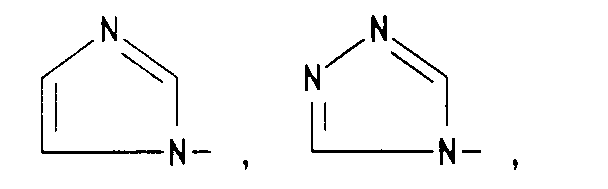
- m
- Null oder 1 und
R(1) sowie (C₁-C₄)-Alkyl die zur Formel III angegebenen Bedeutungen haben - m
- Null oder 1, und
- R(6) in Formel IV können auch andere die Carboxylgruppe in Carbonsäuren die Veresterung aktivierende Gruppen beinhalten, so beispielsweise -O-CO-CF₃ oder die aus Phosphon- oder Phosphinsäureanhydriden (z. B. Propanphosphonsäureanhydrid) oder Polyphosphorsäureanhydrid (PPA) herstellbaren aktivierten Carbonsäuren.
Weitere Phosphorreagentien, die eine schonende Veresterung von organischen Carbonsäuren mit der 21-Alkoholgruppe von Corticoid-17-alkylcarbonaten bewirken können, sind in den Literaturstellen Synth. Commun. 13, 471ff (1983) und Synth. Commun. 14, 515ff (1984) angeführt bzw. beschrieben. - Zur Veresterung mit einem Carbonsäurehalogenid oder -anhydrid oder einem Halogenformat löst man die Steroidkomponente in einem inerten Lösungsmittel, beispielsweise in einem Ether, wie Dioxan, Tetrahydrofuran, Diglym, oder gegebenenfalls halogenierten Kohlenwasserstoffen, wie Benzol, Toluol, Cyclohexan, Methylenchlorid, Chloroform oder in Aceton oder in einem Gemisch dieser Lösungsmittel. Zur Entfernung der in der Reaktion entstehenden Halogenwasserstoffsäure setzt man 1 bis 1000 Moläquivalente einer tertiären Base, wie Pyridin, Chinon, Triethylamin, Dimethylanilin, Dimethylaminopyridin usw., zu. Man kann aber auch eine anorganische Base, wie Natriumhydrogencarbonat oder Calciumcarbonat, zur Entfernung der Säure benutzen. Anschließend tropft man 1 bis 200 Moläquivalente, vorzugsweise 1 bis 3 Moläquivalente eines der oben angeführten Acylierungsmittel, gegebenenfalls gelöst in einem der oben angeführten Lösungsmittel, bei einer Temperatur von -40°C bis zum Siedepunkt des verwendeten Lösungsmittels, vorzugsweise von 0 bis 25°C, zu. Anschließend läßt man das Reaktionsgemisch eine bis 120 Stunden bei einer Temperatur von -40°C bis zum Siedepunkt des Lösungsmittels, vorzugsweise von 0 bis 25°C stehen.
- Bei Verwendung von Carbonsäureanhydriden als Acylierungsmittel ist es hin und wieder von Vorteil, ohne Zusatz von Lösungsmitteln zu arbeiten. Es reicht in der Regel aus, lediglich die organische Base, vorzugsweise Pyridin, dem gegebenenfalls im Überschuß angewandten Säureanhydrid zuzufügen.
- Insbesondere bei empfindlichen (und zuweilen instabilen) Carbonsäurederivaten des o. a. Typs, insbesondere bei Verwendung von Phenylacetylchloriden, -anhydriden, Hetarylacetylchloriden und -anhydriden, ist es von großem präparativem und reaktionsselektivem Vorteil, die Corticoid-17-carbonsäureester mit freier 21-Hydroxylgruppe mit 1 bis 4 Moläquivalenten des Chlorids bzw. Anhydrids bei -10 bis +6°C (maximal 20°C) in chlorierten Kohlenwasserstoffen, wie vorzugsweise Dichlormethan, sowie mit 1 bis 4 Moläquivalenten einer Pyridinbase, vorzugsweise Dimethylaminopyridin, umzusetzen.
- Hierbei werden die Reaktionsprodukte der Formel I in hoher Reinheit, ohne nennenswerte Beimengungen an Nebenprodukten, insbesondere 11-acylierten Produkten, erhalten (Verfolgung der Reaktionsführungen durch DC), das heißt die Reaktionsführungen sind hinsichtlich der Umsetzung der 21-Hydroxygruppe hoch regioselektiv.
- Bei den Reaktionen mit Carbonsäurechloriden wird in vorteilhafter Weise oft absolutes Dioxan oder Tetrahydrofuran zum Reaktionsgemisch gegeben, z. B. bei Benzoylchlorid, wobei z. B. das Verhältnis Dioxan/Pyridin etwa 1:1 ist, und zur Reaktionsbeschleunigung wird das Reaktionsgemisch oft, insbesondere bei sterisch gehinderten oder weniger reaktiven Carbonsäurechloriden oder -anhydriden auf etwa 60°C erwärmt (DC-Verfolgung der Reaktionsverläufe).
- Die Charakterisierung der Reaktionsprodukte kann durch Dünnschicht-Chromatographie (DC) erfolgen; hierbei haben die Reaktionsprodukte RF-Werte von etwa 0,65 bis 0,8. In der Regel werden die Reaktionsprodukte durch Massenspektren mit MS = m/z = .... (M + H⁺) charakterisiert (in der Regel FAB-Spektren); es werden jeweils die monoisotopischen Molmassen erfaßt. Die M + H⁺-Werte wurden jeweils aufgerundet. Auch IR-, ¹H-NMR- und UV-Spektren können zur Charakterisierung herangezogen werden.
- Zur Aufarbeitung gießt man das Reaktionsgemisch in Wasser, das gegebenenfalls mit Natriumchlorid und Natriumbicarbonat versetzt wurde, wobei die Reaktionsprodukte, oft erst nach längerem Stehen, im allgemeinen kristallin ausfallen. Ölig oder wachsartig gebliebene Reaktionsprodukte werden durch Ausschütteln mit einem geeigneten Extraktionsmittel und Eindampfen angereichert. Die Reaktionsprodukte können, falls erforderlich, durch Umkristallisieren oder durch Chromatographie aufgetrennt oder gereinigt werden. Oft genügt auch intensives Digerieren in einem das Reaktionsprodukt möglichst wenig oder nicht lösenden organischen Lösungsmittel, wie Diethylether oder Cyclohexan, oder einem Gemisch aus diesen Komponenten zur weiteren Reinigung der Reaktionsprodukte.
- Bei Verwendung von Carbonsäureazoliden führt man die Veresterung zweckmäßig als Eintopfreaktion durch. Hierbei löst man beispielsweise Aryl-oder Hetarylessigsäure oder eine andere Carbonsäure der Formel III [R(6) gleich OH), n gleich Null], in absolutem Pyridin und gibt eine vorzugsweise äquimolare Menge N,N-Carbonyl-diimidazol oder -[1H-1,2,4-triazol] hinzu, wobei sich bei 0 bis 20°C die entsprechenden Säureazolide bilden. Nach Zugabe einer etwa äquimolaren Menge Corticoid-17-carbonsäureester der Formel II [R(5) = OH] und katalytischer Menge einer Base, vorzugsweise Natriumhydrid oder-imidazolid rührt man in Pyridin zwischen 0 bis 40°C; vorzugsweise 20°C und arbeitet wie üblich auf.
- Man kann aber auch das vorher durch äquimolare Mengen N,N'-Carbonylazolid und Carbonsäure in absolutem Tetrahydrofuran hergestellte und isolierte Carbonsäureazolid in Lösungsmitteln wie Pyridin, Dimethylformamid, Tetrahydrofuran im gelösten Steroid zugeben und weiter wie oben geschildert verfahren [s. auch Chem. Ber. 95, S. 1284 ff. (1962)].
- Bei der Veresterung mit Hilfe von Phosphon- bzw. Phosphinsäureanhydriden setzt man vorzugsweise äquimolare Mengen Carbonsäure und Corticoid-21-alkohol in absolutem Pyridin mit 50 %igen Propanphosphorsäureanhydrid in Methylenchlorid bei 20 bis 60°C unter Zugabe von 4-Dimethylaminopyridin als Säurefänger hinzu und arbeitet wie üblich auf (in Eiswasser eingießen, mit Essigester extrahieren, mit 5 % KHSO₄ waschen, abdestillieren, kristallisieren). Anstelle von Phosphonsäureanhydriden kann man auch Polyphosphorsäureanhydrid (PPA) einsetzen.
- Ein weiteres vorteilhaftes Veresterungsverfahren, das auf die gemäß Formel III [R(6) gleich OH und n gleich Null] oder in der Liste aufgeführten Carbonsäuren anwendbar ist, ist die direkte Umsetzung von Corticoid-17-carbonsäureestern der Formel II [R(5) gleich OH] mit Hilfe von wasserentziehenden Mitteln, wie Carbodiimiden, vorzugsweise N,N'-Dicyclohexylcarbodiimid (DCCI). Anstelle von DCCi kann man in einigen Fällen auch mit "Molekularsieben" als wasserentziehenden Mitteln arbeiten.
- Durch Zusatz einer Säure, z. B. Schwefelsäure, Phosphorsäure, Chlorwasserstoffsäure, Diphenylphosphorsäure, p-Toluolsulfonsäure bzw. von deren Pyridiniumsalzen oder einer organischen Base, z. B. Dimethylaminopyridin (= besonders vorteilhaft in halogenierten Lösungsmitteln, z. B. Methylenchlorid oder in Dimethylformamid) kann die Veresterung katalytisch beschleunigt bzw. optimiert werden, was insbesondere bei sonst schwer reagierenden bzw. empfindlichen Carbonsäuren, z. B. vom Indolylessigsäure-, Pyrrolcarbonsäure-, Aryl- und Hetarylessigsäuretyp usw. sehr vorteilhaft ist. Hierbei ist es überraschend, daß die sekundäre 11-Hydroxygruppe in den eingesetzten Corticoid-17-carbonsäureestern (praktisch) in der Regel nicht gleichzeitig mit verestert wird, wie man es öfters bei der Veresterung mit den entsprechenden Säurehalogeniden beobachtet.
- In einer besonderen Verfahrensvariante gibt man zu einer Lösung von 1 Moläqu. Corticoid-17-carbonsäureester-21-alkohol [Formel II, R(5) gleich OH] und 1 bis 4 Moläqu. Carbonsäure der Formel III [R(6) gleich OH, n gleich Nul] vorzugsweise 2 Äquivalente, in absolutem Pyridin eine katalytische Menge Schwefelsäurepyridiniumsalz, sowie nach circa 20 Minuten 1 bis 4 Moläqu. Dicyclohexylcarbodiimid, vorzugsweise 1 bis 2 Moläqu. zu. Man rührt hiernach bei 0 bis 50°C, vorzugsweise 20°C, bis eine DC-Probe keine Ausgangscarbonsäure, sondern nur gewünschte Carbonsäure-21-corticoidester der Formel I anzeigt. Man filtriert vom entstandenen Dicyclohexylharnstoff ab, gießt das Filtrat zweckmäßig in Wasser ein, filtriert (bei Kristallbildung) oder dekantiert (bei öligen bzw. wachsartigen Umfällungen) ab, wäscht mit Wasser nach (gegebenenfalls extrahiert man auch mit Extraktionsmittel, insbesondere Dichlormethan) trocknet, kristallisiert wie üblich um oder stellt, falls erforderlich, die Reaktionsprodukte durch übliche Chromatographie, vorzugsweise an Kieselgel, rein dar.
- Anstelle von Pyridin können in einigen Fällen auch andere inerte Lösungsmittel, wie z. B. Tetrahydrofuran, Dioxan, Methylenchlorid, Dimethylformamid zweckmäßig unter Hinzugabe von tertiären Basen, beispielsweise Pyridin, 4-Dimethylaminopyridin verwendet werden. Bei Verwendung von Molekularsieben als wasserentziehenden Mittel sind letztere Lösungsmittel vorzuziehen.
- Für die Veresterung mit den empfindlichen Aryl- und Hetarylessigsäuren hat sich weiterhin folgende Variante bewährt: 1 Äqu. Carbonsäure wird bei 0°C in absolutem Dichlormethan gelöst, und nacheinander wird mit 1 Äqu. DCCI, bis 0,2 Äqu. 4-N,N'-Dimethylaminopyridin und einer Lösung von 1 Äqu. Corticosteroid-17-carbonsäureester-21-alkohol in absolutem Dichlormethan versetzt und 18 bis 48 Stunden bei 20°C gerührt. Nach üblicher Aufarbeitung kann der gewünschte Ester der Formel I rein dargestellt werden. Anstatt DCCI kann auch Molekularsieb verwendet werden.
- In einer weiteren Veresterungsmethode wird Corticoid-17-carbonsäureester-21-[tert.-Butyldimethylsilyl-(O)-ether] in absolutem Tetrahydrofuran mit 1 Moläqu.
- Carbonsäure und Trifluoressigsäureanhydrid versetzt, und nach etwa 1 bis 6 Stunden Rühren wird bei 20°C wie üblich aufgearbeitet.
- Man kann aber auch direkt die Carbonsäure sowie den Corticoid-17-carbonsäureester-21-alkohol (freie Form) mit Trifluoressigsäureanhydrid zum gewünschten 21-Carbonsäureester umsetzen (= Bildung des gemischten Anhydrids aus Carbonsäure und Trifluoressigsäure, das dann mit dem 21-Alkohol zum 21-Ester reagiert).
- Eine weitere vorteilhafte Verfahrensvariante, die zu den erfindungsgemäßen Corticoiden führt, besteht darin, daß man ein Corticoid-17-carbonsäureester-21-halogenid, vorzugsweise 21-Iodid oder 21-Bromid oder 21-Sulfonat, vorzugsweise 21-p-Chlorbenzolsulfonsäureester oder 21-methansulfonsäureester mit den Metallsalzen, vorzugsweise Alkalisalzen oder Trialkylammoniumsalzen, der in Liste 2 aufgeführten Carbonsäuren in inerten organischen Lösungsmitteln, vorzugsweise Dimethylsulfoxyd, Dimethylformamid, Butanon-(2), Aceton, Acetonitril, 1 bis 16 Stunden, vorzugsweise 1 bis 10 Stunden bei 20°C bis zu den Siedepunkten der verwendeten Lösungsmittel, vorzugsweise ca. 50°C, erhitzt und nach üblicher Aufarbeitung, vorzugsweise Eingießen von Wasser, Abfiltrieren oder Abdekantieren des Niederschlags und üblicher Reindarstellung isoliert.
- Bei dieser nucleophilen Austauschreaktion einer 21-Halogenid- bzw. 21-Sulfonsäureestergruppe gegen eine Carbonsäureestergruppe ist es überraschend, daß unter den vorzugsweise alkalischen Reaktionsbedingungen die für das Wirkungsprofil mitverantwortliche 17-Carbonsäureestergruppe in den Verfahrensprodukten nicht gleichzeitig verseift wird.
- Für die gemäß Verfahrensweisen a) und b) hergestellten Verbindungen I gilt, daß eine Hydroxygruppe in 11-Stellung gegebenenfalls nach üblichen Methoden zur Ketogruppe oxydiert werden kann. Vorzugsweise wird diese Oxydation mit Chromtrioxid in saurem Medium und in einem inerten organischen Lösungsmittel durchgeführt. Eine im Corticoidteil vorhandene 9(11)-Doppelbindung kann gegebenenfalls durch Addition von Halogenwasserstoffsäure oder durch Chlor nach üblichen bekannten Methoden in die entsprechenden erfindungsgemäßen Corticoid-17,21-dicarbonsäureester mit einer 11β-Hydroxyl-9α-Halogenidgruppe (9αF,Cl) oder 11β-9α-Dichlorgruppe überführt werden.
- Die Verfahrensprodukte besitzen wertvolle pharmakologische Eigenschaften. Sie sind insbesondere lokal und topisch sehr stark antiphlogistisch wirksam und zeigen teilweise ein überraschend sehr gutes Verhältnis von lokaler zu systemischer antiinflammtorischer Wirkung, das gegenüber analogen Corticoid-17,21-diestern sowie z.B. gegenüber bekannten Corticoid-17-alkylcarbonat-21-estern, die im 21-Esterrest keine Aryl- oder Hetarylgruppe tragen, so z. B. 21-Estergruppen mit einer 21-Alkylgruppe, oft deutlich überlegen ist, wie aus pharmakologischen Standardtests hergeleitet werden kann. Demgemäß ist Gegenstand der Erfindung auch ein Mittel zur Behandlung entzündlicher Dermatosen bestehend aus einer Verbindung der Formel I.
- Die Verfahrensprodukte können in der Veterinär- und Humantherapie zur Behandlung von entzündlichen Dermatosen verschiedenster Genese in Form von Suspensionen, Salben, Cremes, Sprays usw. Verwendung finden. Dabei ist als besonders vorteilhaft für die lokale und topische Therapieform herauszuheben, daß die Verfahrensprodukte aufgrund ihres äußerst günstigen Verhältnisses von lokaler zu systemischer antiphlogistischer Wirkung auch bei hochdosierter und langanhaltender Therapie praktisch nur geringfügige systemische Nebenwirkungen hervorrufen können. Bei äußerlicher Behandlung werden Salben, Cremes, Suspensionen usw. mit einer Konzentration von 0,01 bis 2 Gew.-% verwendet. Insbesondere zeigen die Verfahrensprodukte in pharmakologischen Tests einen zum Teil wesentlich besseren Split (Verhältnis) von lokaler/systemischer antiinflammatorischer Wirkung als entsprechende Präparate mit einer 21-Estergruppe, die im Esterteil keine Aryl- bzw. Hetarylanteile, wie es bei den erfindungsgemäßen Verbindungen der Fall ist, aufweisen. Weiterhin zeigen die Verfahrensprodukte teilweise auch eine stärkere lokale antiphlogistische Wirksamkeit als die zuletzt genannten Analogpräparate. Darüber hinaus können die erfindungsgemäßen Corticoid-17,21-dicarbonsäureester gegenüber den analogen zuletzt genannten Corticoid-17,21-diestern oft eine noch geringere Haut- Atrophogenität aufweisen, was ein weiterer Vorteil für eine dermatotherapeutische Behandlung ist.
- Corticoid-17-carbonsäureester-21-zimtsäureester, insbesondere in 4-Stellung im Aromaten durch Methoxy-, Methylendioxy oder Ethoxy substituierte, können über ihre antiphlogistische Wirkung hinaus eine zusätzliche Lichtschutzwirkung gegen Sonnen-, insbesondere UV-B und UV-A-Strahlung aufweisen. Das Gleiche gilt auch für Corticoid-17-carbonsäure-21-ester, die in 21-Position ein N,N-Dialkylbenzoat, vorzugsweise ein 4-(Dimethylamino)-benzoat, aufweisen. Auch diese Verbindungen können zusätzliche Lichtschutzwirkung aufweisen. Ferner können Corticoid-17-carbonsäureester mit einem Chlorambucilanteil im 21-Ester, so z. B. Prednisolon-17-n-butyrat-21-chloramibucil-ester, antitumorale Wirkungen aufweisen, die den Wirkungen des bekannten Prednimustin entsprechen (Merck Index 11, 7718).
- Darüber hinaus können die erfindungsgemäßen Verfahrensprodukte mit diversen gut hautverträglichen lokal wirksamen Antibiotika, z. B. vom Typ des Gentamycins, Neomycins, Erythromycins, Tetracyclins oder der Fusidinsäure und anderen, in galenischen Formulierungen kombiniert werden. Derartige Kombinationen aus den Verfahrensprodukten und den lokalen wirksamen Antibiotika können zur Behandlung von primären bakteriellen oder bakteriell superinfizierten entzündlichen Dermatosen verwendet werden.
- So zeigten z. B. Prednisolon-17-benzoat-21-phenylessigsäure-ester (I) oder Betamethason-17-benzoat-21-phenylessigsäure-ester (II) eine starke lokale antiphlogistische Wirkung bei einem auffallend günstigen Split zur schwachen systemischen Wirksamkeit, wie aus den unten angeführten pharmakologischen Testergebnissen [Vergleichspräparat Prednicarbat (= Prednisolon-17-ethylcarbonat-21-propionat (US-Patentschrift 4 242 334) und (Merck Index 11, 7717))] hervorgeht:
- Wir verwendeten die Rattenohr-Methode von Tonelli et al., Endocrinology, 77, 625 (1965): Männliche Wistar-Ratten aus eigener Zucht im Gewicht um 50 g wurden am rechten Ohr mit dem Irritans bzw. Testsubstanz enthaltenden Irritans epikutan behandelt. Das linke Ohr blieb unbehandelt. Zur Entzündungsauslösung diente TPA (12-o-Tetradecanoylphorbol-13-acetat, SIGMA P 8139) in Aceton gelöst, 0,2 mg/ml (davon je 20 µl innen bzw. außen). Die zu prüfenden Kortikoide wurden hierin in den angegebenen Endkonzentrationen gelöst. Kontrollen erhielten nur das TPA-Lösungsmittelgemisch. 4 Stunden nach epikutaner Behandlung wurden die Tiere mit CO₂ getötet. Aus dem rechten (behandelten) und dem linken (unbehandelten) Ohr wurden 8 mm Durchmesser messende Scheiben ausgestanzt und sofort gewogen.
Diese Differenz als Parameter für den Grad der Entzündung bei Kontrollen (mg, x ± s) wurde gleich 100 gesetzt. Die antiphlogistische Wirkung wird durch Angabe der ca. 50 %igen Hemmdosis in mg/ml charakterisiert:Behandlung mg/ml x ± s (mg) Hemmung in % Kontrolle - 21,2±5,1 - Verb. I 0,1 5,0±3,1 76 0,3 3,1±2,5 85 1,0 2,0±1,4 91 Verb. II 0,1 7,0±3,3 67 0,3 4,9±3,3 77 1,0 1,1±0,9 95 Prednicarbat 0,1 5,2±3,3 75 0,3 2,6±2,4 88 Ergebnis: Die extrapolierte 50 %ige Hemmdosis liegt für Verbindung I, Verbindung II und das Vergleichspräparat bei 0,03 mg/ml. - Als Test für die akute systemische antiphlogistische Wirkung wurde das Carrageenan-Pfotenödem an Ratten nach der von Winter et al., Proc. Soc. exp. Bio. (NY), 111, 544 (1962), beschriebenen Methode gewählt. Männliche Sprague-Dawley-Ratten im Gewicht um 120 g erhielten die zu prüfenden Substanzen s.c. (0,2 ml/100 g) in Sesamöl gelöst. 30 min später wurde in die linke Hinterpfote 0,1 ml einer 0,5 % Carrageenan-Lösung injiziert. 6 Stunden später wurde die Schwellungszunahme volumetrisch gemessen. Kontrollen erhielten nur Sesamöl.
- Die Pfotenvolumina sind in ml, x ± s, angegeben. Die antiphlogistische Wirkung wird auch hier durch Angabe der ca. 50 %igen Hemmdosis in mg/kg charakterisiert.
Behandlung Dosis in mg/kg s.c. Ausgangswert (ml) Volumenzunahme (ml) Kontrolle - 1,39±0,09 0,58±0,16 Verb. I 0,3 1,40±0,12 0,46±0,19 3,0 1,34±0,06 0,38±0,15 Verb. II 0,3 1,42±0,05 0,56±0,09 3,0 1,31±0,09 0,45±0,14 Prednicarbat 0,3 1,44±0,08 0,36±0,13 3,0 1,37±0,07 0,09±0,08* Ergebnis: Die Versuchsauswertung mit dem Dunnett-Test ergab bei beiden Dosierungen der Verbindungen I und II keine signifikante Hemmwirkung, während Prednicarbat mit 3 mg/kg eine signifikante systemische Wirkung hatte (*). Damit sind Verbindungen I und II ca. 10mal geringer wirksam als Prednicarbat, also um diesen Faktor günstiger einzustufen als dieser Standard. - Eine empflindliche Methode zum Nachweis systemischer Wirkung auf den Kohlhydratstoffwechsel ist die Prüfung der glukoneogenetischen Wirkung von Corticosteroiden an der adrenalektomierten Ratte. Drei Tage vor dem Versuch werden Gruppen zu je 6 Ratten in Pentobarbitalnarkose adrenalektomiert und mit 0,9 % Kochsalzlösung als Trinkflüssigkeit versorgt. Zwei Tage später, d. h. 24 Stunden vor Versuchsbeginn, wird das Futter entzogen, um die Glykogenvorräte in der Leber zu reduzieren.
- Am Versuchstag werden die Prüfpräparate subcutan appliziert, gelöst in Sesamöl (2 ml/kg). Sechs Stunden später werden die Tiere dekapitiert, die Leber wird entnommen und 1 g davon in 5 ml 0,6 molarer Perchlorsäure aufgenommen. Nach Homogenisierung wird die freie Glukose im Überstand des Zentrifugats bestimmt, das Zentrifugat (Glykogen) enzymatisch mit Amyloglukosidase aufgespalten und hierin ebenfalls der Glukosegehalt bestimmt (Hexokinase-Methode, Boehringer Mannheim). Es wurden die folgenden Ergebnisse erhalten/Mittelwert ± Standardabweichung):
Behandlung Dosis (mg/kg s.c.) Leberglykogen Glykogen + Glukose mg/100 g Leber Kontrolle - 1,1±0,6 11,2±1,7 Verb. I 0,3 2,2±2,1 20,4±11,7 n.s. 3,0 43,2±25,8 96,0±26,2 Verb. II 0,3 1,1±0,5 10,8±1,3 n.s. 3,0 36,1±45,2 81,2±61,7 Prednicarbat 0,3 41,2±42,8 85,7±40,5* 3,0 93,3±28,9 148,2±32,4 * p<0,05 (t-Test gegen Kontrolle)
n.s. - nicht signifikant - Aus den aufgeführten Ergebnissen zur Glukose-/Glykogenneubildung ist zu entnehmen, daß die Verbindung I und die Verbindung II mit 0,3 mg/kg noch keine signifikante Wirkung haben, während Prednicarbat hier bereits eine geringe aber signifikante (p < 0,05, t-Test) Wirkung aufweist. Ähnlich verhält es sich bei den Dosierungen 3 mg/kg, bei welcher Prednicarbat signifikant stärker ist als Verbindungen I und II. Bei den Verbindungen I und II ist daher der therapeutische Vorteil (geringe systemische Wirkung) größer als bei Prednicarbat. Weiterhin weisen z.B. auch die Verbindungen Prednisolon-17-n-butylcarbonsäureester-21-phenylacetat und Betamethason-17-n-valerat-21-phenylacetat gleichartige Wirkprofile wie die Verbindungen I und II auf.
- Zu den im folgenden aufgeführten Beispielen sind die nachstehenden allgemeinen Bemerkungen zu machen:
Die Schmelzpunkte werden im Apparat nach Tottoli (Fa. Büchi) oder auf der Kofler-Heizbank der Fa. Reichert (Austria), Typ 7841, bestimmt und sind nicht korrigiert.
Die IR-Spektren (in KBr) werden mit dem Gitterspektrophotometer Perkin-Elmer 521 aufgenommen. Es werden jeweils nur die charakteristischen Banden angeführt. Die Aufnahme der UV-Spektren (in Methanol) erfolgte mit dem Spektralphotometer Beckmann DK 1 A. Die massenspektroskopischen Untersuchungen (MS) werden vorwiegend mit dem Gerät MS 9 (Fa. AEI) durchgeführt. Angabe der MS-Spektren (Molgewichtspeak) überwiegend in: MS = m/z = ... (M + H⁺) (Messung mit Reinistopen), d. h. es wurde jeweils die monoisotopische Molmasse erfaßt. In der Regel wurden FAB-MS-Spektren gemessen.
Für die Dünnschicht-Chromatographie (DC) dienten Fertigplatten Kieselgel F₂₅₄ (Fa. Merck). Wenn nicht anders angegeben, wurde als Laufmittel Methylenchorid: Methanol = 19:1 benutzt (Laufstrecke 7 cm). Es wurde jeweils zweimal entwickelt. Die Flecken wurden entweder mit einer UV-Lampe bei 254 nm detektiert oder durch Besprühen mit 10 %-iger methanolischer Schwefelsäure sowie durch Erhitzen auf 100°C sichtbar gemacht. Die RF-Werte sind immer nur relativ zu verstehen. Zur Säulenchromatographie wurde 15 Kieselgel 60, Korngröße 0,063 bis 0,2 mm (Fa. Merck) verwendet. - Bei den Reaktionen mit Carbonsäurechloriden wird in vorteilhafter Weise oft absolutes Dioxan zum Reaktionsgemisch gegeben, z. B. bei substituierten Benzoylchloriden, wobei das Verhältnis Dioxan/Pyridin etwa 1:1 ist, und zur Reaktionsbeschleunigung wird das Reaktionsgemisch oft, insbesondere bei sterisch gehinderten oder weniger reaktiven Carbonsäurechloriden oder -anhydriden auf etwa 60°C erwärmt (DC-Verfolgung der Reaktionsverläufe).
- Die Charakterisierung der Reaktionsprodukte kann durch Dünnschicht-Chromatograpie (DC) erfolgen; hierbei haben die Reaktionsprodukte RF-Werte von etwa 0,65 bis 0,75. In der Regel werden die Reaktionsprodukte durch Massenspektren mit MS = m/z = ... (M + H⁺) charakterisiert (In der Regel FAB-Spektren); es wird jeweils die monoisotopische Molmasse erfaßt. Die M + H⁺-Werte wurden jeweils aufgerundet. Auch IR-, ¹H-NMR- und UV-Spektren können zur Charakterisierung herangezogen werden.
- Zu einer Lösung von 226 mg Prednisolon-17-butyrat in 2 ml absolutem Pyridin wird bei 0°C und Rühren eine Lösung von 200 mg Furan-2-carbonsäurechlorid in 1 ml absolutem Dioxan zugetropft. Nach 5 bis 6 Stunden Rühren bei 0°C (DC zeigt vollständige Bildung des gewünschten Reaktionsproduktes) gießt man in 100 ml halbgesättigte wäßrige Kochsalzlösung ein, isoliert die Ausfällung (ölig oder Wachs) über ein Faltenfilter, nimmt diese mit Methylenchlorid (oder Essigester) auf, wäscht mit Wasser, trocknet mit Natriumsulfat, destilliert im Vakuum das Lösungsmittel ab, kristallisiert mit Diisopropylether oder Diethylether oder Petrolether, filtriert ab und kristallisiert (gegebenenfalls) aus Ethanol/Ether (gegebenenfalls Zusatz von Petrolether) um. Man erhält 160 mg der o. a. Titelverbindung vom Schmp.: 206°C.
MS: m/z = 525 (M+H⁺)
DC: RF ≅ 0,7 - In gleicher Weise wie unter Beispiel 1 beschrieben, werden 230 mg Prednisolon-17-n-butyrat mit 230 mg Thiophen-2-carbonsäurechlorid anstelle des Furan-2-carbonsäurechlorids umgesetzt, aufgearbeitet; die Titelverbindung wird kristallin rein dargestellt. Man erhält 130 mg der o. a. Titelverbindung vom
Schmp.: 120 bis 124°C.
MS: m/z = 541 (M+H⁺)
DC: RF ≅ 0,7 - In gleicher Weise wie unter Beispiel 1 beschrieben werden 230 mg Prednisolon-17-n-butyrat mit 240 mg 4-Methoxybenzoylchlorid (= p-Anissäurechlorid) anstelle des Furan-2-carbonsäurechlorids umgesetzt, aufgearbeitet; die Titelverbindung wird kristallin rein dargestellt. Man erhält 140 mg der o. a. Titelverbindung vom
Schmp.: 190-192°C.
MS: m/z = 565 (M+H⁺)
DC: RF ≅ 0,7 - Wird entsprechend Beispiel 3 m-Anissäurechlorid oder o-Anissäurechlorid eingesetzt, so erhält man entsprechend Prednisolon-17-n-butyrat-21-(3-methoxybenzoat) oder Prednisolon-17-n-butyrat-21-(2-methoxybenzoat). Beide Reaktionsprodukte zeigen
MS: m/z = 565 (M+H⁺)
DC: RF ≅ 0,7 - In gleicher Weise wie unter Beispiel 1 beschrieben, werden 230 mg Prednisolon-17-n-butyrat mit 270 mg 3,4-Methylendioxybenzoylchlorid anstelle des Furan-2-carbonsäurechlorids umgesetzt, aufgearbeitet; die Titelverbindung wird kristallin rein dargestellt. Man erhält 155 mg der o. a. Titelverbindung vom
Schmp.: 210°C.
MS: m/z = 579 (M+H⁺)
DC: RF ≅ 0,75 - Zu einer Lösung von 340 mg Prednisolon-17-n-butyrat in 3 ml absolutem Pyridin wird bei 0°C und unter Rühren eine Lösung von 300 mg 3-Phenylpropionsäurechlorid in 1 ml absolutem Dioxan zugetropft. Nach 5 bis 6 Stunden. Rühren bei 0°C (DC zeigt vollständige Bildung des gewünschten Reaktionsproduktes) gießt man in 100 ml halbgesättigte wäßrige Kochsalzlösung ein, isoliert die Ausfällung (ölig oder Wachs) über ein Faltenfilter, nimmt diese mit Methylenchlorid (oder Essigester) auf, wäscht mit Wasser, trocknet mit Natriumsulfat, destilliert im Vakuum das Lösungsmittel ab, kristallisiert (gegebenenfalls) aus Ethanol/Ether (gegebenenfalls Zusatz von Petrolether) um. Man erhält 400 mg der o. a. Titelverbindung vom Schmp.: 90 bis 93°C (amorph) (aus Petroläther gefällt)
MS: m/z = 563 (M+H⁺)
DC: RF ≅ 0,7 - In gleicher Weise wie unter Beispiel 6 beschrieben, werden 340 mg Prednisolon-17-n-butyrat mit 300 mg Phenoxyessigsäurechlorid anstelle des 3-Phenylpropionsäurechlorids umgesetzt, aufgearbeitet. Die Titelverbindung wird kristallin rein dargestellt. Man erhält 380 mg der o. a. Titelverbindung vom Schmp.: 93 bis 95°C (gefällt aus Petrolether; amorph).
MS: m/z = 565 (M+H⁺)
DC: RF ≅ 0,7 - In gleicher Weise, wie unter Beispiel 6 beschrieben, werden 350 mg Prednisolon-17-n-butyrat mit 320 mg Zimtsäurechlorid anstelle des 3-Phenylpropionsäurechlorids umgesetzt; es wird aufgearbeitet und das Produkt kristallisiert rein dargestellt. Man erhält 300 mg der o. a. Titelverbindung. Schmp.: 112°C (aus Petrolether, amorph).
MS: m/z = 561 (M+H⁺)
DC: RF ≅ 0,7 - Wird in Beispiel 8 anstelle des dortigen Zimtsäurechlorids 360 mg p-Methoxyzimtsäurechlorid eingesetzt, so erhält man nach analoger Aufarbeitung, Isolierung und Reindarstellung 330 mg Prednisolon-17-n-butyrat-21-p-methoxyzimtsäureester vom Schmp. 120°C (aus Petrolether, amorph)
MS: m/z = 591 (M+H⁺)
DC: RF ≅ 0,8 - In gleicher Weise, wie in Beispiel 8 beschrieben, werden 0,3 g Prednisolon-17-iso-butyrat mit 0,3 g 2-Thienylacetylchlorid anstelle des dortigen Säurechlorids umgesetzt, aufgearbeitet und kristallisiert rein dargestellt. Aus Diethylether erhält man 240 mg der o. a. Titelverbindung. (DC-reiner Wachs)
MS: m/z = 555 (M+H⁺)
DC: RF ≅ 0,7 - In gleicher Weise, wie in Beispiel 8 beschrieben, werden 0,3 g Prednisolon-17-n-butyrat mit 0,3 g Thiophen-2-carbonsäurechlorid anstelle des dortigen Säurechlorids umgesetzt. Nach 5 Stunden Rühren bei 0°C wird aufgearbeitet, und das Produkt wird kristallisiert rein dargestellt. Aus Diethylether erhält man 260 mg der o. a. Titelverbindung. Schmp.: 120 bis 124°C
MS: m/z = 541 (M+H⁺);
DC: RF = 0,7 - In gleicher Weise, wie in Beispiel 8 beschrieben, werden 0,3 g Prednisolon-17-n-butyrat mit 0,31 g Thienylacrylsäurechlorid anstelle des dortigen Säurechlorids umgesetzt; es wird aufgearbeitet, und das Produkt wird kristallisiert rein dargestellt. Aus Diethylether erhält man 280 mg der o. a. Titelverbindung. Schmp.: 176-179°C
MS: m/z = 567 (M+H⁺); DC: RF ≅ 0,7 - In gleicher Weise, wie in Beispiel 8 beschrieben, werden 0,3 g Prednisolon-17-n-butyrat mit 0,3 g Furan-2-carbonsäurechlorid anstelle des dortigen Säurechlorids umgesetzt; es wird aufgearbeitet, und das Produkt wird kristallisiert rein dargestellt. Aus Diethylether erhält man 230 mg der o. a. Titelverbindung. Schmp.: 206°C
MS: m/z = 525 (M+H⁺)
DC: RF ≅ 0,7 - In gleicher Weise, wie in Beispiel 8 beschrieben, werden 0,3 g Prednisolon-17-n-butyrat mit 0,31 g β- oder 3-(2-Furylacrylsäure)chlorid anstelle des dortigen Säurechlorids umgesetzt; es wird aufgearbeitet, und das Produkt wird kristallisiert rein dargestellt. Aus Diethylether erhält man 250 mg der o. a. Titelverbindung. Schmp.: 220-224°C
MS: m/z = 551 (M+H⁺)
DC: RF ≅ 0,7 - In gleicher Weise, wie unter Beispiel 8 beschrieben, werden 350 mg Prednisolon-17-propionat mit 320 mg Zimtsäurechlorid umgesetzt, aufgearbeitet und die Titelverbindung rein dargestellt. Man erhält 280 mg der o. a. Titelverbindung; Schmp.: 105 bis 110°C (aus Petrolether, amorph.)
MS: m/z = 547 (M+H⁺);
DC: RF ≅ 0,7 - In gleicher Weise, wie unter Beispiel 8 beschrieben werden 350 mg Prednisolon-17-n-valerat mit 320 mg Zimtsäurechlorid umgesetzt, aufgearbeitet und die Titelverbindung rein dargestellt. Man erhält 245 mg der o. a. Titelverbindung. Schmp.: 90 bis 98°C (aus Petrolether gefällt)
MS: m/z = 575 (M+H⁺)
DC: RF ≅ 0,75 - In gleicher Weise, wie in Beispiel 13 beschrieben, werden 0,3 g Prednisolon-17-propionat mit 0,3 g Furan-2-carbonsäurechlorid umgesetzt, aufgearbeitet und die Titelverbindung rein dargestellt. Durch Fällen mit Petrolether erhält man 280 mg der o. a. Titelverbindung von amorpher Konsistenz.
MS: m/z = 511
DC: RF ≅ 0,7 -
- a) Setzt man in Beispiel 17 anstelle des Prednisolon-17-propionat 0,3 g 6α-Methyl-prednisolon-17-propionat in die Reaktion ein, so erhält man nach Fällen mit Petrolether 0,25 g des analogen 6α-Methyl-prednisolon-17-propionat-21-(furan-2-carbonsäure)esters in amorpher Form, das nicht umkristallisiert wurde.
MS: m/z = 525 (M+H⁺)
DC: RF ≅ 0,75 - b) Setzt man in Beispiel 16 anstelle des Prednisolon-17-n-valerat 0,33 g 6α-Methyl-prednisolon-17-propionat mit 0,33 g Zimtsäurechlorid um, so erhält man nach gleicher Reaktionsführung, Aufarbeitung und Reindarstellung 210 mg 6α-Methyl-prednisolon-17-propionat-21-zimtsäureester vom Schmp.: 125°C (Fällung mit Petrolether)
MS: m/z = 561 (M+H⁺)
DC: RF ≅ 0,7
In einem dreifach so großen analogen Reaktionsansatz werden 880 mg Reaktionsproduktvom Schmp.: 125°C [MS: m/z = 561 (M+H⁺)] erhalten. - In gleicher Weise, wie unter Beispiel 8 beschrieben, werden 340 mg Prednisolon-17-propionat mit 350 mg p-Methoxyzimtsäurechlorid umgesetzt, aufgearbeitet und rein dargestellt. Man erhält aus Petrolether 330 mg der o. a. Titelverbindung als Wachs.
MS: m/z = 577 (M+H⁺)
DC: RF ≅ 0,8 -
- a) In gleicher Weise, wie unter Beispiel 6 beschrieben, werden 350 mg Prednisolon-17-n-butyrat mit 320 mg Phenylacetylchlorid anstelle des 3-Phenylpropionsärechlorids umgesetzt; es wird aufgearbeitet und das Produkt kristallisiert dargestellt. Man erhält 140 mg der o. a. Titelverbindung. Schmp.: ca. 160°C
MS: m/z = 549 (M+H⁺)
DC: RF = ≅ 0,8 (Noch Nebenflecke geringer Intensität im DC oder- und unterhalb des Hauptfleckes bei RF ≅ 0,8) - b) Zu einer Lösung von 1,1 g (0,0025 mol) Prednisolon-17-n-butyrat und 1,2 g (0,0088 mol) Phenylessigsäure (5 Stunden in Vakuum über P₂O₅ bei ca. 50 bis 60°C getrocknet) in 6 ml absolutem Pyridin gibt man unter Rühren und bei 20°C eine frisch zubereitete Mischung von 30 mg konzentrierter Schwefelsäure in 2,5 ml absolutem Pyridin (Suspension von Pyridinium-Sulfat). Nach 15 Minuten Rühren gibt man 720 mg (0,0035 mol) N,N'-Dicyclohexylcarbodiimid zu. Aus der anfänglichen klaren Lösung fällt bald ein kristalliner Niederschlag von gebildeten N,N'-Dicyclohexylharnstoff aus. Man rührt solange bis im DC kein Edukt mehr nachweisbar ist und das Reaktionsprodukt bei RF = 0,8 detektierbar ist (in der Regel 16 Stunden Reaktionszeit; eine längere Reaktionszeit, z. B. Stehen bzw. Rühren übers Wochenende beeinträchtigt nicht das Reaktionsergebnis). Hiernach gibt man 0,3 ml Essigsäure oder Essigsäureanhydrid hinzu und läßt den Ansatz noch 1 Stunde bei 20°C 24 bis 48 Stunden im Tiefkühlschrank (ca. -15°C) stehen. Man filtriert vom ausgefallenem N,N'-Dicyclohexylharnstoff ab, wäscht diesen mit etwa -15°C kaltem Pyridin und rührt das Filtrat in ca. 400 ml viertelgesättigte wäßrige Kochsalzlösung ein, gibt etwa 5 ml Ethanol hinzu, filtriert die öligkristalline Ausfällung ab, wäscht diese mehrmals mit Wasser und nimmt diese mit etwa 20 ml Methylenchlorid auf. Nach dem Trocknen mit Natriumsulfat destilliert man ab und kristallisiert den Rückstand durch Zugabe von Diethylether oder Diisopropylether. Man erhält 1,1 g Prednisolon-17-n-butyrat-21-phenylacetat vom Schmp. ca. 160°C, das aus tert.-Butanol/Diethylether umkristallisiert wird. Schmp.: 164 bis 166°C
MS: m/z = 549 (M+H⁺)
DC: RF ≅ 0,80 (RF v. ED ≅ 0,45) keine sichbaren Nebenflecken oberhalb und unterhalb RF ≅ 0,8. - c) Es wird ein weiterer analoger Ansatz, wie unter Beispiel 20 b) beschrieben durchgeführt; allerdings wird der saure Katalysator, konzentrierte Schwefelsäure in Pyridin, weggelassen. Nach etwa 5-facher Reaktionszeit, wie unter Beispiel 20 b) angegeben, zeigt eine DC-Probe kein Edukt mehr. Nach analoger Aufarbeitung und Reindarstellung, wie unter Beispiel 20 b) angegeben, werden 1,0 g Prednisolon-17-n-butyrat-21-phenylacetat mit den gleichen Kenndaten, wie unter Beispiel 20 b) angegeben, erhalten.
Wird anstelle von Pyridin absolutes Dimethylformamid als Lösungsmittel verwendet, so erhält man die Titelverbindung ebenfalls mit den gleichen Daten. - d) Es wird ein weiterer analoger Ansatz, wie unter Beispiel 20 b) beschrieben durchgeführt. Anstelle der Schwefelsäure werden aber 60 mg p-Toluolsulfonsäure zugegeben. Nach analoger Aufarbeitung und Reindarstellung, wie unter Beispiel 20 b) angegeben, werden 1,3 g Prednisolon-17-n-butyrat-21-phenylacetat mit den gleichen Kenndaten, wie in Beispiel 20 b) angegeben, erhalten.
- e) Zu einer Lösung von 2,16 g Prednisolon-17-n-butyrat und 1,22 g Phenylessigsäure in 40 ml absolutem Methylenchlorid gibt man bei 0°C und Rühren 120 mg 4-Dimethylaminopyridin und 1,75 g Dicyclohexylcarbodiimid. Die zunächst klare Reaktionslösung trübt sich bald. Nach ca. 36 Stunden Rühren bei Zimmertemperatur zeigt eine DC-Probe kein Edukt mehr. Man bewahrt dann 2 Tabe bei -15°C (Tiefkühlschrank) auf, filtriert den ausgefallenen Dicyclohexylharnstoff ab, wäscht diesen mit etwa -15°C kaltem Methylenchlorid und zieht das organische Lösungsmittel im Vakuum ab. Der hinterbliebene Rückstand wird aus siedendem Diethylether zur Kristallisation gebraucht und aus Ethanol/Diethylether umkristallisiert. Man erhält 1,9 g der o. a. Titelverbindung (strahlend weiße Kristalle) mit den gleichen unter Beispiel 20 b) angegebenen Daten (MS, DC, Schmelzpunkt). Der Schmelzpunkt ist gegenüber Beispiel 2 b) um etwa 2° höher: Schmp.: 166 bis 168°C,
- f) bei einem analogen Ansatz gemäß e) wird das Methylenchlorid durch Dimethylformamid als Lösungsmittel ersetzt. Ansonsten wird genau wie unter Beispiel 20 e) angegeben verfahren. Nach der Aufarbeitung erhält man 1,7 g der o. a. Titelverbindung mit Schmp.: 165 bis 167°C
- Werden, wie in Beispiel 20 b) beschrieben, 1,1 g Prednisolon-17-propionat mit 1,2 g Phenylessigsäure und 720 mg N,N'-Dicyclohexylcarbodiimid sowie Pyridiniumsulfat in insgesamt 8,5 ml absolutem Pyridin umgesetzt, aufgearbeitet und die Titelverbindung rein darstellt, so erhält man 1,1 g der o. a. Titelverbindung vom Schmp.: 168°C (aus Diethylether kristallisiert).
MS: m/z = 535 (M+H⁺)
DC: RF ≅ 0,7 (fast 0,75) - Werden in gleicher Weise, wie in Beispiel 20 b) beschrieben, 1,1 g Prednisolon-17-n-valerat mit 1,2 g Phenylessigsäure und 720 mg N,N'-Dicyclohexylcarbodiimid sowie Pyridiniumsulfat in 9 ml absolutem Pyridin umgesetzt, aufgearbeitet und rein dargestellt, so erhält man (nach Chromatographie) 0,8 g der o. a. Titelverbindung mit Schmp.: 178°C (aus Diethylether).
MS: m/z = 563 (M+H⁺)
DC: RF ≅ 0,75 - Werden, wie in Beispiel 20 b) beschrieben, 1,1 g Prednisolon-17-benzoat mit 1,2 g Phenylessigsäure und 720 mg N,N'-Dicyclohexylcarbodiimid sowie Pyridiniumsulfat in 8 ml absolutem Pyridin umgesetzt, aufgearbeitet und rein dargestellt, so erhält man nach Kristallisation mit Diisopropylether 850 mg der o. a. Titelverbindung vom Schmp.: 106°C
MS: m/z = 583 (M+H⁺) DC: RF ≅ 0,8 - Werden, wie in Beispiel 20 b) beschrieben, 1,1 g Prednisolon-17-phenylacetat mit 1,2 g Phenylessigsärue und 730 mg N,N'-Dicyclohexylcarbodiimid sowie Pyridiniumsulfat in 7,5 ml absolutem Pyridin umgesetzt, aufgearbeitet und rein dargestellt, so erhält man nach Digerieren mit Petrolether 1,0 g amorphes Produkt, das o. a. Titelverbindung darstellt.
MS: m/z = 597 (M+H⁺)
DC: RF ≅ 0,8 - Werden, wie in Beispiel 20 b) beschrieben, 2 g 6α-Methyl-prednisolon-17-propionat mit 1,95 g Phenylessigsäure und 1,3 g N,N'-Dicyclohexylcarbodiimid sowie Pyridiniumsulfat (hier: 60 mg konz. Schwelfelsäure + 2 ml absolutes Pyridin) in 12 ml abs. Pyridin umgesetzt (24 Stunden bei 20°C), so erhält man nach analoger Aufarbeitung und Reindarstellung (hier aber ohne Chromatographie) nach dem Anreiben mit Petrolether 1,9 g der o. a. Titelverbindung vom Schmp.: 113 bis 116°C.
MS: m/z = 549 (M+H⁺)
DC: RF ≅ 0,5 - Werden, wie in Beispiel 20 b) beschrieben, 1,65 g Prednisolon-17-propionat mit 1,9 g 2-Thienylessigsäure anstelle von Phenylessigsäure und 1,1 g N,N'-Dicyclohexylcarbodiimid sowie Pyridiniumsulfat (35 g H₂SO₄ + 2 ml Pyridin) in 8 ml absolutem Pyridin umgesetzt, aufgearbeitet und rein dargestellt, so erhält man nach Chromatographie und Kristallisieren aus Diethylether 800 mg der o. a. Titelverbindung. Schmp.: 154 bis 158°C
MS: m/z = 541 (M+H⁺)
DC: RF ≅ 0,7 - Zu einer Lösung von 300 mg Betamethason-17-n-valerat in 2 ml absolutem Pyridin wird bei 0°C und unter Rühren eine Lösung von 0,3 ml Phenoxyessigsäurechlorid (Phenoxyacetylchlorid) in 1 ml absolutem Dioxan zugetropft. Nach 5 Stunden Rühren bei 0°C (DC zeigt vollständige Bildung des gewünschten Reaktionsproduktes) gießt man in 50 ml halbgesättigte wäßrige Kochsalzlösung ein. Nach 16 Stunden stehen bei 20°C filtriert man die ölige bis wachsartige Ausfällung über ein Faltenfilter, wäscht diese mit Wasser und nimmt diese mit Methylenchlorid (oder Essigester) auf, wäscht mit Wasser, trocknet mit Natriumsulfat, destilliert im Vakuum des Lösungsmittels ab und digeriert den Rückstand mit Petrolether. Nach dem Abfiltrieren erhält man 340 mg der o. a. Titelverbindung vom Schmp. 130 bis 132°C. Aus Ethanol/Diethylether, gegebenenfalls unter Hinzufügen von Petrolether kann man das Reaktionsprodukt umkristallisieren.
MS: m/z = 611 (M+H⁺)
DC: RF ≅ 0,8 - In gleicher Weise, wie in Beispiel 27 beschrieben, werden 0,3 Betamethason-17-n-valerat mit 300 mg 2-Phenylpropionsäurechlorid anstelle des Phenoxyacetylchlorids in Pyridin/Dioxan bei 0°C umgesetzt. Nach analoger Aufarbeitung und Isolierung erhält man aus Petrolether 310 mg der o. a. Titelverbindung. Schmp.: 186°C
MS: m/z = 609 (M+H⁺) DC: RF ≅ 0,8 - In gleicher Weise, wie in Beispiel 27 beschrieben, werden 0,3 g Betamethason-17-n-valerat mit 0,3 g Zimtsäurechlorid anstelle des Phenoxyacetylchlorids in Pyridin/Dioxan bei 0°C umgesetzt, aufgearbeitet und rein dargestellt. Nach Verreiben mit Diisopropylether erhält man 290 mg der o.g. Titelverbindung. Schmp.: 147°C
MS: m/z = 607 (M+H⁺)
DC: RF ≅ 0,8 - Wird in Beispiel 29 anstatt Zimtsäurechlorid 0,35 g 4-Methoxy-zimtsäurechlorid eingesetzt, so erhält man nach analoger Reaktionsführung, Aufarbeitung und Reindarstellung 310 mg der o. a. Titelverbindung. MS: m/z = 637 (M+H⁺)
DC: RF ≅ 0,8 - In gleicher Weise, wie in Beispiel 27 beschrieben, werden 0,3 g Betamethason-17-n-valerat mit 0,3 g Furan-2-carbonsäurechlorid anstelle des Phenoxyacetylchlorids umgesetzt, aufgearbeitet und rein dargestellt. Nach Digerieren mit Petrolether erhält man 315 mg der o. a. Titelverbindung. Schmp.: 135 bis 140°C
MS: m/z = 571 (M+H⁺)
DC: RF ≅ 0,8 - In gleicher Weise, wie in Beispiel 27 beschrieben, werden 0,3 g Dexamethason-17-n-butyrat mit 0,3 g Zimtsäurechlorid anstelle des Phenoxyacetylchlorids in Pyridin/Dioxan bei 0°C umgesetzt, aufgearbeitet und rein dargestellt. Nach Verreiben mit Petrolether erhält man 360 mg der o. a. Titelverbindung in amorpher Form.
MS: m/z = 593 (M+H⁺)
DC: RF ≅ 0,7 - Wird in Beispiel 32 anstatt Zimtsäurechlorid 0,35 g 4-Methoxyzimtsäurechlorid eingesetzt, so erhält man nach analoger Reaktionsführung, Aufarbeitung und Reindarstellung 315 mg der o. a. Titelverbindung (amorph).
MS: m/z = 623 (M+H⁺)
DC: RF ≅ 0,75 -
- a) In gleicher Weise, wie in Beispiel 20 b) beschrieben, werden 2,4 g Betamethason-17-valerat mit 2,4 g Phenylessigsäure, Pyridiniumsulfat (69 mg konz. Schwefelsäure in 2 ml Pyridin) sowie 1,44 g N,N'-Dicyclohexylcarbodiimid in 12 ml absolutem Pyridin 72 Stunden bei 20°C umgesetzt, aufgearbeitet und rein dargestellt. Nach Kristallisation der ursprünglich wachsartigen Ausfällung aus Diethylether erhält man 1,6 g der obigen Titelverbindung. Schmp.: 178 bis 181°C
MS: m/z = 595 (M+H⁺)
DC: RF ≅ 0,75 - b) In gleicher Weise, wie in Beispiel 20 e) beschrieben, werden 12 g Betamethason-17-valerat in 200 ml Methylenchlorid mit 6,1 g Phenylessigsäure, 8,75 g N,N'-Dicylohexylcarbodiimid sowie 600 mg 4-Dimethylaminopyrimidin 16 Stunden bei 0°C umgesetzt, aufgearbeitet und rein dargestellt. Durch Kristallisation aus Diethylether und zweimalige Umkristallisation aus Ethanol/Methylenchlorid + Diethylether erhält man 6,2 g der o. a. Titelverbindung mit den gleicher unter a) angegebenen Daten. Schmp. 178-179°C.
Wurde aber analog 24 Stunden bei Zimmertemperatur (22°C) umgesetzt, so erhielt man als Hauptprodukt 8,2 g Betamethason-17n-valerat-11,21-bis-phenylacetat (Kristallisation aus Ethanol). Schmp. 121°C;
MS: m/z = 713 (M+H⁺)
DC: RF ≅ 0,85-0,90
Aus der Mutterlauge erhält man nach Kristallisation aus Diethylether 2,8 g die o.g. Titelverbindung mit den gleichen Daten wie unter Beispiel 34a). - In gleicher Weise, wie in Beispiel 20 e) beschrieben, werden 230 mg Betamethason-17-n-valerat in 5 ml absolutem Methylenchlorid mit 250 mg Indolyl-3-essigsäure, 180 mg N,N'-Dicylohexylcarbodiimid sowie 14 mg 4-Dimethylaminopyridin 3 Tage bei 0°C umgesetzt, aufgearbeitet und rein dargestellt. Man erhält nach Anreiben des Rückstands mit Petrolether 175 mg der o. a. Titelverbindung. Schmp.: 120 bis 135°C (amorph)
MS: m/z = 634 (M+H⁺)
DC: RF ≅ 0,7 - In gleicher Weise wie in Beispiel 35 bzw. Beispiel 20 e) beschrieben, werden 230 mg Dexamethason-17-n-butyrat anstatt des Betamethason-17-valerats in Beispiel 35 umgesetzt, allerdings 3 Tage bei 20°C, aufgearbeitet und isoliert. Aus Petrolether erhält man 180 mg der o. a. Titelverbindung in amorpher Form.
MS: m/z = 620 (M+H⁺)
DC: RF ≅ 0,7 - Zu einer Lösung von 2,2 g Prednisolon-17-n-butyrat und 3,1 g 3-Indolessigsäure (getrocknet) in 15 ml absolutem Pyridin gibt man unter Rühren und bei 20°C Pyridiniumsulfat (aus 56 mg konz. Schwefelsäure in 2,5 ml absol. Pyridin, gemäß Beispiel 20b). Nach 30 Minuten Rühren (20°C) gibt man 1,55 g N,N'-Dicyclohexylcarbodiimid hinzu. Nach 48 Stunden Rühren bei 20°C zeigt das Massenspektrum m/z = 588 (M+H⁺) und kein m/z = 431 (M+H⁺) für das Ausgangssteroid. Nach analoger Weiterbehandlung und Aufarbeitung wie unter Beispiel 20b) erhält man nach dem Eingießen in ca. 500 ml halbgesättigte Kochsalzlösung eine ölige Ausfällung, die in ein Wachs übergeht. Man dekantiert bzw. filtriert das Wachs ab, wäscht es mit Wasser und trocknet es im Exsikkator im Vakuum über P₂O₅. Nach dem Anreiben mit Petrolether erhält man 1,55 g der Titelverbindung als amorphes Produkt.
MS (von Wachs bzw. amorphen Material): m/z = 588 (M + H⁺)
DC ≅ 0,7 (Hauptfleck = Hf + wenige schwache Nebenflecke).
Zur Reinstdarstellung wird mit Methylenchlorid/Methanol = 99,5:0,5 an Kieselgel chromatographiert (Säule: Durchmesser = 5 cm; h = 20 cm). Die mit RF ≅ 0,7 anfallenden Eluat-Fraktionen werden vereinigt und von den Lösungsmitteln durch Destillation befreit. Der Rückstand wird aus Diethylether zur Kristallisation gebracht. Man erhält 1,3 g der Titelverbindung vom Schmp.: 144°C mit den gleichen Daten für MS und DC wie die wachsartige bzw. amorphe Titelverbindung. -
- a) Prednisolon-17-acetat-21-phenylacetat
Werden, wie in Beispiel 37 beschrieben, 0,5 g Prednisolon-17-acetat mit 0,6 g Phenylessigsäure anstelle der 2-Indolylessigsäure, und 360 mg N,N'-Dicyclohexylcarbodiimid sowie 15 mg konzentrierte Schwefelsäure in 1,25 ml Pyridin (= Pyridiniumsulfat) in insgesamt 4,5 ml absolutem Pyridin bei Raumtemperatur umgesetzt, aufgearbeitet als Wachs oder amorph isoliert und (gegebenenfalls durch Chromatographie rein dargestellt), so erhält man 410 mg Prednisolon-17-acetat-21-phenylacetat, Schmp.: 170 bis 175°C (nach Digerieren mit Diisopropylether)In gleicher Weise, wie in Beispiel 38 a) beschrieben, werden ausgehend von (anstelle von Prednisolon-17-acetat)
- b) Hydrocortison-17-n-butyrat das Hydrocortison-17-n-butyrat-21-phenylacetat (Ms: m/z = 551 (M+H⁺); RF ≅ 0,8)
- c) Cortison-17-n-butyrat das Cortison-17-n-butyrat-21-phenylacetat (RF ≅ 0,8)
- d) Prednison-17-n-butyrat das Prednison-17-n-butyrat-21-phenylacetat (RF ≅ 0,7)
- e) 6α-Fluor-prednisolon-17-n-butyrat das 6a-Fluor-prednisolon-17-n-butyrat-21-phenylacetat (RF ≅ 0,8; MS: m/z = 567 (M+H⁺))
- f) 6α-Fluor-dexamethason-17-n-butyrat das 6α-Fluor-dexamethason-17-n-butyrat-21-phenylacetat (RF ≅ 0,8; MS: m/z 599 (M + H⁺))
- g) 6α-Fluor-betamethason-17-n-butyrat das 6α-Fluor-betamethason-17-n-butyrat-21-phenyiacetat (RF ≅ 0,75)
- h) 6α,16α-Dimethyl-prednisolon-17-n-butyrat das 6α,16α-Dimethyl-prednisolon-17-n-butyrat-21-phenylacetat (RF ≅ 0,75)
- i) vom 17α-n-Butyrat von Reichsteins Substanz S das 17α-n-Butyrat-21-phenylacetat von Reichsteins Substanz S (RF ≅ 0,85; MS: m/z = 535 (M+H⁺))
- j) Beclomethason-17α-n-butyrat das Beclomethason-17α-n-butyrat-21-phenylacetat (RF = ≅ 0,8)
- k) 6α-Methyl-9α-fluor-prednisolon-17-n-butyrat das 6α-Methyl-9α-fluor-prednisolon-17-n-butyrat-21-phenylacetat (RF ≅ 0,85; MS: m/z = 581 (M+H⁺))
- l) Betamethason-17-propylat das Betamethason-17-propylat-21-phenylacetat (RF = ≅ 0,8)
- m) Dexamethason-17-n-butyrat das Dexamethason-17-n-butyrat-21-phenylacetat (RF = ≅ 0,75; MS = m/z = 581 (M+H⁺))
- n) Dexamethason-17-n-valerat das Dexamethason-17-n-valerat-21-phenylacetat (RF ≅ 0,75; MS = m/z = 595 (M+H⁺))
-
- a) Zu einer Lösung von 2,10 g Prednisolon-17-n-butyrat und 1,20 g Phenylessigsäure in 40 ml absololutem Methylenchlorid gibt man bei 0°C und Rühren 120 mg 4-Dimethylaminopyridin und 1,75 g Dicyclohexylcarbodiimid. Die zunächst klare Reaktionslösung trübt sich bald. Nach ca. 36 Stunden Rühren bei Zimmertemperatur zeigt eine DC-Probe kein Edukt mehr. Man bewahrt dann 2 Tage bei -15°C (Tiefkühlschrank) auf, filtriert den ausgefallenen Dicyclohexylharnstoff ab, wäscht diesen mit etwas -15°C kaltem Methylenchlorid und zieht das organische Lösungsmittel im Vakuum ab. Der hinterbliebene Rückstand wird aus siedendem Diethylether zur Kristallisation gebracht und aus Ethanol/Diethylether umkristallisiert. Man erhält 1,8 g der o. a. Titelverbindung mit den gleichen unter Beispiel 20b) angegebenen Daten (MS, DC, Schmelzpunkt. Der Schmelzpunkt ist gegenüber Beispiel 20 b) um etwa 3° höher: Schmp.: 167 bis 169°C,
- b) bei einem analogen Ansatz gemäß Beispiel 31 a) wird das Methylenchlorid durch Dimethylformamid als Lösungsmittel ersetzt. Ansonsten wird genau wie unter Beispiel 39 a) angegeben, verfahren. Nach der Aufarbeitung erhält man 1,7 g der o.a. Titelverbindung mit Schmp.: 166°C
-
- a) Eine Mischung von 216 mg Prednisolon-17-n-butyrat oder 270 mg 21-(tert.-Butyldimethylsiloxy-prednisolon-17-n-butyrat, 136 mg Phenylessigsäure, 210 mg Trifluoressigsäureanhydrid sowie 6 mg wasserfreie p-Toluolsulfonsäure wird 7 Stunden in 40 ml absolutem Toluol oder Benzol am Rückfluß gekocht. Hiernach wird in 6 %ige wäßrige Natriumbicarbonatlösung eingegossen und intensiv durchgerührt. Man wäscht mit Wasser, trocknet, zieht das Lösungsmittel ab und chromatographiert an Kieselgel (s. Beispiel 20 b)). Das bei DC = RF ≅ 0,7 laufende Produkt wird aus Diethylether kristallisiert. Es ist in allen Daten mit dem unter Beispiel 20 angegebenen Reaktionsprodukt identisch.
- b) Bei einem weiteren Ansatz werden 700 mg Prednisolon-17-n-butyrat in 20 ml absolutem Dioxan mit 1,5 g Phenylessigsäure und 0,75 ml Trifluoressigsäureanhydrid versetzt. Nach 30 Stunden Rühren bei 20°C rührte man in 40 ml Wasser, das 2 g Natriumbicarbonat enthält, ein. Das erhaltene wachsartige Produkt wird nach dem Trocknen wie unter Beispiel 20 b) chromatographiert und aus Diethylether kristallisiert. Man erhält o. a. Titelverbindung mit den gleichen, wie unter Beispiel 20 b), angegebenen Daten.
- Zu einer Lösung von 4,32 g Prednisolon-17-n-butyrat und 3,5 g (4-(4-(N,N-bis(2-chlorethyl)amino)phenyl)buttersäure (= Chlorambucil) in 30 ml absolutem Pyridin gibt man unter Rühren und bei 20°C Pyridiniumsulfat (aus 110 mg konz. Schwefelsäure in 2,5 ml abs. Pyridin hergestellt gemäß Beispiel 20 b)). Nach 20 Minuten Rühren (20°C) gibt man 3 g N,N'-Dicyclohexylcarbodiimid hinzu.
- Nach 48 Stunden Rühren bei 20°C wird mit 100 ml Essigester und 100 ml Wasser + Eis versetzt. Man bringt mit 5-N-Salzsäure (aqu.) auf pH ≅ 2,5 bis 3,0, wäscht die organische Phase nacheinander mit Wasser, Sodalösung (aqu.) und Wasser. Nach dem Trocknen (Na₂SO₄) wird das Lösungsmittel im Rotationsverdampfer abgezogen und der Rückstand mit Petrolether digeriert. Man filtriert ab und trocknet das amorphe Reaktionsprodukt über P₂O₅ im Vakuum. Man erhält 5,0 g der o. a. Titelverbindung, die im DC einen Hauptfleck bei RF ≅ 0,8 aufweist.
- Zu einer Lösung von 8,6 g Prednisolon-17-n-butyrat und 7,2 g 4-(4-(N,N)-(bis(2-chlorethyl)amino)phenyl)buttersäure (= Chlorambucil) in 50 ml absol. Pyridin gibt man unter Rühren und bei 20°C Pyridiniumsulfat (aus 300 mg konz. Schwefelsäure in 10 ml absol. Pyridin, hergestellt gemäß Beispiel 20b). Nach 20 Minuten Rühren bei 20°C gibt man 5,77 g N,N-Dicyclohexylcarbodiimid hinzu. Nach 48 Std. Rühren bei 20°C gibt man 2 ml Eisessig hinzu und beläßt den Ansatz 48 Std. im Tiefkühlschrank (-15°C). Man filtriert vom ausgefallenen N,N'-Dicyclohexylharnstoff (6,1 g) ab und versetzt das Filtrat mit etwa 300 ml halbgesättigter wäßriger Kochsalzlösung, wobei ein Öl ausfällt. Man filtriert das Öl über ein Faltenfilter ab, versetzt es mit 400 ml Wasser, wobei es innerhalb 48 Std. in ein Wachs übergeht. Man filtriert das Wachs ab, wäscht es mit Wasser und trocknet es, zuletzt im Vakuumexsikkator. Man löst es unter Rückfluß in siedendem Isopropanol und läßt auf 20°C abkühlen, wobei bald ein dickes Kristallisat ausfällt. Dieses wird abfiltriert und mit 0°C kaltem Isopropanol gewaschen. Nach dem Trocknen erhält man 7,0 g der o.a. Titelverbindung in kristalliner Form. Schmp. 112 bis 115°C
MS: m/z = 716
DC: RF ≅ 0,8 - Eine Lösung von 286 mg Phenylessigsäure in 14 ml absolutem Methylenchlorid wurde bei 0°C und unter Rühren nacheinander mit 435 mg N,N'-Dicyclohexylcarbodiimid, 43 mg N,N-Dimethylaminopyridin sowie 700 mg Prednisolon-17-n-butyrat versetzt. Nach 18 Stunden Rühren bei 20°C wird mit 40 ml gesättigter wäßriger Natriumhydrogencarbonatlösung, mit 30 ml wäßriger Salzsäure (2 mol dm⁻³) sowie Wasser gewaschen. Die Methylenchloridphase wird im Vakuum im Rotationsverdampfer eingedampft und der Rückstand aus Ethanol/Methylenchlorid/Diethylether kristallisiert. Man erhält 570 mg der o. a. Titelverbindung, die in allen Daten mit dem nach Beispiel 20 a) oder 20 b) erhaltenem Produkt identisch ist.
- 150 mg Phenylessigsäure und 430 mg Prednisolon-17-n-butyrat werden in 3 ml abs. Methylenchlorid sowie 5 ml absolutem Pyridin gelöst und mit 0,25 ml 50 %iger Propanphosphonsäureanhydridlösung in absolutem Methylenchlorid sowie 10 mg 4-Dimethylaminopyridin versetzt. Nach 8 Stunden Rühren bei ca. 40°C (Ölbad) wird in Eiswasser, das zur Neutralisation Natriumbicarbonat enthält, eingegossen. Es wird mit Essigester extrahiert, mit wäßriger KHSO₄-Lösung sowie Wasser gewaschen. Nach dem Abdestillieren wird der Rückstand an Kieselgel chromatographiert. Neben Ausgangsmaterial und Prednisolon enthält eine Eluatsfraktion auch die gewünschte o. a. Titelverbindung mit den gleichen Daten, wie unter Beispiel 20 b) angegeben.
- Zu einer Lösung von 220 mg Prednisolon-17-n-butyrat in 2 ml absolutem Pyridin wird bei 0°C und unter Rühren eine Lösung von 400 ml Phenylessigsäureanhydrid in 1 ml absolutem Dioxan zugetropft. Nach 5 bis 6 Stunden Rühren bei 0°C und 16 Stunden Rühren bei 20°C gießt man in 100 ml halbgesättigte wäßrige Kochsalzlösung ein, isoliert die wachsartige Ausfällung über ein Faltenfilter, nimmt diese mit Methylenchlorid (oder Essigester) auf, wäscht mit Wasser, trocknet mit Natriumsulfat, destilliert im Vakuum das Lösungsmittel ab, kristallisiert mit Diisopropylether oder Diethylether oder Petrolether, filtriert ab und kristallisiert aus Ethanol/Ether (gegebenenfalls Zusatz von Petrolether) um. Man erhält 135 mg der o. a. Titelverbindung vom Schmp.: 165°C
MS: m/z = 549 (M+H⁺)
DC: RF ≅ 0,7 - In gleicher Weise wie unter Beispiel 44 beschrieben, werden 220 mg Prednisolon-17-n-butyrat mit 280 mg 3,4-(Methylendioxy)benzoylchlorid oder 600 mg 3,4-(Methylendioxybenzoesäureanhydrid anstelle des Phenylessigsäureanhydrids umgesetzt und aufgearbeitet. Man erhält 160 mg der o. a. Titelverbindung als Wachs (aus Petrolether).
MS: m/z = 579 (M+H⁺)
DC: RF ≅ 0,7 - Zu einer Lösung von 2,20 g Prednisolon-17-n-butyrat in 9 ml absolutem Pyridin wird bei 0°C und unter Rühren eine Lösung von 4 ml Chlorameisensäurephenylester in 12 ml absolutem Dioxan zugetropft, wobei eine ölige Ausfällung auftrat. Nach 7 Stunden Rühren bei 0°C gießt man in 200 ml halbgesättigte Kochsalzlösung (aqu) ein, filtriert das ausgefallene Öl über ein Faltenfilter ab, nimmt es mit Methylenchlorid auf und chromatographiert den Rückstand an Kieselgel (35 bis 70 my) mit Methylenchlorid/Methanol = 99,5:0,5. Die Fraktionen bei RF ≅ 0,75 werden vereinigt und aus Diisopropylether zur Kristallisation gebracht. Man erhält 1,1 g der o.a. Titelverbindung vom Schmp.: 119°C (unscharf).
MS: m/z = 551 (M+H⁺)
DC: RF ≅ 0,7 - In gleicher Weise, wie unter Beispiel 46 beschrieben, werden 2,20 g Prednisolon-17-n-butyrat mit 7,5 g Chlorameisensäure-(9-fluorenylmethyl)ester umgesetzt, aufgearbeitet und dargestellt. Man erhält 1,4 g der o. a. Titelverbindung als amorphes Produkt (aus Petrolether).
MS: m/z = 653 (M+H⁺)
DC: RF ≅ 0,7 -
- a) Eine Lösung von 500 mg Prednisolon-17-n-butyrat-21-mesylat (oder eine äquimolare Menge des analogen -21-p-chlor-benzolsulfonats), 145 mg Phenylessigsäure und 112 mg Triethylamin (hierbei findet intermediär Bildung des Triethylammoniumphenylacetats statt) in 25 ml Dimethylformamid (oder Acetonitril) wird 3 Stunden bei ca. 45°C (Ölbad) gerührt. Hiernach wird das Dimethylformamid bzw. Acetonitril im Vakuum abdestilliert und der Rückstand mit 30 ml Methylenchlorid behandelt. Man wäscht die organische Phase hintereinander mit 1 N wäßriger Salzsäure und 4 mal mit Wasser. Nach Chromatographie gemäß Beispiel 46 und Kristallisation aus Diethylether erhält man die o.a. Titelverbindung mit den gleichen Daten, wie unter Beispiel 20 b) angegeben.
- b) Zur gleichen Titelverbindung gelangt man, wenn man 600 mg Prednisolon-17-n-butyrat-21-desoxy-21-iodid, 150 mg Phenylessigsäure, 2,5 ml Triethylamin in 25 ml Acetonitril 45 Minuten am Rückfluß kocht und wie unter a) aufarbeitet und isoliert.
- c) 600 mg Prednisolon-17-n-butyrat-21-desoxy-21-iodid werden mit 200 ml Kalium-phenylacetat (Rhone-Poulenc) in 25 ml absolutem Dimethylformamid 40 Minuten auf 100°C (Ölbad) unter Rühren erhitzt. hiernach kühlt man ab und gießt in halbgesättigte wäßrige Kochsalzlösung ein, wobei ein abfiltrierbares öliges Wachs ausfällt, das nach dem Abfiltrieren, Waschen mit Wasser und Trocknen (Vakuum über P₂O₅) an Kieselgel gemäß Beispiel 46 chromatographiert wird und nach dem Kristallisieren die o. a. Titelverbindung mit den gleichen Daten wie in Beispiel 20 a) bzw. 20 b) ergibt.
- In gleicher Weise, wie in Beispiel 27 beschrieben, werden 0,3 g 6α-Methyl-prednisolon-17n-butyrat anstelle des Betamethason-17-n-valerats mit 350 mg Zimtsäurechlorid anstelle des Phenoxyacetylchlorids in Pyridin/Dioxan bei 0°C umgesetzt. Nach analoger Aufarbeitung und Isolierung erhält man durch Fällen mit n-Hexan die
o.a. Titelverbindung in amorpher Form, die aus Ethanol/Diethyleter kristallisiert werden kann.
MS: = 575 (M+H⁺)
DC: RF ≅ 0,8 - In gleicher Weise, wie in Beispiel 27 beschrieben, werden 0,3 g Prednison-17-n-butyrat anstelle des Betamethason-17-n-valerats mit 350 mg Zimtsäurechlorid anstelle des Phenoxyacetylchlorids in Pyridin/Dioxan bei 0°C umgesetzt. Nach analoger Aufarbeitung und Isolierung erhält man durch Fällen mit Petrolether die o.a. Titelverbindung in amorpher Form.
MS: = 559 (M+H⁺)
DC: RF ≅ 0,75 - In gleicher Weise wie unter Beispiel 6 beschrieben, werden 350 mg Prednisolon-17-benzoat anstelle des Prednisolon-17-n-butyrats mit 320 mg Zimtsäurechlorid in Pyridin/Dioxan bei 0°C umgesetzt. Nach analoger Aufarbeitung und Isolierung erhält man durch Fällen mit Petrolether die o.a. Titelverbindung in amorpher Form.
MS: = 595 (M+H⁺)
DC: RF ≅ 0,8 - Werden in Beispiel 51 anstelle des Zimtsäurechlorids 380 mg p-Methoxyzimtsäurechlorid eingesetzt, so erhält man nach analoger Reaktionsführung, Aufarbeitung und Isolierung durch Fällen mit Petrolether die o.a. Titelverbindung (amorph).
MS: = 625 (M+H⁺)
DC: RF ≅ 0,8 - In gleicher Weise wie unter Beispiel 6 beschrieben, werden 360 mg Betamethason-17-benzoat anstelle des Prednisolon-17-n-butyrats mit 320 mg Zimtsäurechlorid in Pyridin/Dioxan bei 0°C umgesetzt. Nach analoger Aufarbeitung und Isolierung erhält man durch Fällen mit Petrolether die o.a. Titelverbindung (amorph).
MS: = 628 (M+H⁺)
DC: RF ≅ 0,8 - Werden in Beispiel 53 anstelle des Zimtsäurechlorids 380 mg p-Methoxyzimtsäurechlorid eingesetzt, so erhält man nach analoger Reaktionsführung, Aufarbeitung und Isolierung durch Fällen mit Petrolether die o.a. Titelverbindung in amorpher Form.
MS: = 658 (M+H⁺)
DC: RF ≅ 0,8 - Zu einer Lösung von 3,0 g Prednisolon-17-n-butyrat und 2,0 g 4-Phenylzimtsäure in 60 ml absol. Methylenchlorid gibt man bei 0°C und unter Rühren 84 mg 4-Dimethylaminopyridin und 1,75 g Dicyclohexylcarbodiimid. Die zunächst klare Reaktionslösung trübt sich bald. Nach ca. 6 Stunden Rühren bei Zimmertemperatur zeigt eine DC-Probe kein Edukt mehr. Man bewahrt dann 2 Tage bei +4°C und 2 Tage bei -15°C (Tiefkühlschrank) auf, filtriert den ausgefallenen Dicyclohexylharnstoff ab, wäscht diesen mit etwas -15°C kaltem Methylenchlorid und zieht das organische Lösungsmittel im Vakuum ab. Der hinterbliebene Rückstand wird aus siedendem Diethylether zur Kristallisation gebracht und aus Ethanol/Diethylether umkristallisiert. Man erhält 2,2 g der o.a. Titelverbindung vom Schmp. 192°C.
MS: m/z = 637 (M+H⁺)
DC: RF ≅ 0,8 - In gleicher Weise, wie in Beispiel 55 beschrieben, werden 3 g Prednisolon-17-n-butyrat mit 2,1 g trans-3,4-Methylendioxy-zimtsäure anstelle von 4-Phenylzimtsäure umgesetzt, aufgearbeitet, isoliert und rein dargestellt. Man erhält 2,0 g der o.a. Titelverbindung.
MS: m/z = 605 (M+H⁺)
DC: RF ≅ 0,8 - In gleicher Weise, wie in Beispiel 55 beschrieben, werden 3 g Prednisolon-17-n-butyrat mit 1,9 g Phenylpropiolsäure anstelle von 4-Phenylzimtsäure umgesetzt (Reaktionszeit 24 Std.), aufgearbeitet und isoliert. Aus dem resultierendem Öl (2,0 g) kristallisiert nach mehreren Wochen die o.a. Titelverbindung in kristallinierter Form langsam aus, die nur schlecht rein dargestellt werden kann. Ausmessung des ölig-kristallinen Rohprodukts.
MS: m/z = 559 (M+H⁺)
DC: RF ≅ 0,8 - In gleicher Weise, wie in Beispiel 55 beschrieben, werden 3 g Prednisolon-17-n-butyrat mit 1,56 g 5-Phenyl-penta-2,4-diensäure (= Cinnamylideneacetic acid) anstelle von 4-Phenylzimtsäure umgesetzt, aufgearbeitet, isoliert und rein dargestellt. Man erhält 3,0 g der o.a. Titelverbindung mit Schmp. 161°C.
MS: m/z = 587 (M+H⁺)
DC: RF ≅ 0,8 - Zu einer Lösung von 1,37 g Betamethason-17-benzoat und 1,32 g Phenylessigsäure (getrocknet) in 6 ml absol. Pyridin gibt man unter Rühren und bei 20°C Pyridiniumsulfat (aus 50 mg konz. Schwefelsäure in 1,7 ml absol. Pyridin gemäß Beispiel 20 b) hergestellt). Nach 30 Minuten Rühren (20°C) gibt man 790 mg N,N'-Dicyclohexylcarbodiimid hinzu. Nach 60 Std. Rühren bei 20°C zeigt das DC vollständige Umsetzung zur o.a. Titelverbindung. Nach Zugabe von 0,25 ml Essigsäureanhydrid wird 24 Stunden im Tiefkühlschrank (-15°C) aufbewahrt. Man filtriert den ausgefallenen Dicyclohexylharnstoff ab, wäscht ihn mit 10 ml absol. Pyridin (-15°C) nach und engt das Filtrat an der Hochvakuumpumpe ein. Man erhält 1,75 g Wachs, das an Kieselgel (Merck AG, 35-70 my) (Säulenfüllung: 24 cm Höhe, 3,5 cm Breite) mit ca. 1l säurefreiem Methylenchlorid + 0,5 % Zusatz an Methanol chromatographiert wird. Nach Abdestilieren des Eluationsmittels erhält man nach Anreiben und Kristallisieren mit Diisopropylether 820 mg der o.a. Titelverbindung in DC-reinster Form. Schmp. 186°C.
MS: = 616; (M+H⁺)
DC: RF ≅ 0,85 - Wird ein analoger Ansatz wie unter Beispiel 59 beschrieben mit 170 g 3-Indolylessigsäure anstatt der Phenylessigsäure durchgeführt, so erhält man nach analoger Reaktionsführung, Aufarbeitung, Isolierung und Chromatographie nach Anreiben mit Diisopropylether 930 mg der o.a. Titelverbindung.
Schmp. 145°-149°C (amorph?)
MS: = 655 (M+H⁺)
DC: RF ≅ 0,8 - Wird in Beispiel 60 anstelle von Betamethason-17-benzoat 1,30 g Prednisolon-17-benzoat eingesetzt, so erhält man nach analoger Reaktionsführung, Aufarbeitung, Isolierung und Chromatographie nach dem Anreiben mit Diisopropylether 780 mg der o.a. Titelverbindung (amorph).
MS: = 623 (M+H⁺)
DC: RF ≅ 0,8
Analog zu diesen Beispielen sind folgende Beispiele von Tabellen 1 und 2, wobei R(1)' die gesamte Seitenkette an der 21CH₂-O-Gruppe darstellt. - Zur Charakterisierung der Syntheseprodukte wurden jeweils lediglich die nach den Massenspektren erhaltenen Molgewichtspeaks (m/z = ... (M + H⁺) ausgewertet (als Öl oder Wachs oder amorph oder kristallisiert), und in der Regel erfolgte hiernach keine Reinstdarstellung durch Kristallisation (Umkristallisation) bzw. Chromatographie.


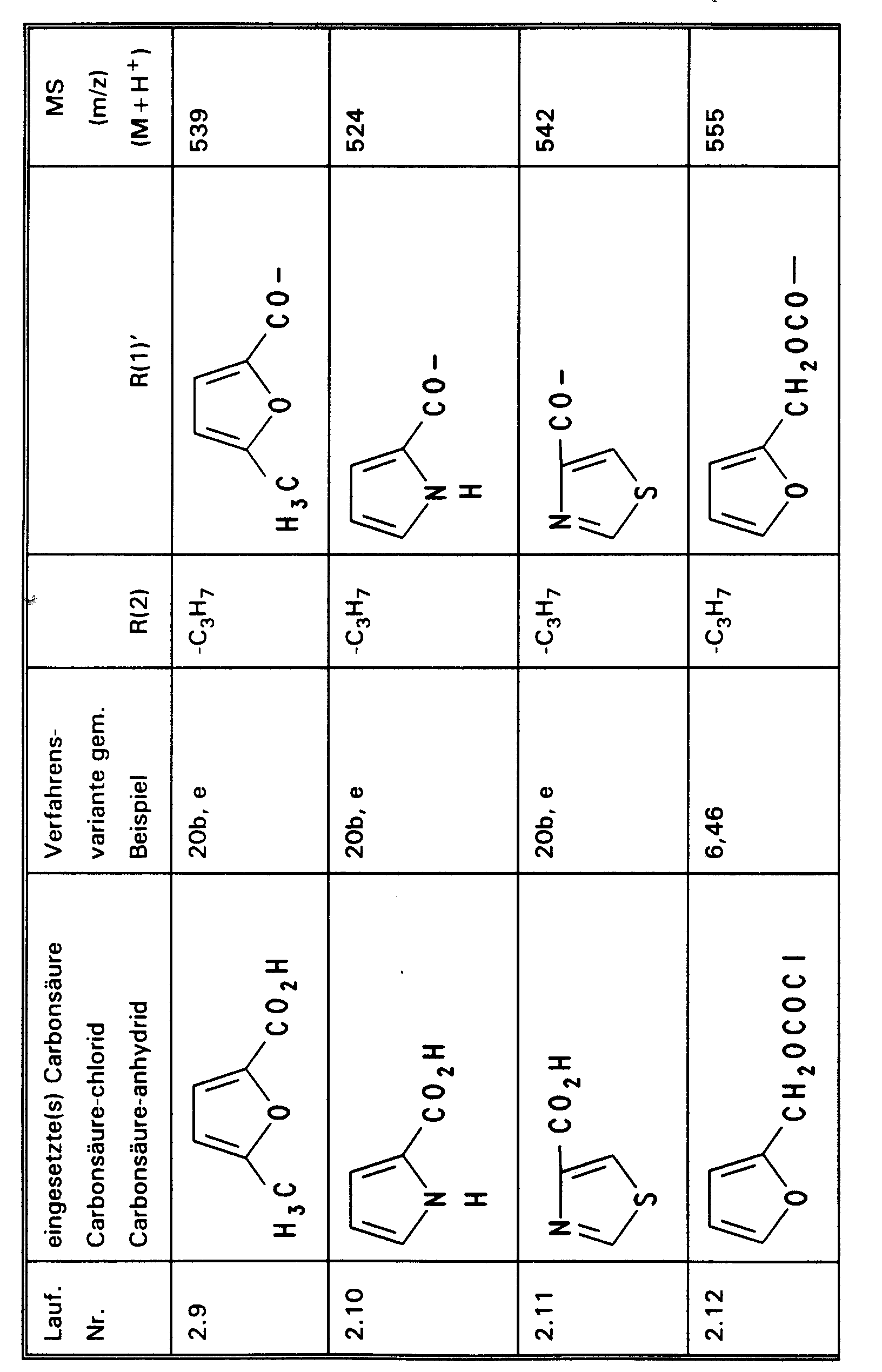


-

- R =
- (ein- oder mehrfach] substituiertes Alkoxy, Methylendioxy, Acylamino, Dialkylamino, Fluor, Chlor, Mercaptoalkyl, Phenoxy, Alkyl, Dialkylamino, Amino:
- substituierte Pyridincarbonsäuren` vorzugsweise 2-Mercaptomethyl-nicotinsäure; 2-Chlor-nicotinsäure, 2-Fluor-nicotinsäure; Methoxy-nicotinsäure; 6-Chlor-nicotinsäure; 6-Acetamido-nicotinsäure; Pyrazin-2-carbonsäure; 6,6'-Dithiodinicotinsäure; 2-Methylnicotinsäure; Thiophen-2- oder -3-carbonsäure; 5- oder 4-Methylthiophen-2- oder -3-carbonsäure; 5- oder 4-Chlorthiophen-2- oder 3-carbonsäure; Furan-2- oder -3-carbonsäure; 5-Chlor- und 5-Methyl-furan-2-carbonsäuren; 5-Nitro-furan-2-carbonsäure, Furan-2,5-dicarbonsäure; Pyrrol-2-carbonsäure; Imidazol-2-carbonsäure; 3-Isopropoxy-thiophen-5-carbonsäure; 5-Chlor-thiophen-2-carbonsäure;
-
- a.) nicht annelierte Säuren
Phenylessigsäure; 2-Methyl- oder 3-Methyl- oder 4-Methyl-phenylessigsäure, 4-(t-Butyl)-phenylessigsäure; 2-Chlor- oder 3-Chlor- oder 4-Chlor-phenylessigsäure; 2,6-Dichlor- oder 3,4-Dichlorphenylessigsäure; 2-Fluor- oder 3-Fluor- oder 4-Fluor-phenylessigsäure; 2,6-Difluor-phenylessigsäure; 2-Nitro- oder 3-Nitro- oder 4-Nitrophenylessigsäure; 2,4-Dinitro-phenylessigsäure; 2-Methoxy- oder 3-Methoxy- oder 4-Methoxy-phenylessigsäure; 4-Benzyloxy-phenylessigsäure; 3-Chlor-4-methoxy-phenylessigsäure; 3-Brom-4-methoxy-phenylessigsäure; 3-Nitro-4-methoxy-phenylessigsäure; 3,4-Dimethoxy-phenylessigsäure; 2,3,4-Trimethoxy-phenylessigsäure; 3,4-Methylendioxy-phenylessigsäure; 3,4-Diethoxy-phenylessigsäure; 4-Biphenyl-essigsäure; 3-Phenoxy-phenylessigsäure; 2-Acetamino- oder 3-Acetamino- oder 4-Acetamino-phenylessigsäure; 3-(N)-BOC-amino-phenylessigsäure; 4-Formylamino-phenylessigsäure; 4-N,N-Dimethylamino-phenylessigsäure;
4-Benzyloxy-phenylessigsäure; 4-(2-Methoxybenzyloxy)-phenylessigsäure; 4-(4-Fluorbenzyloxy)-phenylessigsäuren; 2-(Thiazol-4-yl)-essigsäure; 2-(Thiazol-4-yl)-2-methoxyiminoessigsäure; 3-Phenyl-propionsäure; D,L-2-Phenyl-propionsäure; 3-[4-Methyl-phenyl]-propionsäure, 3-[4-Chlor- oder 4-Fluor- oder 4-Methoxy-phenyl]-propionsäuren; (S)-(+)-2-Phenylpropionsäure; (R)-(-)-2-Phenylpropionsäure; 4-Phenyl-buttersäure; Phenoxyessigsäure und Derivate (Substituenten im Phenylanteil); cis- oder (bevorzugt] trans-Zimtsäure; 2-, 3- oder 4-Methoxy-zimtsäure; 4-Ethoxy-zimtsäure; 3,4-Dimethoxyzimtsäure; 3,4,5-Trimethoxyzimtsäure; 4-Fluor-zimtsäure; 3- oder 4-Chlor-zimtsäure; 3-Brom-zimtsäure; 2- oder 3-Nitro-zimtsäure; 4-Cyan-zimtsäure; 4-Isopropyl-zimtsäure; 4-(t-Butyl)-zimtsäure, 2- oder 4-Trifluormethyl-zimtsäure; D,L- oder (S)- oder (R)-2-(4-Isobutylphenyl)-propionsäure (Ibuprofen); 4-(Isobutylphenyl)-essigsäure (Ibufenac); Phenylmercaptoessigsäure; Phenylpropiolsäure; 2-Methyl-3-(4-tetradecyloxyphenyl)-2-propenoic acid (MTPA); 3-(4-Crotyloxyphenyl)propionsäure; 4-Dodecylbenzoyl-essigsäure (DBAA); Benzoylacrylsäure; Chlorambucil; 3,4,5-Trimethoxy-benzoylacrylsäure; 2-(4-(Thiazol-2-yl)phenyl)propionsäure; 2-(Xanthon-oxy)essigsäure; 2-Phenyl-cyclopropan-carbonsäuren (trans); 3-(Phenylmercapto)acrylsäure; (4-Phenyl)buttersäure;
2-Thienylessigsäure; 3-Thienylessigsäure; N-Methylpyrrol-2-carbonsäure; Furylessigsäure; 2-, 3- oder 4-Pyridyl-essigsäure;
3-(2-Furyl)acrylsäure; 3-(2-Thienyl)acrylsäure; 3-(3-Thienyl)acrylsäure; 3-(4- oder 2-Pyridyl)acrylsäure; 3-(2-Thienyl)propionsäuren; 3-(2-Furyl)propionsäure; 3-(4-Imidazolyl)acrylsäure; (N-Methylpyrrol-2-yl)-essigsäure; - b.) Annelierte Säuren
Indol-2-carbonsäure; Indol-3-carbonsäure; Indol-4-carbonsäure; (N-Methyl)-indol-2-carbonsäure; 2- oder 1-Naphthalin-carbonsäure; 2- oder 3- oder 4-Chinolincarbonsäure; Xanthen-α-carbonsäure; 1-Fluorencarbonsäure; 9-Fluorenon-4-carbonsäure;
3-Indolyl-essigsäure; 2-Indolyl-essigsäure; (N-Methyl)-2- oder -3-indolyl-essigsäure; 3-(3-Indolyl)-propionsäure; 3- oder 2-Indolyl-acrylsäure (auch (N-Methyl)); (2-Methyl-3-indolyl)-essigsäure, 3,4-(Methylendioxy)-phenylessigsäure; 3,4-(Methylendioxy)-zimtsäure; Indol-3-buttersäure; (5-Methoxyindol-3-yl)essigsäure; Naphthyl-1- oder -2-essigsäure; Pyrazin-2-carbonsäure; Flavon-8-essigsäure und 5,6-Dimethylxanthon-4-essigsäure (die hieraus hergestellten Corticoid-21-carbonsäureester könnten auch antitumorale Wirkung zeigen L. L. Thomsen et al.: Cancer Chemother, Pharmacol. 31, 151ff. (1992). -
(+) oder (-)- Chlorameisensäure-phenylester Chlorameisensäure-benzylester Chlorameisensäure-4-bromphenylester Chlorameisensäure-(α-chlor-2-fluorbenzylester) Chlorameisensäure-4-chlorphenylester Chlorameisensäure-[1-(9-fluorenyl)ethylester Chlorameisensäure-(9-fluroenylmethyl)ester Chlorameisensäure-4-fluorphenylester Chlorameisensäure-4-methoxyphenylester Chlorameisensäure-2-Nitrophenylester Chlorameisensäure-p-tolylester
Mono- oder Bis-chlorameisensäureester von 1.): 2,5-Bis-(hydroxymethyl)-furan von 2.): 2,6-Bis-(hydroxymethyl)pyridin Chlorameisensäureester von 2-Hydroxymethylfuran
O{-OC-[(C₁-C₄)-Alkyl]m-R(1)}₂ V,
in der bedeuten:
als Öl oder Wachs amorph oder kristallisiert erhalten.
2-, 3- oder 4-Methoxy-benzoesäure; 2-, 3- oder 4-Chlor-benzoesäure; Fluor-benzoesäure; 2,4-, 3,4- oder 2,6-Difluor- oder dichlor-benzoesäure; 2-, 3- oder 4-Methyl-benzoesäure; 3,5-Dimethylbenzoesäure; 3- oder 4-Trifluorbenzoesäure; 4-Acetaminobenzoesäure, 4-Acetaminomethyl-benzoesäure, 4-(t-Butoxy)-benzoesäure; 4-t-Butyl-benzoesäure; 3,4-Methylendioxy-benzoesäure; 2,3-, 3,5- oder 2,6-Dimethoxybenzoesäure; 2,3,4-Trimethoxybenzoesäure; 4-BOC-amino-benzoesäure; 4-Mercaptomethyl-benzoesäure; 4-Phenoxy-benzoesäure; 4-Amino-benzoesäure (PABA), 4-(Dimethylamino)-benzoesäure;
Claims (6)
- Corticoid-17,21-dicarbonsäureester sowie Corticoid-17-carbonsäureester-21-kohlensäureester der Formel I
 A CHOH und CHCl in beliebiger sterischer Anordnung, CH₂, C=O, 9(11)-DoppelbindungY Wasserstoff, Fluor, ChlorZ Wasserstoff, Fluor, MethylR(1) gegebenenfalls substituiertes oder annelliertes Aryl, Hetaryl, (C₁-C₄)-Alkyl
gesättigt, einfach oder mehrfach ungesättigt, durch weitere Alkylgruppen verzweigt, unsubstituiert oder durch Heteroatome O, S, N insertiert oder substituiert,n Null oder 1,m Null oder 1,R(2) lineares oder verzweigtes (C₁-C₈)-Alkyl, R(3) Wasserstoff, α- oder β-Methyl.
 - Corticoid-17,21-dicarbonsäureester sowie Corticoid-17-carbonsäureester-21-kohlensäureester I nach Anspruch 1, dadurch gekennzeichnet, daß R(1), A, Y ,Z, R(3) und R(4) wie in Anspruch 1 definiert sind und daß R(2) lineares oder verzweigtes (C₁-C₈)-Alkyl,

- Verfahren zum Herstellen einer Verbindung I nach Anspruch 1, dadurch gekennzeichnet, daß mana) eine Verbindung der Formel II,
 a 1) mit einer aktivierten Carbonsäure der Formel III, vorzugsweise einem Halogenid oder Anhydrid oder Azolid,
R(6)-CO-(O)n-[(C₁-C₄)-Alkyl]m-R(1) III
umsetzt, wobei bedeuten:n Null,m Null oder 1, und
[(C₁-C₄)-Alkyl] und R(1) die oben angegebenen Bedeutungen haben undR(6) Cl, Br, O[-CO-(O)n-[(C₁-C₄)-Alkyl]m-R(1)]₁-, -O-C(O)-CF₃ oder ein anderes aktiviertes Säureradikal, odera 2) mit einem Halogenformat der Formel III,
in dern 1,m Null oder 1,
[(C₁-C₄)-Alkyl] und R(1) die oben angegebenen Bedeutungen haben und R(6) Cl, Br, J bedeuten, odera 3) mit einer Carbonsäure der Formel III selbst, in derR(6) OH undn Null sind,in Gegenwart Wasser abspaltender Reagentien (DCCI etc.) umsetzt
und die weiteren Substituenten bei Formel III angegeben sind,
oder daß manb) Verbindungen der Formel II,
R(6)-CO-(O)n-[(C₁-C₄)-Alkyl]m-R(1) III
in derR(6) -[O⁻Me⁺] undn Null bedeuten,
und die weiteren Substituenten die bei Formel III angegebenen Bedeutungen haben,
umsetzt,
wobei Me vorzugsweise das Kation eines Alkalisalzes oder eines
Trialkylammoniumsalzes ist. - Medikament, gekennzeichnet durch einen wirksamen Gehalt einer Verbindung I nach Anspruch 1.
- Verfahren zum Behandeln von Dermatosen, dadurch gekennzeichnet, daß man eine wirksame Menge einer Verbindung I nach Anspruch 1, kombiniert mit pharmazeutisch üblichen Zusatzstoffen, auf die befallene Hautstelle aufbringt.
- Verwendung einer Verbindung I nach Anspruch 1 zum Herstellen eines Medikaments zur Behandlung von Dermatosen.
Applications Claiming Priority (2)
| Application Number | Priority Date | Filing Date | Title |
|---|---|---|---|
| DE4333920 | 1993-10-05 | ||
| DE4333920A DE4333920A1 (de) | 1993-10-05 | 1993-10-05 | Corticoid-17,21-dicarbonsäureester sowie Corticosteroid-17-carbonsäureester-21-kohlensäureester, Verfahren zu deren Herstellung und diese enthaltende Arzneimittel |
Publications (2)
| Publication Number | Publication Date |
|---|---|
| EP0646593A1 true EP0646593A1 (de) | 1995-04-05 |
| EP0646593B1 EP0646593B1 (de) | 2001-12-05 |
Family
ID=6499450
Family Applications (1)
| Application Number | Title | Priority Date | Filing Date |
|---|---|---|---|
| EP94115348A Expired - Lifetime EP0646593B1 (de) | 1993-10-05 | 1994-09-29 | Corticoid-17,21-dicarbonsäureester sowie Verfahren zu deren Herstellung und diese enthaltende Arzneimittel |
Country Status (19)
| Country | Link |
|---|---|
| US (1) | US6835724B2 (de) |
| EP (1) | EP0646593B1 (de) |
| JP (1) | JP3549125B2 (de) |
| KR (1) | KR950011463A (de) |
| CN (1) | CN1051316C (de) |
| AT (1) | ATE210143T1 (de) |
| AU (1) | AU679551B2 (de) |
| CA (1) | CA2133607C (de) |
| DE (2) | DE4333920A1 (de) |
| DK (1) | DK0646593T3 (de) |
| EC (1) | ECSP941054A (de) |
| ES (1) | ES2168283T3 (de) |
| FI (1) | FI114158B (de) |
| HU (1) | HU219401B (de) |
| IL (1) | IL111132A (de) |
| NO (1) | NO305483B1 (de) |
| PT (1) | PT646593E (de) |
| TW (1) | TW283709B (de) |
| ZA (1) | ZA947739B (de) |
Cited By (12)
| Publication number | Priority date | Publication date | Assignee | Title |
|---|---|---|---|---|
| US6750210B2 (en) | 2000-08-05 | 2004-06-15 | Smithkline Beecham Corporation | Formulation containing novel anti-inflammatory androstane derivative |
| US6759398B2 (en) | 2000-08-05 | 2004-07-06 | Smithkline Beecham Corporation | Anti-inflammatory androstane derivative |
| US6777400B2 (en) | 2000-08-05 | 2004-08-17 | Smithkline Beecham Corporation | Anti-inflammatory androstane derivative compositions |
| US6777399B2 (en) | 2000-08-05 | 2004-08-17 | Smithkline Beecham Corporation | Anti-inflammatory androstane derivative compositions |
| US6787532B2 (en) | 2000-08-05 | 2004-09-07 | Smithkline Beecham Corporation | Formulation containing anti-inflammatory androstane derivatives |
| US6858593B2 (en) | 2000-08-05 | 2005-02-22 | Smithkline Beecham Corporation | Anti-inflammatory androstane derivative compositions |
| US6858596B2 (en) | 2000-08-05 | 2005-02-22 | Smithkline Beecham Corporation | Formulation containing anti-inflammatory androstane derivative |
| US6878698B2 (en) | 2001-04-07 | 2005-04-12 | Glaxo Group Limited | Anti-inflammatory androstane derivatives |
| US7125985B2 (en) | 2000-08-05 | 2006-10-24 | Glaxo Group Limited | Compounds useful in the manufacture of an anti-inflammatory androstane derivative |
| US7291608B2 (en) | 2001-04-30 | 2007-11-06 | Glaxo Group Limited | Anti-inflammatory 17.β.-carbothioate ester derivatives of androstane with a cyclic ester group in position 17.α |
| US7498321B2 (en) | 2000-08-05 | 2009-03-03 | Glaxo Group Limited | 17β-carbothioate 17α-arylcarbonyloxyloxy androstane derivative as anti-inflammatory agents |
| WO2010136940A1 (en) * | 2009-05-29 | 2010-12-02 | Pfizer Limited | Novel glucocorticoid receptor agonists |
Families Citing this family (8)
| Publication number | Priority date | Publication date | Assignee | Title |
|---|---|---|---|---|
| ATE399174T1 (de) * | 2001-06-12 | 2008-07-15 | Glaxo Group Ltd | Neue anti inflammatorische 17.alpha.- heterozyklische ester von 17.beta.-carbothioat androstan derivativen |
| US20050175545A1 (en) * | 2002-02-04 | 2005-08-11 | Keith Biggadike | Formulation for inhalation comprising a glucocorticoid and a beta 2-adrenoreceptor agonist |
| GB0202635D0 (en) * | 2002-02-05 | 2002-03-20 | Glaxo Wellcome Mfg Pte Ltd | Formulation containing novel anti-inflammatory androstane derivative |
| KR100472303B1 (ko) * | 2002-05-21 | 2005-03-08 | 김영미 | 결장표적성 프로드럭으로서의 코티코스테로이드21-설페이트 소듐 유도체 |
| GB2389530B (en) * | 2002-06-14 | 2007-01-10 | Cipla Ltd | Pharmaceutical compositions |
| GB0507165D0 (en) * | 2005-04-08 | 2005-05-18 | Glaxo Group Ltd | Novel crystalline pharmaceutical product |
| GB0615108D0 (en) * | 2006-07-28 | 2006-09-06 | Glaxo Group Ltd | Novel formulations |
| CN113092601B (zh) * | 2021-03-02 | 2022-12-20 | 苏州市药品检验检测研究中心 | 一种化妆品中倍他米松17-丙酸酯及倍他米松21-丙酸酯的检测方法 |
Citations (3)
| Publication number | Priority date | Publication date | Assignee | Title |
|---|---|---|---|---|
| EP0000742A1 (de) * | 1977-08-04 | 1979-02-21 | Hoechst Aktiengesellschaft | Corticoid-17-Alkylcarbonate und Verfahren zu deren Herstellung und diese enthaltende Mittel |
| EP0072200A2 (de) * | 1981-08-04 | 1983-02-16 | Plurichemie Anstalt | Steroidesters und Verfahren zur Herstellung von Steroidesters |
| EP0156643A2 (de) * | 1984-03-28 | 1985-10-02 | The Upjohn Company | Steroide Estern als Wirkstoffvorläufer |
Family Cites Families (14)
| Publication number | Priority date | Publication date | Assignee | Title |
|---|---|---|---|---|
| US3133940A (en) * | 1956-04-10 | 1964-05-19 | Glaxo Group Ltd | Process for the separation of delta-1, 4-3-keto steroid compounds from mixtures thereof with other 3-keto steroids |
| US3201429A (en) * | 1958-07-12 | 1965-08-17 | Syntex Corp | 17, 21-diesters of 6alpha, 16alpha-dimethyl-delta4-pregnen-17alpha-21-diol-3, 20-dione and process therefor |
| US3201391A (en) * | 1959-02-18 | 1965-08-17 | Syntex Corp | 6alpha, 9alpha, 11beta-trichloro and 6alpha-fluoro-9alpha, 11beta-dichloro pregnenes |
| DE2204366A1 (de) | 1972-01-27 | 1973-08-02 | Dermal Lab Ltd | Steroid-abkoemmlinge |
| GB1516095A (en) | 1974-07-31 | 1978-06-28 | Glaxo Lab Ltd | 17,21-diesters of 17alpha,21-dihydroxy-steroids of the pregnane series |
| DE2645104C2 (de) | 1976-10-04 | 1986-04-24 | Schering AG, 1000 Berlin und 4709 Bergkamen | 11β-Hydroxy-1,4,8-pregnatrien-3,20-dion-Derivate und Verfahren zu ihrer Herstellung |
| DE2817988A1 (de) | 1978-04-25 | 1979-11-08 | Hoechst Ag | Corticoid 17-alkylcarbonate und verfahren zu deren herstellung |
| EP0095894A3 (de) * | 1982-05-31 | 1985-01-02 | Ohta Seiyaku Kabushiki Kaisha. | 6-Alpha Methyl Prednisolon Derivate |
| DE3225848A1 (de) * | 1982-07-07 | 1984-01-19 | Schering AG, 1000 Berlin und 4709 Bergkamen | Kortikoidhaltige zubereitung zur topischen applikation |
| DE3227312A1 (de) * | 1982-07-19 | 1984-01-19 | Schering AG, 1000 Berlin und 4709 Bergkamen | Neue 6,16-dimethylkortikoide, ihre herstellung und verwendung |
| DE3243482A1 (de) * | 1982-11-22 | 1984-05-24 | Schering AG, 1000 Berlin und 4709 Bergkamen | Neue 6(alpha)-methylkortikoide, ihre herstellung und verwendung |
| DE3400188A1 (de) * | 1984-01-02 | 1985-07-11 | Schering AG, Berlin und Bergkamen, 1000 Berlin | Neue 6(alpha),16(alpha)-dimethylkortikoide |
| PT78973A (en) * | 1984-07-25 | 1984-08-01 | Joao Emerico Villax | New preparation process of the 9alpha-fluoro 17,21-acylates or hidroxilades in 17 and 21 chloro-corticosteroid |
| DE4025342A1 (de) | 1990-08-10 | 1992-02-13 | Hoechst Ag | In 17-stellung substituierte corticoid-17-alkylcarbonate, verfahren zu deren herstellung und diese enthaltende arzneimittel |
-
1993
- 1993-10-05 DE DE4333920A patent/DE4333920A1/de not_active Withdrawn
-
1994
- 1994-03-16 EC EC1994001054A patent/ECSP941054A/es unknown
- 1994-04-01 TW TW083102857A patent/TW283709B/zh active
- 1994-09-29 EP EP94115348A patent/EP0646593B1/de not_active Expired - Lifetime
- 1994-09-29 DE DE59409991T patent/DE59409991D1/de not_active Expired - Lifetime
- 1994-09-29 PT PT94115348T patent/PT646593E/pt unknown
- 1994-09-29 AT AT94115348T patent/ATE210143T1/de active
- 1994-09-29 DK DK94115348T patent/DK0646593T3/da active
- 1994-09-29 ES ES94115348T patent/ES2168283T3/es not_active Expired - Lifetime
- 1994-09-30 CN CN94116479A patent/CN1051316C/zh not_active Expired - Fee Related
- 1994-10-03 HU HU9402831A patent/HU219401B/hu not_active IP Right Cessation
- 1994-10-03 IL IL11113294A patent/IL111132A/xx not_active IP Right Cessation
- 1994-10-03 FI FI944599A patent/FI114158B/fi not_active IP Right Cessation
- 1994-10-03 AU AU74395/94A patent/AU679551B2/en not_active Expired
- 1994-10-04 KR KR1019940025282A patent/KR950011463A/ko not_active Ceased
- 1994-10-04 NO NO943701A patent/NO305483B1/no not_active IP Right Cessation
- 1994-10-04 CA CA002133607A patent/CA2133607C/en not_active Expired - Lifetime
- 1994-10-04 JP JP26323494A patent/JP3549125B2/ja not_active Expired - Lifetime
- 1994-10-04 ZA ZA947739A patent/ZA947739B/xx unknown
-
1997
- 1997-07-22 US US08/897,455 patent/US6835724B2/en not_active Expired - Fee Related
Patent Citations (3)
| Publication number | Priority date | Publication date | Assignee | Title |
|---|---|---|---|---|
| EP0000742A1 (de) * | 1977-08-04 | 1979-02-21 | Hoechst Aktiengesellschaft | Corticoid-17-Alkylcarbonate und Verfahren zu deren Herstellung und diese enthaltende Mittel |
| EP0072200A2 (de) * | 1981-08-04 | 1983-02-16 | Plurichemie Anstalt | Steroidesters und Verfahren zur Herstellung von Steroidesters |
| EP0156643A2 (de) * | 1984-03-28 | 1985-10-02 | The Upjohn Company | Steroide Estern als Wirkstoffvorläufer |
Non-Patent Citations (1)
| Title |
|---|
| M. ISOGAI ET AL: "Binding affinities of mometasone furoate and related compounds including its metabolites for the glucocorticoid receptor of rat skin tissue.", THE JOURNAL OF STEROID BIOCHEMISTRY AND MOLECULAR BIOLOGY, vol. 44, no. 2, February 1993 (1993-02-01), OXFORD, GB, pages 141 - 145, XP025697221, DOI: doi:10.1016/0960-0760(93)90021-N * |
Cited By (18)
| Publication number | Priority date | Publication date | Assignee | Title |
|---|---|---|---|---|
| US7125985B2 (en) | 2000-08-05 | 2006-10-24 | Glaxo Group Limited | Compounds useful in the manufacture of an anti-inflammatory androstane derivative |
| US7144845B2 (en) | 2000-08-05 | 2006-12-05 | Glaxo Group Limited | Compounds useful in the manufacture of an anti-inflammatory androstane derivative |
| US6777400B2 (en) | 2000-08-05 | 2004-08-17 | Smithkline Beecham Corporation | Anti-inflammatory androstane derivative compositions |
| US6777399B2 (en) | 2000-08-05 | 2004-08-17 | Smithkline Beecham Corporation | Anti-inflammatory androstane derivative compositions |
| US6787532B2 (en) | 2000-08-05 | 2004-09-07 | Smithkline Beecham Corporation | Formulation containing anti-inflammatory androstane derivatives |
| US6858593B2 (en) | 2000-08-05 | 2005-02-22 | Smithkline Beecham Corporation | Anti-inflammatory androstane derivative compositions |
| US6858596B2 (en) | 2000-08-05 | 2005-02-22 | Smithkline Beecham Corporation | Formulation containing anti-inflammatory androstane derivative |
| US7629335B2 (en) | 2000-08-05 | 2009-12-08 | Glaxo Group Limited | Anti-inflammatory androstane derivative |
| US6759398B2 (en) | 2000-08-05 | 2004-07-06 | Smithkline Beecham Corporation | Anti-inflammatory androstane derivative |
| US6750210B2 (en) | 2000-08-05 | 2004-06-15 | Smithkline Beecham Corporation | Formulation containing novel anti-inflammatory androstane derivative |
| US7132532B2 (en) | 2000-08-05 | 2006-11-07 | Glaxo Group Limited | Compounds useful in the manufacture of an anti-inflammatory androstane derivative |
| US7541350B2 (en) | 2000-08-05 | 2009-06-02 | Glaxo Group Limited | Formulation containing anti-inflammatory androstane derivative |
| US7498321B2 (en) | 2000-08-05 | 2009-03-03 | Glaxo Group Limited | 17β-carbothioate 17α-arylcarbonyloxyloxy androstane derivative as anti-inflammatory agents |
| US7531528B2 (en) | 2000-08-05 | 2009-05-12 | Glaxo Group Limited | Formulation containing anti-inflammatory androstane derivatives |
| US6878698B2 (en) | 2001-04-07 | 2005-04-12 | Glaxo Group Limited | Anti-inflammatory androstane derivatives |
| US7291608B2 (en) | 2001-04-30 | 2007-11-06 | Glaxo Group Limited | Anti-inflammatory 17.β.-carbothioate ester derivatives of androstane with a cyclic ester group in position 17.α |
| WO2010136940A1 (en) * | 2009-05-29 | 2010-12-02 | Pfizer Limited | Novel glucocorticoid receptor agonists |
| CN102448978A (zh) * | 2009-05-29 | 2012-05-09 | 辉瑞有限公司 | 新颖的糖皮质激素受体激动剂 |
Also Published As
| Publication number | Publication date |
|---|---|
| CN1051316C (zh) | 2000-04-12 |
| EP0646593B1 (de) | 2001-12-05 |
| TW283709B (de) | 1996-08-21 |
| IL111132A0 (en) | 1994-12-29 |
| KR950011463A (ko) | 1995-05-15 |
| HU219401B (hu) | 2001-04-28 |
| US6835724B2 (en) | 2004-12-28 |
| ECSP941054A (es) | 1995-02-27 |
| AU679551B2 (en) | 1997-07-03 |
| ZA947739B (en) | 1995-05-18 |
| AU7439594A (en) | 1995-04-27 |
| DE59409991D1 (de) | 2002-01-17 |
| PT646593E (pt) | 2002-05-31 |
| JP3549125B2 (ja) | 2004-08-04 |
| NO943701D0 (no) | 1994-10-04 |
| FI944599L (fi) | 1995-04-06 |
| CN1108661A (zh) | 1995-09-20 |
| ATE210143T1 (de) | 2001-12-15 |
| ES2168283T3 (es) | 2002-06-16 |
| FI114158B (fi) | 2004-08-31 |
| JPH07165788A (ja) | 1995-06-27 |
| CA2133607A1 (en) | 1995-04-06 |
| IL111132A (en) | 2000-10-31 |
| NO943701L (no) | 1995-04-06 |
| NO305483B1 (no) | 1999-06-07 |
| CA2133607C (en) | 2007-07-03 |
| HU9402831D0 (en) | 1995-01-30 |
| DK0646593T3 (da) | 2002-03-18 |
| US20020103392A1 (en) | 2002-08-01 |
| DE4333920A1 (de) | 1995-04-13 |
| FI944599A0 (fi) | 1994-10-03 |
| HUT68577A (en) | 1995-06-28 |
Similar Documents
| Publication | Publication Date | Title |
|---|---|---|
| EP0640616B1 (de) | Corticosteroid-17-alkylcarbonat-21-(O)-Carbonsäure- und Kohlensäureester, Verfahren zu deren Herstellung und diese enthaltende Arzneimittel | |
| EP0646593B1 (de) | Corticoid-17,21-dicarbonsäureester sowie Verfahren zu deren Herstellung und diese enthaltende Arzneimittel | |
| EP0000742B1 (de) | Corticoid-17-Alkylcarbonate und Verfahren zu deren Herstellung und diese enthaltende Mittel | |
| EP0004975B1 (de) | Corticoid-17-Alkylcarbonate, Verfahren zu deren Herstellung sowie deren Verwendung als Arzneimittel gegen Dermatosen | |
| DE60013266T2 (de) | Steroidnitrate zur behandlung von oxidativen schädigungen und endothelialer dysfunktion | |
| DE4025342A1 (de) | In 17-stellung substituierte corticoid-17-alkylcarbonate, verfahren zu deren herstellung und diese enthaltende arzneimittel | |
| DE68913778T2 (de) | 11 beta, 17 alpha, 21-Trihydroxy-1,4-pregnadien-3,20-dion 21-[(E,E)-3,7,11-trimethyl-2,6,10-dodecatriensäure ester]. | |
| DE2643936A1 (de) | Arzneimittel mit erythropoietischer wirksamkeit | |
| DE2607418A1 (de) | Terpenoidester von steroiden, verfahren zu ihrer herstellung und sie enthaltende praeparate | |
| EP0708111B1 (de) | 17-Desoxi-corticosteroid-21-[O]-Carbonsäureester, Verfahren zu deren Herstellung und diese enthaltende Arzneimittel | |
| DE3881657T2 (de) | 21-alkoxy-steroid-derivate. | |
| EP0011121B1 (de) | Hydrocortisonester, diese enthaltende pharmazeutische Zubereitungen und Verfahren zu ihrer Herstellung | |
| DE3105307C2 (de) | ||
| EP0023713B1 (de) | Neue Derivate des 9-Chlorprednisolons, ihre Herstellung und Verwendung | |
| EP0012271A1 (de) | Neue Prednison-Derivate, Verfahren zu ihrer Herstellung, diese Verbindungen enthaltende pharmazeutische Präparate und deren Verwendung | |
| DE1175669B (de) | Verfahren zur Herstellung von 16(17)-Dehydro-20-oxo-steroiden |
Legal Events
| Date | Code | Title | Description |
|---|---|---|---|
| PUAI | Public reference made under article 153(3) epc to a published international application that has entered the european phase |
Free format text: ORIGINAL CODE: 0009012 |
|
| AK | Designated contracting states |
Kind code of ref document: A1 Designated state(s): AT BE CH DE DK ES FR GB GR IE IT LI LU NL PT SE |
|
| 17P | Request for examination filed |
Effective date: 19951005 |
|
| 17Q | First examination report despatched |
Effective date: 19990217 |
|
| RTI1 | Title (correction) |
Free format text: CORTICOID-17,21-DICARBOXYLIC ACID ESTER, PROCESS FOR THEIR PRODUCTION AND MEDICAMENTS CONTAINING THEM |
|
| GRAG | Despatch of communication of intention to grant |
Free format text: ORIGINAL CODE: EPIDOS AGRA |
|
| GRAG | Despatch of communication of intention to grant |
Free format text: ORIGINAL CODE: EPIDOS AGRA |
|
| GRAH | Despatch of communication of intention to grant a patent |
Free format text: ORIGINAL CODE: EPIDOS IGRA |
|
| GRAH | Despatch of communication of intention to grant a patent |
Free format text: ORIGINAL CODE: EPIDOS IGRA |
|
| GRAA | (expected) grant |
Free format text: ORIGINAL CODE: 0009210 |
|
| AK | Designated contracting states |
Kind code of ref document: B1 Designated state(s): AT BE CH DE DK ES FR GB GR IE IT LI LU NL PT SE |
|
| REF | Corresponds to: |
Ref document number: 210143 Country of ref document: AT Date of ref document: 20011215 Kind code of ref document: T |
|
| REG | Reference to a national code |
Ref country code: CH Ref legal event code: EP |
|
| REG | Reference to a national code |
Ref country code: GB Ref legal event code: IF02 |
|
| REG | Reference to a national code |
Ref country code: IE Ref legal event code: FG4D Free format text: GERMAN |
|
| REF | Corresponds to: |
Ref document number: 59409991 Country of ref document: DE Date of ref document: 20020117 |
|
| REG | Reference to a national code |
Ref country code: DK Ref legal event code: T3 |
|
| GBT | Gb: translation of ep patent filed (gb section 77(6)(a)/1977) |
Effective date: 20020221 |
|
| ET | Fr: translation filed | ||
| REG | Reference to a national code |
Ref country code: PT Ref legal event code: SC4A Free format text: AVAILABILITY OF NATIONAL TRANSLATION Effective date: 20020208 |
|
| REG | Reference to a national code |
Ref country code: ES Ref legal event code: FG2A Ref document number: 2168283 Country of ref document: ES Kind code of ref document: T3 |
|
| REG | Reference to a national code |
Ref country code: GR Ref legal event code: EP Ref document number: 20020400786 Country of ref document: GR |
|
| PLBE | No opposition filed within time limit |
Free format text: ORIGINAL CODE: 0009261 |
|
| STAA | Information on the status of an ep patent application or granted ep patent |
Free format text: STATUS: NO OPPOSITION FILED WITHIN TIME LIMIT |
|
| 26N | No opposition filed | ||
| PGFP | Annual fee paid to national office [announced via postgrant information from national office to epo] |
Ref country code: GR Payment date: 20130813 Year of fee payment: 20 Ref country code: CH Payment date: 20130912 Year of fee payment: 20 Ref country code: IE Payment date: 20130910 Year of fee payment: 20 Ref country code: NL Payment date: 20130910 Year of fee payment: 20 Ref country code: SE Payment date: 20130911 Year of fee payment: 20 Ref country code: AT Payment date: 20130828 Year of fee payment: 20 Ref country code: DK Payment date: 20130910 Year of fee payment: 20 Ref country code: ES Payment date: 20130813 Year of fee payment: 20 Ref country code: PT Payment date: 20130401 Year of fee payment: 20 Ref country code: DE Payment date: 20130925 Year of fee payment: 20 |
|
| PGFP | Annual fee paid to national office [announced via postgrant information from national office to epo] |
Ref country code: FR Payment date: 20130910 Year of fee payment: 20 Ref country code: GB Payment date: 20130925 Year of fee payment: 20 |
|
| PGFP | Annual fee paid to national office [announced via postgrant information from national office to epo] |
Ref country code: IT Payment date: 20130912 Year of fee payment: 20 |
|
| PGFP | Annual fee paid to national office [announced via postgrant information from national office to epo] |
Ref country code: BE Payment date: 20130912 Year of fee payment: 20 Ref country code: LU Payment date: 20131007 Year of fee payment: 20 |
|
| REG | Reference to a national code |
Ref country code: DE Ref legal event code: R071 Ref document number: 59409991 Country of ref document: DE |
|
| REG | Reference to a national code |
Ref country code: DK Ref legal event code: EUP Effective date: 20140929 |
|
| REG | Reference to a national code |
Ref country code: PT Ref legal event code: MM4A Free format text: MAXIMUM VALIDITY LIMIT REACHED Effective date: 20140929 |
|
| REG | Reference to a national code |
Ref country code: NL Ref legal event code: V4 Effective date: 20140929 |
|
| REG | Reference to a national code |
Ref country code: CH Ref legal event code: PL |
|
| REG | Reference to a national code |
Ref country code: GB Ref legal event code: PE20 Expiry date: 20140928 |
|
| PG25 | Lapsed in a contracting state [announced via postgrant information from national office to epo] |
Ref country code: DE Free format text: LAPSE BECAUSE OF EXPIRATION OF PROTECTION Effective date: 20140930 |
|
| REG | Reference to a national code |
Ref country code: SE Ref legal event code: EUG |
|
| REG | Reference to a national code |
Ref country code: IE Ref legal event code: MK9A |
|
| REG | Reference to a national code |
Ref country code: AT Ref legal event code: MK07 Ref document number: 210143 Country of ref document: AT Kind code of ref document: T Effective date: 20140929 |
|
| REG | Reference to a national code |
Ref country code: GR Ref legal event code: MA Ref document number: 20020400786 Country of ref document: GR Effective date: 20140930 |
|
| PG25 | Lapsed in a contracting state [announced via postgrant information from national office to epo] |
Ref country code: GB Free format text: LAPSE BECAUSE OF EXPIRATION OF PROTECTION Effective date: 20140928 |
|
| REG | Reference to a national code |
Ref country code: ES Ref legal event code: FD2A Effective date: 20150107 |
|
| PG25 | Lapsed in a contracting state [announced via postgrant information from national office to epo] |
Ref country code: PT Free format text: LAPSE BECAUSE OF EXPIRATION OF PROTECTION Effective date: 20141007 Ref country code: ES Free format text: LAPSE BECAUSE OF EXPIRATION OF PROTECTION Effective date: 20140930 Ref country code: IE Free format text: LAPSE BECAUSE OF EXPIRATION OF PROTECTION Effective date: 20140929 |