EP0646825A1 - Lentille de contact - Google Patents
Lentille de contact Download PDFInfo
- Publication number
- EP0646825A1 EP0646825A1 EP93116083A EP93116083A EP0646825A1 EP 0646825 A1 EP0646825 A1 EP 0646825A1 EP 93116083 A EP93116083 A EP 93116083A EP 93116083 A EP93116083 A EP 93116083A EP 0646825 A1 EP0646825 A1 EP 0646825A1
- Authority
- EP
- European Patent Office
- Prior art keywords
- lens
- contact lens
- toric
- slab
- prism
- Prior art date
- Legal status (The legal status is an assumption and is not a legal conclusion. Google has not performed a legal analysis and makes no representation as to the accuracy of the status listed.)
- Granted
Links
Images


Classifications
-
- G—PHYSICS
- G02—OPTICS
- G02C—SPECTACLES; SUNGLASSES OR GOGGLES INSOFAR AS THEY HAVE THE SAME FEATURES AS SPECTACLES; CONTACT LENSES
- G02C7/00—Optical parts
- G02C7/02—Lenses; Lens systems ; Methods of designing lenses
- G02C7/04—Contact lenses for the eyes
-
- G—PHYSICS
- G02—OPTICS
- G02C—SPECTACLES; SUNGLASSES OR GOGGLES INSOFAR AS THEY HAVE THE SAME FEATURES AS SPECTACLES; CONTACT LENSES
- G02C7/00—Optical parts
- G02C7/02—Lenses; Lens systems ; Methods of designing lenses
- G02C7/04—Contact lenses for the eyes
- G02C7/041—Contact lenses for the eyes bifocal; multifocal
-
- G—PHYSICS
- G02—OPTICS
- G02C—SPECTACLES; SUNGLASSES OR GOGGLES INSOFAR AS THEY HAVE THE SAME FEATURES AS SPECTACLES; CONTACT LENSES
- G02C7/00—Optical parts
- G02C7/02—Lenses; Lens systems ; Methods of designing lenses
- G02C7/04—Contact lenses for the eyes
- G02C7/048—Means for stabilising the orientation of lenses in the eye
Definitions
- the present invention relates to a contact lens for correcting astigmatism or presbyopia. More particularly, it relates to a toric contact lens or a multifocal (bifocal) contact lens capable of preventing the rotation of it on the eye during use.
- the astigmatism is a state that parallel beams do not form an image at a point and the presbyopia is a state that a man becomes inability to attain a sharp focus for near vision due to the reduction of elasticity of the crystalline lens.
- glasses or a contact lens is usually used.
- a contact lens to correct the astigmatism there is known a toric contact lens wherein the radius of curvature of the inner (back) and/or the outer (front) surfaces is different from each other in terms of two orthogonally intersecting meridians.
- a multifocal (bifocal) contact lens wherein a plurality of areas of the degree of lens power are formed at the inner (back) and/or outer (front) surfaces in order to see near and distant objects.
- multifocal contact lens there are various kinds of multifocal contact lens to be worn by patients of presbyopia, some kinds of multifocal contact lens have to be worn at a fixed position to human eyes in the same manner as the toric contact lens.
- the multifocal contact lens of the above-mentioned kind is such that the areas of the different degrees of lens power formed in the contact lens are not at the positions of rotation symmetry when the lens is viewed from the front side.
- a frame holding lenses is fitted to the ears or the nose. Accordingly, the correct position of the lenses can be assured.
- a toric contact lens or a certain kind of multifocal contact lens there is no means to fix the lenses, and accordingly, the contact lenses tend to rotate on the eye, whereby it may not obtain proper correction.
- the toric contact lens or the multifocal contact lens there have been proposed various improvements to prevent the rotation of the lens on the eye.
- the proposed improvements can be generally classified into two types.
- the first type is called a ballast type wherein the lower portion of the contact lens is relatively made heavy to thereby prevent the rotation of the lens on the eye (the cornea).
- a bifocal (multifocal) type contact lens 31 which belongs this type, has bee known (for instance, in Japanese Examined Patent Publication No. 18531/1962).
- the second type is such one as to correspond to the shape of the eye of a wearer so that the rotation of the lens on the cornea can be prevented.
- the second type can also be classified into two types: a truncation type and a slab-off type.
- a cut portion (a truncated portion) 33 is formed at a part of the outer periphery of a contact lens ( Figure 6), which is disclosed in, for instance, Japanese Unexamined Utility Model Publication No. 13048/1973).
- a thin portion 35 is formed in a contact lens 34 ( Figure 7) which is disclosed in, for instance, Japanese Unexamined Utility Model Publication No. 133151/1975.
- the ballast type contact lens In the ballast type contact lens, the thickness in a portion of the lens is increased to shift the gravity center to the lower portion. Therefore, the ballast type contact lens has a disadvantage that a wearer may feel a pressure on the eye, discomfort or pain.
- a so-called prism ballast type contact lens is proposed wherein the central axis of the outer surface of the contact lens is deviated from the central axis of the inner surface so that the thickness of the lens is gradually increased downwardly.
- the proposed prism ballast type contact lens has, however, such a disadvantage that when a lens is designed in accordance with the parameters (such as the degree of lens power), there may result a thicker portion in the lens, to which a wearer can not endure. Further, as the thickness of the lens is increased, an amount of oxygen to be transmitted therethrough is reduced, whereby the cornea may be injured.
- the truncation type contact lens is so formed that the peripheral region of the lens in a plane view is not smooth, a wearer may feel discomfort when the lens is worn. In order to improve the feeling of wearing, it is necessary to finish the truncated portion smoothly. However, it requires high skill and technique. Further, even though a truncated portion having a smooth surface is formed, sufficient effect can not be expected depending on the shape of eyelid of a wearer.
- the contact lens In the slab-off type contact lens, there is no problem on the feeling of wearing.
- the contact lens has its gravity center which coincides with geometric center. Accordingly, there is a problem of stability because the lens may rotate on the cornea when the eye blinks.
- a thin wall portion (hereinbelow, referred to as a slab-off portion) is formed at the upper portion of a lens to shift the gravity center downwardly.
- a prism ballast type contact lens which is for stabilizing the rotation of the lens by forming a prism ballast, has been so designed and developed as to how much amount of prism is formed, i.e., depending on a quantity of prism (a degree of prism diopter).
- the inventors of the application have completed the present invention from a new viewpoint. Namely, they have considered that how much amount of a deviation rate or an offset is resulted by the employment of a prism ballast, and have designed and developed the lens so that a suitable effect of ballast can be obtained by making the lens thin as possible.
- a toric or multifocal (bifocal) contact lens having a prism ballast shape and the gravity center deviated downwardly from its geometric center, characterized in that thinner wall regions are formed in at least upper and lower peripheral portions of the lens.
- the toric or multifocal (bifocal) contact lens preferably has the deviation rate of the gravity center from the geometric center in a range from 2.5% to 7.5%.
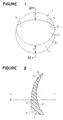
- a toric contact lens 1 has a prism ballast shape as a whole.
- the inner surface (back surface) 2 and the outer surface (front surface) 3 of the lens 1 are respectively formed of a spherical surface and a toric surface wherein the central axis B of the outer surface 3 is determined at a position lower than the central axis A of the inner surface 2, and the both central axis A, B extend in parallel. Accordingly, the thickness of the toric contact lens 1 increases downwardly whereby the gravity center is shifted downwardly ( Figure 2). Further, spherical cut surfaces 6, 7 (surfaces resulted by forming slab-off portions) are formed respectively in upper and lower slab-off portions 4, 5 of the toric contact lens 1.
- Numeral 8 designates the border line between the outer surface 3 and the cut surface 6
- numeral 9 designates the boarder line between the outer surface 3 and the cut surface 7.
- the region 10 surrounded by the border lines 8 and 9 provides an effective optical zone which actually performs function as a contact lens.
- the outer surface 3 is provided with a toric surface which comprises curved surfaces having different radius of curvatures in the directions of two orthogonally intersecting meridians.
- the toric surface corrects astigmatism. Accordingly, it is easy to form the toric surface by a lathe cutting process in comparison with the forming of it in the inner surface 2.
- the same effect of preventing the rotation as the ballast type is obtainable since the toric contact lens is formed to have a prism ballast shape as a whole whereby the gravity center is shifted downwardly. Further, since the upper and lower peripheral portions are shaved or cut, the deviation rate of the lens is smaller than that of the prism ballast type. Accordingly, the largest thickness of the toric contact lens 1 (the thickness of the lowermost portion of the toric lens 1 shown in Figure 2) can be reduced, and at the same time, the thickness in the entire portion of the toric contact lens 1 can be reduced, whereby the feeling of wearing can be improved. Further, an amount of oxygen to be supplied to the cornea can be increased to thereby prevent the cornea from injuring.
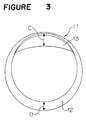
- Figure 3 shows another embodiment of the toric contact lens 11 according to the present invention.
- the lower slab-off portion extends to the upper portion through both side portions. Namely, a lower cut surface 12 is first formed and then, an upper cut surface 13 is formed.
- two-dotted chain line designates the boarder line of the lower cut surface 12 which disappears by the formation of the upper cut surface 13.
- the toric contact lens 11 performs the same function as the toric contact lens 1.
- FIG 4 shows a multifocal contact lens 20 for presbyopia as another embodiment of the present invention.
- the multifocal contact lens 20 has the same prism ballast and slab-off portions (the slab-off portions are indicated by cut surfaces 24) as the toric contact lens, shown in Figure 1.
- An optical zone is formed between the cut surfaces which are provided at upper and lower portions of the lens.
- the optical zone is constituted by a near vision correction zone to see near objects, a far vision correction zone to see distant objects and an intermediate distance correction zone 23 having an intermediate function of correction of those of the near vision correction zone 21 and the far vision correction zone 24, which is formed between those zones 21, 24.
- the near vision correction zone 21 and the intermediate distance correction zone 23 are shifted to the right side (the nose side) so as to be easy to watch near objects in a time of reading a book, for instance.
- Figure 5 shows a multifocal (bifocal) contact lens 25 for presbyopia as another embodiment of the present invention.
- the contact lens 25 has the same prism ballast and slab-off portions (the slab-off portions are indicated by cut surfaces 28, 29) as the toric contact lens 11 shown in Figure 3.
- Numeral 26 designates a near vision correction zone to see near objects formed at the front side of the contact lens 25
- numeral 27 designates a far vision correction zone to see distant objects.
- the contact lens 25 has the near vision correction zone 26 at its lower position so as to be capable of seeing near objects in a time of reading a book, for instance.
- areas having different degree of lens power are not at positions of rotation symmetry in the front view of the lens. They are of a type that it is necessary for a wearer to wear it at a fixed eye position, in the same manner as the toric contact lens.
- the deviation rate of the lens is preferably selected from the range of 2.5% - 7.5% because when the deviation rate exceeds 7.5%, the lens becomes thick by the requirement in the parameters, and on the other hand, when it is less than 2.5%, a sufficient effect of ballast can not be obtained. In order to effectively obtain stability on the rotation of the lens, it is preferable to select the deviation rate in a range of 3.5 - 5.5%.
- the ballast formed in the contact lens of the present invention is of the prism ballast type. Accordingly, the surface of the lens is very smooth unlike the conventional contact lens wherein the lower portion is simply weighed. Accordingly, the feeling of wearing is further improved.
- the deviation rate of the lens is first determined. Then, the deviation quantity of the lens (namely, the distance of the gravity center from the geometric center) is calculated so as to obtain the predetermined deviation rate of the lens. Then, the prism quantity of the lens and the width of slab-off portions are set. It is natural to consider the deviation quantity of the lens due to the toric or multifocal (bifocal) surface in the designing of the contact lens 1, 11, 20 or 25.
- a flowchart in Figure 4 shows preferred steps of the design for the toric contact lens.
- the smallest thickness t min of the toric contact lens 1 by which the necessary strength can be obtained is set.
- the smallest thickness t min varies depending on material used and is set in consideration of various conditions. Further, a desired deviation quantity H for the lens is also set.
- the radius of curvature of the inner surface 2, i.e. the base curve (BC) is set so as to meet the shape of the cornea of a wearer (Step 14).
- the outer surface 3 is so designed as to meet desired parameters of contact lens (e.g. the degree of spherical power, the degree of cylindrical power, the axis of correction for astigmatism and so on) in consideration of the previously set base curve (Step 15).
- desired parameters of contact lens e.g. the degree of spherical power, the degree of cylindrical power, the axis of correction for astigmatism and so on
- the prism quantity (the degree of prism diopter) is optionally set (Step 16).
- the thickness of the lens is measured (Step 17). Since the toric contact lens 1 is formed to have a prism ballast, the geometric center of the inner surface 2 does not coincide with that of the outer surface 3. Accordingly, since the position where the thickness of the lens is the smallest is a position other than the geometric center or the spherical portion of the contact lens, the smallest thickness of the lens is set by examining the thickness of the lens at various positions. As a result, when the smallest value in the thickness t of the lens indicates the smallest thickness portion t min , the next step is taken. Otherwise, the procedure is returned to Step 16 to set the prism quantity (the degree of prism) again.
- the width of the upper and lower slab-off portions is set (Step 18).
- the width of the upper slab-off portion (the width C in Figures 1 and 3) should be maintained to be greater as possible to thereby obtain a large deviation quantity, which can further improve the effect of preventing the rotation. Accordingly, a large value (e.g. 2.5 mm) should be previously set, however, the value may be an optional value.
- the position of gravity center (deviation quantity) is calculated (Step 19).
- the prism quantity the degree of prism diopter
- the width of the slab-off portions which have been obtained in the previous steps are set as formal values.
- the sequential step is returned to Step 18 where the width of the slab-off portions is set again.
- the width C of the upper slab-portion is 2.5 mm
- the width D of the lower slab-off portion ( Figure 1 and Figure 3) is limited to 0.1 mm - 2.5 mm so that the effective width of the optical portion 10 of the toric contact lens 1 can be assured.
- the sequential step is returned to Step 16 where the prism quantity (the degree of prism) is set again.
- the toric contact lens 1 having the smallest thickness is employed in consideration of the thickness at various positions (the thickness at the central portion, the peripheral portions and so on) of the lens.
- a lathe cutting process or a molding process which can render the manufacture easy may be used.
- the multifocal (bifocal) contact lens of the present invention can be designed in the same manner as the toric contact lens described above. Further, it can be manufactured by either process of lathe cutting or molding.
- the following advantages are obtainable.
- the rotation of the lens can be effectively prevented. Excellent feeling of wearing is obtainable. It is safe in use because a sufficient amount of oxygen to the cornea can be assured. Further, the flexibility of the design is obtainable because restriction to the parameter of the lens can be substantially expanded. Further, since the prism quantity (the degree of prism) can be smaller than the conventional technique, and an adverse optical effect such as polarization can be reduced.
Landscapes
- Health & Medical Sciences (AREA)
- Ophthalmology & Optometry (AREA)
- Physics & Mathematics (AREA)
- General Health & Medical Sciences (AREA)
- General Physics & Mathematics (AREA)
- Optics & Photonics (AREA)
- Eyeglasses (AREA)
Priority Applications (7)
| Application Number | Priority Date | Filing Date | Title |
|---|---|---|---|
| US08/130,728 US5532768A (en) | 1993-10-04 | 1993-10-04 | Contact lens |
| ES93116083T ES2130201T3 (es) | 1993-10-05 | 1993-10-05 | Lente de contacto. |
| DE1993624144 DE69324144T2 (de) | 1993-10-05 | 1993-10-05 | Kontaktlinse |
| EP93116083A EP0646825B1 (fr) | 1993-10-04 | 1993-10-05 | Lentille de contact |
| ES98116593T ES2190559T3 (es) | 1993-10-05 | 1993-10-05 | Lente de contacto. |
| EP98116593A EP0883014B1 (fr) | 1993-10-05 | 1993-10-05 | Lentille de contact |
| DE1993632627 DE69332627T2 (de) | 1993-10-05 | 1993-10-05 | Kontaktlinse |
Applications Claiming Priority (2)
| Application Number | Priority Date | Filing Date | Title |
|---|---|---|---|
| US08/130,728 US5532768A (en) | 1993-10-04 | 1993-10-04 | Contact lens |
| EP93116083A EP0646825B1 (fr) | 1993-10-04 | 1993-10-05 | Lentille de contact |
Related Child Applications (1)
| Application Number | Title | Priority Date | Filing Date |
|---|---|---|---|
| EP98116593A Division EP0883014B1 (fr) | 1993-10-05 | 1993-10-05 | Lentille de contact |
Publications (2)
| Publication Number | Publication Date |
|---|---|
| EP0646825A1 true EP0646825A1 (fr) | 1995-04-05 |
| EP0646825B1 EP0646825B1 (fr) | 1999-03-24 |
Family
ID=26133454
Family Applications (1)
| Application Number | Title | Priority Date | Filing Date |
|---|---|---|---|
| EP93116083A Expired - Lifetime EP0646825B1 (fr) | 1993-10-04 | 1993-10-05 | Lentille de contact |
Country Status (2)
| Country | Link |
|---|---|
| US (1) | US5532768A (fr) |
| EP (1) | EP0646825B1 (fr) |
Cited By (6)
| Publication number | Priority date | Publication date | Assignee | Title |
|---|---|---|---|---|
| EP0942311A1 (fr) * | 1998-03-09 | 1999-09-15 | Menicon Co., Ltd. | Lentille de contact du type alourdie d'un prisme, méthode de fabrication et moule utilisé pour la fabrication de la lentille |
| EP0949529A3 (fr) * | 1998-04-10 | 2000-01-12 | Menicon Co., Ltd. | Lentille multifocale torique avec puissances optiques différentes pour la correction d'astigmatisme dans des régions de correction de vision respectives, et méthode de fabrication de celle-ci |
| EP0982618A1 (fr) * | 1998-08-26 | 2000-03-01 | Menicon Co., Ltd. | Lentille de contact pour la correction de la presbytie |
| EP1008890A1 (fr) * | 1998-12-09 | 2000-06-14 | JOHNSON & JOHNSON VISION PRODUCTS, INC. | Lentilles de contact toriques |
| EP1014156A1 (fr) * | 1998-12-21 | 2000-06-28 | JOHNSON & JOHNSON VISION PRODUCTS, INC. | Lentilles de contact avec contours géométriques constants |
| EP2318880A1 (fr) * | 2008-08-28 | 2011-05-11 | Johnson & Johnson Vision Care, Inc. | Lentilles de contact toriques |
Families Citing this family (26)
| Publication number | Priority date | Publication date | Assignee | Title |
|---|---|---|---|---|
| US5980040A (en) * | 1997-06-30 | 1999-11-09 | Wesley Jessen Corporation | Pinhole lens and contact lens |
| US6457826B1 (en) | 1998-08-06 | 2002-10-01 | John B. W. Lett | Multifocal aspheric lens |
| US6286956B1 (en) * | 1998-10-19 | 2001-09-11 | Mencion Co., Ltd. | Multifocal ocular lens including intermediate vision correction region between near and distant vision correction regions |
| AU2365300A (en) | 1998-12-16 | 2000-07-03 | Wesley-Jessen Corporation | Multifocal contact lens with aspheric surface |
| US6467903B1 (en) | 2000-03-31 | 2002-10-22 | Ocular Sciences, Inc. | Contact lens having a uniform horizontal thickness profile |
| EP1783535A3 (fr) * | 2000-03-31 | 2011-05-11 | Coopervision International Holding Company, LP. | Lentille de contact possédant un profil d'épaisseur horizontal uniforme |
| US7628485B2 (en) * | 2000-03-31 | 2009-12-08 | Coopervision International Holding Company, Lp | Contact lens having a uniform horizontal thickness profile |
| CN100510847C (zh) * | 2000-03-31 | 2009-07-08 | 库柏维景国际控股公司 | 贴目镜片 |
| US7152975B2 (en) * | 2000-11-10 | 2006-12-26 | Cooper Vision, Inc. | Junctionless ophthalmic lenses and methods for making same |
| US6923540B2 (en) * | 2002-07-31 | 2005-08-02 | Novartis Ag | Toric multifocal contact lenses |
| EP2508936B1 (fr) * | 2002-08-06 | 2016-11-23 | Novartis AG | Lentilles de contact |
| EP2388640A3 (fr) * | 2003-05-21 | 2012-09-19 | Novartis AG | Lentilles de contact |
| US6939005B2 (en) | 2003-08-20 | 2005-09-06 | Johnson & Johnson Vision Care Inc. | Rotationally stabilized contact lenses |
| US20070159593A1 (en) * | 2003-10-27 | 2007-07-12 | Menicon Co., Ltd. | Contact lens |
| US7036930B2 (en) | 2003-10-27 | 2006-05-02 | Johnson & Johnson Vision Care, Inc. | Methods for reducing corneal staining in contact lens wearers |
| US6988800B2 (en) * | 2004-01-06 | 2006-01-24 | St. Shine Optical Co., Ltd. | Toric contact lens with meniscus-shaped flattened top and bottom zones for dynamic stabilization |
| US7201480B2 (en) * | 2004-05-20 | 2007-04-10 | Johnson & Johnson Vision Care, Inc. | Methods for rotationally stabilizing contact lenses |
| AR062067A1 (es) * | 2006-07-17 | 2008-10-15 | Novartis Ag | Lentes de contacto toricas con perfil de potencia optica controlado |
| US8646908B2 (en) * | 2008-03-04 | 2014-02-11 | Johnson & Johnson Vision Care, Inc. | Rotationally stabilized contact lenses and methods for their design |
| US9676125B2 (en) * | 2011-09-09 | 2017-06-13 | Ezekiel Nominees Pty Ltd | Method of cast moulding a translating multifocal contact lens |
| US10191302B2 (en) * | 2015-09-23 | 2019-01-29 | Ohio State Innovation Foundation | Contact lens comprising lenticular-like curve |
| ES2969255T3 (es) | 2015-09-23 | 2024-05-17 | Ohio State Innovation Foundation | Lente de contacto que comprende una lenticular en una porción superior de la lente de contacto |
| WO2019046714A1 (fr) | 2017-09-01 | 2019-03-07 | Ohio State Innovation Foundation | Lentille de contact souple comprenant un lenticulaire dans une partie supérieure de la lentille de contact avec échange lacrymal amélioré |
| AR115981A1 (es) | 2019-03-19 | 2021-03-17 | Ohio State Innovation Foundation | Lente de contacto |
| JP7674269B2 (ja) * | 2019-05-20 | 2025-05-09 | リアン,ジュンジョン | 人間の目の乱視、コマ収差、老視のウェーブフロント治療のための方法及び装置 |
| USD1075870S1 (en) | 2020-03-26 | 2025-05-20 | Ohio State Innovation Foundation | Contact lens |
Citations (8)
| Publication number | Priority date | Publication date | Assignee | Title |
|---|---|---|---|---|
| EP0008726A1 (fr) * | 1978-09-04 | 1980-03-19 | Hirst Contact Lens Limited | Verres de contact et méthodes de fabrication de ceux-ci |
| GB2041557A (en) * | 1978-10-05 | 1980-09-10 | Kwok Chu Fung J | Soft contact lenses |
| DE3003985A1 (de) * | 1980-02-04 | 1981-08-13 | Hecht Contactlinsen GmbH, 7800 Freiburg | Contactlinse |
| EP0062178A1 (fr) * | 1981-03-23 | 1982-10-13 | BAUSCH & LOMB INCORPORATED | Support à stabiliser des lentilles de contact toriques |
| EP0102223A2 (fr) * | 1982-08-19 | 1984-03-07 | Vistakon, Inc. | Lentille de contact souple bifocale |
| US4573774A (en) * | 1981-09-28 | 1986-03-04 | Vistakon, Inc. | Soft toric contact lens |
| US4618229A (en) * | 1983-07-22 | 1986-10-21 | Bausch & Lomb Incorporated | Bifocal contact lens |
| EP0452549A1 (fr) * | 1990-04-19 | 1991-10-23 | HEINRICH WÖHLK, INSTITUT FÜR CONTACTLINSEN GmbH & CO. | Lentille de contact avec stabilisation de position |
Family Cites Families (9)
| Publication number | Priority date | Publication date | Assignee | Title |
|---|---|---|---|---|
| DE2413845C3 (de) * | 1974-03-22 | 1979-08-02 | Moeller & Neumann Gmbh, 6670 St Ingbert | Auflaufrollgang für Walzstäbe, insbesondere Flach- oder Profilstäbe, mit anschließender Querförderung |
| US4095878A (en) * | 1974-03-28 | 1978-06-20 | Titmus Eurocon Kontaktlinsen Gmbh & Co. Kg | Soft contact lens with flattened region for automatic orientation |
| US4324461A (en) * | 1979-11-26 | 1982-04-13 | Salvatori Ophthalmics, Inc. | Contact lens for non-rotational orientation |
| US4508436A (en) * | 1981-09-28 | 1985-04-02 | Frontier Contact Lenses Of Florida, Inc. | Soft toric contact lens |
| DE3222099C2 (de) * | 1982-06-11 | 1984-06-20 | Titmus Eurocon Kontaktlinsen Gmbh & Co Kg, 8750 Aschaffenburg | Bifokale Kontaktlinse vom bivisuellen Typ |
| US4628229A (en) * | 1983-02-15 | 1986-12-09 | Olympus Optical Company, Ltd | Flashlight emission apparatus |
| CA1265688A (fr) * | 1984-10-17 | 1990-02-13 | Alain Rainville | Lentille corneenne a double foyer et methode de production |
| US5076683A (en) * | 1988-09-14 | 1991-12-31 | Allergan, Inc. | Spuncast compound contact lens |
| US5020898A (en) * | 1990-01-29 | 1991-06-04 | Schering Corporation | Contact lens for correction of astigmatism |
-
1993
- 1993-10-04 US US08/130,728 patent/US5532768A/en not_active Expired - Lifetime
- 1993-10-05 EP EP93116083A patent/EP0646825B1/fr not_active Expired - Lifetime
Patent Citations (8)
| Publication number | Priority date | Publication date | Assignee | Title |
|---|---|---|---|---|
| EP0008726A1 (fr) * | 1978-09-04 | 1980-03-19 | Hirst Contact Lens Limited | Verres de contact et méthodes de fabrication de ceux-ci |
| GB2041557A (en) * | 1978-10-05 | 1980-09-10 | Kwok Chu Fung J | Soft contact lenses |
| DE3003985A1 (de) * | 1980-02-04 | 1981-08-13 | Hecht Contactlinsen GmbH, 7800 Freiburg | Contactlinse |
| EP0062178A1 (fr) * | 1981-03-23 | 1982-10-13 | BAUSCH & LOMB INCORPORATED | Support à stabiliser des lentilles de contact toriques |
| US4573774A (en) * | 1981-09-28 | 1986-03-04 | Vistakon, Inc. | Soft toric contact lens |
| EP0102223A2 (fr) * | 1982-08-19 | 1984-03-07 | Vistakon, Inc. | Lentille de contact souple bifocale |
| US4618229A (en) * | 1983-07-22 | 1986-10-21 | Bausch & Lomb Incorporated | Bifocal contact lens |
| EP0452549A1 (fr) * | 1990-04-19 | 1991-10-23 | HEINRICH WÖHLK, INSTITUT FÜR CONTACTLINSEN GmbH & CO. | Lentille de contact avec stabilisation de position |
Cited By (11)
| Publication number | Priority date | Publication date | Assignee | Title |
|---|---|---|---|---|
| EP0942311A1 (fr) * | 1998-03-09 | 1999-09-15 | Menicon Co., Ltd. | Lentille de contact du type alourdie d'un prisme, méthode de fabrication et moule utilisé pour la fabrication de la lentille |
| US6158861A (en) * | 1998-03-09 | 2000-12-12 | Menicon Co., Ltd. | Prism ballast type contact lens, method of producing the same, and mold assembly used in producing the lens |
| EP0949529A3 (fr) * | 1998-04-10 | 2000-01-12 | Menicon Co., Ltd. | Lentille multifocale torique avec puissances optiques différentes pour la correction d'astigmatisme dans des régions de correction de vision respectives, et méthode de fabrication de celle-ci |
| US6142625A (en) * | 1998-04-10 | 2000-11-07 | Menicon Co., Ltd. | Toric multifocal lens having different astigmatism corrective optical powers in respective vision correction regions, and method of producing the same |
| EP0982618A1 (fr) * | 1998-08-26 | 2000-03-01 | Menicon Co., Ltd. | Lentille de contact pour la correction de la presbytie |
| US6199982B1 (en) | 1998-08-26 | 2001-03-13 | Menicon Co., Ltd. | Presbyopia correction contact lens |
| EP1008890A1 (fr) * | 1998-12-09 | 2000-06-14 | JOHNSON & JOHNSON VISION PRODUCTS, INC. | Lentilles de contact toriques |
| US6176578B1 (en) | 1998-12-09 | 2001-01-23 | Johnson & Johnson Vision Care, Inc. | Toric contact lenses |
| EP1014156A1 (fr) * | 1998-12-21 | 2000-06-28 | JOHNSON & JOHNSON VISION PRODUCTS, INC. | Lentilles de contact avec contours géométriques constants |
| US6183082B1 (en) | 1998-12-21 | 2001-02-06 | Johnson & Johnson Vision Care, Inc. | Contact lenses with constant peripheral geometry |
| EP2318880A1 (fr) * | 2008-08-28 | 2011-05-11 | Johnson & Johnson Vision Care, Inc. | Lentilles de contact toriques |
Also Published As
| Publication number | Publication date |
|---|---|
| US5532768A (en) | 1996-07-02 |
| EP0646825B1 (fr) | 1999-03-24 |
Similar Documents
| Publication | Publication Date | Title |
|---|---|---|
| EP0646825B1 (fr) | Lentille de contact | |
| US6773107B2 (en) | Soft translating contact lens for presbyopia | |
| US5020898A (en) | Contact lens for correction of astigmatism | |
| US4898461A (en) | Multifocal ophthalmic lens | |
| US5877839A (en) | Multifocal ophthalmic lens | |
| US4762408A (en) | Progressive multifocal lens and spectacles using same | |
| AU605332B2 (en) | Multifocal ophthalmic lens | |
| EP0102223B1 (fr) | Lentille de contact souple bifocale | |
| US5166711A (en) | Multifocal ophthalmic lens | |
| US4549794A (en) | Hydrophilic bifocal contact lens | |
| EP1242845B1 (fr) | Lentille de contact souple multifocale | |
| JPH04225314A (ja) | ガス透過性硬質コンタクトレンズおよびその製造方法 | |
| IL123857A (en) | Contact lenses and their fitting process | |
| US20030016331A1 (en) | Bifocal contact lens with secondary prism | |
| GB2041557A (en) | Soft contact lenses | |
| GB2031178A (en) | Contact lens | |
| JP2958189B2 (ja) | トーリックコンタクトレンズならびに該レンズの製法および該レンズの設計方法 | |
| EP0883014B1 (fr) | Lentille de contact | |
| WO1998052090A1 (fr) | Lentille de contact perfectionnee | |
| EP1476783A1 (fr) | Lentilles de contact comportant une surface spherique decentree | |
| CA2096706A1 (fr) | Lentille torique souple pour la correction de l'astigmatisme | |
| CA1244687A (fr) | Lentilles de contact | |
| HK1007445B (en) | Contact lens for correction of astigmatism | |
| HK1088667A1 (zh) | 贴目镜片 | |
| HK1088667B (en) | Contact lens |
Legal Events
| Date | Code | Title | Description |
|---|---|---|---|
| PUAI | Public reference made under article 153(3) epc to a published international application that has entered the european phase |
Free format text: ORIGINAL CODE: 0009012 |
|
| AK | Designated contracting states |
Kind code of ref document: A1 Designated state(s): DE ES FR GB |
|
| 17P | Request for examination filed |
Effective date: 19950828 |
|
| 17Q | First examination report despatched |
Effective date: 19970514 |
|
| GRAG | Despatch of communication of intention to grant |
Free format text: ORIGINAL CODE: EPIDOS AGRA |
|
| GRAG | Despatch of communication of intention to grant |
Free format text: ORIGINAL CODE: EPIDOS AGRA |
|
| GRAH | Despatch of communication of intention to grant a patent |
Free format text: ORIGINAL CODE: EPIDOS IGRA |
|
| GRAH | Despatch of communication of intention to grant a patent |
Free format text: ORIGINAL CODE: EPIDOS IGRA |
|
| GRAA | (expected) grant |
Free format text: ORIGINAL CODE: 0009210 |
|
| AK | Designated contracting states |
Kind code of ref document: B1 Designated state(s): DE ES FR GB |
|
| REF | Corresponds to: |
Ref document number: 69324144 Country of ref document: DE Date of ref document: 19990429 |
|
| REG | Reference to a national code |
Ref country code: ES Ref legal event code: FG2A Ref document number: 2130201 Country of ref document: ES Kind code of ref document: T3 |
|
| ET | Fr: translation filed | ||
| PLBE | No opposition filed within time limit |
Free format text: ORIGINAL CODE: 0009261 |
|
| STAA | Information on the status of an ep patent application or granted ep patent |
Free format text: STATUS: NO OPPOSITION FILED WITHIN TIME LIMIT |
|
| 26N | No opposition filed | ||
| REG | Reference to a national code |
Ref country code: GB Ref legal event code: IF02 |
|
| PGFP | Annual fee paid to national office [announced via postgrant information from national office to epo] |
Ref country code: GB Payment date: 20100929 Year of fee payment: 18 |
|
| PGFP | Annual fee paid to national office [announced via postgrant information from national office to epo] |
Ref country code: DE Payment date: 20100929 Year of fee payment: 18 |
|
| PGFP | Annual fee paid to national office [announced via postgrant information from national office to epo] |
Ref country code: FR Payment date: 20111103 Year of fee payment: 19 Ref country code: ES Payment date: 20111115 Year of fee payment: 19 |
|
| GBPC | Gb: european patent ceased through non-payment of renewal fee |
Effective date: 20121005 |
|
| REG | Reference to a national code |
Ref country code: FR Ref legal event code: ST Effective date: 20130628 |
|
| PG25 | Lapsed in a contracting state [announced via postgrant information from national office to epo] |
Ref country code: GB Free format text: LAPSE BECAUSE OF NON-PAYMENT OF DUE FEES Effective date: 20121005 Ref country code: DE Free format text: LAPSE BECAUSE OF NON-PAYMENT OF DUE FEES Effective date: 20130501 |
|
| REG | Reference to a national code |
Ref country code: DE Ref legal event code: R119 Ref document number: 69324144 Country of ref document: DE Effective date: 20130501 |
|
| PG25 | Lapsed in a contracting state [announced via postgrant information from national office to epo] |
Ref country code: FR Free format text: LAPSE BECAUSE OF NON-PAYMENT OF DUE FEES Effective date: 20121031 |
|
| REG | Reference to a national code |
Ref country code: ES Ref legal event code: FD2A Effective date: 20140116 |
|
| PG25 | Lapsed in a contracting state [announced via postgrant information from national office to epo] |
Ref country code: ES Free format text: LAPSE BECAUSE OF NON-PAYMENT OF DUE FEES Effective date: 20121006 |