EP0646879A1 - Strukturierverfahren eines Expertensystems mit einem oder mehreren Neuronalnetzwerken - Google Patents
Strukturierverfahren eines Expertensystems mit einem oder mehreren Neuronalnetzwerken Download PDFInfo
- Publication number
- EP0646879A1 EP0646879A1 EP94115117A EP94115117A EP0646879A1 EP 0646879 A1 EP0646879 A1 EP 0646879A1 EP 94115117 A EP94115117 A EP 94115117A EP 94115117 A EP94115117 A EP 94115117A EP 0646879 A1 EP0646879 A1 EP 0646879A1
- Authority
- EP
- European Patent Office
- Prior art keywords
- expert system
- output
- input
- neural network
- production rules
- Prior art date
- Legal status (The legal status is an assumption and is not a legal conclusion. Google has not performed a legal analysis and makes no representation as to the accuracy of the status listed.)
- Withdrawn
Links
Images





Classifications
-
- G—PHYSICS
- G06—COMPUTING OR CALCULATING; COUNTING
- G06N—COMPUTING ARRANGEMENTS BASED ON SPECIFIC COMPUTATIONAL MODELS
- G06N3/00—Computing arrangements based on biological models
- G06N3/02—Neural networks
- G06N3/04—Architecture, e.g. interconnection topology
- G06N3/042—Knowledge-based neural networks; Logical representations of neural networks
-
- Y—GENERAL TAGGING OF NEW TECHNOLOGICAL DEVELOPMENTS; GENERAL TAGGING OF CROSS-SECTIONAL TECHNOLOGIES SPANNING OVER SEVERAL SECTIONS OF THE IPC; TECHNICAL SUBJECTS COVERED BY FORMER USPC CROSS-REFERENCE ART COLLECTIONS [XRACs] AND DIGESTS
- Y10—TECHNICAL SUBJECTS COVERED BY FORMER USPC
- Y10S—TECHNICAL SUBJECTS COVERED BY FORMER USPC CROSS-REFERENCE ART COLLECTIONS [XRACs] AND DIGESTS
- Y10S128/00—Surgery
- Y10S128/92—Computer assisted medical diagnostics
- Y10S128/925—Neural network
Definitions
- the present invention is related to the following inventions which are assigned to the same assignee as the present invention:
- This invention relates generally to expert systems and, in particular, to an expert system which utilizes one or more neural networks.
- expert systems have been used in many applications which have traditionally been carried out using complex algorithmic approaches. These applications include medical diagnosis, financial analysis, electronics design, nuclear power plant monitoring and control, oil exploration, etc. Expert systems have also been used for interpretation, prediction, planning, monitoring, debugging, repair, and instruction.
- the surge in popularity of expert systems is mainly due to their simplicity in modeling complicated systems by Production Rules (i.e. IF/THEN rules) and to their capability in recommending appropriate actions by inference (or search).
- fuzzy logic makes use of fuzzy sets and fuzzy relational equations.
- fuzzy set theory quantifiers such as “for many” and “for a few” are used to relate elements of different sets. Fuzzy set theory, then, is useful in those situations in which data and relationships cannot be written in crisp mathematical terms. Simplicity and speed of design are two major advantages of fuzzy systems. Once an engineer has defined the variables and fuzzy sets, using intuition and experience, the design of a fuzzy logic control system prototype can be completed in a relatively short time.
- a third known method of handling the above types of applications uses conventional artificial neural networks.
- An artificial neural network can be considered as a network of neuron-like units operating on data "all-at-once" rather than “step-by-step” as in a conventional computation.
- the problem of control can often be viewed as a pattern-recognition problem, wherein the patterns to be recognized are mappings of measured signals for "change” into calculated controls for "action".
- the ability to learn from experience to provide ever-improving performance is an advantage in using artificial neural networks for implementation of an intelligent controller.
- known artificial neural networks suffer from several significant problems, including the necessity for lengthy repetitive training of the networks, the fact that only local minimum solutions are generated, and the need for using trial and error techniques in structuring the number of neurons and layers of neurons in the network.
- the present invention offers a unified approach which combines the best features of the above three techniques. But first let us review some of the characteristics of expert systems.
- FIG. 1 shows a conceptual diagram illustrating a conventional expert system 1 which comprises two modules.
- a first module 2 is a Knowledge Base, which comprises a group of Production Rules (which typically are IF/THEN statements) and Facts.
- a second module 3 is an Inference Engine which makes decisions using the Production Rules and the given Facts.
- the expert system receives Inputs and generates Outputs using the Knowledge Base 2 and Inference Engine 3.
- FIG. 2 shows a graph illustrating the brittleness of a conventional expert system. For example, if an Input x has a specific value x1, when we apply the following Production Rules the Output value y will be zero: IF x is in set A (lying between x2 and x3), THEN y is 1. IF x is not in set A, THEN y is 0.
- FIG. 3 shows a conceptual diagram of a Knowledge Base for a conventional expert system.
- This example of a Knowledge Base has two Production Rules and a set of Facts comprising x1, x2, and x3 representing the Inputs of the expert system.
- An Inference Engine e.g. Inference Engine 3, FIG. 1 checks to see whether a given Rule is true by matching the set of Facts with the premise of such Rule.
- premise is meant the clause immediately following the "IF” statement of the Production Rule.
- the “conclusion” is the clause immediately following the "THEN” statement.
- the Inference Engine checks to see whether Rule 1 is true by matching the given set of Facts with the premise of Rule 1. However, Rule 1 is not matched, because the Facts do not match its premise, since the Facts don't include z1.
- the Inference Engine checks to see whether Rule 2 is true by matching the given set of Facts with the premise of Rule 2.
- Rule 2 is matched, because the Facts include x1 and x2. Because Rule 2 is fired, the set of Facts will now include z1, as shown in FIG. 5.
- the Inference Engine checks to see whether Rule 1 is true by matching the set of Facts with the premise of Rule 1.
- Rule 1 is matched, because the set of Facts includes z1 and x3.
- the expert system has made a decision (y is true), so that the set of Facts will include y from now on, as shown by FIG. 7.
- the present invention represents a combination of expert system, fuzzy logic, and neural network technologies.
- a neural network first learns a group of given Production Rules and then produces one or more interpolated Outputs, either in real-time applications or non-time-critical applications.
- Groups of Production Rules may be linked together to form an expert system comprising a neural network for each group of Production rules.
- Each neural network utilizes a training algorithm which does not require repetitive training and which yields a global minimum to each given set of Input variables.
- each neural network which learns a group of Production Rules for defuzzification, produces excellent interpolated Output, thereby significantly enhancing the robustness of the expert system.
- the neural networks may be implemented either in software or hardware.
- a method for structuring an expert system with a plurality of neural networks comprising the steps of: (a) defining a plurality of subsystems for a problem, each subsystem having at least one input and at least one output; (b) defining a group of production rules for each of the subsystems by relating the at least one output to the at least one input in a certain manner; (c) linking the subsystems together into the expert system; (d) defining the plurality of neural networks, one for each group of production rules, each of the networks comprising a plurality of neurons; and (e) computing the weights of the neural networks.
- FIG. 3 shows a conceptual diagram of a Knowledge Base for a conventional expert system, wherein an Inference Engine checks to see whether a first rule is true or not.
- FIG. 8 shows a conceptual diagram illustrating how groups of Production Rules, each group constituting a subsystem, are used to provide an expert system utilizing one or more neural networks, according to a preferred embodiment of the present invention.
- Expert system 10 comprises three subsystems 11-13. Each subsystem 11-13 comprises a group of Production Rules that links the given Inputs to the desired Outputs.
- a first subsystem 11 receives a set of three Inputs x1-x3 and generates one Output z1.
- a second subsystem 12 also has three Inputs x4-x6 and generates an Output y2.
- a third subsystem 13 receives two Inputs, z1 and x4, and generates an Output y1. It should be noted that Inputs x1-x6 to expert system 10 are external Inputs, and that y1 and y2 are external Outputs of expert system 10.
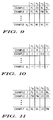
- FIG. 9 shows a table illustrating the Production Rules for subsystem 11 in FIG. 8.
- the expressions PL, PM, Z0, NM, and NL represent an arbitrary set of N possible values for a given Input or Output.
- N is chosen to be five, so there are five possible values for a given Input or Output, represented by the values PL, PM, Z0, NM, and NL. It will be understood that there may be more or less than five possible values for a given Input or Output, depending upon the particular application.
- NL represents a "negative large” value with respect to normal values of the variables; NS is a “negative small” value; ZO is a zero value; PS is a “positive small” value; and PL is a "positive large” value.
- FIG. 11 shows a table illustrating the Production Rules or Examples for subsystem 12 in FIG. 8
- FIG. 13 shows a table illustrating the Production Rules or Examples for subsystem 13 in FIG. 8.
- FIG. 12 shows quantified values for the table shown in FIG. 11
- FIG. 14 shows quantified values for the table shown in FIG. 13.
- FIG. 15 shows a conceptual diagram of the normalization of an Input value x' to a normalized value x having a value between -1 and +1.
- the normalization is performed by appropriate, well-known means 20.
- the generation of Outputs from Inputs is a three-stage process: (1) normalizing Inputs as described with reference to FIG. 15, (2) training the network, and (3) computing the interpolated Outputs from the neural network associated with such subsystem.
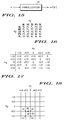
- FIG. 16 shows Production Rules in table form for a process control problem. This problem has two Inputs and one Output. For two given variables x1 and x2, the desired Output response y is illustrated by the table of FIG. 16.
- NL represents a "negative large” value with respect to normal values of the variables x1 and x2 about their respective average, mean, or other selected centerpoint values;
- NS is a "negative small” value;
- ZO is a zero value;
- PS is a “positive small” value;
- PL is a "positive large” value.
- This table represents twenty-five Production Rules.
- the Production Rules are derived from the practitioner's experience and/or knowledge about the problem to be solved. It will be understood that while it may be advantageous to utilize Production Rules to tackle a problem, it should be noted that Production Rules for an expert system are often very brittle (i.e. the Output cannot be interpolated but must be a specified value). Increasing the number of Production Rules improves the robustness of the expert system at the cost of computational complexity and maintenance difficulty.
- FIG. 17 shows quantified values for FIG. 16.
- the variable x1 is a continuous function of x1'.
- x1 is f(x1'), as shown in FIG. 8.
- x2 and x2' are continuous functions of x1 and x2, respectively.
- Input variables x1 and x2 we choose values for PL, PS, ZO, NS, and NL between -1 and +1.
- PL +1.0
- PS +0.5
- ZO 0
- NS -0.5
- NL -1.0.
- PL +.98 or +.95
- PS e.g. +0.51 or +0.48
- Z0, NS, and NL there may be more or less than five possible values for a given input or output variable.
- Training the neural network associated with a given subsystem or group of Production Rules comprises two steps: (1) defining the number of neurons in the network to be less than or equal to the number of Production Rules of such subsystem, although it will be understood that the present invention may be implemented with a greater number of neurons than the number of Production Rules in the relevant subsystem; (2) computing the weights of the neural network, in the manner referred to in Related Invention No. 1.
- FIG. 18 shows an example of interpolating the Outputs from a given network.
- each intersection e.g. intersection 61, 62, 63, or 64
- the neural network produces either an actual Output or an interpolated Output for a given set of Input values.
- FIG. 19 shows a conceptual diagram of a neural network for performing an expert system computation in accordance with the present invention.
- a plurality of Inputs x1, x2, . . ., x n are fed to Input nodes 101, 102, . . . ., 104 of the Input Layer.
- each input node 101, 102, and 104 in the Input Layer is coupled to each neuron circuit of the Hidden Layer (of which only neuron circuits N1, N2, N3, N n+1 , N n+2 , N 2n+1 , and N N are shown).
- the Output of input node 101 is coupled to each of neuron circuits N1, N2, N3, N n+1 , N n+2 , N 2n+1 , and N N , and to all other neuron circuits (not shown) in the Hidden Layer.
- the gated Inputs are first produced by the neuron circuit and then multiplied by the multiplier of the neuron circuit to produce the neuron Outputs.
- the Outputs of neuron circuits N1, N2, N3, N n+1 , N n+2 , N 2n+1 , and N N are summed by summing circuit 110 to produce a network Output y.
- the operation of a neural network of the type employed in the present invention is based upon the use of a polynomial expansion and, in a loose sense, the use of an orthogonal function, such as sine, cosine, exponential/logarithmic, Fourier transformation, Legendre polynomial, radial basis function, or the like, or a combination of polynomial expansion and orthogonal functions.
- an orthogonal function such as sine, cosine, exponential/logarithmic, Fourier transformation, Legendre polynomial, radial basis function, or the like, or a combination of polynomial expansion and orthogonal functions.
- Equation 5 expresses a neuron Output and the weight and gating functions associated with such neuron.
- the number of terms of the polynomial expansion to be used in a neural network is based upon a number of factors, including the number of available neurons, the number of training examples, etc. Equation 5 may be expressed alternatively, as disclosed in Related Invention No. 1.
- Equation 5 is produced by the Output of a neuron or neuron circuit.
- neuron circuit N1 produces the term w0.
- Neuron circuit N2 produces the term w1 x1. And so on.
- the number of neuron circuits of the neural network is selected to be equal or less than the number of examples presented to the network.
- An "example” is defined as one set of given Inputs and resulting Outputs.
- the weight of each neuron circuit must be determined. This can be accomplished by the use of an appropriate training algorithm, as described in Related Invention No. 1.
- FIG. 19 shows only one summing circuit in the Output Layer, it will be understood by one of ordinary skill that two or more summing circuits may be used if a particular expert system application requires multiple Outputs.
- the values of the Outputs of the subsystems represented by neural networks are between +1 and -1. Therefore, they may need to be decoded to represent their actual values.
- FIG. 20 shows a conceptual diagram of the decoding of a normalized Output value y i ' to an actual value y i by suitable decoding formula 120.
- an existing expert system comprises a large bundle of Production Rules.
- these rules are orderly grouped into a plurality of subsystems, each of which is governed by a selected group of the given Production Rules, which may be expressed by "IF / THEN" rules, or a table providing the relationship between inputs and outputs, or the like.
- each subsystem as illustrated for example in FIG. 8, can be represented by a neural network of the type shown in FIG. 19.
- the Production Rules for each subsystem are expressed by a polynomial expansion (e.g. Equation 5), and at least one output, which may be an interpolated output, is computed from the polynomial expansion by substituting at least one input into the polynomial expansion and solving as explained above.
- FIG. 21 shows a flow diagram of a method for learning Production Rules of an expert system in accordance with the present invention.
- the Inputs and Outputs are defined for the expert system.
- the Inputs are normalized.
- the Outputs may also be normalized, if appropriate (e.g. if an Output is an internal Output which will be fed to another neural network).
- each Input is classified into one of a number of N values, N being a positive integer.
- N being a positive integer.
- each Input was classified into one of five values.
- a plurality of groups of Production Rules are defined by relating, for each of such groups, one of the Outputs to one or more of the Inputs in a certain manner.
- a neural network is defined for each group of Production Rules by expressing the rules in the form of a polynomial expansion.
- At least one Output is computed from at least one neural network by substituting at least one Input into the corresponding polynomial expansion.
- the Output may be either an exact value or an interpolated value.
- FIG. 22 shows a flow diagram of a method for structuring an expert system incorporating a neural network in accordance with the present invention.
- a plurality of subsystems are defined for a problem.
- Each subsystem has at least one Input and at least one Output.
- the Inputs are normalized.
- the Outputs may also be normalized, if appropriate (e.g. if an Output is an internal Output which will be fed to another neural network).
- a group of Production Rules is defined for each subsystem by relating at least one Output to at least one Input.
- box 167 the subsystems are linked together into an expert system.
- a neural network is defined for each group of Production Rules by expressing the rules in the form of a polynomial expansion.
- At least one Output is computed from at least one neural network by substituting at least one Input into the corresponding polynomial expansion.
- the Output may be either an exact value or an interpolated value.
- neural networks disclosed and described herein may be implemented either in software or hardware.
Landscapes
- Engineering & Computer Science (AREA)
- Theoretical Computer Science (AREA)
- Physics & Mathematics (AREA)
- General Health & Medical Sciences (AREA)
- Computing Systems (AREA)
- Biomedical Technology (AREA)
- Biophysics (AREA)
- Computational Linguistics (AREA)
- Data Mining & Analysis (AREA)
- Evolutionary Computation (AREA)
- Life Sciences & Earth Sciences (AREA)
- Molecular Biology (AREA)
- Artificial Intelligence (AREA)
- General Engineering & Computer Science (AREA)
- General Physics & Mathematics (AREA)
- Mathematical Physics (AREA)
- Software Systems (AREA)
- Health & Medical Sciences (AREA)
- Devices For Executing Special Programs (AREA)
- Feedback Control In General (AREA)
Applications Claiming Priority (2)
| Application Number | Priority Date | Filing Date | Title |
|---|---|---|---|
| US08/129,275 US5455890A (en) | 1993-09-30 | 1993-09-30 | Method for structuring an expert system utilizing one or more neural networks |
| US129275 | 1998-08-05 |
Publications (1)
| Publication Number | Publication Date |
|---|---|
| EP0646879A1 true EP0646879A1 (de) | 1995-04-05 |
Family
ID=22439247
Family Applications (1)
| Application Number | Title | Priority Date | Filing Date |
|---|---|---|---|
| EP94115117A Withdrawn EP0646879A1 (de) | 1993-09-30 | 1994-09-26 | Strukturierverfahren eines Expertensystems mit einem oder mehreren Neuronalnetzwerken |
Country Status (4)
| Country | Link |
|---|---|
| US (1) | US5455890A (de) |
| EP (1) | EP0646879A1 (de) |
| JP (1) | JPH07121495A (de) |
| CA (1) | CA2130761A1 (de) |
Families Citing this family (22)
| Publication number | Priority date | Publication date | Assignee | Title |
|---|---|---|---|---|
| US5737214A (en) * | 1993-06-09 | 1998-04-07 | Abb Patent Gmbh | Method for controlling a function unit with a steering and control device |
| US5633987A (en) * | 1994-07-28 | 1997-05-27 | Motorola, Inc. | Auto-scaling controller and method of use therefor |
| KR960038646A (ko) * | 1995-04-17 | 1996-11-21 | 구자홍 | 신경회로망 시스템의 퍼지법칙 생성방법 및 장치 |
| US5748845A (en) * | 1995-07-31 | 1998-05-05 | Motorola, Inc. | FES method and system for controlling the movement of a limb |
| US5724486A (en) * | 1995-08-21 | 1998-03-03 | Motorola Inc. | Method for structuring an expert system utilizing one or more polynomial processors |
| US6678669B2 (en) | 1996-02-09 | 2004-01-13 | Adeza Biomedical Corporation | Method for selecting medical and biochemical diagnostic tests using neural network-related applications |
| JPH1063634A (ja) * | 1996-04-05 | 1998-03-06 | Nec Corp | 時系列予測・分類のための方法及び装置 |
| US5839438A (en) * | 1996-09-10 | 1998-11-24 | Neuralmed, Inc. | Computer-based neural network system and method for medical diagnosis and interpretation |
| US5774831A (en) * | 1996-12-06 | 1998-06-30 | Gupta; Surender Kumar | System for improving average accuracy of signals from global positioning system by using a neural network to obtain signal correction values |
| US6401080B1 (en) | 1997-03-21 | 2002-06-04 | International Business Machines Corporation | Intelligent agent with negotiation capability and method of negotiation therewith |
| TW504632B (en) | 1997-03-21 | 2002-10-01 | Ibm | Apparatus and method for optimizing the performance of computer tasks using intelligent agent with multiple program modules having varied degrees of domain knowledge |
| US6267722B1 (en) | 1998-02-03 | 2001-07-31 | Adeza Biomedical Corporation | Point of care diagnostic systems |
| US6394952B1 (en) | 1998-02-03 | 2002-05-28 | Adeza Biomedical Corporation | Point of care diagnostic systems |
| USD432244S (en) * | 1998-04-20 | 2000-10-17 | Adeza Biomedical Corporation | Device for encasing an assay test strip |
| USD434153S (en) * | 1998-04-20 | 2000-11-21 | Adeza Biomedical Corporation | Point of care analyte detector system |
| JP3762840B2 (ja) * | 1998-11-24 | 2006-04-05 | 富士通株式会社 | 類似事例に基づく予測を行う予測装置および方法 |
| KR100695563B1 (ko) | 2000-12-22 | 2007-03-15 | 에이덴티티 매트릭스 메디컬 인코포레이티드 | 문제해결 및 튜터링을 위한 멀티 에이전트 협동 아키텍쳐 |
| WO2002063985A2 (en) * | 2001-02-09 | 2002-08-22 | Terry Manufacturing Co., Inc. | Multipurpose garment |
| US20030037063A1 (en) * | 2001-08-10 | 2003-02-20 | Qlinx | Method and system for dynamic risk assessment, risk monitoring, and caseload management |
| US7275048B2 (en) * | 2001-10-30 | 2007-09-25 | International Business Machines Corporation | Product support of computer-related products using intelligent agents |
| US7565377B2 (en) * | 2001-12-05 | 2009-07-21 | Robert Michael Watson | Artificially intelligent fulfillment system |
| US6871105B2 (en) * | 2002-09-26 | 2005-03-22 | General Electric Company | Methods and apparatus for reducing hyperplanes in a control space |
Citations (1)
| Publication number | Priority date | Publication date | Assignee | Title |
|---|---|---|---|---|
| EP0536396A1 (de) * | 1990-04-27 | 1993-04-14 | Kabushiki Kaisha Komatsu Seisakusho | Verfahren um automatisch eine wissensbasis eines expertensystems mit einem neuronalen netzwerk anzupassen und gerät dafür |
Family Cites Families (4)
| Publication number | Priority date | Publication date | Assignee | Title |
|---|---|---|---|---|
| US5255344A (en) * | 1988-05-20 | 1993-10-19 | Matsushita Electric Industrial Co., Ltd. | Inference rule determining method and inference device |
| US5129037A (en) * | 1989-06-20 | 1992-07-07 | Digital Equipment Corporation | Neural network for performing beta-token partitioning in a RETE network |
| US5121467A (en) * | 1990-08-03 | 1992-06-09 | E.I. Du Pont De Nemours & Co., Inc. | Neural network/expert system process control system and method |
| US5263120A (en) * | 1991-04-29 | 1993-11-16 | Bickel Michael A | Adaptive fast fuzzy clustering system |
-
1993
- 1993-09-30 US US08/129,275 patent/US5455890A/en not_active Expired - Lifetime
-
1994
- 1994-08-24 CA CA002130761A patent/CA2130761A1/en not_active Abandoned
- 1994-09-20 JP JP6251310A patent/JPH07121495A/ja active Pending
- 1994-09-26 EP EP94115117A patent/EP0646879A1/de not_active Withdrawn
Patent Citations (1)
| Publication number | Priority date | Publication date | Assignee | Title |
|---|---|---|---|---|
| EP0536396A1 (de) * | 1990-04-27 | 1993-04-14 | Kabushiki Kaisha Komatsu Seisakusho | Verfahren um automatisch eine wissensbasis eines expertensystems mit einem neuronalen netzwerk anzupassen und gerät dafür |
Non-Patent Citations (4)
| Title |
|---|
| HUDLI: "A neural network based expert system model", PROCEEDINGS OF THE 1991 IEEE INTERNATIONAL CONFERENCE ON TOOLS FOR ARTIFICIAL INTELLIGENCE, 10 November 1991 (1991-11-10), SAN JOSE , USA, pages 145 - 149 * |
| RAMAMOORTHY: "Implementation of rule-based expert systems for time-critical applications using neural networks", IEEE INTERNATIONAL CONFERENCE ON SYSTEMS ENGINEERING, 24 August 1989 (1989-08-24), FAIRBORN , USA, pages 147 - 150, XP000089031 * |
| STOTTLER: "Automatic translation from an expert system to a neural network representation", IJCNN INTERNATIONAL JOINT CONFERENCE ON NEURAL NETWORKS, vol. 1, 7 June 1992 (1992-06-07), BALTIMORE , USA, pages 13-20 * |
| WRAY: "The practical use of artificial networks: an investigation using Taylor series expansions of the network equations", IJCNN-91-SEATTLE INTERNATIONAL JOINT CONFERENCE ON NEURAL NETWORKS, vol. 2, 8 July 1991 (1991-07-08), SEATTLE , USA, pages 995 * |
Also Published As
| Publication number | Publication date |
|---|---|
| US5455890A (en) | 1995-10-03 |
| CA2130761A1 (en) | 1995-03-31 |
| JPH07121495A (ja) | 1995-05-12 |
Similar Documents
| Publication | Publication Date | Title |
|---|---|---|
| US5455890A (en) | Method for structuring an expert system utilizing one or more neural networks | |
| US5524176A (en) | Fuzzy expert system learning network | |
| Castillo et al. | Some applications of functional networks in statistics and engineering | |
| Kasabov | On-line learning, reasoning, rule extraction and aggregation in locally optimized evolving fuzzy neural networks | |
| EP0646878A1 (de) | Konvertierungsverfahren eines Expertensystems in ein System mit einem oder mehreren Neuronalnetzwerken | |
| Mitiku et al. | Neuro fuzzy inference approach: a survey | |
| Chaki | A fuzzy logic-Based approach to handle uncertainty in artificial intelligence | |
| Abraham et al. | MARS: Still an alien planet in soft computing? | |
| US5724486A (en) | Method for structuring an expert system utilizing one or more polynomial processors | |
| US20220147825A1 (en) | Machine learning | |
| Wong et al. | A stock selection strategy using fuzzy neural networks | |
| Anderson et al. | MR. FIS: Mamdani rule style fuzzy inference system | |
| Konstantinov et al. | An explicit concept-based approach for incorporating expert rules into machine learning models | |
| Manoranjan et al. | A systematic approach to obtaining fuzzy sets for control systems | |
| Bideh et al. | Automatic fault diagnosis of computer networks based on a combination BP neural network and fuzzy logic | |
| Sartori et al. | A multilayer perceptron solution to the match phase problem in rule-based artificial intelligence systems | |
| Ponomarenko et al. | Fuzzy inference systems base on polynomial consequents of fuzzy rules | |
| LIANG | Stock market forecasting based on artificial intelligence technology | |
| Basal et al. | Genetic algorithm-based fuzzy expert system | |
| Prokopchina | Intelligent Measurements as a Bridge between Measurement Theory and Artificial Intelligence: Bayesian Measurement Neural Networks (BMN) Based on the Methodology of the Regularizing Bayesian Approach | |
| Sobirov et al. | Fuzzy network analysis for neuron viability in production models | |
| Chen | Unraveling the Black Box of Neural Networks: A Dynamic Extremum Mapper | |
| Chen et al. | A Neuro-Fuzzy System on System Modeling and Its Application on Character Recognition | |
| Ishibuchi et al. | Designing compact fuzzy rule-based systems with default hierarchies for linguistic approximation | |
| Hu | Nonlinear control based on structurally optimized neural fuzzy networks |
Legal Events
| Date | Code | Title | Description |
|---|---|---|---|
| PUAI | Public reference made under article 153(3) epc to a published international application that has entered the european phase |
Free format text: ORIGINAL CODE: 0009012 |
|
| AK | Designated contracting states |
Kind code of ref document: A1 Designated state(s): DE FR GB NL |
|
| 17P | Request for examination filed |
Effective date: 19951005 |
|
| 17Q | First examination report despatched |
Effective date: 19981013 |
|
| STAA | Information on the status of an ep patent application or granted ep patent |
Free format text: STATUS: THE APPLICATION IS DEEMED TO BE WITHDRAWN |
|
| 18D | Application deemed to be withdrawn |
Effective date: 19990224 |