EP0646958A2 - Gehäuse und Modul für Halbleiter und Herstellungsverfahren - Google Patents
Gehäuse und Modul für Halbleiter und Herstellungsverfahren Download PDFInfo
- Publication number
- EP0646958A2 EP0646958A2 EP94114986A EP94114986A EP0646958A2 EP 0646958 A2 EP0646958 A2 EP 0646958A2 EP 94114986 A EP94114986 A EP 94114986A EP 94114986 A EP94114986 A EP 94114986A EP 0646958 A2 EP0646958 A2 EP 0646958A2
- Authority
- EP
- European Patent Office
- Prior art keywords
- base structure
- fabricating
- module
- semiconductor
- unitary base
- Prior art date
- Legal status (The legal status is an assumption and is not a legal conclusion. Google has not performed a legal analysis and makes no representation as to the accuracy of the status listed.)
- Withdrawn
Links
Images

Classifications
-
- H—ELECTRICITY
- H10—SEMICONDUCTOR DEVICES; ELECTRIC SOLID-STATE DEVICES NOT OTHERWISE PROVIDED FOR
- H10W—GENERIC PACKAGES, INTERCONNECTIONS, CONNECTORS OR OTHER CONSTRUCTIONAL DETAILS OF DEVICES COVERED BY CLASS H10
- H10W70/00—Package substrates; Interposers; Redistribution layers [RDL]
- H10W70/60—Insulating or insulated package substrates; Interposers; Redistribution layers
- H10W70/67—Insulating or insulated package substrates; Interposers; Redistribution layers characterised by their insulating layers or insulating parts
- H10W70/69—Insulating materials thereof
-
- H—ELECTRICITY
- H10—SEMICONDUCTOR DEVICES; ELECTRIC SOLID-STATE DEVICES NOT OTHERWISE PROVIDED FOR
- H10W—GENERIC PACKAGES, INTERCONNECTIONS, CONNECTORS OR OTHER CONSTRUCTIONAL DETAILS OF DEVICES COVERED BY CLASS H10
- H10W76/00—Containers; Fillings or auxiliary members therefor; Seals
- H10W76/10—Containers or parts thereof
- H10W76/12—Containers or parts thereof characterised by their shape
-
- H—ELECTRICITY
- H10—SEMICONDUCTOR DEVICES; ELECTRIC SOLID-STATE DEVICES NOT OTHERWISE PROVIDED FOR
- H10W—GENERIC PACKAGES, INTERCONNECTIONS, CONNECTORS OR OTHER CONSTRUCTIONAL DETAILS OF DEVICES COVERED BY CLASS H10
- H10W40/00—Arrangements for thermal protection or thermal control
- H10W40/20—Arrangements for cooling
- H10W40/25—Arrangements for cooling characterised by their materials
- H10W40/257—Arrangements for cooling characterised by their materials having a heterogeneous or anisotropic structure, e.g. powder or fibres in a matrix, wire mesh or porous structures
-
- H—ELECTRICITY
- H10—SEMICONDUCTOR DEVICES; ELECTRIC SOLID-STATE DEVICES NOT OTHERWISE PROVIDED FOR
- H10W—GENERIC PACKAGES, INTERCONNECTIONS, CONNECTORS OR OTHER CONSTRUCTIONAL DETAILS OF DEVICES COVERED BY CLASS H10
- H10W70/00—Package substrates; Interposers; Redistribution layers [RDL]
- H10W70/60—Insulating or insulated package substrates; Interposers; Redistribution layers
- H10W70/67—Insulating or insulated package substrates; Interposers; Redistribution layers characterised by their insulating layers or insulating parts
- H10W70/68—Shapes or dispositions thereof
-
- H—ELECTRICITY
- H10—SEMICONDUCTOR DEVICES; ELECTRIC SOLID-STATE DEVICES NOT OTHERWISE PROVIDED FOR
- H10W—GENERIC PACKAGES, INTERCONNECTIONS, CONNECTORS OR OTHER CONSTRUCTIONAL DETAILS OF DEVICES COVERED BY CLASS H10
- H10W76/00—Containers; Fillings or auxiliary members therefor; Seals
- H10W76/10—Containers or parts thereof
- H10W76/12—Containers or parts thereof characterised by their shape
- H10W76/15—Containers comprising an insulating or insulated base
-
- H—ELECTRICITY
- H10—SEMICONDUCTOR DEVICES; ELECTRIC SOLID-STATE DEVICES NOT OTHERWISE PROVIDED FOR
- H10W—GENERIC PACKAGES, INTERCONNECTIONS, CONNECTORS OR OTHER CONSTRUCTIONAL DETAILS OF DEVICES COVERED BY CLASS H10
- H10W76/00—Containers; Fillings or auxiliary members therefor; Seals
- H10W76/10—Containers or parts thereof
- H10W76/17—Containers or parts thereof characterised by their materials
-
- H—ELECTRICITY
- H10—SEMICONDUCTOR DEVICES; ELECTRIC SOLID-STATE DEVICES NOT OTHERWISE PROVIDED FOR
- H10W—GENERIC PACKAGES, INTERCONNECTIONS, CONNECTORS OR OTHER CONSTRUCTIONAL DETAILS OF DEVICES COVERED BY CLASS H10
- H10W90/00—Package configurations
-
- Y—GENERAL TAGGING OF NEW TECHNOLOGICAL DEVELOPMENTS; GENERAL TAGGING OF CROSS-SECTIONAL TECHNOLOGIES SPANNING OVER SEVERAL SECTIONS OF THE IPC; TECHNICAL SUBJECTS COVERED BY FORMER USPC CROSS-REFERENCE ART COLLECTIONS [XRACs] AND DIGESTS
- Y10—TECHNICAL SUBJECTS COVERED BY FORMER USPC
- Y10T—TECHNICAL SUBJECTS COVERED BY FORMER US CLASSIFICATION
- Y10T29/00—Metal working
- Y10T29/49—Method of mechanical manufacture
- Y10T29/49002—Electrical device making
- Y10T29/49117—Conductor or circuit manufacturing
- Y10T29/49124—On flat or curved insulated base, e.g., printed circuit, etc.
- Y10T29/4913—Assembling to base an electrical component, e.g., capacitor, etc.
- Y10T29/49144—Assembling to base an electrical component, e.g., capacitor, etc. by metal fusion
Definitions
- the present invention relates, in general, to semiconductor packages and modules, and more particularly, to semiconductor packages and modules comprising unitary base structures.
- semiconductor device modules such as high power switching modules have comprised a large flat stamped metallic heatsink at the bottom of the module.
- the stamped heatsink provides support for the remainder of the components of the module and provides the thermal interface between the module and a cold plate in the operating environment.
- the flat stamped heatsink of the conventional semiconductor module gives rise to certain substantial disadvantages.
- stamped flat heatsink does not encircle or enclose the remainder of the module components, there is no convenient way for the remainder of the module components to be positioned during fabrication of the module. Typically, complicated fixtures are used to hold components in place while the module is assembled.
- the stamped flat heatsink is highly susceptible to bowing due to mismatches in thermal coefficients of other portions of the module and also due to stresses induced when the module is mounted on the cold plate of the operating environment. When the module is bowed it does not mate well with the cold plate of the operating environment.
- the present invention provides a method and apparatus for fabricating a semiconductor package and module.
- the invention provides a metal unitary enclosing structure, or box, for a power module.
- the box acts as a heatsink and can be fashioned with integral slots, pins, etc. to provide alignment for the components comprising the power module. Consequently, complicated fixturing for holding components in place during assembly is not required.
- the heatsink is an enclosing structure, or box, it is highly resistive to bowing from thermal mismatches of other components and from stresses induced during mounting. Consequently, the module in accordance with the present invention will mate better with the cold plate of the operating environment, thereby providing improved thermal conductivity. Additionally, the lack of bowing substantially reduces failure modes of the power module.
- the preferred embodiment of the present invention is accomplished by combining a metal matrix composite (MMC) and a ceramic in a molding and bonding process to form the box which is a unitary structure having a bottom and sidewalls.
- MMC metal matrix composite
- a ceramic layer is placed into the bottom of a molded porous silicon carbide (SiC) preform.
- Molten aluminum (Al) is infiltrated into the preform, thereby reinforcing the preform and simultaneously bonding the newly formed SiC/Al MMC to the ceramic layer.
- the structure is designed having a very high stiffness to resist warping during the various packaging processes and a slightly convexed bottom surface for intimate thermal contact with a cold plate during mounting.
- the matrix material referenced is SiC.
- the infiltrating material referenced is Al
- the ceramic material referenced is aluminum nitride (AlNi). This invention is not limited to these materials, although this is the preferred embodiment.
- matrix materials such as nickel-iron-silver composites.
- Other infiltrating materials that can be used are aluminum alloys, copper or copper alloys, and other metals.
- Aluminum oxide may be used as the ceramic. The preceding examples given are representative and not all inclusive.
- FIG. 1 illustrates a semiconductor package 100 that includes a unitary base structure 101, a semiconductor mounting area 102, encircling walls 103, an alignment mechanism 104, mounting holes 105 and a convexed bottom surface 106.
- the SiC/Al unitary base structure formation process begins by the combining powdered SiC with a bonder to form a slurry. The slurry is then molded using standard molding technology into the desired shape. The bonders are removed by placing the molded structure into a hot furnace for some time. The porous structure that remains is known as a "green preform". Al is then infiltrated at high temperatures into the preform. Since the Al is molten and the preform is porous, the Al will completely fill the porosity of the preform through capillary flow, thereby reinforcing the SiC and forming the metal matrix composite.
- the unitary base structure 101 comprising semiconductor mounting area 102 and encircling walls 103, has a very high stiffness since its moment of inertia is such that it behaves similar to an I-beam when subjected to stresses and bending moments. This is desirable because during package assembly, the different coefficients of thermal expansion of the various materials in the package generate high stresses. These stresses can warp a base plate structure so as to accelerate failure mechanisms such as fatigue, cracking, and delamination between layers.
- the unitary base structure 101 comprising semiconductor mounting area 102 and encircling walls 103 resists deformations because of its shape, as compared to a flat two-dimensional base plate.
- the bottom surface of the unitary base structure 101 has a molded spherically convexed bottom 106.
- the convexity is less than a 0.254 mm bow across the diagonal length of the base plate, and therefore not noticeable in the FIGs.
- Bottom 106 is shaped such that when placed on a flat surface, the structure would tend to rock slightly.
- the purpose of having a slightly convexed bottom surface is to facilitate intimate thermal contact between the semiconductor package and the cold plate of the operating environment. During mounting, the applied forces at the corners of the package create a uniform bending moment on the structure. If the bottom surface were flat, the moment would bend the package up in the center and would normally create an air gap between the center of the bottom surface and the cold plate mounting surface.
- the resulting mounted package would exhibit poor heat transfer.
- the applied force at the four corners tends to flatten out the package, maintaining intimate thermal contact with the entire mounting area.
- FIG. 2 illustrates a cross-sectional view of the semiconductor package 100.
- the semiconductor package 100 further includes base bottom layer 200 and a ceramic layer 201.
- the ceramic layer 201 is typically an AlN substrate.
- the substrate is placed within the uninfiltrated molded preform so that one side of the ceramic is in contact with the preform.
- the Al infiltrates to the preform-ceramic interface to form a bond between the two materials. This bond forms the unitary base structure 101, comprising the SiC/Al MMC and the ceramic layer.
- Convexed bottom surface 106 is fabricated of the infiltrated material during the infiltration step. This is accomplished by leaving an empty region (less than .381 mm thick) in the mold cavity adjacent the bottom surface of the preform. This region is filled with the infiltrating material. Since convexed bottom surface 106 is made out of a metal or metal alloy, it is malleable. Convexed bottom surface 106 therefore tends to deform during mounting and tends to fill any air gaps that may be present. The soft convexed bottom layer thus provides intimate thermal contact between the package and the cold plate.
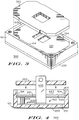
- FIG. 3 illustrates a semiconductor module 300 that includes unitary base structure 101 having encircling walls 103, an alignment mechanism 104, control circuit board 301 and package lid 302.
- the control circuit board 301 may be a standard printed circuit board material (FR4 board) with components on one or two sides (components not shown).
- Board 301 is generally used to control the power electronic components (shown in FIG. 4) mounted on semiconductor mounting area 102.
- Control circuit board 301 is aligned with alignment mechanism 104 so that no additional fixturing is required during assembly in order to position the control board 301 within unitary base structure 101.
- board 301 is shaped to fit within the slots of alignment mechanism 104, thereby being aligned.
- Package lid 302 is typically made out of an epoxy material or other plastic material capable of withstanding the operating temperatures of the package.
- the size of the package lid is large enough so as to barely fit within the encircling walls 103, or somewhat smaller so as to leave a distance between the lid and the walls 103.
- Alignment mechanism 104 is also used to position package lid 302 with respect to unitary base structure 101.
- FIG. 4 illustrates a cross-sectional view of the semiconductor module 300.
- the semiconductor module 300 further comprises semiconductor device 401 positioned in semiconductor mounting area 102.
- the module 300 additionally comprises control leads 404 connecting control circuit board 301 to semiconductor mounting area 102.
- Module 300 further comprises silicon gel 402 filling the module up past control circuit board 301.
- module 300 includes epoxy layer 403 filling the remainder of the module, up to the top of encircling walls 103.
- FIG. 4 additionally illustrates power lead 405 which provides an electrode to the semiconductor device.
- unitary base structure 101 is provided with ceramic layer 201 in place as described above.
- Semiconductor device 401 (along with others, depending upon the particular application) is positioned on ceramic layer 201.
- Ceramic layer 201 additionally includes metal traces as needed for circuit connections.
- circuit control board 301 is positioned within unitary body 101 using alignment mechanism 104 for alignment.
- Power leads 405 and control leads 404 are positioned in unitary body 101 in a similar manner, taking advantage of an alignment mechanism, depending upon the particular design.
- Silicon gel 402 is inserted into unitary body 101 to a level above control circuit board 301. Silicon gel 402 provides protection from the environment for the circuitry on board 301 as well as the circuitry in the semiconductor mounting area. Additionally, silicon gel 402 provides a support mechanism for control leads 404. In other embodiments, however, a physical support mechanism may take the form an extra slot formed in the side of unitary body 101. The slot would provide space and support for leads between board 301 and the semiconductor mounting area 102.
- the preferred embodiment of the present invention provides an improved method and apparatus for fabricating a semiconductor package and semiconductor module with advantages including resistance to bowing and inherent alignment. Consequently, the preferred embodiment of the present invention provides improved thermal contact to the cold plate of the operating environment and reduced failure rates. Additionally, assembly is greatly simplified due to inherent alignment.
Landscapes
- Cooling Or The Like Of Semiconductors Or Solid State Devices (AREA)
- Wire Bonding (AREA)
Applications Claiming Priority (2)
| Application Number | Priority Date | Filing Date | Title |
|---|---|---|---|
| US130824 | 1987-12-09 | ||
| US08/130,824 US5465481A (en) | 1993-10-04 | 1993-10-04 | Method for fabricating a semiconductor package |
Publications (2)
| Publication Number | Publication Date |
|---|---|
| EP0646958A2 true EP0646958A2 (de) | 1995-04-05 |
| EP0646958A3 EP0646958A3 (de) | 1997-01-29 |
Family
ID=22446523
Family Applications (1)
| Application Number | Title | Priority Date | Filing Date |
|---|---|---|---|
| EP94114986A Withdrawn EP0646958A3 (de) | 1993-10-04 | 1994-09-23 | Gehäuse und Modul für Halbleiter und Herstellungsverfahren. |
Country Status (4)
| Country | Link |
|---|---|
| US (1) | US5465481A (de) |
| EP (1) | EP0646958A3 (de) |
| JP (1) | JPH07161863A (de) |
| KR (1) | KR950012692A (de) |
Cited By (2)
| Publication number | Priority date | Publication date | Assignee | Title |
|---|---|---|---|---|
| EP1000915A3 (de) * | 1998-11-12 | 2000-09-06 | Denki Kagaku Kogyo Kabushiki Kaisha | Siliziumkarbid-Verbundwerkstoff, Verfahren zu seiner Herstellung und Wärmeableitungsanordnung, die diesen verwendet |
| EP1796164A4 (de) * | 2004-09-14 | 2011-11-09 | Denki Kagaku Kogyo Kk | Aluminium-silizium-carbid-verbindung |
Families Citing this family (8)
| Publication number | Priority date | Publication date | Assignee | Title |
|---|---|---|---|---|
| US5616886A (en) * | 1995-06-05 | 1997-04-01 | Motorola | Wirebondless module package |
| US5801074A (en) * | 1996-02-20 | 1998-09-01 | Kim; Jong Tae | Method of making an air tight cavity in an assembly package |
| US5898128A (en) * | 1996-09-11 | 1999-04-27 | Motorola, Inc. | Electronic component |
| US5943558A (en) * | 1996-09-23 | 1999-08-24 | Communications Technology, Inc. | Method of making an assembly package having an air tight cavity and a product made by the method |
| JP3496816B2 (ja) * | 1999-06-25 | 2004-02-16 | 電気化学工業株式会社 | 金属−セラミックス複合体とそれを用いた放熱部品 |
| AT408345B (de) * | 1999-11-17 | 2001-10-25 | Electrovac | Verfahren zur festlegung eines aus metall-matrix- composite-(mmc-) materiales gebildeten körpers auf einem keramischen körper |
| DE102011085629A1 (de) * | 2011-11-02 | 2013-05-02 | Robert Bosch Gmbh | Elektronikmodul zum Betrieb im Getriebe |
| US9431311B1 (en) | 2015-02-19 | 2016-08-30 | Semiconductor Components Industries, Llc | Semiconductor package with elastic coupler and related methods |
Family Cites Families (31)
| Publication number | Priority date | Publication date | Assignee | Title |
|---|---|---|---|---|
| BE760031A (fr) * | 1969-12-11 | 1971-05-17 | Rca Corp | Boitier pour module de puissance hybride a semiconducteurs |
| US4217684A (en) * | 1979-04-16 | 1980-08-19 | General Electric Company | Fabrication of front surface matched ultrasonic transducer array |
| US4355463A (en) * | 1980-03-24 | 1982-10-26 | National Semiconductor Corporation | Process for hermetically encapsulating semiconductor devices |
| US4390220A (en) * | 1981-04-02 | 1983-06-28 | Burroughs Corporation | Electrical connector assembly for an integrated circuit package |
| US4633573A (en) * | 1982-10-12 | 1987-01-06 | Aegis, Inc. | Microcircuit package and sealing method |
| JPS59138339A (ja) * | 1983-01-28 | 1984-08-08 | Toshiba Corp | 半導体装置 |
| US4577056A (en) * | 1984-04-09 | 1986-03-18 | Olin Corporation | Hermetically sealed metal package |
| US4853491A (en) * | 1984-10-03 | 1989-08-01 | Olin Corporation | Chip carrier |
| US4661653A (en) * | 1984-12-27 | 1987-04-28 | Seiichiro Aigo | Package assembly for semiconductor device |
| US4780572A (en) * | 1985-03-04 | 1988-10-25 | Ngk Spark Plug Co., Ltd. | Device for mounting semiconductors |
| US4635093A (en) * | 1985-06-03 | 1987-01-06 | General Electric Company | Electrical connection |
| DE3521572A1 (de) * | 1985-06-15 | 1986-12-18 | Brown, Boveri & Cie Ag, 6800 Mannheim | Leistungshalbleitermodul mit keramiksubstrat |
| DE3604882A1 (de) * | 1986-02-15 | 1987-08-20 | Bbc Brown Boveri & Cie | Leistungshalbleitermodul und verfahren zur herstellung des moduls |
| US4831212A (en) * | 1986-05-09 | 1989-05-16 | Nissin Electric Company, Limited | Package for packing semiconductor devices and process for producing the same |
| US4814943A (en) * | 1986-06-04 | 1989-03-21 | Oki Electric Industry Co., Ltd. | Printed circuit devices using thermoplastic resin cover plate |
| US4859640A (en) * | 1986-08-13 | 1989-08-22 | Lanxide Technology Company, Lp | Method of making ceramic composite articles with shape replicated surfaces |
| US4960736A (en) * | 1986-09-16 | 1990-10-02 | Lanxide Technology Company, Lp | Surface bonding of ceramic bodies |
| FR2634616B1 (fr) * | 1988-07-20 | 1995-08-25 | Matra | Procede de montage de micro-composants electroniques sur un support et produit realisable par le procede |
| US5163499A (en) * | 1988-11-10 | 1992-11-17 | Lanxide Technology Company, Lp | Method of forming electronic packages |
| US5222542A (en) * | 1988-11-10 | 1993-06-29 | Lanxide Technology Company, Lp | Method for forming metal matrix composite bodies with a dispersion casting technique |
| US5020583A (en) * | 1988-11-10 | 1991-06-04 | Lanxide Technology Company, Lp | Directional solidification of metal matrix composites |
| US5007475A (en) * | 1988-11-10 | 1991-04-16 | Lanxide Technology Company, Lp | Method for forming metal matrix composite bodies containing three-dimensionally interconnected co-matrices and products produced thereby |
| US5256901A (en) * | 1988-12-26 | 1993-10-26 | Ngk Insulators, Ltd. | Ceramic package for memory semiconductor |
| US4930857A (en) * | 1989-05-19 | 1990-06-05 | At&T Bell Laboratories | Hybrid package arrangement |
| JPH0325962A (ja) * | 1989-06-23 | 1991-02-04 | Fuji Electric Co Ltd | 半導体装置 |
| US5105536A (en) * | 1989-07-03 | 1992-04-21 | General Electric Company | Method of packaging a semiconductor chip in a low inductance package |
| US5221558A (en) * | 1990-01-12 | 1993-06-22 | Lanxide Technology Company, Lp | Method of making ceramic composite bodies |
| US5148264A (en) * | 1990-05-02 | 1992-09-15 | Harris Semiconductor Patents, Inc. | High current hermetic package |
| JP2623952B2 (ja) * | 1990-10-17 | 1997-06-25 | 日本電気株式会社 | 集積回路パッケージ |
| US5158912A (en) * | 1991-04-09 | 1992-10-27 | Digital Equipment Corporation | Integral heatsink semiconductor package |
| US5281849A (en) * | 1991-05-07 | 1994-01-25 | Singh Deo Narendra N | Semiconductor package with segmented lead frame |
-
1993
- 1993-10-04 US US08/130,824 patent/US5465481A/en not_active Expired - Fee Related
-
1994
- 1994-09-23 EP EP94114986A patent/EP0646958A3/de not_active Withdrawn
- 1994-09-30 KR KR1019940024850A patent/KR950012692A/ko not_active Withdrawn
- 1994-09-30 JP JP6259642A patent/JPH07161863A/ja active Pending
Cited By (3)
| Publication number | Priority date | Publication date | Assignee | Title |
|---|---|---|---|---|
| EP1000915A3 (de) * | 1998-11-12 | 2000-09-06 | Denki Kagaku Kogyo Kabushiki Kaisha | Siliziumkarbid-Verbundwerkstoff, Verfahren zu seiner Herstellung und Wärmeableitungsanordnung, die diesen verwendet |
| US6447894B1 (en) | 1998-11-12 | 2002-09-10 | Denki Kagaku Kogyo Kabushiki Kaisha | Silicon carbide composite, method for producing it and heat dissipation device employing it |
| EP1796164A4 (de) * | 2004-09-14 | 2011-11-09 | Denki Kagaku Kogyo Kk | Aluminium-silizium-carbid-verbindung |
Also Published As
| Publication number | Publication date |
|---|---|
| JPH07161863A (ja) | 1995-06-23 |
| EP0646958A3 (de) | 1997-01-29 |
| KR950012692A (ko) | 1995-05-16 |
| US5465481A (en) | 1995-11-14 |
Similar Documents
| Publication | Publication Date | Title |
|---|---|---|
| JP2725637B2 (ja) | 電子回路装置およびその製造方法 | |
| US5533257A (en) | Method for forming a heat dissipation apparatus | |
| JPH07211832A (ja) | 電力放散装置とその製造方法 | |
| US5508559A (en) | Power circuit package | |
| JP2003068931A (ja) | 半導体パッケージ及びその製造方法 | |
| US8039757B2 (en) | Electronic part mounting substrate and method for producing same | |
| US5465481A (en) | Method for fabricating a semiconductor package | |
| US6858931B2 (en) | Heat sink with collapse structure for semiconductor package | |
| US6828676B2 (en) | Semiconductor device manufacturing method, semiconductor device, and semiconductor device unit | |
| EP0484180A1 (de) | Verkapselte Halbleiteranordnung mit optimierter Wärmeabführung | |
| JP3793562B2 (ja) | セラミック回路基板 | |
| US5480727A (en) | Electronic device assembly and method for making | |
| EP0434392B1 (de) | Adhäsionsstruktur für Halbleiterbauelement und Verfahren zu ihrer Herstellung | |
| JP2004022964A (ja) | Al−SiC系複合体およびそれを用いた放熱部品、半導体モジュール装置 | |
| CN117080171A (zh) | 功率半导体模块装置及其制造方法 | |
| JPH11238838A (ja) | 混成集積回路装置 | |
| JP2006013420A (ja) | 電子部品収納用パッケージおよび電子装置 | |
| JPH0382142A (ja) | 半導体装置 | |
| JPH1056110A (ja) | 半導体用プラスチックパッケージと半導体装置 | |
| JP2000114442A (ja) | 電子部品用パッケージ | |
| KR20250001881A (ko) | 세라믹 회로 기판, 그 제조방법, 및 이를 구비한 양면 냉각형 파워 모듈 | |
| JP2005136220A (ja) | 半導体装置 | |
| JPH05152459A (ja) | 混成集積回路装置 | |
| JP2005252144A (ja) | 金属ベース回路基板 | |
| JPH0951070A (ja) | パッケージ |
Legal Events
| Date | Code | Title | Description |
|---|---|---|---|
| PUAI | Public reference made under article 153(3) epc to a published international application that has entered the european phase |
Free format text: ORIGINAL CODE: 0009012 |
|
| AK | Designated contracting states |
Kind code of ref document: A2 Designated state(s): DE FR GB IT |
|
| PUAL | Search report despatched |
Free format text: ORIGINAL CODE: 0009013 |
|
| AK | Designated contracting states |
Kind code of ref document: A3 Designated state(s): DE FR GB IT |
|
| 17P | Request for examination filed |
Effective date: 19970729 |
|
| 17Q | First examination report despatched |
Effective date: 19980826 |
|
| STAA | Information on the status of an ep patent application or granted ep patent |
Free format text: STATUS: THE APPLICATION IS DEEMED TO BE WITHDRAWN |
|
| 18D | Application deemed to be withdrawn |
Effective date: 19990106 |