EP0647136B1 - Verwendung von kondensierte bis-(3,4-dihydro-pyridinyl)methane zur behandlung von morbus crohn, colitis ulcerosa, chronisch inflammatorischen prozessen und als antiproliferative mitteln - Google Patents
Verwendung von kondensierte bis-(3,4-dihydro-pyridinyl)methane zur behandlung von morbus crohn, colitis ulcerosa, chronisch inflammatorischen prozessen und als antiproliferative mitteln Download PDFInfo
- Publication number
- EP0647136B1 EP0647136B1 EP93914664A EP93914664A EP0647136B1 EP 0647136 B1 EP0647136 B1 EP 0647136B1 EP 93914664 A EP93914664 A EP 93914664A EP 93914664 A EP93914664 A EP 93914664A EP 0647136 B1 EP0647136 B1 EP 0647136B1
- Authority
- EP
- European Patent Office
- Prior art keywords
- alkyl
- denote
- group
- denotes
- hydrogen
- Prior art date
- Legal status (The legal status is an assumption and is not a legal conclusion. Google has not performed a legal analysis and makes no representation as to the accuracy of the status listed.)
- Expired - Lifetime
Links
- 230000001028 anti-proliverative effect Effects 0.000 title claims abstract description 8
- 208000011231 Crohn disease Diseases 0.000 title claims abstract description 7
- 206010009887 colitis Diseases 0.000 title abstract 2
- 238000000034 method Methods 0.000 title description 12
- 230000001684 chronic effect Effects 0.000 title description 2
- 230000008569 process Effects 0.000 title description 2
- PGLANSGXWYGGLT-UHFFFAOYSA-N 2-(3,4-dihydropyridin-2-ylmethyl)-3,4-dihydropyridine Chemical compound C(C1=NC=CCC1)C1=NC=CCC1 PGLANSGXWYGGLT-UHFFFAOYSA-N 0.000 title 1
- 150000003839 salts Chemical class 0.000 claims abstract description 6
- 230000006020 chronic inflammation Effects 0.000 claims abstract description 4
- 150000001875 compounds Chemical class 0.000 claims description 36
- UFHFLCQGNIYNRP-UHFFFAOYSA-N Hydrogen Chemical compound [H][H] UFHFLCQGNIYNRP-UHFFFAOYSA-N 0.000 claims description 35
- 229910052739 hydrogen Inorganic materials 0.000 claims description 30
- 239000001257 hydrogen Substances 0.000 claims description 27
- -1 amino, thiomethyl Chemical group 0.000 claims description 23
- 125000000217 alkyl group Chemical group 0.000 claims description 21
- 125000000229 (C1-C4)alkoxy group Chemical group 0.000 claims description 18
- 125000002887 hydroxy group Chemical group [H]O* 0.000 claims description 16
- 125000004178 (C1-C4) alkyl group Chemical group 0.000 claims description 11
- 125000001424 substituent group Chemical group 0.000 claims description 10
- 125000000008 (C1-C10) alkyl group Chemical group 0.000 claims description 9
- 229910052799 carbon Inorganic materials 0.000 claims description 9
- 125000004432 carbon atom Chemical group C* 0.000 claims description 9
- 125000001997 phenyl group Chemical group [H]C1=C([H])C([H])=C(*)C([H])=C1[H] 0.000 claims description 9
- 125000001054 5 membered carbocyclic group Chemical group 0.000 claims description 8
- 125000005605 benzo group Chemical group 0.000 claims description 7
- 125000004008 6 membered carbocyclic group Chemical group 0.000 claims description 6
- 229910052794 bromium Inorganic materials 0.000 claims description 6
- 229910052801 chlorine Inorganic materials 0.000 claims description 6
- 229910052731 fluorine Inorganic materials 0.000 claims description 6
- 229910052736 halogen Inorganic materials 0.000 claims description 6
- 150000002367 halogens Chemical class 0.000 claims description 6
- 125000004029 hydroxymethyl group Chemical group [H]OC([H])([H])* 0.000 claims description 6
- 206010009900 Colitis ulcerative Diseases 0.000 claims description 5
- 201000006704 Ulcerative Colitis Diseases 0.000 claims description 5
- 150000002431 hydrogen Chemical class 0.000 claims description 4
- 125000000956 methoxy group Chemical group [H]C([H])([H])O* 0.000 claims description 4
- 238000002360 preparation method Methods 0.000 claims description 4
- 125000004169 (C1-C6) alkyl group Chemical group 0.000 claims description 3
- 125000002496 methyl group Chemical group [H]C([H])([H])* 0.000 claims description 3
- 230000004927 fusion Effects 0.000 claims description 2
- 150000007522 mineralic acids Chemical class 0.000 claims description 2
- 150000007524 organic acids Chemical class 0.000 claims description 2
- 229910052740 iodine Inorganic materials 0.000 claims 2
- 239000008194 pharmaceutical composition Substances 0.000 claims 2
- 210000004027 cell Anatomy 0.000 description 36
- 239000011575 calcium Substances 0.000 description 24
- 239000000126 substance Substances 0.000 description 16
- 108050009340 Endothelin Proteins 0.000 description 14
- 102000002045 Endothelin Human genes 0.000 description 14
- HATRDXDCPOXQJX-UHFFFAOYSA-N Thapsigargin Natural products CCCCCCCC(=O)OC1C(OC(O)C(=C/C)C)C(=C2C3OC(=O)C(C)(O)C3(O)C(CC(C)(OC(=O)C)C12)OC(=O)CCC)C HATRDXDCPOXQJX-UHFFFAOYSA-N 0.000 description 14
- ZUBDGKVDJUIMQQ-UBFCDGJISA-N endothelin-1 Chemical compound C([C@@H](C(=O)N[C@@H](CC(C)C)C(=O)N[C@@H](CC(O)=O)C(=O)N[C@@H]([C@@H](C)CC)C(=O)N[C@@H]([C@@H](C)CC)C(=O)N[C@@H](CC=1C2=CC=CC=C2NC=1)C(O)=O)NC(=O)[C@H]1NC(=O)[C@H](CC=2C=CC=CC=2)NC(=O)[C@@H](CC=2C=CC(O)=CC=2)NC(=O)[C@H](C(C)C)NC(=O)[C@H]2CSSC[C@@H](C(N[C@H](CO)C(=O)N[C@@H](CO)C(=O)N[C@H](CC(C)C)C(=O)N[C@@H](CCSC)C(=O)N[C@H](CC(O)=O)C(=O)N[C@@H](CCCCN)C(=O)N[C@@H](CCC(O)=O)C(=O)N2)=O)NC(=O)[C@@H](CO)NC(=O)[C@H](N)CSSC1)C1=CNC=N1 ZUBDGKVDJUIMQQ-UBFCDGJISA-N 0.000 description 14
- 108091005462 Cation channels Proteins 0.000 description 13
- IXFPJGBNCFXKPI-FSIHEZPISA-N thapsigargin Chemical compound CCCC(=O)O[C@H]1C[C@](C)(OC(C)=O)[C@H]2[C@H](OC(=O)CCCCCCC)[C@@H](OC(=O)C(\C)=C/C)C(C)=C2[C@@H]2OC(=O)[C@@](C)(O)[C@]21O IXFPJGBNCFXKPI-FSIHEZPISA-N 0.000 description 13
- GUBGYTABKSRVRQ-QKKXKWKRSA-N Lactose Chemical compound OC[C@H]1O[C@@H](O[C@H]2[C@H](O)[C@@H](O)C(O)O[C@@H]2CO)[C@H](O)[C@@H](O)[C@H]1O GUBGYTABKSRVRQ-QKKXKWKRSA-N 0.000 description 12
- 230000005764 inhibitory process Effects 0.000 description 12
- 238000012360 testing method Methods 0.000 description 11
- 210000003630 histaminocyte Anatomy 0.000 description 9
- HQKMJHAJHXVSDF-UHFFFAOYSA-L magnesium stearate Chemical compound [Mg+2].CCCCCCCCCCCCCCCCCC([O-])=O.CCCCCCCCCCCCCCCCCC([O-])=O HQKMJHAJHXVSDF-UHFFFAOYSA-L 0.000 description 8
- 230000020411 cell activation Effects 0.000 description 7
- 230000004941 influx Effects 0.000 description 7
- 229920002261 Corn starch Polymers 0.000 description 6
- 239000004480 active ingredient Substances 0.000 description 6
- 239000008120 corn starch Substances 0.000 description 6
- 229940099112 cornstarch Drugs 0.000 description 6
- YFHXZQPUBCBNIP-UHFFFAOYSA-N fura-2 Chemical compound CC1=CC=C(N(CC(O)=O)CC(O)=O)C(OCCOC=2C(=CC=3OC(=CC=3C=2)C=2OC(=CN=2)C(O)=O)N(CC(O)=O)CC(O)=O)=C1 YFHXZQPUBCBNIP-UHFFFAOYSA-N 0.000 description 6
- 230000004913 activation Effects 0.000 description 5
- 238000001994 activation Methods 0.000 description 5
- 208000006673 asthma Diseases 0.000 description 5
- 229910052791 calcium Inorganic materials 0.000 description 5
- 230000001086 cytosolic effect Effects 0.000 description 5
- 238000004519 manufacturing process Methods 0.000 description 5
- 230000001404 mediated effect Effects 0.000 description 5
- 239000000243 solution Substances 0.000 description 5
- OYPRJOBELJOOCE-UHFFFAOYSA-N Calcium Chemical compound [Ca] OYPRJOBELJOOCE-UHFFFAOYSA-N 0.000 description 4
- 108091006146 Channels Proteins 0.000 description 4
- NTYJJOPFIAHURM-UHFFFAOYSA-N Histamine Chemical compound NCCC1=CN=CN1 NTYJJOPFIAHURM-UHFFFAOYSA-N 0.000 description 4
- 241000288906 Primates Species 0.000 description 4
- 241000700159 Rattus Species 0.000 description 4
- 230000003834 intracellular effect Effects 0.000 description 4
- 235000019359 magnesium stearate Nutrition 0.000 description 4
- 238000005259 measurement Methods 0.000 description 4
- 125000005948 methanesulfonyloxy group Chemical group 0.000 description 4
- 239000000203 mixture Substances 0.000 description 4
- 238000012216 screening Methods 0.000 description 4
- 230000000638 stimulation Effects 0.000 description 4
- QTBSBXVTEAMEQO-UHFFFAOYSA-N Acetic acid Chemical compound CC(O)=O QTBSBXVTEAMEQO-UHFFFAOYSA-N 0.000 description 3
- 0 CCCC(CCCC1(C)C)[C@]1C(*(C)CC)=C(*)C(C1C(CC2)CCC(C)(*)CC1)=C2*=C Chemical compound CCCC(CCCC1(C)C)[C@]1C(*(C)CC)=C(*)C(C1C(CC2)CCC(C)(*)CC1)=C2*=C 0.000 description 3
- 229940127291 Calcium channel antagonist Drugs 0.000 description 3
- IAZDPXIOMUYVGZ-UHFFFAOYSA-N Dimethylsulphoxide Chemical compound CS(C)=O IAZDPXIOMUYVGZ-UHFFFAOYSA-N 0.000 description 3
- VEXZGXHMUGYJMC-UHFFFAOYSA-N Hydrochloric acid Chemical compound Cl VEXZGXHMUGYJMC-UHFFFAOYSA-N 0.000 description 3
- OFOBLEOULBTSOW-UHFFFAOYSA-N Malonic acid Chemical compound OC(=O)CC(O)=O OFOBLEOULBTSOW-UHFFFAOYSA-N 0.000 description 3
- MUBZPKHOEPUJKR-UHFFFAOYSA-N Oxalic acid Chemical compound OC(=O)C(O)=O MUBZPKHOEPUJKR-UHFFFAOYSA-N 0.000 description 3
- 239000000556 agonist Substances 0.000 description 3
- 230000008485 antagonism Effects 0.000 description 3
- 239000005557 antagonist Substances 0.000 description 3
- 239000000427 antigen Substances 0.000 description 3
- 102000036639 antigens Human genes 0.000 description 3
- 108091007433 antigens Proteins 0.000 description 3
- 230000001964 calcium overload Effects 0.000 description 3
- 238000012512 characterization method Methods 0.000 description 3
- KRKNYBCHXYNGOX-UHFFFAOYSA-N citric acid Chemical compound OC(=O)CC(O)(C(O)=O)CC(O)=O KRKNYBCHXYNGOX-UHFFFAOYSA-N 0.000 description 3
- 210000000805 cytoplasm Anatomy 0.000 description 3
- 239000003814 drug Substances 0.000 description 3
- 210000004969 inflammatory cell Anatomy 0.000 description 3
- 230000002401 inhibitory effect Effects 0.000 description 3
- 230000007246 mechanism Effects 0.000 description 3
- 230000010412 perfusion Effects 0.000 description 3
- 102000005962 receptors Human genes 0.000 description 3
- 108020003175 receptors Proteins 0.000 description 3
- 210000004881 tumor cell Anatomy 0.000 description 3
- 230000003235 vasospasmolytic effect Effects 0.000 description 3
- CIWBSHSKHKDKBQ-JLAZNSOCSA-N Ascorbic acid Chemical compound OC[C@H](O)[C@H]1OC(=O)C(O)=C1O CIWBSHSKHKDKBQ-JLAZNSOCSA-N 0.000 description 2
- FERIUCNNQQJTOY-UHFFFAOYSA-N Butyric acid Chemical compound CCCC(O)=O FERIUCNNQQJTOY-UHFFFAOYSA-N 0.000 description 2
- VZCYOOQTPOCHFL-OWOJBTEDSA-N Fumaric acid Chemical compound OC(=O)\C=C\C(O)=O VZCYOOQTPOCHFL-OWOJBTEDSA-N 0.000 description 2
- 108010010803 Gelatin Proteins 0.000 description 2
- 101100102514 Haliotis rufescens VERL gene Proteins 0.000 description 2
- KFZMGEQAYNKOFK-UHFFFAOYSA-N Isopropanol Chemical compound CC(C)O KFZMGEQAYNKOFK-UHFFFAOYSA-N 0.000 description 2
- NBIIXXVUZAFLBC-UHFFFAOYSA-N Phosphoric acid Chemical compound OP(O)(O)=O NBIIXXVUZAFLBC-UHFFFAOYSA-N 0.000 description 2
- 229920002472 Starch Polymers 0.000 description 2
- QAOWNCQODCNURD-UHFFFAOYSA-N Sulfuric acid Chemical compound OS(O)(=O)=O QAOWNCQODCNURD-UHFFFAOYSA-N 0.000 description 2
- GWEVSGVZZGPLCZ-UHFFFAOYSA-N Titan oxide Chemical compound O=[Ti]=O GWEVSGVZZGPLCZ-UHFFFAOYSA-N 0.000 description 2
- 239000002253 acid Substances 0.000 description 2
- 230000001464 adherent effect Effects 0.000 description 2
- 239000000853 adhesive Substances 0.000 description 2
- 230000001070 adhesive effect Effects 0.000 description 2
- WPYMKLBDIGXBTP-UHFFFAOYSA-N benzoic acid Chemical compound OC(=O)C1=CC=CC=C1 WPYMKLBDIGXBTP-UHFFFAOYSA-N 0.000 description 2
- 230000015572 biosynthetic process Effects 0.000 description 2
- 230000009460 calcium influx Effects 0.000 description 2
- 229910001424 calcium ion Inorganic materials 0.000 description 2
- 230000004663 cell proliferation Effects 0.000 description 2
- 239000006285 cell suspension Substances 0.000 description 2
- 210000001072 colon Anatomy 0.000 description 2
- 238000001514 detection method Methods 0.000 description 2
- XBDQKXXYIPTUBI-UHFFFAOYSA-N dimethylselenoniopropionate Natural products CCC(O)=O XBDQKXXYIPTUBI-UHFFFAOYSA-N 0.000 description 2
- 108010067755 dinitrophenyl-bovine serum albumin Proteins 0.000 description 2
- 230000000694 effects Effects 0.000 description 2
- ZUBDGKVDJUIMQQ-ZTNLKOGPSA-N endothelin i Chemical compound C([C@@H](C(=O)N[C@@H](CC(C)C)C(=O)N[C@@H](CC(O)=O)C(=O)N[C@@H]([C@@H](C)CC)C(=O)N[C@@H]([C@@H](C)CC)C(=O)N[C@@H](CC=1C2=CC=CC=C2NC=1)C(O)=O)NC(=O)[C@H]1NC(=O)[C@H](CC=2C=CC=CC=2)NC(=O)[C@H](CC=2C=CC(O)=CC=2)NC(=O)[C@H](C(C)C)NC(=O)[C@@H]2CSSC[C@@H](C(N[C@@H](CO)C(=O)N[C@@H](CO)C(=O)N[C@@H](CC(C)C)C(=O)N[C@@H](CCSC)C(=O)N[C@@H](CC(O)=O)C(=O)N[C@@H](CCCCN)C(=O)N[C@@H](CCC(O)=O)C(=O)N2)=O)NC(=O)[C@H](CO)NC(=O)[C@@H](N)CSSC1)C1=CNC=N1 ZUBDGKVDJUIMQQ-ZTNLKOGPSA-N 0.000 description 2
- 108010074605 gamma-Globulins Proteins 0.000 description 2
- 229920000159 gelatin Polymers 0.000 description 2
- 239000008273 gelatin Substances 0.000 description 2
- 235000019322 gelatine Nutrition 0.000 description 2
- 235000011852 gelatine desserts Nutrition 0.000 description 2
- 239000008187 granular material Substances 0.000 description 2
- 229960001340 histamine Drugs 0.000 description 2
- 238000011534 incubation Methods 0.000 description 2
- 230000004054 inflammatory process Effects 0.000 description 2
- 238000011835 investigation Methods 0.000 description 2
- JVTAAEKCZFNVCJ-UHFFFAOYSA-N lactic acid Chemical compound CC(O)C(O)=O JVTAAEKCZFNVCJ-UHFFFAOYSA-N 0.000 description 2
- 208000032839 leukemia Diseases 0.000 description 2
- 230000031700 light absorption Effects 0.000 description 2
- 239000002609 medium Substances 0.000 description 2
- MYWUZJCMWCOHBA-VIFPVBQESA-N methamphetamine Chemical compound CN[C@@H](C)CC1=CC=CC=C1 MYWUZJCMWCOHBA-VIFPVBQESA-N 0.000 description 2
- 210000002569 neuron Anatomy 0.000 description 2
- 230000008506 pathogenesis Effects 0.000 description 2
- 239000000825 pharmaceutical preparation Substances 0.000 description 2
- BOLDJAUMGUJJKM-LSDHHAIUSA-N renifolin D Natural products CC(=C)[C@@H]1Cc2c(O)c(O)ccc2[C@H]1CC(=O)c3ccc(O)cc3O BOLDJAUMGUJJKM-LSDHHAIUSA-N 0.000 description 2
- 235000019698 starch Nutrition 0.000 description 2
- 239000008107 starch Substances 0.000 description 2
- 239000000454 talc Substances 0.000 description 2
- 229910052623 talc Inorganic materials 0.000 description 2
- VZCYOOQTPOCHFL-UHFFFAOYSA-N trans-butenedioic acid Natural products OC(=O)C=CC(O)=O VZCYOOQTPOCHFL-UHFFFAOYSA-N 0.000 description 2
- 230000004614 tumor growth Effects 0.000 description 2
- 239000000717 tumor promoter Substances 0.000 description 2
- 230000002792 vascular Effects 0.000 description 2
- PXGPLTODNUVGFL-BRIYLRKRSA-N (E,Z)-(1R,2R,3R,5S)-7-(3,5-Dihydroxy-2-((3S)-(3-hydroxy-1-octenyl))cyclopentyl)-5-heptenoic acid Chemical compound CCCCC[C@H](O)C=C[C@H]1[C@H](O)C[C@H](O)[C@@H]1CC=CCCCC(O)=O PXGPLTODNUVGFL-BRIYLRKRSA-N 0.000 description 1
- BJEPYKJPYRNKOW-REOHCLBHSA-N (S)-malic acid Chemical compound OC(=O)[C@@H](O)CC(O)=O BJEPYKJPYRNKOW-REOHCLBHSA-N 0.000 description 1
- WBYWAXJHAXSJNI-VOTSOKGWSA-M .beta-Phenylacrylic acid Natural products [O-]C(=O)\C=C\C1=CC=CC=C1 WBYWAXJHAXSJNI-VOTSOKGWSA-M 0.000 description 1
- MMWCIQZXVOZEGG-UHFFFAOYSA-N 1,4,5-IP3 Natural products OC1C(O)C(OP(O)(O)=O)C(OP(O)(O)=O)C(O)C1OP(O)(O)=O MMWCIQZXVOZEGG-UHFFFAOYSA-N 0.000 description 1
- YNGDWRXWKFWCJY-UHFFFAOYSA-N 1,4-Dihydropyridine Chemical compound C1C=CNC=C1 YNGDWRXWKFWCJY-UHFFFAOYSA-N 0.000 description 1
- HGDSYZMHRDLVDE-UHFFFAOYSA-N 1-(3,4-dihydro-2h-pyridin-1-ylmethyl)-3,4-dihydro-2h-pyridine Chemical class C1CCC=CN1CN1CCCC=C1 HGDSYZMHRDLVDE-UHFFFAOYSA-N 0.000 description 1
- SGTNSNPWRIOYBX-UHFFFAOYSA-N 2-(3,4-dimethoxyphenyl)-5-{[2-(3,4-dimethoxyphenyl)ethyl](methyl)amino}-2-(propan-2-yl)pentanenitrile Chemical compound C1=C(OC)C(OC)=CC=C1CCN(C)CCCC(C#N)(C(C)C)C1=CC=C(OC)C(OC)=C1 SGTNSNPWRIOYBX-UHFFFAOYSA-N 0.000 description 1
- AZKSAVLVSZKNRD-UHFFFAOYSA-M 3-(4,5-dimethylthiazol-2-yl)-2,5-diphenyltetrazolium bromide Chemical compound [Br-].S1C(C)=C(C)N=C1[N+]1=NC(C=2C=CC=CC=2)=NN1C1=CC=CC=C1 AZKSAVLVSZKNRD-UHFFFAOYSA-M 0.000 description 1
- BMYNFMYTOJXKLE-UHFFFAOYSA-N 3-azaniumyl-2-hydroxypropanoate Chemical compound NCC(O)C(O)=O BMYNFMYTOJXKLE-UHFFFAOYSA-N 0.000 description 1
- 108091006112 ATPases Proteins 0.000 description 1
- 244000215068 Acacia senegal Species 0.000 description 1
- 102000057290 Adenosine Triphosphatases Human genes 0.000 description 1
- 208000032791 BCR-ABL1 positive chronic myelogenous leukemia Diseases 0.000 description 1
- 239000005711 Benzoic acid Substances 0.000 description 1
- 108091003079 Bovine Serum Albumin Proteins 0.000 description 1
- BHPQYMZQTOCNFJ-UHFFFAOYSA-N Calcium cation Chemical compound [Ca+2] BHPQYMZQTOCNFJ-UHFFFAOYSA-N 0.000 description 1
- 241000354018 Catamixis Species 0.000 description 1
- 208000010833 Chronic myeloid leukaemia Diseases 0.000 description 1
- WBYWAXJHAXSJNI-SREVYHEPSA-N Cinnamic acid Chemical compound OC(=O)\C=C/C1=CC=CC=C1 WBYWAXJHAXSJNI-SREVYHEPSA-N 0.000 description 1
- MMWCIQZXVOZEGG-XJTPDSDZSA-N D-myo-Inositol 1,4,5-trisphosphate Chemical compound O[C@@H]1[C@H](O)[C@@H](OP(O)(O)=O)[C@H](OP(O)(O)=O)[C@@H](O)[C@@H]1OP(O)(O)=O MMWCIQZXVOZEGG-XJTPDSDZSA-N 0.000 description 1
- FEWJPZIEWOKRBE-JCYAYHJZSA-N Dextrotartaric acid Chemical compound OC(=O)[C@H](O)[C@@H](O)C(O)=O FEWJPZIEWOKRBE-JCYAYHJZSA-N 0.000 description 1
- CEAZRRDELHUEMR-URQXQFDESA-N Gentamicin Chemical compound O1[C@H](C(C)NC)CC[C@@H](N)[C@H]1O[C@H]1[C@H](O)[C@@H](O[C@@H]2[C@@H]([C@@H](NC)[C@@](C)(O)CO2)O)[C@H](N)C[C@@H]1N CEAZRRDELHUEMR-URQXQFDESA-N 0.000 description 1
- 229930182566 Gentamicin Natural products 0.000 description 1
- 229920000084 Gum arabic Polymers 0.000 description 1
- 208000022559 Inflammatory bowel disease Diseases 0.000 description 1
- 206010025323 Lymphomas Diseases 0.000 description 1
- 206010027476 Metastases Diseases 0.000 description 1
- 208000033761 Myelogenous Chronic BCR-ABL Positive Leukemia Diseases 0.000 description 1
- PRQROPMIIGLWRP-UHFFFAOYSA-N N-formyl-methionyl-leucyl-phenylalanin Chemical compound CSCCC(NC=O)C(=O)NC(CC(C)C)C(=O)NC(C(O)=O)CC1=CC=CC=C1 PRQROPMIIGLWRP-UHFFFAOYSA-N 0.000 description 1
- 206010028980 Neoplasm Diseases 0.000 description 1
- GRYLNZFGIOXLOG-UHFFFAOYSA-N Nitric acid Chemical compound O[N+]([O-])=O GRYLNZFGIOXLOG-UHFFFAOYSA-N 0.000 description 1
- HVAUUPRFYPCOCA-AREMUKBSSA-O PAF Chemical compound CCCCCCCCCCCCCCCCOC[C@@H](OC(C)=O)COP(O)(=O)OCC[N+](C)(C)C HVAUUPRFYPCOCA-AREMUKBSSA-O 0.000 description 1
- 239000012980 RPMI-1640 medium Substances 0.000 description 1
- KDYFGRWQOYBRFD-UHFFFAOYSA-N Succinic acid Natural products OC(=O)CCC(O)=O KDYFGRWQOYBRFD-UHFFFAOYSA-N 0.000 description 1
- FEWJPZIEWOKRBE-UHFFFAOYSA-N Tartaric acid Natural products [H+].[H+].[O-]C(=O)C(O)C(O)C([O-])=O FEWJPZIEWOKRBE-UHFFFAOYSA-N 0.000 description 1
- 206010047163 Vasospasm Diseases 0.000 description 1
- 235000010489 acacia gum Nutrition 0.000 description 1
- 239000000205 acacia gum Substances 0.000 description 1
- 150000007513 acids Chemical class 0.000 description 1
- 239000013543 active substance Substances 0.000 description 1
- 208000009956 adenocarcinoma Diseases 0.000 description 1
- BJEPYKJPYRNKOW-UHFFFAOYSA-N alpha-hydroxysuccinic acid Natural products OC(=O)C(O)CC(O)=O BJEPYKJPYRNKOW-UHFFFAOYSA-N 0.000 description 1
- 229910000147 aluminium phosphate Inorganic materials 0.000 description 1
- 230000003110 anti-inflammatory effect Effects 0.000 description 1
- 239000007864 aqueous solution Substances 0.000 description 1
- 239000007900 aqueous suspension Substances 0.000 description 1
- 235000010323 ascorbic acid Nutrition 0.000 description 1
- 229960005070 ascorbic acid Drugs 0.000 description 1
- 239000011668 ascorbic acid Substances 0.000 description 1
- 238000003556 assay Methods 0.000 description 1
- 238000010009 beating Methods 0.000 description 1
- 235000013871 bee wax Nutrition 0.000 description 1
- 239000012166 beeswax Substances 0.000 description 1
- 235000010233 benzoic acid Nutrition 0.000 description 1
- 230000000903 blocking effect Effects 0.000 description 1
- 229940098773 bovine serum albumin Drugs 0.000 description 1
- 201000008274 breast adenocarcinoma Diseases 0.000 description 1
- KDYFGRWQOYBRFD-NUQCWPJISA-N butanedioic acid Chemical compound O[14C](=O)CC[14C](O)=O KDYFGRWQOYBRFD-NUQCWPJISA-N 0.000 description 1
- 150000001669 calcium Chemical class 0.000 description 1
- 239000000480 calcium channel blocker Substances 0.000 description 1
- 201000011510 cancer Diseases 0.000 description 1
- 239000002775 capsule Substances 0.000 description 1
- 238000004113 cell culture Methods 0.000 description 1
- 210000000170 cell membrane Anatomy 0.000 description 1
- 230000003399 chemotactic effect Effects 0.000 description 1
- 235000013985 cinnamic acid Nutrition 0.000 description 1
- 229930016911 cinnamic acid Natural products 0.000 description 1
- 235000015165 citric acid Nutrition 0.000 description 1
- 230000000052 comparative effect Effects 0.000 description 1
- 230000002596 correlated effect Effects 0.000 description 1
- 210000003618 cortical neuron Anatomy 0.000 description 1
- IMZMKUWMOSJXDT-UHFFFAOYSA-N cromoglycic acid Chemical compound O1C(C(O)=O)=CC(=O)C2=C1C=CC=C2OCC(O)COC1=CC=CC2=C1C(=O)C=C(C(O)=O)O2 IMZMKUWMOSJXDT-UHFFFAOYSA-N 0.000 description 1
- 239000012895 dilution Substances 0.000 description 1
- 238000010790 dilution Methods 0.000 description 1
- 201000010099 disease Diseases 0.000 description 1
- 208000037265 diseases, disorders, signs and symptoms Diseases 0.000 description 1
- 239000002552 dosage form Substances 0.000 description 1
- 231100000673 dose–response relationship Toxicity 0.000 description 1
- 239000008298 dragée Substances 0.000 description 1
- 229940079593 drug Drugs 0.000 description 1
- 210000000981 epithelium Anatomy 0.000 description 1
- 239000012894 fetal calf serum Substances 0.000 description 1
- 239000001530 fumaric acid Substances 0.000 description 1
- 235000011087 fumaric acid Nutrition 0.000 description 1
- 239000007903 gelatin capsule Substances 0.000 description 1
- 239000011521 glass Substances 0.000 description 1
- 210000003714 granulocyte Anatomy 0.000 description 1
- 229940093915 gynecological organic acid Drugs 0.000 description 1
- 238000003384 imaging method Methods 0.000 description 1
- 230000001900 immune effect Effects 0.000 description 1
- 208000030603 inherited susceptibility to asthma Diseases 0.000 description 1
- 208000028867 ischemia Diseases 0.000 description 1
- 239000004310 lactic acid Substances 0.000 description 1
- 235000014655 lactic acid Nutrition 0.000 description 1
- 210000002429 large intestine Anatomy 0.000 description 1
- GWNVDXQDILPJIG-NXOLIXFESA-N leukotriene C4 Chemical compound CCCCC\C=C/C\C=C/C=C/C=C/[C@H]([C@@H](O)CCCC(O)=O)SC[C@@H](C(=O)NCC(O)=O)NC(=O)CC[C@H](N)C(O)=O GWNVDXQDILPJIG-NXOLIXFESA-N 0.000 description 1
- 150000002617 leukotrienes Chemical class 0.000 description 1
- 201000005249 lung adenocarcinoma Diseases 0.000 description 1
- VZCYOOQTPOCHFL-UPHRSURJSA-N maleic acid Chemical compound OC(=O)\C=C/C(O)=O VZCYOOQTPOCHFL-UPHRSURJSA-N 0.000 description 1
- 239000011976 maleic acid Substances 0.000 description 1
- 239000001630 malic acid Substances 0.000 description 1
- 235000011090 malic acid Nutrition 0.000 description 1
- 230000009401 metastasis Effects 0.000 description 1
- WBYWAXJHAXSJNI-UHFFFAOYSA-N methyl p-hydroxycinnamate Natural products OC(=O)C=CC1=CC=CC=C1 WBYWAXJHAXSJNI-UHFFFAOYSA-N 0.000 description 1
- 230000007576 microinfarct Effects 0.000 description 1
- 210000003470 mitochondria Anatomy 0.000 description 1
- 210000004877 mucosa Anatomy 0.000 description 1
- 210000004400 mucous membrane Anatomy 0.000 description 1
- 230000036457 multidrug resistance Effects 0.000 description 1
- 210000000107 myocyte Anatomy 0.000 description 1
- VMGAPWLDMVPYIA-HIDZBRGKSA-N n'-amino-n-iminomethanimidamide Chemical compound N\N=C\N=N VMGAPWLDMVPYIA-HIDZBRGKSA-N 0.000 description 1
- 230000003448 neutrophilic effect Effects 0.000 description 1
- 229910017604 nitric acid Inorganic materials 0.000 description 1
- 238000010606 normalization Methods 0.000 description 1
- 231100000590 oncogenic Toxicity 0.000 description 1
- 230000002246 oncogenic effect Effects 0.000 description 1
- 235000005985 organic acids Nutrition 0.000 description 1
- 235000006408 oxalic acid Nutrition 0.000 description 1
- 230000001991 pathophysiological effect Effects 0.000 description 1
- 230000007310 pathophysiology Effects 0.000 description 1
- 230000002688 persistence Effects 0.000 description 1
- 230000001766 physiological effect Effects 0.000 description 1
- 230000003389 potentiating effect Effects 0.000 description 1
- 108090000765 processed proteins & peptides Proteins 0.000 description 1
- 238000012545 processing Methods 0.000 description 1
- 235000019260 propionic acid Nutrition 0.000 description 1
- 201000005825 prostate adenocarcinoma Diseases 0.000 description 1
- IUVKMZGDUIUOCP-BTNSXGMBSA-N quinbolone Chemical compound O([C@H]1CC[C@H]2[C@H]3[C@@H]([C@]4(C=CC(=O)C=C4CC3)C)CC[C@@]21C)C1=CCCC1 IUVKMZGDUIUOCP-BTNSXGMBSA-N 0.000 description 1
- 230000001105 regulatory effect Effects 0.000 description 1
- 230000036633 rest Effects 0.000 description 1
- 229920006395 saturated elastomer Polymers 0.000 description 1
- 230000004936 stimulating effect Effects 0.000 description 1
- 239000000725 suspension Substances 0.000 description 1
- 239000011975 tartaric acid Substances 0.000 description 1
- 235000002906 tartaric acid Nutrition 0.000 description 1
- 210000004876 tela submucosa Anatomy 0.000 description 1
- 125000003831 tetrazolyl group Chemical group 0.000 description 1
- 238000011287 therapeutic dose Methods 0.000 description 1
- 239000004408 titanium dioxide Substances 0.000 description 1
- 230000001960 triggered effect Effects 0.000 description 1
- 230000007306 turnover Effects 0.000 description 1
- 229960001722 verapamil Drugs 0.000 description 1
- 208000013013 vulvar carcinoma Diseases 0.000 description 1
- 238000005303 weighing Methods 0.000 description 1
Classifications
-
- A—HUMAN NECESSITIES
- A61—MEDICAL OR VETERINARY SCIENCE; HYGIENE
- A61K—PREPARATIONS FOR MEDICAL, DENTAL OR TOILETRY PURPOSES
- A61K31/00—Medicinal preparations containing organic active ingredients
- A61K31/33—Heterocyclic compounds
- A61K31/395—Heterocyclic compounds having nitrogen as a ring hetero atom, e.g. guanethidine or rifamycins
- A61K31/435—Heterocyclic compounds having nitrogen as a ring hetero atom, e.g. guanethidine or rifamycins having six-membered rings with one nitrogen as the only ring hetero atom
- A61K31/47—Quinolines; Isoquinolines
-
- A—HUMAN NECESSITIES
- A61—MEDICAL OR VETERINARY SCIENCE; HYGIENE
- A61K—PREPARATIONS FOR MEDICAL, DENTAL OR TOILETRY PURPOSES
- A61K31/00—Medicinal preparations containing organic active ingredients
- A61K31/33—Heterocyclic compounds
- A61K31/395—Heterocyclic compounds having nitrogen as a ring hetero atom, e.g. guanethidine or rifamycins
- A61K31/435—Heterocyclic compounds having nitrogen as a ring hetero atom, e.g. guanethidine or rifamycins having six-membered rings with one nitrogen as the only ring hetero atom
- A61K31/44—Non condensed pyridines; Hydrogenated derivatives thereof
-
- A—HUMAN NECESSITIES
- A61—MEDICAL OR VETERINARY SCIENCE; HYGIENE
- A61P—SPECIFIC THERAPEUTIC ACTIVITY OF CHEMICAL COMPOUNDS OR MEDICINAL PREPARATIONS
- A61P1/00—Drugs for disorders of the alimentary tract or the digestive system
-
- A—HUMAN NECESSITIES
- A61—MEDICAL OR VETERINARY SCIENCE; HYGIENE
- A61P—SPECIFIC THERAPEUTIC ACTIVITY OF CHEMICAL COMPOUNDS OR MEDICINAL PREPARATIONS
- A61P29/00—Non-central analgesic, antipyretic or antiinflammatory agents, e.g. antirheumatic agents; Non-steroidal antiinflammatory drugs [NSAID]
Definitions
- the invention relates to condensed bis (3,4-dihydro-1-pyridinyl) methanes and their use for the production of pharmaceutical preparations for the treatment of chronic inflammatory processes, of ulcerative colitis and Crohn's disease and of pharmaceutical preparations with an antiproliferative effect.
- the carbocycle formed by R 2 and R 3 or R 6 and R 7 and the respective carbon atom to which they are attached is preferably a saturated 5- or 6-membered carbocycle.
- the compounds can be prepared by processes known per se (e.g. according to EP 288 048).
- Acids suitable for salt formation are, for example, hydrochloric acid, hydrobromic acid, sulfuric acid, phosphoric acid, nitric acid, acetic acid, propionic acid, butyric acid, oxalic acid, malonic acid, succinic acid, maleic acid, fumaric acid, lactic acid, tartaric acid, citric acid, malic acid, benzoic acid, cinnamic acid, ascorbic acid, methanesorbic acid.
- the present invention relates to the use of the compounds mentioned for the production of medicaments for the treatment of chronic inflammatory processes, ulcerative colitis and Crohn's disease and of medicaments with an antiproliferative effect.
- the effect of the compounds can be explained by their inhibition of the unselective cation channels (UKK).
- the pathophysiology of chronic bronchial asthma is based on inflammatory processes that are mediated by the activation of inflammatory cells. (BARHES, 1987; SEIFERT and SCHULTZ, 1991).
- the receptor-regulated activation of inflammatory cells becomes chemotactic, regardless of the type of stimulating agonists (e.g. endothelin, PAF, leukotrienes) Peptide fMLP or antigen against sensitized mast cells) inhibited by blockers of unselective cation channels (UKK) (RINK, 1990). Through these channels, extracellular calcium reaches the cells, which is necessary for the persistence of receptor-mediated cell activations (PUTNEY, 1990). If this calcium supply is interrupted, the activation of inflammatory cells is blocked.
- the kinetics of the cytoplasmic calcium ion concentration in fura-2-loaded cells is measured fluorometrically using the method described by GRYNKIEWICZ et al. (1985) quantified method. In the context of this invention, this procedure has proven to be a reliable screening method for the detection of UKK blockers.
- THAPSIGARGIN is one of THASTRUP et al. (Proc. Natl. Acad. Sci. (USA), 87, 2466-2470, 1990) described tumor promoter which selectively and irreversibly inhibits the Ca 2+ ATPase intracellular, IP 3 sensitive Ca 2+ stores. As a result, the Ca 2+ stores are rapidly emptied. As described by J. PUTNEY (Calcium, 11, 611-624, 1990), the emptying of these stores represents the physiological stimulus for the opening of unselective cation channels in the cell membrane. The result is a massive influx of Na + and Ca 2+ into the Cell. Because of these properties, thapsigargin is suitable as an indirect stimulator for the agonist and IP 3 independent opening of the unselective cation channels.
- thapsigargin stimulation of unselective cation channels on HL 60 cells human leukemia cell
- hippocamplic and cortical neuron cells and on RBL cells rat basophilic lymphoma cells
- the cytoplasmic Ca 2+ concentration plays an important role in cell proliferation and in tumor growth (for an overview, see LR ZACHARSKI, Journal of Medicine 19: 145-177, 1988).
- the Ca 2+ influx into the cell stimulated by receptor activation with consecutive inositol trisphosphate (IP 3 -) mediation is said to be of crucial importance for oncogenic cell proliferation (U. KIKKAWA and Y. NISHIZUKA, Ann. REV. CELL. BIOL. 2: 149-178, 1986).
- This mechanism also plays a role in metastasis formation and multi-drug resistance. (For an overview, see the publication by LR ZACHARSKI mentioned above.) J. MED. 19: 145-177, 1980.
- endothelin I plays an important pathophysiological role in inflammatory bowel diseases such as ulcerative colitis and Crohn's disease.
- inflammatory bowel diseases such as ulcerative colitis and Crohn's disease.
- immunohistochronic methods it was found that patients with Crohn's disease in the submucosa area and patients with ulcerative colitis in the area of the lamina intestinal of the large intestine epithelium have significantly and greatly increased endothelin I concentrations compared to normal healthy people.
- Local release of endothelin is believed to cause massive vasospasms with consecutive disseminated ischemia with micro-infarctions, which are believed to be the root cause of the diseases mentioned.
- endothelin primarily triggers an IP 3 -mediated intracellular Ca 2+ release, which is followed by a massive transmembrane Ca 2+ influx through dihydropyridine-insensitive channels.
- These channels are unselective cation channels, the existence of which has also recently been described in cells of the colon mucosa. (Chr. Siemer and H. Gögelein, Europ. J. Physiol. 420: 319-328, 1992).
- the endothelin-stimulated activation of Fura-2-loaded human leukemia cells has proven to be a suitable screening model for finding functional endothelin antagonists.
- the intracellular Ca 2+ concentration in the cytoplasm of HL 60 cells can be monitored spectrofluorometrically and quantified as a measure of cell activation by endothelin.
- the stimulation was carried out by adding 0.1 ⁇ M endothelin; it could be inhibited in a dose-dependent manner by the substances according to the invention.
- the functional endothelin antagonism of the substances according to the invention is mediated by blocking the unselective cation channels. Therefore, the detection of a functional thapsigargin antagonism on RBL-hm1 cells is also suitable as a screening method for functional endothelin antagonists.
- Fura-2-loaded adhesive RBL-hm 1 cells are stimulated with 0.1 ⁇ M thapsigargin in Ca 2+ -free incubation medium. After 4 minutes, extracellular Ca 2+ is restored to 1.5 mM and the excessive increase in the cytoplasmic Ca 2+ concentration due to a massive transmembrane Ca 2+ influx through unselective cation channels is registered on the basis of the fura-2 fluorescence.
- This influx is to be inhibited exclusively and dose-dependently by unselective cation channel blockers.
- Neither classic calcium antagonists nor specific blockers of agonists that can stimulate IP 3 turnover can inhibit the transmembrane Ca 2+ influx indirectly triggered by thapsigargin.
- the compounds of the present invention are characterized by an inhibition of UKK.
- the fluorometric calcium measurement in the cytoplasm of individual adherent RBL-hm1 cells is carried out analogously to the method described for neuronal cells by KUDO and OGURA (1986).
- An AXIOVERT 35 fluorescence microscope from ZEISS is used in combination with an imaging system from HAMAMATSU, consisting of the ICMS image processing system, residual light camera with control unit and image intensifier DVS 3000.
- the kinetics of the cytoplasmic Ca +2 concentration is continuously recorded as a concentration-time curve after the cell activation stimulated by thapsigargin (0.1 ⁇ M).
- the curves of two activated cell cultures are compared in the presence and absence of 10 ⁇ M test substance.
- the area under the curves (AUC) is integrated and registered as a measure of cell activation.
- % H the percentage inhibition of calcium influx by unselective cation channels which is stimulated and inhibited by 10 ⁇ M test substance.
- AUC inh area under the curve recorded in the presence of the stimulant plus 10 ⁇ M inhibitory test substance.
- AUC contr. Area under the curve that is only registered after the stimulant has been added.
- the RBL-2H3 cells are cultivated and adhered to in the method described by HIDE and BEAVEN (1991). To sensitize the adhesive RBL-2H3 cells, the cells are incubated for 2 hours at room temperature with a 1: 2000 diluted commercial gamma globulin E solution against a dinitrophenol-bovine serum albumin complex (DNP-BSA antigen). The cells are then washed. By adding 0.1 ml DNP-BSA solution (10 ⁇ g / ml) there is massive immunological cell activation, which is mediated by a cytoplasmic Ca 2+ overload.
- the fluorometric calcium measurement in the cytoplasm of individual adherent RBL-2H3 cells is carried out analogously to the method described by KUDO and OGURA (1986) for neuronal cells, which is also explained further above in this description.
- Chromoglycate (10 ⁇ M) serves as a comparative substance in this study, which causes an approximately 50% inhibition of antigen-induced cell activation.
- the antiproliferative effectiveness of the test substances was determined using the method described by MOSMANN (J. IMMUNOL. METH. 65: 55-63, 1983), DENIZOT et al. (J. IMMUNOL. METH. 89: 271-277, 1986) and by J. ELIASON et al. (INT. J. CANCER 46: 113-117, 1990).
- MOSMANN J. IMMUNOL. METH. 65: 55-63, 1983
- DENIZOT et al. J. IMMUNOL. METH. 89: 271-277, 1986
- J. ELIASON et al. INT. J. CANCER 46: 113-117, 1990.
- MMTT [3- (4,5-dimethylthiazol-2yl) 2,5-diphenyl-tetrazolium bromide] from CHEMICON Inc. El Segundo, Ca, USA). This indicator is only from living cells with intact mitochondria metabolized to a blue formazan product.
- the following human tumor cell lines were used in our test: A 549 (adenocarcinoma of the lung), A 431 (epidermic carcinoma of the vulva), PC 3 (adenocarcinoma of the prostate), SK BR 3 (adenocarcinoma of the breast), HT 29 (CX1 1) (adenocarcinoma des Colon) and K 562 (chronic myeloid leukemia cell).
- the test was carried out on microtiter plates. Each well contained 100 ⁇ l of a cell suspension (0.2 x 10 6 cells / ml).
- RPMI 1640 with 10% heat-inactivated fetal calf serum and 50 ⁇ g / ml gentamycin served as the incubation medium.
- the cell suspensions were incubated for 0, 24, 48 or 72 hours at saturated atmospheric humidity in a CO 2 (5%) - air (95%) mixture at 37 ° C. in the presence and absence of variable concentrations of antiproliferative test substances.
- the test substances were dissolved in DMSO (final dilution: 0.1%).
- 10 ⁇ l of MTT solution (3 mg / ml) and after 3 hours 100 ⁇ l of an isopropanol solution containing 0.08 N HCl were added.
- the light absorption at 570 nm (comparison wavelength 630 nm) was determined in a microplate reader. The light absorption is directly proportional to the number of living cells.
- the half-maximum inhibitory concentrations of the investigated substances were 1 ⁇ g / ml.
- vasospasmolytic effectiveness of the functional endothelin or Thapsigargin antagonists were confirmed on the isolated vascular preparation: perfused on retrograde spontaneously beating LANGENDORFF hearts from rats, the coronary perfusion was continuously quantified by means of electromagnetic flow measurement (equipment from Hugo Sachs Elektronik, MARCH). With this measuring arrangement, the extent, duration and course of vasospas can be registered with great accuracy. When perfusing with 100 nM endothelin concentration, the coronary perfusion flow is reduced from 11 to 5 ml / min. The perfusion restriction can be removed by the substances according to the invention.
- the compounds can be administered both enterally and parenterally. 0.1 to 500 mg of active ingredient per dose are suggested as a dose for oral use, and 0.05 to 150 mg per dose for iv use.
- the desired therapeutic dose depends on the indication and dosage form and can be determined experimentally.
- Dragees 1 coated tablet contains: Active ingredient of the general formula I. 30.0 mg Milk sugar 100.0 mg Cornstarch 75.0 mg gelatin 3.0 mg Magnesium stearate 2.0 mg 210.0 mg ⁇
- the mixture of the active substance with milk sugar and corn starch is granulated with a 10% aqueous gelatin solution through a sieve with a 1 mm mesh size, dried at 40 ° C. and rubbed again through a sieve.
- the granules obtained in this way are mixed with magnesium stearate and pressed.
- the cores obtained in this way are coated in a conventional manner with a casing which is applied with the aid of an aqueous suspension of sugar, titanium dioxide, talc and gum arabic.
- the finished coated tablets are polished with beeswax.
- the active ingredient and magnesium stearate are granulated with an aqueous solution of the soluble starch, the granules are dried and mixed intimately with milk sugar and corn starch. The mixture is then compressed into tablets weighing 210 mg.
- Active ingredient, milk sugar and corn starch are first mixed in a mixer and then in a shredder. The mixture is added to the mixer again, thoroughly mixed with the talc and filled into hard gelatin capsules by machine.
Landscapes
- Health & Medical Sciences (AREA)
- General Health & Medical Sciences (AREA)
- Life Sciences & Earth Sciences (AREA)
- Chemical & Material Sciences (AREA)
- Veterinary Medicine (AREA)
- Pharmacology & Pharmacy (AREA)
- Medicinal Chemistry (AREA)
- Animal Behavior & Ethology (AREA)
- Public Health (AREA)
- Nuclear Medicine, Radiotherapy & Molecular Imaging (AREA)
- Chemical Kinetics & Catalysis (AREA)
- Epidemiology (AREA)
- General Chemical & Material Sciences (AREA)
- Organic Chemistry (AREA)
- Bioinformatics & Cheminformatics (AREA)
- Engineering & Computer Science (AREA)
- Pain & Pain Management (AREA)
- Rheumatology (AREA)
- Pharmaceuticals Containing Other Organic And Inorganic Compounds (AREA)
- Heterocyclic Carbon Compounds Containing A Hetero Ring Having Oxygen Or Sulfur (AREA)
- Nitrogen And Oxygen Or Sulfur-Condensed Heterocyclic Ring Systems (AREA)
- Other In-Based Heterocyclic Compounds (AREA)
- Pyridine Compounds (AREA)
- Hydrogenated Pyridines (AREA)
Description
- Die Erfindung betrifft kondensierte Bis-(3,4-dihydro-1-pyridinyl)methane und deren Verwendung für die Herstellung von pharmazeutischen Zubereitungen für die Behandlung chronisch inflammatorischer Prozesse, von Colitis Ulcerosa und des Morbus Crohn und von pharmazeutischen Zubereitungen mit antiproliferativer Wirkung.
- Die genannten Verbindungen haben die allgemeine Formel I

- A einen Benzo- oder Thienorest bedeutet;
- R2 und R3 unabhängig voneinander Wasserstoff oder (C1-C5)Alkyl oder gemeinsam mit dem Kohlenstoffatom, an das sie gebunden sind, einen 5- oder 6-gliedrigen Carbocyclus bedeuten;
- R11 (C1-C4)Alkyl, Halogen (F, Cl, Br, J), Hydroxy, (C1-C4)Alkoxy, Amino, Thiomethyl, Methansulfonyloxy oder Methansulfonamido bedeutet, oder zwei benachbarte Substituenten R11 zusammen -O-CH2-O- oder -O-CH2-CH2-O- sind;
- m 0, 1, 2 oder 3 bedeutet, wenn A ein Benzorest ist, und 0, 1 oder 2 bedeutet, wenn A ein Thienorest ist;
- und D eine Gruppe der Formel Ia bedeutet

- B einen Benzo- oder Thienorest bedeutet;
- R1 Wasserstoff, (C1-C10)Alkyl, Phenyl, Phenyl(C1-C5)alkyl, (C1-C4)Alkoxy oder -NHCOX (worin X (C1-C5)Alkyl ist) bedeutet;
- R5 Wasserstoff, (C1-C4)Alkyl oder Hydroxymethyl bedeutet;
- R6 und R7 unabhängig voneinander Wasserstoff oder (C1-C5)Alkyl oder gemeinsam mit dem Kohlenstoffatom, an das sie gebunden sind, einen 5- oder 6-gliedrigen Carbocylcus bedeuten;
- R12 (C1-C4)Alkyl, Halogen (F, Cl, Br, J), Hydroxy, (C1-C4)Alkoxy, Amino, Thiomethyl, Methansulfonyloxy oder Methansulfonamido bedeutet, oder zwei benachbarte Substituenten R12 zusammen -O-CH2-O- oder -O-CH2-CH2-O- sind;
- und n 0, 1, 2 oder 3 bedeutet, wenn B ein Benzorest ist, und 0, 1 oder 2 bedeutet, wenn B ein Thienorest ist;
- und ihre pharmazeutisch annehmbaren Salze mit anorganischen oder organischen Säuren.
- Unter dem Carbocyclus, der von R2 und R3 beziehungsweise R6 und R7 und dem jeweiligen Kohlenstoffatom, an das sie gebunden sind, gebildet wird, ist vorzugsweise ein gesättigter 5- oder 6-gliedriger Carbocyclus zu verstehen.
- Verbindungen der Formel I, worin D die Gruppe der Formel Ia ist, werden im folgenden als Verbindungen der Formel VIII bezeichnet.

- Verbindungen der Formel VIII, worin R5 Wasserstoff ist, bilden Tautomere der Formeln VIIIa und VIIIb,

- Von Kobor, Jeno wurde in Szegedi Tonarkepzo Foiskola Tud. Kozl. 1975, Seiten 145-153 (vgl. Chem. Abstr. 87; 13498OZ) die Verbindung der allgemeinen Formel VIII


- Von den Verbindungen der Formel VIII können erfindungsgemäß folgende als besonders interessant bevorgehoben werden:
- -)
- Verbindungen VIII, worin R1 Wasserstoff, (C1-C10)Alkyl, Phenyl(C1-C5)alkyl oder -NHCOX (worin X (C1-C5)Alkyl ist) bedeutet;
R11 und R12 unabhängig voneinander (C1-C4)Alkyl, Hydroxy, (C1-C4)Alkoxy, Methansulfonyloxy oder Methansulfonamido bedeuten, oder zwei benachbarte Substituenten R11 beziehungsweise R12 zusammen -O-CH2-O- oder -O-CH2-CH2-O- sind; - -)
- Verbindungen VIII, worin R1 Wasserstoff, (C1-C10)Alkyl oder -NHCOX (worin X (C1-C5)Alkyl ist) bedeutet;
R2, R3, R6 und R7 unabhängig von einander Wasserstoff bedeuten oder R2 mit R3 und/oder R6 mit R7 und dem jeweiligen Kohlenstoffatom, an das sie gebunden sind, einen 5- oder 6-gliedrigen Carbocyclus bedeuten;
R11 und R12 unabhängig voneinander Hydroxy, (C1-C4)Alkoxy, Methansulfonyloxy oder Methansulfonamido bedeuten, oder zwei benachbarte Substituenten R11 beziehungsweise R12 zusammen -O-CH2-O- oder -O-CH2-CH2-O- sind; - -)
- insbesondere Verbindungen, worin R1 Wasserstoff, (C1-C6)Alkyl, oder -NHCOCH3 bedeutet und/oder
R5 Wasserstoff, Methyl oder Hydroxymethyl bedeutet und/oder
R2, R3, R6 und R7 unabhängig voneinander Wasserstoff bedeuten oder R2 mit R3 und/oder R6 mit R7 und dem jeweiligen Kohlenstoffatom, an das sie gebunden sind, einen 5-gliedrigen Carbocyclus bedeuten und/oder
R11 und R12 unabhängig voneinander Hydroxy, Methoxy, Methansulfonyloxy oder Methansulfonamido bedeuten, oder zwei benachbarte Substituenten R11 beziehungsweise R12 zusammen -O-CH2-O- sind. - Besonders hervorzuheben sind Verbindungen
- -) worin R1 und R5 Wasserstoff sind, und/oder worin R2, R3, R6 und R7 Wasserstoff sind oder worin R2 und R3 beziehungsweise R6 und R7 je zusammen -(CH2)4- sind; insbesondere Verbindungen, worin A und B unabhängig voneinander je eine Thienogruppe sind, vorzugsweise 2,3-Thieno, vorzugsweise unsubstituierte Thienogruppe sind
- -) worin A und/oder B ein Benzorest ist, worin m beziehungsweise n 2 bedeuten, wobei vorzugsweise die beiden Substituenten R11 und/oder R12 im Benzorest in meta- beziehungsweise para-Position zu den Fusionspunkten des Restes A beziehungsweise B stehen und vorzugsweise diese Substituenten R11 und R12 unabhängig voneinander Hydroxy, (C1-C4)Alkoxy (vorzugsweise Methoxy) oder die 2 benachbarten Substituenten R11 beziehungsweise R12 zusammen -0-CH2-CH2-0- oder -0-CH2-0- sind.
- Hervorzuheben sind Verbindungen, worin R11 und R12 Methoxy sind.
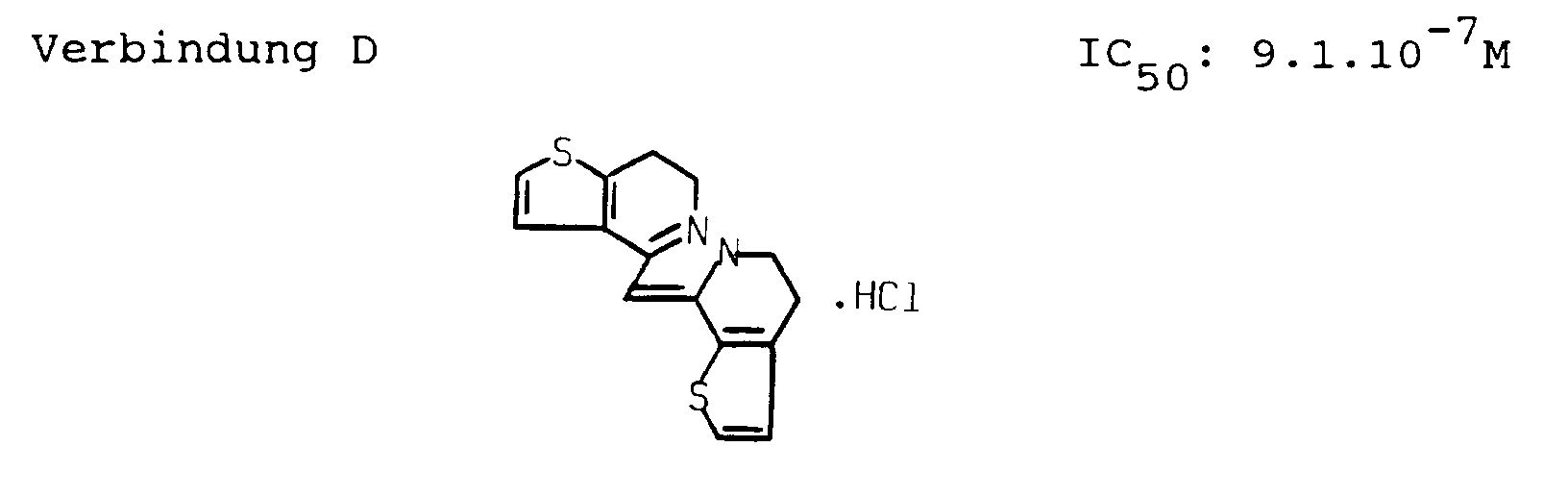
- Beispiele wirksamer Verbindungen gemäß der Erfindung sind in den Tabellen weiter unten angeführt, hervorzuheben sind

- Die Verbindungen können nach an sich bekannten Verfahren (z.B. gemäß EP 288 048) hergestellt werden.
- Zur Salzbildung geeignete Säuren sind beispielsweise Salzsäure, Bromwasserstoffsäure, Schwefelsäure, Phosphorsäure, Salpetersäure, Essigsäure, Propionsäure, Buttersäure, Oxalsäure, Malonsäure, Bernsteinsäure, Maleinsäure, Fumarsäure, Milchsäure, Weinsäure, Zitronensäure, Apfelsäure, Benzoesäure, Zimtsäure, Ascorbinsäure, Methansulfonsäure.
- Gegenstand der vorliegenden Erfindung ist die Verwendung der genannten Verbindungen für die Herstellung von Arzneimitteln zur Behandlung chronisch inflammatorischer Prozesse, der Colitis Ulcerosa und des Morbus Crohn und von Arzneimitteln mit antiproliferativer Wirkung. Die Wirkung der Verbindungen kann durch ihre Hemmung der unselektiven Kationenkanäle (UKK) erklärt werden.
- Der Pathophysiologie des chronischen Bronchialasthma liegen entzündliche Prozesse zugrunde, die durch die Aktivierung inflammatorischer Zellen vermittelt werden. (BARHES, 1987; SEIFERT und SCHULTZ, 1991).
- Die rezeptor-regulierte Aktivierung inflammatorischer Zellen (z.B. neutrophile Granulozyten und Mastzellen bzw. deren permanente Zellinien HL-60 Zellen oder sensibilisierte, d.h. Gammaglobulin E beladene RBL-Zellen) wird unabhängig von der Art der stimulierenden Agonisten (z.B. Endothelin, PAF, Leukotriene, chemotaktisches Peptid fMLP oder Antigen gegen sensibilisierte Mastzellen) durch Blocker unselektiver Kationenkanäle (UKK) inhibiert (RINK, 1990). Durch diese Kanäle gelangt extrazelluläres Calcium in die Zellen, das für die Persistenz der rezeptor-vermittelten Zellaktivierungen erforderlich ist (PUTNEY, 1990). Wird diese Calciumzufuhr unterbrochen resultiert eine Blockade der Aktivierung inflammatorischer Zellen.
- Klassische Calciumantagonisten vom Dihydropyridin- bzw. Phenylalkylamin-Typ hemmen weder UKKs noch inflammatorische Prozesse (WELLS et al., 1986).
- Als Maß der Zellaktivierung bzw. als Maß von deren Hemmung durch UKK-Blocker wird fluorometrisch die Kinetik der cytoplasmatischen Calciumionenkonzentration in Fura-2-beladenen Zellen anhand der von GRYNKIEWICZ et al. (1985) beschriebenen Methode quantifiziert. Diese Vorgehensweise hat sich im Rahmen dieser Erfindung als zuverlässige Screeningmethode zur Auffindung von UKK-Blockern erwiesen.
- Zur spezifischen Charakterisierung von Blockern der unselektiven Kationenkanäle eignet sich die sogenannte funktionelle THAPSIGARGIN-Inhibition. THAPSIGARGIN ist ein von THASTRUP et al. (Proc. Natl. Acad. Sci. (USA), 87, 2466-2470, 1990) beschriebener Tumorpromotor, der selektiv und irreversibel die Ca2+ATPase intrazellulärer, IP3-sensitiver Ca2+-Speicher hemmt. Infolge dessen kommt es zu einer raschen Entleerung der Ca2+-Speicher. Wie von J. PUTNEY (Calcium, 11, 611-624, 1990) beschrieben stellt die Entleerung dieser Speicher den physiologischen Reiz für die Öffnung unselektiver Kationenkanäle in der Zellmembran dar. Die Folge ist ein massiver Einstrom von Na+ und Ca2+ in die Zelle. Aufgrund dieser Eigenschaften eignet sich Thapsigargin als indirekter Stimulator zur agonisten- und IP3-unabhängigen Öffnung der unselektiven Kationenkanäle.
- Im Rahmen der vorliegenden Erfindung wurde die Thapsigargin-Stimulation unselektiver Kationenkanäle an HL 60 Zellen (menschliche Leukämiezelle), an hippocamplen und corticalen Neuronenzellen sowie an RBL-Zellen (rat basophilic lymphoma cells) erfolgreich durchgeführt und somit wurde die Existenz dieser Kanäle in den jeweiligen Zellinien nachgewiesen.
- Die zytoplasmatische Ca2+Konzentration ([Ca2+]i) spielt eine wichtige Rolle bei der Zellproliferation und beim Tumorwachstum (Übersicht siehe L.R. ZACHARSKI, Journal of Medicine 19: 145-177, 1988). Insbesondere der durch Rezeptoraktivierung mit konsekutiver Inositoltrisphosphat-(IP3-)-Vermittlung stimulierte Ca2+-Einstrom in die Zelle soll von entscheidender Bedeutung sein für die oncogene Zellproliferation (U. KIKKAWA und Y. NISHIZUKA, Ann. REV. CELL. BIOL. 2: 149-178, 1986). Dieser Mechanismus spielt auch eine Rolle bei der Metastasenbildung und der "Multi-Drug-Resistance". (Übersicht siehe die obengenannten Veröffentlichung von L.R. ZACHARSKI.) J. MED. 19: 145-177, 1980.
- Diese Hypothese wird dadurch gestützt, daß Thapsigargin als indirekter Stimulator der unselektiven Kationenkanäle (UKK) sowohl zu einem Ca2+-overload in der Zelle führt als auch ein hochwirksamer Tumorpromotor ist. (V. THASTRUP et al. Proceedings of the NATL. Acad. Sci: (USA) 87: 2466-2470, 1990.)
- Die Blockade des Ca2+-Einstroms durch die UKK führt zu einer Normalisierung der intrazellulären Ca-Ionenkonzentration und somit zu einer Hemmung des Tumorwachstums etc.
- Klassiche Calciumantagonisten hemmen diese UKK nicht. Überraschend ist festgestellt worden, daß die Verbindungen dieser Erfindung den Calciumeinstrom in die Zelle durch die UKK hemmen.
- Wie von S. H. MURCH et al. (Lancet 339 : 381-385, 15. Febr. 1992) gezeigt wurde, spielt Endothelin I eine wichtige pathophysiologische Rolle bei entzündlichen Darmerkrankungen wie der Colitis ulcerosa und des Morbus Crohn. Mit Hilfe immunhistochenischer Methoden konnte festgestellt werden, daß Patienten mit M. Crohn im Bereich der Submucosa und Patienten mit Colitis ulcerosa im Bereich der Lamina propria des Dickdarmepithels signifikant und stark erhöhte Endothelin I Konzentrationen im Vergleich zu gesunden Normalpersonen aufweisen. Es wird angenommen, daß die lokale Ausschüttung von Endothelin massive Vasospasmen mit konsekutiver disseminierter Ischämie mit Mikroinfarkten hervorruft, die als eigentliche Ursache der genannten Erkrankungen angesehen werden. Die vasospasmogene Effektivität des Endothelins wird über einen Ca2+-overload vaskulärer Myozyten erklärt. Dabei löst Endothelin primär eine IP3-vermittelte intrazelluläre Ca2+-Freisetzung aus, an die sich ein massiver transmembranärer Ca2+-Einstrom durch dihydropyridin-insensitive Kanäle anschließt. (M. S. Simonson et al. Clin. Invest. Med. 14: 499-507, 1991; T. Masakai, J. Cardiovasc. Pharmacol. 13:Suppl. 5, S1-S4, 1989; D. W. Hay, R. J. Pharmacol. 100: 383-392, 1990) Bei diesen Kanälen handelt es sich um unselektive Kationen Kanäle, deren Existenz kürzlich auch in Zellen der Dickdarmmukosa beschrieben wurde. (Chr. Siemer und H. Gögelein, Europ. J. Physiol. 420: 319-328, 1992).
- Als geeignetes Screening Modell zur Auffindung funktioneller Endothelinantagonisten hat sich die Endothelin stimulierte Aktivierung Fura-2 beladener menschlicher Leukämiezellen (HL 60 Zelle) bewährt. In Anlehnung an G. GRYNKIEWICZ et al. (J. Biol. Chem. 260:340-3450, 1985)läßt sich die intrazelluläre Ca2+-Konzentration im Cytoplasma von HL 60 Zellen (Suspensionen) spektrofluorometrisch verfolgen und als Maß der Zellaktivierung durch Endothelin quantifizieren. Die Stimulation erfolgte durch Zusatz von 0.1 µM Endothelin, sie ließ sich dosisabhängig durch die erfindungsgemäßen Substanzen inhibieren.
- Der funktionelle Endothelinantagonismus der erfindungsgemäßen Substanzen wird über eine Blockade der unselektiven Kationen Kanäle vermittelt. Deshalb eignet sich auch der Nachweis eines funktionellen Thapsigargin-Antagonismus an RBL-hm1-Zellen als Screening Methode für funktionelle Endothelinantagonisten.
- Für Screeningzwecke werden in Ca2+ freiem Inkubationsmedium Fura-2-beladene adhäsive RBL-hm 1-Zellen mit 0,1 µM Thapsigargin stimuliert. Nach 4 Minuten wird extrazelluläres Ca2+ auf 1,5 mM restituiert und anhand der Fura-2-Fluoreszenz der exzessive Anstieg der cytoplasmatischen Ca2+-Konzentration infolge eines massiven transmembranären Ca2+-Einstroms durch unselektive Kationenkanäle registriert.
- Dieser Einstrom ist ausschließlich und dosisabhängig zu inhibieren durch unselektive Kationen-Kanal-Blocker. Weder klassische Kalziumantagonisten noch spezifische Blocker von Agonisten, die den IP3-Turnover stimulieren können den durch Thapsigargin indirekt ausgelösten transmembranären Ca2+-Einstrom hemmen. Die Verbindungen der vorliegenden Erfindung zeichnen sich durch eine Hemmung der UKK aus.
- Die fluorometrische Calciummessung im Cytoplasma einzelner adhärenter RBL-hm1-Zellen erfolgt in Analogie zu der von KUDO und OGURA (1986) für neuronale Zellen beschriebenen Methode. Verwendet wird ein AXIOVERT 35 Fluoreszenzmikroskop von ZEISS in Kombination mit einem Imaging-System von HAMAMATSU, bestehend aus dem ICMS-Bildverarbeitungssystem, Restlichtkamera mit Kontrolleinheit und Bildverstärker DVS 3000.
- Die Kinetik der cytoplasmatischen Ca+2-Konzentration wird als Konzentrations-Zeit-Kurve nach der durch Thapsigargin (0,1 µM) stimulierten Zellaktivierung fortlaufend aufgezeichnet. Verglichen werden die Kurven zweier aktivierter Zellkulturen in Gegenwart und Abwesenheit von 10 µM Testsubstanz. Die Fläche unter diesen Kurven (area under the curve = AUC) wird integriert und als Maß der Zellaktivierung registriert. Die inhibitorische Wirkungsstärke der getesteten UKK-Blocker wird ermittelt anhand folgender Beziehung:

- %H = die prozentuale Hemmung des Calciumeinstroms durch unselektive Kationenkanäle der stimuliert und durch 10 µM Testsubstanz inhibiert wird.
- AUCinh = Fläche unter der Kurve, die in Gegenwart des Stimulans plus 10 µM inhibitorischer Testsubstanz aufgezeichnet wird.
- AUC Kontr. = Fläche unter der Kurve, die nur nach Zusatz des Stimulans registriert wird.
- Literatur zu den obigen Erläuterungen:
- BARNES P.J., I.W. RODGER und N.C. THOMSON
Pathogenesis of asthma, in "ASTHMA, basic mechanisms and clinical management" ED by P.J. BARNES; ACADEMIC PRESS, LONDON, 1988 - GRYNKIEWICZ G., M. POENIE und R.Y. TSIEN
A new generation of Ca2+-indicators with greatly improved fluorescence properties J. BIOL. CHEM. 260: 3440-3450, 1985 - HIDE, M. und M.A. BEAVEN
Calcium influx in a rat mast cell (RBL-2H3) line J. BIOL. CHEM. 266 15221-15229, 1991 - KUDO, Y. und A. OGURA
Glutamate-induced increase in intracellular Ca2+-concentration in isolated hippocampal neurones BR. J. PHARMACOL. 89: 191-198, 1986 - PUTNEY, J.W., jr.
Capacitative Calcium entry revised CELL CALCIUM 11: 611-624, 1990 - RINK, T.J.
Receptor-mediated calcium entry FEBS LETT. 268: 381-385, 1990 - SEIFERT, R. und G. SCHULTZ
The superoxide forming NADPH oxidase of phagocytes: An enzym system regulated by multiple mechanism REV. PHYSIOL. BIOCHEM. PHARMACOL., Vol. 117, SPRINGER VERL., 1991 - WELLS, E., C.G. JACKSON, S.T. HARPER, J. MANN and R.P. EAOY
Characterization of primate bronchoalveolar mast cells II, inhibition of histamine, LTC4 and PGF2α release from primate bronchoalveolar mast cells and a comparison with rat peritoneal mast cells
J. IMMUNOL. 137: 3941-3945, 1986. - Angegeben wird die prozentuale Hemmung der UKK nach Thapsigarginstimulation (0,1 µM Thapsigargin) in RBL-hm 1 Zellen. Die einheitliche Konzentration der Testsubstanzen ist 10-5 Mol).
- RBL - hm 1 Zellen - Thapsigargin (0,1 µM)-Stimulation

- Anhand des folgenden Tests kann die funktionelle antiinflammatorische Effektivität gezeigt:
- Verwendet werden einzelne an Glasplättchen adhärente RBL-2H3-Zellen (eine den Mastzellen verwandte Tumorzellinie).
- Die Kultivierung und Anhaftung der RBL-2H3-Zellen erfolgt in der HIDE und BEAVEN (1991) beschriebenen Methode. Zur Sensibilisierung der adhäsiven RBL-2H3-Zellen werden die Zellen 2 Stunden bei Raumtemperatur mit einer 1:2000 verdünnten käuflichen Gammaglobulin E-Lösung gegen einen Dinitrophenol-Rinderserumalbumin-Komplex (DNP-BSA-Antigen) inkubiert. Anschließend werden die Zellen gewaschen. Durch Zusatz von 0,1 ml DNP-BSA-Lösung (10 µg/ml) erfolgt eine massive immunologische Zellaktivierung, die durch einen cytoplasmatischen Ca2+-overload vermittelt wird. Die fluorometrische Calciummessung im Cytoplasma einzelner adhärenter RBL-2H3-Zellen erfolgt in Analogie zu der von KUDO und OGURA (1986) für neuronale Zellen beschriebenen Methode, die auch weiter oben in dieser Beschreibung erläutert wird.
- Als Vergleichssubstanz dient in diesen Untersuchungen (10 µM) Chromoglycat, das eine ca. 50 %ige Hemmung der antigen-induzierten Zellaktivierung bewirkt.
- In diesem Test zeigen die oben genannten Verbindungen %H Werte, die den oben angegebenen Werten vergleichbar sind.
- Untersuchungen an Mikrokulturen verschiedener menschlicher Tumorzellinien mit Hilfe des Tetrazolium Assays zur Feststellung des antiproliferativen Effektes der erfindungsgemäßen Substanzen zeigte sich überraschenderweise, daß die geprüfte Verbindung 5 bis 100 mal wirkungsstärker als die Vergleichssubstanz Verapamil sind.
- Die antiproliferative Effektivität der Testsubstanzen wurde mit Hilfe des von MOSMANN (J. IMMUNOL. METH. 65: 55-63, 1983), DENIZOT et al. (J. IMMUNOL. METH. 89: 271-277, 1986) und von J. ELIASON et al. (INT. J. CANCER 46: 113-117, 1990) beschriebenen MTT-Tests bestimmt. (MTT = [3-(4,5-dimethylthiazol-2yl)2,5-diphenyl-tetrazoliumbromid] von CHEMICON Inc. El Segundo, Ca, USA). Dieser Indikator wird nur von lebenden Zellen mit intakten Mitochondrien zu einem blauen Formazan Produkt metabolisiert. Folgende menschliche Tumorzellinien wurden in unserem Test verwendet: A 549 (Adenocarcinom der Lunge), A 431 (Epidermiscarcinom der Vulva), PC 3 (Adenocarcinom der Prostata), SK BR 3 (Adenocarcinom der Mamma), HT 29 (CX1 1) (Adenocarcinom des Colon) und K 562 (chronisch-myeloische Leukämiezelle).
Der Test wurde auf Mikrotiterplatten durchgeführt. Jedes Well enthielt 100 µl einer Zellsuspension (0,2 x 10⁶ Zellen/ml). Als Inkubationsmedium diente RPMI 1640 mit 10% Hitze-inaktiviertem fetalen Kälberserum und 50 µg/ml Gentamycin. Die Zellsuspensionen wurden 0, 24, 48 oder 72 Stunden bei gesättigter Luftfeuchtigkeit in einem CO2 (5%) - Luft (95%)-Gemisch bei 37°C inkubiert in Gegenwart und Abwesenheit von variablen Konzentrationen antiproliferativer Testsubstanzen. Die Testsubstanzen wurden in DMSO (Endverdünnung: 0,1 %) gelöst. Anschließend wurden 10 µl MTT-Lösung (3 mg/ml) und nach 3 Stunden 100 µl einer 0,08 N HCl enthaltenden Isopropanollösung zugesetzt. Nach einer weiteren Stunde wurde die Lichtabsorption bei 570 nm (Vergleichswellenlänge 630 nm) in einem Mikroplattenleser ermittelt. Die Lichtabsorption ist direkt proportional zur Anzahl lebender Zellen. Die halbmaximalen Hemmkonzentrationen der untersuchten Substanzen lagen bei 1 µg/ml. - Die vasospasmolytische Effektivität der obengenannten funktionellen Endothelin- bzw.
Thapsigargin-Antagonisten wurde am isolierten Gefäßpräparat bestätigt: An retrograd perfundierten spontan schlagenden LANGENDORFF Herzen aus Ratten wurde die coronare Perfusion fortlaufend mittels elektromagnetischer Flußmessung (Apparatur von Hugo Sachs Elektronik, MARCH), quantifiziert. Mit dieser Meßanordnung lassen sich Ausmaß, Dauer und Verlaufsform von Gefäßspasmen mit großer Genauigkeit registrieren. Perfundiert man mit 100 nM Endothelinkonzentration, so wird der coronare Perfusionsfluß von 11 auf 5 ml/min reduziert. Die Perfusionseinschränkung kann durch die erfindungsgemäßen Substanzen aufgehoben werden. Die Wirkungsstärken der erfindungsgemäßen Verbindungen bezüglich der Thapsigargininhibition an Fura-2-beladenen RBL-hm1-Zellen bzw. der Effektivität der Endothelininhibition an Fura-2 beladenen HL 60 Zellen korrelierte eindeutig mit der am Langendorffpräparat nachgewiesenen vasospasmolytischen Effektivität der untersuchten Substanzen. Es kann daraus geschlossen werden, daß dem vasospasmolytischen Endothelinantagonismus der untersuchten Substanzen eine Blockade der unselektiven Kationen Kanäle unterliegt. - Die Verbindungen können sowohl enteral als auch parenteral verabreicht werden. Als Dosis für die orale Anwendung werden 0,1 bis 500 mg Wirkstoff pro Dosis, für die i.v.-Anwendung von 0,05 bis 150 mg pro Dosis vorgeschlagen. Der gewünschte therapeutische Dosis ist von der Indikation und Darreichungsform abhängig und kann experimentell bestimmt werden.
- Beispiele wirksamer Verbindungen werden in den folgenden Tabellen zusammengefaßt:


-
a) Dragees
1 Drageekern enthält:Wirkstoff der allgemeinen Formel I 30,0 mg Milchzucker 100,0 mg Maisstärke 75,0 mg Gelatine 3,0 mg Magnesiumstearat 2,0 mg 
- Die Mischung der Wirksubstanz mit Milchzucker und Maisstärke wird mit einer 10%-igen wässerigen Gelatinelösung durch ein Sieb mit 1 mm Maschenweite granuliert, bei 40°C getrocknet und nochmals durch ein Sieb gerieben. Das so erhaltene Granulat wird mit Magnesiumstearat gemischt und verpreßt. Die so erhaltenen Kerne werden in üblicher Weise mit einer Hülle überzogen, die mit Hilfe einer wässerigen Suspension von Zucker, Titandioxyd, Talkum und Gummi arabicum aufgebracht wird. Die fertigen Dragees werden mit Bienenwachs poliert.
b) Tabletten Wirkstoff der allgemeinen Formel I 30,0 mg Milchzucker 100,0 mg Maisstärke 70,0 mg löslich Stärke 7,0 mg Magnesiumstearat 3,0 mg 
- Wirkstoff und Magnesiumstearat werden mit einer wässerigen Lösung der löslichen Stärke granuliert, das Granulat getrocknet und innig mit Milchzucker und Maisstärke vermischt. Das Gemisch wird sodann zu Tabletten von 210 mg Gewicht verpreßt.
c) Kapseln Wirkstoff gemäß Anspruch 1 20,0 mg Milchzucker 230,0 mg Maisstärke 40,0 mg Talk 10,0 mg 
- Wirkstoff, Milchzucker und Maisstärke werden zunächst in einem Mischer und dann in einer Zerkleinerungsmaschine vermengt. Das Gemisch wird nochmals in den Mischer gegeben, gründlich mit dem Talk vermengt und maschinell in Hartgelatinekapseln abgefüllt.
Claims (11)
- Verwendung einer Verbindung der allgemeinen Formel I
 A einen Benzo- oder Thienorest bedeutet;R2 und R3 unabhängig voneinander Wasserstoff oder (C1-C5)Alkyl oder gemeinsam mit dem Kohlenstoffatom, an das sie gebunden sind, einen 5- oder 6-gliedrigen Carbocyclus bedeuten;R11 (C1-C4)Alkyl, Halogen (F, Cl, Br, J), Hydroxy, (C1-C4)Alkoxy, Amino, Thiomethyl, Methansulfonyloxy oder Methansulfonamido bedeutet, oder zwei benachbarte Substituenten R11 zusammen -O-CH2-O- oder -O-CH2-CH2-O- sind;m 0, 1, 2 oder 3 bedeutet, wenn A ein Benzorest ist, und 0, 1 oder 2 bedeutet, wenn A ein Thienorest ist;und D eine Gruppe der Formel Ia bedeutet
 B einen Benzo- oder Thienorest bedeutet;R1 Wasserstoff, (C1-C10)Alkyl, Phenyl, Phenyl(C1-C5)alkyl, (C1-C4)Alkoxy oder -NHCOX (worin X (C1-C5)Alkyl ist) bedeutet;R5 Wasserstoff, (C1-C4)Alkyl oder Hydroxymethyl bedeutet;R6 und R7 unabhängig voneinander Wasserstoff oder (C1-C5)Alkyl oder gemeinsam mit dem Kohlenstoffatom, an das sie gebunden sind, einen 5- oder 6-gliedrigen Carbocylcus bedeuten;R12 (C1-C4)Alkyl, Halogen (F, Cl, Br, J), Hydroxy, (C1-C4)Alkoxy, Amino, Thiomethyl, Methansulfonyloxy oder Methansulfonamido bedeutet, oder zwei benachbarte Substituenten R12 zusammen -O-CH2-O- oder -O-CH2-CH2-O-sind;und n 0, 1, 2 oder 3 bedeutet, wenn B ein Benzorest ist, und 0, 1 oder 2 bedeutet, wenn B ein Thienorest ist;oder deren pharmazeutisch annehmbaren Salzes mit einer anorganischen oder organischen Säure für die Herstellung eines Arzneimittels für die Behandlung chronisch inflammatorischer Prozesse, der Colitis Ulcerosa und des Morbus Crohn und eines Arzneimittels mit antiproliferativer Wirkung.
 - Verwendung einer Verbindung nach Anspruch 1, worinR1 Wasserstoff, (C1-C10)Alkyl, Phenyl(C1-C5)alkyl oder -NHCOX (worin X (C1-C5)Alkyl ist) bedeutet;R11 und R12 unabhängig voneinander (C1-C4)Alkyl, Hydroxy, (C1-C4)Alkoxy, Methansulfonyloxy oder Methansulfonamido bedeuten, oder zwei benachbarte Substituenten R11 beziehungsweise R12 zusammen -O-CH2-O- oder -O-CH2-CH2-O- sind.worin vorzugsweise R1 Wasserstoff, (C1-C10)Alkyl oder -NHCOX (worin X (C1-C5)Alkyl ist) bedeutet;R2, R3, R6 und R7 unabhängig voneinander Wasserstoff bedeuten oder R2 mit R3 und/oder R6 mit R7 und dem jeweiligen Kohlenstoffatom, an das sie gebunden sind, einen 5- oder 6-gliedrigen Carbocyclus bedeuten;R11 und R12 unabhängig voneinander Hydroxy, (C1-C4)Alkoxy, Methansulfonyloxy oder Methansulfonamido bedeuten, oder zwei benachbarte Substituenten R11 beziehungsweise R12 zusammen -O-CH2-O- oder -O-CH2-CH2-O- sind; worin insbesondere R1 Wasserstoff, (C1-C6)Alkyl, oder -NHCOCH3 bedeutet und/oderR5 Wasserstoff, Methyl oder Hydroxymethyl bedeutet und/oderR2, R3, R6 und R7 unabhängig voneinander Wasserstoff bedeuten oder R2 mit R3 und/oder R6 mit R7 und dem jeweiligen Kohlenstoffatom, an das sie gebunden sind, einen 5-gliedrigen Carbocyclus bedeuten und/oderR11 und R12 unabhängig voneinander Hydroxy, Methoxy, Methansulfonoxy oder Methansulfonamido bedeuten, oder zwei benachbarte Substituenten R11 beziehungsweise R12 zusammen -O-CH2-O- sind.
- Verwendung einer Verbindung nach Anspruch 1 oder 2, worin R1 und R5 Wasserstoff sind.
- Verwendung einer Verbindung nach einem der Ansprüche 1 bis 3, worin, wenn R2, R3, R6 und R7 Wasserstoff sind.
- Verwendung einer Verbindung nach einem der Ansprüche 1 bis 3, worin R2 und R3 beziehungsweise R6 und R7 je zusammen -(CH2)4- sind.
- Verwendung einer Verbindung nach einem der Ansprüche 1 bis 5, worin A und B unabhängig voneinander je eine Thienogruppe sind, vorzugsweise 2,3-Thieno.
- Verwendung einer Verbindung nach Anspruch 6, worin A und B eine unsubstituierte Thienogruppe sind.
- Verwendung einer Verbindung nach einem der Ansprüche 1 bis 5, worin A und/oder B ein Benzorest ist, worin m beziehungsweise n 2 bedeuten.
- Verwendung einer Verbindung nach Anspruch 8, worin, wenn A und/oder B ein Benzorest ist, die beiden Substituenten R11 und/oder R12 im Benzorest in meta- beziehungsweise para-Position zu den Fusionspunkten des Restes A beziehungsweise B stehen.
- Verwendung einer Verbindung nach einem der Ansprüche 1 bis 5, 8 und 9, worin R11 und R12 unabhängig voneinander Hydroxy, (C1-C4)Alkoxy (vorzugsweise Methoxy) oder die 2 benachbarten Substituenten R11 beziehungsweise R12 zusammen -O-CH2-O- sind.
- Verwendung einer Verbindung nach Anspruch 1, die


Applications Claiming Priority (7)
| Application Number | Priority Date | Filing Date | Title |
|---|---|---|---|
| DE4220324 | 1992-06-22 | ||
| DE19924220324 DE4220324A1 (de) | 1992-06-22 | 1992-06-22 | Verwendung von kondensierten Bis-(3,4-dihydro-l-pyridinyl)methanen für die Herstellung von Mitteln für die Behandlung chronisch inflammatorischer Prozesse |
| DE19924220379 DE4220379A1 (de) | 1992-06-22 | 1992-06-22 | Verwendung von kondensierten Bis-(3,4-dihydro-l-pyridinyl)methanen für die Herstellung von Mitteln für die Behandlung der Colitis Ulcerosa und des Morbus Crohn |
| DE4220320 | 1992-06-22 | ||
| DE19924220320 DE4220320A1 (de) | 1992-06-22 | 1992-06-22 | Verwendung von kondensierten Bis-(3,4-dihydro-l-pyridinyl)methanen für die Herstellung von Mitteln mit antiproliferativer Wirkung |
| PCT/EP1993/001531 WO1994000122A1 (de) | 1992-06-22 | 1993-06-16 | Verwendung von kondensierte bis-(3,4-dihydro-pyridinyl)methane zur behandlung von morbus crohn, colitis ulcerosa, chronisch inflammatorischen prozessen und als antiproliferative mitteln |
| DE4220379 | 1993-06-22 |
Publications (2)
| Publication Number | Publication Date |
|---|---|
| EP0647136A1 EP0647136A1 (de) | 1995-04-12 |
| EP0647136B1 true EP0647136B1 (de) | 1997-03-19 |
Family
ID=27203871
Family Applications (1)
| Application Number | Title | Priority Date | Filing Date |
|---|---|---|---|
| EP93914664A Expired - Lifetime EP0647136B1 (de) | 1992-06-22 | 1993-06-16 | Verwendung von kondensierte bis-(3,4-dihydro-pyridinyl)methane zur behandlung von morbus crohn, colitis ulcerosa, chronisch inflammatorischen prozessen und als antiproliferative mitteln |
Country Status (10)
| Country | Link |
|---|---|
| EP (1) | EP0647136B1 (de) |
| JP (1) | JPH07508014A (de) |
| CN (1) | CN1082536A (de) |
| AT (1) | ATE150306T1 (de) |
| AU (1) | AU4418793A (de) |
| CA (1) | CA2138167A1 (de) |
| DE (1) | DE59305890D1 (de) |
| IL (1) | IL106087A0 (de) |
| MX (1) | MX9303705A (de) |
| WO (1) | WO1994000122A1 (de) |
Families Citing this family (2)
| Publication number | Priority date | Publication date | Assignee | Title |
|---|---|---|---|---|
| US5604231A (en) * | 1995-01-06 | 1997-02-18 | Smith; Carr J. | Pharmaceutical compositions for prevention and treatment of ulcerative colitis |
| USD507631S1 (en) | 2003-03-17 | 2005-07-19 | Baxter International Inc. | Valve |
Family Cites Families (2)
| Publication number | Priority date | Publication date | Assignee | Title |
|---|---|---|---|---|
| IL86131A0 (en) * | 1987-04-24 | 1988-11-15 | Boehringer Ingelheim Kg | Benzo-and thieno-3,4-dihydropyridine derivatives,their preparation and pharmaceutical compositions containing them |
| US5082838A (en) * | 1989-06-21 | 1992-01-21 | Takeda Chemical Industries, Ltd. | Sulfur-containing fused pyrimidine derivatives, their production and use |
-
1993
- 1993-06-16 AT AT93914664T patent/ATE150306T1/de not_active IP Right Cessation
- 1993-06-16 JP JP6502008A patent/JPH07508014A/ja active Pending
- 1993-06-16 WO PCT/EP1993/001531 patent/WO1994000122A1/de not_active Ceased
- 1993-06-16 AU AU44187/93A patent/AU4418793A/en not_active Abandoned
- 1993-06-16 DE DE59305890T patent/DE59305890D1/de not_active Expired - Fee Related
- 1993-06-16 EP EP93914664A patent/EP0647136B1/de not_active Expired - Lifetime
- 1993-06-16 CA CA002138167A patent/CA2138167A1/en not_active Abandoned
- 1993-06-21 MX MX9303705A patent/MX9303705A/es not_active IP Right Cessation
- 1993-06-21 IL IL106087A patent/IL106087A0/xx unknown
- 1993-06-22 CN CN93107616A patent/CN1082536A/zh active Pending
Also Published As
| Publication number | Publication date |
|---|---|
| WO1994000122A1 (de) | 1994-01-06 |
| JPH07508014A (ja) | 1995-09-07 |
| IL106087A0 (en) | 1993-10-20 |
| CN1082536A (zh) | 1994-02-23 |
| MX9303705A (es) | 1994-01-31 |
| ATE150306T1 (de) | 1997-04-15 |
| CA2138167A1 (en) | 1994-01-06 |
| EP0647136A1 (de) | 1995-04-12 |
| DE59305890D1 (de) | 1997-04-24 |
| AU4418793A (en) | 1994-01-24 |
Similar Documents
| Publication | Publication Date | Title |
|---|---|---|
| DE69814688T2 (de) | Benzylidene- und cinnamylidene-anabaseine als neuronale nikotin alpha-7 rezeptoragonisten | |
| DE69626104T2 (de) | Tricyclische carbamat-derivate zur inhibierung der g-protein funktion und zur behandlung von proliferativen erkrankungen | |
| DE69833748T2 (de) | Benzocycloheptha-thiophen verbindungen | |
| EP0528922B1 (de) | Neue sulfonylverbindungen | |
| DE60011755T2 (de) | Calciumkanalblocker als antikrebsmittel | |
| EP1928836B1 (de) | Substituierte 4-phenyltetrahydroisochinoline, verfahren zu ihrer herstellung, ihre verwendung als medikament, sowie sie enthaltendes medikament | |
| DE69533194T2 (de) | PYRAZOLO(3,4-g)CHINOXALINE ALS PDGF-REZEPTOR PROTEIN TYROSIN-KINASE INHIBITOREN | |
| DE69922594T2 (de) | Indazol-Derivate als 5-HT1F agonists | |
| EP0736012B1 (de) | Anellierte dihydropyridine und deren verwendung für die herstellung von pharmazeutischen zubereitungen | |
| WO1992011010A1 (de) | Neue 3,4-dihydroisochinolinderivate und neue pharmazeutische verwendung carbocyclisch und heterocyclisch anellierter dihydropyridine | |
| EP0213293B1 (de) | In 11-Stellung substituierte 5,11-Dihydro-6H-pyrido-[2,3-b][1,4]benzodiazepin-6-one, Verfahren zur ihrer Herstellung und diese Verbindungen enthaltende Arzneimittel | |
| DE19643790A1 (de) | Benzoxazol-Derivat | |
| EP1317430B1 (de) | (2-azabicyclo [2.2.1]hept-7-yl)methanol-derivate als nikotinische acetylcholinrezeptor agonisten | |
| WO1994000122A1 (de) | Verwendung von kondensierte bis-(3,4-dihydro-pyridinyl)methane zur behandlung von morbus crohn, colitis ulcerosa, chronisch inflammatorischen prozessen und als antiproliferative mitteln | |
| EP0647226B1 (de) | 9-AMINO-PYRIDAZINO 4',5' : 3,4]PYRROLO- 2,1-a]ISOCHINOLINE UND DEREN VERWENDUNG FÜR DIE HERSTELLUNG VON PHARMAZEUTISCHEN ZUBEREITUNGEN | |
| EP0736011B1 (de) | Anellierte dihydropyridine und deren verwendung für die herstellung von pharmazeutischen zubereitungen | |
| DE102005044815A1 (de) | Verwendung von Inhibitoren des Na+/H+ Austauschers, Subtyp 5 (NHE5) zur Gedächtnisverbesserung | |
| EP0647220A1 (de) | Anellierte dihydropyridine und deren verwendung für die herstellung von pharmazeutischen zubereitungen | |
| EP0736026A1 (de) | NEUE PYRIDAZINO 4',5':3,4]PYRROLO- 2,1-a]ISOCHINOLINE UND DEREN VERWENDUNG FÜR DIE HERSTELLUNG VON PHARMAZEUTISCHEN ZUBEREITUNGEN | |
| EP0402734A2 (de) | Mittel zur Behandlung von Erkrankungen des Zentralnervensystems und zur Förderung der cerebralen Durchblutung | |
| DE4220379A1 (de) | Verwendung von kondensierten Bis-(3,4-dihydro-l-pyridinyl)methanen für die Herstellung von Mitteln für die Behandlung der Colitis Ulcerosa und des Morbus Crohn | |
| DE4220324A1 (de) | Verwendung von kondensierten Bis-(3,4-dihydro-l-pyridinyl)methanen für die Herstellung von Mitteln für die Behandlung chronisch inflammatorischer Prozesse | |
| DE4343684A1 (de) | Anellierte Dihydropyridine und deren Verwendung für die Herstellung von pharmazeutischen Zubereitungen | |
| DE3718570A1 (de) | Benzo- und thieno-3,4-dihydro-1- pyridinylessigsaeurederivate, verfahren zu ihrer herstellung und diese verbindungen enthaltende arzneimittel | |
| EP0326066A2 (de) | Neue kondensierte Diazepinone, Verfahren zu ihrer Herstellung und diese Verbindungen enthaltende Arzneimittel |
Legal Events
| Date | Code | Title | Description |
|---|---|---|---|
| PUAI | Public reference made under article 153(3) epc to a published international application that has entered the european phase |
Free format text: ORIGINAL CODE: 0009012 |
|
| 17P | Request for examination filed |
Effective date: 19941214 |
|
| AK | Designated contracting states |
Kind code of ref document: A1 Designated state(s): AT BE CH DE DK ES FR GB GR IE IT LI LU MC NL PT SE |
|
| GRAG | Despatch of communication of intention to grant |
Free format text: ORIGINAL CODE: EPIDOS AGRA |
|
| 17Q | First examination report despatched |
Effective date: 19960425 |
|
| GRAH | Despatch of communication of intention to grant a patent |
Free format text: ORIGINAL CODE: EPIDOS IGRA |
|
| GRAH | Despatch of communication of intention to grant a patent |
Free format text: ORIGINAL CODE: EPIDOS IGRA |
|
| GRAA | (expected) grant |
Free format text: ORIGINAL CODE: 0009210 |
|
| AK | Designated contracting states |
Kind code of ref document: B1 Designated state(s): AT BE CH DE DK ES FR GB GR IE IT LI LU MC NL PT SE |
|
| PG25 | Lapsed in a contracting state [announced via postgrant information from national office to epo] |
Ref country code: NL Free format text: LAPSE BECAUSE OF FAILURE TO SUBMIT A TRANSLATION OF THE DESCRIPTION OR TO PAY THE FEE WITHIN THE PRESCRIBED TIME-LIMIT Effective date: 19970319 Ref country code: GR Free format text: LAPSE BECAUSE OF FAILURE TO SUBMIT A TRANSLATION OF THE DESCRIPTION OR TO PAY THE FEE WITHIN THE PRESCRIBED TIME-LIMIT Effective date: 19970319 Ref country code: ES Free format text: THE PATENT HAS BEEN ANNULLED BY A DECISION OF A NATIONAL AUTHORITY Effective date: 19970319 Ref country code: DK Effective date: 19970319 |
|
| REF | Corresponds to: |
Ref document number: 150306 Country of ref document: AT Date of ref document: 19970415 Kind code of ref document: T |
|
| REG | Reference to a national code |
Ref country code: CH Ref legal event code: EP |
|
| REF | Corresponds to: |
Ref document number: 59305890 Country of ref document: DE Date of ref document: 19970424 |
|
| ITF | It: translation for a ep patent filed | ||
| GBT | Gb: translation of ep patent filed (gb section 77(6)(a)/1977) |
Effective date: 19970429 |
|
| REG | Reference to a national code |
Ref country code: IE Ref legal event code: FG4D Free format text: 72608 |
|
| PG25 | Lapsed in a contracting state [announced via postgrant information from national office to epo] |
Ref country code: LU Free format text: LAPSE BECAUSE OF NON-PAYMENT OF DUE FEES Effective date: 19970616 Ref country code: IE Free format text: LAPSE BECAUSE OF NON-PAYMENT OF DUE FEES Effective date: 19970616 Ref country code: AT Free format text: LAPSE BECAUSE OF NON-PAYMENT OF DUE FEES Effective date: 19970616 |
|
| PG25 | Lapsed in a contracting state [announced via postgrant information from national office to epo] |
Ref country code: SE Effective date: 19970619 Ref country code: PT Effective date: 19970619 |
|
| ET | Fr: translation filed | ||
| PG25 | Lapsed in a contracting state [announced via postgrant information from national office to epo] |
Ref country code: BE Effective date: 19970630 |
|
| NLV1 | Nl: lapsed or annulled due to failure to fulfill the requirements of art. 29p and 29m of the patents act | ||
| BERE | Be: lapsed |
Owner name: BOEHRINGER INGELHEIM K.G. Effective date: 19970630 Owner name: BOEHRINGER INGELHEIM INTERNATIONAL G.M.B.H. Effective date: 19970630 |
|
| PG25 | Lapsed in a contracting state [announced via postgrant information from national office to epo] |
Ref country code: MC Effective date: 19971231 |
|
| PLBE | No opposition filed within time limit |
Free format text: ORIGINAL CODE: 0009261 |
|
| STAA | Information on the status of an ep patent application or granted ep patent |
Free format text: STATUS: NO OPPOSITION FILED WITHIN TIME LIMIT |
|
| 26N | No opposition filed | ||
| PGFP | Annual fee paid to national office [announced via postgrant information from national office to epo] |
Ref country code: GB Payment date: 19980514 Year of fee payment: 6 |
|
| PGFP | Annual fee paid to national office [announced via postgrant information from national office to epo] |
Ref country code: FR Payment date: 19980518 Year of fee payment: 6 |
|
| PGFP | Annual fee paid to national office [announced via postgrant information from national office to epo] |
Ref country code: DE Payment date: 19980520 Year of fee payment: 6 |
|
| PGFP | Annual fee paid to national office [announced via postgrant information from national office to epo] |
Ref country code: CH Payment date: 19980527 Year of fee payment: 6 |
|
| PG25 | Lapsed in a contracting state [announced via postgrant information from national office to epo] |
Ref country code: GB Free format text: LAPSE BECAUSE OF NON-PAYMENT OF DUE FEES Effective date: 19990616 |
|
| PG25 | Lapsed in a contracting state [announced via postgrant information from national office to epo] |
Ref country code: LI Free format text: LAPSE BECAUSE OF NON-PAYMENT OF DUE FEES Effective date: 19990630 Ref country code: FR Free format text: THE PATENT HAS BEEN ANNULLED BY A DECISION OF A NATIONAL AUTHORITY Effective date: 19990630 Ref country code: CH Free format text: LAPSE BECAUSE OF NON-PAYMENT OF DUE FEES Effective date: 19990630 |
|
| GBPC | Gb: european patent ceased through non-payment of renewal fee |
Effective date: 19990616 |
|
| REG | Reference to a national code |
Ref country code: CH Ref legal event code: PL |
|
| PG25 | Lapsed in a contracting state [announced via postgrant information from national office to epo] |
Ref country code: DE Free format text: LAPSE BECAUSE OF NON-PAYMENT OF DUE FEES Effective date: 20000503 |
|
| REG | Reference to a national code |
Ref country code: FR Ref legal event code: ST |
|
| PG25 | Lapsed in a contracting state [announced via postgrant information from national office to epo] |
Ref country code: IT Free format text: LAPSE BECAUSE OF NON-PAYMENT OF DUE FEES;WARNING: LAPSES OF ITALIAN PATENTS WITH EFFECTIVE DATE BEFORE 2007 MAY HAVE OCCURRED AT ANY TIME BEFORE 2007. THE CORRECT EFFECTIVE DATE MAY BE DIFFERENT FROM THE ONE RECORDED. Effective date: 20050616 |