EP0647590A2 - Synthetischer Diamant, Verfahren zu dessen Herstellung, sowie Methode zur Spannungsmessung des Diamanten - Google Patents
Synthetischer Diamant, Verfahren zu dessen Herstellung, sowie Methode zur Spannungsmessung des Diamanten Download PDFInfo
- Publication number
- EP0647590A2 EP0647590A2 EP94307418A EP94307418A EP0647590A2 EP 0647590 A2 EP0647590 A2 EP 0647590A2 EP 94307418 A EP94307418 A EP 94307418A EP 94307418 A EP94307418 A EP 94307418A EP 0647590 A2 EP0647590 A2 EP 0647590A2
- Authority
- EP
- European Patent Office
- Prior art keywords
- diamond
- crystal
- synthetic diamond
- strain
- nitrogen
- Prior art date
- Legal status (The legal status is an assumption and is not a legal conclusion. Google has not performed a legal analysis and makes no representation as to the accuracy of the status listed.)
- Granted
Links
Images
Classifications
-
- B—PERFORMING OPERATIONS; TRANSPORTING
- B01—PHYSICAL OR CHEMICAL PROCESSES OR APPARATUS IN GENERAL
- B01J—CHEMICAL OR PHYSICAL PROCESSES, e.g. CATALYSIS OR COLLOID CHEMISTRY; THEIR RELEVANT APPARATUS
- B01J3/00—Processes of utilising sub-atmospheric or super-atmospheric pressure to effect chemical or physical change of matter; Apparatus therefor
- B01J3/06—Processes using ultra-high pressure, e.g. for the formation of diamonds; Apparatus therefor, e.g. moulds or dies
-
- B—PERFORMING OPERATIONS; TRANSPORTING
- B01—PHYSICAL OR CHEMICAL PROCESSES OR APPARATUS IN GENERAL
- B01J—CHEMICAL OR PHYSICAL PROCESSES, e.g. CATALYSIS OR COLLOID CHEMISTRY; THEIR RELEVANT APPARATUS
- B01J3/00—Processes of utilising sub-atmospheric or super-atmospheric pressure to effect chemical or physical change of matter; Apparatus therefor
- B01J3/06—Processes using ultra-high pressure, e.g. for the formation of diamonds; Apparatus therefor, e.g. moulds or dies
- B01J3/062—Processes using ultra-high pressure, e.g. for the formation of diamonds; Apparatus therefor, e.g. moulds or dies characterised by the composition of the materials to be processed
-
- C—CHEMISTRY; METALLURGY
- C01—INORGANIC CHEMISTRY
- C01B—NON-METALLIC ELEMENTS; COMPOUNDS THEREOF; METALLOIDS OR COMPOUNDS THEREOF NOT COVERED BY SUBCLASS C01C
- C01B32/00—Carbon; Compounds thereof
- C01B32/25—Diamond
-
- C—CHEMISTRY; METALLURGY
- C01—INORGANIC CHEMISTRY
- C01B—NON-METALLIC ELEMENTS; COMPOUNDS THEREOF; METALLOIDS OR COMPOUNDS THEREOF NOT COVERED BY SUBCLASS C01C
- C01B32/00—Carbon; Compounds thereof
- C01B32/25—Diamond
- C01B32/26—Preparation
-
- C—CHEMISTRY; METALLURGY
- C01—INORGANIC CHEMISTRY
- C01B—NON-METALLIC ELEMENTS; COMPOUNDS THEREOF; METALLOIDS OR COMPOUNDS THEREOF NOT COVERED BY SUBCLASS C01C
- C01B33/00—Silicon; Compounds thereof
- C01B33/06—Metal silicides
-
- B—PERFORMING OPERATIONS; TRANSPORTING
- B01—PHYSICAL OR CHEMICAL PROCESSES OR APPARATUS IN GENERAL
- B01J—CHEMICAL OR PHYSICAL PROCESSES, e.g. CATALYSIS OR COLLOID CHEMISTRY; THEIR RELEVANT APPARATUS
- B01J2203/00—Processes utilising sub- or super atmospheric pressure
- B01J2203/06—High pressure synthesis
- B01J2203/0605—Composition of the material to be processed
- B01J2203/061—Graphite
-
- B—PERFORMING OPERATIONS; TRANSPORTING
- B01—PHYSICAL OR CHEMICAL PROCESSES OR APPARATUS IN GENERAL
- B01J—CHEMICAL OR PHYSICAL PROCESSES, e.g. CATALYSIS OR COLLOID CHEMISTRY; THEIR RELEVANT APPARATUS
- B01J2203/00—Processes utilising sub- or super atmospheric pressure
- B01J2203/06—High pressure synthesis
- B01J2203/0605—Composition of the material to be processed
- B01J2203/062—Diamond
-
- B—PERFORMING OPERATIONS; TRANSPORTING
- B01—PHYSICAL OR CHEMICAL PROCESSES OR APPARATUS IN GENERAL
- B01J—CHEMICAL OR PHYSICAL PROCESSES, e.g. CATALYSIS OR COLLOID CHEMISTRY; THEIR RELEVANT APPARATUS
- B01J2203/00—Processes utilising sub- or super atmospheric pressure
- B01J2203/06—High pressure synthesis
- B01J2203/065—Composition of the material produced
- B01J2203/0655—Diamond
-
- B—PERFORMING OPERATIONS; TRANSPORTING
- B01—PHYSICAL OR CHEMICAL PROCESSES OR APPARATUS IN GENERAL
- B01J—CHEMICAL OR PHYSICAL PROCESSES, e.g. CATALYSIS OR COLLOID CHEMISTRY; THEIR RELEVANT APPARATUS
- B01J2203/00—Processes utilising sub- or super atmospheric pressure
- B01J2203/06—High pressure synthesis
- B01J2203/0675—Structural or physico-chemical features of the materials processed
- B01J2203/068—Crystal growth
Definitions
- This invention relates to a colourless, transparent, high purity and good crystallinity synthetic diamond, substantially free from impurities, crystal defects, strains, etc., and a process for the production of the same and also a method for measuring the strain in diamond.
- Diamond crystals can be applied to various uses such as heat sinks, dies for wire drawing, cutting tools for precision working, optical parts, laser windows, and anvils for producing ultra-high pressures, because of their high hardness and strength, excellent thermal conductivity and corrosion resistance and good transmittance of light.
- Naturally occurring diamonds most of which are called Ia type, contain about 1000 ppm of nitrogen.
- the nitrogen in this natural diamond is distributed in the crystal in an aggregated form, resulting in a significant number of crystal defects and high internal strains. Additionally, there is absorption of light in the infrared range due to the presence of the nitrogen. Depending upon the variety of a rough stone, there is a large dispersion. Consequently, the applied use has been limited to heat sinks or tools.
- High purity natural diamond containing nitrogen impurities in an amount of at the most several ppm is called IIa type and such diamond constitutes an output of only about 2 % based on all rough stones. Since the natural diamond of IIa type contains a very small amount of impurities, is colorless and transparent and has superior transmittance properties, it has widely been applied to jewelery, optical parts and laser window materials.
- An ordinary diamond artificially synthesized under ultra-high pressure and high temperature is called type Ib and contains several hundreds ppm of nitrogen. Since the nitrogen is contained in the diamond crystal as an isolatcd substitutional impurity, the crystal is rendered yellow and is therefore less valuable as a jewel. In addition, the concentration of nitrogen in the diamond varies depending on the growth sectors and the nitrogen distribution is therefore largely uneven in the interior part of the crystal, thus resulting in greater strains in the crystal.
- Natural diamond has a number of defects and large strains in the interior part of the crystal.
- Natural diamond of IIa type contains less impurities, but is poor with regard to crystallinity, defects, strains, etc.
- natural diamond of IIa type tends to crack during working, when used in applications requiring strength, for example, an anvil for producing an ultra-high pressure, a compression cell for FT-IR, a laser window material, etc. Further, it cannot be used in applications requiring high crystallinity, for example, monochomaters, semiconductor substrates, etc.
- a synthetic diamond of IIa type has a greater crystallinity than natural diamond, but is deficient in other respects.
- the working yield is low
- the mechanical strength is lower than that of diamond itself
- the synthetic diamond of IIa type also cannot be used in applications requiring high crystallinity, for example, monochomaters, semiconductor substrates, etc.
- the synthetic diamond crystal of IIa type of the prior art contains several ppm of boron and thus absorbs light in the infrared range, thereby rendering it unsuitable for optical applications. In addition, there are some defects and strains in the crystal.
- diamond is used as a carbon source.
- a commercially available diamond powder contains 10 to 1000 ppm of boron and natural diamond powder contains several tens to several hundreds ppm of boron with a large dispersion.
- several ppm of boron are present resulting in a blue color. Accordingly, there occurs an absorption due to boron in the infrared range and ultraviolet to visible range, which is obviously undesirable for optical applications.
- the concentration of boron in the diamond varies depending on the growth sectors and the boron distribution is therefore largely uneven in the interior part of the crystal. This is considered to be one reason in explaining why the crystallinity is not particularly good.
- the present invention provides a high purity synthetic diamond with less impurities, crystal defects, strains, etc., and a proccss for the production of the same and also a method for measuring the strain in the synthetic diamond.
- a strain-free synthetic diamond characterized in that the nitrogen content is at the most 10 ppm and the boron content is at the most 1 ppm; a synthetic diamond, characterized in that nitrogen atoms and boron atoms are contained in the crystal and the difference between the number of the nitrogen atoms and that of the boron atoms is at most 1 x 10¹⁷ atoms/ cm3; a process for the production of a strain-free synthetic diamond by the temperature gradient method, characterized by using a carbon source having a boron content of at the most 10 ppm and a solvent metal having a boron content of at the most 1 ppm and adding a nitrogen getter to the solvent metal; and a method for measuring the strain in a synthetic diamond, characterized by measuring the rocking curve by the double crystal method using, as a first crystal, a diamond crystal having the same diffraction angle within 10 arcseconds as the Bragg angle of a diffraction face of a diamond crystal used for
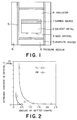
- Fig. 1 is a schematic view of the structure of a sample chamber for the synthesis of a diamond crystal in one embodiment of the present invention, showing a carbon source (1), a solvent metal (2), a seed crystal (3), an insulator (4), a graphite heater (5) and a pressure medium (6).
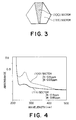
- Fig. 2 is a graph showing the relationship between the amount of Ti or A1 getter added and the nitrogen content in the crystal.
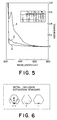
- Fig 3 is a schematic view of the cross-section of a crystal.
- Fig. 4 is a graph showing the relationship between the boron content and nitrogen-presumed content in the sector (111) and sector (100) and the absorption spectrum of ultraviolet to visible in each sector.
- Fig. 5 illustrates ultraviolet absorption spectra of diamond crystals synthesized by changing the amounts of Ti and Cu.
- Fig. 6 illustrates an estimation standard for the estimation (++, +, -) of metal inclusions in Table 1.
- the present invention has been developed to solve the above described problems and thus provides (1) a strain-free synthetic diamond, characterized in that the nitrogen content is at the most 10 ppm, preferably at the most 0.1 ppm, and the boron content is at the most 1 ppm, preferably at the most 0.1 ppm, (2) a strain-free synthetic diamond, characterized in that in the X-ray diffraction by the double crystal method, a diamond crystal is used as a first crystal and the FWHM of the X-ray diffraction rocking curve is at the most 10 arcseconds, preferably at the most 6 arcseconds for measurement using CuK ⁇ rays with an arrangement in parallel to (004) plane, and (3) a strain-free synthetic diamond, characterized in that the FWHM of a peak at 1332 to 1333 cm ⁇ 1 in the Raman spectrum of diamond, measured by means of an apparatus for Raman spectroscopic analysis with a resolving power of at the most 1 cm ⁇ 1 is at the most 2.3 cm ⁇ 1,
- the present invention relates to strain-free synthetic diamonds consisting of at least two combinations of the above described features (1) to (3).
- the unit of FWHM, arcseconds is used as a measure for indicating the completeness of crystallinity.
- the theoretical value of FWHM of a complete crystal is 4.1 arcseconds.
- the present invention also provides a process for the production of a strain-free synthetic diamond, which is characterized in that in a process for the synthesis of a diamond single crystal by the temperature gradient method, a carbon source having a boron content of at the most 10 ppm and a solvent metal having a boron content of at the most 1 ppm are used and a nitrogen getter is added to the solvent metal, thereby synthesizing a strain-free diamond having at least one of the above described features (1) to (3).
- the above described carbon source graphite which has been subjected to a halogenizing treatment to reduce the boron content to at the most 1 ppm.
- the above described nitrogen getter is preferably at least one elememt from Group IVa or Va of the Periodic Table.
- the above described solvent metal is preferably one to which an element is added capable of preventing carbide formation of at least one element from Group IVa or Va of the Periodic Table.
- diamond is synthesized at an ultra-high pressure and high temperature by the temperature gradient method, wherein the temperature and pressure at a sample section are reduced to normal temperature and pressure, and the reduction in the pressure is completed at a temperature in the range of from 300 to 1000 °C in the sample section.
- the present invention provides methods for measuring the strain in a synthetic diamond.
- the first method is characterized by measuring the X-ray diffraction rocking curve thereof using a diamond crystal as a first crystal and based on the FWHM thereof, estimating the strain in the synthetic diamond.
- the second method is characterized by measuring the X-ray diffraction rocking curve thereof by the quadruple crystal method using Si, Ge or diamond crystal and based on the FWHM thereof, estimating the strain in the synthetic diamond.
- the third method is characterized by measuring the peak (of the spectrum by LO phonon) at 1332 cm ⁇ 1 to 1333 cm ⁇ 1 of the Raman spectrum and based on the FWHM thereof, estimating the strain in the synthetic diamond.
- the inventors have estimated the crystallinity of various diamonds by various means.
- an X-ray diffraction method has been developed using, as a first crystal, a very high purity, strain-free synthetic diamond dveloped by the inventos. According to this method, a very precise and quantitative measurement of strain can be carried out.
- the inventors have attained such a new knowledge that the strain in a diamond crystal can precisely and quantitatively be estimated by the FWHM of an X-ray diffraction rocking curve measured by the use of a diamond crystal as the first crystal, by the FWHM of an X-ray diffraction rocking curve measured by the quadruple crystal method or by the FWHM of a peak at peak at 1332 to 1333 cm ⁇ 1 in the Raman spectrum.
- boron impurities in raw materials or solvent metal are decreased to such an extent as little as possible and 0.1 to 5 % by weight of a nitrogen getter is added to the weight of the solvent metal to adjust the nitrogen content and boron content in the crystal respectively to at most 0.1 ppm.
- the solvent metal for example, there are used metals such as Fe, Co, Ni, Mn, Cr, etc. and alloys thereof.
- the nitrogen getter there is used a material having a reactivity with nitrogen without hindering the growth of a diamond crystal, for example, at least one metal selected from the group consisting of Group IVa and Va metals of Periodic Table, such as Ti, Zr, Hf, V, Nb, Ta, etc., and alloys of these metals.
- a high purity diamond powder having a boron content of at most 10 ppm, more preferably a high purity graphite subjected to a halogenizing treatment to substantially remove boron. The use of the latter is more effective.
- an element capable of preventing formation of a carbide of an element selected from Group IVa and Va elements of Periodic Table for example, Cu, Ag, Au, Zn, Cd, etc. in a proportion of 0.1 to 20 % by weight to the solvent metal.
- a buffer material consisting of an element selected from the group consisting of Al, Ni, Cu, Zn, Ga, Ag, Cd, In, Sn, Au, Ti and Pb, for example, a thin sheet of Al or Cu with a thickness of 0.01 to 0.5 mm, between the surface of a seed and solvent metal for the purpose of stabilizing the initial growing state of a diamond crystal.
- the strain due to incorporation of inclusions and the crystalline defects or strains due to unstable growth at the initial crystal growth can be reduced by employing these methods or means.
- the present invention provides (4) a synthetic diamond, characterized in that nitrogen atoms and boron atoms are contained in the crystal and the difference between the number of the nitrogen atoms and that of the boron atoms is at most 1 x 10¹⁷ atoms/cm3 and (5) a synthetic diamond, characterized in that nitrogen atoms and boron atoms are contained in the crystal and the difference between the number of the nitrogen atoms and that of the boron atoms is at most 1 x 10¹⁸ atoms/cm3.
- the present invention also provides a process for the production of the above described synthetic diamond (4) or (5), which is characterized in that in a process for the synthesis of diamond single crystal by the temperature gradient method, the amount of a nitrogen getter to be added to a solvent or the amount of boron to be added to a carbon source or solvent is controlled so that the amount of nitrogen and that of boron taken in the crystal during the synthesis be substantially the same by the number of atoms.
- the inventors have made various efforts to solve the above described problems and consequently, have found that blueing of diamond crystal and lowering of the crystallinity thereof due to the presence of boron impurities from raw materials can be compensated by retaining nitrogen to some extent in the diamond crystal.
- the inventors have attained a colorless and trasnparent diamond which contains boron and nitrogen, but which is free from optical absorption of boron or nitrogen by controlling the amount of nitrogen removed, and a process for the production of the same.
- the strain in the crystal due to boron is moderated and the crystallinity is improved.
- Synthesis of Diamond single crystal is carried out by an epitaxial growth on a seed crystal according to the temperature gradient method under synthetic conditions of a pressure of 5.5 GPa and a temperature of 135 °C. A high purity raw material containing no boron is used in the synthesis. Above all, a crystal synthesized by adding 30 ppm of boron is most colorless and transparent and accordingly, polishing is carried out in such a manner that the plane (110) be an observing plane.
- Fig. 3 shows a schematic view of a crystal cross-section and Fig. 4 shows the boron content and estimated nitrogen content in each sector.
- the boron content is measured by comparison of a sample by SIMS with a previously prepared standard sample whose boron content is clarified by the ion implantation method.
- the nitrogen content is estimated from the graph of Fig. 2 showing the relationship between the amount of Ti or Al getter added and the nitrogen content in the crystal.
- the abscissa shows the amount of a getter added (atomic percent) and the ordinate shows the nitrogen content (ppm) in the crystal.
- AD pair is formed since in the sector, in which boron and nitrogen are contained in substantially equimolar amounts, absorption of nitrogen of Ib type dissolved in the isolated dispersion type is decreased, as described above.
- the number of nitrogen and boron atoms contained in diamond crystal are substantially the same. If the difference between the number of both the atoms is at most 1 x 10¹⁷ atoms/cm3, a diamond crystal whose strains are more reduced as compared with natural diamond and synthetic diamond of Ib type of the prior art will be obtained.
- seven to ten crystals are respectively prepared as to natural diamond of IIa type, nattural diamond of Ia type and synthetic diamond of Ib type of the prior art and subjected to the above described measurements to obtain respectively rocking curve FWHM of 300 to 3000 arcseconds, 200 to 600 arcseconds and 15 to 30 arc-seconds, and FWHM of a peak at 1332 cm ⁇ 1 to 1333 cm ⁇ 1 in the Raman spectrum of 2.15 to 3.5 cm ⁇ 1, 2.8 to 3.3 cm ⁇ 1 and 2.4 to 2.6 cm ⁇ 1.
- the diamond has such a good crystallinity that the FWHM of the X-ray diffraction rocking curve is at most 7 arcseconds, measured by an arrangement of a first crystal in parallel to (004) plane of diamond, or the FWHM of a peak at 1332 cm ⁇ 1 to 1333 cm ⁇ 1 in the Raman spectrum is at most 2 cm ⁇ 1 and can thus be applied to uses needing high grade crystallinity, for example, monochromators, semiconductor substrates, etc.
- this diamond can also be applied to various optical parts or window materials because of being from absorption of light by impurities such as nitrogen, boron, etc. exclusive of the absorption by the diamond itself in the near ultraviolet to far infrared range and applied to uses for jewels because of being a colorless and highly transparent diamond crystal.
- the color grade of the diamond crystal is at least G color by GIA scale, corresponding to the highest level as an estimation of the diamond for jewels. It will clearly be understood how the diamond of the present invention is excellent from the fact that the well-known synthetic diamond of IIa type is of middle class represented by H to J in the same estimation (Japanese Patent Laid-Open Publication No. 88289/1977).
- Synthesis of the diamond as described above is carried out by controlling the amount of a nitrogen getter to be added to a solvent so that the amounts of nitrogen and boron taken in the crystal are approximately same by the number of the atoms, or controlling the amount of boron to be added to a carbon source or solvent. Specifically, the following procedures are employed.
- a suitable procedure can be selected from these procedures considering the varieties of the carbon source or solvent (boron content), the nitrogen removal efficiency of the nitrigen getter, the degree of hindering the crystal growth of the nitrogen getter, etc.
- the nitrogen getter added to the solvent in the present invention there can be used Al or Group IVa or Group Va elements such as Ti, Zr, Hf, V, Nb, Ta, etc.
- a material capable of suppressing formation of carbides of these elements For example, at least one element selected from Al, Ni, Cu, Zn, Ga, Ag, Cd, In, Sn, Au, Tl and Pb is added, as such a material, in a proportion of 0.1 to 20 weight % to the solvent metal. The following experiment is carried out based on this knowledge.
- TiC observed in the solvent is size-reduced to 1 ⁇ m or less and the amount thereof is largely decreased, resulting in decrease of the inclusions in the diamond crystal. It is assumed that TiC is decompsed or the formation of TiC is suppressed by the addition of Cu.
- Table 1 shows results of typical synthetic experiments. When Ti is added in an amount of at least 1.5 %, nitrogen is substantially completely removed and even when Cu is added in an amount of 1 to 3 %, this state is not changed.
- Fig. 5 shows ultraviolet absorption spectra of diamond crystals synthesized with changing the amount of Ti an Cu added and when adding 1.5 % of Ti, the absorption by nitrogen is hardly found.
- the addition of Cu in substantially the same amount as the amount of Ti results in large reduction of the inclusion of the solvent and incorporation of fine impurities, whereby a good quality diamond crystal can be obtained in stable manner.
- the standard (++, +, -) of estimation of the metal inclusion in Table 1 is shown in Fig. 6.
- Fe, Co, Ni, Mn, Cr, etc. or alloys of these metals are generally used as the solvent metal.
- the carbon source in the present invention there can be used synthetic or natural diamond powders and graphite powders or moldings thereof.
- seed crystal small crystals of synthetic or natural diamond are used.
- a buffer material consisting of at least one element selected from Al, Ni, Cu, Zn, Ga, Ag, Cd, In , Sn, Au, Tl and Pb, for example, Al plate or Cu plate between the surface of a seed and a solvent during synthesis of diamond.
- the plate thickness of the buffer material is generally in the range of about 0.01 to 0.5 mm.
- the strains due to incorporation of the inclusions or the crystal defects or strains in the crystal due to unstable growth at the initial period of crystal growth can be reduced by employing these procedures.
- the pressure is preferably released at an internal temperature of 300 to 1000 °C, preferably 400 to 800 °C, more preferably 500 to 600 °C, whereby to reduce remaining of strains due to stress in the crystal.
- the nitrogen getter is added to the solvent in a proportion of 0.1 to 5 weight %.
- the synthetic diamond of the present invention has less impurities, strains and crystal defects and reduced disadvantages such as cracking or breakage during compressing, and can be used as a diamond anvil for producing an ultra-high pressure or diamond anvil for FT-IR with a largely improved service life and stability.
- the synthetic diamond of the present invention can also be applied to uses needing high crystallinity of diamond, for example, monochromators, window materials for radiation light or radiation beam, semiconductr substrates, etc.
- the synthetic diamond of the present invention contains nitrogen and boron as impurities, but the contents of the both are substantially the same and compensated with each other, so the synthetic diamond of the present invention meets with no absorption of light due to nitrogen and boron and little strain in the crystal in an analogous manner to high purity diamond of IIa type hardly containing impurities.
- the synthetic diamond of the present invention having disadvantages such as cracking or breakage rduced during compressing can be used as a diamond anvil for producing an ultrahigh pressure or diamond anvil for FT-IR with a largely improved service life and stability.
- diamond having very high crystallinity and light transmission property can be synthesized, which can be applied to uses such as monochromators, semiconductor substrates, jewels, etc.
- the above described high quality synthetic diamond can be realized by the production process of the present invention. Moreover, accoridng to the method of measuring the strain of the synthetic diamond of the present invention, a more precise and quantitative measurement of strain than in the prior art is rendered possible. This is very advantageous.
- Fig. 1 is shown the structure of a sample chamber for the synthesis of diamond, used in Examples and Comparative Examples.
- To this solvent metal were added 1.5 weight % of Ti as a nitrogen getter (based on the weight of the solvent metal) and 1 weight % of Cu (based on the weight of the solvent metal).
- a seed crystal 3 there was used a diamond crystal with a size of 500 ⁇ m.
- the carbon source 1 and seed crystal 3 were set in a graphite heater 5 to give a temperature gradient of about 30 °C and maintained at a pressure of 5.5 GPa and a temperature of 1300 °C for 70 hours in an ultra-high pressure producing apparatus to grow diamond on the seed crystal.
- the FWHM of the X-ray diffraction rocking curve was 5.8 arcseconds in the case of measuring using CuK ⁇ ray by the double crystal method with an arrangement in parallel to (004) plane of a synthetic diamond crystal as a first crystal.
- Example 2 Ti 1.5 weight %, Cu 2 weight %
- Example 3 Ti 1.0 weight %, Cu 1 weight %
- Example 4 Ti 0.5 weight %, Cu 1 weight %
- Diamond crystals were synthesized in the similar manner to Example 1 but changing the amounts of Ti and Cu as described above.
- Four kinds of the thus resulting crystals, six natural diamond crystals of IIa type and six natural diamond crystals of Ia type were respectively subjected to measurement and estimation of nitrogen impurity, boron impurity, the FWHM of rocking curve, the FWHM of Raman peak and the strains by observation of polarized light images in an analogous manner to Example 1. The results are shown in Table 1 with the results of Example 1.
- Diamond of IIa type was synthesized in an analogous manner to Example 1 except that an Al plate with a thickness of 0.05 mm, as a buffer material for stabilizing the initial crystal growth, was arranged between the solvent metal and seed crystal. Consequently, the crystallinity of the resulting diamond was further improved as represented by the fact that the FWHM of rocking curve was 5.6 arcsec. and the FWHM of Raman spectrum peak was 1.6 cm ⁇ 1.
- Diamond of IIa type was synthesized in an analogous manner to Example 1 except that after the synthesis of diamond, lowering of the temperature and reduction of the pressure were simultaneously carried out and the lowering of the pressure was completed when the internal temperature was 500 °C. Consequently, the crystallinity of the resulting diamond was further improved as represented by the fact that the FWHM of rocking curve was 5.7 arcsec. and the FWHM of Raman spectrum peak was 1.6 cm ⁇ 1.
- (004) plane of diamond was used as a first crystal in X-ray diffraction and arranged in parallel, but in the method of measuring the strains by X-ray diffraction, another plane, for example, (111) plane of diamond can be used and it is also effective to arrange it otherwise, for example, in asymmetric manner.
- Fig. 1 is shown the structure of a sample chamber for the synthesis of diamond, used in Examples.
- a solvent metal composition of Fe/Co 60/40 (weight ratio).
- To this solvent metal were added 0.8 weight % of Ti as a nitrogen getter and simultaneously, 1 weight % of Cu.
- a seed crystal 3 there was used a diamond crystal with a size of 500 ⁇ m.
- the carbon source 1 and seed crystal 3 were set in a graphite heater 5 to give a temperature gradient of about 30°C between them and maintained at a pressure of 5.5 GPa and a temperature of 1300 °C for 70 hours in an ultra-high pressure producing apparatus to grow diamond on the seed crystal.
- Diamond was synthesized in an analogous manner to Example 7 except changing the amounts of Ti and Cu added respectively to 1.5 weight % and 1.5 weight %.
- the resulting diamond was a blueish crystal which contained nitrogen and boron respectively in amounts of 1.0 x 10¹⁶ atoms/cm3 and 1.2 x 10¹⁷ atoms/cm3 by SIMS analysis. Measurement of the infrared absorption spectrum told that absorption by boron was found in the vicinity of 2800 cm ⁇ 1. Observation of the resulting diamond by a polarizing microscope to observe a polarized light image and to estimate the strains taught that there was found a small amount of strains.
- the FWHM of the X-ray diffraction rocking curve was 8.3 arcseconds in the case of measuring by the double crystal method with an arrangement in parallel to (004) plane of a synthetic diamond crystal as a first crystal.
- the FWHM of a peak at 1332 cm ⁇ 1 to 1333 cm ⁇ 1 in the Raman spectrum, masured by means of anapparatus for double monochromator Raman spectroscopic analysis was 2.5 cm ⁇ 1.
- Diamond was synthesized in an analogous manner to Example 7 except adding 0.04 weight % (based on carbon source) of boron to the carbon source, 1.5 weight % of Al as a nitrogen getter and no copper. Consequently, there was obtained a diamond crystal of IIa type, with 0.7 to 0.9 carat.
- the nitrogen and boron in the crystal were subjected to quantitative analysis by SIMS to obtain 1.8 x 10¹⁷atoms/cm3 and 1.5 x 10¹⁷ atoms/cm3 by SIMS.
- Diamond was synthesized in an analogous manner to Example 9 except changing the amount of Al to 0.5 weight % .
- the resulting diamond was a somewhat yellowish crystal which contained nitrogen and boron respectively in amounts of 1.6 x 10¹⁶ atoms/cm3 and 1.5 x 10¹⁷ atoms/cm3 by SIMS analysis. Measurement of the infrared absorption spectrum and ultraviolet-visible spectrum as to the resulting diamond told that in any case, absorption of nitrogen was found.
- Diamond of IIa type was synthesized in an analogous manner to Example 11 except that an Al plate with a thickness of 0.05 mm, as a buffer material for stabilizing the initial crystal growth, was arranged between the solvent metal and seed crystal. Consequently, the crystallinity of the resulting diamond was further improved as represented by the fact that the FWHM of rocking curve was 5.7 arcsec. and the FWHM of Raman spectrum peak was 1.6 cm ⁇ 1 The other properties were same as those of Example 11.
- Diamond of IIa type was synthesized in an analogous manner to Example 11 except that after the synthesis of diamond, lowering of the temperature and reduction of the pressure were simultaneously carried out and the lowering of the pressure was completed when the internal temperature was 500 °C. Consequently, the crystallinity of the resulting diamond was further improved as represented by the fact that the FWHM of rocking curve was 5.7 arcsec. and the FWHM of Raman spectrum peak was 1.6 cm ⁇ 1. The other properties were same as those of Example 11.
Landscapes
- Chemical & Material Sciences (AREA)
- Organic Chemistry (AREA)
- Inorganic Chemistry (AREA)
- Life Sciences & Earth Sciences (AREA)
- General Life Sciences & Earth Sciences (AREA)
- Geology (AREA)
- Chemical Kinetics & Catalysis (AREA)
- Carbon And Carbon Compounds (AREA)
- Crystals, And After-Treatments Of Crystals (AREA)
Applications Claiming Priority (6)
| Application Number | Priority Date | Filing Date | Title |
|---|---|---|---|
| JP25321093 | 1993-10-08 | ||
| JP253210/93 | 1993-10-08 | ||
| JP269040/93 | 1993-10-27 | ||
| JP26904093A JP3339137B2 (ja) | 1993-10-27 | 1993-10-27 | 合成ダイヤモンド単結晶およびその製造方法 |
| JP169154/94 | 1994-07-21 | ||
| JP16915494A JP3456263B2 (ja) | 1993-10-08 | 1994-07-21 | 歪みの少ない合成ダイヤモンドおよびその製造方法並びに合成ダイヤモンドの歪み測定方法 |
Publications (3)
| Publication Number | Publication Date |
|---|---|
| EP0647590A2 true EP0647590A2 (de) | 1995-04-12 |
| EP0647590A3 EP0647590A3 (de) | 1995-07-26 |
| EP0647590B1 EP0647590B1 (de) | 1998-06-24 |
Family
ID=27323128
Family Applications (1)
| Application Number | Title | Priority Date | Filing Date |
|---|---|---|---|
| EP94307418A Expired - Lifetime EP0647590B1 (de) | 1993-10-08 | 1994-10-10 | Synthetischer Diamant und Verfahren zu dessen Herstellung |
Country Status (4)
| Country | Link |
|---|---|
| US (1) | US6030595A (de) |
| EP (1) | EP0647590B1 (de) |
| KR (1) | KR100269924B1 (de) |
| DE (1) | DE69411244T2 (de) |
Cited By (3)
| Publication number | Priority date | Publication date | Assignee | Title |
|---|---|---|---|---|
| EP1460040A4 (de) * | 2001-12-28 | 2005-06-08 | Toyo Tanso Co | Graphitmaterial zur synthese von halbleiterdiamant und danach hergestellter halbleiterdiamant |
| US7404399B2 (en) | 2003-10-10 | 2008-07-29 | Sumitomo Electric Industries, Ltd. | Diamond tool, synthetic single crystal diamond and method of synthesizing single crystal diamond, and diamond jewelry |
| EP4317545A4 (de) * | 2021-03-31 | 2024-11-06 | Sumitomo Electric Industries, Ltd. | Einkristalliner diamant und herstellungsverfahren dafür |
Families Citing this family (46)
| Publication number | Priority date | Publication date | Assignee | Title |
|---|---|---|---|---|
| US5966673A (en) | 1997-01-10 | 1999-10-12 | Diamond Technologies, Inc. | System and method for computerized evaluation of gemstones |
| US9221154B2 (en) | 1997-04-04 | 2015-12-29 | Chien-Min Sung | Diamond tools and methods for making the same |
| US7323049B2 (en) * | 1997-04-04 | 2008-01-29 | Chien-Min Sung | High pressure superabrasive particle synthesis |
| US9199357B2 (en) | 1997-04-04 | 2015-12-01 | Chien-Min Sung | Brazed diamond tools and methods for making the same |
| US9463552B2 (en) | 1997-04-04 | 2016-10-11 | Chien-Min Sung | Superbrasvie tools containing uniformly leveled superabrasive particles and associated methods |
| US9868100B2 (en) | 1997-04-04 | 2018-01-16 | Chien-Min Sung | Brazed diamond tools and methods for making the same |
| US9409280B2 (en) | 1997-04-04 | 2016-08-09 | Chien-Min Sung | Brazed diamond tools and methods for making the same |
| US7368013B2 (en) * | 1997-04-04 | 2008-05-06 | Chien-Min Sung | Superabrasive particle synthesis with controlled placement of crystalline seeds |
| US9238207B2 (en) | 1997-04-04 | 2016-01-19 | Chien-Min Sung | Brazed diamond tools and methods for making the same |
| US6473164B1 (en) | 2000-02-16 | 2002-10-29 | Gemological Institute Of America, Inc. | Systems, apparatuses and methods for diamond color measurement and analysis |
| US7260544B1 (en) * | 2000-10-12 | 2007-08-21 | Gemological Institute Of America, Inc. | System and methods for evaluating the appearance of a gemstone |
| GB0227261D0 (en) | 2002-11-21 | 2002-12-31 | Element Six Ltd | Optical quality diamond material |
| US7517588B2 (en) * | 2003-10-08 | 2009-04-14 | Frushour Robert H | High abrasion resistant polycrystalline diamond composite |
| US7595110B2 (en) * | 2003-10-08 | 2009-09-29 | Frushour Robert H | Polycrystalline diamond composite |
| JP3764157B2 (ja) * | 2003-10-10 | 2006-04-05 | 東洋炭素株式会社 | 高純度炭素系材料及びセラミックス膜被覆高純度炭素系材料 |
| JP4387159B2 (ja) * | 2003-10-28 | 2009-12-16 | 東洋炭素株式会社 | 黒鉛材料、炭素繊維強化炭素複合材料、及び、膨張黒鉛シート |
| JP5362992B2 (ja) * | 2004-12-09 | 2013-12-11 | エレメント シックス (プロダクション)(プロプライエタリィ) リミテッド | ダイヤモンドの合成 |
| ES2258921B2 (es) * | 2005-02-21 | 2007-04-01 | Instituto De Monocristales, S.L. | Diamante sintetico de distintos colores personalizado a partir de queratina humana o animal (vivo o muerto). procedimiento para su fabricacion. |
| ES2258919B2 (es) * | 2005-02-21 | 2007-04-01 | Instituto De Monocristales, S.L. | Capsula y elementos para la produccion de sintesis del diamante. |
| US20060210465A1 (en) * | 2005-03-04 | 2006-09-21 | The Morgan Crucible Company Plc | Anisotropic material treatment heater tubes |
| US8678878B2 (en) | 2009-09-29 | 2014-03-25 | Chien-Min Sung | System for evaluating and/or improving performance of a CMP pad dresser |
| US8622787B2 (en) * | 2006-11-16 | 2014-01-07 | Chien-Min Sung | CMP pad dressers with hybridized abrasive surface and related methods |
| US8398466B2 (en) * | 2006-11-16 | 2013-03-19 | Chien-Min Sung | CMP pad conditioners with mosaic abrasive segments and associated methods |
| US8393934B2 (en) | 2006-11-16 | 2013-03-12 | Chien-Min Sung | CMP pad dressers with hybridized abrasive surface and related methods |
| US9138862B2 (en) | 2011-05-23 | 2015-09-22 | Chien-Min Sung | CMP pad dresser having leveled tips and associated methods |
| US9724802B2 (en) | 2005-05-16 | 2017-08-08 | Chien-Min Sung | CMP pad dressers having leveled tips and associated methods |
| US20060292302A1 (en) * | 2005-06-24 | 2006-12-28 | Robert Chodelka | Apparatus and method for growing a synthetic diamond |
| US7887631B2 (en) * | 2005-06-24 | 2011-02-15 | The Gemesis Corporation | System and high pressure, high temperature apparatus for producing synthetic diamonds |
| RU2320404C2 (ru) * | 2005-11-28 | 2008-03-27 | Федеральное государственное учреждение "Технологический институт сверхтвердых и новых углеродных материалов" (ФГУ ТИСНУМ) | Способ выращивания монокристаллов алмаза |
| US20070251327A1 (en) * | 2006-04-13 | 2007-11-01 | Broene William J | Crash analysis through estimation of residual strains resulting from metal formation |
| US9262284B2 (en) * | 2006-12-07 | 2016-02-16 | Lenovo Enterprise Solutions (Singapore) Pte. Ltd. | Single channel memory mirror |
| TWI388402B (en) | 2007-12-06 | 2013-03-11 | Methods for orienting superabrasive particles on a surface and associated tools | |
| US8252263B2 (en) * | 2008-04-14 | 2012-08-28 | Chien-Min Sung | Device and method for growing diamond in a liquid phase |
| US9255009B2 (en) * | 2009-06-26 | 2016-02-09 | Element Six Technologies Limited | Diamond material |
| CN103221180A (zh) | 2010-09-21 | 2013-07-24 | 铼钻科技股份有限公司 | 具有基本平坦颗粒尖端的超研磨工具及其相关方法 |
| US9238875B2 (en) | 2011-02-01 | 2016-01-19 | Sunset Peak International Limited | Multilayer structure for a diamond growth and a method of providing the same |
| US8858665B2 (en) | 2011-04-28 | 2014-10-14 | Robert Frushour | Method for making fine diamond PDC |
| US8741010B2 (en) | 2011-04-28 | 2014-06-03 | Robert Frushour | Method for making low stress PDC |
| US8974559B2 (en) | 2011-05-12 | 2015-03-10 | Robert Frushour | PDC made with low melting point catalyst |
| US8828110B2 (en) | 2011-05-20 | 2014-09-09 | Robert Frushour | ADNR composite |
| US9061264B2 (en) | 2011-05-19 | 2015-06-23 | Robert H. Frushour | High abrasion low stress PDC |
| WO2012162430A2 (en) | 2011-05-23 | 2012-11-29 | Chien-Min Sung | Cmp pad dresser having leveled tips and associated methods |
| US9835570B2 (en) * | 2013-09-13 | 2017-12-05 | The United States Of America As Represented By The Administrator Of Nasa | X-ray diffraction (XRD) characterization methods for sigma=3 twin defects in cubic semiconductor (100) wafers |
| CN107311660B (zh) * | 2017-06-27 | 2020-03-13 | 中南钻石有限公司 | 用于IIa型钻石合成的碳源的制备方法 |
| CN116997689A (zh) * | 2021-03-31 | 2023-11-03 | 住友电气工业株式会社 | 单晶金刚石及其制造方法 |
| JPWO2022210566A1 (de) | 2021-03-31 | 2022-10-06 |
Citations (1)
| Publication number | Priority date | Publication date | Assignee | Title |
|---|---|---|---|---|
| JPS5288289A (en) | 1976-01-16 | 1977-07-23 | Gen Electric | Method and apparatus for making diamonds |
Family Cites Families (10)
| Publication number | Priority date | Publication date | Assignee | Title |
|---|---|---|---|---|
| US4301134A (en) * | 1973-11-02 | 1981-11-17 | General Electric Company | Novel diamond products and the manufacture thereof |
| US4125770A (en) * | 1975-01-03 | 1978-11-14 | Lang Andrew R | Diamond identification |
| US4287168A (en) * | 1975-01-27 | 1981-09-01 | General Electric Company | Apparatus and method for isolation of diamond seeds for growing diamonds |
| US4333986A (en) * | 1979-06-11 | 1982-06-08 | Sumitomo Electric Industries, Ltd. | Diamond sintered compact wherein crystal particles are uniformly orientated in a particular direction and a method for producing the same |
| US4754140A (en) * | 1985-03-21 | 1988-06-28 | Nam Tom L | Diamond as a thermoluminescent material |
| JPH0635325B2 (ja) * | 1986-09-22 | 1994-05-11 | 東洋炭素株式会社 | 高純度黒鉛材の製造方法 |
| US5133332A (en) * | 1989-06-15 | 1992-07-28 | Sumitomo Electric Industries, Ltd. | Diamond tool |
| JP2940099B2 (ja) * | 1990-08-09 | 1999-08-25 | 住友電気工業株式会社 | 高熱伝導性ダイヤモンド単結晶の合成方法 |
| US6129900A (en) * | 1991-02-15 | 2000-10-10 | Sumitomo Electric Industries, Ltd. | Process for the synthesis of diamond |
| US5382809A (en) * | 1992-09-14 | 1995-01-17 | Sumitomo Electric Industries, Ltd. | Semiconductor device including semiconductor diamond |
-
1994
- 1994-10-07 KR KR1019940025640A patent/KR100269924B1/ko not_active Expired - Fee Related
- 1994-10-10 DE DE69411244T patent/DE69411244T2/de not_active Expired - Lifetime
- 1994-10-10 EP EP94307418A patent/EP0647590B1/de not_active Expired - Lifetime
-
1996
- 1996-07-22 US US08/684,725 patent/US6030595A/en not_active Expired - Lifetime
Patent Citations (1)
| Publication number | Priority date | Publication date | Assignee | Title |
|---|---|---|---|---|
| JPS5288289A (en) | 1976-01-16 | 1977-07-23 | Gen Electric | Method and apparatus for making diamonds |
Cited By (5)
| Publication number | Priority date | Publication date | Assignee | Title |
|---|---|---|---|---|
| EP1460040A4 (de) * | 2001-12-28 | 2005-06-08 | Toyo Tanso Co | Graphitmaterial zur synthese von halbleiterdiamant und danach hergestellter halbleiterdiamant |
| US8916125B2 (en) | 2001-12-28 | 2014-12-23 | Toyo Tanso Co., Ltd. | Graphite material for synthesizing semiconductor diamond and semiconductor diamond produced by using the same |
| US7404399B2 (en) | 2003-10-10 | 2008-07-29 | Sumitomo Electric Industries, Ltd. | Diamond tool, synthetic single crystal diamond and method of synthesizing single crystal diamond, and diamond jewelry |
| EP1671726B1 (de) * | 2003-10-10 | 2013-02-13 | Sumitomo Electric Industries, Ltd. | Diamantwerkzeug |
| EP4317545A4 (de) * | 2021-03-31 | 2024-11-06 | Sumitomo Electric Industries, Ltd. | Einkristalliner diamant und herstellungsverfahren dafür |
Also Published As
| Publication number | Publication date |
|---|---|
| US6030595A (en) | 2000-02-29 |
| KR950011040A (ko) | 1995-05-15 |
| KR100269924B1 (ko) | 2000-11-01 |
| EP0647590A3 (de) | 1995-07-26 |
| DE69411244T2 (de) | 1998-12-24 |
| EP0647590B1 (de) | 1998-06-24 |
| DE69411244D1 (de) | 1998-07-30 |
Similar Documents
| Publication | Publication Date | Title |
|---|---|---|
| EP0647590B1 (de) | Synthetischer Diamant und Verfahren zu dessen Herstellung | |
| EP0525207B1 (de) | Diamantsyntheseverfahren | |
| EP0715885B1 (de) | Diamant-Einkristall mit niedriger Fehlerdichte und Verfahren zu dessen Herstellung | |
| EP2446070B1 (de) | Verfahren zur herstellung eines extravaganten blassblauen oder blassblau/grünen cvd-einkristalldiamants und gewonnenes produkt | |
| Sumiya et al. | High-pressure synthesis of high-purity diamond crystal | |
| US9017632B2 (en) | Diamond material | |
| EP2576441B1 (de) | Diamantwerkzeuge | |
| EP3312311B1 (de) | Diamant-einkristall, werkzeug und verfahren zur herstellung eines diamant-einkristalls | |
| Sumiya et al. | Development of high-quality large-size synthetic diamond crystals | |
| KR20180135005A (ko) | 다이아몬드 공구 부품 | |
| EP2468392B1 (de) | Diamantenwerkzeug, synthetischer einzelkristalldiamant und verfahren zur synthese eines einzelkristalldiamanten und diamantenschmuck | |
| Liang et al. | Enhancing the mechanical properties of single-crystal CVD diamond | |
| JP3339137B2 (ja) | 合成ダイヤモンド単結晶およびその製造方法 | |
| KR20110104562A (ko) | 단결정 다이아몬드의 제조를 위한 고압고온 (hpht) 방법 | |
| EP4357491A1 (de) | Synthetischer einkristalldiamant und verfahren zur herstellung davon | |
| KR20170126926A (ko) | 단결정 다이아몬드 및 이것을 성장시키는 방법 | |
| JP3456263B2 (ja) | 歪みの少ない合成ダイヤモンドおよびその製造方法並びに合成ダイヤモンドの歪み測定方法 | |
| EP4357490A1 (de) | Synthetischer einkristalldiamant und herstellungsverfahren dafür | |
| EP4650497A1 (de) | Synthetischer monokristalliner diamant | |
| Kanda | Colored high pressure high temperature (HPHT) synthetic diamonds | |
| JPH04260435A (ja) | ダイヤモンドの合成方法 | |
| HK1170273B (en) | Method for making fancy pale blue or fancy pale blue / green single crystal cvd diamond and product obtained | |
| HK1170273A (en) | Method for making fancy pale blue or fancy pale blue / green single crystal cvd diamond and product obtained |
Legal Events
| Date | Code | Title | Description |
|---|---|---|---|
| PUAI | Public reference made under article 153(3) epc to a published international application that has entered the european phase |
Free format text: ORIGINAL CODE: 0009012 |
|
| AK | Designated contracting states |
Kind code of ref document: A2 Designated state(s): BE DE FR GB IE |
|
| PUAL | Search report despatched |
Free format text: ORIGINAL CODE: 0009013 |
|
| AK | Designated contracting states |
Kind code of ref document: A3 Designated state(s): BE DE FR GB IE |
|
| 17P | Request for examination filed |
Effective date: 19950905 |
|
| 17Q | First examination report despatched |
Effective date: 19961022 |
|
| GRAG | Despatch of communication of intention to grant |
Free format text: ORIGINAL CODE: EPIDOS AGRA |
|
| GRAG | Despatch of communication of intention to grant |
Free format text: ORIGINAL CODE: EPIDOS AGRA |
|
| GRAH | Despatch of communication of intention to grant a patent |
Free format text: ORIGINAL CODE: EPIDOS IGRA |
|
| GRAH | Despatch of communication of intention to grant a patent |
Free format text: ORIGINAL CODE: EPIDOS IGRA |
|
| GRAA | (expected) grant |
Free format text: ORIGINAL CODE: 0009210 |
|
| AK | Designated contracting states |
Kind code of ref document: B1 Designated state(s): BE DE FR GB IE |
|
| REF | Corresponds to: |
Ref document number: 69411244 Country of ref document: DE Date of ref document: 19980730 |
|
| ET | Fr: translation filed | ||
| REG | Reference to a national code |
Ref country code: IE Ref legal event code: FG4D |
|
| PLBE | No opposition filed within time limit |
Free format text: ORIGINAL CODE: 0009261 |
|
| STAA | Information on the status of an ep patent application or granted ep patent |
Free format text: STATUS: NO OPPOSITION FILED WITHIN TIME LIMIT |
|
| 26N | No opposition filed | ||
| PGFP | Annual fee paid to national office [announced via postgrant information from national office to epo] |
Ref country code: GB Payment date: 20011010 Year of fee payment: 8 |
|
| PGFP | Annual fee paid to national office [announced via postgrant information from national office to epo] |
Ref country code: IE Payment date: 20011026 Year of fee payment: 8 |
|
| PGFP | Annual fee paid to national office [announced via postgrant information from national office to epo] |
Ref country code: BE Payment date: 20011129 Year of fee payment: 8 |
|
| REG | Reference to a national code |
Ref country code: GB Ref legal event code: IF02 |
|
| PG25 | Lapsed in a contracting state [announced via postgrant information from national office to epo] |
Ref country code: IE Free format text: LAPSE BECAUSE OF NON-PAYMENT OF DUE FEES Effective date: 20021010 Ref country code: GB Free format text: LAPSE BECAUSE OF NON-PAYMENT OF DUE FEES Effective date: 20021010 |
|
| PG25 | Lapsed in a contracting state [announced via postgrant information from national office to epo] |
Ref country code: BE Free format text: LAPSE BECAUSE OF NON-PAYMENT OF DUE FEES Effective date: 20021031 |
|
| BERE | Be: lapsed |
Owner name: *SUMITOMO ELECTRIC INDUSTRIES LTD Effective date: 20021031 |
|
| GBPC | Gb: european patent ceased through non-payment of renewal fee |
Effective date: 20021010 |
|
| REG | Reference to a national code |
Ref country code: IE Ref legal event code: MM4A |
|
| PGFP | Annual fee paid to national office [announced via postgrant information from national office to epo] |
Ref country code: DE Payment date: 20131002 Year of fee payment: 20 Ref country code: FR Payment date: 20131009 Year of fee payment: 20 |
|
| REG | Reference to a national code |
Ref country code: DE Ref legal event code: R071 Ref document number: 69411244 Country of ref document: DE |