EP0647701B1 - Schmiermittel für kühlschrank und dieses enthaltende schmiermittelzusammensetzung - Google Patents
Schmiermittel für kühlschrank und dieses enthaltende schmiermittelzusammensetzung Download PDFInfo
- Publication number
- EP0647701B1 EP0647701B1 EP94910524A EP94910524A EP0647701B1 EP 0647701 B1 EP0647701 B1 EP 0647701B1 EP 94910524 A EP94910524 A EP 94910524A EP 94910524 A EP94910524 A EP 94910524A EP 0647701 B1 EP0647701 B1 EP 0647701B1
- Authority
- EP
- European Patent Office
- Prior art keywords
- acid
- hydrofluorocarbon
- coolant
- refrigerator
- carbon atoms
- Prior art date
- Legal status (The legal status is an assumption and is not a legal conclusion. Google has not performed a legal analysis and makes no representation as to the accuracy of the status listed.)
- Expired - Lifetime
Links
Classifications
-
- C—CHEMISTRY; METALLURGY
- C10—PETROLEUM, GAS OR COKE INDUSTRIES; TECHNICAL GASES CONTAINING CARBON MONOXIDE; FUELS; LUBRICANTS; PEAT
- C10M—LUBRICATING COMPOSITIONS; USE OF CHEMICAL SUBSTANCES EITHER ALONE OR AS LUBRICATING INGREDIENTS IN A LUBRICATING COMPOSITION
- C10M171/00—Lubricating compositions characterised by purely physical criteria, e.g. containing as base-material, thickener or additive, ingredients which are characterised exclusively by their numerically specified physical properties, i.e. containing ingredients which are physically well-defined but for which the chemical nature is either unspecified or only very vaguely indicated
- C10M171/008—Lubricant compositions compatible with refrigerants
-
- C—CHEMISTRY; METALLURGY
- C10—PETROLEUM, GAS OR COKE INDUSTRIES; TECHNICAL GASES CONTAINING CARBON MONOXIDE; FUELS; LUBRICANTS; PEAT
- C10M—LUBRICATING COMPOSITIONS; USE OF CHEMICAL SUBSTANCES EITHER ALONE OR AS LUBRICATING INGREDIENTS IN A LUBRICATING COMPOSITION
- C10M105/00—Lubricating compositions characterised by the base-material being a non-macromolecular organic compound
- C10M105/08—Lubricating compositions characterised by the base-material being a non-macromolecular organic compound containing oxygen
- C10M105/32—Esters
- C10M105/38—Esters of polyhydroxy compounds
-
- C—CHEMISTRY; METALLURGY
- C10—PETROLEUM, GAS OR COKE INDUSTRIES; TECHNICAL GASES CONTAINING CARBON MONOXIDE; FUELS; LUBRICANTS; PEAT
- C10M—LUBRICATING COMPOSITIONS; USE OF CHEMICAL SUBSTANCES EITHER ALONE OR AS LUBRICATING INGREDIENTS IN A LUBRICATING COMPOSITION
- C10M107/00—Lubricating compositions characterised by the base-material being a macromolecular compound
- C10M107/20—Lubricating compositions characterised by the base-material being a macromolecular compound containing oxygen
- C10M107/30—Macromolecular compounds obtained otherwise than by reactions only involving carbon-to-carbon unsaturated bonds
- C10M107/32—Condensation polymers of aldehydes or ketones; Polyesters; Polyethers
- C10M107/34—Polyoxyalkylenes
-
- C—CHEMISTRY; METALLURGY
- C10—PETROLEUM, GAS OR COKE INDUSTRIES; TECHNICAL GASES CONTAINING CARBON MONOXIDE; FUELS; LUBRICANTS; PEAT
- C10M—LUBRICATING COMPOSITIONS; USE OF CHEMICAL SUBSTANCES EITHER ALONE OR AS LUBRICATING INGREDIENTS IN A LUBRICATING COMPOSITION
- C10M129/00—Lubricating compositions characterised by the additive being an organic non-macromolecular compound containing oxygen
- C10M129/02—Lubricating compositions characterised by the additive being an organic non-macromolecular compound containing oxygen having a carbon chain of less than 30 atoms
- C10M129/04—Hydroxy compounds
- C10M129/10—Hydroxy compounds having hydroxy groups bound to a carbon atom of a six-membered aromatic ring
-
- C—CHEMISTRY; METALLURGY
- C10—PETROLEUM, GAS OR COKE INDUSTRIES; TECHNICAL GASES CONTAINING CARBON MONOXIDE; FUELS; LUBRICANTS; PEAT
- C10M—LUBRICATING COMPOSITIONS; USE OF CHEMICAL SUBSTANCES EITHER ALONE OR AS LUBRICATING INGREDIENTS IN A LUBRICATING COMPOSITION
- C10M129/00—Lubricating compositions characterised by the additive being an organic non-macromolecular compound containing oxygen
- C10M129/02—Lubricating compositions characterised by the additive being an organic non-macromolecular compound containing oxygen having a carbon chain of less than 30 atoms
- C10M129/16—Ethers
- C10M129/18—Epoxides
-
- C—CHEMISTRY; METALLURGY
- C10—PETROLEUM, GAS OR COKE INDUSTRIES; TECHNICAL GASES CONTAINING CARBON MONOXIDE; FUELS; LUBRICANTS; PEAT
- C10M—LUBRICATING COMPOSITIONS; USE OF CHEMICAL SUBSTANCES EITHER ALONE OR AS LUBRICATING INGREDIENTS IN A LUBRICATING COMPOSITION
- C10M129/00—Lubricating compositions characterised by the additive being an organic non-macromolecular compound containing oxygen
- C10M129/02—Lubricating compositions characterised by the additive being an organic non-macromolecular compound containing oxygen having a carbon chain of less than 30 atoms
- C10M129/66—Epoxidised acids or esters
-
- C—CHEMISTRY; METALLURGY
- C10—PETROLEUM, GAS OR COKE INDUSTRIES; TECHNICAL GASES CONTAINING CARBON MONOXIDE; FUELS; LUBRICANTS; PEAT
- C10M—LUBRICATING COMPOSITIONS; USE OF CHEMICAL SUBSTANCES EITHER ALONE OR AS LUBRICATING INGREDIENTS IN A LUBRICATING COMPOSITION
- C10M133/00—Lubricating compositions characterised by the additive being an organic non-macromolecular compound containing nitrogen
- C10M133/02—Lubricating compositions characterised by the additive being an organic non-macromolecular compound containing nitrogen having a carbon chain of less than 30 atoms
- C10M133/22—Lubricating compositions characterised by the additive being an organic non-macromolecular compound containing nitrogen having a carbon chain of less than 30 atoms containing a carbon-to-nitrogen double bond, e.g. guanidines, hydrazones, semicarbazones
-
- C—CHEMISTRY; METALLURGY
- C10—PETROLEUM, GAS OR COKE INDUSTRIES; TECHNICAL GASES CONTAINING CARBON MONOXIDE; FUELS; LUBRICANTS; PEAT
- C10M—LUBRICATING COMPOSITIONS; USE OF CHEMICAL SUBSTANCES EITHER ALONE OR AS LUBRICATING INGREDIENTS IN A LUBRICATING COMPOSITION
- C10M137/00—Lubricating compositions characterised by the additive being an organic non-macromolecular compound containing phosphorus
- C10M137/02—Lubricating compositions characterised by the additive being an organic non-macromolecular compound containing phosphorus having no phosphorus-to-carbon bond
- C10M137/04—Phosphate esters
-
- C—CHEMISTRY; METALLURGY
- C10—PETROLEUM, GAS OR COKE INDUSTRIES; TECHNICAL GASES CONTAINING CARBON MONOXIDE; FUELS; LUBRICANTS; PEAT
- C10M—LUBRICATING COMPOSITIONS; USE OF CHEMICAL SUBSTANCES EITHER ALONE OR AS LUBRICATING INGREDIENTS IN A LUBRICATING COMPOSITION
- C10M169/00—Lubricating compositions characterised by containing as components a mixture of at least two types of ingredient selected from base-materials, thickeners or additives, covered by the preceding groups, each of these compounds being essential
- C10M169/04—Mixtures of base-materials and additives
-
- C—CHEMISTRY; METALLURGY
- C10—PETROLEUM, GAS OR COKE INDUSTRIES; TECHNICAL GASES CONTAINING CARBON MONOXIDE; FUELS; LUBRICANTS; PEAT
- C10M—LUBRICATING COMPOSITIONS; USE OF CHEMICAL SUBSTANCES EITHER ALONE OR AS LUBRICATING INGREDIENTS IN A LUBRICATING COMPOSITION
- C10M2207/00—Organic non-macromolecular hydrocarbon compounds containing hydrogen, carbon and oxygen as ingredients in lubricant compositions
- C10M2207/02—Hydroxy compounds
- C10M2207/023—Hydroxy compounds having hydroxy groups bound to carbon atoms of six-membered aromatic rings
-
- C—CHEMISTRY; METALLURGY
- C10—PETROLEUM, GAS OR COKE INDUSTRIES; TECHNICAL GASES CONTAINING CARBON MONOXIDE; FUELS; LUBRICANTS; PEAT
- C10M—LUBRICATING COMPOSITIONS; USE OF CHEMICAL SUBSTANCES EITHER ALONE OR AS LUBRICATING INGREDIENTS IN A LUBRICATING COMPOSITION
- C10M2207/00—Organic non-macromolecular hydrocarbon compounds containing hydrogen, carbon and oxygen as ingredients in lubricant compositions
- C10M2207/02—Hydroxy compounds
- C10M2207/023—Hydroxy compounds having hydroxy groups bound to carbon atoms of six-membered aromatic rings
- C10M2207/024—Hydroxy compounds having hydroxy groups bound to carbon atoms of six-membered aromatic rings having at least two phenol groups but no condensed ring
-
- C—CHEMISTRY; METALLURGY
- C10—PETROLEUM, GAS OR COKE INDUSTRIES; TECHNICAL GASES CONTAINING CARBON MONOXIDE; FUELS; LUBRICANTS; PEAT
- C10M—LUBRICATING COMPOSITIONS; USE OF CHEMICAL SUBSTANCES EITHER ALONE OR AS LUBRICATING INGREDIENTS IN A LUBRICATING COMPOSITION
- C10M2207/00—Organic non-macromolecular hydrocarbon compounds containing hydrogen, carbon and oxygen as ingredients in lubricant compositions
- C10M2207/02—Hydroxy compounds
- C10M2207/023—Hydroxy compounds having hydroxy groups bound to carbon atoms of six-membered aromatic rings
- C10M2207/026—Hydroxy compounds having hydroxy groups bound to carbon atoms of six-membered aromatic rings with tertiary alkyl groups
-
- C—CHEMISTRY; METALLURGY
- C10—PETROLEUM, GAS OR COKE INDUSTRIES; TECHNICAL GASES CONTAINING CARBON MONOXIDE; FUELS; LUBRICANTS; PEAT
- C10M—LUBRICATING COMPOSITIONS; USE OF CHEMICAL SUBSTANCES EITHER ALONE OR AS LUBRICATING INGREDIENTS IN A LUBRICATING COMPOSITION
- C10M2207/00—Organic non-macromolecular hydrocarbon compounds containing hydrogen, carbon and oxygen as ingredients in lubricant compositions
- C10M2207/02—Hydroxy compounds
- C10M2207/023—Hydroxy compounds having hydroxy groups bound to carbon atoms of six-membered aromatic rings
- C10M2207/027—Neutral salts thereof
-
- C—CHEMISTRY; METALLURGY
- C10—PETROLEUM, GAS OR COKE INDUSTRIES; TECHNICAL GASES CONTAINING CARBON MONOXIDE; FUELS; LUBRICANTS; PEAT
- C10M—LUBRICATING COMPOSITIONS; USE OF CHEMICAL SUBSTANCES EITHER ALONE OR AS LUBRICATING INGREDIENTS IN A LUBRICATING COMPOSITION
- C10M2207/00—Organic non-macromolecular hydrocarbon compounds containing hydrogen, carbon and oxygen as ingredients in lubricant compositions
- C10M2207/04—Ethers; Acetals; Ortho-esters; Ortho-carbonates
-
- C—CHEMISTRY; METALLURGY
- C10—PETROLEUM, GAS OR COKE INDUSTRIES; TECHNICAL GASES CONTAINING CARBON MONOXIDE; FUELS; LUBRICANTS; PEAT
- C10M—LUBRICATING COMPOSITIONS; USE OF CHEMICAL SUBSTANCES EITHER ALONE OR AS LUBRICATING INGREDIENTS IN A LUBRICATING COMPOSITION
- C10M2207/00—Organic non-macromolecular hydrocarbon compounds containing hydrogen, carbon and oxygen as ingredients in lubricant compositions
- C10M2207/04—Ethers; Acetals; Ortho-esters; Ortho-carbonates
- C10M2207/042—Epoxides
-
- C—CHEMISTRY; METALLURGY
- C10—PETROLEUM, GAS OR COKE INDUSTRIES; TECHNICAL GASES CONTAINING CARBON MONOXIDE; FUELS; LUBRICANTS; PEAT
- C10M—LUBRICATING COMPOSITIONS; USE OF CHEMICAL SUBSTANCES EITHER ALONE OR AS LUBRICATING INGREDIENTS IN A LUBRICATING COMPOSITION
- C10M2207/00—Organic non-macromolecular hydrocarbon compounds containing hydrogen, carbon and oxygen as ingredients in lubricant compositions
- C10M2207/10—Carboxylix acids; Neutral salts thereof
- C10M2207/24—Epoxidised acids; Ester derivatives thereof
-
- C—CHEMISTRY; METALLURGY
- C10—PETROLEUM, GAS OR COKE INDUSTRIES; TECHNICAL GASES CONTAINING CARBON MONOXIDE; FUELS; LUBRICANTS; PEAT
- C10M—LUBRICATING COMPOSITIONS; USE OF CHEMICAL SUBSTANCES EITHER ALONE OR AS LUBRICATING INGREDIENTS IN A LUBRICATING COMPOSITION
- C10M2207/00—Organic non-macromolecular hydrocarbon compounds containing hydrogen, carbon and oxygen as ingredients in lubricant compositions
- C10M2207/28—Esters
- C10M2207/281—Esters of (cyclo)aliphatic monocarboxylic acids
-
- C—CHEMISTRY; METALLURGY
- C10—PETROLEUM, GAS OR COKE INDUSTRIES; TECHNICAL GASES CONTAINING CARBON MONOXIDE; FUELS; LUBRICANTS; PEAT
- C10M—LUBRICATING COMPOSITIONS; USE OF CHEMICAL SUBSTANCES EITHER ALONE OR AS LUBRICATING INGREDIENTS IN A LUBRICATING COMPOSITION
- C10M2207/00—Organic non-macromolecular hydrocarbon compounds containing hydrogen, carbon and oxygen as ingredients in lubricant compositions
- C10M2207/28—Esters
- C10M2207/282—Esters of (cyclo)aliphatic oolycarboxylic acids
-
- C—CHEMISTRY; METALLURGY
- C10—PETROLEUM, GAS OR COKE INDUSTRIES; TECHNICAL GASES CONTAINING CARBON MONOXIDE; FUELS; LUBRICANTS; PEAT
- C10M—LUBRICATING COMPOSITIONS; USE OF CHEMICAL SUBSTANCES EITHER ALONE OR AS LUBRICATING INGREDIENTS IN A LUBRICATING COMPOSITION
- C10M2207/00—Organic non-macromolecular hydrocarbon compounds containing hydrogen, carbon and oxygen as ingredients in lubricant compositions
- C10M2207/28—Esters
- C10M2207/283—Esters of polyhydroxy compounds
-
- C—CHEMISTRY; METALLURGY
- C10—PETROLEUM, GAS OR COKE INDUSTRIES; TECHNICAL GASES CONTAINING CARBON MONOXIDE; FUELS; LUBRICANTS; PEAT
- C10M—LUBRICATING COMPOSITIONS; USE OF CHEMICAL SUBSTANCES EITHER ALONE OR AS LUBRICATING INGREDIENTS IN A LUBRICATING COMPOSITION
- C10M2207/00—Organic non-macromolecular hydrocarbon compounds containing hydrogen, carbon and oxygen as ingredients in lubricant compositions
- C10M2207/28—Esters
- C10M2207/283—Esters of polyhydroxy compounds
- C10M2207/2835—Esters of polyhydroxy compounds used as base material
-
- C—CHEMISTRY; METALLURGY
- C10—PETROLEUM, GAS OR COKE INDUSTRIES; TECHNICAL GASES CONTAINING CARBON MONOXIDE; FUELS; LUBRICANTS; PEAT
- C10M—LUBRICATING COMPOSITIONS; USE OF CHEMICAL SUBSTANCES EITHER ALONE OR AS LUBRICATING INGREDIENTS IN A LUBRICATING COMPOSITION
- C10M2207/00—Organic non-macromolecular hydrocarbon compounds containing hydrogen, carbon and oxygen as ingredients in lubricant compositions
- C10M2207/28—Esters
- C10M2207/286—Esters of polymerised unsaturated acids
-
- C—CHEMISTRY; METALLURGY
- C10—PETROLEUM, GAS OR COKE INDUSTRIES; TECHNICAL GASES CONTAINING CARBON MONOXIDE; FUELS; LUBRICANTS; PEAT
- C10M—LUBRICATING COMPOSITIONS; USE OF CHEMICAL SUBSTANCES EITHER ALONE OR AS LUBRICATING INGREDIENTS IN A LUBRICATING COMPOSITION
- C10M2207/00—Organic non-macromolecular hydrocarbon compounds containing hydrogen, carbon and oxygen as ingredients in lubricant compositions
- C10M2207/28—Esters
- C10M2207/287—Partial esters
- C10M2207/289—Partial esters containing free hydroxy groups
-
- C—CHEMISTRY; METALLURGY
- C10—PETROLEUM, GAS OR COKE INDUSTRIES; TECHNICAL GASES CONTAINING CARBON MONOXIDE; FUELS; LUBRICANTS; PEAT
- C10M—LUBRICATING COMPOSITIONS; USE OF CHEMICAL SUBSTANCES EITHER ALONE OR AS LUBRICATING INGREDIENTS IN A LUBRICATING COMPOSITION
- C10M2209/00—Organic macromolecular compounds containing oxygen as ingredients in lubricant compositions
- C10M2209/10—Macromolecular compoundss obtained otherwise than by reactions only involving carbon-to-carbon unsaturated bonds
- C10M2209/103—Polyethers, i.e. containing di- or higher polyoxyalkylene groups
- C10M2209/1033—Polyethers, i.e. containing di- or higher polyoxyalkylene groups used as base material
-
- C—CHEMISTRY; METALLURGY
- C10—PETROLEUM, GAS OR COKE INDUSTRIES; TECHNICAL GASES CONTAINING CARBON MONOXIDE; FUELS; LUBRICANTS; PEAT
- C10M—LUBRICATING COMPOSITIONS; USE OF CHEMICAL SUBSTANCES EITHER ALONE OR AS LUBRICATING INGREDIENTS IN A LUBRICATING COMPOSITION
- C10M2209/00—Organic macromolecular compounds containing oxygen as ingredients in lubricant compositions
- C10M2209/10—Macromolecular compoundss obtained otherwise than by reactions only involving carbon-to-carbon unsaturated bonds
- C10M2209/103—Polyethers, i.e. containing di- or higher polyoxyalkylene groups
- C10M2209/104—Polyethers, i.e. containing di- or higher polyoxyalkylene groups of alkylene oxides containing two carbon atoms only
- C10M2209/1045—Polyethers, i.e. containing di- or higher polyoxyalkylene groups of alkylene oxides containing two carbon atoms only used as base material
-
- C—CHEMISTRY; METALLURGY
- C10—PETROLEUM, GAS OR COKE INDUSTRIES; TECHNICAL GASES CONTAINING CARBON MONOXIDE; FUELS; LUBRICANTS; PEAT
- C10M—LUBRICATING COMPOSITIONS; USE OF CHEMICAL SUBSTANCES EITHER ALONE OR AS LUBRICATING INGREDIENTS IN A LUBRICATING COMPOSITION
- C10M2209/00—Organic macromolecular compounds containing oxygen as ingredients in lubricant compositions
- C10M2209/10—Macromolecular compoundss obtained otherwise than by reactions only involving carbon-to-carbon unsaturated bonds
- C10M2209/103—Polyethers, i.e. containing di- or higher polyoxyalkylene groups
- C10M2209/105—Polyethers, i.e. containing di- or higher polyoxyalkylene groups of alkylene oxides containing three carbon atoms only
-
- C—CHEMISTRY; METALLURGY
- C10—PETROLEUM, GAS OR COKE INDUSTRIES; TECHNICAL GASES CONTAINING CARBON MONOXIDE; FUELS; LUBRICANTS; PEAT
- C10M—LUBRICATING COMPOSITIONS; USE OF CHEMICAL SUBSTANCES EITHER ALONE OR AS LUBRICATING INGREDIENTS IN A LUBRICATING COMPOSITION
- C10M2209/00—Organic macromolecular compounds containing oxygen as ingredients in lubricant compositions
- C10M2209/10—Macromolecular compoundss obtained otherwise than by reactions only involving carbon-to-carbon unsaturated bonds
- C10M2209/103—Polyethers, i.e. containing di- or higher polyoxyalkylene groups
- C10M2209/105—Polyethers, i.e. containing di- or higher polyoxyalkylene groups of alkylene oxides containing three carbon atoms only
- C10M2209/1055—Polyethers, i.e. containing di- or higher polyoxyalkylene groups of alkylene oxides containing three carbon atoms only used as base material
-
- C—CHEMISTRY; METALLURGY
- C10—PETROLEUM, GAS OR COKE INDUSTRIES; TECHNICAL GASES CONTAINING CARBON MONOXIDE; FUELS; LUBRICANTS; PEAT
- C10M—LUBRICATING COMPOSITIONS; USE OF CHEMICAL SUBSTANCES EITHER ALONE OR AS LUBRICATING INGREDIENTS IN A LUBRICATING COMPOSITION
- C10M2209/00—Organic macromolecular compounds containing oxygen as ingredients in lubricant compositions
- C10M2209/10—Macromolecular compoundss obtained otherwise than by reactions only involving carbon-to-carbon unsaturated bonds
- C10M2209/103—Polyethers, i.e. containing di- or higher polyoxyalkylene groups
- C10M2209/106—Polyethers, i.e. containing di- or higher polyoxyalkylene groups of alkylene oxides containing four carbon atoms only
- C10M2209/1065—Polyethers, i.e. containing di- or higher polyoxyalkylene groups of alkylene oxides containing four carbon atoms only used as base material
-
- C—CHEMISTRY; METALLURGY
- C10—PETROLEUM, GAS OR COKE INDUSTRIES; TECHNICAL GASES CONTAINING CARBON MONOXIDE; FUELS; LUBRICANTS; PEAT
- C10M—LUBRICATING COMPOSITIONS; USE OF CHEMICAL SUBSTANCES EITHER ALONE OR AS LUBRICATING INGREDIENTS IN A LUBRICATING COMPOSITION
- C10M2209/00—Organic macromolecular compounds containing oxygen as ingredients in lubricant compositions
- C10M2209/10—Macromolecular compoundss obtained otherwise than by reactions only involving carbon-to-carbon unsaturated bonds
- C10M2209/103—Polyethers, i.e. containing di- or higher polyoxyalkylene groups
- C10M2209/107—Polyethers, i.e. containing di- or higher polyoxyalkylene groups of two or more specified different alkylene oxides covered by groups C10M2209/104 - C10M2209/106
-
- C—CHEMISTRY; METALLURGY
- C10—PETROLEUM, GAS OR COKE INDUSTRIES; TECHNICAL GASES CONTAINING CARBON MONOXIDE; FUELS; LUBRICANTS; PEAT
- C10M—LUBRICATING COMPOSITIONS; USE OF CHEMICAL SUBSTANCES EITHER ALONE OR AS LUBRICATING INGREDIENTS IN A LUBRICATING COMPOSITION
- C10M2209/00—Organic macromolecular compounds containing oxygen as ingredients in lubricant compositions
- C10M2209/10—Macromolecular compoundss obtained otherwise than by reactions only involving carbon-to-carbon unsaturated bonds
- C10M2209/103—Polyethers, i.e. containing di- or higher polyoxyalkylene groups
- C10M2209/107—Polyethers, i.e. containing di- or higher polyoxyalkylene groups of two or more specified different alkylene oxides covered by groups C10M2209/104 - C10M2209/106
- C10M2209/1075—Polyethers, i.e. containing di- or higher polyoxyalkylene groups of two or more specified different alkylene oxides covered by groups C10M2209/104 - C10M2209/106 used as base material
-
- C—CHEMISTRY; METALLURGY
- C10—PETROLEUM, GAS OR COKE INDUSTRIES; TECHNICAL GASES CONTAINING CARBON MONOXIDE; FUELS; LUBRICANTS; PEAT
- C10M—LUBRICATING COMPOSITIONS; USE OF CHEMICAL SUBSTANCES EITHER ALONE OR AS LUBRICATING INGREDIENTS IN A LUBRICATING COMPOSITION
- C10M2209/00—Organic macromolecular compounds containing oxygen as ingredients in lubricant compositions
- C10M2209/10—Macromolecular compoundss obtained otherwise than by reactions only involving carbon-to-carbon unsaturated bonds
- C10M2209/103—Polyethers, i.e. containing di- or higher polyoxyalkylene groups
- C10M2209/108—Polyethers, i.e. containing di- or higher polyoxyalkylene groups etherified
- C10M2209/1085—Polyethers, i.e. containing di- or higher polyoxyalkylene groups etherified used as base material
-
- C—CHEMISTRY; METALLURGY
- C10—PETROLEUM, GAS OR COKE INDUSTRIES; TECHNICAL GASES CONTAINING CARBON MONOXIDE; FUELS; LUBRICANTS; PEAT
- C10M—LUBRICATING COMPOSITIONS; USE OF CHEMICAL SUBSTANCES EITHER ALONE OR AS LUBRICATING INGREDIENTS IN A LUBRICATING COMPOSITION
- C10M2209/00—Organic macromolecular compounds containing oxygen as ingredients in lubricant compositions
- C10M2209/10—Macromolecular compoundss obtained otherwise than by reactions only involving carbon-to-carbon unsaturated bonds
- C10M2209/103—Polyethers, i.e. containing di- or higher polyoxyalkylene groups
- C10M2209/109—Polyethers, i.e. containing di- or higher polyoxyalkylene groups esterified
- C10M2209/1095—Polyethers, i.e. containing di- or higher polyoxyalkylene groups esterified used as base material
-
- C—CHEMISTRY; METALLURGY
- C10—PETROLEUM, GAS OR COKE INDUSTRIES; TECHNICAL GASES CONTAINING CARBON MONOXIDE; FUELS; LUBRICANTS; PEAT
- C10M—LUBRICATING COMPOSITIONS; USE OF CHEMICAL SUBSTANCES EITHER ALONE OR AS LUBRICATING INGREDIENTS IN A LUBRICATING COMPOSITION
- C10M2211/00—Organic non-macromolecular compounds containing halogen as ingredients in lubricant compositions
- C10M2211/02—Organic non-macromolecular compounds containing halogen as ingredients in lubricant compositions containing carbon, hydrogen and halogen only
- C10M2211/022—Organic non-macromolecular compounds containing halogen as ingredients in lubricant compositions containing carbon, hydrogen and halogen only aliphatic
-
- C—CHEMISTRY; METALLURGY
- C10—PETROLEUM, GAS OR COKE INDUSTRIES; TECHNICAL GASES CONTAINING CARBON MONOXIDE; FUELS; LUBRICANTS; PEAT
- C10M—LUBRICATING COMPOSITIONS; USE OF CHEMICAL SUBSTANCES EITHER ALONE OR AS LUBRICATING INGREDIENTS IN A LUBRICATING COMPOSITION
- C10M2211/00—Organic non-macromolecular compounds containing halogen as ingredients in lubricant compositions
- C10M2211/06—Perfluorinated compounds
-
- C—CHEMISTRY; METALLURGY
- C10—PETROLEUM, GAS OR COKE INDUSTRIES; TECHNICAL GASES CONTAINING CARBON MONOXIDE; FUELS; LUBRICANTS; PEAT
- C10M—LUBRICATING COMPOSITIONS; USE OF CHEMICAL SUBSTANCES EITHER ALONE OR AS LUBRICATING INGREDIENTS IN A LUBRICATING COMPOSITION
- C10M2215/00—Organic non-macromolecular compounds containing nitrogen as ingredients in lubricant Compositions
- C10M2215/02—Amines, e.g. polyalkylene polyamines; Quaternary amines
- C10M2215/06—Amines, e.g. polyalkylene polyamines; Quaternary amines having amino groups bound to carbon atoms of six-membered aromatic rings
- C10M2215/064—Di- and triaryl amines
- C10M2215/065—Phenyl-Naphthyl amines
-
- C—CHEMISTRY; METALLURGY
- C10—PETROLEUM, GAS OR COKE INDUSTRIES; TECHNICAL GASES CONTAINING CARBON MONOXIDE; FUELS; LUBRICANTS; PEAT
- C10M—LUBRICATING COMPOSITIONS; USE OF CHEMICAL SUBSTANCES EITHER ALONE OR AS LUBRICATING INGREDIENTS IN A LUBRICATING COMPOSITION
- C10M2215/00—Organic non-macromolecular compounds containing nitrogen as ingredients in lubricant Compositions
- C10M2215/14—Containing carbon-to-nitrogen double bounds, e.g. guanidines, hydrazones, semicarbazones
-
- C—CHEMISTRY; METALLURGY
- C10—PETROLEUM, GAS OR COKE INDUSTRIES; TECHNICAL GASES CONTAINING CARBON MONOXIDE; FUELS; LUBRICANTS; PEAT
- C10M—LUBRICATING COMPOSITIONS; USE OF CHEMICAL SUBSTANCES EITHER ALONE OR AS LUBRICATING INGREDIENTS IN A LUBRICATING COMPOSITION
- C10M2215/00—Organic non-macromolecular compounds containing nitrogen as ingredients in lubricant Compositions
- C10M2215/22—Heterocyclic nitrogen compounds
- C10M2215/221—Six-membered rings containing nitrogen and carbon only
- C10M2215/222—Triazines
-
- C—CHEMISTRY; METALLURGY
- C10—PETROLEUM, GAS OR COKE INDUSTRIES; TECHNICAL GASES CONTAINING CARBON MONOXIDE; FUELS; LUBRICANTS; PEAT
- C10M—LUBRICATING COMPOSITIONS; USE OF CHEMICAL SUBSTANCES EITHER ALONE OR AS LUBRICATING INGREDIENTS IN A LUBRICATING COMPOSITION
- C10M2219/00—Organic non-macromolecular compounds containing sulfur, selenium or tellurium as ingredients in lubricant compositions
- C10M2219/08—Thiols; Sulfides; Polysulfides; Mercaptals
- C10M2219/082—Thiols; Sulfides; Polysulfides; Mercaptals containing sulfur atoms bound to acyclic or cycloaliphatic carbon atoms
- C10M2219/087—Thiols; Sulfides; Polysulfides; Mercaptals containing sulfur atoms bound to acyclic or cycloaliphatic carbon atoms containing hydroxy groups; Derivatives thereof, e.g. sulfurised phenols
-
- C—CHEMISTRY; METALLURGY
- C10—PETROLEUM, GAS OR COKE INDUSTRIES; TECHNICAL GASES CONTAINING CARBON MONOXIDE; FUELS; LUBRICANTS; PEAT
- C10M—LUBRICATING COMPOSITIONS; USE OF CHEMICAL SUBSTANCES EITHER ALONE OR AS LUBRICATING INGREDIENTS IN A LUBRICATING COMPOSITION
- C10M2219/00—Organic non-macromolecular compounds containing sulfur, selenium or tellurium as ingredients in lubricant compositions
- C10M2219/08—Thiols; Sulfides; Polysulfides; Mercaptals
- C10M2219/082—Thiols; Sulfides; Polysulfides; Mercaptals containing sulfur atoms bound to acyclic or cycloaliphatic carbon atoms
- C10M2219/087—Thiols; Sulfides; Polysulfides; Mercaptals containing sulfur atoms bound to acyclic or cycloaliphatic carbon atoms containing hydroxy groups; Derivatives thereof, e.g. sulfurised phenols
- C10M2219/088—Neutral salts
-
- C—CHEMISTRY; METALLURGY
- C10—PETROLEUM, GAS OR COKE INDUSTRIES; TECHNICAL GASES CONTAINING CARBON MONOXIDE; FUELS; LUBRICANTS; PEAT
- C10M—LUBRICATING COMPOSITIONS; USE OF CHEMICAL SUBSTANCES EITHER ALONE OR AS LUBRICATING INGREDIENTS IN A LUBRICATING COMPOSITION
- C10M2219/00—Organic non-macromolecular compounds containing sulfur, selenium or tellurium as ingredients in lubricant compositions
- C10M2219/08—Thiols; Sulfides; Polysulfides; Mercaptals
- C10M2219/082—Thiols; Sulfides; Polysulfides; Mercaptals containing sulfur atoms bound to acyclic or cycloaliphatic carbon atoms
- C10M2219/087—Thiols; Sulfides; Polysulfides; Mercaptals containing sulfur atoms bound to acyclic or cycloaliphatic carbon atoms containing hydroxy groups; Derivatives thereof, e.g. sulfurised phenols
- C10M2219/089—Overbased salts
-
- C—CHEMISTRY; METALLURGY
- C10—PETROLEUM, GAS OR COKE INDUSTRIES; TECHNICAL GASES CONTAINING CARBON MONOXIDE; FUELS; LUBRICANTS; PEAT
- C10M—LUBRICATING COMPOSITIONS; USE OF CHEMICAL SUBSTANCES EITHER ALONE OR AS LUBRICATING INGREDIENTS IN A LUBRICATING COMPOSITION
- C10M2219/00—Organic non-macromolecular compounds containing sulfur, selenium or tellurium as ingredients in lubricant compositions
- C10M2219/10—Heterocyclic compounds containing sulfur, selenium or tellurium compounds in the ring
- C10M2219/104—Heterocyclic compounds containing sulfur, selenium or tellurium compounds in the ring containing sulfur and carbon with nitrogen or oxygen in the ring
- C10M2219/108—Phenothiazine
-
- C—CHEMISTRY; METALLURGY
- C10—PETROLEUM, GAS OR COKE INDUSTRIES; TECHNICAL GASES CONTAINING CARBON MONOXIDE; FUELS; LUBRICANTS; PEAT
- C10M—LUBRICATING COMPOSITIONS; USE OF CHEMICAL SUBSTANCES EITHER ALONE OR AS LUBRICATING INGREDIENTS IN A LUBRICATING COMPOSITION
- C10M2223/00—Organic non-macromolecular compounds containing phosphorus as ingredients in lubricant compositions
- C10M2223/02—Organic non-macromolecular compounds containing phosphorus as ingredients in lubricant compositions having no phosphorus-to-carbon bonds
- C10M2223/04—Phosphate esters
-
- C—CHEMISTRY; METALLURGY
- C10—PETROLEUM, GAS OR COKE INDUSTRIES; TECHNICAL GASES CONTAINING CARBON MONOXIDE; FUELS; LUBRICANTS; PEAT
- C10M—LUBRICATING COMPOSITIONS; USE OF CHEMICAL SUBSTANCES EITHER ALONE OR AS LUBRICATING INGREDIENTS IN A LUBRICATING COMPOSITION
- C10M2223/00—Organic non-macromolecular compounds containing phosphorus as ingredients in lubricant compositions
- C10M2223/02—Organic non-macromolecular compounds containing phosphorus as ingredients in lubricant compositions having no phosphorus-to-carbon bonds
- C10M2223/04—Phosphate esters
- C10M2223/041—Triaryl phosphates
-
- C—CHEMISTRY; METALLURGY
- C10—PETROLEUM, GAS OR COKE INDUSTRIES; TECHNICAL GASES CONTAINING CARBON MONOXIDE; FUELS; LUBRICANTS; PEAT
- C10M—LUBRICATING COMPOSITIONS; USE OF CHEMICAL SUBSTANCES EITHER ALONE OR AS LUBRICATING INGREDIENTS IN A LUBRICATING COMPOSITION
- C10M2223/00—Organic non-macromolecular compounds containing phosphorus as ingredients in lubricant compositions
- C10M2223/02—Organic non-macromolecular compounds containing phosphorus as ingredients in lubricant compositions having no phosphorus-to-carbon bonds
- C10M2223/04—Phosphate esters
- C10M2223/042—Metal salts thereof
-
- C—CHEMISTRY; METALLURGY
- C10—PETROLEUM, GAS OR COKE INDUSTRIES; TECHNICAL GASES CONTAINING CARBON MONOXIDE; FUELS; LUBRICANTS; PEAT
- C10N—INDEXING SCHEME ASSOCIATED WITH SUBCLASS C10M RELATING TO LUBRICATING COMPOSITIONS
- C10N2020/00—Specified physical or chemical properties or characteristics, i.e. function, of component of lubricating compositions
- C10N2020/01—Physico-chemical properties
-
- C—CHEMISTRY; METALLURGY
- C10—PETROLEUM, GAS OR COKE INDUSTRIES; TECHNICAL GASES CONTAINING CARBON MONOXIDE; FUELS; LUBRICANTS; PEAT
- C10N—INDEXING SCHEME ASSOCIATED WITH SUBCLASS C10M RELATING TO LUBRICATING COMPOSITIONS
- C10N2040/00—Specified use or application for which the lubricating composition is intended
-
- C—CHEMISTRY; METALLURGY
- C10—PETROLEUM, GAS OR COKE INDUSTRIES; TECHNICAL GASES CONTAINING CARBON MONOXIDE; FUELS; LUBRICANTS; PEAT
- C10N—INDEXING SCHEME ASSOCIATED WITH SUBCLASS C10M RELATING TO LUBRICATING COMPOSITIONS
- C10N2040/00—Specified use or application for which the lubricating composition is intended
- C10N2040/30—Refrigerators lubricants or compressors lubricants
-
- C—CHEMISTRY; METALLURGY
- C10—PETROLEUM, GAS OR COKE INDUSTRIES; TECHNICAL GASES CONTAINING CARBON MONOXIDE; FUELS; LUBRICANTS; PEAT
- C10N—INDEXING SCHEME ASSOCIATED WITH SUBCLASS C10M RELATING TO LUBRICATING COMPOSITIONS
- C10N2040/00—Specified use or application for which the lubricating composition is intended
- C10N2040/32—Wires, ropes or cables lubricants
-
- C—CHEMISTRY; METALLURGY
- C10—PETROLEUM, GAS OR COKE INDUSTRIES; TECHNICAL GASES CONTAINING CARBON MONOXIDE; FUELS; LUBRICANTS; PEAT
- C10N—INDEXING SCHEME ASSOCIATED WITH SUBCLASS C10M RELATING TO LUBRICATING COMPOSITIONS
- C10N2040/00—Specified use or application for which the lubricating composition is intended
- C10N2040/34—Lubricating-sealants
-
- C—CHEMISTRY; METALLURGY
- C10—PETROLEUM, GAS OR COKE INDUSTRIES; TECHNICAL GASES CONTAINING CARBON MONOXIDE; FUELS; LUBRICANTS; PEAT
- C10N—INDEXING SCHEME ASSOCIATED WITH SUBCLASS C10M RELATING TO LUBRICATING COMPOSITIONS
- C10N2040/00—Specified use or application for which the lubricating composition is intended
- C10N2040/36—Release agents or mold release agents
-
- C—CHEMISTRY; METALLURGY
- C10—PETROLEUM, GAS OR COKE INDUSTRIES; TECHNICAL GASES CONTAINING CARBON MONOXIDE; FUELS; LUBRICANTS; PEAT
- C10N—INDEXING SCHEME ASSOCIATED WITH SUBCLASS C10M RELATING TO LUBRICATING COMPOSITIONS
- C10N2040/00—Specified use or application for which the lubricating composition is intended
- C10N2040/38—Conveyors or chain belts
-
- C—CHEMISTRY; METALLURGY
- C10—PETROLEUM, GAS OR COKE INDUSTRIES; TECHNICAL GASES CONTAINING CARBON MONOXIDE; FUELS; LUBRICANTS; PEAT
- C10N—INDEXING SCHEME ASSOCIATED WITH SUBCLASS C10M RELATING TO LUBRICATING COMPOSITIONS
- C10N2040/00—Specified use or application for which the lubricating composition is intended
- C10N2040/40—Generators or electric motors in oil or gas winning field
-
- C—CHEMISTRY; METALLURGY
- C10—PETROLEUM, GAS OR COKE INDUSTRIES; TECHNICAL GASES CONTAINING CARBON MONOXIDE; FUELS; LUBRICANTS; PEAT
- C10N—INDEXING SCHEME ASSOCIATED WITH SUBCLASS C10M RELATING TO LUBRICATING COMPOSITIONS
- C10N2040/00—Specified use or application for which the lubricating composition is intended
- C10N2040/42—Flashing oils or marking oils
-
- C—CHEMISTRY; METALLURGY
- C10—PETROLEUM, GAS OR COKE INDUSTRIES; TECHNICAL GASES CONTAINING CARBON MONOXIDE; FUELS; LUBRICANTS; PEAT
- C10N—INDEXING SCHEME ASSOCIATED WITH SUBCLASS C10M RELATING TO LUBRICATING COMPOSITIONS
- C10N2040/00—Specified use or application for which the lubricating composition is intended
- C10N2040/44—Super vacuum or supercritical use
-
- C—CHEMISTRY; METALLURGY
- C10—PETROLEUM, GAS OR COKE INDUSTRIES; TECHNICAL GASES CONTAINING CARBON MONOXIDE; FUELS; LUBRICANTS; PEAT
- C10N—INDEXING SCHEME ASSOCIATED WITH SUBCLASS C10M RELATING TO LUBRICATING COMPOSITIONS
- C10N2040/00—Specified use or application for which the lubricating composition is intended
- C10N2040/50—Medical uses
Definitions
- the present invention relates to a lubricant for use in refrigerators and a refrigerant composition using same, more specifically, to a lubricant for use in refrigerators employing a hydrofluorocarbon coolant such as R 134a (1,1,1,2-tetrafluoroethane: Flon 134a), R 32 (difluoromethane: Flon 32), R 125 (pentafluoroethane: Flon 125) and a refrigerant composition using same.
- a hydrofluorocarbon coolant such as R 134a (1,1,1,2-tetrafluoroethane: Flon 134a)
- R 32 difluoromethane: Flon 32
- R 125 penentafluoroethane: Flon 125
- Hydrocarbon coolants containing fluorine and chlorine such as chlorofluorocarbons and hydrochlorofluorocarbons have conventionally been considered excellent for use as coolants for refrigerators as they are chemically stable and have low toxicity.
- chlorofluorocarbons for example R 12 (dichlorodifluoromethane: Flon 12) shall be totally abolished by the year 1996, because chlorofluorocarbons cause damage to the ozone layer in the stratosphere and thereby contribute to global warming.
- hydrochlorofluorocarbons such as R 22 (monochlorodifluoromethane: Flon 22) have been expected to be used as alternatives to R 12, various countries are conferring in order to abolish the use of R 22 by the early twenty-first century, since there is an uneasiness concerning its damage to the ozone layer.
- R 134a and a mixture of R 134a and R 32 have been noted as alternatives to R 12 and R 22 respectively.
- hydrocarbon coolants which do not contain chlorine in their molecular compositions such as hydrofluorocarbon coolants as represented above have been expected to be used in the future as coolants.
- hydrofluorocarbon coolants such as R 134a, R 32 is higher than that of R 12 or R 22, these hydrofluorocarbon coolants have poor compatibility with naphthene mineral oils, alkylbenzene and the like which have been conventionally employed as lubricants for refrigerators.
- lubricants comprising polyoxyalkylene glycol has been described in U.S. Patent No.4,755,316, Japanese Patent Laid-Open No. 03-28296 and lubricants comprising esters have been proposed in Japanese Patent Laid-Open Nos. 03-505602, 03-88892, 03-128991, 03-128992.
- polyoxyalkylene glycols are relatively stable against hydrolysis, they have poor heating oxidation stability and lubricating properies. Consequently, when they are subjected to heating oxidation, not only do their molecular weights decrease but they also generate acidic substances which may cause corrosion of materials used in refrigerators. Furthermore, their poor lubricating properties cause some problems such as slight vibrations and an increase in wear of devices in refrigerators.
- Japanese Patent Laid-Open No. 02-102296 discloses refrigerator lubricants which are composed of polyoxyalkylene glycol blended with an antioxidant (e.g. phenol-, amine-, phosphorus- and benzotriazole-based one) and a phosphorus-based antiwear agent
- Japanese Patent Laid-Open No. 02-84491 discloses refrigerator lubricants which are composed of polyoxyalkylene glycol monoalkyl ether blended with an epoxy compound and a phosphorus-based antiwear agent.
- the glycidyl ether type epoxy compounds having superior compatibility with R 134a proposed in Japanese Patent Laid-Open Nos. 03-275799 and 04-55498 invariably have chlorine remaining in their products and are thus not preferable when considering the environment, and further there is a disadvantage in that the inhibition of corrosion by free acids and the like that is produced is insufficient, since said epoxy compound is slowly reacted with free acids and the like to form sludge by polymerization on the sliding surface.
- antioxidants described in Japanese Patent Laid-Open No. 02-102296 those based on amine and phosphorus may possibly corrode materials used in refrigerators and therefore can not be used practically, and those based on benzotriazole and phenol still do not impart sufficient antioxidation effects.
- the epoxy group-containing compounds described in Japanese Patent Laid-Open No. 02-84491 have some disadvantages in that they may cause polymerization on the sliding surface in the compressor, resulting in the production of sludge. Also, they can not sufficiently inhibit the corrosion caused by acidic substances occurring from heat oxidation of polyoxyalkylene glycol since they barely react with the acidic substances.
- the antiwear agent is readily hydrolyzed with any trace amounts of water involved in the refrigerator and therefore may be a cause of corrosion. Furthermore, the hydrolysate of the phosphorus-based antiwear agent acts as a catalyst for heating-oxidative degradation of polyalkylene glycol as well, which affects the stability of polyalkylene glycol.
- Dutch Patent No.144982 discloses a lubricating oil composition containing a carbodiimide compound. In this patent, it is described that the composition is improved in its oxidation stability, but there is no description about its hydrolysis stability and there is also no disclosure or suggestion that it can be used as a refrigerator lubricating oil.
- a lubricant for use in refrigerators containing a stabilizing agent reacting smoothly with free acids and/or acidic materials which has superior compatibility with hydrofluorocarbon coolants such as R 134a and a refrigerant composition containing said hydrofluorocarbon coolants and said lubricant.
- the present inventors as a result of having made various studies regarding lubricants for use in refrigerators have achieved the present invention.
- hydrofluorocarbon-coolant-cooled-refrigerator lubricant and compositions containing same as set out in the appended claims.
- R 1 and R 2 may be hydrogen atoms, hydrocarbon groups or nitrogen and/or oxygen containing hydrocarbon groups, and said R 1 and R 2 may be the same or different groups.
- R 1 and R 2 are hydrogen atoms, aliphatic hydrocarbon groups having 1 to 12 carbon atoms, aromatic hydrocarbon groups or aromatic-aliphatic hydrocarbon groups having 6 to 18 carbon atoms are preferable, and concretely said compounds contain as R 1 and R 2 for example hydrogen atom, alkyl groups such as methyl, ethyl, propyl, isopropyl, butyl, isobutyl, pentyl, 2-methylbutyl, hexyl, heptyl, octyl, 2-ethylhexyl, nonyl, decyl, undecyl, dodecyl and the like, alkenyl groups such as propenyl, butenyl, isobutenyl, pentenyl, 2-ethylhexenyl, octenyl, cycloalkyl groups such as cyclopentyl, cyclohexyl, methylcyclopentyl,
- solubility with synthetic oil as well as hydrofluorocarbon coolants of these compounds has a tendency to lower if the number of carbon atoms increase and the boiling point of these compounds also has a tendency to lower if the number of carbon atoms decrease.
- carbodiimide compounds having higher polarity are preferable, since hydrofluorocarbon coolants and synthetic oils for use in refrigerators have comparatively high polarity.
- the carbodiimide compounds have as R 1 and R 2 alkyl groups having 3 to 6 carbon atoms as aliphatic hydrocarbon groups, aryl or alkyl substituted phenyl groups having 6 to 15 carbon atoms as aromatic and aromatic-aliphatic hydrocarbon groups with such carbodiimide compounds being illustrated by those containing propyl, isopropyl, butyl, isobutyl, pentyl, 2-methylbutyl, hexyl, phenyl, toluyl, isopropylphenyl, diisopropylphenyl, triisopropylphenyl groups as R 1 and R 2 .
- carbodiimide compounds used in the present invention among said compounds indicated by the above general formula (1) carbodiimide compounds having substituent group represented by the following general formula as R 1 and R 2 may be illustrated: wherein R 8 , R 9 and R 10 represent independently hydrogen atoms or alkyl groups having 1 to 10 carbon atoms, and where in said compound R 1 and R 2 may be the same group or different groups.
- the carbodiimide compounds in which R 1 and R 2 are substituted with the substituent groups represented by the general formula (2) above are most suitable as additives for refrigerators, since they have excellent stability as the reaction products with free acids and acidic substances and excellent solubility with synthetic oils and hydrofluorocarbons. It is considered that this is because the benzene ring in the aryl group and/or alkylaryl group, which are substituted with the substituent represented by the formula (2) above, improves the stability of the reaction products and the solubility with synthetic oils and hydrofluorocarbon coolants.
- R 8 , R 9 and R 10 may be hydrogen atoms or alkyl groups having 1 to 10 carbon atoms.
- R 8 , R 9 and R 10 may be illustrated by hydrogen atom, methyl, ethyl, propyl, isopropyl, butyl, isobutyl, t-butyl, pentyl, isopentyl, hexyl, isohexyl, heptyl, isoheptyl, octyl, isooctyl, 2-ethylhexyl, nonyl, isononyl, 3,5,5-trimethylhexyl, decyl, isodecyl group.
- R 8 , R 9 and R 10 are selected so that the total number of carbon atoms contained in R 8 , R 9 and R 10 is not more than 12, from the viewpoint of the solubility of the reaction products with free acids and acidic substances to synthetic oils and hydrocarbon coolants. Therefore, among the examples described above, hydrogen atoms, and methyl, ethyl, propyl, isopropyl, butyl, isobutyl and t-butyl groups are particularly preferable.
- R 3 represents a hydrogen atom or an alkyl group having 1 to 10 carbon atoms
- R 4 represents a hydrogen atom or an alkyl group having 1 to 10 carbon atoms or a substitutent group indicated by the following general formula: wherein R 5 , R 6 , R 7 , R 8 , R 9 and R 10 represent hydrogen atoms or alkyl groups, the total number of carbon atoms contained in R 5 , R 6 and R 7 is not more than 10, the total number of carbon atoms contained in R 8 , R 9 and R 10 is also not more than 10, and n ⁇ 2.
- the total number of carbon atoms contained in R 5 , R 6 and R 7 or R 8 , R 9 and R 10 in this compound is more than 10, because the solubility with synthetic oils or hydrofluorocarbon coolants may be decreased.
- methyl, ethyl, isopropyl, propyl, butyl, isobutyl, pentyl, hexyl, heptyl, 2-ethylhexyl, nonyl, isodecyl groups may be illustrated. From the viewpoint of the solubility of the carbodiimide compounds with synthetic oils and hydrofluorocarbon coolants, among the examples described above, methyl, ethyl, isopropyl and propyl groups are particularly preferable.
- n may range from 2 to 6, but it is preferable that n be limited from 2 to 3, since the solubility with synthetic oils and/or hydrofluorocarbon coolants has a tendency to lower with an increase in the value of n .
- the amount of the above carbodiimide compounds added in the present invention may be from 0.05 to 15 parts by weight, more preferably from 0.1 to 10 parts by weight, most preferably from 0.3 to 5 parts by weight to 100 parts by weight of synthetic oils for refrigerators. If this amount is lower than the above range, insufficient effects from adding said compounds may be obtained and if this amount is higher than the above range, the effect of adding these compounds may only be slightly increased and conversely cause such problems as a lack of lubricity and the like.
- the synthetic oils used in the present invention are neopentyl polyol ester of from 2 to 50 x 10 -6 m 2 /s (cSt) of kinematic viscosity at 100°C.
- the optimum temperature of the refrigeration cycle may differ according to kind of refrigerator and the use thereof, preferable compatible temperature ranges between hydrofluorocarbon coolants and lubricants for use in the refrigerator can not be generally indicated.
- said temperature range may be from -60 to 50°C
- in small size domestic refrigerators said temperature range may be from -40 to 80°C
- in room air conditioners said temperature range may be from -20 to 50°C
- in automotive air conditioners said temperature range may be from -20 to 80°C
- said temperature range may be not be less than 0°C.
- the lubricants whose molecules do not contain chlorine for use in refrigerators according to the present invention can improve the stability of refrigerator lubricants, particularly those having an ester linkage, the effects of the present invention are sufficiently exhibited when synthetic oils having ester linkages are used as the base oil.
- neopentyl polyol ester are illustrated by esters of aliphatic carboxylic acid having 2 to 18, preferably 2 to 9 carbon atoms with neopentyl polyol such as neopentyl glycol. trimethylolethane, trimethylolpropane, pentaerythritol, dipentaerythritol and the like.
- Neopentyl polyol esters are synthetic oils having an ester linkage. Since neopentyl polyol esters have greater electric insulation properties than modified products of polyoxyalkylene glycol, are superior to carbonate compounds that generate carbon dioxide gas, have greater heat resistance than dibasic acid esters or polyesters, and have better lubricity than aromatic polybasic acid esters, the use of neopentyl polyol ester is preferable particularly when the lubricants according to the present invention are used in closed type refrigerators.
- Neopentyl polyols that constituted said neopentyl polyol ester are not limited and may be those having a neopentyl configuration and two or more hydroxyl groups.
- Such neopentyl polyols may be illustrated by neopentyl glycol, trimethylol propane, trimethylol ethane, ditrimethylol propane. ditrimethylol ethane. pentaerythritol, dipentaerythritol, tripentaerythritol and the like, and these neopentyl polyols may be used singly or in mixtures of two or more thereof.
- Fatty acids that constituted said neopentyl polyol ester may be one or a mixture of two or more of saturated fatty acids having a linear chain and/or branched chain, but it is preferable that these saturated fatty acids having linear chains and/or branched chains have 4 to 10 carbon atoms of linear part of said fatty acid (if a mixture of two or more of the fatty acids are used, said carbon atom number is a mean carbon atom number).
- the saturated fatty acid may for example, be illustrated by n-butanoic acid, isopentanoic acids such as 2-methylbutanoic acid, 3-methylbutanoic acid and the like, n-pentanoic acid, isohexanoic acids such as 2-methylpentanoic acid, 3-methylpentanoic acid and the like, n-hexanoic acid, isoheptanoic acids such as 2-methylhexanoic acid, 2-ethylpentanoic acid, 3-methylhexanoic acid, 5-methylhexanoic acid and the like, n-heptanoic acid, isooctylic acids such as 2-ethylhexanoic acid, 3,5-dimethylhexanoic acid, 4,5-dimethylhexanoic acid, 4-methylpentanoic acid and the like, n-octylic acid, isononanoic acids such as 3,5,5-trimetylhexanoic acid
- the carbon atom number of the linear part of that fatty acid that is described hereinbefore refers to the carbon atom number of the longest carbon chain.
- the carbon atom number of 2-ethylhexanoic acid is 6.
- neopentyl polyol esters if R 134a is used alone as a hydrofluorocarbon coolant and mixed coolant such as a mixture of R 134a and R 32 or R 134a, R 32 and R 125, the following neopentyl polyol esters are preferable.
- neopentyl polyol esters may be illustrated by 3,5,5-trimethylhexanoate 2-ethylhexanoate of neopentylglycol, n-nonanoate of neopentylglycol, ethylhexanoate of neopentylglycol, n-heptanoate of trimetylolpropane, of trimetylolpropane, 2-ethylhexanoate of trimethylolpropane, esters of mixed 2-methylhexanoic and 2-ethylhexanoic acids with trimethylolpropane, esters of mixed 2-methylhexanoic and 2-ethylhexanoic acids with pentaerythritol, esters of mixed 2-methylhexanoic and 2-ethylpentanoic acids with pentaerythritol, esters of mixed 2-methylhexanoic,
- the lubricant for use in refrigerators according to the present invention may be used alone or, if necessary, in combination with other known additives for the purpose of further improving its lubricating properties and stability.
- a phosphorus-type additive may be incorporated with the lubricant as an extreme pressure agent or a friction-controlling agent, such as an aryl group- and/or alkyl group-containing phosphate and/or phosphite.
- Typical example of such phosphorus-type additives include normal phosphates such as trimethyl phosphate, triethyl phosphate, tributyl phosphate, tri-2-ethylhexyl phosphate, tributoxyethyl phosphate, trioleyl phosphate, triphenyl phosphate, tricresyl phosphate, trixylenyl phosphate.
- normal phosphates such as trimethyl phosphate, triethyl phosphate, tributyl phosphate, tri-2-ethylhexyl phosphate, tributoxyethyl phosphate, trioleyl phosphate, triphenyl phosphate, tricresyl phosphate, trixylenyl phosphate.
- tertiary phosphites such as triphenyl phosphite, tri(p-cresyl) phosphite, tris(nonylphenyl) phosphite, triisooctyl phosphite, diphenyisodecyl phosphite, phenyldiisodecyl phosphite, triisodecyl phosphite, tristearyl phosphite, trioleyl phosphite and the like; and secondary phosphites such as di-2-ethylhexyl hydrogen phosphite, dilauryl hydrogen phosphite, dioleyl hydrogen phosphite and the like.
- acidic phosphates are limited in application because of their corrosiveness, and their compatibility decreases as the carbon atoms in the alkyl group increases and accordingly, preferably used are, for example, normal phosphates having aryl or alkyl-aryl groups such as tricresyl phosphate and tertiary phosphites such as triphenyl phosphite.
- the lubricant for use in refrigerators according to the present invention has excellent stability, and therefore there is nothing preventing them from being added to refrigerator oils.
- the use of the phosphorus-type additives described is preferable, since the lubricating properties of the lubricants are remarkably improved by combining them with the phosphorus-type additives.
- the mixing ratio of the phosphorus-type additive is preferably 0.1 to 10 parts by weight based on 100 parts by weight of the lubricants for use in refrigerators of the present invention.
- the lubricants for use in refrigerators according to the present invention can be incorporated with other additives such as zinc compounds, molybdenum compounds and the like as an extreme pressure agent or friction-controlling agent in the addition range ordinary employed, may be incorporated with other stabilizers such as glycidyl ether compounds and alicyclic epoxy compounds, and further may be incorporated with other antioxidants such as amine-type antioxidants (e.g. ⁇ -naphthylbenzylamine, phenothiazine, etc.), sulfer-type antioxidants and phosphorus-type antioxidants within the addition range commonly employed.
- other additives such as zinc compounds, molybdenum compounds and the like as an extreme pressure agent or friction-controlling agent in the addition range ordinary employed
- stabilizers such as glycidyl ether compounds and alicyclic epoxy compounds
- other antioxidants such as amine-type antioxidants (e.g. ⁇ -naphthylbenzylamine, phenothiazine
- the lubricants for use in refrigerators of the present invention may be mixed with other known refrigerator oils such as synthetic oils (e.g. alkylbenzene, poly- ⁇ -olefin, etc.) and highly purified naphthene-type mineral oils which have a good low temperature fluidity and barely separate out waxes, so far as the addition of such oils does not impair the effect of the present invention.
- synthetic oils e.g. alkylbenzene, poly- ⁇ -olefin, etc.
- highly purified naphthene-type mineral oils which have a good low temperature fluidity and barely separate out waxes, so far as the addition of such oils does not impair the effect of the present invention.
- the blending ratio of the lubricants for use in refrigerators of the present invention with other refrigerator oils is preferably 1 : 0 to 1 : 5, and more preferably 1 : 0 to 1 : 2.
- the refrigerant composition used for refrigerators of the present invention contains the lubricants of the content described above and hydrofluorocarbon coolants and the blending ratio of both components is not particularly limited, as long as it is within the range of 1 : 99 to 99 : 1 by weight.
- hydrofluorocarbon coolants used in the present refrigerant composition are also not particularly limited, but one or mixtures of two or more selected from the group consisting of R 134a, R 32 and R 125 may be employed.
- Phenylglycidylether represented by the following formula:
- Esters of mixed 2-ethylbutanoic and n-hexanoic acids (molar ratio of 1:1) with dipentaerythritol [Kinematic viscosity of 10.8 x10 -6 m 2 /s (cSt) at 100°C, acid value of 0.005 mgKOH/g and (Y-4)x(X+3)/Y 1.8].
- Polyoxypropyleneglycol diacetate (Kinematic viscosity of 9.8 x10 -6 m 2 /s (cSt) at 100°C and acid value of 0.009 mgKOH/g).
- Esters of mixed 2-ethylhexanoic and n-nonanoic acids (molar ratio of 1:1) with pentaerythritol [Kinematic viscosity of 6.3 x10 -6 m 2 /s (cSt) at 100°C, acid value of 0.004 mgKOH/g and (Y-4)x(X+3)/Y 3.3].
- the present products and comparative products were prepared by using the above lubricants and base oils before carrying out the Examples.
- compatibility with hydrofluorocarbon coolants were tested as follows and the results obtained are indicated in the following Tables 1-1 to 1-4.
- Tests of compatibility with hydrofluorocarbon coolants 15 parts by weight of each Sample described in Table 1 and 85 parts by weight of 1 ⁇ R 134a, 2 ⁇ a mixture of R 134a and R 32 (molar ratio of 1:1) or 3 ⁇ a mixture of R 134a, R 32 and R 125 (molar ratio of 52:23:25) were charged for the purpose of examining compatibility in a temperature range of -20 to 50°C.
- ⁇ -5°C means 'dissolved at a temperature of not less than -5°C'.
- ⁇ +8°C means 'dissolved at a temperature of not less than +8°C'.
- ⁇ +10°C means 'dissolved at a temperature of not less than +10°C'.
- ⁇ +20°C means 'dissolved at a temperature of not less than +20°C'.
- the products of the present invention are extremely superior in compatibility with hydrofluorocarbons under the conditions employed in this test. Although a portion of them may not be termed extremely superior in compatibility with hydrofluorocarbons under the conditions employed in this test, they are fully compatible with hydrofluorocarbons at least within a certain temperature range. Therefore they are practical for use as refrigerator oils if they are adequately selected depending on intended use, type of refrigerator and type of compressor employed.
- the resultant oil was measured for kinematic viscosity, acid value and metal content.
- the stability test was carried out using a mixture of R 134a and R 32 (1:1) instead of R 134a alone.
- the stability test was carried out using a mixture of R 134a, R32 and R 125 (52:23:25) instead of R 134a alone. The results are summarized in Tables 3-1 and 3-2.
- the products of the present invention are stable.
- the compound of Sample 2 which is one of carbodiimide compounds, is found to be most suitable as a lubricant for use in refrigerators.
- the lubricants for use in refrigerators employing hydrofluorocarbon coolants have no trouble in evaporators, since said lubricants have good compatibility with hydrofluorocarbon coolants such as R 134a and the like.
Landscapes
- Chemical & Material Sciences (AREA)
- Chemical Kinetics & Catalysis (AREA)
- General Chemical & Material Sciences (AREA)
- Oil, Petroleum & Natural Gas (AREA)
- Organic Chemistry (AREA)
- Health & Medical Sciences (AREA)
- Emergency Medicine (AREA)
- Lubricants (AREA)
Claims (6)
- Schmiermittel für einen mit Fluorkohlenwasserstoff-Kühlmittel gekühlten Kühlschrank, das ein synthetisches Neopentylpolyolester-Öl und eine Carbodiimid-Verbindung, die durch die folgende Formel dargestellt wird:
- Schmiermittel für einen mit Fluorkohlenwasserstoff-Kühlmittel gekühlten Kühlschrank nach Anspruch 1, worin R1 und R2 die folgende Formel darstellen:(worin R8, R9 und R10 unabhängig voneinander ein Wasserstoffatom oder eine Alkyl-Gruppe mit 1 bis 10 Kohlenstoffatomen darstellen) und R1 und R2 dieselbe Gruppe oder verschiedene Gruppen sein können.

- Schmiermittel für einen mit Fluorkohlenwasserstoff-Kühlmittel gekühlten Kühlschrank nach Anspruch 1, worin die Carbodiimid-Verbindung durch die folgende Formel dargestellt wird:worin R3 ein Wasserstoffatom oder eine Alkyl-Gruppe mit 1 bis 10 Kohlenstoffatomen darstellt, R4 ein Wasserstoffatom oder eine Alkyl-Gruppe mit 1 bis 10 Kohlenstoffatomen oder eine Substituenten-Gruppe darstellt, welche durch die folgende allgemeine Formel dargestellt wird:
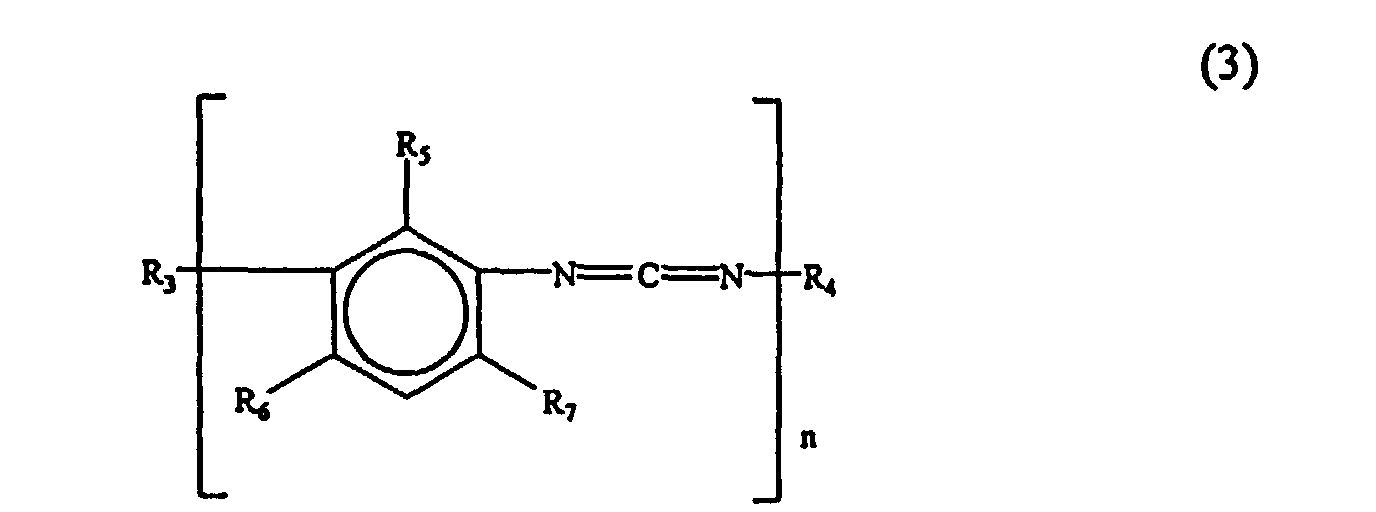 worin R5, R6, R7, R8, R9 und R10 ein Wasserstoffatom oder eine Alkyl-Gruppe darstellen, die Gesamtzahl der Kohlenstoffatome, die in R5, R6 und R7 enthalten sind, nicht mehr als 10 ist, die Gesamtzahl der Kohlenstoffatome, die in R8, R9 und R10 enthalten sind, nicht mehr als 10 ist.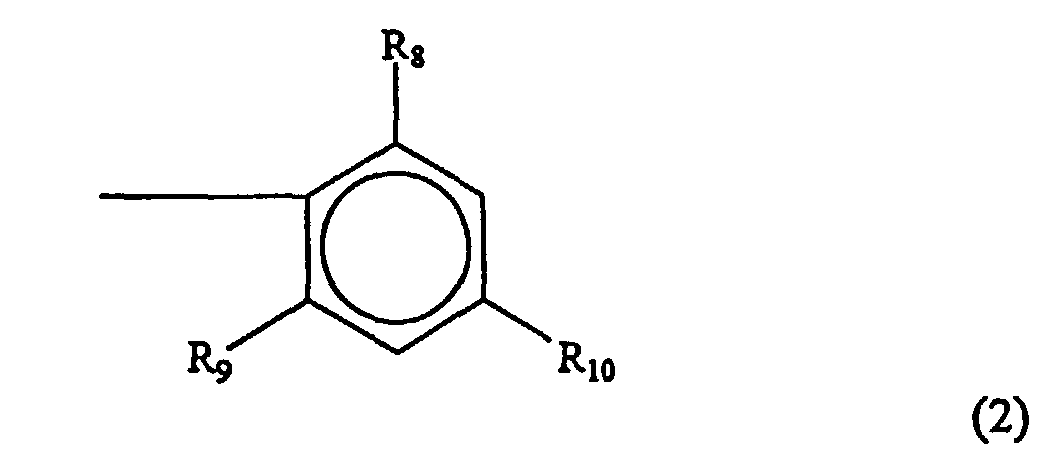
und für n n≥2 gilt. - Schmiermittel für einen mit Fluorkohlenwasserstoff-Kühlmittel gekühlten Kühlschrank nach einem der vorangehenden Ansprüche, worin das synthetische Neopentylpolyolester-Öl einen Ester einer oder mehrerer gesättigter Fettsäuren, die lineare oder verzweigte Ketten haben, mit Neopentylpolyol umfaßt, der der folgenden Formel enspricht:
- Kältemittel-Zusammensetzung für einen mit Fluorkohlenwasserstoff-Kühlmittel gekühlten Kühlschrank, umfassend das in den Ansprüchen 1 bis 4 beschriebene Schmiermittel und Fluorkohlenwasserstoff-Kühlmittel, das in einem Gewichtsverhältnis 1:99 bis 99:1 enthalten ist.
- Kältemittel-Zusammensetzung für einen mit Fluorkohlenwasserstoff-Kühlmittel gekühlten Kühlschrank nach Anspruch 5, worin das Fluorkohlenwasserstoff-Kühlmittel eines oder mehrere, ausgewählt aus der Gruppe bestehend aus R 134a, R 32 und R 125, ist.
Applications Claiming Priority (4)
| Application Number | Priority Date | Filing Date | Title |
|---|---|---|---|
| JP6693993 | 1993-03-25 | ||
| JP66939/93 | 1993-03-25 | ||
| JP6693993 | 1993-03-25 | ||
| PCT/JP1994/000465 WO1994021759A1 (fr) | 1993-03-25 | 1994-03-23 | Lubrifiant pour refrigerateurs et composition refrigerante contenant ce lubrifiant |
Publications (3)
| Publication Number | Publication Date |
|---|---|
| EP0647701A1 EP0647701A1 (de) | 1995-04-12 |
| EP0647701A4 EP0647701A4 (de) | 1995-11-15 |
| EP0647701B1 true EP0647701B1 (de) | 1999-10-06 |
Family
ID=13330483
Family Applications (1)
| Application Number | Title | Priority Date | Filing Date |
|---|---|---|---|
| EP94910524A Expired - Lifetime EP0647701B1 (de) | 1993-03-25 | 1994-03-23 | Schmiermittel für kühlschrank und dieses enthaltende schmiermittelzusammensetzung |
Country Status (8)
| Country | Link |
|---|---|
| US (1) | US5498356A (de) |
| EP (1) | EP0647701B1 (de) |
| JP (1) | JP3354152B2 (de) |
| KR (1) | KR100318110B1 (de) |
| AU (1) | AU667010B2 (de) |
| CA (1) | CA2136427C (de) |
| DE (1) | DE69421032T2 (de) |
| WO (1) | WO1994021759A1 (de) |
Families Citing this family (40)
| Publication number | Priority date | Publication date | Assignee | Title |
|---|---|---|---|---|
| US5976399A (en) | 1992-06-03 | 1999-11-02 | Henkel Corporation | Blended polyol ester lubricants for refrigerant heat transfer fluids |
| JP3432566B2 (ja) | 1994-02-10 | 2003-08-04 | 協和醗酵工業株式会社 | エステルの加水分解抑制方法、加水分解抑制剤およびエステル組成物 |
| DE4435548A1 (de) * | 1994-10-05 | 1996-04-11 | Rhein Chemie Rheinau Gmbh | Stabilisierte Schmierstoff-Grundsubstanz |
| SG75080A1 (en) * | 1994-11-29 | 2000-09-19 | Sanyo Electric Co | Refrigerating apparatus and lubricating oil composition |
| US6166466A (en) * | 1995-06-28 | 2000-12-26 | Nisshinbo Industries, Inc. | Insulating material for enameled wire of motor of refrigeration compressor |
| US6143702A (en) * | 1998-10-09 | 2000-11-07 | Exxon Research And Engineering Company | Lubricating oils of enhanced oxidation stability containing n-phenyl-naphthyl amines, or substituted derivatives of n-phenyl naphthyl amine and carbodiimide acid scavengers |
| US6235687B1 (en) * | 1998-10-09 | 2001-05-22 | Exxon Research And Engineering Company | Method for producing lubrication oils possessing anti rust properties containing acidic anti rust additive and acid scavengers |
| US6750182B1 (en) * | 1998-10-09 | 2004-06-15 | Exxonmobil Research And Engineering Company | Polar oil based industrial oils with enhanced sludge performance |
| GB0107502D0 (en) * | 2001-03-26 | 2001-05-16 | Ici Plc | Lubricant compositions |
| EP1698842A3 (de) * | 1999-03-02 | 2009-12-09 | Daikin Industries, Ltd. | Kühlgerät |
| US6739143B1 (en) | 1999-03-02 | 2004-05-25 | Daikin Industries, Ltd. | Refrigerating device |
| US20010019120A1 (en) | 1999-06-09 | 2001-09-06 | Nicolas E. Schnur | Method of improving performance of refrigerant systems |
| JP5314230B2 (ja) * | 2000-10-30 | 2013-10-16 | Jx日鉱日石エネルギー株式会社 | 冷凍機用流体組成物 |
| DE10164056B4 (de) * | 2001-12-29 | 2006-02-23 | Fuchs Petrolub Ag | Betriebsmittel für Kohlendioxid-Kälte- und Klimaanlagen |
| US6899820B2 (en) * | 2002-06-10 | 2005-05-31 | E. I. Du Pont De Nemours And Company | Fluorocarbon, oxygenated and non-oxygenated lubricant, and compatibilizer composition, and method for replacing refrigeration composition in a refrigeration system |
| US6841088B2 (en) * | 2002-06-10 | 2005-01-11 | E. I. Du Pont De Nemours And Company | Fluorocarbon, oxygenated and non-oxygenated lubricant, and compatibilizer composition, and method for replacing refrigeration composition in a refrigeration system |
| AU2003273365A1 (en) * | 2002-10-01 | 2004-04-23 | James B. Tieken | Refrigerant blend |
| US20060122077A1 (en) * | 2004-12-03 | 2006-06-08 | Bruce Wilburn | Compositions comprising at least one carbodiimide |
| US7456137B2 (en) * | 2004-12-03 | 2008-11-25 | Afton Chemical Corporation | Compositions comprising at least one carbodiimide |
| JP5110240B2 (ja) * | 2005-05-27 | 2012-12-26 | 日油株式会社 | 冷凍機用潤滑油組成物 |
| US7732386B2 (en) | 2005-10-25 | 2010-06-08 | Chevron U.S.A. Inc. | Rust inhibitor for highly paraffinic lubricating base oil |
| EP2067844A4 (de) * | 2006-09-29 | 2011-05-04 | Idemitsu Kosan Co | Schmiermittel für kompressionskältemaschine und kühlapparatur damit |
| JP5193485B2 (ja) * | 2007-03-27 | 2013-05-08 | Jx日鉱日石エネルギー株式会社 | 冷凍機油及び冷凍機用作動流体組成物 |
| ES2673993T3 (es) * | 2008-12-23 | 2018-06-26 | Shrieve Chemical Products, Inc. | Composición lubricante para refrigerantes |
| BR112012007422A2 (pt) * | 2009-10-07 | 2016-12-06 | Chemtura Corp | éster de poliol adequado para utilização como um lubrificante ou um estoque de base de lubrificante. |
| JP5555568B2 (ja) * | 2010-07-26 | 2014-07-23 | Jx日鉱日石エネルギー株式会社 | 冷凍機油 |
| US8889031B2 (en) * | 2010-11-30 | 2014-11-18 | Jx Nippon Oil & Energy Corporation | Working fluid composition for refrigerator machine and refrigerating machine oil |
| EP2705063B1 (de) | 2011-05-05 | 2017-07-12 | LANXESS Deutschland GmbH | Carbodiimide aus trisubstituierten aromatischen isocyanaten, ein verfahren zu deren herstellung und deren verwendung |
| PT2751154T (pt) | 2011-08-30 | 2019-11-04 | Basf Se | Policarbodiimida de elevado peso molecular e método de produção da mesma |
| EP2660258A1 (de) * | 2012-05-03 | 2013-11-06 | Rhein Chemie Rheinau GmbH | Neue Carbodiimid-haltige Zusammensetzungen, ein Verfahren zu deren Herstellung und deren Verwendung |
| JP2014172917A (ja) * | 2013-03-06 | 2014-09-22 | Ihi Corp | 潤滑油および潤滑油の酸化物析出低減方法 |
| US8999191B2 (en) | 2013-03-15 | 2015-04-07 | National Refrigerants, Inc. | R22 replacement refrigerant |
| BR112015027977A2 (pt) * | 2013-05-07 | 2017-07-25 | Rhein Chemie Rheinau Gmbh | método para a produção de formulações de óleo, formulações de óleo, e uso das formulações de óleo |
| WO2015109095A1 (en) | 2014-01-16 | 2015-07-23 | Shrieve Chemical Products, Inc. | Desicating synthetic refrigeration lubricant composition |
| JP6072706B2 (ja) * | 2014-01-28 | 2017-02-01 | Jxエネルギー株式会社 | 冷凍機用作動流体組成物及び冷凍機油 |
| CN104530702B (zh) * | 2014-12-31 | 2017-01-18 | 金发科技股份有限公司 | 一种稳定剂组合物及其制备方法和由其组成的模塑组合物 |
| US10253232B2 (en) * | 2015-02-10 | 2019-04-09 | Patech Fine Chemicals Co., Ltd. | Method of lubricating a rotary screw compressor |
| CN107250330B (zh) * | 2015-02-20 | 2020-10-02 | Jxtg能源株式会社 | 冷冻机油及冷冻机用工作流体组合物 |
| JP5919430B2 (ja) * | 2015-11-05 | 2016-05-18 | Jxエネルギー株式会社 | 冷凍機油 |
| US12146117B2 (en) | 2019-07-29 | 2024-11-19 | Eneos Corporation | Refrigerator oil, and working fluid composition for refrigerator |
Family Cites Families (11)
| Publication number | Priority date | Publication date | Assignee | Title |
|---|---|---|---|---|
| DE1243811B (de) * | 1964-06-16 | 1967-07-06 | Bayer Ag | Schmierstoffzusatzmittel |
| US3634493A (en) * | 1968-04-11 | 1972-01-11 | Rohm & Haas | Oil-soluble azo compounds |
| JPS5550509B2 (de) * | 1973-05-02 | 1980-12-18 | ||
| US4098710A (en) * | 1976-04-26 | 1978-07-04 | Exxon Research & Engineering Co. | Oil-soluble addition products of an ethylene-propylene copolymer and anionically polymerizable monomer having utility as multifunctional V.I. improver for lubricating oils |
| DE3221137A1 (de) * | 1982-06-04 | 1983-12-08 | Bayer Ag, 5090 Leverkusen | Verfahren zur herstellung von schwerentflammbaren fluessigkeiten mit hohem viskositaetsindex und deren verwendung |
| US4467395A (en) * | 1983-02-25 | 1984-08-21 | Sprague Electric Company | AC Metallized capacitor and impregnant therefor |
| JPS6145775A (ja) * | 1984-08-07 | 1986-03-05 | テルモ株式会社 | 医療用チューブガイドワイヤーおよびその製造方法 |
| DE3582754D1 (de) * | 1984-06-04 | 1991-06-13 | Terumo Corp | Medizinisches werkzeug und verfahren zur herstellung. |
| DE69008642T2 (de) * | 1989-06-06 | 1994-11-03 | Rohm & Haas | Organische Stabilisatoren für Isothiazolone. |
| JPH03275799A (ja) * | 1990-03-23 | 1991-12-06 | Asahi Denka Kogyo Kk | 冷凍機油組成物 |
| JP2843119B2 (ja) * | 1990-06-22 | 1999-01-06 | 旭電化工業株式会社 | 冷凍機油 |
-
1994
- 1994-03-23 CA CA002136427A patent/CA2136427C/en not_active Expired - Fee Related
- 1994-03-23 JP JP52038594A patent/JP3354152B2/ja not_active Expired - Lifetime
- 1994-03-23 DE DE69421032T patent/DE69421032T2/de not_active Expired - Fee Related
- 1994-03-23 WO PCT/JP1994/000465 patent/WO1994021759A1/ja not_active Ceased
- 1994-03-23 KR KR1019940704254A patent/KR100318110B1/ko not_active Expired - Lifetime
- 1994-03-23 EP EP94910524A patent/EP0647701B1/de not_active Expired - Lifetime
- 1994-03-23 AU AU62910/94A patent/AU667010B2/en not_active Ceased
- 1994-11-18 US US08/338,552 patent/US5498356A/en not_active Expired - Lifetime
Also Published As
| Publication number | Publication date |
|---|---|
| AU6291094A (en) | 1994-10-11 |
| WO1994021759A1 (fr) | 1994-09-29 |
| DE69421032T2 (de) | 2000-02-03 |
| KR100318110B1 (ko) | 2002-07-31 |
| KR950701675A (ko) | 1995-04-28 |
| DE69421032D1 (de) | 1999-11-11 |
| AU667010B2 (en) | 1996-02-29 |
| CA2136427C (en) | 2003-07-15 |
| US5498356A (en) | 1996-03-12 |
| CA2136427A1 (en) | 1994-09-26 |
| JP3354152B2 (ja) | 2002-12-09 |
| EP0647701A4 (de) | 1995-11-15 |
| EP0647701A1 (de) | 1995-04-12 |
Similar Documents
| Publication | Publication Date | Title |
|---|---|---|
| EP0647701B1 (de) | Schmiermittel für kühlschrank und dieses enthaltende schmiermittelzusammensetzung | |
| EP1019463B1 (de) | Kühlmittel auf basis von poly(neopentyl polyol) estern und verbessertes additiv-konzentrat | |
| US5403503A (en) | Refrigerator oil composition for hydrogen-containing hydrofluorocarbon refrigerant | |
| EP2739714B1 (de) | Schmiermittelzusammensetzungen mit verbesserter oxidationsstabilität und lebensdauer | |
| CA2084786C (en) | Lubrication for refrigerant heat transfer fluids | |
| JPWO1994021759A1 (ja) | 冷凍機用潤滑剤及びそれを用いた冷媒組成物 | |
| EP0644921A1 (de) | Schmiermittel auf basis von polyolester für kälteübertragungsmittel | |
| EP3279295B1 (de) | Kühlmaschinenschmieröl und gemischte zusammensetzung für eine kühlmaschine | |
| US5804096A (en) | Refrigerating machine oil | |
| US20020055442A1 (en) | Method of reducing wear of metal surfaces and maintaining a hydrolytically stable environment in refrigeration equipment during the operation of such equipment | |
| HK1007572B (en) | Refrigerant working fluids including lubricants | |
| HK1008680A (en) | Lubricant for regrigerant heat transfer fluids |
Legal Events
| Date | Code | Title | Description |
|---|---|---|---|
| PUAI | Public reference made under article 153(3) epc to a published international application that has entered the european phase |
Free format text: ORIGINAL CODE: 0009012 |
|
| AK | Designated contracting states |
Kind code of ref document: A1 Designated state(s): DE FR GB IT SE |
|
| 17P | Request for examination filed |
Effective date: 19950316 |
|
| A4 | Supplementary search report drawn up and despatched | ||
| AK | Designated contracting states |
Kind code of ref document: A4 Designated state(s): DE FR GB IT SE |
|
| 17Q | First examination report despatched |
Effective date: 19980223 |
|
| GRAG | Despatch of communication of intention to grant |
Free format text: ORIGINAL CODE: EPIDOS AGRA |
|
| GRAG | Despatch of communication of intention to grant |
Free format text: ORIGINAL CODE: EPIDOS AGRA |
|
| GRAH | Despatch of communication of intention to grant a patent |
Free format text: ORIGINAL CODE: EPIDOS IGRA |
|
| GRAH | Despatch of communication of intention to grant a patent |
Free format text: ORIGINAL CODE: EPIDOS IGRA |
|
| GRAA | (expected) grant |
Free format text: ORIGINAL CODE: 0009210 |
|
| AK | Designated contracting states |
Kind code of ref document: B1 Designated state(s): DE FR GB IT SE |
|
| ITF | It: translation for a ep patent filed | ||
| REF | Corresponds to: |
Ref document number: 69421032 Country of ref document: DE Date of ref document: 19991111 |
|
| ET | Fr: translation filed | ||
| PLBE | No opposition filed within time limit |
Free format text: ORIGINAL CODE: 0009261 |
|
| STAA | Information on the status of an ep patent application or granted ep patent |
Free format text: STATUS: NO OPPOSITION FILED WITHIN TIME LIMIT |
|
| 26N | No opposition filed | ||
| REG | Reference to a national code |
Ref country code: GB Ref legal event code: IF02 |
|
| PGFP | Annual fee paid to national office [announced via postgrant information from national office to epo] |
Ref country code: SE Payment date: 20030306 Year of fee payment: 10 |
|
| PGFP | Annual fee paid to national office [announced via postgrant information from national office to epo] |
Ref country code: FR Payment date: 20040309 Year of fee payment: 11 |
|
| PGFP | Annual fee paid to national office [announced via postgrant information from national office to epo] |
Ref country code: GB Payment date: 20040317 Year of fee payment: 11 |
|
| PG25 | Lapsed in a contracting state [announced via postgrant information from national office to epo] |
Ref country code: SE Free format text: LAPSE BECAUSE OF NON-PAYMENT OF DUE FEES Effective date: 20040324 |
|
| PGFP | Annual fee paid to national office [announced via postgrant information from national office to epo] |
Ref country code: DE Payment date: 20040401 Year of fee payment: 11 |
|
| EUG | Se: european patent has lapsed | ||
| REG | Reference to a national code |
Ref country code: FR Ref legal event code: TP |
|
| PG25 | Lapsed in a contracting state [announced via postgrant information from national office to epo] |
Ref country code: IT Free format text: LAPSE BECAUSE OF NON-PAYMENT OF DUE FEES Effective date: 20050323 Ref country code: GB Free format text: LAPSE BECAUSE OF NON-PAYMENT OF DUE FEES Effective date: 20050323 |
|
| PG25 | Lapsed in a contracting state [announced via postgrant information from national office to epo] |
Ref country code: DE Free format text: LAPSE BECAUSE OF NON-PAYMENT OF DUE FEES Effective date: 20051001 |
|
| GBPC | Gb: european patent ceased through non-payment of renewal fee |
Effective date: 20050323 |
|
| PG25 | Lapsed in a contracting state [announced via postgrant information from national office to epo] |
Ref country code: FR Free format text: LAPSE BECAUSE OF NON-PAYMENT OF DUE FEES Effective date: 20051130 |
|
| REG | Reference to a national code |
Ref country code: FR Ref legal event code: ST Effective date: 20051130 |