EP0647708A2 - Procédé et appareil pour la propagation de levure - Google Patents
Procédé et appareil pour la propagation de levure Download PDFInfo
- Publication number
- EP0647708A2 EP0647708A2 EP94114133A EP94114133A EP0647708A2 EP 0647708 A2 EP0647708 A2 EP 0647708A2 EP 94114133 A EP94114133 A EP 94114133A EP 94114133 A EP94114133 A EP 94114133A EP 0647708 A2 EP0647708 A2 EP 0647708A2
- Authority
- EP
- European Patent Office
- Prior art keywords
- yeast
- suspension
- assimilator
- oxygen
- content
- Prior art date
- Legal status (The legal status is an assumption and is not a legal conclusion. Google has not performed a legal analysis and makes no representation as to the accuracy of the status listed.)
- Withdrawn
Links
Images


Classifications
-
- C—CHEMISTRY; METALLURGY
- C12—BIOCHEMISTRY; BEER; SPIRITS; WINE; VINEGAR; MICROBIOLOGY; ENZYMOLOGY; MUTATION OR GENETIC ENGINEERING
- C12C—BEER; PREPARATION OF BEER BY FERMENTATION; PREPARATION OF MALT FOR MAKING BEER; PREPARATION OF HOPS FOR MAKING BEER
- C12C11/00—Fermentation processes for beer
-
- C—CHEMISTRY; METALLURGY
- C12—BIOCHEMISTRY; BEER; SPIRITS; WINE; VINEGAR; MICROBIOLOGY; ENZYMOLOGY; MUTATION OR GENETIC ENGINEERING
- C12M—APPARATUS FOR ENZYMOLOGY OR MICROBIOLOGY; APPARATUS FOR CULTURING MICROORGANISMS FOR PRODUCING BIOMASS, FOR GROWING CELLS OR FOR OBTAINING FERMENTATION OR METABOLIC PRODUCTS, i.e. BIOREACTORS OR FERMENTERS
- C12M41/00—Means for regulation, monitoring, measurement or control, e.g. flow regulation
- C12M41/30—Means for regulation, monitoring, measurement or control, e.g. flow regulation of concentration
- C12M41/34—Means for regulation, monitoring, measurement or control, e.g. flow regulation of concentration of gas
Definitions
- the invention relates to a method according to the preamble of claim 1 and a system according to the preamble of claim 7 for the propagation of yeast, in particular brewer's yeast.
- yeast in particular brewer's yeast.
- the principles of the process and the basic structure of the plant can also be used for the propagation of wine and baker's yeast.
- yeast that originates from one or more previous fermentation processes is used in breweries for the fermentation process in the fermentation tank, the fermentation activity of the yeast gradually decreases for various reasons, for example due to an enrichment with weakened or dead yeast cells or due to aging and a lack of metabolism, through signs of degeneration or through exposure to harmful foreign organisms - contamination.
- the plant used for yeast production includes a propagation tank, to which a certain amount of pure yeast was originally put and which is also fed sterile wort.
- the propagation tank is set to parameters that deviate from the optimal fermentation parameters, but are suitable for the propagation of the yeast cells.
- a circuit is provided for setting the parameters outside the propagation tank, through which the wort-yeast suspension is circulated, sterile air and further sterile wort being supplied to the suspension in this circuit while maintaining a given mixing ratio.
- the invention is intended to optimize the yeast propagation in the yeast propagation plant which is separate from the fermentation tank.
- This is achieved by the inventive method characterized in claim 1, which is preferably carried out with the inventive system characterized in claim 7.
- the extract content and the oxygen content of the suspension or the CO2 formation are monitored continuously or over time and, according to the measurement result, oxygen is replenished more quickly or more slowly, thereby keeping the oxygen content within specified limits, which, however, vary depending on the type of beer, yeast and the needs of the brewery can be predetermined.
- the "extract” is the concentration of various dissolved substances, in particular the sugar in the wort that can be used by the yeast.
- the content of such sugars can be determined directly by a corresponding extract measurement or indirectly by determining the pH curve.
- the extract content in connection with the degree of filling of the assimilator, the oxygen content and the temperature are preferably regulated together with the aim of ensuring a constant logarithmic multiplication of the yeast.
- the activity can be so high and the bound oxygen content can drop so quickly that it is difficult to measure the remaining stock.
- the generation of the carbon dioxide gas known to be produced during fermentation can be used as a control criterion, most simply by measuring the CO2 gas directly in the suspension or by inserting intervals in which, after the assimilator has been hermetically sealed, the pressure rise in it is measured and controls the addition of oxygen according to the measurements obtained from it.
- Cell proliferation in the logarithmic phase can also take a long time at low temperatures.
- Cells from the logarithmic phase - both at low and at higher growth temperatures - have several beneficial effects: yeast has such an activity that a much lower amount of yeast is sufficient for the main fermentation.
- ordinary wort can be used to feed the propagation tank, which in the present embodiment is referred to as an "assimilator".
- the logarithmic yeast is so active and resistant and exerts such a strong selection pressure that foreign germs are displaced by its own proliferation. It is therefore not necessary to use specially sterilized wort.
- the advantage that only a reduced amount of yeast is required to Carrying out complete fermentation also has the useful effect that less waste yeast has to be disposed of overall.
- the method according to the invention can be carried out in such a way that a given percentage of the suspension is withdrawn from an assimilator into the fermentation tank and the assimilator in one or at regular intervals over a longer period of time, which depends on the brewing frequency of the brewery for the beer type concerned in several successive stages so that the extract concentration remains in the optimal range, replenished while maintaining the optimal oxygen concentration, whereupon the yeast cells remaining in the assimilator continue to multiply in a logarithmic phase until the given percentage is withdrawn the next time.
- This percentage can be 10% with bottom fermenting yeast and with top-fermenting yeast amount to 50% of the working volume, i.e. the assimilator volume.
- the amount of suspension already present in the assimilator which determines the yeast cell density in the suspension, is also important for adding the extract. If the density is too low, the selection pressure of the yeast is no longer optimal.
- the propagation can always be restarted with a new strain of pure yeast, with the wort initially being added in smaller stages so that the yeast cells are not excessively diluted.
- the method according to the invention can be carried out with a system according to claim 7, which preferably contains an automatic control system.
- a CO2 measuring transmitter in the suspension or a pressure measuring device in particular in the gas bubble located at the top in the assimilator, can continuously measure the increase in CO2 or the increase in gas pressure resulting from the generation of CO2 due to the yeast activity and around the time of the completion of the propagation Indicates the yeast activity and thus the oxygen requirement. From the increase in CO2 gas or the increase in CO2 pressure can also be seen, for example, whether the fermentation in the fermentation tank, which is fed with the yeast, will take a slightly shorter or longer time.
- the oxygen metering device mentioned in claim 7, which introduces sterile air can be supplemented by the fact that a special ventilation agitator in the assimilator an air injection nozzle is assigned.
- a special ventilation agitator in the assimilator an air injection nozzle is assigned.
- the oxygen level can be kept in the required range, while a pipe, for example a Venturi nozzle, represents the actual ventilation device.
- This and the tank interior ventilation in connection with the ventilation agitator with optimal air swirling effect are harmoniously coordinated with each other through adjustable interval control and integrated in the CIP.
- the individual assimilator can work on its own and be equipped with external piping in which the required oxygen in the form of sterile air is metered in - optionally in addition to the oxygen entered in the assimilator.
- the system can be operated in such a way that the suspension is forced into the other assimilator by sterile compressed air which is introduced into one of the assimilators and the oxygen is metered in this way.
- This design has the advantage that pumps are avoided that can quickly damage the yeast cells. Centrifugal pumps are usually used, which can pose a risk to the yeast cells through both cavitation and shear.
- the construction according to claim 10 avoids this danger by a pump-free operation in the press-over method.
- the additional measure that the assimilation is connected in its upper area to a controllable compressed air source serves to enable the pressing process to be carried out even if a very low suspension level is reached shortly after the first feeding with pure yeast.
- the system according to claim 12 uses a pump again, but works overall on the principle of communicating Tubes also with two assimilators, which can then be separated for the purpose of tapping for starting and for the purpose of refilling with wort, so that these operations can be carried out simultaneously with both assimilators. So you can reload and unplug at the same time, whereupon you can compensate again via the line connecting the output connections.
- the measure according to claim 13 relates to the complete dissolving of the oxygen introduced before the suspension flows back into the assimilator. This avoids air bubbles and undesirable foaming.
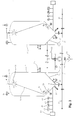
- Fig. 1 shows a single yeast multiplication tank, designated as assimilator 1, in the form of an essentially closed container with a volume of, for example, 30 to 100 hl for top-fermenting yeast or, for example, 500 hl for bottom-fermenting yeast.
- the container shape of the assimilator converges conically at the bottom to an outlet on which a first connection 3 is formed. Somewhat higher in the conical area, a second connection 5 opens into the assimilator.
- a pipe ring line 7 between the connections 3 and 5 there is a pipe ring line 7, in the course of which a pump 9, an air metering device 11, e.g. B.
- the first connection serves as an outlet from the assimilator and the second connection serves as an inlet into the assimilator.
- a wort line 15 which comes from a wort metering device (not shown) or another wort source, opens into the ring line 7 via a shut-off valve.
- a wort sterile tank which temporarily stores the wort germ-free, is not required.
- a yeast / wort suspension line 17 and a drain line 19 which opens into a gully 21.
- the assimilator has a cooling 23 and, which may be necessary if the assimilator is installed in a cool fermentation cellar, a heating 25. These installations can also be combined.
- the vaccine connector 27 can also be used for taking samples.
- a controlled one opens into the upper area of the assimilator Gas passage 29 with a cleaning spray ball 31 through which sterile air P can be introduced into the assimilator by pressure.
- the pushing in of sterile air through the gas passage 29 serves to pretension the assimilator for reducing O2 bubbles or for pressing.
- gas passage 29 on the other hand, gas can be pressed outwards when the liquid level in the assimilator rises.
- the sterile air is guided downwards in the assimilator, where it flows harmoniously via a blow-out nozzle 34 in the area of a special ventilation agitator 35, which is driven by a motor M with magnetic force transmission through the wall is driven.
- the agitator 35 is equipped with a dry run protection, not shown, which prevents it from being driven if the liquid level in the assimilator 1 is not completely above the agitator.
- Assimilator 1 is equipped with the following measuring devices: A weighing device 37 serves primarily to measure the weight of the assimilator, but secondarily to determine its degree of filling. A pressure measuring device 39, namely an electronic, highly sensitive, fine pressure measuring device, measures the pressure in the gas bubble above the liquid level and is used specifically to determine the pressure rise over time at intervals in which the gas passage 29 is closed. In this respect, the equipment is still state of the art.
- the assimilator also has a measuring probe 40 for measuring the CO2 content and a measuring probe 41 for measuring the oxygen content of the yeast suspension in the wort as a liquid in the assimilator, an extract measuring device 43 which measures the extract concentration in this suspension pH meter 45 and a temperature meter 47.
- the extract meter 43 and the pH meter 45 are alternative sensors. Only one of the two measuring devices is required, since the pH value of the suspension is usually parallel to the extraction of the extract. The use of the pH value meter is preferred insofar as such commercially available measuring devices are considerably less expensive than extract measuring devices.
- the measuring devices 40, 41, 43, 45 and 47 can be probes inside the assimilator 1 and / or in pipes connected to them.
- the yeast multiplication can be carried out according to the following procedure.
- an amount of, for example, 500 to 1000 g of pure yeast is input via the inoculation connection 27 and an amount of, for example, 15 l of wort is pumped in via the wort line 15 in order to achieve the desired yeast density in the shortest possible time.
- the yeast multiplies and partly uses the extract of the wort and also oxygen, which is dissolved in the wort.
- the pump 9 is switched on in a known manner (DE-PS 4137537) from time to time, for example every hour, and suspension is pumped through the ring line 7, where it is in the air metering device 11 with air from the the oxygen is used, is enriched.
- the solution section 13 serves to completely dissolve the air introduced before the suspension returns to the assimilator 1. In the course of the propagation of the yeast in the suspension, it finally reaches a much higher population density, while the extract of the wort is consumed. It is possible to determine the yeast cell density, for example by measuring the turbidity, and to take the value into account in the control.
- wort is introduced via the wort line and the suspension volume in the assimilator 1 is increased so that the yeast concentration is still in one for the Propagation favorable range of values.
- oxygen is reloaded in batches, whereby once the agitator 35 is completely within the suspension, the basic oxygen requirement can be covered in intervals by the air line 33 with the nozzle 34 and the swirling by the agitator 35.
- the agitator 35 should basically run during heating, cooling, aeration, wort addition, removal and during CIP.
- the oxygen uptake depends on the flow rate of the wort in the wort aeration device. If pumping is not carried out intermittently, but continuously, the oxygen content can be regulated by influencing the flow rate.
- the assimilator 1 is finally largely filled with suspension and this is drawn off about half via the pump 9 and the suspension line 17 for placement in a fermentation tank for the main fermentation when the maximum desired yeast cell density is reached after appropriate adjustment of the shut-off valves. Then the assimilator 1 is refilled via the wort line 15 and the yeast multiplication continues unchanged.
- the yeast setting cycle can then be increased, for example, to a setting every four hours, if the maximum frequency is set, the yeast being so active that a yeast cell density of approximately 20% of the conventional amount is sufficient for the main fermentation in the fermentation tank, in order to achieve the same main fermentation time as so far with only average active yeast was possible.
- Maintaining the constant logarithmic multiplication phase also has the advantage that it is not sterile wort that can be used to fill up the suspension in the assimilator 1, but ordinary wort that can be branched off in the brewery at the wort cooler. Any germs contained in it are displaced by the highly active yeast so that they soon disappear in the assimilator.
- This logarithmic increase in yeast is now achieved by optimizing the conditions in the assimilator 1.
- An automatic controller 49 is used for this purpose, which uses the measured values of the various sensors 37, 39, 40, 41, 43, 45 and 47.
- the measured values of sensors 39, 40 and 41 are used alternatively. If there are difficulties with the direct measurement of the oxygen content, this is carried out at intervals of e.g. 5 minutes measured pressure rise in the assimilator, measured with the sensor 39, or the increase in the CO2 content in the suspension, measured with the sensor 40, as a controlled variable in the control.
- the temperature range is from 12 to 24 ° C., in particular from 19 to 22 ° C.
- the oxygen content should then be in a medium range of 0.5 to 2 mg per liter and the extract range in a range above 7%, the upper limit of the extract content being that the original wort content is limited due to the types of beer and mostly at 12, up to a maximum of 16%. If the pH value is used, this should be between 4 and 6.
- the pitching yeast suspension is finally filled with a yeast cell count of e.g. 70 ... 180 million cells / ml deducted.
- the regulation is carried out in principle according to the same principles, but the value ranges are somewhat different.
- the temperature is 6 to 16 ° C, but especially in the range of 8 to 14 ° C. Based on these much lower temperatures, the number of yeast cells increases correspondingly more slowly, with the result that only a smaller percentage, for example 10% every 4 hours, can be removed for the same cycle of stripping yeast, and larger assimilators are required for the same amount of yeast.
- the oxygen content in the middle range is, for example, 0.3 to 1 mg per liter and the extract content should be at least 6%, or the pH value, as in top-fermenting yeast, is 4 to 6.
- the number of yeast cells is advantageously in the range of 30 ... 180 million cells / ml.
- the procedure is also e.g. for dosing yeast for wheat beer bottle fermentation can be used with advantage.
- the multiplication of the yeast in the logarithmic phase does not mean that the maximum multiplication speed is always set.
- the advantages of the logarithmic phase lie in the possibility of rapid multiplication when this is needed, but especially in the far increased activity of the yeast. The latter also arises if, for operational reasons, the increase is slower, for example if the next fermentation process does not start until after the weekend, ie in two or three days. If there is not enough oxygen in the suspension, the yeast starts to ferment. Longer propagation periods are therefore not regulated by lack of air, but mainly by lowering the temperature, but also by diluting the yeast with seasoning. To switch on, the temperature of the suspension should not deviate from the switch-on temperature of the fermentation tank by more than 2 ° C.
- the sensors 39 and 40 are partially omitted since they are not required in every case.
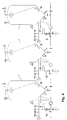
- Fig. 2 shows a system with two assimilators 1 and 1 ' the assimilator 1 of Fig. 1 same, but in their respective ring line 7, 7 'have a common branch with the pump 9, the air metering device 11 and the O2 solution path 13.
- Such a double arrangement is suitable when yeast with a higher frequency is required and the two assimilators 1 and 1 'are loaded with yeast and ripening wort of the same type.
- Operation can then be carried out in two different ways, namely in the manner of two independent individual assimilators, which, however, activate the external circuit via the ring line 7 or 7 'at different times, in particular in push-pull mode.
- this pump also remain switched off and the pushing through the air metering device 11 and the O2 solution path 13 by pumping sterile air through the nozzle 31 into the assimilator to be emptied, while the other assimilator is vented through the gas passage 29 take place.
- the derivation of the starting suspension is not effected by switching on the pump 9, but by pressing the given percentage out of the filled assimilator.
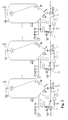
- the pump 9 can also be completely omitted and the intermittent passage of the suspension through the air metering device 11 and the O2 solution path 13 can generally only be done by pressing from one to the other assimilator.
- a corresponding system is shown in Fig. 3.
- FIG. 4 shows a system with three individual assimilators 1, which in turn could be varied, for example, so that two of the assimilators according to FIG. 3 are switched.
- Multi-assimilator systems are suitable for larger breweries with faster brewing sequences, but also, for example, for the propagation of various yeast strains.
- each assimilator is independent of the other assimilators with regard to the supply of wort and the discharge of suspension to the fermentation tank.
- Each of the line branches containing the pump 9 and the drain line 19 of the individual assimilators is bridged by an additional line branch 55, which also contains a shut-off valve 56.
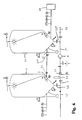
- the sixth shows a further modified arrangement of two assimilators 1 and 1 ′′.
- the first connection 3 or 3 ′′ and the second connection 5 or 5 ′′ serve here alternately as an inlet connection and an outlet connection.
- the second connections 5, 5 ′′ are connected to one another via shut-off valves 51, 51 ′′, and the first connections 3, 3 ′′ are connected via a line referred to as a ring line 7 ′′, which connects the pump 9 and the air metering device 11 and contains the O2 solution path 13.
- Shut-off valves 53, 53 ′′ separate the connections 3 and 3 ′′ from the ring line 7 ′′, into which, similar to the arrangement according to FIG.
- the wort line 15 flows or from which the suspension line 17 branches, again in each case with the interposition of shut-off valves .
- the assimilators 1 and 1 ′′ act as communicating tubes.
- the advantage of the system according to FIG. 5 is that one can reload and pull off at the same time.
- the process can be operated as follows: the brewing rhythm of the brewery results in certain times for the need for pitch suspension and for the occurrence of rash.
- the assimilator 1 is loaded in accordance with this brewing rhythm and adjusted for logarithmic multiplication of the yeast. Until the next occurrence of wort or until the next need for preparation suspension is increased further, the suspension is brought into the assimilator 1 '' by pressing over the connection of the connections 5, 5 ''.
- the propagation is regulated in both assimilators to maintain the logarithmic phase with computer support. For enrichment with oxygen, pumping is carried out between the assimilators via the ring line 7 ′′ and, at the same time, compensation is made via the connection of the connections 5, 5 ′′.
- the starting suspension can be withdrawn simultaneously from the assimilator 1 and the assimilator 1 ′′ can be topped up with wort.
Landscapes
- Chemical & Material Sciences (AREA)
- Organic Chemistry (AREA)
- Engineering & Computer Science (AREA)
- Zoology (AREA)
- Health & Medical Sciences (AREA)
- Life Sciences & Earth Sciences (AREA)
- Bioinformatics & Cheminformatics (AREA)
- Wood Science & Technology (AREA)
- Biochemistry (AREA)
- Genetics & Genomics (AREA)
- General Health & Medical Sciences (AREA)
- General Engineering & Computer Science (AREA)
- Food Science & Technology (AREA)
- Analytical Chemistry (AREA)
- Biomedical Technology (AREA)
- Biotechnology (AREA)
- Microbiology (AREA)
- Sustainable Development (AREA)
- Distillation Of Fermentation Liquor, Processing Of Alcohols, Vinegar And Beer (AREA)
- Apparatus Associated With Microorganisms And Enzymes (AREA)
Applications Claiming Priority (2)
| Application Number | Priority Date | Filing Date | Title |
|---|---|---|---|
| DE19934331409 DE4331409C1 (de) | 1993-09-15 | 1993-09-15 | Verfahren und Anlage zur Vermehrung von Bierhefe |
| DE4331409 | 1993-09-15 |
Publications (2)
| Publication Number | Publication Date |
|---|---|
| EP0647708A2 true EP0647708A2 (fr) | 1995-04-12 |
| EP0647708A3 EP0647708A3 (fr) | 1997-07-30 |
Family
ID=6497823
Family Applications (1)
| Application Number | Title | Priority Date | Filing Date |
|---|---|---|---|
| EP94114133A Withdrawn EP0647708A3 (fr) | 1993-09-15 | 1994-09-08 | Procédé et appareil pour la propagation de levure. |
Country Status (2)
| Country | Link |
|---|---|
| EP (1) | EP0647708A3 (fr) |
| DE (1) | DE4331409C1 (fr) |
Cited By (5)
| Publication number | Priority date | Publication date | Assignee | Title |
|---|---|---|---|---|
| WO1998008930A1 (fr) * | 1995-03-10 | 1998-03-05 | Bass Pulic Limited Company | Ameliorations concernant la propagation de la levure de biere et le brassage |
| EP1167514A1 (fr) * | 2000-06-19 | 2002-01-02 | Enologica Vason S.r.l. | Procédé et appareil semi-automatique pour la réhydratation de levures |
| AU779542B2 (en) * | 1998-12-04 | 2005-01-27 | Institut Pasteur | Method and device for selecting accelerated proliferation of living cells in suspension |
| WO2021160458A1 (fr) * | 2020-02-10 | 2021-08-19 | Krinner Drucklufttechnik Gmbh | Procédé de multiplication de cellules de levure |
| CN115678767A (zh) * | 2022-11-18 | 2023-02-03 | 山东葆华生物科技有限公司 | 透明质酸钠发酵系统及利用其实现的透明质酸钠生产方法 |
Families Citing this family (4)
| Publication number | Priority date | Publication date | Assignee | Title |
|---|---|---|---|---|
| DE19740319C2 (de) * | 1996-11-20 | 1999-02-04 | Tuchenhagen Gmbh | Verfahren und Anordnung zur beschleunigten Hefevermehrung im Brauprozeß |
| WO1998022570A2 (fr) * | 1996-11-20 | 1998-05-28 | Tuchenhagen Gmbh | Procede et dispositif d'acceleration de la croissance de la levure dans l'industrie brassicole |
| DE29820046U1 (de) | 1998-10-24 | 1999-05-27 | Christian Gresser GmbH, 93055 Regensburg | Vorrichtung zur Vermehrung oder Herführung von Hefe, insbesondere Bierhefe |
| DE102019211243A1 (de) * | 2019-07-29 | 2021-02-04 | Krones Ag | Bereitstellung von Zellkulturen |
Family Cites Families (2)
| Publication number | Priority date | Publication date | Assignee | Title |
|---|---|---|---|---|
| EP0089225B1 (fr) * | 1982-03-15 | 1988-06-01 | WHITBREAD & CO. LTD. | Régulation de fermentations alcooliques |
| DE3560775D1 (en) * | 1984-08-31 | 1987-11-19 | Air Liquide | Process and plant for the culture of microorganisms |
-
1993
- 1993-09-15 DE DE19934331409 patent/DE4331409C1/de not_active Expired - Fee Related
-
1994
- 1994-09-08 EP EP94114133A patent/EP0647708A3/fr not_active Withdrawn
Cited By (5)
| Publication number | Priority date | Publication date | Assignee | Title |
|---|---|---|---|---|
| WO1998008930A1 (fr) * | 1995-03-10 | 1998-03-05 | Bass Pulic Limited Company | Ameliorations concernant la propagation de la levure de biere et le brassage |
| AU779542B2 (en) * | 1998-12-04 | 2005-01-27 | Institut Pasteur | Method and device for selecting accelerated proliferation of living cells in suspension |
| EP1167514A1 (fr) * | 2000-06-19 | 2002-01-02 | Enologica Vason S.r.l. | Procédé et appareil semi-automatique pour la réhydratation de levures |
| WO2021160458A1 (fr) * | 2020-02-10 | 2021-08-19 | Krinner Drucklufttechnik Gmbh | Procédé de multiplication de cellules de levure |
| CN115678767A (zh) * | 2022-11-18 | 2023-02-03 | 山东葆华生物科技有限公司 | 透明质酸钠发酵系统及利用其实现的透明质酸钠生产方法 |
Also Published As
| Publication number | Publication date |
|---|---|
| DE4331409C1 (de) | 1994-11-10 |
| EP0647708A3 (fr) | 1997-07-30 |
Similar Documents
| Publication | Publication Date | Title |
|---|---|---|
| DE68907623T2 (de) | Verfahren zur gesteuerten oxygenierung einer alkoholischen gaermaische und vorrichtung zum durchfuehren dieses verfahrens. | |
| DE4331409C1 (de) | Verfahren und Anlage zur Vermehrung von Bierhefe | |
| DD209653A5 (de) | Verfahren zur kontinuierlichen herstellung von alkohol | |
| DE69006695T2 (de) | Verfahren und System für Zellkulturen. | |
| DE1517879C3 (fr) | ||
| DE607712C (de) | Verfahren zur Herstellung von Hefe | |
| DE2423766A1 (de) | Fermentierungsverfahren sowie vorrichtung zu dessen durchfuehrung | |
| DE19740319C2 (de) | Verfahren und Anordnung zur beschleunigten Hefevermehrung im Brauprozeß | |
| DE69737803T2 (de) | Bäckerhefe | |
| DE60001721T2 (de) | Verfahren und Vorrichtung für die Rehydrierung von Hefe | |
| EP0098826B1 (fr) | Procédé de fabrication de vinaigre par charges successives | |
| DE4308459C2 (de) | Verfahren und Vorrichtung zum Vermehren von Hefe | |
| DE69707176T3 (de) | Dosierung von Hefekreme | |
| DE4316944C2 (de) | Verfahren und Vorrichtung zur semikontinuierlichen Herstellung von Milchsäure aus Würze | |
| EP2576035B1 (fr) | Procédé permettant d'accélérer la fermentation, et dispositif de mélange du contenu d'une cuve | |
| DE3939064C2 (de) | Verfahren zur Herstellung alkoholarmer bis alkoholfreier Getränke | |
| DE4324293C2 (de) | Verfahren und Vorrichtung zum Vermehren von Hefe | |
| AT237560B (de) | Verfahren zur Regelung des Zu- und/oder Ablaufes bei der biologischen Oxydation von Alkohol zu Essigsäure | |
| WO2021018480A1 (fr) | Fourniture de culture cellulaire | |
| AT310115B (de) | Verfahren zur kontinuierlichen Schnellgärung von Biewürze | |
| AT56072B (de) | Verfahren zur Lüftung bei steriler Gärung von Bier. | |
| DE60107653T2 (de) | Verfahren zur Steuerung der Züchtung von Bräuhefe in einem Nährmedium | |
| AT339847B (de) | Verfahren zum zuchten von hefe, vorzugsweise backhefe | |
| WO1998022570A2 (fr) | Procede et dispositif d'acceleration de la croissance de la levure dans l'industrie brassicole | |
| EP0026527A2 (fr) | Procédé et installation pour la fabrication de vinaigre de fermentation |
Legal Events
| Date | Code | Title | Description |
|---|---|---|---|
| PUAI | Public reference made under article 153(3) epc to a published international application that has entered the european phase |
Free format text: ORIGINAL CODE: 0009012 |
|
| AK | Designated contracting states |
Kind code of ref document: A2 Designated state(s): AT BE CH DE DK FR GB IT LI NL |
|
| PUAL | Search report despatched |
Free format text: ORIGINAL CODE: 0009013 |
|
| AK | Designated contracting states |
Kind code of ref document: A3 Designated state(s): AT BE CH DE DK FR GB IT LI NL |
|
| STAA | Information on the status of an ep patent application or granted ep patent |
Free format text: STATUS: THE APPLICATION IS DEEMED TO BE WITHDRAWN |
|
| 18D | Application deemed to be withdrawn |
Effective date: 19971001 |