EP0647895B1 - Verfahren zur Verhinderung des unabsichtlichen Verrats des gespeicherten digitalen Geheimnisse durch einen Treuhänder - Google Patents
Verfahren zur Verhinderung des unabsichtlichen Verrats des gespeicherten digitalen Geheimnisse durch einen Treuhänder Download PDFInfo
- Publication number
- EP0647895B1 EP0647895B1 EP94303429A EP94303429A EP0647895B1 EP 0647895 B1 EP0647895 B1 EP 0647895B1 EP 94303429 A EP94303429 A EP 94303429A EP 94303429 A EP94303429 A EP 94303429A EP 0647895 B1 EP0647895 B1 EP 0647895B1
- Authority
- EP
- European Patent Office
- Prior art keywords
- information
- trustee
- user
- secret
- escrowed
- Prior art date
- Legal status (The legal status is an assumption and is not a legal conclusion. Google has not performed a legal analysis and makes no representation as to the accuracy of the status listed.)
- Expired - Lifetime
Links
Images



Classifications
-
- G—PHYSICS
- G06—COMPUTING OR CALCULATING; COUNTING
- G06F—ELECTRIC DIGITAL DATA PROCESSING
- G06F21/00—Security arrangements for protecting computers, components thereof, programs or data against unauthorised activity
- G06F21/30—Authentication, i.e. establishing the identity or authorisation of security principals
- G06F21/31—User authentication
-
- G—PHYSICS
- G06—COMPUTING OR CALCULATING; COUNTING
- G06F—ELECTRIC DIGITAL DATA PROCESSING
- G06F12/00—Accessing, addressing or allocating within memory systems or architectures
- G06F12/14—Protection against unauthorised use of memory or access to memory
- G06F12/1408—Protection against unauthorised use of memory or access to memory by using cryptography
-
- G—PHYSICS
- G06—COMPUTING OR CALCULATING; COUNTING
- G06F—ELECTRIC DIGITAL DATA PROCESSING
- G06F21/00—Security arrangements for protecting computers, components thereof, programs or data against unauthorised activity
- G06F21/60—Protecting data
- G06F21/62—Protecting access to data via a platform, e.g. using keys or access control rules
- G06F21/6218—Protecting access to data via a platform, e.g. using keys or access control rules to a system of files or objects, e.g. local or distributed file system or database
-
- G—PHYSICS
- G06—COMPUTING OR CALCULATING; COUNTING
- G06Q—INFORMATION AND COMMUNICATION TECHNOLOGY [ICT] SPECIALLY ADAPTED FOR ADMINISTRATIVE, COMMERCIAL, FINANCIAL, MANAGERIAL OR SUPERVISORY PURPOSES; SYSTEMS OR METHODS SPECIALLY ADAPTED FOR ADMINISTRATIVE, COMMERCIAL, FINANCIAL, MANAGERIAL OR SUPERVISORY PURPOSES, NOT OTHERWISE PROVIDED FOR
- G06Q20/00—Payment architectures, schemes or protocols
- G06Q20/38—Payment protocols; Details thereof
- G06Q20/382—Payment protocols; Details thereof insuring higher security of transaction
- G06Q20/3821—Electronic credentials
-
- H—ELECTRICITY
- H04—ELECTRIC COMMUNICATION TECHNIQUE
- H04L—TRANSMISSION OF DIGITAL INFORMATION, e.g. TELEGRAPHIC COMMUNICATION
- H04L9/00—Cryptographic mechanisms or cryptographic arrangements for secret or secure communications; Network security protocols
- H04L9/08—Key distribution or management, e.g. generation, sharing or updating, of cryptographic keys or passwords
- H04L9/0894—Escrow, recovery or storing of secret information, e.g. secret key escrow or cryptographic key storage
-
- G—PHYSICS
- G06—COMPUTING OR CALCULATING; COUNTING
- G06F—ELECTRIC DIGITAL DATA PROCESSING
- G06F2221/00—Indexing scheme relating to security arrangements for protecting computers, components thereof, programs or data against unauthorised activity
- G06F2221/21—Indexing scheme relating to G06F21/00 and subgroups addressing additional information or applications relating to security arrangements for protecting computers, components thereof, programs or data against unauthorised activity
- G06F2221/2107—File encryption
-
- G—PHYSICS
- G06—COMPUTING OR CALCULATING; COUNTING
- G06F—ELECTRIC DIGITAL DATA PROCESSING
- G06F2221/00—Indexing scheme relating to security arrangements for protecting computers, components thereof, programs or data against unauthorised activity
- G06F2221/21—Indexing scheme relating to G06F21/00 and subgroups addressing additional information or applications relating to security arrangements for protecting computers, components thereof, programs or data against unauthorised activity
- G06F2221/2131—Lost password, e.g. recovery of lost or forgotten passwords
Definitions
- the present invention relates generally to computer data security. More particularly, the invention relates to a method and apparatus for preventing a trustee holding escrowed security information from revealing the information to someone other than a party legitimately entitled to receive such information.
- the information is encrypted with a key which is derived in some fashion from a password known only to the user.
- the password is converted via well known cryptographic processing techniques into a cryptographic key, which is used to decrypt (and thereby access) all information stored in the computer.
- a trustee i.e., a trusted entity, such as, for example, a computer security software officer in the user's organization.
- the user may use the trustee's public key to encrypt the secret information and store the information in, for example, with the trustee, with a 3rd party or with the protected computer itself .
- the trustee could, in case of emergency, be given the resulting escrowed cipher text and use its private key to decrypt and retrieve the escrowed secret.
- the process for retrieving the secret information is relatively straightforward.
- the known user presents the escrowed information (possibly including the entire computer) to the trustee, who then retrieves the escrowed information with the trustee's private key (the other half of the public/private key pair) associated with the trustee's encrypting public key) to decrypt the user's secret information.
- the user may be provided with a program to extract the escrowed information to be forwarded to the trustee. If only the trustee has access to the decrypting private key, the escrowed information is not compromised by the storage of the escrowed information in the user's computer.
- the present invention addresses the danger that the trustee might be tricked into revealing escrowed information to someone other than the legitimate owner (or another party entitled to receive the escrowed information). For example, a thief could present a stolen computer to the trustee claiming that it is their own.
- WO-A-9201961 describes a method for document authentication in which a document is exchanged and modified by multiple parties until all parties agree on a final version.
- US-A-5214702 and US-A-4386233 describe the digital signing of public keys.
- various alternative binary data strings may be escrowed.
- a password used to derive a symmetric DES key which is used to encrypt the user's secret may be escrowed.
- the present invention contemplates escrowing any secret digital information voluntarily placed in the hands of an escrow agent (e.g., a Swiss bank account number, safety deposit identifying indicia, vault combination, the formula for Coca Cola ® or the like).
- the present invention permits a user to cryptographically secure such data and to securely permit a manufacturer, vendor, or other escrow agent's (trustee) to allow the user to access data under circumstances where the password is forgotten or lost.
- the present invention is designed to reduce, if not eliminate, the risk of a trustee escrow agent's (e.g., vendor) possible inadvertent betrayal while balancing the escrow agent's goal of providing security, with optional recoverability -- even when the true owner/customer was previously unknown to the vendor.
- the present invention provides significant assurance to both user and trustee that the trust delegated will not be betrayed if the trustee assists in re-enabling a lost key or password.
- the present invention accomplishes these objectives utilizing methodology employing a voluntary identification/definition phase performed, for example, shortly after a computer is purchased, and a secret information retrieval phase.
- the true owner/customer defines an escrow record which provides self-identification data together with encrypted password or other secret data.
- the present invention contemplates prompting a user to voluntarily escrow password or other secret information for later retrieval by entering a series of information uniquely describing himself or herself.
- the identification indicia is combined with the secret information (such as the user's encryption password) and is then encrypted under the control of the trustee's public key.
- the combined information may be encrypted, for example, under a random symmetric key (such as DES) which is then encrypted under the trustee's public key.
- the user is asked to select a password to protect the system. Thereafter, all the personal identifying data, together with the password, is encrypted with the manufacturer's (trustee's) public key and is stored, for example, in the user's computer as an escrow security record. The password is then used to encrypt all data on the user's disk.
- the retrieval phase of the applicant's invention is performed. Under such circumstances, the user contacts the escrow agent, e.g., the vendor or manufacturer.
- the user (applicant) must provide sufficient credentials to definitively establish his or her identification. This might take the form of an affidavit executed before a notary public. It might occur by using a digitally signed message verifiable with a well certified public key (or the public key indicated in the escrowed information itself). It might require production of a driver's license, independent investigation by the trustee; or the physical presence of the applicant to confirm identity.
- the user in initially establishing the escrow record is asked to define for the vendor what security measures are to be required if the key (or other secret information) must sometimes be retrieved, such as, by requiring identification performed before a notary, a personal appearance, production of a valid driver's license, etc. This allows the true owner to stipulate recovery procedures.
- the trustee(s) In order to retrieve the escrowed secret, the trustee(s) must have both the encrypted escrowed information as well as the user's credentials.
- the order in which these are presented to the trustee can vary depending upon the specific embodiment. For example, in the model in which the trustee (or some other third party) stores the escrowed information, one presumes that it is easy for the user to extract the escrowed information (say at the time it was created) and transmit it to the trustee. In another model, such as where the trustee is a vendor providing the key-recovery service, it may be preferred that the user can only extract the escrowed ciphertext with the help of a utility provided by the vendor (at an applicant's request).
- This utility might be provided to the applicant only after confirming the applicant's identity (even before it is matched with the escrowed identification). In the extreme model, one might even require that the trustee be given physical access (or even possession) of the equipment before extracting the key. This latter requirement could facilitate the return by the trustee of the equipment to its rightful owner.
- the trustee acquires the escrow record, the trustee then decrypts the escrow information and compares the applicant's credentials with the identification stipulated by the true owner of the escrowed information.
- the trustee utilizes the documentary evidence presented by the alleged legitimate user and determines whether such evidence matches the previously encrypted escrow information stored in the escrow record created by the user. If they agree, then the trustee has confidence that the true owner is making the request, and that revealing the secret key will not betray the owner's interest and subject the trustee to possible legal action.
- the applicant's credentials are ambiguous - in that they (seem to) confirm the applicant, but not to the level of certainty required -- falling below the level of proof required by the trustee, or perhaps not meeting all demands initially set or demanded by the true owner at the time the secret and identification was escrowed.
- the trustee can take whatever action seems appropriate, including locating the true owner based on the identification embodied in the escrowed information and informing him of the attempted impersonation; attempting to obtain the apparently stolen computer with the intent of returning it to the true owner; informing the police or other authorities of the suspected crime; or determining that the applicant, while not the true owner, may actually have the right to valid access (perhaps by virtue of being the employer). In this case, the applicant would have so advised the trustee and presented sufficient additional credentials.
- Different embodiments may determine which, if any, of the various identification facts may appear in the escrowed information outside of the encrypted portion, and how much with the encrypted portion. It may be desirable to encrypt all of the identifying information. This way, an attacker will have fewer clues with which to attempt impersonation. On the other hand, if some of the (more innocuous) information were stored in the escrow record in cleartext, then this could enable a good Samaritan to know the equipment's rightful owner in case of loss.
- FIGURE 1 shows in block diagram form an exemplary communications system with which the present invention may be employed.
- the system may include a communications channel 12 which may, for example, be a telephone line or other unsecured channel over which communications between terminals A, B, ... take place.
- terminal A represents a data processing system used by the escrow agent/trustee/vendor.
- Terminals B through N illustrate user-based computer terminals, the legitimate owners of which utilize the vendor to escrow password/secret information in accordance with the methodology described below.
- Terminals A, B ... N may, by way of example only, each include an IBM PC compatible processor with main memory 2 which is coupled to a conventional keyboard/CRT display 4.
- the vendor's data processing system (Terminal A) additionally includes a secret private key storage device 5 for storing at least the private half of a public/private key pair. The contents of storage device 5 are only accessible to processor module 2.
- Processor 2 retrieves plain text escrow information by decrypting the escrow ciphertext with the private key stored in private key storage 5.
- Processor 2 may be a secure processor which is sensitive to physical tampering by an unauthorized employee or thief to reduce the possibility of contamination with a trojan horse or other virus.
- Storage device 5 is preferably a read-only memory (ROM) (which may be used as a program memory for processor module 2) which is sufficiently secure such that employees of the vendor are unable to determine the contents of the storage device, i.e., the private key.
- Storage device 5 may be embodied, if desired, in processor module 2.
- An escrow record containing user passwords and/or other secret information is also stored in the escrow agent's terminal A (either soon after generation or during the password retrieval process) as will be explained below. Any desired method for securely storing the password may be utilized.
- Terminals A, B...N also include a conventional IBM communications board (not shown) which when coupled to a conventional modem 6. 8, 10, respectively, permits message transmission and reception. Each terminal is capable of generating a message, performing whatever cryptographic and data processing operations may be required.
- Vendor terminal A is shown being coupled to a communications channel 12 for receipt of escrow information from users. However, it is not necessary that communications between the user and the vendor be through a telephone link. The escrow information could be transmitted to the vendor terminal via a floppy disk inserted into a floppy disk reader associated with processor 2 of the vendor terminal, or it may be that the entire terminals themselves may be brought to the trustee.
- the terminals A, B, ... N are also capable of performing cryptographic operations on messages as required.
- Digital signature operations may be performed using well-known public key cryptography methodology such as is described in the inventor's U.S. Patent Nos. 4,868,877 and 5,214,702 , which patents are hereby incorporated herein by reference.
- FIGURE 1 shows only one vendor terminal A
- the present invention also contemplates split-key secret sharing, whereby one or more trustees receive "split-key" components of the user's secret to escrow.
- each trustee also receives appropriate user identification (possibly the same or possibly different). Distributing different aspects of the personal identifying information to each trustee reduces the ability of one corrupted trustee to know all the information necessary to trick other trustees into betraying their respective secrets.
- the escrowed information may be maintained and/or extracted independently of other information.
- the secret information is a password used to encrypt data on the user's hard disk
- the user may retain possession of the hard disk, only delivering the isolated escrowed information to the trustee via communications channel 12.
- a special program to extract the escrow record from the hard disk could be used. This isolated information is then communicated to the trustee.
- the trustee's name, address, telephone number, etc. may be kept in plaintext with the escrow information so the user need not be required to search through old files for this information.
- the trustee need never have access to the actual data which is encrypted under the escrowed key.
- a user soon after purchasing is prompted during system setup operation to generate an escrow record including self-identification data to establish his or her identification.
- identification information may include the identification indicia described below in conjunction with FIGURE 2 and, for example, the questions framed and answered in FIGURE 3.
- the questions may establish the line of inquiry a vendor is authorized to pursue of the party claiming to be the rightful owner of a password which was lost or forgotten.
- the rightful owner or possessor e.g., an authorized corporate employee
- provides a "secret message" requesting the preferred protocol the trustee should use if the secret information is lost and what should be done in the face of suspected wrongdoing.
- This information is then written into an escrow information record which is encrypted with the vendor's public key.
- the user at terminal B electronically sends an escrow record to the vendor/escrow agent via modems 6 and 8.
- the vendor then decrypts the escrow information with the private key stored in secret storage 5 and proceeds to check the escrow information (as will be described below) and verify the user's identity by, for example, asking the questions specified by the original terminal B owner. If the identity is verified, the password is communicated to the requestor (who has been appropriately identified) via communication channel 12 in a secure fashion.
- the secret key/password information could be stored on smart cards, which require the input of a PIN in order to trigger operation to retrieve the requested secret information.
- FIGURE 2 illustrates exemplary "standard" escrow information (18) that might be collected for identifying a rightful computer owner or possessor and includes data fields specifying data characteristics, (e.g., name, address, etc.).
- the standard escrow information digital tabulation additionally includes indicia identifying the type of data stored (e.g., text, binary, hash, etc.), and a value field identifying the specific information falling within the identified characteristic (e.g., specific name, address, etc.).
- the exemplary "standard" escrow information shown in FIGURE 2 is incorporated as part of the escrow record described below in conjunction with FIGURE 4 (84).
- the identifying information is preferably provided by the user when the escrow agent is selected and defined and includes information, such as, the user's name 20, address 22, birth date 24, birth place 26, telephone number 28, user's public key 30, employer 32, job title 34, supervisor's name 36, employee number 38, social security number 40, and driver's license number 42.
- the identification data may be augmented to include physical information such as the user's height 44, weight 46, race 47, and eye color 48.
- the physical information may include such complex digitized information as digitized photographs 50, fingerprints 52, retina parameters 54, voice print message 56, handwriting image 58, writing stroke information 60, or even a digitized DNA pattern. Numerous alternative or additional identifying characteristics (64) may also be specified if desired. Some of such physical characteristic information may be documented, if desired, by an impartial judge, such as a notary public, and provided to the trustee as part of the applicant's request.
- the standard identification information may be augmented to include personal facts known only to the user, such as favorite foods, names of friends from the distant past, etc. This information may be used by a trustee to elicit more convincing evidence of identity.
- this identification information is likely to be voluminous and is capable of being maintained off-line in other data bases, only the hash (using, e.g., MD5 or SHA) of the digitized data needs to be included in an escrow record.
- the hash using, e.g., MD5 or SHA
- the trustee has a copy of the official digital photo when making a retrieval request to the trustee(s).
- the hash of this auxiliary information must agree with that specified in the escrow record. Any such defining information associated with the escrow record is then compared with the actual user (voice, height, complexion, age, etc.) or a user's authenticating document (driver's license, employee ID card, notary public statement, etc.).
- the identification data together with the secret information to be escrowed is encrypted under a random DES key which, in turn, is encrypted under the trustee's public key and then recorded.
- the trustee must be presented with the source of any information referenced only by its hash in the escrow record. It is also contemplated in some implementations to only encrypt some of the identifying data (e.g., all data except the name). Keeping some or all of the defining identification hidden (except from the trustee) reduces the opportunity for a determined attacker to know what must be mimicked/forged.
- the defining information need not be explicitly provided by the user but might be automatically determined by other information available at the time the secret is escrowed or might be provided by an agent of the user, such as the supervisor or enterprise security official, who installs the underlying security system on behalf of the actual user.
- FIGURE 3 shows exemplary "private" identifying information data (reflecting private knowledge about which the user may be later queried) together with other instructions or information or advice for the trustee.
- the user identifies a question and an appropriate response which the trustee has been authorized to ask an alleged true owner seeking password information.
- Private information (70) include past personal events generally unknown to anyone except the owner, the names of obscure relatives, or any other unusual information that an attempted impersonator is not likely to know.
- the information specified in the private information field may also include instructions as to how to handle a suspected impersonator including whether the trustee should attempt to recover the computer from a suspected impersonator and the nature and/or degree of proof the owner wishes the trustee to require, such as, a telephone voice request, digital signature, handwritten signature, delivery of a notarized request, personal interview, etc.
- the preferred protocol to be used by a trustee before divulging the secret information is specified by the user together with what should be done by the trustee in the face of suspected wrongdoing. If the personal private information is ever actually used for secret information retrieval, the data should be replaced with new information.
- FIGURE 4 is a data structure showing an exemplary escrow record (80).
- the escrow record 80 includes optional trustee identification field 82 identifying the trustee preferably in plain text.
- the escrow record also includes an optional "standard" information field 84 identifying the owner, using, for example, the information described in conjunction with FIGURE 2. This standard information may, if desired, be encrypted as it is in the preferred embodiment.
- Escrow record 80 also has a field 86 including the private identifying information together with advice, instructions and requests for the trustees such as shown and described above in conjunction with FIGURE 3.
- the escrow record 80 includes a secret information field 88 containing, for example, the entire password that decrypts the data stored in the user's computer.
- the secret information may be "split" if the secret is being split among multiple trustees.
- split information there will be multiple escrow components created -- encrypted under respective public keys of each different trustee.
- Split escrowing can require that information must be retrieved from several trustees, and then combined in order to be able to reconstruct the user's secret.
- Shamir's one of the originator's of RSA public key cryptography
- a user must convince some necessary subset of trustees (the various allowed subsets are defined when the secret is escrowed, and might be, for example, 2 out of 3, etc.) of his/her identity.
- the advantage of the split key approach is that no single trustee can, either deliberately or through error, compromise the system.
- the escrow record 80 also contains in field 90 a hash of fields 82, 84, 86, and 88. Additionally, the record 80 includes a field 92 for storing the encryption under the trustee's public key of the random symmetric (e.g., DES) key used to encrypt the above information.
- DES random symmetric
- the information to each trustee should be encrypted under a separate random symmetric (DES) key -- otherwise any trustee would have the ability to decrypt the records belonging to other trustees (defeating the safeguards of key splitting).
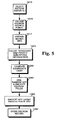
- FIGURE 5 is a flowchart which delineates the sequence of operations involved in the user identification or definition phase of an exemplary embodiment of the present invention.
- the processing steps set forth in FIGURE 5 solicit the user's selection and responses via a menu driven operator prompting routine.
- the routine shown in FIGURE 5 preferably is executed when the user, who has just purchased a computer, initializes the computer or any time the user escrows a new secret. After the routine is initially executed, it does not necessarily need to reacquire information that is not subject to change (e.g., birth date, birth place, etc.) if it is available in some other way.
- the operations shown in FIGURE 5 are performed, the information including the secret information is placed in the escrow record format shown in FIGURE 4.
- a trustee/escrow agent or set of escrow agents 1010
- split secret escrowing there is more than one trustee, and there must be some way to determine how the escrow information is to be partitioned among the trustees.
- a separate escrow record and random symmetric key is generated for each trustee.
- the trustee's public key is obtained (1015) and the trustee's identification, possibly including public key and key-splitting reassembly rules, are loaded in the escrow record field 82.
- the secret information is obtained and loaded into field 88 shown in FIGURE 4 (1017).
- the secret might be supplied by the user and in other cases it might be internally generated by the computer (e.g., in the case of defining encryption keys).
- the routine begins accumulating, via a sequence of operator prompts, the standard identifying information shown, for example, in FIGURE 2, and loads such information into escrow record field 84 (FIGURE 4). An operator prompt then provides a user the opportunity to supply private identifying information, and/or advice and instructions to the trustee and such information is loaded into field 86 shown in FIGURE 4.
- More voluminous digital information such as, a digitized photograph, voice samples, etc.
- the applicant should supply any necessary additional digital information as referenced by his or her hash in order for the trustee to check it.
- each identifying characteristic is labelled with explicit information indicating which characteristic is defined as well as the form of the inclusion (full data, inclusion by hash reference, etc.) as shown in FIGURE 2.
- the routine then computes the hash of the aggregate data and stores the computed hash in field 90 of escrow record 80.
- the computed hash is based on the standard identifying information (field 84), the private identifying information, if any, (field 86), the advice/instructions to the trustee, if any (field 86), and the secret information (e.g., the user's cipher password) from field 88.
- the hash is computed using any of various possible preferred hashing algorithms, such as, MD5 or the secure hash algorithm (SHA).
- a random symmetric (e.g., DES) key is generated (1040) which is used to encrypt at least the following information: the secret information stored at escrow record field 88, the hash of the aggregate information in field 90, and the private identifying information, if any, in field 86.
- the advice/instructions in field 86 for the trustee are included as part of the private information and are preferably encrypted.
- the standard identifying information in field 84 could be encrypted in whole, in part, or not at all, depending on whether it is considered more beneficial, in the event of loss, to allow a finder to determine the identity of an owner or to give an adversary minimal information about the characteristics necessary to forge in order to dupe the trustee.
- step 1050 the symmetric cipher key as generated in accordance with step 1040 and is encrypted using the public key of the trustee. This encrypted value is stored in field 92 of the escrow record 80 (1060). For multiple trustees, the information should be encrypted with a random symmetric key unique to each trustee.
- the escrow record 80 in accordance with block 1060 may be stored in a variety of acceptable locations.
- the escrow record may be communicated to the trustee immediately for safekeeping or it may be written to a floppy disk and saved by the user until and if required.
- the escrow record 80 may be recorded on hard disk. If the escrowed secret is the password to the hard disk, then it must be recorded on a portion of the disk which is not so encrypted.
- the escrow record 80 may be communicated to a third party other than the trustee for independent storage. A printed version of the escrow record may be generated.
- FIGURE 6 is a flowchart delineating the sequence of operations performed when an applicant attempts to retrieve escrowed secret information.
- the applicant may be the legitimate owner of the secret information or may be an imposter seeking to steal valuable information.
- the applicant provides the trustee with the escrow information record 80 which has been encrypted with the trustee's public key together with complete information for those items contained in the escrow record 80 which have been referenced only by a hash of the information, such as, for example, a digitized picture.
- the applicant also presents the trustee with documentation containing credentials that can be matched with the escrowed information.
- Such documentation may, for example, include a handwritten signed request for the secret information, an affidavit executed by a notary public attesting to the applicant's characteristics.
- the request for the secret information must be verifiable with the same public key stipulated in the escrow record. Additionally, the physical appearance of the applicant must match the described characteristics in the standard identifying information shown in FIGURE 2 contained in the escrow record at field 84.
- a public key may be required from the applicant to define the public key under which the applicant wants the information returned. In this fashion, the trustee and the applicant may secretly communicate without any danger of the secret information being revealed to an opponent who intercepts the communication.
- the trustee then receives the applicant's escrow record which has been extracted at block 2010 (2020) via the communication channel 12 shown in FIGURE 1 or by any other mechanism, such as by mail or even physical delivery of the entire computer.
- the trustee uses its secret private key to decrypt field 92 of the escrow record to thereby access the random symmetric key that encrypts the balance of the record (2030). If the trustee cannot decrypt field 92 using its private key, as determined by a check at block 2035, then the retrieval process fails and a appropriate failure message is returned to the applicant (2036).
- decryption check at block 2035 If decryption check at block 2035 was successful, then the trustee decrypts fields 86, 88, 90, and, to the extent it is encrypted, field 84, such that all fields in the escrow record are processable in plain text (2040). A check is made at block 2045 to ensure that the decryption operations were successfully completed to confirm that reliable data is retrievable. If the decryption was not successful, then an appropriate failure message is communicated to the user (2046).
- the trustee then recomputes the hash of escrow record fields 84, 86 and 88 (2050).
- a check is then made at block 2060 to determine if the recomputed hash matches the supplied hash value in field 90 of FIGURE 4. If the hash values do not match, then retrieval is not permissible since the applicant's escrow data is not trustworthy and may reflect tampered ciphertext. Accordingly, the retrieval process cannot be reliably performed and an appropriate message is communicated to the applicant (2061).
- the trustee If the hashes do match, then the trustee is assured that the escrow record has been delivered in correct form.
- the trustee reviews the escrow record data (2070) to determine whether the escrowed identification is supported by the applicant's documented credentials provided to the trustee at block 2010.
- the trustee thereby determines whether the data which has been supplied via affidavit from a notary public, voice communication, etc., matches the escrow record data.
- a determination is made at block 2080 whether the applicant appears to be the legitimate owner or has a genuine claim to the data (such as being the corporate owner of a secret managed by an employee).
- the trustee then encrypts the escrowed secret value contained in field 88 of FIGURE 4 using the public key defined by the applicant's request (2010) or the public key defined in the escrowed information (30 of Figure 2) and forwards the encrypted secret information to the applicant (2140).
- the action to be taken by the trustee is preferably specified in the escrow record in field 86 as part of the advice/instructions and requests to the trustee.
- the routine branches to block 2100 to request additional credentials as needed from the applicant in order to resolve the identification ambiguity.
- additional information may include a request for a source of digital biometrics (e.g. , a digitized photograph) that may have been referenced by hash in the escrow record and not included in the initial application, questions suggested by the private identification information supplied in the escrow information, a personal interview, a telephone conversation, a signature witnessed by a notary public, a challenge/response based on the public key stipulated in the escrowed information, and documents verified by an independent third party, such as a driver's license.
- a source of digital biometrics e.g. , a digitized photograph
- Production of the actual computer in question may be required, particularly if that was specified by the advice in the private identification information field 86. More reliable or more authenticated credential documentation may be required together with any other information necessary to confirm the identity of the applicant. If the credentials are requested electronically, then the request itself may be encrypted with either the public key supplied with the applicant's credentials or the public key contained in the escrow information.
- the applicant receives the additional query in block (2110) and it is encrypted, the applicant decrypts it with the appropriate private key.
- the applicant complies with the request by supplying additional credentials, or taking whatever steps are necessary to convince the trustee of his true identity. This may include a personal appearance, a telephone call or answering questions set forth in the escrowed private identification information. If the answers are returned electronically, then they can be encrypted under the trustee's public key.
- the trustee receives the additional information and decrypts it as necessary.
- the additional credentials are combined with those already in hand and the routine branches back to block 2070 to resume the evaluation process.
- the evaluation process is repeated as often as necessary to confirm that the applicant is either legitimate at block 2080 or an imposter at block 2090.
- the secret information is transmitted to the applicant encrypted under the private key with the escrow information (30) or as supplied by the (now confirmed) application in 2010.
- the applicant receives the supplied escrowed secret information and decrypts the supplied secret information using the appropriate private key (2150).
- split key secret sharing whereby each split key trustee receives a component of the user's secret, processing continues until the entirety of the secret information is accumulated.
- a check is made at block 2160 to determine whether the received escrow information is the last (or only) piece of the escrowed secret. For example, two or three trustees may be used to each escrow in part one-half or one-third of the secret information.
- the loop illustrated at block at blocks 2150-2170 reflect the processing to accumulate from each trustee all of the secret information. Once all the secret information is received is determined at 2160, then the applicant has regained sufficient information to restore the secret information, e.g., his or her password.
- the routine branches to 2170, where processing steps are performed to ensure the acquisition of the additional escrowed pieces of the split secret until sufficient pieces are retrieved such that the original secret information can be assembled. If the processing at block 2170 indicates that one of the escrow agents requires additional information, then processing branches to block 2110 to thereby process the additional identification query to the applicant. If the processing at block 2170 results in a trustee supplying a missing piece of secret information then that information is forwarded to the applicant at block 2150. Ultimately, if the applicant is entitled to receive the secret information, all the secret information is assembled.
Landscapes
- Engineering & Computer Science (AREA)
- Computer Security & Cryptography (AREA)
- Theoretical Computer Science (AREA)
- Physics & Mathematics (AREA)
- General Physics & Mathematics (AREA)
- General Engineering & Computer Science (AREA)
- Business, Economics & Management (AREA)
- Computer Hardware Design (AREA)
- Software Systems (AREA)
- Accounting & Taxation (AREA)
- Bioethics (AREA)
- General Health & Medical Sciences (AREA)
- Health & Medical Sciences (AREA)
- Databases & Information Systems (AREA)
- Finance (AREA)
- Strategic Management (AREA)
- General Business, Economics & Management (AREA)
- Computer Networks & Wireless Communication (AREA)
- Signal Processing (AREA)
- Storage Device Security (AREA)
- Electrophonic Musical Instruments (AREA)
- Management, Administration, Business Operations System, And Electronic Commerce (AREA)
- Facsimile Transmission Control (AREA)
Claims (32)
- Verfahren zum Betreiben eines Computers, um es zu ermöglichen, dass geheime digitale Informationen des Computerbenutzers anschließend von einer Vertrauensperson mit einem öffentlichen Schlüssel der Vertrauensperson und einem privaten Schlüssel der Vertrauensperson wiederhergestellt werden, wobei das Verfahren die folgenden Schritte umfasst:Bilden privater digitaler Identifikationsinformationen, die einen bestimmten Computerbenutzer (1020) identifizieren;Kombinieren privater digitaler Identifikationsinformationen mit den geheimen digitalen Informationen des Computerbenutzers, um kombinierte digitale Informationen (1030) zu erzeugen;Verschlüsseln der kombinierten digitalen Informationen unter Verwendung des öffentlichen Schlüssels der Vertrauensperson, derart, dass die kombinierten digitalen Informationen nur von dem privaten Schlüssel (1050) der Vertrauensperson entschlüsselt werden können, um eine treuhänderisch hinterlege Aufzeichnung mit zumindest den verschlüsselten kombinierten digitalen Informationen zu erzeugen;Speichern der treuhänderisch hinterlegten Aufzeichnungen;Geben der treuhänderisch hinterlegten Aufzeichnung zu der Vertrauensperson;Geben von Referenzen zu der Vertrauensperson, die den bestimmten Computerbenutzer identifizieren; undEmpfangen der geheimen digitalen Informationen von der Vertrauensperson.
- Verfahren nach Anspruch 1, bei dem zumindest ein Teil der Identifikationsformationen prüfsummiert wird.
- Verfahren nach Anspruch 1, bei dem zumindest ein Teil der Identifikationsinformationen in Klartext gespeichert wird.
- Verfahren nach Anspruch 1, bei dem der Schritt des Bildens den Schritt des Aufforderns des Computerbenutzers (1020) umfasst, eine Vielzahl von charakteristischen Identifikationsdaten des Benutzers bereitzustellen.
- Verfahren nach Anspruch 1, bei dem der Schritt des Bildens den Schritt von dem Benutzer umfasst, charakteristische physikalische Informationen bereitzustellen.
- Verfahren nach Anspruch 1, bei dem der Schritt des Bildens den Schritt von dem Benutzer umfasst, den öffentlichen Schlüssel von dem Benutzer bereitzustellen.
- Verfahren nach Anspruch 1, des Weiteren mit dem Schritt, von dem Computerbenutzer (1020) Instruktionen zu erbitten, die von der Vertrauensperson zu befolgen sind, wenn ein Versuch gemacht wird, die geheimen Informationen wiederherzustellen.
- Verfahren nach Anspruch 1, bei dem der Schritt des Bildens den Schritt von dem Benutzer umfasst, zumindest eine Frage (70) bereitzustellen, die von der Vertrauensperson einer Person zu stellen ist, die versucht, die geheimen Informationen wiederherzustellen.
- Verfahren nach Anspruch 1, bei dem der Schritt des verschlüsselns den Schritt des Erzeugens eines Verschlüsselungsschlüssels und des Verschlüsselns von zumindest den geheimen Informationen mit dem Verschlüsselungsschlüssel umfasst.
- Verfahren nach Anspruch 9, bei dem der Schritt das Verschlüsseln den Schritt des Verschlüsselns des Verschlüsselungsschlüssels unter Verwendung des öffentlichen Schlüssels der Vertrauensperson (1050) umfasst.
- Verfahren nach Anspruch 1, bei dem der Schritt des Speicherns den Schritt des Speicherns der digitalen Verschlüsselungsinformationen auf einen Speichermedium des Computerbenutzers umfasst.
- Verfahren nach Anspruch 1, bei dem der Schritt des Speicherns den Schritt des Speicherns von Informationen in Klartext umfasst, die die Vertrauensperson beschreiben.
- Verfahren zum Betreiben eines Computers, um es einem öffentlichen Schlüssel einer Vertrauensperson und einem privaten Schlüssel einer Vertrauensperson zu ermöglichen, treuhänderisch hinterlegte digitale geheime Informationen sicher zum Vorschein zu bringen, die in einer treuhänderisch hinterlegten Aufzeichnung für einen Anmelder enthalten sind, mit den folgenden Schritten:Erhalten der treuhänderisch hinterlegten Aufzeichnung (2010);Erhalten von Referenzen, die den Anmelder (2020) identifizieren;Entschlüsseln zumindest eines Teils der treuhänderisch hinterlegten Aufzeichnung unter Verwendung des privaten Schlüssels (2020) der Vertrauensperson;Vergleichen der Referenzen des Anmelders mit Identifikationsinformationen, die in der treuhänderisch hinterlegten Aufzeichnung (2080) eingebettet sind; undZum-Vorschein-Bringen der treuhänderisch hinterlegten digitalen geheimen Informationen für den Anmelder, wenn die Referenzen mit den treuhänderisch hinterlegten Identifikationsinformationen übereinstimmen, die in der treuhänderisch hinterlegten Aufzeichnung (2140) eingebettet sind.
- Verfahren nach Anspruch 13, bei dem die Identifikationsinformationen als Teil der Informationen verschlüsselt sind, die der Vertrauensperson verfügbar sind.
- Verfahren nach Anspruch 13, bei dem die Prüfsumme der Identifikationsinformationen als Teil der Informationen verschlüsselt werden, die der Vertrauensperson zur Verfügung stehen.
- Verfahren nach Anspruch 13, bei der die treuhänderisch hinterlegten Informationen in digitaler Form auf Papier gedruckt werden.
- Verfahren nach Anspruch 13, bei dem die digitalen Identifikationsinformationen (18) zumindest eine der folgenden umfasst:Name; Adresse; Telefonnummer; Größe; Gewicht; Geburtsdatum; Hautfarbe; Rasse; Augenfarbe; Geburtsort; Arbeitgeber; Titel; Geschäftsort; Arbeitnehmeridentifikation; Leiter; Identifikationsnummer; digitalisierter Fingerabdruck; digitalisierte Fotografie; digitalisierte Sprachaufzeichnung; digitalisierte Retinainformationen; Informationen betreffend die DNA des Benutzers; digitalisierte Handschriftprobe; digitalisierter Tastenanschlag; Anschlaganalyse; DNA-Muster; und Tatsachen, die außer dem Computerbenutzer wahrscheinlich nicht allgemein bekannt sind.
- Verfahren nach Anspruch 13, bei dem der Schritt des Entschlüsselns (2030) den Schritt des Verwendens des privaten Schlüssels der Vertrauensperson umfasst, um zumindest einen Teil der treuhänderisch hinterlegten Aufzeichnung zu entschlüsseln.
- Verfahren nach Anspruch 13, bei dem der Schritt des Entschlüsselns (2030) den Schritt des Verwendens des privaten Schlüssels der Vertrauensperson umfasst, um die treuhänderisch hinterlegte Aufzeichnung zu entschlüsseln, um auf einen zufälligen Verschlüsselungsschlüssel zuzugreifen, der verwendet wurde, um andere Felder in der treuhänderisch hinterlegten Aufzeichnung zu verschlüsseln.
- Verfahren nach Anspruch 13, des Weiteren mit dem Schritt des Berechnens der Prüfsumme einer Vielzahl von Feldern in der treuhänderisch hinterlegten Aufzeichnung (2050).
- Verfahren nach Anspruch 13, des Weiteren mit dem Schritt des Anforderns weiterer Referenzen (2100) von dem Anmelder, wenn die Referenzen nicht hinreichend mit den treuhänderisch hinterlegten Daten übereinstimmen.
- Verfahren nach Anspruch 21, bei dem der Schritt des Anforderns weiterer Referenzen den Schritt des Stellens von Fragen an den Anmelder umfasst, wie es in der treuhänderisch hinterlegten Aufzeichnung spezifiziert ist.
- Verfahren nach Anspruch 13, des Weiteren mit dem Schritt des Erfassens verschiedener Abschnitte der geheimen Informationen von einer Vielzahl von Vertrauenspersonen.
- Verfahren nach Anspruch 13, bei dem zumindest ein Teil der digitalen Identifikationsinformationen durch die Prüfsumme der Identifikationsinformationen angegeben wird.
- Computersystem, das angeordnet ist, um es zu ermöglichen, dass digitale geheime Informationen eines Computerbenutzers anschließend von einer Vertrauensperson wiederhergestellt werden, die einen öffentlichen Schlüssel der Vertrauensperson und einen privaten Schlüssel der Vertrauensperson hat, wobei das Computersystem umfasst:Mittel zum Bilden privater digitaler Identifikationsinformationen, die einen bestimmten Computerbenutzer (1020) identifizieren;Mittel zum Kombinieren der digitalen privaten Identifikationsinformationen mit den geheimen digitalen Informationen des Computerbenutzers, um kombinierte digitale Informationen (1030) zu erzeugen;Mittel zum Verschlüsseln der kombinierten digitalen Informationen unter Verwendung des öffentlichen Schlüssels der Vertrauensperson, derart, dass die kombinierten digitalen Informationen nur von dem privaten Schlüssel (1050) der Vertrauensperson entschlüsselt werden können, um eine treuhänderisch hinterlegte Aufzeichnung mit zumindest den verschlüsselten kombinierten digitalen Informationen zu erzeugen;Mittel zum Speichern der verschlüsselten digitalen Informationen;Mittel zum Geben der treuhänderisch hinterlegten Aufzeichnung zu der Vertrauensperson;Mittel zum Geben von Referenzen, die den bestimmten Computerbenutzer identifizieren, zu der Vertrauensperson; undMittel zum Empfangen der geheimen digitalen Informationen von der Vertrauensperson.
- Computersystem nach Anspruch 25, angeordnet, um Daten (18) zu speichern, die die Vertrauensperson identifizieren.
- Computersystem nach Anspruch 25, angeordnet, um eine verschlüsselte Version des Verschlüsselungsschlüssels zu speichern, der eingesetzt wird, um die geheimen digitalen Informationen zu verschlüsseln.
- Computersystem nach Anspruch 25, angeordnet, um eine Prüfsumme der Identifikationsinformationen und der geheimen digitalen Informationen zu speichern.
- Computersystem nach Anspruch 25, bei dem die Identifikationsinformationen (18) zumindest eine der folgenden umfasst:Name; Adresse; Telefonnummer; Größe; Gewicht; Geburtsdatum; Hautfarbe; Rasse; Augenfarbe; Geburtsort; Arbeitgeber; Titel; Geschäftsort; Arbeitnehmeridentifikation; Leiter; Identifikationsnummer; digitalisierter Fingerabdruck; digitalisierte Fotografie; digitalisierte Sprachaufzeichnung; digitalisierte Retinainformationen; Informationen betreffend die DNA des Benutzers; digitalisierte Handschriftprobe; digitalisierter Tastenanschlag; Anschlaganalyse; DNA-Muster; und Tatsachen, die außer dem Computerbenutzer wahrscheinlich nicht allgemein bekannt sind.
- Computersystem nach Anspruch 25, angeordnet, um Befehle zu speichern, die von der Vertrauensperson für den Fall zu folgen sind, dass ein Anmelder danach strebt, Zugriff auf die geheimen Informationen zu erhalten.
- Computersystem nach Anspruch 25, angeordnet, um zumindest eine Frage (70) zu speichern, die von der Vertrauensperson an eine Person zu stellen ist, die versucht, die geheimen Informationen wiederherzustellen.
- Computersystem, um es einem öffentlichen Schlüssel einer Vertrauensperson und einem privaten Schlüssel einer Vertrauensperson zu ermöglichen, treuhänderisch hinterlegte digitale geheime Informationen sicher zum Vorschein zu bringen, die in einer treuhänderisch hinterlegten Aufzeichnung an den Anmelder enthalten ist, wobei das Computersystem umfasst:Mittel zum Erhalten der treuhänderisch hinterlegten Aufzeichnung (2010);Mittel zum Erhalten von Referenzen, die den Anmelder (2020) identifizieren;Mittel zum Entschlüsseln zumindest eines Teils der treuhänderisch hinterlegten Aufzeichnung unter Verwendung des privaten Schlüssels (2030) der Vertrauensperson;Mittel zum Vergleichen der Referenzen des Anmelders mit Identifikationsinformationen, die in der treuhänderisch hinterlegten Aufzeichnung (2080) einbettet sind; undMittel zum Zum-Vorschein-Bringen der treuhänderisch hinterlegten digitalen geheimen Informationen für den Anmelder, wenn die Referenzen mit den treuhänderisch hinterlegten Identifikationsinformationen übereinstimmen, die in den treuhänderisch hinterlegten Aufzeichnungen (2140) eingebettet sind.
Applications Claiming Priority (2)
| Application Number | Priority Date | Filing Date | Title |
|---|---|---|---|
| US130126 | 1993-10-04 | ||
| US08/130,126 US5436972A (en) | 1993-10-04 | 1993-10-04 | Method for preventing inadvertent betrayal by a trustee of escrowed digital secrets |
Publications (2)
| Publication Number | Publication Date |
|---|---|
| EP0647895A1 EP0647895A1 (de) | 1995-04-12 |
| EP0647895B1 true EP0647895B1 (de) | 2008-01-16 |
Family
ID=22443170
Family Applications (1)
| Application Number | Title | Priority Date | Filing Date |
|---|---|---|---|
| EP94303429A Expired - Lifetime EP0647895B1 (de) | 1993-10-04 | 1994-05-12 | Verfahren zur Verhinderung des unabsichtlichen Verrats des gespeicherten digitalen Geheimnisse durch einen Treuhänder |
Country Status (7)
| Country | Link |
|---|---|
| US (3) | US5436972A (de) |
| EP (1) | EP0647895B1 (de) |
| JP (1) | JPH08171535A (de) |
| AT (1) | ATE384289T1 (de) |
| AU (1) | AU674560B2 (de) |
| CA (1) | CA2120667C (de) |
| DE (1) | DE69435066T2 (de) |
Families Citing this family (151)
| Publication number | Priority date | Publication date | Assignee | Title |
|---|---|---|---|---|
| US5557346A (en) * | 1994-08-11 | 1996-09-17 | Trusted Information Systems, Inc. | System and method for key escrow encryption |
| US5557765A (en) * | 1994-08-11 | 1996-09-17 | Trusted Information Systems, Inc. | System and method for data recovery |
| US7302415B1 (en) * | 1994-09-30 | 2007-11-27 | Intarsia Llc | Data copyright management system |
| US5721777A (en) * | 1994-12-29 | 1998-02-24 | Lucent Technologies Inc. | Escrow key management system for accessing encrypted data with portable cryptographic modules |
| US6272632B1 (en) | 1995-02-21 | 2001-08-07 | Network Associates, Inc. | System and method for controlling access to a user secret using a key recovery field |
| US5826245A (en) * | 1995-03-20 | 1998-10-20 | Sandberg-Diment; Erik | Providing verification information for a transaction |
| IL119444A (en) * | 1995-10-20 | 2001-10-31 | Yeda Res & Dev | Method and system for private retrieval of information |
| US5774870A (en) * | 1995-12-14 | 1998-06-30 | Netcentives, Inc. | Fully integrated, on-line interactive frequency and award redemption program |
| US5778367A (en) * | 1995-12-14 | 1998-07-07 | Network Engineering Software, Inc. | Automated on-line information service and directory, particularly for the world wide web |
| US5764772A (en) * | 1995-12-15 | 1998-06-09 | Lotus Development Coporation | Differential work factor cryptography method and system |
| US5812670A (en) * | 1995-12-28 | 1998-09-22 | Micali; Silvio | Traceable anonymous transactions |
| US5841888A (en) | 1996-01-23 | 1998-11-24 | Harris Corporation | Method for fingerprint indexing and searching |
| US5828773A (en) * | 1996-01-26 | 1998-10-27 | Harris Corporation | Fingerprint sensing method with finger position indication |
| US5956415A (en) * | 1996-01-26 | 1999-09-21 | Harris Corporation | Enhanced security fingerprint sensor package and related methods |
| US5963679A (en) * | 1996-01-26 | 1999-10-05 | Harris Corporation | Electric field fingerprint sensor apparatus and related methods |
| US5815573A (en) * | 1996-04-10 | 1998-09-29 | International Business Machines Corporation | Cryptographic key recovery system |
| JPH09284272A (ja) * | 1996-04-19 | 1997-10-31 | Canon Inc | エンティティの属性情報に基づく暗号化方式、署名方式、鍵共有方式、身元確認方式およびこれらの方式用装置 |
| GB9608696D0 (en) * | 1996-04-26 | 1996-07-03 | Europ Computer Ind Res | Electronic copy protection mechanism |
| US5768373A (en) * | 1996-05-06 | 1998-06-16 | Symantec Corporation | Method for providing a secure non-reusable one-time password |
| WO1997046933A1 (en) * | 1996-06-03 | 1997-12-11 | Electronic Data Systems Corporation | Automated password reset |
| US5937066A (en) * | 1996-10-02 | 1999-08-10 | International Business Machines Corporation | Two-phase cryptographic key recovery system |
| JP3815831B2 (ja) * | 1996-12-10 | 2006-08-30 | 株式会社Access | インターネットカード付きインターネットテレビおよびインターネットユニット |
| US5920630A (en) * | 1997-02-25 | 1999-07-06 | United States Of America | Method of public key cryptography that includes key escrow |
| US6779178B1 (en) | 1997-03-07 | 2004-08-17 | Signature Mail. Com, Llc | System and method for personalizing electronic mail messages |
| US6314190B1 (en) | 1997-06-06 | 2001-11-06 | Networks Associates Technology, Inc. | Cryptographic system with methods for user-controlled message recovery |
| US6775382B1 (en) * | 1997-06-30 | 2004-08-10 | Sun Microsystems, Inc. | Method and apparatus for recovering encryption session keys |
| US6185308B1 (en) * | 1997-07-07 | 2001-02-06 | Fujitsu Limited | Key recovery system |
| JP3076273B2 (ja) * | 1997-07-07 | 2000-08-14 | 日本電気株式会社 | 鍵回復条件暗号化装置および復号装置 |
| US6229894B1 (en) * | 1997-07-14 | 2001-05-08 | Entrust Technologies, Ltd. | Method and apparatus for access to user-specific encryption information |
| JP4006796B2 (ja) | 1997-11-17 | 2007-11-14 | 株式会社日立製作所 | 個人情報管理方法および装置 |
| US6098056A (en) * | 1997-11-24 | 2000-08-01 | International Business Machines Corporation | System and method for controlling access rights to and security of digital content in a distributed information system, e.g., Internet |
| US6151395A (en) * | 1997-12-04 | 2000-11-21 | Cisco Technology, Inc. | System and method for regenerating secret keys in diffie-hellman communication sessions |
| US7268700B1 (en) | 1998-01-27 | 2007-09-11 | Hoffberg Steven M | Mobile communication device |
| US6324650B1 (en) | 1998-03-16 | 2001-11-27 | John W.L. Ogilvie | Message content protection and conditional disclosure |
| US6970836B1 (en) | 1998-04-14 | 2005-11-29 | Citicorp Development Center, Inc. | System and method for securely storing electronic data |
| CA2356998C (en) * | 1998-05-21 | 2002-04-16 | Equifax Inc. | System and method for authentication of network users |
| AU4005999A (en) | 1998-05-21 | 1999-12-06 | Equifax, Inc. | System and method for authentication of network users and issuing a digital certificate |
| WO1999060481A1 (en) * | 1998-05-21 | 1999-11-25 | Equifax Inc. | System and method for authentication of network users with preprocessing |
| US6336187B1 (en) * | 1998-06-12 | 2002-01-01 | International Business Machines Corp. | Storage system with data-dependent security |
| US6442686B1 (en) | 1998-07-02 | 2002-08-27 | Networks Associates Technology, Inc. | System and methodology for messaging server-based management and enforcement of crypto policies |
| US6336186B1 (en) | 1998-07-02 | 2002-01-01 | Networks Associates Technology, Inc. | Cryptographic system and methodology for creating and managing crypto policy on certificate servers |
| JP3820777B2 (ja) * | 1998-11-12 | 2006-09-13 | 富士ゼロックス株式会社 | 秘密鍵寄託システムおよび方法 |
| US7171000B1 (en) | 1999-06-10 | 2007-01-30 | Message Secure Corp. | Simplified addressing for private communications |
| JP2000215172A (ja) | 1999-01-20 | 2000-08-04 | Nec Corp | 個人認証システム |
| US6668323B1 (en) * | 1999-03-03 | 2003-12-23 | International Business Machines Corporation | Method and system for password protection of a data processing system that permit a user-selected password to be recovered |
| US6601175B1 (en) | 1999-03-16 | 2003-07-29 | International Business Machines Corporation | Method and system for providing limited-life machine-specific passwords for data processing systems |
| US6671672B1 (en) * | 1999-03-30 | 2003-12-30 | Nuance Communications | Voice authentication system having cognitive recall mechanism for password verification |
| JP2001084275A (ja) * | 1999-04-28 | 2001-03-30 | Ricoh Co Ltd | データ転送装置 |
| US20020019932A1 (en) * | 1999-06-10 | 2002-02-14 | Eng-Whatt Toh | Cryptographically secure network |
| US6988199B2 (en) * | 2000-07-07 | 2006-01-17 | Message Secure | Secure and reliable document delivery |
| US20020101998A1 (en) * | 1999-06-10 | 2002-08-01 | Chee-Hong Wong | Fast escrow delivery |
| WO2000079368A1 (en) * | 1999-06-23 | 2000-12-28 | The Brodia Group | Software smart card |
| GB2353682B (en) * | 1999-07-15 | 2004-03-31 | Nds Ltd | Key management for content protection |
| IL130963A (en) * | 1999-07-15 | 2006-04-10 | Nds Ltd | Key management for content protection |
| AU3793501A (en) * | 1999-11-22 | 2001-06-04 | Ascom Hasler Mailing Systems, Inc. | Generation and management of customer pin's |
| JP2001223690A (ja) | 2000-02-08 | 2001-08-17 | Io Network:Kk | 情報通信方法 |
| US6453301B1 (en) | 2000-02-23 | 2002-09-17 | Sony Corporation | Method of using personal device with internal biometric in conducting transactions over a network |
| EP1261904A2 (de) * | 2000-02-28 | 2002-12-04 | Edentity Limited | Informationsverarbeitungssystem und -verfahren |
| US7703131B1 (en) * | 2000-03-01 | 2010-04-20 | Microsoft Corporation | Secured distributed impersonation |
| US6823070B1 (en) * | 2000-03-28 | 2004-11-23 | Freescale Semiconductor, Inc. | Method for key escrow in a communication system and apparatus therefor |
| CA2304433A1 (en) * | 2000-04-05 | 2001-10-05 | Cloakware Corporation | General purpose access recovery scheme |
| EP1272915B1 (de) * | 2000-04-11 | 2008-07-16 | Thomson Licensing | Vorrichtung zum sicheren speichern geheimer informationen |
| KR100933387B1 (ko) * | 2000-04-24 | 2009-12-22 | 비자 인터내셔날 써비스 어쏘시에이션 | 온라인 지불인 인증 서비스 |
| DE10025626A1 (de) * | 2000-05-24 | 2001-11-29 | Deutsche Telekom Ag | Verschlüsseln von abzuspeichernden Daten in einem IV-System |
| FR2810138B1 (fr) * | 2000-06-08 | 2005-02-11 | Bull Cp8 | Procede de stockage securise d'une donnee sensible dans une memoire d'un systeme embarque a puce electronique, notamment d'une carte a puce, et systeme embarque mettant en oeuvre le procede |
| US20040073617A1 (en) | 2000-06-19 | 2004-04-15 | Milliken Walter Clark | Hash-based systems and methods for detecting and preventing transmission of unwanted e-mail |
| US20020029269A1 (en) | 2000-06-29 | 2002-03-07 | Campus Pipeline, Inc. | Methods and systems for coordinating the termination of sessions on one or more systems |
| US20020057284A1 (en) | 2000-06-29 | 2002-05-16 | Dalby Richard Sean | Methods and systems for delivering announcements to users of an information system |
| US7093020B1 (en) | 2000-06-29 | 2006-08-15 | Sungard Sct Inc. | Methods and systems for coordinating sessions on one or more systems |
| US7251728B2 (en) | 2000-07-07 | 2007-07-31 | Message Secure Corporation | Secure and reliable document delivery using routing lists |
| US7191466B1 (en) | 2000-07-25 | 2007-03-13 | Laurence Hamid | Flexible system and method of user authentication for password based system |
| US20020051545A1 (en) * | 2000-08-14 | 2002-05-02 | Ogilvie John W.L. | Encryption multiplexing |
| US20020048372A1 (en) * | 2000-10-19 | 2002-04-25 | Eng-Whatt Toh | Universal signature object for digital data |
| US20020095580A1 (en) * | 2000-12-08 | 2002-07-18 | Brant Candelore | Secure transactions using cryptographic processes |
| US6950939B2 (en) * | 2000-12-08 | 2005-09-27 | Sony Corporation | Personal transaction device with secure storage on a removable memory device |
| US7251633B2 (en) * | 2000-12-11 | 2007-07-31 | Sony Corporation | Method or system for executing deferred transactions |
| US7765163B2 (en) * | 2000-12-12 | 2010-07-27 | Sony Corporation | System and method for conducting secure transactions over a network |
| US7360075B2 (en) | 2001-02-12 | 2008-04-15 | Aventail Corporation, A Wholly Owned Subsidiary Of Sonicwall, Inc. | Method and apparatus for providing secure streaming data transmission facilities using unreliable protocols |
| US7383329B2 (en) * | 2001-02-13 | 2008-06-03 | Aventail, Llc | Distributed cache for state transfer operations |
| US7353380B2 (en) * | 2001-02-12 | 2008-04-01 | Aventail, Llc, A Subsidiary Of Sonicwall, Inc. | Method and apparatus for providing secure streaming data transmission facilities using unreliable protocols |
| US20020124190A1 (en) * | 2001-03-01 | 2002-09-05 | Brian Siegel | Method and system for restricted biometric access to content of packaged media |
| US20020188511A1 (en) * | 2001-05-14 | 2002-12-12 | Trilegiant Loyalty Solutions | Interactive online point redemption system |
| US7093282B2 (en) * | 2001-08-09 | 2006-08-15 | Hillhouse Robert D | Method for supporting dynamic password |
| US7773730B1 (en) | 2001-08-09 | 2010-08-10 | Voice Signature Llc | Voice record integrator |
| US7526654B2 (en) * | 2001-10-16 | 2009-04-28 | Marc Charbonneau | Method and system for detecting a secure state of a computer system |
| US20030105959A1 (en) * | 2001-12-03 | 2003-06-05 | Matyas Stephen M. | System and method for providing answers in a personal entropy system |
| US8914411B1 (en) * | 2002-01-10 | 2014-12-16 | Verizon Patent And Licensing Inc. | Method, system and computer program product for controlling data access through question and answer mechanism |
| DE60224226T2 (de) * | 2002-01-24 | 2008-12-04 | Activcard Ireland Ltd. | Flexibles verfahren zur benutzerauthentifizierung für ein passwortbasiertes system |
| US7146009B2 (en) * | 2002-02-05 | 2006-12-05 | Surety, Llc | Secure electronic messaging system requiring key retrieval for deriving decryption keys |
| US7231657B2 (en) * | 2002-02-14 | 2007-06-12 | American Management Systems, Inc. | User authentication system and methods thereof |
| US20030174840A1 (en) * | 2002-03-12 | 2003-09-18 | Bogan William B. | Encryption method for preventing unauthorized dissemination of protected data |
| US8086867B2 (en) * | 2002-03-26 | 2011-12-27 | Northrop Grumman Systems Corporation | Secure identity and privilege system |
| US7469210B1 (en) | 2002-08-08 | 2008-12-23 | Voice Signature Llc | Outbound voice signature calls |
| US20040078603A1 (en) * | 2002-10-18 | 2004-04-22 | Eiji Ogura | System and method of protecting data |
| US20040103325A1 (en) * | 2002-11-27 | 2004-05-27 | Priebatsch Mark Herbert | Authenticated remote PIN unblock |
| US9818136B1 (en) | 2003-02-05 | 2017-11-14 | Steven M. Hoffberg | System and method for determining contingent relevance |
| GB2401014B (en) * | 2003-04-23 | 2005-09-14 | Hewlett Packard Development Co | Cryptographic method and apparatus |
| DE602004001273T2 (de) * | 2003-04-23 | 2007-05-31 | Hewlett-Packard Development Co., L.P., Houston | Verfahren und Vorrichtung zur Identifiezierungsbasierten Verschlüsselung |
| US20050021973A1 (en) * | 2003-04-23 | 2005-01-27 | Liqun Chen | Cryptographic method and apparatus |
| US7822988B2 (en) * | 2003-10-23 | 2010-10-26 | Microsoft Corporation | Method and system for identity recognition |
| US20050114447A1 (en) * | 2003-10-24 | 2005-05-26 | Kim Cameron | Method and system for identity exchange and recognition for groups and group members |
| US7379551B2 (en) * | 2004-04-02 | 2008-05-27 | Microsoft Corporation | Method and system for recovering password protected private data via a communication network without exposing the private data |
| US8015211B2 (en) * | 2004-04-21 | 2011-09-06 | Architecture Technology Corporation | Secure peer-to-peer object storage system |
| US7647498B2 (en) * | 2004-04-30 | 2010-01-12 | Research In Motion Limited | Device authentication |
| GB2415579B (en) * | 2004-06-23 | 2006-12-20 | Hewlett Packard Development Co | Cryptographic method and apparatus |
| US7590589B2 (en) | 2004-09-10 | 2009-09-15 | Hoffberg Steven M | Game theoretic prioritization scheme for mobile ad hoc networks permitting hierarchal deference |
| US7716489B1 (en) * | 2004-09-29 | 2010-05-11 | Rockwell Automation Technologies, Inc. | Access control method for disconnected automation systems |
| US8688590B2 (en) * | 2004-10-14 | 2014-04-01 | Google Inc. | System and method to strengthen advertiser and consumer affinity |
| US8224725B2 (en) | 2004-10-14 | 2012-07-17 | Google Inc. | Escrowing digital property in a secure information vault |
| US7587366B2 (en) * | 2004-10-14 | 2009-09-08 | International Business Machines Corporation | Secure information vault, exchange and processing system and method |
| US8620816B2 (en) * | 2004-10-14 | 2013-12-31 | Google Inc. | Information vault, data format conversion services system and method |
| GB2421093A (en) * | 2004-12-07 | 2006-06-14 | Symbian Software Ltd | Trusted user interface |
| US8874544B2 (en) | 2005-01-13 | 2014-10-28 | International Business Machines Corporation | System and method for exposing internal search indices to internet search engines |
| US7707118B2 (en) * | 2005-02-24 | 2010-04-27 | James Ring F | Asymmetrical escrow system for use in non-cooperative bargaining relationships |
| JP4697583B2 (ja) * | 2005-03-02 | 2011-06-08 | 琢晃 伊藤 | 個人情報の漏洩を回避した個人認証システム |
| EP1715404A1 (de) * | 2005-04-22 | 2006-10-25 | Siemens Aktiengesellschaft | System zur Speicherung und Wiedergewinnung vertraulicher Informationen |
| US8204233B2 (en) * | 2005-07-21 | 2012-06-19 | Symantec Corporation | Administration of data encryption in enterprise computer systems |
| US20070079143A1 (en) * | 2005-09-29 | 2007-04-05 | Avaya Technology Corp. | Secure recoverable passwords |
| US8874477B2 (en) | 2005-10-04 | 2014-10-28 | Steven Mark Hoffberg | Multifactorial optimization system and method |
| CN101331492A (zh) * | 2005-12-13 | 2008-12-24 | 美商内数位科技公司 | 用于保护节点中的用户数据的方法和系统 |
| US20070143830A1 (en) * | 2005-12-20 | 2007-06-21 | International Business Machines Corporation | Method, apparatus and system for preventing unauthorized access to password-protected system |
| EP1984866B1 (de) * | 2006-02-07 | 2011-11-02 | Nextenders (India) Private Limited | Dokumentsicherheitsverwaltungssystem |
| JP2007272476A (ja) * | 2006-03-30 | 2007-10-18 | Fujitsu Ltd | 情報記憶装置 |
| US10664575B2 (en) | 2006-05-02 | 2020-05-26 | Acer Cloud Technology, Inc. | Virtual vault of licensed content |
| US8239677B2 (en) | 2006-10-10 | 2012-08-07 | Equifax Inc. | Verification and authentication systems and methods |
| GB2446199A (en) * | 2006-12-01 | 2008-08-06 | David Irvine | Secure, decentralised and anonymous peer-to-peer network |
| US7899186B2 (en) * | 2007-09-20 | 2011-03-01 | Seagate Technology Llc | Key recovery in encrypting storage devices |
| GB2460412B (en) * | 2008-05-28 | 2012-09-19 | Hewlett Packard Development Co | Information sharing |
| US8949155B2 (en) * | 2008-12-31 | 2015-02-03 | Microsoft Corporation | Protecting privacy of personally identifying information when delivering targeted assets |
| US8856879B2 (en) * | 2009-05-14 | 2014-10-07 | Microsoft Corporation | Social authentication for account recovery |
| US9124431B2 (en) | 2009-05-14 | 2015-09-01 | Microsoft Technology Licensing, Llc | Evidence-based dynamic scoring to limit guesses in knowledge-based authentication |
| US9922063B2 (en) * | 2009-12-29 | 2018-03-20 | International Business Machines Corporation | Secure storage of secret data in a dispersed storage network |
| US8549314B2 (en) | 2010-04-29 | 2013-10-01 | King Saud University | Password generation methods and systems |
| US8490166B2 (en) * | 2010-12-29 | 2013-07-16 | Facebook, Inc. | Identifying a user account in a social networking system |
| US9754130B2 (en) | 2011-05-02 | 2017-09-05 | Architecture Technology Corporation | Peer integrity checking system |
| EP2771821A4 (de) * | 2011-10-28 | 2015-07-15 | Ydf Global Pty Ltd | Register |
| US20130179552A1 (en) * | 2012-01-09 | 2013-07-11 | Ezshield, Inc. | Computer Implemented Method, Computer System And Nontransitory Computer Readable Storage Medium For Matching URL With Web Site |
| US8930325B2 (en) | 2012-02-15 | 2015-01-06 | International Business Machines Corporation | Generating and utilizing a data fingerprint to enable analysis of previously available data |
| JP6040102B2 (ja) * | 2013-06-04 | 2016-12-07 | 株式会社日立製作所 | 不正情報検知方法および不正情報検知装置 |
| US9639710B2 (en) | 2013-12-23 | 2017-05-02 | Symantec Corporation | Device-based PIN authentication process to protect encrypted data |
| US8978153B1 (en) | 2014-08-01 | 2015-03-10 | Datalogix, Inc. | Apparatus and method for data matching and anonymization |
| US10027717B2 (en) * | 2015-06-26 | 2018-07-17 | Mcafee, Llc | Peer-to-peer group vigilance |
| US10694352B2 (en) | 2015-10-28 | 2020-06-23 | Activision Publishing, Inc. | System and method of using physical objects to control software access |
| US10938560B2 (en) | 2017-06-21 | 2021-03-02 | Microsoft Technology Licensing, Llc | Authorization key escrow |
| US10440006B2 (en) | 2017-06-21 | 2019-10-08 | Microsoft Technology Licensing, Llc | Device with embedded certificate authority |
| US10558812B2 (en) | 2017-06-21 | 2020-02-11 | Microsoft Technology Licensing, Llc | Mutual authentication with integrity attestation |
| US12256024B2 (en) | 2017-06-21 | 2025-03-18 | Microsoft Technology Licensing, Llc | Device provisioning |
| JP6647258B2 (ja) * | 2017-09-11 | 2020-02-14 | Capy株式会社 | ユーザ認証方法、評価装置、プログラム、及びユーザ認証システム |
| US10546276B2 (en) | 2017-09-13 | 2020-01-28 | Microsoft Technology Licensing, Llc | Cyber ownership transfer |
| US11374760B2 (en) | 2017-09-13 | 2022-06-28 | Microsoft Technology Licensing, Llc | Cyber physical key |
| US11157626B1 (en) | 2019-05-29 | 2021-10-26 | Northrop Grumman Systems Corporation | Bi-directional chain of trust network |
Family Cites Families (9)
| Publication number | Priority date | Publication date | Assignee | Title |
|---|---|---|---|---|
| US4386233A (en) * | 1980-09-29 | 1983-05-31 | Smid Miles E | Crytographic key notarization methods and apparatus |
| US5214702A (en) * | 1988-02-12 | 1993-05-25 | Fischer Addison M | Public key/signature cryptosystem with enhanced digital signature certification |
| US5163091A (en) * | 1990-01-29 | 1992-11-10 | Graziano James M | Knowledge based system for document authentication (apparatus) |
| US5091939A (en) * | 1990-06-22 | 1992-02-25 | Tandy Corporation | Method and apparatus for password protection of a computer |
| FR2671205B1 (fr) * | 1990-12-27 | 1995-01-20 | Telemecanique | Procede de controle de l'utilisation d'un poste de travail informatique par mot de passe et poste de travail informatique mettant en óoeuvre ce procede. |
| US5210795A (en) * | 1992-01-10 | 1993-05-11 | Digital Equipment Corporation | Secure user authentication from personal computer |
| US5418854A (en) * | 1992-04-28 | 1995-05-23 | Digital Equipment Corporation | Method and apparatus for protecting the confidentiality of passwords in a distributed data processing system |
| US5278904A (en) * | 1992-10-09 | 1994-01-11 | Gte Laboratories Incorporated | Method of verifying identification |
| US5345549A (en) * | 1992-10-30 | 1994-09-06 | International Business Machines Corporation | Multimedia based security systems |
-
1993
- 1993-10-04 US US08/130,126 patent/US5436972A/en not_active Expired - Lifetime
-
1994
- 1994-03-15 AU AU57825/94A patent/AU674560B2/en not_active Expired
- 1994-04-06 CA CA002120667A patent/CA2120667C/en not_active Expired - Lifetime
- 1994-05-12 AT AT94303429T patent/ATE384289T1/de active
- 1994-05-12 DE DE69435066T patent/DE69435066T2/de not_active Expired - Lifetime
- 1994-05-12 EP EP94303429A patent/EP0647895B1/de not_active Expired - Lifetime
- 1994-10-03 JP JP6239003A patent/JPH08171535A/ja active Pending
-
1995
- 1995-06-05 US US08/464,069 patent/US6141423A/en not_active Expired - Lifetime
-
2000
- 2000-07-17 US US09/617,814 patent/US6216229B1/en not_active Expired - Lifetime
Also Published As
| Publication number | Publication date |
|---|---|
| US6141423A (en) | 2000-10-31 |
| AU674560B2 (en) | 1997-01-02 |
| DE69435066T2 (de) | 2009-01-08 |
| ATE384289T1 (de) | 2008-02-15 |
| CA2120667A1 (en) | 1995-04-05 |
| JPH08171535A (ja) | 1996-07-02 |
| AU5782594A (en) | 1995-04-13 |
| EP0647895A1 (de) | 1995-04-12 |
| US6216229B1 (en) | 2001-04-10 |
| DE69435066D1 (de) | 2008-03-06 |
| US5436972A (en) | 1995-07-25 |
| CA2120667C (en) | 2000-02-22 |
Similar Documents
| Publication | Publication Date | Title |
|---|---|---|
| US5436972A (en) | Method for preventing inadvertent betrayal by a trustee of escrowed digital secrets | |
| US7346779B2 (en) | System and method for authenticating electronic documents | |
| US5548721A (en) | Method of conducting secure operations on an uncontrolled network | |
| US7797541B2 (en) | Method and apparatus for providing cellular telephone service using an authenticating cellular telephone device | |
| US6263446B1 (en) | Method and apparatus for secure distribution of authentication credentials to roaming users | |
| US6317834B1 (en) | Biometric authentication system with encrypted models | |
| JP4463979B2 (ja) | 暗号方式でカムフラージュされた暗号方式キーをストアし証明し使用する装置および方法 | |
| US20090265559A1 (en) | User authentication by linking randomly-generated authentication secret with personalized secret | |
| US20060149970A1 (en) | Authentication method and device | |
| US20040039909A1 (en) | Flexible authentication with multiple levels and factors | |
| AU742717B2 (en) | Digital signature generating server and digital signature generating method | |
| IL137099A (en) | Method and system for performing a secure digital signature | |
| JPH1188321A (ja) | ディジタル署名生成サーバ | |
| WO2002005475A2 (en) | Generation and use of digital signatures | |
| JPH11353280A (ja) | 秘密データの暗号化による本人確認方法及びシステム | |
| EP1131911B1 (de) | Verfahren und vorrichtung zur sicheren verteilung von authentifizierungsdaten an umherstreifende teilnehmer | |
| JP3697212B2 (ja) | ユーザ認証システム、ユーザ認証方法、ユーザ認証プログラム、及び、コンピュータ読取可能な記録媒体 | |
| JP3660306B2 (ja) | ユーザ認証システム、ユーザ認証方法、ユーザ認証プログラム、及び、コンピュータ読取可能な記録媒体 | |
| Chen et al. | A trusted biometric system | |
| JPH1188322A (ja) | ディジタル署名生成方法 | |
| JP2001320361A (ja) | Icカードを用いたデジタル証明書の取得方法及びそのシステム |
Legal Events
| Date | Code | Title | Description |
|---|---|---|---|
| PUAI | Public reference made under article 153(3) epc to a published international application that has entered the european phase |
Free format text: ORIGINAL CODE: 0009012 |
|
| AK | Designated contracting states |
Kind code of ref document: A1 Designated state(s): AT BE CH DE DK ES FR GB GR IE IT LI LU MC NL PT SE |
|
| 17P | Request for examination filed |
Effective date: 19951002 |
|
| 17Q | First examination report despatched |
Effective date: 20020503 |
|
| GRAP | Despatch of communication of intention to grant a patent |
Free format text: ORIGINAL CODE: EPIDOSNIGR1 |
|
| GRAS | Grant fee paid |
Free format text: ORIGINAL CODE: EPIDOSNIGR3 |
|
| GRAA | (expected) grant |
Free format text: ORIGINAL CODE: 0009210 |
|
| AK | Designated contracting states |
Kind code of ref document: B1 Designated state(s): AT BE CH DE DK ES FR GB GR IE IT LI LU MC NL PT SE |
|
| REG | Reference to a national code |
Ref country code: GB Ref legal event code: FG4D |
|
| REG | Reference to a national code |
Ref country code: CH Ref legal event code: EP |
|
| REG | Reference to a national code |
Ref country code: IE Ref legal event code: FG4D |
|
| REF | Corresponds to: |
Ref document number: 69435066 Country of ref document: DE Date of ref document: 20080306 Kind code of ref document: P |
|
| REG | Reference to a national code |
Ref country code: CH Ref legal event code: NV Representative=s name: E. BLUM & CO. AG PATENT- UND MARKENANWAELTE VSP |
|
| PG25 | Lapsed in a contracting state [announced via postgrant information from national office to epo] |
Ref country code: NL Free format text: LAPSE BECAUSE OF FAILURE TO SUBMIT A TRANSLATION OF THE DESCRIPTION OR TO PAY THE FEE WITHIN THE PRESCRIBED TIME-LIMIT Effective date: 20080116 |
|
| NLV1 | Nl: lapsed or annulled due to failure to fulfill the requirements of art. 29p and 29m of the patents act | ||
| PG25 | Lapsed in a contracting state [announced via postgrant information from national office to epo] |
Ref country code: ES Free format text: LAPSE BECAUSE OF FAILURE TO SUBMIT A TRANSLATION OF THE DESCRIPTION OR TO PAY THE FEE WITHIN THE PRESCRIBED TIME-LIMIT Effective date: 20080427 |
|
| PGFP | Annual fee paid to national office [announced via postgrant information from national office to epo] |
Ref country code: LU Payment date: 20080604 Year of fee payment: 15 |
|
| ET | Fr: translation filed | ||
| PG25 | Lapsed in a contracting state [announced via postgrant information from national office to epo] |
Ref country code: BE Free format text: LAPSE BECAUSE OF FAILURE TO SUBMIT A TRANSLATION OF THE DESCRIPTION OR TO PAY THE FEE WITHIN THE PRESCRIBED TIME-LIMIT Effective date: 20080116 Ref country code: PT Free format text: LAPSE BECAUSE OF FAILURE TO SUBMIT A TRANSLATION OF THE DESCRIPTION OR TO PAY THE FEE WITHIN THE PRESCRIBED TIME-LIMIT Effective date: 20080616 |
|
| PGFP | Annual fee paid to national office [announced via postgrant information from national office to epo] |
Ref country code: MC Payment date: 20080429 Year of fee payment: 15 |
|
| PG25 | Lapsed in a contracting state [announced via postgrant information from national office to epo] |
Ref country code: SE Free format text: LAPSE BECAUSE OF FAILURE TO SUBMIT A TRANSLATION OF THE DESCRIPTION OR TO PAY THE FEE WITHIN THE PRESCRIBED TIME-LIMIT Effective date: 20080416 Ref country code: DK Free format text: LAPSE BECAUSE OF FAILURE TO SUBMIT A TRANSLATION OF THE DESCRIPTION OR TO PAY THE FEE WITHIN THE PRESCRIBED TIME-LIMIT Effective date: 20080116 |
|
| PLBE | No opposition filed within time limit |
Free format text: ORIGINAL CODE: 0009261 |
|
| STAA | Information on the status of an ep patent application or granted ep patent |
Free format text: STATUS: NO OPPOSITION FILED WITHIN TIME LIMIT |
|
| 26N | No opposition filed |
Effective date: 20081017 |
|
| PG25 | Lapsed in a contracting state [announced via postgrant information from national office to epo] |
Ref country code: IT Free format text: LAPSE BECAUSE OF FAILURE TO SUBMIT A TRANSLATION OF THE DESCRIPTION OR TO PAY THE FEE WITHIN THE PRESCRIBED TIME-LIMIT Effective date: 20080116 |
|
| PG25 | Lapsed in a contracting state [announced via postgrant information from national office to epo] |
Ref country code: MC Free format text: LAPSE BECAUSE OF NON-PAYMENT OF DUE FEES Effective date: 20090531 |
|
| PG25 | Lapsed in a contracting state [announced via postgrant information from national office to epo] |
Ref country code: GR Free format text: LAPSE BECAUSE OF FAILURE TO SUBMIT A TRANSLATION OF THE DESCRIPTION OR TO PAY THE FEE WITHIN THE PRESCRIBED TIME-LIMIT Effective date: 20080417 |
|
| PG25 | Lapsed in a contracting state [announced via postgrant information from national office to epo] |
Ref country code: LU Free format text: LAPSE BECAUSE OF NON-PAYMENT OF DUE FEES Effective date: 20090512 |
|
| GBPC | Gb: european patent ceased through non-payment of renewal fee |
Effective date: 20110512 |
|
| REG | Reference to a national code |
Ref country code: GB Ref legal event code: S28 Free format text: APPLICATION FILED |
|
| PG25 | Lapsed in a contracting state [announced via postgrant information from national office to epo] |
Ref country code: GB Free format text: LAPSE BECAUSE OF NON-PAYMENT OF DUE FEES Effective date: 20110512 |
|
| REG | Reference to a national code |
Ref country code: GB Ref legal event code: S28 Free format text: RESTORATION ALLOWED Effective date: 20120712 |
|
| PGFP | Annual fee paid to national office [announced via postgrant information from national office to epo] |
Ref country code: AT Payment date: 20120510 Year of fee payment: 19 |
|
| PGFP | Annual fee paid to national office [announced via postgrant information from national office to epo] |
Ref country code: GB Payment date: 20130508 Year of fee payment: 20 Ref country code: DE Payment date: 20130515 Year of fee payment: 20 Ref country code: CH Payment date: 20130514 Year of fee payment: 20 Ref country code: IE Payment date: 20130510 Year of fee payment: 20 |
|
| PGFP | Annual fee paid to national office [announced via postgrant information from national office to epo] |
Ref country code: FR Payment date: 20130531 Year of fee payment: 20 |
|
| REG | Reference to a national code |
Ref country code: DE Ref legal event code: R071 Ref document number: 69435066 Country of ref document: DE |
|
| REG | Reference to a national code |
Ref country code: CH Ref legal event code: PL |
|
| REG | Reference to a national code |
Ref country code: GB Ref legal event code: PE20 Expiry date: 20140511 |
|
| REG | Reference to a national code |
Ref country code: IE Ref legal event code: MK9A |
|
| REG | Reference to a national code |
Ref country code: AT Ref legal event code: MK07 Ref document number: 384289 Country of ref document: AT Kind code of ref document: T Effective date: 20140512 |
|
| PG25 | Lapsed in a contracting state [announced via postgrant information from national office to epo] |
Ref country code: IE Free format text: LAPSE BECAUSE OF EXPIRATION OF PROTECTION Effective date: 20140512 Ref country code: GB Free format text: LAPSE BECAUSE OF EXPIRATION OF PROTECTION Effective date: 20140511 |
|
| PG25 | Lapsed in a contracting state [announced via postgrant information from national office to epo] |
Ref country code: DE Free format text: LAPSE BECAUSE OF EXPIRATION OF PROTECTION Effective date: 20140513 |