EP0647900A1 - Allocation d'espace de stockage de paramètres - Google Patents
Allocation d'espace de stockage de paramètres Download PDFInfo
- Publication number
- EP0647900A1 EP0647900A1 EP94114389A EP94114389A EP0647900A1 EP 0647900 A1 EP0647900 A1 EP 0647900A1 EP 94114389 A EP94114389 A EP 94114389A EP 94114389 A EP94114389 A EP 94114389A EP 0647900 A1 EP0647900 A1 EP 0647900A1
- Authority
- EP
- European Patent Office
- Prior art keywords
- parameter information
- order
- data
- parameter
- data length
- Prior art date
- Legal status (The legal status is an assumption and is not a legal conclusion. Google has not performed a legal analysis and makes no representation as to the accuracy of the status listed.)
- Granted
Links
Images




Classifications
-
- G—PHYSICS
- G06—COMPUTING OR CALCULATING; COUNTING
- G06F—ELECTRIC DIGITAL DATA PROCESSING
- G06F8/00—Arrangements for software engineering
- G06F8/40—Transformation of program code
- G06F8/41—Compilation
- G06F8/44—Encoding
- G06F8/443—Optimisation
Definitions
- the present invention relates to a language processing system and a language processing method therefor. More specifically, the invention relates to a language processing system and a language processing method for coding process of a high level language as a program language of a microprocessor.
- a machine language program instructing operation of the computer is described by a string of figures, such as binary number or hexadecimal number and so forth. Since the machine language program described by the string of figures is too difficult to understand, a programmer typically prepares a program (hereinafter referred to as "source program") by a high level language employing expression easier for the programmer to understand and then translates the source program into the machine language program. Then, the machine language program is loaded to the computer for execution.
- a compiler is one of a language processing system performing this translation.
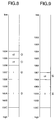
- FIG. 10 is an imaginary illustration showing manner of assignment of "c1", “i”, “c2", “l” in data regions.
- Fig. 10 when “c1" is assigned to an address from 100C, "i” is assigned to an address from 100B, “c2" is assigned to an address from 1009 and "l” is assigned to the address from 1008.
- the access speed for the data in the even number address is higher than that in the odd number address.
- a process called as "alignment" is performed in order to make all data accessible and to speed-up access for permitting higher speed execution of the program.
- the alignment is a restriction of data assignment for accessing of data assigned to the data regions.
- 2-bites alignment there are 2-bites alignment, 4-bites alignment and so forth.
- 2-bits alignment is assignment for assigning the parameter in the data regions of addresses of multiple of 2.
- 4-bites alignment is assignment for assigning parameter in the data regions of addresses of multiple of 4.
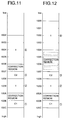
- Fig. 11 is also an explanatory illustration showing the case where data is assigned by 2-bites alignment in assigning of data for the data regions shown in Fig. 10.
- the difference between the charts of Figs. 10 and 11 is that, in Fig. 11, 1-bite correction regions are inserted between the external parameters "c1" and “i” and between the external parameters "c2" and “l”.
- Fig. 12 shows the case where the 4-bites alignment is employed for data assignment with respect to the data region of Fig. 10.
- 1-bite correction region is inserted between the external parameters "c1" and "i” and 3-bites correction region is inserted between the external parameters "c2" and "l”.
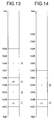
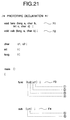
- Fig. 13 illustrates the condition of the stack region immediately after calling of the function func in the example of the program shown in Fig. 21.
- Fig. 14 is the condition of the stack region immediately after calling a function sub.
- a C-language source program shown in Fig. 22 shows an example, in which the function func is called from the function main and the function sub is further called from the function func.
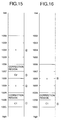
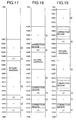
- FIG. 17 is an illustration showing the condition of the stack region immediately after calling the function sub in the example of program of Fig. 22.
- Fig. 18 shows the stack region in the case where the arguments are stacked in the stack region by 2-bites alignment
- Fig. 19 shows the stack region in the case where the arguments are stacked in the stack region by 4-bites alignment.
- "return address" means necessary information to return the process to the function main after completion of the process in the function func.
- the return address is 4-bite data.
- the example of the program in Fig. 22 utilizes the stack region sequentially.
- an optimal data assigning system disclosed in Japanese Unexamined Patent Publication No. 2-24726 proposes arrangement of data in the computer which requires setting of address to a base register when data is made reference to.
- the computer for which this proposal is applicable is limited to the computer which can be made reference to by designating direct address and, in which the designated address requires alignment depending the data length.
- alignment amount is differentiated depending upon the difference of the architecture of the computer, such as 2-bites alignment, 4-bites alignment and so forth, alignment process has to be differentiated for each architecture of the computer.
- Another object of the present invention is to provide a language processing system which permits assignment of parameter or argument in the uniform manner irrespective of an alignment amount and whereby permits unitary data assignment process for parameter or argument without depending upon the difference of architecture.
- a language processing system comprises: parsing means for inputting a source program described by a high-level language, making analysis and generating an intermediate code file on the basis of the results of analysis; code generating means for generating an object program corresponding to the source program analyzed by the parsing means, the code generating means including parameter analyzing means for making analysis of data length of parameter information contained in the source program; and parameter assigning means for assigning parameter information to a predetermined data region in descending order depending upon the data length and in the order of appearance.
- the language processing system may further comprise parameter information storage means for storing the parameter information and the data length analyzed by the data analyzing means.
- the language processing system may further comprise parameter information storage means for storing the parameter information and the data length analyzed by the data analyzing means in mutually associated position, wherein when the data length of the parameter information analyzed by the parameter analyzing means is the maximum, the parameter information is assigned to the data region by the parameter assigning means in the order of appearance, and when the data length of the parameter information analyzed by the parameter analyzing means is not the maximum, the parameter information storage means stores the parameter information and the data length in the order of appearance.
- the parameter information storage means may classify the parameter information depending upon the data length and store in the order of appearance. In such case, the parameter information storage means may store sets of the parameter names of the parameter information and the data lengths in the order of appearance.
- the parameter assigning means may assign the parameter information in the data region in the descending order depending upon the data length.
- a language processing system comprises: parsing means for inputting a source program described by a high-level language, making analysis and generating an intermediate code file on the basis of the results of analysis; code generating means for generating an object program corresponding to the source program analyzed by the parsing means, the code generating means including parameter analyzing means for making analysis of data length of parameter information contained in the source program; assigning order analyzing means for making analysis of order for assigning the parameter information in a predetermined data region with reference to the data length of the parameter information analyzed by the parameter analyzing means and outputting an assignment order information; parameter assigning means for assigning parameter information to the predetermined data region according to the assignment order information.
- the parameter information may be argument of a function described in the source program.
- the language processing system may further comprise parameter information storage means for storing the parameter information and the data length and the assignment order information.
- the assignment order analyzing means may make analysis of the assignment order of the parameter information in such a manner that parameter information is assigned to the data region in descending order depending upon the data length and in the order of appearance.
- the language processing system further comprises parameter information storage means for storing the parameter information, the data length and the assignment order information, wherein the assignment order analyzing means makes analysis of the assignment order of the parameter information in such a manner that parameter information is assigned to the data region in descending order depending upon the data length and in the order of appearance, and stores the data length and the assignment order information in the parameter information storage means in the order of appearance.
- the language processing system further comprises parameter information storage means for storing the parameter information, the data length and the assignment order information
- the assignment order analyzing means makes analysis of the assignment order of the parameter information in such a manner that parameter information is assigned to the data region in descending order depending upon the data length and in the order of appearance, and stores the data length and the assignment order information in the parameter information storage means in the order of appearance
- the parameter assigning means assigns the parameter information to the data region according to the assignment order information with reference to the assignment order information of the parameter information stored in the parameter information storage means in the order of appearance.
- Fig. 1 shows a block diagram showing the first embodiment of a language processing system according to the present invention.
- the shown embodiment of a language processing system includes an input file 101 storing a source program, a language processing program executing portion 102 for generating an object program from the source program, and an output file 107 for storing the generated object program.
- the language processing program executing portion 102 comprises an input portion 103 receiving the source program from the input filter 101, a parsing portion 104 for parsing the input source program and generating an intermediate code file, a code generating portion 105 generating an object program from thus generated intermediate code file and an output portion 106 for outputting thus generated object file to the output file 107.
- the code generating portion 105 includes a data assignment analyzing portion 108 for analyzing data length of external parameter information contained in the input source program and assigning the external parameter information to predetermined data region and a parameter information storage portion 109 for storing the external parameter information classified depending upon the data length.
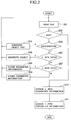
- Fig. 2 is a flowchart showing a processing procedure in the data assignment analyzing portion 108 included in the first embodiment of the language processing program executing portion 102 shown in Fig. 1. It should be noted that, in the shown embodiment, it is assumed that the external parameter information to be handled in the program are three kinds respectively having data lengths of 1 bite, 2 bites and 4 bites.
- the source program input through the input portion 103 is parsed into units (hereinafter referred to as recording unit) of a data definition, an equation, a function, a function definition, a branch by the parsing portion 104 and output as the intermediate code file.
- recording unit units of a data definition, an equation, a function, a function definition, a branch by the parsing portion 104 and output as the intermediate code file.
- the intermediate code file output from the parsing portion 104 is read out.
- the process is advanced to a reading completion judgement step 202.
- step 202 check is performed whether the current recording unit read out at the reading process step 201 is the last recording of the intermediate code file, namely whether the end of the intermediate code file is reached.
- the process is advanced to a data assignment processing step 210.
- the process is advanced to a data definition discriminating step 203.
- the data definition discriminating step 203 judgement is made whether the recording unit read out at the reading processing step 201 is a data definition (declaration of the external parameter) of the external parameter or not. If the recording unit in question is the data definition of the external parameter, the process is advanced to a data length analysis processing step 205. On the other hand, if the recording unit in question is not the data definition of the external parameter, the process is advanced to an object generating process 204 for generating an object of the read out recording unit.
- the data length analysis processing step 205 judgement is made whether the read out recording unit is the external parameter information having 4 bites of data length. If the recording unit in question is the external parameter information having 4 bite data length, the process is advanced to a data assignment processing step 206, and otherwise, the process is advanced to a data length analysis processing step 207.
- the process is advanced to a parameter storage processing step 208, and otherwise, the process is advanced to a parameter storage processing step 209.
- the read out external parameter information is stored in a storage block for the corresponding data length in the parameter information storage portion 108. After thus storing the external parameter data, the process is returned to the reading processing step 201.
- the following table 1 imaginally shows the parameter information storage portion 109, in which the external parameter information is stored at the parameter storage processing steps 208 and 209 TABLE 1 1 Bite Data 2 Bites Data Parameter Name Parameter Name
- an object for assigning the external parameter information having 2 bites of data length stored in the parameter information storage portion 109 at the parameter storage processing step 208 is generated for assigning to the data region. Then, the process is advanced to a data assignment processing step 211. At the data assignment processing step 211, an object for assigning the external parameter information having 1 bite of data length stored in the parameter information storage portion 109 at the parameter storage processing step 208 is generated for assigning to the data region.
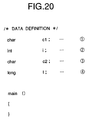
- the program illustrated in Fig. 20 is the source program read in the input portion 103 from the input file 101.
- the following process is performed in a manner set out below.
- the parsing portion 104 judgement is made that 1 to 4 of Fig. 20 are data definitions for the external parameters. Then, the external parameter information is output as the intermediate code file. At the reading processing step 201, the intermediate code file output from the parsing portion 104 is read out per one recording unit.
- the record information of the parameter information "i" having 2 bites of data length is stored in the portion 2 of the table 2 at the parameter information storage processing step 208. Then, the process is returned to the reading processing step 201. Subsequently, when the record information of the external parameter information "c2" is read out, the parameter information "c2" having 1 bite of data length, is stored in the portion 3 in the table 2 at the parameter storage processing step 209. Thereafter, the process is returned to the reading processing step 201.
- object is generated for assigning the parameter information having 2 bites of data length stored in the parameter information storage portion 109 to the data region at the data assignment processing step 210.
- the external parameter information having 2 bites of data length is "i”. Therefore, at the data assignment processing step 210, the object for assigning the external parameter information "i" is generated.
- an object is generated for assigning the external parameter information having 1 bite of data length stored in the parameter information storage portion 109, to the data region.
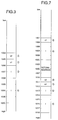
- the external parameter information having 1 bite of data length are "c1" and "c2". Therefore, at the data assignment processing step 210, the objects for assigning the external parameter information "c1” and “c2" are generated. 1 to 3 in Fig. 3 imaginary illustrate there external parameter information "i”, "c1", "c2" assigned to the data region.
- the external parameter information in the program are assigned in the data region in descending order of the data length to assign the parameter information having greater data length at earlier. Therefore, it becomes unnecessary to calculate correction regions as those required in the prior art. This contributes reduction of the data region for assigning the external parameter information. Also, in case of the 2 bites alignment or 4 bites alignment, it becomes possible to assign the external parameter information to the data region in the similar process to that set forth above. Therefore, it becomes possible to unify the data assignment process irrespective of the difference of the architecture of the computer systems.
- the shown embodiment is differentiated from the foregoing first embodiment in that instead classifying the external parameter information depending upon the data length by the data assignment analyzing portion 108 in Fig. 1 for storing in the parameter information storage portion 109, the parameter information storage portion 109 is provided with a function for storing the external parameter information name and the data length thereof with establishing association therebetween.
- the external parameter information to be handled in the program is assumed to have data length of 1 bite, 2 bites and 4 bites, similarly to the foregoing first embodiment. Furthermore, the contents common to the first embodiment will be neglected from discussion and only contents different from the first embodiment will be discussion in detail.
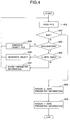
- Fig. 4 is a flowchart showing a processing procedure in the data assignment analyzing portion 108 in the language processing program executing portion 102.
- the process steps 401 to 406 in the shown embodiment are similar to the process steps 201 to 206 in the foregoing first embodiment.
- a parameter storage processing step 407 the read out external parameter information name and the data length of the external parameter information are stored in the parameter information storage portion 109. Then, the process is returned to the step 401.
- the following table 3 imaginary illustrates the content of the parameter information storage portion 109 in the second embodiment.
- the parameter information name is stored in the left half and the data length of the parameter information is stored in the right half.
- the external parameter information name and the data length thereof are stored in the parameter information storage portion in the order of reading out.
- a data assignment processing step 408 the information stored in the parameter information storage portion 109 is read out, and the object for assigning the parameter information having 2 bites of the data length to the data region is generated. This process is repeated until objects for all parameter information having 2 bites data length are generated. When no parameter information having 2 bites data length is remained, the process is advanced to a data assignment processing step 409.
- the process for reading out the parameter information stored in the parameter information storage portion 109 is performed.
- an object is generated for assigning the external parameter data having 1 bite data length to the data region.
- the following table 4 shows the content of the parameter information storage portion 198 storing parameter information written at the step parameter storage process step 407 in the case where the source program shown Fig. 20 is input from the input file 101 similarly to the foregoing first embodiment.
- TABLE 4 Parameter Name Data Length (Bite) c1 1 i 2 c2 1
- the external parameter information "c1" has the 1 bite data length, this parameter information is ignored.
- external parameter information "i” has the 2 bites data length.
- the object for assigning the parameter information "i” to the data region is generated.
- the external parameter information "c2" has the 1 bite data length and thus is ignored.
- the different point of the shown embodiment from the first and second embodiments set forth above is that while the first and second embodiments realizes the assignment process for assigning the external parameter data to the data region, the shown embodiment is characterized by assignment process of an argument of a function to a stack region.
- the source program to be handled in the shown embodiment is a program containing a declaration of prototype in the program or a program having definition of a function before calling of the function.
- the arguments of the function to be handled in the program are assumed to be the three types, i.e. those having data lengths of 1 bite, 2 bites and 4 bites.
- Fig. 5 is a block diagram showing the third embodiment of the language processing system according to the present invention.
- the shown embodiment of the language processing system includes an input file 501 storing a source program, a language processing program executing portion 502 for generating an object program from the source program, and an output file 507 for storing the generated object program.
- the language processing program executing portion 502 comprises an input portion 503 receiving the source program from the input filter 501, a parsing portion 504 for parsing the input source program and generating an intermediate code file, a code generating portion 505 generating an object program from thus generated intermediate code file and an output portion 106 for outputting thus generated object file to the output file 507.
- the code generating portion 505 includes a data assignment analyzing portion 508 for analyzing data length of argument of function contained in the input source program and assigning the argument of function to predetermined stack region and a parameter information storage portion 509 for storing the argument of function, analyzed data length information and assignment order information.
- an assignment order analyzing portion 510 is added for the code generating portion 505.
- the input file 501, the input portion 508, the parsing portion 504, the data assignment analyzing portion 508, the parameter information storage portion 509, the output portion 506 and the output file 507 are respectively the same as respectively corresponding elements in Fig. 1.
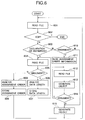
- Fig. 6 is a flowchart showing the processing procedure in the data assignment analyzing portion 508 and the assignment order analyzing portion 510 included in the language processing program executing portion in the third embodiment of the language processing system.
- a reading processing step 601 the intermediate code file output from the parsing portion 504 is read out per one recording unit. Then, the process is advanced to a reading completion judgement step 602. At the reading completion judgement step 602, check is performed whether the current recording unit read out at the reading process step 601 is the last recording of the intermediate code file, namely whether the end of the intermediate code file is reached. When the end of the intermediate code file is reached, the process is goes end.
- the process is advanced to a function declaration discriminating step 603.
- the function declaration discriminating step 603 judgement is made whether the recording unit read out at the reading processing step 601 is a function declaration or a function definition. If the recording unit in question is the function declaration or the function definition, the process is advanced to a reading processing step 604. On the other hand, if the recording unit in question is not the function declaration or the function definition, the process is advanced to a function argument discrimination process step 610.
- the intermediate code file is read out per one recording unit similarly to the reading processing step 601. Thereafter, the process is advanced to a argument discrimination processing step 605.
- the argument discrimination processing step 605 judgement is made whether the record information read at the reading processing step 604 is the argument or not. If the record information is the argument, the process is advanced to a data length analysis processing step 606. On the other hand, if the record information is not the argument, the process is advanced to the assignment order analysis processing portion 608.
- the data length analysis processing step 605 the data length of the argument is analyzed from the read out record information. Then, the process is advanced to the storage processing step 607. At the storage processing step 607, the data length of the read out argument is stored in the parameter information storage portion 509. Then, the process is advanced to the reading processing step 604. The processes from the reading processing step 604 to the storage processing step 607 are repeated until all arguments are processed.
- the order for assigning in the stack region is determined. Then, the process is advanced to a storage processing step 609.
- the order for assigning in the stack region is the order to 4 bites, 2 bites and ten 1 bite depending on the data length/ In case of the arguments having the same data length, the order of assignment is determined depending upon the order of reading out.
- the assignment order information analyzed at the assignment order analysis processing step 608 is stored in the parameter information storage portion 509. Then, the process is returned to a reading processing step 601.
- the function argument discrimination processing step 610 judgement is made whether the read out record information is the argument of the function or not.
- the process is advanced to a assignment information reading processing step 611.
- the process is advanced to an object generating step 615.
- the assignment order information stored in the parameter information storage portion 509 is read out. Then, the process is advanced to a reading processing step 612. At the reading processing step 612, the intermediate code file is read out with reference to the read out assignment order information. Then, the process is advanced to a step stack assignment processing step 613. At the stack assignment processing step 613, object for assigning and stacking the read out argument to the stack region is generated. Thereafter, the process is advanced to the function argument discrimination processing step 614.
- the program shown in Fig. 21 is a source program to be supplied to the input portion 503 from the input file 501. Then, at first, the intermediate code file corresponding to the source file of Fig. 21 is output from the parsing portion 504.
- the following table 5 show record information with respect to F1 and F3 in the program of Fig. 21.
- the process is performed through the following order.
- the following table 6 shows the content of the parameter information storage portion at this time.
- the data length "1" is stored at 1 of the table 6.
- the assignment order information analyzed at the assignment order analysis processing step 608 is stored in the parameter information storage portion 509. Then, the process is returned to the reading processing step 601.
- the following table 7 shows the condition where the assignment order information derived from the content of the table 6 is stored in the parameter information storage portion 509.
- the record information is the argument of the function at the function argument discrimination processing step 610 to advance the process to the assignment information reading processing step 611.
- the assignment information reading processing step 611 the assignment order information containing the content of the table 7 stored in the parameter information storage portion 509 is read out.
- the process is advanced to the reading processing step 612.
- the record information of the argument corresponding to the assignment order "1" in the read out assignment order information is read out.
- the assignment order "1" is given for 4. 4 is the argument in the fourth order in function declaration, 8 of the table 5 is read out.
- the stack assignment processing step 613 the object for assigning and stacking the argument "l" in the stack region.
- Fig. 7 is an imaginary illustration showing the content of the stack region when the assignment of the arguments is performed through the foregoing process. Also, 5 and 6 in Fig. 7 show the assignment condition in the case where assignment process for the argument is performed with respect to F4 (call of function sub) shown in Fig. 21. Comparing the case where the arguments are assigned in consideration of alignment and the case where the arguments are stacked by the process of the present invention with reference to Figs. 7, 17 and 18, it will become clear that when the arguments are stacked through the process, to which the present invention is applied, 3 bites of stack region can be reduced in comparison with the 2 bites alignment process and 7 bites of stack region can be reduced in comparison with the 4 bites alignment.
- the correction region which is otherwise required becomes unnecessary to reduce the required capacity of the data region and/or the stack region.
- assignment process for the parameter and argument can be unitarily performed without depending upon the architecture of the computer system.
Landscapes
- Engineering & Computer Science (AREA)
- General Engineering & Computer Science (AREA)
- Theoretical Computer Science (AREA)
- Software Systems (AREA)
- Physics & Mathematics (AREA)
- General Physics & Mathematics (AREA)
- Devices For Executing Special Programs (AREA)
Applications Claiming Priority (6)
| Application Number | Priority Date | Filing Date | Title |
|---|---|---|---|
| JP226292/93 | 1993-09-13 | ||
| JP22629293 | 1993-09-13 | ||
| JP22629293 | 1993-09-13 | ||
| JP3065694 | 1994-02-28 | ||
| JP6030656A JPH07129408A (ja) | 1993-09-13 | 1994-02-28 | 言語処理プログラムの実行方式 |
| JP30656/94 | 1994-02-28 |
Publications (2)
| Publication Number | Publication Date |
|---|---|
| EP0647900A1 true EP0647900A1 (fr) | 1995-04-12 |
| EP0647900B1 EP0647900B1 (fr) | 2000-05-10 |
Family
ID=26369050
Family Applications (1)
| Application Number | Title | Priority Date | Filing Date |
|---|---|---|---|
| EP94114389A Expired - Lifetime EP0647900B1 (fr) | 1993-09-13 | 1994-09-13 | Allocation d'espace de stockage de paramètres |
Country Status (4)
| Country | Link |
|---|---|
| US (1) | US5802372A (fr) |
| EP (1) | EP0647900B1 (fr) |
| JP (1) | JPH07129408A (fr) |
| DE (1) | DE69424364T2 (fr) |
Families Citing this family (2)
| Publication number | Priority date | Publication date | Assignee | Title |
|---|---|---|---|---|
| CA2211515C (fr) * | 1997-07-25 | 2001-12-11 | Kevin Alexander Stoodley | Systeme et methode d'alignement local des donnees dans une memoire a pile de disques |
| CN108446122B (zh) * | 2018-03-22 | 2021-10-29 | 中国银行股份有限公司 | 一种参数一致性验证方法及装置 |
Citations (1)
| Publication number | Priority date | Publication date | Assignee | Title |
|---|---|---|---|---|
| EP0219008A2 (fr) * | 1985-10-17 | 1987-04-22 | International Business Machines Corporation | Compilateur réorientable |
Family Cites Families (2)
| Publication number | Priority date | Publication date | Assignee | Title |
|---|---|---|---|---|
| JPS63140338A (ja) * | 1986-12-02 | 1988-06-11 | Nec Corp | コンパイラにおける変数のメモリ割付け方式 |
| JPH0792757B2 (ja) * | 1988-07-14 | 1995-10-09 | 日本電気株式会社 | 最適データ割付け方式 |
-
1994
- 1994-02-28 JP JP6030656A patent/JPH07129408A/ja active Pending
- 1994-09-13 US US08/304,944 patent/US5802372A/en not_active Expired - Fee Related
- 1994-09-13 EP EP94114389A patent/EP0647900B1/fr not_active Expired - Lifetime
- 1994-09-13 DE DE69424364T patent/DE69424364T2/de not_active Expired - Fee Related
Patent Citations (1)
| Publication number | Priority date | Publication date | Assignee | Title |
|---|---|---|---|---|
| EP0219008A2 (fr) * | 1985-10-17 | 1987-04-22 | International Business Machines Corporation | Compilateur réorientable |
Non-Patent Citations (1)
| Title |
|---|
| M. GHIASSI: "Validating Optimising Compilers", WESCON/87 CONFERENCE RECORD, vol. 31, LOS ANGELES, CA, US, pages 1 - 13 * |
Also Published As
| Publication number | Publication date |
|---|---|
| DE69424364D1 (de) | 2000-06-15 |
| JPH07129408A (ja) | 1995-05-19 |
| DE69424364T2 (de) | 2001-02-08 |
| EP0647900B1 (fr) | 2000-05-10 |
| US5802372A (en) | 1998-09-01 |
Similar Documents
| Publication | Publication Date | Title |
|---|---|---|
| US5339431A (en) | Software compiler and linker with improved line-number table | |
| EP0646864B1 (fr) | Compilateur optimisant | |
| US6292940B1 (en) | Program complete system and its compile method for efficiently compiling a source program including an indirect call for a procedure | |
| US6647546B1 (en) | Avoiding gather and scatter when calling Fortran 77 code from Fortran 90 code | |
| EP0516266A2 (fr) | Fusion de listes triées | |
| US6334210B1 (en) | Language processing system and language processing method enabling reduction of memory region and overhead in profile information collection of computer | |
| JP2500079B2 (ja) | プログラムの最適化方法及びコンパイラ・システム | |
| US4843545A (en) | Compile method using copy propagation of a variable | |
| CN116893854B (zh) | 指令资源的冲突检测方法、装置、设备及存储介质 | |
| JPH0934725A (ja) | 言語処理装置及び言語処理方法 | |
| US7406681B1 (en) | Automatic conversion of source code from 32-bit to 64-bit | |
| EP0647900A1 (fr) | Allocation d'espace de stockage de paramètres | |
| US7080370B1 (en) | Method and apparatus for compiling source programs using one or more libraries | |
| Debray | Register Allocation in a Prolog Machine. | |
| US7130972B2 (en) | Function execution method, function execution apparatus, computer program and recorded medium | |
| US6802057B1 (en) | Automatic generation of fortran 90 interfaces to fortran 77 code | |
| US7257807B2 (en) | Method for optimizing execution time of parallel processor programs | |
| CN113419802B (zh) | 图集生成方法、装置、电子设备及存储介质 | |
| EP0508412A2 (fr) | Microcalculateur avec mémoire à accès rapide et compilateur optimisé pour celui-ci | |
| JP3060907B2 (ja) | 言語処理プログラムの処理方式 | |
| JP3338466B2 (ja) | 主記憶アクセス最適化処理装置 | |
| JP3018666B2 (ja) | 言語処理装置 | |
| JP2827979B2 (ja) | アセンブラ処理装置及びアセンブラ処理方法 | |
| BOAS et al. | AFDELING ZUIVERE WISKUNDE zw 60/75 | |
| JP2000339172A (ja) | メモリ効率化方法 |
Legal Events
| Date | Code | Title | Description |
|---|---|---|---|
| PUAI | Public reference made under article 153(3) epc to a published international application that has entered the european phase |
Free format text: ORIGINAL CODE: 0009012 |
|
| AK | Designated contracting states |
Kind code of ref document: A1 Designated state(s): DE FR GB |
|
| 17P | Request for examination filed |
Effective date: 19950505 |
|
| 17Q | First examination report despatched |
Effective date: 19981123 |
|
| GRAG | Despatch of communication of intention to grant |
Free format text: ORIGINAL CODE: EPIDOS AGRA |
|
| GRAG | Despatch of communication of intention to grant |
Free format text: ORIGINAL CODE: EPIDOS AGRA |
|
| GRAH | Despatch of communication of intention to grant a patent |
Free format text: ORIGINAL CODE: EPIDOS IGRA |
|
| GRAH | Despatch of communication of intention to grant a patent |
Free format text: ORIGINAL CODE: EPIDOS IGRA |
|
| GRAA | (expected) grant |
Free format text: ORIGINAL CODE: 0009210 |
|
| AK | Designated contracting states |
Kind code of ref document: B1 Designated state(s): DE FR GB |
|
| REF | Corresponds to: |
Ref document number: 69424364 Country of ref document: DE Date of ref document: 20000615 |
|
| ET | Fr: translation filed | ||
| PLBE | No opposition filed within time limit |
Free format text: ORIGINAL CODE: 0009261 |
|
| STAA | Information on the status of an ep patent application or granted ep patent |
Free format text: STATUS: NO OPPOSITION FILED WITHIN TIME LIMIT |
|
| 26N | No opposition filed | ||
| REG | Reference to a national code |
Ref country code: GB Ref legal event code: IF02 |
|
| REG | Reference to a national code |
Ref country code: GB Ref legal event code: 732E |
|
| PGFP | Annual fee paid to national office [announced via postgrant information from national office to epo] |
Ref country code: FR Payment date: 20030909 Year of fee payment: 10 |
|
| PGFP | Annual fee paid to national office [announced via postgrant information from national office to epo] |
Ref country code: GB Payment date: 20030910 Year of fee payment: 10 |
|
| PGFP | Annual fee paid to national office [announced via postgrant information from national office to epo] |
Ref country code: DE Payment date: 20030925 Year of fee payment: 10 |
|
| REG | Reference to a national code |
Ref country code: FR Ref legal event code: TP |
|
| PG25 | Lapsed in a contracting state [announced via postgrant information from national office to epo] |
Ref country code: GB Free format text: LAPSE BECAUSE OF NON-PAYMENT OF DUE FEES Effective date: 20040913 |
|
| PG25 | Lapsed in a contracting state [announced via postgrant information from national office to epo] |
Ref country code: DE Free format text: LAPSE BECAUSE OF NON-PAYMENT OF DUE FEES Effective date: 20050401 |
|
| GBPC | Gb: european patent ceased through non-payment of renewal fee |
Effective date: 20040913 |
|
| PG25 | Lapsed in a contracting state [announced via postgrant information from national office to epo] |
Ref country code: FR Free format text: LAPSE BECAUSE OF NON-PAYMENT OF DUE FEES Effective date: 20050531 |
|
| REG | Reference to a national code |
Ref country code: FR Ref legal event code: ST |