EP0648032A1 - Circuit et méthode de détection de la qualité de signaux pour récepteurs dans le système GSM - Google Patents
Circuit et méthode de détection de la qualité de signaux pour récepteurs dans le système GSM Download PDFInfo
- Publication number
- EP0648032A1 EP0648032A1 EP94202943A EP94202943A EP0648032A1 EP 0648032 A1 EP0648032 A1 EP 0648032A1 EP 94202943 A EP94202943 A EP 94202943A EP 94202943 A EP94202943 A EP 94202943A EP 0648032 A1 EP0648032 A1 EP 0648032A1
- Authority
- EP
- European Patent Office
- Prior art keywords
- signal
- quality
- esnr
- pber
- noise ratio
- Prior art date
- Legal status (The legal status is an assumption and is not a legal conclusion. Google has not performed a legal analysis and makes no representation as to the accuracy of the status listed.)
- Granted
Links
- 238000000034 method Methods 0.000 title claims abstract description 30
- 239000013598 vector Substances 0.000 claims description 9
- 230000003044 adaptive effect Effects 0.000 claims description 8
- 238000004088 simulation Methods 0.000 claims description 4
- 238000005259 measurement Methods 0.000 description 9
- 230000003068 static effect Effects 0.000 description 6
- 238000005562 fading Methods 0.000 description 5
- 230000005540 biological transmission Effects 0.000 description 4
- 238000004364 calculation method Methods 0.000 description 4
- 238000012360 testing method Methods 0.000 description 3
- 238000007476 Maximum Likelihood Methods 0.000 description 2
- 230000001186 cumulative effect Effects 0.000 description 2
- 239000000654 additive Substances 0.000 description 1
- 230000000996 additive effect Effects 0.000 description 1
- 238000007630 basic procedure Methods 0.000 description 1
- 238000012937 correction Methods 0.000 description 1
- 230000002542 deteriorative effect Effects 0.000 description 1
- 238000012986 modification Methods 0.000 description 1
- 230000004048 modification Effects 0.000 description 1
- 230000035945 sensitivity Effects 0.000 description 1
Images
Classifications
-
- H—ELECTRICITY
- H04—ELECTRIC COMMUNICATION TECHNIQUE
- H04L—TRANSMISSION OF DIGITAL INFORMATION, e.g. TELEGRAPHIC COMMUNICATION
- H04L1/00—Arrangements for detecting or preventing errors in the information received
- H04L1/20—Arrangements for detecting or preventing errors in the information received using signal quality detector
- H04L1/201—Frame classification, e.g. bad, good or erased
-
- H—ELECTRICITY
- H04—ELECTRIC COMMUNICATION TECHNIQUE
- H04L—TRANSMISSION OF DIGITAL INFORMATION, e.g. TELEGRAPHIC COMMUNICATION
- H04L1/00—Arrangements for detecting or preventing errors in the information received
- H04L1/20—Arrangements for detecting or preventing errors in the information received using signal quality detector
-
- H—ELECTRICITY
- H04—ELECTRIC COMMUNICATION TECHNIQUE
- H04L—TRANSMISSION OF DIGITAL INFORMATION, e.g. TELEGRAPHIC COMMUNICATION
- H04L1/00—Arrangements for detecting or preventing errors in the information received
- H04L1/20—Arrangements for detecting or preventing errors in the information received using signal quality detector
- H04L1/208—Arrangements for detecting or preventing errors in the information received using signal quality detector involving signal re-encoding
Definitions
- the invention relates to digital data transmission techniques and its application in digital mobile phone systems.
- Bit errors occur in the speech blocks of digital data transmission and it is not possible to correctly decode all the blocks at the receiving end. Therefore, some method must be used to remove faulty speech frames in order to avoid the disturbing sounds in earphones or speakers that are caused by the faulty frames.
- GSM speech channels use three parity bits in each speech frame for detecting errors in data transmission. However, this is not sufficient.
- another method for estimating the quality of the received signal should be used. If the estimated quality of the signal is poor, the speech frame is removed even though the parity was correct. It should be remembered that the parity can be correct even though the only air interface signal received is noise.
- ESNR Estimated Signal-to-Noise Ratio
- PBER Pseudo Bit Error Rate
- a poor-quality speech frame is detected by giving the ESNR a certain threshold value. In this case all frames with an ESNR lower than the threshold value are removed.
- the decoded speech frame is recoded and the coded bits are compared with the received bits.
- the PBER which is an estimate of the real bit error rate is obtained in this way.
- a certain threshold value can also be placed on the number of bit errors, whereby all the frames with a higher number of bit errors are removed.
- a decoder for a radio telephone for providing a decoded signal from a signal transmitted in respective groups comprising: means for providing first and second quality measures for estimating the quality of each of the transmitted signal groups received; and means responsive to the first and second quality measures for disregarding signal groups failing to meet a chosen quality threshold.
- a method for identifying a faulty signal group transmitted in a digital radio telephone system comprising: determining a first quality measure indicative of the quality of the signal group; determining a second quality measure indicative of the quality of the signal group; and disregarding a faulty signal group is faulty based on the first and second quality measures.
- a method for identifying a bad GSM speech frame in digital mobile phone systems characterized in that the estimation of the quality of the received signal is carried out using
- the quality of the decoded signal can be improved.
- the quality measures provide different error information on the signal. Suitable examples are the Estimated Signal-to Noise Ratio (ESNR) and the pseudo-bit error rate (PBER).
- ESNR can be a scalar or vector comprising the estimated signal-to-noise ratio of each received burst.
- the two quality measures are functionally related such that a measured variable is compared with a threshold value in order to determine if a speech frame is to be decoded. They are unconnected so they each provide a different estimate of the quality of the signal.
- the quality measures may be linearly combined and compared with a fixed threshold value.
- One quality measure may be a vector comprising the estimated signal-to-noise ratio of each received burst, or a scalar describing its approximate signal-to-noise ratio.
- the other quality measure may be a pseudo-bit error rate PBER of the received and recoded speech frame is also used so that the speech frame is removed if the function of variables ESNR and PBER Pseudo Bit Error Rate is greater than a given threshold T.
- an adaptive threshold determined in accordance with one or both of the quality measures is compared with a function of the other or both of the quality measures.
- the one quality measure may be the signal-to-noise ratio variance determined from the ESNR, and the other quality measure may be the PBER or vice versa.
- the method according to the invention is implemented with the aid of an estimate of the signal-to-noise ratio of the received signal and with the estimated bit error rate BER of the decoded speech signal.
- both the estimated signal-to-noise ratio ESNR and bit error coefficient PBER of the received and decoded speech frame are used as the basis for estimating the quality of the received signal, however, in a different way than in the previously disclosed, known methods.
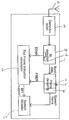
- Figure 1 illustrates a speech demodulator for a radio telephone 1 operating under the GSM protocol.
- the signal is channelled through an antenna 2 to a demodulator 3.
- the demodulator comprises the radio frequency elements and an A/D converter for the baseband or intermediate frequency signal output from the demodulator.
- the digital signal output from the demodulator is provided to the bit detector 4.
- the bit detector 4 comprises an equalizer and detects the burst data which is interleaved and stored for use by the frame decoder 5.
- the bit detector 4 also includes a signal-to-noise ratio estimator 6 which estimates the signal to noise ratio (ESNR) of each burst and provides this information to a 'Bad Frame Indication calculation' module 7.
- ESNR signal to noise ratio
- the receiver uses a Maximum Likelihood Detector (MLSE).
- SNR is calculated from the cumulative metric of the maximum likelihood path and the total input signal power.
- a suitable MLSE detector is described in more detail in Digital Communications (Second Edition) by John G. Proakis (McGraw Hill) incorporated herein by reference.
- the total signal power is equal to S + N and the cumulative metric (assuming the direct form of implementation according to Proakis, formula 6.3.5) is equal to the noise power N.
- the signal to noise ratio can then be calculated as (total power - noise)/noise power .
- Other means for providing an estimated signal-to-noise ratio could, however, be used.
- the burst data is supplied to the frame decoder 5 which includes a convolutional decoder 8 and frame builder 9 for providing speech frames to a speech decoder 10.
- the frame decoder 5 also calculates the estimate for the bit error rate (BER), also called the pseudo-BER (PBER) and supplies this information to the 'Bad Frame Indication calculation' 7.
- BER bit error rate
- PBER pseudo-BER
- the PBER is determined in this instance by re-encoding the channel decoder output and comparing it to the original channel decoder input data. This gives the exact error rate if the error correction is perfect but is almost correct even when averaged over a number of bits. Other ways of estimating the PBER are, however, possible.
- the 'Bad Frame Indication calculation' module contains the means for determining whether a specific speech frame should be ignored based on the ESNR and the PBER supplied from the Bit detector and the Frame decoder respectively.
- a signal BFI support is generated that indicates whether a particular speech frame should be ignored. This is sent to the speech decoder 10 which does not decode those frames that are to be ignored.
- the speech decoder decodes the speech frames given by the frame decoder.
- the decoder checks the parity of the speech frame and the BFI support to determine whether a speech frame is usable. A manner in which this determination can be made is described in detail in the GSM recommendation in series 06 incorporated herein by reference.
- the speech frame is removed if f(ESNR, PBER) > T, where f is a function of variables ESNR and PBER and T is a suitable threshold value.
- f(a,b) (D1 * a) + (D2 * b)
- f(a,b) (D1 * a) + (D2 * b)
- the function is a linear combination of the quality measures which are the estimated number of bit errors in the speech data frame and the signal to noise (interference) ratio measured for each (8) burst over which the speech data is interleaved.
- SNR signal to noise ratio figures
- a digital signal processor may be used to evaluate the function.
- the function could, however, be implemented in the form of a table, whereby the ESNR and PBER are indexes of the table and the values of the function are indexed variables of the table.
- the invention can be implemented using a digital signal processor, an integrated circuit, or an integrated microprocessor.
- the function f and threshold T can be fixed. However, a more flexible decoder is provided by allowing the system to be adaptive. That is, in different regimes, different functions and/or thresholds can be used. For example, when bit errors occur in very short bursts and the signal quality is otherwise fairly good the perceived quality of speech is improved by removing a large number of faulty speech frames.
- the threshold T may, therefore, be lowered if it is observed that the bit errors are tending to occur in very short bursts in a signal of overall relatively high quality. Under different conditions lowering the threshold could merely increase the number of frames removed without significantly improving the perceived speech quality.
- a threshold value calculated from a signal responsive to the ESNR is used to provide a threshold BFI_LIM with which the PBER is compared.
- the BFI_LIM value is basically a constant (C3) tuned according to the above mentioned SNR variance.
- the variance of the values of the ESNR vectors is determined on a burst by burst basis with each vector having eight elements so that the limiting value with which the PBER is compared adapts to the specific environment encountered.
- the BFI_LIM value can then be limited to some fixed range using constants C4 and C5.
- the threshold BFI_LIM obtained is kept within a range of values that correspond to upper and lower permissable limits. If the threshold is too high it is likely that frames that should be removed are not, and if it is too low, frames are not removed that should have been.
- the range of values for BFI_LIM is determined in the following way: C4 ⁇ BFI_LIM ⁇ C5
- the speech frame is removed in the adaptive exemplifying solution, if PBER > BFI_LIM C1, C2, C3, C4 and C5 are constants which are preferably determined by performing simulations.
- the BFI_LIM parameter is used as a threshold value against which the PBER measurement is compared when a frame erasure decision is made. A speech frame is erased if PBER exceeds the calculated threshold value BFI_LIM.
- Constants C1 to C5 are selected to achieve the best speech quality possible.
- One possible way of optimising both the fixed function and the adaptive function mentioned earlier is to run simulations that include the model of the whole receiver chain and cover several different propagation conditions and signal-to-interference ratios. The parameter values can then be changed so that optimum speech quality is achieved.
- a simulated model is preferable because the tests can be accurately reproduced but "real life" tests can also be used while the speech quality is measured.
- the objective measurement should give the minimum number of erased frames versus the number of frames not erased but having bit errors. That is the smallest number of frames should be erased while still minimizing the number of frames containing errors.
- the constants used above are selected so that speech quality is optimized. Generally the BFI process should erase all speech frames whose most important bits are likely to be erroneous. On the other hand as few speech frames as possible should be erased because erasures result in lost speech information. Thus the best compromise between speech frames containing errors that produce audible noise and erased speech frames resulting in lost speech, should be obtained.
- a first step to achieve the BFI requirement is to use the PBER measurement to erase all speech frames that have too many errors (estimated with the PBER measurement) i.e. erasing frames whose pseudo BER exceeds the given threshold value.
- This basic procedure has the drawback that the number of errors, measured using the pseudo BER measurement, does not accurately reflect the number of errors in the bits used by the speech decoder. This is because pseudo BER estimate the number of its errors in the input of the channel codec, and the number of errors at the channel codec output (i.e. the speech decoder input) varies significantly according to signal conditions. If, for example, the propagation conditions are static, the channel codec accepts significantly less errors in the input compared to a fading channel. It is possible to take into account this behaviour in the BFI calculation by adaptively changing the PBER threshold value (BFI_LIM) according to the channel conditions.
- BFI_LIM PBER threshold value
- the PBER limit is determined by modifying the measured SNR_VAR with the parameters C1 and C2 in the manner described ie (SNR_VAR - C1) * C2 .
- the C1 parameter corresponds the SNR_VAR limit that represents a threshold value between static and dynamic channel conditions and the C2 affects the sensitivity of the BFI_LIM value change versus the channel fading strength.
- the adaptive part can be designed using measured behaviour of the SNR_VAR parameter in different channel conditions.
- the following table is an example that has been derived using a simulation model.
- the SNR_VAR value has been measured in different signal to interference ratios and different propagation conditions (the examples of propagation conditions are those that are defined in the GSM specifications).
- a speech frame has 378 bits at the output of the convolutional decoder in the frame decoder which is the reference point for the BFI operation.
- the adaptive PBER measurement ie BFI_LIM
- C1 is typically 0.3 and C2, 20 and C3, 50.
- the method according to the invention is considerably more reliable than previously known methods.
- the quality of speech can be significantly improved using the method and apparatus according to the invention.
- the present invention includes any novel feature or combination of features disclosed herein either explicitly or any generalisation thereof irrespective of whether or not it relates to the claimed invention or mitigates any or all of the problems addressed.
Landscapes
- Engineering & Computer Science (AREA)
- Quality & Reliability (AREA)
- Computer Networks & Wireless Communication (AREA)
- Signal Processing (AREA)
- Mobile Radio Communication Systems (AREA)
- Time-Division Multiplex Systems (AREA)
- Detection And Prevention Of Errors In Transmission (AREA)
- Noise Elimination (AREA)
- Monitoring And Testing Of Transmission In General (AREA)
- Radio Transmission System (AREA)
Applications Claiming Priority (2)
| Application Number | Priority Date | Filing Date | Title |
|---|---|---|---|
| FI934480 | 1993-10-11 | ||
| FI934480A FI94810C (fi) | 1993-10-11 | 1993-10-11 | Menetelmä huonon GSM-puhekehyksen tunnistamiseksi |
Publications (2)
| Publication Number | Publication Date |
|---|---|
| EP0648032A1 true EP0648032A1 (fr) | 1995-04-12 |
| EP0648032B1 EP0648032B1 (fr) | 2002-07-03 |
Family
ID=8538749
Family Applications (1)
| Application Number | Title | Priority Date | Filing Date |
|---|---|---|---|
| EP94202943A Expired - Lifetime EP0648032B1 (fr) | 1993-10-11 | 1994-10-11 | Circuit et méthode de détection de la qualité de signaux pour récepteurs dans le système GSM |
Country Status (6)
| Country | Link |
|---|---|
| US (1) | US5557639A (fr) |
| EP (1) | EP0648032B1 (fr) |
| JP (1) | JP4125386B2 (fr) |
| AT (1) | ATE220268T1 (fr) |
| DE (1) | DE69430894T2 (fr) |
| FI (1) | FI94810C (fr) |
Cited By (18)
| Publication number | Priority date | Publication date | Assignee | Title |
|---|---|---|---|---|
| GB2312359A (en) * | 1996-04-15 | 1997-10-22 | Motorola Inc | Error detector circuit for digital receiver using variable threshold based on signal quality |
| WO1998025383A1 (fr) * | 1996-12-05 | 1998-06-11 | Ericsson Inc. | Procede et dispositif de modulation bidirectionnelle de signaux modules en mode numerique |
| DE19706749C1 (de) * | 1997-02-20 | 1998-08-13 | Siemens Ag | Verfahren und Einrichtung zur Erkennung von Funkblöcken mit Übertragungsfehlern in einem Funk-Kommunikationssystem |
| GB2337904A (en) * | 1998-05-29 | 1999-12-01 | Nec Technologies | Frame erasure for digital data transmission |
| GB2339123A (en) * | 1998-07-03 | 2000-01-12 | Nec Technologies | Frame erasure for digital data transmission systems using an adaptive PBER threshold |
| EP1005242A1 (fr) * | 1998-11-26 | 2000-05-31 | Alcatel | Procédé pour économiser la batterie de téléphones mobiles lors de communications verbales |
| EP0782277A3 (fr) * | 1995-12-27 | 2000-08-16 | Nec Corporation | Circuit d'invalidation de trame de parole pour protection contre des erreurs transitoires de trames TDMA entrelacées |
| GB2348087A (en) * | 1999-03-13 | 2000-09-20 | Nec Technologies | Detection of unreliable frames in digital data transmission systems |
| WO2001076123A1 (fr) * | 2000-04-03 | 2001-10-11 | Nokia Corporation | Evaluation de la qualite des communications |
| EP1187100A1 (fr) * | 2000-09-06 | 2002-03-13 | Koninklijke KPN N.V. | Procédé et dispositif pour l'évaluation objective de la qualité de parole sans signal de référence |
| DE10142846A1 (de) * | 2001-08-29 | 2003-03-20 | Deutsche Telekom Ag | Verfahren zur Korrektur von gemessenen Sprachqualitätswerten |
| GB2381712A (en) * | 2001-10-31 | 2003-05-07 | Ubinetics | Assessing quality of channels in communications systems |
| GB2396083A (en) * | 2002-12-03 | 2004-06-09 | Matsushita Electric Industrial Co Ltd | Frame error detection |
| EP0802636B1 (fr) * | 1996-04-19 | 2004-09-29 | Matsushita Electric Industrial Co., Ltd. | Méthode et dispositif de détection d'erreurs |
| WO2005083943A1 (fr) | 2004-02-20 | 2005-09-09 | Airgo Networks, Inc. | Detection adaptative de paquets permettant de detecter des paquets dans un support sans fil |
| EP1603265A3 (fr) * | 2004-06-02 | 2008-06-25 | Samsung Electronics Co., Ltd. | Dispositif et procédé pour la détection d'une trame de multiplexage par division temporelle dans un système de communication mobile |
| RU2369022C2 (ru) * | 2003-08-28 | 2009-09-27 | Квэлкомм Инкорпорейтед | Указатель плохих кадров в системе мобильной связи gsm |
| CN101188484B (zh) * | 2007-12-14 | 2011-11-02 | 华为技术有限公司 | 检测坏帧的方法和装置 |
Families Citing this family (57)
| Publication number | Priority date | Publication date | Assignee | Title |
|---|---|---|---|---|
| GB2290201B (en) * | 1994-06-09 | 1998-03-04 | Motorola Ltd | Communications system |
| FI944345A7 (fi) * | 1994-09-19 | 1996-03-20 | Nokia Telecommunications Oy | Menetelmä virheellisten puhekehysten tunnistamiseksi puhetta välittävän tietoliikennejärjestelmän vastaanottimessa, sekä tietoliikennejärjestelmän vastaanotin |
| US6334219B1 (en) | 1994-09-26 | 2001-12-25 | Adc Telecommunications Inc. | Channel selection for a hybrid fiber coax network |
| US5706282A (en) * | 1994-11-28 | 1998-01-06 | Lucent Technologies Inc. | Asymmetric speech coding for a digital cellular communications system |
| FI97182C (fi) * | 1994-12-05 | 1996-10-25 | Nokia Telecommunications Oy | Menetelmä vastaanotettujen huonojen puhekehysten korvaamiseksi digitaalisessa vastaanottimessa sekä digitaalisen tietoliikennejärjestelmän vastaanotin |
| US5768291A (en) * | 1994-12-29 | 1998-06-16 | Motorola, Inc. | Method and apparatus for error mitigating a received communication signal |
| USRE42236E1 (en) | 1995-02-06 | 2011-03-22 | Adc Telecommunications, Inc. | Multiuse subcarriers in multipoint-to-point communication using orthogonal frequency division multiplexing |
| US7280564B1 (en) | 1995-02-06 | 2007-10-09 | Adc Telecommunications, Inc. | Synchronization techniques in multipoint-to-point communication using orthgonal frequency division multiplexing |
| FI112895B (fi) * | 1996-02-23 | 2004-01-30 | Nokia Corp | Menetelmä ainakin yhden käyttäjäkohtaisen tunnistetiedon hankkimiseksi |
| US6170073B1 (en) | 1996-03-29 | 2001-01-02 | Nokia Mobile Phones (Uk) Limited | Method and apparatus for error detection in digital communications |
| US5778317A (en) * | 1996-05-13 | 1998-07-07 | Harris Corporation | Method for allocating channels in a radio network using a genetic algorithm |
| JPH09312620A (ja) * | 1996-05-23 | 1997-12-02 | Nec Corp | 音声データ補間処理装置 |
| US5802076A (en) * | 1996-05-24 | 1998-09-01 | National Semiconductor Corporation | Audio error mitigation technique for a TDMA communication system |
| US6101176A (en) * | 1996-07-24 | 2000-08-08 | Nokia Mobile Phones | Method and apparatus for operating an indoor CDMA telecommunications system |
| US7788092B2 (en) * | 1996-09-25 | 2010-08-31 | Qualcomm Incorporated | Method and apparatus for detecting bad data packets received by a mobile telephone using decoded speech parameters |
| US6205130B1 (en) * | 1996-09-25 | 2001-03-20 | Qualcomm Incorporated | Method and apparatus for detecting bad data packets received by a mobile telephone using decoded speech parameters |
| GB2317788B (en) | 1996-09-26 | 2001-08-01 | Nokia Mobile Phones Ltd | Communication device |
| GB2318029B (en) * | 1996-10-01 | 2000-11-08 | Nokia Mobile Phones Ltd | Audio coding method and apparatus |
| US6154499A (en) * | 1996-10-21 | 2000-11-28 | Comsat Corporation | Communication systems using nested coder and compatible channel coding |
| FI116181B (fi) * | 1997-02-07 | 2005-09-30 | Nokia Corp | Virheenkorjausta ja virheentunnistusta hyödyntävä informaationkoodausm enetelmä ja laitteet |
| EP0976216B1 (fr) | 1997-02-27 | 2002-11-27 | Siemens Aktiengesellschaft | Procede et dispositif de detection d'erreurs de trame pour masquage d'erreurs, notamment dans le cas de transmissions gsm |
| JP3198969B2 (ja) * | 1997-03-28 | 2001-08-13 | 日本電気株式会社 | デジタル音声無線伝送システム、デジタル音声無線送信装置およびデジタル音声無線受信再生装置 |
| FI112894B (fi) | 1997-04-10 | 2004-01-30 | Nokia Corp | Menetelmä kehysvirhetodennäköisyyden pienentämiseksi tietokehysmuotoisessa tiedonsiirrossa |
| US6522696B1 (en) * | 1997-04-11 | 2003-02-18 | Agere Systems Inc. | Adaptive frequency correction in a wireless communications system, such as for GSM and IS54 |
| FI102647B1 (fi) * | 1997-04-22 | 1999-01-15 | Nokia Mobile Phones Ltd | Ohjelmoitava vahvistin |
| US6157830A (en) * | 1997-05-22 | 2000-12-05 | Telefonaktiebolaget Lm Ericsson | Speech quality measurement in mobile telecommunication networks based on radio link parameters |
| GB2326308B (en) | 1997-06-06 | 2002-06-26 | Nokia Mobile Phones Ltd | Method and apparatus for controlling time diversity in telephony |
| US6286122B1 (en) * | 1997-07-03 | 2001-09-04 | Nokia Mobile Phones Limited | Method and apparatus for transmitting DTX—low state information from mobile station to base station |
| FI104527B (fi) | 1997-09-17 | 2000-02-15 | Nokia Mobile Phones Ltd | Mukautuva radiolinkki |
| US6389066B1 (en) * | 1997-09-21 | 2002-05-14 | Lucent Technologies Inc. | System and method for adaptive modification of modulated and coded schemes in a communication system |
| US6012025A (en) * | 1998-01-28 | 2000-01-04 | Nokia Mobile Phones Limited | Audio coding method and apparatus using backward adaptive prediction |
| FI108825B (fi) | 1998-03-16 | 2002-03-28 | Nokia Corp | Menetelmä estimoida kanavan bittivirhesuhde ja vastaanotin |
| FI105634B (fi) | 1998-04-30 | 2000-09-15 | Nokia Mobile Phones Ltd | Menetelmä videokuvien siirtämiseksi, tiedonsiirtojärjestelmä ja multimediapäätelaite |
| CN1143470C (zh) * | 1998-05-29 | 2004-03-24 | 西门子公司 | 掩蔽故障的方法和装置 |
| FI981508A7 (fi) | 1998-06-30 | 1999-12-31 | Nokia Corp | Menetelmä, laite ja järjestelmä käyttäjän tilan arvioimiseksi |
| GB9817292D0 (en) | 1998-08-07 | 1998-10-07 | Nokia Mobile Phones Ltd | Digital video coding |
| FI105635B (fi) | 1998-09-01 | 2000-09-15 | Nokia Mobile Phones Ltd | Menetelmä taustakohinainformaation lähettämiseksi tietokehysmuotoisessa tiedonsiirrossa |
| DE19844702C2 (de) * | 1998-09-29 | 2002-11-21 | Siemens Ag | Verfahren, Empfangseinrichtung und Funkstation zur Erkennung eines Nutzdatenblocks mit fehlerhaften Nutzdatensymbolen |
| US6216107B1 (en) * | 1998-10-16 | 2001-04-10 | Ericsson Inc. | High-performance half-rate encoding apparatus and method for a TDM system |
| US6408418B1 (en) * | 1998-10-29 | 2002-06-18 | Lucent Technologies Inc. | Reduced-state device and method for decoding data |
| US6311154B1 (en) | 1998-12-30 | 2001-10-30 | Nokia Mobile Phones Limited | Adaptive windows for analysis-by-synthesis CELP-type speech coding |
| US6330700B1 (en) | 1999-05-18 | 2001-12-11 | Omnipoint Corporation | Out-of-band forward error correction |
| US6314535B1 (en) * | 1999-05-18 | 2001-11-06 | Xircom Wireless, Inc. | Dynamic forward error correction |
| US6775521B1 (en) * | 1999-08-09 | 2004-08-10 | Broadcom Corporation | Bad frame indicator for radio telephone receivers |
| US7167683B2 (en) * | 1999-08-09 | 2007-01-23 | Broadcom Corporation | Bad frame indicator for radio telephone receivers |
| GB2420942B (en) * | 2003-04-22 | 2006-09-27 | Spinvox Ltd | A method of providing voicemails to a mobile telephone |
| ATE352138T1 (de) * | 2004-05-28 | 2007-02-15 | Cit Alcatel | Anpassungsverfahren für ein mehrraten-sprach- codec |
| US7672256B2 (en) * | 2005-08-29 | 2010-03-02 | Interdigital Technology Corporation | Wireless communication method and apparatus for generating a serving grant based on a received relative grant |
| US7434117B1 (en) * | 2005-10-28 | 2008-10-07 | Mediatek Inc. | Method and apparatus of determining bad frame indication for speech service in a wireless communication system |
| EP1946577B1 (fr) * | 2005-11-09 | 2013-01-02 | Telefonaktiebolaget LM Ericsson (publ) | Selection de ressources radio dans un reseau de radiocommunication |
| US8976944B2 (en) * | 2006-02-10 | 2015-03-10 | Nuance Communications, Inc. | Mass-scale, user-independent, device-independent voice messaging system |
| CA2641853C (fr) * | 2006-02-10 | 2016-02-02 | Spinvox Limited | Un systeme de messagerie vocale de masse, independant de l'utilisateur et du dispositif |
| CA2674971C (fr) | 2007-01-09 | 2016-12-06 | Spinvox Limited | Selection d'un lien dans un message recu permettant de dicter une reponse qui est convertie sous forme de texte afin d'etre distribuee |
| US20090041168A1 (en) * | 2007-08-06 | 2009-02-12 | Mediaphy Corporation | Harmonics avoidance |
| US8423852B2 (en) | 2008-04-15 | 2013-04-16 | Qualcomm Incorporated | Channel decoding-based error detection |
| US10365969B2 (en) | 2011-11-01 | 2019-07-30 | International Business Machines Corporation | Multiple wireless communication systems stream slices based on geography |
| US8839368B2 (en) * | 2011-11-01 | 2014-09-16 | Cleversafe, Inc. | Acquiring a trusted set of encoded data slices |
Citations (6)
| Publication number | Priority date | Publication date | Assignee | Title |
|---|---|---|---|---|
| EP0323606A2 (fr) * | 1987-12-22 | 1989-07-12 | SIP SOCIETA ITALIANA PER l'ESERCIZIO DELLE TELECOMUNICAZIONI P.A. | Méthode et dispositif de décodage avec détection d'effacement pour des systèmes de transmission multiniveaux |
| EP0397968A2 (fr) * | 1989-05-15 | 1990-11-22 | Mitsubishi Denki Kabushiki Kaisha | Codeur-décodeur de parole |
| US4991184A (en) * | 1988-12-16 | 1991-02-05 | Nec Corporation | Data communication system having a speed setting variable with transmission quality factors |
| EP0428199A2 (fr) * | 1989-10-25 | 1991-05-22 | Philips Patentverwaltung GmbH | Récepteur pour système de communication numérique comprenant un estimateur de canal |
| WO1992022162A1 (fr) * | 1991-06-03 | 1992-12-10 | British Telecommunications Public Limited Company | Systeme de modulation d'amplitude en quadrature dans lequel la constellation est modifiee en fonction de la qualite du canal |
| US5214687A (en) * | 1991-06-05 | 1993-05-25 | Nokia Mobile Phones Ltd. | Method to determine transmission quality |
Family Cites Families (9)
| Publication number | Priority date | Publication date | Assignee | Title |
|---|---|---|---|---|
| GB8327084D0 (en) * | 1983-10-11 | 1983-11-09 | Gordon J | Error correction decoder apparatus |
| US5375129A (en) * | 1990-07-19 | 1994-12-20 | Technophone Limited | Maximum likelihood sequence detector |
| JP2621614B2 (ja) * | 1990-08-22 | 1997-06-18 | 日本電気株式会社 | 符号誤り検出回路 |
| FI98104C (fi) * | 1991-05-20 | 1997-04-10 | Nokia Mobile Phones Ltd | Menetelmä herätevektorin generoimiseksi ja digitaalinen puhekooderi |
| GB2260244B (en) * | 1991-10-04 | 1995-04-05 | Technophone Ltd | Digital radio receiver |
| FI90477C (fi) * | 1992-03-23 | 1994-02-10 | Nokia Mobile Phones Ltd | Puhesignaalin laadun parannusmenetelmä lineaarista ennustusta käyttävään koodausjärjestelmään |
| US5396653A (en) * | 1992-06-05 | 1995-03-07 | Nokia Mobile Phones Ltd. | Cellular telephone signalling circuit operable with different cellular telephone systems |
| SE470372B (sv) * | 1992-06-23 | 1994-01-31 | Ericsson Telefon Ab L M | Metod jämte anordning att uppskatta kvaliten vid ramfelsdetektering i mottagaren hos ett radiokommunikationssystem |
| FI91579C (fi) * | 1992-08-20 | 1994-07-11 | Nokia Mobile Phones Ltd | Dekoodaus käyttäen lineaarista metriciä ja häiriön estimointia |
-
1993
- 1993-10-11 FI FI934480A patent/FI94810C/fi not_active IP Right Cessation
-
1994
- 1994-10-05 US US08/322,445 patent/US5557639A/en not_active Expired - Lifetime
- 1994-10-11 JP JP24544494A patent/JP4125386B2/ja not_active Expired - Lifetime
- 1994-10-11 DE DE69430894T patent/DE69430894T2/de not_active Expired - Lifetime
- 1994-10-11 EP EP94202943A patent/EP0648032B1/fr not_active Expired - Lifetime
- 1994-10-11 AT AT94202943T patent/ATE220268T1/de active
Patent Citations (6)
| Publication number | Priority date | Publication date | Assignee | Title |
|---|---|---|---|---|
| EP0323606A2 (fr) * | 1987-12-22 | 1989-07-12 | SIP SOCIETA ITALIANA PER l'ESERCIZIO DELLE TELECOMUNICAZIONI P.A. | Méthode et dispositif de décodage avec détection d'effacement pour des systèmes de transmission multiniveaux |
| US4991184A (en) * | 1988-12-16 | 1991-02-05 | Nec Corporation | Data communication system having a speed setting variable with transmission quality factors |
| EP0397968A2 (fr) * | 1989-05-15 | 1990-11-22 | Mitsubishi Denki Kabushiki Kaisha | Codeur-décodeur de parole |
| EP0428199A2 (fr) * | 1989-10-25 | 1991-05-22 | Philips Patentverwaltung GmbH | Récepteur pour système de communication numérique comprenant un estimateur de canal |
| WO1992022162A1 (fr) * | 1991-06-03 | 1992-12-10 | British Telecommunications Public Limited Company | Systeme de modulation d'amplitude en quadrature dans lequel la constellation est modifiee en fonction de la qualite du canal |
| US5214687A (en) * | 1991-06-05 | 1993-05-25 | Nokia Mobile Phones Ltd. | Method to determine transmission quality |
Non-Patent Citations (1)
| Title |
|---|
| N. JAYANT / P. NOLL:: "Digital Coding of waveforms.", 1984, PRENTICE-HALL, ENGLEWOOD CLIFFS, NEW JERSEY, US. * |
Cited By (34)
| Publication number | Priority date | Publication date | Assignee | Title |
|---|---|---|---|---|
| EP0782277A3 (fr) * | 1995-12-27 | 2000-08-16 | Nec Corporation | Circuit d'invalidation de trame de parole pour protection contre des erreurs transitoires de trames TDMA entrelacées |
| FR2748169A1 (fr) * | 1996-04-15 | 1997-10-31 | Motorola Inc | Circuit detecteur d'erreurs pour recepteur numerique utilisant un seuil variable fonde sur la qualite du signal |
| US5815507A (en) * | 1996-04-15 | 1998-09-29 | Motorola, Inc. | Error detector circuit for digital receiver using variable threshold based on signal quality |
| GB2312359A (en) * | 1996-04-15 | 1997-10-22 | Motorola Inc | Error detector circuit for digital receiver using variable threshold based on signal quality |
| CN1091980C (zh) * | 1996-04-15 | 2002-10-02 | 摩托罗拉公司 | 差错检测电路及检测方法 |
| GB2312359B (en) * | 1996-04-15 | 2000-07-12 | Motorola Inc | Error detector circuit for digital receiver using variable threshold based on signal quality |
| EP0802636B1 (fr) * | 1996-04-19 | 2004-09-29 | Matsushita Electric Industrial Co., Ltd. | Méthode et dispositif de détection d'erreurs |
| WO1998025383A1 (fr) * | 1996-12-05 | 1998-06-11 | Ericsson Inc. | Procede et dispositif de modulation bidirectionnelle de signaux modules en mode numerique |
| US5909465A (en) * | 1996-12-05 | 1999-06-01 | Ericsson Inc. | Method and apparatus for bidirectional demodulation of digitally modulated signals |
| DE19706749C1 (de) * | 1997-02-20 | 1998-08-13 | Siemens Ag | Verfahren und Einrichtung zur Erkennung von Funkblöcken mit Übertragungsfehlern in einem Funk-Kommunikationssystem |
| GB2337904B (en) * | 1998-05-29 | 2003-03-12 | Nec Technologies | Frame erasure for digital data transmision systems |
| GB2337904A (en) * | 1998-05-29 | 1999-12-01 | Nec Technologies | Frame erasure for digital data transmission |
| GB2339123B (en) * | 1998-07-03 | 2003-03-26 | Nec Technologies | Frame erasure for digital transmission systems |
| GB2339123A (en) * | 1998-07-03 | 2000-01-12 | Nec Technologies | Frame erasure for digital data transmission systems using an adaptive PBER threshold |
| EP1005242A1 (fr) * | 1998-11-26 | 2000-05-31 | Alcatel | Procédé pour économiser la batterie de téléphones mobiles lors de communications verbales |
| GB2348087B (en) * | 1999-03-13 | 2003-08-13 | Nec Technologies | Detection of unreliable frames in digital data transmission systems |
| GB2348087A (en) * | 1999-03-13 | 2000-09-20 | Nec Technologies | Detection of unreliable frames in digital data transmission systems |
| US6637006B1 (en) | 1999-03-13 | 2003-10-21 | Nec Corporation | Digital data decoder with improved unreliable frame detection performance |
| CN101321048B (zh) * | 2000-04-03 | 2011-04-13 | 诺基亚公司 | 估计通信质量 |
| US7177593B2 (en) | 2000-04-03 | 2007-02-13 | Nokia Corporation | Estimating communication quality |
| WO2001076123A1 (fr) * | 2000-04-03 | 2001-10-11 | Nokia Corporation | Evaluation de la qualite des communications |
| US7024352B2 (en) | 2000-09-06 | 2006-04-04 | Koninklijke Kpn N.V. | Method and device for objective speech quality assessment without reference signal |
| EP1187100A1 (fr) * | 2000-09-06 | 2002-03-13 | Koninklijke KPN N.V. | Procédé et dispositif pour l'évaluation objective de la qualité de parole sans signal de référence |
| WO2002021514A1 (fr) * | 2000-09-06 | 2002-03-14 | Koninklijke Kpn N.V. | Procede et dispositif d'evaluation objective de la qualite vocale sans signal de reference |
| DE10142846A1 (de) * | 2001-08-29 | 2003-03-20 | Deutsche Telekom Ag | Verfahren zur Korrektur von gemessenen Sprachqualitätswerten |
| WO2003039058A3 (fr) * | 2001-10-31 | 2003-07-03 | Ubinetics Ltd | Evaluation de voies dans des systemes de communication |
| GB2381712A (en) * | 2001-10-31 | 2003-05-07 | Ubinetics | Assessing quality of channels in communications systems |
| GB2396083A (en) * | 2002-12-03 | 2004-06-09 | Matsushita Electric Industrial Co Ltd | Frame error detection |
| RU2369022C2 (ru) * | 2003-08-28 | 2009-09-27 | Квэлкомм Инкорпорейтед | Указатель плохих кадров в системе мобильной связи gsm |
| WO2005083943A1 (fr) | 2004-02-20 | 2005-09-09 | Airgo Networks, Inc. | Detection adaptative de paquets permettant de detecter des paquets dans un support sans fil |
| JP2007523573A (ja) * | 2004-02-20 | 2007-08-16 | クアルコム インコーポレイテッド | 無線媒体中のパケットを検出する適応パケット検出 |
| US7466667B2 (en) | 2004-02-20 | 2008-12-16 | Qualcomm Incorporated | Adaptive packet detection for detecting packets in a wireless medium |
| EP1603265A3 (fr) * | 2004-06-02 | 2008-06-25 | Samsung Electronics Co., Ltd. | Dispositif et procédé pour la détection d'une trame de multiplexage par division temporelle dans un système de communication mobile |
| CN101188484B (zh) * | 2007-12-14 | 2011-11-02 | 华为技术有限公司 | 检测坏帧的方法和装置 |
Also Published As
| Publication number | Publication date |
|---|---|
| DE69430894T2 (de) | 2003-02-20 |
| DE69430894D1 (de) | 2002-08-08 |
| FI94810B (fi) | 1995-07-14 |
| US5557639A (en) | 1996-09-17 |
| JP4125386B2 (ja) | 2008-07-30 |
| ATE220268T1 (de) | 2002-07-15 |
| EP0648032B1 (fr) | 2002-07-03 |
| FI94810C (fi) | 1995-10-25 |
| FI934480A0 (fi) | 1993-10-11 |
| FI934480L (fi) | 1995-04-12 |
| JPH07162362A (ja) | 1995-06-23 |
Similar Documents
| Publication | Publication Date | Title |
|---|---|---|
| US5557639A (en) | Enhanced decoder for a radio telephone | |
| RU2130693C1 (ru) | Способ повышения качества текущего речевого кадра в радиосистеме многостанционного доступа с временным разделением каналов и система для осуществления способа | |
| US8532232B2 (en) | Estimating bit error probability (BEP) in an edge wireless system | |
| CA2290821C (fr) | Mesure de la qualite phonique dans les reseaux de telecommunications mobiles sur la base de parametres de liaison radio | |
| KR100487267B1 (ko) | 가변 레이트 데이터를 디코딩하는 방법 및 장치 | |
| US7496804B2 (en) | Communications system, receiver, and method of estimating received signal quality by using bit error rate | |
| US7028232B2 (en) | Error estimation method and apparatus | |
| US7453959B2 (en) | Apparatus and method for erasure detection and soft-decision decoding in cellular system receiver | |
| JPH06508253A (ja) | エラー検出システム | |
| US7107013B2 (en) | Cooperative link characterization and MCS selection by wireless terminal and network for improved system performance | |
| US7907907B2 (en) | Cooperative link characterization and MCS selection by wireless terminal and network for improved system performance | |
| RU2141167C1 (ru) | Устройство для измерения коэффициента ошибок в битах с помощью декодера витерби | |
| KR100270418B1 (ko) | 디지탈수신기에잡음을발생하기위한장치및방법 | |
| US6263030B1 (en) | Equalizer with channel tracker switching | |
| US6714896B1 (en) | Method and apparatus for signal degradation measurement | |
| EP0983655B1 (fr) | Procede de detection de bits dans un systeme de radiocommunication | |
| AU757909B2 (en) | Frame erasure for digital data transmission systems | |
| US20040071231A1 (en) | Receiver signal dynamic range compensation based on received signal strength indicator | |
| US7245878B2 (en) | Method and apparatus for silent frame detection in a GSM communications system | |
| US20020172302A1 (en) | Compensation based bit-error-rate estimation for convolutionally encoded transmissions in wireless systems | |
| US20060194602A1 (en) | Power control based on estimates of cumulative received energy | |
| WO2003039058A2 (fr) | Evaluation de voies dans des systemes de communication | |
| KR20010071514A (ko) | 버스트에 간섭이 발생하기 쉬운 전송 채널을 경유한디지털 데이터 전송 방법 | |
| JP2004282284A (ja) | 送信電力制御方法、無線通信システム及び無線通信装置 |
Legal Events
| Date | Code | Title | Description |
|---|---|---|---|
| PUAI | Public reference made under article 153(3) epc to a published international application that has entered the european phase |
Free format text: ORIGINAL CODE: 0009012 |
|
| AK | Designated contracting states |
Kind code of ref document: A1 Designated state(s): AT DE FR GB IT SE |
|
| 17P | Request for examination filed |
Effective date: 19951012 |
|
| RIN1 | Information on inventor provided before grant (corrected) |
Inventor name: RANTA, JUKKA Inventor name: JOKINEN, HARRI Inventor name: HEIKKILA, ILKKA |
|
| 17Q | First examination report despatched |
Effective date: 19991210 |
|
| GRAG | Despatch of communication of intention to grant |
Free format text: ORIGINAL CODE: EPIDOS AGRA |
|
| GRAG | Despatch of communication of intention to grant |
Free format text: ORIGINAL CODE: EPIDOS AGRA |
|
| GRAH | Despatch of communication of intention to grant a patent |
Free format text: ORIGINAL CODE: EPIDOS IGRA |
|
| RAP1 | Party data changed (applicant data changed or rights of an application transferred) |
Owner name: NOKIA CORPORATION |
|
| GRAH | Despatch of communication of intention to grant a patent |
Free format text: ORIGINAL CODE: EPIDOS IGRA |
|
| GRAA | (expected) grant |
Free format text: ORIGINAL CODE: 0009210 |
|
| AK | Designated contracting states |
Kind code of ref document: B1 Designated state(s): AT DE FR GB IT SE |
|
| REF | Corresponds to: |
Ref document number: 220268 Country of ref document: AT Date of ref document: 20020715 Kind code of ref document: T |
|
| REF | Corresponds to: |
Ref document number: 69430894 Country of ref document: DE Date of ref document: 20020808 |
|
| ET | Fr: translation filed | ||
| PLBE | No opposition filed within time limit |
Free format text: ORIGINAL CODE: 0009261 |
|
| STAA | Information on the status of an ep patent application or granted ep patent |
Free format text: STATUS: NO OPPOSITION FILED WITHIN TIME LIMIT |
|
| 26N | No opposition filed |
Effective date: 20030404 |
|
| PGFP | Annual fee paid to national office [announced via postgrant information from national office to epo] |
Ref country code: SE Payment date: 20131011 Year of fee payment: 20 Ref country code: GB Payment date: 20131009 Year of fee payment: 20 Ref country code: DE Payment date: 20131009 Year of fee payment: 20 Ref country code: AT Payment date: 20130926 Year of fee payment: 20 Ref country code: FR Payment date: 20131009 Year of fee payment: 20 |
|
| PGFP | Annual fee paid to national office [announced via postgrant information from national office to epo] |
Ref country code: IT Payment date: 20131015 Year of fee payment: 20 |
|
| REG | Reference to a national code |
Ref country code: DE Ref legal event code: R071 Ref document number: 69430894 Country of ref document: DE |
|
| REG | Reference to a national code |
Ref country code: GB Ref legal event code: PE20 Expiry date: 20141010 |
|
| REG | Reference to a national code |
Ref country code: AT Ref legal event code: MK07 Ref document number: 220268 Country of ref document: AT Kind code of ref document: T Effective date: 20141011 |
|
| REG | Reference to a national code |
Ref country code: SE Ref legal event code: EUG |
|
| PG25 | Lapsed in a contracting state [announced via postgrant information from national office to epo] |
Ref country code: GB Free format text: LAPSE BECAUSE OF EXPIRATION OF PROTECTION Effective date: 20141010 |