EP0648600A2 - Récipient laminé formé par emboutissage, résistant aux chocs et ayant un excellente rétention d'arôme - Google Patents
Récipient laminé formé par emboutissage, résistant aux chocs et ayant un excellente rétention d'arôme Download PDFInfo
- Publication number
- EP0648600A2 EP0648600A2 EP94307428A EP94307428A EP0648600A2 EP 0648600 A2 EP0648600 A2 EP 0648600A2 EP 94307428 A EP94307428 A EP 94307428A EP 94307428 A EP94307428 A EP 94307428A EP 0648600 A2 EP0648600 A2 EP 0648600A2
- Authority
- EP
- European Patent Office
- Prior art keywords
- copolymerized polyester
- draw
- film
- layer
- acid
- Prior art date
- Legal status (The legal status is an assumption and is not a legal conclusion. Google has not performed a legal analysis and makes no representation as to the accuracy of the status listed.)
- Granted
Links
- 230000035939 shock Effects 0.000 title description 11
- 229920000728 polyester Polymers 0.000 claims abstract description 121
- 239000010410 layer Substances 0.000 claims abstract description 95
- QQVIHTHCMHWDBS-UHFFFAOYSA-N isophthalic acid Chemical compound OC(=O)C1=CC=CC(C(O)=O)=C1 QQVIHTHCMHWDBS-UHFFFAOYSA-N 0.000 claims abstract description 90
- KKEYFWRCBNTPAC-UHFFFAOYSA-N Terephthalic acid Chemical compound OC(=O)C1=CC=C(C(O)=O)C=C1 KKEYFWRCBNTPAC-UHFFFAOYSA-N 0.000 claims abstract description 62
- 229910052751 metal Inorganic materials 0.000 claims abstract description 61
- 239000002184 metal Substances 0.000 claims abstract description 61
- 239000002344 surface layer Substances 0.000 claims abstract description 38
- 229920005989 resin Polymers 0.000 claims abstract description 25
- 239000011347 resin Substances 0.000 claims abstract description 25
- 239000002253 acid Substances 0.000 claims abstract description 24
- 150000002009 diols Chemical class 0.000 claims abstract description 21
- 238000000034 method Methods 0.000 claims abstract description 19
- 239000002648 laminated material Substances 0.000 claims abstract description 7
- LYCAIKOWRPUZTN-UHFFFAOYSA-N Ethylene glycol Chemical compound OCCO LYCAIKOWRPUZTN-UHFFFAOYSA-N 0.000 claims description 61
- 238000002844 melting Methods 0.000 claims description 17
- 230000008018 melting Effects 0.000 claims description 17
- 230000009477 glass transition Effects 0.000 claims description 7
- 239000000796 flavoring agent Substances 0.000 abstract description 30
- 235000019634 flavors Nutrition 0.000 abstract description 28
- 230000007797 corrosion Effects 0.000 abstract description 6
- 238000005260 corrosion Methods 0.000 abstract description 6
- 238000001179 sorption measurement Methods 0.000 abstract description 6
- 238000010828 elution Methods 0.000 abstract description 5
- 229920006267 polyester film Polymers 0.000 description 15
- 238000009740 moulding (composite fabrication) Methods 0.000 description 14
- 239000000203 mixture Substances 0.000 description 12
- 239000003973 paint Substances 0.000 description 12
- 238000010438 heat treatment Methods 0.000 description 11
- 239000002131 composite material Substances 0.000 description 10
- 238000012360 testing method Methods 0.000 description 9
- 229910000831 Steel Inorganic materials 0.000 description 8
- 239000010959 steel Substances 0.000 description 8
- 239000000853 adhesive Substances 0.000 description 7
- 230000001070 adhesive effect Effects 0.000 description 7
- 229910052782 aluminium Inorganic materials 0.000 description 7
- XAGFODPZIPBFFR-UHFFFAOYSA-N aluminium Chemical compound [Al] XAGFODPZIPBFFR-UHFFFAOYSA-N 0.000 description 7
- 230000004888 barrier function Effects 0.000 description 7
- 230000007423 decrease Effects 0.000 description 7
- VYZAMTAEIAYCRO-UHFFFAOYSA-N Chromium Chemical compound [Cr] VYZAMTAEIAYCRO-UHFFFAOYSA-N 0.000 description 6
- 238000002441 X-ray diffraction Methods 0.000 description 6
- WERYXYBDKMZEQL-UHFFFAOYSA-N butane-1,4-diol Chemical compound OCCCCO WERYXYBDKMZEQL-UHFFFAOYSA-N 0.000 description 6
- 229910052804 chromium Inorganic materials 0.000 description 6
- 239000011651 chromium Substances 0.000 description 6
- 239000011248 coating agent Substances 0.000 description 6
- 238000000576 coating method Methods 0.000 description 6
- 238000011156 evaluation Methods 0.000 description 6
- 229920000139 polyethylene terephthalate Polymers 0.000 description 6
- 239000005020 polyethylene terephthalate Substances 0.000 description 6
- 239000002904 solvent Substances 0.000 description 6
- -1 acryl Chemical group 0.000 description 5
- 238000003475 lamination Methods 0.000 description 5
- 239000000463 material Substances 0.000 description 5
- QPFMBZIOSGYJDE-UHFFFAOYSA-N 1,1,2,2-tetrachloroethane Chemical compound ClC(Cl)C(Cl)Cl QPFMBZIOSGYJDE-UHFFFAOYSA-N 0.000 description 4
- ISWSIDIOOBJBQZ-UHFFFAOYSA-N Phenol Chemical compound OC1=CC=CC=C1 ISWSIDIOOBJBQZ-UHFFFAOYSA-N 0.000 description 4
- NBIIXXVUZAFLBC-UHFFFAOYSA-N Phosphoric acid Chemical compound OP(O)(O)=O NBIIXXVUZAFLBC-UHFFFAOYSA-N 0.000 description 4
- 125000001931 aliphatic group Chemical group 0.000 description 4
- KRVSOGSZCMJSLX-UHFFFAOYSA-L chromic acid Substances O[Cr](O)(=O)=O KRVSOGSZCMJSLX-UHFFFAOYSA-L 0.000 description 4
- 230000000052 comparative effect Effects 0.000 description 4
- 239000003822 epoxy resin Substances 0.000 description 4
- 230000002349 favourable effect Effects 0.000 description 4
- AWJWCTOOIBYHON-UHFFFAOYSA-N furo[3,4-b]pyrazine-5,7-dione Chemical compound C1=CN=C2C(=O)OC(=O)C2=N1 AWJWCTOOIBYHON-UHFFFAOYSA-N 0.000 description 4
- 229920000647 polyepoxide Polymers 0.000 description 4
- 229920001187 thermosetting polymer Polymers 0.000 description 4
- 229920001634 Copolyester Polymers 0.000 description 3
- WSFSSNUMVMOOMR-UHFFFAOYSA-N Formaldehyde Chemical compound O=C WSFSSNUMVMOOMR-UHFFFAOYSA-N 0.000 description 3
- DNIAPMSPPWPWGF-UHFFFAOYSA-N Propylene glycol Chemical compound CC(O)CO DNIAPMSPPWPWGF-UHFFFAOYSA-N 0.000 description 3
- GWEVSGVZZGPLCZ-UHFFFAOYSA-N Titan oxide Chemical compound O=[Ti]=O GWEVSGVZZGPLCZ-UHFFFAOYSA-N 0.000 description 3
- IISBACLAFKSPIT-UHFFFAOYSA-N bisphenol A Chemical compound C=1C=C(O)C=CC=1C(C)(C)C1=CC=C(O)C=C1 IISBACLAFKSPIT-UHFFFAOYSA-N 0.000 description 3
- ZCDOYSPFYFSLEW-UHFFFAOYSA-N chromate(2-) Chemical compound [O-][Cr]([O-])(=O)=O ZCDOYSPFYFSLEW-UHFFFAOYSA-N 0.000 description 3
- 239000013078 crystal Substances 0.000 description 3
- 238000002425 crystallisation Methods 0.000 description 3
- 230000008025 crystallization Effects 0.000 description 3
- 238000010586 diagram Methods 0.000 description 3
- MTHSVFCYNBDYFN-UHFFFAOYSA-N diethylene glycol Chemical compound OCCOCCO MTHSVFCYNBDYFN-UHFFFAOYSA-N 0.000 description 3
- 230000002708 enhancing effect Effects 0.000 description 3
- 238000010409 ironing Methods 0.000 description 3
- 238000007747 plating Methods 0.000 description 3
- 229920001707 polybutylene terephthalate Polymers 0.000 description 3
- 239000005029 tin-free steel Substances 0.000 description 3
- 239000005028 tinplate Substances 0.000 description 3
- 238000011282 treatment Methods 0.000 description 3
- PXGZQGDTEZPERC-UHFFFAOYSA-N 1,4-cyclohexanedicarboxylic acid Chemical compound OC(=O)C1CCC(C(O)=O)CC1 PXGZQGDTEZPERC-UHFFFAOYSA-N 0.000 description 2
- 229910000838 Al alloy Inorganic materials 0.000 description 2
- PAYRUJLWNCNPSJ-UHFFFAOYSA-N Aniline Chemical compound NC1=CC=CC=C1 PAYRUJLWNCNPSJ-UHFFFAOYSA-N 0.000 description 2
- IJGRMHOSHXDMSA-UHFFFAOYSA-N Atomic nitrogen Chemical compound N#N IJGRMHOSHXDMSA-UHFFFAOYSA-N 0.000 description 2
- 239000004593 Epoxy Substances 0.000 description 2
- VEXZGXHMUGYJMC-UHFFFAOYSA-N Hydrochloric acid Chemical compound Cl VEXZGXHMUGYJMC-UHFFFAOYSA-N 0.000 description 2
- PXHVJJICTQNCMI-UHFFFAOYSA-N Nickel Chemical compound [Ni] PXHVJJICTQNCMI-UHFFFAOYSA-N 0.000 description 2
- ATJFFYVFTNAWJD-UHFFFAOYSA-N Tin Chemical compound [Sn] ATJFFYVFTNAWJD-UHFFFAOYSA-N 0.000 description 2
- HCHKCACWOHOZIP-UHFFFAOYSA-N Zinc Chemical compound [Zn] HCHKCACWOHOZIP-UHFFFAOYSA-N 0.000 description 2
- 230000009471 action Effects 0.000 description 2
- WNLRTRBMVRJNCN-UHFFFAOYSA-N adipic acid Chemical compound OC(=O)CCCCC(O)=O WNLRTRBMVRJNCN-UHFFFAOYSA-N 0.000 description 2
- 229910000147 aluminium phosphate Inorganic materials 0.000 description 2
- 239000003795 chemical substances by application Substances 0.000 description 2
- 150000001875 compounds Chemical class 0.000 description 2
- 238000009826 distribution Methods 0.000 description 2
- 230000000694 effects Effects 0.000 description 2
- WGCNASOHLSPBMP-UHFFFAOYSA-N hydroxyacetaldehyde Natural products OCC=O WGCNASOHLSPBMP-UHFFFAOYSA-N 0.000 description 2
- 238000010030 laminating Methods 0.000 description 2
- 239000004033 plastic Substances 0.000 description 2
- 229920003023 plastic Polymers 0.000 description 2
- 229920001225 polyester resin Polymers 0.000 description 2
- 239000004645 polyester resin Substances 0.000 description 2
- CXMXRPHRNRROMY-UHFFFAOYSA-N sebacic acid Chemical compound OC(=O)CCCCCCCCC(O)=O CXMXRPHRNRROMY-UHFFFAOYSA-N 0.000 description 2
- 239000002356 single layer Substances 0.000 description 2
- 238000004381 surface treatment Methods 0.000 description 2
- 229920005992 thermoplastic resin Polymers 0.000 description 2
- 235000010215 titanium dioxide Nutrition 0.000 description 2
- 125000000391 vinyl group Chemical group [H]C([*])=C([H])[H] 0.000 description 2
- 229920002554 vinyl polymer Polymers 0.000 description 2
- XLYOFNOQVPJJNP-UHFFFAOYSA-N water Substances O XLYOFNOQVPJJNP-UHFFFAOYSA-N 0.000 description 2
- 239000011701 zinc Substances 0.000 description 2
- 229910052725 zinc Inorganic materials 0.000 description 2
- VZXTWGWHSMCWGA-UHFFFAOYSA-N 1,3,5-triazine-2,4-diamine Chemical compound NC1=NC=NC(N)=N1 VZXTWGWHSMCWGA-UHFFFAOYSA-N 0.000 description 1
- XQUPVDVFXZDTLT-UHFFFAOYSA-N 1-[4-[[4-(2,5-dioxopyrrol-1-yl)phenyl]methyl]phenyl]pyrrole-2,5-dione Chemical compound O=C1C=CC(=O)N1C(C=C1)=CC=C1CC1=CC=C(N2C(C=CC2=O)=O)C=C1 XQUPVDVFXZDTLT-UHFFFAOYSA-N 0.000 description 1
- MMINFSMURORWKH-UHFFFAOYSA-N 3,6-dioxabicyclo[6.2.2]dodeca-1(10),8,11-triene-2,7-dione Chemical group O=C1OCCOC(=O)C2=CC=C1C=C2 MMINFSMURORWKH-UHFFFAOYSA-N 0.000 description 1
- 239000004925 Acrylic resin Substances 0.000 description 1
- 229920000178 Acrylic resin Polymers 0.000 description 1
- 229930185605 Bisphenol Natural products 0.000 description 1
- RYGMFSIKBFXOCR-UHFFFAOYSA-N Copper Chemical compound [Cu] RYGMFSIKBFXOCR-UHFFFAOYSA-N 0.000 description 1
- IAYPIBMASNFSPL-UHFFFAOYSA-N Ethylene oxide Chemical compound C1CO1 IAYPIBMASNFSPL-UHFFFAOYSA-N 0.000 description 1
- YLQBMQCUIZJEEH-UHFFFAOYSA-N Furan Chemical compound C=1C=COC=1 YLQBMQCUIZJEEH-UHFFFAOYSA-N 0.000 description 1
- FYYHWMGAXLPEAU-UHFFFAOYSA-N Magnesium Chemical compound [Mg] FYYHWMGAXLPEAU-UHFFFAOYSA-N 0.000 description 1
- 229920000877 Melamine resin Polymers 0.000 description 1
- 239000004640 Melamine resin Substances 0.000 description 1
- VYPSYNLAJGMNEJ-UHFFFAOYSA-N Silicium dioxide Chemical compound O=[Si]=O VYPSYNLAJGMNEJ-UHFFFAOYSA-N 0.000 description 1
- WGLPBDUCMAPZCE-UHFFFAOYSA-N Trioxochromium Chemical compound O=[Cr](=O)=O WGLPBDUCMAPZCE-UHFFFAOYSA-N 0.000 description 1
- 229920001807 Urea-formaldehyde Polymers 0.000 description 1
- NIXOWILDQLNWCW-UHFFFAOYSA-N acrylic acid group Chemical group C(C=C)(=O)O NIXOWILDQLNWCW-UHFFFAOYSA-N 0.000 description 1
- 239000012790 adhesive layer Substances 0.000 description 1
- 239000001361 adipic acid Substances 0.000 description 1
- 235000011037 adipic acid Nutrition 0.000 description 1
- 229920000180 alkyd Polymers 0.000 description 1
- 239000002216 antistatic agent Substances 0.000 description 1
- 238000007664 blowing Methods 0.000 description 1
- 125000004432 carbon atom Chemical group C* 0.000 description 1
- 230000008859 change Effects 0.000 description 1
- 229910000423 chromium oxide Inorganic materials 0.000 description 1
- 239000010960 cold rolled steel Substances 0.000 description 1
- 238000005097 cold rolling Methods 0.000 description 1
- 238000001816 cooling Methods 0.000 description 1
- 229920001577 copolymer Polymers 0.000 description 1
- 229910052802 copper Inorganic materials 0.000 description 1
- 239000010949 copper Substances 0.000 description 1
- VEIOBOXBGYWJIT-UHFFFAOYSA-N cyclohexane;methanol Chemical compound OC.OC.C1CCCCC1 VEIOBOXBGYWJIT-UHFFFAOYSA-N 0.000 description 1
- 230000003247 decreasing effect Effects 0.000 description 1
- 230000007547 defect Effects 0.000 description 1
- 150000002148 esters Chemical group 0.000 description 1
- 230000001747 exhibiting effect Effects 0.000 description 1
- OIAUFEASXQPCFE-UHFFFAOYSA-N formaldehyde;1,3-xylene Chemical compound O=C.CC1=CC=CC(C)=C1 OIAUFEASXQPCFE-UHFFFAOYSA-N 0.000 description 1
- XXMIOPMDWAUFGU-UHFFFAOYSA-N hexane-1,6-diol Chemical compound OCCCCCCO XXMIOPMDWAUFGU-UHFFFAOYSA-N 0.000 description 1
- 230000006698 induction Effects 0.000 description 1
- QQVIHTHCMHWDBS-UHFFFAOYSA-L isophthalate(2-) Chemical compound [O-]C(=O)C1=CC=CC(C([O-])=O)=C1 QQVIHTHCMHWDBS-UHFFFAOYSA-L 0.000 description 1
- 150000002576 ketones Chemical class 0.000 description 1
- 239000000314 lubricant Substances 0.000 description 1
- 229910052749 magnesium Inorganic materials 0.000 description 1
- 239000011777 magnesium Substances 0.000 description 1
- WPBNNNQJVZRUHP-UHFFFAOYSA-L manganese(2+);methyl n-[[2-(methoxycarbonylcarbamothioylamino)phenyl]carbamothioyl]carbamate;n-[2-(sulfidocarbothioylamino)ethyl]carbamodithioate Chemical compound [Mn+2].[S-]C(=S)NCCNC([S-])=S.COC(=O)NC(=S)NC1=CC=CC=C1NC(=S)NC(=O)OC WPBNNNQJVZRUHP-UHFFFAOYSA-L 0.000 description 1
- WSFSSNUMVMOOMR-NJFSPNSNSA-N methanone Chemical compound O=[14CH2] WSFSSNUMVMOOMR-NJFSPNSNSA-N 0.000 description 1
- 230000005012 migration Effects 0.000 description 1
- 238000013508 migration Methods 0.000 description 1
- 238000002156 mixing Methods 0.000 description 1
- RCHKEJKUUXXBSM-UHFFFAOYSA-N n-benzyl-2-(3-formylindol-1-yl)acetamide Chemical compound C12=CC=CC=C2C(C=O)=CN1CC(=O)NCC1=CC=CC=C1 RCHKEJKUUXXBSM-UHFFFAOYSA-N 0.000 description 1
- RXOHFPCZGPKIRD-UHFFFAOYSA-N naphthalene-2,6-dicarboxylic acid Chemical compound C1=C(C(O)=O)C=CC2=CC(C(=O)O)=CC=C21 RXOHFPCZGPKIRD-UHFFFAOYSA-N 0.000 description 1
- SLCVBVWXLSEKPL-UHFFFAOYSA-N neopentyl glycol Chemical compound OCC(C)(C)CO SLCVBVWXLSEKPL-UHFFFAOYSA-N 0.000 description 1
- 229910052759 nickel Inorganic materials 0.000 description 1
- 229910052757 nitrogen Inorganic materials 0.000 description 1
- 239000005012 oleoresinous Substances 0.000 description 1
- 239000011368 organic material Substances 0.000 description 1
- 230000002093 peripheral effect Effects 0.000 description 1
- 239000005011 phenolic resin Substances 0.000 description 1
- 150000002989 phenols Chemical class 0.000 description 1
- 239000000049 pigment Substances 0.000 description 1
- 239000002985 plastic film Substances 0.000 description 1
- 229920006255 plastic film Polymers 0.000 description 1
- 230000010287 polarization Effects 0.000 description 1
- 229920003192 poly(bis maleimide) Polymers 0.000 description 1
- 229920006324 polyoxymethylene Polymers 0.000 description 1
- 235000013824 polyphenols Nutrition 0.000 description 1
- 238000002360 preparation method Methods 0.000 description 1
- 238000004321 preservation Methods 0.000 description 1
- 238000010791 quenching Methods 0.000 description 1
- 230000000171 quenching effect Effects 0.000 description 1
- 238000005070 sampling Methods 0.000 description 1
- 229920006395 saturated elastomer Polymers 0.000 description 1
- 238000005496 tempering Methods 0.000 description 1
- KKEYFWRCBNTPAC-UHFFFAOYSA-L terephthalate(2-) Chemical compound [O-]C(=O)C1=CC=C(C([O-])=O)C=C1 KKEYFWRCBNTPAC-UHFFFAOYSA-L 0.000 description 1
- 229920002803 thermoplastic polyurethane Polymers 0.000 description 1
- 239000004408 titanium dioxide Substances 0.000 description 1
- ZIBGPFATKBEMQZ-UHFFFAOYSA-N triethylene glycol Chemical compound OCCOCCOCCO ZIBGPFATKBEMQZ-UHFFFAOYSA-N 0.000 description 1
- 229920006337 unsaturated polyester resin Polymers 0.000 description 1
- 229940099259 vaseline Drugs 0.000 description 1
Images

Classifications
-
- B—PERFORMING OPERATIONS; TRANSPORTING
- B32—LAYERED PRODUCTS
- B32B—LAYERED PRODUCTS, i.e. PRODUCTS BUILT-UP OF STRATA OF FLAT OR NON-FLAT, e.g. CELLULAR OR HONEYCOMB, FORM
- B32B15/00—Layered products comprising a layer of metal
- B32B15/04—Layered products comprising a layer of metal comprising metal as the main or only constituent of a layer, which is next to another layer of the same or of a different material
- B32B15/08—Layered products comprising a layer of metal comprising metal as the main or only constituent of a layer, which is next to another layer of the same or of a different material of synthetic resin
- B32B15/09—Layered products comprising a layer of metal comprising metal as the main or only constituent of a layer, which is next to another layer of the same or of a different material of synthetic resin comprising polyesters
-
- B—PERFORMING OPERATIONS; TRANSPORTING
- B32—LAYERED PRODUCTS
- B32B—LAYERED PRODUCTS, i.e. PRODUCTS BUILT-UP OF STRATA OF FLAT OR NON-FLAT, e.g. CELLULAR OR HONEYCOMB, FORM
- B32B7/00—Layered products characterised by the relation between layers; Layered products characterised by the relative orientation of features between layers, or by the relative values of a measurable parameter between layers, i.e. products comprising layers having different physical, chemical or physicochemical properties; Layered products characterised by the interconnection of layers
- B32B7/02—Physical, chemical or physicochemical properties
- B32B7/027—Thermal properties
-
- B—PERFORMING OPERATIONS; TRANSPORTING
- B21—MECHANICAL METAL-WORKING WITHOUT ESSENTIALLY REMOVING MATERIAL; PUNCHING METAL
- B21D—WORKING OR PROCESSING OF SHEET METAL OR METAL TUBES, RODS OR PROFILES WITHOUT ESSENTIALLY REMOVING MATERIAL; PUNCHING METAL
- B21D22/00—Shaping without cutting, by stamping, spinning, or deep-drawing
- B21D22/20—Deep-drawing
- B21D22/28—Deep-drawing of cylindrical articles using consecutive dies
-
- B—PERFORMING OPERATIONS; TRANSPORTING
- B21—MECHANICAL METAL-WORKING WITHOUT ESSENTIALLY REMOVING MATERIAL; PUNCHING METAL
- B21D—WORKING OR PROCESSING OF SHEET METAL OR METAL TUBES, RODS OR PROFILES WITHOUT ESSENTIALLY REMOVING MATERIAL; PUNCHING METAL
- B21D51/00—Making hollow objects
- B21D51/16—Making hollow objects characterised by the use of the objects
- B21D51/26—Making hollow objects characterised by the use of the objects cans or tins; Closing same in a permanent manner
-
- B—PERFORMING OPERATIONS; TRANSPORTING
- B32—LAYERED PRODUCTS
- B32B—LAYERED PRODUCTS, i.e. PRODUCTS BUILT-UP OF STRATA OF FLAT OR NON-FLAT, e.g. CELLULAR OR HONEYCOMB, FORM
- B32B1/00—Layered products having a non-planar shape
-
- B—PERFORMING OPERATIONS; TRANSPORTING
- B32—LAYERED PRODUCTS
- B32B—LAYERED PRODUCTS, i.e. PRODUCTS BUILT-UP OF STRATA OF FLAT OR NON-FLAT, e.g. CELLULAR OR HONEYCOMB, FORM
- B32B15/00—Layered products comprising a layer of metal
- B32B15/04—Layered products comprising a layer of metal comprising metal as the main or only constituent of a layer, which is next to another layer of the same or of a different material
- B32B15/08—Layered products comprising a layer of metal comprising metal as the main or only constituent of a layer, which is next to another layer of the same or of a different material of synthetic resin
-
- B—PERFORMING OPERATIONS; TRANSPORTING
- B32—LAYERED PRODUCTS
- B32B—LAYERED PRODUCTS, i.e. PRODUCTS BUILT-UP OF STRATA OF FLAT OR NON-FLAT, e.g. CELLULAR OR HONEYCOMB, FORM
- B32B27/00—Layered products comprising a layer of synthetic resin
- B32B27/06—Layered products comprising a layer of synthetic resin as the main or only constituent of a layer, which is next to another layer of the same or of a different material
- B32B27/08—Layered products comprising a layer of synthetic resin as the main or only constituent of a layer, which is next to another layer of the same or of a different material of synthetic resin
-
- B—PERFORMING OPERATIONS; TRANSPORTING
- B32—LAYERED PRODUCTS
- B32B—LAYERED PRODUCTS, i.e. PRODUCTS BUILT-UP OF STRATA OF FLAT OR NON-FLAT, e.g. CELLULAR OR HONEYCOMB, FORM
- B32B27/00—Layered products comprising a layer of synthetic resin
- B32B27/36—Layered products comprising a layer of synthetic resin comprising polyesters
-
- B—PERFORMING OPERATIONS; TRANSPORTING
- B65—CONVEYING; PACKING; STORING; HANDLING THIN OR FILAMENTARY MATERIAL
- B65D—CONTAINERS FOR STORAGE OR TRANSPORT OF ARTICLES OR MATERIALS, e.g. BAGS, BARRELS, BOTTLES, BOXES, CANS, CARTONS, CRATES, DRUMS, JARS, TANKS, HOPPERS, FORWARDING CONTAINERS; ACCESSORIES, CLOSURES, OR FITTINGS THEREFOR; PACKAGING ELEMENTS; PACKAGES
- B65D1/00—Rigid or semi-rigid containers having bodies formed in one piece, e.g. by casting metallic material, by moulding plastics, by blowing vitreous material, by throwing ceramic material, by moulding pulped fibrous material or by deep-drawing operations performed on sheet material
- B65D1/22—Boxes or like containers with side walls of substantial depth for enclosing contents
- B65D1/26—Thin-walled containers, e.g. formed by deep-drawing operations
- B65D1/28—Thin-walled containers, e.g. formed by deep-drawing operations formed of laminated material
-
- B—PERFORMING OPERATIONS; TRANSPORTING
- B32—LAYERED PRODUCTS
- B32B—LAYERED PRODUCTS, i.e. PRODUCTS BUILT-UP OF STRATA OF FLAT OR NON-FLAT, e.g. CELLULAR OR HONEYCOMB, FORM
- B32B2439/00—Containers; Receptacles
- B32B2439/02—Open containers
Definitions
- the present invention relates to a laminated draw-formed container having excellent flavor-retentivity and shock resistance (dent resistance). More specifically, the invention relates to a container which is obtained by draw-forming a material comprising a metal plate on which is laminated a polyester film, the container exhibiting improved performance for retaining flavor of the content and improved dent resistance.
- Conventional side seamless cans can be represented by those obtained by subjecting a metal blank such as an aluminum plate, a tin plate or a tin-free steel plate to at least one stage of draw working between a drawing die and a punch thereby to form a cup consisting of a barrel without side seam and a bottom that is connected to the barrel without forming seam, and then, as required, subjecting the barrel to the ironing between an ironing punch and a die to reduce the thickness of the barrel of the container. It has also been known to reduce the thickness of the side wall relying upon the bend-elongation by using the corner portion of a redrawing die (Japanese Patent Publication No. 501442/1981).
- U.S. Patent No. 2,961,365 discloses a laminate obtained by laminating a linear terephthalate polyester via an adhesive layer of a polyester which comprises a polymethylene glycol with 2 to 10 carbon atoms and isophthalic acid, hexahydroterephthalic acid, or a dibasic acid of a combination thereof with terephthalic acid.
- Japanese Laid-Open Patent Publication No. 176144/1991 discloses a laminated material having excellent flavor retentivity comprising a co-extruded resin laminate of a first resin layer of amorphous or low-crystalline saturated polyester resin having a glass transition temperature of not lower than 40 °C and a second resin layer of a crystalline polybutylene terephthalate resin which is a copolymer of a 1,4-butane diol and terephthalic acid.
- Japanese Laid-Open Patent Publication No.42643/1993 discloses a biaxially oriented polyester film that is used being laminated on a metal, the surface layer of the polyester film of the side laminated on the metal having a melting point of not lower than 170 °C but not higher than 220 °C and the surface layer of the polyester film of the side not laminated on the metal having a melting point of not lower than 220 °C but not higher than 255 °C .
- the organic film is subject to be damaged by tools in the draw-forming step, and the metal is actually or latently exposed at portions where the film is damaged, permitting the metal to be eluted out or corroded at such portions.
- the plastic flow causes the adhesion force to decrease between the surface of the metal and the organic film and further causes the adhesion force to decrease between them with the passage of time due to residual distortion of the organic film.
- Such a tendency becomes conspicuous particularly when the content is hot-canned or when the canned content is sterilized at low temperatures or at high temperatures.
- the dent resistance stands for a test of determining whether the film of the container can withstand the breakage or peeling when impact or shock is given to the container to such a degree as to leave a trace of hit, and serves as a very important item for evaluating the practical durability of the canned content.
- a proposal for using a plurality of polyester layers is to eliminate the defect of the case of when a single polyester layer is used.
- problems still remain in obtaining a deep-draw-formed container and in regard to shock resistance and, particularly, dent resistance of the draw-formed container with the passage of time.
- the containers are not still satisfactory in regard to flavor-retentivity of the content.
- the container having the internal surface that comes into contact with the content and is composed of a thermoplastic resin exhibits off-flavor (loss of flavor of the content) to a striking degree compared with the contains having the internal surfaces coated with an epoxy-phenol paint.
- the off-flavor of the container using a thermoplastic resin inclusive of polyester as an inner surface material is attributed to, first, that the flavor components of the content is adsorbed by the resin film layer and, second, that low-molecular components in the resin film and metal components under the film elute out into the content.
- the diol component in the copolymerized polyester (A) which is the surface layer and the diol component in the copolymerized polyester (B) which is the lower layer should be those which are composed of an ethylene glycol as a chief component from the standpoint of flavor retentivity.
- the copolymerized polyester (B) which is the lower layer should contain isophthalic acid in an amount larger by at least 0.5% and, particularly, by at least 1.0% than that in the copolymerized polyester (A) which is the surface layer and, besides, the copolymerized polyester (B) which is the lower layer should further have a melting point which is higher than 220 °C and a glass transition point which is 65 °C or higher.
- the copolymerized polyester (B) which is the lower layer should have a melting point which is lower by at least 0.5 °C than the copolymerized polyester (A) which is the surface layer, and should further have a double refraction method orientation degree ( ⁇ n) of not smaller than 0.001 from the standpoint of maintaining balance among the above-mentioned properties.
- both a polyester of the surface layer side and a polyester of the lower layer side are copolymerized polyesters of terephthalic acid and isophthalic acid.
- Use of copolymerized polyesters of terephthalic acid and isophthalic acid is important in obtaining the action as a barrier layer against the migration of flavor component of the content into the films and in preventing the adsorption of flavor components.
- a polyester containing isophthalic acid as an acid component has a feature in that it exhibits a large barrier effect against various components and that it adsorbs the components little.
- the present invention uses copolyesters of terephthalic acid and isophthalic acid for forming the surface layer and the lower layer.
- the surface layer is composed of a high molecular oriented copolymerized polyester (A) derived from acid components of 85 to 97% of terephthalic acid and 3 to 15% of isophthalic acid, and a diol component.
- A high molecular oriented copolymerized polyester
- the content of the isophthalic acid when the content of the isophthalic acid is larger than the above range, barrier effect is not exhibited to a sufficient degree against the adsorption of flavor components of the content and dent resistance is not, either, imparted to the formed can to a sufficient degree.
- the isophthalic acid that is contained in an amount in the above-mentioned range helps maintain the molecular orientation at a high level in a state of the draw-formed container.
- the lower layer is composed of a low molecular oriented copolymerized polyester (B) derived from acid components of 84.5 to 96.5% of terephthalic acid and 3.5 to 15.5% of isophthalic acid, and a diol component, the amount of the isophthalic acid being larger than that in the copolymerized polyester (A) which is the surface layer.
- B low molecular oriented copolymerized polyester
- the copolymerized polyester (B) which is the lower layer
- the content of the isophthalic acid when the content of the isophthalic acid is larger than the above range, low molecular components are contained in large amounts in the copolymerized polyester and elute out, causing the flavor retentivity to decrease.
- the content of the isophthalic acid is smaller than the above range, on the other hand, adhesion property to the metal becomes poor, workability decreases, the thermal crystallization increases after melted, and mechanical strength and shock resistance decrease.
- the isophthalic acid that is contained in an amount in the above-mentioned range helps maintain the flavor retentivity at an excellent level, increase adhesion property to the metal base material and workability, lower the maximum crystallinity, and increase toughness of the laminated films.
- the copolymerized polyester (B) of the lower layer contains the isophthalic acid in an amount which is larger by at least 0.5% and, particularly, by at least 1.0% than that of the copolymerized polyester (A) of the surface layer.
- the isophthalic acid being contained in an amount larger than in the surface layer, adhesion property is maintained to a sufficient degree even for the severe working such as the draw working and, besides, crystallization is prevented during the melting and the heat-treatment, contributing to markedly improving the dent resistance.
- the acid components substantially comprise terephthalic acid and isophthalic acid only without containing aliphatic component.
- the flavor components of the content are adsorbed by the film or the resin components elute out into the content, which is not desirable.
- the diol component in the copolymerized polyesters is composed of an ethylene glycol as a chief component. This is because, the copolymerized polyester containing terephthalic acid and isophthalic acid as acid components and containing a glycol component composed of an ethylene glycol, adsorbs the flavor components little and permits the resin components to elute out in the least amounts into the content.
- the copolymerized polyester (B) of the lower layer having a small degree of molecular orientation should have a glass transition point of not lower than 65 °C and, preferably, not lower than 70 °C .
- the copolymerized polyester (B) of the lower layer should have a melting point which is lower by at least 0.5 °C and, preferably, by 0.5 to 15 °C than the melting point of the copolymerized polyester (A) of the surface layer from the standpoint of maintaining high degree of molecular orientation in the copolymerized polyester of the surface layer even after it is laminated.
- the copolymerized polyester (B) of the lower layer having a double refraction method orientation degree ( ⁇ n) which is not smaller than 0.001 is desirable from the standpoint of suppressing the thermal crystallinity at the time of lamination or during the subsequent heat-treatment, enhancing the toughness of the copolymerized polyester of the lower layer and maintaining the adhesion property at an excellent level.
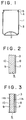
- the draw-formed can 1 is formed by deep-draw-forming (draw-redraw-forming) the aforementioned coated metal plate, and has a bottom portion 2 and a side wall portion 3. As desired, a flange portion 5 is formed at the upper end of the side wall portion 3 via a neck portion 4. In this can 1, the side wall portion 3 has a thickness which is reduced by bend-elongation compared with the bottom portion 2.
- Fig. 2 illustrates in cross section the structure of the side wall portion 3 which comprises a metal base member 6 and a laminated film 9 of a low molecular oriented copolymerized polyester layer 7 located on the side of the metal and a high molecular oriented copolymerized polyester layer 8 located on the side of the front surface.
- the metal base member 6 has an outer film 10 which may be the same as the inner composite film 9 or may be an ordinary paint or a resin film for cans.
- Fig. 3 illustrates, in cross section, another structure of the side wall portion which is the same as that of the case of Fig. 2 except that a primer layer 11 for adhesion is provided between the low molecular oriented copolymerized polyester layer 7 and the metal base member 6.
- the cross-sectional structure of the bottom portion 2 is the same as the cross-sectional structure of the side wall portion 3 with the exception that the bottom portion 2 has not been subjected to the draw-forming.
- the metal plate In the present invention, a variety of surface-treated steel plates and light metal plates such as of aluminum can be used as the metal plate.
- the surface-treated steel plate will be a cold-rolled steel plate which is annealed and is then subjected to the secondary cold rolling followed by one or two or more kinds of surface treatments such as zinc plating, tin plating, nickel plating, electrolytic chromate treatment and chromate treatment.
- a preferred surface-treated steel plate will be an electrolytic chromate-treated steel plate having a metal chromium layer of 10 to 200 mg/m2 and a chromium oxide layer of 1 to 50 mg/m2 (reckoned as metal chromium) which is excellent in film adhesion property and corrosion resistance in combination.
- Another example of the surface-treated steel plate is a hard tin plate which is plated with tin at a rate of from 0.5 to 11.2 g/m2. It is desired that the tin plate has been treated with chromic acid or with chromic acid and phosphoric acid to such an extent that the amount of chromium is from 1 to 30 mg/m2 reckoned as metal chromium
- an aluminum-coated steel plate that is plated with aluminum or to which aluminum is adhered with pressure.
- the light metal plate examples include a so-called aluminum plate and an aluminum alloy plate.
- the aluminum alloy plate which is excellent in corrosion resistance and workability has a composition of 0.2 to 1.5% by weight of manganese, 0.8 to 5% by weight of magnesium, 0.25 to 0.3% by weight of zinc, 0.15 to 0.25% by weight of copper, and the remainder being aluminum. It is desired that the light metal plate has been treated with chromic acid or with chromic acid and phosphoric acid to such an extent that the amount of chromium is from 20 to 300 mg/m2 reckoned as metal chromium.
- the thickness of the metal blank i.e., the thickness (t B ) of the bottom of the can may vary depending upon the kind of the metal, use or size of the container, but should generally be from 0.10 to 0.50 mm. In the case of the surface-treated steel plate, the thickness should be from 0.10 to 0.30 mm and in the case of the light metal plate, the thickness should be from 0.15 to 0.40 mm.
- the surface layer (I) of the composite film used in the present invention comprises a high molecular oriented copolymerized polyester (A) derived from acid components of 85 to 97% of terephthalic acid and 3 to 15% of isophthalic acid, and a diol component.
- the acid components in the copolymerized polyester (A) are 87 to 95% of terephthalic acid and 3 to 15% of isophthalic acid from the stand point of retaining flavor.
- acid components there may be contained other dibasic acid compounds in small amounts, for example, in amounts of not larger than one mol%. It is, however, desired that aliphatic dibasic acid is not contained from the standpoint of preventing the adsorption of flavor components and suppressing the elution of polyester components.
- the diol component in the copolymerized polyester should chiefly be an ethylene glycol. It is desired that not smaller than 95 mol% and, particularly, not smaller than 98 mol% of the diol component is an ethylene glycol from the standpoint of molecular orientation and barrier property against corrosive components and flavor components.
- examples of the dibasic acid other than terephthalic acid and isophthalic acid include P- ⁇ -oxyethoxybenzoic acid, naphthalene 2,6-dicarboxylic acid, diphenoxyethane-4,4'-dicarboxylic acid, 5-sodium sulfoisophthalic acid, hexahydroterephthalic acid, adipic acid, sebacic acid and the like acid.
- diol component other than ethylene glycol examples include such glycol components as propylene glycol, 1,4-butanediol, neopentyl glycol, 1,6-hexylene glycol, diethylene glycol, triethylene glycol, cyclohexane dimethanol, ethylene oxide adduct of bisphenol A, and the like. These components should be contained in small amounts but are not the essential components.
- the high molecular oriented copolymerized polyester (A) of the surface layer should have a molecular weight over a range of forming a film, and the solvent should have an inherent viscosity [ ⁇ ] over a range of from 0.5 to 1.5 as measured by using a phenol/tetrachloroethane mixture solvent.
- the lower layer (II) of the composite film comprises the low molecular oriented copolymerized polyester (B) derived from acid components of 84.5 to 96.5% of terephthalic acid and 3.5 to 15.5% of isophthalic acid, and a diol component, the amount of the isophthalic acid being larger than that in the copolymerized polyester (A) of the surface layer.
- the copolymerized polyester (B) containing 85 to 94% of terephthalic acid and 6 to 15% of isophthalic acid, the amount of the isophthalic acid being larger by at least 0.5% and, particularly, by at least 1.0% than that of the copolymerized polyester (A) of the surface layer, is desirable from the standpoint of decreasing the adsorption of flavor components, preventing the elution of polyester components, enhancing the shock resistance, and improving the adhesion property to the metal base member.
- the copolymerized polyester (B) may contain, as acid components, other dibasic acid compounds in small amounts, for example, in amounts of not larger than 1 mol%. It is, however, desired that the aliphatic dibasic acid is not contained from the standpoint of preventing the adsorption of flavor component and suppressing the elution of polyester components. Similarly, furthermore, it is desired that the diol component is chiefly composed of an ethylene glycol. It is desired that not smaller than 95 mol% and, particularly, not smaller than 98 mol% of the diol component is composed of an ethylene glycol from the standpoint of molecular orientation and barrier property against corrosive components and flavor components.
- the copolymerized polyester (B) of the lower layer should have a glass transition point of not lower than 65 °C and, particularly, not lower than 70 °C from the standpoint of preventing the copolymerized polyester from eluting into the content.
- the lower layer polyester (B) which serves as an adhesive should have an exceptionally high molecular weight and should further have an inherent viscosity [ ⁇ ] over a range of from 0.5 to 1.5 as measured by the method described above.
- the copolymerized polyesters (A) and (B) of the surface layer and of the lower layer used in the present invention may be copolymerized polyesters in a strict sense or may be copolymerized polyesters in a not so strict sense. For instance, they may be a blend of the copolymerized polyesters or a blend of a copolymerized polyester and a homopolyester. When a composition of a copolyester is melted, ester units are exchanged enabling the composition to be homogenized, which accounts for why such a blend can be used.
- the laminated film used in the present invention should have a thickness of 2 to 100 ⁇ m and, particularly, 5 to 50 ⁇ m from the standpoint of protecting the metal and workability.
- the ratio of the thickness of the surface layer (I) to the thickness of the lower layer (II) should be over a range of from 9:95 to 95:5 and, particularly, from 5:95 to 90:10 from the standpoint of balance among shock resistance, workability and flavor retentivity.
- the composite film can be produced by simultaneously extruding the above layers (I) and (II), or by coating one layer with another polyester layer that is extruded, or by the sandwich lamination according to which a polyester composition which is the same, for example, as the layer (II) is extruded between the film of the layer (I) and the film of the layer (II) followed by press-adhesion by the application of heat.
- the composite film should generally be biaxially drawn.
- the degree of biaxial orientation can be confirmed by the X-ray diffraction method, polarized fluorescent method, double refraction method or density-gradient tube method.
- the composite film may, as a matter of course, be blended with widely-known blending agents for films such as an antiblocking agent like amorphous silica, a pigment like titanium dioxide (titanium white), a variety of antistatic agent and a lubricating agent according to a known recipe.
- an antiblocking agent like amorphous silica
- a variety of antistatic agent and a lubricating agent according to a known recipe.
- both surfaces of the metal base member can be provided with the above-mentioned films.
- the outer film may be any one of a widely known paint applied to the outer surface of the cans, a widely known polyester film or any other plastic film.
- thermosetting resin paints that have heretofore been used for the cans, such as phenol aldehyde resin, furane resin, xylene formaldehyde resin, ketone formaldehyde resin, urea resin, melamine resin, aniline resin, alkyd resin, guanamine resin, unsaturated polyester resin, epoxy resin, thermosetting acrylic resin, triarylcyanulate resin, bismaleimide resin, oleoresinous paint, thermosetting acrylic paint, thermosetting vinyl paint, which may be used in one kind or in two or more kinds in combination.
- thermosetting resin paints that have heretofore been used for the cans, such as phenol aldehyde resin, furane resin, xylene formaldehyde resin, ketone formaldehyde resin, urea resin, melamine resin, aniline resin, alkyd resin, guanamine resin, unsaturated polyester resin, epoxy resin, thermosetting acrylic resin, triarylcyanulate resin, bismaleimide resin, oleores
- the adhesive primer that is provided as required between the polyester film and the metal blank exhibits excellent adhesiveness to both the metal blank and the film.
- a representative example of the primer paint excellent in both adhesion property and corrosion resistance is a phenol epoxy paint comprising a resol-type phenol-aldehyde resin derived from various phenols and a formaldehyde, and a bisphenol epoxy resin and, particularly, a paint which contains a phenol resin and an epoxy resin at a weight ratio of 50:50 to 5:95 and, particularly, 40:60 to 10:90.
- the adhesive primer layer should generally have a thickness of from 0.01 to 10 ⁇ m.
- the adhesive primer layer may be formed on the metal blank in advance or may be formed on the polyester film in advance.
- the above laminated film is so laminated that the layer (I) is on the side of the front surface and the layer (II) is on the metal side, and the laminated material is deep-draw-formed into a cup with bottom between a punch and a die, and, as required, the thickness of the side wall of the cup is reduced by bend-elongation or ironing in the step of draw-forming. Then, the film layer of the cup with bottom that is formed is subjected to at least one stage of heat treatment at a temperature lower than the melting point of the polyester composition.
- Lamination of the metal blank and the composite film is carried out by, for example, adhering them together with pressure under a condition where the film is melted only at a portion that comes into contact with the metal blank.
- the metal blank is heated in advance at a temperature higher than the softening point of the polyester (thermally fixing temperature of the film), and the laminate is quickly quenched immediately after the lamination.
- the composite polyester film and the metal blank are adhered together with pressure via an adhesive primer layer provided for either one of them, to accomplish the lamination.
- the laminated film is laminated on the metal base material in such a manner that a double refraction method orientation degree ( ⁇ n) which is not smaller than 0.02 remains in the surface layer and, preferably, that a double refraction method orientation degree ( ⁇ n) which is not smaller than 0.001 remains even in the lower layer.
- Fig. 4 illustrates a distribution of orientation degrees in the direction of thickness of the laminated film in a state of a draw-formed container.
- a high orientation degree near the surface layer helps improve the dent resistance, and a low orientation degree on the side of the metal base material helps increase the workability of the laminate.
- the orientation degree of the copolymerized polyester (B) of the lower layer which is not zero is effective in suppressing the crystallization during the heat treatment of the copolymerized polyester (B). It will be further understood that a difference in the melting point between the copolymerized polyester (A) of the surface layer and the copolymerized polyester (B) of the lower layer is desirable in maintaining the molecular orientation degree of the surface layer as high as possible.
- the thus prepared laminate is draw-formed by a means that has been known per se.
- a deep-draw-forming draw-redraw-forming
- a pre-draw-formed cup 21 made of the coated metal plate is held by an annular holding member 22 inserted in the cup and a redrawing die 23 located beneath it.
- a redrawing punch 24 is provided so as to enter into, and come out from, the holding member 22.
- the redrawing punch 24 and the redrawing die 23 are moved relative to each other so as to be in mesh with each other.
- the side wall of the pre-draw-formed cup 21 passes through a curvature corner portion 26 from the outer peripheral surface 25 of the annular holding member 22, vertically bent inwardly of the diameter, passes through a portion defined by the annular bottom surface 27 of the annular holding member 22 and the upper surface 28 of the redrawing die 23, bent nearly vertically in the axial direction by a working corner portion 29 of the redrawing die 23, and is formed into a deep-draw-formed cup 30 having a diameter smaller than that of the pre-draw-formed cup 21. Thickness of the side wall can be further reduced by bend-elongation.
- the thickness of the side wall of the can should be reduced to 5 to 45% and, particularly, 5 to 40% of the blank thickness (t B ).
- the draw-formed container is, as required, subjected to the heat treatment to remove residual distortion from the film.
- the heat treatment can be executed by a widely known heating device such as an infrared-ray heater, a hot air circulation furnace, an induction heater, and the like.
- the heat treatment may be carried out in one stage, in two stages or in many more stages.
- the heat treatment should be carried out at a temperature of from 180 to 240 °C .
- the container After the heat treatment, the container needs not be quickly quenched.
- a film or a laminated plate can be quickly quenched with ease, but a container having a three-dimensional shape and a large heat capacity in the case when it is made of a metal can be quenched with difficulty when it is carried out on an industrial scale.
- the crystal growth is suppressed by the aforementioned action and excellent properties are obtained in combination. It is of course allowable to employ any quickly quenching means such as blowing the cold air, sprinkling the cold water or the like.
- Characteristic values of the present invention are measured in compliance with the methods described below.
- a steel rod 10 mm in diameter is placed at the bottom radius portion of a can filled with a cola and maintained at 5 °C , and a weight of 500 g is permitted to fall from a height of 60 mm to give impact thereto.
- the condition of the can is checked after it is preserved for a year at room temperature.
- the two-layer film was comprised of a polyester layer I of 4 ⁇ m in thickness and a polyester layer II of 16 ⁇ m in thickness, and possessed a total thickness of 20 ⁇ m.
- the two-layer film was heat-laminated on both surfaces of a tin-free steel plate (TFS) having a blank thickness of 0.175 mm and a tempering degree of DR-9 at a temperature near the melting point of the inner layer (II), and was quickly quenched with the water to obtain a metal plate coated with the laminate.
- Vaseline was applied onto the coated metal plate which was then punched into a disc of a diameter of 179 mm to obtain a shallow cup that was draw-formed in a customary manner at 80 °C .
- the drawing ratio in this step was 1.56.
- the cup was pre-heated at 80 °C , and was subjected to primary and secondary thickness-reducing redraw-formings.
- the thus obtained deep-draw-formed cup exhibited the following properties: Diameter of cup 66 mm Height of cup 128 mm Change in the thickness of the side wall -20% (with respect to the blank thickness)
- the deep-draw-formed cup was domed in a customary manner at 80 °C , and was heat-treated at 215 °C . After left to cool, the cup was trimmed at its open edge portion, printed on the curved surface and was flanged to obtain a 350-g two-piece can.
- the can was filled with a cola, tested in regard to flavor retentivity, and was further examined in regard to inner surface condition of the can and leakage after it was preserved. Table 1 shows the results of evaluation which were favorable.
- the two-layer film was comprised of a polyester layer I of 20 ⁇ m in thickness and a polyester layer II of 5 ⁇ m in thickness, and possessed a total thickness of 25 ⁇ m.
- a 350-g two-piece can was obtained in the same manner as in Example 1.
- Table 1 shows the results of evaluation which were favorable.
- the two-layer film was comprised of a polyester layer I of 2 ⁇ m in thickness and a polyester layer II of 12 ⁇ m in thickness, and possessed a total thickness of 14 ⁇ m.
- a deep-draw-formed cup was prepared in the same manner as in Example 1 and a 350-g two-piece can was obtained in the same manner as in Example 1 but effecting the heat treatment at 225 °C .
- Table 1 shows the results of evaluation which were favorable.
- the two-layer film was comprised of a polyester layer I of 5 ⁇ m in thickness and a polyester layer II of 20 ⁇ m in thickness, and possessed a total thickness of 25 ⁇ m.
- a 350-g two-piece can was obtained in the same manner as in Example 1.
- Table 1 shows the results of evaluation. After the cola was preserved, corrosion developed remarkably on the BHR portion and on the bottom radius portion (dent portion). Leakage developed in 78 cans out of 100 cans, from which it was judged that the cans were not suited for practical use.
- the two-layer film was comprised of a polyester layer I of 15 ⁇ m in thickness and a polyester layer II of 10 ⁇ m in thickness, and possessed a total thickness of 25 ⁇ m.
- a 350-g two-piece can was obtained in the same manner as in Example 1.
- Table 1 shows the results of evaluation. After the cola was preserved, corrosion developed on the BHR portion and on the bottom radius portion (dent portion) though no leakage was found. From the overall point of view, it was judged that the cans were not suited for practical use.
Landscapes
- Engineering & Computer Science (AREA)
- Mechanical Engineering (AREA)
- Physics & Mathematics (AREA)
- Thermal Sciences (AREA)
- Ceramic Engineering (AREA)
- Laminated Bodies (AREA)
- Rigid Containers With Two Or More Constituent Elements (AREA)
- Details Of Rigid Or Semi-Rigid Containers (AREA)
- Shaping Metal By Deep-Drawing, Or The Like (AREA)
Applications Claiming Priority (2)
| Application Number | Priority Date | Filing Date | Title |
|---|---|---|---|
| JP5257222A JP2677172B2 (ja) | 1993-10-14 | 1993-10-14 | 保香性及び耐衝撃性に優れたラミネート絞り容器 |
| JP257222/93 | 1993-10-14 |
Publications (3)
| Publication Number | Publication Date |
|---|---|
| EP0648600A2 true EP0648600A2 (fr) | 1995-04-19 |
| EP0648600A3 EP0648600A3 (fr) | 1995-11-29 |
| EP0648600B1 EP0648600B1 (fr) | 1998-02-25 |
Family
ID=17303368
Family Applications (1)
| Application Number | Title | Priority Date | Filing Date |
|---|---|---|---|
| EP94307428A Expired - Lifetime EP0648600B1 (fr) | 1993-10-14 | 1994-10-11 | Récipient laminé formé par emboutissage, résistant aux chocs et ayant un excellente rétention d'arÔme |
Country Status (4)
| Country | Link |
|---|---|
| US (1) | US5653357A (fr) |
| EP (1) | EP0648600B1 (fr) |
| JP (1) | JP2677172B2 (fr) |
| DE (1) | DE69408619T2 (fr) |
Cited By (2)
| Publication number | Priority date | Publication date | Assignee | Title |
|---|---|---|---|---|
| EP1149772A3 (fr) * | 2000-03-02 | 2004-04-14 | Toyo Seikan Kaisha Limited | Boíte sans joint revetue de resine |
| FR2866592A1 (fr) * | 2004-02-19 | 2005-08-26 | Usinor | Procede de fabrication d'une piece composite |
Families Citing this family (17)
| Publication number | Priority date | Publication date | Assignee | Title |
|---|---|---|---|---|
| JPH10117765A (ja) * | 1996-10-18 | 1998-05-12 | Ngk Insulators Ltd | 試料容器及びその製造方法 |
| SE0002430L (sv) * | 2000-06-28 | 2001-11-26 | Tetra Laval Holdings & Finance | Sätt att reducera påkänningar vid vikning av material |
| JP4775532B2 (ja) * | 2001-08-23 | 2011-09-21 | 東洋製罐株式会社 | 樹脂被覆シームレス缶 |
| EP1449883A1 (fr) * | 2003-02-18 | 2004-08-25 | Corus Technology BV | Couche d'emballage polymère ayant des propriétés antiadhésives améliorées |
| US20070092742A1 (en) * | 2003-03-28 | 2007-04-26 | Corus Staal Bv | Sheet material for forming applications, metal container made form such a sheet material and process for producing said sheet material |
| CA2565277C (fr) * | 2004-05-31 | 2010-04-13 | Jfe Steel Corporation | Plaque de metal revetue de resine |
| KR101207759B1 (ko) * | 2005-10-19 | 2012-12-03 | 도요 세이칸 가부시키가이샤 | 이지 오픈 뚜껑 |
| WO2015037074A1 (fr) * | 2013-09-11 | 2015-03-19 | 大和製罐株式会社 | Procédé de fabrication de boîte de conserve alimentaire en deux pièces |
| USD742251S1 (en) | 2014-07-16 | 2015-11-03 | Ball Corporation | Two-piece contoured metallic container |
| USD758207S1 (en) | 2014-08-08 | 2016-06-07 | Ball Corporation | Two-piece contoured metallic container |
| MX2017004818A (es) | 2014-10-15 | 2017-08-02 | Ball Corp | Aparato y metodo para formar hombro y cuello de recipiente metalico. |
| EP3212347A4 (fr) | 2014-10-28 | 2018-07-18 | Ball Corporation | Appareil et procédé pour former une coupelle avec un fond reformé |
| USD804309S1 (en) | 2016-02-17 | 2017-12-05 | Ball Corporation | Metal bottle |
| USD827685S1 (en) * | 2016-12-19 | 2018-09-04 | Stolle Machinery Company, Llc | Truncated dome cup |
| USD839935S1 (en) * | 2016-12-19 | 2019-02-05 | Stolle Machinery Company, Llc | Truncated dome cup |
| USD1047693S1 (en) | 2020-06-09 | 2024-10-22 | Ball Corporation | Metal bottle |
| USD1043246S1 (en) | 2022-08-05 | 2024-09-24 | Ball Corporation | Bottle |
Family Cites Families (15)
| Publication number | Priority date | Publication date | Assignee | Title |
|---|---|---|---|---|
| US2735354A (en) * | 1956-02-21 | Method of treating containers for food | ||
| US2764313A (en) * | 1952-05-15 | 1956-09-25 | Du Pont | Coated metal surfaces and process of making same |
| US2741397A (en) * | 1952-06-30 | 1956-04-10 | Phillips Petroleum Co | Metal food and beverage container coating composition |
| US2877922A (en) * | 1955-06-10 | 1959-03-17 | Du Pont | Coating composition comprising at least two vinyl polymers and lecithin |
| US2856094A (en) * | 1955-08-16 | 1958-10-14 | Pittsburgh Plate Glass Co | Blends of alkenylphenol-aldehyde resins with polyepoxide resins and metallic surfaces coated therewith |
| US3219729A (en) * | 1961-09-27 | 1965-11-23 | Glidden Co | Mixed neutral vinyl resin/reactive vinyl resin coating compositions, and cans and/or container components coated therewith |
| JPS5610451A (en) * | 1979-07-05 | 1981-02-02 | Toray Industries | Resin coated metallic plate for vessel |
| US4450977A (en) * | 1981-04-02 | 1984-05-29 | The Dow Chemical Company | Manufacture of draw-redraw cans using film laminated or extrusion coated steel sheet material |
| US4452375A (en) * | 1981-04-02 | 1984-06-05 | The Dow Chemical Company | Manufacture of draw-redraw cans using steel sheet material film laminated or extrusion coated with a high density polyethylene graft copolymer |
| JPS5989149A (ja) * | 1982-11-15 | 1984-05-23 | 三井化学株式会社 | 多層容器 |
| US4812365A (en) * | 1986-04-25 | 1989-03-14 | Weirton Steel Corporation | Composite-coated flat-rolled steel can stock and can product |
| CA2007748C (fr) * | 1989-08-31 | 1996-01-02 | Eiji Tamura | Contenant d'emballage (nourriture) |
| US5238715A (en) * | 1989-12-26 | 1993-08-24 | Aluminum Company Of America | Food or beverage container or container panel |
| JP3041153B2 (ja) * | 1993-02-08 | 2000-05-15 | 東洋鋼鈑株式会社 | 薄肉化深絞り缶用樹脂被覆金属板 |
| JPH06307409A (ja) * | 1993-04-27 | 1994-11-01 | Amada Co Ltd | バルブのオーバーラップ部補正方法 |
-
1993
- 1993-10-14 JP JP5257222A patent/JP2677172B2/ja not_active Expired - Fee Related
-
1994
- 1994-10-11 DE DE69408619T patent/DE69408619T2/de not_active Expired - Lifetime
- 1994-10-11 EP EP94307428A patent/EP0648600B1/fr not_active Expired - Lifetime
- 1994-10-13 US US08/322,560 patent/US5653357A/en not_active Expired - Lifetime
Cited By (6)
| Publication number | Priority date | Publication date | Assignee | Title |
|---|---|---|---|---|
| EP1149772A3 (fr) * | 2000-03-02 | 2004-04-14 | Toyo Seikan Kaisha Limited | Boíte sans joint revetue de resine |
| FR2866592A1 (fr) * | 2004-02-19 | 2005-08-26 | Usinor | Procede de fabrication d'une piece composite |
| WO2005089974A1 (fr) * | 2004-02-19 | 2005-09-29 | Usinor | Procede de fabrication d’une piece composite |
| RU2378078C2 (ru) * | 2004-02-19 | 2010-01-10 | АРСЕЛОР Франс | Способ изготовления композитной детали |
| KR101024507B1 (ko) * | 2004-02-19 | 2011-03-31 | 아르셀러미탈 프랑스 | 복합 부품의 제조 방법 |
| US8309004B2 (en) | 2004-02-19 | 2012-11-13 | Usinor | Method for producing a composite part |
Also Published As
| Publication number | Publication date |
|---|---|
| US5653357A (en) | 1997-08-05 |
| EP0648600A3 (fr) | 1995-11-29 |
| DE69408619T2 (de) | 1998-10-15 |
| EP0648600B1 (fr) | 1998-02-25 |
| JPH07108650A (ja) | 1995-04-25 |
| JP2677172B2 (ja) | 1997-11-17 |
| DE69408619D1 (de) | 1998-04-02 |
Similar Documents
| Publication | Publication Date | Title |
|---|---|---|
| EP0648600B1 (fr) | Récipient laminé formé par emboutissage, résistant aux chocs et ayant un excellente rétention d'arÔme | |
| US5300335A (en) | Laminated draw-formed container having excellent shock resistance and process for producing the same | |
| EP0666124B1 (fr) | Boîte sans joint et son procédé de fabrication | |
| US5753328A (en) | Polyester-metal laminated sheet and seamless cans using the same | |
| US6565937B2 (en) | Resin-coated seamless can | |
| EP0312303A1 (fr) | Feuille métallique revêtue | |
| JPH03101930A (ja) | 絞り缶用被覆金属板及び絞り缶 | |
| JPH03133523A (ja) | 薄肉化絞り缶の製造方法 | |
| EP0694580A2 (fr) | Matériau d'emballage ayant une excellente rétention d'arÔme | |
| EP1270201B1 (fr) | Boîte sans joint revetue de resine | |
| EP0731031A1 (fr) | Boîte sans joint | |
| EP3278980B1 (fr) | Plaque métallique stratifiée pour récipient | |
| EP1378344A1 (fr) | Feuille metallique recouverte d'une resine thermoplastique et boite metallique fabriquee a partir d'une telle feuille | |
| US20050100749A1 (en) | Metal sheet coated with thermoplastic resin and can obtained therefrom | |
| JP2565284B2 (ja) | 耐衝撃性及び香味保持性に優れたラミネートシームレス容器及びその製造に用いる素材 | |
| JP3262031B2 (ja) | 積層体及びそれを用いた容器 | |
| JP2874582B2 (ja) | 積層体及びそれを用いた容器 | |
| JP4168466B2 (ja) | 製缶用積層体及びシームレス缶 | |
| JP3915187B2 (ja) | 積層体及びそれを用いた容器 | |
| JP3168933B2 (ja) | 製缶用積層体及びシームレス缶 | |
| JP4447719B2 (ja) | 金属缶溶接部補修フィルム | |
| JPH10235794A (ja) | 製缶用積層体及びシームレス缶 |
Legal Events
| Date | Code | Title | Description |
|---|---|---|---|
| PUAI | Public reference made under article 153(3) epc to a published international application that has entered the european phase |
Free format text: ORIGINAL CODE: 0009012 |
|
| AK | Designated contracting states |
Kind code of ref document: A2 Designated state(s): DE FR GB |
|
| PUAL | Search report despatched |
Free format text: ORIGINAL CODE: 0009013 |
|
| AK | Designated contracting states |
Kind code of ref document: A3 Designated state(s): DE FR GB |
|
| 17P | Request for examination filed |
Effective date: 19960520 |
|
| 17Q | First examination report despatched |
Effective date: 19960918 |
|
| GRAG | Despatch of communication of intention to grant |
Free format text: ORIGINAL CODE: EPIDOS AGRA |
|
| GRAG | Despatch of communication of intention to grant |
Free format text: ORIGINAL CODE: EPIDOS AGRA |
|
| GRAH | Despatch of communication of intention to grant a patent |
Free format text: ORIGINAL CODE: EPIDOS IGRA |
|
| GRAH | Despatch of communication of intention to grant a patent |
Free format text: ORIGINAL CODE: EPIDOS IGRA |
|
| GRAA | (expected) grant |
Free format text: ORIGINAL CODE: 0009210 |
|
| AK | Designated contracting states |
Kind code of ref document: B1 Designated state(s): DE FR GB |
|
| REF | Corresponds to: |
Ref document number: 69408619 Country of ref document: DE Date of ref document: 19980402 |
|
| ET | Fr: translation filed | ||
| PLBE | No opposition filed within time limit |
Free format text: ORIGINAL CODE: 0009261 |
|
| STAA | Information on the status of an ep patent application or granted ep patent |
Free format text: STATUS: NO OPPOSITION FILED WITHIN TIME LIMIT |
|
| 26N | No opposition filed | ||
| REG | Reference to a national code |
Ref country code: GB Ref legal event code: IF02 |
|
| PGFP | Annual fee paid to national office [announced via postgrant information from national office to epo] |
Ref country code: FR Payment date: 20131022 Year of fee payment: 20 Ref country code: GB Payment date: 20131021 Year of fee payment: 20 Ref country code: DE Payment date: 20131021 Year of fee payment: 20 |
|
| REG | Reference to a national code |
Ref country code: DE Ref legal event code: R071 Ref document number: 69408619 Country of ref document: DE |
|
| REG | Reference to a national code |
Ref country code: DE Ref legal event code: R071 Ref document number: 69408619 Country of ref document: DE |
|
| REG | Reference to a national code |
Ref country code: GB Ref legal event code: PE20 Expiry date: 20141010 |
|
| PG25 | Lapsed in a contracting state [announced via postgrant information from national office to epo] |
Ref country code: GB Free format text: LAPSE BECAUSE OF EXPIRATION OF PROTECTION Effective date: 20141010 |